EP0132630A2 - Phosphonsäuregruppen enthaltende Polymerisate, ihre Herstellung und ihre Verwendung - Google Patents
Phosphonsäuregruppen enthaltende Polymerisate, ihre Herstellung und ihre Verwendung Download PDFInfo
- Publication number
- EP0132630A2 EP0132630A2 EP84107636A EP84107636A EP0132630A2 EP 0132630 A2 EP0132630 A2 EP 0132630A2 EP 84107636 A EP84107636 A EP 84107636A EP 84107636 A EP84107636 A EP 84107636A EP 0132630 A2 EP0132630 A2 EP 0132630A2
- Authority
- EP
- European Patent Office
- Prior art keywords
- formula
- carbon atoms
- alkyl
- hydrogen
- copolymers
- Prior art date
- Legal status (The legal status is an assumption and is not a legal conclusion. Google has not performed a legal analysis and makes no representation as to the accuracy of the status listed.)
- Withdrawn
Links
- 229920000642 polymer Polymers 0.000 title claims abstract description 54
- 238000002360 preparation method Methods 0.000 title claims abstract description 21
- ABLZXFCXXLZCGV-UHFFFAOYSA-N phosphonic acid group Chemical group P(O)(O)=O ABLZXFCXXLZCGV-UHFFFAOYSA-N 0.000 title claims description 18
- 229920001577 copolymer Polymers 0.000 claims abstract description 117
- 229910052739 hydrogen Inorganic materials 0.000 claims abstract description 49
- 239000001257 hydrogen Substances 0.000 claims abstract description 49
- 150000001875 compounds Chemical class 0.000 claims abstract description 43
- 239000000178 monomer Substances 0.000 claims abstract description 42
- UFHFLCQGNIYNRP-UHFFFAOYSA-N Hydrogen Chemical compound [H][H] UFHFLCQGNIYNRP-UHFFFAOYSA-N 0.000 claims abstract description 39
- 150000001768 cations Chemical class 0.000 claims abstract description 38
- 229910052751 metal Inorganic materials 0.000 claims abstract description 25
- 239000002184 metal Substances 0.000 claims abstract description 25
- 229920001519 homopolymer Polymers 0.000 claims abstract description 16
- 238000004519 manufacturing process Methods 0.000 claims abstract description 13
- 125000002496 methyl group Chemical group [H]C([H])([H])* 0.000 claims abstract description 12
- 239000012530 fluid Substances 0.000 claims abstract description 11
- 238000007334 copolymerization reaction Methods 0.000 claims abstract description 9
- 239000002562 thickening agent Substances 0.000 claims abstract description 7
- 125000004432 carbon atom Chemical group C* 0.000 claims description 88
- 125000000217 alkyl group Chemical group 0.000 claims description 45
- 239000000203 mixture Substances 0.000 claims description 43
- 238000006116 polymerization reaction Methods 0.000 claims description 40
- -1 polymethylene chain Polymers 0.000 claims description 38
- 150000003839 salts Chemical class 0.000 claims description 32
- 238000000034 method Methods 0.000 claims description 23
- 125000003178 carboxy group Chemical group [H]OC(*)=O 0.000 claims description 19
- 238000004132 cross linking Methods 0.000 claims description 18
- 230000002378 acidificating effect Effects 0.000 claims description 17
- 230000000712 assembly Effects 0.000 claims description 13
- 238000000429 assembly Methods 0.000 claims description 13
- 230000008569 process Effects 0.000 claims description 13
- NIXOWILDQLNWCW-UHFFFAOYSA-N 2-Propenoic acid Natural products OC(=O)C=C NIXOWILDQLNWCW-UHFFFAOYSA-N 0.000 claims description 12
- CERQOIWHTDAKMF-UHFFFAOYSA-N Methacrylic acid Chemical class CC(=C)C(O)=O CERQOIWHTDAKMF-UHFFFAOYSA-N 0.000 claims description 12
- 125000001424 substituent group Chemical group 0.000 claims description 11
- SMZOUWXMTYCWNB-UHFFFAOYSA-N 2-(2-methoxy-5-methylphenyl)ethanamine Chemical compound COC1=CC=C(C)C=C1CCN SMZOUWXMTYCWNB-UHFFFAOYSA-N 0.000 claims description 10
- 238000004043 dyeing Methods 0.000 claims description 10
- 150000002431 hydrogen Chemical class 0.000 claims description 9
- 125000000542 sulfonic acid group Chemical group 0.000 claims description 9
- 239000004971 Cross linker Substances 0.000 claims description 8
- 125000005521 carbonamide group Chemical group 0.000 claims description 8
- 239000000126 substance Substances 0.000 claims description 8
- XEEYBQQBJWHFJM-UHFFFAOYSA-N Iron Chemical compound [Fe] XEEYBQQBJWHFJM-UHFFFAOYSA-N 0.000 claims description 7
- 125000001997 phenyl group Chemical group [H]C1=C([H])C([H])=C(*)C([H])=C1[H] 0.000 claims description 7
- 125000001918 phosphonic acid ester group Chemical group 0.000 claims description 7
- LSNNMFCWUKXFEE-UHFFFAOYSA-M Bisulfite Chemical compound OS([O-])=O LSNNMFCWUKXFEE-UHFFFAOYSA-M 0.000 claims description 6
- 125000003545 alkoxy group Chemical group 0.000 claims description 6
- 125000004453 alkoxycarbonyl group Chemical group 0.000 claims description 6
- NEHMKBQYUWJMIP-UHFFFAOYSA-N chloromethane Chemical compound ClC NEHMKBQYUWJMIP-UHFFFAOYSA-N 0.000 claims description 6
- VAYGXNSJCAHWJZ-UHFFFAOYSA-N dimethyl sulfate Chemical compound COS(=O)(=O)OC VAYGXNSJCAHWJZ-UHFFFAOYSA-N 0.000 claims description 6
- 125000001495 ethyl group Chemical group [H]C([H])([H])C([H])([H])* 0.000 claims description 6
- 239000004753 textile Substances 0.000 claims description 6
- 125000004423 acyloxy group Chemical group 0.000 claims description 5
- UYMKPFRHYYNDTL-UHFFFAOYSA-N ethenamine Chemical class NC=C UYMKPFRHYYNDTL-UHFFFAOYSA-N 0.000 claims description 5
- 125000004435 hydrogen atom Chemical group [H]* 0.000 claims description 5
- 239000007788 liquid Substances 0.000 claims description 5
- 239000002455 scale inhibitor Substances 0.000 claims description 5
- ZAMOUSCENKQFHK-UHFFFAOYSA-N Chlorine atom Chemical compound [Cl] ZAMOUSCENKQFHK-UHFFFAOYSA-N 0.000 claims description 4
- 125000001797 benzyl group Chemical group [H]C1=C([H])C([H])=C(C([H])=C1[H])C([H])([H])* 0.000 claims description 4
- 239000000460 chlorine Substances 0.000 claims description 4
- 229910052801 chlorine Inorganic materials 0.000 claims description 4
- 150000001993 dienes Chemical class 0.000 claims description 4
- 125000004817 pentamethylene group Chemical group [H]C([H])([*:2])C([H])([H])C([H])([H])C([H])([H])C([H])([H])[*:1] 0.000 claims description 4
- 125000004448 alkyl carbonyl group Chemical group 0.000 claims description 3
- NEHMKBQYUWJMIP-NJFSPNSNSA-N chloro(114C)methane Chemical compound [14CH3]Cl NEHMKBQYUWJMIP-NJFSPNSNSA-N 0.000 claims description 3
- 229910052736 halogen Inorganic materials 0.000 claims description 3
- 150000002367 halogens Chemical class 0.000 claims description 3
- 125000004029 hydroxymethyl group Chemical group [H]OC([H])([H])* 0.000 claims description 3
- 229940050176 methyl chloride Drugs 0.000 claims description 3
- 125000004076 pyridyl group Chemical group 0.000 claims description 3
- 125000003258 trimethylene group Chemical group [H]C([H])([*:2])C([H])([H])C([H])([H])[*:1] 0.000 claims description 3
- 230000002745 absorbent Effects 0.000 claims 2
- 239000002250 absorbent Substances 0.000 claims 2
- YGGXZTQSGNFKPJ-UHFFFAOYSA-N methyl 2-naphthalen-1-ylacetate Chemical compound C1=CC=C2C(CC(=O)OC)=CC=CC2=C1 YGGXZTQSGNFKPJ-UHFFFAOYSA-N 0.000 claims 2
- 239000002253 acid Substances 0.000 abstract description 13
- KWKOTMDQAMKXQF-UHFFFAOYSA-N [2-methyl-2-(prop-2-enoylamino)propyl]phosphonic acid Chemical compound OP(=O)(O)CC(C)(C)NC(=O)C=C KWKOTMDQAMKXQF-UHFFFAOYSA-N 0.000 abstract description 7
- 239000003208 petroleum Substances 0.000 abstract description 4
- 239000000243 solution Substances 0.000 description 52
- XLYOFNOQVPJJNP-UHFFFAOYSA-N water Substances O XLYOFNOQVPJJNP-UHFFFAOYSA-N 0.000 description 43
- IJGRMHOSHXDMSA-UHFFFAOYSA-N Atomic nitrogen Chemical compound N#N IJGRMHOSHXDMSA-UHFFFAOYSA-N 0.000 description 38
- 238000006243 chemical reaction Methods 0.000 description 27
- YXFVVABEGXRONW-UHFFFAOYSA-N Toluene Chemical compound CC1=CC=CC=C1 YXFVVABEGXRONW-UHFFFAOYSA-N 0.000 description 20
- HRPVXLWXLXDGHG-UHFFFAOYSA-N Acrylamide Chemical group NC(=O)C=C HRPVXLWXLXDGHG-UHFFFAOYSA-N 0.000 description 19
- 229910052757 nitrogen Inorganic materials 0.000 description 19
- DELJNDWGTWHHFA-UHFFFAOYSA-N 1-azaniumylpropyl(hydroxy)phosphinate Chemical compound CCC(N)P(O)(O)=O DELJNDWGTWHHFA-UHFFFAOYSA-N 0.000 description 16
- QGZKDVFQNNGYKY-UHFFFAOYSA-N Ammonia Chemical compound N QGZKDVFQNNGYKY-UHFFFAOYSA-N 0.000 description 16
- 101710145642 Probable Xaa-Pro aminopeptidase P Proteins 0.000 description 16
- 150000003254 radicals Chemical class 0.000 description 14
- 239000000499 gel Substances 0.000 description 13
- 238000003756 stirring Methods 0.000 description 13
- OKKJLVBELUTLKV-UHFFFAOYSA-N Methanol Chemical group OC OKKJLVBELUTLKV-UHFFFAOYSA-N 0.000 description 12
- 239000000047 product Substances 0.000 description 11
- 239000007864 aqueous solution Substances 0.000 description 10
- VEXZGXHMUGYJMC-UHFFFAOYSA-N Hydrochloric acid Chemical compound Cl VEXZGXHMUGYJMC-UHFFFAOYSA-N 0.000 description 9
- HEMHJVSKTPXQMS-UHFFFAOYSA-M Sodium hydroxide Chemical compound [OH-].[Na+] HEMHJVSKTPXQMS-UHFFFAOYSA-M 0.000 description 9
- PPBRXRYQALVLMV-UHFFFAOYSA-N Styrene Chemical compound C=CC1=CC=CC=C1 PPBRXRYQALVLMV-UHFFFAOYSA-N 0.000 description 8
- 229910021529 ammonia Inorganic materials 0.000 description 8
- ROOXNKNUYICQNP-UHFFFAOYSA-N ammonium peroxydisulfate Substances [NH4+].[NH4+].[O-]S(=O)(=O)OOS([O-])(=O)=O ROOXNKNUYICQNP-UHFFFAOYSA-N 0.000 description 8
- VAZSKTXWXKYQJF-UHFFFAOYSA-N ammonium persulfate Chemical compound [NH4+].[NH4+].[O-]S(=O)OOS([O-])=O VAZSKTXWXKYQJF-UHFFFAOYSA-N 0.000 description 8
- 229910001870 ammonium persulfate Inorganic materials 0.000 description 8
- 239000002585 base Substances 0.000 description 8
- 238000009835 boiling Methods 0.000 description 8
- 239000007789 gas Substances 0.000 description 8
- FQPSGWSUVKBHSU-UHFFFAOYSA-N methacrylamide Chemical compound CC(=C)C(N)=O FQPSGWSUVKBHSU-UHFFFAOYSA-N 0.000 description 8
- 239000012875 nonionic emulsifier Substances 0.000 description 8
- 239000003960 organic solvent Substances 0.000 description 8
- XHZPRMZZQOIPDS-UHFFFAOYSA-N 2-Methyl-2-[(1-oxo-2-propenyl)amino]-1-propanesulfonic acid Chemical compound OS(=O)(=O)CC(C)(C)NC(=O)C=C XHZPRMZZQOIPDS-UHFFFAOYSA-N 0.000 description 7
- NLHHRLWOUZZQLW-UHFFFAOYSA-N Acrylonitrile Chemical compound C=CC#N NLHHRLWOUZZQLW-UHFFFAOYSA-N 0.000 description 7
- 238000009826 distribution Methods 0.000 description 7
- 239000000839 emulsion Substances 0.000 description 7
- 239000002904 solvent Substances 0.000 description 7
- NLVXSWCKKBEXTG-UHFFFAOYSA-N vinylsulfonic acid Chemical compound OS(=O)(=O)C=C NLVXSWCKKBEXTG-UHFFFAOYSA-N 0.000 description 7
- KFZMGEQAYNKOFK-UHFFFAOYSA-N Isopropanol Chemical compound CC(C)O KFZMGEQAYNKOFK-UHFFFAOYSA-N 0.000 description 6
- LRHPLDYGYMQRHN-UHFFFAOYSA-N N-Butanol Chemical compound CCCCO LRHPLDYGYMQRHN-UHFFFAOYSA-N 0.000 description 6
- 239000003995 emulsifying agent Substances 0.000 description 6
- PNLUGRYDUHRLOF-UHFFFAOYSA-N n-ethenyl-n-methylacetamide Chemical compound C=CN(C)C(C)=O PNLUGRYDUHRLOF-UHFFFAOYSA-N 0.000 description 6
- ZTWTYVWXUKTLCP-UHFFFAOYSA-N vinylphosphonic acid Chemical compound OP(O)(=O)C=C ZTWTYVWXUKTLCP-UHFFFAOYSA-N 0.000 description 6
- WHNWPMSKXPGLAX-UHFFFAOYSA-N N-Vinyl-2-pyrrolidone Chemical compound C=CN1CCCC1=O WHNWPMSKXPGLAX-UHFFFAOYSA-N 0.000 description 5
- WEKNAHUISFNUFM-UHFFFAOYSA-N [2-methyl-2-(2-methylprop-2-enoylamino)propyl]phosphonic acid Chemical compound CC(=C)C(=O)NC(C)(C)CP(O)(O)=O WEKNAHUISFNUFM-UHFFFAOYSA-N 0.000 description 5
- 230000015572 biosynthetic process Effects 0.000 description 5
- CQEYYJKEWSMYFG-UHFFFAOYSA-N butyl acrylate Chemical compound CCCCOC(=O)C=C CQEYYJKEWSMYFG-UHFFFAOYSA-N 0.000 description 5
- 230000009920 chelation Effects 0.000 description 5
- 230000000875 corresponding effect Effects 0.000 description 5
- 239000006185 dispersion Substances 0.000 description 5
- 238000001035 drying Methods 0.000 description 5
- 229930195733 hydrocarbon Natural products 0.000 description 5
- 239000003921 oil Substances 0.000 description 5
- 230000020477 pH reduction Effects 0.000 description 5
- 238000012673 precipitation polymerization Methods 0.000 description 5
- 239000011541 reaction mixture Substances 0.000 description 5
- KAKZBPTYRLMSJV-UHFFFAOYSA-N Butadiene Chemical compound C=CC=C KAKZBPTYRLMSJV-UHFFFAOYSA-N 0.000 description 4
- VTYYLEPIZMXCLO-UHFFFAOYSA-L Calcium carbonate Chemical compound [Ca+2].[O-]C([O-])=O VTYYLEPIZMXCLO-UHFFFAOYSA-L 0.000 description 4
- LFQSCWFLJHTTHZ-UHFFFAOYSA-N Ethanol Chemical compound CCO LFQSCWFLJHTTHZ-UHFFFAOYSA-N 0.000 description 4
- RRHGJUQNOFWUDK-UHFFFAOYSA-N Isoprene Chemical compound CC(=C)C=C RRHGJUQNOFWUDK-UHFFFAOYSA-N 0.000 description 4
- GYCMBHHDWRMZGG-UHFFFAOYSA-N Methylacrylonitrile Chemical compound CC(=C)C#N GYCMBHHDWRMZGG-UHFFFAOYSA-N 0.000 description 4
- NWGKJDSIEKMTRX-AAZCQSIUSA-N Sorbitan monooleate Chemical compound CCCCCCCC\C=C/CCCCCCCC(=O)OC[C@@H](O)[C@H]1OC[C@H](O)[C@H]1O NWGKJDSIEKMTRX-AAZCQSIUSA-N 0.000 description 4
- QAOWNCQODCNURD-UHFFFAOYSA-N Sulfuric acid Chemical compound OS(O)(=O)=O QAOWNCQODCNURD-UHFFFAOYSA-N 0.000 description 4
- XTXRWKRVRITETP-UHFFFAOYSA-N Vinyl acetate Chemical compound CC(=O)OC=C XTXRWKRVRITETP-UHFFFAOYSA-N 0.000 description 4
- 239000003513 alkali Substances 0.000 description 4
- 239000011260 aqueous acid Substances 0.000 description 4
- 230000008901 benefit Effects 0.000 description 4
- BTANRVKWQNVYAZ-UHFFFAOYSA-N butan-2-ol Chemical compound CCC(C)O BTANRVKWQNVYAZ-UHFFFAOYSA-N 0.000 description 4
- OSGAYBCDTDRGGQ-UHFFFAOYSA-L calcium sulfate Chemical compound [Ca+2].[O-]S([O-])(=O)=O OSGAYBCDTDRGGQ-UHFFFAOYSA-L 0.000 description 4
- XHDNNRGTROLZCF-UHFFFAOYSA-N ethenyl(methoxy)phosphinic acid Chemical compound COP(O)(=O)C=C XHDNNRGTROLZCF-UHFFFAOYSA-N 0.000 description 4
- ZTWTYVWXUKTLCP-UHFFFAOYSA-L ethenyl-dioxido-oxo-$l^{5}-phosphane Chemical compound [O-]P([O-])(=O)C=C ZTWTYVWXUKTLCP-UHFFFAOYSA-L 0.000 description 4
- 239000004744 fabric Substances 0.000 description 4
- 150000002430 hydrocarbons Chemical class 0.000 description 4
- 230000006698 induction Effects 0.000 description 4
- ZXEKIIBDNHEJCQ-UHFFFAOYSA-N isobutanol Chemical compound CC(C)CO ZXEKIIBDNHEJCQ-UHFFFAOYSA-N 0.000 description 4
- 229940063557 methacrylate Drugs 0.000 description 4
- VNWKTOKETHGBQD-UHFFFAOYSA-N methane Chemical compound C VNWKTOKETHGBQD-UHFFFAOYSA-N 0.000 description 4
- ODYNBECIRXXOGG-UHFFFAOYSA-N n-butylbutan-1-amine;hydron;chloride Chemical compound [Cl-].CCCC[NH2+]CCCC ODYNBECIRXXOGG-UHFFFAOYSA-N 0.000 description 4
- ZQXSMRAEXCEDJD-UHFFFAOYSA-N n-ethenylformamide Chemical compound C=CNC=O ZQXSMRAEXCEDJD-UHFFFAOYSA-N 0.000 description 4
- 229920000847 nonoxynol Polymers 0.000 description 4
- 239000012074 organic phase Substances 0.000 description 4
- 239000012071 phase Substances 0.000 description 4
- 150000002989 phenols Chemical class 0.000 description 4
- 230000000630 rising effect Effects 0.000 description 4
- 239000011734 sodium Substances 0.000 description 4
- 239000004094 surface-active agent Substances 0.000 description 4
- 229910052726 zirconium Inorganic materials 0.000 description 4
- JLIDVCMBCGBIEY-UHFFFAOYSA-N 1-penten-3-one Chemical compound CCC(=O)C=C JLIDVCMBCGBIEY-UHFFFAOYSA-N 0.000 description 3
- JLBJTVDPSNHSKJ-UHFFFAOYSA-N 4-Methylstyrene Chemical compound CC1=CC=C(C=C)C=C1 JLBJTVDPSNHSKJ-UHFFFAOYSA-N 0.000 description 3
- SOGAXMICEFXMKE-UHFFFAOYSA-N Butylmethacrylate Chemical compound CCCCOC(=O)C(C)=C SOGAXMICEFXMKE-UHFFFAOYSA-N 0.000 description 3
- XDTMQSROBMDMFD-UHFFFAOYSA-N Cyclohexane Chemical compound C1CCCCC1 XDTMQSROBMDMFD-UHFFFAOYSA-N 0.000 description 3
- YMWUJEATGCHHMB-UHFFFAOYSA-N Dichloromethane Chemical compound ClCCl YMWUJEATGCHHMB-UHFFFAOYSA-N 0.000 description 3
- VQTUBCCKSQIDNK-UHFFFAOYSA-N Isobutene Chemical compound CC(C)=C VQTUBCCKSQIDNK-UHFFFAOYSA-N 0.000 description 3
- CERQOIWHTDAKMF-UHFFFAOYSA-M Methacrylate Chemical compound CC(=C)C([O-])=O CERQOIWHTDAKMF-UHFFFAOYSA-M 0.000 description 3
- BAPJBEWLBFYGME-UHFFFAOYSA-N Methyl acrylate Chemical compound COC(=O)C=C BAPJBEWLBFYGME-UHFFFAOYSA-N 0.000 description 3
- BZHJMEDXRYGGRV-UHFFFAOYSA-N Vinyl chloride Chemical class ClC=C BZHJMEDXRYGGRV-UHFFFAOYSA-N 0.000 description 3
- 238000010521 absorption reaction Methods 0.000 description 3
- 150000007513 acids Chemical class 0.000 description 3
- 150000003863 ammonium salts Chemical class 0.000 description 3
- 238000005260 corrosion Methods 0.000 description 3
- GQOKIYDTHHZSCJ-UHFFFAOYSA-M dimethyl-bis(prop-2-enyl)azanium;chloride Chemical compound [Cl-].C=CC[N+](C)(C)CC=C GQOKIYDTHHZSCJ-UHFFFAOYSA-M 0.000 description 3
- 230000000694 effects Effects 0.000 description 3
- 238000007720 emulsion polymerization reaction Methods 0.000 description 3
- 238000010528 free radical solution polymerization reaction Methods 0.000 description 3
- 229920002521 macromolecule Polymers 0.000 description 3
- 239000000463 material Substances 0.000 description 3
- 229910021645 metal ion Inorganic materials 0.000 description 3
- 150000002739 metals Chemical class 0.000 description 3
- 229940063559 methacrylic acid Drugs 0.000 description 3
- ZIUHHBKFKCYYJD-UHFFFAOYSA-N n,n'-methylenebisacrylamide Chemical compound C=CC(=O)NCNC(=O)C=C ZIUHHBKFKCYYJD-UHFFFAOYSA-N 0.000 description 3
- RQAKESSLMFZVMC-UHFFFAOYSA-N n-ethenylacetamide Chemical compound CC(=O)NC=C RQAKESSLMFZVMC-UHFFFAOYSA-N 0.000 description 3
- 239000011435 rock Substances 0.000 description 3
- 229920002554 vinyl polymer Polymers 0.000 description 3
- 239000007762 w/o emulsion Substances 0.000 description 3
- DUNKXUFBGCUVQW-UHFFFAOYSA-J zirconium tetrachloride Chemical compound Cl[Zr](Cl)(Cl)Cl DUNKXUFBGCUVQW-UHFFFAOYSA-J 0.000 description 3
- JUWSUSJJTRURBS-UHFFFAOYSA-N (2-methylprop-2-enoylamino)methylphosphonic acid Chemical compound CC(=C)C(=O)NCP(O)(O)=O JUWSUSJJTRURBS-UHFFFAOYSA-N 0.000 description 2
- UIZFXWMQYNTTDO-UHFFFAOYSA-N (prop-2-enoylamino)methylphosphonic acid Chemical compound OP(O)(=O)CNC(=O)C=C UIZFXWMQYNTTDO-UHFFFAOYSA-N 0.000 description 2
- MYRTYDVEIRVNKP-UHFFFAOYSA-N 1,2-Divinylbenzene Chemical compound C=CC1=CC=CC=C1C=C MYRTYDVEIRVNKP-UHFFFAOYSA-N 0.000 description 2
- RVZNTKZAFRNXIK-UHFFFAOYSA-N 1,3-dichloro-5-ethenylbenzene Chemical compound ClC1=CC(Cl)=CC(C=C)=C1 RVZNTKZAFRNXIK-UHFFFAOYSA-N 0.000 description 2
- WGGLDBIZIQMEGH-UHFFFAOYSA-N 1-bromo-4-ethenylbenzene Chemical compound BrC1=CC=C(C=C)C=C1 WGGLDBIZIQMEGH-UHFFFAOYSA-N 0.000 description 2
- JUEZITTWMGABJA-UHFFFAOYSA-N 1-dichlorophosphoryl-2-methylprop-1-ene Chemical class CC(C)=CP(Cl)(Cl)=O JUEZITTWMGABJA-UHFFFAOYSA-N 0.000 description 2
- OZCMOJQQLBXBKI-UHFFFAOYSA-N 1-ethenoxy-2-methylpropane Chemical compound CC(C)COC=C OZCMOJQQLBXBKI-UHFFFAOYSA-N 0.000 description 2
- XKMDZVINHIFHLY-UHFFFAOYSA-N 1-ethenyl-3,5-dimethylbenzene Chemical compound CC1=CC(C)=CC(C=C)=C1 XKMDZVINHIFHLY-UHFFFAOYSA-N 0.000 description 2
- JZHGRUMIRATHIU-UHFFFAOYSA-N 1-ethenyl-3-methylbenzene Chemical compound CC1=CC=CC(C=C)=C1 JZHGRUMIRATHIU-UHFFFAOYSA-N 0.000 description 2
- WHFHDVDXYKOSKI-UHFFFAOYSA-N 1-ethenyl-4-ethylbenzene Chemical compound CCC1=CC=C(C=C)C=C1 WHFHDVDXYKOSKI-UHFFFAOYSA-N 0.000 description 2
- JWYVGKFDLWWQJX-UHFFFAOYSA-N 1-ethenylazepan-2-one Chemical compound C=CN1CCCCCC1=O JWYVGKFDLWWQJX-UHFFFAOYSA-N 0.000 description 2
- OYLCUJRJCUXQBQ-UHFFFAOYSA-N 1-hepten-3-one Chemical compound CCCCC(=O)C=C OYLCUJRJCUXQBQ-UHFFFAOYSA-N 0.000 description 2
- QHVBLSNVXDSMEB-UHFFFAOYSA-N 2-(diethylamino)ethyl prop-2-enoate Chemical compound CCN(CC)CCOC(=O)C=C QHVBLSNVXDSMEB-UHFFFAOYSA-N 0.000 description 2
- JKNCOURZONDCGV-UHFFFAOYSA-N 2-(dimethylamino)ethyl 2-methylprop-2-enoate Chemical compound CN(C)CCOC(=O)C(C)=C JKNCOURZONDCGV-UHFFFAOYSA-N 0.000 description 2
- DPBJAVGHACCNRL-UHFFFAOYSA-N 2-(dimethylamino)ethyl prop-2-enoate Chemical compound CN(C)CCOC(=O)C=C DPBJAVGHACCNRL-UHFFFAOYSA-N 0.000 description 2
- SSONCJTVDRSLNK-UHFFFAOYSA-N 2-methylprop-2-enoic acid;hydrochloride Chemical compound Cl.CC(=C)C(O)=O SSONCJTVDRSLNK-UHFFFAOYSA-N 0.000 description 2
- RUMACXVDVNRZJZ-UHFFFAOYSA-N 2-methylpropyl 2-methylprop-2-enoate Chemical compound CC(C)COC(=O)C(C)=C RUMACXVDVNRZJZ-UHFFFAOYSA-N 0.000 description 2
- HBTKQKFURUBIHW-UHFFFAOYSA-N 4-(diethylamino)butyl prop-2-enoate Chemical compound CCN(CC)CCCCOC(=O)C=C HBTKQKFURUBIHW-UHFFFAOYSA-N 0.000 description 2
- QGXMPHBQJFXJCI-UHFFFAOYSA-N 4-(dimethylamino)butyl prop-2-enoate Chemical compound CN(C)CCCCOC(=O)C=C QGXMPHBQJFXJCI-UHFFFAOYSA-N 0.000 description 2
- YALCWZPBIIWKFH-UHFFFAOYSA-N 6-ethyloct-1-enylbenzene Chemical compound C(C)C(CCCC=CC1=CC=CC=C1)CC YALCWZPBIIWKFH-UHFFFAOYSA-N 0.000 description 2
- CSCPPACGZOOCGX-UHFFFAOYSA-N Acetone Chemical compound CC(C)=O CSCPPACGZOOCGX-UHFFFAOYSA-N 0.000 description 2
- NIXOWILDQLNWCW-UHFFFAOYSA-M Acrylate Chemical compound [O-]C(=O)C=C NIXOWILDQLNWCW-UHFFFAOYSA-M 0.000 description 2
- OSDWBNJEKMUWAV-UHFFFAOYSA-N Allyl chloride Chemical compound ClCC=C OSDWBNJEKMUWAV-UHFFFAOYSA-N 0.000 description 2
- HEDRZPFGACZZDS-UHFFFAOYSA-N Chloroform Chemical compound ClC(Cl)Cl HEDRZPFGACZZDS-UHFFFAOYSA-N 0.000 description 2
- 229920000742 Cotton Polymers 0.000 description 2
- JIGUQPWFLRLWPJ-UHFFFAOYSA-N Ethyl acrylate Chemical compound CCOC(=O)C=C JIGUQPWFLRLWPJ-UHFFFAOYSA-N 0.000 description 2
- QUSNBJAOOMFDIB-UHFFFAOYSA-N Ethylamine Chemical compound CCN QUSNBJAOOMFDIB-UHFFFAOYSA-N 0.000 description 2
- WOBHKFSMXKNTIM-UHFFFAOYSA-N Hydroxyethyl methacrylate Chemical compound CC(=C)C(=O)OCCO WOBHKFSMXKNTIM-UHFFFAOYSA-N 0.000 description 2
- VVQNEPGJFQJSBK-UHFFFAOYSA-N Methyl methacrylate Chemical compound COC(=O)C(C)=C VVQNEPGJFQJSBK-UHFFFAOYSA-N 0.000 description 2
- IMNFDUFMRHMDMM-UHFFFAOYSA-N N-Heptane Chemical compound CCCCCCC IMNFDUFMRHMDMM-UHFFFAOYSA-N 0.000 description 2
- CNCOEDDPFOAUMB-UHFFFAOYSA-N N-Methylolacrylamide Chemical compound OCNC(=O)C=C CNCOEDDPFOAUMB-UHFFFAOYSA-N 0.000 description 2
- WJXSXWBOZMVFPJ-NENRSDFPSA-N N-[(2R,3R,4R,5S,6R)-4,5-dihydroxy-6-methoxy-2,4-dimethyloxan-3-yl]-N-methylacetamide Chemical compound CO[C@@H]1O[C@H](C)[C@@H](N(C)C(C)=O)[C@@](C)(O)[C@@H]1O WJXSXWBOZMVFPJ-NENRSDFPSA-N 0.000 description 2
- CTQNGGLPUBDAKN-UHFFFAOYSA-N O-Xylene Chemical compound CC1=CC=CC=C1C CTQNGGLPUBDAKN-UHFFFAOYSA-N 0.000 description 2
- NBIIXXVUZAFLBC-UHFFFAOYSA-N Phosphoric acid Chemical compound OP(O)(O)=O NBIIXXVUZAFLBC-UHFFFAOYSA-N 0.000 description 2
- DKGAVHZHDRPRBM-UHFFFAOYSA-N Tert-Butanol Chemical compound CC(C)(C)O DKGAVHZHDRPRBM-UHFFFAOYSA-N 0.000 description 2
- 241000718541 Tetragastris balsamifera Species 0.000 description 2
- QCWXUUIWCKQGHC-UHFFFAOYSA-N Zirconium Chemical compound [Zr] QCWXUUIWCKQGHC-UHFFFAOYSA-N 0.000 description 2
- MCMNRKCIXSYSNV-UHFFFAOYSA-N Zirconium dioxide Chemical compound O=[Zr]=O MCMNRKCIXSYSNV-UHFFFAOYSA-N 0.000 description 2
- 239000000654 additive Substances 0.000 description 2
- 150000001447 alkali salts Chemical class 0.000 description 2
- 150000001412 amines Chemical class 0.000 description 2
- 150000008064 anhydrides Chemical class 0.000 description 2
- JEHKKBHWRAXMCH-UHFFFAOYSA-N benzenesulfinic acid Chemical compound O[S@@](=O)C1=CC=CC=C1 JEHKKBHWRAXMCH-UHFFFAOYSA-N 0.000 description 2
- FUSUHKVFWTUUBE-UHFFFAOYSA-N buten-2-one Chemical compound CC(=O)C=C FUSUHKVFWTUUBE-UHFFFAOYSA-N 0.000 description 2
- 229910000019 calcium carbonate Inorganic materials 0.000 description 2
- 239000013522 chelant Substances 0.000 description 2
- 239000003795 chemical substances by application Substances 0.000 description 2
- 238000000576 coating method Methods 0.000 description 2
- 230000002596 correlated effect Effects 0.000 description 2
- 230000007797 corrosion Effects 0.000 description 2
- 239000012043 crude product Substances 0.000 description 2
- JQVDAXLFBXTEQA-UHFFFAOYSA-N dibutylamine Chemical compound CCCCNCCCC JQVDAXLFBXTEQA-UHFFFAOYSA-N 0.000 description 2
- FJKIXWOMBXYWOQ-UHFFFAOYSA-N ethenoxyethane Chemical compound CCOC=C FJKIXWOMBXYWOQ-UHFFFAOYSA-N 0.000 description 2
- WNMORWGTPVWAIB-UHFFFAOYSA-N ethenyl 2-methylpropanoate Chemical compound CC(C)C(=O)OC=C WNMORWGTPVWAIB-UHFFFAOYSA-N 0.000 description 2
- MEGHWIAOTJPCHQ-UHFFFAOYSA-N ethenyl butanoate Chemical compound CCCC(=O)OC=C MEGHWIAOTJPCHQ-UHFFFAOYSA-N 0.000 description 2
- UIWXSTHGICQLQT-UHFFFAOYSA-N ethenyl propanoate Chemical compound CCC(=O)OC=C UIWXSTHGICQLQT-UHFFFAOYSA-N 0.000 description 2
- SUPCQIBBMFXVTL-UHFFFAOYSA-N ethyl 2-methylprop-2-enoate Chemical compound CCOC(=O)C(C)=C SUPCQIBBMFXVTL-UHFFFAOYSA-N 0.000 description 2
- ZNAOFAIBVOMLPV-UHFFFAOYSA-N hexadecyl 2-methylprop-2-enoate Chemical compound CCCCCCCCCCCCCCCCOC(=O)C(C)=C ZNAOFAIBVOMLPV-UHFFFAOYSA-N 0.000 description 2
- LNCPIMCVTKXXOY-UHFFFAOYSA-N hexyl 2-methylprop-2-enoate Chemical compound CCCCCCOC(=O)C(C)=C LNCPIMCVTKXXOY-UHFFFAOYSA-N 0.000 description 2
- LNMQRPPRQDGUDR-UHFFFAOYSA-N hexyl prop-2-enoate Chemical compound CCCCCCOC(=O)C=C LNMQRPPRQDGUDR-UHFFFAOYSA-N 0.000 description 2
- 239000003112 inhibitor Substances 0.000 description 2
- 239000003999 initiator Substances 0.000 description 2
- 239000000976 ink Substances 0.000 description 2
- 238000012688 inverse emulsion polymerization Methods 0.000 description 2
- PBOSTUDLECTMNL-UHFFFAOYSA-N lauryl acrylate Chemical compound CCCCCCCCCCCCOC(=O)C=C PBOSTUDLECTMNL-UHFFFAOYSA-N 0.000 description 2
- 239000010985 leather Substances 0.000 description 2
- FPYJFEHAWHCUMM-UHFFFAOYSA-N maleic anhydride Chemical compound O=C1OC(=O)C=C1 FPYJFEHAWHCUMM-UHFFFAOYSA-N 0.000 description 2
- 238000002156 mixing Methods 0.000 description 2
- UHOVQNZJYSORNB-UHFFFAOYSA-N monobenzene Natural products C1=CC=CC=C1 UHOVQNZJYSORNB-UHFFFAOYSA-N 0.000 description 2
- UTSYWKJYFPPRAP-UHFFFAOYSA-N n-(butoxymethyl)prop-2-enamide Chemical compound CCCCOCNC(=O)C=C UTSYWKJYFPPRAP-UHFFFAOYSA-N 0.000 description 2
- DNTMQTKDNSEIFO-UHFFFAOYSA-N n-(hydroxymethyl)-2-methylprop-2-enamide Chemical compound CC(=C)C(=O)NCO DNTMQTKDNSEIFO-UHFFFAOYSA-N 0.000 description 2
- YOZHLACIXDCHPV-UHFFFAOYSA-N n-(methoxymethyl)-2-methylprop-2-enamide Chemical compound COCNC(=O)C(C)=C YOZHLACIXDCHPV-UHFFFAOYSA-N 0.000 description 2
- ULYOZOPEFCQZHH-UHFFFAOYSA-N n-(methoxymethyl)prop-2-enamide Chemical compound COCNC(=O)C=C ULYOZOPEFCQZHH-UHFFFAOYSA-N 0.000 description 2
- CXSANWNPQKKNJO-UHFFFAOYSA-N n-[2-(diethylamino)ethyl]prop-2-enamide Chemical compound CCN(CC)CCNC(=O)C=C CXSANWNPQKKNJO-UHFFFAOYSA-N 0.000 description 2
- SVGMTQPFFOJCEL-UHFFFAOYSA-N n-[2-(dimethylamino)butyl]prop-2-enamide Chemical compound CCC(N(C)C)CNC(=O)C=C SVGMTQPFFOJCEL-UHFFFAOYSA-N 0.000 description 2
- FZGONJFXUHURTC-UHFFFAOYSA-N n-[2-(methylamino)ethyl]prop-2-enamide Chemical compound CNCCNC(=O)C=C FZGONJFXUHURTC-UHFFFAOYSA-N 0.000 description 2
- ADTJPOBHAXXXFS-UHFFFAOYSA-N n-[3-(dimethylamino)propyl]prop-2-enamide Chemical compound CN(C)CCCNC(=O)C=C ADTJPOBHAXXXFS-UHFFFAOYSA-N 0.000 description 2
- QYMUDOWMRHNHHP-UHFFFAOYSA-N n-[4-(dimethylamino)butyl]prop-2-enamide Chemical compound CN(C)CCCCNC(=O)C=C QYMUDOWMRHNHHP-UHFFFAOYSA-N 0.000 description 2
- RTXGMZRJRSWDRN-UHFFFAOYSA-N n-ethenyl-n-(hydroxymethyl)acetamide Chemical compound CC(=O)N(CO)C=C RTXGMZRJRSWDRN-UHFFFAOYSA-N 0.000 description 2
- MLADWLUEOJQILB-UHFFFAOYSA-N n-ethenyl-n-(hydroxymethyl)formamide Chemical compound OCN(C=C)C=O MLADWLUEOJQILB-UHFFFAOYSA-N 0.000 description 2
- ICBCSSINCRARQK-UHFFFAOYSA-N n-ethenyl-n-(hydroxymethyl)propanamide Chemical compound CCC(=O)N(CO)C=C ICBCSSINCRARQK-UHFFFAOYSA-N 0.000 description 2
- GORGQKRVQGXVEB-UHFFFAOYSA-N n-ethenyl-n-ethylacetamide Chemical compound CCN(C=C)C(C)=O GORGQKRVQGXVEB-UHFFFAOYSA-N 0.000 description 2
- IRLKOTSDYPNEHI-UHFFFAOYSA-N n-ethenyl-n-ethylpropanamide Chemical compound CCN(C=C)C(=O)CC IRLKOTSDYPNEHI-UHFFFAOYSA-N 0.000 description 2
- WTQKCSHGGMGBDC-UHFFFAOYSA-N n-ethenyl-n-methylbutanamide Chemical compound CCCC(=O)N(C)C=C WTQKCSHGGMGBDC-UHFFFAOYSA-N 0.000 description 2
- OFESGEKAXKKFQT-UHFFFAOYSA-N n-ethenyl-n-methylformamide Chemical compound C=CN(C)C=O OFESGEKAXKKFQT-UHFFFAOYSA-N 0.000 description 2
- CYUMARAHSUXESG-UHFFFAOYSA-N n-ethenyl-n-methylhexanamide Chemical compound CCCCCC(=O)N(C)C=C CYUMARAHSUXESG-UHFFFAOYSA-N 0.000 description 2
- DSENQNLOVPYEKP-UHFFFAOYSA-N n-ethenyl-n-methylpropanamide Chemical compound CCC(=O)N(C)C=C DSENQNLOVPYEKP-UHFFFAOYSA-N 0.000 description 2
- YVEXWBLMSGDWMQ-UHFFFAOYSA-N n-ethenyl-n-propylacetamide Chemical compound CCCN(C=C)C(C)=O YVEXWBLMSGDWMQ-UHFFFAOYSA-N 0.000 description 2
- HAZULKRCTMKQAS-UHFFFAOYSA-N n-ethenylbutanamide Chemical compound CCCC(=O)NC=C HAZULKRCTMKQAS-UHFFFAOYSA-N 0.000 description 2
- CTBHJBYNPZEZBJ-UHFFFAOYSA-N n-ethenylhexanamide Chemical compound CCCCCC(=O)NC=C CTBHJBYNPZEZBJ-UHFFFAOYSA-N 0.000 description 2
- IUWVWLRMZQHYHL-UHFFFAOYSA-N n-ethenylpropanamide Chemical compound CCC(=O)NC=C IUWVWLRMZQHYHL-UHFFFAOYSA-N 0.000 description 2
- 239000003345 natural gas Substances 0.000 description 2
- NZIDBRBFGPQCRY-UHFFFAOYSA-N octyl 2-methylprop-2-enoate Chemical compound CCCCCCCCOC(=O)C(C)=C NZIDBRBFGPQCRY-UHFFFAOYSA-N 0.000 description 2
- ANISOHQJBAQUQP-UHFFFAOYSA-N octyl prop-2-enoate Chemical compound CCCCCCCCOC(=O)C=C ANISOHQJBAQUQP-UHFFFAOYSA-N 0.000 description 2
- 125000001037 p-tolyl group Chemical group [H]C1=C([H])C(=C([H])C([H])=C1*)C([H])([H])[H] 0.000 description 2
- 239000012188 paraffin wax Substances 0.000 description 2
- RGSFGYAAUTVSQA-UHFFFAOYSA-N pentamethylene Natural products C1CCCC1 RGSFGYAAUTVSQA-UHFFFAOYSA-N 0.000 description 2
- GYDSPAVLTMAXHT-UHFFFAOYSA-N pentyl 2-methylprop-2-enoate Chemical compound CCCCCOC(=O)C(C)=C GYDSPAVLTMAXHT-UHFFFAOYSA-N 0.000 description 2
- ULDDEWDFUNBUCM-UHFFFAOYSA-N pentyl prop-2-enoate Chemical compound CCCCCOC(=O)C=C ULDDEWDFUNBUCM-UHFFFAOYSA-N 0.000 description 2
- 230000000737 periodic effect Effects 0.000 description 2
- 239000000049 pigment Substances 0.000 description 2
- 229920000058 polyacrylate Polymers 0.000 description 2
- 239000003505 polymerization initiator Substances 0.000 description 2
- 239000000843 powder Substances 0.000 description 2
- 239000002244 precipitate Substances 0.000 description 2
- 125000002924 primary amino group Chemical group [H]N([H])* 0.000 description 2
- AZIQALWHRUQPHV-UHFFFAOYSA-N prop-2-eneperoxoic acid Chemical compound OOC(=O)C=C AZIQALWHRUQPHV-UHFFFAOYSA-N 0.000 description 2
- BDERNNFJNOPAEC-UHFFFAOYSA-N propan-1-ol Chemical compound CCCO BDERNNFJNOPAEC-UHFFFAOYSA-N 0.000 description 2
- BOQSSGDQNWEFSX-UHFFFAOYSA-N propan-2-yl 2-methylprop-2-enoate Chemical compound CC(C)OC(=O)C(C)=C BOQSSGDQNWEFSX-UHFFFAOYSA-N 0.000 description 2
- LYBIZMNPXTXVMV-UHFFFAOYSA-N propan-2-yl prop-2-enoate Chemical compound CC(C)OC(=O)C=C LYBIZMNPXTXVMV-UHFFFAOYSA-N 0.000 description 2
- NHARPDSAXCBDDR-UHFFFAOYSA-N propyl 2-methylprop-2-enoate Chemical compound CCCOC(=O)C(C)=C NHARPDSAXCBDDR-UHFFFAOYSA-N 0.000 description 2
- PNXMTCDJUBJHQJ-UHFFFAOYSA-N propyl prop-2-enoate Chemical compound CCCOC(=O)C=C PNXMTCDJUBJHQJ-UHFFFAOYSA-N 0.000 description 2
- 239000000985 reactive dye Substances 0.000 description 2
- 238000010992 reflux Methods 0.000 description 2
- 229920005989 resin Polymers 0.000 description 2
- 239000011347 resin Substances 0.000 description 2
- 230000002441 reversible effect Effects 0.000 description 2
- 229920006395 saturated elastomer Polymers 0.000 description 2
- 239000007787 solid Substances 0.000 description 2
- 230000000638 stimulation Effects 0.000 description 2
- BUUPQKDIAURBJP-UHFFFAOYSA-N sulfinic acid Chemical compound OS=O BUUPQKDIAURBJP-UHFFFAOYSA-N 0.000 description 2
- 125000000020 sulfo group Chemical group O=S(=O)([*])O[H] 0.000 description 2
- VZGDMQKNWNREIO-UHFFFAOYSA-N tetrachloromethane Chemical compound ClC(Cl)(Cl)Cl VZGDMQKNWNREIO-UHFFFAOYSA-N 0.000 description 2
- 239000010936 titanium Substances 0.000 description 2
- 229910052719 titanium Inorganic materials 0.000 description 2
- RIOQSEWOXXDEQQ-UHFFFAOYSA-N triphenylphosphine Chemical compound C1=CC=CC=C1P(C=1C=CC=CC=1)C1=CC=CC=C1 RIOQSEWOXXDEQQ-UHFFFAOYSA-N 0.000 description 2
- 239000000080 wetting agent Substances 0.000 description 2
- 239000008096 xylene Substances 0.000 description 2
- GBNDTYKAOXLLID-UHFFFAOYSA-N zirconium(4+) ion Chemical compound [Zr+4] GBNDTYKAOXLLID-UHFFFAOYSA-N 0.000 description 2
- 229920002818 (Hydroxyethyl)methacrylate Polymers 0.000 description 1
- LGXVIGDEPROXKC-UHFFFAOYSA-N 1,1-dichloroethene Chemical compound ClC(Cl)=C LGXVIGDEPROXKC-UHFFFAOYSA-N 0.000 description 1
- QLAJNZSPVITUCQ-UHFFFAOYSA-N 1,3,2-dioxathietane 2,2-dioxide Chemical compound O=S1(=O)OCO1 QLAJNZSPVITUCQ-UHFFFAOYSA-N 0.000 description 1
- KOMNUTZXSVSERR-UHFFFAOYSA-N 1,3,5-tris(prop-2-enyl)-1,3,5-triazinane-2,4,6-trione Chemical compound C=CCN1C(=O)N(CC=C)C(=O)N(CC=C)C1=O KOMNUTZXSVSERR-UHFFFAOYSA-N 0.000 description 1
- HSOOIVBINKDISP-UHFFFAOYSA-N 1-(2-methylprop-2-enoyloxy)butyl 2-methylprop-2-enoate Chemical compound CC(=C)C(=O)OC(CCC)OC(=O)C(C)=C HSOOIVBINKDISP-UHFFFAOYSA-N 0.000 description 1
- DREPONDJUKIQLX-UHFFFAOYSA-N 1-[ethenyl(ethoxy)phosphoryl]oxyethane Chemical compound CCOP(=O)(C=C)OCC DREPONDJUKIQLX-UHFFFAOYSA-N 0.000 description 1
- KTZVZZJJVJQZHV-UHFFFAOYSA-N 1-chloro-4-ethenylbenzene Chemical compound ClC1=CC=C(C=C)C=C1 KTZVZZJJVJQZHV-UHFFFAOYSA-N 0.000 description 1
- CQCXMYUCNSJSKG-UHFFFAOYSA-N 1-dimethoxyphosphorylethene Chemical compound COP(=O)(OC)C=C CQCXMYUCNSJSKG-UHFFFAOYSA-N 0.000 description 1
- UZKWTJUDCOPSNM-UHFFFAOYSA-N 1-ethenoxybutane Chemical compound CCCCOC=C UZKWTJUDCOPSNM-UHFFFAOYSA-N 0.000 description 1
- OVGRCEFMXPHEBL-UHFFFAOYSA-N 1-ethenoxypropane Chemical compound CCCOC=C OVGRCEFMXPHEBL-UHFFFAOYSA-N 0.000 description 1
- VTPNYMSKBPZSTF-UHFFFAOYSA-N 1-ethenyl-2-ethylbenzene Chemical compound CCC1=CC=CC=C1C=C VTPNYMSKBPZSTF-UHFFFAOYSA-N 0.000 description 1
- NVZWEEGUWXZOKI-UHFFFAOYSA-N 1-ethenyl-2-methylbenzene Chemical compound CC1=CC=CC=C1C=C NVZWEEGUWXZOKI-UHFFFAOYSA-N 0.000 description 1
- XHUZSRRCICJJCN-UHFFFAOYSA-N 1-ethenyl-3-ethylbenzene Chemical compound CCC1=CC=CC(C=C)=C1 XHUZSRRCICJJCN-UHFFFAOYSA-N 0.000 description 1
- OSSNTDFYBPYIEC-UHFFFAOYSA-N 1-ethenylimidazole Chemical compound C=CN1C=CN=C1 OSSNTDFYBPYIEC-UHFFFAOYSA-N 0.000 description 1
- AKUNSTOMHUXJOZ-UHFFFAOYSA-N 1-hydroperoxybutane Chemical compound CCCCOO AKUNSTOMHUXJOZ-UHFFFAOYSA-N 0.000 description 1
- YAJYJWXEWKRTPO-UHFFFAOYSA-N 2,3,3,4,4,5-hexamethylhexane-2-thiol Chemical compound CC(C)C(C)(C)C(C)(C)C(C)(C)S YAJYJWXEWKRTPO-UHFFFAOYSA-N 0.000 description 1
- OZAIFHULBGXAKX-UHFFFAOYSA-N 2-(2-cyanopropan-2-yldiazenyl)-2-methylpropanenitrile Chemical compound N#CC(C)(C)N=NC(C)(C)C#N OZAIFHULBGXAKX-UHFFFAOYSA-N 0.000 description 1
- OEPOKWHJYJXUGD-UHFFFAOYSA-N 2-(3-phenylmethoxyphenyl)-1,3-thiazole-4-carbaldehyde Chemical compound O=CC1=CSC(C=2C=C(OCC=3C=CC=CC=3)C=CC=2)=N1 OEPOKWHJYJXUGD-UHFFFAOYSA-N 0.000 description 1
- WVJAQOHECZSPBR-UHFFFAOYSA-N 2-(hydroxymethylidene)-3-methylbutanoic acid Chemical compound CC(C)C(=CO)C(O)=O WVJAQOHECZSPBR-UHFFFAOYSA-N 0.000 description 1
- HZAXFHJVJLSVMW-UHFFFAOYSA-N 2-Aminoethan-1-ol Chemical compound NCCO HZAXFHJVJLSVMW-UHFFFAOYSA-N 0.000 description 1
- GOXQRTZXKQZDDN-UHFFFAOYSA-N 2-Ethylhexyl acrylate Chemical compound CCCCC(CC)COC(=O)C=C GOXQRTZXKQZDDN-UHFFFAOYSA-N 0.000 description 1
- GNUGVECARVKIPH-UHFFFAOYSA-N 2-ethenoxypropane Chemical compound CC(C)OC=C GNUGVECARVKIPH-UHFFFAOYSA-N 0.000 description 1
- MLMGJTAJUDSUKA-UHFFFAOYSA-N 2-ethenyl-1h-imidazole Chemical compound C=CC1=NC=CN1 MLMGJTAJUDSUKA-UHFFFAOYSA-N 0.000 description 1
- WDQMWEYDKDCEHT-UHFFFAOYSA-N 2-ethylhexyl 2-methylprop-2-enoate Chemical compound CCCCC(CC)COC(=O)C(C)=C WDQMWEYDKDCEHT-UHFFFAOYSA-N 0.000 description 1
- WFUGQJXVXHBTEM-UHFFFAOYSA-N 2-hydroperoxy-2-(2-hydroperoxybutan-2-ylperoxy)butane Chemical compound CCC(C)(OO)OOC(C)(CC)OO WFUGQJXVXHBTEM-UHFFFAOYSA-N 0.000 description 1
- OMIGHNLMNHATMP-UHFFFAOYSA-N 2-hydroxyethyl prop-2-enoate Chemical compound OCCOC(=O)C=C OMIGHNLMNHATMP-UHFFFAOYSA-N 0.000 description 1
- OLPSPGUBQWMHJZ-UHFFFAOYSA-N 2-hydroxypropan-2-yl prop-2-enoate Chemical compound CC(C)(O)OC(=O)C=C OLPSPGUBQWMHJZ-UHFFFAOYSA-N 0.000 description 1
- VSSGDAWBDKMCMI-UHFFFAOYSA-N 2-methyl-2-(2-methylprop-2-enoylamino)propane-1-sulfonic acid Chemical compound CC(=C)C(=O)NC(C)(C)CS(O)(=O)=O VSSGDAWBDKMCMI-UHFFFAOYSA-N 0.000 description 1
- VLUWLNIMIAFOSY-UHFFFAOYSA-N 2-methylbenzenesulfinic acid Chemical compound CC1=CC=CC=C1S(O)=O VLUWLNIMIAFOSY-UHFFFAOYSA-N 0.000 description 1
- NKYMCSZQHTYOHG-UHFFFAOYSA-N 2-methylprop-1-enylphosphonic acid Chemical compound CC(C)=CP(O)(O)=O NKYMCSZQHTYOHG-UHFFFAOYSA-N 0.000 description 1
- FKPGDIJJHNHJNF-UHFFFAOYSA-N 2-methylprop-2-enamide;hydrobromide Chemical compound Br.CC(=C)C(N)=O FKPGDIJJHNHJNF-UHFFFAOYSA-N 0.000 description 1
- DLWFYOMPBVDICJ-UHFFFAOYSA-N 2-methylprop-2-enylphosphonic acid Chemical compound CC(=C)CP(O)(O)=O DLWFYOMPBVDICJ-UHFFFAOYSA-N 0.000 description 1
- CFVWNXQPGQOHRJ-UHFFFAOYSA-N 2-methylpropyl prop-2-enoate Chemical compound CC(C)COC(=O)C=C CFVWNXQPGQOHRJ-UHFFFAOYSA-N 0.000 description 1
- AGBXYHCHUYARJY-UHFFFAOYSA-N 2-phenylethenesulfonic acid Chemical compound OS(=O)(=O)C=CC1=CC=CC=C1 AGBXYHCHUYARJY-UHFFFAOYSA-N 0.000 description 1
- 125000003903 2-propenyl group Chemical group [H]C([*])([H])C([H])=C([H])[H] 0.000 description 1
- FRIBMENBGGCKPD-UHFFFAOYSA-N 3-(2,3-dimethoxyphenyl)prop-2-enal Chemical compound COC1=CC=CC(C=CC=O)=C1OC FRIBMENBGGCKPD-UHFFFAOYSA-N 0.000 description 1
- FXTXRXXCMFFRTL-UHFFFAOYSA-N 4-ethyl-2-methylideneoctanoic acid Chemical compound CCCCC(CC)CC(=C)C(O)=O FXTXRXXCMFFRTL-UHFFFAOYSA-N 0.000 description 1
- JHWGFJBTMHEZME-UHFFFAOYSA-N 4-prop-2-enoyloxybutyl prop-2-enoate Chemical compound C=CC(=O)OCCCCOC(=O)C=C JHWGFJBTMHEZME-UHFFFAOYSA-N 0.000 description 1
- GHMRLAGSBJPPDG-UHFFFAOYSA-N 5-ethyl-2-methylnon-2-enoic acid Chemical compound CCCCC(CC)CC=C(C)C(O)=O GHMRLAGSBJPPDG-UHFFFAOYSA-N 0.000 description 1
- IUNVCWLKOOCPIT-UHFFFAOYSA-N 6-methylheptylsulfanyl 2-hydroxyacetate Chemical compound CC(C)CCCCCSOC(=O)CO IUNVCWLKOOCPIT-UHFFFAOYSA-N 0.000 description 1
- QGZKDVFQNNGYKY-UHFFFAOYSA-O Ammonium Chemical compound [NH4+] QGZKDVFQNNGYKY-UHFFFAOYSA-O 0.000 description 1
- LLNBFVDTKANTAP-UHFFFAOYSA-N CC(C[ClH]1)=CP1(Cl)=O Chemical compound CC(C[ClH]1)=CP1(Cl)=O LLNBFVDTKANTAP-UHFFFAOYSA-N 0.000 description 1
- 239000004215 Carbon black (E152) Substances 0.000 description 1
- BVKZGUZCCUSVTD-UHFFFAOYSA-L Carbonate Chemical compound [O-]C([O-])=O BVKZGUZCCUSVTD-UHFFFAOYSA-L 0.000 description 1
- VYZAMTAEIAYCRO-UHFFFAOYSA-N Chromium Chemical compound [Cr] VYZAMTAEIAYCRO-UHFFFAOYSA-N 0.000 description 1
- NJLHHACGWKAWKL-UHFFFAOYSA-N ClP(Cl)=O Chemical class ClP(Cl)=O NJLHHACGWKAWKL-UHFFFAOYSA-N 0.000 description 1
- LVZWSLJZHVFIQJ-UHFFFAOYSA-N Cyclopropane Chemical compound C1CC1 LVZWSLJZHVFIQJ-UHFFFAOYSA-N 0.000 description 1
- IAYPIBMASNFSPL-UHFFFAOYSA-N Ethylene oxide Chemical compound C1CO1 IAYPIBMASNFSPL-UHFFFAOYSA-N 0.000 description 1
- YCKRFDGAMUMZLT-UHFFFAOYSA-N Fluorine atom Chemical compound [F] YCKRFDGAMUMZLT-UHFFFAOYSA-N 0.000 description 1
- DGAQECJNVWCQMB-PUAWFVPOSA-M Ilexoside XXIX Chemical compound C[C@@H]1CC[C@@]2(CC[C@@]3(C(=CC[C@H]4[C@]3(CC[C@@H]5[C@@]4(CC[C@@H](C5(C)C)OS(=O)(=O)[O-])C)C)[C@@H]2[C@]1(C)O)C)C(=O)O[C@H]6[C@@H]([C@H]([C@@H]([C@H](O6)CO)O)O)O.[Na+] DGAQECJNVWCQMB-PUAWFVPOSA-M 0.000 description 1
- UEEJHVSXFDXPFK-UHFFFAOYSA-N N-dimethylaminoethanol Chemical compound CN(C)CCO UEEJHVSXFDXPFK-UHFFFAOYSA-N 0.000 description 1
- IGFHQQFPSIBGKE-UHFFFAOYSA-N Nonylphenol Natural products CCCCCCCCCC1=CC=C(O)C=C1 IGFHQQFPSIBGKE-UHFFFAOYSA-N 0.000 description 1
- OAICVXFJPJFONN-UHFFFAOYSA-N Phosphorus Chemical compound [P] OAICVXFJPJFONN-UHFFFAOYSA-N 0.000 description 1
- RVGRUAULSDPKGF-UHFFFAOYSA-N Poloxamer Chemical compound C1CO1.CC1CO1 RVGRUAULSDPKGF-UHFFFAOYSA-N 0.000 description 1
- NPYPAHLBTDXSSS-UHFFFAOYSA-N Potassium ion Chemical compound [K+] NPYPAHLBTDXSSS-UHFFFAOYSA-N 0.000 description 1
- OFOBLEOULBTSOW-UHFFFAOYSA-N Propanedioic acid Natural products OC(=O)CC(O)=O OFOBLEOULBTSOW-UHFFFAOYSA-N 0.000 description 1
- JUJWROOIHBZHMG-UHFFFAOYSA-N Pyridine Chemical compound C1=CC=NC=C1 JUJWROOIHBZHMG-UHFFFAOYSA-N 0.000 description 1
- 238000006434 Ritter amidation reaction Methods 0.000 description 1
- 229910004298 SiO 2 Inorganic materials 0.000 description 1
- 239000004115 Sodium Silicate Substances 0.000 description 1
- DWAQJAXMDSEUJJ-UHFFFAOYSA-M Sodium bisulfite Chemical compound [Na+].OS([O-])=O DWAQJAXMDSEUJJ-UHFFFAOYSA-M 0.000 description 1
- RTAQQCXQSZGOHL-UHFFFAOYSA-N Titanium Chemical compound [Ti] RTAQQCXQSZGOHL-UHFFFAOYSA-N 0.000 description 1
- GSEJCLTVZPLZKY-UHFFFAOYSA-N Triethanolamine Chemical compound OCCN(CCO)CCO GSEJCLTVZPLZKY-UHFFFAOYSA-N 0.000 description 1
- NJSSICCENMLTKO-HRCBOCMUSA-N [(1r,2s,4r,5r)-3-hydroxy-4-(4-methylphenyl)sulfonyloxy-6,8-dioxabicyclo[3.2.1]octan-2-yl] 4-methylbenzenesulfonate Chemical compound C1=CC(C)=CC=C1S(=O)(=O)O[C@H]1C(O)[C@@H](OS(=O)(=O)C=2C=CC(C)=CC=2)[C@@H]2OC[C@H]1O2 NJSSICCENMLTKO-HRCBOCMUSA-N 0.000 description 1
- 150000001252 acrylic acid derivatives Chemical class 0.000 description 1
- 230000009471 action Effects 0.000 description 1
- 230000001476 alcoholic effect Effects 0.000 description 1
- 150000001298 alcohols Chemical class 0.000 description 1
- 150000001299 aldehydes Chemical class 0.000 description 1
- 125000001931 aliphatic group Chemical group 0.000 description 1
- 229910052783 alkali metal Inorganic materials 0.000 description 1
- 150000001340 alkali metals Chemical class 0.000 description 1
- 229910052784 alkaline earth metal Inorganic materials 0.000 description 1
- 150000001342 alkaline earth metals Chemical class 0.000 description 1
- 125000003282 alkyl amino group Chemical group 0.000 description 1
- 125000005210 alkyl ammonium group Chemical group 0.000 description 1
- 229940045714 alkyl sulfonate alkylating agent Drugs 0.000 description 1
- 150000008052 alkyl sulfonates Chemical class 0.000 description 1
- 229910052782 aluminium Inorganic materials 0.000 description 1
- 229910000147 aluminium phosphate Inorganic materials 0.000 description 1
- 229920003180 amino resin Polymers 0.000 description 1
- 125000000129 anionic group Chemical group 0.000 description 1
- 150000004945 aromatic hydrocarbons Chemical class 0.000 description 1
- 125000003118 aryl group Chemical group 0.000 description 1
- 239000012298 atmosphere Substances 0.000 description 1
- 125000004429 atom Chemical group 0.000 description 1
- 125000000751 azo group Chemical group [*]N=N[*] 0.000 description 1
- 239000011230 binding agent Substances 0.000 description 1
- 230000033228 biological regulation Effects 0.000 description 1
- 238000012662 bulk polymerization Methods 0.000 description 1
- ABBZJHFBQXYTLU-UHFFFAOYSA-N but-3-enamide Chemical compound NC(=O)CC=C ABBZJHFBQXYTLU-UHFFFAOYSA-N 0.000 description 1
- 229910052793 cadmium Inorganic materials 0.000 description 1
- BDOSMKKIYDKNTQ-UHFFFAOYSA-N cadmium atom Chemical compound [Cd] BDOSMKKIYDKNTQ-UHFFFAOYSA-N 0.000 description 1
- 229910052799 carbon Inorganic materials 0.000 description 1
- BVKZGUZCCUSVTD-UHFFFAOYSA-N carbonic acid Chemical compound OC(O)=O BVKZGUZCCUSVTD-UHFFFAOYSA-N 0.000 description 1
- 239000003054 catalyst Substances 0.000 description 1
- 229920002678 cellulose Polymers 0.000 description 1
- 239000001913 cellulose Substances 0.000 description 1
- 230000008859 change Effects 0.000 description 1
- 239000003638 chemical reducing agent Substances 0.000 description 1
- 239000012459 cleaning agent Substances 0.000 description 1
- 239000011248 coating agent Substances 0.000 description 1
- 239000002537 cosmetic Substances 0.000 description 1
- 229920006037 cross link polymer Polymers 0.000 description 1
- 239000003431 cross linking reagent Substances 0.000 description 1
- 239000010779 crude oil Substances 0.000 description 1
- 239000008367 deionised water Substances 0.000 description 1
- 229910021641 deionized water Inorganic materials 0.000 description 1
- 238000010586 diagram Methods 0.000 description 1
- 125000005265 dialkylamine group Chemical group 0.000 description 1
- IOMDIVZAGXCCAC-UHFFFAOYSA-M diethyl-bis(prop-2-enyl)azanium;chloride Chemical compound [Cl-].C=CC[N+](CC)(CC)CC=C IOMDIVZAGXCCAC-UHFFFAOYSA-M 0.000 description 1
- 239000000986 disperse dye Substances 0.000 description 1
- 239000002270 dispersing agent Substances 0.000 description 1
- 238000004821 distillation Methods 0.000 description 1
- 239000012153 distilled water Substances 0.000 description 1
- WNAHIZMDSQCWRP-UHFFFAOYSA-N dodecane-1-thiol Chemical compound CCCCCCCCCCCCS WNAHIZMDSQCWRP-UHFFFAOYSA-N 0.000 description 1
- GMSCBRSQMRDRCD-UHFFFAOYSA-N dodecyl 2-methylprop-2-enoate Chemical compound CCCCCCCCCCCCOC(=O)C(C)=C GMSCBRSQMRDRCD-UHFFFAOYSA-N 0.000 description 1
- 238000005553 drilling Methods 0.000 description 1
- 239000000975 dye Substances 0.000 description 1
- 229920001971 elastomer Polymers 0.000 description 1
- 230000005670 electromagnetic radiation Effects 0.000 description 1
- 238000005516 engineering process Methods 0.000 description 1
- GFJVXXWOPWLRNU-UHFFFAOYSA-N ethenyl formate Chemical compound C=COC=O GFJVXXWOPWLRNU-UHFFFAOYSA-N 0.000 description 1
- LZWYWAIOTBEZFN-UHFFFAOYSA-N ethenyl hexanoate Chemical compound CCCCCC(=O)OC=C LZWYWAIOTBEZFN-UHFFFAOYSA-N 0.000 description 1
- 239000002360 explosive Substances 0.000 description 1
- 239000002657 fibrous material Substances 0.000 description 1
- 238000001914 filtration Methods 0.000 description 1
- 238000005189 flocculation Methods 0.000 description 1
- 230000016615 flocculation Effects 0.000 description 1
- 229910052731 fluorine Inorganic materials 0.000 description 1
- 239000011737 fluorine Substances 0.000 description 1
- 239000011888 foil Substances 0.000 description 1
- HANVTCGOAROXMV-UHFFFAOYSA-N formaldehyde;1,3,5-triazine-2,4,6-triamine;urea Chemical compound O=C.NC(N)=O.NC1=NC(N)=NC(N)=N1 HANVTCGOAROXMV-UHFFFAOYSA-N 0.000 description 1
- 239000011521 glass Substances 0.000 description 1
- 229920000578 graft copolymer Polymers 0.000 description 1
- 230000005484 gravity Effects 0.000 description 1
- 239000005337 ground glass Substances 0.000 description 1
- 150000002366 halogen compounds Chemical class 0.000 description 1
- PBZROIMXDZTJDF-UHFFFAOYSA-N hepta-1,6-dien-4-one Chemical compound C=CCC(=O)CC=C PBZROIMXDZTJDF-UHFFFAOYSA-N 0.000 description 1
- PZDUWXKXFAIFOR-UHFFFAOYSA-N hexadecyl prop-2-enoate Chemical compound CCCCCCCCCCCCCCCCOC(=O)C=C PZDUWXKXFAIFOR-UHFFFAOYSA-N 0.000 description 1
- IXCSERBJSXMMFS-UHFFFAOYSA-N hydrogen chloride Substances Cl.Cl IXCSERBJSXMMFS-UHFFFAOYSA-N 0.000 description 1
- 229910000041 hydrogen chloride Inorganic materials 0.000 description 1
- 230000007062 hydrolysis Effects 0.000 description 1
- 238000006460 hydrolysis reaction Methods 0.000 description 1
- 230000002209 hydrophobic effect Effects 0.000 description 1
- 150000004679 hydroxides Chemical class 0.000 description 1
- 238000005470 impregnation Methods 0.000 description 1
- 230000006872 improvement Effects 0.000 description 1
- 238000002347 injection Methods 0.000 description 1
- 239000007924 injection Substances 0.000 description 1
- 229910052742 iron Inorganic materials 0.000 description 1
- BAUYGSIQEAFULO-UHFFFAOYSA-L iron(2+) sulfate (anhydrous) Chemical compound [Fe+2].[O-]S([O-])(=O)=O BAUYGSIQEAFULO-UHFFFAOYSA-L 0.000 description 1
- 229910000359 iron(II) sulfate Inorganic materials 0.000 description 1
- 235000015110 jellies Nutrition 0.000 description 1
- 125000000040 m-tolyl group Chemical group [H]C1=C([H])C(*)=C([H])C(=C1[H])C([H])([H])[H] 0.000 description 1
- 230000014759 maintenance of location Effects 0.000 description 1
- VZCYOOQTPOCHFL-UPHRSURJSA-N maleic acid Chemical compound OC(=O)\C=C/C(O)=O VZCYOOQTPOCHFL-UPHRSURJSA-N 0.000 description 1
- 239000011976 maleic acid Substances 0.000 description 1
- 238000005259 measurement Methods 0.000 description 1
- 229910000000 metal hydroxide Inorganic materials 0.000 description 1
- 150000004692 metal hydroxides Chemical class 0.000 description 1
- 238000006263 metalation reaction Methods 0.000 description 1
- CRVGTESFCCXCTH-UHFFFAOYSA-N methyl diethanolamine Chemical compound OCCN(C)CCO CRVGTESFCCXCTH-UHFFFAOYSA-N 0.000 description 1
- XJRBAMWJDBPFIM-UHFFFAOYSA-N methyl vinyl ether Chemical compound COC=C XJRBAMWJDBPFIM-UHFFFAOYSA-N 0.000 description 1
- YACKEPLHDIMKIO-UHFFFAOYSA-N methylphosphonic acid Chemical compound CP(O)(O)=O YACKEPLHDIMKIO-UHFFFAOYSA-N 0.000 description 1
- 150000007522 mineralic acids Chemical class 0.000 description 1
- 239000003607 modifier Substances 0.000 description 1
- ADGJZVKOKVENDN-UHFFFAOYSA-N n-(butoxymethyl)-2-methylprop-2-enamide Chemical compound CCCCOCNC(=O)C(C)=C ADGJZVKOKVENDN-UHFFFAOYSA-N 0.000 description 1
- CDQCOZRJMSPIBC-UHFFFAOYSA-N n-(butoxymethyl)-n-methylprop-2-enamide Chemical compound CCCCOCN(C)C(=O)C=C CDQCOZRJMSPIBC-UHFFFAOYSA-N 0.000 description 1
- SYSQUGFVNFXIIT-UHFFFAOYSA-N n-[4-(1,3-benzoxazol-2-yl)phenyl]-4-nitrobenzenesulfonamide Chemical class C1=CC([N+](=O)[O-])=CC=C1S(=O)(=O)NC1=CC=C(C=2OC3=CC=CC=C3N=2)C=C1 SYSQUGFVNFXIIT-UHFFFAOYSA-N 0.000 description 1
- BGDTWOQNFJNCKH-UHFFFAOYSA-N n-ethyl-n-prop-2-enylprop-2-en-1-amine Chemical compound C=CCN(CC)CC=C BGDTWOQNFJNCKH-UHFFFAOYSA-N 0.000 description 1
- HLNSIFBJBPSASG-UHFFFAOYSA-N n-methyl-n-prop-2-enylacetamide Chemical compound CC(=O)N(C)CC=C HLNSIFBJBPSASG-UHFFFAOYSA-N 0.000 description 1
- HLOKOWLRHKENST-UHFFFAOYSA-N n-methyl-n-prop-2-enylformamide Chemical compound O=CN(C)CC=C HLOKOWLRHKENST-UHFFFAOYSA-N 0.000 description 1
- WGESLFUSXZBFQF-UHFFFAOYSA-N n-methyl-n-prop-2-enylprop-2-en-1-amine Chemical compound C=CCN(C)CC=C WGESLFUSXZBFQF-UHFFFAOYSA-N 0.000 description 1
- DVQCXAUFUOFSDW-UHFFFAOYSA-N n-prop-2-enylacetamide Chemical compound CC(=O)NCC=C DVQCXAUFUOFSDW-UHFFFAOYSA-N 0.000 description 1
- KTJYOKLCBAFHDD-UHFFFAOYSA-N n-prop-2-enylbutanamide Chemical compound CCCC(=O)NCC=C KTJYOKLCBAFHDD-UHFFFAOYSA-N 0.000 description 1
- SHIGCAOWAAOWIG-UHFFFAOYSA-N n-prop-2-enylformamide Chemical compound C=CCNC=O SHIGCAOWAAOWIG-UHFFFAOYSA-N 0.000 description 1
- 239000002343 natural gas well Substances 0.000 description 1
- 230000007935 neutral effect Effects 0.000 description 1
- 238000006386 neutralization reaction Methods 0.000 description 1
- SNQQPOLDUKLAAF-UHFFFAOYSA-N nonylphenol Chemical compound CCCCCCCCCC1=CC=CC=C1O SNQQPOLDUKLAAF-UHFFFAOYSA-N 0.000 description 1
- 150000001451 organic peroxides Chemical class 0.000 description 1
- 239000003973 paint Substances 0.000 description 1
- 230000000149 penetrating effect Effects 0.000 description 1
- 230000035515 penetration Effects 0.000 description 1
- PNJWIWWMYCMZRO-UHFFFAOYSA-N pent‐4‐en‐2‐one Natural products CC(=O)CC=C PNJWIWWMYCMZRO-UHFFFAOYSA-N 0.000 description 1
- 230000035699 permeability Effects 0.000 description 1
- 125000000864 peroxy group Chemical group O(O*)* 0.000 description 1
- 239000003209 petroleum derivative Substances 0.000 description 1
- 229910052698 phosphorus Inorganic materials 0.000 description 1
- 239000011574 phosphorus Substances 0.000 description 1
- UHZYTMXLRWXGPK-UHFFFAOYSA-N phosphorus pentachloride Chemical compound ClP(Cl)(Cl)(Cl)Cl UHZYTMXLRWXGPK-UHFFFAOYSA-N 0.000 description 1
- 229920003023 plastic Polymers 0.000 description 1
- 239000004033 plastic Substances 0.000 description 1
- 229920000728 polyester Polymers 0.000 description 1
- 239000002685 polymerization catalyst Substances 0.000 description 1
- 239000011148 porous material Substances 0.000 description 1
- 238000001556 precipitation Methods 0.000 description 1
- 230000001681 protective effect Effects 0.000 description 1
- 239000002994 raw material Substances 0.000 description 1
- 230000009257 reactivity Effects 0.000 description 1
- 239000001054 red pigment Substances 0.000 description 1
- 238000003303 reheating Methods 0.000 description 1
- DHHGSXPASZBLGC-VPMNAVQSSA-L remazole orange-3R Chemical compound [Na+].[Na+].OC=1C2=CC(NC(=O)C)=CC=C2C=C(S([O-])(=O)=O)C=1\N=N\C1=CC=C(S(=O)(=O)CCOS([O-])(=O)=O)C=C1 DHHGSXPASZBLGC-VPMNAVQSSA-L 0.000 description 1
- 239000005060 rubber Substances 0.000 description 1
- 239000012266 salt solution Substances 0.000 description 1
- 238000005201 scrubbing Methods 0.000 description 1
- 229910052708 sodium Inorganic materials 0.000 description 1
- 235000010267 sodium hydrogen sulphite Nutrition 0.000 description 1
- NTHWMYGWWRZVTN-UHFFFAOYSA-N sodium silicate Chemical compound [Na+].[Na+].[O-][Si]([O-])=O NTHWMYGWWRZVTN-UHFFFAOYSA-N 0.000 description 1
- 229910052911 sodium silicate Inorganic materials 0.000 description 1
- BWYYYTVSBPRQCN-UHFFFAOYSA-M sodium;ethenesulfonate Chemical compound [Na+].[O-]S(=O)(=O)C=C BWYYYTVSBPRQCN-UHFFFAOYSA-M 0.000 description 1
- 230000002269 spontaneous effect Effects 0.000 description 1
- 239000004575 stone Substances 0.000 description 1
- 150000003440 styrenes Chemical class 0.000 description 1
- 125000001174 sulfone group Chemical group 0.000 description 1
- 230000008961 swelling Effects 0.000 description 1
- 238000003786 synthesis reaction Methods 0.000 description 1
- 230000008719 thickening Effects 0.000 description 1
- VZCYOOQTPOCHFL-UHFFFAOYSA-N trans-butenedioic acid Natural products OC(=O)C=CC(O)=O VZCYOOQTPOCHFL-UHFFFAOYSA-N 0.000 description 1
- 125000005270 trialkylamine group Chemical group 0.000 description 1
- 125000000391 vinyl group Chemical group [H]C([*])=C([H])[H] 0.000 description 1
- 229920003169 water-soluble polymer Polymers 0.000 description 1
- 238000005303 weighing Methods 0.000 description 1
- 239000002023 wood Substances 0.000 description 1
Classifications
-
- D—TEXTILES; PAPER
- D06—TREATMENT OF TEXTILES OR THE LIKE; LAUNDERING; FLEXIBLE MATERIALS NOT OTHERWISE PROVIDED FOR
- D06P—DYEING OR PRINTING TEXTILES; DYEING LEATHER, FURS OR SOLID MACROMOLECULAR SUBSTANCES IN ANY FORM
- D06P1/00—General processes of dyeing or printing textiles, or general processes of dyeing leather, furs, or solid macromolecular substances in any form, classified according to the dyes, pigments, or auxiliary substances employed
- D06P1/44—General processes of dyeing or printing textiles, or general processes of dyeing leather, furs, or solid macromolecular substances in any form, classified according to the dyes, pigments, or auxiliary substances employed using insoluble pigments or auxiliary substances, e.g. binders
- D06P1/52—General processes of dyeing or printing textiles, or general processes of dyeing leather, furs, or solid macromolecular substances in any form, classified according to the dyes, pigments, or auxiliary substances employed using insoluble pigments or auxiliary substances, e.g. binders using compositions containing synthetic macromolecular substances
- D06P1/5207—Macromolecular compounds obtained by reactions involving only carbon-to-carbon unsaturated bonds
- D06P1/525—Polymers of unsaturated carboxylic acids or functional derivatives thereof
- D06P1/5257—(Meth)acrylic acid
-
- C—CHEMISTRY; METALLURGY
- C02—TREATMENT OF WATER, WASTE WATER, SEWAGE, OR SLUDGE
- C02F—TREATMENT OF WATER, WASTE WATER, SEWAGE, OR SLUDGE
- C02F5/00—Softening water; Preventing scale; Adding scale preventatives or scale removers to water, e.g. adding sequestering agents
- C02F5/08—Treatment of water with complexing chemicals or other solubilising agents for softening, scale prevention or scale removal, e.g. adding sequestering agents
- C02F5/10—Treatment of water with complexing chemicals or other solubilising agents for softening, scale prevention or scale removal, e.g. adding sequestering agents using organic substances
- C02F5/14—Treatment of water with complexing chemicals or other solubilising agents for softening, scale prevention or scale removal, e.g. adding sequestering agents using organic substances containing phosphorus
-
- C—CHEMISTRY; METALLURGY
- C08—ORGANIC MACROMOLECULAR COMPOUNDS; THEIR PREPARATION OR CHEMICAL WORKING-UP; COMPOSITIONS BASED THEREON
- C08F—MACROMOLECULAR COMPOUNDS OBTAINED BY REACTIONS ONLY INVOLVING CARBON-TO-CARBON UNSATURATED BONDS
- C08F30/00—Homopolymers or copolymers of compounds having one or more unsaturated aliphatic radicals, each having only one carbon-to-carbon double bond, and containing phosphorus, selenium, tellurium or a metal
- C08F30/02—Homopolymers or copolymers of compounds having one or more unsaturated aliphatic radicals, each having only one carbon-to-carbon double bond, and containing phosphorus, selenium, tellurium or a metal containing phosphorus
-
- C—CHEMISTRY; METALLURGY
- C09—DYES; PAINTS; POLISHES; NATURAL RESINS; ADHESIVES; COMPOSITIONS NOT OTHERWISE PROVIDED FOR; APPLICATIONS OF MATERIALS NOT OTHERWISE PROVIDED FOR
- C09K—MATERIALS FOR MISCELLANEOUS APPLICATIONS, NOT PROVIDED FOR ELSEWHERE
- C09K3/00—Materials not provided for elsewhere
-
- C—CHEMISTRY; METALLURGY
- C09—DYES; PAINTS; POLISHES; NATURAL RESINS; ADHESIVES; COMPOSITIONS NOT OTHERWISE PROVIDED FOR; APPLICATIONS OF MATERIALS NOT OTHERWISE PROVIDED FOR
- C09K—MATERIALS FOR MISCELLANEOUS APPLICATIONS, NOT PROVIDED FOR ELSEWHERE
- C09K8/00—Compositions for drilling of boreholes or wells; Compositions for treating boreholes or wells, e.g. for completion or for remedial operations
- C09K8/02—Well-drilling compositions
- C09K8/03—Specific additives for general use in well-drilling compositions
- C09K8/035—Organic additives
-
- C—CHEMISTRY; METALLURGY
- C09—DYES; PAINTS; POLISHES; NATURAL RESINS; ADHESIVES; COMPOSITIONS NOT OTHERWISE PROVIDED FOR; APPLICATIONS OF MATERIALS NOT OTHERWISE PROVIDED FOR
- C09K—MATERIALS FOR MISCELLANEOUS APPLICATIONS, NOT PROVIDED FOR ELSEWHERE
- C09K8/00—Compositions for drilling of boreholes or wells; Compositions for treating boreholes or wells, e.g. for completion or for remedial operations
- C09K8/58—Compositions for enhanced recovery methods for obtaining hydrocarbons, i.e. for improving the mobility of the oil, e.g. displacing fluids
- C09K8/588—Compositions for enhanced recovery methods for obtaining hydrocarbons, i.e. for improving the mobility of the oil, e.g. displacing fluids characterised by the use of specific polymers
-
- C—CHEMISTRY; METALLURGY
- C09—DYES; PAINTS; POLISHES; NATURAL RESINS; ADHESIVES; COMPOSITIONS NOT OTHERWISE PROVIDED FOR; APPLICATIONS OF MATERIALS NOT OTHERWISE PROVIDED FOR
- C09K—MATERIALS FOR MISCELLANEOUS APPLICATIONS, NOT PROVIDED FOR ELSEWHERE
- C09K8/00—Compositions for drilling of boreholes or wells; Compositions for treating boreholes or wells, e.g. for completion or for remedial operations
- C09K8/60—Compositions for stimulating production by acting on the underground formation
- C09K8/62—Compositions for forming crevices or fractures
- C09K8/72—Eroding chemicals, e.g. acids
- C09K8/74—Eroding chemicals, e.g. acids combined with additives added for specific purposes
Definitions
- the present invention relates to new homopolymers and copolymers, which may also be crosslinked, and to the substituents of the formula in the basic chains exhibit. These substituents impart to the polymers according to the invention a combination of properties which are valuable in terms of application technology and which open up numerous possible uses.
- copolymers which are composed of various known polymer assemblies and are characterized in that, among other things, assemblies of the formula II in their chain molecules wherein R 1 , M 1 and M 2 have the meanings given in claim 1.
- the various known polymer assemblies present in copolymers according to the invention are in principle derived from all known, copolymerizable compounds having one or two olefinic C-C double bonds.
- Such known copolymerizable compounds are in particular the group of acrylic acid derivatives, methacrylic acid derivatives, vinyl chlorides, styrene derivatives, vinyl heterocycles, vinylsulfonic acid, vinylphosphonic acid and allyl compounds and dienes such as butadiene and isoprene.
- Copolymers according to the invention with different assemblies are in particular those which consist of assemblies of the formulas II, III and, if appropriate, IV and V. are constructed in which R 1 , M 1 and M 2 have the meanings given above and X is the carbonamide group -CONH 2 ; a group of formula VI in which R 2 is hydrogen, methyl, ethyl or hydroxymethyl and R 3 is hydrogen or alkyl having 1 to 4 carbon atoms or R 2 and R 3 together represent a polymethylene chain having 3 to 6 carbon atoms; Carboxyl or its salt with a cation M 1 or M 2 ; Alkylcarbonyl (alkyl-CO-) with a total of 2 to 20C atoms; Alkoxycarbonyl with 2 to 19, preferably 2 to 5 C atoms, hydroxyalkoxycarbonyl with 3 to 5 C atoms; N-methylolcarbonamide of the formula HOCH 2 NH-CO-, the methylol group of which can optionally be etherified
- Alkyl radicals with more than 3 to 4 carbon atoms contained in radicals X can be primary, secondary or tertiary and straight-chain or branched.
- the hydrocarbon bridges -C p A 2p - contained in the radicals of the formulas X and XII can also be straight-chain or branched.
- copolymers according to the invention which contain, among other things, modules of the formula III, those are preferred in which in this module a for zero, b represents 1 and Z is hydrogen, in which case this assembly corresponds to the formula XVII, wherein R 1 , X and Y have the meanings given above.
- those copolymers are preferred in which, in an assembly of the formula XVII, R 1 and Y have the meanings given above and X denotes the carbonamide group -CONH 2 ; a group of formula VI in which R 2 is hydrogen, methyl, ethyl and R 3 is hydrogen or alkyl having 1 to 4 carbon atoms or R 2 and R 3 together are a polymethylene chain having 3 to 6 carbon atoms; Carboxyl or its salt with a cation M or M 2 ; Alkoxycarbonyl with 2 to 5 C atoms, hydroxyalkoxycarbonyl with 3 to 5 C atoms; N-methylolcarbonamide of the formula HOCH 2 NH-CO-; Alkoxy with 1 to 4 carbon atoms; Alkanoyloxy with 1 to 4 carbon atoms; Cyan; Phenyl; the sulfonic acid group; Sulfoalkylamidocarbonyl with 1 to 4 carbon atoms in the alkyl radical;
- crosslinked copolymers according to the invention those which are a crosslinking bridge member of a known crosslinker or a crosslinking bridge member of the formula XV or XVI are particularly noteworthy contain, where R 9 is hydrogen or alkyl having 1 to 4 carbon atoms and R 10 is alkyl having 1 to 4 carbon atoms, R 11 and R 12 are independently hydrogen or alkyl having 1 to 4 carbon atoms and m represents a number from 0 to 6, preferably 0 to 2.
- the bridge members of the formula XVI can all be the same To have structure. This is the case if a single pure crosslinking substance of the formula XVIa is used.
- crosslinked copolymers according to the invention can also contain several types of structurally different bridge members.
- the bridge members can differ from one another with regard to the meaning of the radicals R 11 and R 12 and / or the assembly index m, in particular the assembly indices m can assume values from 0 to 6 in a statistical distribution.
- the frequency of the individual values for m can in each case be between 0 and 1, the frequency of which is the proportion of a value m in relation to all the existing values for m.
- crosslinked copolymers according to the invention which contain different crosslinking bridge members with different m values, are particularly advantageous because, with good application properties, they can be manufactured much more simply and therefore more cost-effectively.
- the crosslinking substances of the formula XVIa used for the introduction of the bridge members into the macromolecules can only be prepared as uniform substances in a relatively cumbersome manner. However, mixtures of these substances are simple to obtain, for example according to a publication no. 32 663 described methods. Such mixtures are in the European patent application indicated by the formula have been defined, where R 1 is hydrogen or alkyl having 1 to 4 carbon atoms and n can in practice assume values from 1 to 8.
- the uncrosslinked and crosslinked copolymers according to the invention built up from different assemblies, generally contain the assemblies of formula II which characterize them in a proportion of 1 to 99% by weight, preferably 2 to 50% by weight, based on the Total weight of polymer.,
- Another group of preferred copolymers according to the invention are those which contain 1 to 99, in particular 2 to 50, parts by weight of components of the formula II, 1 to 90, in particular 15 to 60, parts by weight of components of the formula III, 0 to 80, in particular 10 to 40, components of the formula IV and 0 to 80, in particular 10 to 40, components of the formula V contain.
- the copolymers according to the invention are to be predominantly water-soluble or water-swellable, it should be noted that at least 70% of the basic chain building blocks have residues X which have a hydrophilic character and at least about 2%, preferably at least 7%, of the residues X have acid groups or their groups Salts with the cations M and / or M 2 .
- Typical groups which have a hydrophilic character are the sulfonic acid residue or carboxyl and groups X which carry these acidic residues, carbonamide (-CO-NH 2 ) and its methylol derivative and the group of the formula VI.
- Typical groups without a hydrophilic character are e.g. Cyan, phenyl or benzyl.
- Preferred copolymers according to the invention are also those in which 10 to 90% by weight, in particular 30 to 70% by weight, of the bridge members of the formula III X is a sulfo or sulfoalkylamidocarbonyl group having 1 to 4 carbon atoms in the alkyl radical in 10 up to 90% by weight, in particular in 20 to 60% by weight, X is a group of the formula VI and in 5 to 90, in particular 10 to 80% by weight, X has one of the other meanings mentioned above.
- the nature of the cations M and M 2 depends on the desired property of the homo- or copolymer according to the invention.
- M 1 and M 2 can in principle be derived from any water-soluble known base whose strength is sufficient to neutralize the sulfone groups or carboxyl groups of the copolymers according to the invention and which do not impair their hydrophilicity. The selection can thus be made in a simple, known manner.
- M 1 and / or M 2 expediently mean an alkaline earth metal or preferably an alkali metalation, in particular a sodium or potassium cation, ammonium or a cation derived from lower aliphatic amines.
- Lower aliphatic amines, from which the cations M 1 and / or M 2 can be derived, are primary, secondary or tertiary and have alkyl groups with 1 to 4 C atoms which are optionally substituted by -OH groups.
- ⁇ -hydroxyethyl radical such as, for example, ⁇ -aminoethanol, 2-amino-2-methylpropanol-1, ⁇ -dimethylaminoethanol, bis- ( ⁇ -hydroxyethyl) methylamine, tris (ß-hydroxyethyl) amine, diethyl-ß-hydroxyethylamine, bis (ß-hydroxyethyl) ethylamine.
- M 1 and / or M 2 can also be polyvalent metal cations and metal cations with coordination numbers> 1.
- Such products according to the invention are present in the extremely highly viscous to gel-forming metal chelates of products according to the invention.
- Polyvalent or higher coordinative metal cations mainly correspond to the metals of the third to eighth group and the second subgroup of the periodic system of the elements.
- copolymers according to the invention can of course also include several different individuals in the molecule from each of the structural groups defined by the general formulas 1 to V and XVII, which differ in the meanings of the symbols M, M 2 , X, Y, Z or R to R 12 , contain.
- the copolymers according to the invention from the individual groups of the general formulas 1 to V or XVII contain no more than 3, preferably not more than 2, different building blocks.
- the individual types of chain building blocks and, if appropriate, the bridging links in the macromolecules of the copolymers according to the invention are generally statistically distributed.
- copolymers according to the invention then have the structure of block or graft polymers.
- Copolymers according to the invention with approximately statistical distribution of components are preferred.
- DBP 11 01 760 describes a process for the preparation of water-soluble copolymers from vinylsulfonic acid and acrylonitrile or methacrylonitrile, optionally in a mixture with other ethylenically unsaturated compounds.
- Copolymers of vinyl or alkyl sulfonates with acrylamide and vinyl amides are e.g. have been described in DE-AS 24 44 108.
- copolymers according to the invention insofar as they contain radicals of the formula VI in which R 3 and R 4 together mean trimethylene or pentamethylene, can be converted in the manner known from the prior art, for example according to the information in US Pat. No. 3,929,741 Monomers at temperatures from about 10 to 120 ° C, before preferably at 40 to 80 ° C, in the presence of suitable polymerization catalysts.
- Homopolymers or copolymers according to the invention which have substituents of the formula on the polymer chains are accordingly obtained by analogously to the previously known polymerization processes, compounds of the formula IIa Homopolymerized in pure form or copolymerized in a mixture with one another and / or with other known copolymerizable compounds, provided that homopolymers or copolymers which are only obtained using different compounds of the formula Ia or copolymers which are also used with other known copolymerizable compounds in the absence of ring-open vinyl amides of the formula VIa are prepared, the acidic groups of the monomers used can be neutralized before the polymerization, but do not have to, provided that copolymers are prepared in the presence of open-ring compounds of the formula VIa, the acidic groups are neutralized before the polymerization.
- the desired amount, preferably 1 to 99 parts by weight, of an acrylic acid or methacrylic acid derivative of the formula IIa is therefore expediently used to prepare 100 parts by weight of the copolymers according to the invention wherein R 1 , M 1 and M have the meanings given above, in pure form or a mixture of several compounds of this general formula with the amount to be added to 100 parts by weight, preferably 99 to 1 part by weight, of other known copolymerizable monomers, preferably comonomers of the formula IIIa and especially those of formula XVIIa wherein R 1 , X, Y, Z, a and b have the meanings given above and between a and b the relationship given above exists, and optionally a diene of the formula IVa and optionally a known crosslinking substance and / or a polyunsaturated compound of the formula Va wherein R and R have the abovementioned meanings, copolymerized, in the event that a comonomer of the formula IIIa is used in
- Examples of compounds of the formula IVa are: butadiene and isoprene.
- crosslinkers such as, for example, divinylbenzene, methylenebisacrylamide, butanediol diacrylate and butanediol dimethacrylate, tetraallyloxethane, trisacryloyl perhydrotri azine, triallyl isocyanurate.
- Compounds from group Va which can introduce a bridge member of the formula XIII are, for example, methyldiallylamine or ethyldiallylamine, isooctyldiallylamine.
- Compounds of the formula Va which can introduce a radical of the formula XIV are, for example, dimethyldiallylammonium chloride, diethyldiallylammonium chloride.
- Compounds of the formula Va which can introduce a bridging member of the formula XV are the vinylphosphonic anhydrides, in particular mixtures thereof with one another and with vinylphosphonic acid esters, as described, for example, according to EP patent application publication no. 32 663 can be obtained.
- copolymers according to the invention which are not obtained exclusively by copolymerization of compounds of the formula IIa, preference is given to those which by copolymerization comprise from 1 to 99, in particular from 2 to 50, parts by weight of compounds of the formula IIa and from 99 to 1, in particular from 98 to 50 Parts by weight of comonomers of the formulas IIIa, IVa and Va can be obtained.
- a further group of preferred copolymers according to the invention is obtained if 1 to 99, in particular 2 to 50, parts by weight of monomers of the formula IIa, 1 to 90, in particular 15 to 60, parts by weight of monomers of the formula IIIa, 0 to 80, in particular 10 to 40, Monomers of the formula IVa and 0 to 80, in particular 10 to 40, monomers of the formula Va are subjected to the copolymerization.
- copolymers according to the invention are to be prepared with particularly emphasized hydrophilicity, ie if they are to be water-soluble or water-swellable, it should be noted that at least 70% of the starting monomers have those radicals X which have a hydrophilic character and at least about 2%, preferably at least 7% , the radicals X have acidic groups or their salts.
- Typical groups which have a hydrophilic character are the sulfonic acid residue or carboxyl and groups X which carry these acidic residues, carbonamide (-CO-NH 2 ) and its methylol derivative, the group of the formula VI with lower alkyl residues R 2 and R 3 and residues with amino or lower alkylamino or lower alkylammonium groups.
- Preferred copolymers according to the invention are also obtained when in 10 to 90% by weight, in particular in 30 to 70% by weight, of the comonomers of the formula IIIa X is a sulfo or sulfoalkylamidocarbonyl group having 1 to 4 carbon atoms in the alkyl radical, in 10 to 90% by weight, in particular in 20 to 60% by weight, of the comonomers of the formula IIIa X is a group of the formula VI and in 5 to 90, in particular 10 to 80% by weight, of the comonomers of the formula purple X is one of the other abovementioned Has meanings.
- the polymers according to the invention can be prepared by the customary polymerization processes, such as solution polymerization, bulk polymerization, emulsion polymerization, inverse emulsion polymerization, precipitation polymerization, gel polymerization.
- the polymerization is preferably carried out as a gel polymerization, as a precipitation polymerization or in reverse emulsion.
- the copolymerization is carried out in a water-miscible organic solvent, one works under the conditions of the precipitation polymerization.
- the polymer is obtained directly in solid form and can be isolated by distilling off the solvent or by suction and drying.
- water-soluble A lka- nole namely those having 1 to 4 carbon atoms such as methanol, ethanol, propanol, isopropanol, n-, sec- and iso-butanol , but preferably tert. Butanol ,, into consideration.
- the water content of the lower alkanols used here as solvents should not exceed 6% by weight, since otherwise the formation of lumps can occur during the polymerization.
- the water content is preferably from 0 to 3% by weight.
- the amount of solvent to be used depends to a certain extent on the type of comonomers used.
- the aqueous monomer solution is known in a water-immiscible organic solvent, such as cyclohexane, toluene, xylene, heptane or high-boiling gasoline fractions with the addition of 0.5 to 8% by weight, preferably 1 to 4% by weight, known emulsifiers of the W / O type are emulsified and polymerized with customary free-radical initiators.
- a water-immiscible organic solvent such as cyclohexane, toluene, xylene, heptane or high-boiling gasoline fractions with the addition of 0.5 to 8% by weight, preferably 1 to 4% by weight
- known emulsifiers of the W / O type are emulsified and polymerized with customary free-radical initiators.
- the comonomers to be used can be emulsified as such in the water-immiscible organic solvent, or they can be used in the form of an aqueous solution which contains between 100 and 5% by weight of comonomers and 0 to 95% by weight of water, the Composition of the aqueous solution is a question of the solubility of the comonomers in water and the intended polymerization temperature.
- the ratio between water and the monomer is variable within wide limits and is generally from 70: 30 to 30: 70th
- Those emulsifiers which have a relatively low HLB value are preferably used.
- any inert water-insoluble liquid, ie in principle any hydrophobic organic solvent, can be used as the oil phase.
- hydrocarbons can be saturated, linear or branched paraffin hydrocarbons, as are predominantly present in petroleum fractions, and these can also contain the usual proportions of naphthenohydrocarbons.
- aromatic hydrocarbons such as toluene or xylene, and the mixtures of the abovementioned hydrocarbons can also be used as the oil phase.
- a mixture of saturated normal and iso-paraffin hydrocarbons which contains up to 20% by weight of naphthenes is preferably used.
- Crosslinked copolymers with a particularly high degree of polymerization in the base chains are obtained if the polymerization is carried out in aqueous solution by the so-called gel polymerization method.
- 15 to 60% aqueous solutions of the comonomers are polymerized with known suitable catalysts without mechanical mixing using the Trommsdorff-Norrisch effect (Bios Final Rep. 363.22; Makromol. Chem. 1, 169 (1947).
- the quality properties of the polymers can be improved further by reheating the polymer gels obtained in the gel polymerization in the temperature range from 50 to 130 ° C., preferably 70 to 100 ° C.
- copolymers according to the invention prepared in this way and in the form of aqueous jellies can, after mechanical comminution, be dissolved directly in water using suitable apparatus and used. But you can also remove the water by known drying processes in solid form preserved and only be dissolved in water again when they are used.
- the polymerization reaction is carried out in the temperature range between -60 ° C and 200 ° C, preferably between -10 and 120 ° C, it being possible to work both under normal pressure and under elevated pressure.
- the polymerization is carried out in a protective gas atmosphere, preferably under nitrogen.
- high-energy electromagnetic radiation or the usual chemical polymerization initiators can be used, for example organic peroxides, such as benzene peroxide, tert. Butyl hydroperoxide, methyl ethyl ketone peroxide, cumene hydroperoxide, azo compounds such as azo-di-iso-butyro-nitrile or 2'-azo-bis (2-amidinopropane) dihydrochloride as well as inorganic peroxy compounds such as (NH 4 ) 2 S 2 O 8 or K 2 S 2 0 e or H 2 0 2, optionally in combination with reducing agents such as sodium bisulfite and iron (II) sulfate or redox systems which have an aliphatic and aromatic sulfinic acid as reducing component , such as benzenesulfinic acid and toluenesulfinic acid or derivatives of these acids, such as, for example, Mannich adducts of sulfinic
- moderators are so-called moderators, which harmonize the course of the reaction by flattening the reaction rate-time diagram. They thus lead to an improvement in the reproducibility of the reaction and thus enable uniform products with extremely low quality deviations.
- suitable moderators of this type are nitrilo-tris-propionylamide or monoalkylamines, dialkylamines or trialkylamines, such as, for example, dibutylamine.
- Such moderators can also be used advantageously in the preparation of the copolymers according to the invention.
- so-called regulators can also be added to the polymerization batches; these are compounds that influence the molecular weight of the polymers produced.
- Known regulators that can be used include alcohols such as methanol, ethanol, propanol, isopropanol, n-butanol, sec-butanol and amyl alcohols, alkyl mercaptans such as dodecyl mercaptan and tert-dodecyl mercaptan, isooctylthioglycolate and some halogen compounds such as carbon tetrachloride, chloroform and methylene chloride.
- alcohols such as methanol, ethanol, propanol, isopropanol, n-butanol, sec-butanol and amyl alcohols
- alkyl mercaptans such as dodecyl mercaptan and tert-dodecyl mercaptan
- isooctylthioglycolate such as carbon tetrachloride, chloroform and methylene chloride.
- the copolymers according to the invention can be converted into chelates with polyvalent metal cations, in particular those from the third to eighth group and the second subgroup of the periodic system of the elements. Even the metals of the second main group still show a clear chelation effect.
- the copolymers mentioned are combined with salts of these metals, 1 to 100 g equivalent of the copolymer generally being brought together per g equivalent of the metal cation.
- the reaction is generally carried out in water or in a water-miscible organic solvent or in mixtures thereof, but preferably in water, the metal cations being used in the form of an aqueous solution of a water-soluble salt of the metal in question.
- the chelation reaction occurs in the neutral or alkaline pH range or, in the case of very active cations (such as titanium or zirconium), already in the strongly acidic range. It runs at high speed even at room temperature and is in most cases, such as Ti, Zr, Fe or Al after a few seconds to minutes, in rare cases after a few Hours (such as cadmium), fully completed.
- very active cations such as titanium or zirconium
- the amount of the cations representing X + which is equivalent to the amount of polyvalent metal ions added is released, and the polymeric strands crosslink via the polyvalent metal ions.
- Uncrosslinked polymers according to the invention are therefore water-soluble, crosslinked polymers are swellable with a high water absorption capacity.
- the polymers according to the invention have a high dispersing action and anticorrosive properties.
- the combination of the valuable properties mentioned opens up numerous technical applications for the new products, with surprising technical advantages.
- the products according to the invention can thus be used with considerable technical advantage, for example as dyeing and textile auxiliaries.
- the addition of the inventive C opoly- merisate the liquor absorption is substantially increased the to be colored cellulose-containing textile material, resulting in better dye penetration even more voluminous textile fabrics such as jersey leads. This results in dyeings of high levelness and excellent product appearance.
- the novel copolymers according to the invention in pigment dyeing, dyeings of high levelness and depth of color are obtained.
- the copolymers according to the invention bring about excellent levelness and brilliance in the dyeings thus produced.
- the high viscosity of aqueous solutions of the copolymers according to the invention and their metal chelates enables their use as thickeners in aqueous paints or printing inks or in binder dispersions in the impregnation and coating of textile fabrics and as auxiliaries in the petroleum industry, such as as drilling fluid or cementing additives, in polymers for secondary and tertiary production.
- the copolymers according to the invention are particularly valuable for the thickening of acid fluids, which are used for the stimulation of petroleum and natural gas deposits according to the known process of pressure acidification.
- an aqueous acid is injected into the deposit under high pressure through the production well or through an auxiliary well. This is intended to build up high pressure in the petroleum-bearing formation, which is sufficient to blow up new fractures into the rock.
- the acid etches the surface irregularly when penetrating into the cracks, which means that when the pressure is released, the fractures are no longer completely closed, but etched channels remain open, which enable the crude oil or natural gas to flow better.
- a prerequisite for the success of pressure acidification is that the pumped-in acid cannot flow off too quickly through natural pores and crevices in the formation, because otherwise the normal pump output will not be sufficient to generate the required high explosive pressure in the deposit.
- copolymers according to the invention and in particular their metal chelates are now outstandingly suitable as thickeners for aqueous acid fluids which are to be used for the pressure acidification process.
- they are added to the aqueous acids in amounts of 0.1 to 5.0%, preferably 0.2 to 1.5%.
- a particularly advantageous embodiment of the pressure acidification process is made possible by the high speed of the chelation reaction between the copolymers according to the invention and chelatable metal cations.
- the procedure is such that the solution of the non-chelated copolymer in the acid is metered into the metal cations in the form of a metal salt solution or a cation-releasing chelate solution only immediately before the acid fluid enters the bore.
- the amount of the metal salt added in this process depends on the concentration of the polymer in the acid. One operates so that the copolymer per Phosphonklareäquivalent 1 to 1/100 g-equivalent of the Metal cations are added.
- the phosphonic acid equivalent P is calculated from the percentage by weight a of the assembly of formula II in the copolymer according to the equation
- copolymers according to the invention can be used as dispersants as scale inhibitors, as stone inhibitors and as flocculation and filtering aids, furthermore as auxiliaries in papermaking and as anti-corrosion agents.
- Another area of application is the production of highly water-resistant coatings and polishes on wood, rubber, glass, tile, plastic and linoleum surfaces by combining suitable aqueous polymer dispersions with the copolymers according to the invention which are crosslinked by adding polyvalent metal ions.
- the polymers according to the invention can also be used as cosmetic raw materials and as auxiliaries in leather production. Because of the ability of the phosphonic acid grouping to form metal chelates, the polymers according to the invention can also be used to bind polyvalent metal cations or can be crosslinked via such cations.
- the polymers according to the invention are also suitable as additives for cleaning agents, in particular for metal surfaces, and as modifiers for aminoplast resins.
- Copolymers according to the invention with molecular weights of less than 50,000 are also suitable as so-called retanning agents, in particular for chrome leather.
- the 2-methyl-propen-1-yl- or 2-methyl-propen-2-yl-phosphonic acids can be conveniently prepared by hydrolysis of the corresponding phosphonic acid chlorides.
- the isomeric 2-methyl-propenophosphonic dichloride has already been described in detail in the literature (US Patent 2,471,472; L. Maier, Phosphorus 2, 223 (1975)).
- the salts of the phosphonic acid IIa are z. B. prepared by reaction with equivalent amounts of a metal hydroxide or carbonate in aqueous or alcoholic solution.
- the pH of the monomer solution is adjusted to 8.5 with ammonia (25%).
- the aqueous monomer solution is added to the organic phase with rapid stirring.
- the reaction vessel is evacuated and then filled with nitrogen. Now the solution of 0.0275 g of ammonium persulfate in 3 ml of water is added to the mixture and the polymerization is thus started.
- the reaction takes 1 1/2 hours, the reaction temperature is kept between 30 and 40 ° C.
- the result is a stable emulsion which can be inverted in water in a manner known per se using commercially available surface-active agents.
- the resulting polymer solution has a K value of 128.9.
- ®Arkopal N 100 non-ionic emulsifier based on an oxyethylated phenol derivative
- 19.4 g ®Span 80 non-ionic emulsifier based on a sugar alcohol stearate
- ®Isopar M technical mixture of isoparaffin with a boiling point of approx. 200-240 ° C
- a monomer solution is then prepared by dissolving 87.5 g of acrylamide and 21.8 g of AMPP in 110 ml of water.
- the pH of the monomer solution is adjusted to 8.5 with ammonia (25%).
- the aqueous monomer solution is added to the organic phase with rapid stirring.
- the reaction vessel is evacuated and then filled with nitrogen.
- a solution of 0.0275 g of ammonium persulfate in 3 ml of water is then added to the mixture and the polymerization is thus started.
- the reaction takes 1 1/2 hours, the reaction temperature is kept between 30 and 40 0 C.
- the result is a stable emulsion which can be inverted in water in a manner known per se using commercially available surface-active agents.
- the resulting polymer solution has a K value of 198.5.
- copolymers of Tables I and II below can also be prepared analogously to this procedure.
- a monomer solution is prepared in a polymerization flask with a capacity of 1 liter, equipped with a flat ground cover, stirrer, thermometer and gas inlet tube by dissolving 60 g arylamide, 30 g AMPP and 10 g PU in 250 g water.
- the pH is adjusted to 8.5 with ammonia (25%).
- 1 g of an aqueous 10% dibutylamine-HCl solution and 0.1 g of ammonium persulfate are then added.
- the mixture is stirred for 3 minutes at a higher speed while introducing nitrogen.
- the nitrogen introduction is stopped, the inlet tube and stirrer are pulled up. After an induction time of 30 minutes, the polymerization begins, the temperature rising from 20 ° C to 78 ° C and the solution changing into a dimensionally stable gel.
- the K value is 203.9.
- the K value is 136.1.
- copolymers of the following Table III can also be prepared in an analogous manner.
- the copolymer can be isolated by suction and drying. However, the solvent can also be distilled off directly under reduced pressure.
- the polymer is obtained in the form of a white light powder.
- a 0.2% by weight solution of the product is prepared in distilled water and adjusted to pH 8.0 with a base MOH. The solution has a viscosity of 6140 mPas (Brookfield LVT, spindle 3.60 rpm, 20 ° C).
- the polymers of Table IV can be prepared in an analogous manner.
- the polymers of Examples 50 and 51 were saponified with 30% mol NaOH.
- a natural gas well in West Texas is selected for pressurized acidification.
- the well has a production interval of between 2940 and 2970 meters.
- the sole temperature in this interval is 76 to 77 ° C.
- the permeability of the formation is on average 0.1 md (millidarcy).
- the spontaneous productivity of the well before treatment is about 89 m 3 gas and about 500 1 condensate per day.
- the pressurizing fluid to be used is prepared by mixing 150,000 liters of 15% hydrochloric acid containing 300 liters (0.2% by weight) of a commercially available corrosion inhibitor with 1700 kg of a water-in-oil emulsion of a copolymer of 33.5% by weight. % Acrylamide, 47.8% by weight AIBS, 9.2% by weight AMPP and 9.6% by weight VIPY, which has a polymer content of 30% by weight. 300 l (0.2% by weight) of a nonionic fluorine-containing wetting agent are additionally added to the mixture. The mixture is stored for one hour and then represents a homogeneous liquid with a viscosity of approximately 32 mPa.s, measured at a shear gradient of 511 sec.
- the pH of the monomer solution is adjusted to 8.5 with ammonia (25%).
- the aqueous monomer solution is added to the organic phase with rapid stirring.
- the reaction vessel is evacuated and then filled with nitrogen. Now the solution of 165 g of ammonium persulfate in 18 l of water is added to the mixture and the polymerization is thus started.
- the reaction takes 1 1/2 hours, the reaction temperature is kept between 30 and 40 ° C.
- the result is a stable emulsion which can be inverted in water in a manner known per se using commercially available surface-active agents.
- the resulting polymer solution has a K value of 140.1.
- a stopwatch is started and the time that elapses before a viscoelastic gel structure is formed. In the present case, this is 5 seconds.
- copolymers according to the invention listed in the following table can be investigated in an analogous manner, the values given being obtained.
- a copolymer of 50 parts by weight of 2-acrylamido-2-methylpropanephosphonic acid and 50 parts by weight of acrylic acid was prepared by free-radically initiated solution polymerization in a water / isopropanol mixture at 85 ° C.
- the resulting copolymer with a K value of 23 was used as a scale inhibitor to prevent calcium sulfate and calcium carbonate according to NACE standard TM-03-74 (NACE - National Association of Corrosion Engineers 1440 South Creek, Houston, TX). Precipitation in aqueous solutions checked.
- a monomer solution is prepared by dissolving 80 g of acrylic acid, 10 g of AMPP, 10 g of vinylphosphonic acid monomethyl ester and 0.1 g of methylene bisacrylamide in 250 g of water in a polymerization flask with a capacity of 1 liter, equipped with a ground glass cover, stirrer, thermometer and gas inlet tube. The pH is adjusted to 8.5 with ammonia (25%). While stirring and introducing nitrogen, 1 g of an aqueous 10% dibutylamine-HCl solution and 0.1 g of ammonium persulfate are then added. The mixture is stirred for 3 minutes at a higher speed while introducing nitrogen. The nitrogen introduction is stopped, the inlet tube and stirrer are pulled up. After an induction time of 30 minutes, the polymerization begins, the temperature rising from 20 ° C to 78 ° C and the solution changing into a dimensionally stable gel.
- the weight of the gel mass is 489 g.
- eArkopal N 100 non-ionic emulsifier based on an oxyethylated phenol derivative
- 19.4 g ⁇ Span 80 non-ionic emulsifier based on a sugar alcohol stearate
- ®Isopar M technical mixture of isoparaffin with a boiling point of approx. 200-240 ° C
- a monomer solution is then prepared by dissolving 67.2 g of acrylamide, 30 g of acrylic acid, 10.2 g of AMPP and 1.1 g of methylphosphonate (VPE) and 0.15 g of methylenebisacrylamide in 105 ml of water.
- the pH of the monomer solution is adjusted to 8.5 with ammonia (25%).
- the aqueous monomer solution is added to the organic phase with rapid stirring.
- the reaction vessel is evacuated and then filled with nitrogen. Now the solution of 0.0275 g of ammonium persulfate in 3 ml of water is added to the mixture and the polymerization is thus started.
- the reaction takes 1 1/2 hours, the reaction temperature is kept between 30 and 40 0 C.
- a printing ink to be produced as follows is applied to a cotton fabric in flat film printing in the usual way.
- the red pigment print After drying and fixing for 5 minutes at 150 ° C on a hot air device, the red pigment print is resistant to rubbing and scrubbing, as well as being resistant to solvents, and is particularly characterized by a soft handle.
- the K value is 196.1.
- Untreated cotton tricot (Interlock) is on a Spezialfoulard for knitted fabric at a roll pressure of 1 bar cm 2 padded / and at 22 0 C with an aqueous liquor which g per liter, 21 of the reactive dye Reactive Orange 16 (Color Index No.. 17, 757), 40 g of the reactive dye of the formula Contains 8 g of a commercially available anionic wetting agent and 30 g of the copolymer (padding aid), which was obtained according to the above preparation instructions.
- the fleet intake achieved here is 171%.
- Toluene and SOCl 2 are distilled off. To remove the hydrogen chloride, the residue is heated to 180 ° C. for 8 hours with the addition of 3 g of triphenylphosphine at 270 mbar.
- the MAMPP used in the examples can be prepared in an analogous manner.
Landscapes
- Chemical & Material Sciences (AREA)
- Organic Chemistry (AREA)
- Engineering & Computer Science (AREA)
- Chemical Kinetics & Catalysis (AREA)
- Life Sciences & Earth Sciences (AREA)
- Materials Engineering (AREA)
- General Life Sciences & Earth Sciences (AREA)
- General Chemical & Material Sciences (AREA)
- Hydrology & Water Resources (AREA)
- Oil, Petroleum & Natural Gas (AREA)
- Water Supply & Treatment (AREA)
- Environmental & Geological Engineering (AREA)
- Textile Engineering (AREA)
- Health & Medical Sciences (AREA)
- Medicinal Chemistry (AREA)
- Polymers & Plastics (AREA)
- Addition Polymer Or Copolymer, Post-Treatments, Or Chemical Modifications (AREA)
Abstract

- R' Wasserstoff oder Methyl bedeutet,
- M' und M2 gleich oder verschieden sind und Wasserstoff oder ein Äquivalent eines Kations bedeuten und r eine Durchschnittszahl ist, die größer oder gleich 100 ist, und deren Herstellung durch Homo- von 2-Acrylamido -2-methyl-propanphosphonsäure bzw. Copolymerisation dieser Verbindung mit anderen bekannten, copolymerisierbaren oldefinisch ungesättigten Monomeren.
Description
- Die vorliegende Erfindung betrifft neue Homo- und Copolymerisate, die auch vernetzt sein können und die in den Grundketten Substituenten der Formel

- Eine spezielle Gruppe erfindungsgemäßer Polymerisate sind Homo- und Copolymerisate der Formel I

- R Wasserstoff oder Methyl bedeutet,
- M und M2 gleich oder verschieden sind und Wasserstoff oder ein Äquivalent eines Kations bedeuten und r eine Durchschnittszahl ist, die.größer oder gleich 100 ist.
- Eine weitere spezielle Gruppe erfindungsgemäßer Polymerisate sind Copolymerisate, die aus verschiedenen bekannten Polymerbaugruppen aufgebaut sind und dadurch charakterisiert sind, daß in ihren Kettenmolekülen unter anderem Baugruppen der Formel II

- Die in erfindungsgemäßen Copolymerisaten vorhandenen verschiedenen bekannten Polymerbaugruppen leiten sich im Prinzip von allen bekannten, copolymerisierbaren Verbindungen mit einer oder zwei olefinischen C-C-Doppelbindungen ab.
- Solche bekannten copolymerisierbaren Verbindungen sind insbesondere die Gruppe der Acrylsäurederivate, Methacrylsäurederivate, Vinylchloride, Styrolderivate, Vinylheterocyclen, Vinylsulfonsäure, Vinylphosphonsäure und Allylverbindungen sowie Diene wie Butadien und Isopren.
- Erfindungsgemäße Copolymerisate mit unterschiedlichen Baugruppen sind insbesondere solche, die aus Baugruppen der Formeln II, III und gegebenenfalls IV und V


- Atomen ist; einen Rest der Formel IX



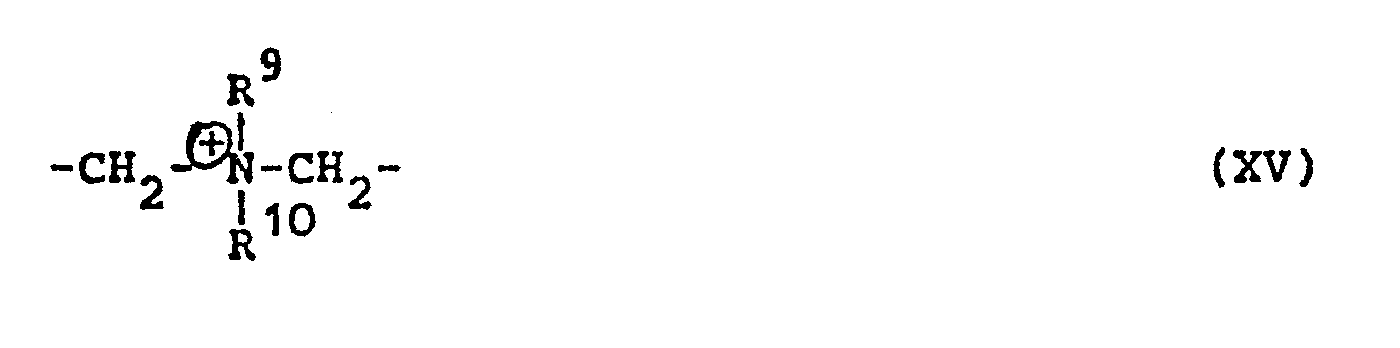

- In Resten X enthaltene Alkylreste mit mehr als 3 bis 4 C-Atomen können primär, sekundär oder tertiär und geradkettig oder verzweigt sein. Auch die in den Resten der Formeln X und XII enthaltenen Kohlenwasserstoffbrücken -CpA2p- können geradkettig oder verzweigt sein.
- Von den erfindungsgemäßen Copolymerisaten, die u.a. Baugruppen der Formel III enthalten, sind diejenigen bevorzugt, bei denen in dieser Baugruppe a für Null, b für 1 steht und Z Wasserstoff ist, bei denen somit diese Baugruppe der Formel XVII entspricht,

- Insbesondere sind solche Copolymerisate bevorzugt, bei denen in einer Baugruppe der Formel XVII R1 und Y die oben genannten Bedeutungen haben und X die Carbonamidgruppe -CONH2; eine Gruppe der Formel VI


- Von den vernetzten erfindungsgemäßen Copolymerisaten sind solche besonders bemerkenswert, die ein vernetzendes Brückenglied eines bekannten Vernetzers oder ein vernetzendes Brückenglied der Formel XV oder XVI


- In den erfindungsgemäßen vernetzten Copolymerisaten können die Brückenglieder der Formel XVI alle die gleiche Struktur haben. Dies ist dann der Fall, wenn bei der Herstellung der Produkte eine einzige reine Vernetzersubstanz der Formel XVIa

- Erfindungsgemäße vernetzte Copolymerisate können jedoch auch mehrere Arten strukturell unterschiedlicher Brückenglieder enthalten. So können sich die Brückenglieder hinsichtlich der Bedeutung der Reste R11 und R12 und/oder des Baugruppenindexes m voneinander unterscheiden, insbesondere können die Baugruppenindices m in statistischer Verteilung Werte von 0 bis 6 annehmen.
- Die Häufigkeit der Einzelwerte für m kann dabei jeweils zwischen 0 und 1 liegen, wobei als Häufigkeit der Anteil eines Wertes m bezogen auf alle vorhandenen Werte für m definiert ist.
- In der Praxis sind erfindungsgemäße vernetzte Copolymerisate, die verschiedene vernetzende Brückenglieder mit unterschiedlichen m-Werten enthalten, besonders vorteilhaft, weil sie bei guten anwendungstechnischen Eigenschaften wesentlich einfacher und damit kostengünstiger hergestellt werden können. Die für die Einführung der Brückenglieder in die Makromoleküle eingesetzten Vernetzersubstanzen der Formel XVIa können nur auf relativ umständliche Weise als einheitliche Substanzen hergestellt werden. Einfach jedoch sind Gemische dieser Substanzen zu erhalten, z.B. nach einem in der Europäischen Patentanmeldung Veröffentlichungs-Nr. 32 663 beschriebenen Verfahren. Solche Gemische sind in der angegebenen Europäischen Patentanmeldung durch die Formel

- Solche Gemische können tel quel ohne Nachteile zur Herstellung der erfindungsgemäßen Produkte eingesetzt werden. Man erhält dann bevorzugte erfindungsgemäße vernetzten Copolymerisate, bei denen im Rahmen der statistischen Verteilung der Baugruppenindices m die Häufigkeit der einzelnen m-Werte mit der Häufigkeit der Werte für n in einem Rohprodukt der Herstellung von Verbindungen der Formel

- Die erfindungsgemäßen, aus unterschiedlichen Baugruppen aufgebauten unvernetzten und vernetzten Copolymerisate enthalten die sie charakterisierenden Baugruppen der Formel II in der Regel in einem Mengenanteil von 1 bis 99 Gew.%, vorzugsweise 2 bis 50 Gew.%, bezogen auf das Gesamtgewicht des Polymers.,
- Eine weitere Gruppe bevorzugter erfindungsgemäßer Copolymerisate sind solche, die 1 bis 99 , insbesondere 2 bis 50, Gewichtsteile Baugruppen der Formel II, 1 bis 90, insbesondere 15 bis 60, Gewichtsteile Baugruppen der Formel III, 0 bis 80, insbesondere 10 bis 40, Baugruppen der Formel IV und 0 bis 80, insbesondere 10 bis 40, Baugruppen der Formel V enthalten.
- Sollen die erfindungsgemäßen Copolymerisate überwiegend wasserlöslich oder wasserquellbar sein, so ist zu beachten, daß mindestens 70 % der Grundkettenbausteine solche Reste X aufweisen, die hydrophilen Charakter besitzen und mindestens etwa 2 %, vorzugsweise mindestens 7 %, der Reste X saure Gruppen aufweisen bzw. deren Salze mit den Kationen M und/oder M 2.
- Typische Gruppen, die hydrophilen Charakter haben, sind der Sulfonsäurerest oder Carboxyl sowie Gruppen X, die diese sauren Reste tragen, Carbonamid (-CO-NH2) sowie dessen Methylolderivat und die Gruppe der Formel VI.
- Typische Gruppen ohne hydrophilen Charakter sind z.B. Cyan, Phenyl oder Benzyl.
- Bevorzugte erfindungsgemäße Copolymerisate sind auch solche, bei denen in 10 bis 90 Gew.%, insbesondere in 30 bis 70 Gew.%, der Brückenglieder der Formel III X eine Sulfo- oder Sulfoalkylamidocarbonylgruppe mit 1 bis 4 C-Atomen im Alkylrest ist, in 10 bis 90 Gew.%, insbesondere in 20 bis 60, Gew.% X eine Gruppe der Formel VI ist und in 5 bis 90, insbesondere 10 bis 80 Gew.% X eine der übrigen oben genannten Bedeutungen hat.
- Die Natur der Kationen M und M2 richtet sich nach der gewünschten Eigenschaft des erfindungsgemäßen Homo- oder Copolymerisats.
- Wird Wasserlöslichkeit der Produkte gewünscht oder sollen chelatisierbare Produkte erzielt werden, so können sich M 1 und M2 prinzipiell von jeder wasserlöslichen bekannten Base ableiten, deren Stärke ausreicht, die Sulfongruppen bzw. Carboxylgruppen der erfindungsgemäßen Copolymerisate zu neutralisieren und die deren Hydrophilie nicht beeinträchtigt. Die Auswahl kann somit in einfacher bekannter Weise erfolgen.
- Zweckmäßigerweise bedeuten jedoch M 1 und/oder M2 ein Erdalkali- oder vorzugsweise ein Alkalikation, insbesondere ein Natrium- oder Kaliumkation, Ammonium oder ein von niederen aliphatischen Aminen abgeleitetes Kation. Niedere aliphatische Amine, von denen sich die Kationen M1 und/oder M 2 ableiten können, sind primär, sekundär oder tertiär und weisen gegebenenfalls durch -OH-Gruppen substituierte Alkylgruppen mit 1 bis 4 C-Atomen auf. Bevorzugt sind solche, die mindestens einen ß-Hydroxyethylrest enthalten, wie z.B. β-Aminoethanol, 2-Amino-2-methylpropanol-1, ß-Dimethylamino-ethanol, Bis-(ß-hy- droxy-ethyl)-methylamin, Tris-(ß-hydroxyethyl)-amin, Diethyl-ß-hydroxyethylamin, Bis-(ß-hydroyethyl)ethylamin.
- M1 und/oder M2 können jedoch auch mehrwertige Metallkationen und Metallkationen mit Koordinationszahlen >1 sein. Solche erfindungsgemäßen Produkte liegen vor in den extrem hochviskosen bis gelbildenden Metallchelaten erfindungsgemäßer Produkte. Mehrwertige oder höherkoordinative Metallkationen entsprechen vorwiegend den Metallen der dritten bis achten Gruppe sowie der zweiten Nebengruppe des periodischen Systems der Elemente.
- Die erfindungsgemäßen Copolymerisate können im Molekül aus jeder der durch die allgemeinen Formeln 1 bis V und XVII definierten Baugruppen selbstverständlich auch mehrere verschiedene Individuen, die sich in den Bedeutungen der Symbole M , M2, X, Y, Z oder R bis R 12 unterscheiden, enthalten.
- So können sie z.B. im gleichen Polymermolekül sowohl 2-Acrylamido-2-mehtyl-propansulfonsäure-(3)- als auch Vinylsulfonsäure-Bausteine oder ringoffene neben ringgeschlossenen Vinylamid-Gruppen der Formel VI oder auch Phosphonsäure-Ester-Gruppen mit verschiedenen Alkylresten R unterschiedlicher Kettenlänge enthalten. In der Regel enthalten die erfindungsgemäßen Copolymerisate aus den einzelnen Gruppen der allgemeinen Formeln 1 bis V bzw. XVII nicht mehr als je 3, vorzugsweise nicht mehr als je 2, verschiedene Bausteine.
- In den erfindungsgemäßen Copolymerisaten sind die einzelnen Arten der Kettenbausteine und gegebenenfalls der Brückenglieder in den Makromolekülen der erfindungsgemäßen Copolymerisate in der Regel statistisch verteilt.
- Abweichungen von der rein statistischen Verteilung der Brückenglieder und auch der Monomeren in den Grundketten ändern erfahrungsgemäß nichts an der anwendungstechnischen Brauchbarkeit der erfindungsgemäßen vernetzten Copolymerisate. Geringfügige Abweichungen von der rein statistischen Verteilung können bereits durch die unterschiedliche Reaktivität der Monomeren und Vernetzer zustande kommen.
- Sollen spezielle Eigenschaften wie z.B. besondere Grenzflächenaktivität der erfindungsgemäßen Copolymerisate besonders betont werden, so kann es auch zweckmäßig sein, wenn die Verteilung der Baugruppen in der Polymerkette nicht statistisch ist, sondern z.B. größere Kettenabschnitte unterschiedlicher Hydrophilie vorhanden sind.
- Die erfindungsgemäßen Copolymerisate haben dann das Aufbauschema von Block- oder Pfropfpolymerisaten.
- Bevorzugt sind erfindungsgemäße Copolymerisate mit annähernd statistischer Baugruppenverteilung.
- Bei der Herstellung der erfindungsgemäßen Copolymerisate sind die gleichen Grundsätze zu beachten, die für die Herstellung anderer bekannter Copolymerisate mit sauren Gruppen gelten. Zwar sind unseres Wissens Copolymerisate mit Gruppen der Formel

- Im DBP 11 01 760 ist ein Verfahren zur Herstellung wasserlöslicher Copolymerisate aus Vinylsulfonsäure und - Acrylnitril bzw. Methacrylnitril gegebenenfalls im Gemisch mit weiteren ethylenisch ungesättigten Verbindungen beschrieben worden. Copolymerisate aus Vinyl bzw. Alkylsulfonaten mit Acrylamid und Vinylamiden sind z.B. in der DE-AS 24 44 108 beschrieben worden.
- Wasserlösliche Copolymerisate, welche 2-Acrylamido-2-methyl-propansulfonsäure-(3), im-folgenden mit AIBS abgekürzt, als Comonomeres enthalten, sind in den US-Patentschriften 3,953,342, 3,768,565, 3,907,927, 3,926,718 sowie in den DE-OS 25 02 012 und 25 47 773 beschrieben.
- Die erfindungsgemäßen Copolymerisate, soweit sie Reste der Formel VI enthalten, bei denen R3 und R4 gemeinsam Trimethylen oder Pentamethylen bedeuten, lassen sich in der aus dem Stand der Technik bekannten Weise, z.B. gemäß den Angaben der US-PS 3,929,741, durch Umsetzung der Monomeren bei Temperaturen von etwa 10 bis 120°C, vorzugsweise bei 40 bis 80°C, in Gegenwart von geeigneten Polymerisationskatalysatoren herstellen.
- Will man, um erfindungsgemäße Copolymerisate herzustellen, die Gruppen der Formel VI enthalten, in denen R4 und R5 nicht gemeinsam für Tri- oder Pentamethylen stehen, unter analogen Bedingungen die Copolymerisation von AIBS, Styrol- oder Vinylsulfonsäure mit nicht ringgeschlossenen N-Vinylamiden der Formel VIa

- Die Neutralisation der sauren Komponenten vor der Polymerisation ist aber auch bei der Copolymerisation von ringgeschlossenen Verbindungen VIa möglich und in der Regel sogar vorteilhaft.
- Erfindungsgemäße Homopolymerisate oder Copolymerisate, die an den Polymerketten Substituenten der Formel


- Zweckmäßigerweise werden somit zur Herstellung von je 100 Gewichtsteilen der erfindungsgemäßen Copolymerisate die gewünschte Menge, vorzugsweise 1 bis 99 Gewichtsteile, eines Acrylsäure- bzw. Methacrylsäurederivats der Formel IIa


- Beispiele für Verbindungen der Formel IIa, die bei der Herstellung erfindungsgemäßer Copolymerisate eingesetzt werden, sind:
- 2-Acrylamido-2-methyl-propan-1-phosphonsäure,
- Acrylamid, Methacrylamid, N-Vinylformamid, N-Vinyl-N-methylformamid, N-Vinylacetamid, N-VinylN-methyl-acetamid, N-Vinyl-N-ethyl-acetamid, N-Vinyl-N-propyl-acetamid, N-Vinylpropionamid, N-Vinyl-N-methyl-propionamid, N-Vinyl-N-ethyl-propionamid, N-Vinyl-butyramid, N-Vinyl-N-methyl-butyramid, N-Vinylcapronamid, N-Vinyl-N-methylcapronamid, N-Vinyl-N-hydroxymethyl-formamid, N-Vinyl-N-hydroxymethyl-acetamid, N-Vinyl-N-hydroxymethyl-propionamid, N-Allylformamid, N-Allyl-N-methyl-formamid, N-Allyl-acetamid, N-Allyl-N-methyl-acetamid, N-Allyl-N-ethyl-acetamid, N-Allyl-N-methyl-propionamid, N-Allylbutyramid, N-Allyl-N-hydroxymethyl-acetamid, N-Vinylpyrrolidon, N-Vinyl-caprolactam, Acrylsäure und Methacrylsäure sowie deren Alkali- und Ammoniumsalze, Vinylmethyl-keton, Vinyl-ethyl-keton, Vinyl-butyl-keton, Methylacrylat, Methylmethacrylat, Ethylacrylat, Ethylmethacrylat, Propylacrylat, Propylmethacrylat, Isopropylacrylat, Isopropylmethacrylat, Butylacrylat, Isobutylacrylat, tert. Butylacrylat, Butylmethacrylat, Isobutylmethacrylat, Amylacrylat, Amylmethacrylat, Hexylacrylat, Hexylmethacrylat, 2-Ethyl-hexyl-acrylat, 2-Ethyl-hexylmethacrylat, n-Octylacrylat, n-Octylmethacrylat, Dodecylacrylat, Dodecylmethacrylat, Hexadecylacrylat, Hexadecylmethacrylat, ß-Hydroxyethylacrylat, ß-Hydroxyethylmethacrylat, ß- oder γ-Hydroxypxopylacrylat, oder -methacrylat, Hydroxyisopropylacrylat, N-Methylolacrylamid, N-Methylolmethacrylamid, N-Methoxymethylacrylamid, N-Methoxymethylmethacrylamid, N-Butoxymethylacrylamid, N-Butoxymethylmethacrylamid, Isooctyloxymethylacrylamid, Vinylmethylether, Vinylethylether, Vinylpropylether, Vinylisopropylether, Vinylbutylether, Vinylisobutylether, Vinylformiat, Vinylacetat, Vinylpropionat, Vinylbutyrat, Vinylisobutyrat, Vinylcapronat, Vinylchlorid, Vinylidenchlorid, Allylchlorid, Acrylnitril, Methacrylnitril, Styrol, 2-, 3-oder 4-Methylstyrol, 2-, 3- oder 4-Ethylstyrol, 2,4-, 2,6-, 3,4-oder 3,5-Dimethylstyrol, 2-, 3- oder 4-Chlor- oder -fluorstyrol, 4-Bromstyrol, 2,3-, 2,4-, 2,5-, 2,6-,' 3,4-oder 3,5-Dichlorstyrol, 4-Ethylhexylstyrol, 3-ß-Bromethylstyrol, 1-Phenylpropen-1, 2-Phenylpropen-1, 2-(2-, 3- oder 4-Methylphenyl)-propen-1, Vinylpyridin-1, Vinylimidazol, Vinylsulfonsäure, 2-Acrylamido-2-methylpro- pan-1-sulfonsäure, Vinylphosphonsäure, Vinylphosphonsäuremonomethylester, Vinylphosphonsäuremonoethylester, Vinylphosphonsäuremonopropylester, Vinylphosphonsäuremonoisopropylester, Vinylphosphonsäuremonobutylester, Vinylphosphonsäuremonoisobutylester, und deren Alkali- oder Ammoniumsalze Vinylphosphonsäuredimethylester, Vinylphosphonsäurediethylester, Vinylphosphonsäuredipropylester, Vinylphosphonsäuredibutylester, 2-Methacrylamido-2-me- thylpropan-1-sulfonsäure, Dimethylphosphinsäure-ester bzw. Diethylphosphinsäure-ester des β-Hydroxyethylacrylats oder β-Hydroxyethylmethacrylats, 2-Dimethylaminoethylacrylat, 2-Dimethylaminoethylmethacrylat, 2-Diethylaminoethylacrylat bzw. -methacrylat, 4-Dimethylaminobutylacrylat bzw. -methacrylat, 4-Diethylaminobutylacrylat oder -methacrylat, Acrylamidomethylphosphonsäure, Methacrylamidomethylphosphonsäure, N-(2-Methylaminoethyl)-acrylamid und -methacrylamid, N-(2-Diethylaminoethyl)-acrylamid und -methacrylamid, N-(3-Dimethylaminopropyl)-acrylamid und -methacrylamid, N-(4-Dimethylaminobutyl)-acrylamid und -methacrylamid, N-(2-Dimethylaminobutyl)-acrylamid und -methacrylamid, 2-Trimethylammoniumethylacrylat- und -methacrylat-hydrochlorid, 2-Triethylammoniumethylacrylat- und -methacrylat-hydrochlorid, N-(2-Tri- methylammoniumethyl)-acryl-amid- und -methacrylamidmethosulfat, N-(2-Triethylammoniumethyl)-acrylamid- und -methacrylamid-hydrobromid, Maleinsäure bzw. Maleinsäureanhydrid.
- Beispiele für Verbindungen der Formel IVa sind: Butadien und Isopren.
- In der Gruppe der Verbindungen der Formel Va befinden sich bekannte Vernetzer wie beispielsweise Divinylbenzol, Methylenbisacrylamid, Butandioldiacrylat und Butandioldimethacrylat, Tetraallyloxethan, Trisacryloylperhydrotriazin, Triallylisocyanurat.
- Verbindungen aus der Gruppe Va, die ein Brückenglied der Formel XIII einführen können, sind beispielsweise Methyldiallylamin oder Ethyldiallylamin, Isooctyldiallylamin.
- Verbindungen der Formel Va, die einen Rest der Formel XIV einführen können, sind beispielsweise Dimethyldiallylammoniumchlorid, Diethyldiallylammoniumchlorid. Verbindungen der Formel Va, die ein Brückenglied der Formel XV einführen können, sind die Vinylphosphonsäureanhydride, insbesondere Mischungen derselben untereinander und mit Vinylphosphonsäureester, wie sie beispielsweise nach den Angaben der EP-Patentanmeldung Veröffentlichungs-Nr. 32 663 erhalten werden können.
- Besonders zweckmäßig ist es, bei der Herstellung der erfindungsgemäßen vernetzten Copolymerisate keine reine Verbindung der Formel Ia als Vernetzer einzusetzen, sondern ein Rohprodukt der Herstellung von Verbindungen der Formel XVIII

- In diesem Fall werden erfindungsgemäße vernetzte Copolymerisate erhalten, die mehrere verschiedene Brückenglieder der Formel XVI enthalten, wobei im Rahmen der statistischen Verteilung der Baugruppenindices m die Häufigkeit der einzelnen m-Werte mit der Häufigkeit der Werte für n in dem eingesetzten Rohprodukt in der Weise korreliert ist, daß die Häufigkeit eines Wertes m gleich ist der Häufigkeit desjenigen Wertes n, der dem Zusammenhang n=m+2 genügt.
- Von den erfindungsgemäßen Copolymerisaten, die nicht ausschließlich durch Copolymerisation von Verbindungen der Formel IIa erhalten werden, sind solche bevorzugt, die durch Copolymerisation von 1 bis 99, insbesondere von 2 bis 50, Gewichtsteilen Verbindungen der Formel IIa und 99 bis 1, insbesondere 98 bis 50, Gewichtsteilen von Comonomeren der Formeln IIIa, IVa und Va erhalten werden.
- Eine weitere Gruppe bevorzugter erfindungsgemäßer Copolymerisate wird erhalten, wenn man 1 bis 99, insbesondere 2 bis 50, Gewichtsteile Monomere der Formel IIa, 1 bis 90, insbesondere 15 bis 60, Gewichtsteile Monomere der Formel IIIa, 0 bis 80, insbesondere 10 bis 40, Monomere der Formel IVa und 0 bis 80, insbesondere 10 bis 40, Monomere der Formel Va der Copolymerisation unterwirft.
- Sollen erfindungsgemäße Copolymerisate mit besonders betonter Hydrophilie hergestellt werden, d.h. sollen sie wasserlöslich oder wasserquellbar sein, so ist zu beachten, daß mindestens 70 % der Ausgangs-Monomeren solche Reste X aufweisen, die hydrophilen Charakter besitzen und mindestens etwa 2 %, vorzugsweise mindestens 7 %, der Reste X saure Gruppen aufweisen bzw. deren Salze. Typische Gruppen, die hydrophilen Charakter haben, sind der Sulfonsäurerest oder Carboxyl sowie Gruppen X, die diese sauren Reste tragen, Carbonamid (-CO-NH2) sowie dessen Methylolderivat, die Gruppe der Formel VI mit niederen Alkylresten R 2 und R3 sowie Reste mit Amino-oder Niederalkylamino oder Niederalkylammoniumgruppen.
- Bevorzugte erfindungsgemäße Copolymerisate werden auch erhalten, wenn in 10 bis 90 Gew.%, insbesondere in 30 bis 70 Gew.%, der Comonomeren der Formel IIIa X eine Sulfo-oder Sulfoalkylamidocarbonylgruppe mit 1 bis 4 C-Atomen im Alkylrest ist, in 10 bis 90 Gew.%, insbesondere in 20 bis 60, Gew.\ der Comonomeren der Formel IIIa X eine Gruppe der Formel VI ist und in 5 bis 90, insbesondere 10 bis 80 Gew.% der Comonomeren der Formel lila X eine der übrigen oben genannten Bedeutungen hat. Die erfindungsgemäßen Polymerisate können nach den üblichen Polymerisationsverfahren, wie Lösungspolymerisation, Substanzpolymerisation, Emulsionspolymerisation, inverse Emulsionspolymerisation, Fällungspolymerisation, Gelpolymerisation hergestellt werden.
- Vorzugsweise wird die Polymerisation als Gelpolymerisation, als Fällungspolymerisation oder in umgekehrter Emulsion ausgeführt.
- Bei der Durchführung der Copolymerisation in einem mit Wasser mischbaren organischen Lösungsmittel arbeitet man unter den Bedingungen der Fällungspolymerisation. Hierbei fällt das Polymerisat direkt in fester Form an und kann durch Abdestillieren des Lösungsmittels oder Absaugen und Trocknen isoliert werden.
- Als wassermischbare organische Lösungsmittel, die zur Durchführung des erfindungsgemäßen Herstellungsverfahrens geeignet sind, kommen insbesondere wasserlösliche Alka- nole, nämlich solche mit 1 bis 4 C-Atomen, wie Methanol, Ethanol, Propanol, Isopropanol, n-, sec- und iso-Butanol, vorzugsweise aber tert. Butanol,,in Betracht.
- Der Wassergehalt der hierbei als Lösungsmitel eingesetzten niederen Alkanole sollte 6 Gew.% nicht überschreiten, da sonst eine Klumpenbildung bei der Polymerisation auftreten kann. Vorzugsweise wird bei einem Wassergehalt von 0 - 3 Gew.% gearbeitet.
- Die Menge des einzusetzenden Lösungsmittels richtet sich bis zu einem gewissen Grad nach der Art der eingesetzten Comonomeren.
- In der Regel werden pro 100 g Gesamtmonomere 200 bis 1000 g des Lösungsmittels eingesetzt.
- Bei der Durchführung der Polymerisation in umgekehrter Emulsion wird die wäßrige Monomerenlösung in bekannter Weise in einem mit Wasser nicht mischbaren organischen Lösungsmittel, wie Cyclohexan, Toluol, Xylol, Heptan oder hochsiedenden Benzinfraktionen unter Zusatz von 0,5 bis 8 Gew.%, vorzugsweise 1 bis 4 Gew.%, bekannter Emulgatoren vom W/O-Typ emulgiert und mit üblichen radikalbildenden Initiatoren polymerisiert.
- Das Prinzip der inversen Emulsionspolymerisation ist aus der US-Patentschrift 3,284,393 bekannt. Bei diesem Verfahren werden wasserlösliche Monomere oder Mischungen davon in der Wärme zu hochmolekularen Copolymerisaten polymerisiert, indem man zunächst die Monomeren oder wäßrige Lösungen davon, unter Zusatz von Wasser-in-öl-Emulgatoren in einem mit Wasser nicht mischbaren, die zusammenhängende Phase bildenden organischen Lösungsmittel emulgiert und diese Emulsion in Gegenwart von radikalischen Initiatoren erwärmt. Die einzusetzenden Comonomeren können als solche in dem mit Wasser nicht mischbaren organischen Lösungsmittel emulgiert werden, oder sie können in Form einer wäßrigen Lösung, die zwischen 100 und 5 Gew.% Comonomere und 0 bis 95 Gew.% Wasser enthält, eingesetzt werden, wobei die Zusammensetzung der wäßrigen Lösung eine Frage der Löslichkeit der Comonomeren in Wasser und der vorgesehenen Polymerisationstemperatur ist. Das Verhältnis zwischen Wasser und der Monomerenphase ist in weiten Grenzen variabel und liegt in der Regel bei 70 : 30 bis 30 : 70.
- Um die Monomerenphase in dem mit Wasser nicht mischbaren organischen Lösungsmittel zu einer Wasser-in-öl-Emulsion zu emulgieren, werden den Gemischen 0,1 bis 10 Gewichtsprozent, bezogen auf die ölphase eines Wasser-in-öl-Emulgators, zugesetzt. Vorzugsweise werden solche Emulgatoren verwendet, die einen relativ niedrigen HLB-Wert aufweisen. Als ölphase kann im Prinzip jede inerte wasserunlösliche Flüssigkeit, d.h. im Prinzip jedes hydrophobe organische Lösungsmittel, eingesetzt werden. Im allgemeinen verwendet man im Rahmen der vorliegenden Erfindung Koh- lenwasserstoffe, deren Siedepunkt im Bereich von 120 bis 350°C liegt. Diese Kohlenwasserstoffe können gesättigte, lineare oder verzweigte Paraffin-Kohlenwasserstoffe, wie sie in Erdölfraktionen vorwiegend vorliegen, sein, wobei diese auch die üblichen Anteile von Naphthenkohlenwasserstoffen enthalten können. Es können aber auch aromatische Kohlenwasserstoffe, wie beispielsweise Toluol oder Xylol, sowie die Gemische der oben genannten Kohlenwasserstoffe als ölphase eingesetzt werden. Vorzugsweise verwendet man ein Gemisch aus gesättigten Normal- und Iso-Paraffinkohlenwasserstoffen, das bis zu 20 Gewichtsprozent Naphthene enthält.
- Eine detaillierte Beschreibung des Verfahrens findet sich beispielsweise in der Deutschen Patentschrift 10 89 173 und in den US-Patentschriften 3,284,393 und 3,624,019.
- Vernetzte Copolymerisate mit besonders hohem Polymerisationsgrad in den Grundketten werden erhalten, wenn man die Polymerisation in wäßriger Lösung nach dem Verfahren der sogenannten Gelpolymerisation durchführt. Dabei werden 15- bis 60%ige wäßrige Lösungen der Comonomeren mit bekannten geeigneten Katalysatoren ohne mechanische Durchmischung unter Ausnutzung des Trommsdorff-Norrisch-Effekts (Bios Final Rep. 363,22; Makromol. Chem. 1, 169 (1947) polymerisiert.
- Durch Nacherhitzen der bei der Gelpolymerisation erhaltenen Polymerisatgele im Temperaturbereich von 50 bis 130°C, vorzugsweise 70 bis 100°C, können die Qualitätseigenschaften der Polymerisate noch verbessert werden.
- Die auf diesem Wege hergestellten, in Form wäßriger Gallerten vorliegenden erfindungsgemäßen Copolymerisate können nach mechanischer Zerkleinerung mit geeigneten Apparaten direkt in Wasser gelöst werden und zum Einsatz gelangen. Sie können aber auch nach Entfernung des Wassers durch bekannte Trocknungsprozesse in fester Form erhalten und erst bei ihrer Verwendung wieder in Wasser aufgelöst werden.
- Die Polymerisationsreaktion wird im Temperaturbereich zwischen -60°C und 200°C, bevorzugt zwischen -10 und 120°C, durchgeführt, wobei sowohl unter Normaldruck als auch unter erhöhtem Druck gearbeitet werden kann. In der Regel wird die Polymerisation in einer Schutzgasatmosphäre, vorzugsweise unter Stickstoff, ausgeführt.
- Zur Auslösung der Polymerisation können energiereiche elektromagnetische Strahlen oder die üblichen chemischen Polymerisationsinitiatoren herangezogen werden, z.B. organische Peroxide, wie Benzolperoxid, tert. Butyl-hydroperoxid, Methylethyl-keton-peroxid, Cumol-hydroperoxid, Azoverbindungen wie Azo-di-iso-butyro-nitril oder 2'-Azo-bis-(2-amidinopropan)-dihydrochlorid

- Es ist weiterhin bekannt, den Polymerisationsansätzen kleine Mengen von sogenannten Moderatoren zuzusetzen, die den Verlauf der Reaktion dadurch harmonisieren, daß sie das Reaktionsgeschwindigkeits-Zeitdiagramm abflachen. Sie führen damit zu einer Verbesserung der Reproduzierbarkeit der Reaktion und ermöglichen damit, einheitliche Produkte mit äußerst geringen Qualitätsabweichunqen herzustellen. Beispiele für geeignete Moderatoren dieses Typs sind Nitrilo-tris-propionylamid oder Monoalkylamine, Dialkylamine oder Trialkylamine, wie z.B. Dibutylamin. Auch bei der Herstellung der erfindungsgemäßen Copolymerisate können solche Moderatoren mit Vorteil verwendet werden. weiterhin können den Polymerisationsansätzen sogenannte Regulatoren zugesetzt werden; das sind solche Verbindungen, die das Molekulargewicht der hergestellten Polymerisate beeinflussen. Brauchbare bekannte Regulatoren sind z.B. Alkohole wie Methanol, Ethanol, Propanol, Isopropanol, n-Butanol, sec.-Butanol und Amylalkohole, Alkylmercaptane wie z.B. Dodecylmercaptan und tert.-Dodecylmercaptan, Isooctylthioglycolat und einige Halogenverbindungen wie z.B. Tetrachlorkohlenstoff, Chloroform und Methylenchlorid.
- Die erfindungsgemäßen Copolymerisate lassen sich mit mehrwertigen Metallkationen, insbesondere solchen der dritten bis achten Gruppe sowie der zweiten Nebengruppe des periodischen Systems der Elemente, zu Chelaten umsetzen. Selbst die Metalle der zweiten Hauptgruppe zeigen noch eine deutliche Chelatisierungswirkung. Hierzu werden die genannten Copolymerisate mit Salzen dieser Metalle vereinigt, wobei in der Regel pro g-Äquivalent des Metallkations 1 bis 100 g-Äquivalent des Copolymerisats zusammengebracht werden. Die Reaktion wird in der Regel in Wasser oder in einem wassermischbaren organischen Lösungsmittel oder in Mischungen davon, vorzugsweise aber in Wasser, durchgeführt, wobei die Metallkationen in Form einer wäßrigen Lösung eines wasserlöslichen Salzes des betreffenden Metalls eingesetzt werden. Die Chelatisierungsreaktion tritt je nach Art des Kations im neutralen oder alkalischen pH-Bereich oder bei sehr aktiven Kationen (wie z.B. bei Titan oder Zirkon) bereits im stark sauren Bereich ein. Sie verläuft bereits bei Zimmertemperatur mit hoher Geschwindigkeit und ist in den meisten Fällen, wie z.B. bei Ti, Zr, Fe oder Al nach wenigen Sekunden bis Minuten, in selteneren Fällen nach einigen Stunden (wie z.B. bei Kadmium), vollständig abgeschlossen.
- Bei der Chelatisierungsreaktion wird die der zugesetzten Menge mehrwertiger Metallionen äquivalente Menge der für X+ stehenden Kationen freigesetzt, und über die mehrwertigen Metallionen kommt es zu einer Vernetzung der Polymerenstränge.
- Dieses Chelatisierungsvermögen der oben definierten - Polymerisate kann einerseits dazu ausgenutzt werden, die betreffenden Kationen fest zu binden und zu maskieren, um sie zu eliminieren oder unwirksam zu machen. Andererseits weisen die Metallchelate der Polymeren selbst höchst - wertvolle technische Eigenschaften auf. Besonders auffäl- .lig-ist die extrem hohe Viskosität schon sehr verdünnter wäßriger Lösungen der chelatisierten Copolymerisate.
- Die Substituenten der Formel

- vermitteln den erfindungsgemäßen Polymerisaten ein hohes Maß an Hydrophilie. Unvernetzte erfindungsgemäße Polymerisate sind daher wasserlöslich, vernetzte Polymerisate quellbar mit hohem Wasseraufnahmevermögen. Zusätzlich weisen die erfindungsgemäßen Polymerisate eine hohe Dispergierwirkung und antikorrosive Eigenschaften auf.
- Durch die Kombination der genannten wertvollen Eigenschaften eröffnen sich für die neuen Produkte zahlreiche technische Einsatzmöglichkeiten, wobei sich überraschende technische Vorteile ergeben. So können die erfindungsgemäßen Produkte mit erheblichem technischen Vorteil z.B. als Färberei- und Textilhilfsmittel eingesetzt werden. Es ergeben sich z. B. erhebliche Vorteile durch den Einsatz erfindungsgemäßer Copolymerisate beim Färben von cellulosehaltigen Fasermaterialien nach dem Klotz-Kaltverweilverfahren. Durch den Zusatz der erfindungsgemäßen Copoly- merisate wird die Flottenaufnahme des zu färbenden cellulosehaltigen Textilmaterials wesentlich erhöht, was zu einer besseren Durchfärbung selbst voluminöser textiler Flächengebilde, wie z.B. Trikot, führt. Dadurch resultieren Färbungen von hoher Egalität und hervorragendem Warenbild. Beim Einsatz der erfindungsgemäßen neuen Copolymerisate in der Pigmentfärberei werden Färbungen hoher Egalität und Farbtiefe erhalten.
- Die erfindungsgemäßen Copolymerisate bewirken beim Zusatz zu Dispersionsfarbstoffen enthaltenden Klotzflotten, wie sie zum Färben von Polyestermaterialien verwendet werden, eine hervorragende Egalität und Brillanz der damit fertiggestellten Färbungen.
- Die hohe Viskosität wäßriger Lösungen der erfindungsgemäßen Copolymerisate und ihrer Metallchelate ermöglicht ihren Einsatz als Verdickungsmittel in wäßrigen Anstrich-oder Druckfarben bzw. in Bindemitteldispersionen bei der Imprägnierung und Beschichtung textiler Flächengebilde sowie als Hilfsmittel in der Erdölindustrie wie z.B. als Bohrspül- oder Zementierungsadditive, in Polymeren für die Sekundär- und Tertiärförderung.
- Besonders wertvoll sind die erfindungsgemäßen Copolymerisate für das Verdicken von Säurefluids, die für die Stimulierung von Erdöl- und Erdgaslagerstätten nach dem an sich bekannten Verfahren der Drucksäuerung eingesetzt werden. Bei diesem Stimulationsverfahren wird eine wäßrige Säure unter hohem Druck durch die Förderbohrung oder durch eine Hilfsbohrung in die Lagerstätte eingepreßt. In der erdölführenden Formation soll dadurch ein hoher Druck aufgebaut werden, der ausreicht, neue Frakturen in das Gestein zu sprengen. Die Säure ätzt beim Eindringen in die entstandenen Risse deren Oberfläche unregelmäßig an, wodurch bei Druckentlastung kein vollständiges Schließen der Frakturen mehr erfolgt sondern geätzte Kanäle offen bleiben, die ein verbessertes Fließen des Rohöls bzw. Erdgases ermöglichen. Voraussetzung für das Gelingen der Drucksäuerung ist es, daß die eingepumpte Säure nicht zu schnell durch natürliche Poren und Spalten der Formation abfließen kann, weil sonst die normale Pumpenleistung nicht ausreicht, den erforderlichen hohen Sprengdruck in der Lagerstätte zu erzeugen.
- Es ist daher von großem Vorteil, die Viskosität der wäßrigen Säure zu erhöhen, weil dies das zu schnelle Abfließen der Säure in das Gestein verhindert und bei gegebener Pumpenleistung in der Lagerstätte ein wesentlich höherer Druck erzeugt werden kann. Die erfindungsgemäßen Copolymerisate und insbesondere deren Metallchelate eignen sich nun hervorragend als Verdicker für wäßrige Säurefluids, die für das Drucksäuerungsverfahren eingesetzt werden sollen. Sie werden für diesen Zweck den wäßrigen Säuren in Mengen von 0,1 bis 5,0 %, vorzugsweise von 0,2 bis 1,5 %, zugesetzt.
- Eine besonders vorteilhafte Ausgestaltung des Drucksäuerungsverfahrens wird ermöglicht durch die hohe Geschwindigkeit der Chelatisierungsreaktion zwischen den erfindungsgemäßen Copolymerisaten und chelatisierbaren Metallkationen. Man verfährt in der Weise, daß man der Lösung des nichtchelatisierten Copolymerisats in der Säure erst unmittelbar vor dem Eintritt des Säurefluids in die Bohrung die Metallkationen in Form einer Metallsalzlösung oder einer Kationen abspaltenden Chelatlösung zudosiert.
- Die Menge des bei diesem Verfahren zudosierten Metallsalzes richtet sich nach der Konzentration des Polymerisats in der Säure. Man arbeitet so, daß pro Phosphonsäureäquivalent des Copolymerisats 1 bis 1/100 g-Äquivalent des Metallkations zudosiert werden.
- Das Phosphonsäureäquivalent P errechnet sich aus dem Gewichtsprozent-Anteil a der Baugruppe der Formel II im Copolymerisat nach der Gleichung

- Weiterhin können die erfindungsgemäßen Copolymerisate als Dispergiermittel als Scale Inhibitoren, als Steinverhinderungsmittel sowie als Flockungs- und Filtrierhilfsmittel, des weiteren als Hilfsmittel bei der Papierherstellung und als Korrosionsschutzmittel eingesetzt werden.
- Ein weiteres Einsatzgebiet besteht in der Herstellung hoch wasserfester Überzüge und Polituren auf Holz, Kautschuk-, Glas-, Fliesen-, Kunststoff- und Linoleumoberflächen durch Kombination geeigneter wäßriger Polymerdispersionen mit den erfindungsgemäßen, durch Zusatz mehrwertiger Metallionen vernetzten Copolymeren.
- Die erfindungsgemäßen Polymeren können auch als Kosmetikgrundstoffe sowie als Hilfsmittel bei der Lederherstellung eingesetzt werden. Aufgrund der Fähigkeit der Phosphonsäuregruppierung, Metallchelate zu bilden, können die erfindungsgemäßen Polymerisate auch zur Bindung mehrwertiger Metallkationen verwendet oder über derartige Kationen vernetzt werden. Die erfindungsgemäßen Polymerisate sind auch als Zusätze zu Reinigungsmitteln insbesondere bei Metalloberflächen, sowie als Modifizierungsmittel für Aminoplastharze geeignet.
- Erfindungsgemäße Copolymerisate mit Molgewichten von weniger als 50000 sind darüber hinaus als sogenannte Nachgerbstoffe, insbesondere für Chromleder, geeignet.
- Die zur Herstellung der erfindungsgemäßen Homo- und Copolymerisate erforderliche 2-Acrylamido- bzw. 2-Methacrylamido-2-methylpropan-phosphonsäure der Formel IIa

- sowie deren Salze lassen sich durch Umsetzung von Acrylnitril bzw. Methacrylnitril mit 1 mol Wasser und 2-Me- thylprop-1-en-1-phosphonsäure bzw. der isomeren 2-Methyl- prop-2-en-1-phosphonsäure in Gegenwart starker Säuren wie z.B. H2SO4, H3PO4, HC104 oder HF nach dem bekannten Schema und unter den an sich bekannten Bedingungen der Ritter-Reaktion herstellen.

- Die 2-Methyl-propen-1-yl- bzw. 2-Methyl-propen-2-yl-phosphonsäuren lassen sich durch Hydrolyse der entsprechenden Phosphonsäurechloride bequem herstellen. Die isomeren 2-Methyl-propenphosphonsäuredichloride sind bereits ausführlich in der Literatur beschrieben worden (U.S. Patent 2,471,472; L. Maier, Phosphorus 2, 223 (1975) ).
- Die Salze der Phosphonsäure IIa werden nach dem Fachmann geläufigen Verfahren z. B. durch Umsetzung mit äquivalenten Mengen eines Metallhydroxids oder Carbonats in wäßriger.oder alkoholischer Lösung hergestellt.
- Die folgenden Ausführungsbeispiele zeigen die Herstellung erfindungsgemäßer Polymerisate. Alle %-Angaben beziehen sich auf Gewichtsmengen.
- Die in den Ausführungs- und Tabellenbeispielen benutzten Abkürzungen haben folgende Bedeutung:
- AMPP 2-Acrylamido-2-methyl-propanphosphonsäure MAMPP 2-Methacrylamido-2-methyl-propanphosphonsäure AM Acrylamid
- VIMA N-Vinyl-N-methyl-acetamid
- VIPY N-Vinylpyrrolidon
- AIBS 2-Acrylamido-2-methyl-propansulfonsäure
- VA Vinylacetamid
- VIFA Vinylformamid
- VSS-Na Natriumvinylsulfonat
- Styrol SS Styrolsulfonsäure
- VPS Vinylphosphonsäure
- VPE Vinylphosphonsäure-methylester
- AS Acrylsäure
- MAS Methacrylsäure
- VAc Vinylacetat
- ACN Acrylnitril
- VPA Vinylphosphonsäureanhydrid
- DADMAC Diallyl-dimethyl-ammoniumchlorid
- MASA Maleinsäureanhydrid
- Die in den Tabellen angegebenen Zahlenwerte der Zusammensetzung sind Gew.%-Angaben.
- 7,2 g Arkopal N 100 (nichtionischer Emulgator auf der Basis eines oxethylierten Phenolderivats) und 19,4 g 0Span 80 (nichtionischer Emulgator auf Basis eines Zuckeralkohol-Stearats) werden in ®Isopar M (technisches Gemisch von Isoparaffin mit einem Siedepunkt von ca. 200-240°C) aufgelöst und die resultierende Lösung in ein 1-1-Reaktionsgefäß eingeschüttet, das mit einem Rührer, Thermometer und einem Stickstoffeinlaß versehen ist. Dann wird eine Monomerlösung durch Auflösung von 97,2 g Acrylamid, 10,2 g AMPP und 1,1 g Vinylphosphonsäuremonomethylester (VPE) in 105 ml Wasser hergestellt. Der pH-Wert der Monomerlösung wird auf 8,5 mit Ammoniak (25%ig) eingestellt. Unter schnellem Rühren wird die wäßrige Monomerlösung der organischen Phase zugefügt. Das Reaktionsgefäß wird evakuiert und anschließend mit Stickstoff gefüllt. Nun wird die Lösung von 0,0275 g Ammoniumpersulfat in 3 ml Wasser dem Gemisch zugefügt und damit die Polymerisation gestartet. Die Reaktion dauert 1 1/2 Stunden, die Reaktionstemperatur wird zwischen 30 und 40°C gehalten. Es resultiert eine stabile Emulsion, die unter Verwendung handelsüblicher oberflächenaktiver Mittel in an sich bekannter Weise in Wasser invertiert werden kann.
- Die resultierende Polymerlösung hat einen K-Wert von 128,9.
- 7,2 g ®Arkopal N 100 (nichtionischer Emulgator auf der Basis eines oxethylierten Phenolderivats) und 19,4 g ®Span 80 (nichtionischer Emulgator auf Basis eines Zuckeralkohol-Stearats) werden in ®Isopar M (technisches Gemisch von Isoparaffin mit einem Siedepunkt von ca. 200-240°C) aufgelöst und die resultierende Lösung in ein 1-1-Reaktionsgefäß eingeschüttet, das mit einem Rührer, Thermometer und einem Stickstoffeinlaß versehen ist. Dann wird eine Monomerlösung durch Auflösung von 87,5 g Acrylamid und 21,8 g AMPP in 110 ml Wasser hergestellt. Der pH-Wert der Monomerlösung wird auf 8,5 mit Ammoniak (25%ig) eingestellt. Unter schnellem Rühren wird die wäßrige Monomerlösung der organischen Phase zugefügt. Das Reaktionsgefäß wird evakuiert und anschließend mit Stickstoff gefüllt. Nun wird eine Lösung von 0,0275 g Ammoniumpersulfat in 3 ml Wasser dem Gemisch zugefügt und damit die Polymerisation gestartet. Die Reaktion dauert 1 1/2 Stunden, die Reaktionstemperatur wird zwischen 30 und 400C gehalten. Es resultiert eine stabile Emulsion, die unter Verwendung handelsüblicher oberflächenaktiver Mittel in an sich bekannter Weise in Wasser invertiert werden kann.
- Analog dieser Verfahrensweise lassen sich auch die Copolymerisate der folgenden Tabellen I und II herstellen.


- In einem Polymerisationskolben von 1 1 Inhalt, ausgestattet mit Planschliffdeckel, Rührer, Thermometer und Gaseinleitungsrohr wird durch Auflösung von 60 g Arylamid, 30 g AMPP und 10 g VPE in 250 g Wasser eine Monomerlösung hergestellt. Der pH-Wert wird mit Ammoniak (25%ig) auf 8,5 eingestellt. Unter Rühren und Einleiten von Stickstoff werden nun 1 g einer wäßrigen 10%igen Dibutylamin-HCl-Lösung und 0,1 g Ammoniumpersulfat zugegeben. Man läßt unter Stickstoff-Einleitung noch 3 Minuten bei erhöhter Drehzahl rühren. Die Stickstoff-Einleitung wird beendet, Einleitungsrohr und Rührer werden hochgezogen. Nach einer Induktionszeit von 30 Minuten setzt die Polymerisation ein, wobei die Temperatur von 20°C auf 78°C ansteigt und die Lösung in ein formstabiles Gel übergeht.
- Der K-Wert beträgt 203,9.
- In einem Polymerisationskolben von 1 1 Inhalt, ausgestattet mit Rührer, Rückflußkühler, Thermometer, Tropftrichter und Gaseinleitungsrohr werden in 440 ml tert.-Butanol 49,7 g Acrylamid, 7,1 g AIBS, 10,7 g AMPP und 3,6 g Methacrylsäure (MAS) gelöst. Unter Rühren und Einleiten von Stickstoff wird die Monomerlösung auf 50°C angeheizt und 1 g Azoisobutyronitril, gelöst in 5 ml DMF, zugetropft. Nach einer Induktionszeit von 30 Minuten setzt die Polymerisation ein, die Reaktionstemperatur steigt auf 68°C, und das Polymerisat fällt aus. Es wird noch 2 Stunden bei 80°C nachgeheizt. Das Copolymerisat kann durch Absaugen und Trocknen isoliert werden. Es kann jedoch auch das Lösungsmittel direkt unter vermindertem Druck abdestilliert werden. Man erhält das Polymere in Form eines weißen leichten Pulvers, das sich gut in Wasser löst und einen K-Wert von 195,0 hat.
- In einem Polymerisationskolben von 1 1 Inhalt, ausgestattet mit Planschliffdeckel, Rührer, Thermometer und Gaseinleitungsrohr werden in 200 g Wasser 20 g AIBS und 50 g AMPP gelöst, und mit Ammoniak (25%ig) neutralisiert. Dann werden 10 g Acrylamid und 10 g VPE zugesetzt. Der pH-Wert wird auf 8,5 eingestellt und 10 g N-Vinyl-N-methyl-acetamid zugefügt. Unter Rühren und Einleiten von Stickstoff wird das Reaktionsgemisch auf 60 C erhitzt. Nun gibt man noch 1 g einer wäßrigen 10%igen Dibutylamin-HCl-Lösung und 0,1 g Ammoniumpersulfat zu. Die Reaktion dauert etwa 30 Minuten, wobei die Temperatur auf 70°C ansteigt. Das Reaktionsgemisch wird viskos. Es wird unter Rühren noch 2 Stunden bei 80°C nachgeheizt. Man erhält eine klare, hochviskose Lösung.
- Der K-Wert beträgt 136,1.
- In analoger Weise lassen sich auch beispielsweise die Copolymerisate der folgenden Tabelle III herstellen.


- In einem Polymerisationskolben von 1 1 Inhalt, ausgestattet mit Rührer, Rückflußkühler, Thermometer, Tropftrichter und Gaseinleitungsrohr werden in 440 ml tert.-Butanol 15 g entionisiertes Wasser, 46,2 g AM, 21,3.g AS, 3,6 AMPP und 1 g Tetraallyloxethan gelöst. Unter Rühren und Einleiten von Stickstoff wird die Monomerlösung auf 50°C angeheizt und 1 g Azoisobutyronitril zugesetzt. Nach einer Induktionszeit von ca. 30 Min. setzt die Polymerisation ein, die Temperatur steigt auf 770C an, und das Polymerisat fällt aus. Es wird noch 2 h bei 800C nachgeheizt. Das Copolymerisat kann durch Absaugen und Trocknen isoliert werden. Es kann jedoch auch das Lösungsmittel direkt unter vermindertem Druck abdestilliert werden. Man erhält das Polymere in Form eines weißen leichten Pulvers. Von dem Produkt wird in destilliertem Wasser eine 0,2 Gew.%ige Lösung hergestellt und mit einer Base MOH auf pH 8,0 eingestellt. Die Lösung hat eine Viskosität von 6140 mPa s (Brookfield LVT, Spindel 3,60 rpm, 20°C).
- In analoger Weise lassen sich die Polymerisate der Tabelle IV herstellen. Die Polymerisate der Beispiele 50 und 51 wurden mit 30 % Mol NaOH verseift.

- a) Eine Erdgasbohrung in West Texas wird für die Drucksäuerung ausgewählt. Die Bohrung hat ein Produktionsintervall zwischen einer Tiefe von 2940 bis 2970 Meter. Die Sohlen-Temperatur in diesem Intervall beträgt 76 bis 77°C. Die Durchlässigkeit der Formation beträgt durchschnittlich 0,1 md (millidarcy). Die spontane Produktivität der Bohrung beträgt vor der Behandlung ca. 89 m3 Gas und ca. 500 1 Kondensat pro Tag.
- Das einzusetzende Drucksäuerungsfluid wird hergestellt, indem man 150000 Liter 15%ige Salzsäure, die 300 1 (0,2 Gew.%) eines handelsüblichen Korrosionsinhibitors enthält, mit 1700 kg einer Wasser-in-öl-Emulsion eines Copolymers aus 33,5 Gew.% Acrylamid, 47,8 Gew.% AIBS, 9,2 Gew.% AMPP und 9,6 Gew.% VIPY versetzt, die einen Polymergehalt von 30 Gew.% hat. Zusätzlich werden der Mischung 300 1 (0,2 Gew.%) eines nichtionischen fluorhaltigen Netzmittels zugesetzt. Die Mischung wird eine Stunde gelagert und stellt dann eine homogene Flüssigkeit mit einer Viskosität von etwa 32 mPa.s dar, gemessen bei einem Scher-Gefälle von 511 sec. 1 in einem Fann-35 Viskosimeter. Dieses Behandlungsfluid wird in die oben bezeichnete Tiefbohrung eingepumpt, wobei gleichzeitig pro 150 1 der Behandlungsflüssigkeit'300 ml einer 10 gew.%igen Zirkontetrachlorid-Lösung in 15%iger Salzsäure eindosiert werden. Die Injektionsgeschwindigkeit des Behandlungsfluids beträgt etwa 2000 1 pro Minute bei einem an der Oberfläche gemessenen Behandlungsdruck von 420 bar. Nach etwa 75 bis 80 Minuten ist die gesamte Behandlungsflüssigkeit in das Bohrloch eingepreßt, und dieses wird für 6 Stunden verschlossen, um der Säure Gelegenheit zu geben, mit dem Gestein zu reagieren. Nach dieser Zeit wird der Druck am Kopf der Bohrung entlastet und die Förderung wiederhergestellt. Eine Messung der Förderrate ergibt eine Zunahme der Produktivität der Bohrung auf 600 m Gas pro Tag.
- b) Das im Abschnitt a) eingesetzte Copolymerisat wurde wie folgt hergestellt:
- 43,2 kg ®Arkopal N 100 (Nichtionischer Emulgator auf der Basis eines oxethylierten Phenolderivats) und 116,4 kg ®Span 80 (Nichtionischer Emulgator auf Basis eines Zuckeralkohol-Stearats) werden in 600 kg ®Isopar M (Technisches Gemisch von Isoparaffin mit einem Siedepunkt von ca 200-240°C) aufgelöst und die resultierende Lösung in ein 1 Liter Reaktionsgefäß eingeschüttet, das mit einem Rührer, Thermometer und einem Stickstoffeinlaß versehen ist. Dann wird eine Monomerlösung durch Auflösung von 227 kg Acrylamid, 324 kg AIBS, 62,1 kg AMPP und 65 kg VIPY in 630 1 Wasser hergestellt.
- Der pH-Wert der Monomerlösung wird auf 8,5 mit Ammoniak (25%ig) eingestellt. Unter schnellem Rühren wird die wässrige Monomerlösung der organischen Phase zugefügt. Das Reaktionsgefäß wird evakuiert und anschließend mit Stickstoff gefüllt. Nun wird die Lösung von 165 g Ammoniumpersulfat in 18 1 Wasser dem Gemisch zugefügt und damit die Polymerisation gestartet. Die Reaktion dauert 1 1/2 Stunden, die Reaktionstemperatur wird zwischen 30 und 40°C gehalten. Es resultiert eine stabile Emulsion, die unter Verwendung handelsüblicher oberflächenaktiver Mittel in an sich bekannter Weise in Wasser invertiert werden kann. Die resultierende Polymerlösung hat einen K-Wert von 140,1.
- Die folgenden anwendungstechnischen Beispiele zeigen das Viskositätsverhalten und die Chelatbildung von Lösungen erfindungsgemäßer Copolymerisate.
- Die Versuche gestatten die Bestimmung der für die praktische Anwendung relevanten Viskositätsgrößen.
- In einem Becherglas werden 150 ml 15%ige Salzsäure vorgelegt und unter Rühren bei 20°C 1,7 g einer Wasser-in-öl-Emulsion eines Copolymerisats aus 35 % Acrylamid, 50 % AIBS, 5 % AMPP und 10 % VIPY, die einen Polymerengehalt von 30 % hat, gelöst. Man rührt noch 10 Minuten bei 20°C weiter und erhält eine homogene 0,34%ige Lösung des Copolymerisats, die eine Viskosität von 32 mPa.s, gemessen in einem Rotationsviskosimeter, bei einem Schergefälle von 515 sec ,aufweist.
- Nun wird der sauren Copolymerisatlösung 0,3 ml einer 10%igen Zirkontetrachlorid-Lösung in 15%iger Salzsäure zugefügt entsprechend einer Zusatzmenge von 7,7 . 10-3% Zirkonion, bezogen auf die gesamte saure Polymerisatlösung bzw. 2,3 % Zirkonion, bezogen auf die eingesetzte Menge des Copolymerisats.
- Mit dem Zirkonzusatz wird eine Stoppuhr gestartet und die Zeit gestoppt, die bis zur Ausbildung einer viskoelastischen Gelstruktur vergeht. Im vorliegenden Fall sind dies 5 Sekunden.
- In analoger Weise können die in der folgenden Tabelle aufgeführten erfindungsgemäßen Copolymerisate untersucht werden, wobei die angegebenen Werte erhalten werden.

- Ein Copolymerisat aus 50 Gewichtsteilen 2-Acrylamido-2-methylpropanphosphonsäure und 50 Gewichtsteilen Acrylsäure wurde durch radikalisch initiierte Lösungspolymerisation in einem Wasser/Isopropanol-Gemisch bei 85°C hergestellt.
- Das resultierende Copolymerisat mit einem K-Wert von 23 (nach Fikentscher) wurde gemäß NACE-Standard TM-03-74 (NACE - National Association of Corrosion Engineers 1440 South Creek, Houston, TX) als Scale Inhibitor zur Verhinderung von Calciumsulfat und Calciumcarbonat-Ausfällungen in wäßrigen Lösungen geprüft.
- Bei Zusatz von 10 ppm Polymer gemäß Testanordnung wurde ein guter handelsüblicher Scale Inhibitor auf Basis eines Polyacrylats gegen ein erfindungsgemäßes Copolymerisat obengenannter Zusammensetzung geprüft.

- Mit erfindungsgemäßen Copolymerisaten anderer Zusammensetzung wurden folgende Ca-sulfat- und Ca-carbonat-Retentionswerte erhalten.

- In einem Polymerisationskolben von 1 Liter Inhalt, ausgestattet mit Planschliffdeckel, Rührer, Thermometer und Gaseinleitungsrohr wird durch Auflösung von 80 g Acrylsäure, 10 g AMPP, 10 g Vinylphosphonsäuremonomethylester und 0,1 g Methylenbisacrylamid in 250 g Wasser eine Monomerlösung hergestellt. Der pH-Wert wird mit Ammoniak (25%ig) auf 8,5 eingestellt. Unter Rühren und Einleiten von Stickstoff werden nun 1 g einer wäßrigen 10%igen Dibutylamin-HCl-Lösung und 0,1 g Ammoniumpersulfat zugegeben. Man läßt unter Stickstoff-Einleitung noch 3 Minuten bei erhöhter Drehzahl rühren. Die Stickstoff-Einleitung wird beendet, Einleitungsrohr und Rührer werden hochgezogen. Nach einer Induktionszeit von 30 Minuten setzt die Polymerisation ein, wobei die Temperatur von 20°C auf 78°C ansteigt und die Lösung in ein formstabiles Gel übergeht.
- Nach Zerkleinerung des Gels in einem Extruder wird bei 90°C getrocknet und dann gemahlen. Man erhält ein pulverförmiges Polymerisat, welches sich durch extremes Wasserbindevermögen unter Quellung auszeichnet. Man rührt dazu 1 g des Polymeren in ca. 1 Liter Wasser ein und filtriert das gequollene Gelmaterial nach 2 Stunden über ein Sieb ab und bestimmt die aufgenommene Wassermenge durch Wägung. Im Falle des gemäß obigen Beispiels hergestellten Polymeren betrug das Gewicht der Gelmasse 422 g.
- Wenn anstelle von Acrylsäure ein Gemisch aus 20 g Acrylsäure und 60 g AIBS eingesetzt wird, beträgt das Gewicht der Gelmasse 489 g.
- 7,2 g eArkopal N 100 (Nichtionischer Emulgator auf der Basis eines oxethylierten Phenolderivats) und 19,4 g ΦSpan 80 (Nichtionischer Emulgator auf Basis eines Zuckeralkohol-Stearats) werden in ®Isopar M (Technisches Gemisch von Isoparaffin mit einem Siedepunkt von ca 200-240°C) aufgelöst und die resultierende Lösung in ein 1 Liter Reaktionsgefäß eingeschüttet, das mit einem Rührer, Thermometer und einem Stickstoffeinlaß versehen ist. Dann wird eine Monomerlösung durch Auflösung von 67,2 g Acrylamid, 30 g Acrylsäure, 10,2 g AMPP und 1,1 g Vinylphosphonsäuremonomethylester (VPE) und 0,15 g Methylenbisacrylamid in 105 ml Wasser hergestellt. Der pH-Wert der Monomerlösung wird auf 8,5 mit Ammoniak (25%ig) eingestellt. Unter schnellem Rühren wird die wäßrige Monomerlösung der organischen Phase zugefügt. Das Reaktionsgefäß wird evakuiert und anschließend mit Stickstoff gefüllt. Nun wird die Lösung von 0,0275 g Ammoniumpersulfat in 3 ml Wasser dem Gemisch zugefügt und damit die Polymerisation gestartet. Die Reaktion dauert 1 1/2 Stunden, die Reaktionstemperatur wird zwischen 30 und 400C gehalten. Es resultiert eine stabile Emulsion, die unter Verwendung handelsüblicher oberflächenaktiver Mittel in an sich bekannter Weise in Wasser invertiert werden kann, wobei hochviskose Massen erhalten werden, welche sich zur Herstellung von Druckpasten eignen. Viskosität: 0,2%ig in Wasser 250C, 2200 mPa.s.
- Auf ein Baumwollgewebe wird im Flachfilmdruck eine wie folgt herzustellende Druckfarbe in der üblichen Weise aufgebracht.
- 45 Gewichtsteile der 20%igen Dispersion (hergestellt durch Dispergieren von 60 Gewichtsteilen der nach obiger Herstellvorschrift erhaltenen Polymerisatdispersion in 47 Gewichtsteilen Testbenzin mit einem Siedebereich von 140-200°C und 32,2 Gewichtsteilen Testbenzin mit einem Siedebereich von 130-1750C unter Zusatz von 0,4 Gewichtsteilen eines Anlagerungsproduktes von 9 mol Ethylenoxid an 1 mol Nonylphenol und 0,4 Gewichtsteilen eines Propylenoxid-Ethylenoxid-Blockpolymeren des PrO-EO Molverhältnisses 90:10) werden am Schnellrührer in 785 Gewichtsteile Wasser eingerührt. Anschließend werden nacheinander 120 Gewichtsteile einer handelsüblichen, ca. 40%igen Copolymerisat-Dispersion auf Polyacrylatbasis, 15 Gewichtsteile eines Mischharzes auf Melamin-Harnstoff-Formaldehyd-Basis, 25 Gewichtsteile der 37%igenwäßrigen Dispersion des Pigmentes mit der C.I. Nr. 12 485 und 10 Gewichtsteile der 33,3%igen wäßrigen Lösung einer anorganischen säureabspaltenden Verbindung zugegeben.
- Der rote Pigmentdruck ist nach dem Trocknen und dem 5-minütigen Fixieren bei 150°C auf einer Heißluftapparatur gut reib- und schrubbecht sowie lösungsmittelbeständig und zeichnet sich besonders durch einen weichen Griff aus.
- In einem Polymerisationskolben von 1 Liter Inhalt, ausgestattet mit Planschliffdeckel, Rührer, Thermometer und Gaseinleitungsrohr werden in 200 g Wasser 20 g AIBS und 10 g AMPP gelöst und mit Ammoniak (25%ig) neutralisiert. Dann werden 60 g Acrylamid zugesetzt. Der pH-Wert wird auf 8,5 eingestellt und 10 g N-Vinyl-N-methyl-acetamid zugefügt. Unter Rühren und Einleiten von Stickstoff wird das Reaktionsgemisch auf 60°C erhitzt. Nun gibt man noch 1 g einer wäßrigen 10%igen Dibutylamin-HCl-Lösung und 0,1 g Ammoniumpersulfat zu. Die Reaktion dauert etwa 30 Minuten, wobei die Temperatur auf 70°C ansteigt. Das Reaktionsgemisch wird viskos. Es wird unter Rühren noch 2 Stunden bei 80°C nachgeheizt. Man erhält eine klare, hochviskose Lösung.
- Der K-Wert beträgt 196,1.
- Unbehandelter Baumwolltrikot (Interlock) wird auf einem Spezialfoulard für Gewirke bei einem Walzendruck von 1 bar/cm2 und bei 220C mit einer wäßrigen Flotte geklotzt, die im Liter 21 g des Reaktivfarbstoffs Reactive Orange 16 (COLOUR INDEX Nr. 17 757), 40 g des Reaktivfarbstoffs der Formel

- Das erforderliche Alkali wird mit einer Dosierpumpe zudosiert in einer Menge von 130 cm3 einer (handelsüblichen) Natronwasserglaslösung mit einem spezifischen Gewicht von 1,345 (=37 0 Be), in welcher das Verhältnis Na2O:SiO2 1:3,3 beträgt, und 34 cm3 Natronlauge 32,5- gew.%ig je Liter Klotzflotte. Die hierbei erzielte Flottenaufnahme beträgt 171 %.
- Nachdem die geklotzte Ware spannungsarm und kantengleich aufgedockt und mit Folie abgedeckt wurde, läßt man die Ware unter langsamer Rotation 15 Stunden verweilen.
- Man erhält eine vollständig egale volle Rotfärbung.
- Wird die Färbung wie vorstehend beschrieben, jedoch unter Weglassen des Mischpolymerisats durchgeführt, so wird nach dem Klotzen und Abquetschen eine Flottenaufnahme von nur 104 % bei gleichem Abquetschdruck erzielt. Die hierbei erzielte Färbung unterscheidet sich in der Farbtiefe von der unter Zusatz des Mischpolymerisats erhaltenen um einen den verschiedenen Flottenaufnahmen proportionalen Wert und ist unegal (Kantenmarkierung). Die in obigen Ausführungsbeispielen eingesetzte AMPP kann nach der folgenden Vorschrift hergestellt werden:
- 1041 g (5 mol) PCl5 werden in 2,5 1 wasserfreiem Toluol suspendiert und bei 10 - 15°C 281 g (5 mol) Isobuten eingeleitet. Man rührt 30 Minuten bei 15°C nach und leitet anschließend bei 10 - 150C so lange S02 ein, bis eine klare Lösung entstanden ist.
- Toluol und SOCl2 werden abdestilliert. Zur Abspaltung des Chlorwasserstoffs wird der Rückstand 8 Stunden unter Zusatz von 3 g Triphenylphosphin bei 270 mbar auf 180°C erhitzt.
- Die Destillation liefert 550 g eines Isomerengemisches aus 2-Methyl-propen-phosphonsäuredichlorid. Kp16mbar = 90 - 93°C. Ausbeute: 64 %.
- 173 g (1 mol) 2-Methylpropen-phosphonsäuredichlorid werden bei 20°C in 200 ml Wasser getropft. Anschließend wird im Vakuum eingedampft und mit Toluol im Vakuum azeotrop entwässert. Toluol wird im Vakuum abdestilliert und die freie Phosphonsäure mit 53,5 g (1 mol) Acrylnitril vermischt. Dann werden bei 25 - 30°C 104 g (1 mol) 96%ige Schwefelsäure zugetropft. Nach 72 Stunden wird die Reaktionsmischung mit 100 g Eis versetzt und die Schwefelsäure mit 80 g NaOH in 200 ml Wasser neutralisiert. Man dampft im Vakuum bis zur Trockene ein, extrahiert den Salzrückstand mit iso-Butanol, engt ein und fällt die Phosphonsäure I mit Aceton aus.
- Ausbeute: 87 g (42 % der Theorie) Fp.: 148 - 150°C.
- In analoger Weise läßt sich die in den Beispielen eingesetzte MAMPP herstellen.
Claims (24)


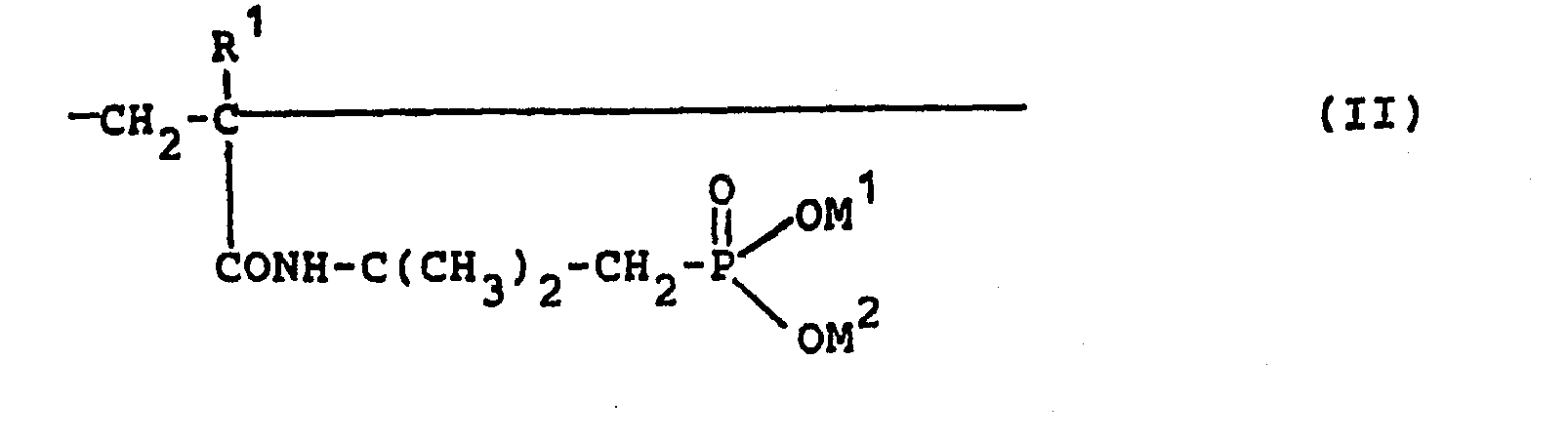














Applications Claiming Priority (2)
| Application Number | Priority Date | Filing Date | Title |
|---|---|---|---|
| DE19833326391 DE3326391A1 (de) | 1983-07-22 | 1983-07-22 | Phosphonsaeuregruppen enthaltende polymerisate, ihre herstellung und ihre verwendung |
| DE3326391 | 1983-07-22 |
Publications (2)
| Publication Number | Publication Date |
|---|---|
| EP0132630A2 true EP0132630A2 (de) | 1985-02-13 |
| EP0132630A3 EP0132630A3 (de) | 1986-10-01 |
Family
ID=6204602
Family Applications (1)
| Application Number | Title | Priority Date | Filing Date |
|---|---|---|---|
| EP84107636A Withdrawn EP0132630A3 (de) | 1983-07-22 | 1984-07-02 | Phosphonsäuregruppen enthaltende Polymerisate, ihre Herstellung und ihre Verwendung |
Country Status (4)
| Country | Link |
|---|---|
| EP (1) | EP0132630A3 (de) |
| JP (1) | JPS6040108A (de) |
| DE (1) | DE3326391A1 (de) |
| NO (1) | NO842737L (de) |
Cited By (7)
| Publication number | Priority date | Publication date | Assignee | Title |
|---|---|---|---|---|
| FR2578549A1 (fr) * | 1985-03-08 | 1986-09-12 | Nl Industries Inc | Compositions liquides contenant un polymere pour l'epaississement de milieux aqueux |
| EP0218351A3 (en) * | 1985-08-29 | 1988-01-27 | Calgon Corporation | Acrylic acid/2-acrylamido-2-methylpropylsulphonic acid/2-acrylamido-2-methylpropyl phosphonic acid polymers and their use as scale and corrosion inhibitors |
| EP0257826A1 (de) * | 1986-08-04 | 1988-03-02 | Calgon Corporation | Verfahren zur Korrosionsinhibierung von Kupfer und Kupferlegierungen |
| AU591696B2 (en) * | 1985-08-29 | 1989-12-14 | Calgon Corporation | Acrylic acid/2-acrylamido-2-methylpropylsufonic acid/2- accrylamido-2-methylpropyl phosphonic acid polymers as scale and corrosion inhibitors |
| AU592111B2 (en) * | 1985-08-30 | 1990-01-04 | Calgon Corporation | Acrylic acid/2-acrylamido-2-methylpropyl- sulfonic acid/2- acrylamido-2-methylpropyl phosphonic acid polymers |
| EP2298704A1 (de) * | 2009-08-20 | 2011-03-23 | Rohm and Haas Company | Kalk- und Rosthemmstoffe für Bedingungen mit hoher Temperatur und hohem Druck |
| WO2026017372A1 (en) | 2024-07-19 | 2026-01-22 | Snf Group | Polymer tanning agent |
Families Citing this family (1)
| Publication number | Priority date | Publication date | Assignee | Title |
|---|---|---|---|---|
| DE69132801T2 (de) * | 1990-09-03 | 2002-08-22 | Showa Denko K.K., Tokio/Tokyo | Flüssigkeitsabsorbierendes Mittel |
Family Cites Families (6)
| Publication number | Priority date | Publication date | Assignee | Title |
|---|---|---|---|---|
| DE3027236C2 (de) * | 1980-07-18 | 1985-08-01 | Chemische Fabrik Stockhausen GmbH, 4150 Krefeld | Terpolymere aus 2-Acrylamido-2-methyl-propansulfonsäure, Acrylamid und Acrylsäure in Form ihrer Salze, Verfahren zur Herstellung dieser Terpolymeren und Verwendung zur Verhinderung von Inkrustationen in wäßrigen Systemen |
| DE3027422A1 (de) * | 1980-07-19 | 1982-02-25 | Cassella Ag, 6000 Frankfurt | Hochmolekulare wasserloesliche copolymerisate, ihre herstellung und verwendung |
| GB2102441B (en) * | 1980-12-15 | 1984-10-10 | Dresser Ind | Copolymers soluble in an aqueous medium and stable in an acid medium, preparation and use thereof |
| DE3124454A1 (de) * | 1981-06-22 | 1983-07-14 | Cassella Ag, 6000 Frankfurt | Wasserquellbare vernetzte copolymerisate, ihre herstellung und verwendung |
| DE3210775A1 (de) * | 1982-03-24 | 1983-09-29 | Hoechst Ag, 6230 Frankfurt | 2-acrylamido-2-methyl-propanphosphonsaeure und ihre salze, verfahren zu deren herstellung und ihre verwendung zur herstellung von copolymeren |
| DE3313819A1 (de) * | 1983-04-16 | 1984-10-18 | Hoechst Ag, 6230 Frankfurt | 2-methacrylamido-2-methyl-propanphosphonsaeure und ihre salze, verfahren zu deren herstellung und ihre verwendung zur herstellung von copolymeren |
-
1983
- 1983-07-22 DE DE19833326391 patent/DE3326391A1/de not_active Withdrawn
-
1984
- 1984-07-02 EP EP84107636A patent/EP0132630A3/de not_active Withdrawn
- 1984-07-05 NO NO842737A patent/NO842737L/no unknown
- 1984-07-20 JP JP59149783A patent/JPS6040108A/ja active Pending
Cited By (10)
| Publication number | Priority date | Publication date | Assignee | Title |
|---|---|---|---|---|
| FR2578549A1 (fr) * | 1985-03-08 | 1986-09-12 | Nl Industries Inc | Compositions liquides contenant un polymere pour l'epaississement de milieux aqueux |
| EP0218351A3 (en) * | 1985-08-29 | 1988-01-27 | Calgon Corporation | Acrylic acid/2-acrylamido-2-methylpropylsulphonic acid/2-acrylamido-2-methylpropyl phosphonic acid polymers and their use as scale and corrosion inhibitors |
| AU591696B2 (en) * | 1985-08-29 | 1989-12-14 | Calgon Corporation | Acrylic acid/2-acrylamido-2-methylpropylsufonic acid/2- accrylamido-2-methylpropyl phosphonic acid polymers as scale and corrosion inhibitors |
| AU592111B2 (en) * | 1985-08-30 | 1990-01-04 | Calgon Corporation | Acrylic acid/2-acrylamido-2-methylpropyl- sulfonic acid/2- acrylamido-2-methylpropyl phosphonic acid polymers |
| EP0257826A1 (de) * | 1986-08-04 | 1988-03-02 | Calgon Corporation | Verfahren zur Korrosionsinhibierung von Kupfer und Kupferlegierungen |
| AU602155B2 (en) * | 1986-08-04 | 1990-10-04 | Calgon Corporation | Method of inhibiting the corrosion of copper and copper alloys |
| EP2298704A1 (de) * | 2009-08-20 | 2011-03-23 | Rohm and Haas Company | Kalk- und Rosthemmstoffe für Bedingungen mit hoher Temperatur und hohem Druck |
| US8158561B2 (en) | 2009-08-20 | 2012-04-17 | Rohm And Haas Company | Scale and corrosion inhibitors for high temperature and pressure conditions |
| WO2026017372A1 (en) | 2024-07-19 | 2026-01-22 | Snf Group | Polymer tanning agent |
| FR3164729A1 (fr) * | 2024-07-19 | 2026-01-23 | Snf Sa | Agent de tannage |
Also Published As
| Publication number | Publication date |
|---|---|
| EP0132630A3 (de) | 1986-10-01 |
| JPS6040108A (ja) | 1985-03-02 |
| DE3326391A1 (de) | 1985-01-31 |
| NO842737L (no) | 1985-01-23 |
Similar Documents
| Publication | Publication Date | Title |
|---|---|---|
| EP0112520B1 (de) | Metallchelate wasserlöslicher Copolymerisate, wasserlösliche Copolymerisate, ihre Herstellung und ihre Verwendung | |
| DE19909231C2 (de) | Wasserlösliche Copolymere auf AMPS-Basis und ihre Verwendung als Bohrhilfsmittel | |
| EP0113438B1 (de) | Wasserlösliche Copolymerisate, ihre Herstellung und ihre Verwendung | |
| DE19752093C2 (de) | Wasserlösliche Copolymere auf Acrylamid-Basis und ihre Verwendung als Zementationshilfsmittel | |
| EP0023712B1 (de) | Wasserlösliches Copolymerisat, Verfahren zu seiner Herstellung und seine Verwendung | |
| WO1983002449A1 (fr) | Copolymeres aqua-solubles, leur preparation et leur utilisation | |
| DE19609509B4 (de) | Wäßrige Polymerdispersionen als Bindemittel für elastische block- und kratzfeste Beschichtungen | |
| EP0123297B1 (de) | Vernetzte hydrophile Copolymerisate, ihre Herstellung und Verwendung | |
| EP0003235A1 (de) | Wasserlösliche Copolymerisate auf der Basis von hydrophilen äthylenisch ungesättigten Monomeren;Verfahren zur Herstellung dieser Copolymerisate und ihre Verwendung | |
| EP1059316A1 (de) | Wasserlösliche Mischpolymere und ihre Verwendung für Exploration und Förderung von Erdöl und Erdgas | |
| CH638233A5 (de) | Ein wasserloesliches vinyladditionspolymer enthaltende mischung. | |
| DE102004027735A1 (de) | Feinteilige, amphotere, wässrige Polymerdispersionen, Verfahren zu ihrer Herstellung und ihre Verwendung | |
| DE1495645B2 (de) | Verfahren zur Herstellung stabiler, wäßriger Emulsionen bzw. Dispersionen von Äthylen-Mischpolymerisaten | |
| DE2806646A1 (de) | Terpolymer-emulsionen zum eindicken von butadien/styrol-latices | |
| EP2115015B1 (de) | Verfahren zur herstellung einer wässrigen polymerzusammensetzung unter verwendung wasserlöslicher radikalkettenregler | |
| DE10150190A1 (de) | Verfahren zur Verringerung oder zur vollständigen Einstellung von Wasserzuflüssen bei einer unterirdischen Formation, und vernetzbare Copolymere zu dessen Durchführung | |
| DE3404491A1 (de) | Wasserloesliche polymerisate und deren verwendung als bohrspueladditive | |
| EP1512703B1 (de) | Verwendung copolymerisierbarer Tenside in der Emulsionspolymerisation | |
| EP0025979A1 (de) | Wässrige Lösung oder Dispersion eines Styrol/Maleinsäureanhydrid-Copolymers, Verfahren zu ihrer Herstellung und ihre Verwendung | |
| DE3326391A1 (de) | Phosphonsaeuregruppen enthaltende polymerisate, ihre herstellung und ihre verwendung | |
| EP0079071A1 (de) | Wasserlösliches Copolymerisat, seine Herstellung und Verwendung | |
| DE3245541A1 (de) | Wasserloesliche copolymerisate, ihre herstellung und ihre verwendung | |
| EP0462469A1 (de) | Leimungsmittel für Papier | |
| DE3525799A1 (de) | Bindemittel fuer den pigmentdruck von textilgut | |
| EP0051144A1 (de) | Feinteilige, stickstoffhaltige Monomere einpolymerisiert enthaltende Polymerdispersion |
Legal Events
| Date | Code | Title | Description |
|---|---|---|---|
| PUAI | Public reference made under article 153(3) epc to a published international application that has entered the european phase |
Free format text: ORIGINAL CODE: 0009012 |
|
| AK | Designated contracting states |
Designated state(s): AT BE CH DE FR GB IT LI NL SE |
|
| PUAL | Search report despatched |
Free format text: ORIGINAL CODE: 0009013 |
|
| AK | Designated contracting states |
Kind code of ref document: A3 Designated state(s): AT BE CH DE FR GB IT LI NL SE |
|
| STAA | Information on the status of an ep patent application or granted ep patent |
Free format text: STATUS: THE APPLICATION IS DEEMED TO BE WITHDRAWN |
|
| 18D | Application deemed to be withdrawn |
Effective date: 19870402 |
|
| RIN1 | Information on inventor provided before grant (corrected) |
Inventor name: GREINER, ULRICH, DR. Inventor name: BALZER, JULIANE Inventor name: ENGELHARDT, FRIEDRICH, DR. Inventor name: RIEGEL, ULRICH Inventor name: SAUER, JOSEF, DR. |