EP0132769A1 - Pharmazeutisches Mittel zur Behandlung des Diabetes mellitus - Google Patents
Pharmazeutisches Mittel zur Behandlung des Diabetes mellitus Download PDFInfo
- Publication number
- EP0132769A1 EP0132769A1 EP84108441A EP84108441A EP0132769A1 EP 0132769 A1 EP0132769 A1 EP 0132769A1 EP 84108441 A EP84108441 A EP 84108441A EP 84108441 A EP84108441 A EP 84108441A EP 0132769 A1 EP0132769 A1 EP 0132769A1
- Authority
- EP
- European Patent Office
- Prior art keywords
- insulin
- formula
- agent
- arg
- proinsulin
- Prior art date
- Legal status (The legal status is an assumption and is not a legal conclusion. Google has not performed a legal analysis and makes no representation as to the accuracy of the status listed.)
- Granted
Links
- 206010012601 diabetes mellitus Diseases 0.000 title abstract description 8
- 239000008194 pharmaceutical composition Substances 0.000 title 1
- NOESYZHRGYRDHS-UHFFFAOYSA-N insulin Chemical class N1C(=O)C(NC(=O)C(CCC(N)=O)NC(=O)C(CCC(O)=O)NC(=O)C(C(C)C)NC(=O)C(NC(=O)CN)C(C)CC)CSSCC(C(NC(CO)C(=O)NC(CC(C)C)C(=O)NC(CC=2C=CC(O)=CC=2)C(=O)NC(CCC(N)=O)C(=O)NC(CC(C)C)C(=O)NC(CCC(O)=O)C(=O)NC(CC(N)=O)C(=O)NC(CC=2C=CC(O)=CC=2)C(=O)NC(CSSCC(NC(=O)C(C(C)C)NC(=O)C(CC(C)C)NC(=O)C(CC=2C=CC(O)=CC=2)NC(=O)C(CC(C)C)NC(=O)C(C)NC(=O)C(CCC(O)=O)NC(=O)C(C(C)C)NC(=O)C(CC(C)C)NC(=O)C(CC=2NC=NC=2)NC(=O)C(CO)NC(=O)CNC2=O)C(=O)NCC(=O)NC(CCC(O)=O)C(=O)NC(CCCNC(N)=N)C(=O)NCC(=O)NC(CC=3C=CC=CC=3)C(=O)NC(CC=3C=CC=CC=3)C(=O)NC(CC=3C=CC(O)=CC=3)C(=O)NC(C(C)O)C(=O)N3C(CCC3)C(=O)NC(CCCCN)C(=O)NC(C)C(O)=O)C(=O)NC(CC(N)=O)C(O)=O)=O)NC(=O)C(C(C)CC)NC(=O)C(CO)NC(=O)C(C(C)O)NC(=O)C1CSSCC2NC(=O)C(CC(C)C)NC(=O)C(NC(=O)C(CCC(N)=O)NC(=O)C(CC(N)=O)NC(=O)C(NC(=O)C(N)CC=1C=CC=CC=1)C(C)C)CC1=CN=CN1 NOESYZHRGYRDHS-UHFFFAOYSA-N 0.000 claims abstract description 195
- 229940125396 insulin Drugs 0.000 claims abstract description 77
- 102000004877 Insulin Human genes 0.000 claims abstract description 71
- 108090001061 Insulin Proteins 0.000 claims abstract description 70
- 239000004026 insulin derivative Substances 0.000 claims abstract description 33
- 230000007935 neutral effect Effects 0.000 claims abstract description 20
- 150000008575 L-amino acids Chemical class 0.000 claims abstract description 9
- 229910052739 hydrogen Inorganic materials 0.000 claims abstract description 9
- 239000004480 active ingredient Substances 0.000 claims abstract description 7
- 125000000962 organic group Chemical group 0.000 claims abstract description 4
- 125000004432 carbon atom Chemical group C* 0.000 claims abstract description 3
- 239000003814 drug Substances 0.000 claims abstract description 3
- 108010076181 Proinsulin Proteins 0.000 claims description 55
- 238000000034 method Methods 0.000 claims description 28
- 108010075254 C-Peptide Proteins 0.000 claims description 24
- VOUAQYXWVJDEQY-QENPJCQMSA-N 33017-11-7 Chemical compound OC(=O)CC[C@H](N)C(=O)N[C@@H](C)C(=O)N[C@@H](CCC(O)=O)C(=O)N[C@@H](CC(O)=O)C(=O)N[C@@H](CC(C)C)C(=O)N[C@@H](CCC(N)=O)C(=O)N[C@@H](C(C)C)C(=O)NCC(=O)N[C@@H](CCC(N)=O)C(=O)N[C@@H](C(C)C)C(=O)N[C@@H](CCC(O)=O)C(=O)N[C@@H](CC(C)C)C(=O)NCC(=O)NCC(=O)NCC(=O)N1CCC[C@H]1C(=O)NCC(=O)N[C@@H](C)C(=O)NCC(=O)N[C@@H](CO)C(=O)N[C@@H](CC(C)C)C(=O)N[C@@H](CCC(N)=O)C(=O)N1[C@H](C(=O)N[C@@H](CC(C)C)C(=O)N[C@@H](C)C(=O)N[C@@H](CC(C)C)C(=O)N[C@@H](CCC(O)=O)C(=O)NCC(=O)N[C@@H](CO)C(=O)N[C@@H](CC(C)C)C(=O)N[C@@H](CCC(N)=O)C(O)=O)CCC1 VOUAQYXWVJDEQY-QENPJCQMSA-N 0.000 claims description 23
- 239000003795 chemical substances by application Substances 0.000 claims description 22
- 150000001413 amino acids Chemical class 0.000 claims description 19
- 230000000694 effects Effects 0.000 claims description 17
- 235000001014 amino acid Nutrition 0.000 claims description 15
- 125000003282 alkyl amino group Chemical group 0.000 claims description 13
- 125000003178 carboxy group Chemical group [H]OC(*)=O 0.000 claims description 11
- LFQSCWFLJHTTHZ-UHFFFAOYSA-N Ethanol Chemical compound CCO LFQSCWFLJHTTHZ-UHFFFAOYSA-N 0.000 claims description 7
- 239000000725 suspension Substances 0.000 claims description 7
- 229910052725 zinc Inorganic materials 0.000 claims description 7
- 239000011701 zinc Substances 0.000 claims description 7
- HCHKCACWOHOZIP-UHFFFAOYSA-N Zinc Chemical compound [Zn] HCHKCACWOHOZIP-UHFFFAOYSA-N 0.000 claims description 6
- 125000003545 alkoxy group Chemical group 0.000 claims description 6
- 108090000765 processed proteins & peptides Proteins 0.000 claims description 5
- 238000004519 manufacturing process Methods 0.000 claims description 4
- 238000002156 mixing Methods 0.000 claims description 4
- 125000000539 amino acid group Chemical group 0.000 claims description 3
- 238000010276 construction Methods 0.000 claims description 3
- 150000002148 esters Chemical group 0.000 claims description 3
- 102000004196 processed proteins & peptides Human genes 0.000 claims description 3
- 239000003381 stabilizer Substances 0.000 claims description 3
- 150000008574 D-amino acids Chemical class 0.000 claims description 2
- QJPWUUJVYOJNMH-VKHMYHEASA-N L-homoserine lactone Chemical group N[C@H]1CCOC1=O QJPWUUJVYOJNMH-VKHMYHEASA-N 0.000 claims description 2
- 150000001371 alpha-amino acids Chemical class 0.000 claims description 2
- 235000008206 alpha-amino acids Nutrition 0.000 claims description 2
- 150000001408 amides Chemical group 0.000 claims description 2
- 150000003863 ammonium salts Chemical class 0.000 claims description 2
- 239000012928 buffer substance Substances 0.000 claims description 2
- 239000007951 isotonicity adjuster Substances 0.000 claims description 2
- 150000002596 lactones Chemical class 0.000 claims description 2
- 239000000463 material Substances 0.000 claims description 2
- 230000006920 protein precipitation Effects 0.000 claims description 2
- 150000003839 salts Chemical class 0.000 claims description 2
- 150000001447 alkali salts Chemical class 0.000 claims 1
- 150000003973 alkyl amines Chemical class 0.000 claims 1
- 125000000656 azaniumyl group Chemical group [H][N+]([H])([H])[*] 0.000 claims 1
- 239000002552 dosage form Substances 0.000 claims 1
- 229940079593 drug Drugs 0.000 claims 1
- 239000003755 preservative agent Substances 0.000 claims 1
- 230000002335 preservative effect Effects 0.000 claims 1
- PBGKTOXHQIOBKM-FHFVDXKLSA-N insulin (human) Chemical compound C([C@@H](C(=O)N[C@@H](CC(C)C)C(=O)N[C@H]1CSSC[C@H]2C(=O)N[C@H](C(=O)N[C@@H](CO)C(=O)N[C@H](C(=O)N[C@H](C(N[C@@H](CO)C(=O)N[C@@H](CC(C)C)C(=O)N[C@@H](CC=3C=CC(O)=CC=3)C(=O)N[C@@H](CCC(N)=O)C(=O)N[C@@H](CC(C)C)C(=O)N[C@@H](CCC(O)=O)C(=O)N[C@@H](CC(N)=O)C(=O)N[C@@H](CC=3C=CC(O)=CC=3)C(=O)N[C@@H](CSSC[C@H](NC(=O)[C@H](C(C)C)NC(=O)[C@H](CC(C)C)NC(=O)[C@H](CC=3C=CC(O)=CC=3)NC(=O)[C@H](CC(C)C)NC(=O)[C@H](C)NC(=O)[C@H](CCC(O)=O)NC(=O)[C@H](C(C)C)NC(=O)[C@H](CC(C)C)NC(=O)[C@H](CC=3NC=NC=3)NC(=O)[C@H](CO)NC(=O)CNC1=O)C(=O)NCC(=O)N[C@@H](CCC(O)=O)C(=O)N[C@@H](CCCNC(N)=N)C(=O)NCC(=O)N[C@@H](CC=1C=CC=CC=1)C(=O)N[C@@H](CC=1C=CC=CC=1)C(=O)N[C@@H](CC=1C=CC(O)=CC=1)C(=O)N[C@@H]([C@@H](C)O)C(=O)N1[C@@H](CCC1)C(=O)N[C@@H](CCCCN)C(=O)N[C@@H]([C@@H](C)O)C(O)=O)C(=O)N[C@@H](CC(N)=O)C(O)=O)=O)CSSC[C@@H](C(N2)=O)NC(=O)[C@H](CCC(N)=O)NC(=O)[C@H](CCC(O)=O)NC(=O)[C@H](C(C)C)NC(=O)[C@@H](NC(=O)CN)[C@@H](C)CC)[C@@H](C)CC)[C@@H](C)O)NC(=O)[C@H](CCC(N)=O)NC(=O)[C@H](CC(N)=O)NC(=O)[C@@H](NC(=O)[C@@H](N)CC=1C=CC=CC=1)C(C)C)C1=CN=CN1 PBGKTOXHQIOBKM-FHFVDXKLSA-N 0.000 description 40
- 101000976075 Homo sapiens Insulin Proteins 0.000 description 36
- ODKSFYDXXFIFQN-BYPYZUCNSA-N L-arginine Chemical compound OC(=O)[C@@H](N)CCCN=C(N)N ODKSFYDXXFIFQN-BYPYZUCNSA-N 0.000 description 26
- 239000000203 mixture Substances 0.000 description 21
- HEMHJVSKTPXQMS-UHFFFAOYSA-M Sodium hydroxide Chemical compound [OH-].[Na+] HEMHJVSKTPXQMS-UHFFFAOYSA-M 0.000 description 18
- 238000002360 preparation method Methods 0.000 description 16
- 229940024606 amino acid Drugs 0.000 description 13
- 239000013078 crystal Substances 0.000 description 9
- VEXZGXHMUGYJMC-UHFFFAOYSA-N Hydrochloric acid Chemical compound Cl VEXZGXHMUGYJMC-UHFFFAOYSA-N 0.000 description 8
- COLNVLDHVKWLRT-QMMMGPOBSA-N L-phenylalanine Chemical compound OC(=O)[C@@H](N)CC1=CC=CC=C1 COLNVLDHVKWLRT-QMMMGPOBSA-N 0.000 description 7
- KDXKERNSBIXSRK-UHFFFAOYSA-N Lysine Natural products NCCCCC(N)C(O)=O KDXKERNSBIXSRK-UHFFFAOYSA-N 0.000 description 7
- 108010005991 Pork Regular Insulin Proteins 0.000 description 7
- 230000009471 action Effects 0.000 description 7
- 125000000956 methoxy group Chemical group [H]C([H])([H])O* 0.000 description 7
- 101001011741 Bos taurus Insulin Proteins 0.000 description 6
- IXIBAKNTJSCKJM-BUBXBXGNSA-N bovine insulin Chemical compound C([C@@H](C(=O)N[C@@H](CC(C)C)C(=O)N[C@H]1CSSC[C@H]2C(=O)N[C@@H](C)C(=O)N[C@@H](CO)C(=O)N[C@H](C(=O)N[C@H](C(N[C@@H](CO)C(=O)N[C@@H](CC(C)C)C(=O)N[C@@H](CC=3C=CC(O)=CC=3)C(=O)N[C@@H](CCC(N)=O)C(=O)N[C@@H](CC(C)C)C(=O)N[C@@H](CCC(O)=O)C(=O)N[C@@H](CC(N)=O)C(=O)N[C@@H](CC=3C=CC(O)=CC=3)C(=O)N[C@@H](CSSC[C@H](NC(=O)[C@H](C(C)C)NC(=O)[C@H](CC(C)C)NC(=O)[C@H](CC=3C=CC(O)=CC=3)NC(=O)[C@H](CC(C)C)NC(=O)[C@H](C)NC(=O)[C@H](CCC(O)=O)NC(=O)[C@H](C(C)C)NC(=O)[C@H](CC(C)C)NC(=O)[C@H](CC=3NC=NC=3)NC(=O)[C@H](CO)NC(=O)CNC1=O)C(=O)NCC(=O)N[C@@H](CCC(O)=O)C(=O)N[C@@H](CCCNC(N)=N)C(=O)NCC(=O)N[C@@H](CC=1C=CC=CC=1)C(=O)N[C@@H](CC=1C=CC=CC=1)C(=O)N[C@@H](CC=1C=CC(O)=CC=1)C(=O)N[C@@H]([C@@H](C)O)C(=O)N1[C@@H](CCC1)C(=O)N[C@@H](CCCCN)C(=O)N[C@@H](C)C(O)=O)C(=O)N[C@@H](CC(N)=O)C(O)=O)=O)CSSC[C@@H](C(N2)=O)NC(=O)[C@H](CCC(N)=O)NC(=O)[C@H](CCC(O)=O)NC(=O)[C@H](C(C)C)NC(=O)[C@@H](NC(=O)CN)[C@@H](C)CC)C(C)C)NC(=O)[C@H](CCC(N)=O)NC(=O)[C@H](CC(N)=O)NC(=O)[C@@H](NC(=O)[C@@H](N)CC=1C=CC=CC=1)C(C)C)C1=CN=CN1 IXIBAKNTJSCKJM-BUBXBXGNSA-N 0.000 description 6
- 108090000623 proteins and genes Proteins 0.000 description 6
- -1 tert-Butyloxycarbonyl-(Boc) Chemical class 0.000 description 6
- XLYOFNOQVPJJNP-UHFFFAOYSA-N water Substances O XLYOFNOQVPJJNP-UHFFFAOYSA-N 0.000 description 6
- 102000007327 Protamines Human genes 0.000 description 5
- 108010007568 Protamines Proteins 0.000 description 5
- 229960001231 choline Drugs 0.000 description 5
- 230000003111 delayed effect Effects 0.000 description 5
- 230000029087 digestion Effects 0.000 description 5
- 101000993800 Sus scrofa Insulin Proteins 0.000 description 4
- 102000004142 Trypsin Human genes 0.000 description 4
- 108090000631 Trypsin Proteins 0.000 description 4
- 230000015572 biosynthetic process Effects 0.000 description 4
- 238000010353 genetic engineering Methods 0.000 description 4
- 238000001727 in vivo Methods 0.000 description 4
- 239000000543 intermediate Substances 0.000 description 4
- 229940119528 pork insulin Drugs 0.000 description 4
- 108010066381 preproinsulin Proteins 0.000 description 4
- 230000008569 process Effects 0.000 description 4
- 229950008679 protamine sulfate Drugs 0.000 description 4
- 125000006239 protecting group Chemical group 0.000 description 4
- 235000018102 proteins Nutrition 0.000 description 4
- 102000004169 proteins and genes Human genes 0.000 description 4
- 239000000126 substance Substances 0.000 description 4
- 238000002560 therapeutic procedure Methods 0.000 description 4
- 239000012588 trypsin Substances 0.000 description 4
- 241000282472 Canis lupus familiaris Species 0.000 description 3
- 102000004190 Enzymes Human genes 0.000 description 3
- 108090000790 Enzymes Proteins 0.000 description 3
- PEDCQBHIVMGVHV-UHFFFAOYSA-N Glycerine Chemical compound OCC(O)CO PEDCQBHIVMGVHV-UHFFFAOYSA-N 0.000 description 3
- OKKJLVBELUTLKV-UHFFFAOYSA-N Methanol Chemical compound OC OKKJLVBELUTLKV-UHFFFAOYSA-N 0.000 description 3
- 101710093543 Probable non-specific lipid-transfer protein Proteins 0.000 description 3
- 238000003776 cleavage reaction Methods 0.000 description 3
- 150000001875 compounds Chemical class 0.000 description 3
- 238000006731 degradation reaction Methods 0.000 description 3
- 229940088598 enzyme Drugs 0.000 description 3
- 238000009472 formulation Methods 0.000 description 3
- 239000012634 fragment Substances 0.000 description 3
- 125000002795 guanidino group Chemical group C(N)(=N)N* 0.000 description 3
- 229940088597 hormone Drugs 0.000 description 3
- 239000005556 hormone Substances 0.000 description 3
- 239000002244 precipitate Substances 0.000 description 3
- 239000002243 precursor Substances 0.000 description 3
- 239000000047 product Substances 0.000 description 3
- 150000003254 radicals Chemical class 0.000 description 3
- 230000007017 scission Effects 0.000 description 3
- 235000002639 sodium chloride Nutrition 0.000 description 3
- 239000007858 starting material Substances 0.000 description 3
- 230000001810 trypsinlike Effects 0.000 description 3
- YSMODUONRAFBET-UHFFFAOYSA-N 5-hydroxylysine Chemical group NCC(O)CCC(N)C(O)=O YSMODUONRAFBET-UHFFFAOYSA-N 0.000 description 2
- QGZKDVFQNNGYKY-UHFFFAOYSA-N Ammonia Chemical compound N QGZKDVFQNNGYKY-UHFFFAOYSA-N 0.000 description 2
- IJGRMHOSHXDMSA-UHFFFAOYSA-N Atomic nitrogen Chemical compound N#N IJGRMHOSHXDMSA-UHFFFAOYSA-N 0.000 description 2
- 241000283690 Bos taurus Species 0.000 description 2
- 108090000087 Carboxypeptidase B Proteins 0.000 description 2
- 102000003670 Carboxypeptidase B Human genes 0.000 description 2
- 102000005367 Carboxypeptidases Human genes 0.000 description 2
- 108010006303 Carboxypeptidases Proteins 0.000 description 2
- ODKSFYDXXFIFQN-SCSAIBSYSA-N D-arginine Chemical compound OC(=O)[C@H](N)CCCNC(N)=N ODKSFYDXXFIFQN-SCSAIBSYSA-N 0.000 description 2
- ROSDSFDQCJNGOL-UHFFFAOYSA-N Dimethylamine Chemical compound CNC ROSDSFDQCJNGOL-UHFFFAOYSA-N 0.000 description 2
- 102000005593 Endopeptidases Human genes 0.000 description 2
- 108010059378 Endopeptidases Proteins 0.000 description 2
- 241000282412 Homo Species 0.000 description 2
- UFHFLCQGNIYNRP-UHFFFAOYSA-N Hydrogen Chemical compound [H][H] UFHFLCQGNIYNRP-UHFFFAOYSA-N 0.000 description 2
- AHLPHDHHMVZTML-BYPYZUCNSA-N L-Ornithine Chemical compound NCCC[C@H](N)C(O)=O AHLPHDHHMVZTML-BYPYZUCNSA-N 0.000 description 2
- HNDVDQJCIGZPNO-YFKPBYRVSA-N L-histidine Chemical compound OC(=O)[C@@H](N)CC1=CN=CN1 HNDVDQJCIGZPNO-YFKPBYRVSA-N 0.000 description 2
- AHLPHDHHMVZTML-UHFFFAOYSA-N Orn-delta-NH2 Natural products NCCCC(N)C(O)=O AHLPHDHHMVZTML-UHFFFAOYSA-N 0.000 description 2
- UTJLXEIPEHZYQJ-UHFFFAOYSA-N Ornithine Natural products OC(=O)C(C)CCCN UTJLXEIPEHZYQJ-UHFFFAOYSA-N 0.000 description 2
- 241000283973 Oryctolagus cuniculus Species 0.000 description 2
- ISWSIDIOOBJBQZ-UHFFFAOYSA-N Phenol Chemical compound OC1=CC=CC=C1 ISWSIDIOOBJBQZ-UHFFFAOYSA-N 0.000 description 2
- 241000288906 Primates Species 0.000 description 2
- 241000282898 Sus scrofa Species 0.000 description 2
- 239000000654 additive Substances 0.000 description 2
- 235000009697 arginine Nutrition 0.000 description 2
- 230000004071 biological effect Effects 0.000 description 2
- 239000008280 blood Substances 0.000 description 2
- 210000004369 blood Anatomy 0.000 description 2
- 210000004899 c-terminal region Anatomy 0.000 description 2
- 230000015556 catabolic process Effects 0.000 description 2
- OEYIOHPDSNJKLS-UHFFFAOYSA-N choline Chemical compound C[N+](C)(C)CCO OEYIOHPDSNJKLS-UHFFFAOYSA-N 0.000 description 2
- 230000002255 enzymatic effect Effects 0.000 description 2
- 102000018146 globin Human genes 0.000 description 2
- 108060003196 globin Proteins 0.000 description 2
- 238000004128 high performance liquid chromatography Methods 0.000 description 2
- 239000001257 hydrogen Substances 0.000 description 2
- 230000002163 immunogen Effects 0.000 description 2
- 230000005923 long-lasting effect Effects 0.000 description 2
- RLSSMJSEOOYNOY-UHFFFAOYSA-N m-cresol Chemical compound CC1=CC=CC(O)=C1 RLSSMJSEOOYNOY-UHFFFAOYSA-N 0.000 description 2
- 235000012054 meals Nutrition 0.000 description 2
- 239000002609 medium Substances 0.000 description 2
- 244000005700 microbiome Species 0.000 description 2
- BAVYZALUXZFZLV-UHFFFAOYSA-N mono-methylamine Natural products NC BAVYZALUXZFZLV-UHFFFAOYSA-N 0.000 description 2
- 229960003104 ornithine Drugs 0.000 description 2
- 239000008177 pharmaceutical agent Substances 0.000 description 2
- COLNVLDHVKWLRT-UHFFFAOYSA-N phenylalanine Natural products OC(=O)C(N)CC1=CC=CC=C1 COLNVLDHVKWLRT-UHFFFAOYSA-N 0.000 description 2
- 230000000979 retarding effect Effects 0.000 description 2
- 239000000243 solution Substances 0.000 description 2
- 241000894007 species Species 0.000 description 2
- 230000000087 stabilizing effect Effects 0.000 description 2
- 239000006228 supernatant Substances 0.000 description 2
- 238000003786 synthesis reaction Methods 0.000 description 2
- 230000000007 visual effect Effects 0.000 description 2
- 229940090248 4-hydroxybenzoic acid Drugs 0.000 description 1
- OMLWNBVRVJYMBQ-YUMQZZPRSA-N Arg-Arg Chemical compound NC(N)=NCCC[C@H](N)C(=O)N[C@@H](CCCN=C(N)N)C(O)=O OMLWNBVRVJYMBQ-YUMQZZPRSA-N 0.000 description 1
- 239000004475 Arginine Substances 0.000 description 1
- 108020004414 DNA Proteins 0.000 description 1
- 241000588724 Escherichia coli Species 0.000 description 1
- 108090000371 Esterases Proteins 0.000 description 1
- LCWXJXMHJVIJFK-UHFFFAOYSA-N Hydroxylysine Natural products NCC(O)CC(N)CC(O)=O LCWXJXMHJVIJFK-UHFFFAOYSA-N 0.000 description 1
- 208000013016 Hypoglycemia Diseases 0.000 description 1
- COCFEDIXXNGUNL-RFKWWTKHSA-N Insulin glargine Chemical compound C([C@@H](C(=O)N[C@@H](CC(C)C)C(=O)N[C@H]1CSSC[C@H]2C(=O)N[C@H](C(=O)N[C@@H](CO)C(=O)N[C@H](C(=O)N[C@H](C(N[C@@H](CO)C(=O)N[C@@H](CC(C)C)C(=O)N[C@@H](CC=3C=CC(O)=CC=3)C(=O)N[C@@H](CCC(N)=O)C(=O)N[C@@H](CC(C)C)C(=O)N[C@@H](CCC(O)=O)C(=O)N[C@@H](CC(N)=O)C(=O)N[C@@H](CC=3C=CC(O)=CC=3)C(=O)N[C@@H](CSSC[C@H](NC(=O)[C@H](C(C)C)NC(=O)[C@H](CC(C)C)NC(=O)[C@H](CC=3C=CC(O)=CC=3)NC(=O)[C@H](CC(C)C)NC(=O)[C@H](C)NC(=O)[C@H](CCC(O)=O)NC(=O)[C@H](C(C)C)NC(=O)[C@H](CC(C)C)NC(=O)[C@H](CC=3NC=NC=3)NC(=O)[C@H](CO)NC(=O)CNC1=O)C(=O)NCC(=O)N[C@@H](CCC(O)=O)C(=O)N[C@@H](CCCNC(N)=N)C(=O)NCC(=O)N[C@@H](CC=1C=CC=CC=1)C(=O)N[C@@H](CC=1C=CC=CC=1)C(=O)N[C@@H](CC=1C=CC(O)=CC=1)C(=O)N[C@@H]([C@@H](C)O)C(=O)N1[C@@H](CCC1)C(=O)N[C@@H](CCCCN)C(=O)N[C@@H]([C@@H](C)O)C(=O)N[C@@H](CCCNC(N)=N)C(=O)N[C@@H](CCCNC(N)=N)C(O)=O)C(=O)NCC(O)=O)=O)CSSC[C@@H](C(N2)=O)NC(=O)[C@H](CCC(N)=O)NC(=O)[C@H](CCC(O)=O)NC(=O)[C@H](C(C)C)NC(=O)[C@@H](NC(=O)CN)[C@@H](C)CC)[C@@H](C)CC)[C@@H](C)O)NC(=O)[C@H](CCC(N)=O)NC(=O)[C@H](CC(N)=O)NC(=O)[C@@H](NC(=O)[C@@H](N)CC=1C=CC=CC=1)C(C)C)C1=CN=CN1 COCFEDIXXNGUNL-RFKWWTKHSA-N 0.000 description 1
- 229940122254 Intermediate acting insulin Drugs 0.000 description 1
- 241001202975 Isophanes Species 0.000 description 1
- 235000014852 L-arginine Nutrition 0.000 description 1
- 229930064664 L-arginine Natural products 0.000 description 1
- KDXKERNSBIXSRK-YFKPBYRVSA-N L-lysine Chemical compound NCCCC[C@H](N)C(O)=O KDXKERNSBIXSRK-YFKPBYRVSA-N 0.000 description 1
- FFEARJCKVFRZRR-BYPYZUCNSA-N L-methionine Chemical compound CSCC[C@H](N)C(O)=O FFEARJCKVFRZRR-BYPYZUCNSA-N 0.000 description 1
- NPBGTPKLVJEOBE-IUCAKERBSA-N Lys-Arg Chemical compound NCCCC[C@H](N)C(=O)N[C@H](C(O)=O)CCCNC(N)=N NPBGTPKLVJEOBE-IUCAKERBSA-N 0.000 description 1
- 206010054805 Macroangiopathy Diseases 0.000 description 1
- 241001465754 Metazoa Species 0.000 description 1
- 108091028043 Nucleic acid sequence Proteins 0.000 description 1
- 102000035195 Peptidases Human genes 0.000 description 1
- 108091005804 Peptidases Proteins 0.000 description 1
- 108700027570 Phe(B1)- insulin Proteins 0.000 description 1
- 108020004511 Recombinant DNA Proteins 0.000 description 1
- 208000017442 Retinal disease Diseases 0.000 description 1
- 206010038923 Retinopathy Diseases 0.000 description 1
- VMHLLURERBWHNL-UHFFFAOYSA-M Sodium acetate Chemical compound [Na+].CC([O-])=O VMHLLURERBWHNL-UHFFFAOYSA-M 0.000 description 1
- FAPWRFPIFSIZLT-UHFFFAOYSA-M Sodium chloride Chemical compound [Na+].[Cl-] FAPWRFPIFSIZLT-UHFFFAOYSA-M 0.000 description 1
- 241000282887 Suidae Species 0.000 description 1
- PTFCDOFLOPIGGS-UHFFFAOYSA-N Zinc dication Chemical compound [Zn+2] PTFCDOFLOPIGGS-UHFFFAOYSA-N 0.000 description 1
- 239000002253 acid Substances 0.000 description 1
- 239000003929 acidic solution Substances 0.000 description 1
- 230000002378 acidificating effect Effects 0.000 description 1
- 150000007513 acids Chemical class 0.000 description 1
- 230000000996 additive effect Effects 0.000 description 1
- 150000001298 alcohols Chemical class 0.000 description 1
- 229910052783 alkali metal Inorganic materials 0.000 description 1
- 125000000217 alkyl group Chemical group 0.000 description 1
- 125000003368 amide group Chemical group 0.000 description 1
- 150000003862 amino acid derivatives Chemical class 0.000 description 1
- 125000003277 amino group Chemical group 0.000 description 1
- 229910021529 ammonia Inorganic materials 0.000 description 1
- 238000013459 approach Methods 0.000 description 1
- 239000012736 aqueous medium Substances 0.000 description 1
- ODKSFYDXXFIFQN-UHFFFAOYSA-N arginine Natural products OC(=O)C(N)CCCNC(N)=N ODKSFYDXXFIFQN-UHFFFAOYSA-N 0.000 description 1
- 150000001484 arginines Chemical class 0.000 description 1
- 108010068380 arginylarginine Proteins 0.000 description 1
- 239000002585 base Substances 0.000 description 1
- 230000008901 benefit Effects 0.000 description 1
- 238000007068 beta-elimination reaction Methods 0.000 description 1
- 239000000969 carrier Substances 0.000 description 1
- 238000006243 chemical reaction Methods 0.000 description 1
- 238000010367 cloning Methods 0.000 description 1
- 125000000000 cycloalkoxy group Chemical group 0.000 description 1
- 239000003405 delayed action preparation Substances 0.000 description 1
- 108700028250 desoctapeptide- insulin Proteins 0.000 description 1
- 238000009792 diffusion process Methods 0.000 description 1
- 238000010790 dilution Methods 0.000 description 1
- 239000012895 dilution Substances 0.000 description 1
- 235000006694 eating habits Nutrition 0.000 description 1
- YSMODUONRAFBET-UHNVWZDZSA-N erythro-5-hydroxy-L-lysine Chemical compound NC[C@H](O)CC[C@H](N)C(O)=O YSMODUONRAFBET-UHNVWZDZSA-N 0.000 description 1
- 239000000284 extract Substances 0.000 description 1
- 238000000855 fermentation Methods 0.000 description 1
- 230000004151 fermentation Effects 0.000 description 1
- 230000002496 gastric effect Effects 0.000 description 1
- 210000004907 gland Anatomy 0.000 description 1
- 229960002885 histidine Drugs 0.000 description 1
- 230000013632 homeostatic process Effects 0.000 description 1
- 150000002431 hydrogen Chemical class 0.000 description 1
- QJHBJHUKURJDLG-UHFFFAOYSA-N hydroxy-L-lysine Natural products NCCCCC(NO)C(O)=O QJHBJHUKURJDLG-UHFFFAOYSA-N 0.000 description 1
- CBOIHMRHGLHBPB-UHFFFAOYSA-N hydroxymethyl Chemical compound O[CH2] CBOIHMRHGLHBPB-UHFFFAOYSA-N 0.000 description 1
- 201000001421 hyperglycemia Diseases 0.000 description 1
- 125000002883 imidazolyl group Chemical group 0.000 description 1
- 238000002347 injection Methods 0.000 description 1
- 239000007924 injection Substances 0.000 description 1
- 238000011835 investigation Methods 0.000 description 1
- 238000001155 isoelectric focusing Methods 0.000 description 1
- 238000002955 isolation Methods 0.000 description 1
- 208000017169 kidney disease Diseases 0.000 description 1
- 238000005259 measurement Methods 0.000 description 1
- 208000030159 metabolic disease Diseases 0.000 description 1
- 239000002207 metabolite Substances 0.000 description 1
- 229930182817 methionine Natural products 0.000 description 1
- 206010062198 microangiopathy Diseases 0.000 description 1
- 230000000813 microbial effect Effects 0.000 description 1
- 201000001119 neuropathy Diseases 0.000 description 1
- 230000007823 neuropathy Effects 0.000 description 1
- 229910052757 nitrogen Inorganic materials 0.000 description 1
- 206010033675 panniculitis Diseases 0.000 description 1
- FJKROLUGYXJWQN-UHFFFAOYSA-N papa-hydroxy-benzoic acid Natural products OC(=O)C1=CC=C(O)C=C1 FJKROLUGYXJWQN-UHFFFAOYSA-N 0.000 description 1
- 238000010647 peptide synthesis reaction Methods 0.000 description 1
- 208000033808 peripheral neuropathy Diseases 0.000 description 1
- 230000037081 physical activity Effects 0.000 description 1
- 230000004962 physiological condition Effects 0.000 description 1
- 239000013612 plasmid Substances 0.000 description 1
- 235000015277 pork Nutrition 0.000 description 1
- 125000002924 primary amino group Chemical group [H]N([H])* 0.000 description 1
- 229940048914 protamine Drugs 0.000 description 1
- 230000017854 proteolysis Effects 0.000 description 1
- 230000006337 proteolytic cleavage Effects 0.000 description 1
- 229940024999 proteolytic enzymes for treatment of wounds and ulcers Drugs 0.000 description 1
- 238000000746 purification Methods 0.000 description 1
- 238000005215 recombination Methods 0.000 description 1
- 230000006798 recombination Effects 0.000 description 1
- 238000003307 slaughter Methods 0.000 description 1
- 239000001632 sodium acetate Substances 0.000 description 1
- 235000017281 sodium acetate Nutrition 0.000 description 1
- 239000011780 sodium chloride Substances 0.000 description 1
- 239000001509 sodium citrate Substances 0.000 description 1
- NLJMYIDDQXHKNR-UHFFFAOYSA-K sodium citrate Chemical compound O.O.[Na+].[Na+].[Na+].[O-]C(=O)CC(O)(CC([O-])=O)C([O-])=O NLJMYIDDQXHKNR-UHFFFAOYSA-K 0.000 description 1
- 239000001488 sodium phosphate Substances 0.000 description 1
- 229910000162 sodium phosphate Inorganic materials 0.000 description 1
- 238000003860 storage Methods 0.000 description 1
- 210000004304 subcutaneous tissue Anatomy 0.000 description 1
- 238000006467 substitution reaction Methods 0.000 description 1
- WPLOVIFNBMNBPD-ATHMIXSHSA-N subtilin Chemical compound CC1SCC(NC2=O)C(=O)NC(CC(N)=O)C(=O)NC(C(=O)NC(CCCCN)C(=O)NC(C(C)CC)C(=O)NC(=C)C(=O)NC(CCCCN)C(O)=O)CSC(C)C2NC(=O)C(CC(C)C)NC(=O)C1NC(=O)C(CCC(N)=O)NC(=O)C(CC(C)C)NC(=O)C(NC(=O)C1NC(=O)C(=C/C)/NC(=O)C(CCC(N)=O)NC(=O)C(CC(C)C)NC(=O)C(C)NC(=O)CNC(=O)C(NC(=O)C(NC(=O)C2NC(=O)CNC(=O)C3CCCN3C(=O)C(NC(=O)C3NC(=O)C(CC(C)C)NC(=O)C(=C)NC(=O)C(CCC(O)=O)NC(=O)C(NC(=O)C(CCCCN)NC(=O)C(N)CC=4C5=CC=CC=C5NC=4)CSC3)C(C)SC2)C(C)C)C(C)SC1)CC1=CC=CC=C1 WPLOVIFNBMNBPD-ATHMIXSHSA-N 0.000 description 1
- 238000013268 sustained release Methods 0.000 description 1
- 239000012730 sustained-release form Substances 0.000 description 1
- 208000024891 symptom Diseases 0.000 description 1
- 230000009897 systematic effect Effects 0.000 description 1
- 125000005931 tert-butyloxycarbonyl group Chemical group [H]C([H])([H])C(OC(*)=O)(C([H])([H])[H])C([H])([H])[H] 0.000 description 1
- 230000001225 therapeutic effect Effects 0.000 description 1
- 229940110253 toujeo Drugs 0.000 description 1
- LENZDBCJOHFCAS-UHFFFAOYSA-N tris Chemical compound OCC(N)(CO)CO LENZDBCJOHFCAS-UHFFFAOYSA-N 0.000 description 1
- RYFMWSXOAZQYPI-UHFFFAOYSA-K trisodium phosphate Chemical compound [Na+].[Na+].[Na+].[O-]P([O-])([O-])=O RYFMWSXOAZQYPI-UHFFFAOYSA-K 0.000 description 1
- 238000005406 washing Methods 0.000 description 1
- 229960001763 zinc sulfate Drugs 0.000 description 1
Classifications
-
- C—CHEMISTRY; METALLURGY
- C07—ORGANIC CHEMISTRY
- C07K—PEPTIDES
- C07K14/00—Peptides having more than 20 amino acids; Gastrins; Somatostatins; Melanotropins; Derivatives thereof
- C07K14/435—Peptides having more than 20 amino acids; Gastrins; Somatostatins; Melanotropins; Derivatives thereof from animals; from humans
- C07K14/575—Hormones
- C07K14/62—Insulins
-
- C—CHEMISTRY; METALLURGY
- C07—ORGANIC CHEMISTRY
- C07K—PEPTIDES
- C07K14/00—Peptides having more than 20 amino acids; Gastrins; Somatostatins; Melanotropins; Derivatives thereof
- C07K14/435—Peptides having more than 20 amino acids; Gastrins; Somatostatins; Melanotropins; Derivatives thereof from animals; from humans
- C07K14/575—Hormones
- C07K14/62—Insulins
- C07K14/625—Extraction from natural sources
-
- A—HUMAN NECESSITIES
- A61—MEDICAL OR VETERINARY SCIENCE; HYGIENE
- A61K—PREPARATIONS FOR MEDICAL, DENTAL OR TOILETRY PURPOSES
- A61K38/00—Medicinal preparations containing peptides
-
- Y—GENERAL TAGGING OF NEW TECHNOLOGICAL DEVELOPMENTS; GENERAL TAGGING OF CROSS-SECTIONAL TECHNOLOGIES SPANNING OVER SEVERAL SECTIONS OF THE IPC; TECHNICAL SUBJECTS COVERED BY FORMER USPC CROSS-REFERENCE ART COLLECTIONS [XRACs] AND DIGESTS
- Y10—TECHNICAL SUBJECTS COVERED BY FORMER USPC
- Y10S—TECHNICAL SUBJECTS COVERED BY FORMER USPC CROSS-REFERENCE ART COLLECTIONS [XRACs] AND DIGESTS
- Y10S930/00—Peptide or protein sequence
- Y10S930/01—Peptide or protein sequence
- Y10S930/26—Containing cys-cys disulfide bridge between nonadjacent cysteine residues
Definitions
- Diabetes mellitus is a metabolic disorder that shows an elevated blood sugar level as a major symptom.
- the reason for this is that the pancreatic hormone insulin is not released in sufficient quantities.
- the substitution of the natural hormone is usually done today by animal insulin, which is isolated from slaughter glands, or human insulin, which is semi-synthetic from pig insulin or by genetic engineering methods.
- the cleavage sites are specified by a sequence Lys-Arg (before the N-terminus of the A chain) or Arg-Arg (at the C-terminus of the B, chain). Only the free insulin has full biological activity because, in the presence of the C peptide, part of the biological recognition region on the surface of the molecule is likely to be masked.
- insulin means that therapy is usually carried out parenterally; the hormone would e.g. completely removed in the gastrointestinal passage before it can have an effect.
- Degradation reactions essentially through various, relatively non-specific proteolytic enzymes, also take place at the injection site and in the circulation.
- the resulting short half-life in vivo of only about 7 minutes is basically physiologically meaningful in terms of homeostasis; Therapy is made considerably more difficult because the diabetic typically has to inject four times a day, usually shortly before meals.
- the slow release of insulin from these sustained-release preparations is believed to be by dilution, i.e. Diffusion of individual components that build up the crystal or the amorphous precipitate or, in the case of insulin complexes with basic proteins, through proteolytic degradation of the depot carrier.
- proinsulin either alone or in combination with the usual depot additives, is being used as Delay principle discussed (see DE-A-32 32 036).
- the idea is that the proteolytic cleavage of the C-peptide is delayed in vivo, and thus the fully active hormone is released from the proinsulin, which is biologically only little active (approx. 1/8 of the activity of the insulin, based on the amount of protein).
- proinsulins are acceptable for use in humans which are identical in sequence to those of humans (apparently there are several) or are very similar.
- Pig or bovine proinsulin as is well known, is immunogenic. The exact mode of action of proinsulin remains open, however. It is by no means proven that specific insulin is released. On the contrary, degradation in vivo will take place in a variety of ways, mostly producing inactive fragments. The therapeutic benefit of proinsulin could therefore be found, if at all, at the receptor level.
- the diabetes therapy is characterized by individual influencing factors, such as differences in the usability of meals, differences in the characteristics of the subcutaneous tissue, but also the specific eating habits, physical activities and many more. It is therefore essential for a good blood sugar control to have a number of insulin preparations with different characteristics that are adapted to individual needs.
- the non-optimal attitude in addition to the immediate subjective and objective effects, such as hyper- or hypoglycaemia, in particular the type of late diabetic damage are discussed. These include above all macro and micro angiopathy, neuropathy, nephropathy and retinopathy.
- Preparations that are optimally adapted to the needs of the patient have, in addition to pure delay insulins, especially so-called intermediate insulins. They represent mixtures of a delayed and an immediate and short-acting component. Such mixtures generally represent complicated multiphase systems which remain stable for a long time only in relatively narrowly limited mixing ratios. For example, a suspension of 2-zinc insulin crystals from pigs is not freely miscible with dissolved pork insulin. The mixed, dissolved insulin precipitates immediately or over time because of the relatively high zinc content, which is necessary for stabilizing the crystals.
- Such mixtures are stable within narrow limits if bovine insulin is used as the dissolved insulin (however, this reduces the species purity, a medically desirable property) or a mixture of dissolved pork insulin and phenylalanine (B1) pork insulin is used (DE-A-24 18 218 and DE-A-24 59 515).
- Protamine-insulin preparations are more advantageous with regard to the miscibility with dissolved insulin if crystals of protamine and insulin are used in the isophane ratio as the delay component. NPH-typical activity profiles can be produced with these preparations; the presence of protamine sulfate as a foreign, but relatively harmless protein as an additive appears to be justifiable.
- the object of the invention is to provide a stable pharmaceutical agent which has an activity characteristic adapted to the individual needs of the diabetic.
- Insulin derivatives which carry the residues Arg-OH or Arg-Arg-OH at the C-terminal end of the B chain have already been described. As is known, these derivatives are formed as natural intermediates in the enzymatic conversion of proinsulin to insulin in vivo and can also be detected in small proportions in pancreatic extracts. The residues mentioned are normally cleaved off by trypsin and / or carboxypeptidase B or enzymes with a similar specificity with the release of the native insulin.
- Insulin derivatives of the formula I which carry phenylalanine in position B1 are particularly preferred. Furthermore preferred are those which have Ala, Thr or Ser in position B30. Your A chain and the chain (B 2-29) expediently have the sequences of bovine or porcine insulin, but in particular those of human insulin.
- amino acid residues X and residues of the corresponding derivatives can be present independently of one another in the D or L configuration. However, the L configuration of all residues is preferred.
- L-amino acids can be genetically encoded: Gly, Ala, Ser, Thr, Val, Leu, Ile, Asp, Asn, Glu, Gln, Cys, Met, Arg, Lys, His, Tyr, Phe, Trp, Pro (neutral Underlined amino acids).
- a neutral, naturally occurring amino acid means in particular Gly, Ala, Ser, Thr, Val, Leu, Ile, Asn, Gln, Cys, Met, Tyr, Phe, Pro or Hyp.
- a basic, naturally occurring amino acid means in particular Arg, Lys, Hyl, Orn, Cit or His.
- Groups which optionally block a free carboxy function at the C-terminal end of the B chain in the insulin derivatives according to the invention mean, above all, ester and amide groups, preferably (C 1 to C 6 ) alkoxy, (C 3 to C 6 ) cycloalkyloxy, NH 2 , (C 1 to C 6 ) alkylamino or di (C 1 to C 6 ) alkylamino or basic groups, such as amino- (C 2 to C 6 ) -alkoxy, (C 2 to C 4 ) -alkylamino- (C 2 to C 6 ) -alkoxy, di- (C 1 to C 4 ) -alkylamino- ( C 2 to C 6 ) alkoxy, tri- (C 1 to C 4 alky) -ammonio- (C 2 to C 6 ) alkoxy, amino- (C 2 to C 6 ) -alkylamino, (C 1 to C 4 ) Alkylamino) - (C
- Des-B30 insulins used as starting compounds in process variant b) are, for example, from EP-A-46 979 or Hoppe-Seyler's Z.Physiol. Chem. 359 (1978) 799.
- the starting material of formula IV used in variant b) is prepared in a manner known per se by the methods of peptide chemistry. Useful protecting groups for IV are described in detail in M. Bodanzky et al., Peptide Synthesis, 2nd Ed. 1976, Wiley & Sons.
- proinsulin using the recombinant DNA methodology requires the formation of a DNA sequence encoding the amino acid sequence of a proinsulin, which can be accomplished either by isolation, construction, or a combination of both.
- the proinsulin DNA is then inserted into a suitable cloning and expression carrier in the reading phase.
- the carrier serves to transform a suitable microorganism, and the transformed microorganism thus obtained is then subjected to fermentation conditions which lead to the formation of further copies of the proinsulin-containing vector and to the expression of proinsulin of a proinsulin derivative or a proinsulin precursor or a preproinsulin derivative.
- the expression product is a proinsulin precursor
- such a product generally contains the proinsulin amino acid sequence which is attached at its terminal amino group to a fragment of a protein which is normally expressed by the gene sequence in which the proinsulin or proinsulin derivative has been used.
- the proinsulin amino acid sequence is linked to the protein fragment via a specifically cleavable site, which is, for example, methionine.
- the proinsulin amino acid sequence obtained is split off from the fused gene product, for example as described in DE-A-.32 32 036, and the proinsulin is isolated after purification.
- the choline ester group can take the place of position B31, which means that two positive charges are obtained.
- the amino acid or the amino acid analog at position B31 can have a free carboxyl end or be esterified with simple alcohols (e.g. methanol, ethanol) or amidated with simple nitrogen bases (e.g.
- ammonia, mono- or dimethylamine it can also e.g. be esterified with choline.
- a neutral or another natural basic amino acid or one of the amino acid derivatives described above can follow; in an analogous manner, their carboxyl group can be free or esterified or amidated.
- the choline ester group or another neutral or basic amino acid or an amino acid analog can follow.
- insulin derivatives have in common that the additional positive charge (s) on the surface of the molecule give the molecule an isoelectric point which is shifted into the neutral region.
- isoelectric points from 5.8 to 8.5, in particular 6.2 to 8.2 measured in the isoelectric focusing.
- these insulin derivatives of the formula I represent completely new delay principles which can be brought into effect without depot auxiliaries, such as zinc or protamine sulfate.
- the depot effect is based on an inherent, protein-chemical, physical principle, the poor solubility at the isoelectric point.
- the redissolution under physiological conditions should, as is assumed, be achieved by cleavage of the additional basic groups which, depending on the derivative, result from tryptic or trypsin-like and / or carboxypeptidase B- or carboxypeptidase B-like and / or esterase activity is coming.
- the groups that are split off are either purely physiological metabolites, such as amino acids, ornithine or choline, or else physiologically harmless and easily metabolizable substances.
- Swine insulin arg B3i- OH and the corresponding di-arginine derivative prove the investigations by Chance, Excerpta Medica International Congress Series No. 231, page 292, 293 according to only 62% and 66% of the activity of native swine insulin.
- Neutral mixtures of one or more derivatives, which act as a sustained release component, with dissolved, native insulin, preferably of the same species, are particularly suitable.
- proinsulin and / or C-peptide in each case alone or in combination with insulin, can be used as the dissolved component. It is characteristic of these preparations that they are stable in any mixing ratio. This is a prerequisite for the production of the intermediate-acting insulin preparations that are very common in therapy today.
- the agents according to the invention can also contain several different insulin derivatives of the formula I and / or several different insulins of the formula I.
- other therapeutically interesting combinations can also be used, such as the mixture of derivative and insulin and / or proinsulin and / or Des-PheB1-insulin and / or C-peptide in dissolved form or in the form of NPH crystals or other conventional ones Forms of delay.
- very long-lasting preparations with a differentiated basal profile can be produced. This would be particularly desirable for human insulin, since experience has shown that its duration of action is neither in the form of zinc crystals still in the form of NPH crystals have a real Ultra-Rctard profile, such as the analog bovine insulin preparations.
- Insulin and / or proinsulin and / or Des-Phe B1- insulin and / or C-peptide and insulin derivative of the formula I can also be used in the form of an alkali metal salt or the ammonium salt.
- the mixing ratios between native insulin and / or proinsulin and / or Des-Phe B1 insulin and / or C-peptide and insulin derivative can vary in the range 0 to 99 percent insulin and 0 to 99 percent proinsulin and 0-99 percent of the phenylalanine ( B1) -insulin and 0-99 percent C-peptide and 1 to 100 percent insulin derivative (based on the total amount of these peptides).
- An application form according to the invention is also an acidic solution e.g. of insulin derivative and insulin or proinsulin which has a pH below the isoelectric point of the insulin.
- Preferred agents have a pH between 2.5 and 8.5 and are present as a solution or suspension.
- aqueous medium which additionally contains a suitable isotonic agent, for example glycerol or common salt, and a suitable agent against microbial attack, for example phenol, m-cresol or p-hydroxybenzoic acid ester, in a suitable dosage.
- a suitable isotonic agent for example glycerol or common salt
- a suitable agent against microbial attack for example phenol, m-cresol or p-hydroxybenzoic acid ester
- This physiologically acceptable carrier can additionally contain a buffer substance in the pH range of 5.0 and 8.5, for example sodium acetate, sodium citrate, sodium phosphate or tris (hydroxymethyl) amino methane.
- Dilute acids typically hydrochloric acid, or dilute alkalis, typically sodium hydroxide, are used.
- Insulin content and / or proinsulin content and / or thePhe B1 insulin content and / or C-peptide content and the insulin derivative of the formula I can be present independently of one another in each case in dissolved, amorphous and / or crystalline form.
- any part of the insulin portion and / or proinsulin portion and / or the phe-insulin portion and / or C-peptide portion and the portion of the insulin derivative of formula I can be in crystalline form, any other portion of the insulin portion and / or proinsulin portion and / or or thePhe-insulin portion and / or the C-peptide portion and the portion of the insulin derivative of the formula I in amorphous form and the rest of the insulin portion and / or proinsulin portion and / or thePhe-insulin portion and / or C-peptide portion and the portion of the insulin Derivatives of formula I are in dissolved form.
- the preparation can contain auxiliaries with a delaying action (depot auxiliaries), such as protamine sulfate, globin or zinc (0 to 100 ⁇ g / 100 I.U.).
- auxiliaries with a delaying action such as protamine sulfate, globin or zinc (0 to 100 ⁇ g / 100 I.U.).
- This delay principle can be used in combination with all or part of the active ingredient. Several different delaying auxiliaries can also be included.
- a suitable stabilizer to the preparation according to the invention, which prevents the precipitation of protein under thermal-mechanical stress upon contact with various materials.
- a suitable stabilizer are known for example from EP-A-18609, DE-A-32 40 177 or from WO-83/00288.
- Insulin-Arg B31 -Arg B32 -OH from pork, produced by tryptic digestion from porcine proinsulin, in neutral formulation with 40 IU / ml and its miscibility with 20% or 40% dissolved pork insulin (40 IU / ml):
- a solution of swine insulin of 40 IU / ml in a similar or the same medium is mixed so that its volume fraction is 20% and 40%, respectively.
- HPLC the total content and the content in the supernatant are determined immediately and after 3 months of storage at 4 ° C.
- Pig insulin arg B31 -Arg B32 -OH is separated from pig insulin on HPLC. There is no derivative in the supernatant demonstrable, ie the insoluble part is not dissolved. Conversely, after washing the precipitate, no insulin is detectable, ie insulin does not fail.
- Porcine insulin Arg B31 -OH produced by tryptic digestion from porcine proinsulin, in a mixture with 25 (activity) dissolved porcine proinsulin in a neutral formulation with 40 IU / ml and its depot effect:
- the pH is adjusted to 7.0 by adding 1N HCl or 1N NaOH.
- Such a suspension shows a depot effect on the dog, which is similar to a depot comparator (Optisulin (R) Depot CS).
- Porcine insulin ArgB 31 -Arg B32 -OH made from porcine proinsulin by tryptic digestion, in the form of NPH crystals, in a mixture with 25% des-phenylalanine (B1) porcine insulin, made from porcine insulin by Edmann degradation, in neutral formulation with 40 IU / ml and its delayed effect.
- the pH is adjusted to 7.3 by adding 1 N HCl or 1 N NaOH.
- Such a suspension shows a depot-like course of action in the dog.
- Human insulin (B30) choline ester, produced from porcine insulin by semisynthesis, in a mixture with 40% human insulin and 20% (mass) human C peptide, in neutral preparation with 40 IU / ml and its medium-long action characteristics:
- Such a suspension shows an activity profile in dogs comparable to a combination preparation (eg Komb-H-Insulin (R) Hoechst).
- a combination preparation eg Komb-H-Insulin (R) Hoechst.
- Human insulin arg B31 -Lys B32 -OCH 3 produced by semisynthesis from pig insulin, in a mixture with 50% zinc human insulin crystals in a preparation with 40 IU / ml and its delayed action.
- the pH is adjusted to 7.0 by adding 1N HCl or 1N NaOH.
- Such a preparation has a pronounced retarding effect on rabbits (0.4 IU / kg).
- the pH is adjusted to 7.3 by adding 1N NaOH or 1N HCl.
- Such a suspension has a strongly delayed and long-lasting effect on rabbits.
Landscapes
- Health & Medical Sciences (AREA)
- Chemical & Material Sciences (AREA)
- Organic Chemistry (AREA)
- Life Sciences & Earth Sciences (AREA)
- Medicinal Chemistry (AREA)
- Molecular Biology (AREA)
- Gastroenterology & Hepatology (AREA)
- Toxicology (AREA)
- Biochemistry (AREA)
- Biophysics (AREA)
- General Health & Medical Sciences (AREA)
- Genetics & Genomics (AREA)
- Endocrinology (AREA)
- Zoology (AREA)
- Proteomics, Peptides & Aminoacids (AREA)
- Diabetes (AREA)
- Medicines That Contain Protein Lipid Enzymes And Other Medicines (AREA)
- Peptides Or Proteins (AREA)
- Medicines Containing Material From Animals Or Micro-Organisms (AREA)
- Pharmaceuticals Containing Other Organic And Inorganic Compounds (AREA)
- Steroid Compounds (AREA)
- Medicinal Preparation (AREA)
- Prostheses (AREA)
- Acyclic And Carbocyclic Compounds In Medicinal Compositions (AREA)
Abstract
Description
- Diabetes mellitus ist eine Stoffwechselstörung, die als wesentliches Symptom einen erhöhten Blutzuckerspiegel zeigt. Sie hat ihre Ursache darin, daß das pankreatische Hormon Insulin nicht in genügender Menge freigesetzt wird. Die Substitution des natürlichen Hormons geschieht heute in der Regel durch tierisches Insulin, das aus Schlachttierdrüsen isoliert wird oder humanes Insulin, das semisynthetisch aus Schweineinsulin oder durch gentechnologische Methoden zugänglich ist.
- Bei der Anwendung gentechnologischer Methoden wurden bisher zwei grundsätzlich verschiedene Wege eingeschlagen: die getrennte Synthese von A- und B-Ketten und deren nachträgliehe chemische Rekombination, sowie die Synthese von Präproinsulin, des natürlichen Vorläufers des Insulins. Im Proinsulin-Molekül sind A- und B-Kette durch ein Verbindungsstück, das C-Peptid, verknüpft. Dessen wichtigste Funktion ist nach gegenwärtiger Vorstellung die räumliche Fixierung der beiden Ketten relativ zueinander, so daß eine korrekte Faltung stattfinden kann. Nachdem die Faltung erfolgt ist, werden die drei Disulfidbrücken geknüpft und damit die native dreidimensionale Struktur des Insulins stabilisiert. Die Abspaltung des C-Peptids erfolgt durch Enzyme mit tryptischer und Carboxypeptidase-B-Aktivität. Die Spaltstellen sind durch eine Sequenz Lys-Arg (vor dem N-Terminus der A-Kette) bzw. Arg-Arg (am C-Terminus der B,-Kette) vorgegeben. Nur das freie Insulin besitzt volle biologische Aktivität, weil bei Gegenwart des C-Peptids wahrscheinlich ein Teil der biologischen Erkennungsregion an der Oberfläche des Moleküls maskiert ist.
- Die spezielle chemische Natur des Insulins bringt es mit sich, daß die Therapie in der Regel parenteral erfolgt; das Hormon würde z.B. bei Magen/Darm-Passage vollständig abgebaut, noch bevor es zur Wirkung kommen kann. Abbaureaktionen, im wesentlichen durch verschiedene, relativ unspezifische proteolytische Enzyme, finden aber auch am Injektionsort und in der Zirkulation statt. Die dadurch bedingte kurze Halbwertszeit in vivo von nur etwa 7 Minuten ist physiologisch im Sinne einer Homöostase im Grunde sinnvoll; die Therapie wird dadurch aber erheblich erschwert, weil der Diabetiker typischerweise viermal täglich, in der Regel kurz vor den Mahlzeiten, spritzen muß.
- Es hat demgemäß schon frühzeitig Versuche gegeben, dem Insulin eine protrahierte Wirkung zu verleihen. Am erfolgreichsten waren dabei bisher solche Methoden, bei denen durch Zusatz eines Depothilfsstoffes das Insulin in eine schwerlösliche Zustandsform überführt wird. Dazu zählen vor allem zweiwertige Zinkionen, in deren Gegenwart das Insulin in neutralem Medium in kristalliner oder amorpher Form vorliegen kann. Der Zusatz von basischen Proteinen, z.B. Protaminsulfat oder Humanglobin, hat, nachdem Insulin ein saures Molekül vom isoelektrischen Punkt pI = 5,4 ist, den gleichen Effekt: basisches Protein und Insulin liegen im Neutralbereich als kristalliner oder amorpher salzartiger, schwerlöslicher Komplex vor.
- Die langsame Freisetzung des Insulins aus diesen Retardzubereitungen erfolgt, wie man sich vorstellt, durch Verdünnung, d.h. Diffusion einzelner, den Kristall oder den amorphen Niederschlag aufbauenden Komponenten oder, im Fall von Insulin-Komplexen mit basischen Proteinen, durch proteolytischen Abbau des Depotträgers.
- Neuerdings wird noch humanes Proinsulin, entweder allein oder in Kombination mit den üblichen Depotzusätzen, als Verzögerungsprinzip diskutiert (s. DE-A-32 32 036). Die Vorstellung ist, daß die proteolytische Abspaltung des C-Peptids in vivo verzögert erfolgt, und damit aus dem an sich biologisch nur wenig aktiven Proinsulin (ca. 1/8 der Aktivität des Insulins, bezogen auf Proteinmenge) das voll aktive Hormon freigesetzt wird. Nur solche Proinsuline sind für die Anwendung am Menschen akzeptabel, die in ihrer Sequenz jener des Menschen identisch (davon gibt es offenbar mehrere) oder sehr ähnlich sind. Schweine- oder Rinderproinsulin sind, wie allgemein bekannt, immunogen. Die exakte Wirkungsweise des Proinsulins bleibt derzeit jedoch noch offen. Es gilt keineswegs als erwiesen, daß spezifisch Insulin freigesetzt wird. Im Gegenteil, der Abbau in vivo wird in vielfältiger Weise unter Produktion zumeist inaktiver Bruchstücke erfolgen. Der therapeutische Nutzen des Proinsulins könnte also vielmehr, wenn überhaupt, auf der Rezeptorebene zu suchen sein.
- Nun ist die Diabetestherapie gekennzeichnet von individuellen Einflußfaktoren, wie Unterschiede in der Verwertbarkeit der Mahlzeiten, Unterschiede in der Charakteristik des Unterhautgewebes, daneben aber auch die spezifischen Eßgewohnheiten, körperliche Aktivitäten und viele mehr. Es ist somit unabdingbar für eine gute Blutzuckereinstellung, eine Reihe von Insulinpräparaten mit unterschiedlicher Wirkungscharakteristik zur Verfügung zu haben, die den individuellen Bedürfnissen angepaßt sind. Im Zusammehang mit nichtoptimaler Einstellung werden neben den unmittelbaren subjektiven und objektiven Effekten, wie Hyper- oder Hypoglykämien insbesondere der Formenkreis der diabetischen Spätschäden, diskutiert. Dazu zählen vor allem Makro- und Mikroangiopathie, Neuropathie, Nephropathie und Retinopathie.
- Als Präparationen, die den Bedürfnissen der Patienten optimal angepaßt sind, haben sich neben reinen Verzögerungsinsulinen vor allem sogenannte Intermediännsuline erwiesen. Sie stellen Mischungen aus einer verzögert und einer sofort und kurz wirksamen Komponente dar. Solche Mischungen stellen i.a. komplizierte Mehrphasensysteme dar, die über lange Zeit hinweg nur in relativ eng begrenzten Mischungsverhältnissen stabil bleiben. So ist beispielsweise eine Suspension von 2-Zink-Insulinkristallen vom Schwein nicht frei mischbar mit gelöstem Schweineinsulin. Sofort oder im Lauf der Zeit fällt das zugemischte, gelöste Insulin wegen des relativ hohen Zinkgehalts, der zur Stabilisierung der Kristalle nötig ist, aus. Solche Mischungen sind innerhalb enger Grenzen stabil, wenn als gelöstes Insulin Rinderinsulin (hiermit wird jedoch die Speziesreinheit, eine medizinisch erwünschte Eigenschaft, eingebüßt) oder eine Mischung aus gelöstem Schweineinsulin und des Phenylalanin(B1)-Schweineinsulin verwendet wird (DE-A-24 18 218 und DE-A-24 59 515). Vorteilhafter hinsichtlich der Mischbarkeit mit gelöstem Insulin sind Protamin-Insulin-Zubereitungen, wenn als Verzögerungskomponente Kristalle aus Protamin und Insulin im isophanen Verhältnis eingesetzt werden. Mit diesen Präparaten sind NPH-typische Wirkprofile herstellbar; die Gegenwart des Protaminsulfats als körperfremdes, jedoch relativ unbedenkliches Protein als Zusatz erscheint vertretbar.
- Aufgabe der Erfindung ist die Bereitstellung eines stabilen pharmazeutischen Mittels, das eine den individuellen Bedürfnissen des Diabetikers angepaßte Wirkungscharakteristik aufweist.
- Diese Aufgabe wurde nun erfindungsgemäß gelöst durch eine Wirkstoffkombination aus einem Insulin-Derivat, dessen B-Kette C-terminal eine organische Gruppe basischen Charakters trägt, und einem nativen Insulin bzw. seinem Des-PheB31-Analogen.
- Insulin-Derivate, die am C-terminalen Ende der B--Kette die Reste Arg-OH oder Arg-Arg-OH tragen wurden schon beschrieben. Bekanntlich entstehen diese Derivate bei der enzymatischen Umwandlung von Proinsulin in Insulin in vivo als natürliche Zwischenprodukte und sind auch in kleinen Anteilen in Pankreasextrakten nachweisbar. Die genannten Reste werden normalerweise durch Trypsin und/oder Carboxypeptidase B oder Enzyme mit ähnlicher Spezifität unter Freisetzung des nativen Insulins abgespalten.
- -Weitere dieser C-terminal basisch modifizierten Insulin-Derivate, Verfahren zu ihrer Herstellung und ihre Verwendung sind Gegenstand der deutschen Patentanmeldung P ............. (HOE 83/F 141).
- Die Erfindung betrifft Arzneimittel aus einem physiologisch unbedenklichen Träger und einer Wirkstoffkombination, die dadurch gekennzeichnet sind, daß sie als Wirkstoffkombination
- a) ein Insulin-Derivat der Formel I,
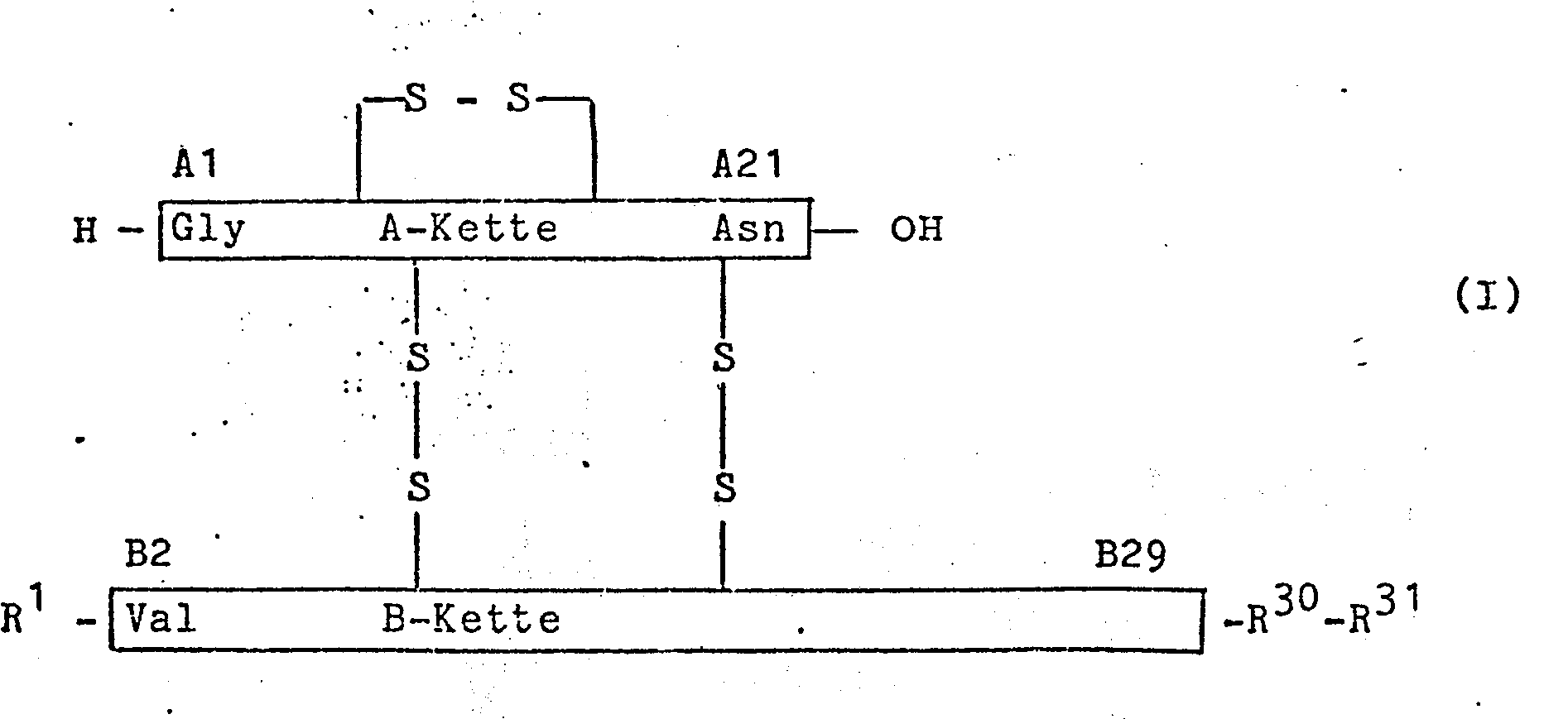
- R1 H oder H-Phe bedeutet,
- R30 für den Rest einer neutralen, genetisch codierbaren L-Aminosäure steht und
- R31 für eine physiologisch verträgliche organische Gruppe basischen Charakters mit bis zu 50 C-Atomen steht, an deren Aufbau 0 bis 3 α-Aminosäuren beteiligt sind und deren gegebenenfalls vorhandene endständige Carboxyfunktion frei, als Esterfunktion, als Amidfunktion, als Lacton oder zu CH2OH reduziert vorliegen kann, mit einem isoelektrischen Punkt zwischen 5,8 und 8,5, und
- b) ein Insulin der Formel I, in welcher
- R1 H oder H-Phe bedeutet,
- R 30 für Ala, Thr oder Ser steht und
- R31 OH bedeutet,
- oder physiologisch unbedenkliche Salze davon, sowie ggf. Proinsulin und ggf. C-Peptid enthält.
- Bevorzugt sind solche, die dadurch gekennzeichnet sind, daß in dem unter a) genannten Insulin-Derivat der Formel I
- R31 für einen Rest der Formel -Xn-S steht,
- in welchem
- n = 0,1,2 oder 3 ist,
- X für gleiche oder verschiedene Reste natürlich vorkommender neutraler oder basischer L-Aminosäuren (vorzugsweise basischer L-Aminosäure, insbesondere Arg, Lys, His oder Orn) und/oder der diesen entsprechenden D-Aminosäuren steht und
- OH oder eine physiologisch verträgliche, die Carboxygruppe blockierende Gruppe bedeutet, die, falls n = 0 ist, einen positiv geladenen oder protonierbaren basischen Rest trägt oder, falls n 0 ist, einen solchen Rest tragen kann und worin der C-Terminus
- -X-S auch für den Rest einer zum entsprechenden Alkohol reduzierten Aminosäure oder, im Falle n = 2 oder 3, für den Homoserinlacton-Rest stehen kann.
- Insulin-Derivate der Formel I, die in Position B1 Phenylalanin tragen, sind besonders bevorzugt. Weiterhin sind solche bevorzugt, die in der Position B30 Ala, Thr oder Ser aufweisen. Ihre A-Kette und die Kette (B 2-29) weist zweckmäßigerweise die Sequenzen des Rinder- oder Schweineinsulins, insbesondere aber die des Humaninsulins auf.
- Die Aminosäurereste X und Reste der entsprechenden Derivate können unabhängig voneinander in der D- oder L-Konfiguration vorliegen. Bevorzugt ist jedoch die L-Konfiguration aller Reste.
- Genetisch kodierbar sind die folgenden L-Aminosäuren: Gly, Ala, Ser, Thr, Val, Leu, Ile, Asp, Asn, Glu, Gln, Cys, Met, Arg, Lys, His, Tyr, Phe, Trp, Pro (neutrale Aminosäuren unterstrichen).
- Unter einer neutralen, natürlich vorkommenden Aminosäure versteht man insbesondere Gly, Ala, Ser, Thr, Val, Leu, Ile, Asn, Gln, Cys, Met, Tyr, Phe, Pro oder Hyp. Unter einer basischen, natürlich vorkommenden Aminosäure versteht man insbesondere Arg, Lys, Hyl, Orn, Cit oder His.
- Unter Gruppen, die gegebenenfalls eine freie Carboxyfunktion am C-terminalen Ende der B-Kette in den erfindungsgemäßen Insulin-Derivaten blockieren, versteht man vor allem Ester-und Amidgruppen, vorzugsweise (C1 bis C6)-Alkoxy, (C3 bis C6)-Cycloalkyloxy, NH2, (C1 bis C6)-Alkylamino oder Di-(C1 bis C6)-alkylamino oder basische Gruppen, wie Amino-(C2 bis C6)-ralkoxy, (C2 bis C4)-Alkylamino-(C2 bis C6)-alkoxy, Di-(C1 bis C4)-alkylamino-(C2 bis C6)-alkoxy, Tri-(C1 bis C4alky]-ammonio-(C2 bis C6) alkoxy, Amino-(C2 bis C6)-alkylamino, (C1 bis C4)-Alkylamino)-(C2 bis C6)-alkylamino, [Di-(C1 bis C4)-alkylamino]-(C2 bis C6)-alkylamino oder [Tri(C1 bis C4)alkylammonio]-(C2 bis C6)-alkylamino, insbesondere -0-(CH2)p-NR2,


- Aus der Reihe der erfindungsgemäßen Insulin-Derivate der Formel I seien beispielsweise die nachstehenden Verbindungen erwähnt, ohne die Erfindung auf diese zu beschränken:
- Humaninsulin - ArgB31-OH
- Schweineinsulin- ArgB31-OH
- Rinderinsulin - ArgB31-OH
- Humaninsulin - ArgB31-ArgB32-OH
- Schweineinsulin- ArgB31-ArgB32-OH
- Rinderinsulin - ArgB31-ArgB32-OH
- Des-PheB1- Schweineinsulin-ArgB31-OH
- Des-PheB1-Humaninsulin-ArgB31-OH
- Des-PheB1-Sehweineinsulin-ArgB31-ArgB32-OH
- Des-PheB1-Humaninsulin-ArgB31-ArgB32-OH
- Sehweineinsulin-ArgB31-OCH3
- Humaninsulin-ArgB31-OCH3
- Rinderinsulin-ArgB31-OCH3
- Sehweineinsulin-ArgB31-ArgB32-OCH3
- Humaninsulin-ArgB31-ArgB32-OCH3
- Des-ThrB30-Humaninsulin-ValB30-ArgB32-OCH3
- Des-ThrB30-Humaninsulin-ValB30-ArgB31-OCH3
- Des-ThrB30-Humaninsulin-ValB30-AlaB31-ArgB32-OH
- Humaninsulin-LysB31-OH
- Humaninsulin-D-ArgB31-OH
- Humaninsulin-D-ArgB31-ArgB32-0H
- Humaninsulin-ArgB31-D-ArgB32-OH
- Humaninsulin-LysB31-ArgB32-OH
- Humaninsulin-ArgB31-LysB32-OH
- Humaninsulin-Arginino1B31
- Humaninsulin-ValB31-ArgB32-OH
- Humaninsulin-ValB31-ArgB32-ArgB33-OH Humanirsulin-ArgB31-ArginirolB32
- Humaninsulin-LysB31-ArgB32-ArgB33-OH


- Humaninsulin-ArgB31-NH2
- Humaninsulin-ArgB31-ArgB32-NH2
- Humaninsulin-OrnB31-OH
- Humaninsulin-LeuB31-CitB32-OH
- Humaninsulin-(B30)-OCH2CH2-NH2
- Humaninsulin-(B30)-NH-CH2CH2-NH2
- Humaninsulin-ArgB31-0-CH2-CH2-NH2
- Humaninsulin-ArgB31-NH-CH2-CH2-N(CH3)2
- Humaninsulin-(B30)-0-CH2-CH2

- Humaninsulin-(B30)-NH-CH2-CH2

- Humansulin-LeuB31

- Humaninsulin-TrpB31-TrpB32-TrpB33-NH(CH2)6-N(nC4H9)3
- Die Herstellung der Insulin-Derivate der Formel I erfolgt dadurch, daß man
- a) ein Des-Octapeptid (B 23-30)-Insulin der Formel II,


- b) ein Des-B30-Insulin der Formel I, in welcher R1 für H oder H-Phe und der C-Terminus R30-R31 zusammen für OH stehen, in Gegenwart von Trypsin oder einer trypsinähnlichen endo-Peptidase umsetzt mit einer Verbindung der Formel IV

- c) zur Herstellung eines Insulin-Derivats mit L-konfigurierten Aminosäureresten im Rest R31 ein Proinsulin, Proinsulinanaloges oder Präproinsulinanaloges oder ein Intermediat dieser Verbindungen chemisch und/oder enzymatisch spaltet.
- Die bei der Verfahrensvariante b) als Ausgangsverbindungen verwendeten Des-B30--Insuline sind beispielsweise aus der EP-A-46 979 oder Hoppe-Seyler's Z.Physiol. Chem.359 (1978) 799 bekannt. Das bei Variante b) verwendete Ausgangsmaterial der Formel IV wird in an sich bekannter Weise nach den Methoden der Peptidchemie hergestellt. Brauchbare Schutzgruppen für IV sind detailiert beschrieben bei M. Bodanzky et al., Peptide Synthesis, 2nd Ed. 1976, Wiley & Sons.
- Durch gentechnolcgische Methoden sind inzwischen humanes oder Primaten-Proinsulin als Ausgangsmaterial für die Verfahrensvariante c) zugänglich: Die Derivate Arg(B31).und Di-Arg(B31-32) sind daraus durch einfache Verdauung mit Trypsin oder trypsin-ähnichen Enzymen zugänglich. Daneben lassen sich aber auch relativ einfach Plasmide konstruieren, die zu neuen Insulinderivaten führen, weil sie an Stelle der natürlich an B31 oder B32 befindlichen Arginine andere neutrale oder basische Aminosäuren codieren.
- Die Herstellung von Proinsulin unter Anwendung der Rekombinations-DNA-Methodologie erfordert die Bildung einer DNA-Sequenz die für die Aminosäuresequenz eines Proinsulins codiert, was sich entweder durch Isolierung, Konstruktion oder eine Kombination aus beidem erreichen läßt. Die Proinsulin-DNA wird dann in Lesephase in einen geeigneten Clonierungs- und Expressionsträger eingesetzt. Der Träger dient zur Transformierung eines geeigneten Mikroorganismus, und der hierbei erhaltene transformierte Mikroorganismus wird dann Fermentationsbedingungen unterzogen, die zur Bildung weiterer Kopien des proinsulinhaltigen Vektors und zur Expression von Proinsulin eines Proinsulinderivats oder einem Proinsulinvorläufer bzw.einem Präproinsulinderivat führen.
- Handelt es sich beim Expressionsprodukt um einen Proinsulinvorläufer, dann enthält ein solches Produkt im allgemeinen die Proinsulinaminosäuresequenz, die an ihrer endständigen Aminogruppe an ein Bruchstück eines Proteins gebunden ist, das normalerweise durch die Gensequenz ausgedrückt wird, bei welcher das Proinsulin oder Proinsulinderivat eingesetzt worden ist. Die Proinsulinaminosäuresequenz ist an das Proteinbruchstück über eine spezifisch spaltbare Stelle gebunden, bei der es sich beispielsweise um Methionin handelt.
- Die erhaltene Proinsulinaminosäuresequenz wird vom verschmolzenen Genprodukt, beispielsweise wie in der DE-A-.32 32 036 beschrieben, abgespalten und das Proinsulin nach Reinigung isoliert.
- Die enzymatische Spaltung des auf diese Weise erhaltenen Proinsulins oder Proinsulinderivats erfolgt in Analogie zu der in Excerpta Medica International Congress Series No. 231, Seite 292 ff, oder der in der deutschen Patentanmeldung P 32 09 184 (HOE 82/F 047) beschriebenen Verfahrensweise.
- Mit Hilfe der beschriebenen semisynthetischen Verfahren sind damit zusätzlich zu den bekannten Arginin(B30)- und Diarginin(B31-32)-Derivaten sowie jenen durch gentechnologischen Methoden zugänglichen Derivaten, die an R31 natürliche L-Aminosäuren tragen,eine Reihe von neuen Insulin-Derivaten zugänglich, die als Charakteristikum eine oder mehrere basische Gruppen und/oder die Abwesenheit der freien Carboxylgruppe aufweisen, so daß die Nettoladung des Moleküls um mindestens eine positive Ladung gegenüber nativem Insulin oder gegenüber Des-PheB1-Insulin zunimmt.
- Dazu gehören z.B. Derivate, die an Position B-31 statt der natürlichen Aminosäuren L-Lysin, L-Histidin oder L-Arginin, deren D-Enantiomere oder gängige D- oder L-Aminosäureanaloge, die in der Seitenkette eine basische Gruppierung (z.B. Ornithin, Hydroxylysin ) tragen, aufweisen. Statt einer Aminosäure kann an Stelle der Position B31 beispielsweise die Cholinestergruppe treten, wodurch netto zwei Positivladungen gewonnen werden. Die Aminosäure oder das Aminosäureanalogon an Position B31 kann ein freies Carboxylende aufweisen oder mit einfachen Alkoholen (z.B. Methanol, Ethanol) verestert bzw. mit einfachen Stickstoffbasen (z.B. Ammoniak, Mono- oder Di- methylamin) amidiert sein; sie kann daneben z.B. mit Cholin verestert sein. An Position B31 kann beispielsweise eine neutrale oder auch eine weitere natürliche basische Aminosäure oder eines der oben beschriebenen Aminosäurederivate folgen; in analoger Weise kann deren Carboxylgruppe frei oder verestert bzw. amidiert sein. Es kann beispielsweise auch hier die Cholinestergruppe bzw. noch eine weitere neutrale oder basische Aminosäure bzw. ein Aminosäureanalogon folgen.
- Allen diesen Insulinderivaten ist gemeinsam, daß die zusätzliche(n), an der Oberfläche des Moleküls befindliche(n) positive(n) Ladung(en) dem Molekül einen in den Neutralbereich hinein verschobenen isoelektrischen Punkt verleihen. Je nach Derivat werden isoelekt.rische Punkte von 5,8 bis 8,5, insbesondere 6,2 bis 8,2 in der isoelektrischen Fokussierung gemessen. Damit sind die Derivate im Neutralbereich weniger löslich als natives Insulin oder Proinsulin, die ihren isoelektrischen Punkt und damit den Bereich maximaler Unlöslichkeit bei pH= 5,4 haben, während sie im Neutralbereich normalerweise gelöst vorliegen.
- Demzufolge stellen diese Insulin-Derivate der Formel I vollkommen neue Verzögerungsprinzipien dar, die ohne Depot-Hilfsstoffe, wie Zink oder Protaminsulfat, zur Wirkung gebracht werden können. Die Depotwirkung geht auf ein inhärentes, proteinchemisch bedingtes, physikalisches Prinzip, die Schwerlöslichkeit am isoelektrischen Punkt, zurück. Die Wiederauflösung unter physiologischen Bedingungen sollte, wie man annehmen wird, durch Abspaltung der zusätzlichen basischen Gruppen erreicht werden, die je nach Derivat durch tryptische oder trypsin-ähnliche, und/oder Carboxypeptidase B- oder Carboxypeptidase B-ähnliche und/oder Esterase-Aktivität zustande kommt. Die jeweils abgespaltenen Gruppen sind entweder rein physiologische Metaboliten, wie Aminosäuren, Ornithin oder Cholin, oder aber physiologisch unbedenkliche und leicht metabolisierbare Substanzen.
- Schweineinsulin-ArgB3i-OH und das entsprechende Di-ärginin-Derivat weisen den Untersuchungen von Chance, Excerpta Medica International Congress Series No. 231, Seite 292, 293 zufolge nur 62 % bzw. 66 % der Aktivität des nativen Schweineinsulins auf.
- Überraschenderweise wurde nun gefunden, daß (auch im Unterschied zu Proinsulin) die biologische Aktivität der Derivate etwa gleich hoch ist wie die von nativem Insulin. Sie sind auch im Unterschied zu in der Literatur beschriebenen Intermediaten, die noch Teile des heterologen C-Peptids enthalten, nicht stärker immunogen als das entsprechende Insulin selbst. Möglicherweise haben die oben genannten,zu niedrigen Werte von Chance ihre Ursache darin, daß diese Peptide nicht rein vorgelegen haben oder daß die Messung mit einem systematischen Fehler behaftet war.
- Neben der Anwendung der beschriebenen Derivate allein oder in Mischung als reine Verzögerungsinsuline oder in Kombination mit den bekannten Depotträgern ist es nun möglich, in vielfältiger Weise stabile Mischungen mit schnell zur Verfügung stehendem Insulin, z.B. gelösten Anteilen, herzustellen. Es ist damit eine Palette von sehr fein abgestimmten Wirkprofilen zugänglich.
- Besonders in Frage kommen neutrale Mischungen aus einem oder mehreren Derivaten, die als Retard-Komponente wirken, mit gelöstem, nativem Insulin, bevorzugt der gleichen Spezies. Daneben können aber auch Proinsulin und/oder C-Peptid, jeweils allein oder in Kombination mit Insulin als gelöste Komponente eingesetzt werden. Charakteristisch für diese Zubereitungen ist, daß sie in jedem Mischungsverhältnis stabil sind. Dies ist Voraussetzung für die Herstellung der heute in der Therapie sehr gebräuchlichen, intermediär wirksamen Insulinpräparate.
- Die erfindungsgemäßen Mittel können auch mehrere verschiedene Insulin-Derivate der Formel I und/oder mehrere verschiedene Insuline der Formel I enthalten. Darüberhinaus können auch andere therapeutisch interessante Kombinationen zur Anwendung kommen, wie etwa die Mischung von Derivat und Insulin und/oder Proinsulin und/oder Des-PheB1-Insulin und/oder C-Peptid in gelöster Form oder in Form von NPH-Kristallen oder anderen klassichen Verzögerungsformen. Auf diese Weise lassen sich u.a. sehr lang wirksame Präparate mit differenziertem Basalprofil herstellen. Gerade beim Humaninsulin wäre dies wünschenswert, da nach den bisherigen Erfahrungen dessen Wirkungsdauer weder in Form der Zinkkristalle noch in Form der NPH-Kristalle ein echtes Ultra-Rctard-Profil, wie etwa die analogen Rinderinsulinpräparate, aufweist.
- Insulin und/oder Proinsulin und/oder Des-PheB1-Insulin und/oder C-Peptid und Insulin-Derivat der Formel I können auch in Form eines Alkalisalzes oder des Ammoniumsalzes eingesetzt werden.
- Die Mischungsverhältnisse zwischen nativem Insulin und/oder Proinsulin und/oder Des-PheB1-Insulin und/oder C-Peptid und Insulinderivat können sich im Bereich 0 bis 99 Prozent Insulin und 0 bis 99 Prozent Proinsulin und 0-99 Prozent des Phenylalanin-(B1)-Insulin und 0-99 Prozent C-Peptid und 1 bis 100 Prozent Insulinderivat (bezogen auf die Gesamtmenge an diesen Peptiden) bewegen.
- Eine erfindungsgemäße Anwendungsform ist auch eine saure Lösung z.B. von Insulin-Derivat und Insulin oder Proinsulin, die einen pH unterhalb des isoelektrischen Punktes des Insulins aufweist.
- Bevorzugte Mittel weisen einen pH-Wert zwischen 2,5 und 8,5 auf und liegen dabei als Lösung oder Suspension vor.
- Typischerweise werden die beschriebenen Anwendungsformen in einem wäßrigen Medium gelöst bzw. suspendiert sein, welches zusätzlich ein geeignetes Isotoniemittel, z.B. Glycerin oder Kochsalz und ein geeignetes Mittel gegen mikrobiellen Befall, z.B. Phenol, m-Kresol oder p-Hydroxybenzoesäureester, in geeigneter Dosierung enthält. Dieser physiologisch unbedenkliche Träger kann im pH-Bereich von 5,0 und 8,5 zusätzlich eine Puffersubstanz, z.B. Natriumacetat, Natriumcitrat, Natriumphosphat oder Tris-(hydroxymethyl)-amino- methan, enthalten. Zum Lösen und zum Einstellen des pH-Wertes werden verdünnte Säuren, typischerweise Salzsaure, oder verdünnte Laugen, typischerweise Natronlauge, verwendet.
- Insulinanteil und/oder Proinsulinanteil und/oder desPheB1- Insulinanteil und/oder C-Peptidanteil und Anteil des Insulin-Derivats der Formel I können unabhängig voneinander jeweils-in gelöster, amorpher und/oder kristalliner Form vorliegen. Jeweils ein beliebiger Teil des Insulinanteils und/oder Proinsulinanteils und/oder desPhe-Insulinanteils und/oder C-Peptidanteils und des Anteils des Insulin-Derivates der Formel I kann in kristalliner Form, jeweils ein weiterer beliebiger Teil des Insulinanteils und/oder Proinsulinanteils und/oder desPhe-Insulinanteils und/oder C-Peptidanteils und des Anteils des Insulin-Derivats der Formel I in amorpher Form sowie jeweils der Rest des Insulinanteils und/oder Proinsulinanteils und/oder desPhe-Insulinanteils und/oder C-Peptidanteils und des Anteils des Insulin-Derivats der Formel I in gelöster Form vorliegen.
- Die Zubereitung kann in geeigneten Mengen Hilfsmittel mit verzögernder Wirkung (Depot-Hilfsmittel) wie etwa Protaminsulfat, Globin oder Zink (0 bis 100µg / 100 I.U.) enthalten.
- Dieses Verzögerungsprinzip kann in Kombination mit dem gesamten.Wirkstoffanteil oder Teilen davon angewandt werden. Auch können mehrere verschiedene verzögernd wirkende Hilfsstoffe enthalten sein.
- Es ist manchmal vorteilhaft, der erfindungsgemäßen Zubereitung eine geeignete Menge eines geeigneten Stabilisators zuzusetzen, der die Präzipitation von Protein bei thermisch-mechanischer Belastung bei Kontakt mit verschiedenen Materialien verhindert. Solche Stabilisatoren sind beispielsweise aus der EP-A-18609,der DE-A-32 40 177 oder aus der WO-83/00288 bekannt.
- Zur weiteren Erläuterung der Erfindung sollen die folgenden Beispiele dienen, ohne die Erfindung auf diese zu beschränken
- Insulin-ArgB31-ArgB32-OH vom Schwein, hergestellt durch tryptische Verdauung aus Schweine-Proinsulin, in neutraler Formulierung mit 40 IE/ml und dessen Mischbarkeit mit 20 % bzw. 40 % gelöstem Schweineinsulin (40 IE/ml):
- Man löst in einem Gesamt-Volumen von 10 ml mit Wasser:

- Der pH wird durch Zugabe von 1 N HCI bzw. 1 N NaCH auf pH = 7,3 eingestellt. Eine Lösung von Schweineinsulin von 40 IE/ml in einem ähnlichen oder dem gleichen Medium wird zugemischt, so daß dessen volumenmäßiger Anteil 20 % bzw. 40 % beträgt. Mit Hilfe der HPLC wird jeweils sofort und nach 3 Monaten Lagerung bei 4°C der Gesamt-Gehalt sowie der Gehalt im Überstand ermittelt.

- Schweineinsulin-ArgB31-ArgB32-OH trennt sich auf der HPLC von Schweineinsulin ab. Im Überstand ist kein Derivat nachweisbar, d.h. der unlösliche Anteil wird nicht aufgelöst. Umgekehrt ist nach Waschen des Niederschlages kein Insulin nachweisbar, d.h. Insulin fällt auch nicht aus.
- Schweineinsulin-ArgB31-OH, hergestellt durch tryptische Verdauung aus Schweine-Proinsulin, in Mischung mit 25 (Aktivität) gelöstem Schweineproinsulin in neutraler Formulierung mit 40 IE/ml und dessen Depot-Wirkung:
- Man mischt in einem Gesamt-Volumen von 10 ml mit Wasser:

- Durch Zugabe von 1 N HCl bzw. 1 N NaOH wird pH = 7,0 eingestellt.
- Eine solche Suspension zeigt am Hund eine Depotwirkung, die ähnlich einem Depot-Vergleichspräparat (Optisulin(R) Depot CS) ist.
- Schweineinsulin-ArgB31-ArgB32-OH, hergestellt aus Schweineproinsulin durch tryptische Verdauung, in Form von NPH-Kristallen, in Mischung mit 25 % des-Phenylalanin-(B1)-Schweineinsulin, hergestellt aus Schweineinsulin durch Edmann Abbau, in neutraler Formulierung mit 40 IE/ml und deren verzögerte Wirkung.
- Man mischt in einem Gesamt-Volumen von 10 ml mit Wasser:

- Durch Zugabe von 1 N HCl bzw. 1 N NaOH wird pH,= 7,3 eingestellt.
- Eine solche Suspension zeigt am Hund einen depotähnlichen Wirkungsverlauf.
- Humaninsulin-(B30)-Cholinester, hergestellt aus Schweineinsulin durch Semisynthese, in Mischung mit 40 % Humaninsulin und 20 % (Masse) Human-C-Peptid, in neutraler Zubereitung mit 40 IE/ml und dessen mittellange Wirkungscharakteristik:
- Man mischt in einem Gesamt-Volumen von 10 ml mit Wasser:

- Der pH-Wert wird durch Zugabe von 1 N HCl bzw. 1 N NaOH auf pH = 7,3 eingestellt.
- Eine solche Suspension zeigt am Hund ein Wirkprofil vergleichbar einem Kombinationspräparat (z.B. Komb-H-Insulin(R) Hoechst).
- Humaninsulin-ArgB31-LysB32-OCH3, hergestellt durch Semisynthese aus Schweineinsulin, in Mischung mit 50 % Zink-Humaninsulinkristallen in einer Zubereitung mit 40 IE/ml und deren verzögerte Wirkung.
- Man mischt in einem Gesamt-Volumen von 10 ml mit Wasser:

- Durch Zugabe von 1 N HCl bzw. 1 N NaOH wird pH = 7,0 eingestellt.
- Eine solche Präparation hat am Kaninchen (0,4 IE/kg) eine ausgeprägte Retardwirkung.
- Humaninsulin-ArgB31-OH in Mischung mit 30 % Humaninsulin-ArgB31-ArgB32-OH, beide hergestellt durch tryptische Verdauung aus Primaten-Präproinsulin exprimiert in E.coli, in Mischung mit 40 % kristallinem NPH-Humaninsulin in einer Zubereitung mit 40 IE/ml und deren ausgeprägte Retardwirkung.
- Man mischt in einem Gesamt-Volumen von 10 ml mit Wasser:

- Durch Zugabe von 1 N NaOH bzw. 1 N HCl wird pH = 7,3 eingestellt.
- Eine solche Suspension zeigt am Kaninchen eine stark verzögerte und lang anhaltende Wirkung.
Claims (23)

Priority Applications (1)
| Application Number | Priority Date | Filing Date | Title |
|---|---|---|---|
| AT84108441T ATE31625T1 (de) | 1983-07-22 | 1984-07-18 | Pharmazeutisches mittel zur behandlung des diabetes mellitus. |
Applications Claiming Priority (2)
| Application Number | Priority Date | Filing Date | Title |
|---|---|---|---|
| DE3326473 | 1983-07-22 | ||
| DE19833326473 DE3326473A1 (de) | 1983-07-22 | 1983-07-22 | Pharmazeutisches mittel zur behandlung des diabetes mellitus |
Publications (2)
| Publication Number | Publication Date |
|---|---|
| EP0132769A1 true EP0132769A1 (de) | 1985-02-13 |
| EP0132769B1 EP0132769B1 (de) | 1988-01-07 |
Family
ID=6204661
Family Applications (1)
| Application Number | Title | Priority Date | Filing Date |
|---|---|---|---|
| EP84108441A Expired EP0132769B1 (de) | 1983-07-22 | 1984-07-18 | Pharmazeutisches Mittel zur Behandlung des Diabetes mellitus |
Country Status (19)
| Country | Link |
|---|---|
| US (1) | US4608364A (de) |
| EP (1) | EP0132769B1 (de) |
| JP (1) | JPS6042334A (de) |
| AT (1) | ATE31625T1 (de) |
| AU (1) | AU564648B2 (de) |
| CA (1) | CA1236012A (de) |
| DE (2) | DE3326473A1 (de) |
| DK (1) | DK172456B1 (de) |
| ES (1) | ES8504456A1 (de) |
| FI (1) | FI79786C (de) |
| GR (1) | GR81550B (de) |
| HU (1) | HUT34889A (de) |
| IE (1) | IE57690B1 (de) |
| IL (1) | IL72468A (de) |
| NO (1) | NO167187C (de) |
| NZ (1) | NZ208960A (de) |
| PH (1) | PH21328A (de) |
| PT (1) | PT78941A (de) |
| ZA (1) | ZA845621B (de) |
Cited By (16)
| Publication number | Priority date | Publication date | Assignee | Title |
|---|---|---|---|---|
| EP0291863A3 (en) * | 1987-05-22 | 1990-04-04 | Hoechst Aktiengesellschaft | Mixed crystals of insulin and insulin derivatives, their process of manufacture, pharmaceutical agents containing them and their use in the treatment of diabetes mellitus |
| US6610649B2 (en) | 1996-09-27 | 2003-08-26 | Creative Peptides Sweden Ab | Insulin C-peptides |
| US7964558B2 (en) | 2003-10-13 | 2011-06-21 | La Jolla | Therapeutic applications for C-peptide |
| US8048854B2 (en) | 2006-07-11 | 2011-11-01 | Sanofi-Aventis Deutschland Gmbh | Amidated insulin glargine |
| US8410048B2 (en) | 2006-07-11 | 2013-04-02 | Sanofi-Aventis Deutschland Gmbh | Method for producing insulin analogs having a dibasic B chain terminus |
| EP2898900A1 (de) | 2008-09-19 | 2015-07-29 | Nektar Therapeutics | Polymerkonjugate von Ziconotid |
| US9526764B2 (en) | 2008-10-17 | 2016-12-27 | Sanofi-Aventis Deutschland Gmbh | Combination of an insulin and a GLP-1-agonist |
| US9707176B2 (en) | 2009-11-13 | 2017-07-18 | Sanofi-Aventis Deutschland Gmbh | Pharmaceutical composition comprising a GLP-1 agonist and methionine |
| US9821032B2 (en) | 2011-05-13 | 2017-11-21 | Sanofi-Aventis Deutschland Gmbh | Pharmaceutical combination for improving glycemic control as add-on therapy to basal insulin |
| US9950039B2 (en) | 2014-12-12 | 2018-04-24 | Sanofi-Aventis Deutschland Gmbh | Insulin glargine/lixisenatide fixed ratio formulation |
| US9981013B2 (en) | 2010-08-30 | 2018-05-29 | Sanofi-Aventis Deutschland Gmbh | Use of AVE0010 for the treatment of diabetes mellitus type 2 |
| US9987332B2 (en) | 2011-09-01 | 2018-06-05 | Sanofi-Aventis Deutschland Gmbh | Pharmaceutical composition for use in the treatment of a neurodegenerative disease |
| US10029011B2 (en) | 2009-11-13 | 2018-07-24 | Sanofi-Aventis Deutschland Gmbh | Pharmaceutical composition comprising a GLP-1 agonist, an insulin and methionine |
| US10159713B2 (en) | 2015-03-18 | 2018-12-25 | Sanofi-Aventis Deutschland Gmbh | Treatment of type 2 diabetes mellitus patients |
| US10434147B2 (en) | 2015-03-13 | 2019-10-08 | Sanofi-Aventis Deutschland Gmbh | Treatment type 2 diabetes mellitus patients |
| US12558307B2 (en) | 2009-07-06 | 2026-02-24 | Sanofi-Aventis | Insulin preparations containing methionine |
Families Citing this family (34)
| Publication number | Priority date | Publication date | Assignee | Title |
|---|---|---|---|---|
| US4946828A (en) * | 1985-03-12 | 1990-08-07 | Novo Nordisk A/S | Novel insulin peptides |
| US5008241A (en) * | 1985-03-12 | 1991-04-16 | Novo Nordisk A/S | Novel insulin peptides |
| DE3880346T2 (de) * | 1987-02-25 | 1993-07-29 | Novonordisk As | Insulinderivate. |
| US4764592A (en) * | 1987-04-23 | 1988-08-16 | Eli Lilly And Company | Crystalline human proinsulin and process for its production |
| US4789660A (en) * | 1987-09-10 | 1988-12-06 | American Home Products Corporation | Insulin administration using methyl and propyl paraben |
| US6875589B1 (en) | 1988-06-23 | 2005-04-05 | Hoechst Aktiengesellschaft | Mini-proinsulin, its preparation and use |
| DE58906966D1 (de) * | 1988-06-23 | 1994-03-24 | Hoechst Ag | Mini-Proinsulin, seine Herstellung und Verwendung. |
| DE3827533A1 (de) * | 1988-08-13 | 1990-02-15 | Hoechst Ag | Pharmazeutische zubereitung zur behandlung des diabetes mellitus |
| DE3837825A1 (de) * | 1988-11-08 | 1990-05-10 | Hoechst Ag | Neue insulinderivate, ihre verwendung und eine sie enthaltende pharmazeutische zubereitung |
| DK134189D0 (da) * | 1989-03-20 | 1989-03-20 | Nordisk Gentofte | Insulinforbindelser |
| DE3936876A1 (de) * | 1989-11-06 | 1991-05-23 | Hoechst Ag | Neue insulinderivate, verfahren zu deren herstellung, ihre verwendung und eine sie enthaltende pharmazeutische zubereitung |
| IL99699A (en) | 1990-10-10 | 2002-04-21 | Autoimmune Inc | Drug with the option of oral, intra-intestinal, or inhaled dosing for suppression of autoimmune response associated with type I diabetes |
| WO1992010284A2 (en) | 1990-12-07 | 1992-06-25 | Cnc Development, Inc. | Catalytic chemical reactor |
| YU66892A (sh) * | 1991-08-20 | 1995-10-24 | Hoechst Ag. | Fosfoinositolglikan - peptid sa delovanjem kao insulin |
| TW224471B (de) * | 1991-11-26 | 1994-06-01 | Lilly Co Eli | |
| EP0545198B1 (de) * | 1991-11-29 | 1999-09-15 | Hoechst Aktiengesellschaft | Peptide mit insulinartiger Wirkung |
| CA2087087C (en) * | 1992-01-22 | 2000-07-18 | Burton H. Sage, Jr. | Molecules for iontophoretic delivery |
| DK72793D0 (da) * | 1993-06-21 | 1993-06-21 | Novo Nordisk As | Nyt produkt |
| US5461031A (en) * | 1994-06-16 | 1995-10-24 | Eli Lilly And Company | Monomeric insulin analog formulations |
| US5547929A (en) * | 1994-09-12 | 1996-08-20 | Eli Lilly And Company | Insulin analog formulations |
| US6451970B1 (en) * | 1996-02-21 | 2002-09-17 | Novo Nordisk A/S | Peptide derivatives |
| DE19649350A1 (de) * | 1996-11-28 | 1998-06-04 | Hoechst Ag | Inositolglykane mit insulinartiger Wirkung |
| US6444641B1 (en) | 1997-10-24 | 2002-09-03 | Eli Lilly Company | Fatty acid-acylated insulin analogs |
| JP2001521004A (ja) | 1997-10-24 | 2001-11-06 | イーライ・リリー・アンド・カンパニー | 脂肪酸−アシル化インスリン類似体 |
| CO4970787A1 (es) * | 1997-12-23 | 2000-11-07 | Lilly Co Eli | Composiciones insolubles de insulina y derivados de insulina que controlan la glucosa sanguinea |
| CA2369451C (en) * | 1999-04-08 | 2009-09-22 | Genentech, Inc. | Composition based on oppositely-charged polypeptides |
| AU2002248464A1 (en) | 2001-02-21 | 2002-09-12 | Medtronic Minimed, Inc. | Stabilized insulin formulations |
| DE10114178A1 (de) | 2001-03-23 | 2002-10-10 | Aventis Pharma Gmbh | Zinkfreie und zinkarme Insulinzubereitungen mit verbesserter Stabilität |
| DE10227232A1 (de) * | 2002-06-18 | 2004-01-15 | Aventis Pharma Deutschland Gmbh | Saure Insulinzubereitungen mit verbesserter Stabilität |
| GB0601950D0 (en) * | 2006-01-31 | 2006-03-15 | Creative Peptides Sweden Ab | Compositions and methods of treating diabetes |
| US8410049B2 (en) | 2009-10-28 | 2013-04-02 | Cebix | Methods and kits for preventing hypoglycemia |
| PL2750699T3 (pl) | 2011-08-29 | 2015-12-31 | Sanofi Aventis Deutschland | Kombinacja farmaceutyczna do stosowania w kontroli glikemii u pacjentów z cukrzycą typu 2 |
| EP3463413A4 (de) * | 2016-05-25 | 2020-03-04 | Merck Sharp & Dohme Corp. | Insulinrezeptorteilagonisten |
| WO2025068976A1 (en) | 2023-09-28 | 2025-04-03 | Biotts Inc. | Compositions comprising insulin agonists, and said compositions for use in the treatment of diabetes or obesity |
Citations (4)
| Publication number | Priority date | Publication date | Assignee | Title |
|---|---|---|---|---|
| FR2511867A1 (fr) * | 1981-08-27 | 1983-03-04 | Lilly Co Eli | Formulations pharmaceutiques comprenant de l'insuline et de la pro-insuline humaines |
| GB2104382A (en) * | 1981-08-27 | 1983-03-09 | Lilly Co Eli | Pharmaceutical formulations comprising human insulin and human C-peptide |
| GB2104380A (en) * | 1981-08-27 | 1983-03-09 | Lilly Co Eli | Human proinsulin pharmaceutical formulations |
| EP0092280A1 (de) * | 1982-04-21 | 1983-10-26 | Akzo N.V. | Semi-synthetisches Verfahren zur Herstellung von Insulin |
Family Cites Families (1)
| Publication number | Priority date | Publication date | Assignee | Title |
|---|---|---|---|---|
| CH650680A5 (de) * | 1981-08-27 | 1985-08-15 | Lilly Co Eli | Pharmazeutisches mittel aus human-insulin, human-c-peptid und human-proinsulin. |
-
1983
- 1983-07-22 DE DE19833326473 patent/DE3326473A1/de not_active Withdrawn
-
1984
- 1984-07-16 HU HU842765A patent/HUT34889A/hu unknown
- 1984-07-18 GR GR75341A patent/GR81550B/el unknown
- 1984-07-18 DE DE8484108441T patent/DE3468323D1/de not_active Expired
- 1984-07-18 AT AT84108441T patent/ATE31625T1/de not_active IP Right Cessation
- 1984-07-18 EP EP84108441A patent/EP0132769B1/de not_active Expired
- 1984-07-19 FI FI842915A patent/FI79786C/fi not_active IP Right Cessation
- 1984-07-19 PT PT78941A patent/PT78941A/de not_active IP Right Cessation
- 1984-07-20 ZA ZA845621A patent/ZA845621B/xx unknown
- 1984-07-20 DK DK198403583A patent/DK172456B1/da not_active IP Right Cessation
- 1984-07-20 IL IL72468A patent/IL72468A/xx not_active IP Right Cessation
- 1984-07-20 IE IE1890/84A patent/IE57690B1/en not_active IP Right Cessation
- 1984-07-20 ES ES534488A patent/ES8504456A1/es not_active Expired
- 1984-07-20 PH PH31011A patent/PH21328A/en unknown
- 1984-07-20 CA CA000459385A patent/CA1236012A/en not_active Expired
- 1984-07-20 US US06/632,859 patent/US4608364A/en not_active Expired - Lifetime
- 1984-07-20 JP JP59149785A patent/JPS6042334A/ja active Granted
- 1984-07-20 NZ NZ208960A patent/NZ208960A/xx unknown
- 1984-07-20 AU AU30917/84A patent/AU564648B2/en not_active Ceased
- 1984-07-20 NO NO842978A patent/NO167187C/no unknown
Patent Citations (4)
| Publication number | Priority date | Publication date | Assignee | Title |
|---|---|---|---|---|
| FR2511867A1 (fr) * | 1981-08-27 | 1983-03-04 | Lilly Co Eli | Formulations pharmaceutiques comprenant de l'insuline et de la pro-insuline humaines |
| GB2104382A (en) * | 1981-08-27 | 1983-03-09 | Lilly Co Eli | Pharmaceutical formulations comprising human insulin and human C-peptide |
| GB2104380A (en) * | 1981-08-27 | 1983-03-09 | Lilly Co Eli | Human proinsulin pharmaceutical formulations |
| EP0092280A1 (de) * | 1982-04-21 | 1983-10-26 | Akzo N.V. | Semi-synthetisches Verfahren zur Herstellung von Insulin |
Cited By (21)
| Publication number | Priority date | Publication date | Assignee | Title |
|---|---|---|---|---|
| EP0291863A3 (en) * | 1987-05-22 | 1990-04-04 | Hoechst Aktiengesellschaft | Mixed crystals of insulin and insulin derivatives, their process of manufacture, pharmaceutical agents containing them and their use in the treatment of diabetes mellitus |
| US6610649B2 (en) | 1996-09-27 | 2003-08-26 | Creative Peptides Sweden Ab | Insulin C-peptides |
| US7964558B2 (en) | 2003-10-13 | 2011-06-21 | La Jolla | Therapeutic applications for C-peptide |
| US8048854B2 (en) | 2006-07-11 | 2011-11-01 | Sanofi-Aventis Deutschland Gmbh | Amidated insulin glargine |
| US8410048B2 (en) | 2006-07-11 | 2013-04-02 | Sanofi-Aventis Deutschland Gmbh | Method for producing insulin analogs having a dibasic B chain terminus |
| US9682153B2 (en) | 2008-09-19 | 2017-06-20 | Nektar Therapeutics | Polymer conjugates of therapeutic peptides |
| EP2898900A1 (de) | 2008-09-19 | 2015-07-29 | Nektar Therapeutics | Polymerkonjugate von Ziconotid |
| US10117909B2 (en) | 2008-10-17 | 2018-11-06 | Sanofi-Aventis Deutschland Gmbh | Combination of an insulin and a GLP-1 agonist |
| US9526764B2 (en) | 2008-10-17 | 2016-12-27 | Sanofi-Aventis Deutschland Gmbh | Combination of an insulin and a GLP-1-agonist |
| US12558307B2 (en) | 2009-07-06 | 2026-02-24 | Sanofi-Aventis | Insulin preparations containing methionine |
| US10029011B2 (en) | 2009-11-13 | 2018-07-24 | Sanofi-Aventis Deutschland Gmbh | Pharmaceutical composition comprising a GLP-1 agonist, an insulin and methionine |
| US12303598B2 (en) | 2009-11-13 | 2025-05-20 | Sanofi-Aventis Deutschland Gmbh | Pharmaceutical composition comprising a GLP-1-agonist and methionine |
| US9707176B2 (en) | 2009-11-13 | 2017-07-18 | Sanofi-Aventis Deutschland Gmbh | Pharmaceutical composition comprising a GLP-1 agonist and methionine |
| US10028910B2 (en) | 2009-11-13 | 2018-07-24 | Sanofi-Aventis Deutschland Gmbh | Pharmaceutical composition comprising a GLP-1-agonist and methionine |
| US9981013B2 (en) | 2010-08-30 | 2018-05-29 | Sanofi-Aventis Deutschland Gmbh | Use of AVE0010 for the treatment of diabetes mellitus type 2 |
| US9821032B2 (en) | 2011-05-13 | 2017-11-21 | Sanofi-Aventis Deutschland Gmbh | Pharmaceutical combination for improving glycemic control as add-on therapy to basal insulin |
| US9987332B2 (en) | 2011-09-01 | 2018-06-05 | Sanofi-Aventis Deutschland Gmbh | Pharmaceutical composition for use in the treatment of a neurodegenerative disease |
| US12186374B2 (en) | 2014-12-12 | 2025-01-07 | Sanofi-Aventis Deutschland Gmbh | Insulin glargine/lixisenatide fixed ratio formulation |
| US9950039B2 (en) | 2014-12-12 | 2018-04-24 | Sanofi-Aventis Deutschland Gmbh | Insulin glargine/lixisenatide fixed ratio formulation |
| US10434147B2 (en) | 2015-03-13 | 2019-10-08 | Sanofi-Aventis Deutschland Gmbh | Treatment type 2 diabetes mellitus patients |
| US10159713B2 (en) | 2015-03-18 | 2018-12-25 | Sanofi-Aventis Deutschland Gmbh | Treatment of type 2 diabetes mellitus patients |
Also Published As
| Publication number | Publication date |
|---|---|
| US4608364A (en) | 1986-08-26 |
| FI842915A0 (fi) | 1984-07-19 |
| IL72468A (en) | 1989-08-15 |
| IE841890L (en) | 1985-01-22 |
| FI79786B (fi) | 1989-11-30 |
| JPH0469128B2 (de) | 1992-11-05 |
| PT78941A (de) | 1984-08-01 |
| AU3091784A (en) | 1985-01-24 |
| JPS6042334A (ja) | 1985-03-06 |
| EP0132769B1 (de) | 1988-01-07 |
| NO167187C (no) | 1991-10-16 |
| GR81550B (de) | 1984-12-11 |
| DK172456B1 (da) | 1998-08-24 |
| HUT34889A (en) | 1985-05-28 |
| FI79786C (fi) | 1990-03-12 |
| DE3326473A1 (de) | 1985-01-31 |
| DK358384D0 (da) | 1984-07-20 |
| DK358384A (da) | 1985-01-23 |
| CA1236012A (en) | 1988-05-03 |
| DE3468323D1 (en) | 1988-02-11 |
| ES534488A0 (es) | 1985-05-01 |
| AU564648B2 (en) | 1987-08-20 |
| IL72468A0 (en) | 1984-11-30 |
| FI842915L (fi) | 1985-01-23 |
| ES8504456A1 (es) | 1985-05-01 |
| NZ208960A (en) | 1989-02-24 |
| NO842978L (no) | 1985-01-23 |
| PH21328A (en) | 1987-10-13 |
| NO167187B (no) | 1991-07-08 |
| ATE31625T1 (de) | 1988-01-15 |
| IE57690B1 (en) | 1993-03-10 |
| ZA845621B (en) | 1985-02-27 |
Similar Documents
| Publication | Publication Date | Title |
|---|---|---|
| EP0132769B1 (de) | Pharmazeutisches Mittel zur Behandlung des Diabetes mellitus | |
| EP0132770B1 (de) | Neue Insulin-Derivate, Verfahren zu deren Herstellung und deren Verwendung sowie pharmazeutische Mittel zur Behandlung des Diabetes mellitus | |
| EP0133285B1 (de) | Insulin-Derivat-Kristallsuspensionen, Verfahren zu deren Herstellung und deren Verwendung | |
| EP0368187B1 (de) | Neue Insulinderivate, ihre Verwendung und eine sie enthaltende pharmazeutische Zubereitung | |
| DE3788684T2 (de) | Peptide. | |
| EP0885961B1 (de) | Neue Insulinderivate mit schnellem Wirkungseintritt | |
| DE69722397T2 (de) | Insulin-derivate und ihre verwendung | |
| EP0140084B1 (de) | Verfahren zur Herstellung von Insulin-Derivaten, deren B-Kette C-terminal verlängert ist, neue basisch modifizierte Insulin-Derivate, diese enthaltende Mittel und ihre Verwendung | |
| EP2229406B1 (de) | Neue insulinderivate mit extrem verzögertem zeit- / wirkungsprofil | |
| DE3880346T2 (de) | Insulinderivate. | |
| DD244345A5 (de) | Neue peptide | |
| EP0821006B1 (de) | Insulinderivate mit erhöhter Zinkbindung | |
| DE102008003566A1 (de) | Neue Insulinderivate mit extrem verzögertem Zeit-/ Wirkungsprofil | |
| EP0376156A2 (de) | Neue Insulinderivate, Verfahren zu deren Herstellung, ihre Verwendung und eine sie enthaltende pharmazeutische Zubereitung | |
| EP0427162A1 (de) | Neue Insulinderivate, Verfahren zu deren Herstellung, ihre Verwendung und eine sie enthaltende pharmazeutische Zubereitung | |
| EP0264750A2 (de) | Wachstumshormon-Releasingfaktor-Analoga | |
| DE19825447A1 (de) | Neue Insulinanaloga mit erhöhter Zinkbildung | |
| DE69014115T2 (de) | Stabilisierte, starke grf-analoga. | |
| EP0137361B1 (de) | In Position B 30 modifizierte Insulin-Derivate, Verfahren zu deren Herstellung und deren Verwendung sowie pharmazeutische Mittel zur Behandlung des Diabetes mellitus | |
| EP1558641B1 (de) | Kristalle von insulinanaloga und verfahren zu ihrer herstellung | |
| DE102008025007A1 (de) | Neue Insulinderivate mit extrem verzögertem Zeit-/ Wirkungsprofil |
Legal Events
| Date | Code | Title | Description |
|---|---|---|---|
| PUAI | Public reference made under article 153(3) epc to a published international application that has entered the european phase |
Free format text: ORIGINAL CODE: 0009012 |
|
| AK | Designated contracting states |
Designated state(s): AT BE CH DE FR GB IT LI LU NL SE |
|
| 17P | Request for examination filed |
Effective date: 19850306 |
|
| 17Q | First examination report despatched |
Effective date: 19860303 |
|
| GRAA | (expected) grant |
Free format text: ORIGINAL CODE: 0009210 |
|
| AK | Designated contracting states |
Kind code of ref document: B1 Designated state(s): AT BE CH DE FR GB IT LI LU NL SE |
|
| REF | Corresponds to: |
Ref document number: 31625 Country of ref document: AT Date of ref document: 19880115 Kind code of ref document: T |
|
| ITF | It: translation for a ep patent filed | ||
| REF | Corresponds to: |
Ref document number: 3468323 Country of ref document: DE Date of ref document: 19880211 |
|
| ET | Fr: translation filed | ||
| GBT | Gb: translation of ep patent filed (gb section 77(6)(a)/1977) | ||
| PLBE | No opposition filed within time limit |
Free format text: ORIGINAL CODE: 0009261 |
|
| STAA | Information on the status of an ep patent application or granted ep patent |
Free format text: STATUS: NO OPPOSITION FILED WITHIN TIME LIMIT |
|
| 26N | No opposition filed | ||
| ITTA | It: last paid annual fee | ||
| EPTA | Lu: last paid annual fee | ||
| EAL | Se: european patent in force in sweden |
Ref document number: 84108441.1 |
|
| PGFP | Annual fee paid to national office [announced via postgrant information from national office to epo] |
Ref country code: CH Payment date: 19970620 Year of fee payment: 14 |
|
| PGFP | Annual fee paid to national office [announced via postgrant information from national office to epo] |
Ref country code: SE Payment date: 19970723 Year of fee payment: 14 |
|
| PGFP | Annual fee paid to national office [announced via postgrant information from national office to epo] |
Ref country code: LU Payment date: 19970807 Year of fee payment: 14 |
|
| PG25 | Lapsed in a contracting state [announced via postgrant information from national office to epo] |
Ref country code: LU Free format text: LAPSE BECAUSE OF NON-PAYMENT OF DUE FEES Effective date: 19980718 |
|
| PG25 | Lapsed in a contracting state [announced via postgrant information from national office to epo] |
Ref country code: SE Free format text: LAPSE BECAUSE OF NON-PAYMENT OF DUE FEES Effective date: 19980719 |
|
| PG25 | Lapsed in a contracting state [announced via postgrant information from national office to epo] |
Ref country code: LI Free format text: LAPSE BECAUSE OF NON-PAYMENT OF DUE FEES Effective date: 19980731 Ref country code: CH Free format text: LAPSE BECAUSE OF NON-PAYMENT OF DUE FEES Effective date: 19980731 |
|
| REG | Reference to a national code |
Ref country code: CH Ref legal event code: PL |
|
| EUG | Se: european patent has lapsed |
Ref document number: 84108441.1 |
|
| PGFP | Annual fee paid to national office [announced via postgrant information from national office to epo] |
Ref country code: DE Payment date: 20010613 Year of fee payment: 18 |
|
| PGFP | Annual fee paid to national office [announced via postgrant information from national office to epo] |
Ref country code: NL Payment date: 20010620 Year of fee payment: 18 Ref country code: FR Payment date: 20010620 Year of fee payment: 18 Ref country code: AT Payment date: 20010620 Year of fee payment: 18 |
|
| PGFP | Annual fee paid to national office [announced via postgrant information from national office to epo] |
Ref country code: GB Payment date: 20010621 Year of fee payment: 18 |
|
| PGFP | Annual fee paid to national office [announced via postgrant information from national office to epo] |
Ref country code: BE Payment date: 20010718 Year of fee payment: 18 |
|
| REG | Reference to a national code |
Ref country code: GB Ref legal event code: IF02 |
|
| PG25 | Lapsed in a contracting state [announced via postgrant information from national office to epo] |
Ref country code: GB Free format text: LAPSE BECAUSE OF NON-PAYMENT OF DUE FEES Effective date: 20020718 Ref country code: AT Free format text: LAPSE BECAUSE OF NON-PAYMENT OF DUE FEES Effective date: 20020718 |
|
| PG25 | Lapsed in a contracting state [announced via postgrant information from national office to epo] |
Ref country code: BE Free format text: LAPSE BECAUSE OF NON-PAYMENT OF DUE FEES Effective date: 20020731 |
|
| BERE | Be: lapsed |
Owner name: *HOECHST A.G. Effective date: 20020731 |
|
| PG25 | Lapsed in a contracting state [announced via postgrant information from national office to epo] |
Ref country code: NL Free format text: LAPSE BECAUSE OF NON-PAYMENT OF DUE FEES Effective date: 20030201 Ref country code: DE Free format text: LAPSE BECAUSE OF NON-PAYMENT OF DUE FEES Effective date: 20030201 |
|
| GBPC | Gb: european patent ceased through non-payment of renewal fee |
Effective date: 20020718 |
|
| PG25 | Lapsed in a contracting state [announced via postgrant information from national office to epo] |
Ref country code: FR Free format text: LAPSE BECAUSE OF NON-PAYMENT OF DUE FEES Effective date: 20030331 |
|
| NLV4 | Nl: lapsed or anulled due to non-payment of the annual fee |
Effective date: 20030201 |
|
| REG | Reference to a national code |
Ref country code: FR Ref legal event code: ST |