EP0133882A2 - Corps poreux - Google Patents
Corps poreux Download PDFInfo
- Publication number
- EP0133882A2 EP0133882A2 EP84106771A EP84106771A EP0133882A2 EP 0133882 A2 EP0133882 A2 EP 0133882A2 EP 84106771 A EP84106771 A EP 84106771A EP 84106771 A EP84106771 A EP 84106771A EP 0133882 A2 EP0133882 A2 EP 0133882A2
- Authority
- EP
- European Patent Office
- Prior art keywords
- mixture
- cooling liquid
- polymer
- point
- liquid
- Prior art date
- Legal status (The legal status is an assumption and is not a legal conclusion. Google has not performed a legal analysis and makes no representation as to the accuracy of the status listed.)
- Granted
Links
Images

Classifications
-
- B—PERFORMING OPERATIONS; TRANSPORTING
- B01—PHYSICAL OR CHEMICAL PROCESSES OR APPARATUS IN GENERAL
- B01D—SEPARATION
- B01D69/00—Semi-permeable membranes for separation processes or apparatus characterised by their form, structure or properties; Manufacturing processes specially adapted therefor
- B01D69/08—Hollow fibre membranes
-
- B—PERFORMING OPERATIONS; TRANSPORTING
- B01—PHYSICAL OR CHEMICAL PROCESSES OR APPARATUS IN GENERAL
- B01D—SEPARATION
- B01D63/00—Apparatus in general for separation processes using semi-permeable membranes
- B01D63/06—Tubular membrane modules
- B01D63/061—Manufacturing thereof
-
- B—PERFORMING OPERATIONS; TRANSPORTING
- B01—PHYSICAL OR CHEMICAL PROCESSES OR APPARATUS IN GENERAL
- B01D—SEPARATION
- B01D71/00—Semi-permeable membranes for separation processes or apparatus characterised by the material; Manufacturing processes specially adapted therefor
- B01D71/06—Organic material
- B01D71/30—Polyalkenyl halides
- B01D71/32—Polyalkenyl halides containing fluorine atoms
- B01D71/34—Polyvinylidene fluoride
-
- B—PERFORMING OPERATIONS; TRANSPORTING
- B01—PHYSICAL OR CHEMICAL PROCESSES OR APPARATUS IN GENERAL
- B01D—SEPARATION
- B01D71/00—Semi-permeable membranes for separation processes or apparatus characterised by the material; Manufacturing processes specially adapted therefor
- B01D71/06—Organic material
- B01D71/56—Polyamides, e.g. polyester-amides
-
- B—PERFORMING OPERATIONS; TRANSPORTING
- B01—PHYSICAL OR CHEMICAL PROCESSES OR APPARATUS IN GENERAL
- B01D—SEPARATION
- B01D71/00—Semi-permeable membranes for separation processes or apparatus characterised by the material; Manufacturing processes specially adapted therefor
- B01D71/06—Organic material
- B01D71/72—Macromolecular compounds obtained otherwise than by reactions only involving carbon-to-carbon unsaturated bonds, not provided for in a single one of the groups B01D71/46 - B01D71/70 and B01D71/701 - B01D71/702
-
- B—PERFORMING OPERATIONS; TRANSPORTING
- B29—WORKING OF PLASTICS; WORKING OF SUBSTANCES IN A PLASTIC STATE IN GENERAL
- B29C—SHAPING OR JOINING OF PLASTICS; SHAPING OF MATERIAL IN A PLASTIC STATE, NOT OTHERWISE PROVIDED FOR; AFTER-TREATMENT OF THE SHAPED PRODUCTS, e.g. REPAIRING
- B29C48/00—Extrusion moulding, i.e. expressing the moulding material through a die or nozzle which imparts the desired form; Apparatus therefor
- B29C48/022—Extrusion moulding, i.e. expressing the moulding material through a die or nozzle which imparts the desired form; Apparatus therefor characterised by the choice of material
-
- B—PERFORMING OPERATIONS; TRANSPORTING
- B29—WORKING OF PLASTICS; WORKING OF SUBSTANCES IN A PLASTIC STATE IN GENERAL
- B29C—SHAPING OR JOINING OF PLASTICS; SHAPING OF MATERIAL IN A PLASTIC STATE, NOT OTHERWISE PROVIDED FOR; AFTER-TREATMENT OF THE SHAPED PRODUCTS, e.g. REPAIRING
- B29C48/00—Extrusion moulding, i.e. expressing the moulding material through a die or nozzle which imparts the desired form; Apparatus therefor
- B29C48/03—Extrusion moulding, i.e. expressing the moulding material through a die or nozzle which imparts the desired form; Apparatus therefor characterised by the shape of the extruded material at extrusion
- B29C48/05—Filamentary, e.g. strands
-
- B—PERFORMING OPERATIONS; TRANSPORTING
- B29—WORKING OF PLASTICS; WORKING OF SUBSTANCES IN A PLASTIC STATE IN GENERAL
- B29C—SHAPING OR JOINING OF PLASTICS; SHAPING OF MATERIAL IN A PLASTIC STATE, NOT OTHERWISE PROVIDED FOR; AFTER-TREATMENT OF THE SHAPED PRODUCTS, e.g. REPAIRING
- B29C48/00—Extrusion moulding, i.e. expressing the moulding material through a die or nozzle which imparts the desired form; Apparatus therefor
- B29C48/03—Extrusion moulding, i.e. expressing the moulding material through a die or nozzle which imparts the desired form; Apparatus therefor characterised by the shape of the extruded material at extrusion
- B29C48/07—Flat, e.g. panels
- B29C48/08—Flat, e.g. panels flexible, e.g. films
-
- B—PERFORMING OPERATIONS; TRANSPORTING
- B29—WORKING OF PLASTICS; WORKING OF SUBSTANCES IN A PLASTIC STATE IN GENERAL
- B29C—SHAPING OR JOINING OF PLASTICS; SHAPING OF MATERIAL IN A PLASTIC STATE, NOT OTHERWISE PROVIDED FOR; AFTER-TREATMENT OF THE SHAPED PRODUCTS, e.g. REPAIRING
- B29C48/00—Extrusion moulding, i.e. expressing the moulding material through a die or nozzle which imparts the desired form; Apparatus therefor
- B29C48/03—Extrusion moulding, i.e. expressing the moulding material through a die or nozzle which imparts the desired form; Apparatus therefor characterised by the shape of the extruded material at extrusion
- B29C48/09—Articles with cross-sections having partially or fully enclosed cavities, e.g. pipes or channels
- B29C48/10—Articles with cross-sections having partially or fully enclosed cavities, e.g. pipes or channels flexible, e.g. blown foils
-
- B—PERFORMING OPERATIONS; TRANSPORTING
- B29—WORKING OF PLASTICS; WORKING OF SUBSTANCES IN A PLASTIC STATE IN GENERAL
- B29C—SHAPING OR JOINING OF PLASTICS; SHAPING OF MATERIAL IN A PLASTIC STATE, NOT OTHERWISE PROVIDED FOR; AFTER-TREATMENT OF THE SHAPED PRODUCTS, e.g. REPAIRING
- B29C48/00—Extrusion moulding, i.e. expressing the moulding material through a die or nozzle which imparts the desired form; Apparatus therefor
- B29C48/25—Component parts, details or accessories; Auxiliary operations
- B29C48/88—Thermal treatment of the stream of extruded material, e.g. cooling
- B29C48/911—Cooling
-
- B—PERFORMING OPERATIONS; TRANSPORTING
- B29—WORKING OF PLASTICS; WORKING OF SUBSTANCES IN A PLASTIC STATE IN GENERAL
- B29K—INDEXING SCHEME ASSOCIATED WITH SUBCLASSES B29B, B29C OR B29D, RELATING TO MOULDING MATERIALS OR TO MATERIALS FOR MOULDS, REINFORCEMENTS, FILLERS OR PREFORMED PARTS, e.g. INSERTS
- B29K2027/00—Use of polyvinylhalogenides or derivatives thereof as moulding material
- B29K2027/12—Use of polyvinylhalogenides or derivatives thereof as moulding material containing fluorine
-
- B—PERFORMING OPERATIONS; TRANSPORTING
- B29—WORKING OF PLASTICS; WORKING OF SUBSTANCES IN A PLASTIC STATE IN GENERAL
- B29K—INDEXING SCHEME ASSOCIATED WITH SUBCLASSES B29B, B29C OR B29D, RELATING TO MOULDING MATERIALS OR TO MATERIALS FOR MOULDS, REINFORCEMENTS, FILLERS OR PREFORMED PARTS, e.g. INSERTS
- B29K2077/00—Use of PA, i.e. polyamides, e.g. polyesteramides or derivatives thereof, as moulding material
-
- B—PERFORMING OPERATIONS; TRANSPORTING
- B29—WORKING OF PLASTICS; WORKING OF SUBSTANCES IN A PLASTIC STATE IN GENERAL
- B29K—INDEXING SCHEME ASSOCIATED WITH SUBCLASSES B29B, B29C OR B29D, RELATING TO MOULDING MATERIALS OR TO MATERIALS FOR MOULDS, REINFORCEMENTS, FILLERS OR PREFORMED PARTS, e.g. INSERTS
- B29K2105/00—Condition, form or state of moulded material or of the material to be shaped
- B29K2105/0058—Liquid or visquous
- B29K2105/0073—Solution
-
- B—PERFORMING OPERATIONS; TRANSPORTING
- B29—WORKING OF PLASTICS; WORKING OF SUBSTANCES IN A PLASTIC STATE IN GENERAL
- B29K—INDEXING SCHEME ASSOCIATED WITH SUBCLASSES B29B, B29C OR B29D, RELATING TO MOULDING MATERIALS OR TO MATERIALS FOR MOULDS, REINFORCEMENTS, FILLERS OR PREFORMED PARTS, e.g. INSERTS
- B29K2105/00—Condition, form or state of moulded material or of the material to be shaped
- B29K2105/04—Condition, form or state of moulded material or of the material to be shaped cellular or porous
- B29K2105/045—Condition, form or state of moulded material or of the material to be shaped cellular or porous with open cells
-
- B—PERFORMING OPERATIONS; TRANSPORTING
- B29—WORKING OF PLASTICS; WORKING OF SUBSTANCES IN A PLASTIC STATE IN GENERAL
- B29L—INDEXING SCHEME ASSOCIATED WITH SUBCLASS B29C, RELATING TO PARTICULAR ARTICLES
- B29L2031/00—Other particular articles
- B29L2031/14—Filters
Definitions
- the invention relates to molded articles having pores, such as threads, membranes in the form of hollow fibers, flat films, tubular films and the like, a method for producing the same, and a device for carrying out the production method.
- Membranes which can be used for separation processes in a wide variety of fields of application, for example in medicine, pharmacy, food chemistry, but also in technical fields, and processes for their production have been known for a long time.
- the membranes are made from polymers such as regenerated cellulose, cellulose derivatives, but also from synthetic polymers such as polypropylene, polyesters, polyamides, polyurethanes, polycarbonates, halogenated polyolefins and the like.
- the membranes are more suitable for osmosis and reverse osmosis, for dialysis, for ultrafiltration, for microfiltration or for other purposes.
- the permeability, permeability, retention limit and selectivity are decisive for the suitability of a membrane for the respective application.
- properties such as mechanical strength, resistance to the treatment medium, hydrophilic or hydrophobic properties to the treatment medium and of course also play a role. It is also important that the membrane can be left in use for as long as possible during a separation operation without the membrane becoming blocked or without changing its properties during use such that the permeability and the selectivity no longer remain the same.
- membranes which have a certain hydrophilicity such as e.g. Membranes based on polyamides.
- PVDF polyvinylidene fluoride
- membranes mentioned above such as permeability and selectivity, depend not least on the pore structure of the membranes.
- Membranes which have pores are generally made by processing a polymer solution, for example by spreading the polymer solution on a smooth surface into a film and allowing the solvent to evaporate, or by treatment with a liquid which is a non-solvent for the polymer, but is a solvent for the solvent that creates the membrane structure by coagulation.
- a liquid which is a non-solvent for the polymer but is a solvent for the solvent that creates the membrane structure by coagulation.
- coagulation processes are not particularly suitable.
- the solvent in which the solvent is evaporated, there is a certain asymmetry within the membrane. A skin often forms which impairs the permeability of the membrane.
- DE-OS 28 33 493 describes a process for the production of porous hollow fibers which can be used as membranes, in which a homogeneous, single-phase mixture of a meltable polymer and a liquid which is inert towards the polymer, the polymer and the inert liquid being a Form a binary system, which in the liquid state has an area of complete miscibility and an area with a miscibility gap, is extruded at a temperature above the separation temperature into a bath which consists wholly or in large part of the inert liquid which is also present in the extruded mixture and that has a temperature below the separation temperature.
- the hollow fiber structure formed is solidified by cooling.
- the inert liquid is removed after the solidification, preferably by extraction.
- this method it is possible to obtain membranes with a largely isotropic structure on the inside, which also have a surface that is very smooth despite a high degree of opening.
- this method can be used to produce good membranes in an excellent way, difficulties arise when processing mixtures whose viscosity is either low due to very low concentrations or which contain polymers which, because of their low molecular weight, lead to mixtures with low viscosity.
- the present invention was therefore based on the object of providing pore-shaped articles, in particular membranes, and a process for producing the same, in which the various process parameters can be varied within wide limits, which is less susceptible to faults, and in particular the processing of low-viscosity mixtures permits and with which reproducibly constant properties such as the porosity can be set and with which one can advantageously obtain molded articles made from a wide variety of polymers.
- This object is achieved by a process for the production of moldings having pores by extruding a homogeneous, single-phase, liquid mixture of one or more polymers and one or more mixture partners which are liquid at the temperature of the preparation of the mixture, the mixture being in the liquid state above room temperature has a range of complete miscibility and a mixture gap and has a solidification range above room temperature, into a cooling device containing cooling liquid and withdrawing the formed body from the cooling liquid, characterized in that the polymer / mixture partner mixture is mixed at a temperature above the mixture gap with an average linear velocity v, through a nozzle from top to bottom into a cooling liquid which does not or only insignificantly dissolves the polymer at cooling temperature and which has a temperature below the solidification point, and the extruded mixture from the point of entry into the cooling liquid at least to the point of the beginning solidification by a channel-shaped, from zone surrounding a wall and in this channel-shaped zone the average velocity v 2 of the cooling liquid, measured in the direction of movement of the polymer-
- the polymer / mixture partner mixture used for the production of the pore-shaped bodies, which is extruded as a single-phase, homogeneous, liquid mixture, is produced from one or more polymers and one or more mixture partners. At least one of the mixture partners must be a solvent for the polymer at the temperature of the preparation of the mixture, so that a single-phase, liquid mixture is obtained.
- the mixture components that is to say the polymer (s) and the mixture partners, must be selected in terms of type and quantity so that the mixture in the liquid state has a range of complete miscibility and a mixture gap, so that the mixture first cools down as a result of separation into liquid phases Passes through the temperature range in which two liquid phases occur side by side and only then solidifies to form a solid molded body.
- One of the two phases formed after segregation is a polymer phase-depleted liquid phase made up of mixture partners the other is a polymer phase-enriched liquid phase that is depleted of mixing partners. The latter leads to a porous shaped body upon further cooling by solidification.
- Both the temperature at which the segregation occurs in two liquid phases and the solidification temperature must be above room temperature in order to ensure that the shaped body is obtained without additional work steps, such as cooling to below room temperature or extraction of the solvent.
- the solidification temperature of the polymer or polymers in the polymer / mixture partner mixture used is preferably at a temperature above 50 ° C.
- other mixture components such as non-solvents, pigments, thickeners and surfactants, provided the above conditions are observed.
- a non-solvent that is to say a mixture partner in which the polymer or polymers is or are not soluble, generally has advantages.
- non-solvent generally does not change the solidification temperature in the systems described above, but increases the separation temperature depending on the type and amount of the non-solvent. This increases the temperature range in which two liquid phases are present next to each other and thus the scope for a targeted variation of the pore system.
- targeted addition of non-solvent in a selected manner and amount leads to more leeway being gained in terms of the type and amount of solvent.
- the choice of some solvents either by type or amount is excluded without the addition of non-solvents because mixtures containing only these Contain solvents, are not capable of forming liquid two-phase systems.
- the mixing partner (s) must be inert to the polymer (s) at the process temperature, i.e. the polymer (s) must not be chemically changed by mixing partners.
- thickeners have proven particularly useful when processing polyamides.
- Thickeners can generally be used in concentrations of up to about 1% by weight, preferably from 0.05 to 0.3% by weight, based on the mixture partner used, that is to say the solvents or non-solvents.
- additives such as silica or reinforcing fibers do not dissolve in the mixture, and the characteristic homogeneous and single-phase relates only to the main constituent of the mixture, namely polymer and mixture partner.
- the process according to the invention is particularly suitable for producing molded articles having pores from polymers with hydrophilic properties. Such properties are particularly desirable in the treatment of water-containing mixtures.
- Areas of application in which the moldings according to the invention can be used particularly advantageously include the medical field, e.g. the sterile filtration of water. There are countless possible uses in technology, e.g. in the field of food chemistry such as in the filtration of beverages, etc.
- Suitable polymers for such applications requiring hydrophilicity are polyurethanes, but especially polyamides and copolyamides; polyamide 6 and copolyamides based on ⁇ -caprolactam and hexamethylene diamine / adipic acid are preferably used, e.g. a copolyamide based on 80% L-caprolactam and 20% hexamethylenediamine / adipic acid salt. Mixtures of homopolyamides and mixtures of homopolyamides and copolyamides and mixtures of copolyamides are also very suitable. By blending these homopolymers or copolymers, interesting properties can be set.
- PVDF polyvinylidene fluoride
- the PVDF used for the preparation of the mixture can be of commercial quality. However, the molecular weight must be at least so high that the polymer is capable of thread formation. Suitable is e.g. Solef 1012 (manufacturer: Solvay, Brussels).
- Particularly suitable solvents for the purposes of the invention for polyamide are ethylene glycol, diethylene glycol, triethylene glycol, glycerol, t-caprolactam, glycerol monoacetate, mixtures of ethylene glycol and glycerol and others.
- Glycerol triacetate, glycerol diacetate, 2- (2-butoxy-ethoxy -) - ethyl acetate or mixtures thereof have proven to be particularly advantageous as solvents in the case of PVDF as a polymer.
- the glycerol diacetate can be the 1,2 or the 1,3 isomer or a mixture of both.
- Glycerin can serve as a non-solvent or as a swelling agent for the polyamides mentioned, namely when another solvent which has a better action at low temperature is already present, so that glycerin acts as a non-solvent.
- Polyethylene glycol and triacetin should also be mentioned in this context.
- any substance or any mixture of substances can be selected when using PVDF as the polymer as the non-solvent, provided that the requirements set out in claim 1 are met.
- Di-n-octyl adipate and castor oil or mixtures thereof have proven to be particularly advantageous, especially in connection with the solvents mentioned which are preferred for PVDF.
- thickeners preferably in concentrations of 0.05 to 0.3 wt .-%, based on the mixture partner (solvent and possibly non-solvent).
- Suitable thickeners are, for example, Carbopol 934 from Goodrich (high molecular weight carboxyphenyl polymer), Keltrol F (Kelco in New Jersey USA) Sedipur TF7 (BASF).
- the single-phase mixtures can in principle be produced by mixing and heating the components to the temperature at which a homogeneous mixture is formed. If the polymer and the mixture partners are mutually inert even at very high temperatures, then at relatively high temperatures, e.g. dissolve above the melting temperature of the polymer; this applies e.g. for the mixture of polyamide 6 and g-caprolactam / triacetin. If polymers and mixture partners are not mutually inert at higher temperatures, e.g.
- polyamide 6 and ethylene glycol / glycerol where polymer degradation takes place at higher temperatures
- polyamide 6 - ethylene glycol / polyethylene glycol mixtures should the temperature for the preparation of the mixture be as low as possible and also the residence time when mixing as short as possible. This can e.g. by melting the polyamide at melting temperatures and heating the mixture partners to a lower temperature and then mixing the polyamide and the mixture partner together. The resulting temperature of the mixture is clearly below the melting point of the polymer, but must be above the temperature of the miscibility gap.
- Both the mixing in the first process and the heating via the miscibility gap in the second process are preferably carried out continuously and with short dwell times, that is to say that the mixture is processed without delay even after the mixing, that is to say it is shaped to give a shaped body.
- the homogeneous, liquid single-phase mixture of one or more polymers and the mixing partner (s) is conveyed through a nozzle for further processing according to methods known per se and then enters a cooling device which contains a cooling liquid.
- the nozzle is designed, for example, as a hollow thread nozzle or as a slot nozzle or also a nozzle for producing hoses.
- the inner filling liquid can be added in the nozzle or at the point at which the mixture emerges from the nozzle.
- a liquid which does not dissolve the polymer or the polymers at the temperature of the conveyance through the nozzle must be selected as the inner filling liquid.
- the use of glycerin as the internal filling liquid or a liquid (e.g. non-solvent) that was used in the production of the polymer mixture partner mixture is advantageous.
- the advantage of working with an internal filling liquid instead of the gases which are frequently used is that a liquid during the subsequent cooling, because of its lower coefficient of thermal expansion, leads to lower volume work and thus to increased dimensional stability of the polymer molded body during its formation.
- the use of a liquid instead of a gas has the advantage that the specific weight of the mixture leaving the nozzle can be set in a wide range. This makes it possible to specifically vary the speed of the mixture from the nozzle to the point where it enters the cooling liquid and also to the point where it begins to solidify. In the event that the interior volume is generated by a gas, nitrogen is preferred.
- the process is very suitable for extruding polymer / mixture partner mixtures with a viscosity of 2 to 25 Pa. s.
- mixtures of higher viscosities can also be processed.
- the values given are the viscosities which the mixtures have at the temperature at which they are conveyed through the nozzle.
- the viscosity of the mixture is preferably 5 to 35 Pa. s.
- Polymer mixture partner mixtures with 10 to 90% by weight polymer are advantageously used, the optimum polymer content depending on the nature and the nature of the mixture partner. In certain cases it is therefore advantageous to process mixtures in which the polymer content is only 10-25% by weight.
- the process according to the invention also allows low-viscosity mixtures to be processed. This possibility is particularly important for the production of pore-containing molded articles from polyamides or from polyvinylidene fluoride (PVDF), since single-phase, liquid mixtures which contain these polymers often have lower viscosities at the temperature of the conveyance through the nozzle than solutions of other polymers such as high polymer polypropylene.
- PVDF polyvinylidene fluoride
- the greater latitude in terms of viscosity given by the method according to the invention compared to known methods leads to greater latitude in the composition of the mixtures, as far as polymer concentration, type and amount of the solvent and possibly other mixture components are concerned.
- Very low-concentration polypropylene mixtures can also be processed with the method according to the invention, for example those with 15% by weight or less polypropylene, which make processing with other known methods difficult.
- the polymer / mixture partner mixture emerging from the nozzle enters a cooling device which is filled with a cooling liquid.
- a cooling liquid There may be an air gap between the nozzle and the point where the mixture enters the cooling liquid.
- an air gap usually has advantages. This air gap can e.g. 2 to 20 mm.
- the air gap can be particularly favorable to air-condition the air gap, i.e. to keep it at a certain temperature by heating, or the air gap, which is gases, e.g. May contain air to give a certain composition, e.g. by setting a certain relative humidity or by setting a certain concentration of solvent vapors.
- the nozzle Since it is essential for the process to keep the mechanical stress on the mixture as low as possible at least until the start of solidification, the nozzle is mounted vertically or almost vertically above the point of entry of the mixture into the cooling liquid, so that the mixture emerges from the Nozzle freely into the cooling liquid without additional forces diverting from the vertical path.
- the mixture is cooled and solidified in the cooling device to form the porous shaped body.
- the device is filled with a cooling liquid.
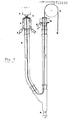
- the cooling liquid is in a U-shaped tube.
- Cooling liquid can be metered continuously into the cooling device during the process, and the direction in which it flows through the device can be the same direction or opposite to the direction of movement of the polymer / mixture partner mixture or of the shaped body formed.
- the metered liquid has a constant temperature which is below the solidification temperature of the mixture.
- the entry point for the cooling liquid into the device is in the case of simultaneous movement close to the entry point of the mixture into the cooling liquid. In this case, there is an overflow device at the exit point of the formed body, at which the cooling liquid leaves the device. In the event of the opposite direction of movement, the entry and exit points are the cooling point liquid swapped accordingly.
- cooling liquid is metered in around the entry point of the mixture through several openings. These openings are expediently arranged symmetrically around the entry point of the mixture. It is very favorable if the cooling liquid is metered around the entry point of the mixture in the form of a coherent film.
- the level of the cooling liquid at the entry point of the mixture and also at the exit point of the shaped body can be checked either only at one point or at both points through an overflow vessel.
- the temperature of the cooling liquid has the same value at every point of the device - which is not possible at all due to the supply of the polymer mixture at a higher temperature - but that the temperature prevailing at each point of the device changes during the Process does not change or changes only insignificantly. It can al o L be a temperature gradient over the length of the device.
- the polymer mixture is subjected to as little mechanical stress as possible at least until solidification begins, ie until shape stabilization begins. It is therefore necessary to ensure that the mixture does not accelerate due to the cooling liquid - this applies if the mixture and cooling liquid move in the same direction - and does not slow down too much - this applies to the opposite direction of movement. Therefore, the average speed v 2 , measured in the direction of movement of the polymer mixture with which the cooling liquid flows through the device, must be at least in the zone between the point of entry of the mixture into the cooling liquid and its beginning solidification than the speed v 1 at which the mixture aud the nozzle emerges. The zone between the entry point of the mixture into the cooling liquid and the point where the mixture begins to solidify is channel-shaped and surrounded by a wall.
- the cooling liquid is passed through the channel-shaped zone with an average linear speed v 2 which is at least 20% less than v 1 '. In certain cases it is also advantageous if the speed v 2 of the cooling liquid is around is at least 25% less than the speed v 1 at which the polymer mixture partner mixture through the
- PVDF polyvinylene fluoride
- the mean linear velocity v 2 of the cooling liquid in the channel-shaped zone can also be kept equal to 0. In such a case, it is advisable to add only the amount of cooling liquid which is carried along by the molded body when it leaves the cooling liquid. In such a case, cooling liquid can be metered in carefully, usually in small quantities, both at the entry and at the exit point.
- the cooling liquid is passed through the channel-shaped zone in the opposite direction to the movement of the polymer mixture partner mixture. This means that the cooling liquid is metered in at the point where the molded body leaves the liquid. It is expedient to check the liquid level of the cooling liquid at the exit point for the formed To keep molded articles at the same level as at the point of entry of the polymer / mixture partner mixture into the cooling liquid.
- the speed of the cooling liquid is of course always at least 25% lower than v1, since the speed of the cooling liquid has a negative sign in this case.
- This provides a wide margin for the speed of the cooling liquid.
- this is limited for the same direction of movement by the above-mentioned conveying that it must be smaller, preferably at least 20 or 25% less than the speed of the polymer mixture.
- this speed may of course not have arbitrarily high values, but finds its limit where the relative speed between the polymer mixture and the cooling liquid is too high. This limit value depends on the respective process parameters and is easy to determine with just a few experiments.
- the speed in the case of the opposite direction of movement finds its limit where deformation or tearing of the not yet stabilized polymer mixture occurs.
- a rule of thumb for the limit of the speed of the cooling liquid in the case of the opposite direction of movement is a value of about 5. 4 ⁇ v 1 where v 1 means the speed of the polymer mixture in m / min at the nozzle outlet.
- the average speed of the cooling liquid would be set to the same value that the mixture had at Has exit from the nozzle, because of the speed distribution in flowing liquids, the cooling liquid in the immediate vicinity of the mixture would have a higher value than the above-mentioned nozzle outlet speed and would accelerate the mixture.
- the speed of the cooling liquid which is of crucial importance in the zone between the point of entry of the polymer mixture into the cooling liquid and the point where the mixture begins to solidify, must therefore be controlled. This is made possible by keeping the level of the cooling liquid constant both at the point of entry of the polymer mixture into the cooling liquid and at the point of exit. For this reason there is an overflow device at the exit point.
- the speed is controlled by appropriate metering of cooling liquid. In the case of a stationary bath, i.e. in the case where the speed of the cooling liquid is zero, dosing means of course only the compensation of losses.
- the level of the cooling liquid at the entry and the exit point is not only kept constant, but the level is also the same at both points. However, there may also be a difference in height between the two.
- a particular advantage of the method in addition to the possibility of processing low-viscosity polymer mixtures, is that, because of the constant level of the cooling liquid and the low flow rate of the cooling liquid, there is a wide margin, which means the viscosity and temperature of the cooling liquid and thus Type of cooling liquid affects. In the case of known methods, this scope is considerably more limited because of the mechanical stress associated therewith of the not yet stabilized polymer mixture.
- the polymer / mixture partner mixture is subjected to as little mechanical stress as possible between the point in time at which it leaves the nozzle and the point in time when it begins to solidify, be it by tensile or shear forces.
- the mixture in this area must not be strongly influenced mechanically by the cooling liquid, such as, for example, by acceleration.
- this is achieved by leading the mixture from top to bottom in a first zone, which extends from the point at which the mixture enters the cooling liquid to the point where solidification begins.
- This zone represents a relatively narrow channel surrounded by walls, for example in the form of a cylindrical tube, the diameter of which is significantly smaller than its length.
- the point at which the mixture begins to solidify up to which the mechanical stress must be kept as low as possible, can be determined in a simple manner. This is done by observing the changes that the mixture undergoes after it emerges from the nozzle. First, due to cooling, segregation takes place in two liquid phases. The formation of two phases is preceded by an increase in viscosity. With the formation of two phases, the mixture begins to cloud, which intensifies until solidification begins. Because the solidification on the outer Layering begins and then only progresses inwards, the visually perceptible cloudiness only increases between the time of segregation until solidification begins and then does not change anymore. The point at which solidification begins is the point at which there is no longer an increase in cloudiness. It can be determined easily and fairly precisely.
- the deflection device may only be located after this point.
- the partially or completely formed solid molded body passes through a second zone of the cooling liquid, in which it is guided from bottom to top. Redirection and guiding from bottom to top are necessary in order to be able to use a device in which both the entry point and the exit point of the cooling liquid can be kept at a constant liquid level.
- This second zone in which the molded body is guided from bottom to top, does not have to be channel-shaped like the first zone, but can be a zone with wider dimensions, for example in the form of a trough, as shown in Figure 2. However, it must not coincide with the first zone * , ie the molded body must not be guided from the bottom upwards in the channel-shaped first zone between the entry point and the point where solidification begins.
- the second zone can also be designed as a channel-shaped zone, as is e.g. the case is when a U-shaped tube as shown in Figure 1 is used as the device.
- the density of the cooling liquid can be higher or lower than that of the polymer / mixture partner mixture.
- the cooling liquid at the point where the polymer mixture partner mixture enters it is a slightly lower, i.e. up to 20% of the specific weight of the polymer / mixture partner mixture has a specific weight that deviates downwards. This prevents the mixture from sagging too quickly or braking too strongly due to large differences in density.
- This slight difference in specific weight can be achieved in addition to the choice of a specific cooling liquid by using a mixture of a certain composition as the cooling liquid.
- any liquids in which the polymer is present can be used as the cooling liquid Temperature of the cooling liquid does not dissolve significantly and do not cause any chemical change in the polymer.
- water which may contain a surfactant to reduce the surface tension, has proven to be suitable. Temperatures of 20 to 80 ° C are preferred.
- the molded body formed can be pulled off from the cooling liquid by known methods, care being taken to ensure that the pulling off does not cause any strong mechanical stress on the mixture between the nozzle outlet and the onset of solidification.
- the molded body formed is normally washed. This can be done by an extraction, which follows the production of the molded body continuously or which is carried out batchwise. After the extraction, the molded body is dried.
- the process steps described enable molded articles having pores, e.g. To produce polymer membranes in the form of hollow threads, tubes or foils, which are characterized by good dimensional stability.
- porous polymer threads can also be produced by the method.
- the process steps succeed in keeping the mechanical load to which the polymer mixture is exposed until the time when the solidification begins, that is to say the dimensional stability begins, lower than in known processes. This makes it possible to also process relatively low-viscosity mixtures to give polymer moldings, which is not possible or only possible to a limited extent using previously known processes.
- Products of consistent and reproducible quality can be produced using the process according to the invention, while uncontrollable quality fluctuations occur during production using processes known hitherto, especially in the case of processing low-viscosity polymer mixtures, which fluctuations can often be attributed to excessive mechanical stress on the polymer mixtures which have not yet solidified or are dimensionally stabilized to let.
- the method according to the invention allows the pore size and characteristic to be reproducibly and specifically set in a wide range by varying process parameters.
- the invention also relates to molded articles having pores, as can be obtained by the processes described above.
- an isotropic or anisotropic pore system can be obtained above all by varying the viscosity of the polymer mixture and the type and temperature of the cooling liquid.
- the pore size and / or structure have a gradient in the direction from the surface into the interior of the shaped body.
- the asymmetry can e.g. can be achieved when the chemical composition of the inner liquid and the cooling liquid and / or their temperature differ in the production of membranes in the form of hollow filament or hoses.
- the polymer moldings produced according to the invention can be used in a variety of ways, e.g. for microfiltration of aqueous solutions and solutions in organic solvents.
- PVDF membranes are suitable because they show exceptional resistance to oxidative attack, are resistant to an unusually large number of organic solvents, and their mechanical data only drop significantly at temperatures near the melting point.
- PVDF membranes can also be used where other polymers cannot be used due to their susceptibility in the strongly acidic or strongly alkaline pH range, e.g. in the filtration of hypochlorite solutions.
- the membranes produced according to the invention are also suitable for transmembrane distillation.
- transmembrane distillation in which the short diffusion distance (membrane wall thickness) is used to evaporate aqueous solutions, the heated solution to be concentrated is on one side of the membrane and "cooling water” on the other side. Due to the difference in steam, water as a gas migrates from the hot to the cold side of the membrane.
- the temperature resistance, the low surface tension of the PVDF, which prevents the breakthrough of aqueous solution, and the oxidative resistance required for cleaning cycles can be used to advantage.
- Hollow polymer membranes with an anisotropic structure in which the pore size decreases from the inside out, can make the use of a prefilter in microfiltration unnecessary. Prefiltration is often used to trap large particles that lead to membrane build-up and thus to a rapid drop in flow. However, these large particles are retained in the anisotropic membrane structures in the large inner pores without reducing the filtering area. The so-called "dirt capacity" of the anisotropic polymer membrane is accordingly larger than in the case of isotropic structures.
- a device is particularly suitable for carrying out the method according to the invention, which is characterized by a nozzle for extruding a homogeneous, single-phase, liquid mixture from top to bottom and a Cooling device containing cooling liquid with a channel-shaped zone (3) surrounded by a wall, which extends from the point of entry of the polymer / mixture partner mixture to at least the point at which the mixture begins to solidify, a deflection device below the point of the beginning solidification and a pull-off device (6 ) for the formed body and one or more openings for the inlet or outlet of the cooling liquid.
- the cooling liquid is preferably designed in the form of a U-tube, in particular an isosceles U-tube.
- the device has an inlet for the cooling liquid with several symmetrically arranged openings.
- the device preferably has an overflow for metering in the cooling liquid. It can also have an overflow for the cooling liquid to drain off.
- the device can be provided with an external thermostat.
- the device is designed in the form of a box-shaped design of the cooling device with a viewing window.
- the device according to the invention it is possible to adjust the level of the cooling liquid in a targeted manner, in particular when using overflow vessels, be it at the entry point of the mixture, be it at the exit point of the shaped body, or be it at the entry point and at the exit point at the same time.
- the embodiment of the device according to the invention for carrying out the method, in which the cooling device is provided with a viewing window, is particularly advantageous because the point at which solidification begins can be observed very precisely with such a device. This is important at the beginning
- the viewing window is a valuable aid in so-called piecing, in which one first has to pull the formed body out of the cooling liquid in order to bring it onto the take-off device.
- the U-tube is mostly made of glass.
- the tube which is essentially composed of five parts, has a diameter of approx. 4 cm and a leg length of approx. 1 m.
- the entry point for the cooling liquid is close to the entry point of the mixture.
- the temperature jacket supports this function.
- this outer jacket and the metering openings at the upper end of the tube ensure a distribution of the liquid flows and allow the polymer mixture, which is still unstable, to be treated as gently as possible.
- the inlet opening of the cooling tube which has a surface area of approximately 5 cm 2 , ensures sufficient scope for thin and thick hollow filaments or hoses and, on the other hand, reduces the uneven surface of the cooling bath.
- the polymer / mixture partner mixture which is to be processed, for example, into a porous hollow thread, passes through the stage of separation in two liquid phases and solidification during cooling.
- the beginning solidification or the Stabilization can be observed in the first or second third of the tube. This can be seen from the fact that the initially transparent thread becomes increasingly milky and retains a certain final cloudiness from the point of solidification.
- the stabilized molded body can be deflected without being deformed. In contrast to other embodiments of the cooling device, no deflection wheel or roller is installed here.
- the tube extension directed downwards after the 1st zone allows favorable handling when piecing.
- the sinking shaped body, e.g. Hollow thread collects here and can be pulled out of the outlet leg (2nd zone) with a wire and placed on the take-off wheel.
- This device is made of metal.
- the height-adjustable middle section determines the overflow height of the cooling medium and thus also the normally level height of the cooling liquid under the spinneret. An air gap between the nozzle and the cooling liquid can thus be set in a simple manner.
- a mixture consisting of 14 parts AKULON 6 (polyamide 6 - from AKZO-Plastics bv) with a relative solution viscosity of 4.7 (measured in formic acid) and 86 parts of a solvent mixture was composed of approx. 75 in a hollow fiber spinning apparatus with a continuously working solution preparation part % Glycerol ( ⁇ 0.05% water) and approx. 25% ethylene glycol ( ⁇ 0.05% water) with the addition of 0.25% of the thickener Carbopol 934 (Goodrich), based on the solvent, and spun immediately.
- the plant was designed in such a way that short dwell times (approx. 10 minutes from the start of solution production) could be guaranteed with the most gentle temperature conditions possible.
- the polymer granules ( ⁇ 0.02% water) were extruded at approx. 280 ° C melted and fed to the mixing chamber heated to approx. 180 ° C with a gear pump.
- the mixer running at about 170 rpm ensured that the metered-in solvent mixture, which was also heated to about 180 ° C., formed a homogeneous, medium-viscosity, clear solution with the polymer melt. It was filtered before being shaped into hollow fibers.
- the hollow thread nozzle was heated to 150 ° C - 155 ° C.
- a mixture of glycerin / PEG 300 1: 1 was used as the internal filling medium.
- the thread entered the 2 meter long, U-shaped glass tube, which was charged with 50 ° C warm water, as shown in Figure 1.
- the thread slowly sank into the lower part of the tube and was pulled out of the outlet leg by means of a wire and placed on the take-off wheel.
- the nozzle exit speed of the polyamide solution was approx. 15 m / min, the average cooling bath speed approx. 1 m / min.
- the hollow thread was charged with deionized water from the inside and the flow rate through the membrane was measured at 1.0 bar.
- a sample of the polymer solution coming out of the nozzle was collected in a tempered glass vessel. The temperature of the solution was lowered with stirring and a solidification temperature of about 150 ° C. was determined.
- the polymer was pasted in powder form in the solvent mixture (including thickener) and fed to a twin-screw extruder by means of a reciprocating piston pump, where it was dissolved at approx. 160-170 ° C. After a short residence time, the homogeneous polymer mixture became the hollow thread fed nozzle and spun as in Example 1 at about 145 ° C. ⁇
- Glycerin was used to form the inner lumen.
- the hollow thread formed passed through the U-shaped cooling tube. After extraction of the solvents including thickeners and drying, the porous hollow fiber membrane was checked.
- ethylene glycol acted as the solvent and glycerin as the non-solvent or swelling agent at the given temperature settings
- Example 1 In the apparatus described in Example 1, a mixture consisting of approx. 15 parts AKULON 6 LV 4.7 and 85 parts of a solvent combination of ethylene glycol / polyglycol (molecular weight 1,500) in a ratio of 87.5: 12.5 and an additional amount of 0. 3% Carbopol 934 transferred to a homogeneous solution at approx. 180 ° C and then spun into a hollow thread. After extraction and drying in the manner described, a porous hollow thread with an open surface on all sides was formed.
- ethylene glycol served as the solvent and polyethylene glycol 1,500 as the non-solvent.
- the temperature at which the homogeneous solution forms can be varied and thus changes the span for the formation of the two phases until solidification, which can lead to different pore formation.
- Perlon LV 3.67 and 82.5% of a mixture consisting of 45 parts of caprolactam and 55 parts of polyethylene glycol 300 (molecular weight) were dissolved at about 200 ° C. in a heatable glass flange flask. A homogeneous, thinly viscous, clear solution was quickly achieved under a nitrogen atmosphere and constant stirring. This approach could be processed in the previous hollow fiber spinning plant.
- the hollow thread was formed at a nozzle temperature of approx. 210 ° C.
- Polyethylene glycol 300 was used as the internal filling medium.
- the cooling bath in the U-shaped cooling pipe was water at 45 ° C.
- the solidified thread could be extracted and dried in the usual way. Microscopic examinations showed a very uniform pore structure over membrane cross-section with openings on the outer and inner surface.
- the transmembrane flow was determined with isopropanol.
- the hollow thread is charged with isopropanol from the inside (35 ° C.) and the flow rate through the membrane is measured at 0.1 bar.
- LV 2.68 measured in dimethylformamide) (from Solvay, Belgium) and 80 parts by weight of a solvent mixture consisting of 37.5% glycerol triacetate (solvent) and 62.5% Witamol 320 (non-solvent dioctyl adipate - from Dynamit Nobel).
- solvent mixture consisting of 37.5% glycerol triacetate (solvent) and 62.5% Witamol 320 (non-solvent dioctyl adipate - from Dynamit Nobel).
- the polymer granules and the solvent mixture were brought to about 215 ° C. with vigorous stirring and in a nitrogen atmosphere. The granules were swollen at approx. 145 ° C. and a homogeneous, low-viscosity solution formed as the temperature rose.
- Part of the solution prepared in this way was extruded at about 220 ° C. through a hollow thread nozzle of a spinning machine into the U-shaped tube shown in FIG. 1 at a speed of 15 m / min. Distilled glycerin was used as the inner filling to form the lumen of the thread. After passing an air gap of approx. 1 cm, the thread entered the approx. 2 m long U-shaped glass tube charged with water at approx. 25 ° C. After entering the cooling medium, the thread slowly sank the lower part of the tube and was pulled out of the outlet leg by means of a wire and placed on a take-off wheel.
- the thread was dried at about 50 ° C in a vacuum.
- the hollow thread was immersed in ethanol and charged with nitrogen from the inside.
- the pressure at which the ethanol was displaced from the walls of the hollow thread by nitrogen and the first gas bubbles could be seen on the outside was measured.
- the maximum pore size is calculated from the value found ("blowing point") in which
- the hollow thread was charged from the inside with isopropanol heated to 35 ° C. and the flow rate measured at 0.1 bar.
- the PVDF solution the solidification temperature of which was approximately 110 ° C., was spun at 150 ° C. as in Example 1 and cooled to 35 ° C. in a glycerol / water (1: 1) bath.
- the extracted and dried hollow fiber had the following characteristics:
Landscapes
- Engineering & Computer Science (AREA)
- Mechanical Engineering (AREA)
- Chemical & Material Sciences (AREA)
- Chemical Kinetics & Catalysis (AREA)
- Manufacturing & Machinery (AREA)
- Physics & Mathematics (AREA)
- Thermal Sciences (AREA)
- Manufacture Of Porous Articles, And Recovery And Treatment Of Waste Products (AREA)
- Separation Using Semi-Permeable Membranes (AREA)
- Extrusion Moulding Of Plastics Or The Like (AREA)
- Artificial Filaments (AREA)
- Spinning Methods And Devices For Manufacturing Artificial Fibers (AREA)
Applications Claiming Priority (4)
| Application Number | Priority Date | Filing Date | Title |
|---|---|---|---|
| DE3327638 | 1983-07-30 | ||
| DE3327638A DE3327638C2 (de) | 1983-07-30 | 1983-07-30 | Verfahren und Vorrichtung zur Herstellung Poren aufweisender Formkörper |
| DE3329578 | 1983-08-16 | ||
| DE3329578A DE3329578A1 (de) | 1983-08-16 | 1983-08-16 | Poren aufweisende polyvinylidenfluorid-formkoerper |
Publications (3)
| Publication Number | Publication Date |
|---|---|
| EP0133882A2 true EP0133882A2 (fr) | 1985-03-13 |
| EP0133882A3 EP0133882A3 (en) | 1987-08-05 |
| EP0133882B1 EP0133882B1 (fr) | 1990-04-04 |
Family
ID=25812782
Family Applications (1)
| Application Number | Title | Priority Date | Filing Date |
|---|---|---|---|
| EP84106771A Expired - Lifetime EP0133882B1 (fr) | 1983-07-30 | 1984-06-14 | Corps poreux |
Country Status (4)
| Country | Link |
|---|---|
| US (1) | US4666607A (fr) |
| EP (1) | EP0133882B1 (fr) |
| JP (1) | JPH0791688B2 (fr) |
| DE (1) | DE3481817D1 (fr) |
Cited By (12)
| Publication number | Priority date | Publication date | Assignee | Title |
|---|---|---|---|---|
| EP0330072A3 (fr) * | 1988-02-26 | 1990-03-14 | SEPAREM S.p.A. | Membrane semi-perméable de séparation de fluides, son procédé de fabrication et son utilisation en microfiltration, distillation et pour des tissus spéciaux |
| DE4226205A1 (de) * | 1991-08-09 | 1993-02-11 | Korea Inst Sci & Tech | Verfahren zur herstellung von poroesen polyolefintrennmembranen ueber thermisch induzierte phasentrennung |
| EP0423249B1 (fr) * | 1988-11-10 | 1994-03-23 | Memtec Limited | Extrusion de membranes de fibres creuses |
| EP0527913B2 (fr) † | 1990-05-09 | 2000-07-05 | Memtec Limited | Procede de preparation de membranes a partir de capillaires de pvdf |
| WO2000043113A1 (fr) * | 1999-01-22 | 2000-07-27 | Membrana Gmbh | Procede de fabrication d'une membrane polyolefinique integralement asymetrique |
| US6409921B1 (en) | 1997-07-23 | 2002-06-25 | Membrana Gmbh | Integrally asymmetrical polyolefin membrane for gas exchange |
| US6497752B1 (en) | 1999-01-21 | 2002-12-24 | Membrana Gmbh | Integrally asymmetrical polyolefin membrane |
| DE10220038A1 (de) * | 2002-05-04 | 2003-11-20 | Membrana Gmbh | Verfahren zur Herstellung geschäumter Polymerformkörper und geschäumter Polymerformkörper |
| US7429343B2 (en) | 2002-01-24 | 2008-09-30 | Membrana Gmbh | Process for producing polyolefin membrane with integrally asymmetrical structure |
| EP2196254A1 (fr) | 2008-12-12 | 2010-06-16 | Membrana GmbH | Membrane PVDF hydrophobe résistant à l'ozone et ayant une stabilité mécanique élevée |
| CN104746159B (zh) * | 2013-12-27 | 2017-05-03 | 川崎重工业株式会社 | 纺丝机以及纺丝机的运转方法 |
| US10946345B2 (en) | 2013-05-29 | 2021-03-16 | Em Innovative Properties Company | Microporous polyvinylidene fluoride membrane |
Families Citing this family (38)
| Publication number | Priority date | Publication date | Assignee | Title |
|---|---|---|---|---|
| DE3631376C1 (de) * | 1986-09-15 | 1988-05-11 | Werner & Pfleiderer | Kuehlvorrichtung fuer Kunststoffgranulat |
| US5318417A (en) * | 1988-11-10 | 1994-06-07 | Kopp Clinton V | Extrusion head for forming polymeric hollow fiber |
| US5047437A (en) * | 1988-11-23 | 1991-09-10 | American Cyanamid | Porous polyacrylonitrile beads and process for their production |
| US4940734A (en) * | 1988-11-23 | 1990-07-10 | American Cyanamid | Process for the preparation of porous polymer beads |
| US5418284A (en) * | 1989-05-08 | 1995-05-23 | Cytec Technology Corp. | Surface-modified polyacrylonitrile beads |
| US5489406A (en) * | 1990-05-09 | 1996-02-06 | Memtec Limited | Method of making polyvinylidene fluoride membrane |
| US5490931A (en) * | 1992-02-24 | 1996-02-13 | Hoechst Celanese Corp. | Fabrication of a fluoropolymer hollow fiber having a defect-free separation layer |
| AU723265B2 (en) * | 1996-01-22 | 2000-08-24 | Usf Filtration And Separations Group Inc. | Highly porous polyvinylidene difluoride membranes |
| US6146747A (en) * | 1997-01-22 | 2000-11-14 | Usf Filtration And Separations Group Inc. | Highly porous polyvinylidene difluoride membranes |
| US7229665B2 (en) * | 2001-05-22 | 2007-06-12 | Millipore Corporation | Process of forming multilayered structures |
| US6994811B2 (en) * | 2001-05-22 | 2006-02-07 | Millipore Corporation | Method of manufacturing membranes and the resulting membranes |
| US7942274B2 (en) * | 2000-05-24 | 2011-05-17 | Millipore Corporation | High-throughput asymmetric membrane |
| US7314895B2 (en) * | 2001-12-19 | 2008-01-01 | Csp Technologies, Inc. | Thermoplastic composition comprising a CO2 releasing material |
| US7517581B2 (en) * | 2003-09-26 | 2009-04-14 | Parker-Hannifin Corporation | Semipermeable hydrophilic membrane |
| JP4761967B2 (ja) * | 2003-10-03 | 2011-08-31 | 株式会社クレハ | フッ化ビニリデン系樹脂多孔質中空糸およびその製造方法 |
| US20050142280A1 (en) * | 2003-10-20 | 2005-06-30 | Kim Kwon I. | System and method for synthesizing a polymer membrane |
| US20100166961A1 (en) * | 2004-01-20 | 2010-07-01 | Beard Kirby W | Production of high porosity open-cell membranes |
| WO2007147167A2 (fr) * | 2006-06-16 | 2007-12-21 | Porous Power Technologies, Llc | Structure microporeuse optimisée de cellules électrochimiques |
| US20090208832A1 (en) * | 2008-02-17 | 2009-08-20 | Porous Power Technologies, Llc | Lamination Configurations for Battery Applications Using PVDF Highly Porous Film |
| US20090227163A1 (en) * | 2008-03-05 | 2009-09-10 | Bernard Perry | Protective Apparel with Porous Material Layer |
| US20090222995A1 (en) * | 2008-03-05 | 2009-09-10 | Bernard Perry | Bedding Applications for Porous Material |
| US20090226683A1 (en) * | 2008-03-05 | 2009-09-10 | Bernard Perry | Porous Material Uses in Furniture |
| US20090223155A1 (en) * | 2008-03-05 | 2009-09-10 | Bernard Perry | Building Construction Applications for Porous Material |
| WO2010038414A1 (fr) * | 2008-09-30 | 2010-04-08 | ユニチカ株式会社 | Membrane fibre creuse en polyamide et son procédé de fabrication |
| US20100178567A1 (en) * | 2008-12-24 | 2010-07-15 | Porous Power Technologies, Llc | Mat Forming Spacers in Microporous Membrane Matrix |
| US9132390B2 (en) | 2009-03-26 | 2015-09-15 | Bl Technologies Inc. | Non-braided reinforced holow fibre membrane |
| US9276246B2 (en) * | 2009-05-20 | 2016-03-01 | Samsung Electronics Co., Ltd. | Treatment and adhesive for microporous membranes |
| JP5745510B2 (ja) | 2009-06-26 | 2015-07-08 | ビーエル・テクノロジーズ・インコーポレイテッド | 非編組式織物で強化された中空糸膜 |
| EP2616167B1 (fr) | 2010-09-15 | 2022-11-02 | BL Technologies, Inc. | Procédé de fabrication de membranes à fibres creuses renforcées par des fils autour d'un noyau soluble |
| US8529814B2 (en) | 2010-12-15 | 2013-09-10 | General Electric Company | Supported hollow fiber membrane |
| US9321014B2 (en) | 2011-12-16 | 2016-04-26 | Bl Technologies, Inc. | Hollow fiber membrane with compatible reinforcements |
| US9643129B2 (en) | 2011-12-22 | 2017-05-09 | Bl Technologies, Inc. | Non-braided, textile-reinforced hollow fiber membrane |
| US9022229B2 (en) | 2012-03-09 | 2015-05-05 | General Electric Company | Composite membrane with compatible support filaments |
| US8999454B2 (en) | 2012-03-22 | 2015-04-07 | General Electric Company | Device and process for producing a reinforced hollow fibre membrane |
| US9227362B2 (en) | 2012-08-23 | 2016-01-05 | General Electric Company | Braid welding |
| EP3235558A1 (fr) | 2016-04-21 | 2017-10-25 | 3M Innovative Properties Company of 3M Center | Membrane à fibres creuses destinée à être utilisée dans un circuit anesthésique |
| KR102225919B1 (ko) | 2016-06-27 | 2021-03-11 | 엔테그리스, 아이엔씨. | 제어된 수축을 거쳐 제조된 고도의 보유성 폴리아미드 중공 섬유 멤브레인 |
| JP2020100902A (ja) * | 2017-03-17 | 2020-07-02 | Spiber株式会社 | 乾湿式紡糸装置 |
Family Cites Families (12)
| Publication number | Priority date | Publication date | Assignee | Title |
|---|---|---|---|---|
| GB1391973A (en) * | 1971-09-07 | 1975-04-23 | Aqua Chem Inc | Polyvinyl acetal membrane |
| JPS523343B2 (fr) * | 1972-04-28 | 1977-01-27 | ||
| JPS5331105B2 (fr) * | 1973-03-27 | 1978-08-31 | ||
| DK171108B1 (da) * | 1976-08-30 | 1996-06-10 | Akzo Nv | Mikroporøst polymerlegeme samt dettes fremstilling og anvendelse |
| US4247498A (en) * | 1976-08-30 | 1981-01-27 | Akzona Incorporated | Methods for making microporous products |
| US4175153A (en) * | 1978-05-16 | 1979-11-20 | Monsanto Company | Inorganic anisotropic hollow fibers |
| NO153879C (no) * | 1978-07-31 | 1986-06-11 | Akzo Nv | Fremstilling av en membran med poroes overflate. |
| DE2833493C2 (de) * | 1978-07-31 | 1989-10-12 | Akzo Gmbh, 5600 Wuppertal | Hohlfäden |
| DE2856642A1 (de) * | 1978-12-29 | 1980-07-10 | Akzo Gmbh | Duennwandiger schlauch aus einem schmelzspinnbaren synthetischen polymeren sowie seine verwendung in einer vorrichtung zum uebertragen von waerme |
| US4291096A (en) * | 1979-03-12 | 1981-09-22 | Extracorporeal Medical Specialties, Inc. | Non-uniform cross-sectional area hollow fibers |
| DE3026718A1 (de) * | 1980-07-15 | 1982-02-04 | Akzo Gmbh, 5600 Wuppertal | Hohlfasermembran fuer die plasmaseparation |
| DE3205289C2 (de) * | 1982-02-15 | 1984-10-31 | Akzo Gmbh, 5600 Wuppertal | Verfahren zur Herstellung von porösen Körpern mit einstellbarem Gesamtporenvolumen, einstellbarer Porengröße und einstellbarer Porenwandung |
-
1984
- 1984-06-14 EP EP84106771A patent/EP0133882B1/fr not_active Expired - Lifetime
- 1984-06-14 DE DE8484106771T patent/DE3481817D1/de not_active Expired - Lifetime
- 1984-07-23 US US06/633,573 patent/US4666607A/en not_active Expired - Lifetime
- 1984-07-30 JP JP15774484A patent/JPH0791688B2/ja not_active Expired - Lifetime
Cited By (14)
| Publication number | Priority date | Publication date | Assignee | Title |
|---|---|---|---|---|
| EP0330072A3 (fr) * | 1988-02-26 | 1990-03-14 | SEPAREM S.p.A. | Membrane semi-perméable de séparation de fluides, son procédé de fabrication et son utilisation en microfiltration, distillation et pour des tissus spéciaux |
| EP0423249B1 (fr) * | 1988-11-10 | 1994-03-23 | Memtec Limited | Extrusion de membranes de fibres creuses |
| EP0527913B2 (fr) † | 1990-05-09 | 2000-07-05 | Memtec Limited | Procede de preparation de membranes a partir de capillaires de pvdf |
| DE4226205A1 (de) * | 1991-08-09 | 1993-02-11 | Korea Inst Sci & Tech | Verfahren zur herstellung von poroesen polyolefintrennmembranen ueber thermisch induzierte phasentrennung |
| US6409921B1 (en) | 1997-07-23 | 2002-06-25 | Membrana Gmbh | Integrally asymmetrical polyolefin membrane for gas exchange |
| US6497752B1 (en) | 1999-01-21 | 2002-12-24 | Membrana Gmbh | Integrally asymmetrical polyolefin membrane |
| WO2000043113A1 (fr) * | 1999-01-22 | 2000-07-27 | Membrana Gmbh | Procede de fabrication d'une membrane polyolefinique integralement asymetrique |
| US7429343B2 (en) | 2002-01-24 | 2008-09-30 | Membrana Gmbh | Process for producing polyolefin membrane with integrally asymmetrical structure |
| DE10220038A1 (de) * | 2002-05-04 | 2003-11-20 | Membrana Gmbh | Verfahren zur Herstellung geschäumter Polymerformkörper und geschäumter Polymerformkörper |
| US7429420B2 (en) | 2002-05-04 | 2008-09-30 | Membrana Gmbh | Method for producing foamed polymer molded bodies and said foamed polymer molder bodies |
| EP2196254A1 (fr) | 2008-12-12 | 2010-06-16 | Membrana GmbH | Membrane PVDF hydrophobe résistant à l'ozone et ayant une stabilité mécanique élevée |
| US8523981B2 (en) | 2008-12-12 | 2013-09-03 | Membrana Gmbh | Hydrophobic ozone-stable membrane made of polyvinylidene fluoride |
| US10946345B2 (en) | 2013-05-29 | 2021-03-16 | Em Innovative Properties Company | Microporous polyvinylidene fluoride membrane |
| CN104746159B (zh) * | 2013-12-27 | 2017-05-03 | 川崎重工业株式会社 | 纺丝机以及纺丝机的运转方法 |
Also Published As
| Publication number | Publication date |
|---|---|
| EP0133882A3 (en) | 1987-08-05 |
| JPH0791688B2 (ja) | 1995-10-04 |
| JPS6052612A (ja) | 1985-03-25 |
| US4666607A (en) | 1987-05-19 |
| DE3481817D1 (de) | 1990-05-10 |
| EP0133882B1 (fr) | 1990-04-04 |
Similar Documents
| Publication | Publication Date | Title |
|---|---|---|
| EP0133882B1 (fr) | Corps poreux | |
| EP1144096B1 (fr) | Membrane polyolefinique integralement asymetrique | |
| EP1140331B1 (fr) | Procede de fabrication d'une membrane polyolefinique integralement asymetrique | |
| EP0999889B1 (fr) | Membrane en polyolefine integralement asymetrique pour echange gazeux | |
| DE2822265C2 (de) | Verfahren zur Herstellung einer polymeren Membran | |
| EP2196254B1 (fr) | Membrane PVDF hydrophobe résistant à l'ozone et ayant une stabilité mécanique élevée | |
| DE3023058C2 (fr) | ||
| DE2833493C2 (de) | Hohlfäden | |
| DE2822266C2 (de) | Kontinuierliches Verfahren zur Herstellung einer mikroporösen Membran aus einem Polymer und nach dem Verfahren hergestellte Membran | |
| DE69130879T2 (de) | Polyvinylidenmembrane | |
| DE68914149T2 (de) | Poröse membranen. | |
| DE69917013T2 (de) | Verfahren zur herstellung einer verstärkten, mikroporösen membran mit drei zonen | |
| DE3205289A1 (de) | Verfahren zur herstellung von poroesen koerpern mit einstellbarem gesamtporenvolumen, einstellbarer porengroesse und einstellbarer porenwandung | |
| DE69322776T2 (de) | Verfahren zur herstellung einer mikroporösen polyvinylidenfluorid-membran | |
| WO1996037282A1 (fr) | Membrane de separation synthetique | |
| WO2016071271A1 (fr) | Membrane plate hydrophobe à base de fluorure de polyvinylidène et procédé de fabrication de ladite membrane | |
| WO2012139896A1 (fr) | Membrane de filtration macroporeuse | |
| EP0357021A2 (fr) | Procédé de fabrication de membranes | |
| DE2621519C3 (de) | Verfahren zur Herstellung von asymmetrischen permselektiven Zellulosetriacetatmembranen mit Skinschicht | |
| CH644789A5 (de) | Membran mit poroeser oberflaeche. | |
| EP1469935A2 (fr) | Membrane polyolefine presentant une structure integralement asymetrique et son procede de production | |
| DE3327638C2 (de) | Verfahren und Vorrichtung zur Herstellung Poren aufweisender Formkörper | |
| DE3329578C2 (fr) | ||
| DE2341392C3 (de) | Semipermeable Hydrogelmembran oder Hohlfaser, Verfahren zu ihrer Herstellung und ihre Verwendung | |
| DE8322086U1 (de) | Vorrichtung zur herstellung poren aufweisender formkoerper |
Legal Events
| Date | Code | Title | Description |
|---|---|---|---|
| PUAI | Public reference made under article 153(3) epc to a published international application that has entered the european phase |
Free format text: ORIGINAL CODE: 0009012 |
|
| AK | Designated contracting states |
Designated state(s): BE DE FR GB IT NL SE |
|
| PUAL | Search report despatched |
Free format text: ORIGINAL CODE: 0009013 |
|
| AK | Designated contracting states |
Kind code of ref document: A3 Designated state(s): BE DE FR GB IT NL SE |
|
| 17P | Request for examination filed |
Effective date: 19870713 |
|
| 17Q | First examination report despatched |
Effective date: 19871027 |
|
| RAP1 | Party data changed (applicant data changed or rights of an application transferred) |
Owner name: AKZO PATENTE GMBH |
|
| RBV | Designated contracting states (corrected) |
Designated state(s): DE FR GB IT NL SE |
|
| ITF | It: translation for a ep patent filed | ||
| GRAA | (expected) grant |
Free format text: ORIGINAL CODE: 0009210 |
|
| AK | Designated contracting states |
Kind code of ref document: B1 Designated state(s): DE FR GB IT NL SE |
|
| GBT | Gb: translation of ep patent filed (gb section 77(6)(a)/1977) | ||
| REF | Corresponds to: |
Ref document number: 3481817 Country of ref document: DE Date of ref document: 19900510 |
|
| ET | Fr: translation filed | ||
| PLBE | No opposition filed within time limit |
Free format text: ORIGINAL CODE: 0009261 |
|
| STAA | Information on the status of an ep patent application or granted ep patent |
Free format text: STATUS: NO OPPOSITION FILED WITHIN TIME LIMIT |
|
| 26N | No opposition filed | ||
| ITTA | It: last paid annual fee | ||
| EAL | Se: european patent in force in sweden |
Ref document number: 84106771.3 |
|
| PGFP | Annual fee paid to national office [announced via postgrant information from national office to epo] |
Ref country code: GB Payment date: 19990430 Year of fee payment: 16 |
|
| PGFP | Annual fee paid to national office [announced via postgrant information from national office to epo] |
Ref country code: SE Payment date: 19990504 Year of fee payment: 16 |
|
| PGFP | Annual fee paid to national office [announced via postgrant information from national office to epo] |
Ref country code: NL Payment date: 19990628 Year of fee payment: 16 |
|
| PGFP | Annual fee paid to national office [announced via postgrant information from national office to epo] |
Ref country code: FR Payment date: 19990908 Year of fee payment: 16 |
|
| PGFP | Annual fee paid to national office [announced via postgrant information from national office to epo] |
Ref country code: DE Payment date: 20000216 Year of fee payment: 16 |
|
| PG25 | Lapsed in a contracting state [announced via postgrant information from national office to epo] |
Ref country code: GB Free format text: LAPSE BECAUSE OF NON-PAYMENT OF DUE FEES Effective date: 20000614 |
|
| PG25 | Lapsed in a contracting state [announced via postgrant information from national office to epo] |
Ref country code: SE Free format text: LAPSE BECAUSE OF NON-PAYMENT OF DUE FEES Effective date: 20000615 |
|
| PG25 | Lapsed in a contracting state [announced via postgrant information from national office to epo] |
Ref country code: NL Free format text: LAPSE BECAUSE OF NON-PAYMENT OF DUE FEES Effective date: 20010101 |
|
| GBPC | Gb: european patent ceased through non-payment of renewal fee |
Effective date: 20000614 |
|
| EUG | Se: european patent has lapsed |
Ref document number: 84106771.3 |
|
| PG25 | Lapsed in a contracting state [announced via postgrant information from national office to epo] |
Ref country code: FR Free format text: LAPSE BECAUSE OF NON-PAYMENT OF DUE FEES Effective date: 20010228 |
|
| NLV4 | Nl: lapsed or anulled due to non-payment of the annual fee |
Effective date: 20010101 |
|
| REG | Reference to a national code |
Ref country code: FR Ref legal event code: ST |
|
| PG25 | Lapsed in a contracting state [announced via postgrant information from national office to epo] |
Ref country code: DE Free format text: LAPSE BECAUSE OF NON-PAYMENT OF DUE FEES Effective date: 20010403 |