EP0134111B1 - Sulfures,sulfones et sulfoxydes araliphatiques et leur utilisation pharmaceutique - Google Patents
Sulfures,sulfones et sulfoxydes araliphatiques et leur utilisation pharmaceutique Download PDFInfo
- Publication number
- EP0134111B1 EP0134111B1 EP84305203A EP84305203A EP0134111B1 EP 0134111 B1 EP0134111 B1 EP 0134111B1 EP 84305203 A EP84305203 A EP 84305203A EP 84305203 A EP84305203 A EP 84305203A EP 0134111 B1 EP0134111 B1 EP 0134111B1
- Authority
- EP
- European Patent Office
- Prior art keywords
- solution
- alkyl
- compound
- stirred
- evaporated
- Prior art date
- Legal status (The legal status is an assumption and is not a legal conclusion. Google has not performed a legal analysis and makes no representation as to the accuracy of the status listed.)
- Expired
Links
- 0 OC(C1CC=C*C1)=O Chemical compound OC(C1CC=C*C1)=O 0.000 description 5
Classifications
-
- C—CHEMISTRY; METALLURGY
- C07—ORGANIC CHEMISTRY
- C07C—ACYCLIC OR CARBOCYCLIC COMPOUNDS
- C07C323/00—Thiols, sulfides, hydropolysulfides or polysulfides substituted by halogen, oxygen or nitrogen atoms, or by sulfur atoms not being part of thio groups
- C07C323/50—Thiols, sulfides, hydropolysulfides or polysulfides substituted by halogen, oxygen or nitrogen atoms, or by sulfur atoms not being part of thio groups containing thio groups and carboxyl groups bound to the same carbon skeleton
- C07C323/51—Thiols, sulfides, hydropolysulfides or polysulfides substituted by halogen, oxygen or nitrogen atoms, or by sulfur atoms not being part of thio groups containing thio groups and carboxyl groups bound to the same carbon skeleton having the sulfur atoms of the thio groups bound to acyclic carbon atoms of the carbon skeleton
-
- C—CHEMISTRY; METALLURGY
- C07—ORGANIC CHEMISTRY
- C07D—HETEROCYCLIC COMPOUNDS
- C07D257/00—Heterocyclic compounds containing rings having four nitrogen atoms as the only ring hetero atoms
- C07D257/02—Heterocyclic compounds containing rings having four nitrogen atoms as the only ring hetero atoms not condensed with other rings
- C07D257/04—Five-membered rings
-
- A—HUMAN NECESSITIES
- A61—MEDICAL OR VETERINARY SCIENCE; HYGIENE
- A61P—SPECIFIC THERAPEUTIC ACTIVITY OF CHEMICAL COMPOUNDS OR MEDICINAL PREPARATIONS
- A61P11/00—Drugs for disorders of the respiratory system
-
- A—HUMAN NECESSITIES
- A61—MEDICAL OR VETERINARY SCIENCE; HYGIENE
- A61P—SPECIFIC THERAPEUTIC ACTIVITY OF CHEMICAL COMPOUNDS OR MEDICINAL PREPARATIONS
- A61P37/00—Drugs for immunological or allergic disorders
- A61P37/08—Antiallergic agents
-
- A—HUMAN NECESSITIES
- A61—MEDICAL OR VETERINARY SCIENCE; HYGIENE
- A61P—SPECIFIC THERAPEUTIC ACTIVITY OF CHEMICAL COMPOUNDS OR MEDICINAL PREPARATIONS
- A61P43/00—Drugs for specific purposes, not provided for in groups A61P1/00-A61P41/00
-
- C—CHEMISTRY; METALLURGY
- C07—ORGANIC CHEMISTRY
- C07C—ACYCLIC OR CARBOCYCLIC COMPOUNDS
- C07C17/00—Preparation of halogenated hydrocarbons
- C07C17/26—Preparation of halogenated hydrocarbons by reactions involving an increase in the number of carbon atoms in the skeleton
- C07C17/263—Preparation of halogenated hydrocarbons by reactions involving an increase in the number of carbon atoms in the skeleton by condensation reactions
- C07C17/2635—Preparation of halogenated hydrocarbons by reactions involving an increase in the number of carbon atoms in the skeleton by condensation reactions involving a phosphorus compound, e.g. Wittig synthesis
-
- C—CHEMISTRY; METALLURGY
- C07—ORGANIC CHEMISTRY
- C07C—ACYCLIC OR CARBOCYCLIC COMPOUNDS
- C07C17/00—Preparation of halogenated hydrocarbons
- C07C17/35—Preparation of halogenated hydrocarbons by reactions not affecting the number of carbon or of halogen atoms in the reaction
- C07C17/354—Preparation of halogenated hydrocarbons by reactions not affecting the number of carbon or of halogen atoms in the reaction by hydrogenation
-
- C—CHEMISTRY; METALLURGY
- C07—ORGANIC CHEMISTRY
- C07C—ACYCLIC OR CARBOCYCLIC COMPOUNDS
- C07C255/00—Carboxylic acid nitriles
-
- C—CHEMISTRY; METALLURGY
- C07—ORGANIC CHEMISTRY
- C07C—ACYCLIC OR CARBOCYCLIC COMPOUNDS
- C07C309/00—Sulfonic acids; Halides, esters, or anhydrides thereof
-
- C—CHEMISTRY; METALLURGY
- C07—ORGANIC CHEMISTRY
- C07C—ACYCLIC OR CARBOCYCLIC COMPOUNDS
- C07C317/00—Sulfones; Sulfoxides
-
- C—CHEMISTRY; METALLURGY
- C07—ORGANIC CHEMISTRY
- C07C—ACYCLIC OR CARBOCYCLIC COMPOUNDS
- C07C323/00—Thiols, sulfides, hydropolysulfides or polysulfides substituted by halogen, oxygen or nitrogen atoms, or by sulfur atoms not being part of thio groups
-
- C—CHEMISTRY; METALLURGY
- C07—ORGANIC CHEMISTRY
- C07C—ACYCLIC OR CARBOCYCLIC COMPOUNDS
- C07C33/00—Unsaturated compounds having hydroxy or O-metal groups bound to acyclic carbon atoms
- C07C33/18—Monohydroxylic alcohols containing only six-membered aromatic rings as cyclic part
- C07C33/20—Monohydroxylic alcohols containing only six-membered aromatic rings as cyclic part monocyclic
-
- C—CHEMISTRY; METALLURGY
- C07—ORGANIC CHEMISTRY
- C07C—ACYCLIC OR CARBOCYCLIC COMPOUNDS
- C07C33/00—Unsaturated compounds having hydroxy or O-metal groups bound to acyclic carbon atoms
- C07C33/28—Alcohols containing only six-membered aromatic rings as cyclic part with unsaturation outside the aromatic rings
- C07C33/30—Alcohols containing only six-membered aromatic rings as cyclic part with unsaturation outside the aromatic rings monocyclic
-
- C—CHEMISTRY; METALLURGY
- C07—ORGANIC CHEMISTRY
- C07D—HETEROCYCLIC COMPOUNDS
- C07D303/00—Compounds containing three-membered rings having one oxygen atom as the only ring hetero atom
- C07D303/02—Compounds containing oxirane rings
- C07D303/04—Compounds containing oxirane rings containing only hydrogen and carbon atoms in addition to the ring oxygen atoms
-
- C—CHEMISTRY; METALLURGY
- C07—ORGANIC CHEMISTRY
- C07D—HETEROCYCLIC COMPOUNDS
- C07D303/00—Compounds containing three-membered rings having one oxygen atom as the only ring hetero atom
- C07D303/02—Compounds containing oxirane rings
- C07D303/12—Compounds containing oxirane rings with hydrocarbon radicals, substituted by singly or doubly bound oxygen atoms
- C07D303/14—Compounds containing oxirane rings with hydrocarbon radicals, substituted by singly or doubly bound oxygen atoms by free hydroxyl radicals
-
- C—CHEMISTRY; METALLURGY
- C07—ORGANIC CHEMISTRY
- C07D—HETEROCYCLIC COMPOUNDS
- C07D303/00—Compounds containing three-membered rings having one oxygen atom as the only ring hetero atom
- C07D303/02—Compounds containing oxirane rings
- C07D303/12—Compounds containing oxirane rings with hydrocarbon radicals, substituted by singly or doubly bound oxygen atoms
- C07D303/32—Compounds containing oxirane rings with hydrocarbon radicals, substituted by singly or doubly bound oxygen atoms by aldehydo- or ketonic radicals
-
- C—CHEMISTRY; METALLURGY
- C07—ORGANIC CHEMISTRY
- C07D—HETEROCYCLIC COMPOUNDS
- C07D303/00—Compounds containing three-membered rings having one oxygen atom as the only ring hetero atom
- C07D303/02—Compounds containing oxirane rings
- C07D303/38—Compounds containing oxirane rings with hydrocarbon radicals, substituted by carbon atoms having three bonds to hetero atoms with at the most one bond to halogen, e.g. ester or nitrile radicals
- C07D303/40—Compounds containing oxirane rings with hydrocarbon radicals, substituted by carbon atoms having three bonds to hetero atoms with at the most one bond to halogen, e.g. ester or nitrile radicals by ester radicals
-
- C—CHEMISTRY; METALLURGY
- C07—ORGANIC CHEMISTRY
- C07D—HETEROCYCLIC COMPOUNDS
- C07D307/00—Heterocyclic compounds containing five-membered rings having one oxygen atom as the only ring hetero atom
- C07D307/77—Heterocyclic compounds containing five-membered rings having one oxygen atom as the only ring hetero atom ortho- or peri-condensed with carbocyclic rings or ring systems
- C07D307/87—Benzo [c] furans; Hydrogenated benzo [c] furans
- C07D307/88—Benzo [c] furans; Hydrogenated benzo [c] furans with one oxygen atom directly attached in position 1 or 3
-
- C—CHEMISTRY; METALLURGY
- C07—ORGANIC CHEMISTRY
- C07D—HETEROCYCLIC COMPOUNDS
- C07D309/00—Heterocyclic compounds containing six-membered rings having one oxygen atom as the only ring hetero atom, not condensed with other rings
- C07D309/02—Heterocyclic compounds containing six-membered rings having one oxygen atom as the only ring hetero atom, not condensed with other rings having no double bonds between ring members or between ring members and non-ring members
- C07D309/08—Heterocyclic compounds containing six-membered rings having one oxygen atom as the only ring hetero atom, not condensed with other rings having no double bonds between ring members or between ring members and non-ring members with hetero atoms or with carbon atoms having three bonds to hetero atoms with at the most one bond to halogen, e.g. ester or nitrile radicals, directly attached to ring carbon atoms
- C07D309/10—Oxygen atoms
- C07D309/12—Oxygen atoms only hydrogen atoms and one oxygen atom directly attached to ring carbon atoms, e.g. tetrahydropyranyl ethers
-
- C—CHEMISTRY; METALLURGY
- C07—ORGANIC CHEMISTRY
- C07D—HETEROCYCLIC COMPOUNDS
- C07D405/00—Heterocyclic compounds containing both one or more hetero rings having oxygen atoms as the only ring hetero atoms, and one or more rings having nitrogen as the only ring hetero atom
- C07D405/02—Heterocyclic compounds containing both one or more hetero rings having oxygen atoms as the only ring hetero atoms, and one or more rings having nitrogen as the only ring hetero atom containing two hetero rings
- C07D405/10—Heterocyclic compounds containing both one or more hetero rings having oxygen atoms as the only ring hetero atoms, and one or more rings having nitrogen as the only ring hetero atom containing two hetero rings linked by a carbon chain containing aromatic rings
-
- C—CHEMISTRY; METALLURGY
- C07—ORGANIC CHEMISTRY
- C07K—PEPTIDES
- C07K5/00—Peptides containing up to four amino acids in a fully defined sequence; Derivatives thereof
- C07K5/04—Peptides containing up to four amino acids in a fully defined sequence; Derivatives thereof containing only normal peptide links
- C07K5/06—Dipeptides
- C07K5/06008—Dipeptides with the first amino acid being neutral
- C07K5/06017—Dipeptides with the first amino acid being neutral and aliphatic
- C07K5/0606—Dipeptides with the first amino acid being neutral and aliphatic the side chain containing heteroatoms not provided for by C07K5/06086 - C07K5/06139, e.g. Ser, Met, Cys, Thr
-
- A—HUMAN NECESSITIES
- A61—MEDICAL OR VETERINARY SCIENCE; HYGIENE
- A61K—PREPARATIONS FOR MEDICAL, DENTAL OR TOILETRY PURPOSES
- A61K38/00—Medicinal preparations containing peptides
-
- Y—GENERAL TAGGING OF NEW TECHNOLOGICAL DEVELOPMENTS; GENERAL TAGGING OF CROSS-SECTIONAL TECHNOLOGIES SPANNING OVER SEVERAL SECTIONS OF THE IPC; TECHNICAL SUBJECTS COVERED BY FORMER USPC CROSS-REFERENCE ART COLLECTIONS [XRACs] AND DIGESTS
- Y02—TECHNOLOGIES OR APPLICATIONS FOR MITIGATION OR ADAPTATION AGAINST CLIMATE CHANGE
- Y02P—CLIMATE CHANGE MITIGATION TECHNOLOGIES IN THE PRODUCTION OR PROCESSING OF GOODS
- Y02P20/00—Technologies relating to chemical industry
- Y02P20/50—Improvements relating to the production of bulk chemicals
- Y02P20/55—Design of synthesis routes, e.g. reducing the use of auxiliary or protecting groups
Definitions
- This invention relates to novel compounds and their use as pharmaceuticals.
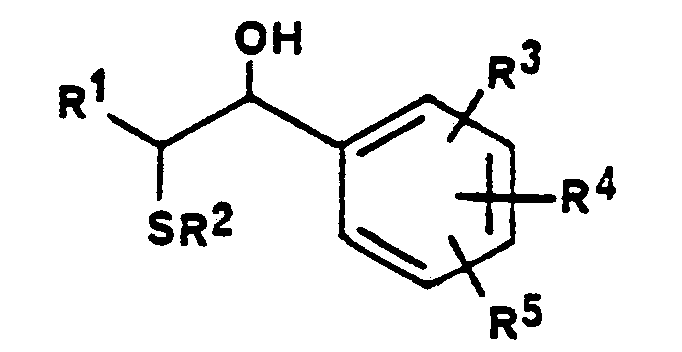
- the compounds of the invention are of the formula in which n is 0, 1 or 2, R 1 is a hydrocarbyl group optionally substituted with an optionally substituted phenyl group and containing from 5 to 30 carbon atoms, R 2 is optionally substituted phenyl or C 1-10 alkyl optionally substituted by one or more substituents selected from optionally protected hydroxyl, optionally protected carboxy, nitrile, optionally protected tetrazolyl, -COR 6 where R 6 is C 1 - 4 alkyl, C 1 - 4 alkoxy, an optionally protected amino acid residue or -NR2 where each R 7 is hydrogen or C 1-4 alkyl, and ⁇ NHR 8 where R 8 is hydrogen, a protecting group, an optionally protected amino acid residue, C 1-4 alkyl or-COR 9 where R 9 is C 1 - 4 alkyl or C 1 - 4 alkoxy, and R 3 , R 4 and R 5 are each selected from hydrogen, carboxyl, C 2-5 alkoxycarbony
- the compounds of the invention in unprotected form, have been shown to be pharmacologically active in tests which demonstrate their antagonist effect on leukotriene receptors and indicate their use in the treatment of allergic disorders.
- the optionally substituted hydrocarbyl group can be saturated or unsaturated and includes an optionally substituted alkyl group or optionally substituted, alkenyl and alkynyl groups, the substituents on such groups being phenyl and substituted phenyl.
- the hydrocarbyl group preferably contains from 5 to 20 carbon atoms, for example from 10 to 20 carbon atoms and especially from 10 to 15 carbon atoms.
- R 1 is alkyl it can be branched or unbranched and is preferably one containing 10 to 15 carbon atoms.
- R 1 is alkenyl it can be branched or unbranched preferably containing 10 to 15 carbon atoms, such as for example 12 to 15.
- Two especially preferred examples of alkenyl groups are: - and
- R 1 is alkynyl it can be branched or unbranched, and preferably contains from 10 to 15 carbon atoms having 1 to 4 triple bonds. It is to be understood that such alkynyl groups can also contain one or more, for example, 1 to 3 double bonds in addition to its triple bond or bonds.
- R 1 When R 1 is substituted hydrocarbyl it is substituted by an optionally substituted phenyl ring, preferably phenyl itself, or a phenyl group substituted with one or more, preferably 1 to 3, substituents selected from C 1-4 akyl, especially methyl, C 1 - 4 alkoxy, especially methoxy and ethoxy, hydroxy, nitro, cyano, halo, especially chloro, trifluoromethyl, carboxyl, tetrazolyl and -CONH 2 .
- R 1 When R 1 is substituted with an optionally substitued phenyl group it is preferably an alkenyl group.
- R 1 is one of the above defined alkenyl groups.
- R 2 this can be a C 1-10 alkyl group, preferably C 1-6 alkyl, and optionally substituted by one or more, preferably 1 to 3, substituents as defined above.
- the substituent can be, ⁇ COR 6 or ⁇ NHR 8 where R 6 and R 8 are amino acid residue.
- Such amino acid residues can be optionally protected by a conventional protecting group and can be derived from any of the commonly occurring amino acids.
- the residue is preferably derived from glycine having the value -NHCH 2 COOH and in the case of R 8 it is preferably derived from aspartic acid or glutamic acid, having the values ⁇ COCH 2 CH(NH 2 )COOH and ⁇ COCH 2 CH 2 CH(NH 2 )COOH, respectively.
- the SR 2 group include cysteinyl, cysteinylglycinyl and glutathionyl of formulae -SCH 2 CH(NH 2 )COOH, -SCH 2 CH(NH 2 )CONHCH 2 COOH and respectively.
- R 2 is an alkyl group substituted with 1 to 3 substituents selected from carboxyl, nitrile, tetrazolyl, and ⁇ COR 6 where R 6 is or C 1-4 alkoxy.
- R 2 is of the following formula: where x is 1 to 5 and R 12 is carboxyl, nitrile, ⁇ CONH 2 or tetrazolyl. Most preferred are groups in which x is 2 and/or R 12 is carboxyl or tetrazolyl.
- R 2 can be optionally substituted phenyl and it can be any of the values defined above when R 1 bears an optionally substituted phenyl group.
- the phenyl ring is substituted with 1 to 3 substituents selected from carboxyl, tetrazolyl and CONH 2 , and especially a single carboxyl substituent.
- the groups R 3 , R 4 and R 5 can be hydrogen, carboxyl, C 2 - s alkoxycarbonyl, C 1 - 4 alkyl, C 1 - 4 alkoxy, hydroxyl, optionally protected tetrazolyl, halo, trifluoromethyl, nitrile, nitro and where each R 10 is hydrogen or C 1 - 4 alkyl.
- the tretrazolyl group is preferably 1H-tetrazol-5-yl.
- the substituent be nitrile, -CONH 2 , tetrazolyl or carboxyl, acid substituents such as tetrazolyl and carboxyl being best of all.
- Maximum biological activity is given by the compounds in which the tetrazolyl or carboxyl group is attached at the ortho or meta positions, and the most preferred groups are of the formula
- Preferred compounds of formula (I) above are those in which n is 0.
- C 1-4 alkyl means a straight or branched chain alkyl group, for example, methyl, ethyl, propyl, isopropyl, butyl, isobutyl and tertiary butyl, and is preferably methyl or ethyl.
- a C 1 - 4 alkoxy group is any such alkyl group attached through oxygen to the appropriate moiety
- alkoxycarbonyl is a group of the form ROCO- where R is a C 1 - 4 alkyl group as described above.
- amino-protecting groups that can be employed in the preparation of the compounds of the invention are also conventional protecting groups.
- Illustrative of such groups are trihalo- acetyl groups especially trifluoroacetyle.
- Such groups are well known in the art and are discussed, for example, in Peptide Synthesis by M. Bodansky, Y. S. Klausner and M. A. Ondetti, Second Edition (1976) John Wiley & Sons. Any free hydroxy groups present in the compound of the invention may likewise be protected if needed.
- a hydroxy group on the R 2 group of a compound of the formula I can be protected with a conventional labile ether forming protecting group such as an ether formed with dihydropyran or methylvinyl ether, or by esters formed with the lower alkyl carboxylic acids such as formic, acetic or propionic, or such halogenated acids, for example, chloroacetic acid, dichloroacetic acid or ⁇ , ⁇ -dichloro- propionic acid.
- a conventional labile ether forming protecting group such as an ether formed with dihydropyran or methylvinyl ether
- esters formed with the lower alkyl carboxylic acids such as formic, acetic or propionic, or such halogenated acids, for example, chloroacetic acid, dichloroacetic acid or ⁇ , ⁇ -dichloro- propionic acid.
- suitable and well known protecting groups for this purpose include the trityl and benzhydryl groups formed by reaction with the appropriate halide in the presence of base for example by reacting the tetrazolyl reactant with trityl chloride and triethylamine.
- base addition salts can be prepared and these are to be regarded as part of the present invention.
- such salts are those derived from ammonium hydroxide and alkali and alkaline earth metal hydroxides, carbonates and bicarbonates, as well as salts derived from aliphatic and aromatic amines, aliphatic diamines and hydroxy alkylamines.
- Bases especially useful in the preparation of such salts include ammonium hydroxide, potassium carbonate, sodium bicarbonate, calcium hydroxide, methylamine, diethylamine, ethylene diamine, cyclohexylamine and ethanolamine.
- the potassium and sodium salt forms together with other pharmaceutically acceptable salts are particularly preferred, but it is to be understood that other non-pharmaceutical salts are involved in the invention since they may be useful for identification, characterization or purification of the free compound.
- acid addition salts can be prepared and these are included in the present invention.
- Example of such salts are those derived from, preferably non-toxic, inorganic acids such as for example hydrochloric acid, nitric acid, phosphoric acid, sulphuric acid and nitric acid, as well as salts derived from, preferably non-toxic, organic acids such as aliphatic mono- and dicarboxylic acids, phenyl-substituted acids, hydroxyalkanoic acids, aromatic acids, and aliphatic and aromatic sulphonic acids.
- the compounds of formula (I) possess chiral centres at the carbon atoms bearing the hydroxyl and SR 2 groups and, accordingly, stereoisomeric forms exist R,R; S,S; R,S; and S,R. Other chiral centres are also possible, depending on the nature of the various substituents, which may lead to further stereoisomeric forms. Furthermore, as mentioned above, comounds containing R 1 alkenyl substituents exhibit cis-trans isomeric forms. All such stereoisomers, and racemic mixtures thereof, are included within the scope of the invention. Isomers can be isolated from racemic mixtures by conventional methods such as by the preparation of diasteroisomers with subsequent liberation of the enantiomers or, alternatively, can be prepared by methods devised to give the pure isomer.
- R 1 is an optionally unsaturated hydrocarbyl group containing from 5 to 30 carbons atoms
- R 2 is C 1-10 alkyl optionally substituted by one or more substituents selected from optionally protected hydroxyl, optionally protected carboxyl, -COR 6 where R 6 is C 1-4 alkoxy or an optionally protected amino acid residue, and ⁇ NHR 8 where R B is hydrogen, a protecting group, an optionally protected amino acid residue, C 1-4 alkyl or-COR 9 where R 9 is C 1-4 alkyl or C l - 4 alkoxy, and R 3 , R 4 and R 5 are each selected from hydrogen, carboxyl, C 2 - s alkoxycarbonyl, C 1 - 4 alkyl, hydroxyl, tetrazolyl, halo, trifluoromethyl, nitrile and nitro; and salts thereof.
- R 1 is an alkenyl group containing 10 to 20 carbon atoms
- R 2 is of the formula ⁇ (CH 2 ) x R 12 where x is 1 to 5 and R 12 is carboxyl, nitrile, -CONH 2 or tetrazolyl
- R 3 , R 4 and R 5 are selected from hydrogen, carboxyl, nitrile, -CONH 2 and tetrazolyl; and salts thereof.
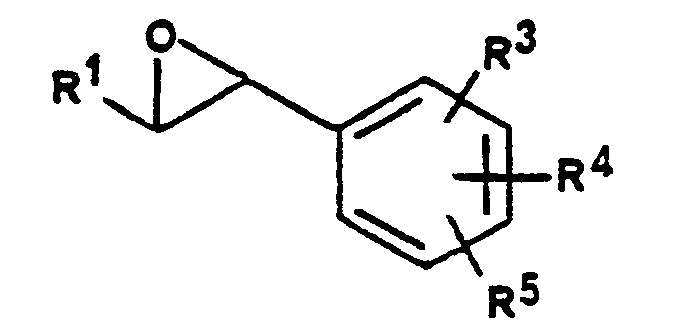
- the invention also includes a process for producing a compound of the formula in which n is 0,1 or 2, R 1 is a hydrocarbyl group optionally substituted with an optionally substituted phenyl group and containing from 5 to 30 carbon atoms, R 2 is optionally substituted phenyl or C 1-10 alkyl optionally substituted by one or more substituents selected from optionally protected hydroxyl, optionally protected carboxyl, nitrile, optionally protected tetrazolyl, -COR 6 where R 6 is C 1-4 alkyl, C 1 - 4 alkoxy, an optionally protected amino acid residue where each R 7 is hydrogen or C 1-4 alkyl, and ⁇ NHR 8 where R 8 is hydrogen, a protecting group, an optionally protected amino acid residue, C 1-4 alkyl or-COR 9 where R 9 is C 1-4 alkyl or C 1-4 alkoxy, and R 3 , R 4 and R 5 are each selected from hydrogen, carboxyl, C 2 - 5 alkoxycarbonyl,
- reaction of compound of formula (II) with thiol is preferably carried out in an inert organic solvent such as an alcohol, for example methanol, in the presence of a base such as a triethylamine and at a temperature of from 0°C to 50°C.
- a base such as a triethylamine
- Thiol reactants containing potential anion especially if it is sterically close to the thiol group are, desirably, protected before reaction.
- the corresponding sulphide in which n is 0 is reacted in substantially equivalent proportions with a suitable oxidising agent such as for example sodium periodate in an aqueous medium such as aqueous methanol at a temperature of, for example, from 0°C to 50°C.
- a suitable oxidising agent such as for example sodium periodate in an aqueous medium such as aqueous methanol at a temperature of, for example, from 0°C to 50°C.
- the sulphone compounds in which n is 2 in formula (I) can be prepared by reacting the sulphide with an excess of oxidising agent such as for example potassium persulphate, or by reacting the appropriate sulphoxide with an excess of oxidising agent, both reactions being carried out under similar conditions to those employed in the preparation of the sulphoxide and preferably at a temperature of from 0°C to 100°C.
- oxidising agent such as for example potassium persulphate
- Such reactions can readily be carried out by use of a base in an inert organic solvent, such as for example, lithium hydroxide in tetrahydrofuran, or potassium carbonate in methanol, at a temperature of from 0°C to 80°C, or by use of acid such as hydrochloric acid for removal of protecting groups from tetrazolyl, or by reduction in the case of protected amino groups, by well known procedures described for example in the authorities referred to above.
- an inert organic solvent such as for example, lithium hydroxide in tetrahydrofuran, or potassium carbonate in methanol
- R 2 group or R 3 , R 4 and R 5 groups can be interconverted. It is often preferred, depending on the nature of the group, that such interconversions are carried out after reaction of compound of formula (II) with thiol.
- R 3 , R 4 or R 5 is C 2 - s alkoxycarbonyl or in which R 2 bears such a group can be converted to the corresponding free carboxyl by hydrolysis by means of base in an inert organic solvent, such as for example, lithium hydroxide in tetrahydrofuran.
- an inert organic solvent such as for example, lithium hydroxide in tetrahydrofuran.
- compounds in which R 3 , R 4 or R 5 is C 2 - 5 alkoxycarbonyl or R 2 has such a group can be prepared from the free acid by esterification of the free carboxyl group with the appropriate alcohol or by treatment with alkyl halide in the presence of base. Salts of the free acid can, of course, be prepared simply by reaction with alkali.
- R 3 , R 4 or R 5 is or R 2 bears a group
- compounds in which R 3 , R 4 or R 5 is or R 2 bears a group can be prepared by reacting a compound with an appropriate alkoxycarbonyl substituent with ammonia or the appropriate amine of formula or , respectively, or they can be prepared by the reaction of an amine of formula NH or NH with the appropriate acyl chloride, which can in its turn be derived from the free carboxyl derivative by the reaction of thionyl chloride. Such reactions are well known in the art.
- R 3 , R 4 or R 5 is a nitrile group or R 2 has such a group can be prepared by dehydration of the appropriate amide (-CONH 2 ), a convenient dehydrating agent being, for example, a mixture of triphenylphosphine and carbon tetrachloride.
- R 3 , R 4 or R 5 is tetrazolyl or R 2 has such a group
- R 3 , R 4 or R 5 is tetrazolyl or R 2 has such a group
- Salts can be prepared from the tetrazolyl derivatives by the addition of base according to standard techniques.
- the reactants of formula R Z SH are known compounds or can be prepared by methods of a type well known in the art. When they bear amino, carboxyl or hydroxyl groups the reaction may benefit in yield if these groups are first protected, but such initial protection is by no means necessary in all cases.
- R 1 is optionally substituted alkenyl or alkynyl
- R 1 is optionally substituted alkenyl or alkynyl
- They may be prepared by the Wittig reaction of a phosphonium salt of formula R 13 CH 2 P + Ph 3 Br-, R 13 being an appropriate optionally substituted alkyl, alkenyl or alkynyl group, in the presence of a base such as butyl lithium, with an aldehyde of formula (III) or (IV)
- the reaction is generally carried out in an inert organic solvent such as for example, tetrahydrofuran, at a temperature of from -80°C to 0°C.
- Compounds offormula (III) may be prepared from known intermediates by, for example, two principal routes. Firstly, they may be prepared, as racemic mixtures, by oxidation with, for example, hydrogen peroxide and sodium hydrogen carbonate in methanolic solution, of an aldehyde of the formula and, in its turn, aldehyde of formula (III) may be converted to one of formula (IV) by reaction with formylmethylenetriphenylphosphorane.
- the compounds of formula (III) may be prepared by oxidation of an epoxy alcohol of the formula with an oxidising agent such as, for example, chromium trioxide in pyridine.
- an oxidising agent such as, for example, chromium trioxide in pyridine.
- Compounds of formula (V) can be prepared in stereospecific form and since the steric configuration is retained on oxidation to provide the aldehyde of formulae (III) and, ultimately, of formula (IV), this route can be employed to provide stereospecific compounds of formula (I).
- Compounds of formula (V) are prepared from the allyl alcohol using as epoxidising agent a reagent such as titanium isopropoxide-t-butyl peroxide in the presence of L or D diethyl tartrate which yields the S,S or R,R epoxide with the above E olefin.
- a reagent such as titanium isopropoxide-t-butyl peroxide in the presence of L or D diethyl tartrate which yields the S,S or R,R epoxide with the above E olefin.
- the Z olefin is used as starting material, the appropriate S,R and R,S stereoisomers result.
- Compounds of formula (VI) can be prepared from the appropriate benzaldehyde via a sequence of reactions involving reaction with malonic acid to provide the cinnamic acid derivative, treatment with oxalyl chloride to give the acid chloride, and reduction with a reagent such as lithium tri-t-butoxyaluminohydride.
- R 1 is alkyl, that is, a saturated group
- R 1 is alkenyl or alkynyl
- a heavy metal catalyst such as Pt0 2 or Pd/carbon or other catalytic systems, preferably at a temperature of from 0°C to 100°C and in an inert organic solvent such as for example ethanol.
- the compounds of the present invention are pharmacologically active, being leukotriene antagonists as shown by the in vitro test on guinea pig ileum segments at concentrations of from 10 ng to 50 ug, according to the method of Schild (1947) Brit. J. Pharm. 2, 197-206 (the unprotected compounds of formula (I) described in the following Examples exhibited an IC so against LTD 4 of less than 10- 5 molar). Also compounds of the invention are active in the in vivo Guinea Pig Pulmonary Function Test of Austen and Drazen (1974) J. Clin. Invest.
- the compounds are accordingly indicated for therapeutic use in the treatment of diseases in which leukotrienes are implicated.
- diseases in which leukotrienes are implicated include allergic reactions of the pulmonary system in which leukotrienes are thought to be casual mediators of bronchospasm, for example, in allergic lung disorders such as extrinsic asthma and industrial asthmas such as farmers lung and Pigeon Fanciers lung, and in other inflammatory disorders, for example, associated with acute or chronic infectious diseases such as allergic skin diseases, ectopic and atopic eczemas, psoriasis, contact hypersensitivity and angioneurotic oedema, bronchitis and crystic fibrosis and rheumatic fever.
- the invention also includes a pharmaceutical composition
- a pharmaceutical composition comprising a pharmaceutically acceptable diluent or carrier in association with a compound of formula (I) in unprotected form: or a pharmaceutically acceptable salt thereof.
- the compounds may be administered by various routes, for examples by the oral or rectal route, topically or parenterally, for example by injection, and especially by inhalation, being usually employed in the form of a pharmaceutical composition.
- Such compositions are prepared in a manner well known in the pharmaceutical art and normally comprise at least one active compound.
- the active ingredient will usually be mixed with a carrier, or diluted by a carrier, and/or enclosed within a carrier which may, for example, be in the form of a capsule, sachet, paper or other container.
- the carrier serves as a diluent, it may be a solid, semi-solid, or liquid material which acts as a vehicle, excipient or medium for the active ingredient.
- the composition may be in the form of tablets, lozenges, sachets, cachets, elixirs, suspensions, aerosols (as a solid or in a liquid medium), ointments containing for example up to 10% by weight of the active compound, soft and hard gelatin capsules, suppositories, injection solutions and suspensions and sterile packaged powders.
- aerosols as a solid or in a liquid medium
- particular forms of presentation include aerosols, atomisers and vaporisers.
- compositions of the invention may, as is well known in the art, be formulated so as to provide quick, sustained or delayed release of the active ingredient after administration to the patient.
- each unit dosage form contains from 5 mg to 500 mg, for example, from 25 mg to 200 mg.
- unit dosage form refers to physically discrete units suitable as unit dosages for human subjects and animals, each unit containing a predetermined quantity of active material calculated to produce the desired therapeutic effect, in association with the required pharmaceutical carrier.
- the active compounds are effective over a wide dosage range and, for example, dosages per day will normally fall within the range of from 0.5 to 300 mg/kg, more usually in the range of from 5 to 100 mg/kg.
- dosages per day will normally fall within the range of from 0.5 to 300 mg/kg, more usually in the range of from 5 to 100 mg/kg.
- the amount administered will be determined by the physician in the light of the relevant circumstances including the condition to be treated, the choice of compound to be administered and the chosen route of administration, and therefore the above dosage ranges are not intended to limit the scope of the invention in any way.
- the invention is illustrated by the following Examples.
- the structure of the compounds prepared was confirmed by I.R. and/or n.m.r. and/or mass spectra and the purity of the product was checked in most cases by HPLC.
- the involatile products were examined by mass spectrometry using the fast atom bombardment (FAB) technique in the negative ion mode. Significant [M-H]- ions (and characteristic fragment ions) were observed.
- FAB fast atom bombardment
- This ester (1.25 g) was dissolved in tetrahydrofuran (10 ml) and 1 M aqueous lithium hydroxide solution (3 ml) added. This solution was then stirred overnight at room temperature under nitrogen. At the end of this period further 1 M aqueous lithium hydroxide solution (2 ml) was added and the solution warmed to 30°C for 3 hours. The solution was then evaporated to remove the tetrahydrofuran and the remaining aqueous solution was adjusted to a pH of 3 with 2 M hydrochloric acid.
- the ether extracts were dried (Mg 2 S0 4 ) and evaporated to a brown oil.
- the oil was dissolved in a mixture of methanol:water (85:15) and applied to a preparative reverse phase HPLC column which was eluted with methanol:water (85:15) containing 0.5% acetic acid.
- the 3(E),5(Z) isomer of (1S,2R)-3- ⁇ 2-[2-1H-tetrazol-5-yl)ethylthio]-1-hydroxypentadeca-dienyl ⁇ benzoic acid eluted first followed closely by the more abundant 3(E),5(E) isomer.
- Glutathione 300 mg was dissolved in a mixture of dry methanol (3 ml) and triethylamine (1 ml) and the solution added to (lS,25)-3-(1,2-oxidopentadeca-3(E),5(Z)-dienyl)benzoic acid, methyl ester (prepared in Example 4(a)) under nitrogen.
- the resultant solution was allowed to stand at room temperature for 6 hours and the solvent then evaporated to dryness.
- Aqueous 2M lithium hydroxide solution (3 ml) was added and the solution stirred under nitrogen for 3 hours at room temperature. The pH of the solution was then adjusted to 4 with acetic acid and extracted with ether to remove non-polar impurities.
- Example 3(b) The product of Example 3(b) was shown by HPLC to contain about 10% of a second component. Isolation of this minor component by reverse phase HPLC on a C 18 Nucleosil column eluting with 80:20 methanol:water buffered to pH 5.3 with acetic acid and ammonia gave the title compound as a crystalline solid.
- Example 39 Similarly prepared, by the methods of Example 39 were the following:
- Each soft gelatin capsule contains:
- the blend is filled into soft gelatin capsules using the appropriate equipment.
- Each capsule contains
- the PEG 4000 is melted and mixed with the active ingredient. Whilst still molten the mixture is filled into capsule shells and allowed to cool.
- the active ingredient is dissolved in the ethanol.
- the concentrate is filled into extruded aluminium cans for inhalation aerosols.
- the cans are degassed with propellant 12 and sealed with an appropriate metered dose valve.
- the volume of product expelled per actuation is 50 or 100 pl equivalent to 0.5-1 mg active ingredient.
Landscapes
- Chemical & Material Sciences (AREA)
- Organic Chemistry (AREA)
- Health & Medical Sciences (AREA)
- Chemical Kinetics & Catalysis (AREA)
- General Health & Medical Sciences (AREA)
- Medicinal Chemistry (AREA)
- Life Sciences & Earth Sciences (AREA)
- General Chemical & Material Sciences (AREA)
- Nuclear Medicine, Radiotherapy & Molecular Imaging (AREA)
- Bioinformatics & Cheminformatics (AREA)
- Pharmacology & Pharmacy (AREA)
- Animal Behavior & Ethology (AREA)
- Engineering & Computer Science (AREA)
- Public Health (AREA)
- Veterinary Medicine (AREA)
- Pulmonology (AREA)
- Biochemistry (AREA)
- Biophysics (AREA)
- Genetics & Genomics (AREA)
- Molecular Biology (AREA)
- Proteomics, Peptides & Aminoacids (AREA)
- Immunology (AREA)
- Organic Low-Molecular-Weight Compounds And Preparation Thereof (AREA)
- Pharmaceuticals Containing Other Organic And Inorganic Compounds (AREA)
- Acyclic And Carbocyclic Compounds In Medicinal Compositions (AREA)
- Plural Heterocyclic Compounds (AREA)
- Epoxy Compounds (AREA)
Claims (13)


Priority Applications (2)
| Application Number | Priority Date | Filing Date | Title |
|---|---|---|---|
| AT84305203T ATE39110T1 (de) | 1983-08-03 | 1984-07-31 | Araliphatische sulfide,sulfone und sulfoxide sowie deren pharmazeutische verwendung. |
| MYPI87001855A MY102762A (en) | 1983-08-03 | 1987-09-22 | Novel organic compounds and their pharmaceutical use. |
Applications Claiming Priority (2)
| Application Number | Priority Date | Filing Date | Title |
|---|---|---|---|
| GB838320943A GB8320943D0 (en) | 1983-08-03 | 1983-08-03 | Organic compounds |
| GB8320943 | 1983-08-03 |
Related Child Applications (1)
| Application Number | Title | Priority Date | Filing Date |
|---|---|---|---|
| EP86106093.7 Division-Into | 1984-07-31 |
Publications (2)
| Publication Number | Publication Date |
|---|---|
| EP0134111A1 EP0134111A1 (fr) | 1985-03-13 |
| EP0134111B1 true EP0134111B1 (fr) | 1988-12-07 |
Family
ID=10546748
Family Applications (2)
| Application Number | Title | Priority Date | Filing Date |
|---|---|---|---|
| EP84305203A Expired EP0134111B1 (fr) | 1983-08-03 | 1984-07-31 | Sulfures,sulfones et sulfoxydes araliphatiques et leur utilisation pharmaceutique |
| EP86106093A Expired - Lifetime EP0201823B1 (fr) | 1983-08-03 | 1984-07-31 | Nouveaux intermédiaires pour la préparation de médicaments |
Family Applications After (1)
| Application Number | Title | Priority Date | Filing Date |
|---|---|---|---|
| EP86106093A Expired - Lifetime EP0201823B1 (fr) | 1983-08-03 | 1984-07-31 | Nouveaux intermédiaires pour la préparation de médicaments |
Country Status (28)
| Country | Link |
|---|---|
| US (3) | US4665189A (fr) |
| EP (2) | EP0134111B1 (fr) |
| JP (1) | JPS6064954A (fr) |
| KR (1) | KR920005382B1 (fr) |
| AR (1) | AR240796A1 (fr) |
| AT (2) | ATE58899T1 (fr) |
| AU (1) | AU575575B2 (fr) |
| CA (2) | CA1297632C (fr) |
| CY (1) | CY1539A (fr) |
| DE (2) | DE3475516D1 (fr) |
| DK (1) | DK167008B1 (fr) |
| EG (1) | EG16349A (fr) |
| ES (1) | ES534825A0 (fr) |
| FI (1) | FI81084C (fr) |
| GB (2) | GB8320943D0 (fr) |
| GR (1) | GR80015B (fr) |
| HK (1) | HK51090A (fr) |
| HU (2) | HU196956B (fr) |
| IE (1) | IE57691B1 (fr) |
| IL (1) | IL72539A (fr) |
| MY (1) | MY102762A (fr) |
| NZ (1) | NZ209050A (fr) |
| PH (1) | PH21029A (fr) |
| PL (1) | PL144336B1 (fr) |
| PT (1) | PT79002B (fr) |
| SG (1) | SG28590G (fr) |
| SU (1) | SU1402256A3 (fr) |
| ZA (1) | ZA845923B (fr) |
Families Citing this family (25)
| Publication number | Priority date | Publication date | Assignee | Title |
|---|---|---|---|---|
| US5143931A (en) * | 1982-06-24 | 1992-09-01 | Smithkline Beecham Corporation | Leukotriene antagonists containing tetrazolyl groups |
| AU573774B2 (en) * | 1984-02-02 | 1988-06-23 | Vanguard, Inc. | Sailboat traveler track |
| GB8432144D0 (en) * | 1984-12-20 | 1985-01-30 | Lilly Industries Ltd | Organic compounds |
| GB8502258D0 (en) * | 1985-01-30 | 1985-02-27 | Lilly Industries Ltd | Organic compounds |
| US4874792A (en) * | 1985-04-19 | 1989-10-17 | Smithkline Beckman Corporation | Thiophenyl Alkanoic acids useful as leukotriene antagonists |
| US4939279A (en) * | 1985-04-19 | 1990-07-03 | Smithkline Beecham Corporation | Leukotriene antagonists |
| US4937253A (en) * | 1985-04-19 | 1990-06-26 | Smithkline Beecham Corporation | Ester prodrugs |
| EP0358240B1 (fr) * | 1985-04-19 | 1993-06-09 | Smithkline Beecham Corporation | Produits intermédiaires pour la préparation d'anagonistes de leukotriène |
| GB8530222D0 (en) * | 1985-12-07 | 1986-01-15 | Lilly Industries Ltd | Organic compounds |
| US4785004A (en) * | 1985-12-23 | 1988-11-15 | Ciba-Geigy Corporation | Aromatic thioethers |
| GB8709546D0 (en) * | 1987-04-22 | 1987-05-28 | Lilly Industries Ltd | Pharmaceutical use of organic compounds |
| GB8709547D0 (en) * | 1987-04-22 | 1987-05-28 | Lilly Industries Ltd | Organic compounds |
| US5314918A (en) * | 1987-06-24 | 1994-05-24 | Smithkline Beecham Corporation | Leukotriene antagonists |
| PT87616B (pt) * | 1987-06-24 | 1992-09-30 | Smithkline Beecham Corp | Processo de preparacao de antagonistas do leucotrieno e de composicoes farmaceuticas |
| GB8725260D0 (en) * | 1987-10-28 | 1987-12-02 | Lilly Industries Ltd | Organic compounds |
| AU610528B2 (en) * | 1987-10-29 | 1991-05-23 | Smithkline Beckman Corporation | Leukotriene antagonists |
| GB8807016D0 (en) * | 1988-03-24 | 1988-04-27 | Lilly Industries Ltd | Organic compounds & their pharmaceutical use |
| US5149717A (en) * | 1988-03-29 | 1992-09-22 | Ciba-Geigy Corporation | Alkanophenones useful for treating allergies |
| DE68914225D1 (de) * | 1988-09-21 | 1994-05-05 | Searle & Co | 3-Oxiranbenzoesäuren und Derivate. |
| US4954513A (en) * | 1988-12-23 | 1990-09-04 | Smithkline Beecham Corporation | Leukotriene antagonists |
| US4954520A (en) * | 1989-01-19 | 1990-09-04 | G. D. Searle & Co. | 1,3-dioxolane derivatives useful in the treatment of inflammation |
| EP0419410A3 (en) * | 1989-09-19 | 1991-08-14 | Ciba-Geigy Ag | Alkanophenones |
| NZ239200A (en) * | 1990-08-01 | 1994-08-26 | Smithkline Beecham Corp | Process and intermediates for the preparation of 2-hydroxy-3-sulphido-3-phenyl propanoic acids |
| AR012550A1 (es) | 1997-02-12 | 2000-11-08 | Smithkline Beecham Corp | Metodo para preparar acidos 4-fenil-4-ciano-ciclohexanoicos sustituidos y compuestos intermediarios |
| US6369226B1 (en) * | 1999-06-21 | 2002-04-09 | Agouron Pharmaceuticals, Inc. | Substituted benzamide inhibitors of rhinovirus 3C protease |
Family Cites Families (5)
| Publication number | Priority date | Publication date | Assignee | Title |
|---|---|---|---|---|
| US3649679A (en) * | 1968-08-15 | 1972-03-14 | Lilly Co Eli | Substituted phenylalkanoic acid derivatives ii |
| GB1520812A (en) * | 1975-10-02 | 1978-08-09 | Lafon Labor | Benzhydrylsulphinyl derivatives |
| US4513005A (en) * | 1981-06-18 | 1985-04-23 | Lilly Industries Limited | SRS-A antagonists |
| CA1255329A (fr) * | 1984-10-19 | 1989-06-06 | Mitsuru Tanemura | Derives d'acide benzoique |
| US4755524A (en) * | 1986-01-31 | 1988-07-05 | G. D. Searle & Co. | Novel phenolic thioethers as inhibitors of 5-lipoxygenase |
-
1983
- 1983-08-03 GB GB838320943A patent/GB8320943D0/en active Pending
-
1984
- 1984-07-26 CA CA000459715A patent/CA1297632C/fr not_active Expired - Fee Related
- 1984-07-30 NZ NZ209050A patent/NZ209050A/xx unknown
- 1984-07-30 PT PT79002A patent/PT79002B/pt not_active IP Right Cessation
- 1984-07-30 IL IL72539A patent/IL72539A/xx not_active IP Right Cessation
- 1984-07-30 US US06/635,863 patent/US4665189A/en not_active Ceased
- 1984-07-30 AU AU31304/84A patent/AU575575B2/en not_active Ceased
- 1984-07-31 EP EP84305203A patent/EP0134111B1/fr not_active Expired
- 1984-07-31 DE DE8484305203T patent/DE3475516D1/de not_active Expired
- 1984-07-31 AT AT86106093T patent/ATE58899T1/de active
- 1984-07-31 PH PH31052A patent/PH21029A/en unknown
- 1984-07-31 DK DK371384A patent/DK167008B1/da not_active IP Right Cessation
- 1984-07-31 DE DE8686106093T patent/DE3483722D1/de not_active Expired - Fee Related
- 1984-07-31 EP EP86106093A patent/EP0201823B1/fr not_active Expired - Lifetime
- 1984-07-31 GB GB08419526A patent/GB2144422B/en not_active Expired
- 1984-07-31 ZA ZA845923A patent/ZA845923B/xx unknown
- 1984-07-31 AT AT84305203T patent/ATE39110T1/de not_active IP Right Cessation
- 1984-07-31 PL PL1984249009A patent/PL144336B1/pl unknown
- 1984-08-01 HU HU842937A patent/HU196956B/hu not_active IP Right Cessation
- 1984-08-01 EG EG490/84A patent/EG16349A/xx active
- 1984-08-01 HU HU884449A patent/HU199457B/hu not_active IP Right Cessation
- 1984-08-01 SU SU843777634A patent/SU1402256A3/ru active
- 1984-08-01 IE IE1989/84A patent/IE57691B1/en not_active IP Right Cessation
- 1984-08-01 FI FI843043A patent/FI81084C/fi not_active IP Right Cessation
- 1984-08-02 GR GR80015A patent/GR80015B/el unknown
- 1984-08-02 KR KR1019840004617A patent/KR920005382B1/ko not_active Expired
- 1984-08-02 ES ES534825A patent/ES534825A0/es active Granted
- 1984-08-02 AR AR297435A patent/AR240796A1/es active
- 1984-08-02 JP JP59163458A patent/JPS6064954A/ja active Granted
-
1987
- 1987-09-22 MY MYPI87001855A patent/MY102762A/en unknown
-
1989
- 1989-11-01 US US07/430,697 patent/USRE33300E/en not_active Expired - Lifetime
- 1989-11-01 US US07/430,105 patent/US4963578A/en not_active Expired - Lifetime
-
1990
- 1990-04-10 SG SG285/90A patent/SG28590G/en unknown
- 1990-06-05 CA CA000615758A patent/CA1301181C/fr not_active Expired - Fee Related
- 1990-06-28 HK HK510/90A patent/HK51090A/xx unknown
- 1990-11-16 CY CY1539A patent/CY1539A/xx unknown
Also Published As
Similar Documents
| Publication | Publication Date | Title |
|---|---|---|
| EP0201823B1 (fr) | Nouveaux intermédiaires pour la préparation de médicaments | |
| US4513005A (en) | SRS-A antagonists | |
| EP0235452B1 (fr) | Composés organiques et leur application pharmaceutique | |
| US4675335A (en) | Sulfur containing alkenylenyl substituted benzoic acids and phenyl tetrazoles and their use as anti-allergic agents | |
| EP0186426B1 (fr) | Dérivés tétrazolyle et leur utilisation pharmaceutique | |
| GB2094301A (en) | Improvements in or relating to organic compounds | |
| US4886885A (en) | Compound containing tetrazolyl groups and their use for treating allergies and cardiovascular disease | |
| GB2177401A (en) | Novel organic compounds and their use as intermediates in the production of pharmaceuticals | |
| US4968711A (en) | Tetrazole compounds and use as anti-allergics | |
| US5021441A (en) | Organic compounds and their pharmaceutical use | |
| EP0063858B1 (fr) | Analogues de leukotriène, leur préparation et utilisation en compositions pharmaceutiques | |
| IE57762B1 (en) | Unsaturated oxyranylbenzene derivatives |
Legal Events
| Date | Code | Title | Description |
|---|---|---|---|
| PUAI | Public reference made under article 153(3) epc to a published international application that has entered the european phase |
Free format text: ORIGINAL CODE: 0009012 |
|
| 17P | Request for examination filed |
Effective date: 19840806 |
|
| AK | Designated contracting states |
Designated state(s): AT BE CH DE FR GB IT LI LU NL SE |
|
| ITF | It: translation for a ep patent filed | ||
| GRAA | (expected) grant |
Free format text: ORIGINAL CODE: 0009210 |
|
| AK | Designated contracting states |
Kind code of ref document: B1 Designated state(s): AT BE CH DE FR GB IT LI LU NL SE |
|
| REF | Corresponds to: |
Ref document number: 39110 Country of ref document: AT Date of ref document: 19881215 Kind code of ref document: T |
|
| REF | Corresponds to: |
Ref document number: 3475516 Country of ref document: DE Date of ref document: 19890112 |
|
| ET | Fr: translation filed | ||
| PLBE | No opposition filed within time limit |
Free format text: ORIGINAL CODE: 0009261 |
|
| STAA | Information on the status of an ep patent application or granted ep patent |
Free format text: STATUS: NO OPPOSITION FILED WITHIN TIME LIMIT |
|
| 26N | No opposition filed | ||
| ITTA | It: last paid annual fee | ||
| PGFP | Annual fee paid to national office [announced via postgrant information from national office to epo] |
Ref country code: SE Payment date: 19940607 Year of fee payment: 11 |
|
| PGFP | Annual fee paid to national office [announced via postgrant information from national office to epo] |
Ref country code: FR Payment date: 19940615 Year of fee payment: 11 |
|
| PGFP | Annual fee paid to national office [announced via postgrant information from national office to epo] |
Ref country code: GB Payment date: 19940623 Year of fee payment: 11 |
|
| PGFP | Annual fee paid to national office [announced via postgrant information from national office to epo] |
Ref country code: CH Payment date: 19940627 Year of fee payment: 11 |
|
| PGFP | Annual fee paid to national office [announced via postgrant information from national office to epo] |
Ref country code: LU Payment date: 19940630 Year of fee payment: 11 |
|
| PGFP | Annual fee paid to national office [announced via postgrant information from national office to epo] |
Ref country code: BE Payment date: 19940707 Year of fee payment: 11 |
|
| PGFP | Annual fee paid to national office [announced via postgrant information from national office to epo] |
Ref country code: AT Payment date: 19940711 Year of fee payment: 11 |
|
| EPTA | Lu: last paid annual fee | ||
| PGFP | Annual fee paid to national office [announced via postgrant information from national office to epo] |
Ref country code: NL Payment date: 19940731 Year of fee payment: 11 |
|
| PGFP | Annual fee paid to national office [announced via postgrant information from national office to epo] |
Ref country code: DE Payment date: 19940907 Year of fee payment: 11 |
|
| EAL | Se: european patent in force in sweden |
Ref document number: 84305203.6 |
|
| PG25 | Lapsed in a contracting state [announced via postgrant information from national office to epo] |
Ref country code: LU Free format text: LAPSE BECAUSE OF NON-PAYMENT OF DUE FEES Effective date: 19950731 Ref country code: LI Effective date: 19950731 Ref country code: GB Effective date: 19950731 Ref country code: CH Effective date: 19950731 Ref country code: BE Effective date: 19950731 Ref country code: AT Effective date: 19950731 |
|
| PG25 | Lapsed in a contracting state [announced via postgrant information from national office to epo] |
Ref country code: SE Effective date: 19950801 |
|
| BERE | Be: lapsed |
Owner name: LILLY INDUSTRIES LTD Effective date: 19950731 |
|
| PG25 | Lapsed in a contracting state [announced via postgrant information from national office to epo] |
Ref country code: NL Effective date: 19960201 |
|
| REG | Reference to a national code |
Ref country code: CH Ref legal event code: PL |
|
| GBPC | Gb: european patent ceased through non-payment of renewal fee |
Effective date: 19950731 |
|
| NLV4 | Nl: lapsed or anulled due to non-payment of the annual fee |
Effective date: 19960201 |
|
| PG25 | Lapsed in a contracting state [announced via postgrant information from national office to epo] |
Ref country code: DE Effective date: 19960402 |
|
| PG25 | Lapsed in a contracting state [announced via postgrant information from national office to epo] |
Ref country code: FR Effective date: 19960430 |
|
| REG | Reference to a national code |
Ref country code: FR Ref legal event code: ST |
|
| EUG | Se: european patent has lapsed |
Ref document number: 84305203.6 |
|
| REG | Reference to a national code |
Ref country code: FR Ref legal event code: ST |
|
| REG | Reference to a national code |
Ref country code: FR Ref legal event code: ST |