EP0134576A2 - Carbocyclische Sechsringverbindungen - Google Patents
Carbocyclische Sechsringverbindungen Download PDFInfo
- Publication number
- EP0134576A2 EP0134576A2 EP84110417A EP84110417A EP0134576A2 EP 0134576 A2 EP0134576 A2 EP 0134576A2 EP 84110417 A EP84110417 A EP 84110417A EP 84110417 A EP84110417 A EP 84110417A EP 0134576 A2 EP0134576 A2 EP 0134576A2
- Authority
- EP
- European Patent Office
- Prior art keywords
- hexakis
- scyllo
- benzene
- benzol
- tris
- Prior art date
- Legal status (The legal status is an assumption and is not a legal conclusion. Google has not performed a legal analysis and makes no representation as to the accuracy of the status listed.)
- Granted
Links
Classifications
-
- C—CHEMISTRY; METALLURGY
- C07—ORGANIC CHEMISTRY
- C07C—ACYCLIC OR CARBOCYCLIC COMPOUNDS
- C07C317/00—Sulfones; Sulfoxides
-
- C—CHEMISTRY; METALLURGY
- C07—ORGANIC CHEMISTRY
- C07C—ACYCLIC OR CARBOCYCLIC COMPOUNDS
- C07C43/00—Ethers; Compounds having groups, groups or groups
- C07C43/02—Ethers
- C07C43/18—Ethers having an ether-oxygen atom bound to a carbon atom of a ring other than a six-membered aromatic ring
- C07C43/184—Ethers having an ether-oxygen atom bound to a carbon atom of a ring other than a six-membered aromatic ring to a carbon atom of a non-condensed ring
-
- C—CHEMISTRY; METALLURGY
- C07—ORGANIC CHEMISTRY
- C07C—ACYCLIC OR CARBOCYCLIC COMPOUNDS
- C07C43/00—Ethers; Compounds having groups, groups or groups
- C07C43/02—Ethers
- C07C43/20—Ethers having an ether-oxygen atom bound to a carbon atom of a six-membered aromatic ring
- C07C43/205—Ethers having an ether-oxygen atom bound to a carbon atom of a six-membered aromatic ring the aromatic ring being a non-condensed ring
- C07C43/2055—Ethers having an ether-oxygen atom bound to a carbon atom of a six-membered aromatic ring the aromatic ring being a non-condensed ring containing more than one ether bond
-
- C—CHEMISTRY; METALLURGY
- C09—DYES; PAINTS; POLISHES; NATURAL RESINS; ADHESIVES; COMPOSITIONS NOT OTHERWISE PROVIDED FOR; APPLICATIONS OF MATERIALS NOT OTHERWISE PROVIDED FOR
- C09K—MATERIALS FOR MISCELLANEOUS APPLICATIONS, NOT PROVIDED FOR ELSEWHERE
- C09K19/00—Liquid crystal materials
- C09K19/04—Liquid crystal materials characterised by the chemical structure of the liquid crystal components, e.g. by a specific unit
- C09K19/06—Non-steroidal liquid crystal compounds
Definitions
- Ph in the following means the benzene nucleus with six free valences, "Cy” a cyclohexane-l, 2,3,4,5,6-hexayl group.
- the compounds of formula I can be as similar compounds are used as components of discotic flüssiakristalli- ner phases, in particular for displays which are erected on the guest-host effect, the effect of deformation phases, the effect of dynamic scattering or on a change of the ellipsization of light.
- the object of the invention was to find new stable liquid-crystalline or mesogenic compounds which are suitable as components of discotic liquid-crystalline phases. This object was achieved by providing the compounds of the formula I.
- the compounds of formula 1 are excellently suitable as components of discotic liquid-crystalline phases.
- they can be used to produce stable discotic liquid-crystalline phases with a wide temperature range of the mesophase that is favorably located for electro-optical effects.
- the compounds of formula I are also suitable as an anisotropic, discotic matrix for spectroscopic investigations.
- the compounds of the formula I have been found to be discotic liquid-crystalline compounds with meso ranges, some of which are very wide.
- the compounds of the formula I in particular, for example, the thioethers of the formula I, in which at least one of the radicals X 1 to X 6 is -SR, are also suitable as intermediates for the preparation of other substances, in particular, for example, the corresponding sulfones of the formula I which are known as Allow components of liquid crystalline discotic phases to be used.
- the compounds of the formula I are colorless in the pure state and form liquid-crystalline mesophases in a temperature range which is conveniently located for electro-optical use. They are very stable chemically, thermally and against light.
- the invention thus relates to the compounds of the formula I and to a process for their preparation, characterized in that a corresponding hydroxy compound is etherified to prepare ethers of the formula I in which at least one of the radicals X 1 to X 6 is -OR and / or that a corresponding carboxylic acid is esterified to prepare esters of the formula I in which at least one of the radicals X to X 6 is -COOR or -0-COR
- the invention furthermore relates to the use of the compounds of the formula I as components of discotic liquid-crystalline phases.
- the invention also relates to discotic liquid-crystalline phases containing at least one compound of the formula I and liquid-crystal display elements which contain such phases.
- a and X 1 to X 6 and R have the meaning given above and below, unless expressly stated otherwise.
- the compounds of the formula I accordingly comprise benzene derivatives of the sub-formula Ia and cyclohexane derivatives of the sub-formula Ib
- Preferred compounds of the formula I in which three of the radicals X 1 to X 6 are H are the 1,3,5-trisubstituted compounds.
- Preferred compounds of formula I are those in which A is a cyclohexane ring.
- Preferred compounds of formula I are those in which none of the radicals X 1 to X 6 represents H, especially those in which the radicals X 1 to X 6 id e n-table are, and the following sub-formulas Ic to the corresponding
- R represents an alkyl radical in which one (oxaalkyl) or two (dioxaalkyl) CH 2 groups can also be replaced by 0 atoms.
- the compounds of formula I are prepared by methods known per se, as described in the literature (for example in the standard works such as Houben-Weyl, Methods of Organic Chemistry, Georg-Thieme-Verlag, Stuttgart), under reaction conditions that are known and suitable for the above-mentioned implementations. Use can also be made of variants which are known per se and are not mentioned here in detail.
- the starting materials are either known, or they can be prepared without difficulty by methods known per se in analogy to known compounds. If desired, they can also be formed in situ in such a way that they are not isolated from the reaction mixture, but instead are immediately reacted further to give the compounds of the formula I.
- Ethers of the formula I can be obtained by etherification of corresponding hydroxy compounds, the hydroxy compound expediently first being converted into a corresponding metal derivative, for example by treatment with NaH, NaNH 2 , NaOH, KOH, Na 2 Co 3 or K 2 CO 3 is converted into the corresponding alkali metal alcoholate or alkali metal phenolate.
- Esters of the formula I in which at least one of the radicals X 1 to X 6 denotes -COOR or -0-COR can be obtained by esterification of carboxylic acids corresponding to the formula I, but in which at least one of the radicals X to X 6 is a COO H Group, with alcohols of the formula R-OH or by esterification of alcohols of the formula I, in which A is a cyclohexane ring, but instead of at least one of the radicals X to X 6, is an OH group, with carboxylic acids of the formula R. -COOH.
- Suitable reactive derivatives of the carboxylic acids mentioned are in particular the acid halides, especially the chlorides and bromides, and also the anhydrides, e.g. also mixed anhydrides, azides or esters, in particular alkyl esters with 1 to 4 carbon atoms in the alkyl group.
- Suitable reactive derivatives of the alcohols mentioned are in particular the corresponding metal alcoholates, in which the OH group (s) is replaced by the OM group (s) and where M is an equivalent of a metal, preferably an alkali metal such as Na or K.
- the esterification is advantageously carried out in the presence of an inert solvent.
- Ethers such as diethyl ether, di-n-butyl ether, THF, dioxane or anisole, ketones such as acetone, butanone or cyclohexanone, amides such as DMF or phosphoric acid hexamethyltriamide, hydrocarbons such as benzene, toluene or xylene, halogenated hydrocarbons such as carbon tetrachloride or tetrachlorethylene, sulfoxides such as sulfoxides are particularly suitable Dimethyl sulfoxide or sulfolane and carboxylic acids such as trifluoroacetic acid.
- Water-immiscible solvents can at the same time advantageously be used for azeotropically distilling off the water formed during the esterification.
- an excess of an organic base for example pyridine, quinoline or triethylamine, can also be used as a solvent for the esterification.
- the esterification can also be carried out in the absence of a solvent, for example by simply heating the components in the presence of sodium acetate.
- the reaction temperature is usually between -50 ° and + 250 °, preferably between -20 ° and + 80 °. At these temperatures, the esterification reactions are usually complete after 15 minutes to 48 hours.
- reaction conditions for the esterification largely depend on the nature of the starting materials used.
- a free carboxylic acid is generally reacted with a free alcohol in the presence of a strong acid, for example a mineral acid such as hydrochloric acid or sulfuric acid.
- a preferred reaction is the reaction of an acid anhydride or, in particular, an acid chloride with an alcohol, preferably in a basic medium, the bases being in particular alkali metal hydroxides such as sodium or potassium hydroxide, alkali metal arbonates or hydrogen carbonates such as sodium carbonate, sodium hydrogen carbonate, potassium carbonate or potassium hydrogen carbonate, alkali metal acetates such as sodium or potassium acetate, alkaline earth metal hydroxides such as calcium hydroxide or organic bases such as triethylamine, pyridine, lutidine, collidine or quinoline are important.
- Another preferred embodiment of the esterification is that the alcohol is first converted into the sodium or potassium alcoholate, e.g.
- Thioethers of the formula I in which at least one of the radicals X 1 to X 6 is -SR, can be prepared by a corresponding halogen compound, preferably a chlorine compound such as hexachlorobenzene or hexachlorocyclohexane, with a corresponding thiol of the formula R-SH or, preferably, one its salts, in particular the corresponding Na thiolate of the formula R-SNa.
- This reaction can take place in the presence or absence of an inert solvent, at temperatures between about -20 and 250 °, preferably between 10 and 150 °.
- Suitable solvents are, for example, hydrocarbons such as benzene, toluene, xylenes or mesitylene; tertiary bases such as triethylamine, pyridine or picolines; Alcohols such as methanol, ethanol or butanol; Glycols and glycol ethers such as ethylene glycol, diethylene glycol, 2-methoxyethanol; Ketones such as acetone; Ethers such as tetrahydrofuran or dioxane; Amides such as DMF or phosphoric acid hexamethyl triamide (HMPT); Sulfoxides such as dimethyl sulfoxide. Mixtures of these solvents are also suitable.
- hydrocarbons such as benzene, toluene, xylenes or mesitylene
- tertiary bases such as triethylamine, pyridine or picolines
- Alcohols such as methanol, ethanol or butanol
- Sulfoxides and sulfones of the formula I in which at least one of the radicals X to X 6 is SOR or -SO 2 R can be prepared by oxidation of corresponding thioethers of the formula I in which at least one of the radicals X to X6 is -SR.
- the same oxidizing agents are used under stronger conditions and7 or in excess and generally at higher temperatures.
- the customary inert solvents can be present or absent in these reactions.
- suitable inert solvents are water, aqueous mineral acids, aqueous alkali lyes, lower alcohols such as methanol or ethanol, esters such as ethyl acetate, ketones such as acetone, lower carboxylic acids such as acetic acid, nitriles such as acetonitrile, hydrocarbons such as benzene, chlorinated hydrocarbons such as chloroform or CC1 4 .
- a preferred oxidizing agent is 30% aqueous hydrogen peroxide.
- solvents such as acetic acid, acetone, ethanol or aqueous sodium hydroxide solution
- this leads to the sulfoxides, in excess at higher temperatures, preferably in acetic acid or in a mixture of acetic acid and acetic anhydride Sulfones.
- Another preferred oxidizing agent is 3-chloroperbenzoic acid.
- thioethers are treated with chlorine, e.g. treated in damp benzene or in acetic acid.
- the dichloro compounds obtained as intermediates are very easily converted into the sulfoxides by hydrolysis.
- the discotic liquid-crystalline phases according to the invention consist of 2 to 15, preferably 3 to 12 components, including at least one compound of the formula I.
- the other constituents are preferably selected from the known discotic liquid-crystalline substances, in particular from the classes of the hexasubstituted benzene or triphenylene derivatives .
- the phases according to the invention contain about U, 1 to 100, preferably 10 to 100%, of one or more compounds of the formula I.
- the discotic liquid-crystalline phases according to the invention are prepared in a conventional manner.
- the components are dissolved in one another, expediently at elevated temperature.
- the discotic liquid-crystalline phases according to the invention can also be modified by suitable additives.
- suitable additives for example, conductive salts to improve the conductivity, pleochroic dyes or substances to change the dielectric anisotropy, the viscosity and / or the orientation of the discotic phases can be added.
Landscapes
- Chemical & Material Sciences (AREA)
- Organic Chemistry (AREA)
- Crystallography & Structural Chemistry (AREA)
- Engineering & Computer Science (AREA)
- Materials Engineering (AREA)
- Organic Low-Molecular-Weight Compounds And Preparation Thereof (AREA)
- Liquid Crystal Substances (AREA)
Abstract

- A ein Benzol- oder Cyclohexanring ist,
- X' bis X6 jeweils unabhängig voneinander H, -OR, -COOR, -SR, -SOR, -SO2R oder, falls A eine Cyclohexanring ist, auch -O-COR, bedeuten, und
- R jeweils eine Alkylgruppe mit bis zu 15 C-Atomen, worin eine oder zwei CH2-Gruppen durch 0-Atome ersetzt sein können, ist. wobei mindestens drei der Substituenten
- X' bis X6 von H verschieden sind. können als Bestandteile von diskotischen flüssigkristallinen Phasen für Flüssigkristall-Anzeigeelemente verwendet werden.
Description
- Die Erfindung betrifft Sechsringverbindungen der Formel I

- A ein Benzol- oder Cyclohexanring ist, X1 bis X6 jeweils unabhängig voneinander H, -OR, -COOR, -SR, -SOR, -SO2R oder, falls A ein Cyclohexanring ist, auch -0-COR,
- R jeweils eine Alkylgruppe mit bis zu 15 C-Atomen, worin eine oder zwei CH2-Gruppen durch 0-Atome ersetzt sein können, ist,
- X1 bis X 6 von H verschieden sind.
- Der Einfachheit halber bedeuten im folgenden "Ph" den Benzolkern mit sechs freien Valenzen, "Cy" eine Cyclohexan-l,2,3,4,5,6-hexaylgruppe.
- Ähnliche Verbindungen, nämlich Hexaalkanoyloxybenzole (entsprechend Formel I, A = Benzolring, X bis X6 = -0-COR) sind bekannt (vgl. S. Chandrasekhar, Mol. Cryst. .Liq. Cryst. 63. (1981) 171-179 und die dort angegebene Literatur).
- Die Verbindungen der Formel I können wie ähnliche Verbindungen als Komponenten diskotischer flüssiakristalli- ner Phasen verwendet werden, insbesondere für Displays, die auf dem Guest-Host-Effekt, dem Effekt der Deformation aufgerichteter Phasen, dem Effekt der dynamischen Streuung oder auf einer Änderung der Elliptisierung des Lichtes beruhen.
- Der Erfindung lag die Aufgabe zugrunde, neue stabile flüssigkristalline oder mesogene Verbindungen aufzufinden, die als Komponenten diskotischer flüssigkristalliner Phasen geeignet sind. Diese Aufgabe wurde durch die Bereitstellung der Verbindungen der Formel I gelöst.
- Es wurde gefunden, daß die Verbindungen der Formel 1 als Komponenten diskotischer flüssigkristalliner Phasen vorzüglich geeignet sind. Insbesondere sind mit ihrer Hilfe stabile diskotische flüssigkristalline Phasen mit einem breiten und für elektrooptische Effekte günstig gelegenen Temperaturbereich der Mesophase herstellbar.
- Die Verbindungen der Formel I eignen sich weiterhin als anisotrope, diskotische Matrix für spektroskopiscne Untersuchungen.
- Andere Verbindungen mit diskotischen Eigenschaften und ihre Verwendung sind beispielsweise in der US-PS 4 333 709 beschrieben.
- Überraschenderweise erwiesen sich die Verbindungen der Formel I als diskotische flüssigkristalline Verbindungen mit teilweise sehr breiten Mesobereichen.
- Mit der Bereitstellung der Verbindungen der Formel I wird außerdem ganz allgemein die Palette der flüssigkristallinen Substanzen, die sich unter verschiedenen anwendungstechnischen Gesichtspunkten zur Herstellunq diskotischer Gemische eignen, erheblich verbreitert.
- Die Verbindungen der Formel I, insbesondere z.B. die Thioether der Formel I, worin mindestens einer der Reste X1 bis X6 -SR bedeutet, eignen sich ferner als Zwischenprodukte zur Herstellung anderer Substanzen, insbesondere z.B. der entsprechenden Sulfone der Formel I, die sich als Bestandteile flüssigkristalliner diskotischer Phasen verwenden lassen.
- Die Verbindungen der Formel I sind in reinem Zustand farblos und bilden flüssigkristalline Mesophasen in einem für die elektrooptische Verwendung günstig gelegenen Temperaturbereich. Chemisch, thermisch und gegen Licht sind sie sehr stabil.
- Gegenstand der Erfindung sind somit die Verbindungen der Formel I sowie ein Verfahren zu ihrer Herstellung, dadurch gekennzeichnet, daß man zur Herstellung von Ethern der Formel I, worin mindestens einer der Reste X 1 bis X6 -OR bedeutet, eine entsprechende Hydroxyverbindung verethert und/oder daß man zur Herstellung von Estern der Formel I, worin mindestens einer der Reste X bis X6 -COOR oder -0-COR bedeutet, eine entsprechende Carbonsäure verestert
- und/oder daß man zur Herstellung von Thioethern der Formel I, worin mindestens einer der Reste X1 bis X6 -SR bedeutet, eine entsprechende Halogenverbindung mit einem entsprechenden Thiol oder einem seiner Salze umsetzt
- und/oder daß man zur Herstellung von Sulfoxiden. der Formel I, worin mindestens einer der Reste X bis X6 -SOR bedeutet, einen entsprechenden Thioether oxidiert und/oder daß man zur Herstellung von Sulfonen der Formel I, worin mindestens einer der Reste X1 bis X6 -SOZR bedeutet, einen entsprechenden Thioether oder ein entsprechendes Sulfoxid oxydiert.
- Weiterhin ist Gegenstand der Erfindung die Verwendung der Verbindungen der Formel I als Komponenten diskotischer flüssigkristalliner Phasen Gegenstand der Erfindung sind ferner diskotische flüssigkristalline Phasen mit einem Gehalt an mindestens einer Verbindung der Formel I sowie Flüssigkristall-Anzeigeelemente, die derartige Phasen enthalten.
- Vor- und nachstehend haben A, X1 bis X6 und R die angegebene Bedeutung, sofern nicht ausdrücklich etwas anderes vermerkt ist.
- Die Verbindungen der Formel I umfassen dementsprechend Benzolderivate der Teilformel Ia und Cyclohexanderivate der Teilformel Ib
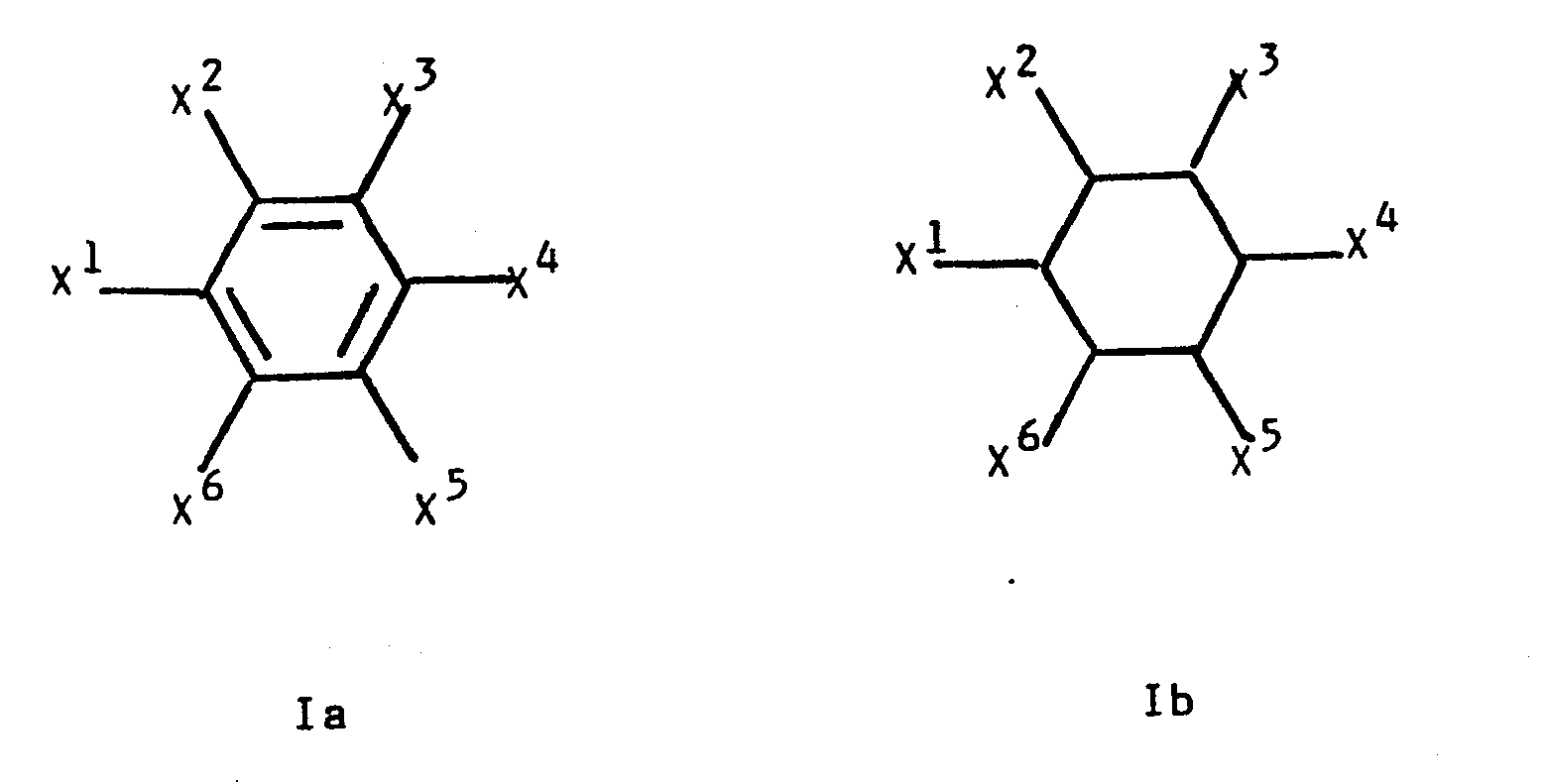
- Bevorzugte Verbindungen der Formel I, in denen drei der Reste X1 bis X6 H bedeuten, sind die 1,3,5-trisubstituierten Verbindungen. Bevorzugte Verbindungen der Formel I sind diejenigen, worin A ein Cyclohexanring ist.
- Bevorzugte Verbindungen der Formel I sind diejenigen, in denen keiner der Reste X1 bis X6 H bedeutet, insbesondere diejenigen, in denen die Reste X1 bis X6 iden-tisch sind und die den folgenden Teilformeln Ic bis Im entsprechen

- Die Verbindungen der Formeln Ig, 11 und Im sind bevorzugt.
- Im übrigen sind von den Cyclohexanen der Formeln Ib sowie Ih bis Im diejenigen bevorzugt, in denen die jeweils gegenüberliegenden Substituenten equatorial und in trans-Stellung zueinander stehen. Das entspricht der Konfiguration des scyllo-Inosits.
- Verbindungen der Formel I, die ein oder mehrere asymmetrische C-Atome aufweisen, können in racemischer oder in optisch-aktiver Form vorliegen, wobei beide Formen von Formel I erfaßt sind.
- R bedeutet einen Alkylrest, in dem auch eine( Oxaalkyl ) oder zwei ( Dioxaalkyl ) CH2-Gruppen durch 0-Atome ersetzt sein können. Diese Reste können geradkettig oder verzweigt sein. Vorzugsweise sind sie geradkettig, haben 3,4, 5,6, 7, 8, 9, 10, 11, 12 oder 13 C-Atome und bedeuten demnach bevorzugt Propyl, Butyl, Pentyl, Hexyl, Heptyl, Octyl, Nonyl, Decyl, Undecyl, Dodecyl, Tridecyl, 2-Oxapropyl (= Methoxymethyl), 2- (= Ethoxymethyl) oder 3-Oxabutyl (= 2-Methoxyethyl), 2-, 3-oder 4-Oxapentyl, 2-, 3-, 4- oder 5-Oxahexyl, 2-, 3-, 4-, 5- oder 6-Oxaheptyl, ferner Ethyl, Tetradecyl, Pentadecyl, 2-, 3-, 4-, 5-, 6- oder 7-Oxaoctyl, 2-, 3-, 4-, 5-, 6-, 7- oder 8-Oxanonyl, 2-, 3-, 4-, 5-, 6-, 7-, 8- oder 9-Oxadecyl, 2-, 3-, 4-, 5-, 6-, 7-, 8-,.9- oder 10-Oxaundecyl, 2-, 3-, 4-, 5-, 6-, 7-, 8-, 9-, 10- oder 11-Oxadodecyl, 2-, 3-, 4-, 5-, 6-, 7-, 8-, 9-, 10-, 11- oder 12-Oxatridecyl, 2,4-Dioxapentyl, 2,4-, 2,5- oder 3,5-Dioxahexyl, 2,4-, 2,5-, 2,6-, 3,5-, 3,6- oder 4,6-Dioxaheptyl.
- Verbindungen der Formeln I sowie Ia bis Im mit verzweigten Gruppen R können gelegentlich wegen einer besseren Löslichkeit in den üblichen flüssigkristallinen Basismaterialien von Bedeutung sein, insbesondere aber als chirale Dotierstoffe, wenn sie optisch aktiv sind. Verzweigte Gruppen dieser Art enthalten in der Regel nicht mehr als eine Kettenverzweigung. Bevorzugte verzweigte Reste R sind Isopropyl, 2-Butyl (= 1-Methylpropyl), Isobutyl (= 2-Methylpropyl), 2-Methylbutyl, Isopentyl (= 3-Methylbutyl), 2-Methylpentyl, 3-Methylpentyl, 2-Ethylhexyl, 2-Propylpentyl, 2-Oxa-3-methylbutyl, 3-0xa-4-methylpentyl.
- Unter den Verbindungen der Formeln I sowie Ia bis Im sind diejenigen bevorzugt, in denen der Rest R eine der angegebenen bevorzugten Bedeutungen hat.
- Die Verbindungen der Formel I werden nach an sich bekannten Methoden hergestellt, wie sie in der Literatur (z.B. in den Standardwerken wie Houben-Weyl, Methoden der Organischen Chemie, Georg-Thieme-Verlag, Stuttgart) beschrieben sind, und zwar unter Reaktionsbedingungen, die für die genannten Umsetzungen bekannt und geeignet sind. Dabei kann man auch von an sich bekannten, hier nicht näher erwähnten Varianten Gebrauch machen.
- Die Ausgangsstoffe sind entweder bekannt, oder sie können ohne Schwierigkeiten nach an sich bekannten Methoden in Analogie zu bekannten Verbindungen hergestellt werden. Sie können gewünschtenfalls auch in situ gebildet werden, derart, daß man sie aus dem Reaktionsgemisch nicht isoliert, sondern sofort weiter zu den Verbindungen der Formel I umsetzt.
- Ether der Formel I (worin mindestens einer der Reste X1 bis X 6 OR bedeutet) sind durch Veretherung entsprechender Hydroxyverbindungen erhältlich, wobei die Hydroxyverbindung zweckmäßig zunächst in ein entsprechendes Metallderivat, z.B. durch Behandeln mit NaH, NaNH2, NaOH, KOH, Na2Co3 oder K2CO3 in das entsprechende Alkalimetallalkoholat oder Alkalimetallphenolat übergeführt wird. Dieses kann dann mit dem entsprechenden Alkylhalogenid, -sulfonat oder Dialkylsulfat umgesetzt werden, zweckmäßig in einem inerten Lösungsmittel wie Aceton, 1,2-Dimethoxyethan, Dimethylformamid (DMF) oder Dimethylsulfoxid oder auch einem Überschuß an wäßriger oder wäßrig-alkoholischer NaOH oder KOH bei Temperaturen zwischen etwa 20° und 100°.
- Ester der Formel I, worin mindestens einer der Reste X1 bis X6 -COOR oder -0-COR bedeutet, sind erhältlich durch Veresterung von Carbonsäuren entsprechend der Formel I, worin aber an Stelle mindestens eines der Reste X bis X6 eine COOH-Gruppe steht, mit Alkoholen der Formel R-OH bzw. durch Veresterung von Alkoholen entsprechend der Formel I, worin A ein Cyclohexanring ist, aber an Stelle mindestens eines der Reste X bis X6 eine OH-Gruppe steht, mit Carbonsäuren der Formel R-COOH.
- An Stelle der Carbonsäuren und/oder der Alkohole können auch ihre reaktionsfähigen Derivate verwendet werden.
- Als reaktionsfähige Derivate der genannten Carbonsäuren eignen sich insbesondere die Säurehalogenide, vor allem die Chloride und Bromide, ferner die Anhydride, z.B. auch gemischte Anhydride, Azide oder Ester, insbesondere Alkylester mit 1 - 4 C-Atomen in der Alkylgruppe.
- Als reaktionsfähige Derivate der genannten Alkohole kommen insbesondere die entsprechenden Metallalkoholate in Betracht, worin an Stelle der OH-Gruppe(n) OM-Gruppe(n) stehen und worin M ein Äquivalent eines Metalls, vorzugsweise eines Alkalimetalls wie Na oder K, bedeutet.
- Die Veresterung wird vorteilhaft in Gegenwart eines inerten Lösungsmittels durchgeführt. Gut geeignet sind insbesondere Ether wie Diethylether, Di-n-butylether, THF, Dioxan oder Anisol, Ketone wie Aceton, Butanon oder Cyclohexanon, Amide wie DMF oder Phosphorsäurehexamethyltriamid, Kohlenwasserstoffe wie Benzol, Toluol oder Xylol, Halogenkohlenwasserstoffe wie Tetrachlorkohlenstoff oder Tetrachlorethylen, Sulfoxide wie Dimethylsulfoxid oder Sulfolan und Carbonsäuren wie Trifluoressigsäure. Mit Wasser nicht mischbare Lösungsmittel können gleichzeitig vorteilhaft zum azeotropen Abdestillieren des bei der Veresterung gebildeten Wassers verwendet werden. Gelegentlich kann auch ein Überschuß einer organischen Base, z.B. Pyridin, Chinolin oder Triethylamin als Lösungsmittel für die Veresterung angewandt werden. Die Veresterung kann auch in Abwesenheit eines Lösungsmittels, z.B. durch einfaches Erhitzen der Komponenten in Gegenwart von Natriumacetat, durchgeführt werden. Die Reaktionstemperatur liegt gewöhnlich zwischen -50° und +250°, vorzugsweise zwischen -20° und +80°. Bei diesen Temperaturen sind die Veresterungsreaktionen in der Regel nach 15 Minuten bis 48 Stunden beendet.
- Im einzelnen hängen die Reaktionsbedingungen für die Veresterung weitgehend von der Natur der verwendeten Ausgangsstoffe ab. So wird eine freie Carbonsäure mit einem freien Alkohol in der Regel in Gegenwart einer starken Säure, beispielsweise einer Mineralsäure wie Salzsäure oder Schwefelsäure, umgesetzt. Eine bevorzugte Reaktionsweise ist die Umsetzung eines Säureanhydrids oder insbesondere eines Säurechlorids mit einem Alkohol, vorzugsweise in einem basischen Milieu, wobei als Basen insbesondere Alkalimetallhydroxide wie Natrium- oder Kaliumhydroxid, Alkalimetallearbonate bzw. -hydrogencarbonate wie Natriumcarbonat, Natriumhydrogencarbonat, Kaliumcarbonat oder Kaliumhydrogencarbonat, Alkalimetallacetate wie Natrium-oder Kaliumacetat, Erdalkalimetallhydroxide wie Calciumhydroxid oder organische Basen wie Triethylamin, Pyridin, Lutidin, Kollidin oder Chinolin von Bedeutung sind. Eine weitere bevorzugte Ausführungsform der Veresterung besteht darin, daß man den Alkohol zunächst in das Natrium- oder Kaliumalkoholat überführt, z.B. durch Behandlung mit ethanolischer Natron-oder Kalilauge, dieses isoliert und zusammen mit Natriumhydrogencarbonat oder Kaliumcarbonat unter Rühren in Aceton oder Diethylether suspendiert und diese Suspension mit einer Lösung des Säurechlorids oder Anhydrids in Diethylether, Aceton oder DMF versetzt, zweckmäßig bei Temperaturen zwischen etwa -25° und +20°.
- Thioether der Formel I, worin mindestens einer der Reste X1 bis X6 -SR bedeutet, können hergestellt werden, indem man eine entsprechende Halogenverbindung, vorzugsweise Chlorverbindung wie Hexachlorbenzol oder Hexachlorcyclohexan, mit einem entsprechenden Thiol der Formel R-SH oder -vorzugsweise - einem seiner Salze, insbesondere dem entsprechenden Na-Thiolat der Formel R-SNa umsetzt. Diese Umsetzung kann in Gegenwart oder Abwesenheit eines inerten Lösungsmittels erfolgen, und zwar bei Temperaturen zwischen etwa -20 und 250°, vorzugsweise zwischen 10 und 150°. Als Lösungsmittel eignen sich beispielsweise Kohlenwasserstoffe wie Benzol, Toluol, Xylole oder Mesitylen; tertiäre Basen wie Triethylamin, Pyridin oder Picoline; Alkohole wie Methanol, Ethanol oder Butanol; Glykole und Glykolether wie Ethylenglykol, Diethylenglykol, 2-Methoxyethanol; Ketone wie Aceton; Ether wie Tetrahydrofuran oder Dioxan; Amide wie DMF oder Phosphorsäurehexamethyltriamid (HMPT); Sulfoxide wie Dimethylsulfoxid. Auch Gemische dieser Lösungsmittel sind geeignet.
- Sulfoxide und Sulfone der Formel I, worin mindestens einer der Reste X bis X6 -SOR oder -SO2R bedeutet, können durch Oxydation entsprechender Thioether der Formel I, worin mindestens einer der Reste X bis X6 -SR bedeutet, hergestellt werden.
- Man oxidiert je nach dem gewählten Reagenz und den angewendeten Bedingungen zu den entsprechenden Sulfoxiden (eine der Gruppen X bis X6 = SO) oder zu den entsprechenden Sulfonen (eine der Gruppen X1 bis X6 = SO2), wobei man nach an sich aus der Literatur bekannten Methoden arbeitet und die Reaktionsbedingungen im einzelnen aus der Literatur leicht entnehmen kann. Will man die Sulfoxide erhalten, so oxydiert man beispielsweise mit Wasserstoffperoxid, Persäuren, Cr(VI)-Verbindungen wie Chromsäure, Salpetersäure, nitrosen Gasen, N203, Halogenen wie Chlor, Hypochloriten, KMn04, N-Bromsuccinimid, 1-Chlorbenztriazol, Ce(IV)-Verbindungen wie (NH4)2Ce(NO3)6, negativ substituierten aromatischen Diazoniumsalzen wie o- oder p-Nitrophenyldiazoniumchlorid oder elektrolytisch unter verhältnismäßig milden Bedingungen und bei relativ niedrigen Temperaturen (etwa -80 bis +100°). Will man dagegen die Sulfone erhalten, so verwendet man die gleichen Oxydationsmittel unter kräftigeren Bedingungen und7 oder im Überschuß sowie in der Regel bei höheren Temperaturen. Bei diesen Umsetzungen können die üblichen inerten Lösungsmittel zugegen oder abwesend sein. Als inerte Lösungsmittel eignen sich beispielsweise Wasser, wässerige Mineralsäuren, wässerige Alkalilaugen, niedere Alkohole wie Methanol oder Ethanol, Ester wie Ethylacetat, Ketone wie Aceton, niedere Carbonsäuren wie Essigsäure, Nitrile wie Acetonitril, Kohlenwasserstoffe wie Benzol, chlorierte Kohlenwasserstoffe wie Chloroform oder CC14.
- Ein bevorzugtes Oxidationsmittel ist 30%iges wässeriges Wasserstoffperoxid. Dieses führt bei Anwendung der berechneten Menge in Lösungsmitteln wie Essigsäure, Aceton, Ethanol oder wässeriger Natronlauge bei Temperaturen zwischen -20 und 100° zu den Sulfoxiden, im Überschuß bei höheren Temperaturen, vorzugsweise in Essigsäure oder in einem Gemisch aus Essigsäure und Acetanhydrid, zu den Sulfonen. Ein weiteres bevorzugtes Oxidationsmittel ist 3-Chlorperbenzoesäure. Diese führt bei Anwendung der berechneten Menge in Lösungsmitteln wie Halogenkohlenwasserstoffen bei Temperaturen innerhalb von 0° zu den Sulfoxiden, im Überschuß bei Temperaturen zwischen 0° und Raumtemperatur zu den Sulfonen.
- Eine weitere Möglichkeit zur Herstellung der Sulfoxide besteht darin, daß man die Thioether mit Chlor, z.B. in feuchtem Benzol oder in Essigsäure, behandelt. Die intermediär erhaltenen Dichlorverbindungen werden durch Hydrolyse sehr leicht in die Sulfoxide umgewandelt.
- Die erfindungsgemäßen diskotischen flüssigkristallinen Phasen bestehen aus 2 bis 15, vorzugsweise 3 bis 12 Komponenten, darunter mindestens einer Verbindung der Formel I. Die anderen Bestandteile werden vorzugsweise ausgewählt aus den bekannten diskotischen flüssigkristallinen Substanzen ,insbesondere aus den Klassen der hexasubstituierten Benzol- oder Triphenylen-Derivate. Die erfindungsgemäßen Phasen enthalten etwa U,1 bis 100, vorzugsweise 10 bis 100%, einer oder mehrerer Verbindungen der Formel I.
- Die Herstellung der erfindungsgemäßen diskotischen flüssigkristallinen Phasen erfolgt in an sich üblicher Weise. In der Regel werden die Komponenten ineinander gelöst, zweckmäßig bei erhöhter Temperatur.
- Die erfindungsgemäßen diskotischen flüssigkristallinen Phasen können weiterhin durch geeignete Zusätze modifiziert werden. Beispielsweise können Leitsalze zur Verbesserung der Leitfähigkeit, pleochroitische Farbstoffe oder Substanzen zur Veränderung der dielektrischen Anisotropie, der Viskosität und/oder der Orientierung der diskotischen Phasen zugesetzt werden.
- Die folgenden Beispiele sollen die Erfindung erläutern, ohne sie zu begrenzen. F = Schmelzpunkt, K = Klärpunkt. Vor- und nachstehend bedeuten Prozentangaben Gewichtsprozent; alle Temperaturen sind in Grad Celsius angegeben. "Übliche Aufarbeitung" bedeutet: man gibt Wasser hinzu, extrahiert mit Methylenchlorid, trennt ab, trocknet die organische Phase, dampft ein und reinigt das Produkt durch Kristallisation und/oder Chromatographie.
- Ein Gemisch von 17,4 g Hexahydroxybenzol, 150 g Hexyljodid, 41,4 g K2CO3 und 250 ml DMF wird unter Rühren 16 Stunden auf 80c erhitzt, dann abgekühlt und wie üblich aufgearbeitet. Man erhält Hexakis-(hexoxy)-benzcl.
- Analog erhält man durch Veretherung von Hexahydroxybenzol bzw. scyllo-Inosit:
- Hexapropoxybenzol
- Hexabutoxybenzol
- Hexakis-(pentoxy)-benzol
- Hexakis-(heptoxy)-benzol
- Hexakis-(octoxy)-benzol
- Hexakis-(nonoxy)-benzol
- Hexakis-(decoxy)-benzol
- Hexakis-(undecoxy)-benzol
- Hexakis-(dodecoxy)-benzol
- Hexakis-(tridecoxy)-benzol
- Hexakis-(tetradecoxy)-benzol
- Hexakis-(pentadecoxy)-benzol scyllo-Inosit-hexakis-(propylether)
- scyllo-Inosit-hexakis-(butylether)
- scyllo-Inosit-hexakis-(pentylether)
- scyllo-Inosit-hexakis-(hexylether)
- scyllo-Inosit-hexakis-(heptylether)
- scyllo-Inosit-hexakis-(octylether)
- scyllo-Inosit-hexakis-(nonylether)
- scyllo-Inosit-hexakis-(decylether)
- scyllo-Inosit-hexakis-(undecylether)
- scyllo-Inosit-hexakis-(dodecylether)
- scyllo-Inosit-hexakis-(tridecylether)
- scyllo-Inosit-hexakis-(tetradecylether)
- scyllo-Inosit-hexakis-(pentadecylether).
- Ein Gemisch von 1,8 g scyllo-Inosit, 12 g Octanoylchlorid und 20 ml Trifluoressigsäure wird 2 Stunden bei 20° gerührt. Nach dem Eindampfen und üblicher Aufarbeitung (Elution mit Hexan Ethylacetat 20:1) erhält man Hexakis-(octanoyl)-scyllo-inosit, F. 77,5°; K. 198,4°.
- Analog erhält man mit den entsprechenden Säurechloriden;
- Hexaacetyl-scyllo-inosit
- Hexapropionyl-scyllo-inosit
- Hexabutyryl-scyllo-inosit
- Hexaisobutyryl-scyllo-inosit
- Hexavaleryl-scyllo-inosit
- Hexacapronyl-scyllo-inosit
- Hexakis-(heptanoyl)-scyllo-inosit
- Hexakis-(nonanoyl)-acyllo-inosit
- Hexakis-(decanoyl)-scyllo-inosit
- Hexakis-(undecanoyl)-scyllo-inosit
- Hexakis-(dodecsnoyl)-scyllo-inosit
- Hexakis-(tridecanoyl)-scyllo-inosit
- Hexakis-(tetradecanoyl)-scyllo-inosit
- Hexakis-(pentadecanoyl)-scyllo-inosit.
- Man kocht 3,48 g scyllo-Cyclohexan-1,2,3,4,5,6-hexa- carbonsäure 1 Stunde mit 14,4 g SOC12, dampft ein, löst das erhaltene rohe Säurechlorid in 50 ml Toluol, versetzt mit 5 ml Pyridin und 10 g Heptanol und kocht 2 Stunden. Nach Abkühlen und üblicher Aufarbeitung erhält man scyllo-Cyclohexan-1,2,3,4,5,6-hexacarbonsäure- hexakis-(heptylester).
- Analog erhält man durch Veresterung:
- scyllo-Cyclohexan-1,2,3,4,5,6-hexacarbonsäure- hexamethylester
- scyllo-Cyclohexan-1,2,3,4,5,6-hexacarbonsäure- hexaethylester
- scyllo-Cyclohexan-1,2,3,4,5,6-hexacarbonsäure- hexapropylester
- scyllo-Cyclohexan-1,2,3,4,5,6-hexacarbonsäure- hexabutylester
- scyllo-Cyclohexan-1,2,3,4,5,6-hexacarbonsäure- hexakis-(pentylester)
- scyllo-Cyclohexan-1,2,3,4,5,6-hexacarbonsäure- hexakis-(hexylester)
- scyllo-Cyclohexan-1,2,3,4,5,6-hexacarbonsäure-hexakis-(octylester)
- scyllo-Cyclohexan-1,2,3,4,5,6-hexacarbonsäure-hexakis-(nonylester)
- scyllo-Cyclohexan-1,2,3,4,5,6-hexacarbonsäure-hexakis-(decylester)
- scyllo-Cyclohexan-l,2,3,4,5,6-hexacarbonsäure-hexakis-(undecylester)
- scyllo-Cyclohexan-1,2,3,4,5,6-hexacarbonsäure-hexakis-(dodecylester)
- scyllo-Cyclohexan-1,2,3,4,5,6-hexacarbonsäure-hexakis-(tridecylester)
- scyllo-Cyclohexan-l,2,3,4,5,6-hexacarbonsäure-hexakis-(tetradecylester)
- scyllo-Cyclohexan-l,2,3,4,5,6-hexacarbonsäure-hexakis-(pentadecylester)
- Mellitsäure-hexamethylester
- Mellitsäure-hexaethylester
- Mellitsäure-hexapropylester
- Mellitsäure-hexabutylester
- Mellitsäure-hexakis-(pentylester)
- Mellitsäure-hexakis-(hexylester)
- Mellitsäure-hexakis-(heptylester)
- Mellitsäure-hexakis-(octylester)
- Mellitsäure-hexakis-(nonylester)-
- Mellitsäure-hexakis-(decylester)
- Mellitsäure-hexakis-(undecylester)
- Mellitsäure-hexakis-(dodecylester)
- Mellitsäure-hexakis-(tridecylester)
- Mellitsäure-hexakis-(tetradecylester)
- Mellitsäure-hexakis-(pentadecylester).
- Man rührt ein Gemisch aus 2,85 g Hexachlorbenzol, 21,8 g Natrium-nonylthiolat und 100 ml HMPT 10 Stunden bei 20° unter N2, dampft ein, arbeitet wie üblich auf (Al2O3; Petrolether/Ether 94:6) und erhält Hexakis-(nonylthio)-benzol, Öl, kein Kp. bis 250°/0,1 Torr.
- Analog erhält man aus Hexachlorbenzol bzw. ß-Hexachlorcyclohexan:
- Hexakis-(methylthio)-benzol
- Hexakis-(ethylthio)-benzol
- Hexakis-(propylthio)-benzol
- Hexakis-(butylthio)-benzol
- Hexakis-(pentylthio)-benzol
- Hexakis-(hexylthio)-benzol
- Hexakis-(heptylthio)-benzol
- Hexakis-(octylthio)-benzol
- Hexakis-(decylthio)-benzol
- Hexakis-(undecylthio)-benzol, F. 29-30°
- Hexakis-(dodecylthio)-benzol
- Hexakis-(tridecylthio)-benzol, F. 44-45°
- Hexakis-(tetradecylthio)-benzol
- Hexakis-(pentadecylthio)-benzol
- scyllo-1,2,3,4,5,6-Hexakis-(methylthio)-cyclohexen
- scyllo-1,2,3,4,5,6-Hexakis-(ethylthio)-cyclohexan
- scyllo-1,2,3,4,5,6-Hexakis-(propylthio)-cyclohexan
- scyllo-1,2,3,4,5,6-Hexakis-(butylthio)-cyclohexan
- scyllo-l,2,3,4,5,6-Hexakis-(pentylthio)-cyclohexan
- scyllo-l,2,3,4,5,6-Hexakis-(hexylthio)-cyclohexan
- scyllo-l,2,3,4,5,6-Hexakis-(heptylthio)-cyclohexan
- scyllo-l,2,3,4,5,6-Hexakis-(octylthio)-cyclohexan
- scyllo-1,2,3,4,5,6-Hexakis-(nonylthio)-cyclohexan
- scyllo-1,2,3,4,5,6-Hexakis-(decylthio)-cyclohexan
- scyllo-l,2,3,4,5,6-Hexakis-(undecylthio)-cyclohexan
- scyllo-l,2,3,4,5,6-Hexakis-(dodecylthio)-cyclohexan
- scyllo-1,2,3,4,5,6-Hexakis-(tridecylthio)-cyclohexan
- scyllo-1,2,3,4,5,6-Hexakis-(tetradecylthio)-cyclohexan
- scyllo-l,2,3,4,5,6-Hexakis-(pentadecylthio)-cyclohexan.
- Zu einer Lösung von 10,26 g Hexakis-(nonylthio)-benzol in 400 ml Essigsäure tropft man innerhalb 30 Minuten unter Rühren bei 75-80° eine Lösung von 6,42 ml 30%igem H2O2 in 150 ml Essigsäure. Man hält 2 Stunden bei 80°, kocht auf, gießt in Wasser, arbeitet wie üblich auf und erhält Hexakis-(nonylsulfinyl)-benzol.
- Analog erhält man durch Oxydation der entsprechenden Thioether:
- Hexakis-(methylsulfinyl)-benzol
- Hexakis-(ethylsulfinyl)-benzol
- Hexakis-(propylsulfinyl)-benzol
- Hexakis-(butylsulfinyl)-benzol
- Hexakis-(pentylsulfinyl)-benzol
- Hexakis-(hexylsulfinyl)-benzol
- Hexakis-(heptylsulfinyl)-benzol
- Hexakis-(octylsulfinyl)-benzol
- Hexakis-(decylsulfinyl)-benzol
- Hexakis-(undecylsulfinyl)-benzol
- Hexakis-(dodecylsulfinyl)-benzol
- Hexakis-(tridecylsulfinyl)-benzol
- Hexakis-(tetradecylsulfinyl)-benzol
- Hexakis-(pentadecylsulfinyl)-benzol
- scyllo-1,2,3,4,5,6-Hexakis-(methylsulfinyl)-cyclohexan
- scyllo-1,2,3,4,5,6-Hexakis-(ethylsulfinyl)-cyclohexan
- scyllo-1,2,3,4,5,6-Hexakis-(propylsulfinyl)-cyclohexan
- scyllo-1,2,3,4,5,6-Hexakis-(butylsulfinyl)-cyclohexan
- scyllo-l,2,3,4,5,6-Hexakis-(pentylsulfinyl)-cyclohexan
- scyllo-1,2,3,4,5,6-Hexakis-(hexylsulfinyl)-cyclohexan
- scyllo-1,2,3,4,5,6-Hexakis-(heptylsulfinyl)-cyclohexan
- scyllo-1,2,3,4,5,6-Hexakis-(octylsulfinyl)-cyclohexan
- scyllo-1,2,3,4,S,b-Hexakis-(nonylsulfinyl)-cyclohexan
- scyllo-1,2,3,4,5,6-Hexakis-(decylsulfinyl)-cyclohexan
- scyllo-1,2,3,4,5,6-Hexakis-(undecylsulfinyl)-cyclohexan
- scyllo-1,2,3,4,5,6-Hexakis-(dodecylsulfinyl)-cyclohexan
- scyllo-1,2,3,4,5,6-Hexakis-(tridecylsulfinyl)-cyclohexan
- scyllo-1,2,3,4,5,6-Hexakis-(tetradecylsulfinyl)-cyclohexan
- scyllo-1,2,3,4,5,6-Hexakis-(pentadecylsulfinyl)-cyclohexan.
- Man kocht 10,26 g Hexakis-(nonylthio)-benzol mit einem 20%igen Überschuß an 85-90%iger m-Chlorperbenzoesäure in insgesamt 60 ml CHCl3 48 Stunden, dampft ein, kristallisiert aus Ethanol/Petrolether um und erhält Hexakis-(nonylsulfonyl)-benzol, F. 95°, K. 131°.
- Analog erhält man durch Oxydation der entsprechenden Thioether:
- Hexakis-(methylsulfonyl)-benzol
- Hexakis-(ethylsulfonyl)-benzol
- Hexakis-(propylsulfonyl)-benzol
- Hexakis-(butylsulfonyl)-benzol Hexakis-(pentylsulfonyl)-benzol
- Hexakis-(hexylsulfonyl)-benzol
- Hexakis-(heptylsulfonyl)-benzol
- Hexakis-(octylsulfonyl)-benzol
- Hexakis-(decylsulfonyl)-benzol
- Hexakis-(undecylsulfonyl)-benzol, F. 76°, K. 116°
- Hexakis-(dodecylsulfonyl)-benzol
- Hexakis-(tridecylsulfonyl)-benzol, F. 60°, K. 89°
- Hexakis-(tetradecylsulfonyl)-benzol
- Hexakis-(pentadecylsulfonyl)-benzol
- scyllo-1,2,3,4,5,6-Hexakis-(methylsulfonyl)-cyclhexan
- scyllo-1,2,3,4,5,6-Hexakis-(ethylsulfonyl)-cyclohexan
- scyllo-1,2,3,4,5,6-Hexakis-(propylsulfonyl)-cyclohexan
- scyllo-l,2,3,4,5,6-Hexakis-(butylsulfonyl)-cyclohexan
- scyllo-l,2,3,4,5,6-Hexakis-(pentylsulfonyl)-cyclohexan
- scyllo-1,2,3,4,5,6-Hexakis-(hexylsulfonyl)-cyclohexan
- scyllo-1,2,3,4,5,6-Hexakis-(heptyisulfonyl)-cyclohexan
- scyllo-l,2,3,4,5,6-Hexakis-(octylsulfonyl)-cyclohexan
- scyllo-1,2,3,4,5,6-Hexakis-(nonylsulfanyl)-cyclohexan
- scyllo-1,2,3,4,5,6-Hexakis-(decylsulfonyl)-cyclohexan
- scyllo-1,2,3,4,5,6-Hexakis-(undecylsulfonyl)-cyclohexan
- scyllo-l,2,3,4,5,6-Hexakis-(dodecylsulfonyl)-cyclohexan
- scyllo-1,2,3,4,5,6-Hexakis-(tridecylsulfonyl)-cyclohexan
- scyllo-l,2,3,4,5,6-Hexakis-(tetradecylsulfonyl)-cyclohexan
- scyllo-l,2,3,4,5,6-Hexakis-(pentadecylsulfonyl)-cyclohexan.
- 1,3,5-Tris-(propylsulfonyl)-benzol
- 1,3,5-Tris-(butylsulfonyl)-benzol
- 1,3,5-Tris-(pentylsulfonyl)-benzol
- 1,3,5-Tris-(hexylsulfonyl)-benzol
- 1,3,5-Tris-(heptylsulfonyl)-benzol
- 1,3,5-Tris-(octylsulfonyl)-benzol
- 1,3,5-Tris-(nonylsulfonyl)-benzol
- 1,3,5-Tris-(decylsulfonyl)-benzol
- 1,3,5-Tris-(undecylsulfonyl)-benzol
- 1,3,5-Tris-(dodecylsulfonyl)-benzol
- 1,3,5-Tris-(tridecylsulfonyl)-benzol
- 1,3,5-Tris-(tetradecylsulfonyl)-benzol
- 1,3,5-Tris-(pentadecylsulfonyl)-benzol
- 1,2,3,5-Tetrakis-(propylsulfonyl)-benzol
- 1,2,3,5-Tetrakis-(butylsulfonyl)-benzol
- 1,2,3,5-Tetrakis-(pentylsulfonyl)-benzol
- 1,2,3,5-Tetrakis-(hexylsulfonyl)-benzol
- 1,2,3,5-Tetrakis-(heptylsulfonyl)-benzol
- 1,2,3,5-Tetrakis-(octylsulfonyl)-benzol
- 1,2,3,5-Tetrakis-(nonylsulfonyl)-benzol
- 1,2,3,5-Tetrakis-(decylsulfonyl)-benzol
- 1,2,3,5-Tetrakis-(undecylsulfonyl)-benzol
- 1,2,3,5-Tetrakis-(dodecylsulfonyl)-benzol
- 1,2,3,5-Tetrakis-(tridecylsulfonyl)-benzol
- 1,2,3,5-Tetrakis-(tetradecylsulfonyl)-benzol
- 1,2,3,5-Tetrakis-(pentadecylsulfonyl)-benzol
- r-1, c-3, c-5-Tris-(propylsulfonyl)-cyclohexan
- r-1, c-3, c-5-Tris-(butylsulfonyl)-cyclohexan
- r-1, c-3, c-5-Tris-(pentylsulfonyl)-cyclohexan
- r-1, c-3, c-5-Tris-(hexylsulfonyl)-cyclohexan
- r-1, c-3, c-5-Tris-(heptylsulfonyl)-cyclohexan
- r-1, c-3, c-5-Tris-(octylsulfonyl)-cyclohexan
- r-1, c-3, c-5-Tris-(nonylsulfonyl)-cyclohexan
- r-1, c-3, c-5-Tris-(decylsulfonyl)-cyclohexan
- r-1, c-3, c-5-Tris-(undecylsulfonyL)-cyclohexan
- r-1, c-3, c-5-Tris-(dodecylsulfonyl)-cyclohexan
- r-1, c-3, c-5-Tris-(tridecylsulfonyl)-cyclohexan
- r-1, c-3, c-5-Tris-(tetradecylsulfonyl)-cyclohexan
- r-1, c-3, c-5-Tris-(pentadecylsulfonyl)-cyclohexan.
- Ein Gemisch von 0,9 g scyllo-Inosit-pentakis-(nonyl- ether), 0,2 g Octanoylchlorid und 10 ml Trifluoressigsäure wird 2 Stunden bei Raumtemperatur gerührt. Nach dem Eindampfen und üblicher Aufarbeitung erhält man Octanoyl-scyllo-inosit-pentakis-(nonylether).
- Analog erhält man mit den entsprechenden Säurechloriden:
- Propionyl-scyllo-inosit-pentakis-(nonylether)
- Butyryl-scyllo-inosit-pentakis-(nonylether)
- Valeryl-scyllo-inosit-pentakis-(nonylether)
- Capronyl-scyllo-inosit-pentakis-(nonylether)
- Heptanoyl-scyllo-inosit-pentakis-(nonylether)
- Nonanoyl-scyllo-inosit-pentakis-(nonylether)
- Undecanoyl-scyllo-inosit-pentakis-(nonylether)
- Dodecanoyl-scyllo-inosit-pentakis-(nonylether)
- Tridecanoyl-scyllo-inosit-pentakis-(nonylether)
- Tetradecanoyl-scyllo-inosit-pentakis-(nonylether)
- Pentadecanoyl-scyllo-inosit-pentakis-(nonylether).
- Man rührt ein Gemisch aus 1,8 g 1,3,5-Trichlorbenzol, 10,9 g Natrium-nonylthiolat und 50 ml HMPT lo Stunden bei 20° unter N2, dampft ein, arbeitet wie üblich auf und erhält 1,3,5-Tris-(nonylthio)-benzol.
- Analog erhält man aus 1,3,5-Trichlorbenzol, 1,2,3,5-Tetrachlorbenzol bzw. r-1, c-3, c-5-Trichlorcyclo- hexan:
- 1,3,5-Tris-(propylthio)-benzol
- 1,3,5-Tris-(butylthio)-benzol
- 1,3,5-Tris-(pentylthio)-benzol
- 1,3,5-Tris-(hexylthio)-benzol
- 1,3,5-Tris-(heptylthio)-benzol
- 1,3,5-Tris-(octylthio)-benzol
- 1,3,5-Tris-(nonylthio)-benzol
- 1,3,5-Tris-(decylthio)-benzol
- 1,3,5-Tris-(undecylthio)-benzol
- 1,3,5-Tris-(dodecylthio)-benzol
- 1,3,5-Tris-(tridecylthio)-benzol
- 1,3,5-Tris-(tetradecylthio)-benzol
- 1,3,5-Tris-(pentadecylthio)-benzol
- 1,2,3,5-Tetrakis-(propylthio)-benzol
- l,2,3,5-Tetrakis-(butylthio)-benzol
- 1,2,3,5-Tetrakis-(pentylthio)-benzol
- 1,2,3,5-Tetrakis-(hexylthio)-benzol
- 1,2,3,5-Tetrakis-(heptylthio)-benzol
- 1,2,3,5-Tetrakis -(octylthio)-benzol
- 1,2,3,5-Tetrakis-(nonylthio)-benzol
- 1,2,3,5-Tetrakis-(decylthio)-benzol
- 1,2,3,5-Tetrakis-(undecylthio)-benzol
- 1,2,3,5-Tetrakis-(dodecylthio)-benzol
- 1,2,3,5-Tetrakis-(tridecylthio)-benzol
- 1,2,3,5-Tetrakis-(tetradecylthio)-benzol
- 1,2,3,5-Tetrakis-(pentadecylthia)-benzol
- r-1, c-3, c-5-Tris-(propylthio)-cyclohexan
- r-1, c-3, c-5-Tris-(butylthio)-cyclohexan
- r-1, c-3, c-5-Tris-(pentylthio)-cyclohexan
- r-1, c-3, c-5-Tris-(hexylthio)-cyclohexan
- r-1, c-3, c-5-Tris-(heptylthio)-cyclohexan
- r-1, c-3, c-5-Tris-(octylthio)-cyclohexan
- r-1, c-3, c-5-Tris-(nonylthio)-cyclohexan
- r-1, c-3, c-5-Tris-(decylthio)-cyclohexan
- r-1, c-3, c-5-Tris-(undecylthio)-cyclohexan
- r-1, c-3, c-5-Tris-(dodecylthio)-cyclohexan
- r-1, c-3, c-5-Tris-(tridecylthio)-cyclohexan
- r-1, c-3, c-5-Tris-(tetradecylthio)-cyclohexan
- r-1, c-3, c-5-Tris-(pentadecylthio)-cyclohexan
wobei mindestens drei der Substituenten
Claims (6)

Applications Claiming Priority (2)
| Application Number | Priority Date | Filing Date | Title |
|---|---|---|---|
| DE3332955 | 1983-09-13 | ||
| DE3332955A DE3332955A1 (de) | 1983-09-13 | 1983-09-13 | Carbocyclische sechsringverbindungen |
Publications (3)
| Publication Number | Publication Date |
|---|---|
| EP0134576A2 true EP0134576A2 (de) | 1985-03-20 |
| EP0134576A3 EP0134576A3 (en) | 1986-03-05 |
| EP0134576B1 EP0134576B1 (de) | 1988-04-06 |
Family
ID=6208916
Family Applications (1)
| Application Number | Title | Priority Date | Filing Date |
|---|---|---|---|
| EP84110417A Expired EP0134576B1 (de) | 1983-09-13 | 1984-09-01 | Carbocyclische Sechsringverbindungen |
Country Status (4)
| Country | Link |
|---|---|
| US (2) | US4578210A (de) |
| EP (1) | EP0134576B1 (de) |
| JP (1) | JPS6084237A (de) |
| DE (2) | DE3332955A1 (de) |
Cited By (8)
| Publication number | Priority date | Publication date | Assignee | Title |
|---|---|---|---|---|
| EP0178684A1 (de) * | 1984-10-19 | 1986-04-23 | Max-Planck-Gesellschaft zur Förderung der Wissenschaften e.V. | Pyramidale Flüssigkristalle |
| FR2579217A1 (fr) * | 1985-03-22 | 1986-09-26 | Merck Patent Gmbh | Composes carbocycliques, leur preparation, leur utilisation en tant que composants de phases a cristaux liquides discotiques et elements d'affichage a cristaux liquides contenant de tels composes |
| US4631143A (en) * | 1983-12-24 | 1986-12-23 | Merck Patent Gesellschaft Mit Beschrankter Haftung | Triphenylene derivatives |
| EP0172450A3 (en) * | 1984-08-18 | 1987-03-25 | Merck Patent Gesellschaft Mit Beschrankter Haftung | Polymer compositions with liquid crystalline phases |
| WO1987004155A1 (fr) * | 1986-01-11 | 1987-07-16 | MERCK Patent Gesellschaft mit beschränkter Haftung | Composes cyclohexanes hexasubstitues |
| WO1988000940A3 (en) * | 1986-07-30 | 1988-02-25 | Merck Patent Gmbh | Hexasubstituted cyclohexane compounds |
| DE19611466A1 (de) * | 1996-03-25 | 1997-10-02 | Nematel Dr Rudolf Eidenschink | Schmiermittel |
| EP0926119A1 (de) * | 1997-12-10 | 1999-06-30 | Union Carbide Chemicals & Plastics Technology Corporation | Dialkoxybenzolelektrondonor |
Families Citing this family (8)
| Publication number | Priority date | Publication date | Assignee | Title |
|---|---|---|---|---|
| DE3334056A1 (de) * | 1983-09-21 | 1985-04-18 | Basf Ag, 6700 Ludwigshafen | Fluessig-kristalline phasen bildende polymere |
| DE3401338A1 (de) * | 1984-01-17 | 1985-07-25 | Merck Patent Gmbh, 6100 Darmstadt | Fluessigkristall-phase |
| JPS63198642A (ja) * | 1986-03-11 | 1988-08-17 | Mitsui Toatsu Chem Inc | ミオイノシトール誘導体の製造方法 |
| JPS62220959A (ja) * | 1986-03-20 | 1987-09-29 | Minolta Camera Co Ltd | 感光体 |
| FI874163A7 (fi) * | 1986-09-26 | 1988-03-27 | Mitsui Toatsu Chemicals Incorporated | Katekolijohdannaiset sekä niitä sisältävät keskushermoston taantumasairauksia ehkäisevät ja parantavat valmisteet. |
| US4959488A (en) * | 1989-05-17 | 1990-09-25 | Henkel Research Corporation | Polyfunctional hexasubstituted benzene derivatives |
| DE4025236A1 (de) * | 1990-08-09 | 1992-02-13 | Hoechst Ag | Mercaptoverbindungen enthaltende ferroelektrische fluessigkristallmischungen |
| CN1558927A (zh) * | 2001-09-25 | 2004-12-29 | ����ɭ���ڻ�ѧר����˾ | 增塑聚氯乙烯 |
Family Cites Families (9)
| Publication number | Priority date | Publication date | Assignee | Title |
|---|---|---|---|---|
| US3444237A (en) * | 1966-03-23 | 1969-05-13 | Grace W R & Co | Esters of cyclohexane-1,2,4-tricarboxylic acid |
| US4029699A (en) * | 1971-09-13 | 1977-06-14 | Takeda Chemical Industries, Ltd. | 3,(2,4,5-Trisubstituted benzoyl)-propionic acid and the salts thereof |
| CA997775A (en) * | 1972-11-23 | 1976-09-28 | Emery Industries (Canada) | Mixed mellitate compounds |
| CA1029940A (en) * | 1973-04-20 | 1978-04-25 | Matsushita Electric Industrial Co., Ltd. | Liquid crystal display device |
| US4163006A (en) * | 1977-05-09 | 1979-07-31 | Ciba-Geigy Corporation | Compositions stabilized with polyalkylthiobenzenes |
| DE2840597A1 (de) * | 1978-09-18 | 1980-03-27 | Akzo Gmbh | Verfahren zur herstellung von phloroglucin |
| DE3068730D1 (en) * | 1979-12-07 | 1984-08-30 | Thomson Csf | Mixture of disc-like liquid crystals, electrooptical device using such a mixture and method for the orientation of the molecules in the mixture |
| FR2489564A1 (fr) * | 1980-09-02 | 1982-03-05 | Thomson Csf | Procede et dispositif de visualisation utilisant un effet thermo-optique avec memoire dans une couche mince de cristal liquide disquotique |
| US4606864A (en) * | 1985-02-01 | 1986-08-19 | Eastman Kodak Company | Thiophenyl thioacrylate and thiomethacrylate monomers |
-
1983
- 1983-09-13 DE DE3332955A patent/DE3332955A1/de not_active Withdrawn
-
1984
- 1984-09-01 EP EP84110417A patent/EP0134576B1/de not_active Expired
- 1984-09-01 DE DE8484110417T patent/DE3470301D1/de not_active Expired
- 1984-09-13 US US06/650,015 patent/US4578210A/en not_active Expired - Fee Related
- 1984-09-13 JP JP59190738A patent/JPS6084237A/ja active Pending
-
1986
- 1986-01-07 US US06/816,790 patent/US4734522A/en not_active Expired - Fee Related
Cited By (12)
| Publication number | Priority date | Publication date | Assignee | Title |
|---|---|---|---|---|
| US4631143A (en) * | 1983-12-24 | 1986-12-23 | Merck Patent Gesellschaft Mit Beschrankter Haftung | Triphenylene derivatives |
| EP0172450A3 (en) * | 1984-08-18 | 1987-03-25 | Merck Patent Gesellschaft Mit Beschrankter Haftung | Polymer compositions with liquid crystalline phases |
| EP0178684A1 (de) * | 1984-10-19 | 1986-04-23 | Max-Planck-Gesellschaft zur Förderung der Wissenschaften e.V. | Pyramidale Flüssigkristalle |
| US4619788A (en) * | 1984-10-19 | 1986-10-28 | Max-Planck-Gesellschaft Zur Foerderung Der Wissenschaften E.V. | Pyramidal liquid crystals |
| FR2579217A1 (fr) * | 1985-03-22 | 1986-09-26 | Merck Patent Gmbh | Composes carbocycliques, leur preparation, leur utilisation en tant que composants de phases a cristaux liquides discotiques et elements d'affichage a cristaux liquides contenant de tels composes |
| WO1987004155A1 (fr) * | 1986-01-11 | 1987-07-16 | MERCK Patent Gesellschaft mit beschränkter Haftung | Composes cyclohexanes hexasubstitues |
| US4877220A (en) * | 1986-01-11 | 1989-10-31 | Merck Patent Gesellschaft Mit Beschrankter Haftung | Hexasubstituted cyclohexane compounds |
| WO1988000940A3 (en) * | 1986-07-30 | 1988-02-25 | Merck Patent Gmbh | Hexasubstituted cyclohexane compounds |
| DE19611466A1 (de) * | 1996-03-25 | 1997-10-02 | Nematel Dr Rudolf Eidenschink | Schmiermittel |
| EP0926119A1 (de) * | 1997-12-10 | 1999-06-30 | Union Carbide Chemicals & Plastics Technology Corporation | Dialkoxybenzolelektrondonor |
| US6124507A (en) * | 1997-12-10 | 2000-09-26 | Union Carbide Chemicals & Plastics Technology Corporation | Electron donors |
| US6399837B1 (en) | 1997-12-10 | 2002-06-04 | Union Carbide Chemicals & Plastics Technology Corporation | Electron donors |
Also Published As
| Publication number | Publication date |
|---|---|
| DE3470301D1 (en) | 1988-05-11 |
| US4578210A (en) | 1986-03-25 |
| JPS6084237A (ja) | 1985-05-13 |
| US4734522A (en) | 1988-03-29 |
| EP0134576B1 (de) | 1988-04-06 |
| DE3332955A1 (de) | 1985-03-28 |
| EP0134576A3 (en) | 1986-03-05 |
Similar Documents
| Publication | Publication Date | Title |
|---|---|---|
| EP0182054B1 (de) | Heterocyclische Verbindungen | |
| EP0094487B1 (de) | Hydroterphenyle, ihre Herstellung und Verwendung für flüssigkristalline Dielektrika | |
| EP0306521B1 (de) | Ethinderivate als komponente flüssigkristalliner phasen | |
| EP0134576B1 (de) | Carbocyclische Sechsringverbindungen | |
| EP0215800B1 (de) | Pyrimidine | |
| DD209205A5 (de) | Fluessigkristallines dielektrikum fuer elektrooptische anzeigeelemente | |
| EP0247466B1 (de) | Flüssigkristalline Derivate von Phenylbenzoat | |
| DE3807801A1 (de) | Derivate des 2,3-difluorhydrochinons | |
| DE4006921B4 (de) | Difluormethylenverbindungen | |
| EP0250505B1 (de) | Flüssigkristalline isothiocyanate-derivate | |
| EP0088907A1 (de) | Halogenbiphenylderivate | |
| DE2613293A1 (de) | Cyanosubstituierte biphenylverbindungen und diese enthaltende fluessigkristalline dielektrika | |
| DE3717484A1 (de) | Cyclobutanderivate | |
| DE4023106A1 (de) | Difluormethylenverbindungen | |
| EP0220254B1 (de) | Benzonitrile | |
| EP0387315A1 (de) | Fluorierte alkoxyverbindungen. | |
| EP0146862A2 (de) | Pyridylthiophene | |
| DE3703651A1 (de) | Kristallin-fluessige gemische mit negativer dielektrischer anisotropie | |
| US4631143A (en) | Triphenylene derivatives | |
| DE3734517C2 (de) | Acetylene und diese enthaltende flüssigkristalline Phasen | |
| DD243937A5 (de) | Fluessigkristalline phase enthaltend cyclohexanderivate | |
| DE3600601A1 (de) | Hexasubstituierte cyclohexanverbindungen | |
| DE3837208A1 (de) | Naphthylacetylene | |
| EP0184068A1 (de) | Carbonitrile | |
| DE3346980A1 (de) | Triphenylenderivate |
Legal Events
| Date | Code | Title | Description |
|---|---|---|---|
| PUAI | Public reference made under article 153(3) epc to a published international application that has entered the european phase |
Free format text: ORIGINAL CODE: 0009012 |
|
| AK | Designated contracting states |
Designated state(s): CH DE GB LI |
|
| PUAL | Search report despatched |
Free format text: ORIGINAL CODE: 0009013 |
|
| AK | Designated contracting states |
Kind code of ref document: A3 Designated state(s): CH DE GB LI |
|
| 17P | Request for examination filed |
Effective date: 19860708 |
|
| 17Q | First examination report despatched |
Effective date: 19870226 |
|
| GRAA | (expected) grant |
Free format text: ORIGINAL CODE: 0009210 |
|
| AK | Designated contracting states |
Kind code of ref document: B1 Designated state(s): CH DE GB LI |
|
| REF | Corresponds to: |
Ref document number: 3470301 Country of ref document: DE Date of ref document: 19880511 |
|
| GBT | Gb: translation of ep patent filed (gb section 77(6)(a)/1977) | ||
| PLBE | No opposition filed within time limit |
Free format text: ORIGINAL CODE: 0009261 |
|
| STAA | Information on the status of an ep patent application or granted ep patent |
Free format text: STATUS: NO OPPOSITION FILED WITHIN TIME LIMIT |
|
| 26N | No opposition filed | ||
| PGFP | Annual fee paid to national office [announced via postgrant information from national office to epo] |
Ref country code: GB Payment date: 19890831 Year of fee payment: 6 |
|
| PGFP | Annual fee paid to national office [announced via postgrant information from national office to epo] |
Ref country code: CH Payment date: 19890927 Year of fee payment: 6 |
|
| PG25 | Lapsed in a contracting state [announced via postgrant information from national office to epo] |
Ref country code: GB Effective date: 19900901 |
|
| PG25 | Lapsed in a contracting state [announced via postgrant information from national office to epo] |
Ref country code: LI Effective date: 19900930 Ref country code: CH Effective date: 19900930 |
|
| GBPC | Gb: european patent ceased through non-payment of renewal fee | ||
| REG | Reference to a national code |
Ref country code: CH Ref legal event code: PL |
|
| PGFP | Annual fee paid to national office [announced via postgrant information from national office to epo] |
Ref country code: DE Payment date: 19920923 Year of fee payment: 9 |
|
| PG25 | Lapsed in a contracting state [announced via postgrant information from national office to epo] |
Ref country code: DE Effective date: 19940601 |