EP0136540A2 - Verfahren zur Herstellung von schlagzähen Polyamidformmassen - Google Patents
Verfahren zur Herstellung von schlagzähen Polyamidformmassen Download PDFInfo
- Publication number
- EP0136540A2 EP0136540A2 EP84110289A EP84110289A EP0136540A2 EP 0136540 A2 EP0136540 A2 EP 0136540A2 EP 84110289 A EP84110289 A EP 84110289A EP 84110289 A EP84110289 A EP 84110289A EP 0136540 A2 EP0136540 A2 EP 0136540A2
- Authority
- EP
- European Patent Office
- Prior art keywords
- polyamide
- weight
- organosilane
- coated
- melting point
- Prior art date
- Legal status (The legal status is an assumption and is not a legal conclusion. Google has not performed a legal analysis and makes no representation as to the accuracy of the status listed.)
- Granted
Links
Classifications
-
- C—CHEMISTRY; METALLURGY
- C08—ORGANIC MACROMOLECULAR COMPOUNDS; THEIR PREPARATION OR CHEMICAL WORKING-UP; COMPOSITIONS BASED THEREON
- C08L—COMPOSITIONS OF MACROMOLECULAR COMPOUNDS
- C08L77/00—Compositions of polyamides obtained by reactions forming a carboxylic amide link in the main chain; Compositions of derivatives of such polymers
Definitions
- the invention relates to the production of impact-resistant polymer mixtures based on polyamides, finely divided silicate reinforced fillers with a special coating of the filler and thermoplastic elastomers.
- the impact strength of polyamide 6 is improved by incorporating ternary copolymers which contain carboxyl groups.
- polyamide molding compounds have already been provided with mineral fillers.
- polyamide molding compositions which contain silicate fillers and grafted elastomers.
- silicate fillers it has been found that the combination of the fillers with the thermoplastic parts of the molding composition leaves something to be desired.
- Polyamide molding compounds with a silicate filler have also been proposed. which can be modified with elastomers to improve toughness, the fillers being coated with an organosilane and a polyurethane ionomer.
- thermoplastic molding compositions containing thermoplastic polyamides, finely divided silicate fillers which are coated with an organosilane and a polyurethane ionomer and also contain carboxyl group-containing thermoplastic elastomers which have high rigidity and Strength have an increased notch and fracture toughness.
- This object is achieved in a process for the preparation of impact-resistant polyamide molding compositions containing 30 to 88% by weight of a thermoplastic polyamide, 10 to 50% by weight of a silicate reinforced filler coated with an organosilane, 0.01 to 5% by weight of one Polyurethane ionomers, 2 to 30% by weight of a carboxyl group-containing thermoplastic elastomer and, if appropriate, customary additives in effective amounts, the one with an organosilane and a Polyure-Bk / P than-ionomer-coated silicate fillers are mixed with the thermoplastic elastomers and the thermoplastic polyamide above the melting point of the polyamide, characterized in that in a first stage the silicate fillers coated with an organosilane and a polyurethane ionomer are first mixed with polyamide above its melting point and in a second stage the thermoplastic elastomers in the filler-containing polyamide are finely divided above its melting point.
- the new process has the advantage that reinforced impact-resistant polyamide molding compositions are obtained which have a uniformly high mechanical level, in particular with regard to tear strength, impact strength, notched impact strength and fracture toughness.
- the mode of operation according to the invention was not indicated in and of itself, since a double thermal load on the polyamide was to be regarded as harmful and rather a reduction in the quality level was to be expected. This is all the more so since, according to EP-P5 21 303, an influence on the type and sequence of incorporation of the additives into the polyamide was not to be expected, since it is stated there that the graft products are preferably incorporated together with glass fiber and / or other fillers and reinforcing materials.
- thermoplastic polyamides used are preferably saturated linear polyamides with a K value (measured according to Fikentscher, Cellulose-Chemie, Volume 13 (1932), page 58, in a 1% strength by weight solution in concentrated sulfuric acid) from 60 to 85.
- suitable examples are polycaprolactam, polyhexamethyleneadipamide, polyhexamethylenesebacamide, polylaurolactam, polyundecanamide, further homo- and copolyamides obtained by using adipic acid, azelaic acid, sebacic acid, dodecanedioic acid, terephthalic acid on the one hand and hexamethylenediamine, trimethylhexamethylenediamine, bis (4-aminocyclohexyl) methane, 2,2 -Bis (4-aminocyclohexyl) propane, on the other hand, and copolyamides which are obtained by polycondensation of lactams together with the above-mentioned dicarboxylic acids and diamines.
- Polycaprolactam and polyhexamethylene adipic acid amide have acquired particular technical importance.
- Glass fibers are suitable as silicate fillers, which are generally available for reinforcing polyamide materials.
- the glass fibers present in the molding composition generally have a length of 0.1 to 0.5 mm, preferably 0.15 to 0.30 mm and a diameter of about 6 to 20 ⁇ m, preferably 10 to 14 pm.
- Further preferred silicate fillers are those with free OH groups on their surface such as calcined kaolin, kaolin, mica, wollastonite, quartz, zirconium silicate or amorphous 5i0 2 .
- the fillers are used in an amount of 10 to 50% by weight, in particular 10 to 40% by weight, based on the molding composition.
- the particle size of the aforementioned fillers is advantageously 0.01 to 10 ⁇ m, preferably 0.05 to 5 ⁇ m, and their specific surface area is advantageously greater than 6 m 2 / g, in particular greater than 10 m 2 / g.
- the silicate fillers are coated with an organosilane, advantageously in an amount of 0.1 to 3% by weight, in particular 0.5 to 2% by weight.
- the silicate fillers are coated with a polyurethane ionomer.
- the amount is 0.1 to 5% by weight, based on the total molding composition. An amount of 0.5 to 3% by weight has proven particularly useful.
- organosilanes known for coating glass fibers or fillers such as aminoalkylsilanes, in particular aminoalkyltrialkoxysilanes, such as ⁇ -aminopropyltriethoxysilane, are suitable as organosilanes.
- the polyurethane ionomers used are polyurethanes which contain ionic centers at greater distances in their molecules. They are heteropolymers with a pronounced segment structure (cf. Angew. Chemie 1970, No. 2, pages 53 to 63).
- the polyurethane ionomers are known to be high molecular weight segment polymers that associate to form macromolecular structures, resulting in particle weights of over 500,000. Due to interschenar interactions (Coulomb forces and hydrogen bonds) they have properties similar to cross-linked elastomers.
- Ionomers present in polar organic solvents spontaneously form stable aqueous dispersions with the ionomer as the disperse phase when water is added, so that the otherwise customary emulsification is eliminated. After removal of the organic solvent, the polyurethane ionomers are present as emulsifiers and solvent-free dispersions, which as a rule contain neither emulsifiers nor solvents.
- the polyurethane ionomers are usually composed of polyesters from aliphatic dicarboxylic acids and diols with molecular weights of 1000 to 5000 as the polyol component and aliphatic, araliphatic or aromatic diisocyanates as the polyisocyanate component and salts of diaminocarboxylic acids to produce the ionic centers in the polyurethane.
- Extraordinarily waterproof polyurethane ionomers are those which are additionally chemically cross-linked by polyisocyanates or other reactive components, such as formaldehyde or its derivatives. Such polymers are therefore particularly suitable for use in coating.
- the polyurethane ionomers can be prepared by various methods known to those skilled in the art, e.g. according to the emulsifier-shear force method, the acetone method or the melt dispersion method (cf. Applied Macromolecular Chemistry, Volume 26, pages 85 and 101).
- Dispersions of polyurethane ionomers such as are e.g. in Angewandte Chemie, Volume 82, pages 53 (1970).
- the ionomer dispersions obtained by the melt dispersion process as is known from DE-OS 1 170 068 and DE-OS 1 913 271, are also suitable.
- dispersions whose dispersed particles have an average diameter of less than 1 micron and in particular from 0.05 to 0.5 micron. Furthermore, dispersions of such polyurethane ionomers are preferred which have an ion group content of 5 to 30 meq. per 100 g of dry matter.
- the dispersed polyurethane ionomers themselves dry up to high molecular weight polymers with good properties.
- the polyurethane ionomers are generally applied in the form of an aqueous dispersion which contains 10 to 60, preferably 20 to 50,% by weight of solid. It has proven to be advantageous if the aforementioned organosilanes are applied to the fillers together with the polyurethane ionomers.
- the filler coated with the aqueous dispersion of the polyurethane ionomer is then dried, expediently at 80 to 120 ° C., and optionally thermally aftertreated for a further 10 to 60 minutes.
- thermoplastic elastomers are copolymers of ethylene with propylene, Vinylester of fatty acids with 2 to 4 carbon atoms, or primary or secondary C 2 - to C S alkyl esters of acrylic acid or methacrylic acid, in particular n-butyl acrylate, the carboxyl group-containing monomers such as acrylic acid, methacrylic acid , Maleic acid or maleic anhydride in an amount of 0.5 to 15% by weight copolymerized.
- These copolymers are advantageously uncrosslinked, ie they are should be at least 90% soluble in hot solvents such as toluene, ethylbenzene or tetrachlorethylene.
- a primary or secondary C 2 -C 8 -alkyl ester of acrylic acid or methacrylic acid preferably n- Butyl acrylate
- a monomer containing acid groups such as methacrylic acid or acrylic acid or a monomer with blocked acid groups, which forms carboxylic acid groups under the packaging conditions or the polymerization conditions, such as maleic anhydride or tert-butyl
- thermoplastic elastomers are copolymers of ethylene with propylene, ethylene with vinyl esters of C 1 to C 4 fatty acid vinyl esters, ethylene with C 2 to C 8 alkyl (meth) acrylate and styrene-butadiene or Isoprene block polymers, the monomers containing carboxyl groups, such as acrylic acid, methacrylic acid, maleic acid or maleic anhydride, being subsequently grafted on.
- a common grafting method is described for example in EP-PS 21 303.
- Another procedure for grafting monomers containing carboxyl groups is described, for example, in DE-OS 27 03 416.
- thermoplastic elastomers have a melting range (melting point between 50 and 100 ° C) and a glass transition temperature below -20 ° C.
- Thermoplastic elastomers which have a shear modulus (according to DIN 53 445) at -20 ° C. of below 200, in particular below 100 N / mm 2 , are advantageously used.
- the preferred thermoplastic elastomers are generally high molecular weight and have a melt index MFI 190 / 2.16 (DIN 53 735) of 1 to 20. Based on the total molding composition, the thermoplastic elastomers are present in an amount of 2 to 30% by weight, in particular 5 up to 25 Gew.X, used.
- molding compositions according to the invention can be modified in conventional effective amounts by customary additives, such as heat and light stabilizers, lubricants and mold release agents, colorants such as dyes and pigments.
- customary additives such as heat and light stabilizers, lubricants and mold release agents, colorants such as dyes and pigments.
- silicate fillers coated with an organosilane and a polyurethane ionomer are first mixed with the polyamide above its melting point, for example polyamide 6, at a temperature of 250 in a first stage up to 270 ° C. The temperature depends essentially on the melting point of the polyamide used in each case.
- Suitable mixing devices are, for example, single or multiple screw extruders, as are customary in the art. As a rule, the mixture thus obtained is then poured into strands, cooled and granulated. The thus produced, coated silicate-containing filler polyamide is.
- thermoplastic elastomer is finely distributed in the polyamide above its melting point.
- a second stage the thermoplastic elastomer is finely distributed in the polyamide above its melting point.
- the mixing process is so intensive that the thermoplastic elastomer is present in individual particles of ⁇ 3m, preferably ⁇ 1 ⁇ m in the polyamide.
- the melt thus obtained is then poured into strands, cooled and granulated.
- a variant of the second stage is that the thermoplastic elastomer is used in the form of a concentrate in polyamide.
- the molding compositions according to the invention are suitable for the production of moldings by the injection molding or extrusion process.
- Endless strands of E-glass fibers without surface treatment were impregnated with a dispersion which contained 50% by weight of an ionomeric polyurethane and 5% by weight ⁇ -aminopropyltriethoxysilane and dried.
- the dried strands contained 1.2% by weight of solids, based on the glass fiber.
- the glass fibers coated in this way were incorporated in a twin-screw kneader into molten polycaprolactam with a K value of 72 in such a way that the amount of glass fibers was 35.3% by weight and the average length of the glass fibers was approximately 0.25 mm.
- the melt was then discharged, poured into strands, cooled and granulated.
- Example 1 The procedure is as described in Example 1, but glass fibers are used which have only been treated with a 10% aqueous solution of ⁇ -aminopropyltriethoxysilane. Otherwise, the procedure was as in Example 1.
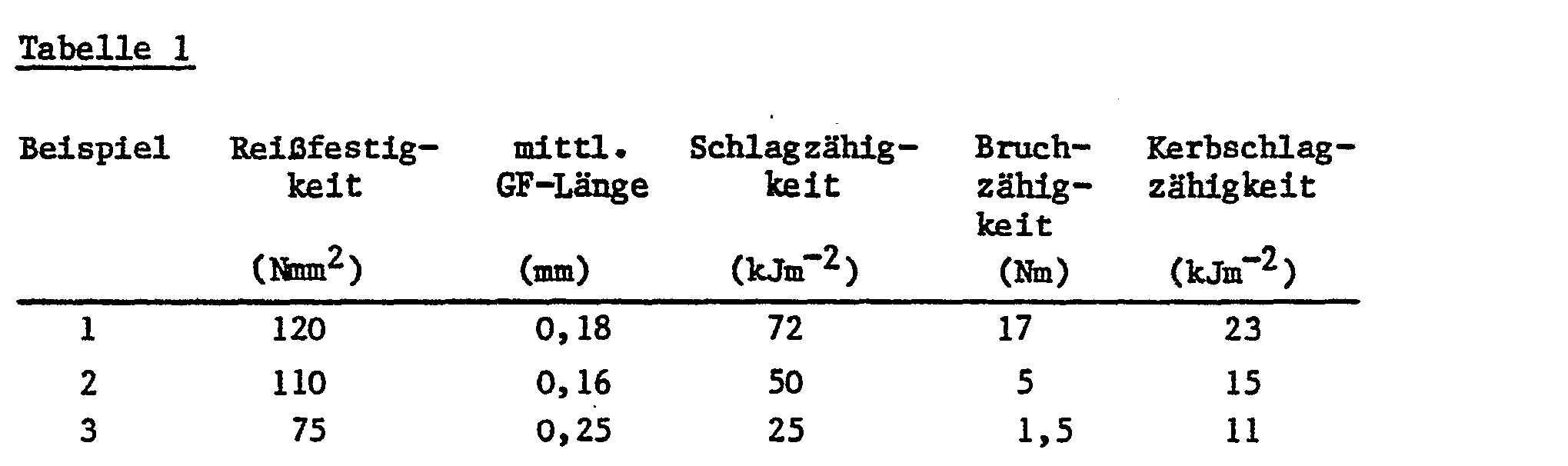
- Glass fibers are coated as described in Example 1. 58 parts of polycaprolactam with a K value of 72 were mixed with 15 parts of a copolymer of ethylene with 4% acrylic acid and 30% by weight of n-butyl acrylate, melted together on an extruder and 30 parts of glass fibers were worked into the melt. The melt is poured into strands, cooled and granulated and the polymer is injection molded into test specimens. The mechanical values can be found in Table 1 below.
- Untreated continuous strands of E-glass fibers were soaked in an aqueous dispersion containing 50% by weight of an ionomeric polyurethane and 5% by weight of ⁇ -minopropyltriethoxysilane and dried.
- the dried strands contained 1.2% by weight of solids, based on glass.
- Example 4 The procedure is as described in Example 4, with the difference that the wollastonite used was only coated with ⁇ -aminopropyltriethoxysilane. Otherwise, the procedure does not differ from Example 4.
- Table 2 The values obtained on the injection molded articles are shown in Table 2.
- Example 4 65 parts of H 72 polycaprolactam and 5 parts of a copolymer as described in Example 4 are mechanically mixed with 20 parts of wollastonite, which is coated as in Example 4, and the mixture is fed to a twin-screw extruder and the polymers are melted. In the melted mixture, 10 parts of glass fiber, which was coated as in Example 4, were added downstream and everything was homogeneously dispersed. The melt is poured into strands, cooled and granulated. The mechanical values of the injection molded bodies produced therefrom are shown in Table 2.
Landscapes
- Chemical & Material Sciences (AREA)
- Health & Medical Sciences (AREA)
- Chemical Kinetics & Catalysis (AREA)
- Medicinal Chemistry (AREA)
- Polymers & Plastics (AREA)
- Organic Chemistry (AREA)
- Compositions Of Macromolecular Compounds (AREA)
- Processes Of Treating Macromolecular Substances (AREA)
Abstract
Description
- Gegenstand der Erfindung ist die Herstellung von schlagzähen Polymergemischen auf Basis von Polyamiden, feinteiligen silikatischen verstärkten Füllstoffen mit einer besonderen Beschichtung des Füllstoffes und thermoplastischen Elastomeren.
- Die mechanischen Eigenschaften von Polymeren hängen häufig von der Art ihrer Vorbehandlung ab. Es sind bereits verschiedene Verfahren zur Erhöhung der Zähigkeit und Flexibilität und Steifigkeit von Polyamiden bekannt.
- So wird entsprechend der Lehre der DE-OS 27 13 537 die Schlagzähigkeit von Polyamid 6 durch Einverleiben von ternären Copolymerisaten die Carboxylgruppen enthalten, verbessert. Solche Polymerisate sind jedoch für spezielle Anwendungszwecke zu wenig steif. Um die Steifigkeit von Polymerisaten zu erhöhen, wurden Polyamidformmassen auch schon mit mineralischen Füllstoffen versehen. Aus der EP-PS 21 303 sind Polyamidformmassen bekannt, die silikatische Füllmittel sowie gepfropfte Elastomere enthalten. Es hat sich jedoch herausgestellt, daß die Verbindung der Füllstoffe mit den thermoplastischen Anteilen der Formmasse zu wünschen übrig läßt. Es wurden auch schon Polyamidformmassen mit einem silikatischen Füllstoff vorgeschlagen. die zur Zähigkeitsverbesserung mit Elastomeren modifiziert sein können, wobei die Füllstoffe mit einem Organosilan und einem Polyurethan-Ionomeren beschichtet sind. Man wurde jedoch darauf aufmerksam, daß das Qualitätsniveau der so erzeugten Massen nicht immer die gestellten Ansprüche erfüllt.
- Es war deshalb die technische Aufgabe gestellt, thermoplastische Formmassen, enthaltend thermoplastische Polyamide, feinteilige silikatische Füllstoffe, die mit einem Organosilan und einem Polyurethan-Ionomeren beschichtet sind und darüber hinaus noch Carboxylgruppen aufweisende thermoplastische Elastomere enthalten, zur Verfügung zu stellen, die bei hoher Steifigkeit und Festigkeit eine erhöhte Kerb- und Bruchzähigkeit aufweisen.
- Diese Aufgabe wird gelöst in einem Verfahren zur Herstellung von schlagzähen Polyamid-Formmassen, enthaltend 30 bis 88 Gew.Z eines thermoplastischen Polyamids, 10 bis 50 Gew.X eines mit einem Organosilan beschichteten silikatischen verstärkten Füllstoffs, 0,01 bis 5 Gew.X eines Polyurethan-Ionomeren, 2 bis 30 Gew.X eines Carboxylgruppen enthaltenden thermoplastischen Elastomeren und gegebenenfalls üblichen Zusatzmitteln in wirksamen Mengen, wobei man die mit einem Organosilan und einem Polyure-Bk/P than-Ionomeren beschichteten silikatischen Füllstoffe mit den thermoplastischen Elastomeren und dem thermoplastischen Polyamid oberhalb des Schmelzpunkts des Polyamids mischt, dadurch gekennzeichnet, daß man in einer 1. Stufe die mit einem Organosilan und einem Polyurethan-Ionomeren beschichteten silikatischen Füllstoffe zunächst mit Polyamid oberhalb dessen Schmelzpunkts mischt und in einer 2. Stufe die thermoplastischen Elastomeren in dem Füllstoff enthaltenden Polyamid oberhalb dessen Schmelzpunkt feinverteilt.
- Das neue Verfahren hat den Vorteil, daß man verstärkte schlagzähe Polyamidformmassen erhält, die ein gleichmäßig hohes mechanisches Niveau, insbesondere hinsichtlich Reißfestigkeit, Schlagzähigkeit, Kerbschlagzähigkeit und Bruchzähigkeit aufweisen. Die erfindungsgemäße Arbeitsweise war an und für sich nicht angezeigt, da eine zweimalige thermische Belastung des Polyamids als schädlich anzusehen war und vielmehr eine Minderung des Qualitätsniveaus zu erwarten war. Dies gilt um so mehr, als entsprechend der EP-P5 21 303 ein Einfluß bei der Art und Reihenfolge der Einarbeitung der Zusätze in das Polyamid nicht zu erwarten war, da dort ausgeführt wird, die Einarbeitung der Pfropfprodukte erfolgt vorzugsweise zusammen mit Glasfaser und/oder anderen Füll- und Verstärkungsstoffen.
- Die verwendeten thermoplastischen Polyamide sind bevorzugt gesättigte lineare Polyamide mit einem K-Wert (gemessen nach Fikentscher, Cellulose--Chemie, Band 13 (1932), Seite 58, in 1 gew.%iger Lösung in konz. Schwefelsäure) von 60 bis 85. Geeignet sind beispielsweise Polycaprolactam, Polyhexamethylenadipinsäureamid, Polyhexamethylensebacinsäureamid, Polylaurinlactam, Polyundecanamid, ferner Homo- und Copolyamide die unter Verwendung von Adipinsäure, Acelainsäure, Sebacinsäure, Dodecandisäure, Terephthalsäure einerseits und Hexamethylendiamin, Trimethylhexamethylendiamin, Bis-(4-aminocyclohexyl)-methan, 2,2-Bis-(4-aminocyclohexyl)-propan andererseits hergestellt werden sowie Copolyamide die durch Polykondensation von Lactamen zusammen mit den obengenannten Dicarbonsäuren und Diaminen erhalten werden. Besondere technische Bedeutung haben Polycaprolactam und Polyhexamethylenadipinsäureamid erlangt.
- Als silikatische Füllstoffe sind Glasfasern geeignet, vorzugsweise aus E-Glas, die allgemein üblich für die Verstärkung von Polyamidmassen angeboten werden. Die in der Formmasse vorliegenden Glasfasern haben im allgemeinen eine Länge von 0,1 bis 0,5 mm, vorzugsweise 0,15 bis 0,30 mm und einen Durchmesser von etwa 6 bis 20µm, vorzugsweise 10 bis 14pm. Weitere bevorzugte silikatische Füllstoffe sind solche mit freien OH-Gruppen an ihrer Oberfläche wie calcinierter Kaolin, Kaolin, Glimmer, Wollastonit, Quarz, Zirkonsilikat oder amorphes 5i02. Man verwendet die Füllstoffe in einer Menge von 10 bis 50 Gew.%, insbesondere 10 bis 40 Gew.X, bezogen auf lie Formmasse. Die Partikelgröße der vorgenannten Füllstoffe beträgt vorteilhaft 0,01 bis 10µm, vorzugsweise 0,05 bis 5µm, und ihre spezifische Oberfläche ist vorteilhaft größer als 6 m2/g, insbesondere größer als 10 m2/g.
- Die silikatischen Füllstoffe sind mit einem Organosilan beschichtet, vorteilhaft in einer Menge von 0,1 bis 3 Gew.%, insbesondere 0,5 bis 2 Gew.X. Zusätzlich sind die silikatischen Füllstoffe mit einem Polyurethan-Ionomeren beschichtet. Die Menge beträgt 0,1 bis 5 Gew.%, bezogen auf die gesamte Formmasse. Besonders bewährt hat sich eine Menge von 0,5 bis 3 Gew.X.
- Als Organosilane sind die üblichen, für die Beschichtung von Glasfasern oder Füllstoffen bekannten Organosilane, wie Aminoalkylsilane, insbesondere Aminoalkyltrialkoxysilane, wie δ-Aminopropyltriethoxysilan, geeignet.
- Die verwendeten Polyurethan-Ionomeren sind Polyurethane, die in ihren Molekülen in größeren Abständen ionische Zentren enthalten. Sie sind Heteropolymere mit ausgeprägter Segmentstruktur (vgl. Angew. Chemie 1970, Nr. 2, Seiten 53 bis 63). Die Polyurethan-Ionomeren sind bekanntlich hochmolekulare Segmentpolymere, die zu makromolekularen Gebilden asoziieren, wodurch Teilchengewichte von über 500.000 entstehen. Durch interschenare Wechselwirkungen (Coulombkräfte und Wasserstoffbrücken) haben sie ähnliche Eigenschaften wie vernetzte Elastomere. In polaren organischen Lösungsmitteln vorliegende Ionomere bilden bei Wasserzusatz spontan stabile wäßrige Dispersionen mit dem Ionomeren als disperse Phase, so daß das sonst übliche Emulgieren entfällt. Nach Entfernen des organischen Lösungsmittels liegen die Polyurethan-Ionomeren als Emulgator und lösungsmittelfreie Dispersionen vor, die in der Regel weder Emulgatoren noch Lösungsmittel enthalten.
- Die Polyurethan-Ionomeren sind üblicherweise aufgebaut aus Polyestern aus aliphatischen Dicarbonsäuren und Diolen mit Molekulargewichten von 1000 bis 5000 als Polyolkomponente und aliphatischen, araliphatischen oder aromatischen Diisocyanaten als Polyisocyanatkomponente sowie Salzen von Diaminocarbonsäuren zur Erzeugung der ionischen Zentren im Polyurethan.
- Außerordentlich wasserfeste Polyurethan-Ionomere sind solche, die durch Polyisocyanate oder andere reaktive Komponenten, wie Formaldehyd oder seine Derivate, zusätzlich chemisch vernetzt sind. Derartige Polymere sind daher zur Verwendung für die Beschichtung besonders geeignet.
- Die Polyurethan-Ionomeren können nach den verschiedenen, dem Fachmann bekannten Verfahren hergestellt werden, z.B. nach dem Emulgator-Scherkraftverfahren, dem Aceton-Verfahren oder dem Schmelzdispergier-Verfahren (vgl. Angewandte makromolekulare Chemie, Band 26, Seiten 85 und 101).
- Bevorzugt werden Dispersionen von Polyurethan-Ionomeren, wie sie z.B. in Angewandte Chemie, Band 82, Seiten 53 (1970) näher beschrieben werden. Ferner sind die nach dem Schmelzdispergier-Verfahren, wie es aus der DE-OS 1 170 068 und DE-OS 1 913 271 bekannt ist, erhaltenen Ionomerdispersionen geeignet.
- Die besten Eigenschaften werden mit solchen Dispersionen erhalten, deren dispergierte Teilchen einen mittleren Durchmesser von weniger als 1 Mikron und insbesondere von 0,05 bis 0,5 Mikron aufweisen. Weiterhin werden Dispersionen solcher Polyurethan-Ionomere bevorzugt, die einen Ionengruppengehalt von 5 bis 30 mäqu. pro 100 g Trockensubstanz aufweisen.
- Zur Erzielung optimaler Eigenschaften ist es weiterhin wünschenswert, daß die dispergierten Polyurethan-Ionomeren selbst zu hochmolekularen Polymeren gutem Eigenschaftsbild auftrocknen. Bevorzugt sind solche Polyurethane, welche, wenn man ihre Dispersion auf eine flache Unterlage ausgießt und trocknet, einen Film liefern, der folgende Werte aufweist: Zugfestigkeit größer 50 kp/cm2, vorzugsweise größer 100 kp/cm2; Bruchdehnung 100 bis 600 X; Shore A-Härte 50 bis 90; Wasserquellung bei 20°C kleiner 30 X.
- Die Polyurethan-Ionomeren werden in der Regel in Form einer wäßrigen Dispersion aufgebracht, die 10 bis 60, vorzugsweise 20 bis 50 Gew.X, Feststoff enthält. Es hat sich als vorteilhaft erwiesen, wenn man die vorgenannten Organosilane zusammen mit den Polyurethan-Ionomeren auf die Füllstoffe aufbringt.
- Der mit der wäßrigen Dispersion des Polyurethan-Ionomeren beschichtete Füllstoff wird anschließend getrocknet, zweckmäßig bei 80 bis 120°C, und gegebenenfalls noch 10 bis 60 min lang thermisch nachbehandelt.
- Bevorzugte thermoplastische Elastomere sind Copolymerisate von Ethylen mit Propylen, Vinylester von Fettsäuren mit 2 bis 4 Kohlenstoffatomen oder primären oder sekundären C2- bis CS-Alkylestern der Acrylsäure oder der Methacrylsäure, insbesondere n-Butylacrylat, die Carboxylgruppen enthaltende Monomere, wie Acrylsäure, Methacrylsäure, Maleinsäure oder Maleinsäureanhydrid in einer Menge von 0,5 bis 15 Gew.% einpolymerisiert enthalten. Vorteilhaft sind diese Copolymerisate unvernetzt, d.h. sie sollen zu mindestens 90 % in heißen Lösungsmitteln, wie Toluol, Ethylbenzol oder Tetrachlorethylen löslich sein. Vorzugsweise setzt man Copolymerisate aus 55 bis 79,5 Gew.X Ethylen, 20 bis 40 Gew.X, insbesondere 25 bis 38 Gew.X, eines primären oder sekundären C2- bis C8-Alkylesters der Acrylsäure oder Methacrylsäure, vorzugsweise n-Butylacrylat, und 0,5 bis 8 Gew.X eines Säuregruppen enthaltenden Monomeren, wie Methacrylsäure oder Acrylsäure oder eines Monomeren mit verkappten Säuregruppen, das unter den Konfektionierbedingungen oder den Polymerisationsbedingungen Carbonsäuregruppen bildet, wie Maleinsäureanhydrid oder tert.-Butyl(meth)-acrylat.
- Eine andere Gruppe von bevorzugten thermoplastischen Elastomeren sind Copolymere von Ethylen mit Propylen, Ethylen mit Vinylestern von C1- bis C4--Fettsäurevinylestern, Ethylen mit C2- bis C8-Alkyl(meth)acrylat und Styrol-Butadien- bzw. -Isopren-Blockpolymerisate, wobei die Carboxylgruppen enthaltenden Monomeren, wie Acrylsäure, Methacrylsäure, Maleinsäure oder Maleinsäureanhydrid nachträglich aufgepfropft wurden. Eine gängige Pfropfmethode wird beispielsweise in der EP-PS 21 303 beschrieben. Eine andere Arbeitsweise zum Aufpfropfen von Carboxylgruppen enthaltenden Monomeren wird beispielsweise beschrieben in DE-OS 27 03 416.
- Bevorzugte thermoplastische Elastomere haben einen Schmelzbereich (Schmelzpunkt zwischen 50 und 100°C) und eine Glasübergangstemperatur unter -20°C. Vorteilhaft verwendet man thermoplastische Elastomere, die einen Schubmodul (nach DIN 53 445) bei -20°C von unter 200, insbesondere unter 100 N/mm2, aufweisen.
- Die bevorzugten thermoplastischen Elastomeren sind im allgemeinen hochmolekular und haben einen Schmelzindex MFI 190/2,16 (DIN 53 735) von 1 bis 20. Bezogen auf die gesamte Formmasse werden die thermoplastischen Elastomeren in einer Menge von 2 bis 30 Gew.X, insbesondere 5 bis 25 Gew.X, verwendet.
- Zusätzlich können die erfindungsgemäßen Formmassen durch übliche Zusatzstoffe, wie Hitze- und Licht-Stabilisatoren, Gleit- und Entformungsmittel, Färbemittel wie Farbstoffe und Pigmente in üblichen wirksamen Mengen modifiziert sein.
- Ein wesentliches Merkmal der Erfindung ist es, in welcher Reihenfolge die einzelnen Komponenten zusammengebracht werden. Erfindungsgemäß mischt man in einer 1. Stufe die mit einem Organosilan und einem Polyurethan-Ionomeren beschichteten silikatischen Füllstoffe zunächst mit dem Polyamid oberhalb dessen Schmelzpunkts, z.B. Polyamid 6 bei einer Temperatur von 250 bis 270°C. Die Temperatur richtet sich im wesentlichen nach dem Schmelzpunkt des jeweils verwendeten Polyamids. Geeignete Mischvorrichtungen sind beispielsweise Einfach- oder Mehrfach-Schneckenextruder, wie sie in der Technik gebräuchlich sind. In der Regel wird die so erhaltene Mischung dann in Stränge gegossen, gekühlt und granuliert. Das so hergestellte, beschichtete silikatische Füllstoffe enthaltende Polyamid, wird. dann z.B. mit dem thermoplastischen Elastomeren gemischt und in einer 2. Stufe das thermoplastische Elastomere in dem Polyamid oberhalb dessen Schmelzpunkts fein verteilt. Dies geschieht z.B. ebenfalls mittels den vorgenannten Vorrichtungen, wie Extrudern oder Schneckenextrudern. Es hat sich bewährt, wenn der Mischvorgang so intensiv ist, daß das thermoplastische Elastomere in Einzelteilchen von < 3m, vorzugsweise < 1µm im Polyamid vorliegt. Die so erhaltene Schmelze wird dann in Stränge gegossen, abgekühlt und granuliert. Eine Variante der zweiten Stufe ist die, daß das thermoplastische Elastomere in Form eines Konzentrates in Polyamid zum Einsatz kommt.
- Die erfindungsgemäßen Formmassen eignen sich zur Herstellung von Formteilen nach dem Spritzguß- oder Extrusionsverfahren.
- Das Verfahren nach der Erfindung sei an folgenden Beispielen veranschaulicht.
- Endlostränge aus E-Glasfasern ohne Oberflächenbehandlung wurden mit einer Dispersion, die 50 Gew.X eines ionomeren Polyurethans und 5 Gew.X δ-Aminopropyltriethoxisilan enthielt, getränkt und getrocknet. Die getrockneten Stränge enthielten 1,2 Gew.% Feststoff, bezogen auf die Glasfaser. Die so beschichteten Glasfasern wurden in einem Zweischneckenkneter in geschmolzenes Polycaprolactam vom K-Wert 72 so eingearbeitet, daß die Glasfasermenge 35,3 Gew.% und die mittlere Glasfaserlänge ca. 0,25 mm betrug. Die Schmelze wurde dann ausgetragen, in Stränge gegossen, gekühlt und granuliert. 85 Teile des so erhaltenen Granulats wurden mit 15 Teilen eines Copolymeren aus Ethylen mit 4 Gew.% Acrylsäure und 30 Gew.% n-Butylacrylat vom Schmelzindex MFI 8 (g/10 min 190°C/2,16 kg) vermischt, erneut im Extruder aufgeschmolzen und homogenisiert. Anschließend wurde die Schmelze in Stränge gegossen, gekühlt und granuliert und aus dem erhaltenen Granulat Prüfkörper gespritzt. Die erhaltenen mechanischen Werte sind in nachfolgender Tabelle 1 aufgeführte Beispiel 2 (Vergleich)
- Man verfährt wie in Beispiel 1 beschrieben, verwendet jedoch Glasfasern die lediglich mit einer 10 Xigen wäßrigen Lösung von δ-Aminopropyltriethoxisilan behandelt wurden. Ansonsten wurde wie in Beispiel 1 verfahren.
- Man beschichtet Glasfasern wie in Beispiel 1 beschrieben. 58 Teile Polycaprolactam vom K-Wert 72 wurden mit 15 Teilen eines Copolymeren aus Ethylen mit 4 % Acrylsäure und 30 Gew.X n-Butylacrylat gemischt, auf einen Extruder zusammen aufgeschmolzen und in die Schmelze 30 Teile Glasfasern eingearbeitet. Die Schmelze wird in Stränge gegossen, ausgekühlt und granuliert und das Polymere zu Prüfkörpern spritzgegossen. Die mechanischen Werte sind aus nachfolgender Tabelle 1 zu entnehmen.
- Unbehandelte Endlosstränge aus E-Glasfasern wurden mit einer wäßrigen Dispersion, die 50 Gew.X eines ionomeren Polyurethans und 5 Gew.% δ-minopropyltriethoxisilan enthält, getränkt und getrocknet. Die getrockneten Stränge enthielten 1,2 Gew.% Feststoff, bezogen auf Glas.
- In einer Dispersion gleicher Zusammensetzung wurde die doppelte Menge Wasser zugegeben und dann 20 % Wollastonit von einem mittleren Teilchendurchmesser von 10µm eingerührt und 30 min durchmischt. Anschließend wurde über eine Fritte abgesaugt und bei 80°C getrocknet. Die Gewichtszunahme des Wollastonits betrug 2,1 Gew.%.
- 20 Teile des so behandelten Wollastonits wurden mit 65 Teilen Polycaprolactam vom K-Wert 72 gemischt, in einen Extruder aufgeschmolzen und in der Schmelze gemischt und in die flüssige Mischung 10 Teile der beschichteten Glasfaser zugegeben. Die Mischung wurde in Stränge gegossen, gekühlt und granuliert. 95 Teile des so erhaltenen Granulats wurden mit 5 Teilen eines Copolymerisats aus Ethylen mit 4 % Acrylsäure und 30 % n-Butylacrylat gemischt, in einem Extruder erneut aufgeschmolzen und homogenisiert, die Schmelze in Stränge gegossen, gekühlt und granuliert. Die mechanischen Werte der daraus gegossenen Prüfkörper sind aus Tabelle 2 ersichtlich.
- Man verfährt wie in Beispiel 4 beschrieben mit dem Unterschied, daß der verwendete Wollastonit lediglich mit δ-Aminopropyltriethoxisilan beschichtet war. Ansonsten unterscheidet sich die Arbeitsweise nicht von Beispiel 4. Die erhaltenen Werte an den Spritzgußkörpern sind aus Tabelle 2 ersichtlich.
- 65 Teile Polycaprolactam vom H-Wert 72 und 5 Teile eines Copolymeren wie in Beispiel 4 beschrieben, werden mit 20 Teilen Wollastonit, der wie in Beispiel 4 beschichtet wird, mechanisch gemischt und das Gemisch einem Zweiwellenextruder zugeführt und die Polymeren aufgeschmolzen. In das aufgeschmolzene Gemisch wurden stromabwärts 10 Teile Glasfaser, die wie im Beispiel 4 beschichtet wurde, zugegeben und alles homogen dispergiert. Die Schmelze wird in Stränge gegossen, gekühlt und granuliert. Die mechanischen Werte der daraus erzeugten Spritzgußkörper sind aus Tabelle 2 ersichtlich.
-

Claims (1)
- Verfahren zur Herstellung von schlagzähen Polyamidformmassen, enthaltend 30 bis 88 Gew.X eines thermoplastischen Polyamids, 10 bis 50 Gew.X eines mit Organosilan beschichteten silikatischen Füllstoffs, 0,1 bis 5 Gew.X eines Polyurethan-Ionomeren, 2 bis 30 Gew.X eines Carboxylgruppen enthaltenden thermoplastischen Elastomeren und gegebenenfalls übliche Zusatzmittel in wirksamen Mengen, wobei man die mit einem Organosilan und einem Polyurethan-Ionomeren beschichteten silikatischen Füllstoffe mit dem thermoplastischen Elastomeren und Polyamid oberhalb des Schmelzpunktes des Polyamids mischt, dadurch gekennzeichnet, daß man in einer 1. Stufe die mit einem Organosilan und einem Polyurethan-Ionomeren beschichteten silikatischen Füllstoffe zunächst mit Polyamid oberhalb dessen Schmelzpunkts mischt und in einer 2. Stufe die thermoplastischen Elastomeren in dem Füllstoff enthaltenden Polyamid oberhalb dessen Schmelzpunkts fein verteilt.
Applications Claiming Priority (2)
| Application Number | Priority Date | Filing Date | Title |
|---|---|---|---|
| DE3331730A DE3331730A1 (de) | 1983-09-02 | 1983-09-02 | Verfahren zur herstellung von schlagzaehen polyamidformmassen |
| DE3331730 | 1983-09-02 |
Publications (3)
| Publication Number | Publication Date |
|---|---|
| EP0136540A2 true EP0136540A2 (de) | 1985-04-10 |
| EP0136540A3 EP0136540A3 (en) | 1986-01-15 |
| EP0136540B1 EP0136540B1 (de) | 1987-06-10 |
Family
ID=6208113
Family Applications (1)
| Application Number | Title | Priority Date | Filing Date |
|---|---|---|---|
| EP84110289A Expired EP0136540B1 (de) | 1983-09-02 | 1984-08-29 | Verfahren zur Herstellung von schlagzähen Polyamidformmassen |
Country Status (4)
| Country | Link |
|---|---|
| US (1) | US4574131A (de) |
| EP (1) | EP0136540B1 (de) |
| JP (1) | JPS6084331A (de) |
| DE (2) | DE3331730A1 (de) |
Cited By (4)
| Publication number | Priority date | Publication date | Assignee | Title |
|---|---|---|---|---|
| WO1990000696A1 (en) * | 1988-07-13 | 1990-01-25 | Wavin B.V. | Pressure-tube of vinylchloride plastic |
| EP0415144A3 (en) * | 1989-08-16 | 1991-10-09 | Basf Aktiengesellschaft | Process for preparing reinforced and impact resistance modified thermoplastic moulding compounds |
| GB2244274A (en) * | 1990-05-08 | 1991-11-27 | Rogers Corp | Thermoplastic composite material |
| US6500883B1 (en) | 1999-12-22 | 2002-12-31 | Degussa Ag | Organosilane-and/or organosiloxane-containing agent for filled polyamide |
Families Citing this family (4)
| Publication number | Priority date | Publication date | Assignee | Title |
|---|---|---|---|---|
| DE3617501A1 (de) * | 1986-05-24 | 1987-11-26 | Basf Ag | Thermoplastische formmassen |
| US4740538A (en) * | 1986-07-03 | 1988-04-26 | Engelhard Corporation | Coated minerals for filling plastics |
| FR2810987B1 (fr) * | 2000-07-03 | 2002-08-16 | Rhodianyl | Compositions polymeres aux proprietes mecaniques ameliorees |
| DE202013012093U1 (de) * | 2012-01-26 | 2015-03-11 | Vossloh-Werke Gmbh | Aus Kunststoff hergestellte Bauelemente für Systeme zum Befestigen von Schienen für Schienenfahrzeuge |
Family Cites Families (8)
| Publication number | Priority date | Publication date | Assignee | Title |
|---|---|---|---|---|
| BR6685446D0 (pt) * | 1965-12-20 | 1973-05-17 | Ici Ltd | Processo para fabricar polimeros organicos termoplasticos reforcados e composicao compreendendo taisasticos preparados polimeros |
| GB1095700A (en) * | 1965-12-20 | 1967-12-20 | Ici Ltd | Reinforcing thermoplastics |
| DE2426657C3 (de) * | 1974-06-01 | 1978-10-05 | Bayer Ag, 5090 Leverkusen | Wäßrige Schlichte für die Verstärkung von thermoplastischen Polyamiden |
| GB1456628A (en) * | 1974-06-01 | 1976-11-24 | Bayer Ag | Sizing glass fibres for thermoplastic resin reinforcement |
| DD129548A1 (de) * | 1976-11-15 | 1978-01-25 | Joachim Gaehde | Verfahren zur herstellung von gefuellten bzw.verstaerkten polymeren |
| FI68646C (fi) * | 1976-11-30 | 1985-10-10 | Bayer Ag | Polyamid-6-basefad pressmassa och formstycken framstaellda av denna |
| DE2926778A1 (de) * | 1979-07-03 | 1981-01-15 | Bayer Ag | Mit fasern verstaerkte polyamid-formmassen |
| DE3303376A1 (de) * | 1983-02-02 | 1984-08-02 | Basf Ag, 6700 Ludwigshafen | Thermoplastische formmassen mit erhoehter zaehigkeit |
-
1983
- 1983-09-02 DE DE3331730A patent/DE3331730A1/de not_active Withdrawn
-
1984
- 1984-08-24 JP JP59175295A patent/JPS6084331A/ja active Pending
- 1984-08-29 DE DE8484110289T patent/DE3464142D1/de not_active Expired
- 1984-08-29 EP EP84110289A patent/EP0136540B1/de not_active Expired
- 1984-08-30 US US06/645,813 patent/US4574131A/en not_active Expired - Lifetime
Cited By (6)
| Publication number | Priority date | Publication date | Assignee | Title |
|---|---|---|---|---|
| WO1990000696A1 (en) * | 1988-07-13 | 1990-01-25 | Wavin B.V. | Pressure-tube of vinylchloride plastic |
| EP0415144A3 (en) * | 1989-08-16 | 1991-10-09 | Basf Aktiengesellschaft | Process for preparing reinforced and impact resistance modified thermoplastic moulding compounds |
| US5104924A (en) * | 1989-08-16 | 1992-04-14 | Basf Aktiengesellschaft | Preparation of reinforced, impact-modified thermoplastic molding compositions |
| GB2244274A (en) * | 1990-05-08 | 1991-11-27 | Rogers Corp | Thermoplastic composite material |
| GB2244274B (en) * | 1990-05-08 | 1993-10-06 | Rogers Corp | Thermoplastic composite material |
| US6500883B1 (en) | 1999-12-22 | 2002-12-31 | Degussa Ag | Organosilane-and/or organosiloxane-containing agent for filled polyamide |
Also Published As
| Publication number | Publication date |
|---|---|
| DE3331730A1 (de) | 1985-03-21 |
| JPS6084331A (ja) | 1985-05-13 |
| DE3464142D1 (en) | 1987-07-16 |
| EP0136540A3 (en) | 1986-01-15 |
| EP0136540B1 (de) | 1987-06-10 |
| US4574131A (en) | 1986-03-04 |
Similar Documents
| Publication | Publication Date | Title |
|---|---|---|
| EP0002761B1 (de) | Schlagzähe Polyamidformmassen | |
| EP0014879B1 (de) | Polymermischungen aus amorphen Polyamiden und Pfropfpolymeren aus Styrol und Acrylnitril auf Polybutadien | |
| EP0021303B1 (de) | Mit Fasern verstärkte Polyamid-Formmassen | |
| EP0269832A2 (de) | Schlagzähe, dimensionsstabile Polyamid-Formmassen | |
| EP0470618B1 (de) | Thermoplastische Polyoxymethylen-Formmasse mit hoher Zähigkeit und ihre Verwendung | |
| DE2444584B2 (de) | Thermoplastische Polyesterformmassen | |
| EP0153587A2 (de) | Elastomere thermoplastische Formmassen und deren Herstellung | |
| EP0027198B1 (de) | Schlagzähe Polyamid-Formmassen | |
| DE2426657C3 (de) | Wäßrige Schlichte für die Verstärkung von thermoplastischen Polyamiden | |
| EP0083446B1 (de) | Schlagzähe Polyamid-Formmassen | |
| DE2454770A1 (de) | Thermoplastische formmassen mit erhoehter zaehigkeit | |
| DE3339000A1 (de) | Thermoplastische polyamid-formmassen mit hoher zaehigkeit | |
| EP0176978A2 (de) | Schlagzähe Polyamid-Formmassen mit verminderter Spannungsrissanfälligkeit | |
| EP0136540B1 (de) | Verfahren zur Herstellung von schlagzähen Polyamidformmassen | |
| DE3832397A1 (de) | Formmassen aus polyamiden und tert.-butylacrylat-haltigen pfropfpolymerisaten | |
| DE3019233A1 (de) | Elastomere thermoplastische formmassen | |
| EP0043491B1 (de) | Schlagzähe Polyamid-Formmassen | |
| DE2435266A1 (de) | Gefuellte thermoplastische polyamidformmassen mit verbesserter zaehigkeit | |
| EP0291796B1 (de) | Schlagzähe Polyamidformmassen | |
| DE3616280C3 (de) | Thermoplastische Polyamidformmassen mit geringer Wasseraufnahme | |
| DE3823942C2 (de) | ||
| DE2654346A1 (de) | Polyamid-formmassen | |
| EP0223005B1 (de) | Schlagzähe leicht fliessende Polyamidformmassen | |
| EP0117998B1 (de) | Thermoplastische Formmassen mit erhöhter Zähigkeit | |
| EP0191164B1 (de) | Formmassen auf Basis von linearen, hochmolekularen Polyestern |
Legal Events
| Date | Code | Title | Description |
|---|---|---|---|
| PUAI | Public reference made under article 153(3) epc to a published international application that has entered the european phase |
Free format text: ORIGINAL CODE: 0009012 |
|
| AK | Designated contracting states |
Designated state(s): BE CH DE FR GB IT LI NL |
|
| RTI1 | Title (correction) | ||
| PUAL | Search report despatched |
Free format text: ORIGINAL CODE: 0009013 |
|
| AK | Designated contracting states |
Designated state(s): BE CH DE FR GB IT LI NL |
|
| 17P | Request for examination filed |
Effective date: 19851122 |
|
| 17Q | First examination report despatched |
Effective date: 19860924 |
|
| GRAA | (expected) grant |
Free format text: ORIGINAL CODE: 0009210 |
|
| AK | Designated contracting states |
Kind code of ref document: B1 Designated state(s): BE CH DE FR GB IT LI NL |
|
| ITF | It: translation for a ep patent filed | ||
| REF | Corresponds to: |
Ref document number: 3464142 Country of ref document: DE Date of ref document: 19870716 |
|
| ET | Fr: translation filed | ||
| PLBE | No opposition filed within time limit |
Free format text: ORIGINAL CODE: 0009261 |
|
| STAA | Information on the status of an ep patent application or granted ep patent |
Free format text: STATUS: NO OPPOSITION FILED WITHIN TIME LIMIT |
|
| 26N | No opposition filed | ||
| ITTA | It: last paid annual fee | ||
| PGFP | Annual fee paid to national office [announced via postgrant information from national office to epo] |
Ref country code: FR Payment date: 19990715 Year of fee payment: 16 |
|
| PGFP | Annual fee paid to national office [announced via postgrant information from national office to epo] |
Ref country code: NL Payment date: 19990721 Year of fee payment: 16 |
|
| PGFP | Annual fee paid to national office [announced via postgrant information from national office to epo] |
Ref country code: CH Payment date: 19990723 Year of fee payment: 16 |
|
| PGFP | Annual fee paid to national office [announced via postgrant information from national office to epo] |
Ref country code: DE Payment date: 19990804 Year of fee payment: 16 |
|
| PGFP | Annual fee paid to national office [announced via postgrant information from national office to epo] |
Ref country code: BE Payment date: 19990813 Year of fee payment: 16 |
|
| PGFP | Annual fee paid to national office [announced via postgrant information from national office to epo] |
Ref country code: GB Payment date: 19990816 Year of fee payment: 16 |
|
| PG25 | Lapsed in a contracting state [announced via postgrant information from national office to epo] |
Ref country code: DE Free format text: LAPSE BECAUSE OF THE APPLICANT RENOUNCES Effective date: 20000819 |
|
| PG25 | Lapsed in a contracting state [announced via postgrant information from national office to epo] |
Ref country code: GB Free format text: LAPSE BECAUSE OF NON-PAYMENT OF DUE FEES Effective date: 20000829 |
|
| PG25 | Lapsed in a contracting state [announced via postgrant information from national office to epo] |
Ref country code: LI Free format text: LAPSE BECAUSE OF NON-PAYMENT OF DUE FEES Effective date: 20000831 Ref country code: CH Free format text: LAPSE BECAUSE OF NON-PAYMENT OF DUE FEES Effective date: 20000831 Ref country code: BE Free format text: LAPSE BECAUSE OF NON-PAYMENT OF DUE FEES Effective date: 20000831 |
|
| BERE | Be: lapsed |
Owner name: BASF A.G. Effective date: 20000831 |
|
| PG25 | Lapsed in a contracting state [announced via postgrant information from national office to epo] |
Ref country code: NL Free format text: LAPSE BECAUSE OF NON-PAYMENT OF DUE FEES Effective date: 20010301 |
|
| REG | Reference to a national code |
Ref country code: CH Ref legal event code: PL |
|
| GBPC | Gb: european patent ceased through non-payment of renewal fee |
Effective date: 20000829 |
|
| PG25 | Lapsed in a contracting state [announced via postgrant information from national office to epo] |
Ref country code: FR Free format text: LAPSE BECAUSE OF NON-PAYMENT OF DUE FEES Effective date: 20010430 |
|
| NLV4 | Nl: lapsed or anulled due to non-payment of the annual fee |
Effective date: 20010301 |
|
| REG | Reference to a national code |
Ref country code: FR Ref legal event code: ST |