EP0136662A2 - 2,6-Dioxa-Bicyclo-[2,2,2]-octan-7-yl-acetaldehyde - Google Patents
2,6-Dioxa-Bicyclo-[2,2,2]-octan-7-yl-acetaldehyde Download PDFInfo
- Publication number
- EP0136662A2 EP0136662A2 EP84111551A EP84111551A EP0136662A2 EP 0136662 A2 EP0136662 A2 EP 0136662A2 EP 84111551 A EP84111551 A EP 84111551A EP 84111551 A EP84111551 A EP 84111551A EP 0136662 A2 EP0136662 A2 EP 0136662A2
- Authority
- EP
- European Patent Office
- Prior art keywords
- dioxa
- compounds
- formula
- octan
- bicyclo
- Prior art date
- Legal status (The legal status is an assumption and is not a legal conclusion. Google has not performed a legal analysis and makes no representation as to the accuracy of the status listed.)
- Granted
Links
Classifications
-
- C—CHEMISTRY; METALLURGY
- C07—ORGANIC CHEMISTRY
- C07D—HETEROCYCLIC COMPOUNDS
- C07D493/00—Heterocyclic compounds containing oxygen atoms as the only ring hetero atoms in the condensed system
- C07D493/02—Heterocyclic compounds containing oxygen atoms as the only ring hetero atoms in the condensed system in which the condensed system contains two hetero rings
- C07D493/08—Bridged systems
Definitions
- the present invention relates to new 2,6-dioxa-bicyclo- [2,2,2] -octan-7-yl-acetaldehydes and their preparation.
- the invention has for its object to provide new intermediates for the production of new 2,10-dioxa-tricyclo- [5,3,1,0 3,8 ] -undecane derivatives with basic 5-position substitution with valuable pharmacological properties, in particular new N - (2,10-Dioxa-tricyclo- [5,3,1,0 3,8 ] -und- can-5-yl) -tryptamine derivatives with valuable pharmacological properties, in particular cardiovascular effects, for example hypotensive effects Find.
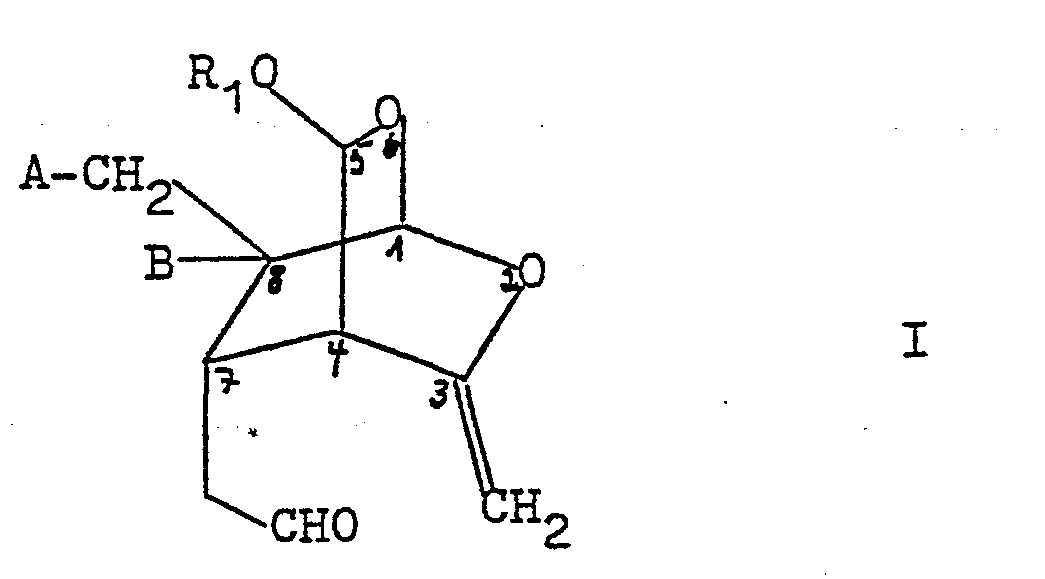
- the invention relates to new compounds of general formula I. wherein R 1 is lower alkyl or benzyl and A and B are each hydrogen or together form a bond, and a process for their preparation.
- R 1 in the compounds of the formula I is preferably methyl.
- the substituents at the centers C5 and C8 can each be arranged in the R or S position, so that the compounds of the formula I can occur in several diastereomeric forms. If A and B each represent hydrogen, C8 is preferably R-configured. C5 is preferably R-configured.
- the present invention includes all diastereoisomeric forms of the compounds of formula I.
- R 1 , A and B are as defined above, X is iodine or bromine and R is hydrogen or lower acyl, treated with a base in the presence of a solvent.
- Suitable bases are lower alkali metal alkoxides, for example sodium methyl alcoholate, alkali metal hydroxides or carbonates, for example potassium carbonate or alkali metal hydrides such as e.g. Sodium hydride.
- Quaternary organic ammonium hydroxides for example quaternary lower alkylammonium hydroxides, such as tetrabutylammonium hydroxide, or tertiary organic amines are also suitable.
- Suitable tertiary organic amines are, in particular, tertiary lower alkylamines such as triethylamine, tripropylamine or tributylamine, and also cyclic tertiary amines such as 1,4-dimethylpiperazine or pyridine.
- the reaction is expediently carried out in a solvent which is capable of dissolving both the compound of the formula II and the base used.
- suitable solvents are lower alcohols, such as methanol or ethanol, open or cyclic ethers, such as diethyl ether, tetrahydrofuran or dioxane, or aromatic hydrocarbons such as toluene or benzene. If appropriate, these solvents can be used mixed with water. If alkali metal alcoholates are used as bases, the corresponding lower alcohols are expediently used as solvents. If hydroxides or carbonates are used, lower Al is preferably used as the solvent kohole optionally used in a mixture with water. If alkali metal hydrides are used, cyclic ethers are preferably used as solvents.
- the reaction may proceed at temperatures between about 10 o C and about 110 OC, preferably between room temperature and about 80 ° C are performed. Depending on the type of starting product used and the reaction conditions used, the reaction time can be between 1 and 5 hours. If R in the compounds of the formula II denotes a lower acyl group, the bases to be used and their amounts and the reaction conditions must of course be selected such that they are suitable for hydrolysis of the ester group.
- the compounds of the formula I according to the invention are suitable as intermediates for the preparation of new 2,10-dioxa-tricyclo- [5,3,1,0 3,8 ] -undecane derivatives which are substituted in the 5-position and have valuable pharmacological properties.
- R 1 , R z , A and B have the above meaning, and which have valuable pharmacological properties, in particular cardiovascular effects, such as hypotensive effects.
- the compounds of formula IV are suitable as antihypertensives for the treatment of high blood pressure.
- the cardiovascular effects of the substances of formula IV can be demonstrated in animals using standard pharmacological test methods.
- the dose is increased 10-fold every 10 minutes without increasing the infusion volume.
- the heart rate is determined from the RR distance.
- the ED 75 is calculated in gmol / kg from the measured blood pressure and heart rate values, which is the total dose which causes these parameters to be reduced by 25% of their initial value.
- the respective ED 123 is calculated in ⁇ mal / kg from the values taken from the EKG, this is the total dose that increases the parameters by 25% of their initial value.
- the compounds of the formula IV show hypotensive effects in a dose range of 1 to 100 gmol / kg.
- 1R, 3R, 5S, 7R, 8R, 9R-N- [3,9-dimethoxy-11-methylene-2,10-dioxa-tricyclo- [5,3,1,0 3,8 ] -undecan-5-yl] -tryptamin determined the following values:
- the compound has a high specificity of the hypotensive effect, in particular on the diastolic blood pressure, and a high tolerance.
- the starting compounds of formula II and their preparation are known, e.g. from DE-OS 21 29 507, 26 07 106 and 27 19 916, or they can be prepared by the processes described in these laid-open documents or analogously to the processes described therein.
- Compounds of formula II in which A and B each form hydrogen can be prepared by hydrogenating compounds of formula II in which A and B together form a bond. The hydrogenation gives an epimer mixture in which the R and S configurations are in the ratio 9: 1.
- the epimers can be separated by fractional crystallization as described in DE-OS 27 19 916.
- the crude product can already be used in this form as an intermediate for further conversion to a compound of formula IV.
- the crude product is purified chromatographically on silica gel using n-hexane / ether as the eluent.
- the thin-layer chromatographically pure product obtained after concentration of the eluate is crystallized from n-hexane / ether.
- This crude product can be used as an intermediate for the preparation of compounds of the formula IV without further purification. If desired, the product can be further purified as described in Example 1. The purified product corresponds to the product obtained in Example 1.
- a solution of 10 g IR, 3S, 4S, 6R, 7S, 8R, 10R-3-iodomethyl-4-acetoxy-8-methoxy-10-methyl-2,9-dioxa-tricyclo- [4,3,1 .0 3.8 ] -decane in 220 ml of methanol is mixed with 3.6 g of potassium carbonate and the reaction mixture is stirred for about 1 hour at room temperature.
- the mixture is diluted with water and extracted with methylene chloride. The organic phase is separated off, dried over sodium sulfate, filtered and concentrated to dryness in vacuo.
- This crude product can be used as an intermediate for the preparation of compounds of the formula IV without further purification.
- the crude product is purified chromatographically on silica gel using n-hexane containing up to 15% ether. After concentrating the eluate, this becomes Pure product obtained by thin layer chromatography as an oil.
- This product can be used directly as an intermediate for the preparation of compounds of the formula IV. If desired, the product can be cleaned as described in Example 3. The purified product corresponds to the product obtained in Example 3.
- This product can be used directly as an intermediate for the preparation of compounds of the formula IV. If desired, the product can be cleaned as described in Example 3. The purified product corresponds to the product obtained in Example 3.
- This product can be used directly as an intermediate for the preparation of compounds of the formula IV.
- This product can be used directly as an intermediate for the preparation of compounds of the formula IV.
Landscapes
- Chemical & Material Sciences (AREA)
- Organic Chemistry (AREA)
- Organic Low-Molecular-Weight Compounds And Preparation Thereof (AREA)
- Heterocyclic Carbon Compounds Containing A Hetero Ring Having Oxygen Or Sulfur (AREA)
- Professional, Industrial, Or Sporting Protective Garments (AREA)
- Steering Devices For Bicycles And Motorcycles (AREA)
- Heterocyclic Compounds That Contain Two Or More Ring Oxygen Atoms (AREA)
- Pharmaceuticals Containing Other Organic And Inorganic Compounds (AREA)
- Polymers With Sulfur, Phosphorus Or Metals In The Main Chain (AREA)
- Transition And Organic Metals Composition Catalysts For Addition Polymerization (AREA)
- Plural Heterocyclic Compounds (AREA)
Abstract

Description
- Die vorliegende Erfindung betrifft neue 2,6-Dioxa-bicyclo-[2,2,2]-octan-7-yl-acetaldehyde und deren Herstellung.
- Der Erfindung liegt die Aufgabe zugrunde, neue Zwischenprodukte zur Herstellung neuer in 5-Stellung basisch substituierter 2,10-Dioxa-tricyclo-[5,3,1,03,8]-undecan-Derivate mit wertvollen pharmakologischen Eigenschaften, insbesondere neuer N-(2,10-Dioxa-tricyclo-[5,3,1,03,8]-unde- can-5-yl)-tryptamin-Derivate mit wertvollen pharmakologischen Eigenschaften, insbesondere Herzkreislauf-Wirkungen, z.B. blutdrucksenkender Wirkung, zu finden.
- Gegenstand der Erfindung sind neue Verbindungen der allgemeinen Formel I worin R1 niederes Alkyl oder Benzyl bedeutet und A und B je Wasserstoff bedeuten oder gemeinsam eine Bindung bilden, sowie ein Verfahren zu deren Herstellung.
- Vorzugsweise stellt R1 in den Verbindungen der Formel I Methyl dar.
- In den Verbindungen der Formel I können die Substituenten an den Zentren C5 und C8 jeweils in R- oder S-Stellung angeordnet sein, so daß die Verbindungen der Formel I in mehreren diastereomeren Formen auftreten können. Falls A und B je Wasserstoff bedeuten, ist C8 bevorzugt R-konfiguriert. C5 ist bevorzugt R-konfiguriert.
- Die vorliegende Erfindung umfaßt alle diastereoisomeren Formen der Verbindungen der Formel I.
- Die Verbindungen der Formel I werden erfindungsgemäß erhalten, indem man Verbindungen der allgemeinen Formel II (s. Formel II)
- worin R1, A und B obige Bedeutung besitzen, X Jod oder Brom bedeutet und R Wasserstoff oder niederes Acyl bedeutet, mit einer Base in Gegenwart eines Lösungsmittels behandelt.
- Vorzugsweise werden Verbindungen der Formel II eingesetzt, worin X Jod bedeutet und R Acetyl oder Wasserstoff bedeutet.
- Verbindungen der Formel II, worin R Wasserstoff bedeutet, können durch Hydrolyse aus Verbindungen der Formel II, worin R Acetyl bedeutet, hergestellt werden.
- Als Basen eignen sich niedere Alkalimetallalkoxide, beispielsweise Natriummethylalkoholat, Alkalimetallhydroxide oder -Carbonate, beispielsweise Kaliumcarbonat oder Alkalimetallhydride wie z.B. Natriumhydrid. Ferner sind quartäre organische Ammoniumhydroxide, beispielsweise quartäre Niederalkylammoniumhydroxide, wie Tetrabutylammoniumhydroxid, oder tertiäre organische Amine geeignet. Als tertiäre organische Amine kommen insbesondere tertiäre Niederalkylamine wie Triäthylamin, Tripropylamin oder Tributylamin in Frage sowie auch cyclische tertiäre Amine wie 1,4-Dimethylpiperazin oder Pyridin.
- Zweckmäßigerweise wird die Reaktion in einem Lösungsmittel, welches sowohl die Verbindung der Formel II wie auch die verwendete Base zu lösen vermag, durchgeführt. Als Beispiele geeigneter Lösungsmittel seien niedere Alkohole, wie z.B. Methanol oder Äthanol, offene oder cyclische Äther, wie z.B. Diäthyläther, Tetrahydrofuran oder Dioxan, oder aromatische Kohlenwasserstoffe wie Toluol oder Benzol genannt. Gegebenenfalls können diese Lösungsmittel im Gemisch mit Wasser verwendet werden. Sofern als Basen Alkalimetallalkoholate eingesetzt werden, werden als Lösungsmittel zweckmäßigerweise die entsprechenden niederen Alkohole verwendet. Falls Hydroxide oder Carbonate eingesetzt werden, werden als Lösungsmittel vorzugsweise niedere Alkohole gegebenenfalls im Gemisch mit Wasser verwendet. Falls Alkalimetallhydride eingesetzt werden, werden als Lösungsmittel vorzugsweise cyclische Äther verwendet.
- Die Reaktion kann bei Temperaturen zwischen ca. 10 oC und ca. 110 oc, vorzugsweise zwischen Raumtemperatur und ca. 80 °C, durchgeführt werden. Die Reaktionsdauer kann je nach Art des verwendeten Ausgangsproduktes und der verwendeten Reaktionsbedingungen zwischen 1 und 5 Stunden betragen. Falls R in den Verbindungen der Formel II eine niedere Acylgruppe bedeutet, müssen selbstverständlich die zu verwendenden Basen und deren Mengen sowie die Reaktionsbedingungen derart gewählt werden, daß sie für eine Hydrolyse der Estergruppe geeignet sind.
- Es ist als überraschend anzusehen, daß nach dem erfindungsgemäßen Verfahren eine Spaltung des carbocyclischen Ringes der Verbindungen der Formel II unter schonenden Bedingungen ermöglicht wird. Bei der Umsetzung bleibt die Konfiguration an allen Asymmetriezentren erhalten, so daß die Stellung der Substituenten an den Zentren C5 und C8 in den Verbindungen der Formel I mit der entsprechenden Konfiguration der eingesetzten Ausgangsprodukte übereinstimmt.
- Die erfindungsgemäßen Verbindungen der Formel I eignen sich als Zwischenprodukte zur Herstellung von neuen in 5-Stellung basisch substituierten 2,10-Dioxa-tricyclo-[5,3,1,03,8]-undecan-Derivaten mit wertvollen pharmakologischen Eigenschaften.
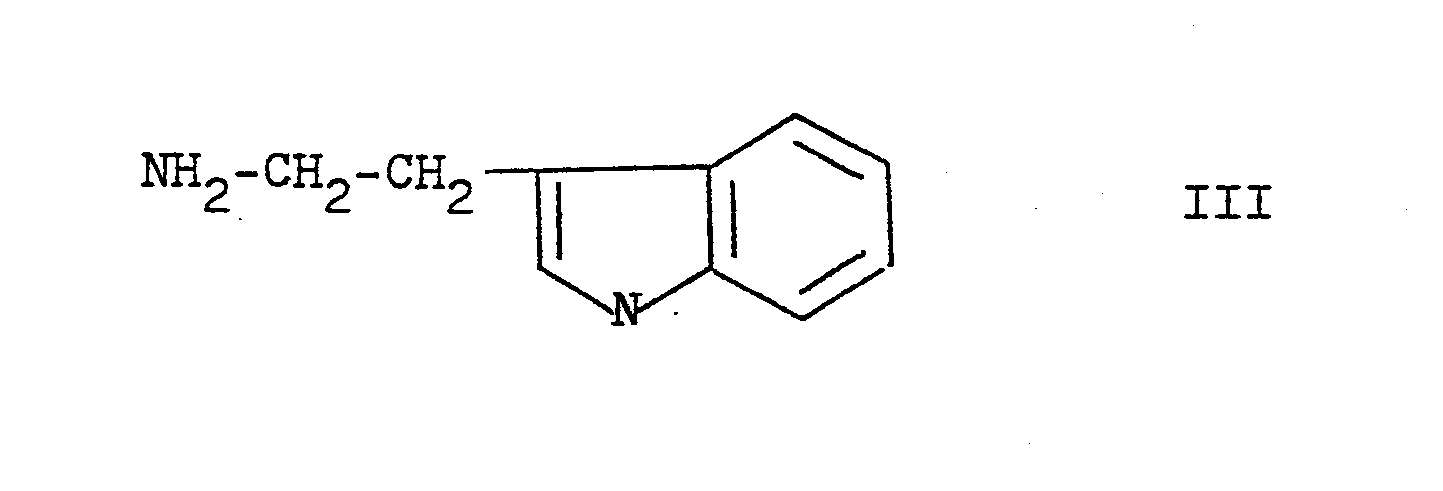
- Beispielsweise können die Verbindungen der Formel I mit Tryptamin, einem Amin der Formel III (s. Formel III)
- in einem Lösungsmittel R2 OH, worin R2 niederes Alkyl oder niederes Alkanoyl bedeutet, umgesetzt werden zu Verbindungen der allgemeinen Formel IV (s. Formel IV)
- worin R1, Rz, A und B obige Bedeutung besitzen, und welche wertvolle pharmakologische Eigenschaften, insbesondere Herzkreislauf-Wirkungen, wie z.B. blutdrucksenkende Wirkungen besitzen.
- So kann die Verarbeitung von Verbindungen der Formel I zu Verbindungen der Formel IV, worin R2 Methyl bedeutet, durch Umsetzen mit Tryptamin in Methanol beispielsweise unter den in dem nachfolgenden Beispiel A angegebenen Reaktionsbedingungen erfolgen.
- Auf Grund ihrer blutdrucksenkenden Wirkung sind die Verbindungen der Formel IV als Antihypertensiva zur Behandlung von Bluthochdruck geeignet.Die Herzkreislauf-Wirkungen der Substanzen der Formel IV lassen sich in pharmakologischen Standardtestmethoden an Tieren nachweisen.
- Die Wirkung der Substanzen auf Blutdruck, Herzfrequenz und EKG-Parameter bei i.v.-Dauerinfusion in narkotisierten Ratten wird nach der Methode von Buschmann et al. (J. Cardiovascular Pharmacol. 2, 777-781 (1980)) bestimmt. Männliche Wistar-Ratten (330-370 g Körpergewicht) werden durch i.p.-Applikation von 1,25 g/kg Urethan narkotisiert und tracheotomiert. Nach einer Äquilibrierungsphase von 10 Minuten wird mit den Messungen begonnen. In einer Vorlaufphase von 5 Minuten werden die Ausgangswerte gemessen. Anschließend werden die Prüfsubstanzen in isotonischer Natriumchloridlösung als Dauerinfusion i.v. appliziert, beginnend mit einer Dosis vom 0,01 µmol/kg/min. Die Dosis wird alle 10 Minuten ohne Erhöhung des Infusionsvolumens auf das 10-fache gesteigert. Es werden der systolische und der diastolische Blutdruck (P syst und P diast) gemessen und daraus der mittlere Blutdruck (P mittel) bestimmt, und aus dem Elektrocardiogramm (EKG) werden die Werte für die atrioventriculäre Überleitungszeit (in msec., herzfrequenz-korrigiert = PRc), das Zeitintervall der intraventriculären Erregungsausbreitung (= QRS) und die Zeitdauer vom Beginn der ventriculären Erregungsausbreitung bis zum Maximum der T-Welle (= R-aT) abgelesen. Die Herzfrequenz wird aus dem R-R-Abstand bestimmt.
- Aus den gemessenen Blutdruck- und Herzfrequenzwerten werden die ED75 in gmol/kg berechnet, das ist die Gesamtdosis, welche eine Senkung dieser Parameter um 25 % ihres Ausgangswertes bewirkt. Aus den dem EKG entnommenen Werten wird die jeweilige ED123 in µmal/kg berechnet, das ist die Gesamtdosis, welche die Parameter um 25 % ihres Ausgangswertes erhöht.
- Ferner wird in dem Versuch auch die minimale letale Dosis (DL min) in µmol/kg mitbestimmt.
- In der vorbeschriebenen Versuchsanordnung zeigen die Verbindungen der Formel IV in einem Dosisbereich von 1 bis 100 gmol/kg blutdrucksenkende Wirkungen. So wurden z.B. für das 1R,3R,5S,7R,8R,9R-N-[3,9-Dimethoxy-11-methylen-2,10-dioxa-tricyclo-[ 5,3,1,03,8]-undecan-5-yl]-tryptamin die folgenden Werte ermittelt:
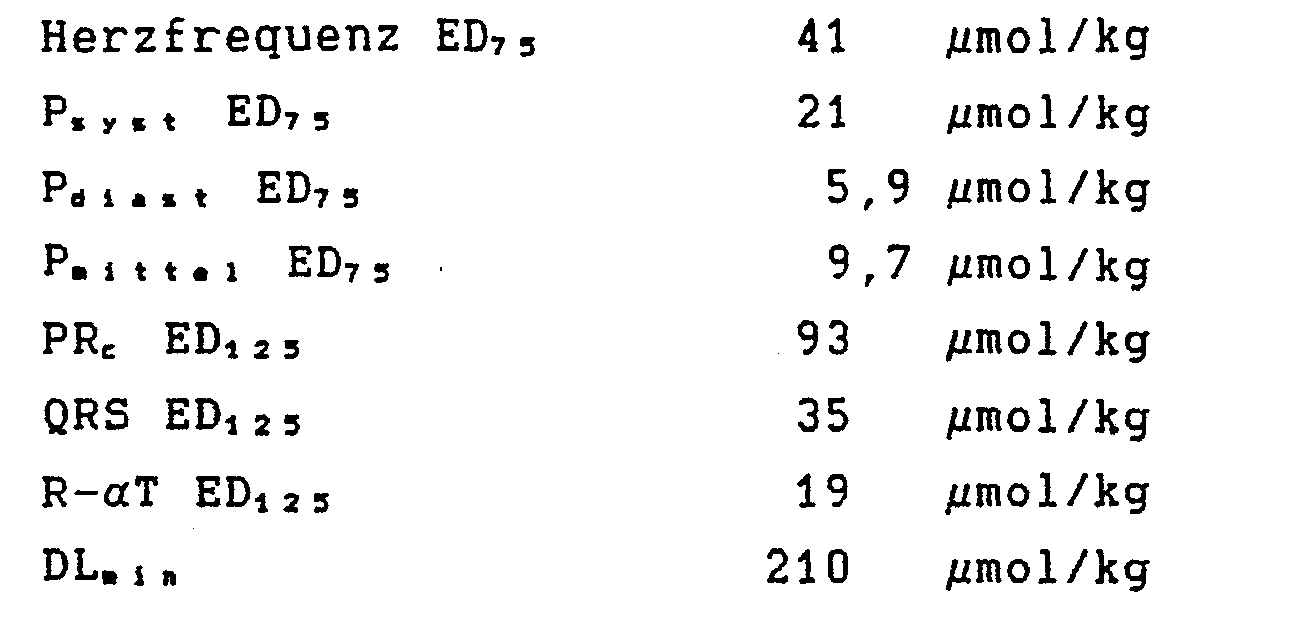
- Aus diesen Werten ist ersichtlich, daß die Verbindung eine hohe Spezifität der blutdrucksenkenden Wirkung insbesondere auf den diastolischen Blutdruck und eine hohe Verträglichkeit aufweist.
- Die Ausgangsverbindungen der Formel II und deren Herstellung sind bekannt, z.B. aus den DE-OS 21 29 507, 26 07 106 und 27 19 916, oder sie können nach den in diesen Offenlegungsschriften beschriebenen Verfahren bzw. analog zu den dort beschriebenen Verfahren hergestellt werden. Verbindungen der Formel II, worin A und B je Wasserstoff bilden, können durch Hydrierung von Verbindungen der Formel II, worin A und B gemeinsam eine Bindung bilden, hergestellt werden. Bei der Hydrierung wird ein Epimerengemisch erhalten, worin R- und S-Konfiguration im Verhältnis 9 : 1 vorliegen. Die Epimeren können durch fraktionierte Kristallisation wie in der DE-OS 27 19 916 beschrieben getrennt werden.
- Die nachfolgenden Beispiele sollen die Herstellung der Verbindungen der Formel-I näher erläutern, jedoch den Umfang der Erfindung in keiner Weise beschränken.
- 1R,4S,5R,7R-5-Methoxy-3,8-dimethylen-2,6-dioxa-bicyclo-[2, 2,2]-octan-7-yl-acetaldehyd.
- Eine Lösung von 7,6 g 1R,3S,4S,6R,7S,8R-3-Jodmethyl-4-acetoxy-8-methoxy-10-methylen-2,9-dioxa-tricyclo-[4,3,1,03,7]-decan in 100 ml absolutem Methanol wird zu einer durch Auflösen von 0,44 g Natrium in 40 ml absolutem Methanol bereiteten Natriummethylat-Lösung gegeben. Das Gemisch wird 4,5 Stunden lang bei 60 oC reagieren gelassen. Anschließend wird zur Aufarbeitung auf Eiswasser gegossen, mit Natriumchlorid gut ausgesalzen und mit Äther extrahiert. Die Ätherphase wird mit einigen Tropfen Eisessig versetzt, über Natriumsulfat getrocknet, filtriert und eingeengt. Als Rückstand verbleiben 4,29 g rohes 1R,4S,5R,7R-5-Methoxy-3,8-dimethylen-2,6-dioxa-bicyclo- [2,2,2]-octan-7-yl-acetaldehyd.
- Das Rohprodukt kann bereits in dieser Form als Zwischenprodukt zur weiteren Umsetzung zu einer Verbindung der Formel IV verwendet werden.
- Zur Reindarstellung wird das Rohprodukt chromatographisch über Kieselgel unter Verwendung von n-Hexan/Äther als Elutionsmittel gereinigt. Das nach Einengen des Eluates erhaltene dünnschichtchromatographisch reine Produkt wird aus n-Hexan/Äther kristallisiert.
- Fp. 56-59 oc IR-Spektrum: 3070 cm-1, 1725 cm-1, 1675 cm-1, 1170 cm-1, 1075 cm-1, 960 cm-1.
- IR,4S,5R,7R-5-Methoxy-3,8-dimethylen-2,6-dioxa-bicyclo-[2,2,2]-octan-7-yl-acetaldehyd.
- 6 g 1R,3S,4S,6R,7S,8R-3-Jodmethyl-4-acetoxy-8-methoxy-10-methylen-2,9-dioxa-tricyclo-[4,3,1,03,7]-decan werden zu einer durch Auflösen von 2,5 g Natrium in 250 ml absolutem Methanol bereiteten Natriummethylat-Lösung gegeben und das Reaktionsgemisch 1,5 Stunden bei einer Badtemperatur von 60 °C unter Stickstoff gerührt. Zur Aufarbeitung wird anschließend auf ca. 1/4 des ursprünglichen Volumens am Rotationsverdampfer eingeengt und die eingeengte Lösung vorsichtig mit 100 g gesättigter (NH4)2SO4-Lösung versetzt, wobei NH3 entweicht. Anschließend wird fünfmal mit insgesamt 500 ml Äther extrahiert. Die ätherischen Extrakte werden mit 50 ml (NH4)2SO4-Lösung und anschließend mit Wasser gewaschen, über Magnesiumsulfat getrocknet und eingedampft. Es werden 2,9 g rohes 1R,4S,5R,7R-5-Methoxy-3,8-dimethylen-2,6-dioxa-bicyclo[2,2,2]-octan-7-yl-acetaldehyd erhalten.
- Dieses Rohprodukt kann ohne weitere Reinigung als Zwischenprodukt zur Herstellung von Verbindungen der Formel IV verwendet werden. Gewünschtenfalls kann das Produkt, wie in Beispiel 1 beschrieben, weiter gereinigt werden. Das gereinigte Produkt stimmt mit dem in Beispiel 1 erhaltenen Produkt überein.
- lR,4S,5R,7R,8R-5-Methoxy-8-methyl-3-methylen-2,6-dioxa-bicyclo-[2,2,2]-octan-7-yl-acetaldehyd.
- A Eine Lösung von 10 g lR,3S,4S,6R,7S,8R,10R-3-Jodmethyl-4-acetoxy-8-methoxy-10-methyl-2,9-dioxa-tricyclo-[4,3,1,03,8]-decan in 220 ml Methanol wird mit 3,6 g Kaliumcarbonat versetzt und die Reaktionsmischung ca. 1 Stunde bei Raumtemperatur gerührt. Zur Aufarbeitung wird das Gemisch mit Wasser verdünnt und mit Methylenchlorid extrahiert. Die organische Phase wird abgetrennt, über Natriumsulfat getrocknet, filtriert und im Vakuum zur Trockne eingeengt. Es wird 8,7 g 1R,3S,4S,6R,7S,8R,10R-3-Jodme- thyl-4-hydroxy-8-methoxy-10-methyl-2,9-dioxa-tricyclo-[4,3,1,03,7]-decan erhalten.
- Fp. 92-93 oC.
- B Eine Lösung von 3,24 g 1R,3S,4S,6R,7S,8R,10R-3-Jodme- thyl-4-hydroxy-8-methoxy-10-methyl-2,9-dioxa-tricyclo-[4,3,1,03,7]-decan in 50 ml absolutem Methanol werden zu einer durch Auflösen von 0,23 g Natrium in 50 ml absolutem Methanol gebildeten Natriummethylat-Lösung gegeben. Das Reaktionsgemisch wird ca. 3 Stunden bei einer Temperatur von 60 °C gerührt. Anschließend wird zur Aufarbeitung auf Eiswasser gegossen, gut mit Natriumchlorid ausgesalzen und mit Äther extrahiert. Die Ätherphase wird mit einigen Tropfen Eisessig versetzt, über Natriumsulfat getrocknet, filtriert und im Vakuum bis zur Trockne eingeengt.
- Als Rückstand werden 2,7 g rohes 1R,4S,5R,7R,8R-5-Methoxy-8-methyl-3-methylen-2,6-dioxa-bicyclo-[2,2,2]-octan-7-yl-acetaldehyd erhalten.
- Dieses Rohprodukt kann ohne weitere Reinigung als Zwischenprodukt zur Herstellung von Verbindungen der Formel IV verwendet werden.
- Zur Reindarstellung wird das Rohprodukt chromatographisch über Kieselgel unter Verwendung von n-Hexan enthaltend bis zu 15 % Äther gereinigt. Nach Einengen des Eluats wird das dünnschichtchromatographisch reine Produkt als öl erhalten.
- IR-Spektrum: 1725 cm-1, 1675 cm-1, 1060 cm-1.
- 1R,4S,5R,7R,8R-5-Methoxy-8-methyl-3-methylen-2,6-dioxa-bicyclo-[2,2,2]-octan-7-yl-acetaldehyd.
- 1 g 1R,3S,4S,6R,7S,8R,10R-3-Jodmethyl-4-acetoxy-8-methoxy-10-methyl-2,9-dioxatricyclo-[4,3,1,03,7]-decan werden in 10 ml Methanol gegeben und mit 0,35 g Kaliumcarbonat versetzt. Das Reaktionsgemisch wird 5 Stunden bei 60 oC gerührt. Anschließend wird zur Aufarbeitung mit Wasser verdünnt und mit Methylenchlorid extrahiert. Die organische Phase wird über Natriumsulfat getrocknet, filtriert und im Vakuum bis zur Trockne eingeengt. Es werden 0,46 g rohes 1R,4S,5R,7R,8R-5-Methoxy-8-methyl-3-methylen-2,6-dioxa-bicyclo-[2,2,2]-octan-7-yl-acetaldehyd erhalten.
- Dieses Produkt kann direkt als Zwischenprodukt zur Herstellung von Verbindungen der Formel IV eingesetzt werden. Gewünschtenfalls kann das Produkt wie in Beispiel 3 beschrieben gereinigt werden. Das gereinigte Produkt stimmt mit dem in Beispiel 3 erhaltenen Produkt überein.
- lR,4S,5R,7R,8R-5-Methoxy-8-methyl-3-methylen-2,6-dioxa-bicyclo-[2,2,2]-octan-7-yl-acetaldehyd.
- 0,14 g Natriumhydrid (50 %-ig in öl) werden in 10 ml absolutes Tetrahydrofuran gegeben und eine Lösung von 1 g 1R,3S,4S,6R,7S,8R,10R-3-Jodmethyl-4-hydroxy-8-methoxy-10-methyl-2,9-dioxa-tricyclo-[4,3,1,03,7]-decan in 10 ml absolutem Tetrahydrofuran hinzugetropft. Das Reaktionsgemisch ca. 3 Stunden bei Raumtemperatur gerührt. Zur Aufarbeitung wird das Gemisch vorsichtig mit Eiswasser versetzt und anschließend mit Methylenchlorid extrahiert. Die organische Phase wird über Natriumsulfat getrocknet, filtriert und im Vakuum bis zur Trockne eingeengt. Es werden 0,68 g rohes 1R,4S,5R,7R,8R-5-Methoxy-8-methyl-3-methylen-2,6-dioxa-bicyclo-[ 2,2,2]-octan-7-yl-acetaldehyd erhalten.
- Dieses Produkt kann direkt als Zwischenprodukt zur Herstellung von Verbindungen der Formel IV eingesetzt werden. Gewünschtenfalls kann das Produkt wie in Beispiel 3 beschrieben gereinigt werden. Das gereinigte Produkt stimmt mit dem in Beispiel 3 erhaltenen Produkt überein.
- 1R,4S,5R,7R-5-Isobutoxy-3,8-dimethylen-2,6-dioxa-bicyclo-[2,2,2]-octan-7-yl-acetaldehyd.
- 4,5 g 1R,3S,4S,6R,7S,8R-3-Jodmethyl-4-acetoxy-8-isobutoxy-10-met hylen-2,9-dioxa-tricyclo-[4,3,1,03,7]-decan (Fp.: 45-50 oC, hergestellt auf an sich bekannte Weise durch Umsetzung von Didrovaltratum mit Isobutanol und Jodwasserstoffsäure) werden wie in Beispiel 1 beschrieben mit einer durch Auflösen von 1,25 g Natrium in 200 ml Methanol bereiteten Natriummethylat-Lösung umgesetzt. Nach Aufarbeitung des Reaktionsgemisches werden 3,5 g rohes 1R,4S,5R,7R-5-Isobutoxy-3,8-dimethylen2,6-dioxa-bicyclo-[2,2,2]-octan-7-yl-acetaldehyd als öl erhalten.
- IR-Spektrum: 3070 cm-1, 1725 cm-1, 1675 cm-1, 1175 cm-1, 1075 cm-1, 960 cm-i.
- Dieses Produkt kann direkt als Zwischenprodukt zur Herstellung von Verbindungen der Formel IV eingesetzt werden.
- 1R,4S,5R,7R-5-Benzyloxy-3,8-dimethylen-2,b-dioxa-bicyclo-[2,2,2]-octan-7-yl-acetaldehyd.
- 4,2 g 1R,3S,4S,6R,7S,8R-3-Jodmethyl-4-acetoxy-8-benzyloxy-10-methylen-2,9-dioxa-tricyclo-[4,3,1,03,7]-decan (Fp.: 69-70 °C, hergestellt auf an sich bekannte Weise durch Umsetzung von Didrovaltratum mit Benzylalkohol und Jodwasserstoffsäure) werden mit einer durch Auflösen von 1,2 g Natrium in 200 ml Methanol hergestellten Nätriummethylat-Lösung wie in Beispiel 1 beschrieben umgesetzt. Nach Aufarbeitung des Reaktionsgemisches werden 3,2 g rohes 1R,4S,5R,7R-5-Benzyloxy-3,8-dimethylen-2,6-dioxa-bicyclo-[2,2,2]-octan-yl-acetaldehyd als öl erhalten.
- IR-Spektrum: 3065 cm-1, 3030 cm-1, 1725 cm-1, 1675 cm-1, 1495 cm-1, 1070 cm-1, 960 cm-1.
- Dieses Produkt kann direkt als Zwischenprodukt zur Herstellung von Verbindungen der Formel IV eingesetzt werden.
- Weiterverarbeitung von 1R,4S,5R,7R-5-Methoxy3,8-dimethy- len-2,6-dioxa-bicyclo-[2,2,2]-octan-7-yl-acetaldehyd zu 1R,3R,5S,7R,8R,9R- und 1R,3R,5R,7R,8R,9R-N-(3,9-Dimethoxy-11-methylen-2,10dioxatricyclo-[5,3,1,03 ,8]-undecan-5yl)-tryptamin.
- Aus 4 g 1R,3S,4S,6R,7S,8R-3-Jodmethyl-4-acetoxy-8-methoxy-10methylen-2,9-dioxa-tricyclo-[4,3,1,03,7]-decan nach der Vorschrift des Beispiels 2 erhaltenes rohes 1R,4S,5R,7R-5-Methoxy-3,8-dimethylen-2,6-dioxa-bicyclo-[2,2,2]octan-7-yl-acetaldehyd werden in 100 ml absolutem Methanol gelöst und die Lösung unter Stickstoff mit 2 g Tryptamin-hydrochlorid versetzt und das Reaktionsgemisch bei einer Badtemperatur von 60 °C 3 1/2 Stunden gerührt. Anschließend wird zur Aufarbeitung das Methanol abdestilliert, das verbleibende Reaktionsgemisch mit konzentrierter Sodalösung alkalisiert und mit Methylenchlorid extrahiert. Die organische Phase wird über Magnesiumsulfat getrocknet und eingedampft. Es werden 4 g rötlich gefärbtes Rohprodukt erhalten. Dieses wird durch Säulenchromatographie unter Druck unter Verwendung von Chloroform enthaltend 5 % Methanol als Elutionsmittel gereinigt. Aus dem Eluat werden 890 mg unpolares 1R,3R,5S,7R,8R,9R-N-(3,9-Dimethoxy-11-methylen-2,10-dioxa-tricyclo-[5,3,1,03,8]-undecan-5-yl)-tryptamin als farbloses Schaumharz erhalten.
- [α]20D = + 3,3 o
- Molekulargewicht:
- berechnet 384,2049 gefunden 384,2048 Massenspektrum (130 oC):
- M+ = 384(4), 383(11), 352(11), 253(43), 221(21), 192(27), 179(42), 175(9), 144(11), 131(100).
- Ferner wird aus dem Eluat als polares Nebenprodukt rohes 1R,3R,5R,7R,8R,9R-N-(3,9-Dimethoxy-11-methylen-2,10-dioxa-tricyclo-[5,3,1,03,8]-undecan-5-yl)-tryptamin erhalten. Nach nochmaliger Reinigung durch präparative Dünnschichtchromatographie unter Verwendung von Chloroform enthaltend 5 % Methanol als Elutionsmittel werden 125 mg reines Produkt als farbloses Schaumharz erhalten.
- Molekulargewicht:
- berechnet 384,2049 gefunden 384,2048 Massenspektrum (110 oC):
- M+ = 384(7), 353(8), 254(100), 242(12).



Claims (2)


Priority Applications (1)
| Application Number | Priority Date | Filing Date | Title |
|---|---|---|---|
| AT84111551T ATE31063T1 (de) | 1983-10-01 | 1984-09-27 | 2,6-dioxa-bicyclo-(2,2,2>-octan-7-ylacetaldehyde. |
Applications Claiming Priority (2)
| Application Number | Priority Date | Filing Date | Title |
|---|---|---|---|
| DE3335827 | 1983-10-01 | ||
| DE19833335827 DE3335827A1 (de) | 1983-10-01 | 1983-10-01 | Neue 2,6-dioxa-bicyclo-(2,2,2)-octan-7-yl- acetaldehyde |
Publications (3)
| Publication Number | Publication Date |
|---|---|
| EP0136662A2 true EP0136662A2 (de) | 1985-04-10 |
| EP0136662A3 EP0136662A3 (en) | 1986-02-12 |
| EP0136662B1 EP0136662B1 (de) | 1987-11-25 |
Family
ID=6210782
Family Applications (1)
| Application Number | Title | Priority Date | Filing Date |
|---|---|---|---|
| EP84111551A Expired EP0136662B1 (de) | 1983-10-01 | 1984-09-27 | 2,6-Dioxa-Bicyclo-[2,2,2]-octan-7-yl-acetaldehyde |
Country Status (12)
| Country | Link |
|---|---|
| US (1) | US4526991A (de) |
| EP (1) | EP0136662B1 (de) |
| JP (1) | JPS6092291A (de) |
| AT (1) | ATE31063T1 (de) |
| CA (1) | CA1207780A (de) |
| DD (1) | DD232494A5 (de) |
| DE (2) | DE3335827A1 (de) |
| ES (1) | ES535352A0 (de) |
| FI (1) | FI843850L (de) |
| HU (1) | HU191453B (de) |
| IL (1) | IL73123A (de) |
| PT (1) | PT79101B (de) |
Families Citing this family (2)
| Publication number | Priority date | Publication date | Assignee | Title |
|---|---|---|---|---|
| DE3335826A1 (de) * | 1983-10-01 | 1985-04-18 | Kali-Chemie Pharma Gmbh, 3000 Hannover | Neue n-(2,10-dioxa-tricyclo-(5,3,1,0(pfeil hoch)3(pfeil hoch)(pfeil hoch),(pfeil hoch)(pfeil hoch)8(pfeil hoch))- undecan-5-yl)-tryptamin-derivate |
| CN111217826B (zh) * | 2019-11-08 | 2021-05-04 | 西北大学 | 一种2,6-二氧二环[3.3.2]辛烷衍生物及其合成方法 |
Family Cites Families (3)
| Publication number | Priority date | Publication date | Assignee | Title |
|---|---|---|---|---|
| US3917651A (en) * | 1969-12-08 | 1975-11-04 | Kali Chemie Ag | Dioxatricyclodecanones |
| DE2129507C3 (de) * | 1971-06-15 | 1980-02-14 | Kali-Chemie Ag, 3000 Hannover | Verfahren zur Herstellung von 8-Alkoxy-3halogenmethyl-4-acetoxy- 10-methylen-2,9dioxatricyclo(43,l,03 7 )decanen |
| DE2719916C2 (de) * | 1977-05-04 | 1987-03-19 | Kali-Chemie Pharma Gmbh, 3000 Hannover | Verfahren zur Herstellung von 2,9-Dioxatricyclo[4,3,1,0↑3↑↑,↑↑7↑]decanen |
-
1983
- 1983-10-01 DE DE19833335827 patent/DE3335827A1/de not_active Withdrawn
-
1984
- 1984-08-17 PT PT79101A patent/PT79101B/pt unknown
- 1984-08-23 ES ES535352A patent/ES535352A0/es active Granted
- 1984-09-20 DD DD84267456A patent/DD232494A5/de unknown
- 1984-09-24 US US06/653,708 patent/US4526991A/en not_active Expired - Fee Related
- 1984-09-27 DE DE8484111551T patent/DE3467758D1/de not_active Expired
- 1984-09-27 EP EP84111551A patent/EP0136662B1/de not_active Expired
- 1984-09-27 AT AT84111551T patent/ATE31063T1/de not_active IP Right Cessation
- 1984-09-28 CA CA000464314A patent/CA1207780A/en not_active Expired
- 1984-09-28 HU HU843675A patent/HU191453B/hu unknown
- 1984-09-30 IL IL73123A patent/IL73123A/xx unknown
- 1984-10-01 JP JP59204190A patent/JPS6092291A/ja active Pending
- 1984-10-01 FI FI843850A patent/FI843850L/fi not_active Application Discontinuation
Also Published As
| Publication number | Publication date |
|---|---|
| FI843850A7 (fi) | 1985-04-02 |
| ES8602007A1 (es) | 1985-11-01 |
| HUT36126A (en) | 1985-08-28 |
| HU191453B (en) | 1987-02-27 |
| FI843850A0 (fi) | 1984-10-01 |
| DE3467758D1 (de) | 1988-01-07 |
| DE3335827A1 (de) | 1985-04-18 |
| JPS6092291A (ja) | 1985-05-23 |
| DD232494A5 (de) | 1986-01-29 |
| EP0136662B1 (de) | 1987-11-25 |
| PT79101B (en) | 1986-07-17 |
| US4526991A (en) | 1985-07-02 |
| ATE31063T1 (de) | 1987-12-15 |
| EP0136662A3 (en) | 1986-02-12 |
| FI843850L (fi) | 1985-04-02 |
| ES535352A0 (es) | 1985-11-01 |
| CA1207780A (en) | 1986-07-15 |
| IL73123A (en) | 1987-09-16 |
| PT79101A (en) | 1984-09-01 |
| IL73123A0 (en) | 1984-12-31 |
Similar Documents
| Publication | Publication Date | Title |
|---|---|---|
| CH623571A5 (de) | ||
| EP0173199A1 (de) | cis, endo-2-Azabicycloalkan-3-carbonsäure-Derivate, Verfahren zu deren Herstellung, deren Verwendung sowie Zwischenprodukte bei deren Herstellung | |
| EP0306871B1 (de) | 3,7-Diazabicyclo [3,3,1] nonan-Verbindungen sowie Verfahren zu ihrer Herstellung und diese Verbindungen enthaltende Arzneimittel | |
| DE4243279A1 (de) | Substituierte Triole | |
| DD235259A5 (de) | Verfahren zur herstellung von 5,11-dihydro-11-[[(1-methyl-4-piperidinyl)amino]carbonyl]-6 h-dibenz[b,e]azepin-6-on und dessen salzen | |
| WO1985000171A1 (fr) | Spiroxuccinimides, leur fabrication et leur utilisation | |
| DE68925173T2 (de) | 4-Methyl und 4-Ethyl substituierte Pyrrolidin-2-one | |
| EP0136662B1 (de) | 2,6-Dioxa-Bicyclo-[2,2,2]-octan-7-yl-acetaldehyde | |
| DE2258257A1 (de) | Citronensaeurederivate | |
| CH616142A5 (de) | ||
| CH617197A5 (de) | ||
| EP0233483A2 (de) | Pyrrolo[1,2-a][4,1]benzoxazepine, Verfahren zur ihrer Herstellung, pharmazeutische Präparate enthaltend diese Verbindungen, sowie therapeutische Verwendung | |
| DE69300011T2 (de) | Diacylglycerol-Nicotinate, Verfahren zu ihrer Herstellung und diese enthaltende pharmazeutische Zubereitungen. | |
| DE2917456C2 (de) | ||
| DE2305078A1 (de) | Neue oxabicyclooctane und verfahren zu ihrer herstellung | |
| EP0293814A1 (de) | Neue Mono- und Polyhydroxyacyl-Derivate polyoxygenierter Labdane, ein Verfahren zu deren Herstellung und ihre Verwendung als Medikamente | |
| EP0180890B1 (de) | Verfahren zur diastereoselektiven Reduktion von 3-Amino-1-benzoxepin-5(2H)-onen | |
| DD251289A5 (de) | Verfahren zur herstellung einer neuartigen racemischen oder optisch aktiven verbindung | |
| DE3026602A1 (de) | 14-oxo-15-halogen-e-homoeburnanderivate, verfahren zur herstellung derselben und von 14-oxo-15-hydroxyimino-e-homoeburnanderivaten und die ersteren enthaltende arzneimittel | |
| EP0136661B1 (de) | N- (2,10-Dioxa-tricyclo-(5,3,1,03,8)-undecan-5-yl)-tryptamin-Derivate | |
| CH663615A5 (de) | Azabicyclische verbindungen, verfahren zu ihrer herstellung sowie diese enthaltendes pharmazeutisches praeparat. | |
| DE60112024T2 (de) | Verfahren zur Isomerisierung von 6-Beta-Fluorosteroide zu den entsprechenden 6-Alpha-Derivaten | |
| DE2720915A1 (de) | Neue 1-acyl-2-hydroxy-1,3-diaminopropane, verfahren zur herstellung derselben und arzneimittel | |
| AT336602B (de) | Verfahren zur herstellung eines optisch aktiven thiolactons | |
| AT336018B (de) | Verfahren zur herstellung von neuen heterocyclischen verbindungen |
Legal Events
| Date | Code | Title | Description |
|---|---|---|---|
| PUAI | Public reference made under article 153(3) epc to a published international application that has entered the european phase |
Free format text: ORIGINAL CODE: 0009012 |
|
| 17P | Request for examination filed |
Effective date: 19841213 |
|
| AK | Designated contracting states |
Designated state(s): AT BE CH DE FR GB IT LI NL SE |
|
| RTI1 | Title (correction) | ||
| PUAL | Search report despatched |
Free format text: ORIGINAL CODE: 0009013 |
|
| AK | Designated contracting states |
Designated state(s): AT BE CH DE FR GB IT LI NL SE |
|
| 17Q | First examination report despatched |
Effective date: 19870224 |
|
| ITF | It: translation for a ep patent filed | ||
| GRAA | (expected) grant |
Free format text: ORIGINAL CODE: 0009210 |
|
| AK | Designated contracting states |
Kind code of ref document: B1 Designated state(s): AT BE CH DE FR GB IT LI NL SE |
|
| REF | Corresponds to: |
Ref document number: 31063 Country of ref document: AT Date of ref document: 19871215 Kind code of ref document: T |
|
| REF | Corresponds to: |
Ref document number: 3467758 Country of ref document: DE Date of ref document: 19880107 |
|
| ET | Fr: translation filed | ||
| GBT | Gb: translation of ep patent filed (gb section 77(6)(a)/1977) | ||
| PLBE | No opposition filed within time limit |
Free format text: ORIGINAL CODE: 0009261 |
|
| STAA | Information on the status of an ep patent application or granted ep patent |
Free format text: STATUS: NO OPPOSITION FILED WITHIN TIME LIMIT |
|
| 26N | No opposition filed | ||
| PG25 | Lapsed in a contracting state [announced via postgrant information from national office to epo] |
Ref country code: GB Effective date: 19890927 Ref country code: AT Effective date: 19890927 |
|
| PG25 | Lapsed in a contracting state [announced via postgrant information from national office to epo] |
Ref country code: SE Effective date: 19890928 |
|
| PG25 | Lapsed in a contracting state [announced via postgrant information from national office to epo] |
Ref country code: LI Effective date: 19890930 Ref country code: CH Effective date: 19890930 Ref country code: BE Effective date: 19890930 |
|
| BERE | Be: lapsed |
Owner name: KALI-CHEMIE PHARMA G.M.B.H. Effective date: 19890930 |
|
| PG25 | Lapsed in a contracting state [announced via postgrant information from national office to epo] |
Ref country code: NL Effective date: 19900401 |
|
| NLV4 | Nl: lapsed or anulled due to non-payment of the annual fee | ||
| GBPC | Gb: european patent ceased through non-payment of renewal fee | ||
| PG25 | Lapsed in a contracting state [announced via postgrant information from national office to epo] |
Ref country code: FR Effective date: 19900531 |
|
| REG | Reference to a national code |
Ref country code: CH Ref legal event code: PL |
|
| PG25 | Lapsed in a contracting state [announced via postgrant information from national office to epo] |
Ref country code: DE Effective date: 19900601 |
|
| REG | Reference to a national code |
Ref country code: FR Ref legal event code: ST |
|
| EUG | Se: european patent has lapsed |
Ref document number: 84111551.2 Effective date: 19900521 |