EP0136850A2 - Herbizid - Google Patents
Herbizid Download PDFInfo
- Publication number
- EP0136850A2 EP0136850A2 EP84306107A EP84306107A EP0136850A2 EP 0136850 A2 EP0136850 A2 EP 0136850A2 EP 84306107 A EP84306107 A EP 84306107A EP 84306107 A EP84306107 A EP 84306107A EP 0136850 A2 EP0136850 A2 EP 0136850A2
- Authority
- EP
- European Patent Office
- Prior art keywords
- cirsii
- disease causing
- causing material
- septoria
- fungus
- Prior art date
- Legal status (The legal status is an assumption and is not a legal conclusion. Google has not performed a legal analysis and makes no representation as to the accuracy of the status listed.)
- Granted
Links
Images
Classifications
-
- C—CHEMISTRY; METALLURGY
- C12—BIOCHEMISTRY; BEER; SPIRITS; WINE; VINEGAR; MICROBIOLOGY; ENZYMOLOGY; MUTATION OR GENETIC ENGINEERING
- C12P—FERMENTATION OR ENZYME-USING PROCESSES TO SYNTHESISE A DESIRED CHEMICAL COMPOUND OR COMPOSITION OR TO SEPARATE OPTICAL ISOMERS FROM A RACEMIC MIXTURE
- C12P1/00—Preparation of compounds or compositions, not provided for in groups C12P3/00 - C12P39/00, by using microorganisms or enzymes
- C12P1/02—Preparation of compounds or compositions, not provided for in groups C12P3/00 - C12P39/00, by using microorganisms or enzymes by using fungi
-
- A—HUMAN NECESSITIES
- A01—AGRICULTURE; FORESTRY; ANIMAL HUSBANDRY; HUNTING; TRAPPING; FISHING
- A01N—PRESERVATION OF BODIES OF HUMANS OR ANIMALS OR PLANTS OR PARTS THEREOF; BIOCIDES, e.g. AS DISINFECTANTS, AS PESTICIDES OR AS HERBICIDES; PEST REPELLANTS OR ATTRACTANTS; PLANT GROWTH REGULATORS
- A01N63/00—Biocides, pest repellants or attractants, or plant growth regulators containing microorganisms, viruses, microbial fungi, animals or substances produced by, or obtained from, microorganisms, viruses, microbial fungi or animals, e.g. enzymes or fermentates
- A01N63/30—Microbial fungi; Substances produced thereby or obtained therefrom
-
- C—CHEMISTRY; METALLURGY
- C12—BIOCHEMISTRY; BEER; SPIRITS; WINE; VINEGAR; MICROBIOLOGY; ENZYMOLOGY; MUTATION OR GENETIC ENGINEERING
- C12N—MICROORGANISMS OR ENZYMES; COMPOSITIONS THEREOF; PROPAGATING, PRESERVING, OR MAINTAINING MICROORGANISMS; MUTATION OR GENETIC ENGINEERING; CULTURE MEDIA
- C12N1/00—Microorganisms; Compositions thereof; Processes of propagating, maintaining or preserving microorganisms or compositions thereof; Processes of preparing or isolating a composition containing a microorganism; Culture media therefor
- C12N1/14—Fungi; Culture media therefor
- C12N1/145—Fungi isolates
-
- C—CHEMISTRY; METALLURGY
- C12—BIOCHEMISTRY; BEER; SPIRITS; WINE; VINEGAR; MICROBIOLOGY; ENZYMOLOGY; MUTATION OR GENETIC ENGINEERING
- C12R—INDEXING SCHEME ASSOCIATED WITH SUBCLASSES C12C - C12Q, RELATING TO MICROORGANISMS
- C12R2001/00—Microorganisms ; Processes using microorganisms
- C12R2001/645—Fungi ; Processes using fungi
-
- Y—GENERAL TAGGING OF NEW TECHNOLOGICAL DEVELOPMENTS; GENERAL TAGGING OF CROSS-SECTIONAL TECHNOLOGIES SPANNING OVER SEVERAL SECTIONS OF THE IPC; TECHNICAL SUBJECTS COVERED BY FORMER USPC CROSS-REFERENCE ART COLLECTIONS [XRACs] AND DIGESTS
- Y10—TECHNICAL SUBJECTS COVERED BY FORMER USPC
- Y10S—TECHNICAL SUBJECTS COVERED BY FORMER USPC CROSS-REFERENCE ART COLLECTIONS [XRACs] AND DIGESTS
- Y10S435/00—Chemistry: molecular biology and microbiology
- Y10S435/8215—Microorganisms
- Y10S435/911—Microorganisms using fungi
Definitions
- This invention relates to a herbicidal composition
- a herbicidal composition comprising an effective amount of disease causing material obtainable by cultivation of Phomopsis cirsii or Septoria cirsii, optionally containing other active materials and an agronomically compatible diluent or carrier and the use of the herbicidal composition against plants belonging to the composites (Compositae).
- Phomopsis cirsii is used.
- the fungi are propagated on nutritive substrates after which the fresh or preserved disease causing material obtained is spread in suitable amounts over the weeds in the field.
- Weeds belonging to the composites are at present controlled with chemical herbicides. These often have no effect on the weeds, which fact may be due to unfavourable climatic conditions at the time of spraying or to the fact that use of the known herbicides over a longer period of time selects for herbicidal tolerant types of weeds. For these and not least for environmental reasons it is desirable to use biological herbicides.
- the fungus Phomopsis cirsii Grove was described for the first time by Grove in British Stem- and Leaf-fungi (Coelomycetes) 1 (1935), 177, and the fungus Septoria cirsii Niessl was described by Saccardo in Sylloge Fungorum 3 (1884), 550.
- Plants may be controlled by spraying with a disease causing material obtained by cultivation of Phomopsis cirsii such as fragments of mycelium, sclerotia, pycnidia, conidia and phytotoxic products therefrom.
- a disease causing material obtained by cultivation of Phomopsis cirsii such as fragments of mycelium, sclerotia, pycnidia, conidia and phytotoxic products therefrom.
- Plants may be infected by spraying with a disease causing material obtained by cultivation of Septoria cirsii such as pycnidia, conidia and phytotoxic products therefrom.
- Each of these fungal structures can be used alone or together as disease causing material.
- the disease causing material may also be obtained from different strains of the fungi.
- the disease causing material obtained by cultivation of either Phomopsis cirsii or Septoria cirsii can be used separately, but if disease causing material obtained from both fungi is used, a wider range of host plants and a higher ecological amplitude is obtained. This will, all things considered, have the most appropriate controlling effect.
- Immature pycnidia from Phomopsis cirsii are glabrous, lenticular and covered by the epidermis. Later, under moist conditions, the pycnidia produce long prominent necks which penetrate the epidermis. Mature pycnidia are pyriform, unilocular, at basis broad to flattened and thin-walled. Wall thickness increases towards the neck. The cavity is mostly simple but sometimes (predominantly in dry material) divided by intrusions from the inner wall.
- PDA Potato Dextrose Agar
- colonies on PDA exhibit a certain variation in colour during the aging of the culture. Initially, they are whitish, transitionally often with greenish yellow mycelium in patches or in a zone extending up to 2 cm from the periphery towards the center of the colony. Later the colonies become greyish brown. The surface is floccose. The margin initially with abundant aerial mycelium, with age becoming appressed. Old cultures may produce raised circular tufts of dense white mycelium, about 3 to 5 mm in diameter.
- the pycnidia are solitary, relatively small, thin-walled and dark brown to black. With the process of aging, larger and more thick-walled pycnidia develop either in clusters (groups) or in complexes with interconnected walls often sharing one ostiole only.
- Phomopsis cirsii is capable of producing three types of conidia.
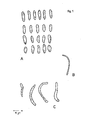
- the type of conidia varies as a result of the pycnidium age (see fig. 1 showing A-, B-, and C-conidia).
- B-conidia are typically the first conidia to be produced. Later in the same pycnidium A-conidia are formed and gradually become more abundant.
- the C-conidia which are an intermediary type between A- and B-conidia, can be found in small numbers.
- the dimensions of the conidia seem to depend on the substrate on which the fungus has been cultivated. The following descriptions of conidia are, however, based upon observations and measurements made on conidia collected from plants and from cultures on PDA, on V8 agar and on oat meal agar.
- the A-conidia are hyaline, unicellular, guttulate and ellipsoid, often slightly constricted in the mid region; measuring about 7 - 10 x 2 - 3 ⁇ m.
- the B-conidia are hyaline, usually curved at one end or flexuos; measuring about 18 - 35 x 0.5 - 1 ⁇ m.
- the C-conidia are hyaline, slightly curved with round or acute ends sometimes ellipsoid, resembling long A-conidia but mostly multi guttulate; measuring about 14 - 30 x 2.5 - 3 ⁇ m.
- Phompsis are the conidial stage of the genus Diaporthe Nits. in the class of Pyrenomycetes in Ascomycotina. No ascocarps or any other sexual structure have been observed on the cultures of Phomopsis cirsii, even when they were kept for one year at room temperature, at 4°C or at alternating conditions in laboratory or in nature.
- Pycnidia from Septoria cirsii are single and immersed, the shape is globose or depressed globose with a diameter of about 40 - 100 ⁇ m, without papilla or neck.
- the conidia producing layer is lining the entire inner surface of the cavity.
- the pycnidial wall is stromatic, composed of several layers of heavily pigmented and relatively thick walled cells.
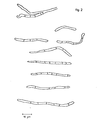
- Conidia (about 20 - 80 x 2 - 3 ⁇ m) are cylindrical, subflexous and normally with 6 - 12 septa. One end truncate to rounded, tne other end narrowed and more acute. Sometimes conidia are without any signs of septation or with only five or fewer distinct septa, all within the same pycnidia (see fig. 2 showing conidia of Septoria cirsii from culture on PDA).
- Septoria cirsii grows well on liquid as well as on solid PDA, but not on Czapek Dox Broth (Difco Laboratories, Detroit, USA).
- colonies derived from mycelium grows very slowly, producing white, sometimes silvery raised hairy colonies with smooth margins, reaching about 4 cm in diameter after one month of incubation at room temperature with or without NUV-light. Only very few or no pycnidia are produced in this colony type. Colonies derived from conidia immediately produce pycnidia immersed in the medium with a minimal mycelium. After about 7 days of incubation at room temperature, mature pycnidia are formed with conidia extruded in opaque or very seldom in rose-pink globules from the ostioles.
- the shape of the pycnidia and conidia and their dimensions in culture are in accordance with the characteristics of the fungus on Cirsium arvense.
- Phomopsis cirsii and Septoria cirsii can be cultivated by surface cultivation or by submerged cultivation.
- Submerged cultivation is carried out under aerobic conditions in a fermentation medium comprising an assimilable nitrogen, carbon source and essential nutrients whereafter the disease causing material is isolated. Further details such as pH value, temperature, aeration and agitation can easily be selected by the skilled art worker.
- the disease causing material described herein may be applied to a region to be treated by being applied directly to the soil as pre-emergence treatment or as post-emergence treatment to plant foliage, or they can be mixed intimately with the soil.
- the preferred treatment is after emergence of the plant foliage and the disease causing material described herein may, for example, be applied to soil or to plant foliage in amounts of from about 100 g to 100 kg per hectare.
- a herbicidal composition of this invention having the disease causing material described herein as its active ingredient may be formulated by mixing it with suitable inert carriers to obtain a composition generally used in agricultural compositions, such as a wettable powder, an emulsifiable concentrate, a granular formulation, a water soluble powder, an alginate, a xanthan gum and an aerosol.
- suitable inert carriers such as a wettable powder, an emulsifiable concentrate, a granular formulation, a water soluble powder, an alginate, a xanthan gum and an aerosol.
- solid carriers bentonite, diatomaceous earth, apatite, gypsum, talc, pyrophyllite, vermiculite and clay may be used.
- a surface active agent may also be added, in order to give a homogeneous and stable formulation.
- the disease causing material described herein can also be admixed with other active materials used in agronomic and horticultural management and which are compatible with it.
- active materials can be plant nutrients, fertilizers, insecticides, acaricides, fungicides, herbicides and nematocides.
- the concentration of the disease causing material described herein in the herbicidal composition of this invention may vary according to the type of formulation and the concentration is, for example, in the range of from about 5 to 80 weight per cent, preferably from about 10 to 60 weight per cent, in a wettable powder; and from about 5 to 70 weight per cent, preferably from about 20 to 60 weight per cent, in a granular formulation.
- a wettable powder or an emulsifiable concentrate thus produced may be "diluted" with water to a specified concentration and used as a liquid suspension or a liquid emulsion for treating soils or plant foliage. Further, a granular formulation may be directly used for soil or foliage treatment.
- V8 agar is made from V8 juice sold by many supermarkets.
- Thistle plants grown in greenhouse at temperatures between 14°C and 35°C were infected when inoculated with a suspension of either pure mycelium, mycelium in combination with microsclerotia (Example 1) or in combination with pycnidia and conidia from Phomopsis cirsii.
- the mycelium was wiped off and blended with distilled water at high speed for two minutes in a Waring blender.
- the suspension was adjusted to contain 80 g of mycelium per liter suspension, using distilled water.
- the plants were incubated for 24 hours in a dew chamber. Five to 7 days after inoculation, signs of infections appeared. Typically, it was black spots or stripes on the veins of the young leaves. The fungus invaded the stems systemicly from the leaves. After girdling of the stem, it grew downwards to the roots causing gradual dieback of the shoot.
- Phomopsis cirsii was also able to invade the stem via involucral bracts of buds or flowering heads and thereby preventing further flowering of the plant.
- the disease varied in severity between and within plant species (see table II and III, below, concerning the specificity of Phomopsis cirsii).
- Example 1 The same inoculation procedure and strain of Phomopsis cirsii as described in Example 1 was used to investigate the specificity of the fungus in the greenhouse on a collection of 147 different species selected from the following four groups: Wild plants (weeds and wild flora), agricultural plants, horticultural plants and plants for technical use.
- Selection criteria for plant species were their relationship to Cirsium arvense and their occurence as crop or wild plants or as weeds.
- the patogenesity of Septoria cirsii was investigated by inoculating plants of Cirsium arvense with a suspension of conidia and crushed pycnidia (concentration: 10 spores per ml), obtained from cultures grown on PDA plates. Distilled water was added to the plates and then the conidia and pycnidia were separated from the medium by gently scraping the medium surface.
- Inoculations were carried out by means of a compressed air supplied spraying pistol (working pressure: 2 kg per cm 2 ). Each plant was sprayed until runoff.
- the plants were incubated for 48 hours in a dew chamber.
- the susceptibility of the species was evaluated as occurrence of infections or no infections during a period of one month from the inoculation. Isolation of Septoria cirsii from the leaf spots confirmed the evaluations.
- herbicidal compositions of this invention are illustrated below:
- the fine particles are made into granules, each having a diameter in the range of about 0.5 - 1.0 mm, to provide a granular formulation. In use it is directly applied.
Landscapes
- Life Sciences & Earth Sciences (AREA)
- Engineering & Computer Science (AREA)
- Zoology (AREA)
- Health & Medical Sciences (AREA)
- Chemical & Material Sciences (AREA)
- Organic Chemistry (AREA)
- Wood Science & Technology (AREA)
- Biotechnology (AREA)
- General Health & Medical Sciences (AREA)
- Mycology (AREA)
- Microbiology (AREA)
- Bioinformatics & Cheminformatics (AREA)
- Genetics & Genomics (AREA)
- General Engineering & Computer Science (AREA)
- Biochemistry (AREA)
- Virology (AREA)
- Chemical Kinetics & Catalysis (AREA)
- Tropical Medicine & Parasitology (AREA)
- Environmental Sciences (AREA)
- Dentistry (AREA)
- Plant Pathology (AREA)
- Pest Control & Pesticides (AREA)
- Agronomy & Crop Science (AREA)
- Botany (AREA)
- Medicinal Chemistry (AREA)
- General Chemical & Material Sciences (AREA)
- Biomedical Technology (AREA)
- Agricultural Chemicals And Associated Chemicals (AREA)
- Micro-Organisms Or Cultivation Processes Thereof (AREA)
- Medicines Containing Plant Substances (AREA)
- Preparation Of Compounds By Using Micro-Organisms (AREA)
- Cultivation Of Plants (AREA)
- Organic Low-Molecular-Weight Compounds And Preparation Thereof (AREA)
Priority Applications (1)
| Application Number | Priority Date | Filing Date | Title |
|---|---|---|---|
| AT84306107T ATE39403T1 (de) | 1983-09-07 | 1984-09-06 | Herbizid. |
Applications Claiming Priority (2)
| Application Number | Priority Date | Filing Date | Title |
|---|---|---|---|
| DK4059/83 | 1983-09-07 | ||
| DK4059/83A DK405983D0 (da) | 1983-09-07 | 1983-09-07 | Biologiske ukrudtsbekaempelsesmidler |
Publications (3)
| Publication Number | Publication Date |
|---|---|
| EP0136850A2 true EP0136850A2 (de) | 1985-04-10 |
| EP0136850A3 EP0136850A3 (en) | 1985-05-08 |
| EP0136850B1 EP0136850B1 (de) | 1988-12-28 |
Family
ID=8129755
Family Applications (1)
| Application Number | Title | Priority Date | Filing Date |
|---|---|---|---|
| EP84306107A Expired EP0136850B1 (de) | 1983-09-07 | 1984-09-06 | Herbizid |
Country Status (14)
| Country | Link |
|---|---|
| US (1) | US4753670A (de) |
| EP (1) | EP0136850B1 (de) |
| JP (1) | JPS6084207A (de) |
| AT (1) | ATE39403T1 (de) |
| AU (1) | AU584585B2 (de) |
| CA (1) | CA1247879A (de) |
| DE (1) | DE3475745D1 (de) |
| DK (1) | DK405983D0 (de) |
| FI (1) | FI74195C (de) |
| GR (1) | GR80308B (de) |
| IE (1) | IE58631B1 (de) |
| NO (1) | NO162212C (de) |
| NZ (1) | NZ209467A (de) |
| ZA (1) | ZA847001B (de) |
Cited By (3)
| Publication number | Priority date | Publication date | Assignee | Title |
|---|---|---|---|---|
| EP0277736A3 (en) * | 1987-02-03 | 1988-08-31 | Univ Mcgill | Fungal herbicides |
| US5212086A (en) * | 1987-02-03 | 1993-05-18 | The Royal Institution For The Advancement Of Learning (On Behalf Of Mcgill University) | Fungal herbicides |
| AU697746B2 (en) * | 1996-11-05 | 1998-10-15 | Mitsui Chemicals, Inc. | A herbicide containing phytopathogenic microorganisms |
Families Citing this family (4)
| Publication number | Priority date | Publication date | Assignee | Title |
|---|---|---|---|---|
| US5077045A (en) * | 1986-08-16 | 1991-12-31 | Michigan State University | Method for suppressing weed grasses using xanthomonas campestris |
| US5192541A (en) * | 1991-08-30 | 1993-03-09 | Mycogen Corporation | Weed killing xanthomonas campestris |
| US5393728A (en) * | 1993-06-15 | 1995-02-28 | University Of Florida | Broad-spectrum bioherbicide to control several species of pigweeds and methods of use |
| USD400512S (en) | 1997-02-12 | 1998-11-03 | Fibox Oy Ab | Enclosure for electronic and electric components |
Family Cites Families (3)
| Publication number | Priority date | Publication date | Assignee | Title |
|---|---|---|---|---|
| GB1038722A (en) * | 1962-12-12 | 1966-08-10 | Ici Ltd | A new composition of matter |
| US3999973A (en) * | 1975-06-19 | 1976-12-28 | The Board Of Trustees Of The University Of Arkansas | C. malvarum spore concentrate, formulation, and agricultural process |
| US4390360A (en) * | 1982-03-10 | 1983-06-28 | The United States Of America As Represented By The Secretary Of Agriculture | Control of sicklepod, showy crotalaria, and coffee senna with a fungal pathogen |
-
1983
- 1983-09-07 DK DK4059/83A patent/DK405983D0/da not_active Application Discontinuation
-
1984
- 1984-09-06 EP EP84306107A patent/EP0136850B1/de not_active Expired
- 1984-09-06 IE IE227384A patent/IE58631B1/en not_active IP Right Cessation
- 1984-09-06 NZ NZ209467A patent/NZ209467A/xx unknown
- 1984-09-06 DE DE8484306107T patent/DE3475745D1/de not_active Expired
- 1984-09-06 NO NO843545A patent/NO162212C/no not_active IP Right Cessation
- 1984-09-06 US US06/647,609 patent/US4753670A/en not_active Expired - Lifetime
- 1984-09-06 CA CA000462595A patent/CA1247879A/en not_active Expired
- 1984-09-06 FI FI843493A patent/FI74195C/fi not_active IP Right Cessation
- 1984-09-06 GR GR80308A patent/GR80308B/el unknown
- 1984-09-06 ZA ZA847001A patent/ZA847001B/xx unknown
- 1984-09-06 JP JP59185460A patent/JPS6084207A/ja active Granted
- 1984-09-06 AT AT84306107T patent/ATE39403T1/de not_active IP Right Cessation
- 1984-09-06 AU AU32760/84A patent/AU584585B2/en not_active Ceased
Cited By (3)
| Publication number | Priority date | Publication date | Assignee | Title |
|---|---|---|---|---|
| EP0277736A3 (en) * | 1987-02-03 | 1988-08-31 | Univ Mcgill | Fungal herbicides |
| US5212086A (en) * | 1987-02-03 | 1993-05-18 | The Royal Institution For The Advancement Of Learning (On Behalf Of Mcgill University) | Fungal herbicides |
| AU697746B2 (en) * | 1996-11-05 | 1998-10-15 | Mitsui Chemicals, Inc. | A herbicide containing phytopathogenic microorganisms |
Also Published As
| Publication number | Publication date |
|---|---|
| NO162212C (no) | 1989-11-29 |
| NZ209467A (en) | 1989-07-27 |
| ZA847001B (en) | 1985-05-29 |
| US4753670A (en) | 1988-06-28 |
| NO843545L (no) | 1985-03-08 |
| FI843493L (fi) | 1985-03-08 |
| ATE39403T1 (de) | 1989-01-15 |
| AU584585B2 (en) | 1989-06-01 |
| CA1247879A (en) | 1989-01-03 |
| FI74195B (fi) | 1987-09-30 |
| DE3475745D1 (en) | 1989-02-02 |
| IE842273L (en) | 1985-03-07 |
| IE58631B1 (en) | 1993-10-20 |
| AU3276084A (en) | 1985-03-14 |
| JPS6084207A (ja) | 1985-05-13 |
| NO162212B (no) | 1989-08-21 |
| FI74195C (fi) | 1988-01-11 |
| DK405983D0 (da) | 1983-09-07 |
| EP0136850A3 (en) | 1985-05-08 |
| FI843493A0 (fi) | 1984-09-06 |
| EP0136850B1 (de) | 1988-12-28 |
| GR80308B (en) | 1985-01-08 |
| JPH0542408B2 (de) | 1993-06-28 |
Similar Documents
| Publication | Publication Date | Title |
|---|---|---|
| EP0706321B1 (de) | Verwendung von streptomyces wyec 108 zur bekämpfung von pflanzenschädlingen | |
| US4798723A (en) | Agricultural products from Pseudomonas cepacia strains and methods of preparation | |
| JP3315142B2 (ja) | 有害生物の制御のための病原性菌類調製物の製造工程および製造方法および使用法 | |
| US4748021A (en) | Antifungal compositions containing trichoderma active against fusarium | |
| Tu | Protection of soybean from severe Phytophthora root rot by Rhizobium | |
| Papavizas et al. | Selective isolation of Phytophthora capsici from soils | |
| US5527526A (en) | Use of streptomyces bacteria to control plant pathogens | |
| Bernard et al. | Fungal parasitism of soybean cyst nematode, Heterodera glycines (Nemata: Heteroderidae), in differing cropping-tillage regimes | |
| EP0136850B1 (de) | Herbizid | |
| Filippi et al. | Antagonistic effects of soil bacteria on Fusarium oxysporum Schlecht f. sp. dianthii (Prill and Del.) Snyd. and Hans. I. In vitro experiments and preliminary assays on Carnation (Dianthus caryophyllus L.) | |
| CA2003461C (en) | Weed control compositions containing drechslera - spp. or metabolite thereof and weed control methods using drechslera spp. or metabolite thereof | |
| EP0255774B1 (de) | Landwirtschaftliche Produkte und Methoden | |
| EP0653162A1 (de) | Colletotrichum und seine verwendung | |
| JPH06247822A (ja) | 生菌含有製剤及びその製造方法 | |
| WO1991001642A1 (en) | Biocontrol compositions | |
| JPH11332556A (ja) | 新規微生物及びそれを用いたコガネムシ科昆虫の防除方法 | |
| JP2962748B2 (ja) | ドレックスレラ属菌又はその代謝産物を含有する雑草防除剤及びそれらによる雑草防除法 | |
| EP0277736B1 (de) | Pilzartige Herbizide | |
| KR102670639B1 (ko) | 뿌리응애 방제능을 가지는 메타리지움 아니소플리애 432 균주 및 이의 용도 | |
| CN1053640A (zh) | 一种短杆菌属的植物活性菌剂的生产方法 | |
| KR100269417B1 (ko) | 아스코키타속에 속하는 미생물 및 그 용도 | |
| Kumhar et al. | Trichoderma spp. of West Bengal Tea Cropping System: Study on Cultural Characteristics and Conidia Production Potency | |
| CA1161753A (en) | Method and compositions for controlling cercospora related plant diseases using hansfordia ssp | |
| JPH05284963A (ja) | 新規微生物、該微生物を含有する除草剤及びそれらによる雑草の防除方法 | |
| Swamy et al. | FRANKIA A PROMISING NITROGEN FIXING |
Legal Events
| Date | Code | Title | Description |
|---|---|---|---|
| PUAI | Public reference made under article 153(3) epc to a published international application that has entered the european phase |
Free format text: ORIGINAL CODE: 0009012 |
|
| PUAL | Search report despatched |
Free format text: ORIGINAL CODE: 0009013 |
|
| AK | Designated contracting states |
Designated state(s): AT BE CH DE FR GB IT LI LU NL SE |
|
| AK | Designated contracting states |
Designated state(s): AT BE CH DE FR GB IT LI LU NL SE |
|
| 17P | Request for examination filed |
Effective date: 19850607 |
|
| 17Q | First examination report despatched |
Effective date: 19861128 |
|
| D17Q | First examination report despatched (deleted) | ||
| GRAA | (expected) grant |
Free format text: ORIGINAL CODE: 0009210 |
|
| AK | Designated contracting states |
Kind code of ref document: B1 Designated state(s): AT BE CH DE FR GB IT LI LU NL SE |
|
| REF | Corresponds to: |
Ref document number: 39403 Country of ref document: AT Date of ref document: 19890115 Kind code of ref document: T |
|
| REF | Corresponds to: |
Ref document number: 3475745 Country of ref document: DE Date of ref document: 19890202 |
|
| ITF | It: translation for a ep patent filed | ||
| ET | Fr: translation filed | ||
| RAP2 | Party data changed (patent owner data changed or rights of a patent transferred) |
Owner name: NOVO-NORDISK A/S |
|
| PLBE | No opposition filed within time limit |
Free format text: ORIGINAL CODE: 0009261 |
|
| STAA | Information on the status of an ep patent application or granted ep patent |
Free format text: STATUS: NO OPPOSITION FILED WITHIN TIME LIMIT |
|
| 26N | No opposition filed | ||
| NLT2 | Nl: modifications (of names), taken from the european patent patent bulletin |
Owner name: NOVO-NORDISK A/S TE BAGSVAERD, DENEMARKEN. |
|
| ITTA | It: last paid annual fee | ||
| EPTA | Lu: last paid annual fee | ||
| EAL | Se: european patent in force in sweden |
Ref document number: 84306107.8 |
|
| PGFP | Annual fee paid to national office [announced via postgrant information from national office to epo] |
Ref country code: GB Payment date: 19990901 Year of fee payment: 16 |
|
| PGFP | Annual fee paid to national office [announced via postgrant information from national office to epo] |
Ref country code: DE Payment date: 19990906 Year of fee payment: 16 |
|
| PGFP | Annual fee paid to national office [announced via postgrant information from national office to epo] |
Ref country code: SE Payment date: 19990907 Year of fee payment: 16 |
|
| PGFP | Annual fee paid to national office [announced via postgrant information from national office to epo] |
Ref country code: FR Payment date: 19990909 Year of fee payment: 16 |
|
| PGFP | Annual fee paid to national office [announced via postgrant information from national office to epo] |
Ref country code: CH Payment date: 19990913 Year of fee payment: 16 Ref country code: AT Payment date: 19990913 Year of fee payment: 16 |
|
| PGFP | Annual fee paid to national office [announced via postgrant information from national office to epo] |
Ref country code: LU Payment date: 19990917 Year of fee payment: 16 |
|
| PGFP | Annual fee paid to national office [announced via postgrant information from national office to epo] |
Ref country code: NL Payment date: 19990930 Year of fee payment: 16 |
|
| PGFP | Annual fee paid to national office [announced via postgrant information from national office to epo] |
Ref country code: BE Payment date: 19991119 Year of fee payment: 16 |
|
| PG25 | Lapsed in a contracting state [announced via postgrant information from national office to epo] |
Ref country code: LU Free format text: LAPSE BECAUSE OF NON-PAYMENT OF DUE FEES Effective date: 20000906 Ref country code: GB Free format text: LAPSE BECAUSE OF NON-PAYMENT OF DUE FEES Effective date: 20000906 Ref country code: AT Free format text: LAPSE BECAUSE OF NON-PAYMENT OF DUE FEES Effective date: 20000906 |
|
| PG25 | Lapsed in a contracting state [announced via postgrant information from national office to epo] |
Ref country code: SE Free format text: THE PATENT HAS BEEN ANNULLED BY A DECISION OF A NATIONAL AUTHORITY Effective date: 20000929 |
|
| PG25 | Lapsed in a contracting state [announced via postgrant information from national office to epo] |
Ref country code: LI Free format text: LAPSE BECAUSE OF NON-PAYMENT OF DUE FEES Effective date: 20000930 Ref country code: CH Free format text: LAPSE BECAUSE OF NON-PAYMENT OF DUE FEES Effective date: 20000930 Ref country code: BE Free format text: LAPSE BECAUSE OF NON-PAYMENT OF DUE FEES Effective date: 20000930 |
|
| BERE | Be: lapsed |
Owner name: NOVO-NORDISK A/S Effective date: 20000930 |
|
| PG25 | Lapsed in a contracting state [announced via postgrant information from national office to epo] |
Ref country code: NL Free format text: LAPSE BECAUSE OF NON-PAYMENT OF DUE FEES Effective date: 20010401 |
|
| GBPC | Gb: european patent ceased through non-payment of renewal fee |
Effective date: 20000906 |
|
| REG | Reference to a national code |
Ref country code: CH Ref legal event code: PL |
|
| EUG | Se: european patent has lapsed |
Ref document number: 84306107.8 |
|
| PG25 | Lapsed in a contracting state [announced via postgrant information from national office to epo] |
Ref country code: FR Free format text: LAPSE BECAUSE OF NON-PAYMENT OF DUE FEES Effective date: 20010531 |
|
| NLV4 | Nl: lapsed or anulled due to non-payment of the annual fee |
Effective date: 20010401 |
|
| PG25 | Lapsed in a contracting state [announced via postgrant information from national office to epo] |
Ref country code: DE Free format text: LAPSE BECAUSE OF NON-PAYMENT OF DUE FEES Effective date: 20010601 |
|
| REG | Reference to a national code |
Ref country code: FR Ref legal event code: ST |