EP0137896A1 - Schaltungsanordnung zur Kompensation von Schwankungen des Uebertragungsfaktors eines linearen Magnetfeldsensors - Google Patents
Schaltungsanordnung zur Kompensation von Schwankungen des Uebertragungsfaktors eines linearen Magnetfeldsensors Download PDFInfo
- Publication number
- EP0137896A1 EP0137896A1 EP84104472A EP84104472A EP0137896A1 EP 0137896 A1 EP0137896 A1 EP 0137896A1 EP 84104472 A EP84104472 A EP 84104472A EP 84104472 A EP84104472 A EP 84104472A EP 0137896 A1 EP0137896 A1 EP 0137896A1
- Authority
- EP
- European Patent Office
- Prior art keywords
- magnetic field
- field sensor
- output
- current source
- current
- Prior art date
- Legal status (The legal status is an assumption and is not a legal conclusion. Google has not performed a legal analysis and makes no representation as to the accuracy of the status listed.)
- Granted
Links
- 230000005540 biological transmission Effects 0.000 title claims abstract description 15
- 238000009415 formwork Methods 0.000 claims 1
- 238000005259 measurement Methods 0.000 description 5
- 230000032683 aging Effects 0.000 description 3
- 239000004020 conductor Substances 0.000 description 3
- 230000008030 elimination Effects 0.000 description 2
- 238000003379 elimination reaction Methods 0.000 description 2
- 230000004907 flux Effects 0.000 description 2
- 238000006243 chemical reaction Methods 0.000 description 1
- 230000008878 coupling Effects 0.000 description 1
- 238000010168 coupling process Methods 0.000 description 1
- 238000005859 coupling reaction Methods 0.000 description 1
- 238000010586 diagram Methods 0.000 description 1
- 238000001914 filtration Methods 0.000 description 1
- 230000002452 interceptive effect Effects 0.000 description 1
- 239000004065 semiconductor Substances 0.000 description 1
- 230000035945 sensitivity Effects 0.000 description 1
Images
Classifications
-
- G—PHYSICS
- G01—MEASURING; TESTING
- G01R—MEASURING ELECTRIC VARIABLES; MEASURING MAGNETIC VARIABLES
- G01R33/00—Arrangements or instruments for measuring magnetic variables
- G01R33/02—Measuring direction or magnitude of magnetic fields or magnetic flux
Definitions
- the invention relates to a circuit arrangement for compensating for fluctuations in the transmission factor of a linear magnetic field sensor of the type mentioned in the preamble of claim 1.
- Magnetic field sensors are used to determine the strength of the magnetic field, e.g. Hall generators, magnetotransistors and other semiconductor elements that generate an output signal that is more or less proportional to the magnetic field.
- a magnetic counter field can be generated by means of a control loop and a magnetic coil, which practically completely compensates the magnetic field to be measured (DE-AS 26 21 302).
- the disadvantage of such so-called compensated transducers is the relatively high expenditure of power for generating the compensating magnetic field.
- Some of the known magnetic field sensors are characterized by a satisfactory linearity of the transmission characteristic, but the slope of the transmission characteristic is a function of the temperature and is also subject to changes due to aging. It is known (EP-A-00 18 750) to determine the slope of the transmission characteristic with a linear magnetic field sensor operating as a magnetic field / frequency converter with the aid of a magnetic direct field and to divide the output frequency by a frequency proportional to the slope, so that Fluctuations in the slope can be compensated.
- this type of determination of the slope presupposes that on the one hand the magnetic field to be measured is a pure alternating field and that on the other hand the transmission characteristic of the magnetic field sensor has no offset.
- the invention has for its object to equip a circuit arrangement of the type mentioned with a magnetic field / voltage converter as a magnetic field sensor and to design such that fluctuations in the gradient of the transmission characteristic of the magnetic field sensor due to temperature or aging influences can be properly compensated even if the magnetic field sensor is one Has offset voltage and if the magnetic field to be measured has a DC field component.
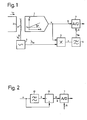
- 1 means a magnetic field sensor which is exposed to a magnetic field to be measured, outputs a voltage u at its output as a function of this magnetic field and thus works as a magnetic field / voltage converter.
- This magnetic field sensor 1 can be, for example, a Hall generator, a MOS magnetotransistor or a MOS magnetodiode.
- the slope a is a function of the temperature and is also subject to age-related fluctuations, so that despite the good linearity of the transmission characteristic curve, an exact measurement of the magnetic field is not possible without special measures.
- the magnetic field sensor 1 can be used to measure a measuring current flowing in an electrical conductor 2 in the magnetic field generated by it.
- the coupling of the generated by the measuring current i m th magnetic field in the magnetic field sensor 1 can take place in a known manner by means of a magnetic core or also without a magnetic core in that the magnetic field sensor 1 is arranged on the surface of the conductor 2 designed as a flat conductor.
- the current source 3 excites the solenoid 4 with an auxiliary current i h , which is an alternating current or a pulsating direct current.
- the magnetic coil 4 generates an alternating or pulsating auxiliary magnetic field of known size and with a known time profile. It is arranged so that this auxiliary field is superimposed on the magnetic field to be measured.
- the amplitude of the auxiliary field is a few percent of the maximum value of the amplitude of the magnetic field to be measured.
- the output of the magnetic field sensor 1 is connected to the signal input 8 of the analog / digital converter 7.
- the multiplier 5 has two inputs, one of which is connected to the output of the magnetic field sensor 1 and the other to the current source 3.
- the output of the multiplier 5 is connected to a reference voltage input 9 of the analog / digital converter 7 via the low pass 6.
- the DC component V dc of this product corresponds to the proportion of the output voltage produced solely by the auxiliary magnetic field is u and the slope a proportionally.
- the low p ass 6 passes the direct current component V dc of the signal v and blocks the remaining components thereof .
- the DC t s p o romkom component V dc reaches 7 as a reference voltage to the analog / digital converter, the sensitivity of the analog / digital converter 7 is proportional to the reciprocal of the reference voltage so that these transducers, the division respectively. carried out and the digital measurement result is independent of the slope a.
- the measuring device described is suitable for measuring alternating currents or alternating magnetic fields as well as direct currents or alternating magnetic fields.
- the time course of the auxiliary current i h is to be selected in such a way that correlations with the magnetic field to be measured are avoided.
- a sinusoidal auxiliary current i h with a frequency of a few kHz is suitable for measuring 50 Hz alternating fields.
- the current source 3 is particularly advantageous to design the current source 3 as a pseudo-random current source. If the time profile of the auxiliary current i h is rectangular, a polarity reversing switch can be used as the multiplier 5, which reverses the polarity of the output voltage u in time with the auxiliary current i h .
- the described compensation of fluctuations in the slope a ensures a high measurement accuracy and greatly reduces the requirements for the stability of the magnetic field sensor 1.
- the use of the analog / digital converter 7 as a division element results in a particularly simple circuit structure and eliminates the need for a stabilized DC voltage source for generating the reference voltage for this converter. Since the auxiliary magnetic field can be weak compared to the magnetic field to be measured, the generation of the auxiliary field requires a significantly lower expenditure of power compared to the compensated transducer mentioned at the beginning.
- a filter can be connected between the output of the magnetic field sensor 1 and the signal input 8 of the analog / digital converter 7, which blocks the DC current component contained in the output voltage u. This measure also eliminates the offset voltage u o of the magnetic field sensor 1.
- the filter mentioned advantageously consists of a low-pass element 10 and a subtractor element 11, the output of the magnetic field sensor 1 (FIG.
Landscapes
- Physics & Mathematics (AREA)
- Condensed Matter Physics & Semiconductors (AREA)
- General Physics & Mathematics (AREA)
- Measuring Magnetic Variables (AREA)
- Arrangements For Transmission Of Measured Signals (AREA)
- Measurement Of Current Or Voltage (AREA)
Abstract
Description
- Die Erfindung bezieht sich auf eine Schaltungsanordnung zur Kompensation von Schwankungen des Uebertragungsfaktors eines linearen Magnetfeldsensors der im Oberbegriff des Anspruchs 1 genannten Art.
- Es ist bekannt, einen elektrischen Strom über das von ihm erzeugte Magnetfeld potentialfrei zu messen. Zur Ermittlung der Stärke des Magnetfeldes dienen Magnetfeldsensoren, z.B. Hallgeneratoren, Magnetotransistoren und andere Halbleiterelemente, die ein zum Magnetfeld mehr oder weniger proportionales Ausgangssignal erzeugen. Um den Einfluss von Nichtlinearitäten und Schwankungen der Steigung der Uebertragungskennlinie des Magnetfeldsensors auf das Messresultat zu eliminieren, kann mittels eines Regelkreises und einer Magnetspule ein magnetisches Gegenfeld erzeugt werden, welches das zu messende Magnetfeld praktisch vollständig kompensiert (DE-AS 26 21 302). Nachteilig bei solchen sogenannten kompensierten Wandlern ist der verhältnismässig hohe Leistungsaufwand zur Erzeugung des kompensierenden Magnetfeldes.
- Manche der bekannten Magnetfeldsensoren zeichnen sich durch eine befriedigende Linearität der Uebertragungskennlinie aus, wobei jedoch die Steigung der Uebertragungskennlinie eine Funktion der Temperatur darstellt und auch alterungsbedingten Aenderungen unterworfen ist. Es ist bekannt (EP-A-00 18 750), bei einem an sich linearen, als Magnetfeld/Frequenzwandler arbeitenden Magnetfeldsensor mit Hilfe eines magnetischen Gleichfeldes die Steigung der Uebertragungskennlinie zu bestimmen und die Ausgangsfrequenz durch eine der Steigung proportionale Frequenz zu dividieren, so dass Schwankungen der Steigung kompensiert werden. Diese Art der Bestimmung der Steigung setzt jedoch voraus, dass einerseits das zu messende Magnetfeld ein reines Wechselfeld ist und das andererseits die Uebertragungskennlinie des Magnetfeldsensors keinen Offset aufweist.
- Der Erfindung liegt die Aufgabe zugrunde, eine Schaltungsanordnung der eingangs genannten Art mit einem Magnetfeld/Spannungswandler als Magnetfeldsensor zu bestücken und derart auszugestalten, dass durch Temperatur- oder Alterungseinflüsse bedingte Schwankungen der Steigung der Uebertragungskennlinie des Magnetfeldsensors auch dann einwandfrei kompensiert werden, wenn der Magnetfeldsensor eine Offset-Spannung aufweist und wenn das zu messende Magnetfeld eine Gleichfeldkomponente besitzt.
- Die Lösung dieser Aufgabe gelingt durch die im Kennzeichen des Anspruchs 1 angegebenen Merkmale.
- Nachfolgend wird ein Ausführungsbeispiel der Erfindung anhand der Zeichnung näher erläutert.
-
- Es zeigen: Fig. 1 ein Prinzipschaltbild und
- Fig. 2 ein Detail einer Variante der Schaltungsanordnung nach der Fig. 1.
- In der Fig. 1 bedeutet 1 einen Magnetfeldsensor, der einem zu messenden Magnetfeld ausgesetzt ist, an seinem Ausgang eine Spannung u in Abhängigkeit von diesem Magnetfeld abgibt und somit als Magnetfeld/Spannungswandler arbeitet. Dieser Magnetfeldsensor 1 kann z.B. ein Hallgenerator, ein MOS-Magnetotransistor oder eine MOS-Magnetodiode sein. Für die Ausgangsspannung u des Magnetfeldsensors 1 gilt die Beziehung u=uo+a.b, wobei uo die gegebenenfalls vorhandene Offset-Spannung, a die Steigung der linearen Uebertragungskennlinie und b die magnetische Flussdichte im Magnetfeldsensor 1 bedeutet. Die Steigung a ist eine Funktion der Temperatur und zudem auch alterungsbedingten Schwankungen unterworfen, so dass trotz der guten Linearität der Uebertragungskennlinie ohne besondere Massnahmen eine genaue Messung des Magnetfeldes nicht möglich ist.
- Der Magnetfeldsensor 1 kann zur Messung eines in einem elektrischen Leiter 2 fliessenden Messstromes im über das von ihm erzeugte Magnetfeld dienen. Die Einkopplung des vom Messstrom i m erzeugten Magnetfeldes in den Magnetfeldsensor 1 kann in bekannten Weise mittels eines Magnetkernes oder auch ohne einen Magnetkern dadurch erfolgen, dass der Magnetfeldsensor 1 auf der Oberfläche des als Flachleiter ausgebildeten Leiters 2 angeordnet wird.
- Mit Hilfe einer Stromquelle 3, einer Magnetspule 4 und eines aus einem Multiplikator 5 und einem Tiefpass 6 bestehenden Korrelators wird die Steigung a der Uebertragungskennlinie bestimmt, und mittels eines als Divisionsglied arbeitenden Analog/Digitalwandlers 7 wird zur Kompensation von temperatur- oder alterungsbedingten Schwankungen der Steigung a die Division u durchgeführt. a
- Die Stromquelle 3 erregt die Magnetspule 4 mit einem Hilfsstrom ih, der ein Wechselstrom oder ein pulsierender Gleichstrom ist. Die Magnetspule 4 erzeugt ein alternierendes oder pulsierendes magnetisches Hilfsfeld bekannter Grösse und mit bekanntem zeitlichem Verlauf. Sie ist so angeordnet, dass dieses Hilfsfeld dem zu messenden Magnetfeld überlagert wird. Die Amplitude des Hilfsfeldes beträgt einige Prozent des MaximaLwertes der Amplitude des zu messenden Magnetfeldes.
- Der Ausgang des Magnetfeldsensors 1 ist mit dem Signaleingang 8 des Analog/Digitalwandlers 7 verbunden. Der Multiplikator 5 besitzt zwei Eingänge, von denen der eine an den Ausgang des Magnetfeldsensors 1 und der andere an die Stromquelle 3 angeschlossen ist. Der Ausgang des Multiplikators 5 ist über den Tiefpass 6 an einen Referenzspannungseingang 9 des Analog/Digitalwandlers 7 angeschlossen .
- Die beschriebene Schaltungsanordnung arbeitet wie folgt:
- Der Magnetfeldsensor 1 erfasst die Summe des zu messenden Magnetfeldes und des vom Hilfsstrom ih erzeugten Magnetfeldes. Für die Ausgangsspannung u des Magnetfeldsensors 1 gilt

- Der Multiplikator 5 bildet das Produkt v = u.ih der zeitveränderli- chen Grössen u und ih. Die Gleichstromkomponente Vdc dieses Produktes entspricht dem allein durch das Hilfsmagnetfeld erzeugten Anteil der Ausgangsspannung u und ist zur Steigung a proportio- nal. Der Tiefpass 6 lässt die Gleichstromkomponente Vdc des Signals v durch und sperrt dessen übrige Komponenten. Die Gleich- stromkomponente Vdc gelangt als Referenzspannung zum Analog/Digitalwandler 7. Der Uebertragungsfaktor des Analog/Digitalwandlers 7 ist proportional zum Reziprokwert der Referenzspannung, so dass dieser Wandler die Division


- Es ist leicht ersichtlich, dass die beschriebene Messeinrichtung sowohl zur Messung von Wechselströmen bzw. magnetischer Wechselfelder als auch von Gleichströmen bzw. magnetischer Gleichfelder geeignet ist. Der zeitliche Verlauf des Hilfsstromes ih ist derart zu wählen, dass Korrelationen mit dem zu messenden Magnetfeld vermieden werden. Zur Messung von 50 Hz-Wechselfeldern eignet sich beispielsweise ein sinusförmiger Hilfsstrom ih mit einer Frequenz von einigen kHz. Besonders vorteilhaft ist es, die Stromquelle 3 als Pseudo-Zufalls-Stromquelle auszubilden. Falls der zeitliche Verlauf des Hilfsstromes ih rechteckförmig ist, kann als Multiplikator 5 ein Umpolschalter verwendet werden, der die Polarität der Ausgangsspannung u im Takt des Hilfsstromes ih umpolt.
- Die beschriebene Kompensation von Schwankungen der Steigung a gewährleistet eine hohe Messgenauigkeit und reduziert in hohem Masse die Anforderungen an die Stabilität des Magnetfeldsensors 1. Die Verwendung des Analog/Digitalwandlers 7 als Divisionsglied ergibt einen besonders einfachen Schaltungsaufbau und erübrigt eine stabilisierte Gleichspannungsquelle zur Erzeugung der Referenzspannung für diesen Wandler. Da das magnetische Hilfsfeld gegenüber dem zu messenden Magnetfeld schwach sein kann, erfordert die Erzeugung des Hilfsfeldes im Vergleich zu dem eingangs erwähnten kompensierten Wandlers einen wesentlich geringeren Leistungsaufwand.
- Wenn eine allfällige Gleichfeldkomponente des zu messenden Magnetfeldes von der Messung nicht erfasst werden soll, kann zwischen den Ausgang des Magnetfeldsensors 1 und den Signaleingang 8 des Analog/Digitalwandlers 7 ein Filter geschaltet werden, das die in der Ausgangsspannung u enthaltene GLeichstromkomponente sperrt. Durch diese Massnahme wird auch die Offset-Spannung uo des Magnetfeldsensors 1 eliminiert. Das genannte Filter besteht gemäss der Fig. 2 vorteilhaft aus einem Tiefpassglied 10 und einem Subtrahierglied 11, wobei der Ausgang des Magnetfeldsensors 1 (Fig. 1) an den Eingang des Tiefpassgliedes 10 sowie an den "+"-Eingang des Subtrahiergliedes 11, der Ausgang des Tiefpassgliedes 10 an den "-"-Eingang des Subtrahiergliedes 11 und der Ausgang des Subtrahiergliedes 11 an den Signaleingang 8 des Analog/Digitalwandlers 7 angeschlossen ist. Die Gleichstromkomponente ü der Ausgangsspannung u gelangt über das Tiefpassglied 10 zum Subtrahierglied 11, an dessen Ausgang das Differenzsignal w=u-ü entsteht.
- Schliesslich ist es auch möglich, die Elimination der Gleichstromkomponente u̅ erst nach der Analog/Digitalumwandlung durch digitale Filterung vorzunehmen.
Claims (5)
Priority Applications (1)
| Application Number | Priority Date | Filing Date | Title |
|---|---|---|---|
| AT84104472T ATE35867T1 (de) | 1983-08-08 | 1984-04-19 | Schaltungsanordnung zur kompensation von schwankungen des uebertragungsfaktors eines linearen magnetfeldsensors. |
Applications Claiming Priority (2)
| Application Number | Priority Date | Filing Date | Title |
|---|---|---|---|
| CH4448/83 | 1983-08-08 | ||
| CH4448/83A CH661359A5 (de) | 1983-08-08 | 1983-08-08 | Schaltungsanordnung zur kompensation von schwankungen des uebertragungsfaktors eines linearen magnetfeldsensors. |
Publications (2)
| Publication Number | Publication Date |
|---|---|
| EP0137896A1 true EP0137896A1 (de) | 1985-04-24 |
| EP0137896B1 EP0137896B1 (de) | 1988-07-20 |
Family
ID=4276311
Family Applications (1)
| Application Number | Title | Priority Date | Filing Date |
|---|---|---|---|
| EP84104472A Expired EP0137896B1 (de) | 1983-08-08 | 1984-04-19 | Schaltungsanordnung zur Kompensation von Schwankungen des Uebertragungsfaktors eines linearen Magnetfeldsensors |
Country Status (4)
| Country | Link |
|---|---|
| EP (1) | EP0137896B1 (de) |
| AT (1) | ATE35867T1 (de) |
| CH (1) | CH661359A5 (de) |
| DE (1) | DE3472840D1 (de) |
Cited By (4)
| Publication number | Priority date | Publication date | Assignee | Title |
|---|---|---|---|---|
| US4752733A (en) * | 1984-08-16 | 1988-06-21 | Jan Petr | Compensating circuit for a magnetic field sensor |
| WO1997014976A1 (de) * | 1995-10-18 | 1997-04-24 | Vdo Adolf Schindling Ag | Magnetfeldsensor |
| GB2312521A (en) * | 1996-04-23 | 1997-10-29 | Hughes Aircraft Co | Digital flux gate magnetometer |
| US6724184B1 (en) * | 1999-01-28 | 2004-04-20 | Robert Bosch Gmbh | Device and method for determining a magnetic field as to its intensity and direction |
Citations (4)
| Publication number | Priority date | Publication date | Assignee | Title |
|---|---|---|---|---|
| DE1297755B (de) * | 1963-05-10 | 1969-06-19 | Siemens Ag | Magnetfeldmessgeraet mit einer Sonde mit magnetfeldabhaengigem Widerstand |
| US4013946A (en) * | 1975-04-02 | 1977-03-22 | Harnessed Energies, Inc. | Means for determining a first magnetic field direction by measuring secondary magnetic fields induced in a body rotated in said first field |
| DE2719073B1 (de) * | 1977-04-29 | 1978-06-22 | Grundig Emv | Verfahren zur Erkennung der Induktion Null mittels einer Feldplatte |
| EP0018750A1 (de) * | 1979-05-04 | 1980-11-12 | THE GENERAL ELECTRIC COMPANY, p.l.c. | Magnetblasenmagnetometer |
-
1983
- 1983-08-08 CH CH4448/83A patent/CH661359A5/de not_active IP Right Cessation
-
1984
- 1984-04-19 DE DE8484104472T patent/DE3472840D1/de not_active Expired
- 1984-04-19 EP EP84104472A patent/EP0137896B1/de not_active Expired
- 1984-04-19 AT AT84104472T patent/ATE35867T1/de not_active IP Right Cessation
Patent Citations (4)
| Publication number | Priority date | Publication date | Assignee | Title |
|---|---|---|---|---|
| DE1297755B (de) * | 1963-05-10 | 1969-06-19 | Siemens Ag | Magnetfeldmessgeraet mit einer Sonde mit magnetfeldabhaengigem Widerstand |
| US4013946A (en) * | 1975-04-02 | 1977-03-22 | Harnessed Energies, Inc. | Means for determining a first magnetic field direction by measuring secondary magnetic fields induced in a body rotated in said first field |
| DE2719073B1 (de) * | 1977-04-29 | 1978-06-22 | Grundig Emv | Verfahren zur Erkennung der Induktion Null mittels einer Feldplatte |
| EP0018750A1 (de) * | 1979-05-04 | 1980-11-12 | THE GENERAL ELECTRIC COMPANY, p.l.c. | Magnetblasenmagnetometer |
Cited By (7)
| Publication number | Priority date | Publication date | Assignee | Title |
|---|---|---|---|---|
| US4752733A (en) * | 1984-08-16 | 1988-06-21 | Jan Petr | Compensating circuit for a magnetic field sensor |
| AU587986B2 (en) * | 1984-08-16 | 1989-09-07 | Lgz Landis & Gyr Zug A.G. | Circuit arrangement for the compensation of fluctuations in the transmission factor of a magnetic field sensor |
| WO1997014976A1 (de) * | 1995-10-18 | 1997-04-24 | Vdo Adolf Schindling Ag | Magnetfeldsensor |
| US6150811A (en) * | 1995-10-18 | 2000-11-21 | Mannesmann Vdo Ag | Magnetic field sensor for stable magnetic field measurement over a wide temperature range |
| GB2312521A (en) * | 1996-04-23 | 1997-10-29 | Hughes Aircraft Co | Digital flux gate magnetometer |
| GB2312521B (en) * | 1996-04-23 | 2000-12-06 | Hughes Aircraft Co | Digital flux gate magnetometer |
| US6724184B1 (en) * | 1999-01-28 | 2004-04-20 | Robert Bosch Gmbh | Device and method for determining a magnetic field as to its intensity and direction |
Also Published As
| Publication number | Publication date |
|---|---|
| ATE35867T1 (de) | 1988-08-15 |
| CH661359A5 (de) | 1987-07-15 |
| EP0137896B1 (de) | 1988-07-20 |
| DE3472840D1 (en) | 1988-08-25 |
Similar Documents
| Publication | Publication Date | Title |
|---|---|---|
| EP0172402B1 (de) | Schaltungsanordnung zur Kompensation von Schwankungen des Uebertragungsfaktors eines Magnetfeldsensors | |
| DE68924112T2 (de) | Stromsensor. | |
| DE2744845C3 (de) | Verfahren zur Kompensation der elektrochemischen Störgleichspannung bei der magnetisch-induktiven Durchflußmessung mit periodisch umgepoltem magnetischem Gleichfeld | |
| DE3133019C2 (de) | ||
| DE69422222T2 (de) | Magnetisch-induktiver Durchflussmesser und dazu gehöriges Messprinzip | |
| DE2410407A1 (de) | Verfahren zur kompensation der elektrochemischen stoergleichspannung bei der induktiven durchflussmessung mit periodisch geschaltetem gleichfeld | |
| EP2666023A1 (de) | Strommessvorrichtung | |
| DE3322942C2 (de) | Schaltung zur Messung der magnetischen Induktion mit einer Hall-Feldsonde | |
| DE3122168A1 (de) | Elektronischer wirkverbrauchszaehler | |
| DE3642771C2 (de) | ||
| DE2837113C2 (de) | ||
| DE10224354C1 (de) | Schaltungsanordnung und Verfahren zur Kompensation von Änderungen eines Übertragungsfaktors einer Magnetfeldsensoranordnung | |
| DE3832568A1 (de) | Schaltungsanordnung zur temperaturkompensation von kapazitiven druck- und differenzdrucksensoren | |
| DE69033966T2 (de) | Sender | |
| EP0137896B1 (de) | Schaltungsanordnung zur Kompensation von Schwankungen des Uebertragungsfaktors eines linearen Magnetfeldsensors | |
| EP0329652B1 (de) | Vorrichtung zur messung eines zeitlich konstanten oder sich ändernden magnetfeldes | |
| EP0250028B1 (de) | Schaltungsanordnung zur Kompensation von temperatur- und nichttemperatur-bedingtem Driften eines kapazitiven Sensors | |
| DE102007032300A1 (de) | Stromsensor zur Gleich- oder Wechselstrommessung | |
| DE10334517B4 (de) | Messgerät für elektrische Energie für ein Wechselstromnetz | |
| DE102004056384A1 (de) | Verfahren zur Offseteliminierung aus Signalen magnetoresistiver Sensoren | |
| DE2827267C2 (de) | Restspannungs-Regelschaltung für ein Hall-Element | |
| DE102019120666B3 (de) | Sensorvorrichtung zur breitbandigen Messung von elektrischen Strömen durch einen Leiter und Verfahren zur breitbandigen Messung | |
| EP0438637A1 (de) | Verfahren und Anordnung zur Ermittlung eines Effektivwertes Ieff eines mit Hilfe eines Hallelementes und einer Verstärkeranordnung zu messenden Stromes | |
| DE3613991A1 (de) | Gleichstrommesswandler insbesondere fuer kleine messstroeme | |
| DE3143669A1 (de) | Schaltung zum messen des effektivwertes einer wechselspannung |
Legal Events
| Date | Code | Title | Description |
|---|---|---|---|
| PUAI | Public reference made under article 153(3) epc to a published international application that has entered the european phase |
Free format text: ORIGINAL CODE: 0009012 |
|
| AK | Designated contracting states |
Designated state(s): AT DE FR GB NL SE |
|
| 17P | Request for examination filed |
Effective date: 19850518 |
|
| 17Q | First examination report despatched |
Effective date: 19861030 |
|
| GRAA | (expected) grant |
Free format text: ORIGINAL CODE: 0009210 |
|
| AK | Designated contracting states |
Kind code of ref document: B1 Designated state(s): AT DE FR GB NL SE |
|
| REF | Corresponds to: |
Ref document number: 35867 Country of ref document: AT Date of ref document: 19880815 Kind code of ref document: T |
|
| GBT | Gb: translation of ep patent filed (gb section 77(6)(a)/1977) | ||
| REF | Corresponds to: |
Ref document number: 3472840 Country of ref document: DE Date of ref document: 19880825 |
|
| ET | Fr: translation filed | ||
| PLBE | No opposition filed within time limit |
Free format text: ORIGINAL CODE: 0009261 |
|
| STAA | Information on the status of an ep patent application or granted ep patent |
Free format text: STATUS: NO OPPOSITION FILED WITHIN TIME LIMIT |
|
| 26N | No opposition filed | ||
| PGFP | Annual fee paid to national office [announced via postgrant information from national office to epo] |
Ref country code: GB Payment date: 19900331 Year of fee payment: 7 |
|
| PGFP | Annual fee paid to national office [announced via postgrant information from national office to epo] |
Ref country code: FR Payment date: 19900407 Year of fee payment: 7 |
|
| PGFP | Annual fee paid to national office [announced via postgrant information from national office to epo] |
Ref country code: AT Payment date: 19900411 Year of fee payment: 7 |
|
| PGFP | Annual fee paid to national office [announced via postgrant information from national office to epo] |
Ref country code: SE Payment date: 19900420 Year of fee payment: 7 |
|
| PGFP | Annual fee paid to national office [announced via postgrant information from national office to epo] |
Ref country code: NL Payment date: 19900430 Year of fee payment: 7 |
|
| PGFP | Annual fee paid to national office [announced via postgrant information from national office to epo] |
Ref country code: DE Payment date: 19900502 Year of fee payment: 7 |
|
| PG25 | Lapsed in a contracting state [announced via postgrant information from national office to epo] |
Ref country code: GB Effective date: 19910419 Ref country code: AT Effective date: 19910419 |
|
| PG25 | Lapsed in a contracting state [announced via postgrant information from national office to epo] |
Ref country code: SE Effective date: 19910420 |
|
| PG25 | Lapsed in a contracting state [announced via postgrant information from national office to epo] |
Ref country code: NL Effective date: 19911101 |
|
| NLV4 | Nl: lapsed or anulled due to non-payment of the annual fee | ||
| GBPC | Gb: european patent ceased through non-payment of renewal fee | ||
| PG25 | Lapsed in a contracting state [announced via postgrant information from national office to epo] |
Ref country code: FR Effective date: 19911230 |
|
| PG25 | Lapsed in a contracting state [announced via postgrant information from national office to epo] |
Ref country code: DE Effective date: 19920201 |
|
| REG | Reference to a national code |
Ref country code: FR Ref legal event code: ST |
|
| EUG | Se: european patent has lapsed |
Ref document number: 84104472.0 Effective date: 19911108 |