EP0138183A2 - Diaryläther und deren Verwendung als Unkrautbekämpfungsmittel - Google Patents
Diaryläther und deren Verwendung als Unkrautbekämpfungsmittel Download PDFInfo
- Publication number
- EP0138183A2 EP0138183A2 EP84112038A EP84112038A EP0138183A2 EP 0138183 A2 EP0138183 A2 EP 0138183A2 EP 84112038 A EP84112038 A EP 84112038A EP 84112038 A EP84112038 A EP 84112038A EP 0138183 A2 EP0138183 A2 EP 0138183A2
- Authority
- EP
- European Patent Office
- Prior art keywords
- chloro
- phenoxy
- ethyl
- ppm
- trifluoromethyl
- Prior art date
- Legal status (The legal status is an assumption and is not a legal conclusion. Google has not performed a legal analysis and makes no representation as to the accuracy of the status listed.)
- Withdrawn
Links
- 0 C1C*C*C1 Chemical compound C1C*C*C1 0.000 description 3
- JAPMJSVZDUYFKL-UHFFFAOYSA-N C1C2C1CCC2 Chemical compound C1C2C1CCC2 JAPMJSVZDUYFKL-UHFFFAOYSA-N 0.000 description 1
Classifications
-
- C—CHEMISTRY; METALLURGY
- C07—ORGANIC CHEMISTRY
- C07F—ACYCLIC, CARBOCYCLIC OR HETEROCYCLIC COMPOUNDS CONTAINING ELEMENTS OTHER THAN CARBON, HYDROGEN, HALOGEN, OXYGEN, NITROGEN, SULFUR, SELENIUM OR TELLURIUM
- C07F9/00—Compounds containing elements of Groups 5 or 15 of the Periodic Table
- C07F9/02—Phosphorus compounds
- C07F9/28—Phosphorus compounds with one or more P—C bonds
- C07F9/38—Phosphonic acids [RP(=O)(OH)2]; Thiophosphonic acids ; [RP(=X1)(X2H)2(X1, X2 are each independently O, S or Se)]
- C07F9/40—Esters thereof
- C07F9/4003—Esters thereof the acid moiety containing a substituent or a structure which is considered as characteristic
- C07F9/4006—Esters of acyclic acids which can have further substituents on alkyl
-
- A—HUMAN NECESSITIES
- A01—AGRICULTURE; FORESTRY; ANIMAL HUSBANDRY; HUNTING; TRAPPING; FISHING
- A01N—PRESERVATION OF BODIES OF HUMANS OR ANIMALS OR PLANTS OR PARTS THEREOF; BIOCIDES, e.g. AS DISINFECTANTS, AS PESTICIDES OR AS HERBICIDES; PEST REPELLANTS OR ATTRACTANTS; PLANT GROWTH REGULATORS
- A01N39/00—Biocides, pest repellants or attractants, or plant growth regulators containing aryloxy- or arylthio-aliphatic or cycloaliphatic compounds, containing the group or, e.g. phenoxyethylamine, phenylthio-acetonitrile, phenoxyacetone
-
- A—HUMAN NECESSITIES
- A01—AGRICULTURE; FORESTRY; ANIMAL HUSBANDRY; HUNTING; TRAPPING; FISHING
- A01N—PRESERVATION OF BODIES OF HUMANS OR ANIMALS OR PLANTS OR PARTS THEREOF; BIOCIDES, e.g. AS DISINFECTANTS, AS PESTICIDES OR AS HERBICIDES; PEST REPELLANTS OR ATTRACTANTS; PLANT GROWTH REGULATORS
- A01N39/00—Biocides, pest repellants or attractants, or plant growth regulators containing aryloxy- or arylthio-aliphatic or cycloaliphatic compounds, containing the group or, e.g. phenoxyethylamine, phenylthio-acetonitrile, phenoxyacetone
- A01N39/02—Aryloxy-carboxylic acids; Derivatives thereof
-
- A—HUMAN NECESSITIES
- A01—AGRICULTURE; FORESTRY; ANIMAL HUSBANDRY; HUNTING; TRAPPING; FISHING
- A01N—PRESERVATION OF BODIES OF HUMANS OR ANIMALS OR PLANTS OR PARTS THEREOF; BIOCIDES, e.g. AS DISINFECTANTS, AS PESTICIDES OR AS HERBICIDES; PEST REPELLANTS OR ATTRACTANTS; PLANT GROWTH REGULATORS
- A01N39/00—Biocides, pest repellants or attractants, or plant growth regulators containing aryloxy- or arylthio-aliphatic or cycloaliphatic compounds, containing the group or, e.g. phenoxyethylamine, phenylthio-acetonitrile, phenoxyacetone
- A01N39/02—Aryloxy-carboxylic acids; Derivatives thereof
- A01N39/04—Aryloxy-acetic acids; Derivatives thereof
-
- A—HUMAN NECESSITIES
- A01—AGRICULTURE; FORESTRY; ANIMAL HUSBANDRY; HUNTING; TRAPPING; FISHING
- A01N—PRESERVATION OF BODIES OF HUMANS OR ANIMALS OR PLANTS OR PARTS THEREOF; BIOCIDES, e.g. AS DISINFECTANTS, AS PESTICIDES OR AS HERBICIDES; PEST REPELLANTS OR ATTRACTANTS; PLANT GROWTH REGULATORS
- A01N43/00—Biocides, pest repellants or attractants, or plant growth regulators containing heterocyclic compounds
- A01N43/34—Biocides, pest repellants or attractants, or plant growth regulators containing heterocyclic compounds having rings with one nitrogen atom as the only ring hetero atom
- A01N43/40—Biocides, pest repellants or attractants, or plant growth regulators containing heterocyclic compounds having rings with one nitrogen atom as the only ring hetero atom six-membered rings
-
- A—HUMAN NECESSITIES
- A01—AGRICULTURE; FORESTRY; ANIMAL HUSBANDRY; HUNTING; TRAPPING; FISHING
- A01N—PRESERVATION OF BODIES OF HUMANS OR ANIMALS OR PLANTS OR PARTS THEREOF; BIOCIDES, e.g. AS DISINFECTANTS, AS PESTICIDES OR AS HERBICIDES; PEST REPELLANTS OR ATTRACTANTS; PLANT GROWTH REGULATORS
- A01N47/00—Biocides, pest repellants or attractants, or plant growth regulators containing organic compounds containing a carbon atom not being member of a ring and having no bond to a carbon or hydrogen atom, e.g. derivatives of carbonic acid
- A01N47/08—Biocides, pest repellants or attractants, or plant growth regulators containing organic compounds containing a carbon atom not being member of a ring and having no bond to a carbon or hydrogen atom, e.g. derivatives of carbonic acid the carbon atom having one or more single bonds to nitrogen atoms
- A01N47/10—Carbamic acid derivatives, i.e. containing the group —O—CO—N<; Thio analogues thereof
- A01N47/12—Carbamic acid derivatives, i.e. containing the group —O—CO—N<; Thio analogues thereof containing a —O—CO—N< group, or a thio analogue thereof, neither directly attached to a ring nor the nitrogen atom being a member of a heterocyclic ring
-
- A—HUMAN NECESSITIES
- A01—AGRICULTURE; FORESTRY; ANIMAL HUSBANDRY; HUNTING; TRAPPING; FISHING
- A01N—PRESERVATION OF BODIES OF HUMANS OR ANIMALS OR PLANTS OR PARTS THEREOF; BIOCIDES, e.g. AS DISINFECTANTS, AS PESTICIDES OR AS HERBICIDES; PEST REPELLANTS OR ATTRACTANTS; PLANT GROWTH REGULATORS
- A01N57/00—Biocides, pest repellants or attractants, or plant growth regulators containing organic phosphorus compounds
- A01N57/18—Biocides, pest repellants or attractants, or plant growth regulators containing organic phosphorus compounds having phosphorus-to-carbon bonds
- A01N57/22—Biocides, pest repellants or attractants, or plant growth regulators containing organic phosphorus compounds having phosphorus-to-carbon bonds containing aromatic radicals
-
- A—HUMAN NECESSITIES
- A01—AGRICULTURE; FORESTRY; ANIMAL HUSBANDRY; HUNTING; TRAPPING; FISHING
- A01N—PRESERVATION OF BODIES OF HUMANS OR ANIMALS OR PLANTS OR PARTS THEREOF; BIOCIDES, e.g. AS DISINFECTANTS, AS PESTICIDES OR AS HERBICIDES; PEST REPELLANTS OR ATTRACTANTS; PLANT GROWTH REGULATORS
- A01N57/00—Biocides, pest repellants or attractants, or plant growth regulators containing organic phosphorus compounds
- A01N57/18—Biocides, pest repellants or attractants, or plant growth regulators containing organic phosphorus compounds having phosphorus-to-carbon bonds
- A01N57/24—Biocides, pest repellants or attractants, or plant growth regulators containing organic phosphorus compounds having phosphorus-to-carbon bonds containing heterocyclic radicals
-
- C—CHEMISTRY; METALLURGY
- C07—ORGANIC CHEMISTRY
- C07C—ACYCLIC OR CARBOCYCLIC COMPOUNDS
- C07C205/00—Compounds containing nitro groups bound to a carbon skeleton
- C07C205/49—Compounds containing nitro groups bound to a carbon skeleton the carbon skeleton being further substituted by carboxyl groups
- C07C205/56—Compounds containing nitro groups bound to a carbon skeleton the carbon skeleton being further substituted by carboxyl groups having nitro groups bound to carbon atoms of six-membered aromatic rings and carboxyl groups bound to acyclic carbon atoms of the carbon skeleton
Definitions
- the compounds of the formula I have herbicidal properties and are suitable as active compounds for weed control agents.
- the invention thus also comprises weed control compositions which comprise compounds of the formula I as active compounds, processes for the preparation of these compounds and the use of such compounds or compositions for combating weeds.
- halogen includes fluorine, chlorine, bromine and iodine.
- C 1-3 alkyl C 1-4 alkyl or “C 1-6 alkyl” are understood to mean both straight-chain and branched alkyl groups, such as methyl, ethyl, n-propyl, isopropyl, n -Butyl, isobutyl, tert-butyl, n-pentyl, isoamyl, neo-pentyl and n-hexyl. This also applies to the alkyl part of the C 1-6 alkoxy group.
- C 1-3 alkylene can also be straight-chain or branched; So it is methylene, ethylene, ethylidene, 1- or 2-methylethylene, propylidene or trimethylene.
- the presence of at least one asymmetric carbon atom in the compounds of the formula I has the consequence that the compounds can occur in isomeric forms which have an enantiomeric or diastereomeric relationship to one another.
- the isomeric forms have optical activity.
- the presence of the nitrogen-carbon double bond in the compounds of the formula I in which R 6 denotes a group (a) additionally leads to geometric isomerism for those compounds in which R 7 and R 8 have different meanings. Irrespective of this, atropisomerism also occurs in certain cases.
- Formula I should accordingly encompass all these possible isomeric forms and the racemates.
- An interesting subgroup of compounds of formula I consists of those compounds of formula I wherein A is CH, R 1 is trifluoromethyl, R 2 is halogen, R 4 is halogen or N itro, R 7 and R 8 are independently C 1-6 alkyl, R 12 is C 1-4 alkyl and Y is oxygen.
- A is preferably CH; R 1 is preferably trifluoromethyl; R 2 is preferably chlorine; R 4 is preferably nitro; R 5 is preferably hydrogen or methyl, especially methyl; and R 7 and R 8 are preferably methyl or ethyl.
- alkali metal salt stands in particular for the sodium, potassium or lithium salt of the phenol of formula II in this regard.
- the term “leaving group” for Q in formula III preferably stands for chlorine, bromine, iodine, mesyloxy or tosyloxy , or for a group -N ⁇ R 15 R 16 R 17 , wherein R 15 , R 16 and R 17 independently of one another are hydrogen or lower alkyl or together with the nitrogen atom form a ring, such as pyridinium, with a suitable anion in particular halide , for example C ⁇ or Br ⁇ , comes into question. If a starting material of the formula III is used, in which Q is a group -N ⁇ R 15 R 16 R 17 , the free phenol of the formula II is used.
- the reaction according to process variant a) can expediently be carried out by adding an alkali metal salt of the phenol of the formula II with a halide - in particular the chloride, bromide or iodide -, the mesylate or the tosylate of the formula III in an inert organic solvent, in particular a dipolar aprotic solvents such as dimethylformamide or dimethyl sulfoxide.
- the reaction temperature is not critical, and temperatures between 0 ° C and 120 °, preferably between 20 ° C and 70 ° C, are generally used.
- the phenol of formula II is converted into the alkali metal salt, preferably using sodium hydride or potassium hydroxide with azeotropic water removal.
- reaction according to process variant a) can expediently also be carried out by reacting the free phenol of the formula II with a halide - in particular the chloride, bromide or iodide -, the mesylate or the tosylate of the formula III in the presence of a suitable inorganic base, e.g. an alkali metal or alkaline earth metal carbonate or bicarbonate, or an organic base such as a tertiary amine, e.g. Triethylamine, dimethylaniline, pyridine or, in particular, 1,8-diaza-bicyclo- [4,5,0] undec-7-ene.
- a suitable inorganic base e.g. an alkali metal or alkaline earth metal carbonate or bicarbonate
- an organic base such as a tertiary amine, e.g. Triethylamine, dimethylaniline, pyridine or, in particular, 1,8-diaza-bicyclo- [4,5,
- reaction is conveniently carried out in a polar aprotic solvent, such as an aliphatic ketone, e.g. Acetone or 2-butanone, dimethylformamide or acetonitrile, and optionally in the presence of a catalytic amount of sodium iodide, potassium iodide or a quaternary ammonium iodide, e.g. Tetrabutylammonium iodide, at temperatures between 0 ° C and 150 ° C, preferably between 20 ° C and 100 ° C.
- a polar aprotic solvent such as an aliphatic ketone, e.g. Acetone or 2-butanone, dimethylformamide or acetonitrile
- a catalytic amount of sodium iodide, potassium iodide or a quaternary ammonium iodide, e.g. Tetrabutylammonium iodide at temperatures between 0 ° C and 150
- Q in formula III is a group -N ⁇ R 15 R 16 R 17 , as described in more detail above, the reaction is preferably carried out in a medium containing hydroxyl groups, for example in the presence of sodium or potassium hydroxide, carried out.
- an inert organic diluent such as an aromatic hydrocarbon, for example toluene, an aliphatic or cyclic ether, for example dimethoxyethane or dioxane, an aprotic dipolar solvent, for example dimethylformamide or acetonitrile, or a mixture of such diluents , at temperatures between 70 ° C and 160 ° C, preferably between 100 ° C and 120 °.
- Process variant b which leads to those compounds of the formula I in which n denotes 1, is an esterification which can be carried out by methods known per se.
- the term "reactive derivative” means in particular a halide, the imidazolide or the anhydride of the corresponding acid of the formula IV.
- Preferred leaving groups U in the formula V are chlorine, bromine, iodine, mesyloxy and tosyloxy, and also a group -N ⁇ R 15 R 16 R 17 , as described in more detail in connection with process variant a).
- esterification of a free acid of the formula IV with a compound of the formula V in which U is a leaving group, such as chlorine, bromine, iodine, mesyloxy or tosyloxy is expediently carried out in the presence of a base or an acid acceptor.
- a base or an acid acceptor for this purpose, all commonly used inorganic and organic acid-binding agents can be used, but preferably alkali metal and alkaline earth metal carbonates and bicarbonates, and tertiary amines, for example triethylamine, dimethylaniline, 1,8-diaza-bicyclo- [4,5,0] undec -7-enes and pyridine.
- the reaction is advantageously carried out in an inert diluent, preferably an inert organic solvent, such as an aliphatic or cyclic ether, for example diethyl ether or tetrahydrofuran, a hydrocarbon, for example n-hexane, benzene or toluene, an aliphatic ketone, for example acetone or 2-butanone, a chlorinated hydrocarbon, for example dichloromethane, chloroform or carbon tetrachloride, or a dipolar aprotic solvent, eg dimethylformamide, dimethyl sulfoxide, N-methylpyrrolidone, sulfolane or hexamethylphosphoric triamide, at temperatures between room temperature and the reflux temperature of the reaction mixture.
- an inert organic solvent such as an aliphatic or cyclic ether, for example diethyl ether or tetrahydrofuran, a hydrocarbon, for example n-hexan
- a group -N 15 R 15 R 16 R 17 is preferably in a medium containing hydroxyl groups, for example in the presence of sodium or potassium hydroxide , implemented.
- the reaction is advantageously carried out in an inert organic diluent, such as an aromatic hydrocarbon, for example toluene, an aliphatic or cyclic ether, for example dimethoxyethane or dioxane, an aprotic dipolar solvent, for example dimethylformamide or acetonitrile, or a mixture of such diluents, at temperatures between 70 ° C and 160 ° C, preferably between 100 ° C and 120 ° C, performed.
- an aromatic hydrocarbon for example toluene
- an aliphatic or cyclic ether for example dimethoxyethane or dioxane
- an aprotic dipolar solvent for example dimethylformamide or acetonitrile
- reaction of a free acid of the formula IV with a compound of the formula V in which U is hydroxy is advantageously carried out in an inert organic diluent, such as an aliphatic or cyclic ether, for example diethyl ether, diisopropyl ether, 1,2-dimethoxyethane, tetrahydrofuran or dioxane , a chlorinated hydrocarbon, for example dichloromethane, chloroform, carbon tetrachloride or trichloroethane, or an aromatic hydrocarbon, for example benzene, toluene or a xylene, and at temperatures between 0 ° C. and the reflux temperature of the reaction mixture.
- an inert organic diluent such as an aliphatic or cyclic ether, for example diethyl ether, diisopropyl ether, 1,2-dimethoxyethane, tetrahydrofuran or dioxane
- reaction is conveniently carried out in the presence of an acid catalyst or a condensing agent, such as sulfuric acid, hydrochloric acid, p-toluenesulfonic acid, dicyclohexylcarbodiimide or carbonyldiimidazole.
- an acid catalyst or a condensing agent such as sulfuric acid, hydrochloric acid, p-toluenesulfonic acid, dicyclohexylcarbodiimide or carbonyldiimidazole.
- Carbonyldiimidazole is preferably used as the condensing agent, the reaction preferably being carried out in the presence of an ether as the diluent.
- the acid of the formula IV for example in an inert organic diluent, in particular an aliphatic or cyclic ether, dissolved or suspended and the solution or suspension added to a solution or suspension of carbonyldiimidazole in the same diluent.
- the reaction is preferably carried out in a temperature range between room temperature and about 50 ° C .; it usually ends within about 2 hours.
- U in the latter formula is hydroxy.
- the reaction is conveniently carried out in an inert diluent such as an aliphatic or cyclic ether, e.g. Diethyl ether or tetrahydrofuran, a hydrocarbon, e.g. n-hexane, benzene or toluene, or a chlorinated hydrocarbon, e.g. Dichloromethane, chloroform or carbon tetrachloride, and at room temperature or elevated temperature, e.g. up to the reflux temperature of the reaction mixture.
- an inert diluent such as an aliphatic or cyclic ether, e.g. Diethyl ether or tetrahydrofuran, a hydrocarbon, e.g. n-hexane, benzene or toluene, or a chlorinated hydrocarbon, e.g. Dichloromethane, chloroform or carbon tetrachloride
- an acid halide of the acid of the formula IV is used, the reaction is expediently carried out in the presence of an acid-binding agent and preferably at temperatures between 0 ° C. and 40 ° C., in particular between 0 ° C. and 10 ° C.
- Suitable acid-binding agents are inorganic bases, for example alkali metal and alkaline earth metal carbonates and bicarbonates, and organic bases, for example tertiary amines, in particular triethylamine or pyridine.
- the preferred acid halide is acid chloride.
- the reaction is conveniently carried out in the presence of an acid-binding agent, in particular an organic base, such as a tertiary amine, for example triethylamine, dimethylaniline or pyridine, at temperatures between 0 ° C. and 40 ° C, especially at room temperature, or without an acid-binding agent at elevated temperature.
- an acid-binding agent in particular an organic base, such as a tertiary amine, for example triethylamine, dimethylaniline or pyridine
- metal nitrate stands in particular for copper (II), iron (III), cobalt (II), cobalt ( III), nickel (III), chromium (III), manganese (II) or aluminum (III) nitrate.
- the preferred metal nitrates are copper (II), iron (III) and aluminum (III) nitrate.
- the reaction is advantageously carried out in the presence of acetic anhydride and an inert diluent, in particular an organic solvent, and at temperatures between 0 ° C. and 100 ° C., in particular between 10 ° C. and 50 ° C.
- Acetic anhydride is preferably used as the diluent. It is preferable to work with an excess of metal nitrate, generally with a 1 to 10 molar excess, preferably a 1.0 to 1.5 molar excess, of metal nitrate. Such processes are described, for example, by JB Menke in Rec. Trav. Chim. Pays-Bas 44, 141 and 269 (1925), by G. Bacharach in J. Amer. Chem. Soc. 49, 1522 (1927) and by AM Talati and B. Shah in Ind. J. Chem. 11, 1076 (1973).
- Process variant d) likewise leads to those compounds of the formula I in which R 4 is nitro.
- alkali metal salt of the alcohol of the formula VIII is to be understood in particular as the sodium, potassium or lithium salt.
- the reaction is advantageously carried out in an inert diluent, in particular an organic solvent, such as tetrahydrofuran or dioxane, and in the presence of a base, such as an alkali metal hydroxide, for example sodium or potassium hydroxide. It is generally carried out in a temperature range between room and reflux temperature, preferably between 40 ° C and 100 ° C. Such a method is described, for example, in German Offenlegungsschrift No. 2.926.829.
- the product obtained can be isolated and purified by methods known per se.
- the product is normally obtained as a mixture of two or more isomers.
- the isomers can be separated by methods known per se. If desired, they can also be prepared by synthesis from appropriate optically active starting materials.
- the starting materials of the formulas II and IV and their alkali metal salts or reactive derivatives are either known or can be prepared in a manner known per se.
- the compounds of the formula III used as starting materials for process variant a), which also include the starting materials of formula V used in process variant b), in which U denotes a leaving group, can be prepared in a manner known per se, for example according to the reaction scheme below :
- R 5 , R and Q have the meanings given above;
- U 'de notes a leaving group, in particular chlorine, bromine, iodine, mesyloxy or tosyloxy, or a group -N ⁇ R 15 R 16 R 17 , as described in more detail in connection with process variant a).
- the reaction conditions are familiar to the person skilled in the art.
- the starting materials of formula VI can be prepared by using a phenol of the general formula in which A , R 1 and R 2 have the meanings given above, or an alkali metal salt thereof, such as the sodium, potassium or lithium salt, with a compound of the general formula III given above.
- the reaction is expediently carried out under the reaction conditions described above in connection with process variant a).
- o-dinitrobenzene derivatives of the formula VII used as starting materials for process variant d) can be analogous to that described in German Offenlegungsschrift N r. 2,926,829 processes described for the preparation of 1- (2-chloro-4-trifluoromethyl-phenoxy) -3,4-dinitrobenzene.
- Alcohols of the formula VIII and their alkali metal salts used can be prepared in a manner known per se, for example by reacting an alcohol of the general formula V 'indicated above with an acid chloride of the formula where R 5 has the meaning given above, in the presence of an acid-binding agent, and optionally subsequent alkali metal salt formation.
- the compounds of the formula I have herbicidal properties and are particularly suitable for controlling weeds, in particular monocotyledon grasses, such as black millet (sorghum bicolor), millet (Echinochloa crus-galli) and finger millet (Digitaria spp.), And dicotyledon grasses, such as Chinese Hemp (Abutilon theophrasti), white goosefoot (Chenopodium album), shaggy amaranth (Amaranthus retroflexus), field mustard (Sinapis arvensis), thorn apple (Datura stramonium), prukwind (Ipomoea spp.) And pointed burl (in particular, xanthum pens) inxanthum pens Rice and cereal crops.
- monocotyledon grasses such as black millet (sorghum bicolor), millet (Echinochloa crus-galli) and finger millet (Digitaria spp.)
- a concentration of 0.01 to 3 kg of active ingredient of the formula I / ha, preferably 0.01 to 1 kg of active ingredient of the formula I / ha, is sufficient to achieve the desired herbicidal effect.
- the compounds of formula I are both pre-emergence herbicides and post-emergence herbicides.
- the weed control composition according to the invention is characterized in that it contains an effective amount of at least one compound of the formula I, as defined above, as well as formulation auxiliaries.
- the agent expediently contains at least one of the following formulation auxiliaries: solid carriers; Solvents or dispersants; Surfactants (wetting and emulsifying agents); Dispersants (without surfactant); and stabilizers.
- formulation auxiliaries solid carriers; Solvents or dispersants; Surfactants (wetting and emulsifying agents); Dispersants (without surfactant); and stabilizers.
- the compounds of the formula I that is to say the herbicidal active ingredients, can be converted into the customary formulations, such as dusts, powders, granules, solutions, emulsions, suspensions, emulsifiable concentrates, pastes and the like.
- the compounds of the formula I are generally water-insoluble and can be made up according to the methods customary for water-insoluble compounds using the formulation auxiliaries relating to this.
- the preparation of the agents can be carried out in a manner known per se, e.g. by mixing the respective active ingredient with solid carriers, by dissolving or suspending in suitable solvents or dispersing agents, possibly using surfactants as wetting or emulsifying agents and / or dispersing agents, by diluting previously prepared emulsifiable concentrates with solvents or dispersing agents, etc .
- the following are essentially suitable as solid carriers: natural minerals, such as chalk, dolomite, limestone, clays and silica and their salts (for example diatomaceous earth, kaolin, bentonite, talc, attapulgite and montmorillonite); synthetic minerals such as finely divided silica, aluminum oxide and silicates; organic substances such as cellulose, starch, urea and synthetic resins; and fertilizers such as phosphates and nitrates, such carriers e.g. can be present as powder or as granules.
- natural minerals such as chalk, dolomite, limestone, clays and silica and their salts (for example diatomaceous earth, kaolin, bentonite, talc, attapulgite and montmorillonite)
- synthetic minerals such as finely divided silica, aluminum oxide and silicates
- organic substances such as cellulose, starch, urea and synthetic resins
- fertilizers such as phosphates and nitrates,
- solvents or dispersing agents aromatics, such as benzene, toluene, xylenes and alkylnaphthalenes; chlorinated aromatics and chlorinated aliphatic hydrocarbons, such as chlorobenzenes, chlorine ethylene and methylene chloride; aliphatic hydrocarbons, such as cyclohexane and paraffins, for example petroleum fractions; Alcohols, such as butanol and glycol, and their ethers and esters; Ketones such as acetone, methyl ethyl ketone, methyl isobutyl ketone and cyclohexanone; and strongly polar solvents or dispersing agents, such as dimethylformamide, N-methylpyrrolidone and dimethyl sulfoxide, such solvents preferably having flash points of at least 30 ° C.
- aromatics such as benzene, toluene, xylenes and alkylnaphthalenes
- liquefied gaseous extenders or carriers which are products which are gaseous at room temperature and under normal pressure, are also suitable among the solvents or dispersants.
- examples of such products are, in particular, aerosol propellants, such as halogenated hydrocarbons, for example dichlorodifluoromethane.
- aerosol propellants such as halogenated hydrocarbons, for example dichlorodifluoromethane.
- a solvent is expediently used in addition to the propellant gas.
- the surfactants can be nonionic compounds, such as condensation products of fatty acids, fatty alcohols or fat-substituted phenols with ethylene oxide; Fatty acid esters and ethers of sugars or polyhydric alcohols; the products obtained from sugars or polyhydric alcohols by condensation with ethylene oxide; Block polymers of ethylene oxide and propylene oxide; or alkyldimethylamine oxides.
- the surfactants can also be anionic compounds, such as soaps; Fatty sulfate esters, for example dodecyl sodium sulfate, octadecyl sodium sulfate and cetyl sodium sulfate; A lkylsulfonate, aryl sulfonates and fat aromatic sulfonates, such as alkylbenzenesulfonates, for example calcium dodecylbenzenesulfonate, and butylnaphthalenesulfonates; and more complex fatty sulfonates, such as the amide condensation products of oleic acid and N-methyl taurine and the sodium sulfonate of dioctyl succinate.
- anionic compounds such as soaps
- Fatty sulfate esters for example dodecyl sodium sulfate, octadecyl sodium sulfate and cetyl sodium sulfate
- the surfactants can be cationic such as alkyldimethylbenzylammonium chlorides, dialkyldimethylammonium chlorides, alkyltrimethylammonium chlorides and ethoxylated quaternary ammonium chlorides.
- lignin sodium and ammonium salts of lignin sulfonic acids, sodium salts of maleic anhydride-diisobutylene copolymers, sodium and ammonium salts of sulfonated polycondensation products made from naphthalene and formaldehyde, and sulfite waste liquors.
- dispersants which are particularly suitable as thickening or anti-settling agents, e.g. Methyl cellulose, carboxymethyl cellulose, hydroxyethyl cellulose, polyvinyl alcohol, alginates, caseinates and blood albumin can be used.
- Suitable stabilizers are acid-binding agents, e.g. Epichlorohydrin, phenylglycidyl ether and soya epoxides; Antioxidants e.g. Gallic acid esters and butylated hydroxytoluene; UV absorbers, e.g. substituted benzophenones, diphenylacrylonitrile acid esters and cinnamic acid esters; and deactivators, e.g. Salts of ethylenediaminotetraacetic acid and polyglycols.
- acid-binding agents e.g. Epichlorohydrin, phenylglycidyl ether and soya epoxides
- Antioxidants e.g. Gallic acid esters and butylated hydroxytoluene
- UV absorbers e.g. substituted benzophenones, diphenylacrylonitrile acid esters and cinnamic acid esters
- deactivators e
- the weed control agents according to the invention can, in addition to the compounds of formula I, synergists and other active substances, e.g. Insecticides, acaricides, bactericides, other herbicides, fungicides, plant growth regulators and fertilizers. Such combination agents are suitable for increasing the activity or for broadening the spectrum of action.
- the weed control compositions according to the invention generally contain between 0.001 and 95 percent by weight, preferably between 5 and 75 percent by weight, of one or more compounds of the formula I as active ingredient (s).
- active ingredient for example, they can be in a form suitable for the Storage and transportation is suitable.
- the active compound concentration is normally in the higher range, preferably between 10 and 75 percent by weight, in particular between 25 and 50 percent by weight.
- These formulations can then, for example with the same or different inert substances, be diluted to active ingredient concentrations which are suitable for practical use, that is to say preferably about 0.1 to 10 percent by weight, in particular about 1 to 5 percent by weight.
- the drug concentrations can also be smaller or larger.
- the weed control compositions according to the invention can be prepared in a manner known per se.
- the active ingredient i.e. at least one compound of formula I are mixed with solid carrier, e.g. by grinding together; or you can impregnate the solid carrier with a solution or suspension of the active ingredient and then remove the solvent or dispersant by evaporation, heating or suction under reduced pressure.
- solid carrier e.g. by grinding together; or you can impregnate the solid carrier with a solution or suspension of the active ingredient and then remove the solvent or dispersant by evaporation, heating or suction under reduced pressure.
- surfactants or dispersants such powdery compositions can be made easily wettable with water, so that they can be dissolved in aqueous suspensions, e.g. suitable as a spray, can be transferred.
- the compound of formula I can also be mixed with a surfactant and a solid carrier to form a wettable powder which is dispersible in water, or it can be mixed with a solid pre-granulated carrier to form a granular product.
- the compound of formula I in a water-immiscible solvent, such as in for example, a high-boiling hydrocarbon, which advantageously contains dissolved emulsifiers, so that the solution has a self-emulsifying effect when added to water.
- a water-immiscible solvent such as in for example, a high-boiling hydrocarbon, which advantageously contains dissolved emulsifiers, so that the solution has a self-emulsifying effect when added to water.
- the active ingredient can be mixed with an emulsifier and the mixture can then be diluted with water to the desired concentration.
- the active ingredient can be dissolved in a solvent and then mixed with an emulsifier.
- Such a mixture can also be diluted with water to the desired concentration. In this way, emulsifiable concentrates or ready-to-use emulsions are obtained.
- the weed control agents according to the invention can be used by customary application methods, such as spraying, spraying, dusting, pouring or spreading.
- the method according to the invention for controlling weeds is characterized in that the crop to be protected against weeds and / or the weeds are treated with a compound according to the invention or a weed control agent according to the invention.
- the organic phase is separated off and the aqueous phase is extracted with 50 ml of ethyl acetate.
- the combined organic phases are then washed in succession with 100 ml of 2N hydrochloric acid, with 100 ml of 5% sodium bicarbonate solution and twice with 100 ml of water each.
- the solvent is evaporated off and the residue is chromatographically purified on ten times the amount of silica gel using diethyl ether / n-hexane (1: 9) as the eluent.
- the organic phase is separated off and the aqueous phase is extracted twice with 50 ml of ethyl acetate each time.
- the combined organic phases are then washed in succession with 50 ml of 2N hydrochloric acid, with 50 ml of 5% sodium bicarbonate solution and twice with 50 ml of water each.
- the solvent is evaporated off and the residue is chromatographically purified on ten times the amount of silica gel using n-hexane / ethyl acetate (1: 1) as the eluent.
- a solution of 4.0 g of 5- (o-chloro-p-trifluoromethyl-phenoxy) -1-nitrophenol in 30 ml of acetonitrile is heated to reflux temperature with 2.0 g of potassium carbonate for 1 hour.
- a solution of 1.9 g of 2-chloroethylcarbamic acid methyl ester in 15 ml of acetonitrile is added dropwise to the warm mixture and the reaction mixture is kept at the reflux temperature for 35 hours.
- the cooled reaction mixture is filtered and the filtrate is diluted with diethyl ether.
- the ether solution is washed with 2N hydrochloric acid, water and saturated sodium chloride solution, dried over anhydrous sodium sulfate and evaporated under reduced pressure.
- the oily residue is purified chromatographically on silica gel with n-hexane / ethyl acetate (4: 1).
- the 2- [5- (o-chloro-p-trifluoromethyl-phenoxy) -2-nitrophenoxy] ethyl carbamic acid methyl ester, mp. 91-92 ° C. is obtained.
- a solution of 1.85 g of 5- (o-chloro-p-trifluoromethylphenoxy) -2-nitrophenol potassium salt and 1.29 g of 3-diethylphosphopropyl bromide in 25 ml of absolute dimethyl sulfoxide is heated to 75-80 ° C. for 4 hours .
- the solvent is subsequently largely distilled off under reduced pressure, water is added to the residue and the aqueous solution is brought to a pH of about 6. Then will the aqueous solution is shaken with ethyl acetate and the combined organic extracts are washed with water, dried over anhydrous sodium sulfate and evaporated to dryness.
- a solution of 2.0 g of 2- [5- (o-chloro-p-trifluoromethylphenoxy) -2-nitrophenoxy] propionic acid in 20 ml of dimethyl Formamide is added dropwise to 0.22 g of a 55% dispersion of sodium hydride in oil. The mixture is then heated to 50 ° C. and stirred for 15 minutes.
- a solution of 1.3 g of 3-bromopropylphosphonic acid diethyl ester in 4 ml of dimethylformamide is then added and the reaction mixture is stirred at 50 ° C. for 6 hours.
- the mixture is extracted three times with 80 ml of ethyl acetate each time, the combined organic phases are washed twice with 50 ml of water each time, the solvent is evaporated off from the organic phase and is obtained by distillation in a bulb tube oven at 100-170 ° C./0.05 mm Hg the 2- [3- (o-chloro-p-trifluoromethyl-phenoxy) -phenoxy] -propionic acid- (2-isopropylideneaminooxy-- ethyl) ester.
- reaction mixture is stirred for 1 hour at room temperature and the solvent is distilled off in vacuo.
- the concentrate thus obtained spontaneously emulsifies in water.
- the emulsion formed is suitable as a ready-to-use spray mixture.
Landscapes
- Life Sciences & Earth Sciences (AREA)
- General Health & Medical Sciences (AREA)
- Health & Medical Sciences (AREA)
- Pest Control & Pesticides (AREA)
- Engineering & Computer Science (AREA)
- Environmental Sciences (AREA)
- Zoology (AREA)
- Agronomy & Crop Science (AREA)
- Wood Science & Technology (AREA)
- Plant Pathology (AREA)
- Dentistry (AREA)
- Chemical & Material Sciences (AREA)
- Organic Chemistry (AREA)
- Biochemistry (AREA)
- Molecular Biology (AREA)
- Agricultural Chemicals And Associated Chemicals (AREA)
- Organic Low-Molecular-Weight Compounds And Preparation Thereof (AREA)
Abstract
Description
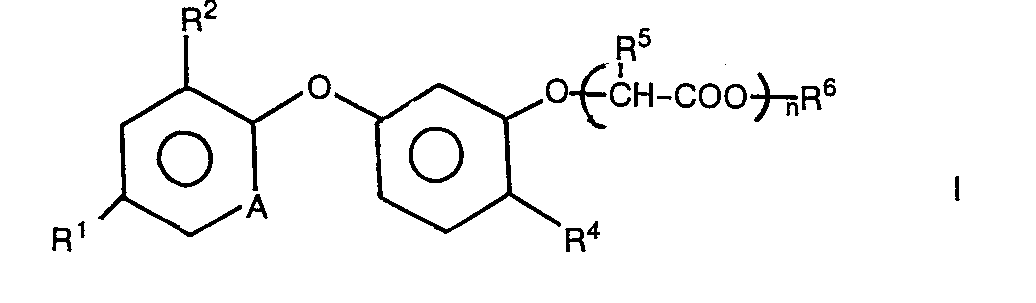
- Die Erfindung betrifft Diaryläther der allgemeinen Formel
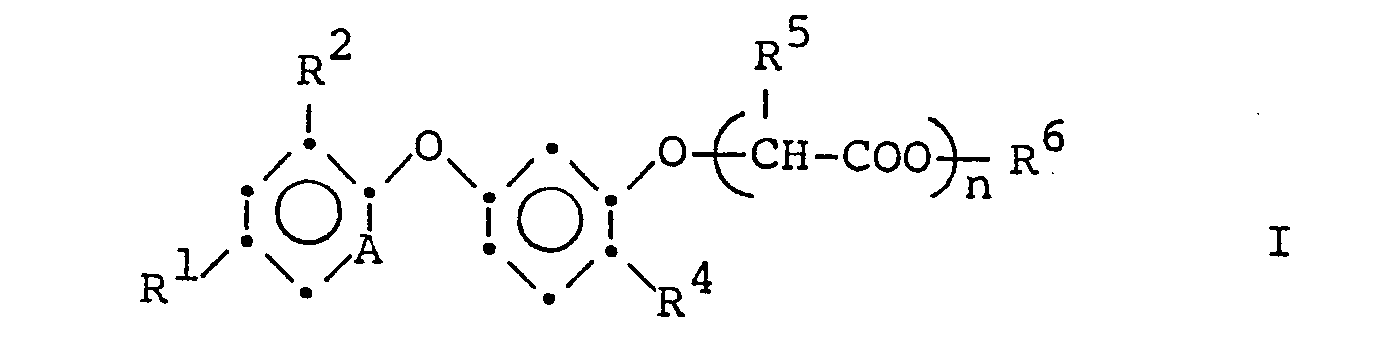
- R 1 Halogen oder Trifluormethyl,
- R2 und R 3 unabhängig voneinander Wasserstoff, Halogen, Nitro oder Cyano,
- R4 Halogen, Nitro oder Cyano,
- R5 Wasserstoff oder C1-3-Alkyl,
- n 0 oder 1,
- R 6 eine der folgenden Gruppen (a) - (c)


- R C1-6-Alkyl,
- R C1-6-Alkyl oder C1-6-Alkoxy,
- oder R7 und R8 zusammen mit dem Kohlenstoffatom, an das sie geknüpft sind, einen C5-7-Cycloalkanring,
- X Methylen, Aethylen oder Aethyliden,
- R9 und R10 unabhängig voneinander Wasserstoff oder C1-4-Alkyl,
- R11 Wasserstoff oder Methyl,
- R12 C1-4-Alkyl oder 2-Chloräthyl,
- Y Sauerstoff oder Schwefel,
- R 13 und R14 unabhängig voneinander C1-6-Alkyl und Z C1-3-Alkylen bedeuten.
- Die Verbindungen der Formel I besitzen herbizide Eigenschaften und eignen sich als Wirkstoffe von Unkrautbekämpfungsmitteln. Somit umfasst die Erfindung auch Unkrautbekämpfungsmittel, welche Verbindungen der Formel I als Wirkstoffe enthalten, Verfahren zur Herstellung dieser Verbindungen sowie die Verwendung solcher Verbindungen bzw. Mittel zur Bekämpfung von Unkräutern.
- In der obigen Formel I umfasst "Halogen" Fluor, Chlor, Brom und Jod. Unter "C1-3-Alkyl", "C1-4-Alkyl" bzw. "C1-6-Alkyl" sind sowohl geradkettige als auch verzweigte Alkylgruppen zu verstehen, wie Methyl, Aethyl, n-Propyl, Isopropyl, n-Butyl, Isobutyl, tert.Butyl, n-Pentyl, Isoamyl, neo-Pentyl und n-Hexyl. Dies gilt auch für den Alkylteil der C1-6-Alkoxygruppe. Auch C1-3-Alkylen kann geradkettig oder verzweigt sein; es ist also Methylen, Aethylen, Aethyliden, 1- oder 2-Methyläthylen, Propyliden oder Trimethylen.
- Das Vorhandensein mindestens eines asymmetrischen Kohlenstoffatoms in den Verbindungen der Formel I hat zur Folge, dass die Verbindungen in isomeren Formen auftreten können, welche in enantiomerer oder diastereomerer Beziehung zueinander stehen. Das gleiche gilt für die Verbindungen der Formel I, in der zusätzlich R13 und R 14 unterschiedliche Bedeutung besitzen. Die isomeren Formen weisen optische Aktivität auf. Durch das Vorliegen der Stickstoff-Kohlenstoff-Doppelbindung in den Verbindungen der Formel I, worin R6 eine Gruppe (a) bedeutet, tritt für jene Verbindungen, worin R7 und R8 unterschiedliche Bedeutung haben, zusätzlich geometrische Isomerie auf. Unabhängig davon kommt auch in gewissen Fällen eine Atropisomerie vor. Die Formel I soll demnach all diese möglichen isomeren Formen sowie die Racemate umfassen.
- Eine interessante Untergruppe von Verbindungen der Formel I besteht aus denjenigen Verbindungen der Formel I, worin A CH, R1 Trifluormethyl, R2 Halogen, R 4 Halogen oder Nitro, R7 und R 8 unabhängig voneinander C1-6-Alkyl, R12 C1-4-Alkyl und Y Sauerstoff bedeuten.
- Unabhängig voneinander bedeuten A vorzugsweise CH; R 1 vorzugsweise Trifluormethyl; R2 vorzugsweise Chlor; R 4 vorzugsweise Nitro; R 5 vorzugsweise Wasserstoff oder Methyl, insbesondere Methyl; und R7 und R8 vorzugsweise Methyl oder Aethyl.
- Besonders bevorzugte Verbindungen der Formel I sind:
- 2-[5-(o-Chlor-p-trifluormethyl-phenoxy)-2-nitro- phenoxy]-propionsäure-isopropylidenaminooxymethylester,
- 2-[5-(o-Chlor-p-trifluormethyl-phenoxy)-2-nitro- phenoxy]-propionsäure-(2-isopropylidenaminooxy-äthyl)ester. und
- N-{2-[2-[5-(o-Chlor-p-trifluormethyl-phenoxy)-2-nitrophenoxy]-propionyloxy]-äthyl}-N-methyl-carbaminsäure- methylester.
- Weitere bevorzugte Verbindungen der Formel I sind:
- 2-[5-(o-Chlor-p-trifluormethyl-phenoxy)-2-nitro- phenoxy]-äthylcarbaminsäure-äthylester,
- 2-[2-[5-(o-Chlor-p-trifluormethyl-phenoxy)-2-nitro- phenoxy]-propionyloxy]-äthylcarbaminsäure-äthylester und
- [2-[5-(o-Chlor-p-trifluormethyl-phenoxy)-2-nitro- phenoxy]-propionyloxy]methylphosphonsäure-diäthylester.
- Das erfindungsgemässe Verfahren zur Herstellung der Verbindungen der Formel I ist dadurch gekennzeichnet, dass man
- a) ein Phenol der allgemeinen Formel

oder ein Alkalimetallsalz davon, mit einer Verbindung der allgemeinen Formel
- b) eine Säure der allgemeinen Formel

oder ein reaktionsfähiges Derivat davon, mit einer Verbindung der allgemeinen Formel
- c) eine Verbindung der allgemeinen Formel

mit einem Metallnitrat behandelt oder - d) ein o-Dinitrobenzolderivat der allgemeinen Formel

mit einem Alkohol der allgemeinen Formel
- Bei der Verfahrensvariante a) steht der Ausdruck "Alkalimetallsalz" insbesondere für das Natrium-, Kalium-oder Lithiumsalz des diesbezüglichen Phenols der Formel II. Der Ausdruck "Abgangsgruppe" für Q in der Formel III steht vorzugsweise für Chlor, Brom Jod, Mesyloxy oder Tosyloxy, oder für eine Gruppe -N⊕R15R16R17, worin R15, R 16 und R 17 unabhängig voneinander Wasserstoff oder nieder Alkyl bedeuten oder zusammen mit dem Stickstoffatom einen Ring, wie Pyridinium, bilden, wobei als geeignetes Anion insbesondere Halogenid, z.B. C⊖ oder Br⊖, in Frage kommt. Im Falle der Verwendung eines Ausgangsmaterials der Formel III, in der Q eine Gruppe -N⊕ R15R16R17 ist, wird das freie Phenol der Formel II eingesetzt.
- Die Umsetzung nach Verfahrensvariante a) kann zweckmässigerweise durchgeführt werden, indem man ein Alkalimetallsalz des Phenols der Formel II mit einem Halogenid - insbesondere dem Chlorid, Bromid oder Jodid - , dem Mesylat oder dem Tosylat der Formel III in einem inerten organischen Lösungsmittel, insbesondere einem dipolaren aprotischen Lösungsmittel, wie Dimethylformamid oder Dimethylsulfoxid, umsetzt. Die Reaktionstemperatur ist nicht kritisch, und man arbeitet im allgemeinen bei Temperaturen zwischen 0°C und 120°, vorzugsweise zwischen 20°C und 70°C. Als Vorstufe wird das Phenol der Formel II in das Alkalimetallsalz übergeführt, und zwar vorzugsweise unter Verwendung von Natriumhydrid oder Kaliumhydroxid unter azeotroper Wasserentfernung.
- Die Umsetzung nach Verfahrensvariante a) kann zweckmässigerweise auch dadurch durchgeführt werden, dass man das freie Phenol der Formel II mit einem Halogenid - insbesondere dem Chlorid, Bromid oder Jodid -, dem Mesylat oder dem Tosylat der Formel III in Gegenwart einer geeigneten anorganischen Base, z.B. eines Alkalimetall- oder Erdalkalimetallcarbonats oder -bicarbonats, oder einer organischen Base, wie eines tert.Amins, z.B. Triäthylamin, Dimethylanilin, Pyridin oder, insbesondere, 1,8-Diaza-bicyclo-[4,5,0]undec-7-en, umsetzt. Zudem erfolgt die Umsetzung zweckmässigerweise in einem polaren aprotischen Lösungsmittel, wie einem aliphatischen Keton, z.B. Aceton oder 2-Butanon, Dimethylformamid oder Acetonitril, und gegebenenfalls in Gegenwart einer katalytischen Menge Natriumjodid, Kaliumjodid oder eines quaternären Ammoniumjodids, z.B. Tetrabutylammoniumjodid, bei Temperaturen zwischen 0°C und 150°C, vorzugsweise zwischen 20°C und 100°C.
- Bedeutet bei der Verfahrensvariante a) Q in der Formel III eine Gruppe -N⊕R15R16R17, wie diese oben näher beschrieben ist, so wird die Umsetzung vorzugsweise in einem Hydroxylgruppen enthaltenden Medium, z.B. in Gegenwart von Natrium-oder Kaliumhydroxid, durchgeführt. Es erfolgt die Umsetzung mit dem freien Phenol der Formel II zweckmässigerweise in einem inerten organischen Verdünnungsmittel, wie einem aromatischen Kohlenwasserstoff, z.B. Toluol, einem aliphatischen oder cyclischen Aether, z.B. Dimethoxyäthan oder Dioxan, einem aprotischen dipolaren Lösungsmittel, z.B. Dimethylformamid oder Acetonitril, oder einem Gemisch solcher Verdünnungsmittel, bei Temperaturen zwischen 70°C und 160°C, vorzugsweise zwischen 100°C und 120°.
- Bei der Verfahrensvariante b), die zu denjenigen Verbindungen der Formel I führt, in der n 1 bedeutet, handelt es sich um eine Veresterung, die nach an sich bekannten Methoden durchgeführt werden kann. Somit bedeutet der Ausdruck "reaktionsfähiges Derivat" insbesondere ein Halogenid, das Imidazolid oder das Anhydrid der diesbezüglichen Säure der Formel IV. Bevorzugte Abgangsgruppen U in der Formel V sind Chlor Brom, Jod, Mesyloxy und Tosyloxy, ferner eine Gruppe -N⊕R15R16R17, wie diese im Zusammenhang mit der Verfahrensvariante a) näher beschrieben ist.
- Die Veresterung einer freien Säure der Formel IV mit einer Verbindung der Formel V, in der U eine Abgangsgruppe, wie Chlor, Brom, Jod, Mesyloxy oder Tosyloxy, bedeutet, wird zweckmässigerweise in Gegenwart einer Base bzw. eines Säureacceptors durchgeführt. Man kann zu diesem Zwecke alle üblicherweise verwendbaren anorganischen und organischen säurebindenden Mittel benützen, vorzugsweise aber Alkalimetall-und Erdalkalimetallcarbonate und -bicarbonate, und tertiäre Amine, z.B. Triäthylamin, Dimethylanilin, 1,8-Diaza-bicyclo-[4,5,0]undec-7-en und Pyridin. Die Umsetzung erfolgt zweckmässigerweise in einem inerten Verdünnungsmittel, vorzugsweise einem inerten organischen Lösungsmittel, wie einem aliphatischen oder cyclischen Aether, z.B. Diäthyläther oder Tetrahydrofuran, einem Kohlenwasserstoff, z.B. n-Hexan, Benzol oder Toluol, einem aliphatischen Keton, z.B. Aceton oder 2-Butanon, einem chlorierten Kohlenwasserstoff, z.B. Dichlormethan, Chloroform oder Tetrachlorkohlenstoff, oder einem dipolaren aprotischen Lösungsmittel, z.B. Dimethylformamid, Dimethylsulfoxid, N-Methylpyrrolidon, Sulfolan oder Hexamethylphosphorsäuretriamid, bei Temperaturen zwischen Raumtemperatur und dem Rückflusstemperatur des Reaktionsgemisches.
- Bei der Veresterung einer freien Säure der Formel IV mit einer Verbindung der Formel V, in der U als Abgangsgruppe eine Gruppe -N⊕ R15R16R17 bedeutet, wird vorzugsweise in einem Hydroxylgruppen enthaltenden Medium, z.B. in Gegenwart von Natrium- oder Kaliumhydroxid, umgesetzt. Die Umsetzung wird zweckmässigerweise in einem inerten organischen Verdünnungsmittel, wie einem aromatischen Kohlenwasserstoff, z.B. Toluol, einem aliphatischen oder cyclischen Aether, z.B. Dimethoxyäthan oder Dioxan, einem aprotischen dipolaren Lösungsmittel, z.B. Dimethylformamid oder Acetonitril, oder einem Gemisch solcher Verdünnungsmittel, bei Temperaturen zwischen 70°C und 160°C, vorzugsweise zwischen 100°C und 120°C, durchgeführt.
- Die Umsetzung einer freien Säure der Formel IV mit einer Verbindung der Formel V, in der U Hydroxy bedeutet, wird zweckmässigerweise in einem inerten organischen Verdünnungsmittel, wie einem aliphatischen oder cyclischen Aether, z.B. Diäthyläther, Diisopropyläther, 1,2-Dimethoxyäthan, Tetrahydrofuran oder Dioxan, einem chlorierten Kohlenwasserstoff, z.B. Dichlormethan, Chloroform, Tetrachlorkohlenstoff oder Trichloräthan, oder einem aromatischen Kohlenwasserstoff, z.B. Benzol, Toluol oder einem Xylol, und bei Temperaturen zwischen 0°C und der Rückflusstemperatur des Reaktionsgemisches durchgeführt. Zudem erfolgt die Umsetzung zweckmässigerweise in Gegenwart eines sauren Katalysators bzw. eines kondensierenden Mittels, wie Schwefelsäure, Salzsäure, p-Toluolsulfonsäure, Dicyclohexylcarbodiimid oder Carbonyldiimidazol. Vorzugsweise wird Carbonyldiimidazol als kondensierendes Mittel benützt, wobei bevorzugt in Gegenwart eines Aethers als Verdünnungsmittel umgesetzt wird. Es wird die Säure der Formel IV, z.B. in einem inerten organischen Verdünnungsmittel, insbesondere einem aliphatischen oder cyclischen Aether, gelöst oder suspendiert und die Lösung bzw. Suspension zu einer Lösung oder Suspension von Carbonyldiimidazol in dem gleichen Verdünnungsmittel gegeben. Nach Beendigung der resultierenden Entwicklung von Kohlendioxid wird das Gemisch mit einer Lösung des Alkohols der Formel V, die zuvor mit einer katalytischen Menge Natrium oder Natriumhydrid bis zur Beendigung von Wasserstoffentwicklung versetzt wurde, versetzt. Die Umsetzung erfolgt vorzugsweise in einem Temperaturbereich zwischen Raumtemperatur und ca. 50°C ; sie ist normalerweise innert ca. 2 Stunden beendet.
- Im Falle der Umsetzung eines reaktionsfähigen Derivats einer Säure der Formel IV mit einer Verbindung der Formel V steht U in letzterer Formel für Hydroxy. Die Umsetzung wird zweckmässigerweise in einem inerten Verdünnungsmittel, wie einem aliphatischen oder cyclischen Aether, z.B. Diäthyläther oder Tetrahydrofuran, einem Kohlenwasserstoff, z.B. n-Hexan, Benzol oder Toluol, oder einem chlorierten Kohlenwasserstoff, z.B. Dichlormethan, Chloroform oder Tetrachlorkohlenstoff, und bei Raumtemperatur oder erhöhter Temperatur, z.B. bis zur Rückflusstemperatur des Reaktionsgemisches, durchgeführt.
- Bei Verwendung eines Säurehalogenides der Säure der Formel IV wird die Umsetzung zweckmässigerweise in Gegenwart eines säurebindenden Mittels und vorzugsweise bei Temperaturen zwischen 0°C und 40°C, insbesondere zwischen 0°C und 10°C, durchgeführt. Als geeignete säurebindende Mittel eignen sich anorganische Basen, z.B. Alkalimetall-und Erdalkalimetallcarbonate und -bicarbonate, sowie organische Basen, z.B. tertiäre Amine, insbesondere Triäthylamin oder Pyridin. Das bevorzugte Säurehalogenid ist das Säurechlorid. Bei Verwendung des Anhydrids der Säure der Formel IV erfolgt die Umsetzung zweckmässigerweise in Gegenwart eines säurebindenden Mittels, insbesondere einer organischen Base, wie eines tertiären Amins, z.B. Triäthylamin, Dimethylanilin oder Pyridin, bei Temperaturen zwischen 0°C und 40°C, insbesondere bei Raumtemperatur, oder ohne säurebindendes Mittel bei erhöhter Temperatur.
- Bei der Verfahrensvariante c), die zu denjenigen Verbindungen der Formel I führt, in der R4 Nitro bedeutet, steht der Ausdruck "Metallnitrat" insbesondere für Kupfer(II)-, Eisen(III)-, Cobalt(II)-, Cobalt(III)-, Nickel(III)-, Chrom(III)-, Mangan(II)- oder Aluminium(III)-nitrat. Die bevorzugten Metallnitrate sind Kupfer(II)-, Eisen(III)- und Aluminium(III)-nitrat. Die Umsetzung wird zweckmässigerweise in Gegenwart von Essigsäureanhydrid und eines inerten Verdünnungsmittels, insbesondere eines organischen Lösungsmittels, und bei Temperaturen zwischen 0°C und 100°C, insbesondere zwischen 10°C und 50°C, durchgeführt. Als Verdünnungsmittel dient vorzugsweise Essigsäureanhydrid. Es wird vorzugsweise mit einem Ueberschuss an Metallnitrat gearbeitet, und zwar im allgemeinen mit einem 1- bis 10-molaren Ueberschuss, vorzugsweise einem 1,0- bis 1,5-molaren Ueberschuss, an Metallnitrat. Solche Verfahren sind z.B. von J.B. Menke in Rec. Trav. Chim. Pays-Bas 44, 141 und 269 (1925), von G. Bacharach in J. Amer. Chem. Soc. 49, 1522 (1927) und von A.M. Talati und B. Shah in Ind. J. Chem. 11, 1076 (1973) beschrieben.
- Die Verfahrensvariante d) führt ebenfalls zu denjenigen Verbindungen der Formel I, in der R4 Nitro bedeutet. Unter dem Ausdruck "Alkalimetallsalz" des Alkohols der Formel VIII ist insbesondere das Natrium-, Kalium- oder Lithiumsalz zu verstehen. Die Umsetzung erfolgt zweckmässigerweise in einem inerten Verdünnungsmittel, insbesondere einem organischen Lösungsmittel, wie Tetrahydrofuran oder Dioxan, und in Gegenwart einer Base, wie eines Alkalimetallhydroxids, z.B. Natrium- oder Kaliumhydroxid. Man arbeitet im allgemeinen in einem Temperaturbereich zwischen Raum- und Rückflusstemperatur, vorzugsweise zwischen 40°C und 100°C. Ein solches Verfahren ist z.B. in der Deutschen Offenlegungsschrift Nr. 2.926.829 beschrieben.
- Das erhaltene Produkt kann nach an sich bekannten Methoden isoliert und gereinigt werden.
- Sofern keine gezielte Synthese zur Isolierung reiner Isomerer durchgeführt wird, fällt das Produkt normalerweise als Gemisch zweier oder mehrerer Isomerer an. Die Isomeren können nach an sich bekannten Methoden aufgetrennt werden. Gewünschtenfalls können sie auch durch Synthese aus entsprechenden optisch aktiven Ausgangsmaterialien hergestellt werden.
- Die Ausgangsmaterialien der Formeln II und IV sowie deren Alkalimetallsalze bzw. reaktionsfähige Derivate sind entweder bekannt oder können in an sich bekannter Weise hergestellt werden. Die als Ausgangsmaterialien der Verfahrensvariante a) verwendeten Verbindungen der Formel III, die auch die in der Verfahrensvariante b) verwendeten Ausgangsmaterialien der Formel V, in der U eine Abgangsgruppe bedeutet, umfassen, lassen sich in an sich bekannter Weise herstellen, z.B. gemäss den nachfolgenden Reaktionsschema:

- In den obigen Reaktionsschemata besitzen R 5, R und Q die oben angegebenen Bedeutungen; U' bedeutet eine Abgangsgruppe, insbesondere Chlor, Brom, Jod, Mesyloxy oder Tosyloxy, oder eine Gruppe -N⊕R15R16R17, wie diese im Zusammenhang mit der Verfahrensvariante a) näher beschrieben ist. Die Reaktionsbedingungen sind dem Fachmann geläufig.
- Die restlichen Ausgangsmaterialien der Formel V, d.h. diejenigen Verbindungen der Formel V, in der U Hydroxy bedeutet, und die obigen Verbindungen der Formel V', sind entweder bekannt oder können in an sich bekannter Weise hergestellt werden.
- Die Ausgangsmaterialien der Formel VI können dadurch hergestellt werden, dass man ein Phenol der allgemeinen Formel

oder ein Alkalimetallsalz davon, wie das Natrium-, Kalium-oder Lithiumsalz, mit einer Verbindung der oben angegebenen allgemeinen Formel III umsetzt. Die Umsetzung erfolgt zweckmässigerweise unter denjenigen Reaktionsbedingungen, die oben im Zusammenhang mit der Verfahrensvariante a) beschrieben sind. - Die als Ausgangsmaterialien der Verfahrensvariante d) verwendeten o-Dinitrobenzolderivate der Formel VII können analog dem in der Deutschen Offenlegungsschrift Nr. 2.926.829 beschriebenen Verfahren zur Herstellung von 1-(2-Chlor-4-trifluormethyl-phenoxy)-3,4-dinitrobenzol hergestellt werden.
- Die als Ausgangsmaterialien der Verfahrensvariante d) verwendeten Alkohole der Formel VIII und deren Alkalimetallsalze lassen sich in an sich bekannter Weise herstellen, z.B. durch Umsetzung eines Alkohols der oben angegebenen allgemeinen Formel V' mit einem Säurechlorid der Formel

in Gegenwart eines säurebindenden Mittels, und gegebenenfalls anschliessende Alkalimetallsalzbildung. - Die Verbindungen der Formel I besitzen herbizide Eigenschaften und eignen sich besonders zur Bekämpfung von Unkräutern, insbesondere von monokotylen Ungräsern, wie Mohrenhirse (Sorghum bicolor), Hühnerhirse (Echinochloa crus-galli) und Fingerhirse (Digitaria spp.), sowie dikotylen Ungräsern, wie Chinesischem Hanf (Abutilon theophrasti), Weissem Gänsefuss (Chenopodium album), Rauhaarigem Amarant (Amaranthus retroflexus), Ackersenf (Sinapis arvensis), Stechapfel (Datura stramonium), Prukwinde (Ipomoea spp.) und Spitzklette (Xanthium pensylvanicum) in diversen Nutzpflanzenkulturen, insbesondere in Reis- und Getreidekulturen.
- Im allgemeinen genügt eine Konzentration von 0,01 bis 3 kg Wirkstoff der Formel I/ha, vorzugsweise 0,01 bis 1 kg Wirkstoff der Formel I/ha, um den gewünschten herbiziden Effekt zu erzielen.
- Die Verbindungen der Formel I sind sowohl Vorauflauf-Herbizide als auch Nachauflauf-Herbizide.
- Das erfindungsgemässe Unkrautbekämpfungsmittel ist dadurch gekennzeichnet, dass es eine wirksame Menge mindestens einer Verbindung der Formel I, wie oben definiert, sowie Formulierungshilfsstoffe enthält. Das Mittel enthält zweckmässigerweise zumindest einen der folgenden Formulierungshilfsstoffe: feste Trägerstoffe; Lösungs- bzw. Dispersionsmittel; Tenside (Netz- und Emulgiermittel); Dispergatoren (ohne Tensidwirkung); und Stabilisatoren. Unter Verwendung solcher und anderer Hilfsstoffe können die Verbindungen der Formel I, also die herbiziden Wirkstoffe, in die üblichen Formulierungen übergeführt werden, wie Stäube, Pulver, Granulate, Lösungen, Emulsionen, Suspensionen, emulgierbare Konzentrate, Pasten und dergleichen.
- Die Verbindungen der Formel I sind im allgemeinen wasserunlöslich und können nach den für wasserunlösliche Verbindungen üblichen Methoden unter Verwendung der diesbezüglichen Formulierungshilfsstoffe konfektioniert werden. Die Herstellung der Mittel kann in an sich bekannter Weise durchgeführt werden, z.B. durch Vermischen des jeweiligen Wirkstoffes mit festen Trägerstoffen, durch Auflösen oder Suspendieren in geeigneten Lösungs- bzw. Dispersionsmitteln, eventuell unter Verwendung von Tensiden als Netz-oder Emulgiermitteln und/oder von Dispergatoren, durch Verdünnen bereits vorbereiteter emulgierbarer Konzentrate mit Lösungs- bzw. Dispersionsmitteln usw.
- Als feste Trägerstoffe kommen im wesentlichen in Frage: natürliche Mineralstoffe, wie Kreide, Dolomit, Kalkstein, Tonerden und Kieselsäure und deren Salze (beispielsweise Kieselgur, Kaolin, Bentonit, Talkum, Attapulgit und Montmorillonit); synthetische Mineralstoffe, wie hochdisperse Kieselsäure, Aluminiumoxid und Silikate; organische Stoffe, wie Cellulose, Stärke, Harnstoff und Kunstharze; und Düngemittel, wie Phosphate und Nitrate, wobei solche Trägerstoffe z.B. als Pulver oder als Granulate vorliegen können.
- Als Lösungs- bzw. Dispersionsmittel kommen im wesentlichen in Frage: Aromaten, wie Benzol, Toluol, Xylole und Alkylnaphthaline; chlorierte Aromaten und chlorierte aliphatische Kohlenwasserstoffe, wie Chlorbenzole, Chlor- äthylene und Methylenchlorid; aliphatische Kohlenwasserstoffe, wie Cyclohexan und Paraffine, z.B. Erdölfraktionen; Alkohole, wie Butanol und Glykol, sowie deren Aether und Ester; Ketone, wie Aceton, Methyläthylketon, Methylisobutylketon und Cyclohexanon; und stark polare Lösungs- bzw. Dispersionsmittel, wie Dimethylformamid, N-Methylpyrrolidon und Dimethylsulfoxid, wobei solche Lösungsmittel vorzugsweise Flammpunkte von mindestens 30°C und Siedepunkte von mindestens 50°C aufweisen, und Wasser. Unter den Lösungs- bzw. Dispersionsmitteln kommen auch in Frage sogenannte verflüssigte gasförmige Streckmittel oder Trägerstoffe, die solche Produkte sind, welche bei Raumtemperatur und unter Normaldruck gasförmig sind. Beispiele solcher Produkte sind insbesondere Aerosol-Treibgase, wie Halogenkohlenwasserstoffe, z.B. Dichlordifluormethan. Liegt das erfindungsgemässe Unkrautbekämpfungsmittel in Form einer Druckgaspackung vor, so wird zweckmässigerweise zusätzlich zum Treibgas ein Lösungsmittel verwendet.
- Die Tenside (Netz- und Emulgiermittel) können nichtionische Verbindungen sein, wie Kondensationsprodukte von Fettsäuren, Fettalkoholen oder fettsubstituierten Phenolen mit Aethylenoxid; Fettsäureester und -äther von Zuckern oder mehrwertigen Alkoholen; die Produkte, die aus Zuckern oder mehrwertigen Alkoholen durch Kondensation mit Aethylenoxid erhalten werden; Blockpolymere von Aethylenoxid und Propylenoxid; oder Alkyldimethylaminoxide.
- Die Tenside können auch anionische Verbindungen sein, wie Seifen; Fettsulfatester, z.B. Dodecylnatriumsulfat, Octadecylnatriumsulfat und Cetylnatriumsulfat; Alkylsul- fonate, Arylsulfonate und fettaromatische Sulfonate, wie Alkylbenzolsulfonate, z.B. Calcium-dodecylbenzolsulfonat, und Butylnaphthalinsulfonate; und komplexere Fettsulfonate, z.B. die Amidkondensationsprodukte von Oelsäure und N-Methyltaurin und das Natriumsulfonat von Dioctylsuccinat.
- Die Tenside können schliesslich kationische Verbindungen sein, wie Alkyldimethylbenzylammoniumchloride, Dialkyldimethylammoniumchloride, Alkyltrimethylammoniumchloride und äthoxylierte quaternäre Ammoniumchloride.
- Als Dispergatoren (ohne Tensidwirkung) kommen im wesentlichen in Frage: Lignin, Natrium- und Ammoniumsalze von Ligninsulfonsäuren, Natriumsalze von Maleinsäureanhydrid-Diisobutylen-Copolymeren, Natrium- und Ammoniumsalze von sulfonierten Polykondensationsprodukten aus Naphthalin und Formaldehyd, und Sulfitablaugen.
- Als Dispergatoren, die sich insbesondere als Verdickungs- bzw. Antiabsetzmittel eignen, können z.B. Methylcellulose, Carboxymethylcellulose, Hydroxyäthylcellulose, Polyvinylalkohol, Alginate, Caseinate und Blutalbumin eingesetzt werden.
- Beispiele von geeigneten Stabilisatoren sind säurebindende Mittel z.B. Epichlorhydrin, Phenylglycidäther und Soyaepoxide; Antioxidantien z.B. Gallussäureester und Butylhydroxytoluol; UV-Absorber, z.B. substituierte Benzophenone, Diphenylacrylonitrilsäureester und Zimtsäureester; und Deaktivatoren, z.B. Salze der Aethylendiaminotetraessigsäure und Polyglykole.
- Die erfindungsgemässen Unkrautbekämpfungsmittel können zusätzlich zu den Verbindungen der Formel I Synergisten und andere Wirkstoffe, z.B. Insektizide, Akarizide, Bakterizide, anderweitige Herbizide, Fungizide, Pflanzenwachstumsregulatoren und Düngemittel, enthalten. Solche Kombinationsmittel eignen sich zur Verstärkung der Aktivität bzw. zur Verbreiterung des Wirkungsspektrums.
- Die erfindungsgemässen Unkrautbekämpfungsmittel enthalten im allgemeinen zwischen 0,001 und 95 Gewichtsprozent, vorzugsweise zwischen 5 und 75 Gewichtsprozent einer bzw. mehrerer Verbindungen der Formel I als Wirkstoff(e). Sie können z.B. in einer Form vorliegen, die sich für die Lagerung und den Transport eignet. In solchen Formulierungen, z.B. emulgierbaren Konzentraten, ist die Wirkstoffkonzentration normalerweise im höheren Bereich, vorzugsweise zwischen 10 und 75 Gewichtsprozent, insbesondere zwischen 25 und 50 Gewichtsprozent. Diese Formulierungen können dann, z.B. mit gleichen oder verschiedenen inerten Stoffen, bis zu Wirkstoffkonzentrationen verdünnt werden, die sich für den praktischen Gebrauch eignen, also vorzugsweise ca. 0,1 bis 10 Gewichtsprozent, insbesondere ca. 1 bis 5 Gewichtsprozent. Die Wirkstoffkonzentrationen können jedoch auch kleiner oder grösser sein.
- Wie oben erwähnt, kann die Herstellung der erfindungsgemässen Unkrautbekämpfungsmittel in an sich bekannter Weise durchgeführt werden.
- Zur Herstellung pulverförmiger Präparate kann der Wirkstoff, d.h. mindestens eine Verbindung der Formel I, mit festem Trägerstoff vermischt werden, z.B. durch Zusammenmahlen; oder man kann den festen Trägerstoff mit einer Lösung oder Suspension des Wirkstoffes imprägnieren und dann das Lösungs- bzw. Dispersionsmittel durch Abdunsten, Erhitzen oder Absaugen unter vermindertem Druck entfernen. Durch Zusatz von Tensiden bzw. Dispergatoren kann man solche pulverförmige Mittel mit Wasser leicht benetzbar machen, so dass sie in wässrige Suspensionen, die sich z.B. als Spritzmittel eignen, übergeführt werden können.
- Die Verbindung der Formel I kann auch mit einem Tensid und einem festen Trägerstoff zur Bildung eines netzbaren Pulvers vermischt werden, welches in Wasser dispergierbar ist, oder sie kann mit einem festen vorgranulierten Trägerstoff zur Bildung eines granulatförmigen Produktes vermischt werden.
- Wenn gewünscht, kann die Verbindung der Formel I in einem mit Wasser nicht mischbaren Lösungsmittel, wie beispielsweise einem hochsiedenden Kohlenwasserstoff, gelöst werden, das zweckmässigerweise gelöste Emulgiermittel enthält, so dass die Lösung bei Zugabe zu Wasser selbstemulgierend wirkt. Andernfalls kann der Wirkstoff mit einem Emulgiermittel vermischt und das Gemisch dann mit Wasser auf die gewünschte Konzentration verdünnt werden. Zudem kann der Wirkstoff in einem Lösungsmittel gelöst und danach mit einem Emulgiermittel gemischt werden. Ein solches Gemisch kann ebenfalls mit Wasser auf die gewünschte Konzentration verdünnt werden. Auf diese Weise erhält man emulgierbare Konzentrate bzw. gebrauchsfertige Emulsionen.
- Die Verwendung der erfindungsgemässen Unkrautbekämpfungsmittel kann nach üblichen Applikationsmethoden, wie Spritzen, Sprühen, Stäuben, Giessen oder Streuen, erfolgen. Das erfindungsgemässe Verfahren zur Bekämpfung von Unkräutern ist dadurch gekennzeichnet, dass man das gegen Unkräuter zu schützende Gut und/oder die Unkräuter mit einer erfindungsgemässen Verbindung bzw. einem erfindungsgemässen Unkrautbekämpfungsmittel behandelt.
- Die nachfolgenden Beispiele dienen zur näheren Erläuterung der Erfindung.
- Zu einer Lösung von 3,0 g Diäthyl-methyl-isopropylidenaminooxymethyl-ammoniumjodid in 10 ml Methanol werden 4,2 g Silberoxid gegeben, und das Gemisch wird 1 Stunde bei Raumtemperatur und im Dunkeln gerührt. Man filtriert die festen Anteile ab und gibt zum Filtrat 3,0 g 5-(o-Chlor-p-trifluormethyl-phenoxy)-2-nitrophenol sowie 50 ml Toluol zu. Nach azeotropem Abdestillieren des Methanols und des bei der Reaktion gebildeten Wassers wird das Gemisch 15 Minuten auf Rückflusstemperatur erhitzt, abgekühlt und auf 100 ml Wasser gegossen. Die organische Phase wird abgetrennt und die wässrige Phase mit 50 ml Aethylacetat extrahiert. Anschliessend werden die vereinigten organischen Phasen der Reihe nach mit 100 ml 2N Salzsäure, mit 100 ml 5%iger Natriumbicarbonatlösung und zweimal mit jeweils 100 ml Wasser gewaschen. Das Lösungsmittel wird abgedampft und der Rückstand an der zehnfachen Menge Kieselgel unter Verwendung von Diäthyläther/n-Hexan (1:9) als Laufmittel chromatographisch gereinigt. Man erhält das 2-Propanon-O-[[5-(o-chlor-p-trifluormethyl-phenoxy)-2-nitrophenoxy]-methyl/oxim als farbloses Oel (2,9 g), n20 D 1,5443; Massenspektrum m/e 418; 1H-NMR (CDC13; 60 MHz) 7,90 ppm (d, 1H), 7,80 ppm (d, 1H), 7,65 ppm (dd, 1H), 7,25 ppm (d, 1H), 6,65 ppm (dd, 1H), 5,70 ppm (s, 2H), 1,78 ppm (d, 6H).
- Eine Lösung von 1,65 g Diäthyl-methyl-isopropylidenaminooxymethyl-ammoniumjodid in 10 ml Methanol wird in Gegenwart von 2,3 g Silberoxid 1 Stunde bei Raumtemperatur und im Dunkeln gerührt. Man filtriert die festen Anteile ab, gibt zum Filtrat 2,0 g 2-[5-(o-Chlor-p-trifluormethyl- phenoxy)-2-nitrophenoxy]-propionsäure sowie 50 ml Toluol zu und destilliert das Methanol und das gebildete Wasser azeotrop ab. Danach wird das Gemisch eine halbe Stunde auf Rückflusstemperatur erhitzt, abgekühlt und auf 100 ml Wasser gegossen. Man trennt die organische Phase ab und extrahiert die wässrige Phase zweimal mit jeweils 50 ml Aethylacetat. Anschliessend werden die vereinigten organischen Phasen der Reihe nach mit 50 ml 2N Salzsäure, mit 50 ml 5%iger Natriumbicarbonatlösung und zweimal mit jeweils 50 ml Wasser gewaschen. Das Lösungsmittel wird abgedampft und der Rückstand an der zehnfachen Menge Kieselgel unter Verwendung von n-Hexan/Aethylacetat (1:1) als Laufmittel chromatographisch gereinigt. Man erhält den 2-[5-(o-Chlor-p-trifluormethyl-phenoxy)-2-nitrophenoxy]-propionsäure-isopropylidenaminooxymethylester, n20 1,5346; Massenspektrum m/e 490; H-NMR (CDC13; 60 MHz) 7,90 ppm (d, 1H), 7,80 ppm (d, 1H), 7,60 ppm (dd, 1H), 7,20 ppm (d, 1H), 6,60 ppm (d, 1H), 6,55 ppm (dd, 1H), 5,75 ppm (s, 2H), 4,75 ppm (q, 1H), 1,90 ppm (d, 6H), 1,72 ppm (d, 6H).
- Eine Lösung von 4,0 g 5-(o-Chlor-p-trifluormethyl- phenoxy)-1-nitrophenol in 30 ml Acetonitril wird mit 2,0 g Kaliumcarbonat während 1 Stunde auf Rückflusstemperatur erhitzt. Nach Zugabe katalytischer Mengen Kaliumjodid und Tetrabutylammoniumjodid tropft man eine Lösung von 1,9 g 2-Chlor-äthylcarbaminsäure-methylester in 15 ml Acetonitril in das warme Gemisch und hält das Reaktionsgemisch während 35 Stunden bei Rückflusstemperatur. Das abgekühlte Reaktionsgemisch wird filtriert und das Filtrat mit Diäthyläther verdünnt. Die Aetherlösung wird mit 2N Salzsäure, Wasser und gesättigter Kochsalzlösung gewaschen, über wasserfreiem Natriumsulfat getrocknet und unter vermindertem Druck eingedampft. Der ölige Rückstand wird an Kieselgel mit n-Hexan/Aethylacetat (4:1) chromatographisch gereinigt. Man erhält den 2-[5-(o-Chlor-p-trifluormethyl-phenoxy)-2-nitrophenoxy]-äthylcarbaminsäure-methylester, Smp. 91-92°C.
- In analoger Weise erhält man beim Einsatz von 2-Chlor-äthylcarbaminsäure-äthylester den 2-[5-(o-Chlor-p-trifluormethyl-phenoxy)-2-nitrophenoxy]-äthylcarbaminsäure-äthylester, Smp. 70-71°C.
- 2,0 g 5-(o-Chlor-p-trifluormethyl-phenoxy)-2-nitrophenol und 1,0 g Kaliumcarbonat werden in 30 ml Acetonitril während 15 Minuten auf Rückflusstemperatur erhitzt. Dann tropft man eine Lösung von 1,68 g 2-(2-Brompropionyloxy)-äthylcarbaminsäure-methylester in 10 ml Acetonitril während 5 Minuten zu und lässt während ca. 16 Stunden bei Rückflusstemperatur reagieren. Zur Aufarbeitung wird auf Eiswasser gegossen und mit Diäthyläther zweimal extrahiert. Die vereinigten Aetherlösungen werden mit 2N Salzsäure, Wasser und gesättigter Kochsalzlösung gewaschen, über wasserfreiem Natriumsulfat getrocknet und eingedampft. Der ölige Rückstand wird durch Chromatographie an Kieselgel mit n-Hexan/Aethylacetat (4:1) gereinigt. Man erhält den 2-[2-C5-(o-Chlor-p-trifluormethyl- phenoxy)-2-nitrophenoxy]-propionyloxy/-äthylcarbaminsäure-methylester, n20 D 1,5258.
- In analoger Weise erhält man beim Einsatz von:
- - 2-(2-Brompropionyloxy)-äthylcarbaminsäure-äthylester den 2-[2-[5-(o-Chlor-p-trifluormethyl-phenoxy)-2-nitro- phenoxy]-propionyloxy]-äthylcarbaminsäure-äthylester, n24 D 1,5185.
- - 2-Bromacetyloxy-äthylcarbaminsäure-methylester den 2-[[5-(o-Chlor-p-trifluormethyl-phenoxy)-2-nitrophenoxy]-acetyloxyJ-äthylcarbaminsäure-methylester, Smp. 105-108°C.
- - 2-Bromacetyloxy-äthylcarbaminsäure-äthylester den 2-[[5-(o-Chlor-p-trifluormethyl-phenoxy)-2-nitrophenoxy]-acetyloxyJ-äthylcarbaminsäure-äthylester, Smp. 94-95°C.
- - 2-(2-Brompropionyloxy)-propylcarbaminsäure-methylester den 2-[2-[5-(o-Chlor-p-trifluormethyl-phenoxy)-2-nitro- phenoxy]-propionyloxy]-propylcarbaminsäure-methylester, 1H-NMR (CDC13, 60 MHz) 8,1 - 6,46 ppm (m, 6H), 5,23 - 4,63 ppm (m, 2H), 4,83 ppm (q, 1H), 3,65 ppm (s, 3H), 3,5 - 3,13 ppm (m, 2H), 1,70 ppm (d, 3H), 1,23 ppm (d, 3H).
- - 1-Aethyl-2-(2-brompropionyloxy)-äthylcarbaminsäure-äthylester den 1-Aethyl-2-[2-C5-(o-chlor-p-trifluormethyl- phenoxy)-2-nitrophenoxy]-propionyloxy]-äthylcarbaminsäure-äthylester, 1H-NMR (CDCl3, 400 MHz) 7,91 ppm (d, 1H), 7,79 ppm (dd, 1H), 7,61 - 7,56 ppm (m, 1H), 7,20 ppm (dd, 1H), 6,67 ppm (breites s, 1H) und 6,59 ppm (d, 1H), 6,51 ppm (dd, 1H), 4,85 ppm (q, 1H), 4,73 - 4,53 ppm (m, 1H), 3,85
- - 3,71 ppm (m, 1H), 1,7 und 1,695 ppm (2d, 3H), 1,56 - 1,3 ppm (m, 2H), 1,29 - 1,18 ppm (m, 3H), 0,93 und 0,90 ppm (2t, 3H).
- - 2-(2-Brompropionyloxy)-äthylcarbaminsäure-isobutylester den 2-[2-[5-(o-Chlor-p-trifluormethyl-phenoxy)-2-nitro- phenoxy]-propionyloxy]-äthylcarbaminsäure-isobutylester, 1H-NMR (CDC13, 60 MHz) 8,1 - 6,4 ppm (m, 6H), 5,17 - 4,80 ppm (breites s, 1H), 4,86 ppm (q, 1H), 4,23 ppm (t, 2H), 3,80 ppm (d, 2H), 3,66 - 3,26 ppm (m, 2H), 1,70 ppm (d, 3H), 1,90 ppm (m, 1H), 0,93 ppm (d, 6H).
- - N-[2-(2-Brompropionyloxy)-äthyl]-N-methyl-carbaminsäure- methylester den N-{2-[2-[5-(o-Chlor-p-trifluormethyl-phenoxy)-2-nitrophenoxy]-propionyloxy]-äthyl}-N-methyl-carbaminsäure- methylester, 1H-NMR (CDC13, 60 MHz) 8,1 - 6,43 ppm (m, 6H), 4,83 ppm (q, 1H), 4,26 ppm (t, 2H), 3,67 ppm (s, 3H), 3,50 ppm (t, 2H), 2,86 ppm (s, 3H), 1,68 ppm (d, 3H).
- In analoger Weise erhält man beim Einsatz von 5-(o-Chlor-p-trifluormethyl-phenoxy)-2-chlorphenol und:
- - 2-(2-Brompropionyloxy)-äthylcarbaminsäure-methylester den 2-[2-[5-(o-Chlor-p-trifluormethyl-phenoxy) -2-chlor- phenoxy]-propionyloxyJ -äthylcarbaminsäure-methylester. 1H-NMR (CDCl3, 60 MHz) 7,85-6,45 ppm (mehrere Signale. 6H), 5,05 ppm (t, 1H), 4,83 ppm (q, 1H, γ = ca. 7-8 Hz). 4,39-3,85 ppm (mehrere Signale. 4H), 3,65 ppm (s. 3H), 1.70 ppm (d. 3H, γ = ca. 7-8 Hz).
- - 2-(2-Brompropionyloxy)-äthylcarbaminsäure-äthylester den 2-[2-[5-(o-Chlor-p-trifluormethyl-phenoxy) -2-chlor- phenoxy]-propionyloxy) -äthylcarbaminsäure-äthylester, 1H-NMR (CDCl3. 60 MHz) 7,85-6,45 ppm (mehrere Signale, 6H), 5.0 ppm (t, 1H), 4.85 ppm (q, 1H. γ = ca. 7-8 Hz). 4,40-3,90 ppm (mehrere Signale, 4H), 3,42 ppm (q. 2H, γ = ca- 7-8 Hz), 1.72 ppm (d, 3H, γ = ca. 7-8 Hz), 1,25 ppm (t, 3H, γ = ca. 7-8 Hz).
- - 2-Brompropionsäure-(2-isopropylidenaminooxyäthyl)ester den 2-[5-(o-Chlor-p-trifluormethyl-phenoxy) -2-chlor- phenoxy]-propionsäure -(2-isopropylidenaminooxy-äthyl)-ester. 1H-NMR (CDCl3, 60 MHz) 7,85-6,45 ppm (mehrere Signale. 6H), 4,80 ppm (q, 1H. γ = ca. 7-8 Hz), 4,30 ppm (m. 4H), 1,80 ppm (s. 3H), 1.78 ppm (s, 3H), 1.70 ppm (d. 3H, γ = ca. 7-8 Hz).
- 1,3 g D-2-[5-(o-Chlor-p-trifluormethyl-phenoxy) -2-nitrophenoxy]-propionsäure werden mit 15 ml Thionylchlorid während 1 Stunde auf Rückflusstemperatur erhitzt. Dann wird das überschüssige Thionylchlorid bei vermindertem Druck abdestilliert und der Rückstand am Hochvakuum getrocknet. Nach Zugabe von 10 ml Methylenchlorid und 0,27 g Pyridin tropft man 0,47 g 2-Hydroxyäthylcarbaminsäure-äthylester in 10 ml Methylenchlorid bei 0-5°C zu und lässt während ca. 16 Stunden bei Raumtemperatur reagieren. Zur Aufarbeitung wird auf Wasser gegossen und dreimal mit Diäthyläther extrahiert. Die Extrakte werden mit 2N Salzsäure, Wasser und gesättigter Kochsalzlösung gewaschen, über wasserfreiem Natriumsulfat getrocknet und eingedampft. Durch Chromatographie an Kieselgel mit n-Hexan/Aethylacetat (4:1) erhält man den 2-[D-2-[5-(o-Chlor-p-trifluormethyl-phenoxy)-2-nitrophenoxy]-propionyloxy]-äthylcarbaminsäure-äthylester, n20 D 1,5362; [α]22 D -18,85° (c = 1,15% in CHC13).
- In analoger Weise erhält man beim Einsatz von D-2-[5-(o-Chlor-p-trifluormethyl-phenoxy)-2-nitrophenoxy]-propionsäure und 2-Hydroxyäthylcarbaminsäure-methylester den 2-[D-2-[5-(o-Chlor-p-trifluormethyl-phenoxy)-2-nitrophenoxy]-propionyloxyJ-äthylcarbaminsäure-methylester, [α]20 D 15,76° (c = 0,83% in CHC13); H-NMR (CDCl3, 60 MHz) 8,1 - 6,45 ppm (m, 6H), 5,25 - 4,7 ppm (breites s, 1H), 4,88 ppm (q, 1H), 4,25 ppm (t, 2H), 3,70 ppm (s, 3H), 3,67 - 3,28 ppm (m, 2H), 1,73 ppm (d, 3H).
- Zu einer Lösung von 2,0 g DL-2-[5-(o-Chlor-p-trifluormethyl-phenoxy)-2-nitrophenoxy]-propionsäurechlorid und 0,86 g 2-Hydroxyäthylphosphonsäure-diäthylester in 5 ml Methylenchlorid wird bei Raumtemperatur 0,41 g Pyridin zugetropft. Das Reaktionsgemisch wird 1 Stunde bei Raumtemperatur nachgerührt und anschliessend unter vermindertem Druck zur Trockene eingedampft. Der Rückstand wird in Aethylacetat gelöst und die Lösung mit Wasser gewaschen, über wasserfreiem Natriumsulfat getrocknet und zur Trockene eingedampft. Der Rückstand wird an Kieselgel mit Aethylacetat/n-Hexan (1:1) chromatographisch gereinigt. Man erhält den 2-[DL-2-[5-(o-Chlor-p-trifluormethyl-phenoxy)-2-nitrophenoxy]-propion- yloxy]-äthylphosphonsäure-diäthylester, 1H-NMR (CDC13; 400 MHz) 7,93 ppm (d, 1H), 7,79 ppm (d, 1H), 7,59 ppm (q, 1H), 7,21 ppm (d, 1H), 6,62 ppm (d, 1H), 6,51 ppm (q, 1H), 4,81 ppm (q, 1H), 4,39 ppm (m, 2H), 4,11 ppm (m, 4H), 2,12 ppm (m, 2H), 1,71 ppm (d, 3H), 1,33 ppm (tt, 6H).
- In analoger Weise erhält man beim Einsatz von:
- - 5-(o-Chlor-p-trifluormethyl-phenoxy)-2-nitrophenoxy- essigsäurechlorid und 2-Hydroxyäthylphosphonsäure-diäthylester den 2-[[5-(o-Chlor-p-trifluormethyl-phenoxy)-2-nitro- phenoxy]acetyloxy],-äthylphosphonsäure-diäthylester, 1H-NMR (CDC13; 400 MHz) 7,96 ppm (d, 1H), 7,80 ppm (d, 1H), 7,59 ppm (q, 1H), 7,21 ppm (d, 1H), 6,71 ppm (d, 1H), 6,52 ppm (q, 1H), 4,78 ppm (s, 2H), 4,45 ppm (m, 2H), 4,12 ppm (m, 4H), 2,17 ppm (m, 2H), 1,33 ppm (tt, 6H).
- - 2-[5-(o-Chlor-p-trifluormethyl-phenoxy)-2-nitrophenoxy]-propionsäurechlorid und 1-Hydroxyäthylphosphonsäure-diäthylester den 1-[2-[5-(o-Chlor-p-trifluormethyl-phenoxy)-2-nitrophenoxy]-propionyloxy]-äthylphosphonsäure-diäthylester, 1H-NMR (CDC13, 400 MHz) 7,93 ppm und 7,92 ppm (2d, 1H), 7,79 ppm (d, 1H), 7,61 - 7,55 ppm (m, 1H), 7,23 ppm und 7,19 ppm (2d, 1H), 6,68 ppm und 6,58 ppm (2d, 1H), 6,53 ppm und 6,46 ppm (2q, 1H), 5,31 ppm und 5,29 ppm (2q, 1H), 4,88 und 4,85 ppm (2q, 1H), 4,21 - 4,05 ppm (m, 4H), 1,73 ppm und 1,72 ppm (2d, 3H), 1,45 ppm und 1,42 ppm (2q, 3H), 1,36 - 1,26 ppm (m, 6H).
- Eine Lösung von 1,85 g 5-(o-Chlor-p-trifluormethyl- phenoxy)-2-nitrophenol-Kaliumsalz und 1,29 g 3-Diäthylphosphopropylbromid in 25 ml absolutem Dimethylsulfoxid wird während 4 Stunden auf 75-80°C erhitzt. Das Lösungsmittel wird nachher weitgehend unter vermindertem Druck abdestilliert, der Rückstand mit Wasser versetzt und die wässrige Lösung auf einen pH-Wert von ca. 6 gebracht. Anschliessend wird die wässrige Lösung mit Aethylacetat ausgeschüttelt, und die vereinigten organischen Extrakte werden mit Wasser gewaschen, über wasserfreiem Natriumsulfat getrocknet und zur Trockene eingedampft. Durch Chromatographie an Kieselgel mit n-Hexan/Aethylacetat gefolgt von reinem Aethylacetat als Laufmittel wird der Rückstand gereinigt. Man erhält den 3-[5-(o-Chlor-p-trifluormethyl-phenoxy)-2-nitrophenoxy]-propylphosphonsäure-diäthylester, 1H-NMR (CDC13; 400 MHz) 7,95 ppm (d, 1H), 7,80 ppm (d, 1H), 7,58 ppm (q, 1H), 7,20 ppm (d, 1H), 6,69 ppm (d, 1H), 6,45 ppm (q, 1H), 4,11 ppm (m, 6H), 2,17 ppm (m, 2H), 2,02 ppm (m, 2H), 1,32 ppm (tt, 6H).
- In analoger Weise erhält man beim Einsatz von :
- - 5-(o-Chlor-p-trifluormethyl-phenoxy)-2-nitrophenol-Kaliumsalz und 2-Brompropionsäure-(2-isopropylidenaminooxy- äthyl)ester den 2-[5-(o-Chlor-p-trifluormethyl-phenoxy)-2-nitrophenoxy]-propionsäure-(2-isopropylidenaminooxy-äthyl)-ester, 1H-NMR (CDC13; 400 MHz) 7,93 ppm (d, 1H), 7,79 ppm (d, 1H), 7,58 ppm (q, 1H), 7,18 ppm (d, 1H), 6,59 ppm (d, 1H), 6,49 ppm (q, 1H), 4,81 ppm (q, 1H), 4,37 ppm (m, 2H), 4,15 ppm (t, 2H), 1,84 ppm (s, 3H), 1,79 ppm (s, 3H), 1,71 ppm (d, 3H).
- - 5-(o-Chlor-p-trifluormethyl-phenoxy)-2-nitrophenol-Kaliumsalz und (2-Brompropionyloxy)methylphosphonsäure- diäthylester den [2-[5-(o-Chlor-p-trifluormethyl-phenoxy)-2-nitrophenoxy]-propionyloxy]-methylphosphonsäure-diäthylester, 1H-NMR (CDC13; 400 MHz) 7,93 ppm (d, 1H), 7,79 ppm (d, 1H), 7,58 ppm (q, 1H), 7,21 ppm (d, 1H), 6,63 ppm (d, 1H), 6,49 ppm (q, 1H), 4,89 ppm (q, 1H), 4,45 ppm (m, 2H), 4,14 ppm (m, 4H), 1,74 ppm (d, 3H), 1,32 ppm (tt, 6H).
- Eine Lösung von 2,0 g 2-[5-(o-Chlor-p-trifluormethyl- phenoxy)-2-nitrophenoxy]-propionsäure in 20 ml Dimethylformamid wird zu 0,22 g einer 55%-igen Dispersion von Natriumhydrid in Oel zugetropft. Anschliessend wird das Gemisch auf 50°C erhitzt und 15 Minuten gerührt. Man fügt danach eine Lösung von 1,3 g 3-Brompropylphosphonsäure-diäthylester in 4 ml Dimethylformamid zu und rührt das Reaktionsgemisch 6 Stunden bei 50°C.
- Zur Aufarbeitung destilliert man das Lösungsmittel weitgehend unter vermindertem Druck ab, löst den Rückstand in Aethylacetat, und wäscht die Lösung mit Wasser, trocknet sie über wasserfreiem Natriumsulfat und dampft sie ein. Schliesslich wird das Rohprodukt an Kieselgel mit Aethylacetat/n-Hexan (3:1) chromatographisch gereinigt. Man erhält den 3-[2-[5-(o-Chlor-p-trifluormethyl-phenoxy) -2-nitrophenoxy]-propionyloxy7 -propylphosphonsäure-diäthylester, 1N-NMR (CDCl3, 400 MHz) 7,93 ppm (d, 1H). 7,79 ppm (d, 1H), 7,60 ppm (q, 1H), 7,23 ppm (d, 1H), 6,57 ppm (d, 1H), 6,50 ppm (q, 1H), 4,81 ppm (q, 1H), 4,28-4,00 ppm (m. 6H), 1,99-1,86 ppm (m. 2H), 1,76-1,65 ppm (m, 5H). 1,36-1,27 ppm (2 x tt, 6H).
- Zu einer Lösung von 2,89 g 3-(o-Chlor-p-trifluormethyl- phenoxy)-phenol in 40 ml Aceton werden 2,76 g wasserfreies Kaliumcarbonat und 3,78 g 2-Brompropionsäure-(2-isopropylidenaminooxy-äthyl)ester gegeben, und das Gemisch wird während 6 Stunden auf Rückflusstemperatur erhitzt. Dann wird die resultierende Lösung auf 30 ml eingeengt und das Konzentrat auf 100 ml Wasser gegossen. Man extrahiert das Gemisch dreimal mit jeweils 80 ml Aethylacetat, wäscht die vereinigten organischen Phasen zweimal mit jeweils 50 ml Wasser nach, dampft das Lösungsmittel von der organischen Phase ab und erhält durch Destillation im Kugelrohrofen bei 100-170°C/0,05 mm Hg den 2-[3-(o-Chlor-p-trifluormethyl-- phenoxy)-phenoxy] -propionsäure-(2-isopropylidenaminooxy-- äthyl)ester.
- 2.3 g des Produktes der ersten Reaktionsstufe werden in 8 ml Acetanhydrid gelöst und mit 0.6 g Kupfernitrat-trihydrat in 4 ml Acetanhydrid versetzt. Die resultierende Lösung wird 12 Stunden bei 45°C gerührt, mit weiteren 0.3 g Kupfernitrat-trihydrat versetzt und weitere 25 Stunden gerührt. Dann wird das Reaktionsgemisch auf 50 g Eis/Wasser gegossen und das wässrige Gemisch dreimal mit jeweils 50 ml Aethylacetat extrahiert. Man wäscht die vereinigten organischen Phasen neutral, engt sie ein und chromatographiert den öligen Rückstand an der hundertfachen Menge Kieselgel G mit n-Hexan/Aethylacetat (4:1). Es wird nach dem Abdampfen des Lösungsmittels der 2-[5-(o-Chlor-p-trifluormethyl-- phenoxy) -2-nitrophenoxy]-propionsäure -(2-isopropylidenaminooxy-äthyl)ester in Form eines Oels isoliert, 1H-NMR (CDC13, 60 MHz) 8,05-6,40 ppm (mehrere Signale, 6H), 4,85 ppm (q, 1H), 4,31 ppm (m, 4H), 1,82 ppm (s. 3H), 1,78 ppm (s,3H), 1,72 ppm (d. 3H). Dieses Produkt ist auch chromatographisch identisch mit dem zweiten Endprodukt des Beispiels 7.
- Eine Lösung von 1,89 g 2-Hydroxypropionsäure-(2-isopropylidenaminooxy-äthyl)ester in 5 ml absolutem Dioxan wird während 15 Minuten bei 25-30°C zu 0,48 g einer 55%-igen Oel-Dispersion von Natriumhydrid in 10 ml absolutem Dioxan zugetropft, und das Gemisch wird 30 Minuten nachgerührt. Anschliessend wird eine Lösung von 3,62 g 2-Chlor-4-trifluormethyl-phenyl-3,4-dinitrophenyl-äther in 10 ml absolutem Dioxan während 10 Minuten zugetropft: dabei steigt die Temperatur auf 30°C an.
- Das Reaktionsgemisch wird 1 Stunde bei Raumtemperatur nachgerührt und das Lösungsmittel im Vakuum abdestilliert.
- Der Rückstand wird in Diäthyläther gelöst, mit Wasser neutral gewaschen, über wasserfreiem Natriumsulfat getrocknet und zur Trockene eingedampft. Schliesslich wird das Rohprodukt an Kieselgel mit Aethylacetat/n-Hexan (1:5) chromatographisch gereinigt. Man erhält den 2-[5-(o-Chlor-p-tri- fluormethylphenoxy) -2-nitrophenoxy]-propionsäure -(2-isopropylidenaminooxy-äthyl)ester, 1H-NMR (CDCl3, 400 MHz) 7,93 ppm (d. 1H). 7,79 ppm (d. 1H), 7,58 ppm (q. 1H), 7.18 ppm (d. 1H), 6,59 ppm (d, 1H), 6,49 ppm (q, 1H), 4,81 ppm (q, 1H), 4,37 ppm (m, 2H), 4,15 ppm (t, 2H), 1,84 ppm (s. 3H). 1,79 ppm (s. 3H), 1,71 ppm (d. 3H).
- II. Herstellung der Ausganasmaterialien:
- Die in den Beispielen 4 und 9 als Ausgangsmaterialien verwendeten Carbaminsäureester können wie folgt hergestellt werden:
- Zu einer auf 0°C gekühlten Lösung von 20 g 2-Hydroxyäthylcarbaminsäure-äthylester und 13,1 g Pyridin in 80 ml Diäthyläther wird eine Lösung von 32.4 g 2-Brompropionsäurebromid in 70 ml Diäthyläther innerhalb einer Stunde unter Eiskühlung zugetropft. Man rührt danach das Reaktionsgemisch 45 Minuten bei Raumtemperatur. Zur Aufarbeitung wird das Gemisch durch Celite abgenutscht und das Filtrat auf Wasser gegossen. Die wässrige Phase wird zweimal mit Diäthyläther extrahiert, und die vereinigten organischen Phasen werden zweimal mit Wasser und einmal mit gesättigter Kochsalzlösung gewaschen, über wasserfreiem Natriumsulfat getrocknet und zur Trockene eingedampft. Man erhält den 2-(2-Brompropionyl- oxy)-äthylcarbaminsäure-äthylester als farbloses Oel, das entweder ohne weitere Reinigung zur Reaktion eingesetzt werden kann oder durch Chromatographie an Kieselgel mit n-Hexan/ Diäthyläther (1:1) weiter gereinigt werden kann; n20 D 1,4770.
- In analoger Weise erhält man beim Einsatz von:
- - 2-Hydroxyäthylcarbaminsäure-methylester und 2-Brompropionsäurebromid den 2-(2-Brompropionyloxy)-äthylcarbaminsäure-methylester, n20 D 1,4799.
- - 2-Hydroxyäthylcarbaminsäure-äthylester und Bromacetylbromid den 2-Bromacetyloxy-äthylcarbaminsäure-äthylester, n20 D 1,4853.
- - 2-Hydroxyäthylcarbaminsäure-methylester und Bromacetylbromid den 2-Bromacetyloxy-äthylcarbaminsäure-methylester, nD0 1,4891.
- - 1-Aethyl-2-hydroxy-äthylcarbaminsäure-äthylester und 2-Brompropionsäurebromid den 1-Aethyl-2-(2-brompropionyloxy)-äthylcarbaminsäure-äthylester, n20 D 1, 4736.
- - 2-Hydroxyäthylcarbaminsäure-isobutylester und 2-Brompropionsäurebromid den 2-(2-Brompropionyloxy)-äthylcarbaminsäure-isobutylester, n20 D 1,4731.
- - 2-Hydroxypropylcarbaminsäure-methylester und 2-Brompropionsäurebromid den 2-(2-Brompropionyloxy)-propylcarbamin- säure-methylester, n20 D 1,4764.
- - N-(2-Hydroxyäthyl)-N-methyl-carbaminsäure-methylester und 2-Brompropionsäurebromid den N-[2-(2-Brompropionyloxy)-äthyl]-N-methyl-carbaminsäure-methylester, 1H-NMR (CDCl3, 60 MHz) 4,35 ppm (q, 1H), 4,32 ppm (t, 2H), 3,75 ppm (s, 3H), 3,58 ppm (t, 2H), 3,0 ppm (s, 3H), 1,82 ppm (d, 3H).
- - 2-Isopropylidenaminooxy-äthanol und 2-Brompropionsäurebromid den 2-Brompropionsäure-(2-isopropylidenaminooxy- äthyl)ester, n20 D 1,4710.
- Die im Beispiel 5 als Ausgangsmaterial verwendete D-2-[5-(2-Chlor-p-trifluormethyl-phenoxy)-2-nitrophenoxy]-propionsäure kann wie folgt hergestellt werden:
- 2,0 g 5-(o-Chlor-p-trifluormethyl-phenoxy)-2-nitrophenol und 1 g Kaliumcarbonat werden in 30 ml Acetonitril während 30 Minuten bei Rückflusstemperatur erhitzt. Anschliessend werden zum warmen Gemisch 1,8 g L-2-Tosyloxy- propionsäure-äthyläther zugetropft, und das Gemisch wird 1,5 Stunden bei Rückflusstemperatur reagieren gelassen. Zur Aufarbeitung wird das Gemisch auf Eiswasser gegossen und die wässrige Phase zweimal mit Diäthyläther extrahiert. Dann werden die vereinigten organischen Phasen mit 2N Salzsäure, Wasser und gesättigter Kochsalzlösung gewaschen, über wasserfreiem Natriumsulfat getrocknet und zur Trockene eingedampft. Der Rückstand wird an Kieselgel unter Verwendung von n-Hexan/Aethylacetat (9:1) als Laufmittel chromatographisch gereinigt. Man erhält den D-2-[5-(o-Chlor-p-trifluormethyl- phenoxy)-2-nitrophenoxy]-propionsäure-äthylester, [α]22 D -39,26° (c = 0,98% in CHC13); 1H-NMR (CDCl3' 60 MHz) 8,1 - 6,46 ppm (m, 6H), 4,8 ppm (q, 1H), 4,22 ppm (q, 2H), 1,70 ppm (d, 3H), 1,23 ppm (t, 3H).
- Aus obigem Produkt erhält man durch Verseifung mit Kaliumhydroxid in Methanol/Wasser bei Raumtemperatur die D-2-[5-(o-Chlor-p-trifluormethyl-phenoxy)-2-nitrophenoxy]-propionsäure, [α]22 D -19,25° (c = 1,04% in CHCl3).
- Zur Herstellung eines emulgierbaren Konzentrates werden die nachstehend aufgeführten Bestandteile miteinander vermischt:

- Das so erhaltene Konzentrat emulgiert spontan in Wasser. Die gebildete Emulsion eignet sich als gebrauchsfertige Spritzbrühe.
oder einem Alkalimetallsalz davon umsetzt.
Claims (38)


sowie Formulierungshilfsstoffe enthält.


dadurch gekennzeichnet, dass man
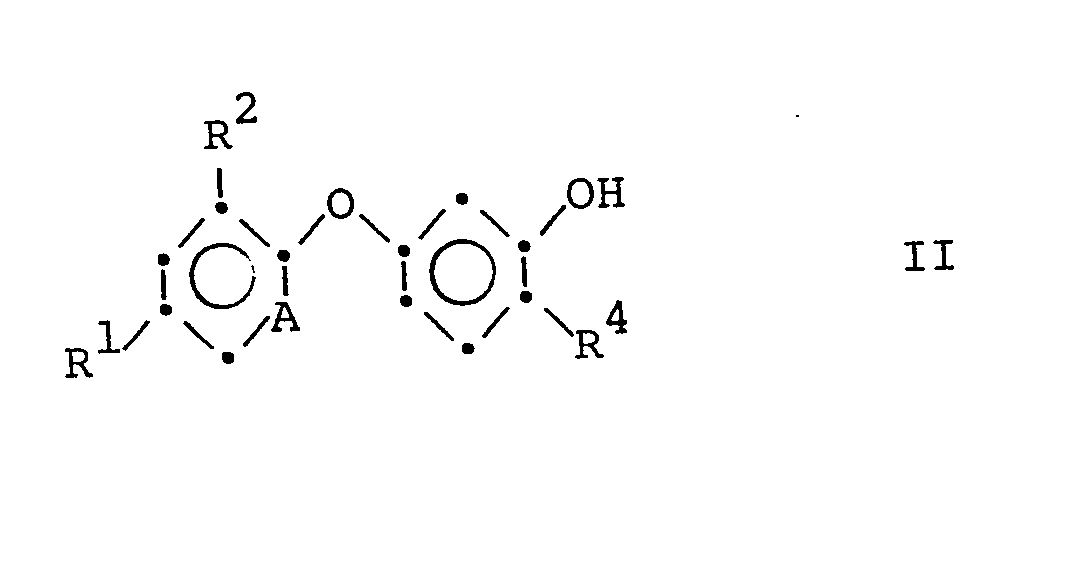
oder ein Alkalimetallsalz davon, mit einer Verbindung der allgemeinen Formel

und Q eine Abgangsgruppe bedeutet, umsetzt,

oder ein reaktionsfähiges Derivat davon, mit einer Verbindung der allgemeinen Formel


mit einem Metallnitrat behandelt oder

mit einem Alkohol der allgemeinen Formel

oder einem Alkalimetallsalz davon umsetzt.


sowie Formulierungshilfsstofe enthält.
ausgewählten Verbindung sowie Formulierungshilfsstoffe enthält.


dadurch gekennzeichnet, dass man

oder ein Alkalimetallsalz davon, mit einer Verbindung der allgemeinen Formel

und Q eine Abgangsgruppe bedeutet, umsetzt,

oder ein reaktionsfähiges Derivat davon, mit einer Verbindung der allgemeinen Formel


mit einem Metallnitrat behandelt oder
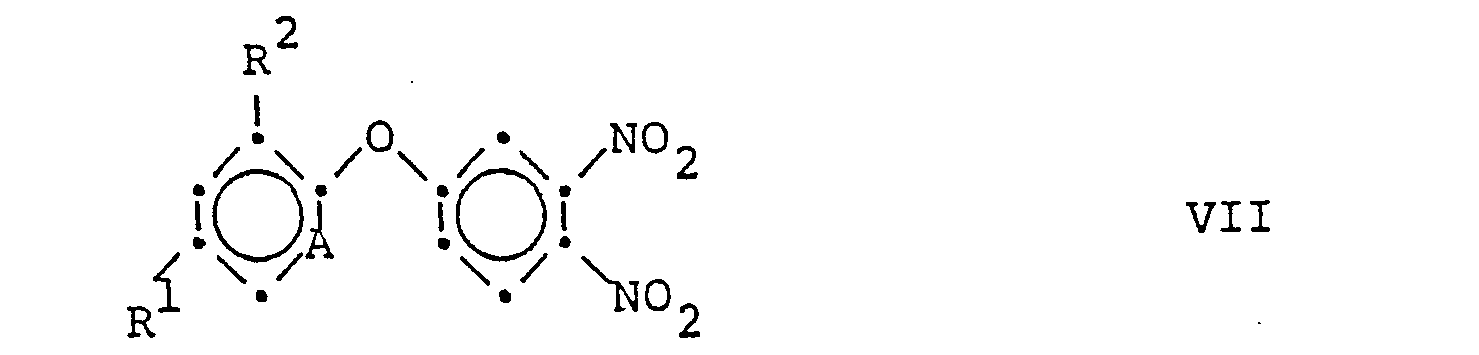
mit einem Alkohol der allgemeinen Formel

oder einem Alkalimetallsalz davon umsetzt.
Applications Claiming Priority (4)
| Application Number | Priority Date | Filing Date | Title |
|---|---|---|---|
| CH564883 | 1983-10-18 | ||
| CH5648/83 | 1983-10-18 | ||
| CH3946/84 | 1984-08-17 | ||
| CH394684 | 1984-08-17 |
Publications (2)
| Publication Number | Publication Date |
|---|---|
| EP0138183A2 true EP0138183A2 (de) | 1985-04-24 |
| EP0138183A3 EP0138183A3 (de) | 1988-02-17 |
Family
ID=25694255
Family Applications (1)
| Application Number | Title | Priority Date | Filing Date |
|---|---|---|---|
| EP84112038A Withdrawn EP0138183A3 (de) | 1983-10-18 | 1984-10-08 | Diaryläther und deren Verwendung als Unkrautbekämpfungsmittel |
Country Status (4)
| Country | Link |
|---|---|
| US (1) | US4792616A (de) |
| EP (1) | EP0138183A3 (de) |
| CA (1) | CA1249993A (de) |
| DK (1) | DK455684A (de) |
Cited By (1)
| Publication number | Priority date | Publication date | Assignee | Title |
|---|---|---|---|---|
| EP0384230A1 (de) * | 1989-02-23 | 1990-08-29 | Bayer Ag | Substituierte Phenoxyphenylpropionsäure-Derivate |
Families Citing this family (2)
| Publication number | Priority date | Publication date | Assignee | Title |
|---|---|---|---|---|
| US5194661A (en) * | 1990-08-20 | 1993-03-16 | Ici Americas Inc. | Substituted benzyl carbamates and their use as herbicides |
| US5363280A (en) * | 1993-04-22 | 1994-11-08 | International Business Machines Corporation | Printed circuit board or card thermal mass design |
Family Cites Families (10)
| Publication number | Priority date | Publication date | Assignee | Title |
|---|---|---|---|---|
| US3137563A (en) * | 1959-08-17 | 1964-06-16 | Hooker Chemical Corp | Treatment of trees |
| US3282991A (en) * | 1963-10-29 | 1966-11-01 | Tenneco Chem | Alkyldichlorobenzoic acids |
| US3325274A (en) * | 1965-08-13 | 1967-06-13 | Univ Iowa State Res Found Inc | Method of growing soybeans for seed yield |
| NZ181994A (en) * | 1975-09-27 | 1978-09-20 | Ishihara Sangyo Kaisha | (2-chloro-4-trifluorom-ethylphenoxy)-phenoxy acids,esters,ethers,amides and nitriles and herbicidal compositions |
| CH626318A5 (de) * | 1977-03-08 | 1981-11-13 | Ciba Geigy Ag | |
| EP0034120B1 (de) * | 1980-02-12 | 1983-12-14 | Ciba-Geigy Ag | Neue Phenoxy-phenoxy-carbonsäurederivate |
| NL8104076A (nl) * | 1980-09-23 | 1982-04-16 | Hoffmann La Roche | Carbaminezuurderivaten. |
| EP0054715A3 (de) * | 1980-12-18 | 1982-09-22 | F. HOFFMANN-LA ROCHE & CO. Aktiengesellschaft | Propionsäureester, Herstellung dieser Verbindungen, Unkrautbekämpfungsmittel, die diese Verbindungen als Wirkstoffe enthalten, sowie Verwendung solcher Verbindungen und Mittel zur Bekämpfung von Unkräutern |
| EP0078536A3 (de) * | 1981-11-02 | 1983-07-27 | Sandoz Ag | Phosphinate und Phosphonate und ihre Verwendung als Herbizide |
| JPS58150559A (ja) * | 1982-03-04 | 1983-09-07 | Sumitomo Chem Co Ltd | オキシムエ−テル誘導体、その製造法およびそれを有効成分として含有する殺虫剤 |
-
1984
- 1984-09-19 CA CA000463538A patent/CA1249993A/en not_active Expired
- 1984-09-24 DK DK455684A patent/DK455684A/da not_active Application Discontinuation
- 1984-10-08 EP EP84112038A patent/EP0138183A3/de not_active Withdrawn
-
1986
- 1986-04-17 US US06/853,113 patent/US4792616A/en not_active Expired - Fee Related
Cited By (2)
| Publication number | Priority date | Publication date | Assignee | Title |
|---|---|---|---|---|
| EP0384230A1 (de) * | 1989-02-23 | 1990-08-29 | Bayer Ag | Substituierte Phenoxyphenylpropionsäure-Derivate |
| US5117038A (en) * | 1989-02-23 | 1992-05-26 | Bayer Aktiengesellschaft | Herbicidal substituted phenoxyphenylpropionic acid derivatives |
Also Published As
| Publication number | Publication date |
|---|---|
| CA1249993A (en) | 1989-02-14 |
| EP0138183A3 (de) | 1988-02-17 |
| DK455684A (da) | 1985-04-19 |
| DK455684D0 (da) | 1984-09-24 |
| US4792616A (en) | 1988-12-20 |
Similar Documents
| Publication | Publication Date | Title |
|---|---|---|
| EP0436680B1 (de) | Heterocyclische verbindungen | |
| EP0323487B1 (de) | Heterocyclische verbindungen | |
| EP0344232B1 (de) | 3-Aryluracile zur Unkrautbekämpfung | |
| EP0002246A2 (de) | Oximester, diese enthaltende Unkrautbekämpfungsmittel, deren Verwendung als Unkrautbekämpfungsmittel sowie ein Verfahren zu deren Herstellung | |
| EP0248968A1 (de) | (R)-2-[4-(5-Chlor-3-fluorpyridin-2-yloxy)-phenoxy]-propionsäure-propinylester mit herbizider Wirkung | |
| EP0000023A1 (de) | Omega-substituierte Pentyl-harnstoff-Derivate, Verfahren zu ihrer Herstellung sowie ihre Verwendung als Fungizide | |
| EP0010673B1 (de) | Substituierte N-Propargyl-aniline, Verfahren zu ihrer Herstellung sowie ihre Verwendung als Fungizide | |
| EP0109575A2 (de) | Benzoesäurederivate, Verfahren und Mittel zu deren Herstellung | |
| EP0002812B1 (de) | Phenoxy-alkyl-oxazoline, ihre Herstellung, sie enthaltende Mittel sowie deren Verwendung als Herbizide | |
| DD210190A5 (de) | Herbizides mittel | |
| EP0054715A2 (de) | Propionsäureester, Herstellung dieser Verbindungen, Unkrautbekämpfungsmittel, die diese Verbindungen als Wirkstoffe enthalten, sowie Verwendung solcher Verbindungen und Mittel zur Bekämpfung von Unkräutern | |
| DE2905458A1 (de) | Ungesaettigte phenoxyphenoxyderivate, verfahren zur herstellung derselben und herbizide mittel mit einem gehalt derselben | |
| DE2733740A1 (de) | Cyclobutan-1-carboxylate, verfahren zu ihrer herstellung und ihre verwendung in der schaedlingsbekaempfung | |
| US4792616A (en) | Diaryl ethers | |
| CH618322A5 (de) | ||
| EP0001804B1 (de) | Beta-Naphthyl- und Beta-Tetrahydronaphthyl-phenyläther, Verfahren zu ihrer Herstellung und ihre Verwendung als herbizide Mittel | |
| EP0066771B1 (de) | 1-Iod-1-propin-3-ole, Verfahren zu ihrer Herstellung sowie ihre Verwendung als Pflanzenschutzmittel | |
| DE2804074A1 (de) | P-phenoxy-phenoxyalkancarbonsaeureester, verfahren zu ihrer herstellung und unkrautbekaempfungsmittel enthaltend diese stoffe | |
| EP0121871B1 (de) | Propionsäureester und deren Verwendung als Unkrautbekämpfungsmittel | |
| EP0035768A2 (de) | Oximester, Verfahren und Mittel zu deren Herstellung, ihre Verwendung, sowie diese Oximester enthaltende Mittel | |
| EP0113831A2 (de) | Carbaminsäureester, Verfahren zu deren Herstellung und deren Verwendung | |
| DE2507929C2 (de) | Silylierte Chloracetanilide, Verfahren zu deren Herstellung und Mittel zur Beeinflussung des Pflanzenwachstums | |
| US4250190A (en) | (O-(N-Methylcarbamoyl)-oxime)-(N,N,N-trialkylurea)-N,N-sulfide derivatives, processes for producing them, compositions containing these derivatives as active ingredients, and the use thereof for controlling insect pests | |
| DE2706127C2 (de) | Verwendung von Pyrimidin(5)yl-thiono-phosphor-(phosphon)-säureestern bzw. -esteramiden als Nematizide | |
| DE2535769A1 (de) | N-propargyl-anilinomethylenmalodinitril-derivate |
Legal Events
| Date | Code | Title | Description |
|---|---|---|---|
| PUAI | Public reference made under article 153(3) epc to a published international application that has entered the european phase |
Free format text: ORIGINAL CODE: 0009012 |
|
| 17P | Request for examination filed |
Effective date: 19841008 |
|
| AK | Designated contracting states |
Designated state(s): AT BE CH DE FR GB IT LI NL |
|
| RTI1 | Title (correction) | ||
| PUAL | Search report despatched |
Free format text: ORIGINAL CODE: 0009013 |
|
| AK | Designated contracting states |
Kind code of ref document: A3 Designated state(s): AT BE CH DE FR GB IT LI NL |
|
| RAP1 | Party data changed (applicant data changed or rights of an application transferred) |
Owner name: F. HOFFMANN-LA ROCHE AG |
|
| 17Q | First examination report despatched |
Effective date: 19900313 |
|
| STAA | Information on the status of an ep patent application or granted ep patent |
Free format text: STATUS: THE APPLICATION IS DEEMED TO BE WITHDRAWN |
|
| 18D | Application deemed to be withdrawn |
Effective date: 19900723 |
|
| RIN1 | Information on inventor provided before grant (corrected) |
Inventor name: WINTERNITZ, PAUL, DR. Inventor name: ZURFLUEH, RENE, DR. |