EP0138263A2 - Verfahren und Vorrichtung zum Behandeln und Entwollen von Häuten, sowie Bestandteile davon - Google Patents
Verfahren und Vorrichtung zum Behandeln und Entwollen von Häuten, sowie Bestandteile davon Download PDFInfo
- Publication number
- EP0138263A2 EP0138263A2 EP84201396A EP84201396A EP0138263A2 EP 0138263 A2 EP0138263 A2 EP 0138263A2 EP 84201396 A EP84201396 A EP 84201396A EP 84201396 A EP84201396 A EP 84201396A EP 0138263 A2 EP0138263 A2 EP 0138263A2
- Authority
- EP
- European Patent Office
- Prior art keywords
- skins
- tunnel
- wool
- skin
- treatment
- Prior art date
- Legal status (The legal status is an assumption and is not a legal conclusion. Google has not performed a legal analysis and makes no representation as to the accuracy of the status listed.)
- Granted
Links
Images



Classifications
-
- C—CHEMISTRY; METALLURGY
- C14—SKINS; HIDES; PELTS; LEATHER
- C14C—CHEMICAL TREATMENT OF HIDES, SKINS OR LEATHER, e.g. TANNING, IMPREGNATING, FINISHING; APPARATUS THEREFOR; COMPOSITIONS FOR TANNING
- C14C1/00—Chemical treatment prior to tanning
- C14C1/06—Facilitating unhairing, e.g. by painting, by liming
-
- C—CHEMISTRY; METALLURGY
- C14—SKINS; HIDES; PELTS; LEATHER
- C14C—CHEMICAL TREATMENT OF HIDES, SKINS OR LEATHER, e.g. TANNING, IMPREGNATING, FINISHING; APPARATUS THEREFOR; COMPOSITIONS FOR TANNING
- C14C1/00—Chemical treatment prior to tanning
-
- C—CHEMISTRY; METALLURGY
- C14—SKINS; HIDES; PELTS; LEATHER
- C14C—CHEMICAL TREATMENT OF HIDES, SKINS OR LEATHER, e.g. TANNING, IMPREGNATING, FINISHING; APPARATUS THEREFOR; COMPOSITIONS FOR TANNING
- C14C15/00—Apparatus for chemical treatment or washing of hides, skins, or leather
Definitions
- the invention relates to a method of treating the skins of sheep (or other similar species) with a view to separating the wool therefrom; it extends to a processing unit intended for the implementation of this method, as well as to new means constituting this unit.
- the stripping industries aim to treat the skins in order to produce, on the one hand, naked skins (sometimes called “tripe skins") intended for the manufacture of leathers in tanning, on the other hand, wool called to undergo different treatments until spinning.
- the preparation operations common to the two processes comprise a first quenching, carried out by stacking the skins one above the other and by immersing these stacks in quenching tanks, then a saberage operation, intended to remove the impurities contained in wool, finally, a second quenching, analogous to the first. These operations last approximately 48 hours.
- the second phase is carried out by a bacteriological fermentation process, the average duration of which is around 4 days.
- the duration of a stripping cycle, in this type of process is of the order of a week and this duration is one of the essential drawbacks of this process.
- the second phase consists of impregnating the flesh side of the skins with a solution based on sodium sulfide and stacking the skins on pallets, allowing them to remain in this way for approximately 8 to 12 hours in order to allow diffusion of the sulfide up to the flower side.
- This sulfide process thus has the advantage of significantly shortening the duration of the stripping cycle.
- the sulfide process has several serious drawbacks.
- the complete cycle which lasts about 60 hours remains long and it would be highly desirable to shorten it in order to make the materials more profitable and to reduce the necessary storage areas; in addition, the quality of the skins and wools obtained is generally poor and very irregular from one skin to another. Indeed, during the stay of the skins in the form of stacking on the pallets, the wool is inevitably soiled by the sulphide which causes a more or less accentuated degradation of the latter; moreover, the skins situated above each stack are subjected to a sulphide action of shorter duration than the skins situated below: the skins above are in fact the last placed on the stack and the first withdrawn.
- the present invention proposes to indicate a treatment method using sulphide as the known method but free from the abovementioned defects of this method.
- Another object of the invention is to reduce the personnel necessary for a given production, while making the work much less arduous for men.
- Another goal is to provide a uni treatment tee allowing an implementation of said process under the best profitability conditions.
- the quenching operation (a) can advantageously be carried out by stacking the skins flat in perforated cages, by causing each of said cages to pivot on itself in order to give the stack a vertical or inclined position, by placing said cages in at least one soaking basin, by supplying the latter with rinsing water, and by renewing this water several times.
- Such quenching has proven to be extremely effective, despite a period which can be limited to 24 hours and without having to use wetting products (which are generally used in known processes); the skins arranged in vertical (or inclined) positions delimit between them vertical or inclined spaces which are traversed by streams of water during evacuations and the intense circulation thus generated between skins causes them to be saturated much more quickly and a very efficient training of deposits.
- This produces a quality re-greening, in a single quenching step, the duration of which can be of the order of half that required for quenching in known processes.
- the quenching operation (a) can comprise between 2 and 4 water renewal and last approximately 24 hours.
- fresh salted skins will be used (and not dried skins).
- the saber operation (b) is an operation well known per se in the stripping industries and it is carried out continuously, in a traditional manner.
- a skinning operation (c) is new in the stripping processes.
- this operation which consists in removing the flesh side of the fragments of fat and flesh is carried out only in tanning on the tripe skins, once they have been stripped; in itself, the implementation of this operation is carried out as in tanning.
- the impregnation operation (d) can be carried out in a manner known per se, by placing each skin with its flesh side situated upwards and by spraying the sulphide solution in the form of fine drops above the water.
- the operation (e) is one of the essential originalities of the process of the invention and makes a large contribution to obtaining skins and wool of good quality; it also makes it possible to shorten the production cycle, its average duration being of the order of 3 hours (instead of approximately 10 hours for the homologous operation of the conventional process).
- This operation (e) is essentially characterized in that, on the one hand, the skins are treated individually by separating them from each other and in that, on the other hand, they are arranged in a specific atmosphere suitable for promoting the rapid and uniform diffusion of the sulfide, and this, for the same time for each skin, corresponding to the time necessary for the diffusion and attack of the hair root without blackening on the flower side or degradation of the wool.
- this operation (e) is carried out by introducing the skins into a tunnel containing a saturated atmosphere heated to a temperature of the order of 25 ° to 30 ° C, by causing each of said skins to circulate inside said tunnel between an inlet and an outlet thereof and by evacuating each skin at the end of its passage through said tunnel.
- the temperature and humidity conditions can be ensured by injecting water vapor along the tunnel, in several areas of the tunnel. under suitable conditions to heat the skins in the vicinity of up to the appropriate temperature and then to maintain the skins at said temperature up to the vicinity of the outlet.
- the stripping operation (f) is executed as soon as the skins leave the aforementioned tunnel, its implementation is in itself conventional.
- the wool rinsing operation (g) which immediately follows the stripping operation prevents the wool from remaining in contact with traces of sulphide, the degradation action caused by this body being very rapid.
- This rinsing operation can in particular be carried out in at least two rinsing tanks, at least one of which contains an aqueous bath added with hydrogen peroxide. This results in a radical elimination of all traces of sulphide, which then keeps the wool in good condition.
- the invention extends, as such, to a tunnel having the characteristics described above or which will be described below, in order to promote the diffusion of a liquid product in the heart of the skins.
- the unit shown by way of example in the figures enables the skinning of skins by a treatment cycle of duration of less than 1.5 days.
- the treatment is carried out on fresh skin.
- the unit is constituted, upstream, by means for soaking the skins M and, after soaking, by a continuous processing chain T.
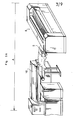
- the soaking means comprise quenching basins such as basin 1 shown diagrammatically in FIG. 2.
- This basin is frontally provided with a watertight door 2, with water supply means of conventional type (water pipes of suitable flow) and conventional discharge means (drain provided on the lower horizontal face).
- water supply means of conventional type (water pipes of suitable flow)
- conventional discharge means drain provided on the lower horizontal face.
- Such basins known per se in the stripping industry allow filling and evacuation in about twenty minutes.
- the skins to be soaked are arranged in several openwork cages such as 3 or 4; each cage of rectangular parallelepiped shape with an open face 3a of dimension adapted to introduce a flat skin as shown in FIG. 2.
- Each cage can contain a stack of approximately 130 skins.
- the cages are placed in abutment on the ground by their face opposite their open face and the skins are positioned flat in horizontal planes.
- Each cage has a member for closing its open face, in the example of the chains 5, and at the end of loading, these are hung so as to block the stacking and immobilize the skins.
- each cage On a face 3b adjacent to the open face 3a, each cage comprises gripping means making it possible to lift it and rotate it using a conventional rotary lifting device.
- four hollowed-out studs such as 6 are secured externally to the cage to allow the passage of a fork of a machine (the ends of which can be seen in broken lines in FIG. 2).
- the cage can thus be lifted and brought to pivot through 90 ° so as to come to rest in the basin 1 on the studs 6 of the face 3b, which act as support wedges.
- the skins are thus arranged vertically as illustrated for the cage 4 in FIG. 2.
- the basin 1 can contain several levels of cages, thanks to guide tips 7 which allow these to be superimposed.
- the dimensions of a basin can be adapted to contain 10 cages on two levels.
- the skins are then extracted from the basin and transported to the treatment chain T.
- the soaking means M will be located in the vicinity of the upstream part of the chain T (with the necessary handling areas) to shorten transfers.
- the treatment chain T is composed of several assemblies arranged one after the other, to allow continuous treatment of the skins.
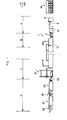
- this chain At its upstream part (FIG. 3a) this chain comprises a saber 8 of a type known per se, which clears the wool of the impurities which it may contain.
- the skins are taken up by a conveyor belt 9 whose width is less than that of the skins; these are thus arranged in a position suitable for facilitating the cutting of the tabs at the level of this mat.
- This carpet then brings the skins to a flail 10 of a type known per se in taverns.
- This machine which works on the flesh side rids the skins of the fragments of flesh and grease which adhere to it and provides a skin of uniform thickness, having a homogeneous surface state. flesh side.
- a sulphide impregnation machine 11 (generally designated by "enclicneuse”).
- This machine known in itself comprises a projection ramp which makes it possible to project a solution based on sulphide on the flesh side of each skin; for this purpose, the skin is constituted by parallel threads, placed on a carpet with its flesh side facing upwards, and passes below the projection ramp.
- the solution used is an aqueous solution containing a concentration of sodium sulfide approximately equal to 200 g / l; a percentage of lime can be added to this solution to improve the fixation of the sulfide on the skin.
- This tunnel is made up of an elongated rectangular paralleled cell whose length is in particular of the order of 40 m to 45 m. It is open, on the one hand, at its upstream end to form an inlet for the introduction and placement of the skins, on the other hand, at its downstream end, to form an opposite outlet for the removal of said skins after passage in the tunnel.
- the tunnel 12 comprises in the vicinity of its lateral flanks two endless chains with rollers such as 13, which are each guided by two toothed wheels such as 14, located in the vicinity of the entry and exit and, between them, by spars such that 15, on which roll the rollers 13a of the chains (FIG. 5).
- the two chains 13 located opposite thus form a conveyor having two superposed horizontal sections, a section descending at the level of the input wheels 14 and a section ascending at the level of the output wheels.
- transverse bars such as 16.
- These rectangular section bars with rounded edges are articulated in a swing, as illustrated in detail figure 5, so as to always keep the same orientation in space whatever the section along which they are.
- each bar is carried on each side by the chains 13 by means of suspension lugs 17 and pins 18 housed in the hollow links of the chains 13.
- the chains 13 are driven in a sequential movement by drive means 19 which are shown diagrammatically in FIG. 6.
- These means are in the example located on the side of the tunnel exit and include two synchronized hydraulic systems, mounted on both sides and on the other side of the tunnel outside of it, in the vicinity of its sides. These systems are suitable for sequentially rotating the transverse shaft 20 which carries the two wheels 14 for guiding the chains on the outlet side.
- the drive of the shaft located at the outlet is preferable, but, of course, it is also possible to provide the hydraulic drive systems on the side of the inlet).
- Each hydraulic system comprises a hydraulic jack 21 whose body is articulated on a fixed support, and the movable rod on flanges 22 articulated around an axis 23.
- These flanges 22 carry a pawl 24 which is arranged to cooperate with a wheel with ratchet 25 mounted in rotation with the shaft 20.
- the hydraulic jacks 21 located on each side of the tunnel are driven by a hydraulic unit and equipped with synchronization conditioning their synchronous operation; control means of conventional type make it possible to adjust the operation of the jacks so as to be able to adjust the average speed of the chains and the duration of the downtimes.
- Such hydraulic means are perfectly suited to the drive of chains 13 and their bars 16 because of the very high torque that they can develop, while benefiting from great structural simplicity (simple and inexpensive mechanical means, hydraulic power station of current type).
- the tunnel 12 contains at least one washing tank 26, which is disposed at the level of the horizontal return section of the conveyor (in the example located above the outbound leg).
- This tank 26 is provided with water inlet and outlet pipes allowing water to circulate therein. It is arranged so that the transverse bars 16 plunge into it during their journey along said return section.
- the bars 16 mounted in a swing swivel upwards in contact with them then come either to plunge into the tank or to extract from it; the edges of the tank have a suitable shape to favor the passage of the bars without jamming.
- the tunnel 12 is equipped with several vapor injection ramps such as 27 which each extend transversely at the bottom of said tunnel and allow the internal atmosphere of the latter to be saturated with moisture and to be adjusted the temperature precisely.
- These ramps are distributed in several zones along the tunnel; a ramp 27 is located in the vicinity of the entrance to the tunnel, its section being greater than that of the other ramps so as to be able to inject a flow of steam, capable of causing the skins to heat up to a temperature of 25 to 30 ° C.
- the other ramps are distributed with appropriate flow rates depending on their position so as to maintain the skins at this temperature.
- Flow distribution means (symbolized by valves such as 28) make it possible to supply the ramps with steam with the appropriate flow rates.
- the tunnel 12 is provided with suction means 29 and 30 which open in the vicinity of the entrance and exit of the tunnel in order to suck in steam at this level in order to reduce losses to the outside via said entry and exit.
- suction means 29 and 30 consist of hoods located above the inlet and outlet and by suction ducts allowing recycling of the sucked steam.
- each skin is individually arranged on a transverse bar 16, after folding in two on itself.
- Figures 8a, 8b, 8c illustrate this operation: at the outlet of the casing machine 11, each skin is folded by an operator, along a line folding along the spine of the skin, so that the flesh side is located inside and the flower side is outside ( Figures 8a and 8b); each skin is then suspended astride a bar 16.
- the length of these bars can be of the order of 4.2 m, so as to allow the placement of 8 skins close to each other.
- the skins are subjected to a stripping operation on a stripping machine 31 of the traditional type, which separates the wool from it. It has been found experimentally that this work is of easy execution without risk of damage to the skins, taking into account the operations of prior preparation.
- the tripe skins, ready to enter the tavern are removed in carriages 32, while the wool is conveyed to the rinsing on a conveyor belt 33.
- the wool is introduced into a first rinsing tank 34 of a type known in itself, where it is rinsed with large amounts of water (FIG. 3D)
- a wringer 35 After wringing by means of a wringer 35, it is introduced by a conveyor belt 36 in a second rinsing tank 37 containing an aqueous bath supplemented with hydrogen peroxide, with a concentration which can be between 4 and 20 g of hydrogen peroxide per liter of water.
- the wool which is in good condition without any trace of sulphide, can be conveyed to the subsequent traditional treatment operations.
- the assemblies likely to be in contact with the sulphide solution are made of anti-corrosion material, such as stainless steel (tunnel and internal organs, rinsing tanks).
Landscapes
- Chemical & Material Sciences (AREA)
- Chemical Kinetics & Catalysis (AREA)
- General Chemical & Material Sciences (AREA)
- Organic Chemistry (AREA)
- Treatment Of Fiber Materials (AREA)
- Chemical Or Physical Treatment Of Fibers (AREA)
- Coloring (AREA)
- Meat, Egg Or Seafood Products (AREA)
Applications Claiming Priority (2)
| Application Number | Priority Date | Filing Date | Title |
|---|---|---|---|
| FR8316845A FR2553433B1 (fr) | 1983-10-18 | 1983-10-18 | Procede et unite de traitement de peaux en vue d'en separer la laine, et moyens constitutifs |
| FR8316845 | 1983-10-18 |
Publications (3)
| Publication Number | Publication Date |
|---|---|
| EP0138263A2 true EP0138263A2 (de) | 1985-04-24 |
| EP0138263A3 EP0138263A3 (de) | 1985-05-22 |
| EP0138263B1 EP0138263B1 (de) | 1986-12-30 |
Family
ID=9293408
Family Applications (1)
| Application Number | Title | Priority Date | Filing Date |
|---|---|---|---|
| EP84201396A Expired EP0138263B1 (de) | 1983-10-18 | 1984-10-02 | Verfahren und Vorrichtung zum Behandeln und Entwollen von Häuten, sowie Bestandteile davon |
Country Status (7)
| Country | Link |
|---|---|
| US (1) | US4670016A (de) |
| EP (1) | EP0138263B1 (de) |
| AU (1) | AU571590B2 (de) |
| DE (1) | DE3461832D1 (de) |
| ES (1) | ES8605864A1 (de) |
| FR (1) | FR2553433B1 (de) |
| NZ (1) | NZ209860A (de) |
Family Cites Families (7)
| Publication number | Priority date | Publication date | Assignee | Title |
|---|---|---|---|---|
| US48578A (en) * | 1865-07-04 | Improved apparatus for liming hides | ||
| US519345A (en) * | 1894-05-08 | Cecils laurepuech | ||
| US2346907A (en) * | 1942-05-22 | 1944-04-18 | Ind Patents Corp | Skins and method of dehairing |
| FR1395692A (fr) * | 1964-03-03 | 1965-04-16 | Procédé et dispositif pour le délainage ou l'épilage en continu des peaux animales | |
| US3582254A (en) * | 1969-04-16 | 1971-06-01 | Gillette Co | Unhairing hides |
| FR2082408A5 (en) * | 1970-03-13 | 1971-12-10 | Rives Philippe Ets | Sheep and goat hair removal |
| AU7215281A (en) * | 1980-06-30 | 1982-01-07 | Commonwealth Industrial Gases Limited, The | Fibre recovery from hides |
-
1983
- 1983-10-18 FR FR8316845A patent/FR2553433B1/fr not_active Expired
-
1984
- 1984-10-02 DE DE8484201396T patent/DE3461832D1/de not_active Expired
- 1984-10-02 EP EP84201396A patent/EP0138263B1/de not_active Expired
- 1984-10-12 NZ NZ209860A patent/NZ209860A/en unknown
- 1984-10-16 AU AU34283/84A patent/AU571590B2/en not_active Ceased
- 1984-10-17 US US06/661,720 patent/US4670016A/en not_active Expired - Fee Related
- 1984-10-17 ES ES536804A patent/ES8605864A1/es not_active Expired
Also Published As
| Publication number | Publication date |
|---|---|
| NZ209860A (en) | 1987-03-31 |
| ES536804A0 (es) | 1986-04-16 |
| AU3428384A (en) | 1985-04-26 |
| AU571590B2 (en) | 1988-04-21 |
| DE3461832D1 (en) | 1987-02-05 |
| EP0138263B1 (de) | 1986-12-30 |
| FR2553433A1 (fr) | 1985-04-19 |
| FR2553433B1 (fr) | 1986-02-21 |
| EP0138263A3 (de) | 1985-05-22 |
| US4670016A (en) | 1987-06-02 |
| ES8605864A1 (es) | 1986-04-16 |
Similar Documents
| Publication | Publication Date | Title |
|---|---|---|
| EP2064373A2 (de) | Ausrüstung zur oberflächenbehandlung von objekten durch eintauchen in eine prozessflüssigkeit | |
| FR2618938A1 (fr) | Appareil et procede pour traiter l'interieur de tubes, notamment de tubes de barres de combustible nucleaire | |
| EP2643486B1 (de) | Gerät für die behandlung und/oder das gerben von tierhäuten oder textilien | |
| EP0138263B1 (de) | Verfahren und Vorrichtung zum Behandeln und Entwollen von Häuten, sowie Bestandteile davon | |
| FR2467255A1 (fr) | Merceriseuse sans chaine comportant un foulard | |
| KR102322741B1 (ko) | 배 얼룩과 방제장치 | |
| EP0587515B1 (de) | Verfahren und Vorrichtung zum Salzen-Trocknen und zum Kalträuchern von Fleisch-Nahrungsmittelprodukten | |
| FR2541091A1 (fr) | Procede de nettoyage notamment destine a des produits alimentaires ainsi que dispositif permettant la mise en oeuvre de ce procede | |
| FR2618775A1 (fr) | Procede et dispositif pour le traitement de la surface exterieure de recipients, notamment pour le depolissage de recipients en verre | |
| US1310662A (en) | Canada | |
| US2822842A (en) | Tomato treating machine | |
| JP2001121092A (ja) | たばこ裁刻機給送チェンの洗浄装置 | |
| JPS6440661A (en) | Method for cleaning roll of hot flue | |
| BE1019582A5 (fr) | Dispositif et procede pour le traitement et le tannage de peaux et procede associe. | |
| EP0795271A1 (de) | Verfahren und Vorrichtung zur Entwasserung und/oder Impraegnierung von Nahrungsmitteln mittels duschen | |
| FR2989555A1 (fr) | Installation pour aseptiser l'enveloppe d'un produit alimentaire en pain | |
| JPH0427479A (ja) | 軸受け洗浄装置 | |
| KR102179053B1 (ko) | 다단 스퀴징 롤러를 이용한 부직포 연속 처리 시스템 및 방법 | |
| JP4549015B2 (ja) | 対象物をガス処理する方法対象物をガス処理する反応装置 | |
| FR2711146A1 (fr) | Installation et procédé de traitement en continu des peaux ou cuirs dans un liquide. | |
| FR2691327A1 (fr) | Appareil mobile de lavage et de traitement automatique des grilles de panification. | |
| FR2691050A1 (fr) | Procédé de traitement en continu d'une matière particulaire par un liquide, en particulier pour blanchir des champignons, et dispositif pour la mise en Óoeuvre de ce procédé. | |
| FR2531318A1 (fr) | Procede et installation pour le salage des fromages | |
| FR2977764A1 (fr) | Installation pour la realisation d'un echaudage d'au moins une carcasse animale et procede mettant en oeuvre une telle installation | |
| EP0108027A1 (de) | Verfahren und Einrichtung zum Glänzen von Glasgegenständen |
Legal Events
| Date | Code | Title | Description |
|---|---|---|---|
| PUAI | Public reference made under article 153(3) epc to a published international application that has entered the european phase |
Free format text: ORIGINAL CODE: 0009012 |
|
| PUAL | Search report despatched |
Free format text: ORIGINAL CODE: 0009013 |
|
| AK | Designated contracting states |
Designated state(s): BE DE GB IT NL |
|
| AK | Designated contracting states |
Designated state(s): BE DE GB IT NL |
|
| RTI1 | Title (correction) | ||
| 17P | Request for examination filed |
Effective date: 19850930 |
|
| 17Q | First examination report despatched |
Effective date: 19860506 |
|
| GRAA | (expected) grant |
Free format text: ORIGINAL CODE: 0009210 |
|
| AK | Designated contracting states |
Kind code of ref document: B1 Designated state(s): BE DE GB IT NL |
|
| REF | Corresponds to: |
Ref document number: 3461832 Country of ref document: DE Date of ref document: 19870205 |
|
| ITF | It: translation for a ep patent filed | ||
| PLBE | No opposition filed within time limit |
Free format text: ORIGINAL CODE: 0009261 |
|
| STAA | Information on the status of an ep patent application or granted ep patent |
Free format text: STATUS: NO OPPOSITION FILED WITHIN TIME LIMIT |
|
| 26N | No opposition filed | ||
| REG | Reference to a national code |
Ref country code: GB Ref legal event code: 732 |
|
| NLS | Nl: assignments of ep-patents |
Owner name: LA MOLE-INDUSTRIES S.A. TE MAZAMET, FRANKRIJK. |
|
| ITPR | It: changes in ownership of a european patent |
Owner name: CESSIONE;LA MOLE - INDUSTRIES S.A. |
|
| PGFP | Annual fee paid to national office [announced via postgrant information from national office to epo] |
Ref country code: BE Payment date: 19891004 Year of fee payment: 6 |
|
| PGFP | Annual fee paid to national office [announced via postgrant information from national office to epo] |
Ref country code: NL Payment date: 19891031 Year of fee payment: 6 |
|
| PGFP | Annual fee paid to national office [announced via postgrant information from national office to epo] |
Ref country code: DE Payment date: 19891214 Year of fee payment: 6 |
|
| PGFP | Annual fee paid to national office [announced via postgrant information from national office to epo] |
Ref country code: GB Payment date: 19901001 Year of fee payment: 7 |
|
| PG25 | Lapsed in a contracting state [announced via postgrant information from national office to epo] |
Ref country code: BE Effective date: 19901031 |
|
| BERE | Be: lapsed |
Owner name: LA MOLE INDUSTRIES S.A. Effective date: 19901031 |
|
| PG25 | Lapsed in a contracting state [announced via postgrant information from national office to epo] |
Ref country code: NL Effective date: 19910501 |
|
| NLV4 | Nl: lapsed or anulled due to non-payment of the annual fee | ||
| PG25 | Lapsed in a contracting state [announced via postgrant information from national office to epo] |
Ref country code: DE Effective date: 19910702 |
|
| PG25 | Lapsed in a contracting state [announced via postgrant information from national office to epo] |
Ref country code: GB Effective date: 19911002 |
|
| GBPC | Gb: european patent ceased through non-payment of renewal fee |