EP0138761A2 - Verfahren zum Pigmentieren von hochmolekularem organischem Material - Google Patents
Verfahren zum Pigmentieren von hochmolekularem organischem Material Download PDFInfo
- Publication number
- EP0138761A2 EP0138761A2 EP84810437A EP84810437A EP0138761A2 EP 0138761 A2 EP0138761 A2 EP 0138761A2 EP 84810437 A EP84810437 A EP 84810437A EP 84810437 A EP84810437 A EP 84810437A EP 0138761 A2 EP0138761 A2 EP 0138761A2
- Authority
- EP
- European Patent Office
- Prior art keywords
- amino
- formula
- methyl
- parts
- groups
- Prior art date
- Legal status (The legal status is an assumption and is not a legal conclusion. Google has not performed a legal analysis and makes no representation as to the accuracy of the status listed.)
- Granted
Links
- 238000000034 method Methods 0.000 title claims abstract description 12
- 239000011368 organic material Substances 0.000 title claims abstract description 6
- 230000008569 process Effects 0.000 title claims abstract description 6
- 230000019612 pigmentation Effects 0.000 title description 2
- -1 monoazo compound Chemical class 0.000 claims abstract description 49
- 239000000049 pigment Substances 0.000 claims abstract description 30
- 125000005843 halogen group Chemical group 0.000 claims abstract description 18
- 125000002496 methyl group Chemical group [H]C([H])([H])* 0.000 claims abstract description 13
- 125000003545 alkoxy group Chemical group 0.000 claims abstract description 11
- 125000004435 hydrogen atom Chemical group [H]* 0.000 claims abstract description 5
- 125000001931 aliphatic group Chemical group 0.000 claims abstract description 4
- 230000000485 pigmenting effect Effects 0.000 claims abstract description 3
- UHOVQNZJYSORNB-UHFFFAOYSA-N monobenzene Natural products C1=CC=CC=C1 UHOVQNZJYSORNB-UHFFFAOYSA-N 0.000 claims description 18
- 125000004432 carbon atom Chemical group C* 0.000 claims description 15
- 125000000217 alkyl group Chemical group 0.000 claims description 13
- NYGZLYXAPMMJTE-UHFFFAOYSA-M metanil yellow Chemical group [Na+].[O-]S(=O)(=O)C1=CC=CC(N=NC=2C=CC(NC=3C=CC=CC=3)=CC=2)=C1 NYGZLYXAPMMJTE-UHFFFAOYSA-M 0.000 claims description 8
- KRVAVIMTIIEASB-UHFFFAOYSA-N n-(1,3-benzothiazol-2-yl)-3-oxobutanamide Chemical compound C1=CC=C2SC(NC(=O)CC(=O)C)=NC2=C1 KRVAVIMTIIEASB-UHFFFAOYSA-N 0.000 claims description 5
- UFHFLCQGNIYNRP-UHFFFAOYSA-N Hydrogen Chemical compound [H][H] UFHFLCQGNIYNRP-UHFFFAOYSA-N 0.000 claims description 4
- 229910052739 hydrogen Inorganic materials 0.000 claims description 4
- 239000001257 hydrogen Substances 0.000 claims description 4
- 125000000449 nitro group Chemical group [O-][N+](*)=O 0.000 claims description 4
- 238000002360 preparation method Methods 0.000 claims description 4
- 125000002023 trifluoromethyl group Chemical group FC(F)(F)* 0.000 claims description 4
- CIUQDSCDWFSTQR-UHFFFAOYSA-N [C]1=CC=CC=C1 Chemical group [C]1=CC=CC=C1 CIUQDSCDWFSTQR-UHFFFAOYSA-N 0.000 claims description 3
- 125000004453 alkoxycarbonyl group Chemical group 0.000 claims description 3
- 125000005138 alkoxysulfonyl group Chemical group 0.000 claims description 3
- 125000004390 alkyl sulfonyl group Chemical group 0.000 claims description 3
- 125000004397 aminosulfonyl group Chemical group NS(=O)(=O)* 0.000 claims description 3
- 125000003236 benzoyl group Chemical group [H]C1=C([H])C([H])=C(C([H])=C1[H])C(*)=O 0.000 claims description 3
- 125000006678 phenoxycarbonyl group Chemical group 0.000 claims description 3
- NGNBDVOYPDDBFK-UHFFFAOYSA-N 2-[2,4-di(pentan-2-yl)phenoxy]acetyl chloride Chemical compound CCCC(C)C1=CC=C(OCC(Cl)=O)C(C(C)CCC)=C1 NGNBDVOYPDDBFK-UHFFFAOYSA-N 0.000 claims description 2
- 150000008065 acid anhydrides Chemical class 0.000 claims description 2
- 125000005153 alkyl sulfamoyl group Chemical group 0.000 claims description 2
- 125000001589 carboacyl group Chemical group 0.000 claims description 2
- 125000000951 phenoxy group Chemical group [H]C1=C([H])C([H])=C(O*)C([H])=C1[H] 0.000 claims description 2
- 125000003170 phenylsulfonyl group Chemical group C1(=CC=CC=C1)S(=O)(=O)* 0.000 claims description 2
- 239000004922 lacquer Substances 0.000 abstract description 10
- 230000005012 migration Effects 0.000 abstract description 4
- 238000013508 migration Methods 0.000 abstract description 4
- 239000000835 fiber Substances 0.000 abstract description 3
- 229920003023 plastic Polymers 0.000 abstract description 3
- 239000004033 plastic Substances 0.000 abstract description 3
- 238000004043 dyeing Methods 0.000 abstract description 2
- QTBSBXVTEAMEQO-UHFFFAOYSA-N Acetic acid Chemical compound CC(O)=O QTBSBXVTEAMEQO-UHFFFAOYSA-N 0.000 description 25
- 239000000243 solution Substances 0.000 description 19
- OKKJLVBELUTLKV-UHFFFAOYSA-N Methanol Chemical compound OC OKKJLVBELUTLKV-UHFFFAOYSA-N 0.000 description 15
- RFFLAFLAYFXFSW-UHFFFAOYSA-N 1,2-dichlorobenzene Chemical compound ClC1=CC=CC=C1Cl RFFLAFLAYFXFSW-UHFFFAOYSA-N 0.000 description 13
- XLYOFNOQVPJJNP-UHFFFAOYSA-N water Chemical compound O XLYOFNOQVPJJNP-UHFFFAOYSA-N 0.000 description 13
- 239000000047 product Substances 0.000 description 12
- 239000005711 Benzoic acid Substances 0.000 description 11
- 239000000843 powder Substances 0.000 description 10
- LFQSCWFLJHTTHZ-UHFFFAOYSA-N Ethanol Chemical compound CCO LFQSCWFLJHTTHZ-UHFFFAOYSA-N 0.000 description 9
- ZMXDDKWLCZADIW-UHFFFAOYSA-N N,N-Dimethylformamide Chemical compound CN(C)C=O ZMXDDKWLCZADIW-UHFFFAOYSA-N 0.000 description 9
- 239000000975 dye Substances 0.000 description 9
- 239000000203 mixture Substances 0.000 description 9
- YXFVVABEGXRONW-UHFFFAOYSA-N Toluene Chemical compound CC1=CC=CC=C1 YXFVVABEGXRONW-UHFFFAOYSA-N 0.000 description 8
- 229960000583 acetic acid Drugs 0.000 description 8
- 230000008878 coupling Effects 0.000 description 8
- 238000010168 coupling process Methods 0.000 description 8
- 238000005859 coupling reaction Methods 0.000 description 8
- 239000000725 suspension Substances 0.000 description 8
- KFZMGEQAYNKOFK-UHFFFAOYSA-N Isopropanol Chemical compound CC(C)O KFZMGEQAYNKOFK-UHFFFAOYSA-N 0.000 description 7
- CTQNGGLPUBDAKN-UHFFFAOYSA-N O-Xylene Chemical compound CC1=CC=CC=C1C CTQNGGLPUBDAKN-UHFFFAOYSA-N 0.000 description 7
- 235000011054 acetic acid Nutrition 0.000 description 7
- 150000001875 compounds Chemical class 0.000 description 7
- 239000008096 xylene Substances 0.000 description 7
- WSFSSNUMVMOOMR-UHFFFAOYSA-N Formaldehyde Chemical compound O=C WSFSSNUMVMOOMR-UHFFFAOYSA-N 0.000 description 6
- 229920000877 Melamine resin Polymers 0.000 description 6
- LRHPLDYGYMQRHN-UHFFFAOYSA-N N-Butanol Chemical compound CCCCO LRHPLDYGYMQRHN-UHFFFAOYSA-N 0.000 description 6
- HEMHJVSKTPXQMS-UHFFFAOYSA-M Sodium hydroxide Chemical compound [OH-].[Na+] HEMHJVSKTPXQMS-UHFFFAOYSA-M 0.000 description 6
- 150000001412 amines Chemical class 0.000 description 6
- 239000011248 coating agent Substances 0.000 description 6
- 238000000576 coating method Methods 0.000 description 6
- 238000002844 melting Methods 0.000 description 6
- 230000008018 melting Effects 0.000 description 6
- NHICDHRWQLIKIS-UHFFFAOYSA-N n-(6-acetamido-1,3-benzothiazol-2-yl)-3-oxobutanamide Chemical compound C1=C(NC(C)=O)C=C2SC(NC(=O)CC(=O)C)=NC2=C1 NHICDHRWQLIKIS-UHFFFAOYSA-N 0.000 description 6
- 239000003960 organic solvent Substances 0.000 description 6
- 229920005989 resin Polymers 0.000 description 6
- 239000011347 resin Substances 0.000 description 6
- GWEVSGVZZGPLCZ-UHFFFAOYSA-N Titan oxide Chemical compound O=[Ti]=O GWEVSGVZZGPLCZ-UHFFFAOYSA-N 0.000 description 5
- XSQUKJJJFZCRTK-UHFFFAOYSA-N Urea Chemical compound NC(N)=O XSQUKJJJFZCRTK-UHFFFAOYSA-N 0.000 description 5
- MVPPADPHJFYWMZ-UHFFFAOYSA-N chlorobenzene Chemical compound ClC1=CC=CC=C1 MVPPADPHJFYWMZ-UHFFFAOYSA-N 0.000 description 5
- WASQWSOJHCZDFK-UHFFFAOYSA-N diketene Chemical compound C=C1CC(=O)O1 WASQWSOJHCZDFK-UHFFFAOYSA-N 0.000 description 5
- 235000019441 ethanol Nutrition 0.000 description 5
- 239000000155 melt Substances 0.000 description 5
- LQNUZADURLCDLV-UHFFFAOYSA-N nitrobenzene Chemical compound [O-][N+](=O)C1=CC=CC=C1 LQNUZADURLCDLV-UHFFFAOYSA-N 0.000 description 5
- 239000004800 polyvinyl chloride Substances 0.000 description 5
- 229920000915 polyvinyl chloride Polymers 0.000 description 5
- AVYGCQXNNJPXSS-UHFFFAOYSA-N 2,5-dichloroaniline Chemical compound NC1=CC(Cl)=CC=C1Cl AVYGCQXNNJPXSS-UHFFFAOYSA-N 0.000 description 4
- CSCPPACGZOOCGX-UHFFFAOYSA-N Acetone Chemical compound CC(C)=O CSCPPACGZOOCGX-UHFFFAOYSA-N 0.000 description 4
- PAYRUJLWNCNPSJ-UHFFFAOYSA-N Aniline Chemical compound NC1=CC=CC=C1 PAYRUJLWNCNPSJ-UHFFFAOYSA-N 0.000 description 4
- JUJWROOIHBZHMG-UHFFFAOYSA-N Pyridine Chemical compound C1=CC=NC=C1 JUJWROOIHBZHMG-UHFFFAOYSA-N 0.000 description 4
- 229920001807 Urea-formaldehyde Polymers 0.000 description 4
- JHIVVAPYMSGYDF-UHFFFAOYSA-N cyclohexanone Chemical compound O=C1CCCCC1 JHIVVAPYMSGYDF-UHFFFAOYSA-N 0.000 description 4
- 150000002148 esters Chemical class 0.000 description 4
- 239000012065 filter cake Substances 0.000 description 4
- 238000000227 grinding Methods 0.000 description 4
- 125000001997 phenyl group Chemical group [H]C1=C([H])C([H])=C(*)C([H])=C1[H] 0.000 description 4
- 239000002244 precipitate Substances 0.000 description 4
- YZVWKHVRBDQPMQ-UHFFFAOYSA-N 1-aminopyrene Chemical compound C1=C2C(N)=CC=C(C=C3)C2=C2C3=CC=CC2=C1 YZVWKHVRBDQPMQ-UHFFFAOYSA-N 0.000 description 3
- CZZZABOKJQXEBO-UHFFFAOYSA-N 2,4-dimethylaniline Chemical compound CC1=CC=C(N)C(C)=C1 CZZZABOKJQXEBO-UHFFFAOYSA-N 0.000 description 3
- ZWEHNKRNPOVVGH-UHFFFAOYSA-N 2-Butanone Chemical compound CCC(C)=O ZWEHNKRNPOVVGH-UHFFFAOYSA-N 0.000 description 3
- ZUVPLKVDZNDZCM-UHFFFAOYSA-N 3-chloro-2-methylaniline Chemical compound CC1=C(N)C=CC=C1Cl ZUVPLKVDZNDZCM-UHFFFAOYSA-N 0.000 description 3
- CXNVOWPRHWWCQR-UHFFFAOYSA-N 4-Chloro-ortho-toluidine Chemical compound CC1=CC(Cl)=CC=C1N CXNVOWPRHWWCQR-UHFFFAOYSA-N 0.000 description 3
- WFDIJRYMOXRFFG-UHFFFAOYSA-N Acetic anhydride Chemical compound CC(=O)OC(C)=O WFDIJRYMOXRFFG-UHFFFAOYSA-N 0.000 description 3
- KXDAEFPNCMNJSK-UHFFFAOYSA-N Benzamide Chemical compound NC(=O)C1=CC=CC=C1 KXDAEFPNCMNJSK-UHFFFAOYSA-N 0.000 description 3
- ZMANZCXQSJIPKH-UHFFFAOYSA-N Triethylamine Chemical compound CCN(CC)CC ZMANZCXQSJIPKH-UHFFFAOYSA-N 0.000 description 3
- 229920000180 alkyd Polymers 0.000 description 3
- 150000001448 anilines Chemical class 0.000 description 3
- 125000001309 chloro group Chemical group Cl* 0.000 description 3
- 239000003086 colorant Substances 0.000 description 3
- 125000000664 diazo group Chemical group [N-]=[N+]=[*] 0.000 description 3
- 238000001035 drying Methods 0.000 description 3
- 238000000465 moulding Methods 0.000 description 3
- PUVDPNAHFVWWJW-UHFFFAOYSA-N n-(6-nitro-1,3-benzothiazol-2-yl)-3-oxobutanamide Chemical compound C1=C([N+]([O-])=O)C=C2SC(NC(=O)CC(=O)C)=NC2=C1 PUVDPNAHFVWWJW-UHFFFAOYSA-N 0.000 description 3
- RZXMPPFPUUCRFN-UHFFFAOYSA-N p-toluidine Chemical compound CC1=CC=C(N)C=C1 RZXMPPFPUUCRFN-UHFFFAOYSA-N 0.000 description 3
- 239000004014 plasticizer Substances 0.000 description 3
- 238000006068 polycondensation reaction Methods 0.000 description 3
- 150000003839 salts Chemical class 0.000 description 3
- 238000005507 spraying Methods 0.000 description 3
- VZGDMQKNWNREIO-UHFFFAOYSA-N tetrachloromethane Chemical compound ClC(Cl)(Cl)Cl VZGDMQKNWNREIO-UHFFFAOYSA-N 0.000 description 3
- KHUFHLFHOQVFGB-UHFFFAOYSA-N 1-aminoanthracene-9,10-dione Chemical compound O=C1C2=CC=CC=C2C(=O)C2=C1C=CC=C2N KHUFHLFHOQVFGB-UHFFFAOYSA-N 0.000 description 2
- GUMCAKKKNKYFEB-UHFFFAOYSA-N 2,4,5-trichloroaniline Chemical compound NC1=CC(Cl)=C(Cl)C=C1Cl GUMCAKKKNKYFEB-UHFFFAOYSA-N 0.000 description 2
- NATVSFWWYVJTAZ-UHFFFAOYSA-N 2,4,6-trichloroaniline Chemical compound NC1=C(Cl)C=C(Cl)C=C1Cl NATVSFWWYVJTAZ-UHFFFAOYSA-N 0.000 description 2
- KQCMTOWTPBNWDB-UHFFFAOYSA-N 2,4-dichloroaniline Chemical compound NC1=CC=C(Cl)C=C1Cl KQCMTOWTPBNWDB-UHFFFAOYSA-N 0.000 description 2
- MCRYBELDVGNCFW-UHFFFAOYSA-N 2,4-dimethyl-3-nitroaniline Chemical compound CC1=CC=C(N)C(C)=C1[N+]([O-])=O MCRYBELDVGNCFW-UHFFFAOYSA-N 0.000 description 2
- JDMFXJULNGEPOI-UHFFFAOYSA-N 2,6-dichloroaniline Chemical compound NC1=C(Cl)C=CC=C1Cl JDMFXJULNGEPOI-UHFFFAOYSA-N 0.000 description 2
- PXBFMLJZNCDSMP-UHFFFAOYSA-N 2-Aminobenzamide Chemical class NC(=O)C1=CC=CC=C1N PXBFMLJZNCDSMP-UHFFFAOYSA-N 0.000 description 2
- XNWFRZJHXBZDAG-UHFFFAOYSA-N 2-METHOXYETHANOL Chemical compound COCCO XNWFRZJHXBZDAG-UHFFFAOYSA-N 0.000 description 2
- NIXOWILDQLNWCW-UHFFFAOYSA-N 2-Propenoic acid Natural products OC(=O)C=C NIXOWILDQLNWCW-UHFFFAOYSA-N 0.000 description 2
- LOCWBQIWHWIRGN-UHFFFAOYSA-N 2-chloro-4-nitroaniline Chemical compound NC1=CC=C([N+]([O-])=O)C=C1Cl LOCWBQIWHWIRGN-UHFFFAOYSA-N 0.000 description 2
- VKTTYIXIDXWHKW-UHFFFAOYSA-N 2-chloro-5-(trifluoromethyl)aniline Chemical compound NC1=CC(C(F)(F)F)=CC=C1Cl VKTTYIXIDXWHKW-UHFFFAOYSA-N 0.000 description 2
- NHMHWQBBDSFEFB-UHFFFAOYSA-N 2-chloro-n-[2-(3-oxobutanoylamino)-1,3-benzothiazol-5-yl]benzamide Chemical compound C=1C=C2SC(NC(=O)CC(=O)C)=NC2=CC=1NC(=O)C1=CC=CC=C1Cl NHMHWQBBDSFEFB-UHFFFAOYSA-N 0.000 description 2
- RKUSRLUGUVDNKP-UHFFFAOYSA-N 2-methoxy-5-(trifluoromethyl)aniline Chemical compound COC1=CC=C(C(F)(F)F)C=C1N RKUSRLUGUVDNKP-UHFFFAOYSA-N 0.000 description 2
- NIPDVSLAMPAWTP-UHFFFAOYSA-N 2-methoxy-5-nitroaniline Chemical compound COC1=CC=C([N+]([O-])=O)C=C1N NIPDVSLAMPAWTP-UHFFFAOYSA-N 0.000 description 2
- XTTIQGSLJBWVIV-UHFFFAOYSA-N 2-methyl-4-nitroaniline Chemical compound CC1=CC([N+]([O-])=O)=CC=C1N XTTIQGSLJBWVIV-UHFFFAOYSA-N 0.000 description 2
- SDYWXFYBZPNOFX-UHFFFAOYSA-N 3,4-dichloroaniline Chemical compound NC1=CC=C(Cl)C(Cl)=C1 SDYWXFYBZPNOFX-UHFFFAOYSA-N 0.000 description 2
- XQVCBOLNTSUFGD-UHFFFAOYSA-N 3-chloro-4-methoxyaniline Chemical compound COC1=CC=C(N)C=C1Cl XQVCBOLNTSUFGD-UHFFFAOYSA-N 0.000 description 2
- ICDVLJMNWGTKFV-UHFFFAOYSA-N 3-oxo-n-[6-(propanoylamino)-1,3-benzothiazol-2-yl]butanamide Chemical compound CCC(=O)NC1=CC=C2N=C(NC(=O)CC(C)=O)SC2=C1 ICDVLJMNWGTKFV-UHFFFAOYSA-N 0.000 description 2
- GDIIPKWHAQGCJF-UHFFFAOYSA-N 4-Amino-2-nitrotoluene Chemical compound CC1=CC=C(N)C=C1[N+]([O-])=O GDIIPKWHAQGCJF-UHFFFAOYSA-N 0.000 description 2
- WDFQBORIUYODSI-UHFFFAOYSA-N 4-bromoaniline Chemical compound NC1=CC=C(Br)C=C1 WDFQBORIUYODSI-UHFFFAOYSA-N 0.000 description 2
- XBAPOWUMJRIKAV-UHFFFAOYSA-N 4-chloro-2-methoxy-5-methylaniline Chemical compound COC1=CC(Cl)=C(C)C=C1N XBAPOWUMJRIKAV-UHFFFAOYSA-N 0.000 description 2
- QSNSCYSYFYORTR-UHFFFAOYSA-N 4-chloroaniline Chemical compound NC1=CC=C(Cl)C=C1 QSNSCYSYFYORTR-UHFFFAOYSA-N 0.000 description 2
- GPYLFBAYZKNVBN-UHFFFAOYSA-N 4-methyl-n-[2-(3-oxobutanoylamino)-1,3-benzothiazol-6-yl]benzamide Chemical compound C1=C2SC(NC(=O)CC(=O)C)=NC2=CC=C1NC(=O)C1=CC=C(C)C=C1 GPYLFBAYZKNVBN-UHFFFAOYSA-N 0.000 description 2
- TYMLOMAKGOJONV-UHFFFAOYSA-N 4-nitroaniline Chemical compound NC1=CC=C([N+]([O-])=O)C=C1 TYMLOMAKGOJONV-UHFFFAOYSA-N 0.000 description 2
- WRZOMWDJOLIVQP-UHFFFAOYSA-N 5-Chloro-ortho-toluidine Chemical compound CC1=CC=C(Cl)C=C1N WRZOMWDJOLIVQP-UHFFFAOYSA-N 0.000 description 2
- WBSMIPLNPSCJFS-UHFFFAOYSA-N 5-chloro-2-methoxyaniline Chemical compound COC1=CC=C(Cl)C=C1N WBSMIPLNPSCJFS-UHFFFAOYSA-N 0.000 description 2
- DSBIJCMXAIKKKI-UHFFFAOYSA-N 5-nitro-o-toluidine Chemical compound CC1=CC=C([N+]([O-])=O)C=C1N DSBIJCMXAIKKKI-UHFFFAOYSA-N 0.000 description 2
- GPNAVOJCQIEKQF-UHFFFAOYSA-N 6-nitro-1,3-benzothiazol-2-amine Chemical compound C1=C([N+]([O-])=O)C=C2SC(N)=NC2=C1 GPNAVOJCQIEKQF-UHFFFAOYSA-N 0.000 description 2
- 229920000178 Acrylic resin Polymers 0.000 description 2
- 239000004925 Acrylic resin Substances 0.000 description 2
- WKBOTKDWSSQWDR-UHFFFAOYSA-N Bromine atom Chemical compound [Br] WKBOTKDWSSQWDR-UHFFFAOYSA-N 0.000 description 2
- KAKZBPTYRLMSJV-UHFFFAOYSA-N Butadiene Chemical compound C=CC=C KAKZBPTYRLMSJV-UHFFFAOYSA-N 0.000 description 2
- DKPFZGUDAPQIHT-UHFFFAOYSA-N Butyl acetate Natural products CCCCOC(C)=O DKPFZGUDAPQIHT-UHFFFAOYSA-N 0.000 description 2
- IAZDPXIOMUYVGZ-UHFFFAOYSA-N Dimethylsulphoxide Chemical compound CS(C)=O IAZDPXIOMUYVGZ-UHFFFAOYSA-N 0.000 description 2
- VEXZGXHMUGYJMC-UHFFFAOYSA-N Hydrochloric acid Chemical compound Cl VEXZGXHMUGYJMC-UHFFFAOYSA-N 0.000 description 2
- UFWIBTONFRDIAS-UHFFFAOYSA-N Naphthalene Chemical compound C1=CC=CC2=CC=CC=C21 UFWIBTONFRDIAS-UHFFFAOYSA-N 0.000 description 2
- PXHVJJICTQNCMI-UHFFFAOYSA-N Nickel Chemical compound [Ni] PXHVJJICTQNCMI-UHFFFAOYSA-N 0.000 description 2
- 239000000020 Nitrocellulose Substances 0.000 description 2
- NBIIXXVUZAFLBC-UHFFFAOYSA-N Phosphoric acid Chemical compound OP(O)(O)=O NBIIXXVUZAFLBC-UHFFFAOYSA-N 0.000 description 2
- SMWDFEZZVXVKRB-UHFFFAOYSA-N Quinoline Chemical compound N1=CC=CC2=CC=CC=C21 SMWDFEZZVXVKRB-UHFFFAOYSA-N 0.000 description 2
- PPBRXRYQALVLMV-UHFFFAOYSA-N Styrene Chemical compound C=CC1=CC=CC=C1 PPBRXRYQALVLMV-UHFFFAOYSA-N 0.000 description 2
- 239000002253 acid Substances 0.000 description 2
- 150000005840 aryl radicals Chemical class 0.000 description 2
- 239000004305 biphenyl Substances 0.000 description 2
- GDTBXPJZTBHREO-UHFFFAOYSA-N bromine Substances BrBr GDTBXPJZTBHREO-UHFFFAOYSA-N 0.000 description 2
- 229910052794 bromium Inorganic materials 0.000 description 2
- 125000000484 butyl group Chemical group [H]C([*])([H])C([H])([H])C([H])([H])C([H])([H])[H] 0.000 description 2
- 239000004202 carbamide Substances 0.000 description 2
- 229920002678 cellulose Polymers 0.000 description 2
- 239000003795 chemical substances by application Substances 0.000 description 2
- 239000007859 condensation product Substances 0.000 description 2
- 238000001816 cooling Methods 0.000 description 2
- 210000003298 dental enamel Anatomy 0.000 description 2
- 239000006185 dispersion Substances 0.000 description 2
- YRIUSKIDOIARQF-UHFFFAOYSA-N dodecyl benzenesulfonate Chemical compound CCCCCCCCCCCCOS(=O)(=O)C1=CC=CC=C1 YRIUSKIDOIARQF-UHFFFAOYSA-N 0.000 description 2
- 229920001971 elastomer Polymers 0.000 description 2
- 125000001495 ethyl group Chemical group [H]C([H])([H])C([H])([H])* 0.000 description 2
- 239000000945 filler Substances 0.000 description 2
- 239000010408 film Substances 0.000 description 2
- 238000010438 heat treatment Methods 0.000 description 2
- FUZZWVXGSFPDMH-UHFFFAOYSA-N hexanoic acid Chemical compound CCCCCC(O)=O FUZZWVXGSFPDMH-UHFFFAOYSA-N 0.000 description 2
- 239000000976 ink Substances 0.000 description 2
- ZXEKIIBDNHEJCQ-UHFFFAOYSA-N isobutanol Chemical compound CC(C)CO ZXEKIIBDNHEJCQ-UHFFFAOYSA-N 0.000 description 2
- JDSHMPZPIAZGSV-UHFFFAOYSA-N melamine Chemical compound NC1=NC(N)=NC(N)=N1 JDSHMPZPIAZGSV-UHFFFAOYSA-N 0.000 description 2
- 229910052751 metal Inorganic materials 0.000 description 2
- 239000002184 metal Substances 0.000 description 2
- BDAGIHXWWSANSR-UHFFFAOYSA-N methanoic acid Natural products OC=O BDAGIHXWWSANSR-UHFFFAOYSA-N 0.000 description 2
- 229920000609 methyl cellulose Polymers 0.000 description 2
- HFPQKCWDWAFCIQ-UHFFFAOYSA-N methyl n-[2-(3-oxobutanoylamino)-1,3-benzothiazol-6-yl]carbamate Chemical compound COC(=O)NC1=CC=C2N=C(NC(=O)CC(C)=O)SC2=C1 HFPQKCWDWAFCIQ-UHFFFAOYSA-N 0.000 description 2
- MGJXBDMLVWIYOQ-UHFFFAOYSA-N methylazanide Chemical compound [NH-]C MGJXBDMLVWIYOQ-UHFFFAOYSA-N 0.000 description 2
- 239000001923 methylcellulose Substances 0.000 description 2
- 235000010981 methylcellulose Nutrition 0.000 description 2
- 239000000178 monomer Substances 0.000 description 2
- BRSUAKMKDAAYJX-UHFFFAOYSA-N n-(2-amino-1,3-benzothiazol-6-yl)acetamide Chemical compound CC(=O)NC1=CC=C2N=C(N)SC2=C1 BRSUAKMKDAAYJX-UHFFFAOYSA-N 0.000 description 2
- USXPNYCIKXMAAS-UHFFFAOYSA-N n-(5-acetamido-1,3-benzothiazol-2-yl)-3-oxobutanamide Chemical compound CC(=O)NC1=CC=C2SC(NC(=O)CC(=O)C)=NC2=C1 USXPNYCIKXMAAS-UHFFFAOYSA-N 0.000 description 2
- SQEGTPFHKAUTFG-UHFFFAOYSA-N n-(5-acetamido-6-methyl-1,3-benzothiazol-2-yl)-3-oxobutanamide Chemical compound CC(=O)NC1=C(C)C=C2SC(NC(=O)CC(=O)C)=NC2=C1 SQEGTPFHKAUTFG-UHFFFAOYSA-N 0.000 description 2
- PKISLVZSVWPWSJ-UHFFFAOYSA-N n-(7-acetamido-1,3-benzothiazol-2-yl)-3-oxobutanamide Chemical compound C1=CC(NC(C)=O)=C2SC(NC(=O)CC(=O)C)=NC2=C1 PKISLVZSVWPWSJ-UHFFFAOYSA-N 0.000 description 2
- UPDHYAMUCJPRBV-UHFFFAOYSA-N n-[2-(3-oxobutanoylamino)-1,3-benzothiazol-4-yl]benzamide Chemical compound C1=CC=C2SC(NC(=O)CC(=O)C)=NC2=C1NC(=O)C1=CC=CC=C1 UPDHYAMUCJPRBV-UHFFFAOYSA-N 0.000 description 2
- GLEHKRJJEFEQPM-UHFFFAOYSA-N n-[2-(3-oxobutanoylamino)-1,3-benzothiazol-5-yl]benzamide Chemical compound C=1C=C2SC(NC(=O)CC(=O)C)=NC2=CC=1NC(=O)C1=CC=CC=C1 GLEHKRJJEFEQPM-UHFFFAOYSA-N 0.000 description 2
- FSCQACDNUODEBM-UHFFFAOYSA-N n-[2-(3-oxobutanoylamino)-1,3-benzothiazol-6-yl]octadecanamide Chemical compound CCCCCCCCCCCCCCCCCC(=O)NC1=CC=C2N=C(NC(=O)CC(C)=O)SC2=C1 FSCQACDNUODEBM-UHFFFAOYSA-N 0.000 description 2
- ZZOANVGYMIEIOQ-UHFFFAOYSA-N n-[2-(3-oxobutanoylamino)-1,3-benzothiazol-7-yl]benzamide Chemical compound C=12SC(NC(=O)CC(=O)C)=NC2=CC=CC=1NC(=O)C1=CC=CC=C1 ZZOANVGYMIEIOQ-UHFFFAOYSA-N 0.000 description 2
- SCNJQXAZQMQROY-UHFFFAOYSA-N n-[6-(butanoylamino)-1,3-benzothiazol-2-yl]-3-oxobutanamide Chemical compound CCCC(=O)NC1=CC=C2N=C(NC(=O)CC(C)=O)SC2=C1 SCNJQXAZQMQROY-UHFFFAOYSA-N 0.000 description 2
- GYNAVKULVOETAD-UHFFFAOYSA-N n-phenoxyaniline Chemical compound C=1C=CC=CC=1NOC1=CC=CC=C1 GYNAVKULVOETAD-UHFFFAOYSA-N 0.000 description 2
- VBEGHXKAFSLLGE-UHFFFAOYSA-N n-phenylnitramide Chemical compound [O-][N+](=O)NC1=CC=CC=C1 VBEGHXKAFSLLGE-UHFFFAOYSA-N 0.000 description 2
- 229920001220 nitrocellulos Polymers 0.000 description 2
- 239000003791 organic solvent mixture Substances 0.000 description 2
- BHAAPTBBJKJZER-UHFFFAOYSA-N p-anisidine Chemical compound COC1=CC=C(N)C=C1 BHAAPTBBJKJZER-UHFFFAOYSA-N 0.000 description 2
- XNGIFLGASWRNHJ-UHFFFAOYSA-N phthalic acid Chemical compound OC(=O)C1=CC=CC=C1C(O)=O XNGIFLGASWRNHJ-UHFFFAOYSA-N 0.000 description 2
- 229920000728 polyester Polymers 0.000 description 2
- 229920000642 polymer Polymers 0.000 description 2
- 238000006116 polymerization reaction Methods 0.000 description 2
- ODGAOXROABLFNM-UHFFFAOYSA-N polynoxylin Chemical compound O=C.NC(N)=O ODGAOXROABLFNM-UHFFFAOYSA-N 0.000 description 2
- 229920000098 polyolefin Polymers 0.000 description 2
- 238000007639 printing Methods 0.000 description 2
- BDERNNFJNOPAEC-UHFFFAOYSA-N propan-1-ol Chemical compound CCCO BDERNNFJNOPAEC-UHFFFAOYSA-N 0.000 description 2
- 125000001436 propyl group Chemical group [H]C([*])([H])C([H])([H])C([H])([H])[H] 0.000 description 2
- UMJSCPRVCHMLSP-UHFFFAOYSA-N pyridine Natural products COC1=CC=CN=C1 UMJSCPRVCHMLSP-UHFFFAOYSA-N 0.000 description 2
- 150000003254 radicals Chemical class 0.000 description 2
- 239000005060 rubber Substances 0.000 description 2
- CXMXRPHRNRROMY-UHFFFAOYSA-N sebacic acid Chemical compound OC(=O)CCCCCCCCC(O)=O CXMXRPHRNRROMY-UHFFFAOYSA-N 0.000 description 2
- LPXPTNMVRIOKMN-UHFFFAOYSA-M sodium nitrite Chemical compound [Na+].[O-]N=O LPXPTNMVRIOKMN-UHFFFAOYSA-M 0.000 description 2
- 239000002904 solvent Substances 0.000 description 2
- 239000000126 substance Substances 0.000 description 2
- UMGDCJDMYOKAJW-UHFFFAOYSA-N thiourea Chemical compound NC(N)=S UMGDCJDMYOKAJW-UHFFFAOYSA-N 0.000 description 2
- 239000004408 titanium dioxide Substances 0.000 description 2
- 239000002966 varnish Substances 0.000 description 2
- VIRDYRPKKYCAJQ-UHFFFAOYSA-N (4-chlorophenyl) 2-aminobenzoate Chemical compound NC1=CC=CC=C1C(=O)OC1=CC=C(Cl)C=C1 VIRDYRPKKYCAJQ-UHFFFAOYSA-N 0.000 description 1
- HYBCFWFWKXJYFT-UHFFFAOYSA-N 1,3-benzothiazole-2,6-diamine Chemical compound C1=C(N)C=C2SC(N)=NC2=C1 HYBCFWFWKXJYFT-UHFFFAOYSA-N 0.000 description 1
- RYHBNJHYFVUHQT-UHFFFAOYSA-N 1,4-Dioxane Chemical compound C1COCCO1 RYHBNJHYFVUHQT-UHFFFAOYSA-N 0.000 description 1
- OCJBOOLMMGQPQU-UHFFFAOYSA-N 1,4-dichlorobenzene Chemical compound ClC1=CC=C(Cl)C=C1 OCJBOOLMMGQPQU-UHFFFAOYSA-N 0.000 description 1
- ULHFFAFDSSHFDA-UHFFFAOYSA-N 1-amino-2-ethoxybenzene Chemical compound CCOC1=CC=CC=C1N ULHFFAFDSSHFDA-UHFFFAOYSA-N 0.000 description 1
- XEONODGQEFLDTL-UHFFFAOYSA-N 1-amino-3-chloroanthracene-9,10-dione Chemical compound O=C1C2=CC=CC=C2C(=O)C2=C1C=C(Cl)C=C2N XEONODGQEFLDTL-UHFFFAOYSA-N 0.000 description 1
- 125000001637 1-naphthyl group Chemical group [H]C1=C([H])C([H])=C2C(*)=C([H])C([H])=C([H])C2=C1[H] 0.000 description 1
- PKJBRKTYYNRVSN-UHFFFAOYSA-N 10-(aminomethyl)-9,10-dihydroanthracene-1,2-diol Chemical compound OC1=CC=C2C(CN)C3=CC=CC=C3CC2=C1O PKJBRKTYYNRVSN-UHFFFAOYSA-N 0.000 description 1
- DYSRXWYRUJCNFI-UHFFFAOYSA-N 2,4-dibromoaniline Chemical compound NC1=CC=C(Br)C=C1Br DYSRXWYRUJCNFI-UHFFFAOYSA-N 0.000 description 1
- WRTAZRGRFBCKBU-UHFFFAOYSA-N 2,5-dibromoaniline Chemical compound NC1=CC(Br)=CC=C1Br WRTAZRGRFBCKBU-UHFFFAOYSA-N 0.000 description 1
- SMZOUWXMTYCWNB-UHFFFAOYSA-N 2-(2-methoxy-5-methylphenyl)ethanamine Chemical compound COC1=CC=C(C)C=C1CCN SMZOUWXMTYCWNB-UHFFFAOYSA-N 0.000 description 1
- GOJUJUVQIVIZAV-UHFFFAOYSA-N 2-amino-4,6-dichloropyrimidine-5-carbaldehyde Chemical group NC1=NC(Cl)=C(C=O)C(Cl)=N1 GOJUJUVQIVIZAV-UHFFFAOYSA-N 0.000 description 1
- FDPVTENMNDHFNK-UHFFFAOYSA-N 2-amino-n-phenylbenzamide Chemical compound NC1=CC=CC=C1C(=O)NC1=CC=CC=C1 FDPVTENMNDHFNK-UHFFFAOYSA-N 0.000 description 1
- UHGULLIUJBCTEF-UHFFFAOYSA-N 2-aminobenzothiazole Chemical class C1=CC=C2SC(N)=NC2=C1 UHGULLIUJBCTEF-UHFFFAOYSA-N 0.000 description 1
- AOPBDRUWRLBSDB-UHFFFAOYSA-N 2-bromoaniline Chemical compound NC1=CC=CC=C1Br AOPBDRUWRLBSDB-UHFFFAOYSA-N 0.000 description 1
- 125000004182 2-chlorophenyl group Chemical group [H]C1=C([H])C(Cl)=C(*)C([H])=C1[H] 0.000 description 1
- SVONRAPFKPVNKG-UHFFFAOYSA-N 2-ethoxyethyl acetate Chemical compound CCOCCOC(C)=O SVONRAPFKPVNKG-UHFFFAOYSA-N 0.000 description 1
- BSKHPKMHTQYZBB-UHFFFAOYSA-N 2-methylpyridine Chemical compound CC1=CC=CC=N1 BSKHPKMHTQYZBB-UHFFFAOYSA-N 0.000 description 1
- JBIJLHTVPXGSAM-UHFFFAOYSA-N 2-naphthylamine Chemical compound C1=CC=CC2=CC(N)=CC=C21 JBIJLHTVPXGSAM-UHFFFAOYSA-N 0.000 description 1
- SLRMQYXOBQWXCR-UHFFFAOYSA-N 2154-56-5 Chemical compound [CH2]C1=CC=CC=C1 SLRMQYXOBQWXCR-UHFFFAOYSA-N 0.000 description 1
- DHYHYLGCQVVLOQ-UHFFFAOYSA-N 3-bromoaniline Chemical compound NC1=CC=CC(Br)=C1 DHYHYLGCQVVLOQ-UHFFFAOYSA-N 0.000 description 1
- 125000004179 3-chlorophenyl group Chemical group [H]C1=C([H])C(*)=C([H])C(Cl)=C1[H] 0.000 description 1
- FRKPCXYPIHAOFI-UHFFFAOYSA-N 3-methylaniline Chemical compound [CH2]C1=CC=CC(N)=C1 FRKPCXYPIHAOFI-UHFFFAOYSA-N 0.000 description 1
- OSWFIVFLDKOXQC-UHFFFAOYSA-N 4-(3-methoxyphenyl)aniline Chemical compound COC1=CC=CC(C=2C=CC(N)=CC=2)=C1 OSWFIVFLDKOXQC-UHFFFAOYSA-N 0.000 description 1
- PBGKNXWGYQPUJK-UHFFFAOYSA-N 4-chloro-2-nitroaniline Chemical compound NC1=CC=C(Cl)C=C1[N+]([O-])=O PBGKNXWGYQPUJK-UHFFFAOYSA-N 0.000 description 1
- ISFYBUAVOZFROB-UHFFFAOYSA-N 4-ethoxy-2-nitroaniline Chemical compound CCOC1=CC=C(N)C([N+]([O-])=O)=C1 ISFYBUAVOZFROB-UHFFFAOYSA-N 0.000 description 1
- IMPPGHMHELILKG-UHFFFAOYSA-N 4-ethoxyaniline Chemical compound CCOC1=CC=C(N)C=C1 IMPPGHMHELILKG-UHFFFAOYSA-N 0.000 description 1
- 125000000590 4-methylphenyl group Chemical group [H]C1=C([H])C(=C([H])C([H])=C1*)C([H])([H])[H] 0.000 description 1
- WRDWWAVNELMWAM-UHFFFAOYSA-N 4-tert-butylaniline Chemical compound CC(C)(C)C1=CC=C(N)C=C1 WRDWWAVNELMWAM-UHFFFAOYSA-N 0.000 description 1
- PHORTNLNXNZNET-UHFFFAOYSA-N 5-chloro-2-(2-chlorophenoxy)aniline Chemical compound NC1=CC(Cl)=CC=C1OC1=CC=CC=C1Cl PHORTNLNXNZNET-UHFFFAOYSA-N 0.000 description 1
- WLJSUJOESWTGEX-UHFFFAOYSA-N 5-chloro-2-(4-chlorophenoxy)aniline Chemical compound NC1=CC(Cl)=CC=C1OC1=CC=C(Cl)C=C1 WLJSUJOESWTGEX-UHFFFAOYSA-N 0.000 description 1
- SXEBHIMOUHBBOS-UHFFFAOYSA-N 5-chloro-2-phenoxyaniline Chemical compound NC1=CC(Cl)=CC=C1OC1=CC=CC=C1 SXEBHIMOUHBBOS-UHFFFAOYSA-N 0.000 description 1
- UNEAJZHBVAOTDN-UHFFFAOYSA-N 6-methyl-5-nitro-1,3-benzothiazol-2-amine Chemical compound C1=C([N+]([O-])=O)C(C)=CC2=C1N=C(N)S2 UNEAJZHBVAOTDN-UHFFFAOYSA-N 0.000 description 1
- NLHHRLWOUZZQLW-UHFFFAOYSA-N Acrylonitrile Chemical compound C=CC#N NLHHRLWOUZZQLW-UHFFFAOYSA-N 0.000 description 1
- NLXLAEXVIDQMFP-UHFFFAOYSA-N Ammonium chloride Substances [NH4+].[Cl-] NLXLAEXVIDQMFP-UHFFFAOYSA-N 0.000 description 1
- VHUUQVKOLVNVRT-UHFFFAOYSA-N Ammonium hydroxide Chemical compound [NH4+].[OH-] VHUUQVKOLVNVRT-UHFFFAOYSA-N 0.000 description 1
- DQEFEBPAPFSJLV-UHFFFAOYSA-N Cellulose propionate Chemical compound CCC(=O)OCC1OC(OC(=O)CC)C(OC(=O)CC)C(OC(=O)CC)C1OC1C(OC(=O)CC)C(OC(=O)CC)C(OC(=O)CC)C(COC(=O)CC)O1 DQEFEBPAPFSJLV-UHFFFAOYSA-N 0.000 description 1
- ZAMOUSCENKQFHK-UHFFFAOYSA-N Chlorine atom Chemical compound [Cl] ZAMOUSCENKQFHK-UHFFFAOYSA-N 0.000 description 1
- MQIUGAXCHLFZKX-UHFFFAOYSA-N Di-n-octyl phthalate Natural products CCCCCCCCOC(=O)C1=CC=CC=C1C(=O)OCCCCCCCC MQIUGAXCHLFZKX-UHFFFAOYSA-N 0.000 description 1
- RTZKZFJDLAIYFH-UHFFFAOYSA-N Diethyl ether Chemical compound CCOCC RTZKZFJDLAIYFH-UHFFFAOYSA-N 0.000 description 1
- 229920000965 Duroplast Polymers 0.000 description 1
- 239000004638 Duroplast Substances 0.000 description 1
- PXGOKWXKJXAPGV-UHFFFAOYSA-N Fluorine Chemical compound FF PXGOKWXKJXAPGV-UHFFFAOYSA-N 0.000 description 1
- 229920003264 Maprenal® Polymers 0.000 description 1
- NTIZESTWPVYFNL-UHFFFAOYSA-N Methyl isobutyl ketone Chemical compound CC(C)CC(C)=O NTIZESTWPVYFNL-UHFFFAOYSA-N 0.000 description 1
- UIHCLUNTQKBZGK-UHFFFAOYSA-N Methyl isobutyl ketone Natural products CCC(C)C(C)=O UIHCLUNTQKBZGK-UHFFFAOYSA-N 0.000 description 1
- KIMWOULVHFLJIU-UHFFFAOYSA-N N-Methylanthranilamide Chemical compound CNC(=O)C1=CC=CC=C1N KIMWOULVHFLJIU-UHFFFAOYSA-N 0.000 description 1
- SECXISVLQFMRJM-UHFFFAOYSA-N N-Methylpyrrolidone Chemical compound CN1CCCC1=O SECXISVLQFMRJM-UHFFFAOYSA-N 0.000 description 1
- GRYLNZFGIOXLOG-UHFFFAOYSA-N Nitric acid Chemical compound O[N+]([O-])=O GRYLNZFGIOXLOG-UHFFFAOYSA-N 0.000 description 1
- 239000004952 Polyamide Substances 0.000 description 1
- 239000004698 Polyethylene Substances 0.000 description 1
- 229920002367 Polyisobutene Polymers 0.000 description 1
- 239000004743 Polypropylene Substances 0.000 description 1
- 229920000297 Rayon Polymers 0.000 description 1
- XSTXAVWGXDQKEL-UHFFFAOYSA-N Trichloroethylene Chemical group ClC=C(Cl)Cl XSTXAVWGXDQKEL-UHFFFAOYSA-N 0.000 description 1
- BZHJMEDXRYGGRV-UHFFFAOYSA-N Vinyl chloride Chemical compound ClC=C BZHJMEDXRYGGRV-UHFFFAOYSA-N 0.000 description 1
- 238000006993 Weiss annulation reaction Methods 0.000 description 1
- UKLDJPRMSDWDSL-UHFFFAOYSA-L [dibutyl(dodecanoyloxy)stannyl] dodecanoate Chemical compound CCCCCCCCCCCC(=O)O[Sn](CCCC)(CCCC)OC(=O)CCCCCCCCCCC UKLDJPRMSDWDSL-UHFFFAOYSA-L 0.000 description 1
- WETWJCDKMRHUPV-UHFFFAOYSA-N acetyl chloride Chemical compound CC(Cl)=O WETWJCDKMRHUPV-UHFFFAOYSA-N 0.000 description 1
- 239000012346 acetyl chloride Substances 0.000 description 1
- YRKCREAYFQTBPV-UHFFFAOYSA-N acetylacetone Natural products CC(=O)CC(C)=O YRKCREAYFQTBPV-UHFFFAOYSA-N 0.000 description 1
- 230000002378 acidificating effect Effects 0.000 description 1
- 150000007513 acids Chemical class 0.000 description 1
- 125000002252 acyl group Chemical group 0.000 description 1
- 239000000654 additive Substances 0.000 description 1
- 150000001298 alcohols Chemical class 0.000 description 1
- GZCGUPFRVQAUEE-SLPGGIOYSA-N aldehydo-D-glucose Chemical compound OC[C@@H](O)[C@@H](O)[C@H](O)[C@@H](O)C=O GZCGUPFRVQAUEE-SLPGGIOYSA-N 0.000 description 1
- 125000002947 alkylene group Chemical group 0.000 description 1
- 229910000147 aluminium phosphate Inorganic materials 0.000 description 1
- 150000001408 amides Chemical class 0.000 description 1
- 150000005415 aminobenzoic acids Chemical class 0.000 description 1
- 235000011114 ammonium hydroxide Nutrition 0.000 description 1
- PYKYMHQGRFAEBM-UHFFFAOYSA-N anthraquinone Natural products CCC(=O)c1c(O)c2C(=O)C3C(C=CC=C3O)C(=O)c2cc1CC(=O)OC PYKYMHQGRFAEBM-UHFFFAOYSA-N 0.000 description 1
- 150000004056 anthraquinones Chemical class 0.000 description 1
- BBEAQIROQSPTKN-UHFFFAOYSA-N antipyrene Natural products C1=CC=C2C=CC3=CC=CC4=CC=C1C2=C43 BBEAQIROQSPTKN-UHFFFAOYSA-N 0.000 description 1
- 150000004982 aromatic amines Chemical class 0.000 description 1
- 150000004945 aromatic hydrocarbons Chemical class 0.000 description 1
- 125000005161 aryl oxy carbonyl group Chemical group 0.000 description 1
- 125000004391 aryl sulfonyl group Chemical group 0.000 description 1
- 125000004104 aryloxy group Chemical group 0.000 description 1
- 239000012752 auxiliary agent Substances 0.000 description 1
- 150000001555 benzenes Chemical group 0.000 description 1
- PASDCCFISLVPSO-UHFFFAOYSA-N benzoyl chloride Chemical compound ClC(=O)C1=CC=CC=C1 PASDCCFISLVPSO-UHFFFAOYSA-N 0.000 description 1
- 125000001797 benzyl group Chemical group [H]C1=C([H])C([H])=C(C([H])=C1[H])C([H])([H])* 0.000 description 1
- 239000011230 binding agent Substances 0.000 description 1
- BJQHLKABXJIVAM-UHFFFAOYSA-N bis(2-ethylhexyl) phthalate Chemical compound CCCCC(CC)COC(=O)C1=CC=CC=C1C(=O)OCC(CC)CCCC BJQHLKABXJIVAM-UHFFFAOYSA-N 0.000 description 1
- 230000001680 brushing effect Effects 0.000 description 1
- 125000004106 butoxy group Chemical group [*]OC([H])([H])C([H])([H])C(C([H])([H])[H])([H])[H] 0.000 description 1
- 238000003490 calendering Methods 0.000 description 1
- 125000003917 carbamoyl group Chemical group [H]N([H])C(*)=O 0.000 description 1
- 125000002837 carbocyclic group Chemical group 0.000 description 1
- 239000005018 casein Substances 0.000 description 1
- BECPQYXYKAMYBN-UHFFFAOYSA-N casein, tech. Chemical compound NCCCCC(C(O)=O)N=C(O)C(CC(O)=O)N=C(O)C(CCC(O)=N)N=C(O)C(CC(C)C)N=C(O)C(CCC(O)=O)N=C(O)C(CC(O)=O)N=C(O)C(CCC(O)=O)N=C(O)C(C(C)O)N=C(O)C(CCC(O)=N)N=C(O)C(CCC(O)=N)N=C(O)C(CCC(O)=N)N=C(O)C(CCC(O)=O)N=C(O)C(CCC(O)=O)N=C(O)C(COP(O)(O)=O)N=C(O)C(CCC(O)=N)N=C(O)C(N)CC1=CC=CC=C1 BECPQYXYKAMYBN-UHFFFAOYSA-N 0.000 description 1
- 235000021240 caseins Nutrition 0.000 description 1
- 238000005266 casting Methods 0.000 description 1
- 239000004359 castor oil Substances 0.000 description 1
- 235000019438 castor oil Nutrition 0.000 description 1
- 238000009903 catalytic hydrogenation reaction Methods 0.000 description 1
- 238000010531 catalytic reduction reaction Methods 0.000 description 1
- 239000001913 cellulose Substances 0.000 description 1
- 229920002301 cellulose acetate Polymers 0.000 description 1
- 229920003086 cellulose ether Polymers 0.000 description 1
- 229920006218 cellulose propionate Polymers 0.000 description 1
- 229910052801 chlorine Inorganic materials 0.000 description 1
- 239000000460 chlorine Substances 0.000 description 1
- DZCMOEVPIMXJES-UHFFFAOYSA-N chlorobenzene;pyridine Chemical compound C1=CC=NC=C1.ClC1=CC=CC=C1 DZCMOEVPIMXJES-UHFFFAOYSA-N 0.000 description 1
- 239000000084 colloidal system Substances 0.000 description 1
- 238000004040 coloring Methods 0.000 description 1
- 238000009833 condensation Methods 0.000 description 1
- 230000005494 condensation Effects 0.000 description 1
- 239000000470 constituent Substances 0.000 description 1
- 229920001577 copolymer Polymers 0.000 description 1
- 125000000753 cycloalkyl group Chemical group 0.000 description 1
- 238000000354 decomposition reaction Methods 0.000 description 1
- 150000008049 diazo compounds Chemical class 0.000 description 1
- 239000012975 dibutyltin dilaurate Substances 0.000 description 1
- 229940117389 dichlorobenzene Drugs 0.000 description 1
- DSSKDXUDARIMTR-UHFFFAOYSA-N dimethyl 2-aminobenzene-1,4-dicarboxylate Chemical compound COC(=O)C1=CC=C(C(=O)OC)C(N)=C1 DSSKDXUDARIMTR-UHFFFAOYSA-N 0.000 description 1
- 239000002270 dispersing agent Substances 0.000 description 1
- 125000003438 dodecyl group Chemical group [H]C([H])([H])C([H])([H])C([H])([H])C([H])([H])C([H])([H])C([H])([H])C([H])([H])C([H])([H])C([H])([H])C([H])([H])C([H])([H])C([H])([H])* 0.000 description 1
- 229940071161 dodecylbenzenesulfonate Drugs 0.000 description 1
- MPOGZNTVZCEKSW-UHFFFAOYSA-N ethenyl 2-hydroxypropanoate Chemical compound CC(O)C(=O)OC=C MPOGZNTVZCEKSW-UHFFFAOYSA-N 0.000 description 1
- LYCAIKOWRPUZTN-UHFFFAOYSA-N ethylene glycol Natural products OCCO LYCAIKOWRPUZTN-UHFFFAOYSA-N 0.000 description 1
- 238000001125 extrusion Methods 0.000 description 1
- 230000002349 favourable effect Effects 0.000 description 1
- 238000001914 filtration Methods 0.000 description 1
- GVEPBJHOBDJJJI-UHFFFAOYSA-N fluoranthrene Natural products C1=CC(C2=CC=CC=C22)=C3C2=CC=CC3=C1 GVEPBJHOBDJJJI-UHFFFAOYSA-N 0.000 description 1
- 229910052731 fluorine Inorganic materials 0.000 description 1
- 239000011737 fluorine Substances 0.000 description 1
- 235000019253 formic acid Nutrition 0.000 description 1
- 239000012362 glacial acetic acid Substances 0.000 description 1
- ZEMPKEQAKRGZGQ-XOQCFJPHSA-N glycerol triricinoleate Natural products CCCCCC[C@@H](O)CC=CCCCCCCCC(=O)OC[C@@H](COC(=O)CCCCCCCC=CC[C@@H](O)CCCCCC)OC(=O)CCCCCCCC=CC[C@H](O)CCCCCC ZEMPKEQAKRGZGQ-XOQCFJPHSA-N 0.000 description 1
- WGCNASOHLSPBMP-UHFFFAOYSA-N hydroxyacetaldehyde Natural products OCC=O WGCNASOHLSPBMP-UHFFFAOYSA-N 0.000 description 1
- 230000006872 improvement Effects 0.000 description 1
- 238000001746 injection moulding Methods 0.000 description 1
- 229940035429 isobutyl alcohol Drugs 0.000 description 1
- 125000003253 isopropoxy group Chemical group [H]C([H])([H])C([H])(O*)C([H])([H])[H] 0.000 description 1
- 125000001449 isopropyl group Chemical group [H]C([H])([H])C([H])(*)C([H])([H])[H] 0.000 description 1
- 150000002576 ketones Chemical class 0.000 description 1
- 238000004898 kneading Methods 0.000 description 1
- 239000000944 linseed oil Substances 0.000 description 1
- 235000021388 linseed oil Nutrition 0.000 description 1
- VZCYOOQTPOCHFL-UPHRSURJSA-N maleic acid Chemical compound OC(=O)\C=C/C(O)=O VZCYOOQTPOCHFL-UPHRSURJSA-N 0.000 description 1
- 238000004519 manufacturing process Methods 0.000 description 1
- 239000000463 material Substances 0.000 description 1
- JJYPMNFTHPTTDI-UHFFFAOYSA-N meta-toluidine Natural products CC1=CC=CC(N)=C1 JJYPMNFTHPTTDI-UHFFFAOYSA-N 0.000 description 1
- 125000005397 methacrylic acid ester group Chemical group 0.000 description 1
- 125000000956 methoxy group Chemical group [H]C([H])([H])O* 0.000 description 1
- VAMXMNNIEUEQDV-UHFFFAOYSA-N methyl anthranilate Chemical group COC(=O)C1=CC=CC=C1N VAMXMNNIEUEQDV-UHFFFAOYSA-N 0.000 description 1
- 238000002156 mixing Methods 0.000 description 1
- RYWYJGXIHQNKFE-UHFFFAOYSA-N n-(1,3-benzothiazol-2-yl)propanamide Chemical compound C1=CC=C2SC(NC(=O)CC)=NC2=C1 RYWYJGXIHQNKFE-UHFFFAOYSA-N 0.000 description 1
- QYAOPDWNAYHNHC-UHFFFAOYSA-N n-(2-amino-1,3-benzothiazol-6-yl)benzamide Chemical compound C1=C2SC(N)=NC2=CC=C1NC(=O)C1=CC=CC=C1 QYAOPDWNAYHNHC-UHFFFAOYSA-N 0.000 description 1
- YIJJFJWMWPUBKJ-UHFFFAOYSA-N n-(4-acetamido-1,3-benzothiazol-2-yl)-3-oxobutanamide Chemical compound C1=CC=C2SC(NC(=O)CC(=O)C)=NC2=C1NC(C)=O YIJJFJWMWPUBKJ-UHFFFAOYSA-N 0.000 description 1
- CHMBIJAOCISYEW-UHFFFAOYSA-N n-(4-aminophenyl)acetamide Chemical compound CC(=O)NC1=CC=C(N)C=C1 CHMBIJAOCISYEW-UHFFFAOYSA-N 0.000 description 1
- UDQMBBSIOJZDHL-UHFFFAOYSA-N n-(5-amino-6-methyl-1,3-benzothiazol-2-yl)-3-oxobutanamide Chemical compound NC1=C(C)C=C2SC(NC(=O)CC(=O)C)=NC2=C1 UDQMBBSIOJZDHL-UHFFFAOYSA-N 0.000 description 1
- SIZUOWLMHPIEBU-UHFFFAOYSA-N n-(6-methyl-5-nitro-1,3-benzothiazol-2-yl)-3-oxobutanamide Chemical compound [O-][N+](=O)C1=C(C)C=C2SC(NC(=O)CC(=O)C)=NC2=C1 SIZUOWLMHPIEBU-UHFFFAOYSA-N 0.000 description 1
- YFFMOTYYWNEBHP-UHFFFAOYSA-N n-[2-(3-oxobutanoylamino)-1,3-benzothiazol-6-yl]benzamide Chemical compound C1=C2SC(NC(=O)CC(=O)C)=NC2=CC=C1NC(=O)C1=CC=CC=C1 YFFMOTYYWNEBHP-UHFFFAOYSA-N 0.000 description 1
- 125000000740 n-pentyl group Chemical group [H]C([H])([H])C([H])([H])C([H])([H])C([H])([H])C([H])([H])* 0.000 description 1
- 239000005445 natural material Substances 0.000 description 1
- 239000000025 natural resin Substances 0.000 description 1
- 229910017604 nitric acid Inorganic materials 0.000 description 1
- 125000004433 nitrogen atom Chemical group N* 0.000 description 1
- RWZYAGGXGHYGMB-UHFFFAOYSA-N o-aminobenzenecarboxylic acid Natural products NC1=CC=CC=C1C(O)=O RWZYAGGXGHYGMB-UHFFFAOYSA-N 0.000 description 1
- 239000003921 oil Substances 0.000 description 1
- 235000019198 oils Nutrition 0.000 description 1
- RNVCVTLRINQCPJ-UHFFFAOYSA-N ortho-methyl aniline Natural products CC1=CC=CC=C1N RNVCVTLRINQCPJ-UHFFFAOYSA-N 0.000 description 1
- 125000003854 p-chlorophenyl group Chemical group [H]C1=C([H])C(*)=C([H])C([H])=C1Cl 0.000 description 1
- 239000003973 paint Substances 0.000 description 1
- 229920001568 phenolic resin Polymers 0.000 description 1
- 150000002989 phenols Chemical class 0.000 description 1
- XNGIFLGASWRNHJ-UHFFFAOYSA-L phthalate(2-) Chemical compound [O-]C(=O)C1=CC=CC=C1C([O-])=O XNGIFLGASWRNHJ-UHFFFAOYSA-L 0.000 description 1
- 229920002587 poly(1,3-butadiene) polymer Polymers 0.000 description 1
- 229920002647 polyamide Polymers 0.000 description 1
- 229920000573 polyethylene Polymers 0.000 description 1
- 229920001155 polypropylene Polymers 0.000 description 1
- 229920001296 polysiloxane Polymers 0.000 description 1
- 238000001556 precipitation Methods 0.000 description 1
- 238000003825 pressing Methods 0.000 description 1
- 230000001681 protective effect Effects 0.000 description 1
- 239000002994 raw material Substances 0.000 description 1
- 230000009467 reduction Effects 0.000 description 1
- 238000006722 reduction reaction Methods 0.000 description 1
- 238000002310 reflectometry Methods 0.000 description 1
- 230000000630 rising effect Effects 0.000 description 1
- 229920006395 saturated elastomer Polymers 0.000 description 1
- 229920002545 silicone oil Polymers 0.000 description 1
- 235000010288 sodium nitrite Nutrition 0.000 description 1
- VGTPCRGMBIAPIM-UHFFFAOYSA-M sodium thiocyanate Chemical compound [Na+].[S-]C#N VGTPCRGMBIAPIM-UHFFFAOYSA-M 0.000 description 1
- 238000001256 steam distillation Methods 0.000 description 1
- 125000004079 stearyl group Chemical group [H]C([*])([H])C([H])([H])C([H])([H])C([H])([H])C([H])([H])C([H])([H])C([H])([H])C([H])([H])C([H])([H])C([H])([H])C([H])([H])C([H])([H])C([H])([H])C([H])([H])C([H])([H])C([H])([H])C([H])([H])C([H])([H])[H] 0.000 description 1
- 125000001424 substituent group Chemical group 0.000 description 1
- 239000000758 substrate Substances 0.000 description 1
- 229920001169 thermoplastic Polymers 0.000 description 1
- 239000010409 thin film Substances 0.000 description 1
- VZCYOOQTPOCHFL-UHFFFAOYSA-N trans-butenedioic acid Natural products OC(=O)C=CC(O)=O VZCYOOQTPOCHFL-UHFFFAOYSA-N 0.000 description 1
- 238000005406 washing Methods 0.000 description 1
- 210000002268 wool Anatomy 0.000 description 1
- 150000003738 xylenes Chemical class 0.000 description 1
Classifications
-
- C—CHEMISTRY; METALLURGY
- C09—DYES; PAINTS; POLISHES; NATURAL RESINS; ADHESIVES; COMPOSITIONS NOT OTHERWISE PROVIDED FOR; APPLICATIONS OF MATERIALS NOT OTHERWISE PROVIDED FOR
- C09B—ORGANIC DYES OR CLOSELY-RELATED COMPOUNDS FOR PRODUCING DYES, e.g. PIGMENTS; MORDANTS; LAKES
- C09B29/00—Monoazo dyes prepared by diazotising and coupling
- C09B29/32—Monoazo dyes prepared by diazotising and coupling from coupling components containing a reactive methylene group
- C09B29/33—Aceto- or benzoylacetylarylides
- C09B29/335—Aceto- or benzoylacetylarylides free of acid groups
- C09B29/338—Heterocyclic arylides, e.g. acetoacetylaminobenzimidazolone
-
- C—CHEMISTRY; METALLURGY
- C08—ORGANIC MACROMOLECULAR COMPOUNDS; THEIR PREPARATION OR CHEMICAL WORKING-UP; COMPOSITIONS BASED THEREON
- C08K—Use of inorganic or non-macromolecular organic substances as compounding ingredients
- C08K5/00—Use of organic ingredients
- C08K5/36—Sulfur-, selenium-, or tellurium-containing compounds
- C08K5/45—Heterocyclic compounds having sulfur in the ring
- C08K5/46—Heterocyclic compounds having sulfur in the ring with oxygen or nitrogen in the ring
- C08K5/47—Thiazoles
Definitions
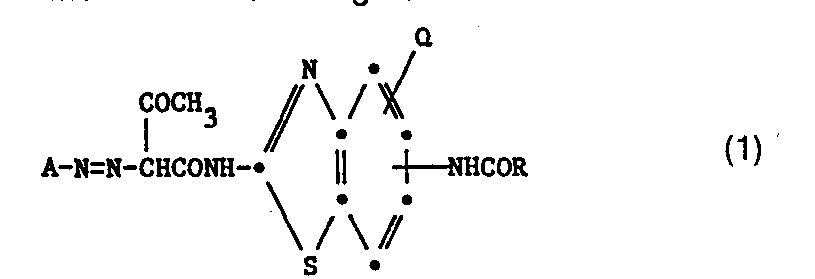
- the invention relates to pigmenting high molecular weight organic material with monoazo compounds of the formula wherein A is a carbocyclic aromatic radical, R is an aliphatic, cycloaliphatic, araliphatic or aromatic radical or an alkoxy group and Q is an H or halogen atom or a methyl group.
- a as a carbocyclic aromatic radical can mean, for example, a benzene, naphthalene, anthraquinone or pyrene radical.
- These radicals can have the following substituents: halogen atoms, for example chlorine, bromine, fluorine, alkyl groups, preferably with 1-6 C atoms, in particular methyl groups, alkoxy groups, in particular CC alkoxy groups, for example methoxy, ethoxy or isopropoxy groups, furthermore aryloxy or Aryloxycarbonyl groups, for example 1- or 2-naphthoxy groups, 1- or 2-naphthoxycarbonyl groups, but preferably phenoxy or phenoxycarbonyl groups, which may be substituted in the phenyl radical by halogen atoms, methyl or trifluoromethyl groups or C 2 -C 6 alkoxycarbonyl groups, and also nitro- , Cyan or trifluoromethyl groups, alkoxycarbonyl groups,
- R preferably represents an aliphatic or cycloaliphatic radical, for example an alkyl group with 2-18 C atoms, preferably one with 2-6 C atoms, for example a methyl, propyl, isopropyl or butyl group. Lauryl or stearyl groups may be mentioned as higher aliphatic radicals.
- R can furthermore represent an aralkyl radical, for example a benzyl radical or an aryl radical, in particular a benzene radical, which can be substituted by halogen atoms, in particular chlorine atoms, methyl or phenyl groups.
- aryl radicals are the phenyl, the o-, m- or p-chlorophenyl, the o-, m- or p-methylphenyl, the diphenylyl and the 1- or 2-naphthyl radical.
- R can also represent an alkoxy group, for example a methoxy, alkoxy, propoxy, isopropoxy or butoxy group.
- Preferred monoazo compounds of the formula 1) are those in which A is a benzene radical, in particular one of the formula means where X and Y are hydrogen or halogen atoms, nitro, cyano, carbamoyl or sulfamoyl groups, alkyl, alkoxy, alkylsulfonyl, alkoxycarbonyl, alkanoyl, alkoxysulfonyl or alkylsulfamoyl groups containing 1-6 carbon atoms, optionally by Halogen atoms, alkyl or alkoxy groups containing 1-4 carbon atoms or trifluoromethyl groups substituted phenoxy, phenylsulfonyl, phenoxycarbonyl, benzoyl or phenylsulfamoyl groups and Z is a hydrogen or halogen atom or an alkyl group containing 1-4 carbon atoms.
- R is a phenyl radical which is optionally substituted by halogen atoms, nitro, C 1 -C 4 alkyl or C 1 -C 4 alkoxy groups and in particular those in which R is an alkyl group having 1-6 C -Atoms means.
- A is a carbocyclic aromatic radical
- R ' is a C 1 -C 6 alkyl or C 5 -C 8 cycloalkyl group
- Q is an H or halogen atom or a methyl group.
- the monoazo compounds of the formulas 1) and 3) are obtained by coupling a diazotized carbocyclic, aromatic amine with an acetoacetylamino-benzothiazole of the formula
- Aminobenzenes of the formula are preferably used as amines where X, Y and Z have the meaning given.
- the coupling can also be carried out by suspending the diazo component with the coupling component in an organic solvent and with a diazotized agent, in particular an ester of nitric acid, such as methyl, ethyl. Treated butyl, amyl or octyl nitrite.
- a diazotized agent in particular an ester of nitric acid, such as methyl, ethyl. Treated butyl, amyl or octyl nitrite.
- the monoazo compounds of the formula 1) can also be obtained by condensation of an aminoazo dye of the formula
- the aminoazo dyes of the formula 6) can be obtained from the corresponding nitroazo dyes by reduction.
- the pigments obtained usually precipitate out already in the heat and can be isolated in pure form by filtering off and, if necessary, washing with organic solvents.
- the pigments obtained generally have a good texture and can mostly be used as raw products. If necessary or desired, the raw products can be converted into a finely dispersed form by grinding or kneading. It is useful to use grinding aids such as inorganic and / or organic salts in the presence or absence of organic solvents. After grinding, auxiliary agents are removed as usual, soluble inorganic salts e.g. with water and water-insoluble organic auxiliaries, for example by steam distillation.
- An improvement in the properties can often also be achieved by treating the raw pigments with organic solvents, preferably those which boil above 60 ° C.
- organic solvents preferably those which boil above 60 ° C.
- Particularly suitable have been found to be benzenes substituted by halogen atoms, alkyl or nitro groups, such as xylenes, chlorobenzene, o-dichlorobenzene or nitrobenzene, and pyridine bases, such as pyridine, picoline or quinoline, and also ketones, such as cyclohexanone, methyl isobutyl ketone, acetylacetone ethers, such as ethylene glycol monomethyl - Or monoethyl ether, amides, such as dimethylformamide or N-methyl-pyrrolidone, acids such as formic acid or acetic acid, alcohols, such as methyl alcohol, ethyl alcohol, propyl alcohol, isopropyl alcohol, butyl alcohol, is
- the aftertreatment is preferably carried out by heating the pigment in the solvent to 60 to 180 ° C., in which case grain coarsening occurs, which has a favorable effect on the fastness to light and migration of the pigments obtained.
- the pigments may prove advantageous to use as toners or in the form of preparations.
- the high molecular weight organic material to be colored according to the invention can be of natural or artificial origin.
- natural resins or drying oils rubber or casein or modified natural substances such as chlorinated rubber, oil-modified alkyd resins, viscose, cellulose ethers or esters such as cellulose acetate, cellulose propionate, cellulose acetobutyrate or nitrocellulose, but especially fully synthetic thermoplastic polymers (duroplast) they are obtained by polymerization, polycondensation or polyaddition.
- polystyrene resins From the class of polymerization resins, the following may be mentioned primarily: polyolefins, such as polyethylene, polypropylene or polyisobutylene, further substituted polyolefins, such as polymers made from vinyl chloride, vinyl lactate, styrene, acrylonitrile, acrylic acid and / or methacrylic acid ester or butadiene, and copolymers of the monomers mentioned, in particular ABS or EVA.
- polyolefins such as polyethylene, polypropylene or polyisobutylene
- further substituted polyolefins such as polymers made from vinyl chloride, vinyl lactate, styrene, acrylonitrile, acrylic acid and / or methacrylic acid ester or butadiene
- copolymers of the monomers mentioned, in particular ABS or EVA From the class of polymerization resins, the following may be mentioned primarily: polyolefins, such as polyethylene, polyprop
- the condensation products of formaldehyde with phenols are the condensation products of formaldehyde with phenols, the so-called phenoplasts, and the condensation products of formaldehyde with urea, thiourea and melamine, the so-called aminoplastics, are the polyesters used as coating resins, both saturated and e.g. Alkyd resins, as well as unsaturated, such as maleate resins, also called the linear polyesters and polyamides or silicones.
- the high-molecular compounds mentioned can be present individually or in mixtures, as plastic masses or melts, which can optionally be spun into fibers.
- They can also be present in the form of their monomers or in the polymerized state in dissolved form as film formers or binders for lacquers or printing inks, e.g. Linseed oil varnish, nitrocellulose, alkyd resins, melamine resins and urea-formaldehyde resins or acrylic resins.
- film formers or binders for lacquers or printing inks e.g. Linseed oil varnish, nitrocellulose, alkyd resins, melamine resins and urea-formaldehyde resins or acrylic resins.
- the pigmentation of the high molecular weight, organic substances with the pigments of the formula 1) takes place, for example, in such a way that such a pigment, if appropriate in the form of masterbatches, is added to these substrates using roller mills, mixing or grinding apparatus.
- the pigmented material is then brought into the desired final shape by methods known per se, such as calendering, pressing, extrusion, brushing, casting or by injection molding.
- plasticizers into the high-molecular compounds before the molding in order to produce non-strong moldings or to reduce their brittleness.
- serve esters of phosphoric acid, phthalic acid or sebacic acid e.g. Serve esters of phosphoric acid, phthalic acid or sebacic acid.
- the plasticizers can be incorporated into the polymers before or after the pigment dye has been incorporated. It is also possible to add fillers or other coloring constituents such as white, colored or black pigments to the high molecular weight, organic substances in addition to the compounds of formula 1) in order to achieve different colors.
- the high molecular weight organic materials and the compounds of formula 1) are finely dispersed or dissolved in a common organic solvent or solvent mixture. You can do this by dispersing or dissolving the individual components for yourself or several together and only then bringing all the components together.
- the dyeings obtained preferably contain 0.01-20% by weight of pigment, for example in plastics, fibers, lacquers and prints, and are notable for very great color strength, high saturation, good dispersibility, good overpainting, migration, heat and light and weather fastness as well as good gloss and good IR reflectivity.
- the compounds of formula 1) can also be used as photoelectrophoretic toners.
- the pigment aftertreated by heating in 170 parts by volume of dimethylformamide for 2 hours at 147 ° produces true yellow colors in polyvinyl chloride.
- the pigment produced according to Example 1 is isolated as a moist product. 30 parts of it are stirred in 200 parts by volume of 50% alcohol, stirred in an autoclave at 170 ° for 3 hours, cooled to 20 ° and suction filtered. The product has the same properties in terms of shade, fastness and habit as the pigment of Example 1.
- Examples 42-76 Analogously to Example 41, the moist goods of Example 1 can also be treated in other conditions. Then products are created that differ in their properties. In the table below, column I indicates the solvent, column II the temperature and column III the time of the treatment.
- Example 1 The pigment of Example 1 becomes coarser in this table from top to bottom. It becomes weaker in color, but the weather fastness increases.
- Example 77 30 parts of the moist product prepared according to Example 1 are heated in 200 parts by volume of o-dichlorobenzene to 178 ° in 2 hours.
- the water-o-dichlorobenzene mixture distills azeotropically from 100 °. When no more water is detectable in the distillate, the orange suspension is cooled to 80 ° and filtered. The filter cake is washed with o-dichlorobenzene and 60 ° methanol and dried in vacuo at 60 °.
- Example 78 4.2 parts of the aminoazo dye of the formula are heated to 156 ° in 150 parts by volume of o-dichlorobenzene. At this temperature, the dark brown solution is mixed with the solution of 1.2 parts of acetic anhydride in 50 parts by volume of o-dichlorobenzene in about one minute. After about 2 minutes, an orange falls
- Example 1 0.6 part of the pigment obtained in Example 1 is mixed with 67 g of polyvinyl chloride, 33 g of dioctyl phthalate, 2 g of dibutyltin dilaurate and 2 g of titanium dioxide and processed on a roller mill for 15 minutes at 160 ° to form a thin film.
- the yellow color produced in this way is strong in color, resistant to migration and light.
- Example 83 (Acrylic melamine stove enamel)
Landscapes
- Chemical & Material Sciences (AREA)
- Organic Chemistry (AREA)
- Health & Medical Sciences (AREA)
- Chemical Kinetics & Catalysis (AREA)
- Medicinal Chemistry (AREA)
- Polymers & Plastics (AREA)
- Compositions Of Macromolecular Compounds (AREA)
- Thiazole And Isothizaole Compounds (AREA)
- Coloring (AREA)
Abstract
Description
- Gegenstand der Erfindung ist das Pigmentieren von hochmolekularem organischem Material mit Monoazoverbindungen der Formel

- A als carbocyclischer aromatischer Rest kann beispielsweise einen Benzol-, Naphthalin-, Anthrachinon- oder Pyrenrest bedeuten. Diese Reste können folgende Substituenten aufweisen: Halogenatome, beispielsweise Chlor, Brom, Fluor, Alkylgruppen, vorzugsweise mit 1-6 C-Atomen, insbesondere Methylgruppen, Alkoxygruppen, insbesondere C-C-Alkoxygruppen, beispielsweise Methoxy-, Aethoxy- oder Isopropoxygruppen, ferner Aryloxy- oder Aryloxycarbonylgruppen, beispielsweise 1- oder 2-Naphtoxygruppen, 1- oder 2-Naphtoxycarbonylgruppen, vorzugwseise aber Phenoxy- oder Phenoxycarbonylgruppen, die im Phenylrest gegebenenfalls durch Halogenatome, Methyl- oder Trifluormethylgruppen oder C2-C6-Alkoxycarbonylgruppen substituiert sein können, ferner Nitro-, Cyan- oder Trifluormethylgruppen, Alkoxycarbonylgruppen, vorzugsweise mit 2-6 C-Atomen, die im Alkylrest Halogenatome aufweisen können, Sulfamoyl- oder Carbamoylgruppen, die am N-Atom durch Alkylgruppen mit 1-6 C-Atomen, Phenyl-oder Benzylgruppen substituiert sein können, Alkylsulfonylgruppen mit 1-6 C-Atomen, Arylsulfonylgruppen, insbesondere gegebenenfalls durch Chloratome oder Methylgruppen substituierte Phenylsulfonylgruppen, Aroylgruppen, insbesondere gegebenenfalls durch Chloratome oder Methylgruppen substituierte Benzoylgruppen, oder Alkanoylgruppen mit 2-6 C-Atomen oder Alkoxysulfonylgruppen mit 1-6 C-Atomen.
- R steht vorzugsweise für einen aliphatischen oder cycloaliphatischen Rest, beispielsweise eine Alkylgruppe mit 2-18 C-Atomen, vorzugsweise eine solche mit 2-6 C-Atomen, beispielsweise eine Methyl-, Propyl-, Isopropyl- oder Butylgruppe. Als höhere aliphatische Reste seien die Lauryl- oder Stearylgruppen genannt. R kann ferner für einen Aralkylrest, beispielsweise einen Benzylrest oder einen Arylrest, insbesondere einen Benzolrest stehen, der durch Halogenatome, insbesondere Chloratome, Methyl- oder Phenylgruppen substituiert sein kann. Als Beispiele von Arylresten seien der Phenyl-, der o-, m-oder p-Chlorphenyl-, der o-, m- oder p-Methylphenyl-, der Diphenylyl-, sowie der 1- oder 2-Naphthylrest genannt. R kann auch für eine Alkoxygruppe, beispielsweise eine Methoxy-, Alkoxy-, Propoxy-, Isopropoxy- oder Butoxygruppe stehen.
- Bevorzugt sind jene Monoazoverbindungen der Formel 1), worin A einen Benzolrest, insbesondere einen solchen der Formel

- Von besonderem Interesse sind jene Monoazoverbindungen der Formel 1), worin R einen gegebenenfalls durch Halogenatome, Nitro-, CI-C4-Alkyl- oder Cl-C4-Alkoxygruppen substituierten Phenylrest und insbesondere jene, worin R eine Alkylgruppe mit 1-6 C-Atomen bedeutet.
- Einen weiteren Erfindungsgegenstand bilden die Verbindungen der Formel

- Auch hier sind jene Verbindungen bevorzugt, worin A einen Benzolrest, insbesondere einen solchen der Formel 2) bedeutet.
- Die Monoazoverbindungen der Formeln 1) und 3) erhält man durch Kuppeln eines diazotierten carbocyclischen, aromatischen Amins mit einem Acetoacetylamino-benzthiazol der Formel

- Als Amine verwendet man vorzugsweise Aminobenzole der Formel
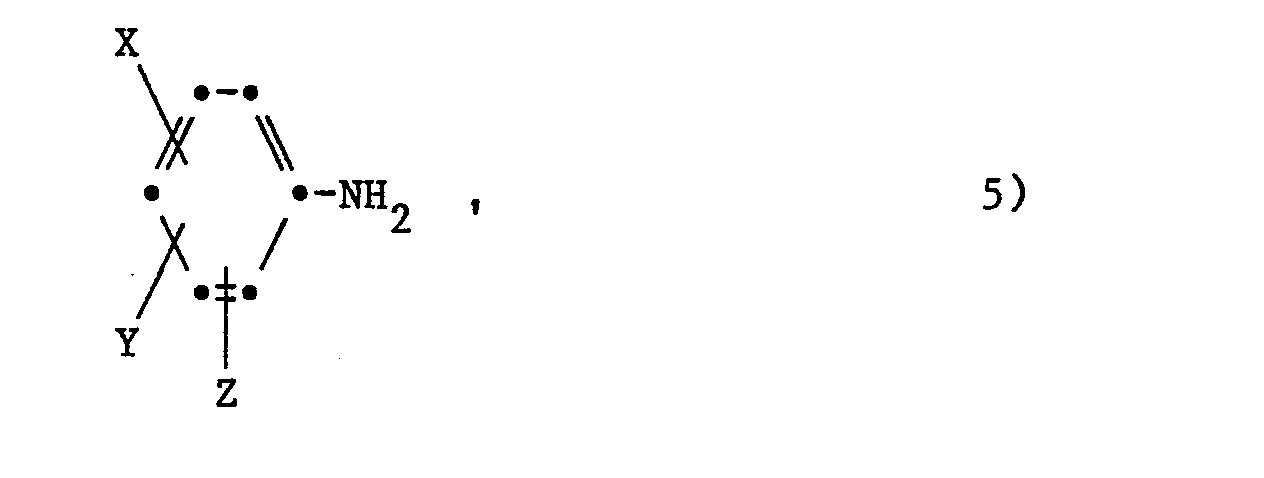
- Als Beispiele von Aminen der Formel 5) seien genannt:
- Aniline wie 2-, 3- oder 4- Chloraniline, 3,4-Dichloranilin, 2r3-Dichloranilin, 2,4-Dichloranilin, 2,5-Dichloranilin, 2,6-Dichloranilin, 2,4,5-Trichloranilin, 2,4,6-Trichloranilin, 2-, 3- oder 4-Bromanilin, 2,4-Dibromanilin, 2,5-Dibromanilin, 2-Methyl-5-chloranilin, 2-Methyl-4-chloranilin, 2-Methyl-3-chloranilin, 2-Chlor-5-trifluormethylanilin,
- alkylierte Aniline wie 2-, 3- oder 4-Methylanilin, 4-tert.-Butyl- anilin, 2,4-Dimethylanilin, sowie
- Nitroaniline, z.B. 2-, 3- oder 4-Nitroaniline, 4-Chlor-2-nitroani- lin, 2-Chlor-4-nitroanilin, 4-Methyl-3-nitroanilin, 2,4-Dimethyl-3-nitroanilin, 2-Methyl-5-nitroanilin, 2-Methyl-4-nitroanilin, ferner
- Alkoxyaniline und Phenoxyaniline, z.B. 2- und 4-Methoxyanilin, 2-und 4-Aethoxyanilin, 3-Chlor-4-methoxyanilin, 2-Methoxy-5-nitroanilin, 2-Methoxy-5-chloranilin, 2-Methoxy-5-trifluormethylanilin, 2-Amino-4-trifluormethyl-4'-chlor-diphenyläther, 2-Nitro-4-äthoxyanilin, 2-Methoxy-4-chlor-5-methylanilin, 2-Amino-4-chlordiphenyläther, 2-Amino-2',4-dichlordiphenyläther, 2-Amino-4,4'-dichlordiphenyl- äther,
- sowie Aminobenzoesäureester, wie
- Anthranilsäuremethyl-, äthyl- oder isopropylester Anthranilsäurephenylester
- Anthranilsäure-p-chlorphenylester
- Anthranilsäure-p-methoxycarbonyl-phenylester 1-Amino-4-chlor-2-benzoesäuremethylester
- 1-Amino-4-nitro-2-benzoesäuremethylester
- 1-Amino-3-benzoesäuremethylester
- 1-Amino-3-benzoesäurephenylester
- 1-Amino-3-benzoesäure-2'-diphenylester
- l-Amino-2-chlor-5-benzoesäuremethylester
- 1-Amino-2-chlor-4-benzoesäure-phenylester
- l-Amino-2-chlor-5-benzoesäure-4'-diphenylester
- 1-Amio-2-chlor-5-benzoesäure-4'-propoxycarbonyl-phenylester
- 1-Amino-2-methyl-3-benzoesäurephenylester
- 1-Amio-2-methyl-5-benzoesäureäthylester
- 1-Amino-2-methyl-5-benzoesäurepropylester
- 1-Amino-2-methyl-5-benzoesäureisopropylester
- 1-Amino-2-methyl-5-benzoesäure-ß-chloräthylester
- 1-Amino-2-methyl-5-phenylester
- 1-Amino-2-methyl-5-o-, m- oder p-methylphenylester
- 1-Amino-2-methyl-5-o-, m- oder p-tert.-octyl-phenylester
- l-Amino-2-methyl-5-3',5'-dimethylphenylester
- 1-Amino-2-methyl-5-benzoesäure-4'-methoxycarbonyl-phenylester
- 1-Amino-2-methyl-5-benzoesäure-4'-äthoxycarbonyl-phenylester
- 1-Amino-2-methyl-5-benzoesäure-4'-propoxycarbonyl-phenylester
- 1-Amino-2-methyl-5-benzoesäure-ß-naphthylester
- 1-Amino-2-methoxy-5-benzoesäure-4'-isopropoxycarbonyl-phenylester
- Amino-terephthalsäuredimethylester
- Amio-terephthalsäure-di-isopropylester
- Amino-terephthalsäure-diphenylester ferner Aminobenzoesäureamide, wie Anthranilsäureamid, Anthranilsäuremethylamid, Anthranilsäurephenylamid, 1-Amino-3-benzoesäuremethylamid, l-Amino-3-benzoesäurephenylamid, 1-Amino-2-chlor-5-benzoesäureamid,
- 1-Amino-2-chlor-5-benzoesäuremethylamid,
- 1-Amino-2-chlor-5-benzoesäurephenylamid,
- 1-Amino-2-methyl-5-benzoesäureamid,
- 1-Amino-2-methyl-5-benzoesäuremethylamid,
- 1-Amino-2-methyl-5-benzoesäurephenylamid, a-Naphthylamin,
- 1-Aminoanthrachinon, 1-Amino-3-chloranthrachinon,
- l-Amino-4-benzoylaminoanthrachinon, 3-Aminopyren.
- Die Acetoacetylaminobenzthiazole der Formel 4) erhält man durch Umsetzen der entsprechenden 2-Aminobenzthiazole mit Diketen. Als Beispiele von Acetoacetylaminobenzthiazolen seien genannt:
- 2-Acetoacetylamino-6-acetylamino-benzthiazol
- 2-Acetoacetylamino-6-propionylamino-benzthiazol
- 2-Acetoacetylamino-6-butyrylamino-benzthiazol
- 2-Acetoacetylamino-6-stearoylamino-benzthiazol
- 2-Acetoacetylamino-6-phenacetylamino-benzthiazol
- 2-Acetoacetylamino-6-iso-butyrylamino-benzthiazol
- 2-Acetoacetylamino-6-(2'-phenoxy)-propionylamino-benzthiazol
- 2-Acetoacetylamio-6-benzoylamino-benzthiazol
- 2-Acetoacetylamino-6-p-methylbenzoylamino-benzthiazol
- 2-Acetoacetylamino-6-o-chlorbenzoylamino-benzzhiazol
- 2-Acetoacetylamino-5-acetamino-benzthiazol
- 2-Acetoacetylamino-5-phenacetylamino-benzthiazol
- 2-Acetoacetylamino-5-benzoylamino-benzthiazol
- 2-Acetoacetylamino-5-o-chlorbenzoylamino-benzthiazol
- 2-Acetoacetylamino-4-acetylamino-benzthiazol
- 2-Acetoacetylamino-4-benzoylamino-benzthiazol
- 2-Acetoacetylamino-7-acetamino-benzthiazol
- 2-Acetoacetylamino-7-benzoylamino-benzthiazol
- 2-Acetoacetylamino-6-methoxycarbonylamino-benzthiazol.
- Schliesslich kann die Kupplung auch so vollzogen werden, dass man die Diazokomponente mit der Kupplungskomponente in einem organischen Lösungsmittel suspendiert und mit einem diazotierten Mittel, insbesondere einem Ester der Salpetersäure, wie Methyl-, Aethyl-. Butyl-, Amyl- oder Octylnitrit behandelt.
- Die Monoazoverbindungen der Formel 1) können auch durch Kondensation eines Aminoazofarbstoffes der Formel
-

- Die erhaltenen Pigmente fallen zumeist schon in der Hitze aus und können durch Abfiltrieren und gegebenenfalls durch Waschen mit organischen Lösungsmitteln in reiner Form isoliert werden.
- Die erhaltenen Pigmente besitzen im allgemeinen eine gute Textur und können meistens als Rohprodukte verwendet werden. Falls nötig oder erwünscht, kann man die Rohprodukte durch Mahlen oder Kneten in eine feindisperse Form überführen. Dabei werden zweckmässig Mahlhilfsmittel, wie anorganische und/oder organische Salze in Gegenwart oder Abwesenheit organischer Lösungsmittel verwendet. Nach dem Mahlen werden Hilfsmittel wie üblich entfernt, lösliche anorganische Salze z.B. mit Wasser und wasserunlösliche organische Hilfsmittel beispielsweise durch Wasserdampfdestillation.
- Auch durch Behandeln der Rohpigmente mit organischen Lösungsmitteln, vorzugsweise solchen, die über 60°C sieden, kann oft eine Verbesserung der Eigenschaften erreicht werden. Als besonders geeignet erweisen sich durch Halogenatome, Alkyl- oder Nitrogruppen substituierte Benzole, wie Xylole, Chlorbenzol, o-Dichlorbenzol oder Nitrobenzol sowie Pyridinbasen, wie Pyridin, Picolin oder Chinolin, ferner Ketone, wie Cyclohexanon, Methyl-isobutylketon, Acetylaceton Aether, wie Aethylenglykolmonomethyl- oder monoäthyläther, Amide, wie Dimethylformamid oder N-Methyl-pyrrolidon, Säuren wie Ameisensäure oder Essigsäure Alkohole, wie Methylalkohol, Aethylalkohol, Propylalkohol, Isopropylalkohol, Butylalkohol, Isobutylalkohol, Alkohol-Wasser-Mischungen sowie Dimethylsulfoxid oder Wasser ohne oder unter Druck.
- Die Nachbehandlung erfolgt vorzugsweise durch Erhitzen des Pigments im Lösungsmittel auf 60 bis 180°C, wobei in vielen Fällen eine Kornvergröberung eintritt, was sich günstig auf die Licht- und Migrationsechtheit der erhaltenen Pigmente auswirkt.
- Je nach Verwendungszweck erweist es sich als vorteilhaft, die Pigmente als Toner oder in Form von Präparaten zu verwenden.
- Das erfindungsgemäss zu färbende hochmolekulare organische Material kann natürlicher oder künstlicher Herkunft sein. Es kann sich z.B. um Naturharze oder trocknende Oele, Kautschuk oder Casein oder um abgewandelte Naturstoffe, wie Chlorkautschuk, ölmodifizierte Alkydharze, Viscose, um Celluloseäther oder Ester, wie Celluloseacetat, Cellulosepropionat, Celluloseacetobutyrat oder Nitrocellulose handeln, insbesondere aber um vollsynthetische organische Polymere (Duroplast und Thermoplaste), wie sie durch Polymerisation, Polykondensation oder Polyaddition erhalten werden. Aus der Klasse der Polymerisationsharze seien in erster Linie genannt: Polyolefine, wie Polyäthylen, Polypropylen oder Polyisobutylen, ferner substituierte Polyolefine, wie Polymerisate aus Vinylchlorid, Vinylactat, Styrol, Acrylnitril, Acrylsäure und/oder Methacrylsäureester oder Butadien, sowie Copolymerisate der erwähnten Monomeren, insbesondere ABS oder EVA.
- Aus der Reihe der Polyadditionssalze und Polykondensationsharze seien die Kondensationsprodukte von Formaldehyd mit Phenolen, die sogenannten Phenoplaste, und die Kondensationsprodukte von Formaldehyd mit Harnstoff, Thioharnstoff und Melamin, die sogenannten Aminoplaste, die als Lackharze verwendeten Polyester, und zwar sowohl gesättigte, wie z.B. Alkydharze, als auch ungesättigte, wie beispielsweise Maleinatharze, ferner die linearen Polyester und Polyamide oder Silikone genannt.
- Die erwähnten hochmolekularen Verbindungen können einzeln oder in Gemischen, als plastische Massen oder Schmelzen, die gegebenenfalls zu Fasern versponnen werden können, vorliegen.
- Sie können auch in Form ihrer Monomeren oder im polymerisierten Zustand in gelöster Form als Filmbildner oder Bindemittel für Lacke oder Druckfarben vorliegen, wie z.B. Leinölfirnis, Nitrocellulose, Alkydharze, Melaminharze und Harnstoff-Formaldehydharze oder Acrylharze.
- Die Pigmentierung der hochmolekularen, organischen Substanzen mit den Pigmenten der Formel 1) erfolgt beispielsweise derart, dass man ein solches Pigment gegebenenfalls in Form von Masterbatches, diesen Substraten unter Verwendung von Walzwerken, Misch- oder Mahlapparaten zumischt. Das pigmentierte Material wird hierauf nach an sich bekannten Verfahren wie Kalandrieren, Pressen, Strangpressen, Streichen, Giessen oder durch Spritzguss in die gewünschte endgültige Form gebracht. Oft ist es erwünscht, zur Herstellung von nicht starken Formlingen oder zur Verringerung ihrer Sprödigkeit, den hochmolekularen Verbindungen vor der Verformung sogenannte Weichmacher einzuverleiben. Als solche können z.B. Ester der Phosphorsäure, Phthalsäure oder Sebacinsäure dienen. Die Weichmacher können im erfindunsgemässen Verfahren vor oder nach der Einverleibung des Pigmentfarbstoffes in die Polymeren eingearbeitet werden. Es ist ferner möglich, zwecks Erzielung verschiedener Farbtöne den hochmolekularen, organischen Stoffen neben den Verbindungen der Formel 1) noch Füllstoffe bzw. andere farbgebende Bestandteile wie Weiss-, Bunt- oder Schwarzpigmente in beliebigen Mengen zuzufügen.
- Zum Pigmentieren von Lacken und Druckfarben werden die hochmolekularen organische Materialien und die Verbindungen der Formel 1) gegebenenfalls zusammen mit Zusatzstoffen wie Füllmitteln, anderen Pigmenten, Siccativen oder Weichmachern, in einem gemeinsamen organischen Lösungsmittel oder Lösungsmittelgemisch fein dispergiert bzw. gelöst. Man kann dabei so verfahren, dass man die einzelnen Komponenten für sich oder auch mehrere gemeinsam dispergiert bzw. löst und erst hierauf alle Komponenten zusammenbringt.
- Die erhaltenen Färbungen enthalten vorzugsweise 0,01-20 Gew.% Pigment, beispielsweise in Kunststoffen, Fasern, Lacken und Drucken, und zeichnen sich durch sehr grosse Farbstärke, hohe Sättigung, gute Dispergierbarkeit, gute Ueberlackier-, Migrations-, Hitze-, Licht-und Wetterechtheit sowie durch einen guten Glanz und gutes IR-Remissionsverhalten aus.
- Die Verbindungen der Formel 1) können auch als photoelektrophoretische Toner verwendet werden.
- In den nachfolgenden Beispielen bedeuten die Teile, sofern nichts anderes angegeben wird, Gewichtsteile, die Prozente Gewichtsprozente, und die Temperaturen sind in Celsiusgraden angegeben.
- 2,4 Teile 2,5-Dichloranilin werden in 17 Vol.-Teilen Eisessig bei Raumtemperatur gelöst. Die braune Lösung wird mit 3,9 Vol.-Teilen konzentrierter Salzsäure verrührt, die entstandene dicke Suspension (Chlorhydrat) mit 8 Teilen Wasser verdünnt, auf 5° abgekühlt, während 15 Min. und bei 5° mit 3,9 Vol.-Teilen 4n-Natriumnitritlösung tropfenweise versetzt und die erhaltene braune Diazolösung klärfiltriert.
- Man löst danach 4,4 Teile 2-Acetoacetylamino-6-acetaminobenzthiazol in 11,3 Vol.-Teilen 30%iger Natronlauge und 75 Teilen Wasser. Die orange Lösung wird filtriert, auf 5° abgekühlt und innerhalb 20 Min. mit der Diazolösung tropfenweise versetzt. Es entsteht dabei ein oranger Niederschlag. Die erhaltene Suspension wird durch langsame Zugabe von 12 Vol.-Teilen 30riger Natriumhydroxydlösung auf einen pH-Wert von 5 eingestellt. Sie wird während 4 Stunden bei einer bis auf 23° steigenden Temperatur gerührt, im Laufe einer Stunde auf 75° erhitzt und heiss abgenutscht. Der Rückstand wird salzfrei gewaschen und im Vakuum bei 80° getrocknet. Man erhält 6,9 Teile, entsprechend 99% der Theorie, eines orangen Pulvers der Formel

- Das durch Erhitzen in 170 Vol.-Teilen Dimethylformamid während 2 Std. bei 147° nachbehandelte Pigment erzeugt in Polyvinylchlorid echte gelbe Färbungen.
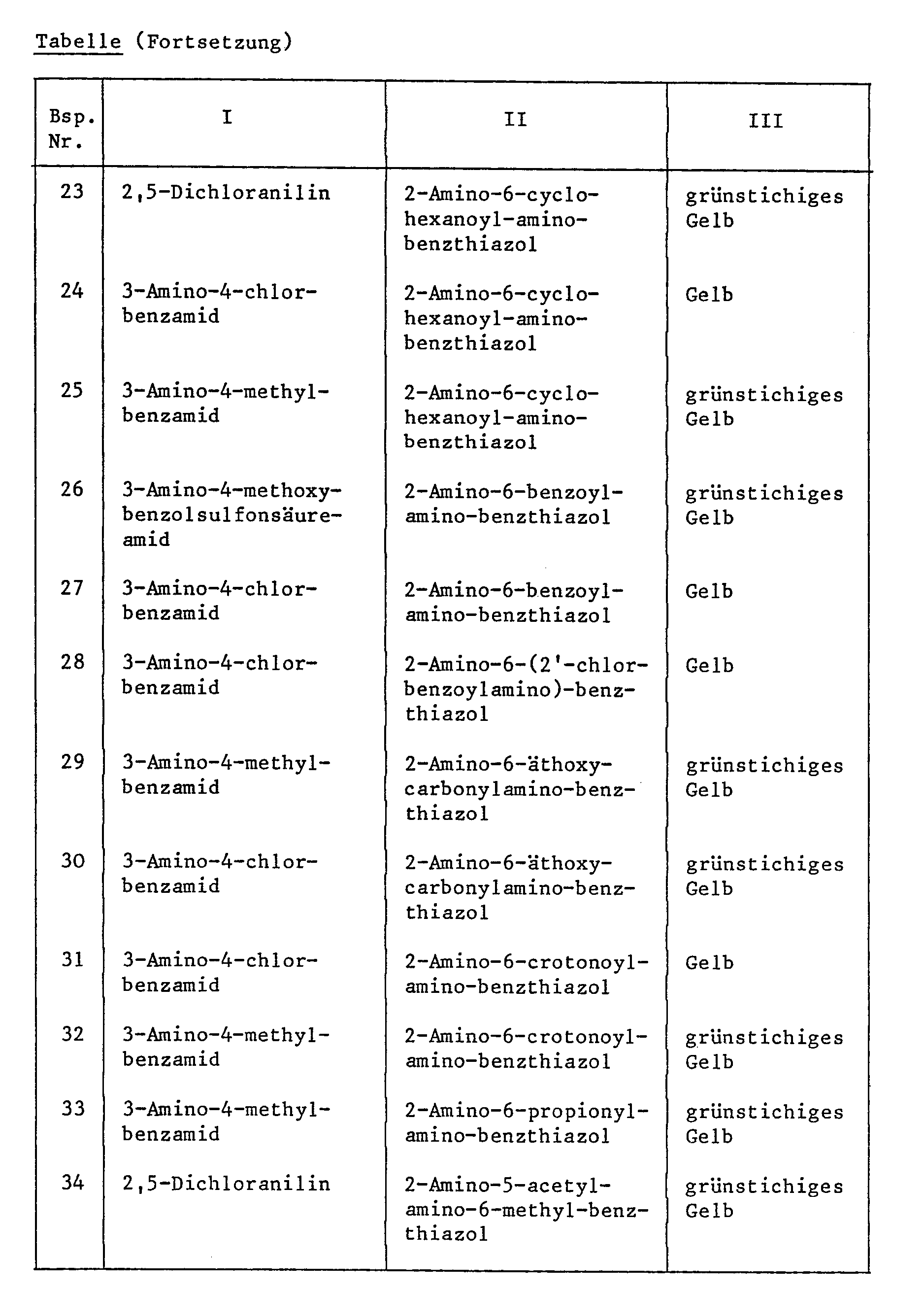
- In nachstehender Tabelle sind weitere erfindungsgemässe Pigmente beschrieben, die durch Kuppeln der Diazoverbindungen der Amine der Kolonne I mit den Acetessigaryliden der Amine der Kolonne II erhalten werden. Kolonne III gibt den Farbton einer mit 0,2% dieser Pigmente gefärbten PVC-Folie an.



- Die Suspension aus 75,1 Teilen p-Aminoacetanilid und 81 Teilen Natriumrhodanid in 750 Vol.-Teilen Essigsäure wird auf 9° abgekühlt und in einer Stunde mit der Lösung von 25,8 Teilen Brom in 125 Vol-Teilen Essigsäure tropfenweise versetzt. Die Temperatur steigt trotz Kühlung auf 14°. Man rührt 3 Stunden ohne Kühlung, die Temperatur steigt auf 20°C. Die dicke, hellbeige Suspension wird abgenutscht. Das Nutschgut wird mit 200 Vol.-Teilen Essigsäure gewaschen, gut abgepresst und in 1000 Teilen Wasser von 60° gelöst. Die trübe braune Lösung wird filtriert, auf 20° abgekühlt und mit ca. 400 Vol.-Teilen 25%iger Ammoniaklösung auf pH 7 gestellt. Der ausgefallene hellgelbe Niederschlag wird schliesslich abgenutscht und im Vakuum bei 80° getrocknet. Man erhält 87 Teile (83% der Theorie) eines hellgelben Pulvers vom Schmelzpunkt 228-229°.
- 78 Teile 2-Amino-6-acetylamino-benzthiazol werden in 150 Vol.-Teilen Essigsäure auf 63° erhitzt. Die ockergelbe Lösung wird in 15 Minuten mit 41 Teilen Diketen tropfenweise versetzt. Die Temperatur steigt vorübergehend auf 96°. Man rührt 2,5 Stunden bei 80°, nach ca. einer Stunde fällt ein dicker Niederschlag aus. Man lässt dann auf 29° abkühlen und verdünnt mit 300 Teilen dest. Wasser. Die dicke hellgraue Suspension wird 2 Stunden bei einer bis auf 24° sinkenden Temperatur gerührt und abgenutscht. Das Produkt wird mit 500 Teilen Wasser gewaschen und im Vakuum bei 80° getrocknet. Danach erhält man 83 Teile (7S% der Theorie) eines hellgelben Pulvers vom Schmelzpunkt 248-250°.
-

- Die meisten Kupplungskomponenten wurden nach dieser Methode hergestellt.
- Die Suspension von 16,5 Teilen 2,6-Diamino-benzthiazol in 100 Vol.-Teilen Benzol und 13,9 Teilen Triäthylamin wird in einer Stunde (sehr langsam) mit 11,6 Teilen Benzoylchlorid tropfenweise versetzt, in einer Stunde auf 80° erhitzt, auf 20° abgekühlt und abgenutscht. Das Nutschgut wird mit einem Mixer in 200 Teilen Wasser aufgeschlämmt, abgesaugt und im Vakuum bei 60° getrocknet. Ausbeute: 25,5 Teile, d.h. 95% der Theorie. Das hellgelbe Pulver schmilzt bei 213-215°.

- So, wie bei der Darstellung von 2-Acetoacetylamino-6-acetylamino- benzthiazol beschrieben. Ausbeute: 76% der Theorie. Das weisse Pulver schmilzt unscharf zwischen 190 und 198°.

- Aus 2-Amino-5-nitro-6-methyl-benzthiazol mit Diketen in Essigsäure. Ausbeute: 94% der Theorie. Das hellgelbe Pulver schmilzt bei 201-203°.

- Aus dem Nitrokörper durch katalytische Hydrierung (RaNi) in Dioxan. Ausbeute: 75% der Theorie. Aspekt: beiges Pulver. Der Schmelzpunkt beträgt 200 bis 202°.

- Aus dem Amin mit Acetylchlorid in Chlorbenzol-Pyridin (10:1). Ausbeute: 74% der Theorie. Das hellgelbe Produkt schmilzt bei 220 bis 222°.

- Das gemäss Beispiel 1 hergestellte Pigment wird als feuchte Ware isoliert. 30 Teile davon verrührt man in 200 Vol.-Teilen 50%igem Alkohol, rührt in einem Autoklaven 3 Stunden bei 170°, kühlt auf 20° und nutscht ab. Das Produkt weist die gleichen Eigenschaften bezüglich Nuance, Echtheiten und Habitus auf, wie das Pigment des Beispiels 1.
- Beispiele 42-76: Analog Beispiel 41 kann die feuchte Ware des Beispiel 1 auch in anderen Bedingungen behandelt werden. Dann entstehen Produkte, die in ihren Eigenschaften voneinander abweichen. In nachfolgender Tabelle gibt Kolonne I das Lösungsmittel, Kolonne II die Temperatur und Kolonne III die Zeit der Behandlung an.
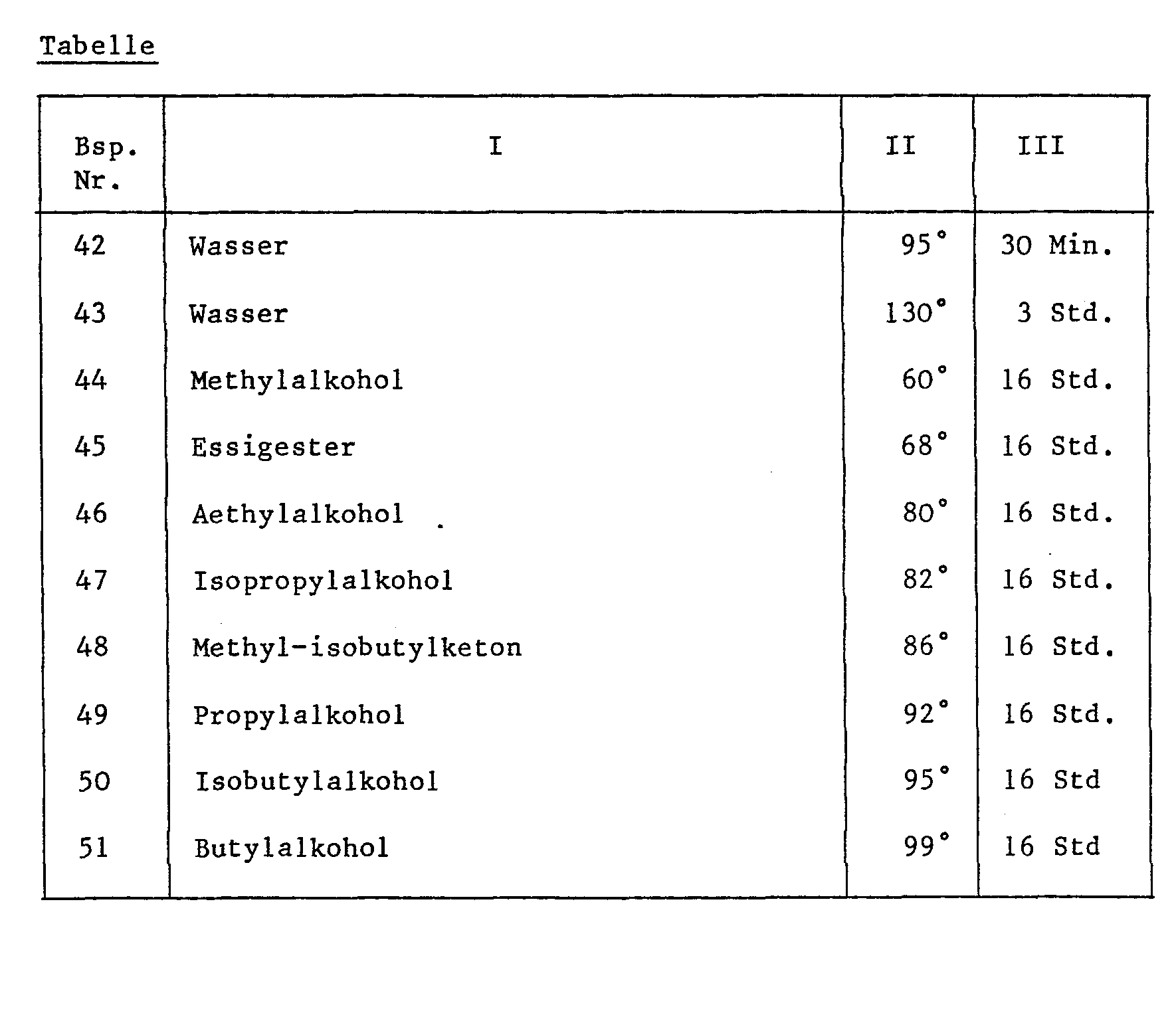


- Das Pigment des Beispiels 1 wird in dieser Tabelle von oben nach unten immer gröber. Es wird dadurch farbschwächer, die Wetterechtheit nimmt hingegen zu.
- Beispiel 77: 30 Teile des gemäss Beispiel 1 hergestellten feuchten Produktes werden in 200 Vol.-Teilen o-Dichlorbenzol in 2 Stunden auf 178° erhitzt. Ab 100° destilliert das Wasser-o-Dichlorbenzol-Gemisch azeotropisch. Wenn im Destillat kein Wasser mehr nachweisbar ist, kühlt man die orange Suspension auf 80° und filtriert. Das Nutschgut wird mit o-Dichlorbenzol und 60°igem Methanol gewaschen und im Vakuum bei 60° getrocknet. Das Produkt färbt PVC in echten gelben Tönen.
- Beispiel 78: 4,2 Teile des Aminoazofarbstoffes der Formel

- Niederschlag aus. Man rührt die Suspension 30 Minuten bei 160°, kühlt auf 82° und filtriert heiss. Das Nutschgut wird mit o-Dichlorbenzol und 60°igem Methanol gewaschen und getrocknet. Man erhält 4,3 Teile, entsprechend 91% der Theorie, eines orangen Pulvers der Formel

- Dieses Produkt und das Pigment des Beispiels 1 sind miteinander identisch.
- Darstellung des Aminoazofarbstoffes:
- a) 2-Acetoacetylamino-6-nitro-benzthiazol Aus 2-Amino-6-nitro-benzthiazol mit Diketen in Essigsäure. Ausbeute: 93% der Theorie. Aspekt: weisses Pulver. Der Schmelzpunkt beträgt 246 bis 248°.

- b) Nitroazofarbstoff der Formel

- Aus 2-Acetoacetylamino-6-nitro-benzthiazol und diazotiertem 2,5-Dichloranilin. Ausbeute: 84% der Theorie. Der Schmelzpunkt des braungelben Produktes liegt über 300°.

- c) Aminoazofarbstoff
- Aus dem entsprechenden Nitroazofarbstoff durch katalytische Reduktion (RaNi) in Dimethylformamid.
- Ausbeute: 73% der Theorie. Schmelzpunkt des rotbraunen Pulvers: 272-275° (Zersetzung).

- 0,6 Teile des gemäss Beispiel 1 erhaltenen Pigments werden mit 67 g Polyvinylchlorid, 33 g Dioctylphthalat, 2 g Dibutylzinndilaurat und 2 g Titandioxyd zusammengemischt und auf dem Walzenstuhl während 15 min bei 160° zu einer dünnen Folie verarbeitet. Die so erzeugte gelbe Färbung ist farbstark, migrations- und lichtecht.
- 100 Teile eines pulverförmigen Formaldehyd-Harnstoffharzes, das für Pressmassen geeignet ist, 10 Teile Lithopone und 1 Teil des nach Beispiel 1 hergestellten Pigments werden in einer Kugelmühle 16 Stunden gemahlen. Danach wird die Masse bei 140-160° in Formen gepresst. Die gelben Presslinge besitzen gute Licht- und Hitzebeständigkeit.
- 15 Teile einer 35% Butanol enthaltenden Kolloidwolle, 15 Teile eines mit Riciusöl modifizierten Phthalatharzes, 15 Teile einer 70%igen butanolischen Lösung eines Harnstofflackes, 20 Teile Butylacetat, 10 Teile Glykolmonoäthylester, 20 Teile Toluol und 5 Teile Alkohol werden zu einem Lack verarbeitet. Dieser wird anschliessend mit 2 Teilen des gemäss Beispiel 1 erhaltenen Pigmentes und 2 Teilen Titandioxid (Rutil) pigmentiert und gemahlen. Nach dem Spritzen auf Karton und Trocknen des Lackes erhält man einen gelben Ueberzug von sehr guter Licht-, Ueberlackier- und Wetterechtheit.
- 60 Teile einer 60%igen Lösung eines nicht-trocknenden Alkylharzes in Xylol (Handelsname Beckosol® 27-320 der Firma Reichhold-Albert-Chemie), 36 Teile einer 50%igen Lösung eines Melamin-Formaldehyd-Harzes in einem Alkohol-Aromaten-Gemisch (Handelsname Super-Beckamin® 13-501 der Firma Reichhold-Albert-Chemie), 2 Teile Xylol und 2 Teile Methylcellosolve werden vermischt und 100 Teile dieses Gemisches werden mit Hilfe eines Rührers zu einer homogenen Lacklösung verrührt. 95 Teile des so erhaltenen Klarlackes und 5 Teile des gemäss Anspruch 1 erhaltenen Pigmentes werden in einer Kugelmühle während 72 Stunden gemahlen. Der eingefärbte Lack wird dann nach üblicher Spritzmethode auf Blech appliziert und 30 min bei 120° eingebrannt. Man erhält eine gelbe Lackierung von guter Lichtechtheit.
- 41,3 Teile einer 60%igen Lösung eines Acrylharzes in Xylol (Handelsname Viacryl® VC 373 der Firma Vianova), 16,3 Teile einer 55%igen Lösung eines Melamin-Formaldehyd-Harzes in Butanol (Handelsname Maprenal® TTX der Firma Bayer), 32,8 Teile Xylol, 4,6 Teile Aethylglykolacetat, 2 Teile Cyclohexanon, 2 Teile Butylacetat und 1 Teil Siliconöl A (1% in Xylol) der Firma Bayer werden mit Hilfe eines Rührers zu einer homogenen Lacklösung verrührt. 95 Teile des so erhaltenen Klarlackes, 5 Teile des gemäss Anspruch 1 erhaltenen Pigmentes werden in einer Kugelmühle während 72 Stunden gemahlen. Der eingefärbte Lack wird dann nach üblicher Spritzmethode auf Blech appliziert und 30 Minuten bei 120° eingebrannt. Man erhält eine gelbe Lackierung von guter Lichtechtheit.
Claims (9)

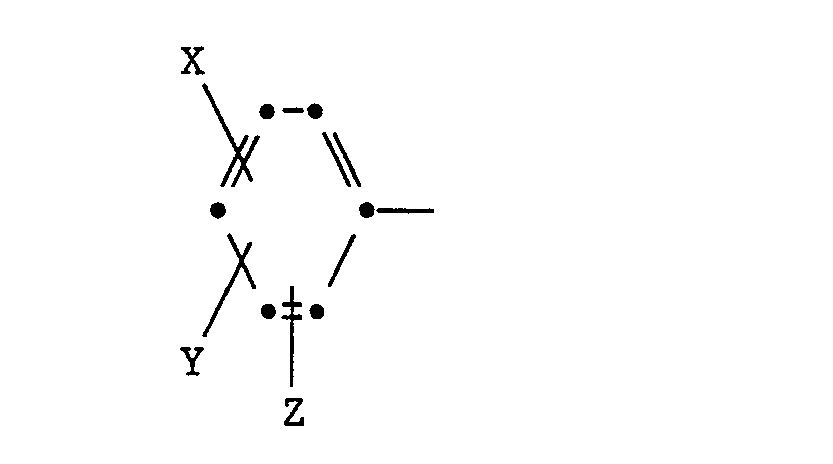


Applications Claiming Priority (2)
| Application Number | Priority Date | Filing Date | Title |
|---|---|---|---|
| CH500883 | 1983-09-14 | ||
| CH5008/83 | 1983-09-14 |
Publications (3)
| Publication Number | Publication Date |
|---|---|
| EP0138761A2 true EP0138761A2 (de) | 1985-04-24 |
| EP0138761A3 EP0138761A3 (en) | 1986-12-10 |
| EP0138761B1 EP0138761B1 (de) | 1989-03-22 |
Family
ID=4286352
Family Applications (1)
| Application Number | Title | Priority Date | Filing Date |
|---|---|---|---|
| EP84810437A Expired EP0138761B1 (de) | 1983-09-14 | 1984-09-10 | Verfahren zum Pigmentieren von hochmolekularem organischem Material |
Country Status (5)
| Country | Link |
|---|---|
| US (1) | US4602961A (de) |
| EP (1) | EP0138761B1 (de) |
| JP (1) | JPS6086133A (de) |
| CA (1) | CA1227791A (de) |
| DE (1) | DE3477393D1 (de) |
Cited By (3)
| Publication number | Priority date | Publication date | Assignee | Title |
|---|---|---|---|---|
| EP0359708A3 (de) * | 1988-09-14 | 1991-09-18 | Ciba-Geigy Ag | Monoazoverbindungen mit langkettigen Alkylresten |
| EP0816439A1 (de) * | 1996-06-17 | 1998-01-07 | Clariant GmbH | Wasserunlösliche Azofarbmittel auf Basis von N-Acetoacetyldehydrothiotoluidin |
| US11185318B2 (en) | 2016-06-16 | 2021-11-30 | Phillips Medical, LLC | Methods and systems for sealing a puncture of a vessel |
Families Citing this family (2)
| Publication number | Priority date | Publication date | Assignee | Title |
|---|---|---|---|---|
| ATE267847T1 (de) * | 1999-08-11 | 2004-06-15 | Clariant Finance Bvi Ltd | Pigment zum färben von polyolefinen ohne verziehen |
| JP5942377B2 (ja) * | 2011-10-07 | 2016-06-29 | 山陽色素株式会社 | 顔料およびその製造方法 |
Family Cites Families (3)
| Publication number | Priority date | Publication date | Assignee | Title |
|---|---|---|---|---|
| DE600101C (de) * | 1932-09-10 | 1934-07-16 | I G Farbenindustrie Akt Ges | Verfahren zur Herstellung von wasserunloeslichen Azofarbstoffen |
| US2014487A (en) * | 1933-05-23 | 1935-09-17 | Gen Aniline Works Inc | Azodyestuffs insoluble in water and fibers dyed therewith |
| US4400319A (en) * | 1980-10-03 | 1983-08-23 | Ciba-Geigy Corporation | Monoazo pigments containing heterocycles, and high-molecular organic materials dyed therewith |
-
1984
- 1984-09-07 US US06/648,190 patent/US4602961A/en not_active Expired - Fee Related
- 1984-09-10 EP EP84810437A patent/EP0138761B1/de not_active Expired
- 1984-09-10 DE DE8484810437T patent/DE3477393D1/de not_active Expired
- 1984-09-12 CA CA000462934A patent/CA1227791A/en not_active Expired
- 1984-09-14 JP JP59193784A patent/JPS6086133A/ja active Pending
Cited By (5)
| Publication number | Priority date | Publication date | Assignee | Title |
|---|---|---|---|---|
| EP0359708A3 (de) * | 1988-09-14 | 1991-09-18 | Ciba-Geigy Ag | Monoazoverbindungen mit langkettigen Alkylresten |
| EP0816439A1 (de) * | 1996-06-17 | 1998-01-07 | Clariant GmbH | Wasserunlösliche Azofarbmittel auf Basis von N-Acetoacetyldehydrothiotoluidin |
| US5756691A (en) * | 1996-06-17 | 1998-05-26 | Hoechst Aktiengesellschaft | Water--insoluble azo colorants based on N-acetoacetyldehydrothiotoluidine |
| US11185318B2 (en) | 2016-06-16 | 2021-11-30 | Phillips Medical, LLC | Methods and systems for sealing a puncture of a vessel |
| US11751860B2 (en) | 2016-06-16 | 2023-09-12 | Phillips Medical, LLC | Methods and systems for sealing a puncture of a vessel |
Also Published As
| Publication number | Publication date |
|---|---|
| US4602961A (en) | 1986-07-29 |
| JPS6086133A (ja) | 1985-05-15 |
| EP0138761B1 (de) | 1989-03-22 |
| DE3477393D1 (en) | 1989-04-27 |
| CA1227791A (en) | 1987-10-06 |
| EP0138761A3 (en) | 1986-12-10 |
Similar Documents
| Publication | Publication Date | Title |
|---|---|---|
| DE2644265A1 (de) | Heterocyclische verbindungen | |
| EP0151393B1 (de) | Azinpigmente, Verfahren zu ihrer Herstellung sowie ihre Verwendung | |
| EP0138761B1 (de) | Verfahren zum Pigmentieren von hochmolekularem organischem Material | |
| EP0168343B1 (de) | Neue Metallkomplexe, Verfahren zu ihrer Herstellung ihre Verwendung zum Färben von hochmolekularem organischem Material | |
| EP0241413A2 (de) | Neue Aminsalze von Azoverbindungen | |
| EP0169167B1 (de) | Verfahren zum Färben von hochmolekularem organischem Material und neue Metallkomplexe | |
| DE2244035C3 (de) | Disazopigmente, Verfahren zu deren Herstellung und ihre Verwendung zum Pigmentieren von hochmolekularem organischen Material | |
| EP0101954B1 (de) | Isoindolazine, Verfahren zu ihrer Herstellung sowie ihre Verwendung | |
| EP0190692B1 (de) | Bis-isoindolinpigmente und ihre Verwendung | |
| EP0051560B1 (de) | Heterocyclen enthaltende Monoazopigmente, Verfahren zu deren Herstellung und deren Verwendung | |
| EP0162806B1 (de) | Monoazoverbindungen enthaltend mindestens eine Carbonamidgruppe | |
| DE2739041A1 (de) | Verfahren zum pigmentieren von hochmolekularem organischem material | |
| DE2800765C2 (de) | Neue Monoazopigmente, Verfahren zu deren Herstellung und deren Verwendung | |
| EP0523005B1 (de) | Disazoverbindungen mit Cycloalkylester- oder Cycloalkylamidresten | |
| EP0183651A2 (de) | Neue Metallkomplexe, Verfahren zu deren Herstellung und Verwendung | |
| EP0710705A1 (de) | Gelbe Diketopyrrolopyrrolpigmente | |
| EP0006154B1 (de) | Monoazopigmente und deren Verwendung zum Pigmentieren von hochmolekularem organischem Material | |
| DE2812255A1 (de) | Azomethin-pigmente | |
| DE2429286A1 (de) | Neue disazopigmente und verfahren zu deren herstellung und verwendung | |
| DE2556430A1 (de) | Neue disazopigmente und verfahren zu deren herstellung und verwendung | |
| EP0442846A2 (de) | Disazoverbindungen mit langkettigen Alkylester- oder Alkylamidresten | |
| EP0098242B1 (de) | Naphthostyril-Metallkomplexe, Verfahren zu deren Herstellung und damit pigmentiertes hochmolekulares organisches Material | |
| EP0095442A1 (de) | Disazopigmente, Verfahren zu deren Herstellung und Verwendung | |
| DE2429022A1 (de) | Neue disazopigmente und verfahren zu deren herstellung | |
| DE2144877A1 (de) | Monoazopigmente |
Legal Events
| Date | Code | Title | Description |
|---|---|---|---|
| PUAI | Public reference made under article 153(3) epc to a published international application that has entered the european phase |
Free format text: ORIGINAL CODE: 0009012 |
|
| 17P | Request for examination filed |
Effective date: 19840912 |
|
| AK | Designated contracting states |
Designated state(s): CH DE FR GB IT LI |
|
| RTI1 | Title (correction) | ||
| PUAL | Search report despatched |
Free format text: ORIGINAL CODE: 0009013 |
|
| AK | Designated contracting states |
Kind code of ref document: A3 Designated state(s): CH DE FR GB IT LI |
|
| 17Q | First examination report despatched |
Effective date: 19880414 |
|
| GRAA | (expected) grant |
Free format text: ORIGINAL CODE: 0009210 |
|
| AK | Designated contracting states |
Kind code of ref document: B1 Designated state(s): CH DE FR GB IT LI |
|
| ITF | It: translation for a ep patent filed | ||
| REF | Corresponds to: |
Ref document number: 3477393 Country of ref document: DE Date of ref document: 19890427 |
|
| GBT | Gb: translation of ep patent filed (gb section 77(6)(a)/1977) | ||
| ET | Fr: translation filed | ||
| PLBE | No opposition filed within time limit |
Free format text: ORIGINAL CODE: 0009261 |
|
| STAA | Information on the status of an ep patent application or granted ep patent |
Free format text: STATUS: NO OPPOSITION FILED WITHIN TIME LIMIT |
|
| 26N | No opposition filed | ||
| PGFP | Annual fee paid to national office [announced via postgrant information from national office to epo] |
Ref country code: FR Payment date: 19900720 Year of fee payment: 7 |
|
| PGFP | Annual fee paid to national office [announced via postgrant information from national office to epo] |
Ref country code: DE Payment date: 19900801 Year of fee payment: 7 |
|
| PGFP | Annual fee paid to national office [announced via postgrant information from national office to epo] |
Ref country code: GB Payment date: 19900813 Year of fee payment: 7 |
|
| PGFP | Annual fee paid to national office [announced via postgrant information from national office to epo] |
Ref country code: CH Payment date: 19900926 Year of fee payment: 7 |
|
| ITTA | It: last paid annual fee | ||
| PG25 | Lapsed in a contracting state [announced via postgrant information from national office to epo] |
Ref country code: GB Effective date: 19910910 |
|
| PG25 | Lapsed in a contracting state [announced via postgrant information from national office to epo] |
Ref country code: LI Effective date: 19910930 Ref country code: CH Effective date: 19910930 |
|
| GBPC | Gb: european patent ceased through non-payment of renewal fee | ||
| PG25 | Lapsed in a contracting state [announced via postgrant information from national office to epo] |
Ref country code: FR Effective date: 19920529 |
|
| REG | Reference to a national code |
Ref country code: CH Ref legal event code: PL |
|
| PG25 | Lapsed in a contracting state [announced via postgrant information from national office to epo] |
Ref country code: DE Effective date: 19920602 |
|
| REG | Reference to a national code |
Ref country code: FR Ref legal event code: ST |