EP0138773A2 - Verwendung von Chinolinderivaten zum Schützen von Kulturpflanzen - Google Patents
Verwendung von Chinolinderivaten zum Schützen von Kulturpflanzen Download PDFInfo
- Publication number
- EP0138773A2 EP0138773A2 EP84810502A EP84810502A EP0138773A2 EP 0138773 A2 EP0138773 A2 EP 0138773A2 EP 84810502 A EP84810502 A EP 84810502A EP 84810502 A EP84810502 A EP 84810502A EP 0138773 A2 EP0138773 A2 EP 0138773A2
- Authority
- EP
- European Patent Office
- Prior art keywords
- hydrogen
- formula
- und
- halogen
- substituted
- Prior art date
- Legal status (The legal status is an assumption and is not a legal conclusion. Google has not performed a legal analysis and makes no representation as to the accuracy of the status listed.)
- Granted
Links
- UVOSKQZTQVKFLB-UHFFFAOYSA-N C=C(CCN=C)CON Chemical compound C=C(CCN=C)CON UVOSKQZTQVKFLB-UHFFFAOYSA-N 0.000 description 1
- OGDYBWWCHWXCEV-UHFFFAOYSA-N CCC1[N](C)(C)C1 Chemical compound CCC1[N](C)(C)C1 OGDYBWWCHWXCEV-UHFFFAOYSA-N 0.000 description 1
Classifications
-
- C—CHEMISTRY; METALLURGY
- C07—ORGANIC CHEMISTRY
- C07D—HETEROCYCLIC COMPOUNDS
- C07D405/00—Heterocyclic compounds containing both one or more hetero rings having oxygen atoms as the only ring hetero atoms, and one or more rings having nitrogen as the only ring hetero atom
- C07D405/02—Heterocyclic compounds containing both one or more hetero rings having oxygen atoms as the only ring hetero atoms, and one or more rings having nitrogen as the only ring hetero atom containing two hetero rings
- C07D405/12—Heterocyclic compounds containing both one or more hetero rings having oxygen atoms as the only ring hetero atoms, and one or more rings having nitrogen as the only ring hetero atom containing two hetero rings linked by a chain containing hetero atoms as chain links
-
- A—HUMAN NECESSITIES
- A01—AGRICULTURE; FORESTRY; ANIMAL HUSBANDRY; HUNTING; TRAPPING; FISHING
- A01N—PRESERVATION OF BODIES OF HUMANS OR ANIMALS OR PLANTS OR PARTS THEREOF; BIOCIDES, e.g. AS DISINFECTANTS, AS PESTICIDES OR AS HERBICIDES; PEST REPELLANTS OR ATTRACTANTS; PLANT GROWTH REGULATORS
- A01N25/00—Biocides, pest repellants or attractants, or plant growth regulators, characterised by their forms, or by their non-active ingredients or by their methods of application, e.g. seed treatment or sequential application; Substances for reducing the noxious effect of the active ingredients to organisms other than pests
- A01N25/32—Ingredients for reducing the noxious effect of the active substances to organisms other than pests, e.g. toxicity reducing compositions, self-destructing compositions
-
- C—CHEMISTRY; METALLURGY
- C07—ORGANIC CHEMISTRY
- C07D—HETEROCYCLIC COMPOUNDS
- C07D215/00—Heterocyclic compounds containing quinoline or hydrogenated quinoline ring systems
- C07D215/02—Heterocyclic compounds containing quinoline or hydrogenated quinoline ring systems having no bond between the ring nitrogen atom and a non-ring member or having only hydrogen atoms or carbon atoms directly attached to the ring nitrogen atom
- C07D215/16—Heterocyclic compounds containing quinoline or hydrogenated quinoline ring systems having no bond between the ring nitrogen atom and a non-ring member or having only hydrogen atoms or carbon atoms directly attached to the ring nitrogen atom with hetero atoms or with carbon atoms having three bonds to hetero atoms with at the most one bond to halogen, e.g. ester or nitrile radicals, directly attached to ring carbon atoms
- C07D215/20—Oxygen atoms
- C07D215/24—Oxygen atoms attached in position 8
- C07D215/26—Alcohols; Ethers thereof
-
- C—CHEMISTRY; METALLURGY
- C07—ORGANIC CHEMISTRY
- C07D—HETEROCYCLIC COMPOUNDS
- C07D215/00—Heterocyclic compounds containing quinoline or hydrogenated quinoline ring systems
- C07D215/02—Heterocyclic compounds containing quinoline or hydrogenated quinoline ring systems having no bond between the ring nitrogen atom and a non-ring member or having only hydrogen atoms or carbon atoms directly attached to the ring nitrogen atom
- C07D215/16—Heterocyclic compounds containing quinoline or hydrogenated quinoline ring systems having no bond between the ring nitrogen atom and a non-ring member or having only hydrogen atoms or carbon atoms directly attached to the ring nitrogen atom with hetero atoms or with carbon atoms having three bonds to hetero atoms with at the most one bond to halogen, e.g. ester or nitrile radicals, directly attached to ring carbon atoms
- C07D215/20—Oxygen atoms
- C07D215/24—Oxygen atoms attached in position 8
- C07D215/26—Alcohols; Ethers thereof
- C07D215/28—Alcohols; Ethers thereof with halogen atoms or nitro radicals in positions 5, 6 or 7
Definitions
- the present invention relates to the use of quinoline derivatives for protecting crops against the damaging effects of agricultural chemicals, agents which contain these quinoline derivatives, new quinoline derivatives and the production of the new quinoline derivatives.
- the crop can be damaged to a certain extent.
- herbicides from a wide variety of substance classes, such as triazines, urea derivatives, carbamates, thiolcarbamates, haloacetanilides, halophenoxyacetic acids and other classes, to a certain extent, when used in an effective dose, the crop plants which are to be protected against the disadvantageous action of undesired vegetation Mass damage.
- British Patent No. 1,277,557 describes the treatment of seeds or sprouts of wheat and sorghum with certain oxamic acid esters and amides for protection against attack by "ALACHLOR" (N-methoxymethyl-N-chloroacetyl-2,6-diethylaniline).
- AACHLOR N-methoxymethyl-N-chloroacetyl-2,6-diethylaniline.
- antidotes for the treatment of cereal, maize and rice seeds are proposed for protection against the damaging action of herbicidally active thiolcarbamates.
- German Patent 1,567,075 and US Patent 3,131,509 hydroxyaminoacetanilides and hydantoins are used to protect cereal seeds against carbamates.
- maize plants can be effectively protected against damage by chloroacetanilides in accordance with German Offenlegungsschrift 2,402,983 by adding an N-disubstituted dichloroacetamide to the soil as an antidote.
- alkoximinobenzyl cyanides the alkoxy group of which i.a. is substituted by an acetalized carbonyl group, can be used as a means of protecting crop plants from the damaging action of herbicides of different classes of substances.
- halogen means fluorine, chlorine, bromine and iodine, in particular chlorine, bromine and iodine.
- the alkoxy group present as substituent Y and the alkyl and alkoxy groups occurring as substituents R 1 , R 2 , 3, R 4 , R 5 and R 6 can be straight-chain or branched and advantageously contain 1 to 8, preferably 1 to 4, and especially 1 to 3 carbon atoms.
- substituents are methyl, ethyl, n-propyl, isopropyl, n-pentyl, n-hexyl, n-heptyl, n-octyl and isomers thereof, and also methoxy, ethoxy, isopropoxy, n-propoxy, butoxy, pentyloxy or hexyloxy .
- Suitable acyl radicals are preferably alkylcarbonyl groups, in particular those having 1 to 6 carbon atoms and preferably having 1 to 3 carbon atoms. These acyl radicals also preferably form the acyl part of the acyloxy group.
- the propionyloxy and acetoxy groups are to be mentioned here, for example.
- the substituent group -XY if Y is hydrogen, are saturated or unsaturated, straight-chain or branched hydrocarbon radicals, which can be interrupted by one or more heteroatoms, for example oxygen.
- hydrocarbon radicals are methyl, ethyl, n-propyl, iso propyl, n-butyl, isobutyl, sec.-butyl, tert.-butyl, allyl, butenyl, methallyl, dimethallyl, chlorallyl, propargyl, n-pentyl, isopentyl, n-hexyl, n-heptyl, n-octyl and n- Dodecyl and isomers thereof.
- Y has a meaning other than hydrogen
- the hydrocarbon radicals decimated by one hydrogen atom such as methylene, ethylene, n-propylene, n-butylene and isomers thereof, are suitable for X-Y.
- Y as an alkenyloxy group or alkynyloxy group, there is in particular one with 3 to 6, preferably 3 to 4 carbon atoms, such as allyloxy or propargyloxy.
- the multiple bond is preferably separated from the oxygen atom by at least one carbon atom which is not involved in the multiple bond.
- a substituted amino group Y is preferably an amino group which is substituted by one or two alkyl groups each having 1 to 4 carbon atoms, such as dimethylamino or diethylamino.
- the ammonio group is especially one of the formula -N ⁇ R a R b R c ⁇ ⁇ , in which R a , R b and R c are preferably alkyl having 1 to 4 carbon atoms, for example methyl, or one of the substituents R, R b and R c also denote benzyl and Q ⁇ stands for the anion of an organic or inorganic acid, for example hydrochloric acid.
- a cycloaliphatic radical is primarily to be understood as a cycloalkyl ring having 3 to 6 carbon atoms, such as cyclopropyl and cyclohexyl.
- Y as a heterocyclic radical, in particular saturated, 5- or 6-membered, heterocyclic rings with one or two oxygen atoms or with a nitrogen atom are suitable, which are unsubstituted or substituted by alkyl having 1 to 4 carbon atoms, for example methyl.
- heterocyclic radicals examples include piperidino, tetrahydrofuranyl, such as tetrahydrofuran-2-yl, dioxanyl, such as 1,3-dioxan-2-yl, and dioxolanyl optionally substituted by alkyl having 1 to 4 carbon atoms, such as 1,3-dioxolan-2 -yl, 1,3-dioxolan-4-yl and 2-methyl-1,3-dioxolan-4-yl.
- An unsubstituted or substituted phenyl radical is preferably an aryl part of the aryloxy group.
- aromatic rings which are present as a substituent or part of a substituent can in turn be substituted, for example by halogen, alkyl having 1 to 4 carbon atoms, which is unsubstituted or substituted one or more times by halogen, for example fluorine, or alkoxy with 1 to 4 carbon atoms.
- substituted aromatic radicals are chlorophenyl, chlorophenoxy, methylphenoxy, methoxyphenoxy, p-chlorobenzyloxy, p-fluorobenzyloxy, p-methoxybenzyloxy and m- (trifluoromethyl) benzyloxy.
- Organic and inorganic acids can be used as salt formers.
- organic acids are acetic acid, trichloroacetic acid, oxalic acid, benzenesulfonic acid and methanesulfonic acid.
- inorganic acids are hydrochloric acid, hydrobromic acid, hydroiodic acid, sulfuric acid, phosphoric acid, phosphorous acid and nitric acid.
- Suitable metal complexing agents are, for example, elements of the 3rd and 4th main groups, such as aluminum, tin and lead, and the 1st to 8th subgroups, such as chromium, manganese, iron, cobalt, nickel, Zircon, zinc, copper, silver and mercury.
- the subgroup elements of the 4th period are preferred.
- the quinoline derivatives of the formula I have an outstanding property of protecting crop plants against the damaging effects of agricultural chemicals.
- suitable agricultural chemicals are defoliating agents, desiccating agents, agents for protecting against frost damage and crop protection agents, such as insecticides, fungicides, bactericides, nematocides and in particular herbicides.
- the herbicides can belong, for example, to one of the following classes of substances: triazines and triazinones; Phenylureas, especially 3- (4-isopropylphenyl) -1,1-dimethylurea ("isoproturon"); Carbamates and thiocarbamates; Haloacetanilides, especially chloroacetanilides; Chloroacetamide; Halophenoxyacetic acid esters; Diphenyl ethers such as substituted phenoxyphenoxyacetic acid esters and amides and substituted phenoxyphenoxypropionic acid esters and amides; substituted pyridyloxyphenoxyacetic acid esters and amides and substituted pyridyloxyphenoxypropionic acid esters and amides, in particular 2- [4- (3,5-dichloropyridyl-2-oxy) phenoxy] propionic acid 2-propinyl ester; Benzoic acid derivatives; Nitroanilines; Oxadia
- triazines and triazinones 2,4-bis (isopropylamino) -6-methylthio-1,3,5-triazine ("Prometryn”), 2,4-bis (ethylamino) -6- methylthio-1,3,5-triazine ( “simetryn”), 2- (1 ', 2'-dimethylpropylamino) -4-ethylamino-6-methyl-th i o - 1, 3, 5-triazine ( "dimethametryn” ), 4-Amino-6-tert-butyl-4,5-di-hydro-3-methylthio-1,2,4-triazin-5-one ("metribuzin”).
- Phenylureas N- (3 ', 4'-dimethylbenzyl) -N'-4-tolylurea (R D imuron), N- (3'-chloro-4'-isopropylphenyl) -N', N '- (3rd -methyl-pentamethylene-1,5-yl) urea.
- Chloroacetanilides 2-chloro-2 ', 6'-diethyl-N- (2 "-propyloxyethyl) acetanilide (" Propalochlor "), 2-chloro-6'-ethyl-N- (2" -methoxy-1 "-methyl - ethyl) -acet-o-toluidide ("metolachlor”), 2-chloro-2 ', 6'-diethyl-N- (butoxymethyl) acetanilide (“butachlor”), 2-chloro-6'-ethyl-N- (ethoxy-methyl) acet-o-toluidide (“acetochlor”), 2-chloro-6'-ethyl-N- (2 "-propoxy-l” -methylethyl) acet-o-toluidide, 2-chloro-2 ' , 6'-dimethyl-N- (2 "-methoxy-l” -methylethyl) ace
- Chloroacetamides N- [1-isopropyl-2-methylpropen-1-yl- (I)] - N- (2'-methoxyethyl) chloroacetamide.
- Diphenyl ether and nitrodiphenyl ether 2,4-dichlorophenyl-4'-nitrophenyl ether ("nitrofen”), 2-chloro-1- (3'-ethoxy-4'-nitrophenoxy) -4-trifluoromethyl-benzene (“oxyfluorfen”) , 2 ', 4'-dichlorophenyl-3-methoxy-4-nitrophenyl ether (“chloromethoxynil”), 2- [4' - (2 ", 4" -dichlorophenoxy) phenoxy) propionic acid methyl ester, N- (2nd '-Phenoxyethyl) -2- [5' (2 "-chloro-4" -trifluoromethylphenoxy) phenoxy] propionic acid amide.
- nitrofen 2,4-dichlorophenyl-4'-nitrophenyl ether
- Benzoic acid derivatives methyl S- (2 ', 4'-dichlorophenoxy) -2-nitrobenzoate ("bifenox"), 5- (2'-chloro-4'-trifluoromethylphenoxy) -2-nitrobenzoic acid (“acifluorfen”), 2, 6-dichlorobenzonitrile ("dichlobenil”).
- Nitroanilines 2,6-dinitro-N, N-dipropyl-4-trifluoromethylaniline ("trifluralin"), N- (1'-ethylpropyl) -2,6-dinitro-3,4-xylidine ("pendimethalin”).
- Oxadiazolones 5-tert-butyl-3- (2 ', 4'-dichloro-5'-isopropoxyphenyl) -1,3,4-oxadiazol-2-one ("oxadiazon").
- Phosphates S-2-methylpiperidino-carbonylmethyl-0,0-dipropyl-phospho-rodithioate ("Piperophos").
- Cultivated plants which can be protected against agricultural chemicals by quinoline derivatives of the formula I are, in particular, those which are important in the food or textile sector, such as, for example, millet, rice, maize, cereals (wheat, rye, barley, oats) , Cotton, sugar beet, sugar cane and soy.
- a suitable method for protecting crop plants using compounds of the formula I is that crop plants, parts of these plants or soils intended for the cultivation of the crop plants are mixed with a compound of the formula I or before or after the plant material has been introduced into the soil an agent containing such a compound.
- the treatment can take place before, at the same time as or after the use of the agricultural chemical.
- Particularly suitable plant parts are those which are capable of forming a new plant, such as, for example, seeds, fruits, parts of stems and branches (cuttings) as well as roots, tubers and rhizomes.
- the invention also relates to a method for the selective control of weeds in crop plants, wherein the crop plants, parts of the crop plants or cultivated areas for crop plants are treated with a herbicide and a compound of the formula I or an agent which contains this combination.
- the agents containing the herbicide / antidote combination also form part of the present invention.
- the weeds to be controlled can be both monocot and dicot weeds.
- Cultivated plants or parts of these plants are, for example, those mentioned above.
- the cultivated areas include those already overgrown with cultivated plants or the sown areas, as well as the soils intended for cultivation with cultivated plants.
- the application rate of antidote in relation to the agricultural chemical largely depends on the type of application.
- the ratio of antidote to agricultural chemical is generally from 1: 100 to 10: 1, preferably 1: 5 to 8: 1, and especially 1: 1, before.
- antidote In contrast, much smaller amounts of antidote are required in relation to the application rate of agricultural chemical / ha of cultivated area for seed dressing and similar application methods.
- 0.1 to 10 g antidote / kg seed preferably 1 to 2 g, are generally applied. If the antidote is applied shortly before sowing with swelling of the seeds, it is expedient to use antidote solutions which contain the active compound in a concentration of 1 to 10,000 ppm, preferably 100 to 1000 ppm.
- the compounds of the formula I can be used on their own or together with inert additives and / or the agricultural chemicals to be antagonized.
- compositions which contain compounds of the formula I and inert additives and / or agricultural chemicals to be antagonized, in particular crop protection agents and especially herbicides.
- the compounds of the formula I or combinations of compounds of the formula I with agricultural chemicals to be antagonized are expediently used together with the auxiliaries customary in formulation technology and are therefore used, for example, to form emulsion concentrates, spreadable pastes, directly sprayable or dilutable solutions, diluted emulsions, wettable powders, soluble powders, dusts, granules, also encapsulations in eg poly meren fabrics processed in a known manner.
- the methods of application such as spraying, atomizing, dusting, scattering, brushing or pouring are chosen in the same way as the type of agent, in accordance with the intended goals and the prevailing conditions.
- formulations i.e. which comprise the active ingredient of the formula I or a combination of active ingredient of the formula I with agricultural chemical to be antagonized and, if appropriate, agents, preparations or compositions comprising a solid or liquid additive are prepared in a known manner, e.g. by intimately mixing and / or grinding the active ingredients with extenders, e.g. with solvents, solid carriers, and optionally surface-active compounds (surfactants).
- extenders e.g. with solvents, solid carriers, and optionally surface-active compounds (surfactants).
- Aromatic hydrocarbons preferably fractions C 8 to C 12 , such as xylene mixtures or substituted naphthalenes, phthalic acid esters such as dibutyl or dioctyl phthalate, aliphatic hydrocarbons such as cyclohexane or paraffins, alcohols and glycols and their ethers and esters, such as Ethanol, ethylene glycol, ethylene glycol monomethyl or ethyl ether, ketones such as cyclohexanone, strongly polar solvents such as N-methyl-2-pyrrolidone, dimethyl sulfoxide or dimethylformamide, and optionally epoxidized vegetable oils such as epoxidized coconut oil or soybean oil; or water.
- Aromatic hydrocarbons preferably fractions C 8 to C 12 , such as xylene mixtures or substituted naphthalenes, phthalic acid esters such as dibutyl or dioctyl phthalate, aliphatic
- Natural rock flours such as calcite, talc, kaolin, montmorillonite or attapulgite, are generally used as solid carriers, for example for dusts and dispersible powders.
- highly disperse silica or highly disperse absorbent polymers can also be added.
- Porous types such as pumice, broken brick, sepiolite or bentonite can be used as granular, adsorptive granulate carriers, and non-sorptive carrier materials, such as calcite or sand.
- inorganic or pre-granulated materials organic nature such as in particular dolomite or shredded plant residues can be used.
- Suitable surface-active compounds are, depending on the nature of the active ingredient of the formula I to be formulated and, if appropriate, also the agricultural chemical to be antagonized, nonionic, cationic and / or anionic surfactants with good emulsifying, dispersing and wetting properties. Surfactants are also to be understood as mixtures of surfactants.
- Suitable anionic surfactants can be both so-called water-soluble soaps and water-soluble synthetic surface-active compounds.
- Suitable soaps are the alkali, alkaline earth or optionally substitutable t are u s ated ammonium salts of higher fatty acids (C 10 -C 22), such as the sodium or potassium salts of oleic or stearic acid, or of natural fatty acid mixtures which can be obtained from coconut or tallow oil, for example.
- the fatty acid methyl taurine salts should also be mentioned.
- the fatty sulfonates or sulfates are generally present as alkali, alkaline earth or optionally substituted ammonium salts and have an alkyl radical with 8 to 22 carbon atoms, alkyl also including the alkyl part of acyl radicals, for example the sodium or calcium salt lignin sulfonic acid, dodecylsulfuric acid ester or a fatty alcohol sulfate mixture made from natural fatty acids.
- This subheading also includes the salts of sulfuric acid esters and sulfonic acids from fatty alcohol-ethylene oxide adducts.
- the sulfonated benzimidazole derivatives preferably contain 2-sulfonic acid groups and one Fatty acid residue with 8 to 22 carbon atoms.
- alkylarylsulfonates are the sodium, calcium or triethanolamine salts of dodecylbenzenesulfonic acid, dibutylnaphthalenesulfonic acid, or a naphthalenesulfonic acid / formaldehyde condensation product.
- Corresponding phosphates such as e.g. Salts of the phosphoric acid ester of a p-nonylphenol- (4-14) -ethylene oxide adduct or phospholipids in question.
- Suitable nonionic surfactants are primarily polyglycol ether derivatives of aliphatic or cycloaliphatic alcohols, saturated or unsaturated fatty acids and alkylphenols, which can contain 3 to 30 glycol ether groups and 8 to 20 carbon atoms in the (aliphatic) hydrocarbon radical and 6 to 18 carbon atoms in the alkyl radical of the alkylphenols.
- nonionic surfactants are the water-soluble polyethylene oxide adducts containing 20 to 250 ethylene glycol ether groups and 10 to 100 propylene glycol ether groups with polypropylene glycol, ethylene diaminopolypropylene glycol and alkyl polypropylene glycol with 1 to 10 carbon atoms in the alkyl chain.
- the compounds mentioned usually contain 1 to 5 ethylene glycol units per propylene glycol unit.
- nonionic surfactants are nonylphenol polyethoxyethanols, castor oil polyglycol ethers, polypropylene-polyethylene oxide adducts, tributylphenoxypolyethoxyethanol, polyethylene glycol and octylphenoxypolyethoxyethanol.
- Fatty acid esters of polyoxyethylene sorbitan such as polyoxyethylene sorbitan trioleate, are also suitable.
- the cationic surfactants are primarily quaternary ammonium salts which contain at least one alkyl radical having 8 to 22 carbon atoms as N substituents and have lower, optionally halogenated alkyl, benzyl or lower hydroxyalkyl radicals as further substituents.
- the salts are preferably in the form of halides, methyl sulfates or ethyl sulfates, e.g. the stearyltrimethylammonium chloride or the benzyldi (2-chloroethyl) ethylammonium bromide.
- the agrochemical preparations generally contain 0.1 to 99 percent by weight, in particular 0.1 to 95 percent by weight, of active ingredient of the formula I or a combination of active ingredient of the formula I with agricultural chemical to be antagonized, 1 to 99.9 percent by weight, in particular 5 to 99 , 8 percent by weight of a solid or liquid additive and 0 to 25 percent by weight, in particular 0.1 to 25 percent by weight, of a surfactant.
- the agents can also contain other additives such as stabilizers, defoamers, viscosity regulators, binders, adhesives and fertilizers or contain other active ingredients to achieve special effects.
- the dressing of the seed or the treatment of the germinated seedling are naturally the preferred methods of application because the active ingredient treatment is completely aimed at the target culture.
- 10 g to 500 g, preferably 50 to 250 g ai are used per 100 kg of seed, depending on the method, which also allows the addition of other active substances or micronutrients, to deviate upwards or downwards from the specified limit concentrations (repeat stain ).
- a liquid processing of a mixture of antidote and herbicide (mutual ratio between 10: 1 and 1:10) is used, the application rate of herbicide is 0.1 to 10 kg per hectare.
- Such a tank mix is preferably applied before or immediately after sowing or is worked into the soil which has not yet been sown to a depth of 5 to 10 cm.
- the antidote is introduced into the open seeded furrow as an emulsion concentrate, wettable powder or as granules, and after the seed furrow has been covered, the herbicide is applied in a pre-emergence process in a normal manner.
- the active ingredient is applied to mineral granulate carriers or polymerized granules (urea / formaldehyde) in solution and left to dry. If necessary, a coating can be applied (coating granules) which allows the active ingredient to be dispensed in a metered manner over a certain period of time.
- mineral granulate carriers or polymerized granules urea / formaldehyde
- a coating can be applied (coating granules) which allows the active ingredient to be dispensed in a metered manner over a certain period of time.
- quinoline derivatives covered by the formula I processes for their preparation are known, and also their use as bactericides and fungicides.
- the use of the quinoline derivatives of the formula I as safeners is not known and thus opens up a new area of application.
- a releasable radical Z in the compound of the formula III is in particular a halogen atom or a methylsulfonyloxy, phenylsulfonyloxy or para-tolylsulfonyloxy group.
- Halogen here stands for fluorine, chlorine, bromine and iodine, preferably for chlorine and bromine.
- M is hydrogen in the compound of the formula II and Z is a halogen atom in the compound of the formula III
- the reaction can preferably be carried out in the presence of a customary proton acceptor.
- Z in the compound of formula III represents a halogen atom
- the addition of a small amount of alkali iodide has a catalytic effect.
- the reaction is expediently carried out in the presence of solvents which are inert to the reactants.
- solvents are hydrocarbons such as benzene, toluene, xylene, petroleum ether or cyclohexane, ethers such as, for example, diethyl ether, dipropyl ether, tetrahydrofuran, dioxane, dimethoxyethane or diethylene glycol dimethyl ether, acid amides such as dimethylformamide, dimethylacetamide, 2-pyrrethylphididoxides or hexamethylamidiamine oxides such as dimethylamido or hexamethylamido sulfide or hexamethylamidoxydioxide or hexamethylamido sulfate or hexamethylamidoxydioxide or hexamethylamidoxides or hexamethylamidoxides or hexamethylamidoxides into consideration.
- Acid-binding agents which can be used are, for example, alkali metal and alkaline earth metal hydroxides or alcoholates, alkali metal carbonates or tertiary organic bases.
- reaction temperatures are generally in the range from 0 to 200 ° C., in particular in the range from 50 to 150 ° C.
- the starting products used are known or can be prepared analogously to known processes.
- Group q compounds are obtained by using a compound of formula V where M is hydrogen, an alkali or alkaline earth atom, with where Z stands for a cleavable residue.
- quinoline derivatives can be prepared analogously to the procedure described above or according to one of the processes described in the literature below for the preparation of 8-alkoxyquinolines: J. of General Chemistry of USSR 1952, Vol 22, pp. 1263-1266; Acta Pharmaceutica Internationale Vol II, No. 1-5, p. 149-161; Arch. Of Pharmacy 279 (1941), p. 154-165; B1 (5) 12 (1945), p. 866-870; J. Am. Chem. Soc. 52, p. 4433 (1930); Helv. Chim. acta 27, p. 1736; Ber. 14, 2570; Ber. 49, 518; J.p. Chem. 93, 376.
- the compounds can also be prepared by a production process which has become known recently, the phase transfer catalytic process by Chin-Hsien et al from Synthesis 1982, No. 10, p. Manufacture 858-861.
- the 8-oxyquinolines and their substitution products used as starting materials are known: 8-oxyquinoline, 8-oxyquinoline, 5-chloro-8-oxyquinoline, 5-chloro-8-oxyquinoline, 7-chloro-8-oxyquinoline, 7-chloro. 8-oxyquininaldine, 5,7-dichloro-8-oxyquinoline, 5-chloro-7-iodine-8-oxyquinoline, 5-bromo-8-oxyquinoline, 5,7-dibromoquinoline and others.
- Their manufacture can be found in part in Beta Pharmaceutica Internationale Vol II No. 1-5, p. 153 (1951) Copenhagen.
- the preparation of 5-aceto-8-oxyquinoline, 5-ethyl-8-oxyquinoline is described in Arch. Der Pharmazie 279 (1941) p. 154.
- Preferred starting materials are 8-oxyquinoline, 8-oxyquinoline, 5-chloro-8-oxyquinoline and 5-chloro-8-oxyquinoline.
- Example 1 5-chloro-8- (2-butenyloxy) quinoline (Compound No. 1) 3.6 g (0.09 mol) of NaOH cookies are dissolved in 300 ml of water, 300 ml of methylene chloride are added, 10.8 g (0.06 mol) of 5-chloro-8-oxyquinoline and 16.2 g of 2-butenyl bromide (0.12 mol) and 0.5 g of tetra-n-butylammonium bromide were added and the mixture was stirred at room temperature for 5 hours. The organic layer is separated and the aqueous layer extracted twice with methylene chloride. The organic solvents are combined and evaporated. The residue is taken up in water and methylene chloride, the organic layer is extracted three times with 2N NaOH, separated, dried with Na 2 S0 4 and evaporated. Crude yield 15.5 g.
- Emulsions of any desired concentration can be prepared from such concentrates by dilution with water.
- the solutions are suitable for use in the form of tiny drops.
- the active ingredient is dissolved in methylene chloride, sprayed onto the carrier and the solvent is then evaporated off in vacuo.
- Ready-to-use dusts are obtained by intimately mixing the carrier substances with the active ingredient.
- the active ingredient is mixed well with the additives and ground well in a suitable mill.
- Spray powder is obtained which can be diluted with water to form suspensions of any desired concentration.
- Emulsions of any desired concentration can be prepared from this concentrate by dilution with water.
- Ready-to-use dusts are obtained by mixing the active ingredient with the carrier substances and grinding them in a suitable mill.
- the active ingredient is mixed with the additives, ground and moistened with water. This mixture is extruded and then dried in an air stream.
- the finely ground active ingredient is applied evenly in a mixer to the kaolin moistened with polyethylene glycol. In this way, dust-free coating granules are obtained.
- the finely ground active ingredient is intimately mixed with the additives. This gives a suspension concentrate from which suspensions of any desired concentration can be prepared by dilution with water.
- Emulsions of any desired concentration can be prepared from such concentrates by dilution with water.
- Emulsions of any desired concentration can be prepared from such concentrates by dilution with water.
- Emulsions of any desired concentration can be prepared from such concentrates by dilution with water.
- Emulsions of any desired concentration can be prepared from such concentrates by dilution with water.
- Emulsions of any desired concentration can be prepared from such concentrates by dilution with water.
- the solutions are suitable for use in the form of tiny drops.
- the solutions are suitable for use in the form of tiny drops.
- the solutions are suitable for use in the form of tiny drops.
- the solutions are suitable for use in the form of tiny drops.
- the solutions are suitable for use in the form of tiny drops.
- the active ingredient is dissolved in methylene chloride, sprayed onto the carrier and the solvent is then evaporated off in vacuo.
- the active ingredient is dissolved in methylene chloride, sprayed onto the carrier and the solvent is then evaporated off in vacuo.
- Ready-to-use dusts are obtained by intimately mixing the carrier substances with the active ingredient.
- the active ingredient is mixed well with the additives and ground well in a suitable mill.
- Spray powder is obtained which can be diluted with water to form suspensions of any desired concentration.
- the active ingredient is mixed well with the additives and ground well in a suitable mill.
- Spray powder is obtained which can be diluted with water to form suspensions of any desired concentration.
- the active ingredient is mixed well with the additives and ground well in a suitable mill.
- Spray powder is obtained which can be diluted with water to form suspensions of any desired concentration.
- Emulsions of any desired concentration can be prepared from this concentrate by dilution with water.
- Emulsions of any desired concentration can be prepared from this concentrate by dilution with water.
- Emulsions of any desired concentration can be prepared from this concentrate by dilution with water.
- Ready-to-use dusts are obtained by mixing the active ingredient with the carrier substances and grinding them in a suitable mill.
- the active ingredient is mixed with the additives, ground and moistened with water. This mixture is extruded and then dried in an air stream.
- the finely ground active ingredient is applied evenly in a mixer to the kaolin moistened with polyethylene glycol. In this way, dust-free coating granules are obtained.
- the finely ground active ingredient is intimately mixed with the additives. This gives a suspension concentrate from which suspensions of any desired concentration can be prepared by dilution with water.
- the finely ground active ingredient is intimately mixed with the additives. This gives a suspension concentrate from which suspensions of any desired concentration can be prepared by dilution with water.
- the finely ground active ingredient is intimately mixed with the additives. This gives a suspension concentrate from which suspensions of any desired concentration can be prepared by dilution with water.
- Example 39 Post-emergence application of herbicide and safener in a tank mixture
- Plastic pots (upper diameter 7 cm) are filled with sandy clay loam. "Besso" wheat seeds are sown, covered with soil and then watered. The plants are cultivated in the greenhouse to the 2 to 3 leaf stage. Then the substance to be tested as a safener is dissolved in water and together with the herbicide 2- [4- (3,5-dichloropyridyl-2-oxy) phenoxy] propionic acid 2-propinyl ester in a total of 550 l of broth / ha on the Plants sprayed. The application rate of safener corresponds to 1.5 kg of AS / ha and 0.75 kg of AS / ha of herbicide. The protective effect of the safener is rated in percent three weeks after application. Plants treated with the herbicide alone as well as completely untreated control plants serve as a reference. The results are shown in the table below.
- Example 40 Post-emergence application of herbicide and safener in a tank mixture
- Plastic pots (upper diameter 11 cm, content 500 cm 3 ) are filled with sandy clay loam. "Besso" wheat seeds are sown, covered with soil and then watered. The plants are cultivated in the greenhouse to the 2 to 3 leaf stage. Then the substance to be tested as a safener is dissolved in water and together with the herbicide 2- [4- (3,5-dichloropyridyl-2-oxy) phenoxy] propionic acid 2-propinyl ester in a total of 550 l of broth / ha on the Plants sprayed. The protective effect of the safener is rated in percent three weeks after application. Plants treated with the herbicide alone as well as completely untreated control plants serve as a reference. The results are shown in the table below.
- Example 41 Post-emergence application of herbicide and safener in a tank mixture
Landscapes
- Organic Chemistry (AREA)
- Chemical & Material Sciences (AREA)
- Life Sciences & Earth Sciences (AREA)
- Health & Medical Sciences (AREA)
- General Health & Medical Sciences (AREA)
- Zoology (AREA)
- Pest Control & Pesticides (AREA)
- Engineering & Computer Science (AREA)
- Dentistry (AREA)
- Wood Science & Technology (AREA)
- Plant Pathology (AREA)
- Environmental Sciences (AREA)
- Toxicology (AREA)
- Agronomy & Crop Science (AREA)
- Plural Heterocyclic Compounds (AREA)
- Quinoline Compounds (AREA)
- Nitrogen And Oxygen Or Sulfur-Condensed Heterocyclic Ring Systems (AREA)
- Agricultural Chemicals And Associated Chemicals (AREA)
- Pharmaceuticals Containing Other Organic And Inorganic Compounds (AREA)
- Heterocyclic Carbon Compounds Containing A Hetero Ring Having Nitrogen And Oxygen As The Only Ring Hetero Atoms (AREA)
Abstract
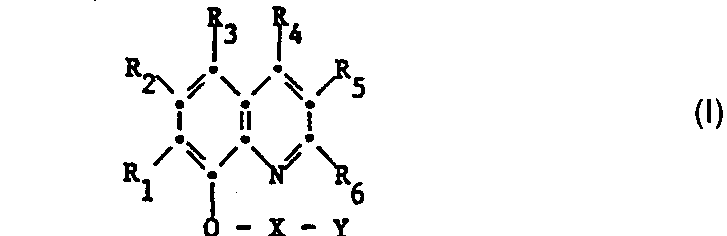
- R1, R2 und R3 unabhängig voneinander Wasserstoff, Halogen, Nitro, Cyan, Alkyl, Alkoxy oder Acyl,
- R4, R, und R. unabhängig voneinander Wasserstoff, Halogen oder Alkyl,
- X einen aliphatischen, gesättigten oder ungesättigten, geradkettigen oder verzweigten Kohlenwasserstoffrest mit 1 bis 12 Kohlenstoffatomen, welcher durch ein oder mehrere Heteroatome unterbrochen oder durch Halogen substituiert sein kann, und
- Y Wasserstoff, Halogen, Hydroxy, Alkoxy, Alkenyloxy, Alkinyloxy, eine substituierte Aminogruppe, eine Ammoniogruppe, einen cycloaliphatischen Rest, einen heterocyclischen Rest, welcher unsubstituiert oder durch Alkyl mit bis 4 Kohlenstoffatomen substituiert ist, Phenyl, weiches unsubstituiert oder substituiert ist, Aryloxy, welches unsubstituiert oder substituiert ist, Benzyloxy, welches unsubstituiert oder substituiert ist, oder Acyloxy
bedeuten, unter Einschluss ihrer Säureadditionssalze und Metallkomplexe, oder Mittel, welche solche Derivate enthalten, eingesetzt. Es werden auch neue Chinolinderivate und ihre Herstellung beschrieben.
worin R1, R2, R3, R4, R, und R6 die für Formel angegebenen Bedeutungen haben und M für Wasserstoff, ein Alkali- oder Erdalkalimetallatom steht, mit einer Verbindung der Formel III
Description
- Die vorliegende Erfindung betrifft die Verwendung von Chinolinderivaten zum Schützen von Kulturpflanzen gegen schädigende Wirkungen von Agrarchemikalien, Mittel, welche diese Chinolinderivate enthalten, neue Chinolinderivate und die Herstellung der neuen Chinolinderivate.
- Beim Einsatz von Agrarchemikalien, wie Pflanzenschutzmitteln und insbesondere Herbiziden, können in Abhängigkeit von Faktoren wie beispielsweise Dosis der Agrarchemikalie und Applikationsart, Art der Kulturpflanze, Bodenbeschaffenheit und klimatischen Bedingungen, wie beispielsweise Belichtungsdauer, Temperatur und Niederschlagsmengen, die Kulturpflanzen in gewissem Masse geschädigt werden. So ist beispielsweise bekannt, dass Herbizide aus den verschiedensten Stoffklassen, wie Triazine, Harnstoffderivate, Carbamate, Thiolcarbamate, Halogenacetanilide, Halogenphenoxyessigsäuren und anderen Klassen bei der Anwendung in wirksamer Dosis die Kulturpflanzen, welche gegen die nachteilige Wirkung von unerwünschtem Pflanzenwuchs geschützt werden sollen, in gewissem Masse schädigen können. Um diesem Problem zu begegnen, sind schon verschiedene Stoffe vorgeschlagen worden, welche befähigt sind, die schädigende Wirkung eines Herbizids auf die Kulturpflanze spezifisch zu antagonisieren, d.h., die Kulturpflanze zu schützen, ohne zugleich die Herbizidwirkung gegen zu bekämpfende Unkräuter merklich zu beeinflussen. Dabei hat sich jedoch gezeigt, dass die vorgeschlagenen Gegenmittel häufig nur ein enges Einsatzgebiet haben, d.h., ein bestimmtes Gegenmittel eignet sich oftmals nur zur Anwendung bei einzelnen Kulturpflanzenarten und/oder zum Schutz der Kulturpflanzen gegen einzelne herbizide Substanzen oder Stoffklassen.
- So beschreibt die Britische Patentschrift 1,277,557 die Behandlung von Samen bzw. Sprösslingen von Weizen und Sorghum mit gewissen Oxamsäureestern und Amiden zum Schutz vor dem Angriff durch "ALACHLOR" (N-Methoxymethyl-N-chloracetyl-2,6-diäthylanilin). In den Deutschen Offenlegungsschriften 1,952,910 und 2,245,471, sowie in der Französischen Patentschrift 2,021,611 werden Gegenmittel zur Behandlung von Getreide-, Mais- und Reissamen zum Schutz gegen die schädigende Einwirkung von herbizid wirksamen Thiolcarbamaten vorgeschlagen. Gemäss der Deutschen Patentschrift 1,567,075 und der US-Patentschrift 3,131,509 werden Hydroxyaminoacetanilide und Hydantoine für den Schutz von Getreidesamen gegenüber Carbamaten verwendet.
- Die direkte pre- oder postemergente Behandlung gewisser Nutzpflanzen mit Gegenmitteln als Antagonisten bestimmter Herbizidklassen auf einer Anbaufläche ist in den Deutschen Offenlegungsschriften 2,141,586 und 2,218,097, sowie im US-Patent 3,867,444 beschrieben.
- Ferner können Maispflanzen gemäss der Deutschen Offenlegungsschrift 2,402,983 wirksam vor Schädigung durch Chloracetanilide geschützt werden, indem man dem Boden als Gegenmittel ein N-disubstituiertes Dichloracetamid zuführt.
- Gemäss EP-A 11.047 können auch Alkoximinobenzylcyanide, deren Alkoxygruppe u.a. durch eine acetalisierte Carbonylgruppe substituiert ist, als Mittel zum Schutz von Kulturpflanzen vor der schädigenden Wirkung von Herbiziden verschiedener Stoffklassen verwendet werden.
- Weiterhin beschreiben beispielsweise die amerikanische Patentschrift 4.176.185, die britischen Patentschriften 760.319, 989.578, 1.003.477 und 1.003.478, die schweizerische Patentschrift 408.007, die DE-OS 25 46 845, Areschka, A. et al., Eur. J. Med. Chem.-Chimica Therapeutica, Sept.-Okt. 1975-10, No. 5, 463-469, Major R.T. et al., J. Med. Pharm. Chem. 4, 317-326, 1961, und Thompson, H.E., Botan. Gaz. 107. 476-507, 1946, den Einsatz von Chinolinderivaten auf therapeutischem Gebiet, als Ausgangsprodukt zur Herstellung therapeutischer Wirkstoffe, als Mittel zur Wachstumsförderung bei Tieren, als Pflanzenwuchshemmer oder als Herbizide.
- Es wurde nun gefunden, dass sich überraschenderweise eine Gruppe von Chinolinderivaten hervorragend dazu eignet, Kulturpflanzen gegen schädigende Wirkungen von Agrarchemikalien, wie beispielsweise Pflanzenschutzmitteln, insbesondere Herbiziden, zu schützen. Diese Chinolinderivate werden daher im folgenden auch als "Gegenmittel", "Antidot" oder "Safener" bezeichnet.
- Chinolinderivate, welche zum Schützen von Kulturpflanzen gegen schädigende Wirkungen von Agrarchemikalien geeignet sind, entsprechen der Formel I

- R1, R2 und R3 unabhängig voneinander Wasserstoff, Halogen, Nitro, Cyan, Alkyl, Alkoxy oder Acyl,
- R4, R5 und R6 unabhängig voneinander Wasserstoff, Halogen oder Alkyl, X einen aliphatischen, gesättigten oder ungesättigten, geradkettigen oder verzweigten Kohlenwasserstoffrest mit 1 bis 12 Kohlenstoffatomen, welcher durch ein oder mehrere Heteroatome unterbrochen oder durch Halogen substituiert sein kann, und
- Y Wasserstoff, Halogen, Hydroxy, Alkoxy, Alkenyloxy, Alkinyloxy, eine substituierte Aminogruppe, eine Ammoniogruppe, einen cycloaliphatischenRest, einen heterocyclischen Rest, welcher unsubstituiert oder durch Alkyl mit 1 bis 4 Kohlenstoffatomen substituiert ist, Phenyl, welches unsubstituiert oder substituiert ist, Aryloxy, welches unsubstituiert oder substituiert ist, Benzyloxy, welches unsubstituiert oder substituiert ist, oder Acyloxy
bedeuten, unter Einschluss ihrer Säureadditionssalze und Metallkomplexe. - Soweit optisch isomere Verbindungen der Formel I existieren, sind im Rahmen der vorliegenden Erfindung sowohl die optisch reinen Isomere wie auch die Isomerengemische zu verstehen.
- In den Verbindungen der Formel I sind unter Halogen Fluor, Chlor, Brom und Jod zu verstehen, insbesondere Chlor, Brom und Jod.
- Die als Substituent Y vorliegende Alkoxygruppe sowie die als Substi- tuenten R 1, R 2, 3, R 4, R5 und R6 vorkommenden Alkyl- und Alkoxygruppen können geradkettig oder verzweigt sein und enthalten zweckmässigerweise 1 bis 8, bevorzugt 1 bis 4, und insbesondere 1 bis 3 Kohlenstoffatome. Beispiele für solche Substituenten sind Methyl, Aethyl, n-Propyl, Isopropyl, n-Pentyl, n-Hexyl, n-Heptyl, n-Oktyl und Isomere davon, sowie Methoxy, Aethoxy, Isopropoxy, n-Propoxy, Butoxy, Pentyloxy oder Hexyloxy.
- Als Acylreste kommen bevorzugt Alkylcarbonylgruppen in Betracht, insbesondere solche mit 1 bis 6 Kohlenstoffatomen und bevorzugt mit 1 bis 3 Kohlenstoffatomen. Diese Acylreste bilden auch bevorzugt den Acylteil der Acyloxygruppe. Hier sind beispielsweise die Propionyloxy- und die Acetoxygruppe zu nennen.
- Als Substituentengruppe -X-Y kommen, wenn Y für Wasserstoff steht, gesättigte oder ungesättigte, geradkettige oder verzweigte Kohlenwasserstoffreste in Frage, welche durch ein oder mehrere Heteroatome, beispielsweise Sauerstoff, unterbrochen sein können. Beispiele für derartige Kohlenwasserstoffreste sind Methyl, Aethyl, n-Propyl, Isopropyl, n-Butyl, Isobutyl, sek.-Butyl, tert.-Butyl, Allyl, Butenyl, Methallyl, Dimethallyl, Chlorallyl, Propargyl, n-Pentyl, Isopentyl, n-Hexyl, n-Heptyl, n-Oktyl und n-Dodecyl und Isomere davon.
- Sofern Y eine andere Bedeutung als Wasserstoff hat, kommen für X beispielsweise die vorstehend für -X-Y genannten, um ein Wasserstoffatom dezimierten Kohlenwasserstoffreste in Frage, wie beispielsweise Methylen, Aethylen, n-Propylen, n-Butylen und Isomere davon.
- Für Y als Alkenyloxygruppe oder Alkinyloxygruppe kommt insbesondere eine solche mit 3 bis 6, vorzugsweise 3 bis 4 Kohlenstoffatomen in Frage, wie beispielsweise Allyloxy bzw. Propargyloxy.
- Bei den über Sauerstoff gebundenen, ungesättigten Kohlenwasserstoffresten ist die Mehrfachbindung bevorzugt durch mindestens ein an der Mehrfachbindung nicht beteiligtes Kohlenstoffatom vom Sauerstoffatom getrennt.
- Unter einer substituierten Aminogruppe Y ist vorzugsweise eine Aminogruppe zu verstehen, welche durch eine oder zwei Alkylgruppen mit je 1 bis 4 Kohlenstoffatomen substituiert ist, wie beispielsweise Dimethylamino oder Diäthylamino.
- Als Ammoniogruppe kommt vor allem eine solche der Formel -N⊕RaRbRc·⊖ in Betracht, worin Ra, Rb und Rc vorzugsweise Alkyl mit 1 bis 4 Kohlenstoffatomen, beispielsweise Methyl, oder einer der Substituenten R , Rb und Rc auch Benzyl bedeuten und Q⊖ für das Anion einer organischen oder anorganischen Säure, beispielsweise der Salzsäure, steht.
- Unter einem cycloaliphatischen Rest ist vor allem ein Cycloalkylring mit 3 bis 6 Kohlenstoffatomen zu verstehen, wie beispielsweise Cyclopropyl und Cyclohexyl.
- Für Y als heterocyclischen Rest kommen insbesondere gesättigte, 5-oder 6-gliedrige, heterocyclische Ringe mit einem oder zwei Sauerstoffatomen oder mit einem Stickstoffatom in Betracht, welche unsubstituiert oder durch Alkyl mit 1 bis 4 Kohlenstoffatomen, beispielsweise Methyl, substituiert sind. Beispiele für solche heterocyclischen Reste sind Piperidino, Tetrahydrofuranyl, wie Tetrahydrofuran-2-yl, Dioxanyl, wie 1,3-Dioxan-2-yl, und gegebenenfalls durch Alkyl mit 1 bis 4 Kohlenstoffatomen substituiertes Dioxolanyl, wie 1,3-Dioxolan-2-yl, 1,3-Dioxolan-4-yl und 2-Methyl-1,3-dioxolan-4-yl.
- Als Arylteil der Aryloxygruppe kommt vorzugsweise ein unsubstituierter oder substituierter Phenylrest in Frage.
- In den Verbindungen der Formel I können aromatische Ringe, welche als Substituenten oder Teil eines Substituenten vorliegen, ihrerseits substituiert sein, beispielsweise durch Halogen, Alkyl mit 1 bis 4 Kohlenstoffatomen, welches unsubstituiert oder ein- oder mehrfach durch Halogen, beispielsweise Fluor, substituiert ist, oder Alkoxy mit 1 bis 4 Kohlenstoffatomen. Beispiele für solche substituierten aromatischen Reste sind Chlorphenyl, Chlorphenoxy, Methylphenoxy, Methoxyphenoxy, p-Chlorbenzyloxy, p-Fluorbenzyloxy, p-Methoxybenzyloxy und m-(Trifluormethyl)-benzyloxy.
- Als Salzbildner kommen organische und anorganische Säuren in Betracht. Beispiele organischer Säuren sind Essigsäure, Trichloressigsäure, Oxalsäure, Benzolsulfonsäure und Methansulfonsäure. Beispiele anorganischer Säuren sind Chlorwasserstoffsäure, Bromwasserstoffsäure, Jodwasserstoffsäure, Schwefelsäure, Phosphorsäure, phosphorige Säure und Salpetersäure.
- Als Metallkomplexbildner eignen sich beispielsweise Elemente der 3. und 4. Hauptgruppe, wie Aluminium, Zinn und Blei, sowie der 1. bis 8. Nebengruppe, wie beispielsweise Chrom, Mangan, Eisen, Kobalt, Nickel, Zirkon, Zink, Kupfer, Silber und Quecksilber. Bevorzugt sind die Nebengruppenelemente der 4. Periode.
- Besonders geeignet zur erfindungsgemässen Verwendung sind Verbindungen der Formel I, die den nachfolgend aufgeführten Verbindungsgruppen angehören:
- a) Verbindungen der Formel I, in denen R1, R2, R3, R42 R S und R6 die für Formel I angegebenen Bedeutungen haben und X und Y zusammen einen aliphatischen, gesättigten oder ungesättigten Kohlenwasserstoffrest bilden, unter Einschluss ihrer Säureadditionssalze und Metallkomplexe;
- b) Verbindungen der Formel I, in denen R1, R2, R3, R4, R5 und R 6 die für Formel I angegebenen Bedeutungen haben und X und Y zusammen einen aliphatischen, gesättigten Kohlenwasserstoffrest bilden, unter Einschluss ihrer Säureadditionssalze und Metallkomplexe;
- c) Verbindungen der Formel I, in denen R1, R2, R3, R4, R5 und R6 die für Formel I angegebenen Bedeutungen haben und X und Y zusammen einen aliphatischen ungesättigten Kohlenwasserstoffrest bilden, unter Einschluss ihrer Säureadditionssalze und Metallkomplexe;
- d) Verbindungen der Formel I, in denen R3 Halogen bedeutet, R1, R2, R4, R5 und R6 die für Formel I angegebenen Bedeutungen haben und X und Y zusammen den n-Octylrest bilden, unter Einschluss ihrer Säureadditionssalze und Metallkomplexe;
- e) Verbindungen der Formel I, in denen R3 Chlor bedeutet, R1, R2, R4, R 5 und R6 die für Formel I angegebenen Bedeutungen haben und X und Y zusammen den n-Octylrest bilden, unter Einschluss der Säureadditionssalze und Metallkomplexe;
- f) Verbindungen der Formel I, in denen R3 Halogen bedeutet, R1, R2, R42 R5 und R6 die für Formel I angegebenen Bedeutungen haben und X und Y zusammen den 2-Butenyl-Rest bilden, unter Einschluss der Säureadditionssalze und Metallkomplexe;
- g) Verbindungen der Formel I, in denen R3 Chlor bedeutet, R1, R2, R4, R5 und R6 die für Formel I angegebenen Bedeutungen haben und X und Y zusammen den 2-Butenyl-Rest bilden, unter Einschluss der Säureadditionssalze und Metallkomplexe;
- h) Verbindungen der Formel I, in denen R3 Chlor, und R1, R2, R4, R5 und R6 Wasserstoff bedeuten und X und Y zusammen den n-Octylrest bilden, unter Einschluss der Säureadditionssalze und Metallkomplexe;
- i) Verbindungen der Formel I, in denen R3 Chlor und R1, R2, R 42 R5 und R6 Wasserstoff bedeuten und X und Y zusammen den 2-Butenyl-Rest bilden, unter Einschluss der Säureadditionssalze und Metallkomplexe;
- k) Verbindungen der Formel I, in denen RI, R2, R3, R4, R5 und R6 die für Formel I angegebenen Bedeutungen haben und X Methylen und Y Phenyl, welches unsubstituiert oder substituiert ist, einen Dioxolanrest, einen Dioxanrest oder einen Tetrahydrofuranrest bedeuten, unter Einschluss ihrer Säureadditionssalze und Metallkomplexe;
- 1) Verbindungen der Formel I, in denen R1, R2, R3, R4, R5 und R 6 die für Formel I angegebene Bedeutung haben und X Methylen und Y einen Dioxolanrest, einen Dioxanrest oder einen Tetrahydrofuranrest bedeuten, unter Einschluss ihrer Säureadditonssalze und Metallkompplexe;
- m) Verbindungen der Formel I, in denen R3 Halogen und R1, R2, R4, R5 und R6 Wasserstoff bedeuten und X Methylen und Y einen Dioxolanrest, einen Dioxanrest oder einen Tetrahydrofuranrest bedeuten, unter Einschluss ihrer Säureadditionssalze und Metallkomplexe;
- n) Verbindungen der Formel I, in denen R3 Chlor und R1, R2, R42 R5 und R6 Wasserstoff bedeuten und X Methylen und Y einen Dioxolanrest, einen Dioxanrest oder einen Tetrahydrofuranrest bedeuten, unter Einschluss ihrer Säureadditionssalze und Metallkomplexe;
- o) Verbindungen der Formel I, in denen R3 Chlor und R1, R2, R4, R5 und R6 Wasserstoff bedeuten und X Methylen und Y einen Dioxolanrest bedeuten, unter Einschluss der Säureadditionssalze und Metallkomplexe;
- p) Verbindungen der Formel I, in denen R3 Chlor und R1, R2, R4, R5 und R6 Wasserstoff und X Methylen und Y einen Dioxanrest bedeutet, unter Einschluss der Säureadditionssalze und Metallkomplexe;
- q) Verbindungen der Formel I, in denen R3 Chlor und R1, R2, R4, R5 und R6 Wasserstoff und X Methylen und Y einen Tetrahydrofuranrest bedeutet, unter Einschluss der Säureadditionssalze und Metallkomplexe;
- r) Verbindungen der Formel I, in denen R1, R2, R3, R4, R5 und R6 Wasserstoff bedeuten und X und Y zusammen einen aliphatischen gesättigten oder ungesättigten Kohlenwasserstoffrest bilden,unter Einschluss ihrer Säureadditionssalze und Metallkomplexe;
- s) Verbindungen der Formel I, in denen R1, R2, R3, R49 R5 und R 6 Was- serstoff bedeuten und X und Y zusammen den 2-Butenyl-Rest bilden,. unter Einschluss der Säureadditionssalze und Metallkomplexe;
- t) Verbindungen der Formel I, in denen R1, R2, R3, R4, R5 und R6 Wasserstoff, X Methylen und Y einen Dioxolanrest, einen Dioxanrest oder einen Tetrahydrofuranrest bedeuten, unter Einschluss ihrer Säureadditionssalze und Metallkomplexe;
- u) Verbindungen der Formel I, in denen R1, R2, R3, R4, R5 und R 6 Was- serstoff, X Methylen und Y einen Dioxolanrest bedeuten, unter Einschluss ihrer Säureadditionssalze und Metallkomplexe;
- v) Verbindungen der Formel I, in denen R1, R2, R3, R4, R5 und R6 Was- serstoff, X Methylen und Y einen Dioxanrest bedeuten, unter Einschluss ihrer Säureadditionssalze und Metallkomplexe.
- w) Verbindungen der Formel I, in denen R1, R2, R3, R4, R5 und R 6 Was- serstoff, X Methylen und Y einen Tetrahydrofuranrest bedeuten, unter Einschluss ihrer Säureadditionssalze und Metallkomplexe;
- x) Verbindungen der Formel I, in denen R1, R2, R3, R4, R5 und R6 die für Formel I angegebenen Bedeutungen haben, X einen aliphatischen gesättigten Kohlenwasserstoffrest und Y Halogen, Hydroxy, Alkoxy, Alkenyloxy, Alkinyloxy, eine substituierte Aminogruppe, eine Ammoniogruppe, einen cycloaliphatischen Rest, einen heterocyclischen Rest, welcher unsubstituiert oder durch Alkyl mit 1 bis 4 Kohlenstoffatomen substituiert ist, Phenyl, welches unsubstituiert oder substituiert ist, Aryloxy, welches unsubstituiert oder substituiert ist, Benzyloxy, welches unsubstituiert oder substituiert ist, oder Acyloxy bedeuten, unter Einschluss ihrer Säureadditionssalze und Metallkomplexe;
- y) Verbindungen der Formel I, in denen R3 Chlor und R1, R2, R 4, R5 und R6 die für Formel I angegebenen Bedeutungen haben, X einen aliphatischen gesättigten Kohlenwasserstoffrest undYHalogen, Hydroxy, Alkoxy, Alkenyloxy, Alkinyloxy, eine substituierte Aminogruppe, eine Ammoniogruppe, einen cycloaliphatischen Rest, einen heterocyclischen Rest, welcher unsubstituiert oder durch Alkyl mit 1 bis 4 Kohlenstoffatomen substituiert ist, Phenyl, welches unsubstituiert oder substituiert ist, Aryloxy, welches unsubstituiert oder substituiert ist, Benzyloxy, welches unsubstituiert oder substituiert ist, oder Acyloxy bedeuten, unter Einschluss ihrer Säureadditionssalze und Metallkomplexe;
- z) Verbindungen der Formel I, in denen R1, R2, R3, R4, R52 R 6 und Y die für Formel I angegebenen Bedeutungen haben und X für -CH2- steht;
- a') Verbindungen der Formel I, in denen R1, R2, R3, R4, R5, R 6 und Y die für Formel I angegebenen Bedeutungen haben und X für -CH2-CH2- steht;
- b') Verbindungen der Formel I, in denen R1, R2, R3, R4, R5, R 6 und Y die für Formel I angegebenen Bedeutungen haben und X für -CH2-CH2-CH2- steht;
- c') Verbindungen der Formel I, in denen R1, R2, R3, R4, R 5, R 6 und Y die für Formel I angegebenen Bedeutungen haben und X für -CH2-CH=CH-CH2- steht;
- d') Verbindungen der Formel I, in denen R1, R2, R3, R 4, R5, R6 und Y die für Formel I angegebene Bedeutung haben und X für -CH2-CH=CH- steht.
- e') Verbindungen der Formel I, in denen R1, R2, R4 und R5 Wasserstoff, R3 Wasserstoff oder Chlor und R6 Wasserstoff oder Methyl bedeuten und die Substituentengruppe -X-Y für n-Oktyl, Allyl, 2-Butenyl, Propargyl, 1,3-Dioxolan-2-ylmethyl, 1,3-Dioxan-2-ylmethyl oder Tetrahydrofuran-2-ylmethyl steht.
- a") Verbindungen, in denen R1 Wasserstoff, Chlor oder Brom, R2, R4 und R5 Wasserstoff, R3 Wasserstoff, Chlor, Brom oder Nitro, R6 Wasserstoff oder Methyl und i) X einen C1-C4 Alkylenrest oder einen unsubstituierten oder durch Chlor substituierten C2-C3-Alkenylenrest und Y Chlor, 2-Propenyloxy, Dimethylamino, Diäthylamino, Benzyldimethylammoniochlorid, 1,3-Dioxolanyl, Methyl-1,3-Dioxolanyl, 1,3-Dioxanyl, Furyl, Piperidino, Phenyl, Chlorphenyl, Phenoxy, Methylphenoxy, Benzyloxy oder Acetoxy oder ii) Y Wasserstoff und X und Y gemeinsam Butyl, Oktyl, 2-Propenyl, Chlor-2-propenyl, 2-Butenyl oder 2-Propinyl bedeuten, und hiervon insbesondere diejenigen Verbindungen, in denen R1 Wasserstoff, Chlor oder Brom, R2, R4 und R5 Wasserstoff, R3 Wasserstoff, Chlor, Brom oder Nitro, R6 Wasserstoff oder Methyl und i) X Methylen und Y 1,3-Dioxolan-2-yl oder ii) X 2-Chlor-2-propenylen und Y Chlor oder iii) Y Wasserstoff und X und Y gemeinsam n-Butyl, n-Oktyl oder 2-Butenyl bedeuten.
- b") Verbindungen, in denen R1 und R3 unabhängig voneinander Wasserstoff oder Chlor, R2, R4 und R5 Wasserstoff, R6 Wasserstoff oder Methyl, X Methylen und Y 1,3-Dioxolan-2-yl, 1,3-Dioxolan-4-yl, 2-Methyl-1,3-dioxolan-4-yl, 1,3-Dioxan-2-yl, 2-Furyl, Phenyl oder 4-Chlorphenyl bedeuten.
- c") Verbindungen, in denen R und R3 unabhängig voneinander Wasserstoff; Chlor oder Brom, R2, R4, R5 und R6 Wasserstoff, X Aethylen oder Trimethylen und Y 2-Propenyloxy, Dimethylamino, Diäthylamino, Benzyldimethylammoniochlorid, Piperidino, Phenoxy, 4-Methylphenoxy, Benzyloxy oder Acetoxy bedeuten.
- d") Verbindungen, in denen R1, R2, R4, R5 und R6 Wasserstoff, R3 Chlor und i) X 2-Propenylen und Y Phenyl oder ii) X 2-Butenylen und Y Chlor bedeuten.
- e") Verbindungen, in denen R1, R2, R4, R5 und R6 Wasserstoff, R3 Chlor und Y Wasserstoff und X und Y gemeinsam n-Butyl, sek.-Butyl, 2-Propenyl, 2-Chlor-2-propenyl, 2-Butenyl oder 2-Propinyl bedeuten.
- f") Verbindungen der unter die Formel I fallenden Formel Ia

- R1', R2 1 und R3' unabhängig voneinander Wasserstoff, Halogen, Nitro, Cyan, Alkyl, Alkoxy oder Acyl,
- R4', R5' und R6' unabhängig voneinander Wasserstoff, Halogen oder Alkyl und
- die Substituentengruppe -X'-Y' 2-Butenyl, 1,3-Dioxolan-2-ylmethyl, 1,3-Dioxan-2-ylmethyl oder Tetrahydrofuran-2-ylmethyl bedeuten.
- Wegen ihrer Wirkung bevorzugte Einzelverbindungen:
- 8-Allyloxychinolin,
- 8-(2-Butenyloxy)-chinolin,
- 5-Chlor-8-allyloxychinolin,
- 5-Chlor-8-propargyloxychinolin,
- 5-Chlor-8-(2-butenyloxy)-chinaldin,
- 8-Oktyloxychinolin,
- 5-Chlor-8-oktyloxychinolin,
- 8-Oktyloxychinaldin,
- 5-Chlor-8-oktyloxychinaldin,
- 8-(1,3-Dioxolan-2-ylmethoxy)-chinolin,
- 5-Chlor-8-(1,3-dioxolan-2-ylmethoxy)-chinolin,
- 8-(1,3-Dioxan-2-ylmethoxy)-chinolin,
- 5-Chlor-8-(1,3-dioxan-2-ylmethoxy)-chinolin,
- 5-Chlor-8-(tetrahydrofuran-2-ylmethoxy)-chinolin und insbesondere
- 5-Chlor-8-(2-butenyloxy)-chinolin.
- Die Chinolinderivate der Formel I besitzen in hervorragendem Masse die Eigenschaft, Kulturpflanzen gegen schädigende Wirkungen von Agrarchemikalien zu schützen. Als Agrarchemikalien kommen beispielsweise Defoliationsmittel, Desiccationsmittel, Mittel zum Schutz gegen Frostschäden und Pflanzenschutzmittel, wie beispielsweise Insektizide, Fungizide, Bakterizide, Nematozide und insbesondere Herbizide in Betracht. Die Herbizide können beispielsweise zu einer der folgenden Stoffklassen gehören: Triazine und Triazinone; Phenylharnstoffe, insbesondere 3-(4-Isopropylphenyl)-1,1-dimethylharnstoff ("Isoproturon"); Carbamate und Thiocarbamate; Halogenacetanilide, insbesondere Chloracetanilide; Chloracetamide; Halogenphenoxyessigsäureester; Diphenyläther, wie beispielsweise substituierte Phenoxyphenoxyessigsäureester und -amide und substituierte Phenoxyphenoxypropionsäureester und -amide; substituierte Pyridyloxyphenoxyessigsäureester und -amide und substituierte Pyridyloxyphenoxypropionsäureester und -amide, insbesondere 2-[4-(3,5-Dichlorpyridyl-2-oxy)-phenoxy]-propionsäure-2-propinylester; Benzoesäurederivate; Nitroaniline; Oxadiazolone; Sulfonylharnstoffe; (4,5-Dihydro-4-oxo-lH-imidazol-2-yl)-benzoesäureDerivate, -nicotinsäure-Derivate und -chinolincarbonsäure-Derivate; Phosphate; und Pyrazole.
- Im einzelnen kommen beispielsweise folgende Substanzen in Betracht: Triazine und Triazinone: 2,4-Bis(isopropylamino)-6-methylthio-1,3,5-triazin ("Prometryn"), 2,4-bis(äthylamino)-6-methylthio-1,3,5-triazin ("Simetryn"), 2-(1',2'-Dimethylpropylamino)-4-äthylamino-6-methyl- thio-1,3,5-triazin ("Dimethametryn"), 4-Amino-6-tert.butyl-4,5-di- hydro-3-methylthio-1,2,4-triazin-5-on ("Metribuzin").
- Phenylharnstoffe: N-(3',4'-Dimethylbenzyl)-N'-4-tolyl-harnstoff ( R Dimuron), N-(3'-Chlor-4'-isopropylphenyl)-N',N'-(3-methyl-pentamethylen-1,5-yl)-harnstoff.
- Carbamate und Thiocarbamate: N-(3',4'-Dichlorphenyl)-propionanilid ("propanil"), S-4-Chlorbenzyl-diäthyl-thiocarbamat ("Benthiocarb"), S-Aethyl-N,N-hexamethylen-thiocarbamat ("Molinate"), S-Aethyldi-propyl-thiocarbamat ("EPTC"), N,N-di-sec.Butyl-S-benzyl-thiocarba- mat (Drepamon), S-(2,3-Dichlorallyl)-di-isopropyl-thiocarbamat ("Di-allate"), 1-(Propylthiocarbonyl)-decahydro-chinaldin.
- Chloracetanilide: 2-Chlor-2',6'-diäthyl-N-(2"-propyloxyäthyl)acetanilid ("Propalochlor"), 2-Chlor-6'-äthyl-N-(2"-methoxy-1"-methyl- äthyl)-acet-o-toluidid ("Metolachlor"), 2-Chlor-2',6'-diäthyl-N-(butoxymethyl)acetanilid ("Butachlor"), 2-Chlor-6'-äthyl-N-(äthoxy- methyl)acet-o-toluidid ("Acetochlor"), 2-Chlor-6'-äthyl-N-(2"-propoxy-l"-methyläthyl)acet-o-toluidid, 2-Chlor-2',6'-dimethyl-N-(2"-methoxy-l"-methyläthyl)acetanilid, 2-Chlor-2',6'-dimethyl-N-(2"-methoxy- äthyl)acetanilid ("Dimethachlor"), 2-Chlor-2',6'-diäthyl-N-(pyrazol- l-ylmethyl)acetanilid, 2-Chlor-6'-äthyl-N-(pyrazol-1-ylmethyl)acet-o-toluidid, 2-Chlor-6'-äthyl-N-(3,5-dimethyl-pyrazol-1-ylmethyl)acet-o-toluidid, 2-Chlor-6'-äthyl-N-(2"-butoxy-1"-methyläthyl)acet-o-toluidid ("Metazolachlor"), 2-Chlor-6'-äthyl-N-(2"-butoxyl-1"-(methyläthyl) acet-o-toluidid und 2-Chlor-2'-trimethylsilyl-N-(butoxymethyl)-acetanilid.
- Chloracetamide: N-[1-Isopropyl-2-methylpropen-1-yl-(I)]-N-(2'-methoxy- äthyl)-chloracetamid.
- Diphenyläther und Nitrodiphenyläther: 2,4-Dichlorphenyl-4'-nitro- phenyläther ("Nitrofen"), 2-Chlor-1-(3'-äthoxy-4'-nitrophenoxy)-4-trifluormethyl-benzol ("Oxyfluorfen"), 2',4'-Dichlorphenyl-3-methoxy-4-nitrophenyl-äther ("Chlormethoxynil"), 2-[4'-(2",4"-Dichlorphenoxy)-phenoxy)propionsäure-methylester, N-(2'-Phenoxyäthyl)-2-[5'(2"-chlor-4"-trifluormethylphenoxy)-phenoxy]-propionsäureamid. Benzoesäurederivate: Methyl-S-(2',4'-dichlorphenoxy)-2-nitrobenzoat ("Bifenox"), 5-(2'-Chlor-4'-trifluormethylphenoxy)-2-nitrobenzoesäure ("Acifluorfen"), 2,6-Dichlorbenzonitril ("Dichlobenil").
- Nitroaniline: 2,6-Dinitro-N,N-dipropyl-4-trifluormethylanilin ("Trifluralin"), N-(1'-Aethylpropyl)-2,6-dinitro-3,4-xylidin ("Pendimethalin").
- Oxadiazolone: 5-tert.-Butyl-3-(2',4'-dichlor-5'-isopropoxyphenyl)-1,3,4-oxadiazol-2-on ("Oxadiazon").
- Phosphate: S-2-Methylpiperidino-carbonylmethyl-0,0-dipropyl-phospho- rodithioat ("Piperophos").
- Pyrazole: 1,3-Dimethyl-4-(2',4'-dichlorbenzoyl)-5-(4'-tolylsulfonyl- oxy)-pyrazol.
- Besonders geeignet sind die Verbindungen der Formel I zum Schützen von Kulturpflanzen gegen schädigende Wirkungen von Herbiziden der Formel H - I


- R13C1-C4-Alkyl, R 14 C1-C4-Alkyl oder R 13 und R 14 gemeinsam C4-C5-Alkylen,
- X1" Wasserstoff oder Halogen,
- X2" Wasserstoff, Halogen oder Trifluormethyl,
- G das Fragment =N- oder =CH-,
- E ein Sauerstoff- oder Schwefelatom,
- R15 Halogen, Cl-C4-Alkyl oder Trifluormethyl,
- n eine Zahl von 0 bis 2,
- R 16 Halogen, C1-C4 Alkyl oder Trifluormethyl und
- m eine Zahl von 0 bis 2 bedeuten.
- Zu betonen ist auch die gute Schutzwirkung von Verbindungen der Formel I bei Kulturpflanzen, insbesondere bei Getreide, gegen schädigende Wirkungen von Herbiziden, wie Diphenyläther-Derivaten und substituierten Pyridyloxyphenoxypropionsäureestern, insbesondere 2-[4-(3,5-Dichlor- pyridyl-2-oxy)-phenoxy]-propionsäure-2-propinylester.
- Als Kulturpflanzen, welche durch Chinolinderivate der Formel I gegen Agrarchemikalien geschützt werden können, kommen insbesondere diejenigen in Betracht, die auf dem Nahrungs- oder Textilsektor von Bedeutung sind, wie beispielsweise Kulturhirse, Reis, Mais, Getreidearten (Weizen, Roggen, Gerste, Hafer), Baumwolle, Zuckerrüben, Zuckerrohr und Soja.
- Ein geeignetes Verfahren zum Schützen von Kulturpflanzen unter Verwendung von Verbindungen der Formel I besteht darin, dass man Kulturpflanzen, Teile dieser Pflanzen oder für den Anbau der Kulturpflanzen bestimmte Böden vor oder nach dem Einbringen des pflanzlichen Materials in den Boden mit einer Verbindung der Formel I oder einem Mittel, welches eine solche Verbindung enthält, behandelt. Die Behandlung kann vor, gleichzeitig mit oder nach dem Einsatz der Agrarchemikalie erfolgen. Als Pflanzenteile kommen insbesondere diejenigen in Betracht, die zur Neubildung einer Pflanze befähigt sind, wie beispielsweise Samen, Früchte, Stengelteile und Zweige (Stecklinge) sowie auch Wurzeln, Knollen und Rhizome.
- Die Erfindung betrifft auch ein Verfahren zur selektiven Bekämpfung von Unkräutern in Kulturpflanzenbeständen, wobei die Kulturpflanzenbestände, Teile der Kulturpflanzen oder Anbauflächen für Kulturpflanzen mit einem Herbizid und einer Verbindung der Formel I oder einem Mittel, welches diese Kombination enthält, behandelt werden. Die die Herbzid/Antidot-Kombination enthaltenden Mittel bilden ebenfalls einen Bestandteil der vorliegenden Erfindung.
- Bei den zu bekämpfenden Unkräutern kann es sich sowohl um monokotyle wie um dikotyle Unkräuter handeln.
- Als Kulturpflanzen oder Teile.dieser Pflanzen kommen beispielsweise die vorstehend genannten in Betracht. Als Anbauflächen gelten die bereits mit Kulturpflanzen bewachsenen oder die ausgesäten Bodenareale, wie auch die zur Bebauung mit Kulturpflanzen bestimmten Böden.
- Die zu applizierende Aufwandmenge Antidot im Verhältnis zur Agrarchemikalie richtet sich weitgehend nach der Anwendungsart. Bei einer Feldbehandlung, welche entweder unter Verwendung einer Tankmischung oder durch getrennte Applikation von Agrarchemikalie und Antidot durchgeführt wird, liegt in der Regel ein Verhältnis von Antidot zu Agrarchemikalie von 1:100 bis 10:1, bevorzugt 1:5 bis 8:1, und insbesondere 1:1, vor.
- Dagegen werden bei der Samenbeizung und ähnlichen Einsatzmethoden weit geringere Mengen Antidot im Verhältnis zur Aufwandmenge an Agrarchemikalie/ha Anbaufläche benötigt. Bei der Samenbeizung werden in der Regel 0,1 bis 10 g Antidot/kg Samen, bevorzugt 1 bis 2 g, appliziert. Wird das Gegenmittel kurz vor der Aussaat unter Samenquellung appliziert, so werden zweckmässigerweise Antidot-Lösungen verwendet, welche den Wirkstoff in einer Konzentration von 1 bis 10 000 ppm, bevorzugt 100 bis 1000 ppm, enthalten.
- Die Verbindungen der Formel I können für sich allein oder zusammen mit inerten Zusatzstoffen und/oder den zu antagonisierenden Agrarchemikalien zur Anwendung gelangen.
- Die vorliegende Anmeldung betrifft daher auch Mittel, welche Verbindungen der Formel I und inerte Zusatzstoffe und/oder zu antagonisierende Agrarchemikalien, insbesondere Pflanzenschutzmittel und vor allem Herbizide, enthalten.
- Zur Applikation werden die Verbindungen der Formel I oder Kombinationen von Verbindungen der Formel I mit zu antagonisierenden Agrarchemikalien zweckmässigerweise zusammen mit den in der Formulierungstechnik üblichen Hilfsmitteln eingesetzt und werden daher z.B. zu Emulsionskonzentraten, streichfähigen Pasten, direkt versprühbaren oder verdünnbaren Lösungen, verdünnten Emulsionen, Spritzpulvern, löslichen Pulvern, Stäubemitteln, Granulaten, auch Verkapselungen in z.B. polymeren Stoffen in bekannter Weise verarbeitet. Die Anwendungsverfahren wie Versprühen, Vernebeln, Verstäuben, Verstreuen, Bestreichen oder Giessen werden gleich wie die Art der Mittel den angestrebten Zielen und den gegebenen Verhältnissen entsprechend gewählt.
- Die Formulierungen, d.h., die den Wirkstoff der Formel I oder eine Kombination von Wirkstoff der Formel I mit zu antagonisierender Agrarchemikalie und gegebenenfalls einen festen oder flüssigen Zusatzstoff enthaltenden Mittel, Zubereitungen oder Zusammensetzungen werden in bekannter Weise hergestellt, z.B. durch inniges Vermischen und/oder Vermahlen der Wirkstoffe mit Streckmitteln, wie z.B. mit Lösungsmitteln, festen Trägerstoffen, und gegebenenfalls oberflächenaktiven Verbindungen (Tensiden).
- Als Lösungsmittel können in Frage kommen: Aromatische Kohlenwasserstoffe, bevorzugt die Fraktionen C8 bis C12, wie z.B. Xylolgemische oder substituierte Naphthaline, Phthalsäureester wie Dibutyl- oder Dioctylphthalat, aliphatische Kohlenwasserstoffe wie Cyclohexan oder Paraffine, Alkohole und Glykole sowie deren Aether und Ester, wie Aethanol, Aethylenglykol, Aethylenglykolmonomethyl- oder -äthyläther, Ketone wie Cyclohexanon, stark polare Lösungsmittel wie N-Methyl-2-pyrrolidon, Dimethylsulfoxid oder Dimethylformamid, sowie gegebenenfalls epoxydierte Pflanzenöle wie epoxydiertes Kokosnussöl oder Sojaöl; oder Wasser.
- Als feste Trägerstoffe, z.B. für Stäubemittel und dispergierbare Pulver, werden in der Regel natürliche Gesteinsmehle verwendet, wie Calcit, Talkum, Kaolin, Montmorillonit oder Attapulgit. Zur Verbesserung der physikalischen Eigenschaften können auch hochdisperse Kieselsäure oder hochdisperse saugfähige Polymerisate zugesetzt werden. Als gekörnte, adsorptive Granulatträger kommen poröse Typen wie z.B. Bimsstein, Ziegelbruch, Sepiolit oder Bentonit, als nicht sorptive Trägermaterialien z.B. Calcit oder Sand in Frage. Darüberhinaus kann eine Vielzahl von vorgranulierten Materialien anorganischer oder organischer Natur wie insbesondere Dolomit oder zerkleinerte Pflanzenrückstände verwendet werden.
- Als oberflächenaktive Verbindungen kommen je nach Art des zu formulierenden Wirkstoffs der Formel I und gegebenenfalls auch der zu antagonisierenden Agrarchemikalie nichtionogene, kation- und/oder anionaktive Tenside mit guten Emulgier-, Dispergier- und Netzeigenschaften in Betracht. Unter Tensiden sind auch Tensidgemische zu verstehen.
- Geeignete anionische Tenside können sowohl sog. wasserlösliche Seifen wie wasserlösliche synthetische oberflächenaktive Verbindungen sein.
- Als Seifen seien die Alkali-, Erdalkali- oder gegebenenfalls substi- tuierten Ammoniumsalze von höheren Fettsäuren (C10-C22), wie z.B. die Na- oder K-Salze der Oel- oder Stearinsäure, oder von natürlichen Fettsäuregemischen, die z.B. aus Kokosnuss- oder Talgöl gewonnen werden können, genannt. Ferner sind auch die Fettsäure-methyltaurinsalze zu erwähnen.
- Häufiger werden jedoch sog. synthetische Tenside verwendet, insbesondere Fettsulfonate, Fettsulfate, sulfonierte Benzimidazolderivate oder Alkylarylsulfonate.
- Die Fettsulfonate oder -sulfate liegen in der Regel als Alkali-, Erdalkali- oder gegebenenfalls substituierte Ammoniumsalze vor und weisen einen Alkylrest mit 8 bis 22 C-Atomen auf, wobei Alkyl auch den Alkylteil von Acylresten einschliesst, z.B. das Na- oder Ca-Salz der Ligninsulfonsäure, des Dodecylschwefelsäureesters oder eines aus natürlichen Fettsäuren hergestellten Fettalkoholsulfatgemisches. Hierher gehören auch die Salze der Schwefelsäureester und Sulfonsäuren von Fettalkohol-Aethylenoxyd-Addukten. Die sulfonierten Benzimidazolderivate enthalten vorzugsweise 2-Sulfonsäuregruppen und einen Fettsäurerest mit 8 bis 22 C-Atomen. Alkylarylsulfonate sind z.B. die Na-, Ca- oder Triäthanolaminsalze der Dodecylbenzolsulfonsäure, der Dibutylnaphthalinsulfonsäure, oder eines Naphthalinsulfonsäure-Formaldehydkondensationsproduktes.
- Ferner kommen auch entsprechende Phosphate wie z.B. Salze des Phosphorsäureesters eines p-Nonylphenol-(4-14)-Aethylenoxyd-Adduktes oder Phospholipide in Frage.
- Als nichtionische Tenside kommen in erster Linie Polyglykolätherderivate von aliphatischen oder cycloaliphatischen Alkoholen, gesättigten oder ungesättigten Fettsäuren und Alkylphenolen in Frage, die 3 bis 30 Glykoläthergruppen und 8 bis 20 Kohlenstoffatome im (aliphatischen) Kohlenwasserstoffrest und 6 bis 18 Kohlenstoffatome im Alkylrest der Alkylphenole enthalten können.
- Weitere geeignete nichtionische Tenside sind die wasserlöslichen, 20 bis 250 Aethylenglykoläthergruppen und 10 bis 100 Propylenglykoläthergruppen enthaltenden Polyäthylenoxidaddukte an Polypropylenglykol, Aethylendiaminopolypropylenglykol und Alkylpolypropylenglykol mit 1 bis 10 Kohlenstoffatomen in der Alkylkette. Die genannten Verbindungen enthalten üblicherweise pro Propylenglykol-Einheit 1 bis 5 Aethylenglykoleinheiten.
- Als Beispiele nichtionischer Tenside seien Nonylphenolpolyäthoxy- äthanole, Ricinusölpolyglykoläther, Polypropylen-Polyäthylenoxydaddukte, Tributylphenoxypolyäthoxyäthanol, Polyäthylenglykol und Octylphenoxypolyäthoxyäthanol erwähnt.
- Ferner kommen auch Fettsäureester von Polyoxyäthylensorbitan wie das Polyoxyäthylensorbitan-trioleat in Betracht.
- Bei den kationischen Tensiden handelt es sich vor allem um quartäre Ammoniumsalze, welche als N-Substituenten mindestens einen'Alkylrest mit 8 bis 22 C-Atomen enthalten und als weitere Substituenten niedrige, gegebenenfalls halogenierte Alkyl-, Benzyl- oder niedrige Hydroxyalkylreste aufweisen. Die Salze liegen vorzugsweise als Halogenide, Methylsulfate oder Aethylsulfate vor, z.B. das Stearyltrimethylammoniumchlorid oder das Benzyldi(2-chloräthyl)äthylammoniumbromid.
- Die in der Formulierungstechnik gebräuchlichen Tenside sind u.a. in folgenden Publikationen beschrieben:
- "Mc Cutcheon's Detergents and Emulsifiers Annual" MC Publishing Corp., Ridgewood New Jersey, 1980
- Stache, H., "Tensid-Taschenbuch",
- Carl Hanser Verlag, München/Wien, 1981
- Die agrochemischen Zubereitungen enthalten in der Regel 0,1 bis 99 Gewichtsprozent, insbesondere 0,1 bis 95 Gewichtsprozent, Wirkstoff der Formel I oder eine Kombination von Wirkstoff der Formel I mit zu antagonisierender Agrarchemikalie, 1 bis 99,9 Gewichtsprozent, insbesondere 5 bis 99,8 Gewichtsprozent, eines festen oder flüssigen Zusatzstoffes und 0 bis 25 Gewichtsprozent, insbesondere 0,1 bis 25 Gewichtsprozent, eines Tensides.
- Während als Handelsware eher konzentrierte Mittel bevorzugt werden, verwendet der Endverbraucher in der Regel verdünnte Mittel.
- Die Mittel können auch weitere Zusätze wie Stabilisatoren, Entschäumer, Viskositätsregulatoren, Bindemittel, Haftmittel sowie Dünger oder andere Wirkstoffe zur Erzielung spezieller Effekte enthalten.
- Für die Verwendung von Verbindungen der Formel I oder sie enthaltender Mittel zum Schützen von Kulturpflanzen gegen schädigende Wirkungen von Agrarchemikalien kommen verschiedene Methoden und Techniken in Betracht, wie beispielsweise die folgenden:
- i) Samenbeizung
- a) Beizung der Samen mit einem als Spritzpulver formulierten Wirkstoff durch Schütteln in einem Gefäss bis zur gleichmässigen Verteilung auf der Samenoberfläche (Trockenbeizung). Man verwendet dabei etwa 10 bis 500 g Wirkstoff der Formel I (40 g bis 2'kg Spritzpulver) pro 100 kg Saatgut.
- b) Beizung der Samen mit einem Emulsionskonzentrat des Wirkstoffs der Formel I nach der Methode a) (Nassbeizung).
- c) Beizung durch Tauchen des Saatguts in eine Brühe mit 50-3200 ppm Wirkstoff der Formel I während 1 bis 72 Stunden und gegebenenfalls nachfolgendes Trocknen der Samen (Tauchbeizung).
- Die Beizung des Saatguts oder die Behandlung des angekeimten Sämlings sind naturgemäss die bevorzugten Metoden der Applikation, weil die Wirkstoffbehandlung vollständig auf die Zielkultur gerichtet ist. Man verwendet in der Regel 10 g bis 500 g, vorzugsweise 50 bis 250 g AS pro 100 kg Saatgut, wobei man je nach Methodik, die auch den Zusatz anderer Wirkstoffe oder Mikronährstoffe ermöglicht, von den angegebenen Grenzkonzentrationen nach oben oder unten abweichen kann (Wiederholungsbeize).
- Eine flüssige Aufarbeitung eines Gemisches von Gegenmittel und Herbizid (gegenseitiges Mengenverhältnis zwischen 10:1 und 1:10) wird verwendet, wobei die Aufwandmenge an Herbizid 0,1 bis 10 kg pro Hektar beträgt. Solche Tankmischung wird vorzugsweise vor oder unmittelbar nach der Aussaat appliziert oder 5 bis 10 cm tief in den noch nicht gesäten Boden eingearbeitet.
- Das Gegenmittel wird als Emulsionskonzentrat, Spritzpulver oder als Granulat in die offene besäte Saatfurche eingebracht und hierauf wird nach dem Decken der Saatfurche in normaler Weise das Herbizid im Vorauflaufverfahren appliziert.
- Der Wirkstoff wird in Lösung auf mineralische Granulatträger oder polymerisierte Granulate (Harnstoff/Formaldehyd) aufgezogen und trocknen gelassen. Gegebenenfalls kann ein Ueberzug aufgebracht werden (Umhüllungsgranulate), der es erlaubt, den Wirkstoff über einen bestimmten Zeitraum dosiert abzugeben.
- Für einen Teil der unter der Formel I fallenden Chinolinderivate sind Verfahren zu ihrer Herstellung bekannt, sowie auch die Verwendung als Bakterizide und Fungizide. Die Verwendung der Chinolinderivate der Formel I als Safener ist jedoch nicht bekannt und erschliesst somit ein neuartiges Einsatzgebiet.
- Einen Bestandteil der vorliegenden Anmeldung bilden neue Chinolinderivate der Formel I. Besonders erwähnenswert sind neue Verbindungen der Formel Ia

- R' 1, R' 2 und R' 3 unabhängig voneinander Wasserstoff, Halogen, Nitro, Cyan, Alkyl, Alkoxy oder Acyl,
- R' 4, R' 5 und R' 6 unabhängig voneinander Wasserstoff, Halogen oder Alkyl, und
- die Substituentengruppe -X'-Y' 2-Butenyl, 1,3-Dioxolan-2-ylmethyl, 1,3-Dioxan-2-ylmethyl oder Tetrahydrofuran-2-ylmethyl bedeuten.
- Von den neuen Verbindungen der Formel I sind besonders diejenigen erwähnenswert, welche den Gegenstand einer der als bevorzugt angegebenen Verbindungsgruppen d, e, f, g, h, i, k, 1, m, n, o, p, q, s, t, u, v und w bilden.
- Die Herstellung neuer Verbindungen der Formel I erfolgt, indem man eine Verbindung der Formel II


- In der Verbindung der Formel III kommt als abspaltbarer Rest Z insbesondere ein Halogenatom oder eine Methylsulfonyloxy-, Phenylsulfonyloxy- oder para-Tolylsulfonyloxygruppe in Betracht. Halogen steht hier für Fluor, Chlor, Brom und Jod, bevorzugt für Chlor und Brom.
- Wenn in der Verbindung der Formel II M für Wasserstoff und in der Verbindung der Formel III Z für ein Halogenatom steht, so lässt sich die Umsetzung bevorzugt in Gegenwart eines üblichen Protonenakzeptors durchführen. Ferner wirkt, wenn in der Verbindung der Formel III Z für ein Halogenatom steht, die Zugabe einer geringen Menge Alkalijodid katalytisch.
- Die Umsetzung wird zweckmässigerweise in Gegenwart von gegenüber den Reaktionsteilnehmern inerten Lösungsmitteln durchgeführt. Als solche kommen beispielsweise Kohlenwasserstoffe wie Benzol, Toluol, Xylol, Petroläther oder Cyclohexan, Aether wie beispielsweise Diäthyläther, Dipropyläther, Tetrahydrofuran, Dioxan, Dimethoxyäthan oder Diäthylenglykol-dimethyläther, Säureamide wie beispielsweise Dimethylformamid, Dimethylacetamid, 2-Pyrrolidinon oder Hexamethylphosphorsäuretriamid oder Sulfoxide wie beispielsweise Dimethylsulfoxid in Betracht.
- Als säurebindende Mittel können beispielsweise Alkalimetall- und Erdalkalimetallhydroxide oder -alkoholate, Alkalicarbonate oder tertiäre organische Basen eingesetzt werden.
- Die Reaktionstemperaturen liegen im allgemeinen in einem Bereich von 0 bis 200°C, insbesondere im Bereich von 50 bis 150°C.
- Die verwendeten Ausgangsprodukte sind bekannt oder können analog bekannten Verfahren hergestellt werden.
- Auf diese Weise lassen sich beispielsweise Verbindungen von als bevorzugt angegebenen Gruppen wie folgt herstellen:
-
- Verbindungen der Gruppe g) erhält man, indem man eine Verbindung der Formel IV

- Verbindungen der Gruppe h) erhält man, indem man eine Verbindung der Formel V

- Verbindungen der Gruppe i) erhält man, indem man eine Verbindung der Formel V

- Verbindungen der Gruppe o) erhält man, indem man eine Verbindung der Formel V


- Verbindungen der Gruppe p) erhält man, indem man eine Verbindung der Formel V


- Verbindungen der Gruppe q erhält man, indem man eine Verbindung der Formel V


- Verbindungen der Gruppe s) erhält man, indem man eine Verbindung der Formel VI


- Verbindungen der Gruppe u) erhält man, indem man eine Verbindung der Formel VI


- Verbindungen der Gruppe v) erhält man, indem man eine Verbindung der Formel VI


- Verbindungen der Gruppe w) erhält man, indem man eine Verbindung der Formel VI


- Die bereits bekannten Chinolinderivate können analog der vorstehend beschriebenen Verfahrensweise oder gemäss einem der in der nachfolgend genannten Literatur beschriebenen Verfahren zur Herstellung von 8-Alkoxychinolinen hergestellt werden: J. of General Chemistry of UdSSR 1952, Vol 22, S. 1263-1266; Acta Pharmaceutica Internationale Vol II, No. 1-5, p. 149-161; Arch. der Pharmazie 279 (1941), p. 154-165; B1 (5) 12 (1945), p. 866-870; J. Am. Chem. Soc. 52, p. 4433 (1930); Helv. Chim. acta 27, p. 1736; Ber. 14, 2570; Ber. 49, 518; J.p. Chem. 93, 376.
- Die Verbindungen lassen sich auch nach einem in jüngerer Zeit bekanntgewordenen Herstellungsverfahren,dem Phasen-Transfer-Catalytischen Verfahren von Chin-Hsien et al aus Synthesis 1982, Nr. 10, p. 858-861 herstellen.
- Die als Ausgangsstoffe verwendeten 8-Oxychinoline und ihre Substitutionsprodukte sind bekannt: 8-Oxychinolin, 8-Oxychinaldin, 5-Chlor-8- oxychinolin , 5-Chlor-8-oxychinaldin, 7-Chlor-8-oxychinolin, 7-Chlor-. 8-oxychinaldin, 5,7-Dichlor-8-oxychinolin, 5-Chlor-7-jod-8-oxychinolin, 5-Brom-8-oxychinolin, 5,7-Dibromchinolin und weitere. Ihre Herstellung findet sich teilweise in Beta Pharmaceutica Internationale Vol II Nr. 1-5, p. 153 (1951) Copenhagen. Die Herstellung von 5-Aceto-8-oxychinolin, 5-Aethyl-8-oxychinolin wird in Arch. der Pharmazie 279 (1941) S. 154 beschrieben.
- Bevorzugte Ausgangsstoffe sind das 8-Oxychinolin, das 8-Oxychinaldin, das 5-Chlor-8-Oxychinolin, und das 5-Chlor-8-oxychinaldin.
- Beispiel 1: 5-Chlor-8- (2-butenyloxy)-chinolin (Verbindung Nr. 1)

- Dest. bei 0,08-0,06 mbar, 122-120°C: 8,9g, Sdp. 123-131/0.06-0.08 C13H12Cl NO Mg 233,5
- Ber.: 66,81 % C Gef. 67,0 % C
- 5,18 % H 5,6% H
- 6,0 % N 5,6 % N
- Beispiel 2: 8-(1,3-Dioxolan-2-ylmethoxy)-chinolin (Verbindung Nr. 2)

- 36,6 g Kalium-8-chinolinoxid werden fein gemahlen und in 120 ml Dimethylsulfoxid auf 45-50° unter Rühren erwärmt. Nachdem alles gelöst ist, wird wieder abgekühlt und bei Raumtemperatur mit 33,4 g 2-Brommethyl-1,3-dioxolan versetzt. Es wird während 6 Stunden auf 60-65° gerührt und anschliessend eingedampft. Der Rückstand wird in Wasser und Methylenchlorid aufgenommen, die organische Schicht über Kieselerde filtriert und anschliessend dreimal mit Wasser und verdünnter NaOH gewaschen, dann mit Wasser neutral gewaschen, mit Na2S04 getrocknet und eingedampft.
- Dest. bei 0,1 mbar, 145-150°C: Smp. 60-63°, 12,9 g.
- C 13 H 13 0 3 N Mg 231,25
- Ber: 67,52 % C Gef. 67,2 % C
- 5,67 % H 5,9 % H
- 6,06 % N 6,4 % N
- In gleicher Weise wird das 5-Chlor-8-(1,3-dioxolan-2-ylmethoxy-chinolin

- Analog einer der vorstehend beschriebenen Methoden lassen sich auch die folgenden, in der Tabelle 1 zusammen mit den Verbindungen der vorstehenden Beispiele aufgeführten Verbindungen der Formel I herstellen:


-

- Aus solchen Konzentraten können durch Verdünnen mit Wasser Emulsionen jeder gewünschten Konzentration hergestellt werden.

- Die Lösungen sind zur Anwendung in Form kleinster Tropfen geeignet.

- Der Wirkstoff wird in Methylenchlorid gelöst, auf den Träger aufgesprüht und das Lösungsmittel anschliessend im Vakuum abgedampft.

- Durch inniges Vermischen der Trägerstoffe mit dem Wirkstoff erhält man gebrauchsfertige Stäubemittel.
-

- Der Wirkstoff wird mit den Zusatzstoffen gut vermischt und in einer geeigneten Mühle gut vermahlen. Man erhält Spritzpulver, die sich mit Wasser zu Suspensionen jeder gewünschten Konzentration verdünnen lassen.

- Aus diesem Konzentrat können durch Verdünnen mit Wasser Emulsionen jeder gewünschten Konzentration hergestellt werden.

- Man erhält anwendungsfertige Stäubemittel, indem der Wirkstoff mit den Trägerstoffen vermischt und auf einer geeigneten Mühle vermahlen wird.
-

- Der Wirkstoff wird mit den Zusatzstoffen vermischt, vermahlen und mit Wasser angefeuchtet. Dieses Gemisch wird extrudiert und anschliessend im Luftstrom getrocknet.
-

- Der fein gemahlene Wirkstoff wird in einem Mischer auf das mit Polyäthylenglykol angefeuchtete Kaolin gleichmässig aufgetragen. Auf diese Weise erhält man staubfreie Umhüllungs-Granulate.
-

-


- Aus solchen Konzentraten können durch Verdünnen mit Wasser Emulsionen jeder gewünschten Konzentration hergestellt werden.

- Aus solchen Konzentraten können durch Verdünnen mit Wasser Emulsionen jeder gewünschten Konzentration hergestellt werden.

- Aus solchen Konzentraten können durch Verdünnen mit Wasser Emulsionen jeder gewünschten Konzentration hergestellt werden.

- Aus solchen Konzentraten können durch Verdünnen mit Wasser Emulsionen jeder gewünschten Konzentration hergestellt werden.

- Die Lösungen sind zur Anwendung in Form kleinster Tropfen geeignet.

- Die Lösungen sind zur Anwendung in Form kleinster Tropfen geeignet.

- Die Lösungen sind zur Anwendung in Form kleinster Tropfen geeignet.

- Die Lösungen sind zur Anwendung in Form kleinster Tropfen geeignet.

- Die Lösungen sind zur Anwendung in Form kleinster Tropfen geeignet.

- Der Wirkstoff wird in Methylenchlorid gelöst, auf den Träger aufgesprüht und das Lösungsmittel anschliessend im Vakuum abgedampft.

- Der Wirkstoff wird in Methylenchlorid gelöst, auf den Träger aufgesprüht und das Lösungsmittel anschliessend im Vakuum abgedampft.

- Durch inniges Vermischen der Trägerstoffe mit dem Wirkstoff erhält man gebrauchsfertige Stäubemitel.
-

- Der Wirkstoff wird mit den Zusatzstoffen gut vermischt und in einer geeigneten Mühle gut vermahlen. Man erhält Spritzpulver, die sich mit Wasser zu Suspensionen jeder gewünschten Konzentration verdünnen lassen.

- Der Wirkstoff wird mit den Zusatzstoffen gut vermischt und in einer geeigneten Mühle gut vermahlen. Man erhält Spritzpulver, die sich mit Wasser zu Suspensionen jeder gewünschten Konzentration verdünnen lassen.

- Der Wirkstoff wird mit den Zusatzstoffen gut vermischt und in einer geeigneten Mühle gut vermahlen. Man erhält Spritzpulver, die sich mit Wasser zu Suspensionen jeder gewünschten Konzentration verdünnen lassen.
-

- Aus diesem Konzentrat können durch Verdünnen mit Wasser Emulsionen jeder gewünschten Konzentration hergestellt werden.
-

-

- Aus diesem Konzentrat können durch Verdünnen mit Wasser Emulsionen jeder gewünschten Konzentration hergestellt werden.

- Man erhält anwendungsfertige Stäubemittel, indem der Wirkstoff mit den Trägerstoffen vermischt und auf einer geeigneten Mühle vermahlen wird.
-

- Der Wirkstoff wird mit den Zusatzstoffen vermischt, vermahlen und mit Wasser angefeuchtet. Dieses Gemisch wird extrudiert und anschliessend im Luftstrom getrocknet.
-

- Der fein gemahlene Wirkstoff wird in einem Mischer auf das mit Polyethylenglykol angefeuchtete Kaolin gleichmässig aufgetragen. Auf diese Weise erhält man staubfreie Umhüllungs-Granulate.
-

- Der fein gemahlene Wirkstoff wird mit den Zusatzstoffen innig vermischt. Man erhält so ein Suspensions-Konzentrat, aus welchem durch Verdünnen mit Wasser Suspensionen jeder gewünschten Konzentration hergestellt werden können.
-

-

- Der fein gemahlene Wirkstoff wird mit den Zusatzstoffen innig vermischt. Man erhält so ein Suspensions-Konzentrat, aus welchem durch Verdünnen mit Wasser Suspensionen jeder gewünschten Konzentration hergestellt werden können.
- Weizensamen werden in Plastiktöpfe, die 0,5 1 Gartenerde enthalten, im Gewächshaus ausgesät. Nach dem Auflaufen der Pflanzen bis zum 2- bis 3-Blattstadium wird die als Antidot zu prüfende Substanz zusammen mit dem Herbizid 2-[4-(3,5-Dichlorpyridyl-2-oxy)-phenoxy]-propionsäure-2-propinylester als Tankmischung appliziert. Die Aufwandmengen an Antidot und Herbizid entsprechen je 0,5 kg AS/ha. 20 Tage nach der Applikation wird die Schutzwirkung des Antidots in Prozent bonitiert. Als Referenzen dienen dabei mit dem Herbizid allein behandelte Pflanzen sowie vollständig unbehandelte Kontrollpflanzen. Die Ergebnisse zeigt die folgende Tabelle:

- Plastiktöpfe (oberer Duchmesser 7 cm) werden mit sandig-toniger Lehmerde gefüllt. Weizensamen der Sorte "Besso" werden eingesät, mit Erde bedeckt und anschliessend angegossen. Die Pflanzen werden im Gewächshaus bis zum 2- bis 3-Blattstadium kultiviert. Dann wird die als Safener zu prüfende Substanz in Wasser gelöst und zusammen mit dem Herbizid 2-[4-(3,5-Dichlorpyridyl-2-oxy)-phenoxy]-propionsäure-2-propinylester in insgesamt 550 1 Brühe/ha auf die Pflanzen gesprüht. Die Aufwandmenge an Safener entspricht 1,5 kg AS/ha, an Herbizid 0,75 kg AS/ha. Drei Wochen nach der Applikation wird die Schutzwirkung des Safeners in Prozent bonitiert. Als Referenz dienen dabei mit dem Herbizid allein behandelte Pflanzen sowie vollständig unbehandelte Kontrollpflanzen. Die Resultate sind in der nachfolgenden Tabelle dargestellt.

- Plastiktöpfe (oberer Durchmesser 11 cm, Inhalt 500 cm3) werden mit sandig-toniger Lehmerde gefüllt. Weizensamen der Sorte "Besso" werden eingesät, mit Erde bedeckt und anschliessend angegossen. Die Pflanzen werden im Gewächshaus bis zum 2- bis 3-Blattstadium kultiviert. Dann wird die als Safener zu prüfende Substanz in Wasser gelöst und zusammen mit dem Herbizid 2-[4-(3,5-Dichlorpyridyl-2- oxy)-phenoxy]-propionsäure-2-propinylester in insgesamt 550 1 Brühe/ha auf die Pflanzen gesprüht. Drei Wochen nach der Applikation wird die Schutzwirkung des Safeners in Prozent bonitiert. Als Referenz dienen dabei mit dem Herbizid allein behandelte Pflanzen sowie vollständig unbehandelte Kontrollpflanzen. Die Resultate sind in der nachfolgenden Tabelle dargestellt.

- Plastikbehälter (Länge x Breite x Höhe = 25 x 17 x 21 cm) werden mit sandig-toniger Lehmerde gefüllt. Weizensamen der Sorte "Besso" werden eingesät, mit Erde bedeckt und anschliessend angegossen. Die Pflanzen werden im Gewächshaus bis zum 2- bis 3-Blattstadium kultiviert. Dann wird das als Safener zu prüfende 5-Chlor-8-(2-butenyloxy)-chinolin (Verbindung Nr. 1) in Wasser gelöst und zusammen mit dem Herbizid 2-[4-(3,5-Dichlorpyridyl-2-oxy)-phenoxy]-propionsäure-2-propinylester in insgesamt 550 1 Brühe/ha auf die Pflanzen gesprüht. Drei Wochen nach der Applikation wird die Schutzwirkung des Safeners in Prozent bonitiert. Als Referenz dienen dabei mit dem Herbizid allein behandelte Pflanzen sowie vollständig unbehandelte Kontrollpflanzen. Die Resultate zeigt die nachfolgende Tabelle.

Claims (20)

welches unsubstituiert oder substituiert ist, Atyloxy, welches unsubstituiert oder substituiert ist, Benzyloxy, welches unsubstituiert oder substituiert ist, oder Acyloxy bedeuten, unter Einschluss ihrer Säureadditionssalze und Metallkomplexe, oder einem Mittel, welches eine dieser Verbindungen enthält, behandelt.


die Substituentengruppe -X'-Y' 2-Butenyl, 1,3-Dioxolan-2-ylmethyl, 1,3-Dioxan-2-ylmethyl oder Tetrahydrofuran-2-ylmethyl bedeuten.
Priority Applications (1)
| Application Number | Priority Date | Filing Date | Title |
|---|---|---|---|
| AT84810502T ATE55993T1 (de) | 1983-10-18 | 1984-10-12 | Verwendung von chinolinderivaten zum schuetzen von kulturpflanzen. |
Applications Claiming Priority (2)
| Application Number | Priority Date | Filing Date | Title |
|---|---|---|---|
| CH564783 | 1983-10-18 | ||
| CH5647/83 | 1983-10-18 |
Publications (3)
| Publication Number | Publication Date |
|---|---|
| EP0138773A2 true EP0138773A2 (de) | 1985-04-24 |
| EP0138773A3 EP0138773A3 (en) | 1986-03-19 |
| EP0138773B1 EP0138773B1 (de) | 1990-08-29 |
Family
ID=4297097
Family Applications (1)
| Application Number | Title | Priority Date | Filing Date |
|---|---|---|---|
| EP84810502A Expired - Lifetime EP0138773B1 (de) | 1983-10-18 | 1984-10-12 | Verwendung von Chinolinderivaten zum Schützen von Kulturpflanzen |
Country Status (10)
| Country | Link |
|---|---|
| US (1) | US4749406A (de) |
| EP (1) | EP0138773B1 (de) |
| JP (1) | JPS60109564A (de) |
| AT (1) | ATE55993T1 (de) |
| AU (1) | AU579116B2 (de) |
| CA (1) | CA1260940A (de) |
| DE (1) | DE3483081D1 (de) |
| ES (3) | ES8604154A1 (de) |
| IL (1) | IL73257A (de) |
| ZA (1) | ZA848092B (de) |
Cited By (3)
| Publication number | Priority date | Publication date | Assignee | Title |
|---|---|---|---|---|
| DE3404401A1 (de) * | 1984-02-08 | 1985-08-08 | Hoechst Ag, 6230 Frankfurt | Verwendung von aryloxy- und chinolinoxy-verbindungen als antidots |
| EP0254222A3 (en) * | 1986-07-23 | 1988-09-21 | Hoechst Aktiengesellschaft | Quinolinoxy compounds, procedure for their synthesis and their application as antidotes |
| EP0492366A3 (en) * | 1990-12-21 | 1992-11-25 | Hoechst Aktiengesellschaft | New 5-chloroquinolin-8-oxyalkanecarbonic acid derivatives, process for their preparation and their use as antidotes for herbicides |
Families Citing this family (8)
| Publication number | Priority date | Publication date | Assignee | Title |
|---|---|---|---|---|
| ATE103902T1 (de) * | 1982-05-07 | 1994-04-15 | Ciba Geigy Ag | Verwendung von chinolinderivaten zum schuetzen von kulturpflanzen. |
| US5017583A (en) * | 1983-04-21 | 1991-05-21 | Merck Frosst Canada, Inc. | Leukotriene antagonists |
| US5201933A (en) * | 1988-08-01 | 1993-04-13 | Monsanto Company | Safening herbicidal benzoic acid derivatives |
| AU680870B2 (en) * | 1993-04-28 | 1997-08-14 | Astellas Pharma Inc. | New heterocyclic compounds |
| WO1997024928A1 (en) * | 1996-01-11 | 1997-07-17 | Board Of Supervisors Of Louisiana State University And Agricultural And Mechanical College | Inhibiting induced phytotoxicity in herbicides on rice |
| US5670450A (en) * | 1997-01-02 | 1997-09-23 | Board Of Supervisors Of Louisiana State University And Agricultural And Mechanical College | Composition and method of using fungicides for inhibiting induced phytotoxicity in rice from halogenated aromatic herbicides |
| KR102762016B1 (ko) | 2018-09-29 | 2025-02-05 | 장슈 야홍 메디텍 코퍼레이션 리미티드 | 니트록솔린 전구약물 및 이의 용도 |
| US12583835B2 (en) | 2020-03-30 | 2026-03-24 | Jiangsu Yahong Meditech Co., Ltd. | Crystal form of nitroxoline prodrug, pharmaceutical composition containing same, and preparation method therefor and application thereof |
Family Cites Families (19)
| Publication number | Priority date | Publication date | Assignee | Title |
|---|---|---|---|---|
| DE490419C (de) * | 1926-09-19 | 1930-02-10 | I G Farbenindustrie Akt Ges | Verfahren zur Darstellung von AEthern des 6, 8-Dioxychinolins |
| GB760319A (en) * | 1952-02-07 | 1956-10-31 | Hoechst Ag | Manufacture of basic ª -aryloxybutyric acid esters |
| US2661277A (en) * | 1952-09-12 | 1953-12-01 | Monsanto Chemicals | Herbicides |
| US3131509A (en) * | 1961-05-08 | 1964-05-05 | Spencer Chem Co | Compositions and methods for reducing herbicidal injury |
| CH411883A (de) * | 1962-05-11 | 1966-04-30 | Geigy Ag J R | Verfahren zur Herstellung von neuen Chinolyl-(8)-oxyessigsäurederivaten |
| CH408006A (de) * | 1962-05-11 | 1966-02-28 | Geigy Ag J R | Verfahren zur Herstellung von Chinolyl-(8)-oxyessigsäurederivaten |
| FR1538541A (fr) * | 1967-07-25 | 1968-09-06 | Benzyloxyquinoléines | |
| US3749566A (en) * | 1968-10-25 | 1973-07-31 | Gulf Research Development Co | Improving resistance of rice seed to preemergence herbicides |
| US3564768A (en) * | 1968-10-25 | 1971-02-23 | Gulf Research Development Co | Coated corn seed |
| US3719466A (en) * | 1970-04-16 | 1973-03-06 | Gulf Research Development Co | Protection of wheat and grain sorghum from herbicidal injury |
| US3702759A (en) * | 1970-05-27 | 1972-11-14 | Gulf Research Development Co | Herbicide resistant corn seed method |
| CA1010257A (en) * | 1970-08-31 | 1977-05-17 | Duane R. Arneklev | Antidote compositions and method of use with herbicides |
| FR2257580B1 (de) * | 1974-01-10 | 1977-06-10 | Kodak Pathe | |
| DE2546845A1 (de) * | 1975-10-18 | 1977-04-28 | Basf Ag | Substituierte 2-(chinolyl-xy)- und 2-(isochinolyl-oxy)-carbonsaeurederivate |
| US4269775A (en) * | 1978-09-01 | 1981-05-26 | Ciba-Geigy Corporation | Oxime derivatives for protecting plant crops |
| JPS55145629A (en) * | 1979-05-01 | 1980-11-13 | Agency Of Ind Science & Technol | Vinyl ether derivative and its preparation |
| DE3000076A1 (de) * | 1980-01-03 | 1981-09-03 | Hoechst Ag, 6000 Frankfurt | Wachstumsfoerdernde und pflanzenschuetzende mittel |
| MA19709A1 (fr) * | 1982-02-17 | 1983-10-01 | Ciba Geigy Ag | Application de derives de quinoleine a la protection des plantes cultivees . |
| ATE103902T1 (de) * | 1982-05-07 | 1994-04-15 | Ciba Geigy Ag | Verwendung von chinolinderivaten zum schuetzen von kulturpflanzen. |
-
1984
- 1984-10-12 EP EP84810502A patent/EP0138773B1/de not_active Expired - Lifetime
- 1984-10-12 DE DE8484810502T patent/DE3483081D1/de not_active Expired - Lifetime
- 1984-10-12 US US06/660,195 patent/US4749406A/en not_active Expired - Fee Related
- 1984-10-12 AT AT84810502T patent/ATE55993T1/de active
- 1984-10-16 IL IL73257A patent/IL73257A/xx unknown
- 1984-10-16 CA CA000465499A patent/CA1260940A/en not_active Expired
- 1984-10-17 ES ES537191A patent/ES8604154A1/es not_active Expired
- 1984-10-17 ZA ZA848092A patent/ZA848092B/xx unknown
- 1984-10-17 AU AU34297/84A patent/AU579116B2/en not_active Ceased
- 1984-10-18 JP JP59219340A patent/JPS60109564A/ja active Pending
-
1985
- 1985-09-02 ES ES547305A patent/ES8701163A1/es not_active Expired
- 1985-09-02 ES ES547306A patent/ES8702894A1/es not_active Expired
Cited By (5)
| Publication number | Priority date | Publication date | Assignee | Title |
|---|---|---|---|---|
| DE3404401A1 (de) * | 1984-02-08 | 1985-08-08 | Hoechst Ag, 6230 Frankfurt | Verwendung von aryloxy- und chinolinoxy-verbindungen als antidots |
| EP0254222A3 (en) * | 1986-07-23 | 1988-09-21 | Hoechst Aktiengesellschaft | Quinolinoxy compounds, procedure for their synthesis and their application as antidotes |
| US4925478A (en) * | 1986-07-23 | 1990-05-15 | Hoechst Aktiengesellschaft | Novel quinolinoxy compounds, a process for their preparation, and their use as antidotes |
| EP0492366A3 (en) * | 1990-12-21 | 1992-11-25 | Hoechst Aktiengesellschaft | New 5-chloroquinolin-8-oxyalkanecarbonic acid derivatives, process for their preparation and their use as antidotes for herbicides |
| US5380852A (en) * | 1990-12-21 | 1995-01-10 | Hoechst Aktiengesellschaft | 5-chloroquinolin-8-oxyalkanecarboxylic acid derivatives, useful as antidotes for herbicides |
Also Published As
| Publication number | Publication date |
|---|---|
| JPS60109564A (ja) | 1985-06-15 |
| EP0138773A3 (en) | 1986-03-19 |
| IL73257A (en) | 1987-12-20 |
| IL73257A0 (en) | 1985-01-31 |
| AU579116B2 (en) | 1988-11-17 |
| ES8604154A1 (es) | 1986-01-16 |
| ES537191A0 (es) | 1986-01-16 |
| ATE55993T1 (de) | 1990-09-15 |
| ES8701163A1 (es) | 1986-11-16 |
| ES547306A0 (es) | 1987-01-16 |
| ZA848092B (en) | 1985-06-26 |
| ES8702894A1 (es) | 1987-01-16 |
| CA1260940A (en) | 1989-09-26 |
| ES547305A0 (es) | 1986-11-16 |
| AU3429784A (en) | 1986-09-11 |
| US4749406A (en) | 1988-06-07 |
| DE3483081D1 (de) | 1990-10-04 |
| EP0138773B1 (de) | 1990-08-29 |
Similar Documents
| Publication | Publication Date | Title |
|---|---|---|
| EP0094349B1 (de) | Verwendung von Chinolinderivaten zum Schützen von Kulturpflanzen | |
| EP0086750B1 (de) | Verwendung von Chinolinderivaten zum Schützen von Kulturpflanzen | |
| EP0191736B1 (de) | Verwendung von Chinolinderivaten zum Schützen von Kulturpflanzen | |
| DE3817192A1 (de) | 1,2,4-triazolderivate enthaltende pflanzenschuetzende mittel sowie neue derivate des 1,2,4-triazols | |
| EP0055693A1 (de) | Verwendung von Phenylpyrimidinen als Gegenmittel zum Schützen von Kulturpflanzen vor durch Herbizide verursachte phytotoxische Schäden | |
| EP0096657A2 (de) | 2-Phenyl-, 2-Naphthyl- und 2-Heterocyclylpyrimidine als Gegenmittel zum Schützen von Kulturpflanzen vor durch Herbizide verursachte phytotoxische Schäden | |
| EP0378508B1 (de) | Antidots zur Verbesserung der Kulturpflanzenvertäglichkeit agrochemischer Wirkstoffe | |
| EP0138773B1 (de) | Verwendung von Chinolinderivaten zum Schützen von Kulturpflanzen | |
| EP0149974B1 (de) | Mittel zum Schützen von Kulturpflanzen vor der phytotoxischen Wirkung von Herbiziden | |
| EP0112280B1 (de) | 2-Aryl-4,6-dihalogenpyrimidine als Gegenmittel zum Schützen von Kulturpflanzen vor durch Herbizide verursachten phytotoxischen Schäden | |
| EP0159287A1 (de) | Verwendung von Chinolinderivaten zum Schützen von Kulturpflanzen | |
| EP0112289B1 (de) | N-Sulfonyl-imino-thiokohlensäure-diester als Herbizid-Antagonisten zum Schutz von Reiskulturen | |
| EP0134198A1 (de) | Verwendung von Chinonderivaten zum Schützen von Kulturpflanzen vor der phytotoxischen Wirkung von Herbiziden | |
| EP0089313A1 (de) | Neue Oximäther, Verfahren zu ihrer Herstellung, Mittel die die neuen Oximäther enthalten und ihre Verwendung | |
| EP0143078B1 (de) | Neue Phosphorverbindungen als Wirkstoffe zum Schützen von Kulturpflanzen vor der phytotoxischen Wirkung von Herbiziden | |
| EP0126710B1 (de) | Mittel zum Schützen von Kulturpflanzen vor der phytotoxischen Wirkung von Herbiziden | |
| EP0094351B1 (de) | Cyclopropancarbonsäurederivate | |
| EP0086746B1 (de) | Phenylamino-oxo-essigsäure und deren Ester als Herbizid-Gegenmittel zum Schutz von Kulturpflanzen | |
| DD231978A5 (de) | Herbizide zusammensetzung | |
| EP0092517B1 (de) | Neue Oximäther, Verfahren zu ihrer Herstellung, Mittel die die neuen Oximäther enthalten und ihre Verwendung | |
| EP0174278B1 (de) | Neue N-(substituierte Alkyl)-dichloracetamid-derivate | |
| EP0170905B1 (de) | alpha-Acyloximino-alkanphosphon-(und-phosphin)-säureester, ihre Herstellung und Verwendung im Pflanzenschutz | |
| EP0163607A2 (de) | Mittel zum Schützen von Kulturpflanzen vor der phytotoxischen Wirkung von herbizid wirksamen Chloracetaniliden | |
| EP0236268A1 (de) | Halogenacylierte Amine zum Schützen von Kulturpflanzen vor der phytotoxischen Wirkung von stark wirksamen Halogenacyl-Herbiziden | |
| CH657358A5 (en) | Oxime ethers, a process for their preparation, agents which contain such oxime ethers and their use |
Legal Events
| Date | Code | Title | Description |
|---|---|---|---|
| PUAI | Public reference made under article 153(3) epc to a published international application that has entered the european phase |
Free format text: ORIGINAL CODE: 0009012 |
|
| AK | Designated contracting states |
Designated state(s): AT BE CH DE FR GB IT LI NL |
|
| RTI1 | Title (correction) | ||
| PUAL | Search report despatched |
Free format text: ORIGINAL CODE: 0009013 |
|
| AK | Designated contracting states |
Kind code of ref document: A3 Designated state(s): AT BE CH DE FR GB IT LI NL |
|
| 17P | Request for examination filed |
Effective date: 19841015 |
|
| 17Q | First examination report despatched |
Effective date: 19880609 |
|
| GRAA | (expected) grant |
Free format text: ORIGINAL CODE: 0009210 |
|
| PGFP | Annual fee paid to national office [announced via postgrant information from national office to epo] |
Ref country code: FR Payment date: 19900817 Year of fee payment: 7 |
|
| AK | Designated contracting states |
Kind code of ref document: B1 Designated state(s): AT BE CH DE FR GB IT LI NL |
|
| REF | Corresponds to: |
Ref document number: 55993 Country of ref document: AT Date of ref document: 19900915 Kind code of ref document: T |
|
| PGFP | Annual fee paid to national office [announced via postgrant information from national office to epo] |
Ref country code: DE Payment date: 19900830 Year of fee payment: 7 |
|
| PGFP | Annual fee paid to national office [announced via postgrant information from national office to epo] |
Ref country code: GB Payment date: 19900903 Year of fee payment: 7 Ref country code: AT Payment date: 19900903 Year of fee payment: 7 |
|
| ITF | It: translation for a ep patent filed | ||
| REF | Corresponds to: |
Ref document number: 3483081 Country of ref document: DE Date of ref document: 19901004 |
|
| PGFP | Annual fee paid to national office [announced via postgrant information from national office to epo] |
Ref country code: CH Payment date: 19901005 Year of fee payment: 7 |
|
| PGFP | Annual fee paid to national office [announced via postgrant information from national office to epo] |
Ref country code: BE Payment date: 19901026 Year of fee payment: 7 |
|
| ITTA | It: last paid annual fee | ||
| PGFP | Annual fee paid to national office [announced via postgrant information from national office to epo] |
Ref country code: NL Payment date: 19901031 Year of fee payment: 7 |
|
| ET | Fr: translation filed | ||
| GBT | Gb: translation of ep patent filed (gb section 77(6)(a)/1977) | ||
| PLBE | No opposition filed within time limit |
Free format text: ORIGINAL CODE: 0009261 |
|
| STAA | Information on the status of an ep patent application or granted ep patent |
Free format text: STATUS: NO OPPOSITION FILED WITHIN TIME LIMIT |
|
| 26N | No opposition filed | ||
| PG25 | Lapsed in a contracting state [announced via postgrant information from national office to epo] |
Ref country code: GB Effective date: 19911012 Ref country code: AT Effective date: 19911012 |
|
| PG25 | Lapsed in a contracting state [announced via postgrant information from national office to epo] |
Ref country code: LI Effective date: 19911031 Ref country code: CH Effective date: 19911031 Ref country code: BE Effective date: 19911031 |
|
| BERE | Be: lapsed |
Owner name: CIBA-GEIGY A.G. Effective date: 19911031 |
|
| PG25 | Lapsed in a contracting state [announced via postgrant information from national office to epo] |
Ref country code: NL Effective date: 19920501 |
|
| GBPC | Gb: european patent ceased through non-payment of renewal fee | ||
| NLV4 | Nl: lapsed or anulled due to non-payment of the annual fee | ||
| PG25 | Lapsed in a contracting state [announced via postgrant information from national office to epo] |
Ref country code: FR Effective date: 19920630 |
|
| REG | Reference to a national code |
Ref country code: CH Ref legal event code: PL |
|
| PG25 | Lapsed in a contracting state [announced via postgrant information from national office to epo] |
Ref country code: DE Effective date: 19920701 |
|
| REG | Reference to a national code |
Ref country code: FR Ref legal event code: ST |