EP0138797A2 - Bande sans fin - Google Patents
Bande sans fin Download PDFInfo
- Publication number
- EP0138797A2 EP0138797A2 EP84870140A EP84870140A EP0138797A2 EP 0138797 A2 EP0138797 A2 EP 0138797A2 EP 84870140 A EP84870140 A EP 84870140A EP 84870140 A EP84870140 A EP 84870140A EP 0138797 A2 EP0138797 A2 EP 0138797A2
- Authority
- EP
- European Patent Office
- Prior art keywords
- yarns
- layer
- base fabric
- endless belt
- running direction
- Prior art date
- Legal status (The legal status is an assumption and is not a legal conclusion. Google has not performed a legal analysis and makes no representation as to the accuracy of the status listed.)
- Withdrawn
Links
Images


Classifications
-
- D—TEXTILES; PAPER
- D21—PAPER-MAKING; PRODUCTION OF CELLULOSE
- D21F—PAPER-MAKING MACHINES; METHODS OF PRODUCING PAPER THEREON
- D21F3/00—Press section of machines for making continuous webs of paper
- D21F3/02—Wet presses
- D21F3/0209—Wet presses with extended press nip
- D21F3/0218—Shoe presses
- D21F3/0227—Belts or sleeves therefor
-
- D—TEXTILES; PAPER
- D21—PAPER-MAKING; PRODUCTION OF CELLULOSE
- D21F—PAPER-MAKING MACHINES; METHODS OF PRODUCING PAPER THEREON
- D21F1/00—Wet end of machines for making continuous webs of paper
- D21F1/0027—Screen-cloths
- D21F1/0036—Multi-layer screen-cloths
Definitions
- the present invention relates to an endless belt and particularly to the base fabric structure of an endless belt used for the extended nip press (called as ENP hereafter) in the press part of papermaking process.
- ENP extended nip press
- the extended nip press is a dewatering press consisting of a rotating roll and a pressure shoe. Dewatering is accomplished by pressing the pressure shoe through the endless belt for ENP in contact with said roll against the roll while a web of wet paper sandwiched between two sheets of felt is passed between them.
- Conventional belts for the extended nip press have such a structure that a flat base fabric of multiple layer weave of synthetic fiber is jointed endless by fabric seaming technology and a layer of elastic material is formed on one side thereof. In use, that side of the belt on which is formed the layer of elastic material is in sliding contact with the pressure shoe and the other side of the belt which is the base fabric side exposed, contacts with the felt.
- the conventional belt is made endless by joining the ends of a flat base fabric of multiple layer weave of synthetic fiber, it has a disadvantage of forming the joint mark on the wet paper.
- the seam is not uniform with other parts in fabric structure and yarn density to decrease the strength of the seam.
- the yarns in the belt running direction (referred to as lengthwise yarns hereinafter) wind sufficiently to twine them fully.
- the structure is realized by a multiple weft weaving fabric in which the lengthwise yarns wind to a large extent throughout the entire belt.
- the yarns in the direction transversely across the belt running direction (referred to as crosswise yarns hereinafter) do not need a high strength. Therefore, it is not necessary for the crosswise yarns to wind in the transverse direction. According to such a structure, the apexes of the winding of the lengthwise yarns project outside the crosswise yarns.
- the lengthwise yarns come into direct contact with the felt and wear out sooner than the crosswise yarns.
- the conventional endless belt formed by seaming a flat base fabric of multiple layer weave is at a disadvantage that the yarns which need strength most wear out soon.
- the endless belt of this invention which is made endless by hollow weaving as mentioned above does not have the seam which differs in structure, thickness, and air permeability from the rest of the base fabric. Therefore, it has no possibility of giving seam marks to paper when it is used as a belt for an ENP .
- the exposed side of the base fabric of the endless belt has such a structure that the crosswise yarns are disposed outside the lengthwise yarns, so that the lengthwise yarns are protected by the crosswise yarns.
- the endless belt of this invention is used for an ENP , the crosswise yarns, which are not subjected to high tension, will wear out as the result of contact with the felt, but the lengthwise yarns, which are subjected to high tension, will not wear out. This extends the life time of the belt and permits the belt to perform dewatering.in a stable manner over a long period of time.
- the base fabric for the endless belt of this invention is produced by hollow multiple layer weaving, with the crosswise yarns being warps and the lengthwise yarns being wefts.
- the lengthwise yarns should be woven in two to four layers.
- an inner temple is used to make the warp density at both selvedges of hollow woven fabric even with that in other parts.
- the hollow weave thus produced is cut to the fixed length to give the base fabric of the endless belt.
- the base fabric is undergone heat setting with infrared rays or a hot cylinder under a predetermined amount of stretching.
- Tension to be applied to the lengthwise yarns is 4 to 7 kg per centimeter of the belt width. Heat treatment is performed at 130 to 170°C for 30 to 120 seconds.
- the base fabric is woven of monofilaments or multifilaments of 6-nylon, 6,6-nylon, 6,10-nylon, 12-nylon, aromatic polyamide, or polyester or the like.
- the lengthwise yarns in the exposed side of the base fabric should be monofilaments 0.25 mm to 0.6 mm in diameter in order that the base fabric has as much strength and thickness as required.
- the lengthwise yarns in the coated side of the base fabric should be textured mutifilament yarns, nylon spun yarns, or polyester spun yarns of 1000 to 4000 denier in order that they are balanced with the above-mentioned monofilaments or multifilaments and the base fabric has as much air permeability as required.
- the number of yarns in each layer is 5 to 30 per centimeter depending on the thickness, strength, and air permeability required.
- the most preferred embodiment of multiple layer fabric is triple layer fabric.
- the lengthwise yarns on the exposed side of the base fabric are the same as those in the above-mentioned double layer fabric; and the lengthwise yarns on the coated side of the base fabric should be monofilaments.0.25 to 0.6 mm in diameter or mutifilaments of 450 to 3500 denier or twisted yarns thereof in order to ensure good adhesion with an elastic material.
- the yarns of the intermediate layer sandwiched between the two layers should be the same as the lengthwise yarns on the coated side of,the above-mentioned double layer fabric.
- the number of yarns in each layer should preferably be 5 to 12 per centimeter.
- the lengthwise yarns in the exposed layer and the adjacent layer thereof should be the same as those in the exposed layer of the above-mentioned triple layer weave, and the lengthwise yarns in the third layer (from the exposed layer) and the coated layer should be the same as those in the intermediate layer and the coated layer of the above-mentioned triple layerweave, respectively.
- the number of yarns in each layer should be the same as that in the case of triple layer weave.
- the crosswise yarns should be monofilaments 0.3 to 0.7 mm in diameter and the number of yarns should be 12 to 24 per centimeter in order that the base fabric has proper thickness, wear resistance, and running stability.
- the layer of elastic material should preferably be made of polyurethane, acrylonitrile-butadiene copolymer, ethylene-acrylate copolymer, fluorinated hydrocarbons, epichlorohydrin rubber, polyester elastomer, plasticized polyvinyl chloride, or thermoplastic polyurethane.
- the surface of the layer of elastic material should preferably be roughened with a grindstone or the like so that it has an improved adhesion for lubricant.
- the yarns on the exposed side of the base fabric should preferably be coated with wear-resistant film, low-friction film, or water-proof film made of fluorocarbon resin, silicone resin, fluorine-containing epoxy resin, or polyurethane resin.
- the base fabric produced as mentioned above should have such a structure that the plane formed by connecting the apexes of the winding of the lengthwise yarns is at a lower position than that formed by connecting the apexes of the winding of the crosswise yarns, the distance between the two planes being 0.11 to 0.33 mm.
- This structure is preferred from the standpoint of strength and wear resistance.
- the air permeability (measured according to JIS L-1079-1976) should preferably be 20 to 100 cm 3 /cm 2 /sec from the standpoint of forming the layer of elastic material.
- the air permeability is less than 20 cm 3 /cm 2 /sec, air is entrapped in the layer of elastic material; and if it is in excess of 100 cm 3 /cm 2 /sec, the elastic material passes through the base fabric during the coating process.
- the layer of elastic material can be famed by applying an elastic material to one side of the base fabric and grinding to a desired thickness after curing. It is necessary to take care that the elastic material does not penetrate the base fabric.
- One way of controlling the penetration is to use a fast-curing elastic material, and the other way is to use textured yarns as mentioned above. Textured yarns may be replaced by singed spun yarns. (Singeing is required to eliminate fluff that forms bubbles in the layer of elastic material.)
- the layer of elastic material is finished to a desired thickness by grinding and at the same time the surface thereof is roughened.
- the grindstone for this grinding and roughening is one which is made of green silicon carbide (JIS designation: GC) having an average diameter of 840 to 500pm (JIS designation: grain size 24). This grindstone gives a surface roughness of about Rmax 20 ⁇ m.
- the exposed side of the base fabric should be coated with wear-resistant film, low-friction film, or water-proof film by spraying or dipping.
- the base fabric of the endless belt is made by hollow weaving.
- the endless belt of this invention is free of the seam which has caused problems in the conventional endless belt.
- this structure permits the crosswise yarns to protect the lengthwise yarns under tension from wearing.
- the endless belt of this invention is remarkably improved in the life time.
- the endless belt of this invention is similar to the conventional one in that the base fabric is of endless multiple layer weave; but it is characterized in that the base fabric is made endless by hollow weaving, not by seaming. Therefore, the endless belt of this invention does not have the seaming at which irregular force is applied. It is superior in strength and other aspects to the known endless belt for the ENP.
- the endless belt of this invention was compared with a conventional one by flex test under the following conditions (in accordance with JIS K-6323).
- Test piece of endless belt 30 mm wide by 500 mm long Stroke of flexing: 130 mm Rate of flexing: 180 times/minute Ambient temperature: 25 to 35°C Load: 100 kg
- the conventional endless belt became unusable due to excessive wear of the yarns in the running direction after 500,000 time of flexing; whereas the endless belt of this invention withstood 1,000,000 times of flexing at which there was no sign of wear on the yarns in the belt. In other words, it is expected that the endless belt of this invention has a service life which is longer than twice that of the conventional one.
- Fig. 1 there is shown an example of the endless belt (1) of this invention in which the base fabric is of triple warp weave.
- the length in the belt running direction ( ⁇ ) is 7.62 m and the width in the transverse direction ( ⁇ ) is 4.76 m.
- the outside is the exposed side (2) of the base fabric and the inside is the polyurethane rubber layer (3).
- Fig. 2 is a sectional view taken along the line A-A' of Fig. 1.
- the thickness T l of the endless belt (1) is 2.7 mm
- the thickness T 2 of the base fabric (4) is 1.76 mm
- the thickness T 3 of the polyurethane rubber layer (3) is 2.2 mm.
- the lengthwise yarns (in the running direction ( ⁇ )) form three layers, i.e., the layer of the exposed side (x l , x 2 , ...), the intermediate layer (y 1 , y 2 , ...), and the layer adjacent to the polyurethane layer (z 1 , z 2 , ).
- the crosswise yarns (in the transverse direction ( ⁇ )) (k l , k 2 , ...) pass outside the lengthwise yarns (x 1 , x 2 , ... and z l, z 2, ).
- the imaginary plane (P) on the exposed side (2) is in contact with the apexes of the bends of the crosswise yarns (k l , k 2 , ).
- the imaginary plane (Q) is in contact with the apexes of the bends of the lengthwise yarns (x l , x 2 , ).
- the distance (H) between the plane (P) and the plane (Q) is 0.21 mm.
- Fig. 3 shows the detailed structure of the base fabric (4).
- the crosswise yarns (k l , k 2 , ...) are nylon monofilaments 0.47 mm in diameter, which are set as the warp on the loom.
- the lengthwise yarns (xl, x 2 , ...) in the upper layer are nylon monofilaments 0.37 mm in diameter;
- the lengthwise yarns (y 1 , Y 2 , ...) in the middle layer are textured yarns of 1600 denier nylon multifilaments;
- the lengthwise yarns (z l , z 2 , ...) in the lower layer are nylon monofilaments 0.37 mm in diameter.
- the thus set warps and wefts undergo hollow weave according to the weave pattern shown in Fig. 3(c).
- the warps become the crosswise yarns in the transverse direction (( ⁇ ) and the wefts become the lengthwise yarns in the running direction ( ⁇ ).
- Tables 1-1 to 1-3 shews the characteristic properties of the base fabric (4) and other base fabrics which are the same in structure as the base fabric (4) but are made of different kinds of yarns.
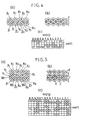
- Fig. 4 shows another example of triple layer weave which is different from that shown in Fig. 3.
- the crosswise yarns (k 2 and k 4 ) weave through the lengthwise yarns (xl, x2 , ... and z 1 , z2, ...)
- the crosswise yarn (k l ) weaves through the lengthwise yarns (xl, x 2 , ...)
- the crosswise yarn (k 3 ) weaves through the lengthwise yarns (z l , z 2 , ). Since the yarns (k 1 and k 3 ) bend obtuse and the area in contact with the felt is large, the base fabric of this structure is superior in wear resistance.
- the lengthwise yarns (x l , x 2 , ...) at the exposed side of the base fabric are nylon monofilaments 0.43 mm in diameter; the lengthwise yarns (Y 1 , Y2 , ...) in the middle layer are textured yarns of 1600 denier nylon multifilaments; and the lengthwise yarns (z 1 , z 2 , ...) in the layer adjacent to the polyurethane rubber layer are nylon monofilaments 0.43 mm in diameter.
- the crosswise yarns (k l , k 2 , ...) are nylon monofilaments 0.52 mm in diameter.
- Table 2 shows the characteristic properties of the base fabric of this example.
- the base fabric was woven according to the weave pattern shown in F ig. 4(c).
- the base fabric was made into the endless belt having the same length and width as in Fig.3.
- Fig. 5 shows a base fabric of quadruple layer weave in which the lengthwise yarns ( x l, x 2, ...; Y 1 , Y2, ...; z l, z 2 , ...; and w 1 , w 2 , Certainly are disposed in four layers.
- the lengthwise yarns (x l , x 2 , ...) at the exposed side of the base fabric are nylon monofilaments 0.35 mm in diameter;
- the lengthwise yarns (y 1 , y 2 , ...) in the first middle layer are nylon monofilaments 0.35 mm in diameter;
- the lengthwise yarns (w 1 , w 2 , ...) in the second middle layer are 1600 denier polyester spun yarn;
- the lengthwise yarns (z l , z 2 , ...) in the layer adjacent to the polyurethane rubber layer are nylon monofilaments 0.35 mm in diameter.
- the crosswise yarns (k l , k 2 , ...) are nylon monofilaments 0.52 mm in diameter.
- Table 3 shows the characteristic properties of the base fabric of this example.
- the base fabric was woven according to the weave pattern shown in Fig. 5 (c).
- the base fabric was made into the endless belt having the same lenght and width as the one shown in Fig. 1.
- Fig. 6 shows a base fabric of double layer weave in which the lengthwise yarns (x and y) are disposed in two layers.
- the lengthwise yarns (x) at the exposed side of the base fabric are textured yarns of 1600 denier nylon monofilaments, and the lengthwise yarns (y) in the layer adjacent to the polyurethane rubber layer are nylon monofilaments 0.52 mm in diameter.
- the crosswise yarns (k l and k 2 ) are nylon monofilaments 0.52 mm in diameter.
- Table 4 shows the characteristic properties of the base fabric of this example.
- the base fabric was woven according to the design shown in Fig. 6(c).
- the base fabric was made into the endless belt having the same length and width as the one shown in Fig. 1.
Landscapes
- Paper (AREA)
- Woven Fabrics (AREA)
- Control And Other Processes For Unpacking Of Materials (AREA)
- Liquid Crystal (AREA)
- Photographic Processing Devices Using Wet Methods (AREA)
- Belt Conveyors (AREA)
Applications Claiming Priority (2)
| Application Number | Priority Date | Filing Date | Title |
|---|---|---|---|
| JP58189039A JPS6081391A (ja) | 1983-10-07 | 1983-10-07 | 抄紙用エンドレス・ベルト |
| JP189039/83 | 1983-10-07 |
Publications (2)
| Publication Number | Publication Date |
|---|---|
| EP0138797A2 true EP0138797A2 (fr) | 1985-04-24 |
| EP0138797A3 EP0138797A3 (fr) | 1985-09-18 |
Family
ID=16234267
Family Applications (1)
| Application Number | Title | Priority Date | Filing Date |
|---|---|---|---|
| EP84870140A Withdrawn EP0138797A3 (fr) | 1983-10-07 | 1984-09-28 | Bande sans fin |
Country Status (9)
| Country | Link |
|---|---|
| EP (1) | EP0138797A3 (fr) |
| JP (1) | JPS6081391A (fr) |
| AU (1) | AU572562B2 (fr) |
| BR (1) | BR8405060A (fr) |
| CA (1) | CA1260749A (fr) |
| DE (1) | DE138797T1 (fr) |
| ES (1) | ES536193A0 (fr) |
| FI (1) | FI85889B (fr) |
| NO (1) | NO843988L (fr) |
Cited By (6)
| Publication number | Priority date | Publication date | Assignee | Title |
|---|---|---|---|---|
| US4948658A (en) * | 1987-05-14 | 1990-08-14 | Thomas Josef Heimbach Gmbh & Co. | Strip of material and its manufacturing method |
| DE3914534C1 (fr) * | 1989-05-02 | 1990-10-18 | Thomas Josef Heimbach Gmbh & Co, 5160 Dueren, De | |
| DE3914533A1 (de) * | 1989-05-02 | 1990-11-08 | Heimbach Gmbh Thomas Josef | Band fuer papiermaschinen |
| FR2651808A1 (fr) * | 1989-09-08 | 1991-03-15 | Albany Int Corp | Courroie pour presse a emprise prolongee de machine de fabrication de papier. |
| EP0834615A1 (fr) * | 1996-10-01 | 1998-04-08 | Württembergische Filztuchfabrik D. Geschmay GmbH | Bande de tissu |
| EP1574617A1 (fr) * | 2004-03-10 | 2005-09-14 | Stowe Woodward Aktiengesellschaft | Bande intégrale pour une presse à patin |
Families Citing this family (7)
| Publication number | Priority date | Publication date | Assignee | Title |
|---|---|---|---|---|
| DE3715153A1 (de) * | 1987-05-07 | 1988-12-01 | Voith Gmbh J M | Verstaerkter pressmantel fuer eine presseinrichtung zur behandlung bahnfoermigen gutes, wie z. b. von papierbahnen, sowie verfahren und vorrichtung zu seiner herstellung |
| JP3038677B2 (ja) * | 1988-10-26 | 2000-05-08 | 株式会社リコー | 用紙移送ベルトの製造方法 |
| JPH0311097U (fr) * | 1989-03-18 | 1991-02-01 | ||
| JP2001151319A (ja) * | 1999-11-30 | 2001-06-05 | Nippon Filcon Co Ltd | 防汚性衛生用不織布製品加工用ベルト |
| JP2002275780A (ja) * | 2001-03-19 | 2002-09-25 | Ichikawa Woolen Textile Co Ltd | シュープレス用ベルト |
| JP4937330B2 (ja) * | 2009-10-22 | 2012-05-23 | 日本フエルト株式会社 | シュープレス用ベルト |
| JP7205506B2 (ja) * | 2020-02-28 | 2023-01-17 | イチカワ株式会社 | シュープレスベルトおよびシュープレスベルトの製造方法 |
Family Cites Families (10)
| Publication number | Priority date | Publication date | Assignee | Title |
|---|---|---|---|---|
| SE324101B (fr) * | 1967-01-31 | 1970-05-19 | Nordiska Maskinfilt Ab | |
| US4086941A (en) * | 1976-10-26 | 1978-05-02 | Huyck Corporation | Biplanar papermaker's belt |
| DE3026222A1 (de) * | 1980-07-10 | 1982-02-04 | Siegfried Alexander Dipl.-Ing. 7960 Aulendorf Eisenmann | Zahnringpumpe |
| US4359069A (en) * | 1980-08-28 | 1982-11-16 | Albany International Corp. | Low density multilayer papermaking fabric |
| BR8107715A (pt) * | 1981-01-29 | 1983-04-12 | Albany Int Corp | Tecido secador para maquina de producao de papel correia secadora sem fim tecido de feltro secador processo para estabilizacao de um tecido de feltro secador |
| GB2106555B (en) * | 1981-09-15 | 1985-10-02 | Albany Int Corp | Improvements relating to extended nip dewatering presses and to the manufacture of belts for use in such presses |
| FR2513281B1 (fr) * | 1981-09-24 | 1985-07-26 | Albany Int Corp | Presse pour extraire l'eau d'une pate a papier et procede de fabrication d'une courroie pour une telle presse |
| US4423755A (en) * | 1982-01-22 | 1984-01-03 | Huyck Corporation | Papermakers' fabric |
| JPS59100788A (ja) * | 1982-12-02 | 1984-06-11 | アルバニ−・インタナシヨナル・コ−ポレ−シヨン | 脱水プレス |
| JPS59100789A (ja) * | 1982-12-02 | 1984-06-11 | アルバニ−・インタナシヨナル・コ−ポレ−シヨン | 脱水プレス |
-
1983
- 1983-10-07 JP JP58189039A patent/JPS6081391A/ja active Granted
-
1984
- 1984-09-20 CA CA000463664A patent/CA1260749A/fr not_active Expired
- 1984-09-24 ES ES536193A patent/ES536193A0/es active Granted
- 1984-09-25 AU AU33493/84A patent/AU572562B2/en not_active Ceased
- 1984-09-28 DE DE198484870140T patent/DE138797T1/de active Pending
- 1984-09-28 EP EP84870140A patent/EP0138797A3/fr not_active Withdrawn
- 1984-10-04 NO NO843988A patent/NO843988L/no unknown
- 1984-10-05 BR BR8405060A patent/BR8405060A/pt not_active IP Right Cessation
- 1984-10-05 FI FI843927A patent/FI85889B/fi not_active Application Discontinuation
Cited By (9)
| Publication number | Priority date | Publication date | Assignee | Title |
|---|---|---|---|---|
| US4948658A (en) * | 1987-05-14 | 1990-08-14 | Thomas Josef Heimbach Gmbh & Co. | Strip of material and its manufacturing method |
| DE3914534C1 (fr) * | 1989-05-02 | 1990-10-18 | Thomas Josef Heimbach Gmbh & Co, 5160 Dueren, De | |
| DE3914533A1 (de) * | 1989-05-02 | 1990-11-08 | Heimbach Gmbh Thomas Josef | Band fuer papiermaschinen |
| US5175037A (en) * | 1989-05-02 | 1992-12-29 | Thomas Josef Heimbach Gmbh & Co. | Belt for papermaking machines |
| US5178937A (en) * | 1989-05-02 | 1993-01-12 | Thomas Josef Heimbach Gmbh & Co. | Belt for papermaking machines |
| FR2651808A1 (fr) * | 1989-09-08 | 1991-03-15 | Albany Int Corp | Courroie pour presse a emprise prolongee de machine de fabrication de papier. |
| BE1002796A3 (fr) * | 1989-09-08 | 1991-06-11 | Albany Int Corp | Courroie pour presse a emprise prolongee de machine de fabrication de papier. |
| EP0834615A1 (fr) * | 1996-10-01 | 1998-04-08 | Württembergische Filztuchfabrik D. Geschmay GmbH | Bande de tissu |
| EP1574617A1 (fr) * | 2004-03-10 | 2005-09-14 | Stowe Woodward Aktiengesellschaft | Bande intégrale pour une presse à patin |
Also Published As
| Publication number | Publication date |
|---|---|
| FI843927L (fi) | 1985-04-08 |
| DE138797T1 (de) | 1985-10-24 |
| EP0138797A3 (fr) | 1985-09-18 |
| ES8506127A1 (es) | 1985-06-16 |
| AU572562B2 (en) | 1988-05-12 |
| CA1260749A (fr) | 1989-09-26 |
| AU3349384A (en) | 1985-04-18 |
| BR8405060A (pt) | 1985-08-20 |
| ES536193A0 (es) | 1985-06-16 |
| FI85889B (fi) | 1992-02-28 |
| JPS6315398B2 (fr) | 1988-04-04 |
| JPS6081391A (ja) | 1985-05-09 |
| NO843988L (no) | 1985-04-09 |
| FI843927A0 (fi) | 1984-10-05 |
Similar Documents
| Publication | Publication Date | Title |
|---|---|---|
| US4533594A (en) | Batt-on-mesh felt employing polyurethane-coated multifilaments in the cross-machine direction | |
| CA1181622A (fr) | Toile faite de files a points de fusion differentiels pour machine a papier | |
| US4182381A (en) | Papermakers fabrics | |
| CA1101255A (fr) | Traduction non-disponible | |
| EP0138797A2 (fr) | Bande sans fin | |
| US4824525A (en) | Papermaking apparatus having a seamed wet press felt | |
| US3885603A (en) | Papermaking fabric | |
| US4759976A (en) | Forming fabric structure to resist rewet of the paper sheet | |
| US4909284A (en) | Double layered papermaker's fabric | |
| US4559258A (en) | Pressure belt for use with extended nip press in paper making machine | |
| US3885602A (en) | Woven fourdrinier fabric | |
| US5422166A (en) | Abrasion resisting edge for a forming fabric | |
| US5200260A (en) | Needled papermaking felt | |
| EP2213789B1 (fr) | Feutre pour fabriquer du papier | |
| US5137601A (en) | Paper forming fabric for use with a papermaking machine made of PPT fibers | |
| US6284102B1 (en) | Shoe press belt and method for manufacturing the same | |
| US5324392A (en) | Extendable and heat shrinkable polyamide mono-filament for endless fabric and endless fabric | |
| US4892781A (en) | Base fabric structures for seamed wet press felts | |
| CA1188201A (fr) | Toile resistant a l'usure pour machine a papier | |
| US20090250184A1 (en) | Belt for shoe press | |
| JPH0229796B2 (fr) | ||
| US4940630A (en) | Base fabric structures for seamed wet press felts | |
| CA2061435C (fr) | Feutre dote d'un tissu uni sans fin pour presse humide de fabricant de papier | |
| JP3080640B2 (ja) | 広幅ニッププレス用加圧ベルト | |
| JPS60224893A (ja) | エンドレスベルト |
Legal Events
| Date | Code | Title | Description |
|---|---|---|---|
| PUAI | Public reference made under article 153(3) epc to a published international application that has entered the european phase |
Free format text: ORIGINAL CODE: 0009012 |
|
| AK | Designated contracting states |
Designated state(s): AT DE FR GB SE |
|
| PUAL | Search report despatched |
Free format text: ORIGINAL CODE: 0009013 |
|
| EL | Fr: translation of claims filed | ||
| TCAT | At: translation of patent claims filed | ||
| AK | Designated contracting states |
Designated state(s): AT DE FR GB SE |
|
| DET | De: translation of patent claims | ||
| 17P | Request for examination filed |
Effective date: 19850902 |
|
| 17Q | First examination report despatched |
Effective date: 19870113 |
|
| STAA | Information on the status of an ep patent application or granted ep patent |
Free format text: STATUS: THE APPLICATION IS DEEMED TO BE WITHDRAWN |
|
| 18D | Application deemed to be withdrawn |
Effective date: 19870723 |
|
| RIN1 | Information on inventor provided before grant (corrected) |
Inventor name: YAMAMOTO, MASAKAZU Inventor name: UEMURA, YOSHIHARU Inventor name: HAMADA, YUKIO Inventor name: NAKAGAWA, SEIJI Inventor name: NAKAJIMA, TOICHI Inventor name: SUZUKI, AKIRA |