EP0140162A2 - Système de refroidissement pour moteur d'automotrice - Google Patents
Système de refroidissement pour moteur d'automotrice Download PDFInfo
- Publication number
- EP0140162A2 EP0140162A2 EP84111486A EP84111486A EP0140162A2 EP 0140162 A2 EP0140162 A2 EP 0140162A2 EP 84111486 A EP84111486 A EP 84111486A EP 84111486 A EP84111486 A EP 84111486A EP 0140162 A2 EP0140162 A2 EP 0140162A2
- Authority
- EP
- European Patent Office
- Prior art keywords
- coolant
- engine
- radiator
- coolant jacket
- level
- Prior art date
- Legal status (The legal status is an assumption and is not a legal conclusion. Google has not performed a legal analysis and makes no representation as to the accuracy of the status listed.)
- Withdrawn
Links
Images




Classifications
-
- F—MECHANICAL ENGINEERING; LIGHTING; HEATING; WEAPONS; BLASTING
- F01—MACHINES OR ENGINES IN GENERAL; ENGINE PLANTS IN GENERAL; STEAM ENGINES
- F01P—COOLING OF MACHINES OR ENGINES IN GENERAL; COOLING OF INTERNAL-COMBUSTION ENGINES
- F01P3/00—Liquid cooling
- F01P3/22—Liquid cooling characterised by evaporation and condensation of coolant in closed cycles; characterised by the coolant reaching higher temperatures than normal atmospheric boiling-point
- F01P3/2285—Closed cycles with condenser and feed pump
-
- F—MECHANICAL ENGINEERING; LIGHTING; HEATING; WEAPONS; BLASTING
- F01—MACHINES OR ENGINES IN GENERAL; ENGINE PLANTS IN GENERAL; STEAM ENGINES
- F01P—COOLING OF MACHINES OR ENGINES IN GENERAL; COOLING OF INTERNAL-COMBUSTION ENGINES
- F01P11/00—Component parts, details, or accessories not provided for in, or of interest apart from, groups F01P1/00 - F01P9/00
- F01P11/14—Indicating devices; Other safety devices
- F01P11/18—Indicating devices; Other safety devices concerning coolant pressure, coolant flow, or liquid-coolant level
-
- F—MECHANICAL ENGINEERING; LIGHTING; HEATING; WEAPONS; BLASTING
- F01—MACHINES OR ENGINES IN GENERAL; ENGINE PLANTS IN GENERAL; STEAM ENGINES
- F01P—COOLING OF MACHINES OR ENGINES IN GENERAL; COOLING OF INTERNAL-COMBUSTION ENGINES
- F01P7/00—Controlling of coolant flow
- F01P7/14—Controlling of coolant flow the coolant being liquid
Definitions
- the present invention relates generally to a cooling system for an internal combustion engine wherein a liquid coolant is boiled to make use of the latent heat of vaporization of the same and the vapor used as a vehicle for removing heat from the engine, and more specifically to such an engine wherein the pressure within the cooling system can be rendered sub-atmospheric in order to lower the boiling point of the coolant and which includes means via which contaminating air can be prevented from leaking into the system under such circumstances.
- the cooling system is required to remove approximately 4000 Kcal/h.
- a flow rate of 167 Liter/min (viz., 4000 - 60 x 4) must be produced by the water pump. This of course undesirably consumes a number of horsepower.
- the temperature of the coolant is prevented from boiling and maintained within a predetermined narrow temperature range (usually 80 to 90 degrees) irrespective of the load and/or mode of operation of the engine, despite the fact that it is advantageous from the point of fuel economy to raise the temperature of the engine during low-medium load "urban” cruising, to increase the thermal efficiency of the engine, and reduce same during high speed and/or high load (full throttle) modes of operation for engine protection.
- a predetermined narrow temperature range usually 80 to 90 degrees
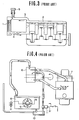
- Fig. 3 shows an arrangement disclosed in Japanese Patent Application Second Provisional Publication No. Sho 57-57608.
- This arrangement has attempted to vapourize a liquid coolant and use the gaseous form thereof as a vehicle for removing heat from the engine.
- the radiator 1 and the coolant jacket 2 are in constant and free communication via conduits 3, 4 whereby the coolant which condenses in the radiator 1 is returned to the coolant jacket 2 little by little under the influence of gravity.
- This arrangement has suffered from the drawbacks that the radiator, depending on its position with respect to the engine proper tends to be at least partially filled with liquid coolant.
- the undisolved air tends to collect in the upper section of the radiator and inhibit the convention-like circulation of the vapor from the cylinder block to the radiator. This of course further deteriorates the performance of the device.
- European Patent Application Provisional Publication No. 0 059 423 published on September 8, 1982 discloses another arrangement wherein, liquid coolant in the coolant jacket of the engine, is not circulated therein and permitted to absorb heat to the point of boiling.
- the gaseous coolant thus generated is adiabatically compressed in a compressor so as to raise the temperature and pressure thereof and introduced into a heat exchanger. After condensing, the coolant is temporarily stored in a reservoir and recycled back into the coolant jacket via a flow control valve.
- This arrangement while providing an arrangement via which air can be initially purged from the system tends to, due to the nature of the arrangement which permits said initial non-condensible matter to be purged from the system, suffers from rapid loss of coolant when operated at relatively high altitudes. Further, once the engine cools air is relatively freely admitted back into the system. Moreover, with this system it is impossible to reduce the pressure within the system below atmospheric so as to lower the boiling point of the coolant as under such conditions air is readily inducted into the system. The provision of the separation tank 6 also renders engine layout difficult.
- Japanese -Patent Application First Provisional Publication No. Sho. 56-32026 discloses an arrangement wherein the structure defining the cylinder head and cylinder liners are covered in a porous layer of ceramic material 12 and coolant sprayed into the cylinder ' block from shower-like arrangements 13 located above the cylinder heads 14.
- the interior of the coolant jacket defined within the engine proper is essentially filled with gaseous coolant during engine operation during which liquid coolant sprayed onto the ceramic layers 12.
- this arrangement aims at maintaining a uniform temperature regardless of variations in the conditions to which the engine is exposed and accordingly lacks any ablitity to vary the engine temperature in response to changes in engine speed and sngine load and in nj way seeks to induce conditions which minimize the tendancy for contaminating air to leak back into the system when it cools down after operation.
- the above mentioned objects are fullfilled by an arrangement wherein, in to prevent air leaking into a ICE cooling system in which the coolant is boiled and condensed in a radiator or condenser in a manner that the rate of condensation can be increased to the point of lowering the pressure within the system to a sub-atmospheric level and thus lower the boiling point of the coolant; special seals are provided between the cylinder head and cylinder block (by way of example) which hermetically seal same against the invasion of contaminating air, while, when the engine is stopped, coolant is admitted to fill the system. To purge any air or like non-condensible which finds its way into the system, excess coolant is pumped in to overfill same during engine warm up.
- the present invention takes the form of an internal combustion engine having a combustion chamber and which features a radiator, a coolant jacket in which coolant is boiled and the vapor produced fed to the radiator, a first sensor for sensing a first engine operation parameter, a device responsive to the first sensor for varying the rate of condensation of the vapor in the radiator, and means for preventing air entering the coolant jacket when sub-atmospheric pressures prevail therein.
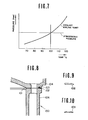
- Fig. 6 graphically shows in terms of engine torque and engine speed the various load "zones" which are encountered by an automotive vehicle engine.
- the curve F denotes full throttle torque characteristics
- trace L denotes the resistance encountered when a vehicle is running on a level surface
- zones I, II and III denote respectively "urban cruising", “high speed cruising” and “high load operation” (such as hillclimbing, towing etc.).
- a suitable coolant temperature for zone I is approximately 110 o C while 90 - 80°C for zones II and III.
- the high temperature during "urban cruising" of course promotes improved fuel economy while the lower temperatures promote improved charging efficiency while simultaneously removing sufficient heat from the engine and associated struture to obviate engine knocking and/or engine damage in the other zones.
- Figs. 9 and 10 shown possible alternate seal arrangements.
- the seal 108 takes the form of a gasket similar to the head gasket but which is folded back to double its thickeness.
- the seal 109 takes the form of a gasket formed with two or more ridges which establish line contact with the cylinder head. If desired the latter two examples may be formed integrally with the main body of the head gasket.
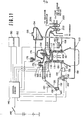
- FIG. 11 shows an engine system incorporating the present invention.
- an internal combustion engine 100 includes a cylinder block 106 on which a cylinder head 104 is detachably secured.
- the cylinder head and cylinder block include suitable cavities 115 - 118 which define a coolant jacket 120 about the heated portions of the cylinder head and block.
- coolant is introduced into the coolant jacket 120 through a port 122 formed in the cylinder block 106. As shown, this port 122 communicates with a lower level of the coolant jacket 120.
- Fluidly communicating with a vapor discharge port 124 of the cylinder head 104 is a radiator or heat exchanger 126.
- this radiator is maintained essentially empty of liquid coolant during normal engine operation so as to maximize the surface area available for condensing coolant vapor (via heat exchange with the ambient atmosphere) and that the cooling system as a whole (viz., coolant jacket, radiator etc.) is hermetically sealed when the engine is warmed up and running.
- a mesh screen or like separator (not shown) can be disposed in the vapor discharge port of the cylinder head so as to minimize the transfer of liquid coolant which tends to froth during boiling, to the radiator 126.
- a electrically driven fan 130 Disposed in a coolant return conduit 132 is a return pump 134.
- the pump is driven by an electric motor 136.
- a level sensor 140 is disposed as shown. It will be noted that this sensor is located at a level higher than that of the combustion chambers, exhaust ports and valves (structure subject to high heat flux) so as to maintain same securely immersed in coolant and therefore attenuate engine knocking and the like due to the formation of localized zones of abnormally high temperature or "hot spots".
- a temperature sensor 144 Located below the level sensor 140 so as to be immersed in the liquid coolant is a temperature sensor 144.
- the output of the level sensor 140 and the temperature sensor 144 are fed to a control circuit 146 or modulator which is suitably connected with a source of EMF upon closure of a switch 148.
- This switch of course may advantageously be arranged to be simultaneously closed with the ignition switch of the engine (not shown).
- the control circuit 146 further receives an input from the engine distributor 150 (or like device) indicative of engine speed and an input from a load sensing device 152 such as a throttle valve position sensor. It will be noted that as an alternative to throttle position, the output of an air flow meter or an induction vacuum sensor may used to indicate load.
- the engine is equipped with a tubocharger 200.
- This turbocharger unit as shown, includes an impeller 202 rotatably driven by the hot exhaust gases discharged from the combustion chamber via the exhaust port 204.
- the compressor 206 of the turbocharger is arranged to induct air via an air cleaner and air flow meter, compress and discharge same into the induction manifold of the engine via an intercooler if desired (neither shown).
- a coolant reservoir 154 is located beside the engine proper as shown. In this embodiment the reservoir 154 is arranged at a level higher than the engine for reasons which will become apparent hereinlater.
- An air permeable cap 156 is used to close the reservoir in a manner that atmospheric pressure continuously prevails therein.
- the reservoir 154 fluidly communicates with the engine coolant jacket 120 via conduit 158 and an electromagnetic valve 160.
- This valve 160 is arranged to be closed when energized and to communicate with a port 161 formed in a lower portion of the coolant jacket.
- a second electromagnetic valve 162 is disposed in the return conduit 132 and arranged to establish fluid communication between the pump 134 and a small collection tank or reservoir 164 provided at the bottom of the radiator 126 when de-energized and establish fluid communication between the pump 134 and the reservoir 154 via conduit 158, when energized.
- a second coolant level sensor 166 is disposed in the collection tank 164.
- a third coolant level sensor 168 is disposed in a riser-like portion 170 of the cylinder head 104. This sensor 168 is located immediately below a cap 171 which hermetically closes the riser 170. Located immediately adjacent and/or slighty above the third level sensor 168 is a "purge" port 172. This port, as shown, communicates with the reservoir 154 via an overflow conduit 174. A normally closed third electromagnetic valve 176 is disposed in the overflow conduit.174. This valve is opened when energized.
- Seals of the nature disclosed hereinbefore are used to seal the interfaces defined between the cyliner head 104 and cylinder block 106 and other sites where air is apt to leak into the system upon a negative pressure prevailing therein. For simplicity of illustration these seals are not shown in Fig. 11.
- the cooling system Prior to use the cooling system is filled to the brim with coolant (for example water or a mixture of water and antifreeze or the like) and the cap 171 securely set in place to seal the system.
- coolant for example water or a mixture of water and antifreeze or the like
- a suitable quantity of coolant is also poured into the reservoir 154.
- the engine is started. Under these conditions as the system is completely filled with coolant very little heat can be removed from the engine and the coolant quicky warms. Before reaching a predetermined temperature (for example 35°C) any air in the system, such as that disolved in the coolant per se, tends to be forced out of solution by the heating and rise to collect in the riser portion 170.
- a predetermined temperature for example 35°C
- the control circiut energizes the electromagnetic valves 160, 162 & 176 and the pump 134.
- This energization may be continued for a predetermined short period of time (e.g. three or four seconds) after the level sensor 168 indicates the level having risen thereto.
- This procedure closes valve 160, moves valve 162 to the position wherein communication is established between the pump 134 and the reservoir 154 and opens the overflow conduit 174 (via opening of third valve 176). Accordingly, the pump 134 draws coolant from the reservoir 154 via conduit 158 and forces same into the system overfilling same.
- the coolant temperature continues to rise and begins generating vapor pressure within the system.
- This pressure displaces coolant back out through valve 160 (now de-energized) to the reservoir 154 until the first level sensor 140 is uncovered.
- This induces the energization of the pump 134 which inducts coolant from the radiator 126 and discharges same into the cylinder block 106 through port 122.
- This tends to empty the radiator 126 while maintaining the level of the coolant within the cylinder block at that of the first level sensor 140.
- This procedure is continued until the level of coolant in the radiator 126 falls to that of the second level sensor 166, whereupon the valve 160 is energized and system placed in a "closed" condition.
- control circuit 146 selectively energizes the motor of the fan 130 in a manner to induce a rate of condensation in the radiator which controls the pressure prevailing in the cooling system to a level whereat the coolant boils at a temperature suited to the particular load and/or engine speed conditions of the engine.
- valve 160 Upon stoppage of the ermine 100, valve 160 is de-energized and, as the vapor pressure within the radiator and cylinder head falls due to the cooling of the engine and the condensation of the steam therein, coolant flows into the system from the reservoir 154 via the valve 160 under the influence of atmospheric pressure acting on the surface of the coolant in the reservoir and under the influence of gravity (it being noted that the reservoir is located slightly above the engine per se) until the system is filled.
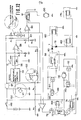
- Fig. 12 shows a circuit suitable for controlling the valves 160, 162 & 176, pump 134 and fan 130 shown in Fig. 11.
- the distributor 150 of the engine ignition system is connected with the source of EMF via the switch 148.
- a monostable multivibrator 54 is connected in series between the distributor 150 and a smoothing circuit 56.
- a DC-DC converter 57 is arranged, as shown in broken line, to ensure a supply of constant voltage.
- a first voltage divider consisting of resistors R1 and R2 provides a comparator 58 with a reference voltage at its inverting input (-) thereof while the non-inverting input (+) of said comparator receives the output of the smoothing circuit 56.
- a second voltage dividing arrangement consisting of a resistor R3 and a thermistor T m (viz., the heart of the temperature sensor 144) applies a variable voltage to a second comparator 60 which also receives a signal from a cam operated throttle switch 62 via a resistor arrangement including resistors R4, R5, R6 and R7 connected as shown.
- the output of the comparator 60 is applied to the fan 130 via a relay 61 for energizing same.
- the circuit further includes a transistor 62 which acts a switch upon receiving an output from the level sensor 140 to establish a circuit between the source of EMF and ground.
- a transistor 62 which acts a switch upon receiving an output from the level sensor 140 to establish a circuit between the source of EMF and ground.
- an inverter or the like may be interposed between the level sensor 140 and the transistor 62, and the level sensor adapted to produce an output when immersed in coolant. With this arrangement should the level sensor malfunction, the lack of output therefrom causes the transistor 62 to be continuously rendered conductive and the pump 136 continually energized to ensure . that an adequate amount of coolant is maintained in the coolant jacket.
- level sensor 166 is circuited via transistor 64 with a self-energizing relay 66 in a manner that, until the level of the coolant in the radiator 126 is forced down to the level of the level sensor 166, the relay is not closed and the solenoid of the valve.160 not energized, whereby the desired amount of coolant contained in the radiator 126 and coolant jacket can be appropriately adjusted. Opening of the switch 148 de-energizes the solenoid of the valve 160 and opens the self energizing relay 66.
- the temperature of the coolant in the coolant jacket 120 will be adjusted in a manner that at low engine speeds and loads the voltage appearing at the inverting terminal of the comparator will be compared with the voltage appearing on the non-inverting terminal thereof and the fan 130 suitably engergized to maintain a high temperature under so called "urban cruising" conditions and lowered at high load/speed operation. Further, upon stoppage of the motor, the coolant jacket 120 and radiator 126 will be completely filled with coolant to exclude the possiblity'of air contamination.
- This circiut further includes a comparator 68 which receives the output of second voltage divider (R3, T M ) on its non-inverting terminal (+) and a reference voltage from a voltage divider consisting of resistors R8, R9 on its inverting one (-).
- the resistances of the resistors R8, R9 are selected to provide a voltage representative of the predetermined temperature (viz., 35 0 C).
- the output of this comparator 68 is fed to a timer circuit 70 via transistor 72.
- the base of this transistor 72 is connected with the third level sensor 168 so that upon the level falling below same, the sensor 168 outputs a signal rendering the transistor 72 conductive.
- the timer circuit 70 may be arranged to maintain a high level output for a short period of time after the high level ouput of the comparator 68 disappears (3-4 seconds for example).
- the output of the timer circiut 70 is fed to the base of a transistor 74 which as shown serves a switch for energizing relay 76. This relay 76 upon being closed by a current passing through the coil thereof (via the pump motor 136 and the transistor 74), supplies current to the solenoids of valves 162, 176.
- the relay 76 is connected to the selenoid of valve 160 through a diode 78.
- a second diode 80 is disposed as shown, to prevent current from flowing from terminal Y to ground through the coil of relay 66.
- valves 160, 162 & 168 and the pump motor 136 will be energized.
- timer circiut 70 may be omitted.
- Fig. 8 shows a second circuit arrangement which may be employed in the case the engine is equipped with a fuel injection system. This arrangement does not include the level sensors and associated elements for simplicity of illustration.
- This alternative arrangement differs from that shown in Fig. 7 by the inclusion of a transistor 270, a clock circuit 272, a ripple counter 274 and a smoothing circuit 276, all connected as shown. Due to the fact that the frequency of injection control pulses varies with engine speed and the voltage output of the smoothing circuit 276 varies with pulse width as well as the frequency of injection, it is possible to use this arrangement in place of both of the throttle switch 62 and distributor 150 as will be appreciated by those skilled in the art. For the sake of simplicity the level sensors 140, 166 & 168 and associated circuitry have been emitted from this figure as previously mentioned.
- the operation of the Fig. 7 circuit is such that when the injector driving signal is applied to the base of the transistor 270 and the output of the clock generator 272 is fed to the ripple counter 274.
- the characteristics of the ripple counter 274 are so selected that it outputs a carry only when the width of the injection pulses are greater than a predetermined value (viz., indicative of a load in excess of a predetermined value).
- the injection driving pulses are applied to the reset terminal of the counter 274.
- the ripple counter 274 Upon the width of the injection pulse exceeding said predetemined value, the ripple counter 274 will output a carry (a number of clock pulses) which varies with the width of the pulse in excess of the predetermined value, as will be clear from insert "A".
- the output of the smoothing circuit 276 accordingly increases with engine speed and load (pulse width).
- the output of the smoothing circuit 276 is applied to the non-inverting terminal (+) of the comparator 58 which receives a fixed reference voltage from the voltage divider defined by resistors R1 and R2 on its inverting one (-). Accordingly, upon the voltage level of the smoothing circuit 276 output exceeding that provided by the R1 - R2 voltage divider (see voltage P in insert "B"), -the comparator produces an output to terminal Q.
- the voltage appearing at terminal R decreases with increase of coolant temperature due to the inherent characteristics of the thermistor T M' Accordingly, if the voltage appearing on terminal R is at a high level due to the engine operating at high load/speed conditions, the fan 130 will be energized to maintain a low coolant temperature (T L ) as will be clear from insert "C". On the other hand, should the engine be operating under the so called "urban cruising" conditions, the voltage appearing on terminal Q will be low due to absence of an output from the comparator 58 and the fan 130 will be operated in a manner to reduce the rate. of condensation in the radiator 126 and raise the temperature of the coolant to a high level (TH).
- a microprocessor may be used in place of the above disclosed circuits. This processor of course may also be used for other engine control functions as well known in the art of engine control.
- the program via which the embodiment shown in Fig. 11 can be controlled is deemed relatively simple and well within the perview of one skilled in the art of computer programming and thus will not be discussed for brevity.
- the temperature of the engine coolant may be varied continuously with change in load and/or engine speed as different form the stepwise control disclosed hereinbefore.
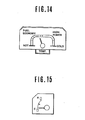
- Figs. 14 and 15 shows different types of gauges which may be placed in instrument cluster on the instrument panel of the vehicle. With this arrangement should a malfunction occur in the system, the driver may be able to discern same given the temperature conditions of the engine and the mode in the vehicle is being controlled.
- a pressure sensor may be used in place of the disclosed temperature sensor 144 if desired. In thi: instance the pressure sensor would be disposed at a level above that of the first level sensor 140.
- turbocharged engines With the present invention, a notable improvement in turbocharged engines may be realized. That is to say, as the temperature of the engine coolant is raised to 120°C (by way of example) during relatively light load operation, the temperature of -the exhaust gases which power the turbocharger is higher than with conventional cooling systems and thus impart more energy thereto. Hence, at low loads and speeds the efficiency and rate of acceleration of the turbocharger are increased.
- the temperature of the engine coolant is raised to 120°C (by way of example) during relatively light load operation, the temperature of -the exhaust gases which power the turbocharger is higher than with conventional cooling systems and thus impart more energy thereto.
- the efficiency and rate of acceleration of the turbocharger are increased.
- high load operation as it is possible to remove much more heat than with the prior art arrangements and the temperature of the engine is also notably lower, it is possible to operate the engine under full supercharge boost with only half the ignition retardation required by the prior art. Accordingly, this, in combination with the inherently increased charging efficiency provided under such circumstances, markedly
Landscapes
- Engineering & Computer Science (AREA)
- Chemical & Material Sciences (AREA)
- Combustion & Propulsion (AREA)
- Mechanical Engineering (AREA)
- General Engineering & Computer Science (AREA)
- Cylinder Crankcases Of Internal Combustion Engines (AREA)
- Combined Controls Of Internal Combustion Engines (AREA)
Applications Claiming Priority (2)
| Application Number | Priority Date | Filing Date | Title |
|---|---|---|---|
| JP202179/83 | 1983-10-28 | ||
| JP58202179A JPS6093113A (ja) | 1983-10-28 | 1983-10-28 | エンジンの沸騰冷却装置 |
Publications (2)
| Publication Number | Publication Date |
|---|---|
| EP0140162A2 true EP0140162A2 (fr) | 1985-05-08 |
| EP0140162A3 EP0140162A3 (fr) | 1986-05-28 |
Family
ID=16453265
Family Applications (1)
| Application Number | Title | Priority Date | Filing Date |
|---|---|---|---|
| EP84111486A Withdrawn EP0140162A3 (fr) | 1983-10-28 | 1984-09-26 | Système de refroidissement pour moteur d'automotrice |
Country Status (3)
| Country | Link |
|---|---|
| US (1) | US4649869A (fr) |
| EP (1) | EP0140162A3 (fr) |
| JP (1) | JPS6093113A (fr) |
Cited By (1)
| Publication number | Priority date | Publication date | Assignee | Title |
|---|---|---|---|---|
| EP0167169A3 (en) * | 1984-07-06 | 1986-12-03 | Nissan Motor Co., Ltd. | Cooling system for automotive engine or the like |
Families Citing this family (12)
| Publication number | Priority date | Publication date | Assignee | Title |
|---|---|---|---|---|
| US5198034A (en) * | 1987-03-31 | 1993-03-30 | Epsilon Technology, Inc. | Rotatable substrate supporting mechanism with temperature sensing device for use in chemical vapor deposition equipment |
| JPH0289194A (ja) * | 1988-09-26 | 1990-03-29 | Fujitsu Ltd | 手書文字認識方式 |
| US5031579A (en) * | 1990-01-12 | 1991-07-16 | Evans John W | Cooling system for internal combustion engines |
| FR2684721A1 (fr) * | 1991-12-06 | 1993-06-11 | Valeo Thermique Moteur Sa | Procede et dispositif de refroidissement d'un moteur thermique a charge fortement variable. |
| US5582138A (en) * | 1995-03-17 | 1996-12-10 | Standard-Thomson Corporation | Electronically controlled engine cooling apparatus |
| JP3783904B2 (ja) * | 1998-08-31 | 2006-06-07 | スズキ株式会社 | 過給機付エンジンの冷却装置 |
| US6408802B1 (en) * | 1999-09-30 | 2002-06-25 | Sanshin Kogyo Kabushiki Kaisha | Cam drive cooling arrangement |
| US7152555B2 (en) * | 2001-02-20 | 2006-12-26 | Volvo Trucks North America, Inc. | Engine cooling system |
| US6532910B2 (en) | 2001-02-20 | 2003-03-18 | Volvo Trucks North America, Inc. | Engine cooling system |
| US6640543B1 (en) * | 2001-09-21 | 2003-11-04 | Western Washington University | Internal combustion engine having variable displacement |
| JP6374733B2 (ja) * | 2014-09-04 | 2018-08-15 | 株式会社Subaru | 冷却システム |
| US11649759B2 (en) * | 2021-10-12 | 2023-05-16 | Transportation Ip Holdings, Llc | System and method for thermal management |
Family Cites Families (27)
| Publication number | Priority date | Publication date | Assignee | Title |
|---|---|---|---|---|
| DE316018C (fr) * | ||||
| US1687679A (en) * | 1922-10-30 | 1928-10-16 | Sue R Mallory | Engine-cooling system |
| US1792520A (en) * | 1926-06-03 | 1931-02-17 | Packard Motor Car Co | Internal-combustion engine |
| US1787562A (en) * | 1929-01-10 | 1931-01-06 | Lester P Barlow | Engine-cooling system |
| DE527342C (de) * | 1929-12-28 | 1931-06-17 | Ame Des Usines Chausson Soc | Dampfkondensator, insbesondere fuer Kuehleinrichtungen von Brennkraftmaschinen |
| US2083611A (en) * | 1931-12-05 | 1937-06-15 | Carrier Corp | Cooling system |
| DE736381C (de) * | 1940-03-12 | 1943-06-15 | Messerschmitt Boelkow Blohm | Arbeitsverfahren fuer luftgekuehlte Dampfkondensatoren |
| US2292946A (en) * | 1941-01-18 | 1942-08-11 | Karig Horace Edmund | Vapor cooling system |
| US2420436A (en) * | 1946-02-06 | 1947-05-13 | Mallory Marion | Temperature control for internalcombustion engines |
| GB693873A (en) * | 1950-08-04 | 1953-07-08 | Daimler Benz Ag | Liquid cooling system for internal combustion engines with evaporation cooling |
| US2679241A (en) * | 1950-11-17 | 1954-05-25 | Gen Motors Corp | Cylinder head gasket construction |
| GB786437A (en) * | 1955-04-07 | 1957-11-20 | Cav Ltd | Means for detecting the water level in the jacket cooling system of an internal combustion engine |
| DE1082083B (de) * | 1957-05-03 | 1960-05-19 | Daimler Benz Ag | Kuehlanlage fuer Brennkraftmaschinen |
| US2972341A (en) * | 1958-02-19 | 1961-02-21 | Forst Josef | Means for sealing the cylinder heads of internal combustion engines |
| DE1207710B (de) * | 1958-02-22 | 1965-12-23 | Maschf Augsburg Nuernberg Ag | Regelung der Kuehlmitteltemperatur von fluessigkeitsgekuehlten Brennkraftmaschinen |
| US3430611A (en) * | 1967-06-13 | 1969-03-04 | Dana Corp | Cylinder head gasket assembly with fluid-cooled combustion sealing rings |
| US3727642A (en) * | 1968-09-16 | 1973-04-17 | Opti Cap Inc | Vacuum compensating device for engine cooling system and method of installing same |
| FR2158684A5 (fr) * | 1971-10-28 | 1973-06-15 | Semt | |
| US3809150A (en) * | 1973-04-16 | 1974-05-07 | Opti Cap Inc | Minimizing corrosion of overflow receptacle equipped engine cooling system |
| US3981279A (en) * | 1975-08-26 | 1976-09-21 | General Motors Corporation | Internal combustion engine system |
| US4061187A (en) * | 1976-04-29 | 1977-12-06 | Cummins Engine Company, Inc. | Dual cooling system |
| JPS5632026A (en) * | 1979-08-23 | 1981-04-01 | Nissan Motor Co Ltd | Cooling system for internal-combustion engine for automobile |
| JPS5632025A (en) * | 1979-08-23 | 1981-04-01 | Nissan Motor Co Ltd | Cooling system for internal-combustion engine for automobile |
| JPS56148610A (en) * | 1980-04-18 | 1981-11-18 | Toyota Motor Corp | Cooling device for engine |
| US4367699A (en) * | 1981-01-27 | 1983-01-11 | Evc Associates Limited Partnership | Boiling liquid engine cooling system |
| JPS57143120A (en) * | 1981-02-27 | 1982-09-04 | Nissan Motor Co Ltd | Cooler of internal combustion engine |
| JPS585449A (ja) * | 1981-06-30 | 1983-01-12 | Mazda Motor Corp | エンジンの制御装置 |
-
1983
- 1983-10-28 JP JP58202179A patent/JPS6093113A/ja active Granted
-
1984
- 1984-09-26 EP EP84111486A patent/EP0140162A3/fr not_active Withdrawn
- 1984-10-05 US US06/657,956 patent/US4649869A/en not_active Expired - Fee Related
Cited By (1)
| Publication number | Priority date | Publication date | Assignee | Title |
|---|---|---|---|---|
| EP0167169A3 (en) * | 1984-07-06 | 1986-12-03 | Nissan Motor Co., Ltd. | Cooling system for automotive engine or the like |
Also Published As
| Publication number | Publication date |
|---|---|
| US4649869A (en) | 1987-03-17 |
| JPH0144888B2 (fr) | 1989-10-02 |
| EP0140162A3 (fr) | 1986-05-28 |
| JPS6093113A (ja) | 1985-05-24 |
Similar Documents
| Publication | Publication Date | Title |
|---|---|---|
| US4563983A (en) | Intercooler arrangement for supercharged internal combustion engine | |
| US4545335A (en) | Cooling system for automotive engine or the like | |
| US4549505A (en) | Cooling system for automotive engine or the like | |
| US4649869A (en) | Cooling system for automotive engine or the like | |
| US4788943A (en) | Cooling system for automotive engine or the like | |
| US4782795A (en) | Anti-knock system for automotive internal combustion engine | |
| US4648357A (en) | Cooling system for automotive engine or the like | |
| US4677942A (en) | Cooling system for automotive engine or the like | |
| US4567858A (en) | Load responsive temperature control arrangement for internal combustion engine | |
| US4648356A (en) | Evaporative cooling system of internal combustion engine | |
| EP0121181B1 (fr) | Dispositif de réglage de la température en fonction de la charge pour moteur à combustion interne | |
| US4601264A (en) | Cooling system for automotive engine | |
| US4616602A (en) | Cooling system for automotive engine or the like | |
| US4630573A (en) | Cooling system for automotive engine or the like | |
| US4554891A (en) | Coolant level control arrangement for internal combustion engine | |
| US4633822A (en) | Cooling system for automotive engine or the like | |
| US4574747A (en) | Cooling system for automotive engine | |
| US4632069A (en) | Cooling system for automotive engine | |
| US4662318A (en) | Cooling system for automotive internal combustion engine or the like | |
| EP0153694B1 (fr) | Méthode et système de refroidissement pour moteur à combustion interne | |
| US4681179A (en) | Cooling system for use in cab-over type vehicles | |
| US4700664A (en) | Cooling system for automotive engine or the like | |
| US4624221A (en) | Cooling system for automotive engine or the like | |
| US4686942A (en) | Cooling system for automotive engine or the like | |
| US4662316A (en) | Cooling system for automotive engine or the like |
Legal Events
| Date | Code | Title | Description |
|---|---|---|---|
| PUAI | Public reference made under article 153(3) epc to a published international application that has entered the european phase |
Free format text: ORIGINAL CODE: 0009012 |
|
| 17P | Request for examination filed |
Effective date: 19840926 |
|
| AK | Designated contracting states |
Designated state(s): DE FR GB |
|
| RAP1 | Party data changed (applicant data changed or rights of an application transferred) |
Owner name: NISSAN MOTOR CO., LTD. |
|
| PUAL | Search report despatched |
Free format text: ORIGINAL CODE: 0009013 |
|
| AK | Designated contracting states |
Kind code of ref document: A3 Designated state(s): DE FR GB |
|
| 17Q | First examination report despatched |
Effective date: 19870313 |
|
| STAA | Information on the status of an ep patent application or granted ep patent |
Free format text: STATUS: THE APPLICATION HAS BEEN WITHDRAWN |
|
| 18W | Application withdrawn |
Withdrawal date: 19880816 |
|
| RIN1 | Information on inventor provided before grant (corrected) |
Inventor name: HAYASHI, YOSHIMASA Inventor name: TAMAZAWA, TSUYOSHI |