EP0140224A2 - Système de transmission de signaux numériques - Google Patents
Système de transmission de signaux numériques Download PDFInfo
- Publication number
- EP0140224A2 EP0140224A2 EP84112068A EP84112068A EP0140224A2 EP 0140224 A2 EP0140224 A2 EP 0140224A2 EP 84112068 A EP84112068 A EP 84112068A EP 84112068 A EP84112068 A EP 84112068A EP 0140224 A2 EP0140224 A2 EP 0140224A2
- Authority
- EP
- European Patent Office
- Prior art keywords
- bit
- bits
- information
- program
- stereo
- Prior art date
- Legal status (The legal status is an assumption and is not a legal conclusion. Google has not performed a legal analysis and makes no representation as to the accuracy of the status listed.)
- Granted
Links
Images


Classifications
-
- H—ELECTRICITY
- H04—ELECTRIC COMMUNICATION TECHNIQUE
- H04J—MULTIPLEX COMMUNICATION
- H04J3/00—Time-division multiplex systems
- H04J3/02—Details
- H04J3/04—Distributors combined with modulators or demodulators
- H04J3/047—Distributors with transistors or integrated circuits
-
- H—ELECTRICITY
- H04—ELECTRIC COMMUNICATION TECHNIQUE
- H04H—BROADCAST COMMUNICATION
- H04H20/00—Arrangements for broadcast or for distribution combined with broadcast
- H04H20/28—Arrangements for simultaneous broadcast of plural pieces of information
- H04H20/30—Arrangements for simultaneous broadcast of plural pieces of information by a single channel
-
- H—ELECTRICITY
- H04—ELECTRIC COMMUNICATION TECHNIQUE
- H04H—BROADCAST COMMUNICATION
- H04H20/00—Arrangements for broadcast or for distribution combined with broadcast
- H04H20/65—Arrangements characterised by transmission systems for broadcast
- H04H20/71—Wireless systems
- H04H20/74—Wireless systems of satellite networks
-
- H—ELECTRICITY
- H04—ELECTRIC COMMUNICATION TECHNIQUE
- H04H—BROADCAST COMMUNICATION
- H04H20/00—Arrangements for broadcast or for distribution combined with broadcast
- H04H20/86—Arrangements characterised by the broadcast information itself
- H04H20/88—Stereophonic broadcast systems
-
- H—ELECTRICITY
- H04—ELECTRIC COMMUNICATION TECHNIQUE
- H04H—BROADCAST COMMUNICATION
- H04H60/00—Arrangements for broadcast applications with a direct linking to broadcast information or broadcast space-time; Broadcast-related systems
- H04H60/09—Arrangements for device control with a direct linkage to broadcast information or to broadcast space-time; Arrangements for control of broadcast-related services
- H04H60/11—Arrangements for counter-measures when a portion of broadcast information is unavailable
-
- H—ELECTRICITY
- H04—ELECTRIC COMMUNICATION TECHNIQUE
- H04H—BROADCAST COMMUNICATION
- H04H60/00—Arrangements for broadcast applications with a direct linking to broadcast information or broadcast space-time; Broadcast-related systems
- H04H60/68—Systems specially adapted for using specific information, e.g. geographical or meteorological information
- H04H60/73—Systems specially adapted for using specific information, e.g. geographical or meteorological information using meta-information
- H04H60/74—Systems specially adapted for using specific information, e.g. geographical or meteorological information using meta-information using programme related information, e.g. title, composer or interpreter
Definitions
- the invention relates to a digital signal transmission system according to the preamble of patent claim 1.
- a digital transmission method is known from "Digital radio via radio satellites, information brochure of the Federal Minister for Research and Technology", page 55 et seq., In which 16 stereo or 32 mono sound broadcast programs are transmitted via satellites.
- the individual channels are PCM-coded, each sample is combined into a modulation frame and then modulated on a 4 PSK carrier.
- Certain bits of the frame are used to transmit transmitter and program type identification information and are combined to form new subframes.
- a “quasi instantaneous value compander” is described in "Rundfunk Technische Mitteilungen", Volume 27, 1983, Issue 1, page 9 ff. For improving the signal quality in digital sound transmission. With such a compander, a certain number of samples with a resolution of e.g. 14 bit coded. A corresponding quantization is then selected as a function of the most significant of the stored code words. Code words with a reduced bit length and a scale factor for the selected quantization range are then transmitted.
- the object of the invention is to achieve sufficient security for the recovery of a scale factor in a known M b modulation frame.
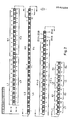
- FIG. 1 shows the structure of a modulation frame according to the invention.
- the same interleaving of the information bits protected by the BCH code is used here, as described in the German patent application P 33 08 025.9.
- the 11th higher-order information bits of a channel which are protected by an error correction system, are replaced by additional bits. These additional bits are adequately protected against transmission errors due to their integration into the error correction system.
- a quasi-instantaneous value companding is used in this modulation frame, in which a total of 13 information bits are transmitted per channel of a stereo program or per monoprogram.
- the letter indicates the left L or right R channel and the number the number of the stereo program.
- the letter Z denotes an additional bit.
- Z2L then means: additional bit of the left channel of the second stereo program.
- the modulation frame length increases by 16 bits. Then 4 bits per channel are transmitted unprotected. To shorten the modulation frame length, however, it is possible to occupy 4 free bits of the special services and the 4 supplementary bits E1-2 to E7-8, so that the modulation frame then has a length of 2 x 328 bits.
- the scale factor serves as additional error protection. If a sample value is defective in the period despite error correction and interpolation and this sample value exceeds the limit specified by the scale factor, then this sample value is either replaced by the preceding sample value or interpolation between the adjacent, correct sample values. In such a case, an unprotected transmission of the scale factor is sufficient.
- the programs are coded with 16 bits and transmitted with 14 bits.
- the scale factor is used to regenerate the 16-bit sample value and must therefore be transmitted with sufficient protection. This is done by integrating the scale factor into a BCH block.
- the scale factor is transmitted 10 times during 1 ms and combined to form a frame as shown in FIG. 3.
- 32 additional bits are transmitted in 1 ms. These are designated in FIG. 3 with Z1 to Z30 for the left channel L of a stereo program, and with Z31-Z60 for the right channel R of a stereo program.
- the last two bits are free.
- a majority vote provides additional protection for the scale factor.
- the most frequently occurring scale factor of a frame according to FIG. 3 is used for the evaluation.
- the scale factor frame is synchronized by synchronizing the transmitter and program type identifier frame. An additional sync word is therefore not required for the scale factor frame. Since the frame for transmitter and program type identification is 320 bits long, every 10th scale factor frame is synchronized.
- this synchronization method When using differential coding of the 4 PSK, which contains clock information in the code, with differential demodulation on the receiver side, this synchronization method provides a sufficiently high level of synchronization security.
- a separate synchronization may be necessary for the scale factor framework.
- the space required for the synchronization word is obtained by transferring fewer scale factors per frame. If 7 scale factors are transmitted per frame, a synchronization word with a length of 11 bits is then obtained.
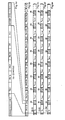
- FIG. 2 shows another exemplary embodiment of a modulation frame according to the invention.
- a flag K is transmitted after the sync word of the main frame.
- the additional bits ZI (1) -ZI (16) are assigned in the modulation frame according to the error correction system F1-2 - F15-16.
- the scale factor frame is created from the additional bits (ZI (1) -ZI (16)), which is synchronized by the sync word of the code bit frame and contains the scale factor protected by a BCH code.
- the number of scale factors contained in the frame is determined by the length of the BCH code used.
- the number of scale factors transmitted per audio channel is then e.g. 3 with a total length of the scale factor frame of 64 bits for a transmission time or scale factor determination phase of 2 m sec. Further program-accompanying information can be transmitted in the remaining bit cells of the frame.
- the program identification frame generated from the characteristic bit K is synchronized by a synchronous word and contains program type information of the transmitted stereo or.
- Monoprograms Two stereo programs, four monoprograms or a combination are combined and separated from the rest by a sync word.
- the synchronization words also serve to synchronize a scale factor frame.
- Fig. 4 shows a section of the subframe for program identification.
- a synchronous word S1 with a length of 16 bits is sent.
- This 16 bit sync word S1 is e.g. a Williard code word. It has the advantage over the 11-bit Barker code word used in the main frame that it has a minimum distance of 2 compared to information in the data part.
- the program identification information PA1, PA1a, PA2, PA2a which are each 8 bits long, are connected to this synchronous word S1. and each represent a mono channel or a pair of stereo channels.
- the data words X1, X2 are free for future applications and are currently with "00000000".
- Synchronous word S2 has a minimum distance of 2 compared to information in the data section.
- 4b shows the complete program identification frame.
- the beginning of a program identification frame is identified by the occurrence of the synchronous word S1. This is followed by the program identification information PA1 / 2 to PA 15/16. Synchronization word S2 is used to separate this program identification information.
- FIGS. 4c to 4e show the scale factor subframes and their temporal assignment to the program identification frame FIG. 4b.
- the first bit of program identification information PA 1/2 to PA 15/16 coincides with the first bit of a scale factor sequence Zi (1) to Zi (16).
- the scale factor frames are synchronized by the synchronization words S1, S2.
- the following code is provided for the program identification information PA1, PA1a ... PA16, PA16a:
- the numbers 0 - 15 under the name “number” indicate the different meanings of the program material. They are binary coded in the first four bits of the eight columns under “Code”. In the fifth column there is an additional coding "M” with regard to music-speech recognition.
- the two bits 2 and 1 are set to "01" to ensure a certain distance from the synchronous words S1, S2.
- the last bit is a parity bit P, by means of which a parity check can be carried out in the receiver in connection with a majority evaluation of the information, which is generally constantly repeated. By a minimum distance of sync words S1. To ensure S2 to the data stream of 2, the parity bit P is set to "0" if the number 7 is even, bit 7 .. bit 1.
- the program identification information is transmitted in the first 8-bit code word PA1 ... PA16 according to the table.
- the second 8-bit code word PA1a ... PA16a contains the stereo identifier, specifically in the form "XXXX" are available for any additional information.
- An evaluation of the information contained in the program identification frame provides an overview of the programs transmitted in a frame. It is therefore possible to search for mono and stereo programs, to find out which types of programs are currently being broadcast and whether music or speech is currently being broadcast. This will evaluate the entire information e.g. simplified by microprocessor system and enables a relatively quick program access or program type search.
Landscapes
- Engineering & Computer Science (AREA)
- Signal Processing (AREA)
- Computer Networks & Wireless Communication (AREA)
- Physics & Mathematics (AREA)
- Astronomy & Astrophysics (AREA)
- General Physics & Mathematics (AREA)
- Microelectronics & Electronic Packaging (AREA)
- Stereo-Broadcasting Methods (AREA)
Priority Applications (1)
| Application Number | Priority Date | Filing Date | Title |
|---|---|---|---|
| AT84112068T ATE62574T1 (de) | 1983-10-29 | 1984-10-09 | Digitales signaluebertragungssystem. |
Applications Claiming Priority (4)
| Application Number | Priority Date | Filing Date | Title |
|---|---|---|---|
| DE3339382 | 1983-10-29 | ||
| DE19833339382 DE3339382A1 (de) | 1983-10-29 | 1983-10-29 | Digitales signaluebertragungssystem |
| DE3421686 | 1984-06-12 | ||
| DE19843421686 DE3421686A1 (de) | 1984-06-12 | 1984-06-12 | Digitales signaluebertragungssystem |
Publications (3)
| Publication Number | Publication Date |
|---|---|
| EP0140224A2 true EP0140224A2 (fr) | 1985-05-08 |
| EP0140224A3 EP0140224A3 (en) | 1988-01-07 |
| EP0140224B1 EP0140224B1 (fr) | 1991-04-10 |
Family
ID=25815249
Family Applications (1)
| Application Number | Title | Priority Date | Filing Date |
|---|---|---|---|
| EP84112068A Expired - Lifetime EP0140224B1 (fr) | 1983-10-29 | 1984-10-09 | Système de transmission de signaux numériques |
Country Status (4)
| Country | Link |
|---|---|
| EP (1) | EP0140224B1 (fr) |
| DE (1) | DE3484415D1 (fr) |
| DK (1) | DK165090C (fr) |
| HK (1) | HK5596A (fr) |
Cited By (1)
| Publication number | Priority date | Publication date | Assignee | Title |
|---|---|---|---|---|
| EP0238988A3 (en) * | 1986-03-27 | 1989-06-28 | Deutsche Thomson-Brandt Gmbh | Digital signal transmitting system |
Family Cites Families (1)
| Publication number | Priority date | Publication date | Assignee | Title |
|---|---|---|---|---|
| DE3126880A1 (de) * | 1981-07-08 | 1983-01-27 | Licentia Gmbh | Digitales signaluebertragungssystem, insbesondere fuer satelliten-rundfunk |
-
1984
- 1984-10-09 DE DE8484112068T patent/DE3484415D1/de not_active Expired - Lifetime
- 1984-10-09 EP EP84112068A patent/EP0140224B1/fr not_active Expired - Lifetime
- 1984-10-26 DK DK512384A patent/DK165090C/da active
-
1996
- 1996-01-11 HK HK5596A patent/HK5596A/xx not_active IP Right Cessation
Cited By (1)
| Publication number | Priority date | Publication date | Assignee | Title |
|---|---|---|---|---|
| EP0238988A3 (en) * | 1986-03-27 | 1989-06-28 | Deutsche Thomson-Brandt Gmbh | Digital signal transmitting system |
Also Published As
| Publication number | Publication date |
|---|---|
| DK512384A (da) | 1985-04-30 |
| DK512384D0 (da) | 1984-10-26 |
| HK5596A (en) | 1996-01-19 |
| EP0140224A3 (en) | 1988-01-07 |
| DK165090C (da) | 1993-02-15 |
| DE3484415D1 (de) | 1991-05-16 |
| DK165090B (da) | 1992-10-05 |
| EP0140224B1 (fr) | 1991-04-10 |
Similar Documents
| Publication | Publication Date | Title |
|---|---|---|
| EP0205200B1 (fr) | Méthode pour transmettre des informations audio et des informations additionnelles en forme numérique | |
| DE69415698T2 (de) | Identifizierung eines Datenstromes der wie eine Paketfolge übertragen wird | |
| EP0127136B1 (fr) | Procédé pour la transmission de signaux analogiques codés d'une manière numérique | |
| DE3783194T2 (de) | Verfahren zur rundfunkuebertragung von textnachrichten auf einen untertraeger, verbunden mit einer radiophonen traegerfrequenz. | |
| EP0470988A1 (fr) | Procede et dispositif pour transmettre des donnees de teletexte. | |
| DE3824309A1 (de) | Verfahren zur auswertung von in einem datentelegramm digital codiert empfangener verkehrsnachrichten, sowie rundfunkempfaenger | |
| DE19527187A1 (de) | RDS-TMC-Rundfunkempfänger | |
| DE4430864C2 (de) | Verfahren zum unbemerktem Übertragen und/oder Speichern von Zusatzinformationen innerhalb eines quellencodierten, datenreduzierten Audiosignals | |
| EP1376512A2 (fr) | Méthode de transmission d'information et récepteur d'information | |
| EP0140224B1 (fr) | Système de transmission de signaux numériques | |
| DE60030932T2 (de) | Suche des optimalen Abtastzeitpunktes in einem TDMA Paketübertragungssystem | |
| DE3339382C2 (fr) | ||
| DE4229654A1 (de) | Verfahren zur uebertragung eines audio- und/oder videosignals | |
| EP0238988B1 (fr) | Système de transmission de signaux numériques | |
| EP0118123B1 (fr) | Procédé pour la transmission et la réception de signaux numériques d'information | |
| EP1784934B1 (fr) | Procede et dispositif pour transmettre des donnees supplementaires relatives a des frequences d'emission numeriques alternatives, dans un systeme de transmission radio analogique | |
| DE19614739A1 (de) | Fehlerrobustes Multiplexverfahren mit HEADER-Kontrollfeld | |
| DE102012210313A1 (de) | Verfahren zum Erkennen, Speichern und/oder Anzeigen eines Sendernamens einesRundfunksenders | |
| DE3421686A1 (de) | Digitales signaluebertragungssystem | |
| EP0836292B1 (fr) | Méthode et dispositif pour la présentation sélective, selon la région ou se trouve le récepteur, de messages codés numériques radiodiffusés | |
| EP0742668B1 (fr) | Méthode de reproduction de signaux de données dans des canaux d'émissions de télévision ou de radio | |
| DE19527185A1 (de) | RDS-TMC-Rundfunkempfänger | |
| DE3937653C2 (fr) | ||
| DE4435833A1 (de) | Verfahren zur Codierung, Übertragung, Speicherung und/oder Decodierung eines Informationskanals | |
| DE102013219129B4 (de) | Verfahren zum Empfangen und Anzeigen einer Textinformation |
Legal Events
| Date | Code | Title | Description |
|---|---|---|---|
| PUAI | Public reference made under article 153(3) epc to a published international application that has entered the european phase |
Free format text: ORIGINAL CODE: 0009012 |
|
| AK | Designated contracting states |
Designated state(s): AT BE CH DE FR GB IT LI LU NL SE |
|
| RTI1 | Title (correction) | ||
| PUAL | Search report despatched |
Free format text: ORIGINAL CODE: 0009013 |
|
| AK | Designated contracting states |
Kind code of ref document: A3 Designated state(s): AT BE CH DE FR GB IT LI LU NL SE |
|
| 17P | Request for examination filed |
Effective date: 19880505 |
|
| 17Q | First examination report despatched |
Effective date: 19890719 |
|
| GRAA | (expected) grant |
Free format text: ORIGINAL CODE: 0009210 |
|
| AK | Designated contracting states |
Kind code of ref document: B1 Designated state(s): AT BE CH DE FR GB IT LI LU NL SE |
|
| REF | Corresponds to: |
Ref document number: 62574 Country of ref document: AT Date of ref document: 19910415 Kind code of ref document: T |
|
| ITF | It: translation for a ep patent filed | ||
| REF | Corresponds to: |
Ref document number: 3484415 Country of ref document: DE Date of ref document: 19910516 |
|
| GBT | Gb: translation of ep patent filed (gb section 77(6)(a)/1977) | ||
| ET | Fr: translation filed | ||
| PLBE | No opposition filed within time limit |
Free format text: ORIGINAL CODE: 0009261 |
|
| STAA | Information on the status of an ep patent application or granted ep patent |
Free format text: STATUS: NO OPPOSITION FILED WITHIN TIME LIMIT |
|
| 26N | No opposition filed | ||
| EPTA | Lu: last paid annual fee | ||
| EAL | Se: european patent in force in sweden |
Ref document number: 84112068.6 |
|
| REG | Reference to a national code |
Ref country code: CH Ref legal event code: PFA Free format text: THOMSON CONSUMER ELECTRONIC SALES GMBH |
|
| NLT1 | Nl: modifications of names registered in virtue of documents presented to the patent office pursuant to art. 16 a, paragraph 1 |
Owner name: THOMSON CONSUMER ELECTRONICS SALES GMBH TE HANNOVE |
|
| PGFP | Annual fee paid to national office [announced via postgrant information from national office to epo] |
Ref country code: FR Payment date: 19951018 Year of fee payment: 12 |
|
| PGFP | Annual fee paid to national office [announced via postgrant information from national office to epo] |
Ref country code: GB Payment date: 19960926 Year of fee payment: 13 |
|
| PGFP | Annual fee paid to national office [announced via postgrant information from national office to epo] |
Ref country code: LU Payment date: 19961001 Year of fee payment: 13 |
|
| PGFP | Annual fee paid to national office [announced via postgrant information from national office to epo] |
Ref country code: SE Payment date: 19961018 Year of fee payment: 13 Ref country code: BE Payment date: 19961018 Year of fee payment: 13 Ref country code: AT Payment date: 19961018 Year of fee payment: 13 |
|
| PGFP | Annual fee paid to national office [announced via postgrant information from national office to epo] |
Ref country code: DE Payment date: 19961220 Year of fee payment: 13 |
|
| PG25 | Lapsed in a contracting state [announced via postgrant information from national office to epo] |
Ref country code: FR Effective date: 19970630 |
|
| REG | Reference to a national code |
Ref country code: FR Ref legal event code: ST |
|
| REG | Reference to a national code |
Ref country code: GB Ref legal event code: 746 Effective date: 19970813 |
|
| PG25 | Lapsed in a contracting state [announced via postgrant information from national office to epo] |
Ref country code: LU Free format text: LAPSE BECAUSE OF NON-PAYMENT OF DUE FEES Effective date: 19971009 Ref country code: GB Free format text: LAPSE BECAUSE OF NON-PAYMENT OF DUE FEES Effective date: 19971009 Ref country code: AT Free format text: LAPSE BECAUSE OF NON-PAYMENT OF DUE FEES Effective date: 19971009 |
|
| PG25 | Lapsed in a contracting state [announced via postgrant information from national office to epo] |
Ref country code: SE Free format text: LAPSE BECAUSE OF NON-PAYMENT OF DUE FEES Effective date: 19971010 |
|
| PG25 | Lapsed in a contracting state [announced via postgrant information from national office to epo] |
Ref country code: BE Free format text: LAPSE BECAUSE OF NON-PAYMENT OF DUE FEES Effective date: 19971031 |
|
| BERE | Be: lapsed |
Owner name: THOMSON CONSUMER ELECTRONICS SALES G.M.B.H. Effective date: 19971031 |
|
| GBPC | Gb: european patent ceased through non-payment of renewal fee |
Effective date: 19971009 |
|
| PG25 | Lapsed in a contracting state [announced via postgrant information from national office to epo] |
Ref country code: DE Free format text: LAPSE BECAUSE OF NON-PAYMENT OF DUE FEES Effective date: 19980701 |
|
| EUG | Se: european patent has lapsed |
Ref document number: 84112068.6 |
|
| PGFP | Annual fee paid to national office [announced via postgrant information from national office to epo] |
Ref country code: CH Payment date: 19981027 Year of fee payment: 15 |
|
| PGFP | Annual fee paid to national office [announced via postgrant information from national office to epo] |
Ref country code: NL Payment date: 19981030 Year of fee payment: 15 |
|
| PG25 | Lapsed in a contracting state [announced via postgrant information from national office to epo] |
Ref country code: LI Free format text: LAPSE BECAUSE OF NON-PAYMENT OF DUE FEES Effective date: 19991031 Ref country code: CH Free format text: LAPSE BECAUSE OF NON-PAYMENT OF DUE FEES Effective date: 19991031 |
|
| PG25 | Lapsed in a contracting state [announced via postgrant information from national office to epo] |
Ref country code: NL Free format text: LAPSE BECAUSE OF NON-PAYMENT OF DUE FEES Effective date: 20000501 |
|
| REG | Reference to a national code |
Ref country code: CH Ref legal event code: PL |
|
| NLV4 | Nl: lapsed or anulled due to non-payment of the annual fee |
Effective date: 20000501 |