EP0140235A2 - Halbleiterspeicheranordnung - Google Patents
Halbleiterspeicheranordnung Download PDFInfo
- Publication number
- EP0140235A2 EP0140235A2 EP84112160A EP84112160A EP0140235A2 EP 0140235 A2 EP0140235 A2 EP 0140235A2 EP 84112160 A EP84112160 A EP 84112160A EP 84112160 A EP84112160 A EP 84112160A EP 0140235 A2 EP0140235 A2 EP 0140235A2
- Authority
- EP
- European Patent Office
- Prior art keywords
- semiconductor
- semiconductor memory
- data
- memory cell
- memory
- Prior art date
- Legal status (The legal status is an assumption and is not a legal conclusion. Google has not performed a legal analysis and makes no representation as to the accuracy of the status listed.)
- Granted
Links
Images



Classifications
-
- G—PHYSICS
- G11—INFORMATION STORAGE
- G11C—STATIC STORES
- G11C11/00—Digital stores characterised by the use of particular electric or magnetic storage elements; Storage elements therefor
- G11C11/21—Digital stores characterised by the use of particular electric or magnetic storage elements; Storage elements therefor using electric elements
- G11C11/34—Digital stores characterised by the use of particular electric or magnetic storage elements; Storage elements therefor using electric elements using semiconductor devices
- G11C11/40—Digital stores characterised by the use of particular electric or magnetic storage elements; Storage elements therefor using electric elements using semiconductor devices using transistors
- G11C11/41—Digital stores characterised by the use of particular electric or magnetic storage elements; Storage elements therefor using electric elements using semiconductor devices using transistors forming static cells with positive feedback, i.e. cells not needing refreshing or charge regeneration, e.g. bistable multivibrator or Schmitt trigger
- G11C11/413—Auxiliary circuits, e.g. for addressing, decoding, driving, writing, sensing, timing or power reduction
- G11C11/417—Auxiliary circuits, e.g. for addressing, decoding, driving, writing, sensing, timing or power reduction for memory cells of the field-effect type
- G11C11/419—Read-write [R-W] circuits
-
- G—PHYSICS
- G11—INFORMATION STORAGE
- G11C—STATIC STORES
- G11C7/00—Arrangements for writing information into, or reading information out from, a digital store
-
- G—PHYSICS
- G11—INFORMATION STORAGE
- G11C—STATIC STORES
- G11C7/00—Arrangements for writing information into, or reading information out from, a digital store
- G11C7/10—Input/output [I/O] data interface arrangements, e.g. I/O data control circuits, I/O data buffers
- G11C7/1006—Data managing, e.g. manipulating data before writing or reading out, data bus switches or control circuits therefor
-
- G—PHYSICS
- G11—INFORMATION STORAGE
- G11C—STATIC STORES
- G11C7/00—Arrangements for writing information into, or reading information out from, a digital store
- G11C7/20—Memory cell initialisation circuits, e.g. when powering up or down, memory clear, latent image memory
Definitions
- This invention relates to an improved semiconductor memory device which can alter, under external control, the contents of a static type random access memory (RAM), particularly, at a specific time during an operation.
- RAM static type random access memory
- ROM read only memory
- EPROM erasable, programmable ROM
- RAM variable data
- static RAM static RAM
- dynamic RAM dynamic RAM
- MNOS metal nitride/oxide semiconductor RAM
- the conventional static RAM is in an unstable memory state upon the closure of a power source and holds given data at a data loading time.
- the conventional ROM is dedicated to data readout only and cannot have its memory data erased even partially for new data.
- a RAM that can permit the memory contents to be altered (this is not possible at the present time), to permit it to have a given memory pattern (a significant data set).
- a ROM that can permit some or all of the data to be altered (this is not possible at the present time) during the running of a program.
- the conventional nonvolatile RAM (MNOS type RAM) does not alter its memory contents upon the cut-off of a power source, and no consideration is given to altering its memory contents to have a given data pattern at an arbitrary time point during its use. The same things are true of the various conventional ROMs.
- a semiconductor memory device comprising a semiconductor memory cell for storing data, a storing data input/output means connected to the memory cell for effecting a data input/output operation with respect to the memory cell, a semiconductor switching means connected to the memory cell for altering the memory content of the memory cell, and a memory contents altering data supply means connected to the switching means for supplying memory contents altering data for switching.
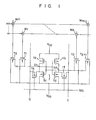
- FIG. 1 A semiconductor memory device according to one embodiment of this invention will be explained below by referring to Fig. 1.
- transistors Ta to Tf show metal oxide semiconductor field effect transistors MOSFETs (hereinafter referred to merely as MOS transistors) which comprise a binary logic circuit (a bistable circuit), such as a flip-flop circuit.
- MOS transistors Tl and T2..., and T1 and Tl+1 are semiconductor switching means whereby a plurality of data which is prepared to alter memory contents is selectively called to a memory cell used, for example, in a RAM.
- Hl... and Hn show input control lines prepared to alter the memory contents, such as to have a given data pattern, as will be described later.
- Ml and M2..., and Mm and M m+1 are selective junctions between the gates of the MOS transistors on one hand and the control lines Hl...Hn on the other hand.
- one of the selective junctions Ml and M2 is electrically connected, and the other selective junction is not electrically connected.
- the same connection is made up to the selective junctions Mm and M m+1 , that is, with one selective junction Mm or M m+l electrically connected and the other selective junction not electrically connected.
- First memory contents altering data is prepared for the memory cell 1 through the control line Hl.
- nth memory contents altering data is prepared for the corresponding memory cell through the control line Hn.
- D and D show data input/output lines for the memory cell 1
- SEL shows a data input/output select line for the memory cell 1.
- MOS transistors Ta and Tb for loading have their drain electrodes connected to a first power source V DD , their source electrodes connected to first and second output terminals O1 and 02, respectively, and their gate electrodes connected to the second and first output terminals 02 and O1, respectively.
- MOS transistors Tc and Td for a flip-flop circuit have their drain electrodes connected to the first and second output terminals Ol and 02, respectively, their source electrodes commonly connected to a second power source terminal V SS (normally a ground level) and their gate electrodes connected to the second and first output terminals 02 and Ol, respectively.
- the MOS transistors Te and Tf for a gate circuit have their drain electrodes connected to the data input/output lines D and D, respectively, their source electrodes connected to the first and second output terminals Ql and Q2, respectively, and their gate electrodes commonly connected to the data input/output select line SEL.
- the MOS transistors Tl and T2..., and Tl and T l+1 as switching means have those drain electrodes at the left side connected to the first output terminal O1 and those drain electrodes at the right side of Fig. 1 connected to the second output terminal 02; their source electrodes commonly connected to the second power source terminal V SS . and their gate electrodes connected to the control lines HI..., and Hn so as to satisfy the above-mentioned requirements.
- Fig. 1 shows a one-bit memory device, but in actual practice use is made of a multi-bit IC memory device having a plurality of memory cells 1 corresponding to a like number of bits with the control lines HI..., and Hn similarly connected in the relation mentioned.
- control lines HI..., and Hn are at the "0" (lower) level, that is, no memory contents altering data items are supplied to the control lines. Since the switching MOS transistors T1 and T2..., and Tl and T l+1 are all nonconductive, the memory cell 1 operates as an ordinary static memory. Suppose also that the memory content of the memory cell 1 is at a "0" state with the MOS transistor Td at an "ON” level and the transistor Tc at an "OFF" level in the flip-flop circuit.
- a voltage going from a negative to a positive direction is applied to the data input/output line D and a negative-going voltage is applied to the data input/output select line SEL.
- the MOS transistors Te and Td for the gate circuit are rendered conductive with the MOS transistor Tc being on and the MOS transistor Td being off.
- the MOS transistors Te and Td are turned off.
- the data input/output line D goes back to a negative voltage level. This means that a level "1" has been stored in the memory cell.
- a pulse voltage is applied on the data input/output select line SEL only.
- the potential on the output terminal of the flip-flop circuit e.g., a read signal, is output.to the data input/output lines D and D.
- a plurality of memory cells 1 is prepared to correspond to a like plurality of bits.
- an X (address) decoder and Y (address) decoder are arranged with respect to the data input/output select line SEL and data input/output lines D and D to obtain a RAM.
- the content of the memory cell 1, that is, that of the static memory can be altered under external control by supplying memory contents altering data at any arbitrary time point of an operation including a time immediately subsequent to the closure of the power source.
- the contents of the memory cells can be so altered as to have a predetermined system program or a given mask pattern (data pattern) which has been set to correspond to the respective bits.
- the level of the respective selective junctions in the ROM configuration is selectively read onto a corresponding one of the bit memory cells in a RAM configuration through the corresponding one of the switching MOS transistors Tl and T2...., and Tl and T t+l to permit this arrangement to be used for a mask ROM.
- This arrangement has a combined RAM/ROM feature, thus reducing the requisite number of circuits in comparison with the case where a RAM and ROM are used separately. It is therefore possible to mount IC elements in a high packing density on a printed circuit board.
- Fig. 2 shows an arrangement of an N-channel MOS type static memory cell, which is substantially similar to that of Fig. 1 except for the use of all N-channel type MOS transistors, the use of load resistors R1 and R2 in place of the load transistors (Fig. 1) and the new addition of capacitors Cl and C2.
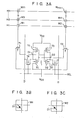
- Fig. 3A shows an arrangement of a complementary MOS (CMOS) type static memory using selective junctions Ml to Mm+l on the gate lines of transistors Tl and T2, and using control lines Hl to Hn as a diode matrix array.
- CMOS complementary MOS
- the selective junctions Ml and M2 are arranged such that with the diode D1 present on the junction M1 as shown in Fig. 3B the diode on the junction M2 is omitted and that with the diode absent on the junction M1, on the other hand, a diode Dl' as shown in Fig. C - which is similar to the diode Dl - is provided on the selective junction M2.
- the remaining selective junctions M3 and M4...Mm and Mm+1 are arranged to have the relation set out above.
- the arrangement as shown in Fig. 3A can be used as an ordinary static memory (RAM) because with the control lines Hl to Hn at the "0" level, the MOS transistors Tl and T2 are turned off as in the case of the arrangement shown in Fig. 1.
- the MOS transistor Tl With respect to the control line Hl set to "1" and the diode D1 present on the selective junction M1, for example, the MOS transistor Tl is turned on and a "0" level appears on the output terminal Ol to permit the memory cell 1 to be correspondingly set.
- the diode Dl' present on the selective junction M2 on the other hand, the MOS transistor T2 is turned on and a "0" level emerges to permit the memory cell to be correspondingly set.
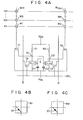
- Figs. 4A to 4C show an arrangement of an n-channel MOS type static memory. This arrangement is similar to that of Fig. 3A except for the replacement of all the transistors of Fig. 3 by N-channel MOS type transistors and the new addition of load resistors Rl and R2, and capacitances Cl and C2. The operation of Fig. 4 is similar to that of Fig. 3 with respect to function.
- Fig. 5 shows a CMOS type static memory. This arrangement is similar to that of Fig. 1 except that MOS transistors Tl' and T2'..., and Tl' and T l+1 are formed as a stacked gate structure (PROM structure).
- PROM structure stacked gate structure
- the on or the off state of the MOS transistors Tl' and T2'..., and Tl' and Tl+1 can be selected whether or not electrons are injected into an insulating film on the gate section of the MOS transistors Tl' and T2'..., and Tt' and T l+1 in the stacked gate structure. Therefore, the user can prepare the desired data items for the PROM structure which correspond in number to control lines Hl to Hn.
- Fig. 6 shows a static memory substantially similar to those shown in Figs. 2 and 4A, except for the replacement of all the MOS transistors of Fig. 5 with N-channel MOS type transistors.
- Memory contents altering data for 8 bits may be supplied from dedicated pins Pl, P2 and P3 through the corresponding output terminals to the IC memory (See Fig. 7).
- the memory contents altering data and ordinary data for 16 bits may also be supplied to the IC memory through their common input/output pins Pll, P12, P13 and P14 (See Fig. 8). That is, the arrangement shown in Fig. 8, if being equipped with the circuit of Fig. 9, permits ordinary data D from an ordinary I/O pin to be supplied under control of a R/W side and permits the memory contents altering data Hl to H16 to be supplied under control of a C/D side in Fig. 9.
- control lines HI to Hn to the corresponding memory cells See Figs. 1 to 9
- this invention should not be restricted thereto.
- only one item of data for altering the memory content may be called from one control line (for example, Hl).
- a desired number of control lines and memory contents which alter data may be provided according to the purpose for which the semiconductor memory device is used. The same thing can be applied to a semiconductor memory device for a plurality of bits.
- an improved semiconductor memory cell which can alter memory contents at any arbitrary time point of an operation.
Landscapes
- Engineering & Computer Science (AREA)
- Microelectronics & Electronic Packaging (AREA)
- Computer Hardware Design (AREA)
- Static Random-Access Memory (AREA)
- Semiconductor Memories (AREA)
Applications Claiming Priority (2)
| Application Number | Priority Date | Filing Date | Title |
|---|---|---|---|
| JP58193747A JPS6085496A (ja) | 1983-10-17 | 1983-10-17 | 半導体メモリ |
| JP193747/83 | 1983-10-17 |
Publications (3)
| Publication Number | Publication Date |
|---|---|
| EP0140235A2 true EP0140235A2 (de) | 1985-05-08 |
| EP0140235A3 EP0140235A3 (en) | 1986-10-29 |
| EP0140235B1 EP0140235B1 (de) | 1989-08-16 |
Family
ID=16313135
Family Applications (1)
| Application Number | Title | Priority Date | Filing Date |
|---|---|---|---|
| EP19840112160 Expired EP0140235B1 (de) | 1983-10-17 | 1984-10-10 | Halbleiterspeicheranordnung |
Country Status (3)
| Country | Link |
|---|---|
| EP (1) | EP0140235B1 (de) |
| JP (1) | JPS6085496A (de) |
| DE (1) | DE3479461D1 (de) |
Cited By (3)
| Publication number | Priority date | Publication date | Assignee | Title |
|---|---|---|---|---|
| EP0430101A3 (en) * | 1989-11-24 | 1992-06-17 | Nec Corporation | Semiconductor memory device having resettable memory cells |
| US5179538A (en) * | 1989-06-30 | 1993-01-12 | The Boeing Company | Memory system including CMOS memory cells and bipolar sensing circuit |
| US6639825B2 (en) | 1999-12-14 | 2003-10-28 | Infineon Technologies Ag | Data memory |
Families Citing this family (2)
| Publication number | Priority date | Publication date | Assignee | Title |
|---|---|---|---|---|
| JPS61230698A (ja) * | 1985-04-05 | 1986-10-14 | Nec Corp | ランダムアクセス半導体メモリセル |
| CN101981540B (zh) * | 2008-04-17 | 2013-03-20 | 本质Id有限责任公司 | 减轻由负偏压温度不稳定性导致的预烧作用的方法 |
Family Cites Families (5)
| Publication number | Priority date | Publication date | Assignee | Title |
|---|---|---|---|---|
| DE2165729C3 (de) * | 1971-12-30 | 1975-02-13 | Ibm Deutschland Gmbh, 7000 Stuttgart | Monolithische, als Lese/Schreiboder als Festwertspeicher betreibbare Speicheranordnung |
| JPS52110531A (en) * | 1976-03-15 | 1977-09-16 | Toshiba Corp | Memory unit |
| US4104719A (en) * | 1976-05-20 | 1978-08-01 | The United States Of America As Represented By The Secretary Of The Navy | Multi-access memory module for data processing systems |
| US4193128A (en) * | 1978-05-31 | 1980-03-11 | Westinghouse Electric Corp. | High-density memory with non-volatile storage array |
| US4347585A (en) * | 1980-06-09 | 1982-08-31 | International Business Machines Corporation | Reproduce only storage matrix |
-
1983
- 1983-10-17 JP JP58193747A patent/JPS6085496A/ja active Pending
-
1984
- 1984-10-10 EP EP19840112160 patent/EP0140235B1/de not_active Expired
- 1984-10-10 DE DE8484112160T patent/DE3479461D1/de not_active Expired
Cited By (4)
| Publication number | Priority date | Publication date | Assignee | Title |
|---|---|---|---|---|
| US5179538A (en) * | 1989-06-30 | 1993-01-12 | The Boeing Company | Memory system including CMOS memory cells and bipolar sensing circuit |
| EP0430101A3 (en) * | 1989-11-24 | 1992-06-17 | Nec Corporation | Semiconductor memory device having resettable memory cells |
| US5285420A (en) * | 1989-11-24 | 1994-02-08 | Nec Corporation | Semiconductor memory device having concurrently resettable memory cells |
| US6639825B2 (en) | 1999-12-14 | 2003-10-28 | Infineon Technologies Ag | Data memory |
Also Published As
| Publication number | Publication date |
|---|---|
| EP0140235A3 (en) | 1986-10-29 |
| EP0140235B1 (de) | 1989-08-16 |
| JPS6085496A (ja) | 1985-05-14 |
| DE3479461D1 (en) | 1989-09-21 |
Similar Documents
| Publication | Publication Date | Title |
|---|---|---|
| US4546273A (en) | Dynamic re-programmable PLA | |
| US4271487A (en) | Static volatile/non-volatile ram cell | |
| US4603404A (en) | Semiconductor memory device with redundant cells | |
| US5111079A (en) | Power reduction circuit for programmable logic device | |
| US5097152A (en) | Buffer circuit used in a semiconductor device operating by different supply potentials and method of operating the same | |
| EP0182595B1 (de) | Nichtflüchtiger Halbleiterspeicher | |
| US4342101A (en) | Nonvolatile semiconductor memory circuits | |
| EP0347530A2 (de) | Statische RAM-Speicheranordnung mit einer Leistungsverminderungsfunktion | |
| US3703710A (en) | Semiconductor memory | |
| US4733371A (en) | Semiconductor memory device with high voltage switch | |
| EP0171718B1 (de) | Dekodierschaltung in einem integrierten Speicherchip | |
| US4275312A (en) | MOS decoder logic circuit having reduced power consumption | |
| US4508977A (en) | Re-programmable PLA | |
| US4174541A (en) | Bipolar monolithic integrated circuit memory with standby power enable | |
| US5818758A (en) | Zero voltage drop negative switch for dual well processes | |
| US5280451A (en) | Signature circuit for non-volatile memory device | |
| US4864541A (en) | Integrated circuit of the logic circuit type comprising an electrically programmable non-volatile memory | |
| KR850006784A (ko) | 반도체 집적 회로장치 | |
| US4641285A (en) | Line change-over circuit and semiconductor memory using the same | |
| EP0140235A2 (de) | Halbleiterspeicheranordnung | |
| US4910710A (en) | Input circuit incorporated in a semiconductor device | |
| US4694431A (en) | Semiconductor memory device with increased adaptability | |
| US4860258A (en) | Electrically programmable non-volatile memory having sequentially deactivated write circuits | |
| EP0107355A2 (de) | CMIS-Schaltungsanordnung | |
| US4610003A (en) | Dynamic type semiconductor memory device |
Legal Events
| Date | Code | Title | Description |
|---|---|---|---|
| PUAI | Public reference made under article 153(3) epc to a published international application that has entered the european phase |
Free format text: ORIGINAL CODE: 0009012 |
|
| 17P | Request for examination filed |
Effective date: 19841107 |
|
| AK | Designated contracting states |
Designated state(s): DE FR GB |
|
| PUAL | Search report despatched |
Free format text: ORIGINAL CODE: 0009013 |
|
| AK | Designated contracting states |
Kind code of ref document: A3 Designated state(s): DE FR GB |
|
| 17Q | First examination report despatched |
Effective date: 19870326 |
|
| GRAA | (expected) grant |
Free format text: ORIGINAL CODE: 0009210 |
|
| AK | Designated contracting states |
Kind code of ref document: B1 Designated state(s): DE FR GB |
|
| REF | Corresponds to: |
Ref document number: 3479461 Country of ref document: DE Date of ref document: 19890921 |
|
| ET | Fr: translation filed | ||
| PLBE | No opposition filed within time limit |
Free format text: ORIGINAL CODE: 0009261 |
|
| STAA | Information on the status of an ep patent application or granted ep patent |
Free format text: STATUS: NO OPPOSITION FILED WITHIN TIME LIMIT |
|
| 26N | No opposition filed | ||
| PGFP | Annual fee paid to national office [announced via postgrant information from national office to epo] |
Ref country code: GB Payment date: 19971001 Year of fee payment: 14 |
|
| PGFP | Annual fee paid to national office [announced via postgrant information from national office to epo] |
Ref country code: FR Payment date: 19971009 Year of fee payment: 14 |
|
| PGFP | Annual fee paid to national office [announced via postgrant information from national office to epo] |
Ref country code: DE Payment date: 19971017 Year of fee payment: 14 |
|
| PG25 | Lapsed in a contracting state [announced via postgrant information from national office to epo] |
Ref country code: GB Free format text: LAPSE BECAUSE OF NON-PAYMENT OF DUE FEES Effective date: 19981010 |
|
| GBPC | Gb: european patent ceased through non-payment of renewal fee |
Effective date: 19981010 |
|
| PG25 | Lapsed in a contracting state [announced via postgrant information from national office to epo] |
Ref country code: FR Free format text: LAPSE BECAUSE OF NON-PAYMENT OF DUE FEES Effective date: 19990630 |
|
| REG | Reference to a national code |
Ref country code: FR Ref legal event code: ST |
|
| PG25 | Lapsed in a contracting state [announced via postgrant information from national office to epo] |
Ref country code: DE Free format text: LAPSE BECAUSE OF NON-PAYMENT OF DUE FEES Effective date: 19990803 |