EP0140541A2 - Appareil pour gazéifier des matières carbonifères - Google Patents
Appareil pour gazéifier des matières carbonifères Download PDFInfo
- Publication number
- EP0140541A2 EP0140541A2 EP84306038A EP84306038A EP0140541A2 EP 0140541 A2 EP0140541 A2 EP 0140541A2 EP 84306038 A EP84306038 A EP 84306038A EP 84306038 A EP84306038 A EP 84306038A EP 0140541 A2 EP0140541 A2 EP 0140541A2
- Authority
- EP
- European Patent Office
- Prior art keywords
- blowing
- nozzles
- carbonaceous material
- gasifying
- molten iron
- Prior art date
- Legal status (The legal status is an assumption and is not a legal conclusion. Google has not performed a legal analysis and makes no representation as to the accuracy of the status listed.)
- Granted
Links
Images


Classifications
-
- C—CHEMISTRY; METALLURGY
- C10—PETROLEUM, GAS OR COKE INDUSTRIES; TECHNICAL GASES CONTAINING CARBON MONOXIDE; FUELS; LUBRICANTS; PEAT
- C10J—PRODUCTION OF PRODUCER GAS, WATER-GAS, SYNTHESIS GAS FROM SOLID CARBONACEOUS MATERIAL, OR MIXTURES CONTAINING THESE GASES; CARBURETTING AIR OR OTHER GASES
- C10J3/00—Production of combustible gases containing carbon monoxide from solid carbonaceous fuels
- C10J3/57—Gasification using molten salts or metals
-
- C—CHEMISTRY; METALLURGY
- C10—PETROLEUM, GAS OR COKE INDUSTRIES; TECHNICAL GASES CONTAINING CARBON MONOXIDE; FUELS; LUBRICANTS; PEAT
- C10J—PRODUCTION OF PRODUCER GAS, WATER-GAS, SYNTHESIS GAS FROM SOLID CARBONACEOUS MATERIAL, OR MIXTURES CONTAINING THESE GASES; CARBURETTING AIR OR OTHER GASES
- C10J2200/00—Details of gasification apparatus
- C10J2200/15—Details of feeding means
- C10J2200/152—Nozzles or lances for introducing gas, liquids or suspensions
-
- C—CHEMISTRY; METALLURGY
- C10—PETROLEUM, GAS OR COKE INDUSTRIES; TECHNICAL GASES CONTAINING CARBON MONOXIDE; FUELS; LUBRICANTS; PEAT
- C10J—PRODUCTION OF PRODUCER GAS, WATER-GAS, SYNTHESIS GAS FROM SOLID CARBONACEOUS MATERIAL, OR MIXTURES CONTAINING THESE GASES; CARBURETTING AIR OR OTHER GASES
- C10J2300/00—Details of gasification processes
- C10J2300/09—Details of the feed, e.g. feeding of spent catalyst, inert gas or halogens
- C10J2300/0913—Carbonaceous raw material
- C10J2300/093—Coal
-
- C—CHEMISTRY; METALLURGY
- C10—PETROLEUM, GAS OR COKE INDUSTRIES; TECHNICAL GASES CONTAINING CARBON MONOXIDE; FUELS; LUBRICANTS; PEAT
- C10J—PRODUCTION OF PRODUCER GAS, WATER-GAS, SYNTHESIS GAS FROM SOLID CARBONACEOUS MATERIAL, OR MIXTURES CONTAINING THESE GASES; CARBURETTING AIR OR OTHER GASES
- C10J2300/00—Details of gasification processes
- C10J2300/09—Details of the feed, e.g. feeding of spent catalyst, inert gas or halogens
- C10J2300/0953—Gasifying agents
- C10J2300/0959—Oxygen
Definitions
- This invention relates to an improved method of gasifying carbonaceous material such as coal, coke, pitch, and the like (hereunder collectively referred to as "carbonaceous material”) by blowing the carbonaceous material together with a gasifying agent such as oxygen onto a molten iron bath at high temperatures.
- carbonaceous material such as coal, coke, pitch, and the like
- molten iron coal gasification process It is known in the art that a carbonaceous material is injected into a molten iron bath together with a gasifying agent to carry out gasification of the carbonaceous material. This process is called "molten iron coal gasification process". This process is classified into two types: one is a top-blowing process in which carbonaceous material is blown simultaneously with a gasifying agent onto a molten iron bath from the above through one or more top-blowing lances (See U.S. Patents 4,388,084 and 4,389,246); the other one is a bottom-blowing process in which the carbonaceous material is blown simultaneously with a gasifying agent onto the molten iron bath from a tuyere provided under the surface of the molten metal bath (See U.S. Patents 3,533,739 and 3,526,478). It has been thought that the top-blowing process_is more advantageous than the bottom blowing process in its gasification efficiency, properties of the produced gas and operational stability.
- the top-blowing process is also superior to the bottom-blowing process in its gasification efficiency, i.e. the amount of carbonaceous material gasified per unit treating time, since the bottom blowing process has an inherent upper limit in the blowing rate of a carrier gas for carbonaceous material.
- the upper limit is determined on the depth of a molten iron bath employed. If the blowing rate increases above the upper limit, unreacted coal is blown off through the molten iron bath, markedly decreasing the efficiency of gasification.
- a lower limit also exists to prevent the clogging of tuyeres.
- the blowing rate of a carrier gas of the bottom blowing process is restricted to within a relatively small range.
- the process is free from the clogging of the tuyeres or the passing through of the carbonaceous material.
- the top-blowing process is not limited, in practice, in respect to the blowing rate of carbonaceous material, either.
- the volume of the gas produced per unit treating time is very large and it is easy to control the volume, i.e. productivity.
- top-blowing process has a lot of heat balance problems common to all other coal gasification processes with a molten iron bath, although they have many advantages such as in the above.
- the carbonaceous material is decomposed at fire points the temperatures of which are much higher than that required to decompose it in other processes.
- the resulting gas of this top-blowing process is rich in CO and H 2 , and the proportion of C0 2 is rather small.
- This means that such a gas composition as in the above is satisfactory to be utilized as a fuel gas and as a chemical raw material.
- this also means that the carbon added is converted into CO gas, not to C0 2 gas. The conversion into C0 2 gas generates heat enough to promote gasification.
- the other method is the one called the "soft blowing" method, in which a secondary combustion is carried out by means of increasing the height of the lance, i.e. the distance between the nozzle end of the lance and the surface of the molten iron bath.
- the carbonaceous material is injected through the lance to reach the molten iron bath surface and then goes into the melt. Since according to this secondary combustion method, the height of the lance is increased, the distance between the lance tip and the molten iron bath surface is also increased, and the time the carbonaceous material takes to go from the lance to the molten metal surface is also increased. This means that before the carbonaceous material reaches the surface of the molten metal bath, it reacts with a gasifying agent such as oxygen and the amount of sulfur which is carried in the combustion gas is markedly increased in comparison with the amount of sulfur which is caught by the slag placed on the molten metal bath. This results in an increase in the sulfur content of the product gas.
- a desulfurization apparatus has to be installed to treat the product gas to decrease the sulfur content to a feasible level. This also adds to the manufacturing costs of the product gas.
- the object of this invention is to provide an apparatus for gasifying carbonaceous material by means of the top-blowing process, in which the thermal balance within the furnace of gasification has been improved most efficiently and conveniently.
- This invention resides in an apparatus for gasifying a carbonacenous material by means of blowing said carbonaceous material onto a high temperature molten iron bath through a top-blowing lance of the non-immersion type, which comprises:
- the gasification furnace may be of the multi-lance type in which at least one of the lances has the structure defined in the above.
- Fig. 1 is a schematic illustration of a melting furnace, i.e. gasification furnace which contains a molten metal 8.
- the gasification furnace comprises a furnace body 1, a slag discharge port 4 provided in the side wall portion for discharging slag 9 through a sliding gate 3.
- a skirt portion 5 and a hood 6 are provided for recovering the product gas, which is formed within the furnace.
- An inlet 7 for charging additives is provided on the hood.
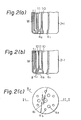
- Fig. 2(a) is a sectional view taken along line I-I of Fig. 2(c)
- Fig. 2(b) is a sectional view taken along line II-II of Fig. 2(c).
- the lance body 2-1 comprises a powder blowing nozzle a l in the center thereof. Through this center blowing nozzle- the carbonaceous material in the form of powder and a carrier gas therefor are injected into the molten iron 8.
- a plurality of nozzles a 2 for blowing a gasifying agent are provided surrounding said powder blowing nozzle a le Preferably, they are on a circle concentric with the central nozzle a 1 .
- Another plurality of nozzles a3 are provided along an outer periphery, surrounding said plurality of nozzles a 2 .
- the outer nozzle a3 are also on a circle which is concentric not only with the central nozzle a l but also with the circle drawn through said inner nozzles a 2 .
- the six outer nozzles a3 are arranged concentrically with respect to a circle drawn through three inner nozzles a 2 , surrounding the circumference thereof.
- all the nozzles a l , a 2 , and a3 are round in section.
- the number of the outer nozzles a 3 is preferably more than that of the inner nozzles a 2 .
- each of the outer nozzles a3 is inclined towards the outer periphery at an angle of 20 - 60°, preferably 20 - 40° with respect to the axis of the central powder blowing nozzle a 1 .
- the angle is shown in Fig. 2(b) by the symbol " ⁇ ".
- Reference W shows a passageway for a coolant.
- each of nozzles a3 for blowing a secondary combustion gas is provided being inclined towards the outer periphery at an angle of 20 - 60° with respect to an axis parallel to the axis of the central nozzle a 1 .
- the angle e is smaller than 20°
- the gas blown through these nozzles a3 is not effective for establishing a advantageous secondary combustion.
- the angle is larger than 60°
- the gas blown therethrough is enough to establish the secondary combustion, but the resulting flames cannot reach the molten iron surface so that the heat contained in the flames cannot arrive into the molten iron bath.
- the flames are diverged so widely that they cause severe damage to the wall of the furnace.
- the top-blowing lance 2 having the above-described structure is inserted into the furnace 1 such that the tip of the lance is positioned a predetermined distance from the surface of the molten iron 8. Then a powdered carbonaceous material 10 carried in a carrier gas such as air, nitrogen and the like is injected into a molten iron bath through the central powder blowing nozzle a l .
- the gasifying agent 11 is blown through the gasifying agent nozzles a 2 and oxygen gas is blown through the secondary combustion gas nozzles a3.
- the oxygen for the secondary combustion is blown into the furnace independently from the blowing of a gasifying agent, i.e. blown through different nozzles.
- the gasifying agent may also be oxygen.
- the height of a lance is substantially the same as conventionally, the secondary combustion of the product gas takes place efficiently. There is no need to carry out the so-called soft-blowing by lifting up the lance, so that the blown carbonaceous material does not burn before it is injected into the molten iron bath. On the contrary, a large amount of heat generated through the secondary combustion may advantageously be transmitted to the molten iron bath, so that the temperature of the molten iron bath is maintained at a level high enough to continue the gasification.
- the carbonaceous material is injected together with a carrier gas through the central powder blowing nozzle a 1 into the molten iron bath at fire points which are formed thanks to an oxygen jet simultaneously injected through the gasifying agent blowing nozzles a 2 , and the thus injected carbonaceous material is subjected to rapid dissolution and thermal decomposition at the fire points and then CO-gas forming reactions take place vigorously.
- the reaction gas generated within the furnace, other than the part which should be consumed in the secondary combustion, is recovered from the top opening by way of the skirt portion 5 and the hood 6.
- the slag 9 formed during gasification is discharged out of the slag discharge port 4.
- the amount of slag to be discharged may be controlled by means of the sliding gate 3.
- a suitable flux such as calcium oxide (quicklime, for example) may be added in the form of powder in the mixture with the carbonaceous material by way of the nozzle a 1 or in the form of bulk by way of an auxilliary raw material inlet 7 provided in the product gas recovering hood 6.
- oxygen gas may be blown into the furnace in order to promote the secondary combustion of the product gas by way of a passageway different from the passage for the gasifying agent, less exothermic (or endothermic), carbonaceous material such as brown coal can efficiently be subjected to a continued gasification.
- carbonaceous material such as brown coal
- the heat generated by the secondary combustion is efficiently transmitted into the molten iron bath while suppressing a decrease in the calorific value of the product gas to the smallest possible extent.
- the most advantageous thermal balance can be achieved within a gasification furnace even in cases where a low grade coal, such as brown coal is charged.
- a melting furnace shown in Fig. 1 with a capacity of 10 tons was used to carry out gasification of this invention.
- the furnace held molten iron having the chemical composition shown in Table 1 at 1510°C.
- the top-blowing lance employed was of the type shown in Figs. 2 with dimensions:
- a coal powder having a chemical composition shown in Table 2 (more than 80% -200 mesh) was injected into the molten iron bath through the nozzle a l at a rate of about 3000 kg/Hr on average, oxygen gas as a gasifying agent was blown through inner nozzles a 2 at a rate of about 850 N m 3 /Hr. Oxygen gas as an oxidizing gas for the secondary combustion was blown into the furnace through outer nozzles a3 at a rate of about 180 Nm 3 /Hr. A suitable amount of a flux was also added so as to adjust basicity of the slag to be about 1.8 - 2.2.
- a carrier gas for the powdered coal was nitrogen.
- the distance between the lance tip and the molten iron bath surface was one meter.
- the gasification was continued for 4 hours.
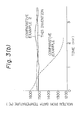
- the average gas composition of the product gas is summarized in Table 3 and changes in carbon content of the molten iron bath and in temperature of the molten iron bath during gasification are shown by graphs in Fig. 3(a) and Fig. 3(b), respectively.
- Example shown in the above was repeated using a molten metal bath at 1600°C except that the top-blowing lance employed herein does not have the outer nozzles a3 for blowing oxygen gas for the secondary combustion of the product gas, and that oxygen gas as a gasifying agent was blown into the furnace at a rate of 950 Nm 3 /Hr.
- Comparative Example 1 was repeated using a molten metal bath at 1525 0 C except that oxygen gas as a gasifying agent was blown at a rate of 1070 Nm 3 /Hr.
- the distance between the tip of the lance and the molten iron surface was adjusted to be 2 meters to achieve the so-called soft-blowing. This has been thought to be effective for promoting the secondary combustion and preventing the molten iron bath temperature from lowering.
- the deterioration in gas composition is kept to minimum levels, and it is possible to carry out gasification of the less exothermic type coals, such as brown coal.
Landscapes
- Chemical & Material Sciences (AREA)
- Engineering & Computer Science (AREA)
- Combustion & Propulsion (AREA)
- Oil, Petroleum & Natural Gas (AREA)
- Organic Chemistry (AREA)
- Carbon Steel Or Casting Steel Manufacturing (AREA)
- Manufacture Of Iron (AREA)
Applications Claiming Priority (2)
| Application Number | Priority Date | Filing Date | Title |
|---|---|---|---|
| JP58165787A JPS6058488A (ja) | 1983-09-07 | 1983-09-07 | 炭素質物質のガス化方法 |
| JP165787/83 | 1983-09-07 |
Publications (3)
| Publication Number | Publication Date |
|---|---|
| EP0140541A2 true EP0140541A2 (fr) | 1985-05-08 |
| EP0140541A3 EP0140541A3 (en) | 1986-02-12 |
| EP0140541B1 EP0140541B1 (fr) | 1988-08-10 |
Family
ID=15818994
Family Applications (1)
| Application Number | Title | Priority Date | Filing Date |
|---|---|---|---|
| EP84306038A Expired EP0140541B1 (fr) | 1983-09-07 | 1984-09-04 | Appareil pour gazéifier des matières carbonifères |
Country Status (9)
| Country | Link |
|---|---|
| US (1) | US4738688A (fr) |
| EP (1) | EP0140541B1 (fr) |
| JP (1) | JPS6058488A (fr) |
| AU (1) | AU562424B2 (fr) |
| BR (1) | BR8404498A (fr) |
| CA (1) | CA1224044A (fr) |
| DE (1) | DE3473296D1 (fr) |
| IN (1) | IN161687B (fr) |
| ZA (1) | ZA847008B (fr) |
Cited By (1)
| Publication number | Priority date | Publication date | Assignee | Title |
|---|---|---|---|---|
| WO2000012767A1 (fr) * | 1998-08-28 | 2000-03-09 | Voest-Alpine Industrieanlagenbau Gmbh | Procede de production d'une masse metallique en fusion et lance multifonction utilisee |
Families Citing this family (5)
| Publication number | Priority date | Publication date | Assignee | Title |
|---|---|---|---|---|
| US6685754B2 (en) | 2001-03-06 | 2004-02-03 | Alchemix Corporation | Method for the production of hydrogen-containing gaseous mixtures |
| WO2009093098A2 (fr) | 2007-12-21 | 2009-07-30 | Gi-Gasification International, Sa | Système injecteur pour production de gaz combustible |
| CN110791301A (zh) * | 2019-10-31 | 2020-02-14 | 中国科学院青岛生物能源与过程研究所 | 易熔金属热载体传热加工工艺方法 |
| MX2022004852A (es) * | 2019-11-06 | 2022-05-19 | Jfe Steel Corp | Metodo para fabricar hierro fundido con horno de arco electrico. |
| CN114672325B (zh) * | 2022-04-13 | 2024-01-05 | 山东四化环保节能工程有限公司 | 一种干熄炉进风闭路系统 |
Family Cites Families (6)
| Publication number | Priority date | Publication date | Assignee | Title |
|---|---|---|---|---|
| US3911716A (en) * | 1971-05-21 | 1975-10-14 | Jerobee Ind Inc | Circuit board, method of making the circuit board and improved die for making said board |
| JPS5589395A (en) * | 1978-12-26 | 1980-07-05 | Sumitomo Metal Ind Ltd | Gasification of solid carbonaceous material and its device |
| DE3031680A1 (de) * | 1980-08-22 | 1982-03-11 | Klöckner-Werke AG, 4100 Duisburg | Verfahren zur gaserzeugung |
| AU535363B2 (en) * | 1980-12-01 | 1984-03-15 | Sumitomo Metal Industries Ltd. | Gasification of solid carbonaceous material |
| JPS5794092A (en) * | 1980-12-01 | 1982-06-11 | Sumitomo Metal Ind Ltd | Method for operating coal gasification furnace |
| US4432539A (en) * | 1981-07-06 | 1984-02-21 | M.A.N.-Roland Druckmaschinen Aktiengesellschaft | Sheet feeding system for printing machines |
-
1983
- 1983-09-07 JP JP58165787A patent/JPS6058488A/ja active Pending
-
1984
- 1984-08-30 CA CA000462097A patent/CA1224044A/fr not_active Expired
- 1984-08-31 AU AU32628/84A patent/AU562424B2/en not_active Ceased
- 1984-09-04 DE DE8484306038T patent/DE3473296D1/de not_active Expired
- 1984-09-04 EP EP84306038A patent/EP0140541B1/fr not_active Expired
- 1984-09-06 IN IN684/MAS/84A patent/IN161687B/en unknown
- 1984-09-06 BR BR8404498A patent/BR8404498A/pt not_active IP Right Cessation
- 1984-09-06 ZA ZA847008A patent/ZA847008B/xx unknown
-
1986
- 1986-07-17 US US06/886,360 patent/US4738688A/en not_active Expired - Fee Related
Cited By (3)
| Publication number | Priority date | Publication date | Assignee | Title |
|---|---|---|---|---|
| WO2000012767A1 (fr) * | 1998-08-28 | 2000-03-09 | Voest-Alpine Industrieanlagenbau Gmbh | Procede de production d'une masse metallique en fusion et lance multifonction utilisee |
| US6558614B1 (en) | 1998-08-28 | 2003-05-06 | Voest-Alpine Industrieanlagenbau Gmbh | Method for producing a metal melt and corresponding multifunction lance |
| EP1304391A3 (fr) * | 1998-08-28 | 2003-07-02 | VOEST-ALPINE Industrieanlagenbau GmbH | Procede de production d'une masse metallique en fusion et lance multifonction utilisee |
Also Published As
| Publication number | Publication date |
|---|---|
| US4738688A (en) | 1988-04-19 |
| EP0140541B1 (fr) | 1988-08-10 |
| EP0140541A3 (en) | 1986-02-12 |
| AU3262884A (en) | 1985-03-14 |
| JPS6058488A (ja) | 1985-04-04 |
| ZA847008B (en) | 1985-06-26 |
| AU562424B2 (en) | 1987-06-11 |
| CA1224044A (fr) | 1987-07-14 |
| IN161687B (fr) | 1988-01-16 |
| DE3473296D1 (en) | 1988-09-15 |
| BR8404498A (pt) | 1985-08-06 |
Similar Documents
| Publication | Publication Date | Title |
|---|---|---|
| US4195985A (en) | Method of improvement of the heat-balance in the refining of steel | |
| KR900007783B1 (ko) | 철의 제조방법 | |
| CA1147966A (fr) | Methode de production d'acier | |
| US4459137A (en) | Gasification of solid carbonaceous materials | |
| EP0056644B1 (fr) | Injection supersonique d'oxygène dans des fours à cuve | |
| US4388084A (en) | Process for gasification of solid carbonaceous material | |
| HU188685B (en) | Process for production of combustible gas in iron-bath reactor containing carbon monoxid and hydrogen | |
| US4389246A (en) | Gasification process of solid carbonaceous material | |
| CA1049792A (fr) | Methode et appareil pour produire du fer en fusion | |
| EP0069490B1 (fr) | Affinage de métaux, en particulier procédé de soufflage d'oxygène par le haut | |
| EP0140541B1 (fr) | Appareil pour gazéifier des matières carbonifères | |
| US4639269A (en) | Method and apparatus for the reducing treatment of molten metals and/or slags thereof | |
| GB2115011A (en) | Improvements in or relating to a process for melting and/or refining steel | |
| US4565551A (en) | Coal gasification apparatus | |
| EP1099746B1 (fr) | Méthode en continu pour la transformation de matériau et appareillage à cet effet | |
| EP0360954A2 (fr) | Procédé de fusion de matériaux froids contenant du fer | |
| US5882377A (en) | Process for smelting reduction of chromium ore | |
| JP3286114B2 (ja) | 屑鉄から高炭素溶融鉄を製造する方法 | |
| EP0137876B1 (fr) | Méthode et appareil pour la gazéification du charbon | |
| CA1202487A (fr) | Methode et installation de gazeification de la houille | |
| US206053A (en) | Improvement in processes for the manufacture of gas | |
| RU2055901C1 (ru) | Способ доменной плавки | |
| CA1170456A (fr) | Gazeification de la houille non broyee | |
| US20030139638A1 (en) | Continuous ecological inertization process of halogenated organic materials by metallurgy reactor thermo-destruction, recovering thermal energy from the combustion of thermo-destruction gases | |
| JPH07126794A (ja) | スクラップを原料とした溶融鉄合金の製造方法 |
Legal Events
| Date | Code | Title | Description |
|---|---|---|---|
| PUAI | Public reference made under article 153(3) epc to a published international application that has entered the european phase |
Free format text: ORIGINAL CODE: 0009012 |
|
| AK | Designated contracting states |
Designated state(s): DE FR GB |
|
| 17P | Request for examination filed |
Effective date: 19850307 |
|
| PUAL | Search report despatched |
Free format text: ORIGINAL CODE: 0009013 |
|
| AK | Designated contracting states |
Designated state(s): DE FR GB |
|
| 17Q | First examination report despatched |
Effective date: 19861017 |
|
| R17C | First examination report despatched (corrected) |
Effective date: 19870609 |
|
| GRAA | (expected) grant |
Free format text: ORIGINAL CODE: 0009210 |
|
| AK | Designated contracting states |
Kind code of ref document: B1 Designated state(s): DE FR GB |
|
| REF | Corresponds to: |
Ref document number: 3473296 Country of ref document: DE Date of ref document: 19880915 |
|
| ET | Fr: translation filed | ||
| PLBE | No opposition filed within time limit |
Free format text: ORIGINAL CODE: 0009261 |
|
| STAA | Information on the status of an ep patent application or granted ep patent |
Free format text: STATUS: NO OPPOSITION FILED WITHIN TIME LIMIT |
|
| 26N | No opposition filed | ||
| PGFP | Annual fee paid to national office [announced via postgrant information from national office to epo] |
Ref country code: GB Payment date: 19930825 Year of fee payment: 10 |
|
| PGFP | Annual fee paid to national office [announced via postgrant information from national office to epo] |
Ref country code: DE Payment date: 19930908 Year of fee payment: 10 |
|
| PGFP | Annual fee paid to national office [announced via postgrant information from national office to epo] |
Ref country code: FR Payment date: 19930909 Year of fee payment: 10 |
|
| PG25 | Lapsed in a contracting state [announced via postgrant information from national office to epo] |
Ref country code: GB Effective date: 19940904 |
|
| GBPC | Gb: european patent ceased through non-payment of renewal fee |
Effective date: 19940904 |
|
| PG25 | Lapsed in a contracting state [announced via postgrant information from national office to epo] |
Ref country code: FR Effective date: 19950531 |
|
| PG25 | Lapsed in a contracting state [announced via postgrant information from national office to epo] |
Ref country code: DE Effective date: 19950601 |
|
| REG | Reference to a national code |
Ref country code: FR Ref legal event code: ST |