EP0140762A1 - Vecteurs d'expression d'une proteine antigenique de la rage dans les cellules eucaryotes et leur application à la préparation d'un vaccin - Google Patents
Vecteurs d'expression d'une proteine antigenique de la rage dans les cellules eucaryotes et leur application à la préparation d'un vaccin Download PDFInfo
- Publication number
- EP0140762A1 EP0140762A1 EP84401962A EP84401962A EP0140762A1 EP 0140762 A1 EP0140762 A1 EP 0140762A1 EP 84401962 A EP84401962 A EP 84401962A EP 84401962 A EP84401962 A EP 84401962A EP 0140762 A1 EP0140762 A1 EP 0140762A1
- Authority
- EP
- European Patent Office
- Prior art keywords
- vector
- expression
- vector according
- rabies
- gene
- Prior art date
- Legal status (The legal status is an assumption and is not a legal conclusion. Google has not performed a legal analysis and makes no representation as to the accuracy of the status listed.)
- Withdrawn
Links
- 108090000623 proteins and genes Proteins 0.000 title claims abstract description 93
- 239000013598 vector Substances 0.000 title claims abstract description 79
- 206010037742 Rabies Diseases 0.000 title claims abstract description 58
- 102000004169 proteins and genes Human genes 0.000 title claims abstract description 47
- 230000014509 gene expression Effects 0.000 title claims abstract description 35
- 230000000890 antigenic effect Effects 0.000 title claims abstract description 25
- 210000003527 eukaryotic cell Anatomy 0.000 title claims description 15
- 229960005486 vaccine Drugs 0.000 title claims description 6
- 238000002360 preparation method Methods 0.000 title claims description 4
- 108091028043 Nucleic acid sequence Proteins 0.000 claims abstract description 16
- 239000013612 plasmid Substances 0.000 claims description 65
- 239000012634 fragment Substances 0.000 claims description 47
- 235000018102 proteins Nutrition 0.000 claims description 44
- 241000829100 Macaca mulatta polyomavirus 1 Species 0.000 claims description 38
- 240000004808 Saccharomyces cerevisiae Species 0.000 claims description 32
- 210000004027 cell Anatomy 0.000 claims description 32
- 230000010076 replication Effects 0.000 claims description 25
- 238000000034 method Methods 0.000 claims description 22
- 239000013604 expression vector Substances 0.000 claims description 20
- 241000700605 Viruses Species 0.000 claims description 19
- 108020004414 DNA Proteins 0.000 claims description 13
- 125000000613 asparagine group Chemical group N[C@@H](CC(N)=O)C(=O)* 0.000 claims description 10
- 241000894006 Bacteria Species 0.000 claims description 9
- 230000000295 complement effect Effects 0.000 claims description 9
- 101150050575 URA3 gene Proteins 0.000 claims description 8
- 230000008488 polyadenylation Effects 0.000 claims description 7
- 108020004440 Thymidine kinase Proteins 0.000 claims description 5
- 230000013595 glycosylation Effects 0.000 claims description 5
- 238000006206 glycosylation reaction Methods 0.000 claims description 5
- 239000000203 mixture Substances 0.000 claims description 5
- 102000006601 Thymidine Kinase Human genes 0.000 claims description 4
- 102000011755 Phosphoglycerate Kinase Human genes 0.000 claims description 3
- 101001099217 Thermotoga maritima (strain ATCC 43589 / DSM 3109 / JCM 10099 / NBRC 100826 / MSB8) Triosephosphate isomerase Proteins 0.000 claims description 3
- 239000003242 anti bacterial agent Substances 0.000 claims description 3
- 230000003115 biocidal effect Effects 0.000 claims description 3
- 239000003550 marker Substances 0.000 claims description 3
- 230000008569 process Effects 0.000 claims description 3
- 102000053602 DNA Human genes 0.000 claims description 2
- 102000018146 globin Human genes 0.000 claims description 2
- 108060003196 globin Proteins 0.000 claims description 2
- 238000002372 labelling Methods 0.000 claims description 2
- 101100246753 Halobacterium salinarum (strain ATCC 700922 / JCM 11081 / NRC-1) pyrF gene Proteins 0.000 claims 1
- XQFRJNBWHJMXHO-RRKCRQDMSA-N IDUR Chemical compound C1[C@H](O)[C@@H](CO)O[C@H]1N1C(=O)NC(=O)C(I)=C1 XQFRJNBWHJMXHO-RRKCRQDMSA-N 0.000 claims 1
- 241000700584 Simplexvirus Species 0.000 claims 1
- 230000029812 viral genome replication Effects 0.000 claims 1
- 108090000288 Glycoproteins Proteins 0.000 abstract description 38
- 102000003886 Glycoproteins Human genes 0.000 abstract description 34
- 230000015572 biosynthetic process Effects 0.000 description 21
- 238000003786 synthesis reaction Methods 0.000 description 20
- 241001631646 Papillomaviridae Species 0.000 description 16
- QKNYBSVHEMOAJP-UHFFFAOYSA-N 2-amino-2-(hydroxymethyl)propane-1,3-diol;hydron;chloride Chemical compound Cl.OCC(N)(CO)CO QKNYBSVHEMOAJP-UHFFFAOYSA-N 0.000 description 15
- 230000029087 digestion Effects 0.000 description 15
- 241000588724 Escherichia coli Species 0.000 description 12
- 108091007433 antigens Proteins 0.000 description 11
- 102000036639 antigens Human genes 0.000 description 11
- 238000010276 construction Methods 0.000 description 11
- 101150074155 DHFR gene Proteins 0.000 description 10
- 239000000427 antigen Substances 0.000 description 10
- KCXVZYZYPLLWCC-UHFFFAOYSA-N EDTA Chemical compound OC(=O)CN(CC(O)=O)CCN(CC(O)=O)CC(O)=O KCXVZYZYPLLWCC-UHFFFAOYSA-N 0.000 description 9
- 230000009471 action Effects 0.000 description 9
- 239000000872 buffer Substances 0.000 description 9
- 101150047627 pgk gene Proteins 0.000 description 9
- 239000002243 precursor Substances 0.000 description 9
- FAPWRFPIFSIZLT-UHFFFAOYSA-M Sodium chloride Chemical compound [Na+].[Cl-] FAPWRFPIFSIZLT-UHFFFAOYSA-M 0.000 description 8
- YBYRMVIVWMBXKQ-UHFFFAOYSA-N phenylmethanesulfonyl fluoride Chemical compound FS(=O)(=O)CC1=CC=CC=C1 YBYRMVIVWMBXKQ-UHFFFAOYSA-N 0.000 description 8
- 238000011282 treatment Methods 0.000 description 8
- 102000004190 Enzymes Human genes 0.000 description 7
- 108090000790 Enzymes Proteins 0.000 description 7
- 239000002299 complementary DNA Substances 0.000 description 7
- 239000002609 medium Substances 0.000 description 7
- LFQSCWFLJHTTHZ-UHFFFAOYSA-N Ethanol Chemical compound CCO LFQSCWFLJHTTHZ-UHFFFAOYSA-N 0.000 description 6
- 108010076504 Protein Sorting Signals Proteins 0.000 description 6
- 241000711798 Rabies lyssavirus Species 0.000 description 6
- 101000895926 Streptomyces plicatus Endo-beta-N-acetylglucosaminidase H Proteins 0.000 description 6
- 210000004962 mammalian cell Anatomy 0.000 description 6
- 210000002966 serum Anatomy 0.000 description 6
- DGVVWUTYPXICAM-UHFFFAOYSA-N β‐Mercaptoethanol Chemical compound OCCS DGVVWUTYPXICAM-UHFFFAOYSA-N 0.000 description 6
- 108091026890 Coding region Proteins 0.000 description 5
- 241000283973 Oryctolagus cuniculus Species 0.000 description 5
- 229920002684 Sepharose Polymers 0.000 description 5
- YJQCOFNZVFGCAF-UHFFFAOYSA-N Tunicamycin II Natural products O1C(CC(O)C2C(C(O)C(O2)N2C(NC(=O)C=C2)=O)O)C(O)C(O)C(NC(=O)C=CCCCCCCCCC(C)C)C1OC1OC(CO)C(O)C(O)C1NC(C)=O YJQCOFNZVFGCAF-UHFFFAOYSA-N 0.000 description 5
- 238000000338 in vitro Methods 0.000 description 5
- 238000001727 in vivo Methods 0.000 description 5
- 125000000311 mannosyl group Chemical group C1([C@@H](O)[C@@H](O)[C@H](O)[C@H](O1)CO)* 0.000 description 5
- 239000008188 pellet Substances 0.000 description 5
- 238000001890 transfection Methods 0.000 description 5
- 230000009466 transformation Effects 0.000 description 5
- ZHSGGJXRNHWHRS-VIDYELAYSA-N tunicamycin Chemical compound O([C@H]1[C@@H]([C@H]([C@@H](O)[C@@H](CC(O)[C@@H]2[C@H]([C@@H](O)[C@@H](O2)N2C(NC(=O)C=C2)=O)O)O1)O)NC(=O)/C=C/CC(C)C)[C@H]1O[C@H](CO)[C@@H](O)[C@H](O)[C@H]1NC(C)=O ZHSGGJXRNHWHRS-VIDYELAYSA-N 0.000 description 5
- MEYZYGMYMLNUHJ-UHFFFAOYSA-N tunicamycin Natural products CC(C)CCCCCCCCCC=CC(=O)NC1C(O)C(O)C(CC(O)C2OC(C(O)C2O)N3C=CC(=O)NC3=O)OC1OC4OC(CO)C(O)C(O)C4NC(=O)C MEYZYGMYMLNUHJ-UHFFFAOYSA-N 0.000 description 5
- ZGTMUACCHSMWAC-UHFFFAOYSA-L EDTA disodium salt (anhydrous) Chemical compound [Na+].[Na+].OC(=O)CN(CC([O-])=O)CCN(CC(O)=O)CC([O-])=O ZGTMUACCHSMWAC-UHFFFAOYSA-L 0.000 description 4
- 101000740205 Homo sapiens Sal-like protein 1 Proteins 0.000 description 4
- ROHFNLRQFUQHCH-YFKPBYRVSA-N L-leucine Chemical compound CC(C)C[C@H](N)C(O)=O ROHFNLRQFUQHCH-YFKPBYRVSA-N 0.000 description 4
- 108010090665 Mannosyl-Glycoprotein Endo-beta-N-Acetylglucosaminidase Proteins 0.000 description 4
- 101900083372 Rabies virus Glycoprotein Proteins 0.000 description 4
- 102100037204 Sal-like protein 1 Human genes 0.000 description 4
- 239000007983 Tris buffer Substances 0.000 description 4
- 229960000723 ampicillin Drugs 0.000 description 4
- AVKUERGKIZMTKX-NJBDSQKTSA-N ampicillin Chemical compound C1([C@@H](N)C(=O)N[C@H]2[C@H]3SC([C@@H](N3C2=O)C(O)=O)(C)C)=CC=CC=C1 AVKUERGKIZMTKX-NJBDSQKTSA-N 0.000 description 4
- 238000004458 analytical method Methods 0.000 description 4
- 238000005119 centrifugation Methods 0.000 description 4
- 238000012217 deletion Methods 0.000 description 4
- 230000037430 deletion Effects 0.000 description 4
- 210000002472 endoplasmic reticulum Anatomy 0.000 description 4
- 239000000284 extract Substances 0.000 description 4
- 239000000499 gel Substances 0.000 description 4
- 239000012133 immunoprecipitate Substances 0.000 description 4
- 230000000977 initiatory effect Effects 0.000 description 4
- 238000003780 insertion Methods 0.000 description 4
- 230000037431 insertion Effects 0.000 description 4
- 230000003362 replicative effect Effects 0.000 description 4
- 239000011780 sodium chloride Substances 0.000 description 4
- ATHGHQPFGPMSJY-UHFFFAOYSA-N spermidine Chemical compound NCCCCNCCCN ATHGHQPFGPMSJY-UHFFFAOYSA-N 0.000 description 4
- PFNFFQXMRSDOHW-UHFFFAOYSA-N spermine Chemical compound NCCCNCCCCNCCCN PFNFFQXMRSDOHW-UHFFFAOYSA-N 0.000 description 4
- 238000013518 transcription Methods 0.000 description 4
- 230000035897 transcription Effects 0.000 description 4
- LENZDBCJOHFCAS-UHFFFAOYSA-N tris Chemical compound OCC(N)(CO)CO LENZDBCJOHFCAS-UHFFFAOYSA-N 0.000 description 4
- GPRLSGONYQIRFK-MNYXATJNSA-N triton Chemical compound [3H+] GPRLSGONYQIRFK-MNYXATJNSA-N 0.000 description 4
- CSCPPACGZOOCGX-UHFFFAOYSA-N Acetone Chemical compound CC(C)=O CSCPPACGZOOCGX-UHFFFAOYSA-N 0.000 description 3
- DCXYFEDJOCDNAF-UHFFFAOYSA-N Asparagine Natural products OC(=O)C(N)CC(N)=O DCXYFEDJOCDNAF-UHFFFAOYSA-N 0.000 description 3
- RTZKZFJDLAIYFH-UHFFFAOYSA-N Diethyl ether Chemical compound CCOCC RTZKZFJDLAIYFH-UHFFFAOYSA-N 0.000 description 3
- PEDCQBHIVMGVHV-UHFFFAOYSA-N Glycerine Chemical compound OCC(O)CO PEDCQBHIVMGVHV-UHFFFAOYSA-N 0.000 description 3
- 108091005904 Hemoglobin subunit beta Proteins 0.000 description 3
- DCXYFEDJOCDNAF-REOHCLBHSA-N L-asparagine Chemical compound OC(=O)[C@@H](N)CC(N)=O DCXYFEDJOCDNAF-REOHCLBHSA-N 0.000 description 3
- FBOZXECLQNJBKD-ZDUSSCGKSA-N L-methotrexate Chemical compound C=1N=C2N=C(N)N=C(N)C2=NC=1CN(C)C1=CC=C(C(=O)N[C@@H](CCC(O)=O)C(O)=O)C=C1 FBOZXECLQNJBKD-ZDUSSCGKSA-N 0.000 description 3
- ROHFNLRQFUQHCH-UHFFFAOYSA-N Leucine Natural products CC(C)CC(N)C(O)=O ROHFNLRQFUQHCH-UHFFFAOYSA-N 0.000 description 3
- 102000003960 Ligases Human genes 0.000 description 3
- 108090000364 Ligases Proteins 0.000 description 3
- 230000004988 N-glycosylation Effects 0.000 description 3
- 210000004102 animal cell Anatomy 0.000 description 3
- 229960001230 asparagine Drugs 0.000 description 3
- 235000009582 asparagine Nutrition 0.000 description 3
- UQBIAGWOJDEOMN-FYHZSNTMSA-N beta-D-Glcp-(1->2)-beta-D-Glcp-(1->2)-D-Glcp Chemical compound O[C@H]1[C@H](O)[C@@H](CO)OC(O)[C@@H]1O[C@H]1[C@H](O[C@H]2[C@@H]([C@@H](O)[C@H](O)[C@@H](CO)O2)O)[C@@H](O)[C@H](O)[C@@H](CO)O1 UQBIAGWOJDEOMN-FYHZSNTMSA-N 0.000 description 3
- 201000010099 disease Diseases 0.000 description 3
- 208000037265 diseases, disorders, signs and symptoms Diseases 0.000 description 3
- 230000002255 enzymatic effect Effects 0.000 description 3
- 230000012010 growth Effects 0.000 description 3
- 238000010166 immunofluorescence Methods 0.000 description 3
- 238000011534 incubation Methods 0.000 description 3
- 238000012423 maintenance Methods 0.000 description 3
- 239000012528 membrane Substances 0.000 description 3
- 229960000485 methotrexate Drugs 0.000 description 3
- 229920002401 polyacrylamide Polymers 0.000 description 3
- 229920001184 polypeptide Polymers 0.000 description 3
- 238000001556 precipitation Methods 0.000 description 3
- 108090000765 processed proteins & peptides Proteins 0.000 description 3
- 102000004196 processed proteins & peptides Human genes 0.000 description 3
- 239000000047 product Substances 0.000 description 3
- 230000002285 radioactive effect Effects 0.000 description 3
- 238000011160 research Methods 0.000 description 3
- 239000006228 supernatant Substances 0.000 description 3
- 238000012360 testing method Methods 0.000 description 3
- 238000012546 transfer Methods 0.000 description 3
- 238000011144 upstream manufacturing Methods 0.000 description 3
- 241000283690 Bos taurus Species 0.000 description 2
- 101100148606 Caenorhabditis elegans pst-1 gene Proteins 0.000 description 2
- 102000012410 DNA Ligases Human genes 0.000 description 2
- 108010061982 DNA Ligases Proteins 0.000 description 2
- 102000016928 DNA-directed DNA polymerase Human genes 0.000 description 2
- 108010014303 DNA-directed DNA polymerase Proteins 0.000 description 2
- 244000068988 Glycine max Species 0.000 description 2
- 235000010469 Glycine max Nutrition 0.000 description 2
- 102100021519 Hemoglobin subunit beta Human genes 0.000 description 2
- 108091092195 Intron Proteins 0.000 description 2
- CKLJMWTZIZZHCS-REOHCLBHSA-N L-aspartic acid Chemical compound OC(=O)[C@@H](N)CC(O)=O CKLJMWTZIZZHCS-REOHCLBHSA-N 0.000 description 2
- 101150007280 LEU2 gene Proteins 0.000 description 2
- 241000124008 Mammalia Species 0.000 description 2
- 241001465754 Metazoa Species 0.000 description 2
- OVRNDRQMDRJTHS-FMDGEEDCSA-N N-acetyl-beta-D-glucosamine Chemical group CC(=O)N[C@H]1[C@H](O)O[C@H](CO)[C@@H](O)[C@@H]1O OVRNDRQMDRJTHS-FMDGEEDCSA-N 0.000 description 2
- HDFGOPSGAURCEO-UHFFFAOYSA-N N-ethylmaleimide Chemical compound CCN1C(=O)C=CC1=O HDFGOPSGAURCEO-UHFFFAOYSA-N 0.000 description 2
- ISWSIDIOOBJBQZ-UHFFFAOYSA-N Phenol Chemical compound OC1=CC=CC=C1 ISWSIDIOOBJBQZ-UHFFFAOYSA-N 0.000 description 2
- ONIBWKKTOPOVIA-UHFFFAOYSA-N Proline Natural products OC(=O)C1CCCN1 ONIBWKKTOPOVIA-UHFFFAOYSA-N 0.000 description 2
- 108010022394 Threonine synthase Proteins 0.000 description 2
- 101710162629 Trypsin inhibitor Proteins 0.000 description 2
- 229940122618 Trypsin inhibitor Drugs 0.000 description 2
- ISAKRJDGNUQOIC-UHFFFAOYSA-N Uracil Chemical compound O=C1C=CNC(=O)N1 ISAKRJDGNUQOIC-UHFFFAOYSA-N 0.000 description 2
- DGEZNRSVGBDHLK-UHFFFAOYSA-N [1,10]phenanthroline Chemical compound C1=CN=C2C3=NC=CC=C3C=CC2=C1 DGEZNRSVGBDHLK-UHFFFAOYSA-N 0.000 description 2
- 229940024606 amino acid Drugs 0.000 description 2
- 235000001014 amino acid Nutrition 0.000 description 2
- 150000001413 amino acids Chemical class 0.000 description 2
- 229940009098 aspartate Drugs 0.000 description 2
- 239000011324 bead Substances 0.000 description 2
- 210000000349 chromosome Anatomy 0.000 description 2
- 238000003776 cleavage reaction Methods 0.000 description 2
- 230000007423 decrease Effects 0.000 description 2
- 238000004925 denaturation Methods 0.000 description 2
- 230000036425 denaturation Effects 0.000 description 2
- 238000011161 development Methods 0.000 description 2
- 230000018109 developmental process Effects 0.000 description 2
- 102000004419 dihydrofolate reductase Human genes 0.000 description 2
- 230000004927 fusion Effects 0.000 description 2
- 239000011521 glass Substances 0.000 description 2
- 238000000227 grinding Methods 0.000 description 2
- PGLTVOMIXTUURA-UHFFFAOYSA-N iodoacetamide Chemical compound NC(=O)CI PGLTVOMIXTUURA-UHFFFAOYSA-N 0.000 description 2
- 239000000463 material Substances 0.000 description 2
- 108020004999 messenger RNA Proteins 0.000 description 2
- 230000004048 modification Effects 0.000 description 2
- 238000012986 modification Methods 0.000 description 2
- 108020004707 nucleic acids Proteins 0.000 description 2
- 102000039446 nucleic acids Human genes 0.000 description 2
- 150000007523 nucleic acids Chemical class 0.000 description 2
- 239000002773 nucleotide Substances 0.000 description 2
- 125000003729 nucleotide group Chemical group 0.000 description 2
- 229920002113 octoxynol Polymers 0.000 description 2
- 230000002265 prevention Effects 0.000 description 2
- 125000002924 primary amino group Chemical group [H]N([H])* 0.000 description 2
- 229960003127 rabies vaccine Drugs 0.000 description 2
- 108091008146 restriction endonucleases Proteins 0.000 description 2
- 230000007017 scission Effects 0.000 description 2
- 241000894007 species Species 0.000 description 2
- 229940063673 spermidine Drugs 0.000 description 2
- 229940063675 spermine Drugs 0.000 description 2
- 235000000346 sugar Nutrition 0.000 description 2
- 238000013519 translation Methods 0.000 description 2
- 230000005945 translocation Effects 0.000 description 2
- 239000002753 trypsin inhibitor Substances 0.000 description 2
- 108091032973 (ribonucleotides)n+m Proteins 0.000 description 1
- FFEARJCKVFRZRR-WFGABJKLSA-N 2-azanyl-4-methylsulfanyl-butanoic acid Chemical compound C[35S]CCC(N)C(O)=O FFEARJCKVFRZRR-WFGABJKLSA-N 0.000 description 1
- 108010055851 Acetylglucosaminidase Proteins 0.000 description 1
- 229930024421 Adenine Natural products 0.000 description 1
- GFFGJBXGBJISGV-UHFFFAOYSA-N Adenine Chemical compound NC1=NC=NC2=C1N=CN2 GFFGJBXGBJISGV-UHFFFAOYSA-N 0.000 description 1
- 108091003079 Bovine Serum Albumin Proteins 0.000 description 1
- 101100328086 Caenorhabditis elegans cla-1 gene Proteins 0.000 description 1
- 241000282693 Cercopithecidae Species 0.000 description 1
- KRKNYBCHXYNGOX-UHFFFAOYSA-K Citrate Chemical compound [O-]C(=O)CC(O)(CC([O-])=O)C([O-])=O KRKNYBCHXYNGOX-UHFFFAOYSA-K 0.000 description 1
- 108091035707 Consensus sequence Proteins 0.000 description 1
- 102000004163 DNA-directed RNA polymerases Human genes 0.000 description 1
- 108090000626 DNA-directed RNA polymerases Proteins 0.000 description 1
- 241001524679 Escherichia virus M13 Species 0.000 description 1
- 241000701533 Escherichia virus T4 Species 0.000 description 1
- 241000206602 Eukaryota Species 0.000 description 1
- 108010058643 Fungal Proteins Proteins 0.000 description 1
- 102000051366 Glycosyltransferases Human genes 0.000 description 1
- 108700023372 Glycosyltransferases Proteins 0.000 description 1
- 208000009889 Herpes Simplex Diseases 0.000 description 1
- ONIBWKKTOPOVIA-BYPYZUCNSA-N L-Proline Chemical compound OC(=O)[C@@H]1CCCN1 ONIBWKKTOPOVIA-BYPYZUCNSA-N 0.000 description 1
- FFEARJCKVFRZRR-BYPYZUCNSA-N L-methionine Chemical compound CSCC[C@H](N)C(O)=O FFEARJCKVFRZRR-BYPYZUCNSA-N 0.000 description 1
- 125000002842 L-seryl group Chemical group O=C([*])[C@](N([H])[H])([H])C([H])([H])O[H] 0.000 description 1
- 108090001030 Lipoproteins Proteins 0.000 description 1
- 102000004895 Lipoproteins Human genes 0.000 description 1
- 101000708578 Milk vetch dwarf virus (isolate N) Para-Rep C3 Proteins 0.000 description 1
- 241000699666 Mus <mouse, genus> Species 0.000 description 1
- 241000699670 Mus sp. Species 0.000 description 1
- GHAZCVNUKKZTLG-UHFFFAOYSA-N N-ethyl-succinimide Natural products CCN1C(=O)CCC1=O GHAZCVNUKKZTLG-UHFFFAOYSA-N 0.000 description 1
- 206010028980 Neoplasm Diseases 0.000 description 1
- 108091092724 Noncoding DNA Proteins 0.000 description 1
- 101710149086 Nuclease S1 Proteins 0.000 description 1
- 108091034117 Oligonucleotide Proteins 0.000 description 1
- 241001505332 Polyomavirus sp. Species 0.000 description 1
- 241000235070 Saccharomyces Species 0.000 description 1
- 241000807910 Streptomyces lysosuperificus Species 0.000 description 1
- 101150003725 TK gene Proteins 0.000 description 1
- 108700019146 Transgenes Proteins 0.000 description 1
- 229920004890 Triton X-100 Polymers 0.000 description 1
- 229960000643 adenine Drugs 0.000 description 1
- 239000011543 agarose gel Substances 0.000 description 1
- HDTRYLNUVZCQOY-LIZSDCNHSA-N alpha,alpha-trehalose Chemical compound O[C@@H]1[C@@H](O)[C@H](O)[C@@H](CO)O[C@@H]1O[C@@H]1[C@H](O)[C@@H](O)[C@H](O)[C@@H](CO)O1 HDTRYLNUVZCQOY-LIZSDCNHSA-N 0.000 description 1
- 125000000539 amino acid group Chemical group 0.000 description 1
- 230000003321 amplification Effects 0.000 description 1
- 230000003698 anagen phase Effects 0.000 description 1
- 229940088710 antibiotic agent Drugs 0.000 description 1
- 239000007864 aqueous solution Substances 0.000 description 1
- 230000001580 bacterial effect Effects 0.000 description 1
- VEZXCJBBBCKRPI-UHFFFAOYSA-N beta-propiolactone Chemical compound O=C1CCO1 VEZXCJBBBCKRPI-UHFFFAOYSA-N 0.000 description 1
- 229960000074 biopharmaceutical Drugs 0.000 description 1
- 210000004556 brain Anatomy 0.000 description 1
- UDSAIICHUKSCKT-UHFFFAOYSA-N bromophenol blue Chemical compound C1=C(Br)C(O)=C(Br)C=C1C1(C=2C=C(Br)C(O)=C(Br)C=2)C2=CC=CC=C2S(=O)(=O)O1 UDSAIICHUKSCKT-UHFFFAOYSA-N 0.000 description 1
- 244000309466 calf Species 0.000 description 1
- 108091092356 cellular DNA Proteins 0.000 description 1
- 239000003795 chemical substances by application Substances 0.000 description 1
- 229960005091 chloramphenicol Drugs 0.000 description 1
- WIIZWVCIJKGZOK-RKDXNWHRSA-N chloramphenicol Chemical compound ClC(Cl)C(=O)N[C@H](CO)[C@H](O)C1=CC=C([N+]([O-])=O)C=C1 WIIZWVCIJKGZOK-RKDXNWHRSA-N 0.000 description 1
- MVWKRECLSFGFPK-UHFFFAOYSA-N chloroform;octan-1-ol Chemical compound ClC(Cl)Cl.CCCCCCCCO MVWKRECLSFGFPK-UHFFFAOYSA-N 0.000 description 1
- 239000013611 chromosomal DNA Substances 0.000 description 1
- 230000002759 chromosomal effect Effects 0.000 description 1
- 150000001875 compounds Chemical class 0.000 description 1
- 238000011109 contamination Methods 0.000 description 1
- 238000001816 cooling Methods 0.000 description 1
- 230000008878 coupling Effects 0.000 description 1
- 238000010168 coupling process Methods 0.000 description 1
- 238000005859 coupling reaction Methods 0.000 description 1
- 238000005520 cutting process Methods 0.000 description 1
- 235000018417 cysteine Nutrition 0.000 description 1
- XUJNEKJLAYXESH-UHFFFAOYSA-N cysteine Natural products SCC(N)C(O)=O XUJNEKJLAYXESH-UHFFFAOYSA-N 0.000 description 1
- 230000001086 cytosolic effect Effects 0.000 description 1
- 238000001514 detection method Methods 0.000 description 1
- 238000010586 diagram Methods 0.000 description 1
- 210000001840 diploid cell Anatomy 0.000 description 1
- 230000000694 effects Effects 0.000 description 1
- 238000001962 electrophoresis Methods 0.000 description 1
- 210000002257 embryonic structure Anatomy 0.000 description 1
- 201000002491 encephalomyelitis Diseases 0.000 description 1
- 238000005516 engineering process Methods 0.000 description 1
- 238000002474 experimental method Methods 0.000 description 1
- 238000000605 extraction Methods 0.000 description 1
- 238000010353 genetic engineering Methods 0.000 description 1
- 125000002791 glucosyl group Chemical group C1([C@H](O)[C@@H](O)[C@H](O)[C@H](O1)CO)* 0.000 description 1
- 125000003147 glycosyl group Chemical group 0.000 description 1
- 239000001963 growth medium Substances 0.000 description 1
- 230000035931 haemagglutination Effects 0.000 description 1
- 238000010438 heat treatment Methods 0.000 description 1
- 230000003067 hemagglutinative effect Effects 0.000 description 1
- 238000002744 homologous recombination Methods 0.000 description 1
- 230000006801 homologous recombination Effects 0.000 description 1
- 238000009396 hybridization Methods 0.000 description 1
- 230000002209 hydrophobic effect Effects 0.000 description 1
- 230000001900 immune effect Effects 0.000 description 1
- 238000007901 in situ hybridization Methods 0.000 description 1
- 229940031551 inactivated vaccine Drugs 0.000 description 1
- 230000002779 inactivation Effects 0.000 description 1
- 208000015181 infectious disease Diseases 0.000 description 1
- 230000010354 integration Effects 0.000 description 1
- 231100000225 lethality Toxicity 0.000 description 1
- 229910003002 lithium salt Inorganic materials 0.000 description 1
- 159000000002 lithium salts Chemical class 0.000 description 1
- 238000004519 manufacturing process Methods 0.000 description 1
- 239000011159 matrix material Substances 0.000 description 1
- 230000035800 maturation Effects 0.000 description 1
- 229930182817 methionine Natural products 0.000 description 1
- 244000005700 microbiome Species 0.000 description 1
- 238000000520 microinjection Methods 0.000 description 1
- 230000009456 molecular mechanism Effects 0.000 description 1
- 238000002703 mutagenesis Methods 0.000 description 1
- 231100000350 mutagenesis Toxicity 0.000 description 1
- 230000007935 neutral effect Effects 0.000 description 1
- 238000003199 nucleic acid amplification method Methods 0.000 description 1
- QYSGYZVSCZSLHT-UHFFFAOYSA-N octafluoropropane Chemical compound FC(F)(F)C(F)(F)C(F)(F)F QYSGYZVSCZSLHT-UHFFFAOYSA-N 0.000 description 1
- 229920000642 polymer Polymers 0.000 description 1
- 230000004481 post-translational protein modification Effects 0.000 description 1
- 238000011533 pre-incubation Methods 0.000 description 1
- 230000003449 preventive effect Effects 0.000 description 1
- 229960000380 propiolactone Drugs 0.000 description 1
- 230000002797 proteolythic effect Effects 0.000 description 1
- 210000001938 protoplast Anatomy 0.000 description 1
- 238000000746 purification Methods 0.000 description 1
- 210000003660 reticulum Anatomy 0.000 description 1
- 239000000523 sample Substances 0.000 description 1
- 239000006152 selective media Substances 0.000 description 1
- 239000000243 solution Substances 0.000 description 1
- 239000000126 substance Substances 0.000 description 1
- 150000008163 sugars Chemical class 0.000 description 1
- 208000024891 symptom Diseases 0.000 description 1
- 230000002103 transcriptional effect Effects 0.000 description 1
- 238000000844 transformation Methods 0.000 description 1
- 108091005703 transmembrane proteins Proteins 0.000 description 1
- 102000035160 transmembrane proteins Human genes 0.000 description 1
- 241000701161 unidentified adenovirus Species 0.000 description 1
- 241001529453 unidentified herpesvirus Species 0.000 description 1
- 229940035893 uracil Drugs 0.000 description 1
- 238000002255 vaccination Methods 0.000 description 1
- 210000005253 yeast cell Anatomy 0.000 description 1
- 239000012138 yeast extract Substances 0.000 description 1
- 206010048282 zoonosis Diseases 0.000 description 1
Images








Classifications
-
- C—CHEMISTRY; METALLURGY
- C07—ORGANIC CHEMISTRY
- C07K—PEPTIDES
- C07K14/00—Peptides having more than 20 amino acids; Gastrins; Somatostatins; Melanotropins; Derivatives thereof
- C07K14/005—Peptides having more than 20 amino acids; Gastrins; Somatostatins; Melanotropins; Derivatives thereof from viruses
-
- C—CHEMISTRY; METALLURGY
- C12—BIOCHEMISTRY; BEER; SPIRITS; WINE; VINEGAR; MICROBIOLOGY; ENZYMOLOGY; MUTATION OR GENETIC ENGINEERING
- C12N—MICROORGANISMS OR ENZYMES; COMPOSITIONS THEREOF; PROPAGATING, PRESERVING, OR MAINTAINING MICROORGANISMS; MUTATION OR GENETIC ENGINEERING; CULTURE MEDIA
- C12N15/00—Mutation or genetic engineering; DNA or RNA concerning genetic engineering, vectors, e.g. plasmids, or their isolation, preparation or purification; Use of hosts therefor
- C12N15/09—Recombinant DNA-technology
- C12N15/63—Introduction of foreign genetic material using vectors; Vectors; Use of hosts therefor; Regulation of expression
- C12N15/79—Vectors or expression systems specially adapted for eukaryotic hosts
- C12N15/80—Vectors or expression systems specially adapted for eukaryotic hosts for fungi
- C12N15/81—Vectors or expression systems specially adapted for eukaryotic hosts for fungi for yeasts
-
- C—CHEMISTRY; METALLURGY
- C12—BIOCHEMISTRY; BEER; SPIRITS; WINE; VINEGAR; MICROBIOLOGY; ENZYMOLOGY; MUTATION OR GENETIC ENGINEERING
- C12N—MICROORGANISMS OR ENZYMES; COMPOSITIONS THEREOF; PROPAGATING, PRESERVING, OR MAINTAINING MICROORGANISMS; MUTATION OR GENETIC ENGINEERING; CULTURE MEDIA
- C12N15/00—Mutation or genetic engineering; DNA or RNA concerning genetic engineering, vectors, e.g. plasmids, or their isolation, preparation or purification; Use of hosts therefor
- C12N15/09—Recombinant DNA-technology
- C12N15/63—Introduction of foreign genetic material using vectors; Vectors; Use of hosts therefor; Regulation of expression
- C12N15/79—Vectors or expression systems specially adapted for eukaryotic hosts
- C12N15/85—Vectors or expression systems specially adapted for eukaryotic hosts for animal cells
- C12N15/86—Viral vectors
-
- A—HUMAN NECESSITIES
- A61—MEDICAL OR VETERINARY SCIENCE; HYGIENE
- A61K—PREPARATIONS FOR MEDICAL, DENTAL OR TOILETRY PURPOSES
- A61K39/00—Medicinal preparations containing antigens or antibodies
-
- C—CHEMISTRY; METALLURGY
- C12—BIOCHEMISTRY; BEER; SPIRITS; WINE; VINEGAR; MICROBIOLOGY; ENZYMOLOGY; MUTATION OR GENETIC ENGINEERING
- C12N—MICROORGANISMS OR ENZYMES; COMPOSITIONS THEREOF; PROPAGATING, PRESERVING, OR MAINTAINING MICROORGANISMS; MUTATION OR GENETIC ENGINEERING; CULTURE MEDIA
- C12N2710/00—MICROORGANISMS OR ENZYMES; COMPOSITIONS THEREOF; PROPAGATING, PRESERVING, OR MAINTAINING MICROORGANISMS; MUTATION OR GENETIC ENGINEERING; CULTURE MEDIA dsDNA viruses
- C12N2710/00011—Details
- C12N2710/20011—Papillomaviridae
- C12N2710/20041—Use of virus, viral particle or viral elements as a vector
- C12N2710/20043—Use of virus, viral particle or viral elements as a vector viral genome or elements thereof as genetic vector
-
- C—CHEMISTRY; METALLURGY
- C12—BIOCHEMISTRY; BEER; SPIRITS; WINE; VINEGAR; MICROBIOLOGY; ENZYMOLOGY; MUTATION OR GENETIC ENGINEERING
- C12N—MICROORGANISMS OR ENZYMES; COMPOSITIONS THEREOF; PROPAGATING, PRESERVING, OR MAINTAINING MICROORGANISMS; MUTATION OR GENETIC ENGINEERING; CULTURE MEDIA
- C12N2760/00—MICROORGANISMS OR ENZYMES; COMPOSITIONS THEREOF; PROPAGATING, PRESERVING, OR MAINTAINING MICROORGANISMS; MUTATION OR GENETIC ENGINEERING; CULTURE MEDIA ssRNA viruses negative-sense
- C12N2760/00011—Details
- C12N2760/20011—Rhabdoviridae
- C12N2760/20111—Lyssavirus, e.g. rabies virus
- C12N2760/20122—New viral proteins or individual genes, new structural or functional aspects of known viral proteins or genes
Definitions
- the present invention relates more particularly to the development of a rabies vaccine.
- Rabies is a disease caused by the rabies virus, which occurs as very serious encephalomyelitis, which is almost always fatal if left untreated before symptoms appear.
- Rabies is a zoonosis. All warm-blooded animals, whether mammals or birds, are receptive.
- the main vector is generally constituted by biting mammals, whether domestic or wild.
- rabies is still a very important disease in some countries in South America, Africa and Asia.
- the essential weapon in the fight against rabies could be prevention through vaccination.
- the vaccines currently used consist of inactivated viruses.
- viruses must be cultured on media such as the brains of newborn mice, on bird embryos, on animal renal cells or on human diploid cells, after which they are completely inactivated. by the action of ⁇ -propio-lactone for example.
- the TRANSGENE Company has already provided a first solution to this problem using vectors which ensure the expression of the antigenic protein of rabies in bacteria such as E. coli (see in particular FR-A 82 08401).
- the object of the present invention is the preparation of a vaccinating antigenic protein free of risk of accidental infection which, moreover, can be prepared under industrial conditions such that it ensures a very low cost of the vaccine by no longer using bacteria as production agents, but eukaryotic cells.
- eukaryotic cells as an element of expression is that they are capable of producing antigens with a structure closer to that of rabies and more complete than bacteria.
- the rabies virus is a rhabdovirus.
- This rhabdovirus consists of a helical nucleocapsid containing an RNA included in a lipoprotein envelope having the shape of a shell.
- This virus comprises five proteins which are coded by the genome: G (glycoprotein), N (nucleo-capdite), M1 and M2 (matrix) and L (large, transcriptase).
- G glycoprotein
- N nucleo-capdite
- M1 and M2 matrix
- L large, transcriptase
- the purified glycoprotein is approximately six times more active in hemagglutination tests than the intact virus.
- glycoprotein of the rabies virus is glycosylated, although the role of this glycosylation is unknown.
- DNA sequence (1) coding for an antigenic protein of rabies is meant a sequence which when expressed in eukaryotic cells leads to an antigenic protein of rabies.
- It may be all or part of the effective DNA sequence coding for the rabies antigenic protein or else a DNA sequence which, when expressed, results in a protein having identical immunological properties or very similar to that of the rabies antigenic protein.
- DNA (1) vary according to the nature of the eukaryotic host cells. We can distinguish two cases which are currently of industrial interest, animal cells in particular mammalian cells, and yeasts, although the other types of eukaryotic cells should not be ruled out a priori.
- the expression elements will generally be taken from a virus, for example viruses from the Papovaviridiae family such as SV40 (simian virus 40, polyomavirus) or BPV (papilloma virus). bovine, papillomavirus). But we can use other viruses such as adenoviruses.
- viruses from the Papovaviridiae family such as SV40 (simian virus 40, polyomavirus) or BPV (papilloma virus). bovine, papillomavirus).
- viruses from the Papovaviridiae family such as SV40 (simian virus 40, polyomavirus) or BPV (papilloma virus). bovine, papillomavirus). But we can use other viruses such as adenoviruses.
- SV40 virus simian virus 40, polyomavirus
- BPV papilloma virus
- bovine papillomavirus
- viruses such as adenovirus
- the expression elements of the vectors according to the invention will comprise at least the promoter of a virus which can be one of the promoters of the vector virus, thus in SV40 the promoter of late genes can be used, but this promoter can come from a different virus thus in the BPV one will use below the promoter of the gene of the thymidine kinase of the virus Herpes Simplex.
- the vectors according to the invention can also comprise introns and polyademylation sites located in this order at the end of the DNA sequence (1). These elements can also come from the vector virus. or be exogenous. Thus in the BPV vector the polyadenylation sites will be the early or late sites of SV40. Among the usable introns, mention should be made of intron I of the rabbit ⁇ globin gene, although this is in no way limiting.
- an autonomous expression vector must be capable of replicating in host cells, the vector must therefore include an origin of replication, for example origin of replication of SV40 or BPV.
- the vector will possibly have to be able to express the proteins necessary for its maintenance and its replication in said cells such as the T antigen for SV40.
- the vectors comprising all of these elements may become too large to be usable, in this case some of the elements necessary for maintaining and replicating the vector may be provided via another vector or else be produced by the cells themselves, allowing the corresponding parts to be deleted in the vector.
- COS cells which carry an integrated SV40 genome and which produce the T antigen necessary for the replication of SV40, are capable of ensuring the replication of an SV40 vector which has an origin of replication but which does not include the functions SV40 early.
- the complementation of the expression vector proper that is to say the vector carrying the DNA sequence (1) will be ensured by another vector called “vector of complement" ensuring the expression of the missing elements in the expression vector.
- a marker for example a gene for resistance to a particular chemical compound.
- this gene is the gene coding for dhfr (dihydrofolate reductase) which confers on cells resistance to methotrexate.
- This selection gene allows the manipulation of vectors in host cells and can, in some cases, ensure their maintenance.
- the expression elements essentially consist of a promoter and optionally a terminator. These elements are preferably, although not necessarily, promoters and terminators of host yeast genes.
- the promoter and the terminator of the URA3 gene or of the PGK gene phosphoglycerate kinase.
- the autonomous expression vector must be capable of replicating in yeasts, to do this it will include an origin of replication of yeast such as the origin of replication of the plasmid 2 ⁇ , but it is possible to use other origins of replication, for example origins of replication of chromosomal origins.
- the vectors according to the invention will also preferably comprise a selection gene, for example the LEU2 or URA3 gene which complements a leu - or ura strain.
- the vectors according to the invention can be in the form of an autonomous vector, that is to say in the form of a plasmid or else be integrated into the chromosomes of eukaryotic cells, both yeast and mammalian cells in this case it is possible to '' integrate the fragment coding for DNA (1), for example the promoter / gene / terminator fragment in one or more copies in the chromosomes (Weawer & coll. 1981).
- the vectors according to the invention will also comprise elements allowing their maintenance in bacteria and in particular will comprise an origin of functional replication in E. coli (ori-eco) and a selection gene for example a gene for resistance to an antibiotic such as Ampicillin (Amp r ).
- an origin of functional replication in E. coli ori-eco
- a selection gene for example a gene for resistance to an antibiotic such as Ampicillin (Amp r ).
- the vectors thus obtained are used to transform or transfect the corresponding eukaryotic cells according to known processes.
- the transfection technique described by H. Ito & coll 1983 can be a particular segregant of Saccharemyces cereviseae (TG Y 1 spl), but other strains of the same species or other species ( S chizosaccharamyces pombes, S. uvanum) may also be suitable hosts.
- the transfection can be carried out for example by the method described by Wigler et al 1978 for cellular DNA, by techniques of fusion of protoplasts or microinjections, techniques other techniques are known when the vector is under form turned it over.
- the mammalian host cells can be varied but adapted to the vector used.
- the transformed or transfected cells are cultured on an appropriate medium ensuring their growth.
- the cells After culture, the cells are harvested and the rabies antigenic protein can be isolated by techniques known in the field of purification of proteins and antigens.
- the antigens thus prepared are useful both for the treatment and prevention of rabies like the antigens prepared by the "conventional” methods, but can also be used in the in vitro diagnostics of this disease.
- This last condition can, at first analysis, be achieved when the given protein is synthesized in the form of a precursor provided with a "signal peptide" generally situated on the aminoterminal side of the mature protein. Indeed, the synthesis of this signal peptide at the level of the translational cytoplasmic complex would allow it, by a molecular mechanism still obscure, to migrate towards the external membrane of the endoplasmic reticulum. The synthesis of polypeptide would then continue simultaneously with the translocation of the chain being elongated through the membrane of the endoplasmic reticulum.
- the rabies glycoprotein when cells are infected with the rabies virus, is synthesized in the form of a precursor comprising an amino terminal signal sequence of 19 amino acid residues, of essentially hydrophobic nature.
- the cDNA corresponding to the rabies glycoprotein contains the information necessary for the synthesis of the precursor provided with the signal sequence.
- yeast is a host of choice for obtaining specific post-translational modifications, namely, for example, the N glycosylation of rabies glycoprotein. It is not unreasonable to envisage that the precursor of the glycoprotein in the process of synthesis in yeast is directed towards the endoplasmic reticulum where the enzymes for synthesis and transfer of the precursor (glc 2 ) are located ( man) g (glcNAc) 2 -P-Pdolichyl. If this is the case, we can expect an N-glycosylation consisting exclusively of N acetylglucosamine residues and mannose residues (possibly glucose residues if no maturation takes place thereafter).
- the present invention covers an antigenic protein of rabies, characterized in that it comprises a yeast glycosylation, in particular a glycosylation carried out by a strain of S. cerevisiae.
- glycosylation is carried out at the two asparagine residues 204 and 319.
- the vector used to transport the yeasts is a vector as described above, characterized in that it comprises in the DNA sequence (I) all or part of the amino terminal signal sequence coding for the 19 residues of amino acids of said signal sequence.
- the present invention relates to vaccines or curative compositions containing, as active principle, in particular, an antigenic protein of glycosylated rabies described above.
- the strain of bacteria used is an E. coli 1106 strain (SupE hSdS met supF).
- TGYlspl est a segregeant obtained by crossing the GFR18 strain (Mat ⁇ His3-11-15 Leu2-3-12) (FINK et al.) With the TGY10-1 strain (Mata Ura3-251-373-328).
- the TGY10-1 strain is an isogenic derivative of the FL100 strain (ATCC 2283).
- oligonucleases used come either from New England Biolab, Hana Biologics and Worthington Biochemical, or are synthesized by the techniques Kohli et al.
- Restriction enzymes are used under the conditions specified by the manufacturer.
- the other enzymatic treatments are carried out according to the techniques described by Maniatis et al. (1982).
- the DNA is extracted with phenol, twice with octanol-chloroform (1: 8) then precipitation with ethanol.
- triple extraction with diethyl ether replaces precipitation with ethanol.
- the analysis of the digestion products is carried out by electrophoresis on agarose gel according to known techniques.
- H pa1 linked via a Kpn1 "linker” oligonucleotide to an Hpc1-BamH1 fragment.
- the polyadenylation sites (A) for the immediate and late transcription of SV40 are flanked by a Kpn1 site and a BamH1 site.
- pK14 is treated with BamH1 and the nuclease S1 followed by digestion with Sal1 and treatment with DNA polymerase, in order to fill the 5 ′ extensions produced by cleavage with Sal1.
- the fusion of the two ends by DNA ligase leads to a reconstruction of the Sal1 site in pTG142.
- this site is an internal site of the plasmid gene which is located in the chloramphenicol resistance gene. Having encountered problems of lethality associated with the expression of the glycoprotein gene in bacteria, the EcoR1-Sal1 fragment was transferred to the corresponding sites of pBR322 to obtain pTG143. A BglII linker is then inserted between the two EcoR1 and Kpn1 sites and adapter technology is used to insert the glycoprotein gene.
- Example 1 Expression using the SV40 virus
- the expression of the gene coding for a rabies antigen protein (hereinafter the rabies gene) in monkey cells via SV40 is based on the complementation between two vectors, one of which carries the gene for rabies and part of the SV40 genome and the other carries the complementary part of the SV40 genome this in order to obtain two vectors of reduced dimensions of the order of 5200 bp (the size of SV40 without insertion) capable of complementing each other and get wrapped up.
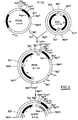
- the genome of the simian virus shown diagrammatically in FIG. 2 consists of a circular double-stranded DNA molecule comprising 5243 bp.
- This genome includes, for our purposes, an origin of OR replication, an early region coding for two antigens, the T and t antigens and a late region comprising VP1, VP2 and VP3.
- the plasmid pBR327 (Soberon et al 1980) is digested with HindIII, the cohesive ends are complemented by treatment with Klenow DNA polymerase, and the plasmid is linked with a 5 'octamer BglII "linker" dCAGATCTG-3'. After rehybridization of the "linker” ends and transformation in E. coli, the correct plasmids are demonstrated by restriction with BglII.
- the starting plasmid pK 14 comprises an EcoR1-BamH1 fragment originating from SV40, inserted between the EcoRI-BamH1 sites of pBR322.
- the SV40 fragment comprises an EcoR1- fragment
- Plasmids pTG147 and pTG149 are digested completely with BglII, mixed in equimolar amount, bound, and the ligation mixture is used to transform E. coli.
- the plasmid pTG150 is identified as the plasmid comprising the complete cDNA of the rabies glycoprotein inserted into the BglII site of pTG149.
- the plasmid pTG150 is introduced entirely in the form of a ClaI digestion fragment into the HpaII restriction site of the SV40 virus (hereinafter referred to as SV401) by subjecting pTG150 to ClaI, SV40 to HpaII respectively and putting the restriction pieces in the presence ligase.
- SV401 HpaII restriction site of the SV40 virus
- This plasmid is too large to be able to be introduced into mammalian cells. This is why it is used in the form of a fragment linearized with BamH1. Indeed, the BamH1 fragment comprises, in addition to the gene for the rabies glycoprotein, the part of the SV40 genome which can be complemented by the plasmid pTG152, the construction of which will be explained below.
- the plasmid pTG152 is obtained from pBR327 D by digestion with BamH1 and Cla1 in order to isolate a fragment comprising an origin of functional replication in E. coli (ori-eco) and the gene for resistance to ampicillin. This fragment is linked to a fragment obtained by digestion of SV40 with Bcl1 and Tag1. This gives the plasmid pTG152 of 5.3 kb which comprises the complementary part for SV40 of the plasmid SVTG151.
- plasmid pTG150 From the plasmid pTG150, a partial digestion is carried out with BglII and then a complete digestion with MstII.
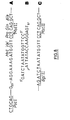
- the plasmid is recircularized by ligation in the presence of a synthetic double-stranded adapter whose formula is given in B fig 8, in order to merge the BglII and MstII sites to delete the G / C polymer at the 5 ′ end of the element cDNA.
- This plasmid pTG155 contains a site of initiation of the reconstituted translation in which the nucleotide adenine is located in position -3 to be in conformity with the generally accepted sequence for the initiation of translation in eukaryotic cells.
- This plasmid can be treated as pTG150 to give the vector SVTG160.
- This vector differs from the previous ones in that it has an intron following the rabies gene.
- This intron is intron I from pSXBETA + (rabbit ⁇ globin).
- This intron is taken in the form of a PvuII / BamH1 fragment and inserted into an M13 phase, in this case M13 TG120, between the HindII and BamH1 sites.
- the phage M13 TG140 (FIG. 10) is thus obtained which comprises the intron I, which is taken in the form of a fragment B g III / BamHI to be inserted between the corresponding sites of pTG149 (see above).
- the plasmid pTG170 is thus obtained.
- the plasmid pTG171 is obtained which, as before, is linearized with BamHI in order to provide the vector SVTG171.
- Example 4 Preparation of a vector from PVB.
- the BPV virus is divided into two parts limited by two unique restriction sites HindIII and BamH1 which delimits two fragments said to be “69%” and "31%” respectively. ( Figure 11 after Chen et al. 1982).
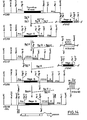
- the vector derived from BPV used in this example is called pMOP. It is obtained by introducing into the BamH1 site of BPV the dhfr marker coding for dihydrofolate reductase under the control of the SV40 early promoter (see FIG. 13).
- This pMOP vector further comprises a fragment of pBR322 carrying the ampicillin resistance gene which comes from the plasmid pML2 described by Lusky and Botchan (1981).
- FIG. 13 represents the detail of the structure of pMOP between the BamH1 sites, these elements do not constitute essential elements in the context of the present invention since they are intended to ensure the expression of the dhfr gene.
- the gene coding for the rabies antigenic protein comes from the plasmid pTG147, the construction of which has been explained previously.
- This gene is taken in the form of a BglII / SalI fragment by partial digestion of pTG147 to be introduced between the corresponding sites of the plasmid pTG301 treated with BglII / SalI.
- This plasmid pTG301 contains the thymidine kinase (tk) gene and its promoter (ptk), it is obtained by insertion into the BamH1 site of pB R 322 of a BamH1-BamH1 fragment of the Herpes virus simplex, the restriction treatment eliminates the tk gene.
- the ligation product pTG156 contains, in its interesting part, the rabies gene under the control of the thymidine kinase promoter, the gene being followed by the polyadenylation site of SV40 (A).
- the introduction of the globin intron is carried out from phage M13TG140 (see above) in the form of a BglII / BamH1 fragment which is inserted into the BglII site of pTG156 after deletion of the corresponding BhlII / BglII fragment.
- This deletion having deleted the rabies gene, it is reintroduced into the unique BglII site of pTG156 in the form of a BglII / BglII fragment of pTG147.
- the plasmid pTG158 is thus obtained.
- This plasmid to be taken in the form of a SalI / SalI fragment (one of the rare unique sites of pMOP) is introduced upstream of the promoter at the BamHI site, a small fragment originating from M13TG120 and comprising a SalI website.
- M13TG120 is set - digestion with BglII and Bam Bam and pTG158 with the whole is bound to give pTG158 SAL.
- the plasmid pTG172 is obtained which comprises, in addition to all the elements mentioned for pMOP, the rabies gene under the control of the Ptk promoter and terminated by the intron of ⁇ globin and a polyadenylation site.
- the original plasmid pMOP and the plasmid pTG17.2 are used for these transformations.
- the transfection with the vectors is carried out after 24 hours of culture by the technique of Wigler et al. 1978.
- the medium is changed 24 hours after transfection. Then transplanting is carried out on selective medium containing methotrexate.
- the cells can be fixed in a colony and the antigens produced can be demonstrated using immunofluorescence.
- Colonies derived from cells which have incorporated a plasmid and therefore a resistance to methotrexate (dhfr + ) were fixed by treatment with acetone.
- the expression of rabies glycoprotein was visualized by successive treatments with a monoclonal antibody (n ° 509-6) directed against the glycoprotein and a second fluorescent anticoprs directed against this first antibody.
- Example 6 Construction of the plasmid pIG 856 comprising the gene for the rabies glycoprotein (FIG. 16).
- the yeast PGK gene was isolated from a chromosomal DNA library produced by integration of fragments cut at random (partial digestion with Sau 3A) at the BamH1 site of a plasmid (pFL 1) capable of replicating both yeast and in E. coli (Chevallier et al, 1980).
- the detection of a fragment containing the PGK gene was carried out by in situ hybridization of bacterial colonies, transformed by this library, with a specific probe (5'-TGTTTAGTTTAGTAGAACCTCGTGAAACTT-3 ') (Maniatis et al, 1982).
- the 5 'region of the PGK gene was recloned as a HindIII-SalI fragment (2.3. Kb) in pBR 322.
- This fragment contains all of the sequences involved in controlling the initiation of the transcription (promoter) of the PGK gene, plus the start of the coding sequence (Hitzeman et al, 1982).
- an EcoRI-HindIII fragment (0.5. Kb) comprising the end (3 ') of the coding sequence and the transcriptional termination signals of the PGK was treated with Klenow polymerase and ligated to the unique PvuII site of the plasmid described in the previous paragraph, so that the EcoRI site thus reconstituted is upstream of the destroyed HindIII site.
- This new integrated fragment comprises a BglII site located in the coding part of the PGK gene. The deletion of the fragment between the two BglII sites, that newly created downstream of the PGK promoter and that upstream of the terminator, leaves a unique BglII site where one can clone the genes that one wants to express.
- the HindIII - Pst 1 fragment comprising, in order, the promoter part of the PGK gene, the BglII site, the terminator part of the PGK gene, the origin of replication of pBR 322 and part of the sequence of the AMp r gene conferring resistance with ampicillin was ligated with the largest fragment resulting from the double digestion HindIII - Pst 1 of the plasmid pJDB 207 so as to reconstitute the Amp r gene (Beggs, 1981) (see Figure 16).
- the resulting plasmid (pTG 841) has. so: the yeast LEU2 gene, the E. coli Amp r gene, the yeast plasmid REP3 gene 2 p, the origin of replication of the plasmid 2 ⁇ yeast, the origin of replication of 322, the promoter and terminator of the yeast PGK gene.
- a 1.1 kb HindIII fragment comprising the yeast URA3 gene (European Patent No. 78 3210) was cloned at the HindIII site of pTG 902, a pBR 322 derivative lacking the Pstl and NdeI sites, to form the plasmid pTG 802.
- the DNA of this plasmid was linearized by cleavage at the unique Pstl site - located in the 5 'non-coding region of the URA3 gene - treated with Klenow polymerase to make the ends blunt: released by Pstl digestion, and recircularized by the action of DNA ligase from phage T4.
- the 1.1 kb HindIII fragment thus modified was integrated into the unique HindIII site of the plasmid pTG 841 so that the direction of transcription of the URA3 gene is divergent compared to that of the PGK (plasmid pTG 849).
- the plasmid PTG 849 therefore has the same characteristics as pTG 841, with the addition of the modified URA3 gene.
- the rabies glycoprotein cDNA was isolated in the form of a BglII fragment comprising the entire coding sequence plus the polydGdC ends.
- An MstII site is located at the start (5 ′) of the coding sequence, the enzyme cutting between the seventh and the eighth nucleotide following the A of the initiating ATG.
- a synthetic sequence was designed to replace the BglII - MstII fragment in the 5 'region of the gene, so as to replace the 5' polydGd C end with a sequence closer to the untranslated sequences of the yeast messenger RNAs (FIG. 17). .
- the BglII fragment thus modified was integrated into the unique BglII site of pTG 849, so that the direction of transcription of the gene for rabies glycoprotein is the same as that of PGK.
- Example 7 Expression of rabies virus glycoprotein polypeptide in yeast.
- the plasmid PTG856 is introduced into the strain S.Cerevisiae TGYlspl according to the technique with lithium salts (Ito & coll 1983).
- the same strain was transformed with PTG849 which is the same plasmid as PTG856 but which does not contain the glycoprotein gene. These strains were cultivated in 25 ml of medium without uracil allowing the plasmid to be stabilized.
- Radioactive cysteine S 35 is added to label the yeast proteins.
- the plasmids pK14, pMOP and pSXBETA were kindly provided by R. Breathnach.
- glycoprotein of the rabies virus expressed in yeast detected by immunoprecipitate, was actually glycosylated
- the glycoprotein was subjected to the action of endo- ⁇ -N acetyglucosaminidase H in vitro.
- the action of tunicamycin in vivo on the glycoprotein expressed in yeast was also examined.
- endo-BN acetylglucosaminidase H decreases the molecular weight of the subunit of the rabies glycoprotein produced in yeast by approximately 5000 Daltons (respectively 63,000 without endo H and 58,000 after action of endo H) which corresponds to the molecular weight of the mature glycoprotein expressed in E. coli).
- Tunicamycin a mixture of antibiotics with related structures, produced from Streptomyces lysosuperificus inhibits the first stage of synthesis of the precursor (glc) 2 (man) 9 (glcNAc) 2-PP-dolichyl.
- the yeast strains (TGY2 sp13b expressing or not expressing the rabies glycoprotein), in the exponential growth phase on YNBG + leucine 20 ⁇ g / ml, are preincubated with tunicamycin (15 ⁇ g / ml) for 30 minutes. A preliminary test has shown that this concentration leads to a total absence of growth on this medium for the strains used.
- methionine 35 S (2 pCi 54 at a rate of 1115 Ci / mmol) is added to the medium and cells were harvested after 10 minutes of labeling. They are resuspended in the TRIS-Cl buffer 12.5 mM pH 7.5, EDTA 5 mM pH 8, KC1 0.5 M, TRIS-Cl 50 mM pH 8.8, TRITON X-100 1%, PMSF 2 mM added with 2.5 pg of DNAse I.
- the pellet of protein A sepharose After adding 8 mg of protein A sepharose and incubation for one hour at room temperature, the pellet of protein A sepharose, obtained after centrifugation, is washed 3 times with 0.5 M KCl TRIS-Cl pH 8.8 10 mM TRITON X-100, 0.5% and 3 times with TRIS-Cl 10 mM pH 8.8. The pellet is finally resuspended in 30 ⁇ l of the denaturation mixture (SDS 10%, ⁇ -mercaptoethanol 25%, glycerol 50%, TRIS-CL pH 6.8 0.325 M), boiled for 10 minutes at 100 ° C, to then be deposited on 10% polyacrylamide gel.
- SDS 10%, ⁇ -mercaptoethanol 25%, glycerol 50%, TRIS-CL pH 6.8 0.325 M
Landscapes
- Life Sciences & Earth Sciences (AREA)
- Health & Medical Sciences (AREA)
- Genetics & Genomics (AREA)
- Chemical & Material Sciences (AREA)
- Organic Chemistry (AREA)
- Engineering & Computer Science (AREA)
- Bioinformatics & Cheminformatics (AREA)
- Biotechnology (AREA)
- General Engineering & Computer Science (AREA)
- Biomedical Technology (AREA)
- Wood Science & Technology (AREA)
- Zoology (AREA)
- Biochemistry (AREA)
- Molecular Biology (AREA)
- Biophysics (AREA)
- General Health & Medical Sciences (AREA)
- Plant Pathology (AREA)
- Physics & Mathematics (AREA)
- Microbiology (AREA)
- Virology (AREA)
- Mycology (AREA)
- Gastroenterology & Hepatology (AREA)
- Medicinal Chemistry (AREA)
- Proteomics, Peptides & Aminoacids (AREA)
- Micro-Organisms Or Cultivation Processes Thereof (AREA)
- Preparation Of Compounds By Using Micro-Organisms (AREA)
Applications Claiming Priority (4)
| Application Number | Priority Date | Filing Date | Title |
|---|---|---|---|
| FR8315716 | 1983-10-03 | ||
| FR8315716A FR2552776B1 (fr) | 1983-10-03 | 1983-10-03 | Vecteurs d'expression d'une proteine antigenique de la rage dans les cellules eucaryotes et leur application a la preparation d'un vaccin |
| FR8404754A FR2562090B2 (fr) | 1984-03-27 | 1984-03-27 | Proteine antigenique de la rage glycosylee |
| FR8404754 | 1984-03-27 |
Publications (1)
| Publication Number | Publication Date |
|---|---|
| EP0140762A1 true EP0140762A1 (fr) | 1985-05-08 |
Family
ID=26223606
Family Applications (1)
| Application Number | Title | Priority Date | Filing Date |
|---|---|---|---|
| EP84401962A Withdrawn EP0140762A1 (fr) | 1983-10-03 | 1984-10-02 | Vecteurs d'expression d'une proteine antigenique de la rage dans les cellules eucaryotes et leur application à la préparation d'un vaccin |
Country Status (3)
| Country | Link |
|---|---|
| EP (1) | EP0140762A1 (da) |
| DK (1) | DK250085D0 (da) |
| WO (1) | WO1985001516A1 (da) |
Cited By (2)
| Publication number | Priority date | Publication date | Assignee | Title |
|---|---|---|---|---|
| EP0324157A1 (en) * | 1987-12-26 | 1989-07-19 | Juridical Foundation The Chemo-Sero-Therapeutic Research Institute | Gene fragment coding for a rabies virus glycoprotein and process for producing a rabies virus glycoprotein using the same |
| EP0162757B1 (fr) * | 1984-04-25 | 1990-01-24 | Transgene S.A. | Vaccin contre la rage et procédé pour sa préparation |
Families Citing this family (4)
| Publication number | Priority date | Publication date | Assignee | Title |
|---|---|---|---|---|
| JPS60145098A (ja) * | 1984-01-09 | 1985-07-31 | Suntory Ltd | 糖付加ポリペプチドの製造法 |
| AU7847094A (en) * | 1993-09-30 | 1995-04-18 | Thomas Jefferson University | Oral vaccination of mammals |
| FR2748480B1 (fr) * | 1996-05-09 | 1998-09-04 | Biocem | Plantes transgeniques exprimant la glycoproteine g de la rage, et glycoproteines ainsi obtenues |
| FR2841246B1 (fr) * | 2002-06-20 | 2004-12-31 | Centre Nat Rech Scient | Peptide issu de la proteine g du virus de la rage, ligand du recepteur de basse affinite des neurotrophines(p75ntr) et ses applications |
Citations (6)
| Publication number | Priority date | Publication date | Assignee | Title |
|---|---|---|---|---|
| EP0060057A1 (en) * | 1981-02-25 | 1982-09-15 | Genentech, Inc. | Expression of polypeptides in yeast |
| EP0073656A2 (en) * | 1981-08-31 | 1983-03-09 | Genentech, Inc. | Preparation of polypeptides in vertebrate cell culture |
| EP0073635A2 (en) * | 1981-08-25 | 1983-03-09 | Celltech Limited | Expression vectors |
| FR2515685A1 (fr) * | 1981-11-04 | 1983-05-06 | Wistar Inst | Adn codant pour la glycoproteine du virus rabique de souche era |
| EP0089666A2 (en) * | 1982-03-22 | 1983-09-28 | Genentech, Inc. | Human growth hormone variants |
| EP0117657A1 (en) * | 1983-02-01 | 1984-09-05 | Genentech, Inc. | Rabies immunogenic polypeptides and vaccine using them, DNA sequences, expression vectors, recombinant cells, and cultures therefor, and processes for their production |
-
1984
- 1984-10-02 WO PCT/FR1984/000217 patent/WO1985001516A1/fr not_active Ceased
- 1984-10-02 EP EP84401962A patent/EP0140762A1/fr not_active Withdrawn
-
1985
- 1985-06-03 DK DK250085A patent/DK250085D0/da not_active Application Discontinuation
Patent Citations (6)
| Publication number | Priority date | Publication date | Assignee | Title |
|---|---|---|---|---|
| EP0060057A1 (en) * | 1981-02-25 | 1982-09-15 | Genentech, Inc. | Expression of polypeptides in yeast |
| EP0073635A2 (en) * | 1981-08-25 | 1983-03-09 | Celltech Limited | Expression vectors |
| EP0073656A2 (en) * | 1981-08-31 | 1983-03-09 | Genentech, Inc. | Preparation of polypeptides in vertebrate cell culture |
| FR2515685A1 (fr) * | 1981-11-04 | 1983-05-06 | Wistar Inst | Adn codant pour la glycoproteine du virus rabique de souche era |
| EP0089666A2 (en) * | 1982-03-22 | 1983-09-28 | Genentech, Inc. | Human growth hormone variants |
| EP0117657A1 (en) * | 1983-02-01 | 1984-09-05 | Genentech, Inc. | Rabies immunogenic polypeptides and vaccine using them, DNA sequences, expression vectors, recombinant cells, and cultures therefor, and processes for their production |
Non-Patent Citations (4)
| Title |
|---|
| BIOCHEMICAL AND BIOPHYSICAL RESEARCH COMMUNICATIONS, volume 103, no. 2, 30 novembre 1981, C.Y. LAI et al.: "Amino acid composition and terminal sequence analysis of the rabies virus glycoprotein: identification of the reading frame on the cDNA sequence", pages 536-542 * |
| NATURE, volume 277, 11 janvier 1979, R.C. MULLIGAN et al.: "Synthesis of rabbit beta-globin in cultured monkey kidney recombinant genome", pages 108-114 * |
| PROCEEDINGS OF THE NATIONAL ACADEMY OF SCIENCES OF THE USA, volume 79, no. 2, janvier 1982, (WASHINGTON, US); J.R. HARTMAN et al.: "Human influenza virus hemagglutinin is expressed in monkey cells using simian virus 40 vectors", pages 233-237 * |
| SCIENCE, volume 219, no. 4585, 11 février 1983; E. YELVERTON et al.: "Rabies virus glycoprotein analogs: biosynthesis in Escherichia coli", pages 614-620 * |
Cited By (2)
| Publication number | Priority date | Publication date | Assignee | Title |
|---|---|---|---|---|
| EP0162757B1 (fr) * | 1984-04-25 | 1990-01-24 | Transgene S.A. | Vaccin contre la rage et procédé pour sa préparation |
| EP0324157A1 (en) * | 1987-12-26 | 1989-07-19 | Juridical Foundation The Chemo-Sero-Therapeutic Research Institute | Gene fragment coding for a rabies virus glycoprotein and process for producing a rabies virus glycoprotein using the same |
Also Published As
| Publication number | Publication date |
|---|---|
| DK250085A (da) | 1985-06-03 |
| WO1985001516A1 (fr) | 1985-04-11 |
| DK250085D0 (da) | 1985-06-03 |
Similar Documents
| Publication | Publication Date | Title |
|---|---|---|
| EP0419621B1 (fr) | Procede de remplacement specifique d'une copie d'un gene present dans le genome receveur par l'integration d'un gene different de celui ou se fait l'integration | |
| ES2805045T3 (es) | Vectores lentivirales | |
| EP0038765B1 (fr) | Vaccin contre l'hépatite virale B, procédé et cellules eucaryotes transformées pour la production de ce vaccin | |
| WO1997004119A1 (fr) | Vecteurs viraux et lignee pour la therapie genique | |
| EP0314569A1 (fr) | Virus du fowlpox recombinant, vecteurs d'expression de protéines héterologues et vaccins pour la volaille dérivés de ce virus | |
| FR2573436A1 (fr) | Adn recombinant comportant une sequence nucleotidique codant pour un polypeptide determine sous le controle d'un promoteur d'adenovirus, vecteurs contenant cet adn recombinant, cellules eucaryotes transformees par cet adn recombinant, produits d'excretion de ces cellules transformees et leurs applications, notamment a la constitution de vaccins | |
| EP0162757B1 (fr) | Vaccin contre la rage et procédé pour sa préparation | |
| EP0517292A1 (fr) | Virus de l'Avipox recombinant | |
| CN103732751A (zh) | 在幽门螺杆菌中的基因表达和根除系统 | |
| EP0094887B1 (fr) | Nouveaux vecteurs d'expression de la protéine antigénique de la rage et leur application à la préparation de vaccins | |
| EP0140762A1 (fr) | Vecteurs d'expression d'une proteine antigenique de la rage dans les cellules eucaryotes et leur application à la préparation d'un vaccin | |
| KR102803305B1 (ko) | 트랜스-스플라이싱 아데노-연관 바이러스 벡터를 포함하는 프라임에디팅용 조성물 | |
| FR2552776A1 (fr) | Vecteurs d'expression d'une proteine antigenique de la rage dans les cellules eucaryotes et leur application a la preparation d'un vaccin | |
| WO2020143125A1 (zh) | 一种基于CRISPR-Cas9技术的基因编辑系统及应用 | |
| WO2001098453A2 (fr) | Vecteurs d'expression comprenant un fragment modifie de l'operon tryptophane | |
| CA2483712A1 (fr) | Utilisation de novirhabdovirus modifies pour l'obtention de vaccins | |
| EP0305229B1 (fr) | Vecteur viral et ADN recombinant codant pour une ou des protéines de structure (HA, F et/ou NP), d'un morbillivirus. | |
| US20240082327A1 (en) | Retroviral vectors | |
| FR3064276A1 (fr) | Production d'arn par des levures a particules peseudo-virales recombinantes | |
| AU2023345979A1 (en) | Retroviral vector comprising rre inserted within an intron | |
| WO1991013987A2 (fr) | Adnc codante pour le gene n du virus de la septicemie hemorragique virale et ses utilisations |
Legal Events
| Date | Code | Title | Description |
|---|---|---|---|
| PUAI | Public reference made under article 153(3) epc to a published international application that has entered the european phase |
Free format text: ORIGINAL CODE: 0009012 |
|
| AK | Designated contracting states |
Designated state(s): AT BE CH DE FR GB IT LI LU NL SE |
|
| RIN1 | Information on inventor provided before grant (corrected) |
Inventor name: LEMOINE, YVES Inventor name: LATHE, RICHARD Inventor name: AIGLE, MICHEL Inventor name: KIENY, MARIE PAULE Inventor name: LECOCQ, JEAN PIERRE Inventor name: LOISON, GERARD |
|
| 17P | Request for examination filed |
Effective date: 19851007 |
|
| 17Q | First examination report despatched |
Effective date: 19870803 |
|
| STAA | Information on the status of an ep patent application or granted ep patent |
Free format text: STATUS: THE APPLICATION IS DEEMED TO BE WITHDRAWN |
|
| 18D | Application deemed to be withdrawn |
Effective date: 19881020 |
|
| RIN1 | Information on inventor provided before grant (corrected) |
Inventor name: KIENY, MARIE PAULE Inventor name: LEMOINE, YVES Inventor name: LOISON, GERARD Inventor name: LECOCQ, JEAN PIERRE Inventor name: AIGLE, MICHEL Inventor name: LATHE, RICHARD |