EP0140805A2 - Lait artificiel pour l'alimentation des nouveaux-nés et des jeunes enfants - Google Patents
Lait artificiel pour l'alimentation des nouveaux-nés et des jeunes enfants Download PDFInfo
- Publication number
- EP0140805A2 EP0140805A2 EP84420170A EP84420170A EP0140805A2 EP 0140805 A2 EP0140805 A2 EP 0140805A2 EP 84420170 A EP84420170 A EP 84420170A EP 84420170 A EP84420170 A EP 84420170A EP 0140805 A2 EP0140805 A2 EP 0140805A2
- Authority
- EP
- European Patent Office
- Prior art keywords
- placenta
- artificial milk
- fatty acids
- milk according
- milk
- Prior art date
- Legal status (The legal status is an assumption and is not a legal conclusion. Google has not performed a legal analysis and makes no representation as to the accuracy of the status listed.)
- Granted
Links
Classifications
-
- A—HUMAN NECESSITIES
- A23—FOODS OR FOODSTUFFS; TREATMENT THEREOF, NOT COVERED BY OTHER CLASSES
- A23C—DAIRY PRODUCTS, e.g. MILK, BUTTER OR CHEESE; MILK OR CHEESE SUBSTITUTES; PREPARATION THEREOF
- A23C9/00—Milk preparations; Milk powder or milk powder preparations
- A23C9/20—Dietetic milk products not covered by groups A23C9/12 - A23C9/18
-
- A—HUMAN NECESSITIES
- A23—FOODS OR FOODSTUFFS; TREATMENT THEREOF, NOT COVERED BY OTHER CLASSES
- A23C—DAIRY PRODUCTS, e.g. MILK, BUTTER OR CHEESE; MILK OR CHEESE SUBSTITUTES; PREPARATION THEREOF
- A23C11/00—Milk substitutes, e.g. coffee whitener compositions
- A23C11/02—Milk substitutes, e.g. coffee whitener compositions containing at least one non-milk component as source of fats or proteins
- A23C11/04—Milk substitutes, e.g. coffee whitener compositions containing at least one non-milk component as source of fats or proteins containing non-milk fats but no non-milk proteins
-
- A—HUMAN NECESSITIES
- A23—FOODS OR FOODSTUFFS; TREATMENT THEREOF, NOT COVERED BY OTHER CLASSES
- A23C—DAIRY PRODUCTS, e.g. MILK, BUTTER OR CHEESE; MILK OR CHEESE SUBSTITUTES; PREPARATION THEREOF
- A23C9/00—Milk preparations; Milk powder or milk powder preparations
- A23C9/152—Milk preparations; Milk powder or milk powder preparations containing additives
- A23C9/1528—Fatty acids; Mono- or diglycerides; Petroleum jelly; Paraffine; Phospholipids; Derivatives thereof
Definitions
- the present invention relates to an artificial milk for feeding newborns and infants.
- An artificial milk is obtained by mixing proteins, carbohydrates, fats, vitamins and mineral contributions, which must emulsify in water to give milk. This emulsification is only possible in the presence of emulsifiers.
- the placenta contains 2.5 to 3% of a complex lipid mixture comprising substantially 15% of free and esterified cholesterol, 45% of phospholipids and 40% of free fatty acids, partial glycerides and triglycerides.
- the proportion of arachidonic acid is of the order of 16 to 20%.
- the placenta of human or animal origin therefore constitutes an extremely rich source of arachidonic acid.
- the human origin of the product is an advantage which makes it possible to reduce the controls aimed at checking the absence of harmful compounds, and which ensures an excellent adequacy between the composition of the product and the needs of the infant.
- the present invention aims to provide an artificial milk for nou calves born and infants containing long-chain polyunsaturated fatty acids greater than C18, chosen from acids C20: 4w6, C20: 3w6 and C22: 6w3.
- the long-chain polyunsaturated fatty acids are contained in a lipid extract of placenta, and in particular of human placenta.
- This lipid extract contains arachidonic acid in position 2, which is an advantageous characteristic, since the fatty acids, located in this position, are assimilated quickly.
- the emulsifying power of the placenta lipids is particularly high, and that it is thus possible to obtain for artificial milks a very fine and stable emulsion.
- the milk according to the invention is therefore much closer to breast milk than traditional milks, while being more digestible, taking into account the fineness and the stability of the emulsion in the form of which it is presented.
- the lipid extract of the placenta is incorporated into the milk-forming mixture in proportions such that the content of long-chain polyunsaturated fatty acids (greater than C18) represents approximately 1% of the total lipid phase.
- milk contains the total lipid phase extracted from the placenta.
- This solution is interesting because it provides an excellent emulsion and avoids or reduces the addition of antioxidants.
- milk contains the only phospholipids recovered from the total lipid phase extracted from a placenta. These phospholipids are obtained by recovery of the fraction insoluble in acetone by extraction at low temperature. If this operation eliminates cholesterol, free fatty acids and triglycerides, it causes the disappearance of a certain number of natural antioxidants.
- antioxidants to the fatty phase, in particular those chosen from the unsaponifiable fraction of placental lipids, such as tocopherols, to improve the resistance to oxidation.
- the total lipid phase can be extracted by any suitable method, such as the FOLCH method.
- the milk according to the invention contains the free fatty acids or the glycerides of a lipid extract from the placenta, or a mixture of these two elements or a mixture of one of these elements with the phospholipids d '' a placenta extract.
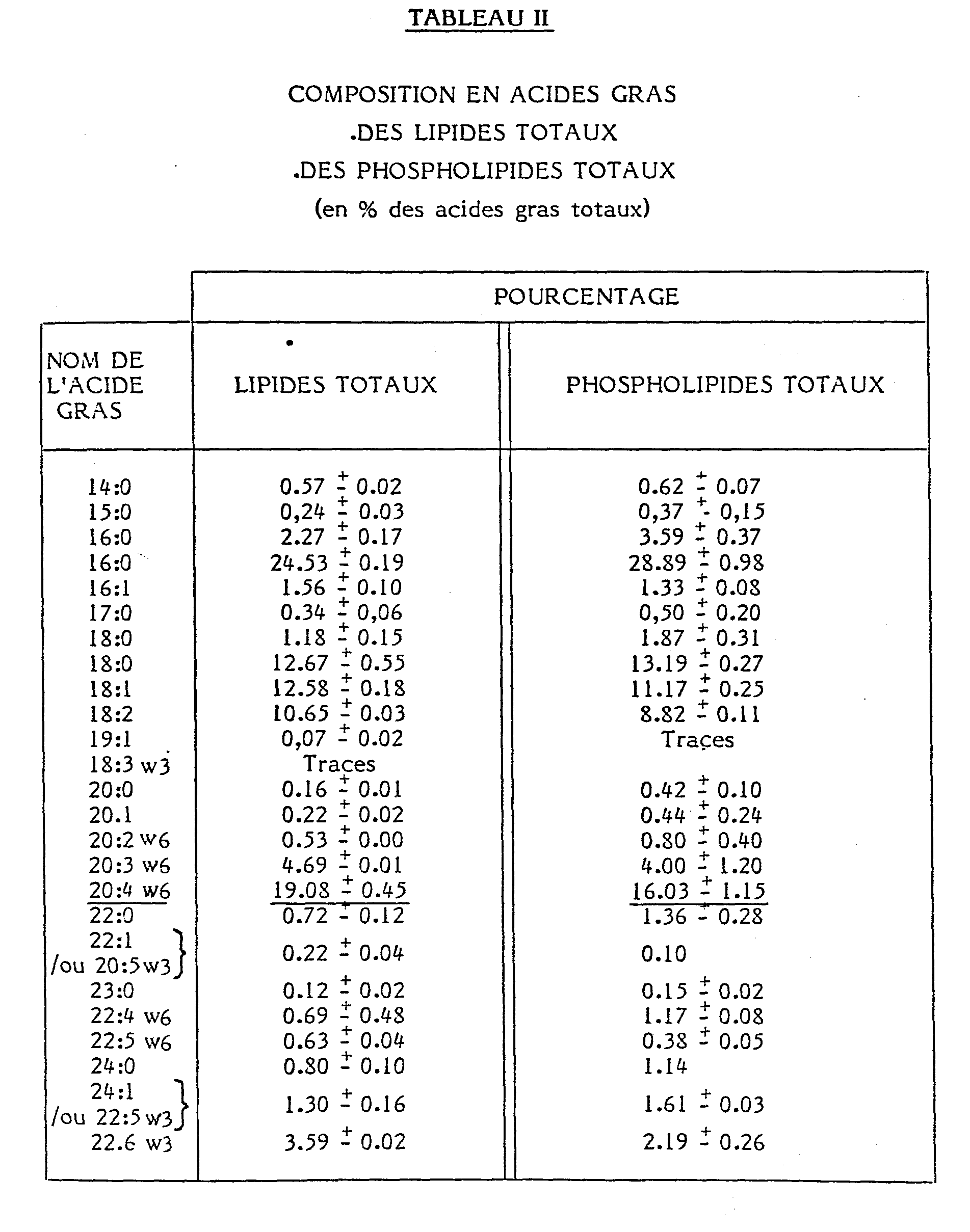
- Tables I and II indicate, respectively, the phospholipid composition of a placenta extract and the fatty acid composition, on the one hand, of total lipids and, on the other hand, of total phospholipids.
- each fatty acid is identified by a complex number, the first element of which denotes the number of C, the second element denotes the number of double bonds, and the third element following the symbol w denotes the position of the first double liaison.
- Arachidonic acid is fatty acid C20: 4w6.
Landscapes
- Life Sciences & Earth Sciences (AREA)
- Chemical & Material Sciences (AREA)
- Engineering & Computer Science (AREA)
- Food Science & Technology (AREA)
- Polymers & Plastics (AREA)
- Biophysics (AREA)
- Oil, Petroleum & Natural Gas (AREA)
- Health & Medical Sciences (AREA)
- Nutrition Science (AREA)
- Medicines Containing Material From Animals Or Micro-Organisms (AREA)
- Dairy Products (AREA)
- Cosmetics (AREA)
Abstract
Description
- La présente invention a pour objet un lait artificiel pour l'alimentation des nouveaux-nés et des nourrissons.
- Les laits artificiels sont utilisés pour réaliser l'alimentation des enfants dans les semaines et les mois qui suivent la naissance, dans la mesure où l'alimentation ne peut pas être réalisée avec le lait maternel.
- Un lait artificiel est obtenu par mélange de protéines, de glucides, de matières grasses, de vitamines et d'apports minéraux, qui doivent s'émulsionner dans l'eau pour donner un lait. Cette émulsification n'est possible qu'en présence d'émulsifiants.
- Il est également connu que les laits artificiels ne contiennent pas certains éléments que contient le lait maternel. Il en est ainsi de l'acide arachidonique. Or, celui-ci n'est pas synthétisé par un enfant dans les semaines qui suivent sa naissance. L'organisme souffre donc d'une carence en acide arachidonique pouvant se traduire par une insuffisance de ce dernier pendant la période d'organogénèse, spécialement pour le système nerveux central.
- Il se pose donc le problème de l'obtention d'acide arachidonique et de son incorporation dans un lait artificiel. Une telle mise en oeuvre n'a jamais été effectuée, compte tenu des difficultés d'obtention d'acide arachidonique à partir des sources connues, telles que foie de porc ou d'autres abats avec tous les inconvénients qui en découlent (circuits de collecte convenant mal aux besoins de l'industrie diététique, traitements risquant d'altérer le produit ou de diminuer sa stabilité, nécessité de poursuivre les purifications jusqu'à obtention d'un acide gras pur...).
- Par ailleurs, il est connu que le placenta contient 2,5 à 3 % d'un mélange lipidique complexe comprenant sensiblement 15 % de cholestérol libre et estérifié, 45 % de phospholipides et 40 % d'acides gras libres, glycérides partiels et triglycérides. Dans ces deux dernières fractions, la proportion d'acide arachidonique est de l'ordre de 16 à 20 %. Le placenta d'origine humaine ou animale constitue donc une source extrêmement riche en acide arachidonique. L'origine humaine du produit est un avantage qui permet de réduire les contrôles visant à vérifier l'absence de composés nocifs, et qui assure une excellente adéquation entre la composition du produit et les besoins du nourrisson.
- La présente invention vise à fournir un lait artificiel pour nouveaux-nés et nourrissons contenant des acides gras polyinsaturés à chaîne longue, supérieure à C18, choisis parmi les acides C20 : 4w6, C20 : 3w6 et C22 : 6w3.
- Avantageusement, les acides gras polyinsaturés à chaîne longue sont contenus dans un extrait lipidique de placenta, et notamment de placenta humain.
- Cet extrait lipidique contient de l'acide arachidonique en position 2, ce qui constitue une caractéristique avantageuse, du fait que les acides gras, situés dans cette position, sont assimilés rapidement.
- En outre, il a été constaté que le pouvoir émulsionnant des lipides du placenta est particulièrement élevé, et qu'il est ainsi possible d'obtenir pour les laits artificiels une émulsion très fine et stable.
- De plus, des expériences de stabilité ont montré la stabilité à l'oxydation de l'acide arachidonique d'origine placentaire pouvant expliquer en partie ce phénomène, en particulier certaines fractions de l'insaponifiable.
- Des indices chimiques (peroxyde et carbonyle) ainsi que physico- chimiques (E y à 232 nm ; E à 270 nm ; E r 303 nm et E pI I 318 nm ; indice d'acide et teneur en C20 : 4 w- 6) ont vérifié la stabilité en fonction du temps.
- Le lait selon l'invention se rapproche donc beaucoup plus du lait maternel que les laits traditionnels, tout en étant plus digeste, compte tenu de la finesse et de la stabilité de l'émulsion sous la forme de laquelle il se présente.
- L'extrait lipidique du placenta est incorporé dans le mélange formant le lait dans des proportions telles que la teneur en acides gras polyinsaturés à chaîne longue (supérieure à C18) représente environ 1 % de la phase lipidique totale.
- Selon une première possibilité, le lait contient la phase lipidique totale extraite du placenta.
- Cette solution est intéressante car fournissant une excellente émulsion et évitant ou réduisant l'ajout d'antioxydants.
- Selon une autre possibilité, le lait contient les seuls phospholipides récupérés à partir de la phase lipidique totale extraite d'un placenta. Ces phospholipides sont obtenus par récupération de la fraction insoluble à l'acétone par extraction à basse température. Si cette opération permet d'éliminer le cholestérol, les acides gras libres et les triglycérides, elle provoque la disparition d'un certain nombre d'antioxydants naturels.
- De ce fait, il est préférable d'ajouter à la phase grasse des antioxydants, notamment ceux choisis dans la fraction insaponifiable des lipides du placenta, tels que des tocophérols, pour améliorer la résistance à l'oxydation.
- Il est à noter que la phase lipidique totale peut être extraite par toute méthode appropriée, telle que la méthode de FOLCH.
- Selon d'autres possibilités, le lait selon l'invention contient les acides gras libres ou les glycérides d'un extrait lipidique de placenta, ou encore un mélange de ces deux éléments ou un mélange de l'un de ces éléments avec les phospholipides d'un extrait de placenta.
- Les tableaux I et II indiquent, respectivement, la composition en phospholipides d'un extrait de placenta et la composition en acides gras, d'une part, des lipides totaux et, d'autre part, des phospholipides totaux.Il est à noter qu'au tableau II, chaque acide gras est identifié par un nombre complexe, dont le premier élément désigne le nombre de C, le second élément désigne le nombre de doubles liaisons, et le troisième élément suivant le symbole w désigne la position de la première double liaison. L'acide arachidonique est l'acide gras en C20 : 4w6.

Claims (9)
Applications Claiming Priority (2)
| Application Number | Priority Date | Filing Date | Title |
|---|---|---|---|
| FR8316664A FR2553261B1 (fr) | 1983-10-14 | 1983-10-14 | Lait artificiel pour l'alimentation des nouveaux-nes et des jeunes enfants |
| FR8316664 | 1983-10-14 |
Publications (3)
| Publication Number | Publication Date |
|---|---|
| EP0140805A2 true EP0140805A2 (fr) | 1985-05-08 |
| EP0140805A3 EP0140805A3 (en) | 1985-06-19 |
| EP0140805B1 EP0140805B1 (fr) | 1988-01-13 |
Family
ID=9293316
Family Applications (1)
| Application Number | Title | Priority Date | Filing Date |
|---|---|---|---|
| EP19840420170 Expired EP0140805B1 (fr) | 1983-10-14 | 1984-10-11 | Lait artificiel pour l'alimentation des nouveaux-nés et des jeunes enfants |
Country Status (6)
| Country | Link |
|---|---|
| EP (1) | EP0140805B1 (fr) |
| DE (1) | DE3468618D1 (fr) |
| DK (1) | DK163859C (fr) |
| FR (1) | FR2553261B1 (fr) |
| GR (1) | GR80632B (fr) |
| IE (1) | IE55645B1 (fr) |
Cited By (4)
| Publication number | Priority date | Publication date | Assignee | Title |
|---|---|---|---|---|
| EP0568608A4 (en) * | 1991-01-24 | 1994-08-24 | Martek Corp | Arachidonic acid and methods for the production and use thereof |
| EP0705539A2 (fr) | 1994-10-06 | 1996-04-10 | Friesland Brands B.V. | Produit alimentaire pour femmes enceintes et allaitantes |
| WO2021058632A1 (fr) | 2019-09-24 | 2021-04-01 | Société des Produits Nestlé SA | Glycyrrhiza et prévention de l'oxydation des lc-pufa |
| WO2021255061A1 (fr) | 2020-06-17 | 2021-12-23 | Société des Produits Nestlé S.A. | Stabilisation de lc-pufa par un produit de soutirage latéral à partir de décaféination de café vert |
Families Citing this family (5)
| Publication number | Priority date | Publication date | Assignee | Title |
|---|---|---|---|---|
| DE3603000A1 (de) * | 1986-01-31 | 1987-08-06 | Milupa Ag | Neue polyensaeure-reiche fettmischung und deren verwendung bei der herstellung von saeuglingsnahrungen |
| DE3920679A1 (de) * | 1989-06-23 | 1991-01-10 | Milupa Ag | Fettmischung zur herstellung von nahrungen, insbesondere saeuglingsnahrungen |
| CA2101274C (fr) * | 1991-01-24 | 1998-12-15 | David J. Kyle | Melanges d'huiles de microorganismes et leurs usages |
| EP0711503A3 (fr) | 1994-11-14 | 1997-11-26 | Scotia Holdings Plc | Lait fortifié avec GLA et/ou DGLA |
| GB9423625D0 (en) | 1994-11-23 | 1995-01-11 | Scotia Holdings Plc | Fortified fruit juice |
Family Cites Families (7)
| Publication number | Priority date | Publication date | Assignee | Title |
|---|---|---|---|---|
| US2611706A (en) * | 1949-12-21 | 1952-09-23 | Wyeth Corp | Fat composition for infants' food |
| GB955347A (en) * | 1962-07-11 | 1964-04-15 | Vaasan Hoeyrymylly Oy | A method of producing a drink for calves |
| US3488198A (en) * | 1967-03-01 | 1970-01-06 | Beatrice Foods Co | Filled milk product |
| BE787961A (fr) * | 1971-08-24 | 1973-02-26 | Behringwerke Ag | Procede d'isolement d'une matiere thromboplastique et medicament contenant ladite matiere |
| FR2197605A1 (en) * | 1972-09-06 | 1974-03-29 | Williams John | Foodstuff or skin nutrient to combat cholesterolaemia - contains arachidonic acid or gamma linolenic acid or esters and salts thereof |
| CH658458A5 (fr) * | 1981-12-17 | 1986-11-14 | Lucchini Lab Sa | Procede pour l'obtention du lacto-n-norhexaosyl ceramide. |
| FR2522935A1 (fr) * | 1982-03-10 | 1983-09-16 | Chevalier Jacques | Nouveaux produits a base de lait et de ses derives riches en acides gras polyinsatures et leur procede de preparation |
-
1983
- 1983-10-14 FR FR8316664A patent/FR2553261B1/fr not_active Expired
-
1984
- 1984-10-11 DE DE8484420170T patent/DE3468618D1/de not_active Expired
- 1984-10-11 EP EP19840420170 patent/EP0140805B1/fr not_active Expired
- 1984-10-12 DK DK491084A patent/DK163859C/da not_active IP Right Cessation
- 1984-10-12 IE IE262984A patent/IE55645B1/en not_active IP Right Cessation
- 1984-10-12 GR GR80632A patent/GR80632B/el unknown
Cited By (6)
| Publication number | Priority date | Publication date | Assignee | Title |
|---|---|---|---|---|
| EP0568608A4 (en) * | 1991-01-24 | 1994-08-24 | Martek Corp | Arachidonic acid and methods for the production and use thereof |
| EP1001034A1 (fr) * | 1991-01-24 | 2000-05-17 | Martek Corporation | Acide arachidonique, ses procédés de production et d'utilisation |
| EP1642983A1 (fr) * | 1991-01-24 | 2006-04-05 | Martek Corporation | Acide arachidonique, ses procédés de production et d'utilisation |
| EP0705539A2 (fr) | 1994-10-06 | 1996-04-10 | Friesland Brands B.V. | Produit alimentaire pour femmes enceintes et allaitantes |
| WO2021058632A1 (fr) | 2019-09-24 | 2021-04-01 | Société des Produits Nestlé SA | Glycyrrhiza et prévention de l'oxydation des lc-pufa |
| WO2021255061A1 (fr) | 2020-06-17 | 2021-12-23 | Société des Produits Nestlé S.A. | Stabilisation de lc-pufa par un produit de soutirage latéral à partir de décaféination de café vert |
Also Published As
| Publication number | Publication date |
|---|---|
| FR2553261B1 (fr) | 1986-02-21 |
| DK491084D0 (da) | 1984-10-12 |
| IE55645B1 (en) | 1990-12-05 |
| GR80632B (en) | 1985-02-13 |
| EP0140805B1 (fr) | 1988-01-13 |
| EP0140805A3 (en) | 1985-06-19 |
| DK163859C (da) | 1992-09-14 |
| DE3468618D1 (en) | 1988-02-18 |
| DK163859B (da) | 1992-04-13 |
| FR2553261A1 (fr) | 1985-04-19 |
| DK491084A (da) | 1985-04-15 |
| IE842629L (en) | 1985-04-14 |
Similar Documents
| Publication | Publication Date | Title |
|---|---|---|
| US4526793A (en) | Lipid composition for oral, enteral or parenteral nutrition | |
| EP0719097B1 (fr) | Nouvelles compositions dietetiques a base de phospholipides et leur utilisation comme complement nutritionnel | |
| Serafini | Dietary vitamin E and T cell-mediated function in the elderly: effectiveness and mechanism of action | |
| MacDonald et al. | Effects of linoleate and arachidonate deficiencies on reproduction and spermatogenesis in the cat | |
| Hamosh | Lipid metabolism in premature infants | |
| US20080226745A1 (en) | Products Containing Highly Unsaturated Fatty Acids for Use by Women During Stages of Preconception, Pregnancy and Lactation/Post-Partum | |
| EP0140805B1 (fr) | Lait artificiel pour l'alimentation des nouveaux-nés et des jeunes enfants | |
| JP2001128642A (ja) | 乳由来のリン脂質を配合した食品組成物。 | |
| Agostoni et al. | Long‐chain polyunsaturated fatty acids in human milk | |
| Lanting et al. | Lipids in infant nutrition and their impact on later development | |
| Beijers et al. | Long-chain polyunsaturated fatty acid content in Dutch preterm breast milk; differences in the concentrations of docosahexaenoic acid and arachidonic acid due to length of gestation | |
| Giovannini et al. | Fatty acid metabolism in phenylketonuria | |
| Bettger et al. | Nervonic acid is transferred from the maternal diet to milk and tissues of suckling rat pups | |
| JP2525624B2 (ja) | 多価不飽和脂肪酸配合育児用粉乳 | |
| Marín et al. | Interrelationship between protein-energy malnutrition and essential fatty acid deficiency in nursing infants | |
| RU2489893C2 (ru) | Композиция на основе лецитина и ее применение в пище | |
| Gurr | Lipid metabolism in man | |
| Sawatzki et al. | Pitfalls in the design and manufacture of infant formulae | |
| EP0465550B1 (fr) | Composition de lipide pharmaceutique pour la nutrition parenterale | |
| Yang et al. | Dietary Echium oil increases tissue (n-3) long-chain polyunsaturated fatty acids without elevating hepatic lipid concentrations in premature neonatal rats | |
| Cunnane et al. | Long chain fatty acids in serum phospholipids in acrodermatitis enteropathica before and after zinc treatment: a case report. | |
| Maki et al. | Bioavailability of eicosapentaenoic and docosahexaenoic n‐3 polyunsaturated fatty acids in salmon patties compared with capsules | |
| Kehrer et al. | Relationship between fatty acids and lipid peroxidation in lungs of neonates | |
| WO2010110649A1 (fr) | Préparation pour nourrisson de 1er âge et 2ème âge | |
| WO2008002116A1 (fr) | Formulation d'une émulsion lipidique à base de l'huile d'argane pour nutrition parentérale |
Legal Events
| Date | Code | Title | Description |
|---|---|---|---|
| PUAI | Public reference made under article 153(3) epc to a published international application that has entered the european phase |
Free format text: ORIGINAL CODE: 0009012 |
|
| PUAL | Search report despatched |
Free format text: ORIGINAL CODE: 0009013 |
|
| AK | Designated contracting states |
Designated state(s): BE DE GB IT NL SE |
|
| AK | Designated contracting states |
Designated state(s): BE DE GB IT NL SE |
|
| 17P | Request for examination filed |
Effective date: 19850829 |
|
| 17Q | First examination report despatched |
Effective date: 19860314 |
|
| ITF | It: translation for a ep patent filed | ||
| GRAA | (expected) grant |
Free format text: ORIGINAL CODE: 0009210 |
|
| AK | Designated contracting states |
Kind code of ref document: B1 Designated state(s): BE DE GB IT NL SE |
|
| REF | Corresponds to: |
Ref document number: 3468618 Country of ref document: DE Date of ref document: 19880218 |
|
| GBT | Gb: translation of ep patent filed (gb section 77(6)(a)/1977) | ||
| PLBE | No opposition filed within time limit |
Free format text: ORIGINAL CODE: 0009261 |
|
| STAA | Information on the status of an ep patent application or granted ep patent |
Free format text: STATUS: NO OPPOSITION FILED WITHIN TIME LIMIT |
|
| 26N | No opposition filed | ||
| ITTA | It: last paid annual fee | ||
| EAL | Se: european patent in force in sweden |
Ref document number: 84420170.7 |
|
| REG | Reference to a national code |
Ref country code: GB Ref legal event code: 732E |
|
| NLS | Nl: assignments of ep-patents |
Owner name: IMEDEX TE CHAPONOST, FRANKRIJK. |
|
| PGFP | Annual fee paid to national office [announced via postgrant information from national office to epo] |
Ref country code: NL Payment date: 19981031 Year of fee payment: 15 |
|
| PGFP | Annual fee paid to national office [announced via postgrant information from national office to epo] |
Ref country code: GB Payment date: 19981103 Year of fee payment: 15 |
|
| PGFP | Annual fee paid to national office [announced via postgrant information from national office to epo] |
Ref country code: BE Payment date: 19981110 Year of fee payment: 15 |
|
| PGFP | Annual fee paid to national office [announced via postgrant information from national office to epo] |
Ref country code: DE Payment date: 19981116 Year of fee payment: 15 |
|
| PGFP | Annual fee paid to national office [announced via postgrant information from national office to epo] |
Ref country code: SE Payment date: 19990129 Year of fee payment: 15 |
|
| PG25 | Lapsed in a contracting state [announced via postgrant information from national office to epo] |
Ref country code: GB Free format text: LAPSE BECAUSE OF NON-PAYMENT OF DUE FEES Effective date: 19991011 |
|
| PG25 | Lapsed in a contracting state [announced via postgrant information from national office to epo] |
Ref country code: SE Free format text: THE PATENT HAS BEEN ANNULLED BY A DECISION OF A NATIONAL AUTHORITY Effective date: 19991030 |
|
| PG25 | Lapsed in a contracting state [announced via postgrant information from national office to epo] |
Ref country code: BE Free format text: LAPSE BECAUSE OF NON-PAYMENT OF DUE FEES Effective date: 19991031 |
|
| BERE | Be: lapsed |
Owner name: IMEDEX Effective date: 19991031 |
|
| PG25 | Lapsed in a contracting state [announced via postgrant information from national office to epo] |
Ref country code: NL Free format text: LAPSE BECAUSE OF NON-PAYMENT OF DUE FEES Effective date: 20000501 |
|
| GBPC | Gb: european patent ceased through non-payment of renewal fee |
Effective date: 19991011 |
|
| EUG | Se: european patent has lapsed |
Ref document number: 84420170.7 |
|
| NLV4 | Nl: lapsed or anulled due to non-payment of the annual fee |
Effective date: 20000501 |
|
| PG25 | Lapsed in a contracting state [announced via postgrant information from national office to epo] |
Ref country code: DE Free format text: LAPSE BECAUSE OF NON-PAYMENT OF DUE FEES Effective date: 20000801 |