EP0141204B1 - Dérivés de hydroxyéthylazoles - Google Patents
Dérivés de hydroxyéthylazoles Download PDFInfo
- Publication number
- EP0141204B1 EP0141204B1 EP84111050A EP84111050A EP0141204B1 EP 0141204 B1 EP0141204 B1 EP 0141204B1 EP 84111050 A EP84111050 A EP 84111050A EP 84111050 A EP84111050 A EP 84111050A EP 0141204 B1 EP0141204 B1 EP 0141204B1
- Authority
- EP
- European Patent Office
- Prior art keywords
- carbon atoms
- alkyl
- halogen
- formula
- optionally substituted
- Prior art date
- Legal status (The legal status is an assumption and is not a legal conclusion. Google has not performed a legal analysis and makes no representation as to the accuracy of the status listed.)
- Expired - Lifetime
Links
- XBVPIPOORLGFGK-UHFFFAOYSA-N 2-(1h-pyrrol-2-yl)ethanol Chemical class OCCC1=CC=CN1 XBVPIPOORLGFGK-UHFFFAOYSA-N 0.000 title claims abstract description 25
- 125000000217 alkyl group Chemical group 0.000 claims abstract description 59
- 150000003839 salts Chemical class 0.000 claims abstract description 33
- 239000002253 acid Substances 0.000 claims abstract description 30
- 229910052751 metal Chemical class 0.000 claims abstract description 19
- 239000002184 metal Chemical class 0.000 claims abstract description 19
- 239000001257 hydrogen Substances 0.000 claims abstract description 12
- 229910052739 hydrogen Inorganic materials 0.000 claims abstract description 12
- 239000001301 oxygen Substances 0.000 claims abstract description 8
- 229910052760 oxygen Inorganic materials 0.000 claims abstract description 8
- 229910052757 nitrogen Inorganic materials 0.000 claims abstract description 7
- 125000004433 nitrogen atom Chemical group N* 0.000 claims abstract description 7
- QVGXLLKOCUKJST-UHFFFAOYSA-N atomic oxygen Chemical compound [O] QVGXLLKOCUKJST-UHFFFAOYSA-N 0.000 claims abstract description 6
- 125000003342 alkenyl group Chemical group 0.000 claims abstract description 5
- 125000004435 hydrogen atom Chemical group [H]* 0.000 claims abstract 6
- 125000004432 carbon atom Chemical group C* 0.000 claims description 82
- 150000001875 compounds Chemical class 0.000 claims description 46
- 238000000034 method Methods 0.000 claims description 44
- 229910052736 halogen Inorganic materials 0.000 claims description 40
- 150000002367 halogens Chemical class 0.000 claims description 40
- -1 trifluoromethoxy, trifluoromethylthio, methoxyiminoethyl Chemical group 0.000 claims description 36
- XLYOFNOQVPJJNP-UHFFFAOYSA-N water Substances O XLYOFNOQVPJJNP-UHFFFAOYSA-N 0.000 claims description 22
- 125000001997 phenyl group Chemical group [H]C1=C([H])C([H])=C(*)C([H])=C1[H] 0.000 claims description 20
- 239000000203 mixture Substances 0.000 claims description 19
- 125000005843 halogen group Chemical group 0.000 claims description 18
- 125000001424 substituent group Chemical group 0.000 claims description 18
- 238000002360 preparation method Methods 0.000 claims description 14
- 239000003960 organic solvent Substances 0.000 claims description 13
- 125000000051 benzyloxy group Chemical group [H]C1=C([H])C([H])=C(C([H])=C1[H])C([H])([H])O* 0.000 claims description 12
- 125000002496 methyl group Chemical group [H]C([H])([H])* 0.000 claims description 12
- 125000003545 alkoxy group Chemical group 0.000 claims description 10
- 239000003085 diluting agent Substances 0.000 claims description 10
- 125000001797 benzyl group Chemical group [H]C1=C([H])C([H])=C(C([H])=C1[H])C([H])([H])* 0.000 claims description 9
- 125000004414 alkyl thio group Chemical group 0.000 claims description 8
- 239000000460 chlorine Substances 0.000 claims description 8
- 229910052801 chlorine Inorganic materials 0.000 claims description 8
- 125000004438 haloalkoxy group Chemical group 0.000 claims description 8
- 125000001188 haloalkyl group Chemical group 0.000 claims description 8
- 125000000449 nitro group Chemical group [O-][N+](*)=O 0.000 claims description 8
- 125000000951 phenoxy group Chemical group [H]C1=C([H])C([H])=C(O*)C([H])=C1[H] 0.000 claims description 8
- ZAMOUSCENKQFHK-UHFFFAOYSA-N Chlorine atom Chemical compound [Cl] ZAMOUSCENKQFHK-UHFFFAOYSA-N 0.000 claims description 7
- 150000002443 hydroxylamines Chemical class 0.000 claims description 7
- 125000001624 naphthyl group Chemical group 0.000 claims description 7
- 150000002924 oxiranes Chemical class 0.000 claims description 7
- DGAQECJNVWCQMB-PUAWFVPOSA-M Ilexoside XXIX Chemical group C[C@@H]1CC[C@@]2(CC[C@@]3(C(=CC[C@H]4[C@]3(CC[C@@H]5[C@@]4(CC[C@@H](C5(C)C)OS(=O)(=O)[O-])C)C)[C@@H]2[C@]1(C)O)C)C(=O)O[C@H]6[C@@H]([C@H]([C@@H]([C@H](O6)CO)O)O)O.[Na+] DGAQECJNVWCQMB-PUAWFVPOSA-M 0.000 claims description 6
- 150000004820 halides Chemical class 0.000 claims description 6
- 125000001495 ethyl group Chemical group [H]C([H])([H])C([H])([H])* 0.000 claims description 5
- 239000000417 fungicide Substances 0.000 claims description 5
- 239000004606 Fillers/Extenders Substances 0.000 claims description 4
- PXGOKWXKJXAPGV-UHFFFAOYSA-N Fluorine Chemical compound FF PXGOKWXKJXAPGV-UHFFFAOYSA-N 0.000 claims description 4
- 150000003851 azoles Chemical class 0.000 claims description 4
- 125000004981 cycloalkylmethyl group Chemical group 0.000 claims description 4
- 125000003884 phenylalkyl group Chemical group 0.000 claims description 4
- 239000011734 sodium Chemical group 0.000 claims description 4
- 229910052708 sodium Inorganic materials 0.000 claims description 4
- 125000000876 trifluoromethoxy group Chemical group FC(F)(F)O* 0.000 claims description 4
- 125000002023 trifluoromethyl group Chemical group FC(F)(F)* 0.000 claims description 4
- 125000003903 2-propenyl group Chemical group [H]C([*])([H])C([H])=C([H])[H] 0.000 claims description 3
- 125000001494 2-propynyl group Chemical group [H]C#CC([H])([H])* 0.000 claims description 3
- ZLMJMSJWJFRBEC-UHFFFAOYSA-N Potassium Chemical group [K] ZLMJMSJWJFRBEC-UHFFFAOYSA-N 0.000 claims description 3
- 125000006193 alkinyl group Chemical group 0.000 claims description 3
- 125000000753 cycloalkyl group Chemical group 0.000 claims description 3
- 229910052731 fluorine Inorganic materials 0.000 claims description 3
- 239000011737 fluorine Substances 0.000 claims description 3
- 125000004108 n-butyl group Chemical group [H]C([H])([H])C([H])([H])C([H])([H])C([H])([H])* 0.000 claims description 3
- 125000004123 n-propyl group Chemical group [H]C([H])([H])C([H])([H])C([H])([H])* 0.000 claims description 3
- ZCYVEMRRCGMTRW-UHFFFAOYSA-N 7553-56-2 Chemical compound [I] ZCYVEMRRCGMTRW-UHFFFAOYSA-N 0.000 claims description 2
- WKBOTKDWSSQWDR-UHFFFAOYSA-N Bromine atom Chemical compound [Br] WKBOTKDWSSQWDR-UHFFFAOYSA-N 0.000 claims description 2
- GDTBXPJZTBHREO-UHFFFAOYSA-N bromine Substances BrBr GDTBXPJZTBHREO-UHFFFAOYSA-N 0.000 claims description 2
- 229910052794 bromium Inorganic materials 0.000 claims description 2
- 125000001309 chloro group Chemical group Cl* 0.000 claims description 2
- 125000004210 cyclohexylmethyl group Chemical group [H]C([H])(*)C1([H])C([H])([H])C([H])([H])C([H])([H])C([H])([H])C1([H])[H] 0.000 claims description 2
- 239000011630 iodine Substances 0.000 claims description 2
- 229910052740 iodine Inorganic materials 0.000 claims description 2
- 125000004430 oxygen atom Chemical group O* 0.000 claims description 2
- 229910052700 potassium Chemical group 0.000 claims description 2
- 239000011591 potassium Chemical group 0.000 claims description 2
- 239000011814 protection agent Substances 0.000 claims description 2
- 239000004094 surface-active agent Substances 0.000 claims description 2
- 241000233866 Fungi Species 0.000 claims 3
- 230000003032 phytopathogenic effect Effects 0.000 claims 2
- WNXJIVFYUVYPPR-UHFFFAOYSA-N 1,3-dioxolane Chemical group C1COCO1 WNXJIVFYUVYPPR-UHFFFAOYSA-N 0.000 claims 1
- 150000007513 acids Chemical class 0.000 abstract description 10
- 230000000855 fungicidal effect Effects 0.000 abstract description 3
- 125000000304 alkynyl group Chemical group 0.000 abstract description 2
- 125000003710 aryl alkyl group Chemical group 0.000 abstract 1
- 125000001316 cycloalkyl alkyl group Chemical group 0.000 abstract 1
- 125000003107 substituted aryl group Chemical group 0.000 abstract 1
- RTZKZFJDLAIYFH-UHFFFAOYSA-N Diethyl ether Chemical compound CCOCC RTZKZFJDLAIYFH-UHFFFAOYSA-N 0.000 description 29
- YMWUJEATGCHHMB-UHFFFAOYSA-N Dichloromethane Chemical compound ClCCl YMWUJEATGCHHMB-UHFFFAOYSA-N 0.000 description 24
- LFQSCWFLJHTTHZ-UHFFFAOYSA-N Ethanol Chemical compound CCO LFQSCWFLJHTTHZ-UHFFFAOYSA-N 0.000 description 19
- YXFVVABEGXRONW-UHFFFAOYSA-N Toluene Chemical compound CC1=CC=CC=C1 YXFVVABEGXRONW-UHFFFAOYSA-N 0.000 description 17
- ZMXDDKWLCZADIW-UHFFFAOYSA-N N,N-Dimethylformamide Chemical compound CN(C)C=O ZMXDDKWLCZADIW-UHFFFAOYSA-N 0.000 description 15
- 239000002904 solvent Substances 0.000 description 14
- 241000196324 Embryophyta Species 0.000 description 12
- VEXZGXHMUGYJMC-UHFFFAOYSA-N Hydrochloric acid Chemical compound Cl VEXZGXHMUGYJMC-UHFFFAOYSA-N 0.000 description 12
- 239000002585 base Substances 0.000 description 11
- HEMHJVSKTPXQMS-UHFFFAOYSA-M sodium hydroxide Inorganic materials [OH-].[Na+] HEMHJVSKTPXQMS-UHFFFAOYSA-M 0.000 description 11
- 239000007858 starting material Substances 0.000 description 11
- 239000000243 solution Substances 0.000 description 10
- XEKOWRVHYACXOJ-UHFFFAOYSA-N Ethyl acetate Chemical compound CCOC(C)=O XEKOWRVHYACXOJ-UHFFFAOYSA-N 0.000 description 9
- 239000000126 substance Substances 0.000 description 9
- JOXIMZWYDAKGHI-UHFFFAOYSA-N toluene-4-sulfonic acid Chemical compound CC1=CC=C(S(O)(=O)=O)C=C1 JOXIMZWYDAKGHI-UHFFFAOYSA-N 0.000 description 9
- IAZDPXIOMUYVGZ-UHFFFAOYSA-N Dimethylsulphoxide Chemical compound CS(C)=O IAZDPXIOMUYVGZ-UHFFFAOYSA-N 0.000 description 8
- LYCAIKOWRPUZTN-UHFFFAOYSA-N Ethylene glycol Chemical compound OCCO LYCAIKOWRPUZTN-UHFFFAOYSA-N 0.000 description 8
- KWYUFKZDYYNOTN-UHFFFAOYSA-M Potassium hydroxide Chemical compound [OH-].[K+] KWYUFKZDYYNOTN-UHFFFAOYSA-M 0.000 description 8
- 238000009472 formulation Methods 0.000 description 8
- 239000000843 powder Substances 0.000 description 8
- QTBSBXVTEAMEQO-UHFFFAOYSA-N Acetic acid Chemical compound CC(O)=O QTBSBXVTEAMEQO-UHFFFAOYSA-N 0.000 description 7
- WEVYAHXRMPXWCK-UHFFFAOYSA-N Acetonitrile Chemical compound CC#N WEVYAHXRMPXWCK-UHFFFAOYSA-N 0.000 description 7
- 239000003995 emulsifying agent Substances 0.000 description 7
- 239000012074 organic phase Substances 0.000 description 7
- ZWEHNKRNPOVVGH-UHFFFAOYSA-N 2-Butanone Chemical compound CCC(C)=O ZWEHNKRNPOVVGH-UHFFFAOYSA-N 0.000 description 6
- CSCPPACGZOOCGX-UHFFFAOYSA-N Acetone Chemical compound CC(C)=O CSCPPACGZOOCGX-UHFFFAOYSA-N 0.000 description 6
- UHOVQNZJYSORNB-UHFFFAOYSA-N Benzene Chemical compound C1=CC=CC=C1 UHOVQNZJYSORNB-UHFFFAOYSA-N 0.000 description 6
- VQTUBCCKSQIDNK-UHFFFAOYSA-N Isobutene Chemical compound CC(C)=C VQTUBCCKSQIDNK-UHFFFAOYSA-N 0.000 description 6
- 239000008187 granular material Substances 0.000 description 6
- 150000002431 hydrogen Chemical class 0.000 description 6
- PMZURENOXWZQFD-UHFFFAOYSA-L Sodium Sulfate Chemical compound [Na+].[Na+].[O-]S([O-])(=O)=O PMZURENOXWZQFD-UHFFFAOYSA-L 0.000 description 5
- 239000004480 active ingredient Substances 0.000 description 5
- 150000001298 alcohols Chemical class 0.000 description 5
- 229960004132 diethyl ether Drugs 0.000 description 5
- 229940052303 ethers for general anesthesia Drugs 0.000 description 5
- 150000002576 ketones Chemical class 0.000 description 5
- 238000002844 melting Methods 0.000 description 5
- 230000008018 melting Effects 0.000 description 5
- 239000011541 reaction mixture Substances 0.000 description 5
- 238000010992 reflux Methods 0.000 description 5
- 229910052938 sodium sulfate Inorganic materials 0.000 description 5
- 235000011152 sodium sulphate Nutrition 0.000 description 5
- 239000000725 suspension Substances 0.000 description 5
- KDGXBQDTTZAZND-UHFFFAOYSA-N 3-hydroxy-3-(imidazol-1-ylmethyl)-2,2-dimethyl-4-naphthalen-1-yloxybutanal Chemical compound C=1C=CC2=CC=CC=C2C=1OCC(O)(C(C)(C=O)C)CN1C=CN=C1 KDGXBQDTTZAZND-UHFFFAOYSA-N 0.000 description 4
- IAYPIBMASNFSPL-UHFFFAOYSA-N Ethylene oxide Chemical compound C1CO1 IAYPIBMASNFSPL-UHFFFAOYSA-N 0.000 description 4
- UFHFLCQGNIYNRP-UHFFFAOYSA-N Hydrogen Chemical compound [H][H] UFHFLCQGNIYNRP-UHFFFAOYSA-N 0.000 description 4
- XEEYBQQBJWHFJM-UHFFFAOYSA-N Iron Chemical compound [Fe] XEEYBQQBJWHFJM-UHFFFAOYSA-N 0.000 description 4
- LRHPLDYGYMQRHN-UHFFFAOYSA-N N-Butanol Chemical compound CCCCO LRHPLDYGYMQRHN-UHFFFAOYSA-N 0.000 description 4
- NBIIXXVUZAFLBC-UHFFFAOYSA-N Phosphoric acid Chemical compound OP(O)(O)=O NBIIXXVUZAFLBC-UHFFFAOYSA-N 0.000 description 4
- UIIMBOGNXHQVGW-UHFFFAOYSA-M Sodium bicarbonate Chemical compound [Na+].OC([O-])=O UIIMBOGNXHQVGW-UHFFFAOYSA-M 0.000 description 4
- QAOWNCQODCNURD-UHFFFAOYSA-N Sulfuric acid Chemical compound OS(O)(=O)=O QAOWNCQODCNURD-UHFFFAOYSA-N 0.000 description 4
- WYURNTSHIVDZCO-UHFFFAOYSA-N Tetrahydrofuran Chemical compound C1CCOC1 WYURNTSHIVDZCO-UHFFFAOYSA-N 0.000 description 4
- 125000003172 aldehyde group Chemical group 0.000 description 4
- 238000009835 boiling Methods 0.000 description 4
- 239000000969 carrier Substances 0.000 description 4
- 229960001760 dimethyl sulfoxide Drugs 0.000 description 4
- 150000002170 ethers Chemical class 0.000 description 4
- 239000003208 petroleum Substances 0.000 description 4
- 238000005554 pickling Methods 0.000 description 4
- BWHMMNNQKKPAPP-UHFFFAOYSA-L potassium carbonate Chemical compound [K+].[K+].[O-]C([O-])=O BWHMMNNQKKPAPP-UHFFFAOYSA-L 0.000 description 4
- 239000000047 product Substances 0.000 description 4
- 230000001681 protective effect Effects 0.000 description 4
- VYPSYNLAJGMNEJ-UHFFFAOYSA-N silicon dioxide Inorganic materials O=[Si]=O VYPSYNLAJGMNEJ-UHFFFAOYSA-N 0.000 description 4
- 238000005507 spraying Methods 0.000 description 4
- 241000190150 Bipolaris sorokiniana Species 0.000 description 3
- KEAYESYHFKHZAL-UHFFFAOYSA-N Sodium Chemical compound [Na] KEAYESYHFKHZAL-UHFFFAOYSA-N 0.000 description 3
- ZMANZCXQSJIPKH-UHFFFAOYSA-N Triethylamine Chemical compound CCN(CC)CC ZMANZCXQSJIPKH-UHFFFAOYSA-N 0.000 description 3
- DHKHKXVYLBGOIT-UHFFFAOYSA-N acetaldehyde Diethyl Acetal Natural products CCOC(C)OCC DHKHKXVYLBGOIT-UHFFFAOYSA-N 0.000 description 3
- 239000003513 alkali Substances 0.000 description 3
- 125000002877 alkyl aryl group Chemical group 0.000 description 3
- 239000007795 chemical reaction product Substances 0.000 description 3
- 239000003795 chemical substances by application Substances 0.000 description 3
- KRKNYBCHXYNGOX-UHFFFAOYSA-N citric acid Chemical compound OC(=O)CC(O)(C(O)=O)CC(O)=O KRKNYBCHXYNGOX-UHFFFAOYSA-N 0.000 description 3
- 239000012141 concentrate Substances 0.000 description 3
- 239000000839 emulsion Substances 0.000 description 3
- RAXXELZNTBOGNW-UHFFFAOYSA-N imidazole Natural products C1=CNC=N1 RAXXELZNTBOGNW-UHFFFAOYSA-N 0.000 description 3
- 239000007788 liquid Substances 0.000 description 3
- 239000012071 phase Substances 0.000 description 3
- 229920000151 polyglycol Polymers 0.000 description 3
- 239000010695 polyglycol Substances 0.000 description 3
- 150000003254 radicals Chemical class 0.000 description 3
- 239000011435 rock Substances 0.000 description 3
- 239000002689 soil Substances 0.000 description 3
- 239000007787 solid Substances 0.000 description 3
- RYHBNJHYFVUHQT-UHFFFAOYSA-N 1,4-Dioxane Chemical compound C1COCCO1 RYHBNJHYFVUHQT-UHFFFAOYSA-N 0.000 description 2
- ZVJHJDDKYZXRJI-UHFFFAOYSA-N 1-Pyrroline Chemical compound C1CC=NC1 ZVJHJDDKYZXRJI-UHFFFAOYSA-N 0.000 description 2
- CURJJLPKEDNNJU-UHFFFAOYSA-N 1-chloro-3-(1,3-dioxolan-2-yl)-3-methylbutan-2-one Chemical compound ClCC(=O)C(C)(C)C1OCCO1 CURJJLPKEDNNJU-UHFFFAOYSA-N 0.000 description 2
- KJCVRFUGPWSIIH-UHFFFAOYSA-N 1-naphthol Chemical compound C1=CC=C2C(O)=CC=CC2=C1 KJCVRFUGPWSIIH-UHFFFAOYSA-N 0.000 description 2
- BTANRVKWQNVYAZ-UHFFFAOYSA-N 2-butanol Substances CCC(C)O BTANRVKWQNVYAZ-UHFFFAOYSA-N 0.000 description 2
- BMYNFMYTOJXKLE-UHFFFAOYSA-N 3-azaniumyl-2-hydroxypropanoate Chemical compound NCC(O)C(O)=O BMYNFMYTOJXKLE-UHFFFAOYSA-N 0.000 description 2
- NEZXFJMPFBOXBA-UHFFFAOYSA-N 4-chloro-2,2-dimethyl-3-oxobutanal Chemical compound O=CC(C)(C)C(=O)CCl NEZXFJMPFBOXBA-UHFFFAOYSA-N 0.000 description 2
- CURLTUGMZLYLDI-UHFFFAOYSA-N Carbon dioxide Chemical compound O=C=O CURLTUGMZLYLDI-UHFFFAOYSA-N 0.000 description 2
- BVKZGUZCCUSVTD-UHFFFAOYSA-L Carbonate Chemical compound [O-]C([O-])=O BVKZGUZCCUSVTD-UHFFFAOYSA-L 0.000 description 2
- HEDRZPFGACZZDS-UHFFFAOYSA-N Chloroform Chemical compound ClC(Cl)Cl HEDRZPFGACZZDS-UHFFFAOYSA-N 0.000 description 2
- RYGMFSIKBFXOCR-UHFFFAOYSA-N Copper Chemical class [Cu] RYGMFSIKBFXOCR-UHFFFAOYSA-N 0.000 description 2
- MYMOFIZGZYHOMD-UHFFFAOYSA-N Dioxygen Chemical compound O=O MYMOFIZGZYHOMD-UHFFFAOYSA-N 0.000 description 2
- VZCYOOQTPOCHFL-OWOJBTEDSA-N Fumaric acid Chemical compound OC(=O)\C=C\C(O)=O VZCYOOQTPOCHFL-OWOJBTEDSA-N 0.000 description 2
- 240000005979 Hordeum vulgare Species 0.000 description 2
- 235000007340 Hordeum vulgare Nutrition 0.000 description 2
- UQSXHKLRYXJYBZ-UHFFFAOYSA-N Iron oxide Chemical compound [Fe]=O UQSXHKLRYXJYBZ-UHFFFAOYSA-N 0.000 description 2
- PXHVJJICTQNCMI-UHFFFAOYSA-N Nickel Chemical compound [Ni] PXHVJJICTQNCMI-UHFFFAOYSA-N 0.000 description 2
- GRYLNZFGIOXLOG-UHFFFAOYSA-N Nitric acid Chemical compound O[N+]([O-])=O GRYLNZFGIOXLOG-UHFFFAOYSA-N 0.000 description 2
- 229920003171 Poly (ethylene oxide) Polymers 0.000 description 2
- ATUOYWHBWRKTHZ-UHFFFAOYSA-N Propane Chemical compound CCC ATUOYWHBWRKTHZ-UHFFFAOYSA-N 0.000 description 2
- KAESVJOAVNADME-UHFFFAOYSA-N Pyrrole Chemical compound C=1C=CNC=1 KAESVJOAVNADME-UHFFFAOYSA-N 0.000 description 2
- VMHLLURERBWHNL-UHFFFAOYSA-M Sodium acetate Chemical compound [Na+].CC([O-])=O VMHLLURERBWHNL-UHFFFAOYSA-M 0.000 description 2
- WQDUMFSSJAZKTM-UHFFFAOYSA-N Sodium methoxide Chemical compound [Na+].[O-]C WQDUMFSSJAZKTM-UHFFFAOYSA-N 0.000 description 2
- 241000228452 Venturia inaequalis Species 0.000 description 2
- HCHKCACWOHOZIP-UHFFFAOYSA-N Zinc Chemical class [Zn] HCHKCACWOHOZIP-UHFFFAOYSA-N 0.000 description 2
- 229960000583 acetic acid Drugs 0.000 description 2
- 150000001338 aliphatic hydrocarbons Chemical class 0.000 description 2
- 229910000147 aluminium phosphate Inorganic materials 0.000 description 2
- 150000001408 amides Chemical class 0.000 description 2
- 150000004945 aromatic hydrocarbons Chemical class 0.000 description 2
- 150000004649 carbonic acid derivatives Chemical class 0.000 description 2
- 150000001805 chlorine compounds Chemical class 0.000 description 2
- 229910052802 copper Inorganic materials 0.000 description 2
- 239000010949 copper Substances 0.000 description 2
- JHIVVAPYMSGYDF-UHFFFAOYSA-N cyclohexanone Chemical compound O=C1CCCCC1 JHIVVAPYMSGYDF-UHFFFAOYSA-N 0.000 description 2
- 238000001212 derivatisation Methods 0.000 description 2
- 239000002270 dispersing agent Substances 0.000 description 2
- 239000000975 dye Substances 0.000 description 2
- 150000002148 esters Chemical class 0.000 description 2
- 238000011156 evaluation Methods 0.000 description 2
- 238000001914 filtration Methods 0.000 description 2
- 125000004995 haloalkylthio group Chemical group 0.000 description 2
- 125000000623 heterocyclic group Chemical group 0.000 description 2
- 150000004678 hydrides Chemical class 0.000 description 2
- XLYOFNOQVPJJNP-UHFFFAOYSA-M hydroxide Chemical compound [OH-] XLYOFNOQVPJJNP-UHFFFAOYSA-M 0.000 description 2
- 238000011534 incubation Methods 0.000 description 2
- 238000011081 inoculation Methods 0.000 description 2
- 229910052742 iron Inorganic materials 0.000 description 2
- 125000000468 ketone group Chemical group 0.000 description 2
- JVTAAEKCZFNVCJ-UHFFFAOYSA-N lactic acid Chemical compound CC(O)C(O)=O JVTAAEKCZFNVCJ-UHFFFAOYSA-N 0.000 description 2
- WPBNNNQJVZRUHP-UHFFFAOYSA-L manganese(2+);methyl n-[[2-(methoxycarbonylcarbamothioylamino)phenyl]carbamothioyl]carbamate;n-[2-(sulfidocarbothioylamino)ethyl]carbamodithioate Chemical class [Mn+2].[S-]C(=S)NCCNC([S-])=S.COC(=O)NC(=S)NC1=CC=CC=C1NC(=S)NC(=O)OC WPBNNNQJVZRUHP-UHFFFAOYSA-L 0.000 description 2
- 238000004519 manufacturing process Methods 0.000 description 2
- 150000002739 metals Chemical class 0.000 description 2
- ANXKZXRDXAZQJT-UHFFFAOYSA-M methyl sulfate;trimethylsulfanium Chemical compound C[S+](C)C.COS([O-])(=O)=O ANXKZXRDXAZQJT-UHFFFAOYSA-M 0.000 description 2
- XTEGVFVZDVNBPF-UHFFFAOYSA-N naphthalene-1,5-disulfonic acid Chemical compound C1=CC=C2C(S(=O)(=O)O)=CC=CC2=C1S(O)(=O)=O XTEGVFVZDVNBPF-UHFFFAOYSA-N 0.000 description 2
- 229910017604 nitric acid Inorganic materials 0.000 description 2
- 235000015097 nutrients Nutrition 0.000 description 2
- 239000006072 paste Substances 0.000 description 2
- 229910000027 potassium carbonate Inorganic materials 0.000 description 2
- YGSDEFSMJLZEOE-UHFFFAOYSA-N salicylic acid Chemical compound OC(=O)C1=CC=CC=C1O YGSDEFSMJLZEOE-UHFFFAOYSA-N 0.000 description 2
- 239000001632 sodium acetate Substances 0.000 description 2
- 235000017281 sodium acetate Nutrition 0.000 description 2
- 229910000030 sodium bicarbonate Inorganic materials 0.000 description 2
- 235000017557 sodium bicarbonate Nutrition 0.000 description 2
- VZGDMQKNWNREIO-UHFFFAOYSA-N tetrachloromethane Chemical compound ClC(Cl)(Cl)Cl VZGDMQKNWNREIO-UHFFFAOYSA-N 0.000 description 2
- YLQBMQCUIZJEEH-UHFFFAOYSA-N tetrahydrofuran Natural products C=1C=COC=1 YLQBMQCUIZJEEH-UHFFFAOYSA-N 0.000 description 2
- WGTYBPLFGIVFAS-UHFFFAOYSA-M tetramethylammonium hydroxide Chemical compound [OH-].C[N+](C)(C)C WGTYBPLFGIVFAS-UHFFFAOYSA-M 0.000 description 2
- VZCYOOQTPOCHFL-UHFFFAOYSA-N trans-butenedioic acid Natural products OC(=O)C=CC(O)=O VZCYOOQTPOCHFL-UHFFFAOYSA-N 0.000 description 2
- 239000011701 zinc Chemical class 0.000 description 2
- 229910052725 zinc Inorganic materials 0.000 description 2
- UXDTWDWFJVQZSB-UHFFFAOYSA-N 1-(2,4-dichlorophenoxy)-3,3-dimethyl-2-(1,2,4-triazol-1-ylmethyl)butan-2-ol Chemical compound C1=NC=NN1CC(O)(C(C)(C)C)COC1=CC=C(Cl)C=C1Cl UXDTWDWFJVQZSB-UHFFFAOYSA-N 0.000 description 1
- RSEBXXFIDLKVNX-UHFFFAOYSA-N 1-(4-chlorophenoxy)-2-imidazol-1-yl-3,3-dimethylbutan-2-ol Chemical compound C1=CN=CN1C(O)(C(C)(C)C)COC1=CC=C(Cl)C=C1 RSEBXXFIDLKVNX-UHFFFAOYSA-N 0.000 description 1
- PPHAIBNIEHPNIC-UHFFFAOYSA-N 1-(4-chlorophenoxy)-3-(1,3-dioxolan-2-yl)-3-methyl-2-(1,2,4-triazol-1-ylmethyl)butan-2-ol Chemical compound C=1C=C(Cl)C=CC=1OCC(O)(CN1N=CN=C1)C(C)(C)C1OCCO1 PPHAIBNIEHPNIC-UHFFFAOYSA-N 0.000 description 1
- JQZAEUFPPSRDOP-UHFFFAOYSA-N 1-chloro-4-(chloromethyl)benzene Chemical compound ClCC1=CC=C(Cl)C=C1 JQZAEUFPPSRDOP-UHFFFAOYSA-N 0.000 description 1
- GSSWPMYSEDCKMF-UHFFFAOYSA-N 1-imidazol-1-ylbutan-2-ol Chemical compound CCC(O)CN1C=CN=C1 GSSWPMYSEDCKMF-UHFFFAOYSA-N 0.000 description 1
- 125000004201 2,4-dichlorophenyl group Chemical group [H]C1=C([H])C(*)=C(Cl)C([H])=C1Cl 0.000 description 1
- XNWFRZJHXBZDAG-UHFFFAOYSA-N 2-METHOXYETHANOL Chemical compound COCCO XNWFRZJHXBZDAG-UHFFFAOYSA-N 0.000 description 1
- MMPYORUIGBSWJP-UHFFFAOYSA-N 2-[2-[2-(naphthalen-1-yloxymethyl)oxiran-2-yl]propan-2-yl]-1,3-dioxolane Chemical compound C1OC1(COC=1C2=CC=CC=C2C=CC=1)C(C)(C)C1OCCO1 MMPYORUIGBSWJP-UHFFFAOYSA-N 0.000 description 1
- ZFFBIQMNKOJDJE-UHFFFAOYSA-N 2-bromo-1,2-diphenylethanone Chemical compound C=1C=CC=CC=1C(Br)C(=O)C1=CC=CC=C1 ZFFBIQMNKOJDJE-UHFFFAOYSA-N 0.000 description 1
- QIUZZYJTTVIHRF-UHFFFAOYSA-N 3-(1,3-dioxolan-2-yl)-1-imidazol-1-yl-3-methyl-2-(naphthalen-1-yloxymethyl)butan-2-ol Chemical compound C=1C=CC2=CC=CC=C2C=1OCC(O)(CN1C=NC=C1)C(C)(C)C1OCCO1 QIUZZYJTTVIHRF-UHFFFAOYSA-N 0.000 description 1
- HHSDGUPTGSOHJO-UHFFFAOYSA-N 3-[(4-chlorophenoxy)methyl]-3-hydroxy-2,2-dimethyl-4-(1,2,4-triazol-1-yl)butanal Chemical compound C1=NC=NN1CC(O)(C(C)(C=O)C)COC1=CC=C(Cl)C=C1 HHSDGUPTGSOHJO-UHFFFAOYSA-N 0.000 description 1
- NSPMIYGKQJPBQR-UHFFFAOYSA-N 4H-1,2,4-triazole Chemical compound C=1N=CNN=1 NSPMIYGKQJPBQR-UHFFFAOYSA-N 0.000 description 1
- 244000215068 Acacia senegal Species 0.000 description 1
- RGCKGOZRHPZPFP-UHFFFAOYSA-N Alizarin Natural products C1=CC=C2C(=O)C3=C(O)C(O)=CC=C3C(=O)C2=C1 RGCKGOZRHPZPFP-UHFFFAOYSA-N 0.000 description 1
- QGZKDVFQNNGYKY-UHFFFAOYSA-O Ammonium Chemical compound [NH4+] QGZKDVFQNNGYKY-UHFFFAOYSA-O 0.000 description 1
- 241000235349 Ascomycota Species 0.000 description 1
- IJGRMHOSHXDMSA-UHFFFAOYSA-N Atomic nitrogen Chemical compound N#N IJGRMHOSHXDMSA-UHFFFAOYSA-N 0.000 description 1
- 241000221198 Basidiomycota Species 0.000 description 1
- ZOXJGFHDIHLPTG-UHFFFAOYSA-N Boron Chemical compound [B] ZOXJGFHDIHLPTG-UHFFFAOYSA-N 0.000 description 1
- 0 CC(C)([C@](C)(*N1*CNC1)N=O)C=* Chemical compound CC(C)([C@](C)(*N1*CNC1)N=O)C=* 0.000 description 1
- GAWIXWVDTYZWAW-UHFFFAOYSA-N C[CH]O Chemical group C[CH]O GAWIXWVDTYZWAW-UHFFFAOYSA-N 0.000 description 1
- 229910021532 Calcite Inorganic materials 0.000 description 1
- 229920002134 Carboxymethyl cellulose Polymers 0.000 description 1
- VGCXGMAHQTYDJK-UHFFFAOYSA-N Chloroacetyl chloride Chemical compound ClCC(Cl)=O VGCXGMAHQTYDJK-UHFFFAOYSA-N 0.000 description 1
- 241000760356 Chytridiomycetes Species 0.000 description 1
- 244000060011 Cocos nucifera Species 0.000 description 1
- 235000013162 Cocos nucifera Nutrition 0.000 description 1
- XDTMQSROBMDMFD-UHFFFAOYSA-N Cyclohexane Chemical compound C1CCCCC1 XDTMQSROBMDMFD-UHFFFAOYSA-N 0.000 description 1
- FEWJPZIEWOKRBE-JCYAYHJZSA-N Dextrotartaric acid Chemical compound OC(=O)[C@H](O)[C@@H](O)C(O)=O FEWJPZIEWOKRBE-JCYAYHJZSA-N 0.000 description 1
- ZAFNJMIOTHYJRJ-UHFFFAOYSA-N Diisopropyl ether Chemical compound CC(C)OC(C)C ZAFNJMIOTHYJRJ-UHFFFAOYSA-N 0.000 description 1
- 241000221785 Erysiphales Species 0.000 description 1
- 229920000084 Gum arabic Polymers 0.000 description 1
- 229930194542 Keto Natural products 0.000 description 1
- 239000005909 Kieselgur Substances 0.000 description 1
- 241001330975 Magnaporthe oryzae Species 0.000 description 1
- FYYHWMGAXLPEAU-UHFFFAOYSA-N Magnesium Chemical compound [Mg] FYYHWMGAXLPEAU-UHFFFAOYSA-N 0.000 description 1
- NTIZESTWPVYFNL-UHFFFAOYSA-N Methyl isobutyl ketone Chemical compound CC(C)CC(C)=O NTIZESTWPVYFNL-UHFFFAOYSA-N 0.000 description 1
- UIHCLUNTQKBZGK-UHFFFAOYSA-N Methyl isobutyl ketone Natural products CCC(C)C(C)=O UIHCLUNTQKBZGK-UHFFFAOYSA-N 0.000 description 1
- ZOKXTWBITQBERF-UHFFFAOYSA-N Molybdenum Chemical compound [Mo] ZOKXTWBITQBERF-UHFFFAOYSA-N 0.000 description 1
- 244000061176 Nicotiana tabacum Species 0.000 description 1
- 235000002637 Nicotiana tabacum Nutrition 0.000 description 1
- CTQNGGLPUBDAKN-UHFFFAOYSA-N O-Xylene Chemical compound CC1=CC=CC=C1C CTQNGGLPUBDAKN-UHFFFAOYSA-N 0.000 description 1
- 241000233654 Oomycetes Species 0.000 description 1
- 240000007594 Oryza sativa Species 0.000 description 1
- 235000007164 Oryza sativa Nutrition 0.000 description 1
- 241000736122 Parastagonospora nodorum Species 0.000 description 1
- 241001503460 Plasmodiophorida Species 0.000 description 1
- 239000004372 Polyvinyl alcohol Substances 0.000 description 1
- OFOBLEOULBTSOW-UHFFFAOYSA-N Propanedioic acid Natural products OC(=O)CC(O)=O OFOBLEOULBTSOW-UHFFFAOYSA-N 0.000 description 1
- 241000520648 Pyrenophora teres Species 0.000 description 1
- 206010039509 Scab Diseases 0.000 description 1
- 239000004113 Sepiolite Substances 0.000 description 1
- KDYFGRWQOYBRFD-UHFFFAOYSA-N Succinic acid Natural products OC(=O)CCC(O)=O KDYFGRWQOYBRFD-UHFFFAOYSA-N 0.000 description 1
- LSNNMFCWUKXFEE-UHFFFAOYSA-N Sulfurous acid Chemical compound OS(O)=O LSNNMFCWUKXFEE-UHFFFAOYSA-N 0.000 description 1
- FEWJPZIEWOKRBE-UHFFFAOYSA-N Tartaric acid Natural products [H+].[H+].[O-]C(=O)C(O)C(O)C([O-])=O FEWJPZIEWOKRBE-UHFFFAOYSA-N 0.000 description 1
- ATJFFYVFTNAWJD-UHFFFAOYSA-N Tin Chemical compound [Sn] ATJFFYVFTNAWJD-UHFFFAOYSA-N 0.000 description 1
- GWEVSGVZZGPLCZ-UHFFFAOYSA-N Titan oxide Chemical compound O=[Ti]=O GWEVSGVZZGPLCZ-UHFFFAOYSA-N 0.000 description 1
- 241000317942 Venturia <ichneumonid wasp> Species 0.000 description 1
- BZHJMEDXRYGGRV-UHFFFAOYSA-N Vinyl chloride Chemical class ClC=C BZHJMEDXRYGGRV-UHFFFAOYSA-N 0.000 description 1
- 240000008042 Zea mays Species 0.000 description 1
- 235000005824 Zea mays ssp. parviglumis Nutrition 0.000 description 1
- 235000002017 Zea mays subsp mays Nutrition 0.000 description 1
- CIUQDSCDWFSTQR-UHFFFAOYSA-N [C]1=CC=CC=C1 Chemical compound [C]1=CC=CC=C1 CIUQDSCDWFSTQR-UHFFFAOYSA-N 0.000 description 1
- 239000000205 acacia gum Substances 0.000 description 1
- 235000010489 acacia gum Nutrition 0.000 description 1
- 230000000895 acaricidal effect Effects 0.000 description 1
- 239000000642 acaricide Substances 0.000 description 1
- 239000000654 additive Substances 0.000 description 1
- 239000000853 adhesive Substances 0.000 description 1
- 230000001070 adhesive effect Effects 0.000 description 1
- 239000000443 aerosol Substances 0.000 description 1
- HFVAFDPGUJEFBQ-UHFFFAOYSA-M alizarin red S Chemical compound [Na+].O=C1C2=CC=CC=C2C(=O)C2=C1C=C(S([O-])(=O)=O)C(O)=C2O HFVAFDPGUJEFBQ-UHFFFAOYSA-M 0.000 description 1
- 229910001854 alkali hydroxide Inorganic materials 0.000 description 1
- 229910052783 alkali metal Inorganic materials 0.000 description 1
- 150000008044 alkali metal hydroxides Chemical class 0.000 description 1
- 150000003973 alkyl amines Chemical group 0.000 description 1
- 150000008055 alkyl aryl sulfonates Chemical class 0.000 description 1
- 150000008051 alkyl sulfates Chemical class 0.000 description 1
- 229940045714 alkyl sulfonate alkylating agent Drugs 0.000 description 1
- 150000008052 alkyl sulfonates Chemical class 0.000 description 1
- 235000012211 aluminium silicate Nutrition 0.000 description 1
- 235000011114 ammonium hydroxide Nutrition 0.000 description 1
- 125000000129 anionic group Chemical group 0.000 description 1
- 150000001450 anions Chemical class 0.000 description 1
- 230000000844 anti-bacterial effect Effects 0.000 description 1
- 150000003974 aralkylamines Chemical class 0.000 description 1
- 229960000892 attapulgite Drugs 0.000 description 1
- 239000003899 bactericide agent Substances 0.000 description 1
- NDKBVBUGCNGSJJ-UHFFFAOYSA-M benzyltrimethylammonium hydroxide Chemical compound [OH-].C[N+](C)(C)CC1=CC=CC=C1 NDKBVBUGCNGSJJ-UHFFFAOYSA-M 0.000 description 1
- 230000001588 bifunctional effect Effects 0.000 description 1
- 239000011230 binding agent Substances 0.000 description 1
- 230000015572 biosynthetic process Effects 0.000 description 1
- 229910052796 boron Inorganic materials 0.000 description 1
- CODNYICXDISAEA-UHFFFAOYSA-N bromine monochloride Chemical compound BrCl CODNYICXDISAEA-UHFFFAOYSA-N 0.000 description 1
- 239000001273 butane Substances 0.000 description 1
- KDYFGRWQOYBRFD-NUQCWPJISA-N butanedioic acid Chemical compound O[14C](=O)CC[14C](O)=O KDYFGRWQOYBRFD-NUQCWPJISA-N 0.000 description 1
- 229910052799 carbon Inorganic materials 0.000 description 1
- 239000001569 carbon dioxide Substances 0.000 description 1
- 229910002092 carbon dioxide Inorganic materials 0.000 description 1
- BVKZGUZCCUSVTD-UHFFFAOYSA-N carbonic acid Chemical class OC(O)=O BVKZGUZCCUSVTD-UHFFFAOYSA-N 0.000 description 1
- 239000001768 carboxy methyl cellulose Substances 0.000 description 1
- 235000010948 carboxy methyl cellulose Nutrition 0.000 description 1
- 150000001735 carboxylic acids Chemical class 0.000 description 1
- 239000008112 carboxymethyl-cellulose Substances 0.000 description 1
- 239000003054 catalyst Substances 0.000 description 1
- 235000013339 cereals Nutrition 0.000 description 1
- 150000008280 chlorinated hydrocarbons Chemical class 0.000 description 1
- 150000008422 chlorobenzenes Chemical class 0.000 description 1
- 229960004106 citric acid Drugs 0.000 description 1
- 238000004140 cleaning Methods 0.000 description 1
- 239000008199 coating composition Substances 0.000 description 1
- 239000010941 cobalt Substances 0.000 description 1
- 229910017052 cobalt Inorganic materials 0.000 description 1
- GUTLYIVDDKVIGB-UHFFFAOYSA-N cobalt atom Chemical compound [Co] GUTLYIVDDKVIGB-UHFFFAOYSA-N 0.000 description 1
- 235000005822 corn Nutrition 0.000 description 1
- GUJOJGAPFQRJSV-UHFFFAOYSA-N dialuminum;dioxosilane;oxygen(2-);hydrate Chemical compound O.[O-2].[O-2].[O-2].[Al+3].[Al+3].O=[Si]=O.O=[Si]=O.O=[Si]=O.O=[Si]=O GUJOJGAPFQRJSV-UHFFFAOYSA-N 0.000 description 1
- KDSGPAZGWJOGTA-UHFFFAOYSA-M dibenzyl(dimethyl)azanium;hydroxide Chemical compound [OH-].C=1C=CC=CC=1C[N+](C)(C)CC1=CC=CC=C1 KDSGPAZGWJOGTA-UHFFFAOYSA-M 0.000 description 1
- 235000014113 dietary fatty acids Nutrition 0.000 description 1
- 238000010790 dilution Methods 0.000 description 1
- 239000012895 dilution Substances 0.000 description 1
- DKWOHBPRFZIUQL-UHFFFAOYSA-N dimethyl-methylidene-oxo-$l^{6}-sulfane Chemical compound C[S+](C)([CH2-])=O DKWOHBPRFZIUQL-UHFFFAOYSA-N 0.000 description 1
- 150000004862 dioxolanes Chemical group 0.000 description 1
- 238000007598 dipping method Methods 0.000 description 1
- 201000010099 disease Diseases 0.000 description 1
- 208000037265 diseases, disorders, signs and symptoms Diseases 0.000 description 1
- 239000010459 dolomite Substances 0.000 description 1
- 229910000514 dolomite Inorganic materials 0.000 description 1
- 238000010410 dusting Methods 0.000 description 1
- 230000000694 effects Effects 0.000 description 1
- 230000001804 emulsifying effect Effects 0.000 description 1
- 238000005538 encapsulation Methods 0.000 description 1
- 238000005516 engineering process Methods 0.000 description 1
- BEFDCLMNVWHSGT-UHFFFAOYSA-N ethenylcyclopentane Chemical compound C=CC1CCCC1 BEFDCLMNVWHSGT-UHFFFAOYSA-N 0.000 description 1
- 238000001704 evaporation Methods 0.000 description 1
- 239000000194 fatty acid Substances 0.000 description 1
- 229930195729 fatty acid Natural products 0.000 description 1
- 239000000706 filtrate Substances 0.000 description 1
- 235000013312 flour Nutrition 0.000 description 1
- 125000001153 fluoro group Chemical group F* 0.000 description 1
- 239000006260 foam Substances 0.000 description 1
- 239000004088 foaming agent Substances 0.000 description 1
- 239000000446 fuel Substances 0.000 description 1
- 239000001530 fumaric acid Substances 0.000 description 1
- 229960002598 fumaric acid Drugs 0.000 description 1
- 239000007789 gas Substances 0.000 description 1
- 229940093915 gynecological organic acid Drugs 0.000 description 1
- 150000008282 halocarbons Chemical class 0.000 description 1
- 239000004009 herbicide Substances 0.000 description 1
- GNOIPBMMFNIUFM-UHFFFAOYSA-N hexamethylphosphoric triamide Chemical compound CN(C)P(=O)(N(C)C)N(C)C GNOIPBMMFNIUFM-UHFFFAOYSA-N 0.000 description 1
- 150000003840 hydrochlorides Chemical class 0.000 description 1
- XNXVOSBNFZWHBV-UHFFFAOYSA-N hydron;o-methylhydroxylamine;chloride Chemical compound Cl.CON XNXVOSBNFZWHBV-UHFFFAOYSA-N 0.000 description 1
- 150000004679 hydroxides Chemical class 0.000 description 1
- WGCNASOHLSPBMP-UHFFFAOYSA-N hydroxyacetaldehyde Natural products OCC=O WGCNASOHLSPBMP-UHFFFAOYSA-N 0.000 description 1
- 239000012442 inert solvent Substances 0.000 description 1
- 150000007529 inorganic bases Chemical class 0.000 description 1
- 229910052500 inorganic mineral Inorganic materials 0.000 description 1
- 239000001023 inorganic pigment Substances 0.000 description 1
- 239000002917 insecticide Substances 0.000 description 1
- 238000002955 isolation Methods 0.000 description 1
- 239000004310 lactic acid Substances 0.000 description 1
- 229960000448 lactic acid Drugs 0.000 description 1
- 235000014655 lactic acid Nutrition 0.000 description 1
- 229920000126 latex Polymers 0.000 description 1
- 239000000787 lecithin Substances 0.000 description 1
- 235000010445 lecithin Nutrition 0.000 description 1
- 229920005610 lignin Polymers 0.000 description 1
- 239000011777 magnesium Substances 0.000 description 1
- 229910052749 magnesium Inorganic materials 0.000 description 1
- VZCYOOQTPOCHFL-UPHRSURJSA-N maleic acid Chemical compound OC(=O)\C=C/C(O)=O VZCYOOQTPOCHFL-UPHRSURJSA-N 0.000 description 1
- 239000011976 maleic acid Substances 0.000 description 1
- 229940098895 maleic acid Drugs 0.000 description 1
- 239000004579 marble Substances 0.000 description 1
- OKKJLVBELUTLKV-UHFFFAOYSA-N methanol Natural products OC OKKJLVBELUTLKV-UHFFFAOYSA-N 0.000 description 1
- SPUACDWLOLSOQO-UHFFFAOYSA-M methoxyazanium;chloride Chemical compound [Cl-].CO[NH3+] SPUACDWLOLSOQO-UHFFFAOYSA-M 0.000 description 1
- 229920000609 methyl cellulose Polymers 0.000 description 1
- PYIGXCSOLWAMGG-UHFFFAOYSA-M methyl(triphenyl)phosphanium;hydroxide Chemical compound [OH-].C=1C=CC=CC=1[P+](C=1C=CC=CC=1)(C)C1=CC=CC=C1 PYIGXCSOLWAMGG-UHFFFAOYSA-M 0.000 description 1
- 239000001923 methylcellulose Substances 0.000 description 1
- 235000010981 methylcellulose Nutrition 0.000 description 1
- 125000001570 methylene group Chemical group [H]C([H])([*:1])[*:2] 0.000 description 1
- 230000003641 microbiacidal effect Effects 0.000 description 1
- 244000005700 microbiome Species 0.000 description 1
- 235000010755 mineral Nutrition 0.000 description 1
- 239000002480 mineral oil Substances 0.000 description 1
- 150000007522 mineralic acids Chemical class 0.000 description 1
- 238000002156 mixing Methods 0.000 description 1
- 229910052750 molybdenum Inorganic materials 0.000 description 1
- 239000011733 molybdenum Substances 0.000 description 1
- 229910052901 montmorillonite Inorganic materials 0.000 description 1
- IJDNQMDRQITEOD-UHFFFAOYSA-N n-butane Chemical compound CCCC IJDNQMDRQITEOD-UHFFFAOYSA-N 0.000 description 1
- PBDNOFLCGXVKLF-UHFFFAOYSA-N n-methoxyhydroxylamine;hydrochloride Chemical compound Cl.CONO PBDNOFLCGXVKLF-UHFFFAOYSA-N 0.000 description 1
- OFBQJSOFQDEBGM-UHFFFAOYSA-N n-pentane Natural products CCCCC OFBQJSOFQDEBGM-UHFFFAOYSA-N 0.000 description 1
- 229940042880 natural phospholipid Drugs 0.000 description 1
- 229920005615 natural polymer Polymers 0.000 description 1
- 239000005645 nematicide Substances 0.000 description 1
- 229910052759 nickel Inorganic materials 0.000 description 1
- 150000002825 nitriles Chemical class 0.000 description 1
- JCXJVPUVTGWSNB-UHFFFAOYSA-N nitrogen dioxide Inorganic materials O=[N]=O JCXJVPUVTGWSNB-UHFFFAOYSA-N 0.000 description 1
- 150000007524 organic acids Chemical class 0.000 description 1
- 235000005985 organic acids Nutrition 0.000 description 1
- 150000007530 organic bases Chemical class 0.000 description 1
- 239000011368 organic material Substances 0.000 description 1
- TWNQGVIAIRXVLR-UHFFFAOYSA-N oxo(oxoalumanyloxy)alumane Chemical compound O=[Al]O[Al]=O TWNQGVIAIRXVLR-UHFFFAOYSA-N 0.000 description 1
- 229910052625 palygorskite Inorganic materials 0.000 description 1
- FJKROLUGYXJWQN-UHFFFAOYSA-N papa-hydroxy-benzoic acid Natural products OC(=O)C1=CC=C(O)C=C1 FJKROLUGYXJWQN-UHFFFAOYSA-N 0.000 description 1
- 244000052769 pathogen Species 0.000 description 1
- 230000001717 pathogenic effect Effects 0.000 description 1
- 239000000575 pesticide Substances 0.000 description 1
- 239000003444 phase transfer catalyst Substances 0.000 description 1
- DJFBJKSMACBYBD-UHFFFAOYSA-N phosphane;hydrate Chemical class O.P DJFBJKSMACBYBD-UHFFFAOYSA-N 0.000 description 1
- 150000003904 phospholipids Chemical class 0.000 description 1
- 150000004714 phosphonium salts Chemical class 0.000 description 1
- 239000001007 phthalocyanine dye Substances 0.000 description 1
- 239000002798 polar solvent Substances 0.000 description 1
- 239000011118 polyvinyl acetate Substances 0.000 description 1
- 229920002689 polyvinyl acetate Polymers 0.000 description 1
- 229920002451 polyvinyl alcohol Polymers 0.000 description 1
- BDAWXSQJJCIFIK-UHFFFAOYSA-N potassium methoxide Chemical compound [K+].[O-]C BDAWXSQJJCIFIK-UHFFFAOYSA-N 0.000 description 1
- LPNYRYFBWFDTMA-UHFFFAOYSA-N potassium tert-butoxide Chemical compound [K+].CC(C)(C)[O-] LPNYRYFBWFDTMA-UHFFFAOYSA-N 0.000 description 1
- 239000002244 precipitate Substances 0.000 description 1
- BDERNNFJNOPAEC-UHFFFAOYSA-N propan-1-ol Chemical compound CCCO BDERNNFJNOPAEC-UHFFFAOYSA-N 0.000 description 1
- 239000001294 propane Substances 0.000 description 1
- 239000003380 propellant Substances 0.000 description 1
- 239000003531 protein hydrolysate Substances 0.000 description 1
- 239000008262 pumice Substances 0.000 description 1
- 239000010453 quartz Substances 0.000 description 1
- 125000001453 quaternary ammonium group Chemical group 0.000 description 1
- 238000001953 recrystallisation Methods 0.000 description 1
- 235000009566 rice Nutrition 0.000 description 1
- 229960004889 salicylic acid Drugs 0.000 description 1
- 229920006395 saturated elastomer Polymers 0.000 description 1
- 229910052624 sepiolite Inorganic materials 0.000 description 1
- 235000019355 sepiolite Nutrition 0.000 description 1
- 150000004760 silicates Chemical class 0.000 description 1
- 239000000377 silicon dioxide Substances 0.000 description 1
- 239000010802 sludge Substances 0.000 description 1
- 230000000391 smoking effect Effects 0.000 description 1
- ODZPKZBBUMBTMG-UHFFFAOYSA-N sodium amide Chemical compound [NH2-].[Na+] ODZPKZBBUMBTMG-UHFFFAOYSA-N 0.000 description 1
- CDBYLPFSWZWCQE-UHFFFAOYSA-L sodium carbonate Substances [Na+].[Na+].[O-]C([O-])=O CDBYLPFSWZWCQE-UHFFFAOYSA-L 0.000 description 1
- 229910000029 sodium carbonate Inorganic materials 0.000 description 1
- 239000012312 sodium hydride Substances 0.000 description 1
- 229910000104 sodium hydride Inorganic materials 0.000 description 1
- 239000004334 sorbic acid Substances 0.000 description 1
- 229940075582 sorbic acid Drugs 0.000 description 1
- 235000010199 sorbic acid Nutrition 0.000 description 1
- 238000003892 spreading Methods 0.000 description 1
- 150000003460 sulfonic acids Chemical class 0.000 description 1
- 150000003462 sulfoxides Chemical class 0.000 description 1
- 229920001059 synthetic polymer Polymers 0.000 description 1
- 239000000454 talc Substances 0.000 description 1
- 229910052623 talc Inorganic materials 0.000 description 1
- 239000011975 tartaric acid Substances 0.000 description 1
- 235000002906 tartaric acid Nutrition 0.000 description 1
- 229960001367 tartaric acid Drugs 0.000 description 1
- XVHQFGPOVXTXPD-UHFFFAOYSA-M tetraphenylphosphanium;hydroxide Chemical compound [OH-].C1=CC=CC=C1[P+](C=1C=CC=CC=1)(C=1C=CC=CC=1)C1=CC=CC=C1 XVHQFGPOVXTXPD-UHFFFAOYSA-M 0.000 description 1
- 229910052718 tin Inorganic materials 0.000 description 1
- 239000011135 tin Substances 0.000 description 1
- OGIDPMRJRNCKJF-UHFFFAOYSA-N titanium oxide Inorganic materials [Ti]=O OGIDPMRJRNCKJF-UHFFFAOYSA-N 0.000 description 1
- 125000003944 tolyl group Chemical group 0.000 description 1
- 125000005034 trifluormethylthio group Chemical group FC(S*)(F)F 0.000 description 1
- BPLKQGGAXWRFOE-UHFFFAOYSA-M trimethylsulfoxonium iodide Chemical compound [I-].C[S+](C)(C)=O BPLKQGGAXWRFOE-UHFFFAOYSA-M 0.000 description 1
- 235000015112 vegetable and seed oil Nutrition 0.000 description 1
- 239000008158 vegetable oil Substances 0.000 description 1
- 238000005406 washing Methods 0.000 description 1
- 239000008096 xylene Substances 0.000 description 1
Classifications
-
- C—CHEMISTRY; METALLURGY
- C07—ORGANIC CHEMISTRY
- C07D—HETEROCYCLIC COMPOUNDS
- C07D231/00—Heterocyclic compounds containing 1,2-diazole or hydrogenated 1,2-diazole rings
- C07D231/02—Heterocyclic compounds containing 1,2-diazole or hydrogenated 1,2-diazole rings not condensed with other rings
- C07D231/10—Heterocyclic compounds containing 1,2-diazole or hydrogenated 1,2-diazole rings not condensed with other rings having two or three double bonds between ring members or between ring members and non-ring members
- C07D231/12—Heterocyclic compounds containing 1,2-diazole or hydrogenated 1,2-diazole rings not condensed with other rings having two or three double bonds between ring members or between ring members and non-ring members with only hydrogen atoms, hydrocarbon or substituted hydrocarbon radicals, directly attached to ring carbon atoms
-
- A—HUMAN NECESSITIES
- A01—AGRICULTURE; FORESTRY; ANIMAL HUSBANDRY; HUNTING; TRAPPING; FISHING
- A01N—PRESERVATION OF BODIES OF HUMANS OR ANIMALS OR PLANTS OR PARTS THEREOF; BIOCIDES, e.g. AS DISINFECTANTS, AS PESTICIDES OR AS HERBICIDES; PEST REPELLANTS OR ATTRACTANTS; PLANT GROWTH REGULATORS
- A01N43/00—Biocides, pest repellants or attractants, or plant growth regulators containing heterocyclic compounds
- A01N43/48—Biocides, pest repellants or attractants, or plant growth regulators containing heterocyclic compounds having rings with two nitrogen atoms as the only ring hetero atoms
- A01N43/50—1,3-Diazoles; Hydrogenated 1,3-diazoles
-
- A—HUMAN NECESSITIES
- A01—AGRICULTURE; FORESTRY; ANIMAL HUSBANDRY; HUNTING; TRAPPING; FISHING
- A01N—PRESERVATION OF BODIES OF HUMANS OR ANIMALS OR PLANTS OR PARTS THEREOF; BIOCIDES, e.g. AS DISINFECTANTS, AS PESTICIDES OR AS HERBICIDES; PEST REPELLANTS OR ATTRACTANTS; PLANT GROWTH REGULATORS
- A01N43/00—Biocides, pest repellants or attractants, or plant growth regulators containing heterocyclic compounds
- A01N43/64—Biocides, pest repellants or attractants, or plant growth regulators containing heterocyclic compounds having rings with three nitrogen atoms as the only ring hetero atoms
- A01N43/647—Triazoles; Hydrogenated triazoles
- A01N43/653—1,2,4-Triazoles; Hydrogenated 1,2,4-triazoles
-
- C—CHEMISTRY; METALLURGY
- C07—ORGANIC CHEMISTRY
- C07D—HETEROCYCLIC COMPOUNDS
- C07D233/00—Heterocyclic compounds containing 1,3-diazole or hydrogenated 1,3-diazole rings, not condensed with other rings
- C07D233/54—Heterocyclic compounds containing 1,3-diazole or hydrogenated 1,3-diazole rings, not condensed with other rings having two double bonds between ring members or between ring members and non-ring members
- C07D233/56—Heterocyclic compounds containing 1,3-diazole or hydrogenated 1,3-diazole rings, not condensed with other rings having two double bonds between ring members or between ring members and non-ring members with only hydrogen atoms or radicals containing only hydrogen and carbon atoms, attached to ring carbon atoms
-
- C—CHEMISTRY; METALLURGY
- C07—ORGANIC CHEMISTRY
- C07D—HETEROCYCLIC COMPOUNDS
- C07D249/00—Heterocyclic compounds containing five-membered rings having three nitrogen atoms as the only ring hetero atoms
- C07D249/02—Heterocyclic compounds containing five-membered rings having three nitrogen atoms as the only ring hetero atoms not condensed with other rings
- C07D249/08—1,2,4-Triazoles; Hydrogenated 1,2,4-triazoles
-
- C—CHEMISTRY; METALLURGY
- C07—ORGANIC CHEMISTRY
- C07D—HETEROCYCLIC COMPOUNDS
- C07D317/00—Heterocyclic compounds containing five-membered rings having two oxygen atoms as the only ring hetero atoms
- C07D317/08—Heterocyclic compounds containing five-membered rings having two oxygen atoms as the only ring hetero atoms having the hetero atoms in positions 1 and 3
- C07D317/10—Heterocyclic compounds containing five-membered rings having two oxygen atoms as the only ring hetero atoms having the hetero atoms in positions 1 and 3 not condensed with other rings
- C07D317/14—Heterocyclic compounds containing five-membered rings having two oxygen atoms as the only ring hetero atoms having the hetero atoms in positions 1 and 3 not condensed with other rings with substituted hydrocarbon radicals attached to ring carbon atoms
- C07D317/26—Radicals substituted by doubly bound oxygen or sulfur atoms or by two such atoms singly bound to the same carbon atom
-
- C—CHEMISTRY; METALLURGY
- C07—ORGANIC CHEMISTRY
- C07D—HETEROCYCLIC COMPOUNDS
- C07D407/00—Heterocyclic compounds containing two or more hetero rings, at least one ring having oxygen atoms as the only ring hetero atoms, not provided for by group C07D405/00
- C07D407/02—Heterocyclic compounds containing two or more hetero rings, at least one ring having oxygen atoms as the only ring hetero atoms, not provided for by group C07D405/00 containing two hetero rings
- C07D407/06—Heterocyclic compounds containing two or more hetero rings, at least one ring having oxygen atoms as the only ring hetero atoms, not provided for by group C07D405/00 containing two hetero rings linked by a carbon chain containing only aliphatic carbon atoms
Definitions
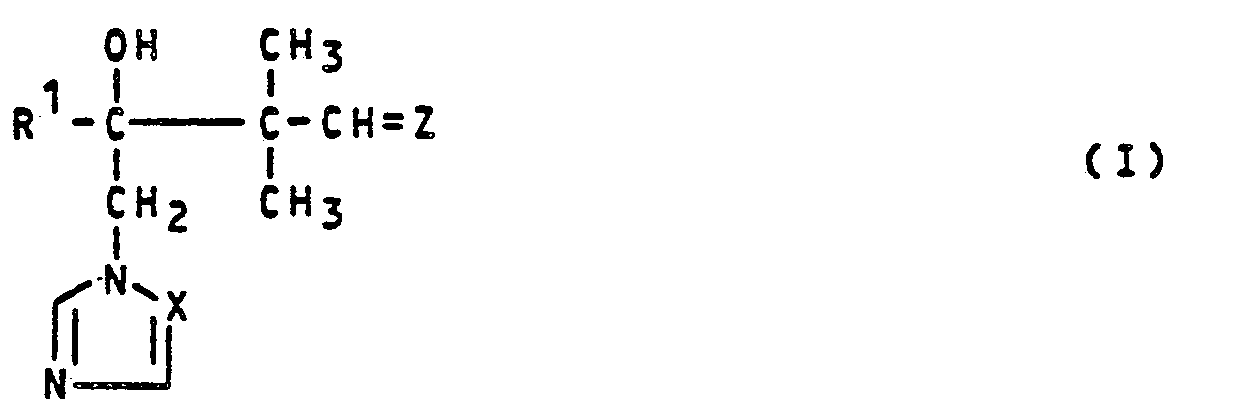
- the present invention relates to new hydroxyethyl azole derivatives, several processes for their preparation and their use as fungicides.
- the general formula (1) listed in EP-A-0 86 917 is directed, inter alia, to fungicidally active hydroxyethyl azolyl derivatives in which an aldhyd group is linked to the carbinol carbon atom via a methylene group substituted by alkyl.
- corresponding compounds which contain a methylene bridge which is substituted twice by alkyl are not disclosed.
- the new hydroxyethyl azole derivatives of the formula (I) have strong fungicidal properties.
- the compounds according to the invention show a higher activity than the hydroxyethyl azole derivatives 1- (2,4-dichlorophenoxy) -3,3-dimethyl-2- (1,2,4-triazole-1) known from the prior art -yl-methyl) -2-butanol and 1- (4-chlorophenoxy) -3,3-dimethyl-2- (imidazol-1-yl) -2-butanol, which are constitutionally and functionally obvious compounds.
- the substances according to the invention thus represent an enrichment of technology.
- Formula (I) provides a general definition of the hydroxyethyl azole derivatives according to the invention.
- Preferred compounds according to the invention are also addition products of acids and those hydroxyethyl azole derivatives of the formula (I) in which the substituents R 1 , X and Z have the meanings which have already been mentioned preferably for these substituents.
- the acids that can be added preferably include hydrohalic acids, e.g. hydrochloric acid and hydrobromic acid, especially hydrochloric acid, also phosphoric acid, nitric acid, mono- and bifunctional carboxylic acids and hydroxycarboxylic acids, e.g. Acetic acid, maleic acid, succinic acid, fumaric acid, tartaric acid, citric acid, salicylic acid, sorbic acid and lactic acid, as well as sulfonic acids, e.g. p-toluenesulfonic acid and 1,5-naphthalenedisulfonic acid.
- hydrohalic acids e.g. hydrochloric acid and hydrobromic acid, especially hydrochloric acid, also phosphoric acid, nitric acid, mono- and bifunctional carboxylic acids and hydroxycarboxylic acids, e.g. Acetic acid, maleic acid, succinic acid, fumaric acid, tartaric acid, citric acid, salicylic acid, sorbic acid
- preferred compounds according to the invention are addition products from salts of metals of the 11th to IVth main groups and of I. and II. And IV. To VIII. Subgroup and those substituted hydroxyethyl-azole derivatives of the formula (I) in which the substituents R 1 , X and Z have the meanings which have preferably already been mentioned for these substituents.
- Salts of copper, zinc, manganese, magnesium, tin, iron and nickel are particularly preferred.
- Anions of these salts are those which are derived from acids which lead to physiologically tolerable addition products.
- Particularly preferred such acids in this connection are the hydrohalic acids, e.g. hydrochloric acid and hydrobromic acid, as well as phosphoric acid, nitric acid and sulfuric acid.
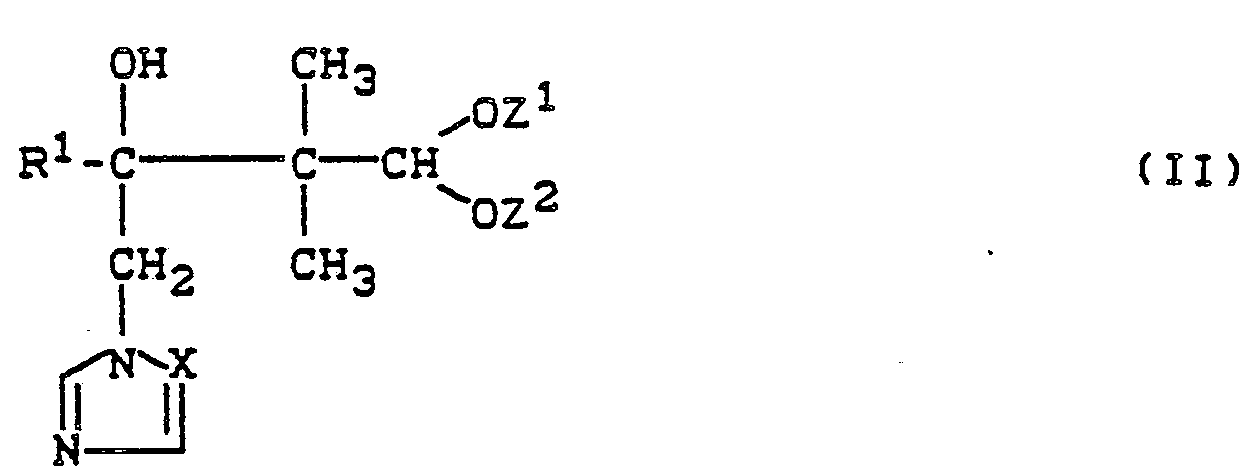
- Formula (II) provides a general definition of the hydroxyethyl azolylacetal derivatives to be used as starting materials for carrying out process (a) according to the invention.
- the oxiranes of the formula (VII) obtained in this way can optionally be reacted directly without isolation.
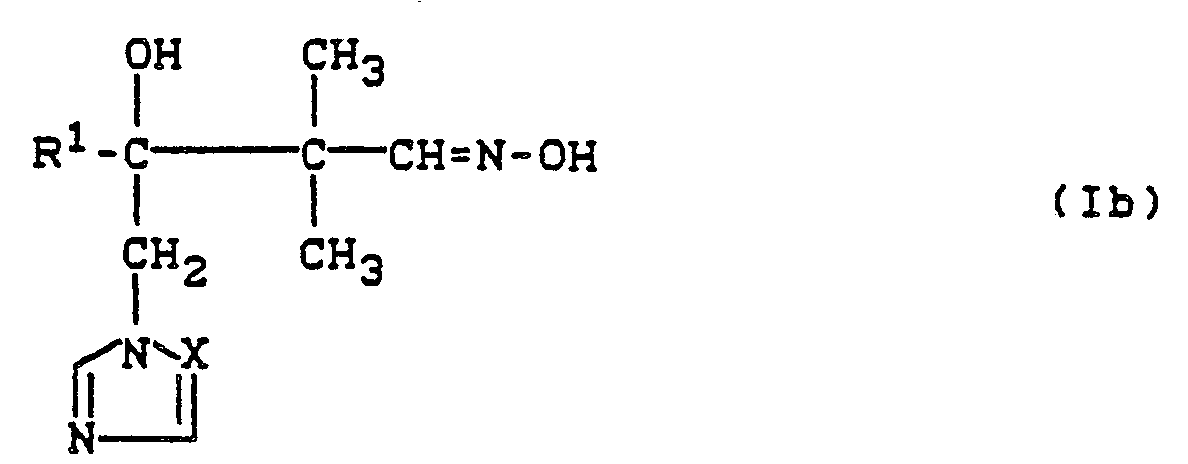
- hydroxyethyl azole derivatives of the formula (Ia) to be used as starting materials when carrying out process (b) according to the invention are compounds according to the invention.
- Formula (111) provides a general definition of the hydroxylamine derivatives to be used as starting materials for carrying out process (b) according to the invention.
- R 2 preferably represents the meanings which have already been mentioned for these substituents in connection with the description of the substances of the formula (I) according to the invention.
- the hydroxylamine derivatives of the formula (111) are generally known compounds of organic chemistry.
- hydroxyethyl azole derivatives of the formula (Ib) to be used as starting materials when carrying out process (c) according to the invention are compounds according to the invention.
- Formula (IV) provides a general definition of the halides to be used as starting materials for carrying out process (c) according to the invention.
- R 3 is preferably the meanings which have already been in connection with the description of the substances of the formula (I) for R 2 of the invention, other than hydrogen, preferably mentioned.
- the halides of the formula (IV) are generally known compounds of organic chemistry.
- Formula (V) provides a general definition of the oxiranes to be used as starting materials when carrying out process (d) according to the invention.
- R 1 preferably represents the meanings which have already been mentioned for these substituents in connection with the description of the substances of the formula (I) according to the invention
- R 3 preferably represents the meanings which have already been mentioned in connection with the description of the substances according to the invention
- Substances of the formula (I) for R 2 other than hydrogen, were preferably mentioned.
- keto-oxime derivatives of the formula (XIV) are known from DE-A-3 224 130, DE-A-3 224 129 and DE-A-3 242 252. They can be obtained in a known manner , for example by reacting 1- (N-morpholino) isobutene of the formula (XI) with chlorides of the formula (XII) in the presence of a solvent, such as, for example, diethyl ether, at temperatures between 20 ° C. and 120 ° C.
- a solvent such as, for example, diethyl ether
- the azoles of the formula (VI) which are also to be used as starting materials for carrying out process (d) according to the invention are generally known compounds of organic chemistry.
- Process (a) according to the invention is carried out in the presence of a mixture of water and a water-miscible, inert organic solvent. Alcohols are preferred as organic solvents.
- Suitable acids for process (a) according to the invention are all inorganic and organic acids which can usually be used. These preferably include hydrochloric acid, sulfuric acid, p-toluenesulfonic acid and acetic acid.
- reaction temperatures can be varied within a substantial range when carrying out process (a) according to the invention. In general, temperatures between 30 ° C and 120 ° C, preferably at the boiling point of the solvent used.
- Suitable diluents for process (b) according to the invention are preferably alcohols and water, or mixtures of the two.
- reaction temperatures in process (b) according to the invention can be varied within a substantial range. Generally one works between 20 ° C and 120 ° C, preferably between 50 ° C and 100 ° C.
- the hydroxylamine derivatives of the formula (111) are used in the form of their salts, in particular as hydrochlorides, optionally in the presence of an acid binder, such as sodium acetate (cf. also the preparation examples).
- Inert organic solvents are suitable as diluents for the reaction according to the invention in process (c).
- ethers such as tetrahydrofuran and dioxane
- aromatic hydrocarbons such as toluene and benzene
- chlorinated hydrocarbons such as chloroform, methylene chloride or carbon tetrachloride
- hexamethylphosphoric acid triamide acid amides such as dimethylformamide and sulfoxides such as dimethyl sulfoxide.
- the reaction according to process (c) according to the invention is optionally carried out in the presence of a strong base.
- a strong base preferably include alkali metal amides, hydrides, hydroxides and carbonates, such as sodium amide, carbonate, hydroxide or hydride and potassium amide, carbonate, hydroxide or hydride, as well as quaternary ammonium hydroxides and phosphonium hydroxides, such as tetramethylammonium hydroxide, benzyltrimethyl ammonium hydroxide or dibenzyldimethylammonium hydroxide and tetraphenylphosphonium hydroxide or methyltriphenylphosphonium hydroxide.
- reaction temperatures can be varied within a wide range in process (c). Generally one works between 20 ° C and 150 ° C, preferably at room temperature. In individual cases, it is advantageous to work at the boiling point of the solvent, for example between 60 ° C and 100 ° C.
- the reaction according to the invention is carried out in a two-phase system, such as, for example, aqueous sodium or potassium hydroxide solution, toluene or methylene chloride, with the addition of 0.01 to 1 mol of a phase transfer catalyst, such as, for example, ammonium or phosphonium compounds. carried out, the alcoholates being formed in the organic phase or at the interfaces and being reacted with the halides in the organic phase.
- a phase transfer catalyst such as, for example, ammonium or phosphonium compounds.
- Suitable diluents for process (d) according to the invention are organic solvents which are inert under the reaction conditions. These preferably include: alcohols, e.g. Ethanol, methoxyethanol or propanol; Ketones, e.g. 2-butanone; Nitriles, e.g. Acetonitrile; Esters, e.g. Ethyl acetate; Ethers such as Dioxane; aromatic hydrocarbons, e.g. Benzene and toluene; or amides, e.g. Dimethylformamide.
- alcohols e.g. Ethanol, methoxyethanol or propanol
- Ketones e.g. 2-butanone
- Nitriles e.g. Acetonitrile
- Esters e.g. Ethyl acetate
- Ethers such as Dioxane
- aromatic hydrocarbons e.g. Benzene and toluene
- Suitable bases for process (d) according to the invention are all inorganic and organic bases which can usually be used. These preferably include alkali carbonates, e.g. Sodium and potassium carbonate; Alkali hydroxides, e.g. Sodium hydroxide; Alkali alcoholates, e.g. Sodium and potassium methylate and ethylate; Alkali hydrides, e.g. Sodium hydride; as well as lower tertiary alkylamines, cycloalkylamines and aralkylamines, such as in particular triethylamine.
- alkali carbonates e.g. Sodium and potassium carbonate
- Alkali hydroxides e.g. Sodium hydroxide
- Alkali alcoholates e.g. Sodium and potassium methylate and ethylate
- Alkali hydrides e.g. Sodium hydride
- reaction temperatures can be varied within a substantial range when carrying out process (d) according to the invention. In general, temperatures between 0 ° C and 200 ° C, preferably between 60 ° C and 150 ° C.
- the acid addition salts of the compounds of the formula (I) can be obtained in a simple manner by customary salt formation methods, for example by dissolving a compound of the general formula (I) in a suitable one inert solvents and addition of the acid, for example hydrochloric acid, can be obtained and isolated in a known manner, for example by filtration, and, if appropriate, purified by washing with an inert organic solvent.
- the metal salt complexes of compounds of the general formula (I) can be obtained in a simple manner by customary processes, e.g. by dissolving the metal salt in alcohol, e.g. Ethanol and adding to compounds of general formula (1).
- Metal salt complexes can be prepared in a known manner, e.g. by filtering, isolating and, if necessary, cleaning by recrystallization.
- the active compounds according to the invention have a strong microbicidal action and can be used practically to combat unwanted microorganisms.
- the active ingredients are suitable for use as pesticides.
- Fungicidal agents in crop protection are used to control Plasmodiophoromycetes, Oomycetes, Chytridiomycetes, Zygomycetes, Ascomycetes, Basidiomycetes, Deuteromycetes.
- the active compounds according to the invention can be used as crop protection agents with particularly good results. Success in the control of Cochliobolus sativus on barley and of Venturia inaequalis on the apple as well as for the control of powdery mildew, Septoria nodorum and Pyrenophora teres on cereals and of Pyricularia oryzae and Pellicularia sesakii on rice.
- the active ingredients can be converted into the customary formulations, such as solutions, emulsions, wettable powders, suspensions, powders, dusts, foams, pastes, soluble powders, granules, aerosols, suspension emulsion concentrates, seed powders, active ingredient-impregnated natural and synthetic substances, very fine encapsulations in polymeric substances and in coating compositions for seeds, also in formulations with fuel sets, such as smoking cartridges, cans, spirals, etc. as well as ULV cold and warm fog formulations.
- customary formulations such as solutions, emulsions, wettable powders, suspensions, powders, dusts, foams, pastes, soluble powders, granules, aerosols, suspension emulsion concentrates, seed powders, active ingredient-impregnated natural and synthetic substances, very fine encapsulations in polymeric substances and in coating compositions for seeds, also in formulations with fuel sets, such as smoking cartridges, cans, spirals, etc. as well as
- formulations are made in a known manner, e.g. by mixing the active ingredients with extenders, that is to say liquid solvents, pressurized liquefied gases and / or solid carriers, if appropriate using surface-active agents, that is to say emulsifiers and / or dispersants and / or foam-generating agents. If water is used as an extender, e.g. organic solvents can also be used as auxiliary solvents.
- extenders that is to say liquid solvents, pressurized liquefied gases and / or solid carriers, if appropriate using surface-active agents, that is to say emulsifiers and / or dispersants and / or foam-generating agents.
- surface-active agents that is to say emulsifiers and / or dispersants and / or foam-generating agents.
- water e.g. organic solvents can also be used as auxiliary solvents.
- aromatics such as xylene, toluene, or alkyl naphthalenes
- chlorinated aromatics or chlorinated aliphatic hydrocarbons such as chlorobenzenes, chlorethylenes or methylene chloride
- aliphatic hydrocarbons such as cyclohexane or paraffins, e.g.
- Petroleum fractions Petroleum fractions, alcohols, such as butanol or glycol, and their ethers and esters, ketones, such as acetone, methyl ethyl ketone, methyl isobutyl ketone or cyclohexanone, strongly polar solvents, such as dimethylformamide and dimethyl sulfoxide, and water;
- liquefied gaseous extenders or carriers mean liquids which are gaseous at normal temperature and under normal pressure, e.g. Aerosol propellants, such as halogenated hydrocarbons and butane, propane, nitrogen and carbon dioxide; solid carriers are possible: e.g.
- natural rock powders such as kaolins, clays, talc, chalk, quartz, attapulgite, montmorillonite or diatomaceous earth and synthetic rock powders such as highly disperse silica, aluminum oxide and silicates; as solid carriers for granules come into question: e.g. broken and fractionated natural rocks such as calcite, marble, pumice, sepiolite, dolomite and synthetic granules from inorganic and organic flours and granules from organic material such as sawdust, coconut shells, corn cobs and tobacco stems; as emulsifying and / or foaming agents are possible: e.g.
- non-ionic and anionic emulsifiers such as polyoxyethylene fatty acid esters, polyoxyethylene fatty alcohol ethers, e.g. Alkylaryl polyglycol ethers, alkyl sulfonates, alkyl sulfates, aryl sulfonates and protein hydrolyzates;
- Possible dispersants are: e.g. Lignin sulfite liquor and methyl cellulose.
- Adhesives such as carboxymethyl cellulose, natural and synthetic polymers in the form of powders, granules or latices, such as gum arabic, polyvinyl alcohol, polyvinyl acetate, and also natural phospholipids, such as cephalins and lecithins, and synthetic phospholipids can be used in the formulations.
- Other additives can be mineral and vegetable oils.
- Dyes such as inorganic pigments, e.g. Iron oxide, titanium oxide, ferrocyan blue and organic dyes such as alizarin, azo, metal phthalocyanine dyes and trace nutrients such as salts of iron, manganese, boron, copper, cobalt, molybdenum and zinc can be used.
- the formulations generally contain between 0.1 and 95 percent by weight of active compound, preferably between 0.5 and 90%.
- the active compounds according to the invention can be present in the formulations or in the various use forms in a mixture with other known active compounds, such as fungicides, bactericides, insecticides, acaricides, nematicides, herbicides, bird repellants, growth agents, plant nutrients and agents which improve soil structure.
- active compounds such as fungicides, bactericides, insecticides, acaricides, nematicides, herbicides, bird repellants, growth agents, plant nutrients and agents which improve soil structure.
- the active compounds as such in the form of their formulations or the use forms prepared therefrom by further dilution, such as ready-to-use solutions, emulsions, suspensions, Powders, pastes and granules can be used. They are used in the customary manner, for example by watering, dipping, spraying, spraying, atomizing, evaporating, injecting, slurrying, spreading, dusting, scattering, dry pickling, wet pickling, wet pickling, sludge pickling or incrusting.
- the active compound concentrations in the use forms can be varied within a substantial range. They are generally between 1 and 0.0001% by weight, preferably between 0.5 and 0.001%.
- amounts of active ingredient of 0.001 to 50 g per kilogram of seed, preferably 0.01 to 10 g, are generally required.
- active ingredient concentrations of 0.00001 to 0.1% by weight, preferably 0.0001 to 0.02% by weight, are required at the site of action.
- Emulsifier 0.25 part by weight of alkylaryl polyglycol ether
- active compound 1 part by weight of active compound is mixed with the stated amounts of solvent and emulsifier and the concentrate is diluted with water to the desired concentration.
- the plants are placed in a greenhouse at a temperature of approx. 20 ° C and a relative humidity of approx. 80%.
- Evaluation is carried out 7 days after the inoculation.
- Emulsifier 0.3 part by weight of alkyl aryl polyglycol ether
- active compound 1 part by weight of active compound is mixed with the stated amounts of solvent and emulsifier and the concentrate is diluted with water to the desired concentration.
- the plants are then placed in a greenhouse at 20 ° C. and a relative humidity of approx. 70%.
- Evaluation is carried out 12 days after the inoculation.
Landscapes
- Organic Chemistry (AREA)
- Chemical & Material Sciences (AREA)
- Life Sciences & Earth Sciences (AREA)
- Health & Medical Sciences (AREA)
- Environmental Sciences (AREA)
- Engineering & Computer Science (AREA)
- Dentistry (AREA)
- General Health & Medical Sciences (AREA)
- Wood Science & Technology (AREA)
- Zoology (AREA)
- Plant Pathology (AREA)
- Pest Control & Pesticides (AREA)
- Agronomy & Crop Science (AREA)
- Agricultural Chemicals And Associated Chemicals (AREA)
- Organic Low-Molecular-Weight Compounds And Preparation Thereof (AREA)
- Plural Heterocyclic Compounds (AREA)
- Pharmaceuticals Containing Other Organic And Inorganic Compounds (AREA)
- Heterocyclic Carbon Compounds Containing A Hetero Ring Having Nitrogen And Oxygen As The Only Ring Hetero Atoms (AREA)
Claims (9)







Priority Applications (1)
| Application Number | Priority Date | Filing Date | Title |
|---|---|---|---|
| AT84111050T ATE53838T1 (de) | 1983-09-26 | 1984-09-17 | Hydroxyethyl-azol-derivate. |
Applications Claiming Priority (2)
| Application Number | Priority Date | Filing Date | Title |
|---|---|---|---|
| DE19833334779 DE3334779A1 (de) | 1983-09-26 | 1983-09-26 | Hydroxyethyl-azol-derivate |
| DE3334779 | 1983-09-26 |
Publications (3)
| Publication Number | Publication Date |
|---|---|
| EP0141204A2 EP0141204A2 (fr) | 1985-05-15 |
| EP0141204A3 EP0141204A3 (en) | 1986-12-17 |
| EP0141204B1 true EP0141204B1 (fr) | 1990-05-02 |
Family
ID=6210085
Family Applications (1)
| Application Number | Title | Priority Date | Filing Date |
|---|---|---|---|
| EP84111050A Expired - Lifetime EP0141204B1 (fr) | 1983-09-26 | 1984-09-17 | Dérivés de hydroxyéthylazoles |
Country Status (15)
| Country | Link |
|---|---|
| US (2) | US4645767A (fr) |
| EP (1) | EP0141204B1 (fr) |
| JP (1) | JPH064599B2 (fr) |
| AT (1) | ATE53838T1 (fr) |
| AU (1) | AU560735B2 (fr) |
| BR (1) | BR8404819A (fr) |
| CA (1) | CA1235419A (fr) |
| DE (2) | DE3334779A1 (fr) |
| DK (1) | DK458484A (fr) |
| ES (1) | ES536217A0 (fr) |
| GR (1) | GR80458B (fr) |
| HU (1) | HU194702B (fr) |
| IL (1) | IL73043A (fr) |
| NZ (1) | NZ209647A (fr) |
| ZA (1) | ZA847537B (fr) |
Families Citing this family (4)
| Publication number | Priority date | Publication date | Assignee | Title |
|---|---|---|---|---|
| DE3436452A1 (de) * | 1984-10-05 | 1986-04-10 | Bayer Ag, 5090 Leverkusen | Antimykotisches mittel |
| DE3725396A1 (de) * | 1987-07-31 | 1989-02-09 | Bayer Ag | Hydroxyethyl-azolyl-oximether |
| DE3804981A1 (de) * | 1988-02-18 | 1989-08-31 | Bayer Ag | Substituierte triazole |
| JPH07215951A (ja) * | 1994-02-04 | 1995-08-15 | Mochida Pharmaceut Co Ltd | 抗真菌作用を有する新規なトリアゾール誘導体 |
Family Cites Families (10)
| Publication number | Priority date | Publication date | Assignee | Title |
|---|---|---|---|---|
| US4147791A (en) * | 1972-01-11 | 1979-04-03 | Bayer Aktiengesellschaft | 1-Substituted-1,2,4-triazole fungicidal compositions and methods for combatting fungi that infect or attack plants |
| AU542623B2 (en) * | 1980-05-16 | 1985-02-28 | Bayer Aktiengesellschaft | 1-hydroxyethyl-azole derivatives |
| EP0158741A3 (fr) * | 1980-11-19 | 1986-02-12 | Imperial Chemical Industries Plc | Intermédiaires pour composés fongicides triazoles ou imidazoles |
| DE3202613A1 (de) * | 1982-01-27 | 1983-08-04 | Bayer Ag, 5090 Leverkusen | Antimykotische mittel |
| DE3202602A1 (de) * | 1982-01-27 | 1983-08-04 | Bayer Ag, 5090 Leverkusen | Antimykotisches mittel |
| EP0086917B1 (fr) * | 1982-02-02 | 1986-08-27 | Imperial Chemical Industries Plc | Composés hétérocycliques utiles comme pesticides et procédés pour leur préparation |
| EP0086304B1 (fr) * | 1982-02-03 | 1986-07-02 | Imperial Chemical Industries Plc | Composés hétérocycliques utiles comme pesticides et leurs procédés de préparation |
| DE3237400A1 (de) * | 1982-10-08 | 1984-04-12 | Bayer Ag, 5090 Leverkusen | Substituierte 1-hydroxyethyl-triazolyl-derivate |
| DE3407005A1 (de) * | 1983-09-26 | 1985-04-04 | Bayer Ag, 5090 Leverkusen | Hydroxyethylazolyl-oxim-derivate |
| DE3335767A1 (de) * | 1983-10-01 | 1985-04-11 | Bayer Ag, 5090 Leverkusen | Herbizide mittel enthaltend metribuzin in kombination mit azolylmethylketonen |
-
1983
- 1983-09-26 DE DE19833334779 patent/DE3334779A1/de not_active Withdrawn
-
1984
- 1984-09-14 US US06/650,965 patent/US4645767A/en not_active Expired - Fee Related
- 1984-09-17 EP EP84111050A patent/EP0141204B1/fr not_active Expired - Lifetime
- 1984-09-17 DE DE8484111050T patent/DE3482111D1/de not_active Expired - Lifetime
- 1984-09-17 AT AT84111050T patent/ATE53838T1/de not_active IP Right Cessation
- 1984-09-21 AU AU33404/84A patent/AU560735B2/en not_active Ceased
- 1984-09-21 JP JP59196938A patent/JPH064599B2/ja not_active Expired - Lifetime
- 1984-09-24 GR GR80458A patent/GR80458B/el unknown
- 1984-09-24 CA CA000463839A patent/CA1235419A/fr not_active Expired
- 1984-09-24 NZ NZ209647A patent/NZ209647A/en unknown
- 1984-09-24 IL IL73043A patent/IL73043A/xx unknown
- 1984-09-25 ZA ZA847537A patent/ZA847537B/xx unknown
- 1984-09-25 DK DK458484A patent/DK458484A/da not_active Application Discontinuation
- 1984-09-25 BR BR8404819A patent/BR8404819A/pt unknown
- 1984-09-25 ES ES536217A patent/ES536217A0/es active Granted
- 1984-09-25 HU HU843620A patent/HU194702B/hu not_active IP Right Cessation
-
1986
- 1986-05-29 US US06/868,402 patent/US4843088A/en not_active Expired - Fee Related
Also Published As
| Publication number | Publication date |
|---|---|
| US4645767A (en) | 1987-02-24 |
| DK458484A (da) | 1985-03-27 |
| DE3482111D1 (de) | 1990-06-07 |
| ATE53838T1 (de) | 1990-06-15 |
| HU194702B (en) | 1988-03-28 |
| IL73043A (en) | 1988-08-31 |
| AU3340484A (en) | 1985-04-04 |
| HUT35931A (en) | 1985-08-28 |
| CA1235419A (fr) | 1988-04-19 |
| DE3334779A1 (de) | 1985-04-11 |
| JPH064599B2 (ja) | 1994-01-19 |
| EP0141204A2 (fr) | 1985-05-15 |
| IL73043A0 (en) | 1984-12-31 |
| ZA847537B (en) | 1985-05-29 |
| AU560735B2 (en) | 1987-04-16 |
| BR8404819A (pt) | 1985-08-13 |
| JPS6087268A (ja) | 1985-05-16 |
| US4843088A (en) | 1989-06-27 |
| GR80458B (en) | 1985-01-28 |
| NZ209647A (en) | 1986-12-05 |
| ES8505663A1 (es) | 1985-06-01 |
| EP0141204A3 (en) | 1986-12-17 |
| DK458484D0 (da) | 1984-09-25 |
| ES536217A0 (es) | 1985-06-01 |
Similar Documents
| Publication | Publication Date | Title |
|---|---|---|
| EP0110048B1 (fr) | Dérivés 1-hydroxyéthyl triazoliques substitués | |
| EP0111711B1 (fr) | Dérivés hydroxyalkyl-azolyles substitués par des hétérocycles | |
| EP0077479A2 (fr) | Phénoxyphényl-azolylméthyl-cétones et -carbinols, leur procédé de préparation et leur application comme fongicides et intermédiaires | |
| EP0192055B1 (fr) | Dérivés d'hydroxyalkynyl-azolyle, leur procédé de préparation et leur application comme fongicides | |
| EP0019189B1 (fr) | Agents fongicides, procédé pour leur préparation, ainsi que leur utilisation comme fongicides | |
| EP0121171B1 (fr) | Fongicides, leur procédé de préparation et leur application | |
| EP0054865A1 (fr) | 1-Azolyl-butan-2-ones substitués, procédé de leur préparation et leur application comme fongicides ainsi que comme intermédiaires | |
| EP0131845B1 (fr) | Utilisation de diazolylalkylecarbinols substitués pour la protection de plantes contre les champignons | |
| EP0121888B1 (fr) | Dérivés 1-azolyl-3-pyrazolyl-2-propanols, leur procédé de préparation et leur application comme fongicides | |
| EP0111234B1 (fr) | Agents fongicides, leur préparation et utilisation | |
| EP0104549B1 (fr) | Azolylbutanoles | |
| EP0080071A2 (fr) | Imidazolylméthyl-2-phényl-2-dioxolanes-1,3, procédé de leur préparation et leur application fongicide | |
| EP0047405B1 (fr) | Dérivés azolylalkyles, leur procédé de préparation et leur application comme fongicides | |
| EP0141205B1 (fr) | Dérivés d'hydroxyéthylazolyl-oximes | |
| EP0102578B1 (fr) | 2-Aryl-2-azolylméthyl-1,3-dioxépines | |
| EP0029542A2 (fr) | Dérivés de l'hydroxybutyl-imidazole, procédé pour leur préparation, intermédiaires pour celle-ci et leur utilisation comme fongicides | |
| EP0118069B1 (fr) | Fongicides contenant des 1,3-diazolyl-propanols | |
| EP0108995A1 (fr) | Dérivés hydroxyalkinyl-azolyliques | |
| EP0042980A2 (fr) | 1-Azolyl-1-phénoxy-3,3-diméthyl-butan-2-ones et -2-ols, substitués en position 4, leur procédé de préparation et leur application comme fongicides | |
| EP0119572B1 (fr) | Dérivés triazolyles-phénéthyl substitués, leur procédé de préparation et leur application comme fongicides | |
| EP0141204A2 (fr) | Dérivés de hydroxyéthylazoles | |
| EP0182188A2 (fr) | Triazolylméthylcarbinol-arylacétales | |
| EP0057864A2 (fr) | Dérivés de 2-azolylméthyl-1,3-dioxolanne et - dioxanne, procédé pour leur préparation et leur application comme fongicide | |
| EP0102591B1 (fr) | Ethers azolyl-cétones et -carbinoles substitués | |
| EP0129115A2 (fr) | Dérivés d'azolylméthyl-thiényl-carbinols |
Legal Events
| Date | Code | Title | Description |
|---|---|---|---|
| PUAI | Public reference made under article 153(3) epc to a published international application that has entered the european phase |
Free format text: ORIGINAL CODE: 0009012 |
|
| 17P | Request for examination filed |
Effective date: 19840917 |
|
| AK | Designated contracting states |
Designated state(s): AT BE CH DE FR GB IT LI NL SE |
|
| PUAL | Search report despatched |
Free format text: ORIGINAL CODE: 0009013 |
|
| AK | Designated contracting states |
Kind code of ref document: A3 Designated state(s): AT BE CH DE FR GB IT LI NL SE |
|
| 17Q | First examination report despatched |
Effective date: 19880504 |
|
| GRAA | (expected) grant |
Free format text: ORIGINAL CODE: 0009210 |
|
| AK | Designated contracting states |
Kind code of ref document: B1 Designated state(s): AT BE CH DE FR GB IT LI NL SE |
|
| PG25 | Lapsed in a contracting state [announced via postgrant information from national office to epo] |
Ref country code: SE Effective date: 19900502 |
|
| REF | Corresponds to: |
Ref document number: 53838 Country of ref document: AT Date of ref document: 19900615 Kind code of ref document: T |
|
| REF | Corresponds to: |
Ref document number: 3482111 Country of ref document: DE Date of ref document: 19900607 |
|
| ET | Fr: translation filed | ||
| GBT | Gb: translation of ep patent filed (gb section 77(6)(a)/1977) | ||
| ITF | It: translation for a ep patent filed | ||
| PG25 | Lapsed in a contracting state [announced via postgrant information from national office to epo] |
Ref country code: AT Effective date: 19900917 |
|
| PLBE | No opposition filed within time limit |
Free format text: ORIGINAL CODE: 0009261 |
|
| STAA | Information on the status of an ep patent application or granted ep patent |
Free format text: STATUS: NO OPPOSITION FILED WITHIN TIME LIMIT |
|
| 26N | No opposition filed | ||
| PGFP | Annual fee paid to national office [announced via postgrant information from national office to epo] |
Ref country code: DE Payment date: 19930813 Year of fee payment: 10 |
|
| PGFP | Annual fee paid to national office [announced via postgrant information from national office to epo] |
Ref country code: CH Payment date: 19930903 Year of fee payment: 10 |
|
| PGFP | Annual fee paid to national office [announced via postgrant information from national office to epo] |
Ref country code: GB Payment date: 19930907 Year of fee payment: 10 |
|
| PGFP | Annual fee paid to national office [announced via postgrant information from national office to epo] |
Ref country code: FR Payment date: 19930917 Year of fee payment: 10 |
|
| PGFP | Annual fee paid to national office [announced via postgrant information from national office to epo] |
Ref country code: BE Payment date: 19930922 Year of fee payment: 10 |
|
| ITTA | It: last paid annual fee | ||
| PGFP | Annual fee paid to national office [announced via postgrant information from national office to epo] |
Ref country code: NL Payment date: 19930930 Year of fee payment: 10 |
|
| PG25 | Lapsed in a contracting state [announced via postgrant information from national office to epo] |
Ref country code: GB Effective date: 19940917 |
|
| PG25 | Lapsed in a contracting state [announced via postgrant information from national office to epo] |
Ref country code: LI Effective date: 19940930 Ref country code: CH Effective date: 19940930 Ref country code: BE Effective date: 19940930 |
|
| EUG | Se: european patent has lapsed |
Ref document number: 84111050.5 Effective date: 19900420 |
|
| BERE | Be: lapsed |
Owner name: BAYER A.G. Effective date: 19940930 |
|
| PG25 | Lapsed in a contracting state [announced via postgrant information from national office to epo] |
Ref country code: NL Effective date: 19950401 |
|
| NLV4 | Nl: lapsed or anulled due to non-payment of the annual fee | ||
| GBPC | Gb: european patent ceased through non-payment of renewal fee |
Effective date: 19940917 |
|
| PG25 | Lapsed in a contracting state [announced via postgrant information from national office to epo] |
Ref country code: FR Effective date: 19950531 |
|
| REG | Reference to a national code |
Ref country code: CH Ref legal event code: PL |
|
| PG25 | Lapsed in a contracting state [announced via postgrant information from national office to epo] |
Ref country code: DE Effective date: 19950601 |
|
| REG | Reference to a national code |
Ref country code: FR Ref legal event code: ST |