EP0141506A2 - Verfahren zur Herstellung einer Halbleiteranordnung - Google Patents
Verfahren zur Herstellung einer Halbleiteranordnung Download PDFInfo
- Publication number
- EP0141506A2 EP0141506A2 EP84306093A EP84306093A EP0141506A2 EP 0141506 A2 EP0141506 A2 EP 0141506A2 EP 84306093 A EP84306093 A EP 84306093A EP 84306093 A EP84306093 A EP 84306093A EP 0141506 A2 EP0141506 A2 EP 0141506A2
- Authority
- EP
- European Patent Office
- Prior art keywords
- layer
- semiconductor
- capping layer
- melting
- insulator
- Prior art date
- Legal status (The legal status is an assumption and is not a legal conclusion. Google has not performed a legal analysis and makes no representation as to the accuracy of the status listed.)
- Withdrawn
Links
Images

Classifications
-
- H—ELECTRICITY
- H10—SEMICONDUCTOR DEVICES; ELECTRIC SOLID-STATE DEVICES NOT OTHERWISE PROVIDED FOR
- H10P—GENERIC PROCESSES OR APPARATUS FOR THE MANUFACTURE OR TREATMENT OF DEVICES COVERED BY CLASS H10
- H10P95/00—Generic processes or apparatus for manufacture or treatments not covered by the other groups of this subclass
- H10P95/90—Thermal treatments, e.g. annealing or sintering
-
- H—ELECTRICITY
- H10—SEMICONDUCTOR DEVICES; ELECTRIC SOLID-STATE DEVICES NOT OTHERWISE PROVIDED FOR
- H10P—GENERIC PROCESSES OR APPARATUS FOR THE MANUFACTURE OR TREATMENT OF DEVICES COVERED BY CLASS H10
- H10P14/00—Formation of materials, e.g. in the shape of layers or pillars
- H10P14/20—Formation of materials, e.g. in the shape of layers or pillars of semiconductor materials
- H10P14/29—Formation of materials, e.g. in the shape of layers or pillars of semiconductor materials characterised by the substrates
- H10P14/2901—Materials
- H10P14/2902—Materials being Group IVA materials
- H10P14/2905—Silicon, silicon germanium or germanium
-
- H—ELECTRICITY
- H10—SEMICONDUCTOR DEVICES; ELECTRIC SOLID-STATE DEVICES NOT OTHERWISE PROVIDED FOR
- H10P—GENERIC PROCESSES OR APPARATUS FOR THE MANUFACTURE OR TREATMENT OF DEVICES COVERED BY CLASS H10
- H10P14/00—Formation of materials, e.g. in the shape of layers or pillars
- H10P14/20—Formation of materials, e.g. in the shape of layers or pillars of semiconductor materials
- H10P14/32—Formation of materials, e.g. in the shape of layers or pillars of semiconductor materials characterised by intermediate layers between substrates and deposited layers
- H10P14/3202—Materials thereof
- H10P14/3238—Materials thereof being insulating materials
-
- H—ELECTRICITY
- H10—SEMICONDUCTOR DEVICES; ELECTRIC SOLID-STATE DEVICES NOT OTHERWISE PROVIDED FOR
- H10P—GENERIC PROCESSES OR APPARATUS FOR THE MANUFACTURE OR TREATMENT OF DEVICES COVERED BY CLASS H10
- H10P14/00—Formation of materials, e.g. in the shape of layers or pillars
- H10P14/20—Formation of materials, e.g. in the shape of layers or pillars of semiconductor materials
- H10P14/34—Deposited materials, e.g. layers
- H10P14/3402—Deposited materials, e.g. layers characterised by the chemical composition
- H10P14/3404—Deposited materials, e.g. layers characterised by the chemical composition being Group IVA materials
- H10P14/3411—Silicon, silicon germanium or germanium
-
- H—ELECTRICITY
- H10—SEMICONDUCTOR DEVICES; ELECTRIC SOLID-STATE DEVICES NOT OTHERWISE PROVIDED FOR
- H10P—GENERIC PROCESSES OR APPARATUS FOR THE MANUFACTURE OR TREATMENT OF DEVICES COVERED BY CLASS H10
- H10P14/00—Formation of materials, e.g. in the shape of layers or pillars
- H10P14/20—Formation of materials, e.g. in the shape of layers or pillars of semiconductor materials
- H10P14/38—Formation of materials, e.g. in the shape of layers or pillars of semiconductor materials characterised by treatments done after the formation of the materials
- H10P14/3802—Crystallisation or recrystallisation of non-monocrystalline semiconductor materials, e.g. regrowth
Definitions
- This invention pertains to processes for semiconductor device manufacture comprising steps of converting amorphous or polycrystalline semiconductor material into single crystal material.
- Electronic devices based on buried insulator structures offer promise of, inter alia, increased dielectric isolation, useful in, e.g., high voltage-high power devices, of reduced parasitic capacitance in integrated circuits, and of improved radiation hardness of devices. See, for instance, H. W. Lam et al, in VLSI Electronics: Microstructure Science, Vol. 4, N. G. Einspruch, editor, Academic Press (1982), pp. 1-54.
- a layer of insulator material is formed on a semiconductor substrate, patterned, a layer of semiconductor material deposited thereover, the semiconductor layer melted in whole or in part, and one or more solidification fronts caused to advance laterally across the semiconductor layer.
- a capping layer is formed atop the deposited semiconductor to, inter alia, prevent balling-up of molten semiconductor material.
- the capping layer typically comprises an oxide, e.g., Si0 2 . See U. S. Patent 4,371,421, issued February 1, 1983, to J. C. C. Fan et al (Fan).
- Various heat sources have been used to melt the thin semiconductor layers, including strip heaters, electron or laser irradiation, and irradiation with high intensity radiation from, e.g., tungsten halogen lamps.
- Various techniques for recrystallization are also known to the art. Among the techniques is a global melting approach, typically comprising simultaneous exposure of a whole wafer to high intensity visible and infrared radiation (G. K. Celler et al, in Laser-Solid Interactions and Transient Thermal Processing of Materials, J. Narayan et al, editors, North Holland, New York (1983), pp. 575-586).
- a different technique comprises zone melting, i.e., relatively slow scan of a strip-like hot zone across the sample.
- the sample e.g., a wafer
- a heat source that maintains the sample at a temperature slightly below the melting temperature of the semiconductor material
- a strip-like hot zone in which the semiconductor material is molten
- a variety of means exists for producing the moving hot zone e.g., a line-focused laser or other light source, or an electron beam.
- Graphite strip heaters are also used in the prior art. See, for instance, the Fan patent or M. W. Geis et al, Journal of the Electrochemical Society: Solid State Science and Technology, Vol. 129(12), pp. 2812-2818 (1982).
- the prior art shows that it is possible, by means of the zone-melting technique, to produce on buried sio 2 recrystallized (100)-oriented Si that is essentially free of large-angle grain boundaries.
- the recrystallized Si produced by prior art zone-melting techniques contains low-angle grain boundaries, often referred to as subboundaries, i.e., grain boundaries involving changes of crystal orientation of less than about 1 degree. See, for instance, M. W. Geis et al, Applied Physics Letters, Vol. 40(2), pp. 158-160 (1982).
- facets form in thin (i.e., about 1 pm or less) unseeded Si layers that spontaneously grow with (100) orientation normal to the film, and with a [100] direction substantially parallel to the scan direction, as well as in seeded (100) Si layers.
- the latter are customarily grown by scanning along a [100] direction of the seed.
- the thus formed facets are thought to intersect the (100) surface along [110] directions, and are also thought to be bounded by (111) planes.
- patterning of a layer of material on a substrate, we mean a procedure that produces a nonuniform layer having a predetermined pattern of voids penetrating to the substrate.
- Photolithography and etching are familiar patterning procedures, but the term is not intended to be limited to such subtractive patterning methods.
- the orientation of a crystal surface is defined by the Miller indices (h, k, 1) of the crystallographic plane parallel to the surface.
- a direction in a crystal surface is defined by means of the indices [u, v, w]. No distinction is made herein between indices referring to a particular plane (direction) and indices referring to a set of crystallographically equivalent planes (direction).
- This invention is a method for producing a semiconductor device, comprising producing a body comprising a single crystal substrate wherein subboundary formation in capped, seeded, laterally recrystallized, zone-melted semiconductor on buried insulator can be reduced or eliminated by scanning the hot zone substantially parallel to a major crystallographic direction of the seed, such as a [110] direction of a Si seed.
- patterning can be advantageously used in semiconductor/ insulator systems other than Si/Si0 2 , e.g., Ge, III-V or II-VI semiconductors such as GaAs, InP, and ZnS on oxides (including, where applicable, native oxide), nitrides, carbides, or borides.
- One aspect of the invention namely, the appropriate choice of hot zone scan direction, is applicable to the zone-melting lateral recrystallization technique, or, more generally, to recrystallization techniques in which a solidification front is caused to move in a predetermined direction across the sample.
- the practice of this aspect may produce improvements in the crystalline perfection of semiconductor materials other than Si, the preferred application is in the seeded growth of (100) Si on Si0 2 .
- FIG. 1 Exemplary apparatus useful for the practice of the zone-melting technique is schematically shown in FIG. 1, wherein sample wafer 11 is shown on lower heater 10, and strip heater 12 is scanned across the sample in scan direction 14 normal to the long direction of hot zone 13 created by the strip heater.
- the lower heater maintains the semiconductor sample at a temperature slightly below the melting point of the semiconductor material, and the heat input to the sample from the strip heater is adjusted to produce a molten zone that extends to the buried insulator layer in the sample.
- Example 1 On a Czochralski-grown single crystal (100) Si wafer, 0.7 mm thick and 75 mm in diameter, doped n-type to about 1.10 15 carriers/cm 3 , we grew a 3.5 um thick layer of thermal oxide by a standard method. The oxide was patterned by photolithography and dry etching into a checkerboard pattern of alternating oxide squares of size ranging from 1.6 mm to 12.8 mm, with edges aligned along [100] crystal directions. A 33 ⁇ m thick n-type Si film with 1.10 14 carriers/cm 3 was formed on the wafer by thermal decomposition of SiHC1 3 at about 1050°C.
- the thus prepared wafer was placed in a recrystallization chamber, the chamber pumped to about 133x10 -7 Pa (10 -7 Torr) and backfilled with about 40,000 Pa (300 Torr) Ar.
- the wafer was radiantly coupled to a graphite heater and heated from below to about 1210°C, with a 5°C nonuniformity from center to edge, as determined with an optical pyrometer corrected for the wafer emissivity.
- a graphite wire of 1 x 1 mm cross section was heated to about 2240 0 C and scanned at 2.0 mm/sec across the wafer at a clearance of about 0.75 mm. This caused a uniform molten zone to move across the wafer under and slightly behind the moving wire heater.
- the wafer was cooled at a rate of about 1°C/sec.
- the Si film between the Si0 2 layers had melted uniformly everywhere on the wafer, the melt stopped at the buried oxide, but extended slightly into the substrate in and very near the buried-oxide-free seed regions.
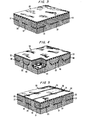
- Etching by means of the well-known Schimmel etchant to reveal grain boundaries and dislocations showed that the previously polycrystalline regions had been transformed into single crystal material, as indicated schematically in FIG. 3. Recrystallized regions of typically about 1 mm2 size were found to be substantially free of subboundaries.
- the variation in thickness of the recrystallized material was found to be less than 10 pm, indicating reduced mass transport as compared to prior art work on recrystallized thick films.
- the recrystallized material however, contained dislocations, with their density increasing gradually in the scan direction, but with a very low density in the top 2 to 3 ⁇ m and in the bottom 4 to 5 ⁇ m of the recrystallized material.
- Example 2 A 30 ⁇ m capped Si layer was grown on buried Si0 2 by a procedure substantially as described in Example 1.
- the zone melting conditions were also as described in Example 1, with the exceptions that the strip heater was aligned along the [100] direction of the substrate (diagonal to the squares of buried oxide), and the scan direction was parallel to the [010] crystallographic direction.
- Schimmel etching revealed subboundaries aligned along the [010] direction, with average spacing of about 110 ⁇ m.
- Example 3 A 0.5 ⁇ m thick Si film was encapsulated between S10 2 layers, substantially as described in Example 1, but with the buried Si0 2 layer being unpatterned. The Si film was recrystallized, using seeding by means of a scratch extending through cap, deposited Si and buried Si0 2 to the Si substrate. The hot zone was scanned in a [110] direction of the substrate crystal. The recrystallized film showed an extended network of subboundaries, of lateral spacing 20 to 60 pm.
- Example 3 demonstrates the fact that film thickness, as well as scan direction, is an important factor in the suppression of subboundaries in the recrystallized Si on insulator. We believe that the suppression of subboundary growth by the improved zone-melting method is most pronounced in layers at least about 10 pm thick, although beneficial results may be obtainable at any thickness.
- our invention can, of course, be practiced with buried insulator configurations other than the simple planar ones described above.
- buried insulator regions 40 form tubs embedded in the substrate material and covered by deposited semiconductor, in turn covered by a capping layer.
- Example 4 A structure similar to that shown in FIG. 4 was created by etching 50 ⁇ m deep rectangular depressions, of size 0.5 mm x 0.7 mm, with walls sloping at about 45 0 , into a (100) Si substrate wafer.
- the depressions were arranged pairwise in rows, the members of each pair spaced about 0.1 mm, pairs about 3 mm, and rows about 6 mm, apart.
- the depressions had [110] oriented sides.
- the oxide layer was patterned so as to retain Si0 2 only in the tub regions.
- Example 1 After CVD deposition of about 80 pm of Si, a 2 ⁇ m thick Si0 2 capping layer was formed on the deposited Si, and a hot zone scanned across the wafer in the [110] direction parallel to the rows. During zone melting, the substrate was maintained at about 1135 0 C, and the strip heater scanned at 0.5 mm/sec. The recrystallized material was found to be substantially free of subboundaries, with a lower defect density than that of Example 1. Unless otherwise noted, the procedures used in this example were substantially as described in Example 1.
- a patterned cap is depicted in FIG. 5, wherein cap regions 50 are separated by voids 51.
- the capping layer atop the layer of semiconductor material serves to contain the molten material, i.e., to prevent its balling-up due to surface tension. See, for instance, FIG. 3 of the Fan patent, op. cit.
- a capping layer may furthermore prevent loss of a volatile constituent of a compound semiconductor, e.g., of P in InP, or even excessive vaporization of an elemental semiconductor, e.g., Si, or of a dopant therein.
- Typical capping layers are oxides, especially the native oxide of the capped semiconductor, but other materials may also be useful, e.g., nitrides, borides or carbides.
- a multilayer capping structure may have advantages, as disclosed in the Fan patent.
- the patterning should produce localized cap-free semiconductor surface regions ("voids"), such that the volume change attending melting or solidification can, for instance, be accommodated by movement of molten material into (or out of) these voids.
- voids localized cap-free semiconductor surface regions
- Patterns that fulfill the requirements are, for instance, strips of capping material running substantially in the scan direction, with narrow voids separating them, or arrays of small windows etched through the capping layer.
- the patterning should be such that on average (i.e., considering a sufficiently large area, e.g., 1 cm 2 ) at least 95% of the semiconductor surface to be recrystallized remains capped.
- the voids should have at least one small dimension, so as not to strongly affect the absorption of energy from the strip heater or other energy source, and to minimize evaporation of the semiconductor.
- a range of the small dimension of the void of about 1-20 ⁇ m gives advantageous results.
- a suitable pattern would be, for instance, 1 mm wide strips of capping material separated by 10 p m wide trenches etched through the cap material.
- the pattern of the capping layer can be, but need not be, correlated with the pattern of seed regions in the buried insulator layer. That is to say, uncapped regions can be above seed regions as well as above buried insulator regions.
- the pattern can be produced by any appropriate technique in any capping layer, including multilayer caps. For instance, we have created a strip pattern (e.g., about 1800 ⁇ m wide strips separated by about 80 pm wide voids) in Sio 2 by means of scribing through the 2 ⁇ m Si0 2 cap with a diamond point.
- a preferred approach is to pattern the capping layer by means of photolithography and dry or wet etching techniques. Such techniques are well known in the art.
- the patterning of the capping layer may also be usefully applied in other lateral recrystallization methods, e.g., the global melting method for Si as described by G. K. Celler et al, op. cit., as well as with other semiconductor or insulator systems, e.g., Ge, or III-V or II-VI compounds such as GaAs, InP, or ZnS.
- These semiconductor layers may be sandwiched between various buried insulator layers and various caps, e.g., oxides, nitrides, carbides, or borides, in any combination subject to the condition that the melting point of the semiconducting film be lower than the melting or softening point of the enveloping layers.
- various caps e.g., oxides, nitrides, carbides, or borides, in any combination subject to the condition that the melting point of the semiconducting film be lower than the melting or softening point of the enveloping layers.
- Example 5 A capped Si film on a (100) oriented Si substrate, with buried oxide regions in a checkerboard pattern, was prepared substantially as described in Example 1.
- the SiO 2 capping layer was patterned by standard photolithography and etching methods into long strips, varying in width from 50 pm to 500 ⁇ m, separated by 5 to 20 ⁇ m voids, the strips running substantially parallel to the scan direction. After scanning the strip heater across the wafer in a [110] direction in a manner substantially as described in Example 1, and removing the remaining capping material by etching in buffered HF, the recrystallized regions were found to be essentially free of grain boundaries, subboundaries, and other extended defects. RBS yielded a X m i n of 3% for this material. This is to be compared with observed Xmin of 15-45% for similarly prepared material without patterning of the capping layer.
- Semiconductor material on insulator recrystallized according to the invention can advantageously be employed for device manufacture, e.g., manufacture of electronic devices such as MOSFET or bipolar transistors, optoelectronic devices, or integrated optics devices.
- the necessary manufacturing techniques including photolithography, etching, doping by indiffusion or implantation, material deposition by evaporation, sputtering, CVD, LPCVD, thermal oxidation, etc., are well known to those skilled in the art and need no recitation here. See, for instance, Integrated Circuit Technology, T. A. Longo, Boston Technical Publishers, Inc., Cambridge, Mass. (1970).
- a MOSFET employing Si on Si0 2 is, for instance, shown schematically in FIG. 13B of the Fan patent, incorporated herein by reference, together with the description of the Figure.
Landscapes
- Recrystallisation Techniques (AREA)
Applications Claiming Priority (2)
| Application Number | Priority Date | Filing Date | Title |
|---|---|---|---|
| US06/531,353 US4444620A (en) | 1983-09-12 | 1983-09-12 | Growth of oriented single crystal semiconductor on insulator |
| US531353 | 1983-09-12 |
Publications (2)
| Publication Number | Publication Date |
|---|---|
| EP0141506A2 true EP0141506A2 (de) | 1985-05-15 |
| EP0141506A3 EP0141506A3 (de) | 1986-09-17 |
Family
ID=24117291
Family Applications (1)
| Application Number | Title | Priority Date | Filing Date |
|---|---|---|---|
| EP84306093A Withdrawn EP0141506A3 (de) | 1983-09-12 | 1984-09-06 | Verfahren zur Herstellung einer Halbleiteranordnung |
Country Status (4)
| Country | Link |
|---|---|
| US (1) | US4444620A (de) |
| EP (1) | EP0141506A3 (de) |
| JP (1) | JPS6076118A (de) |
| CA (1) | CA1225571A (de) |
Cited By (8)
| Publication number | Priority date | Publication date | Assignee | Title |
|---|---|---|---|---|
| EP0217288A3 (en) * | 1985-09-30 | 1988-05-18 | Kabushiki Kaisha Toshiba | Substrate structure for a composite semiconductor device |
| EP0331811A3 (de) * | 1987-12-18 | 1990-01-31 | Fujitsu Limited | Halbleiteranordnungen mit Silicium-auf-Isolator(SOI)-Strukturen |
| EP0197078B1 (de) * | 1984-10-05 | 1990-03-07 | Michel Haond | Verfahren zur herstellung von gegenseitig isolierten inseln aus monokristallinem silizium |
| GB2338598A (en) * | 1998-06-09 | 1999-12-22 | Lg Lcd Inc | Method of crystallising an amorphous silicon layer for a thin film transistor by a laser scanning technique |
| US6177301B1 (en) | 1998-06-09 | 2001-01-23 | Lg.Philips Lcd Co., Ltd. | Method of fabricating thin film transistors for a liquid crystal display |
| US6300175B1 (en) | 1998-06-09 | 2001-10-09 | Lg. Philips Lcd., Co., Ltd. | Method for fabricating thin film transistor |
| US6326286B1 (en) | 1998-06-09 | 2001-12-04 | Lg. Philips Lcd Co., Ltd. | Method for crystallizing amorphous silicon layer |
| US6521473B1 (en) | 1999-10-29 | 2003-02-18 | Lgphilips Lcd Co., Ltd. | Method of fabricating a liquid crystal display |
Families Citing this family (18)
| Publication number | Priority date | Publication date | Assignee | Title |
|---|---|---|---|---|
| DE3177084D1 (en) * | 1980-04-10 | 1989-09-21 | Massachusetts Inst Technology | Method of producing sheets of crystalline material |
| JPS58130517A (ja) * | 1982-01-29 | 1983-08-04 | Hitachi Ltd | 単結晶薄膜の製造方法 |
| JPS58176929A (ja) * | 1982-04-09 | 1983-10-17 | Fujitsu Ltd | 半導体装置の製造方法 |
| JPS5993000A (ja) * | 1982-11-17 | 1984-05-29 | Yoshihiro Hamakawa | 単結晶薄膜製造用基板 |
| KR890004973B1 (ko) * | 1985-04-10 | 1989-12-02 | 후지쓰 가부시기 가이샤 | 자기정합된 바이폴라트랜지스터의 제조방법 |
| JPS6265317A (ja) * | 1985-09-17 | 1987-03-24 | Mitsubishi Electric Corp | 半導体単結晶膜形成のためのウエハ構造 |
| JPH084067B2 (ja) * | 1985-10-07 | 1996-01-17 | 工業技術院長 | 半導体装置の製造方法 |
| US4915772A (en) * | 1986-10-01 | 1990-04-10 | Corning Incorporated | Capping layer for recrystallization process |
| US4760036A (en) * | 1987-06-15 | 1988-07-26 | Delco Electronics Corporation | Process for growing silicon-on-insulator wafers using lateral epitaxial growth with seed window oxidation |
| US4997780A (en) * | 1988-09-21 | 1991-03-05 | Ncr Corporation | Method of making CMOS integrated devices in seeded islands |
| US5322589A (en) * | 1989-02-09 | 1994-06-21 | Fujitsu Limited | Process and apparatus for recrystallization of semiconductor layer |
| US4944835A (en) * | 1989-03-30 | 1990-07-31 | Kopin Corporation | Seeding process in zone recrystallization |
| US5120509A (en) * | 1990-11-02 | 1992-06-09 | Kopin Corporation | Method and apparatus for reducing defects in SOI structures |
| US5186785A (en) * | 1991-04-05 | 1993-02-16 | The United States Of America As Represented By The Secretary Of The Air Force | Zone melted recrystallized silicon on diamond |
| US5543348A (en) * | 1995-03-29 | 1996-08-06 | Kabushiki Kaisha Toshiba | Controlled recrystallization of buried strap in a semiconductor memory device |
| US5905279A (en) * | 1996-04-09 | 1999-05-18 | Kabushiki Kaisha Toshiba | Low resistant trench fill for a semiconductor device |
| CN108550583B (zh) * | 2018-05-09 | 2021-03-23 | 京东方科技集团股份有限公司 | 一种显示基板、显示装置及显示基板的制作方法 |
| US20250062157A1 (en) * | 2023-08-17 | 2025-02-20 | Murata Manufacturing Co., Ltd. | Shallow Trench Isolation using Porous Semiconductor |
Family Cites Families (2)
| Publication number | Priority date | Publication date | Assignee | Title |
|---|---|---|---|---|
| US4323417A (en) * | 1980-05-06 | 1982-04-06 | Texas Instruments Incorporated | Method of producing monocrystal on insulator |
| US4371421A (en) * | 1981-04-16 | 1983-02-01 | Massachusetts Institute Of Technology | Lateral epitaxial growth by seeded solidification |
-
1983
- 1983-09-12 US US06/531,353 patent/US4444620A/en not_active Expired - Fee Related
-
1984
- 1984-07-31 CA CA000460107A patent/CA1225571A/en not_active Expired
- 1984-09-06 EP EP84306093A patent/EP0141506A3/de not_active Withdrawn
- 1984-09-12 JP JP59189832A patent/JPS6076118A/ja active Pending
Cited By (11)
| Publication number | Priority date | Publication date | Assignee | Title |
|---|---|---|---|---|
| EP0197078B1 (de) * | 1984-10-05 | 1990-03-07 | Michel Haond | Verfahren zur herstellung von gegenseitig isolierten inseln aus monokristallinem silizium |
| EP0217288A3 (en) * | 1985-09-30 | 1988-05-18 | Kabushiki Kaisha Toshiba | Substrate structure for a composite semiconductor device |
| US4948748A (en) * | 1985-09-30 | 1990-08-14 | Kabushiki Kaisha Toshiba | Manufacture of a substrate structure for a composite semiconductor device using wafer bonding and epitaxial refill |
| EP0331811A3 (de) * | 1987-12-18 | 1990-01-31 | Fujitsu Limited | Halbleiteranordnungen mit Silicium-auf-Isolator(SOI)-Strukturen |
| GB2338598A (en) * | 1998-06-09 | 1999-12-22 | Lg Lcd Inc | Method of crystallising an amorphous silicon layer for a thin film transistor by a laser scanning technique |
| GB2338598B (en) * | 1998-06-09 | 2001-01-17 | Lg Lcd Inc | Methods of crystalizing amorphous silicon layer and fabricating thin film transistors using the same |
| US6177301B1 (en) | 1998-06-09 | 2001-01-23 | Lg.Philips Lcd Co., Ltd. | Method of fabricating thin film transistors for a liquid crystal display |
| US6235614B1 (en) | 1998-06-09 | 2001-05-22 | Lg. Philips Lcd Co., Ltd. | Methods of crystallizing amorphous silicon layer and fabricating thin film transistor using the same |
| US6300175B1 (en) | 1998-06-09 | 2001-10-09 | Lg. Philips Lcd., Co., Ltd. | Method for fabricating thin film transistor |
| US6326286B1 (en) | 1998-06-09 | 2001-12-04 | Lg. Philips Lcd Co., Ltd. | Method for crystallizing amorphous silicon layer |
| US6521473B1 (en) | 1999-10-29 | 2003-02-18 | Lgphilips Lcd Co., Ltd. | Method of fabricating a liquid crystal display |
Also Published As
| Publication number | Publication date |
|---|---|
| EP0141506A3 (de) | 1986-09-17 |
| US4444620A (en) | 1984-04-24 |
| CA1225571A (en) | 1987-08-18 |
| JPS6076118A (ja) | 1985-04-30 |
Similar Documents
| Publication | Publication Date | Title |
|---|---|---|
| US4444620A (en) | Growth of oriented single crystal semiconductor on insulator | |
| Jastrzebski | SOI by CVD: Epitaxial lateral overgrowth (ELO) process | |
| Lam et al. | Single Crystal Silicon‐on‐Oxide by a Scanning CW Laser Induced Lateral Seeding Process | |
| US4751193A (en) | Method of making SOI recrystallized layers by short spatially uniform light pulses | |
| US4500388A (en) | Method for forming monocrystalline semiconductor film on insulating film | |
| US5629532A (en) | Diamond-like carbon optical waveguide | |
| US5540785A (en) | Fabrication of defect free silicon on an insulating substrate | |
| US4824795A (en) | Method for obtaining regions of dielectrically isolated single crystal silicon | |
| US4576851A (en) | Semiconductor substrate | |
| US4999313A (en) | Preparation of a semiconductor article using an amorphous seed to grow single crystal semiconductor material | |
| US4590130A (en) | Solid state zone recrystallization of semiconductor material on an insulator | |
| Celler et al. | Seeded recrystallization of thick polysilicon films on oxidized 3‐in. wafers | |
| JP2670453B2 (ja) | 結晶の形成方法 | |
| US4678538A (en) | Process for the production of an insulating support on an oriented monocrystalline silicon film with localized defects | |
| CA1333248C (en) | Method of forming crystals | |
| US5463975A (en) | Process for producing crystal | |
| US5364815A (en) | Crystal articles and method for forming the same | |
| CA1339827C (en) | Crystal articles and method for forming the same | |
| JPS59121823A (ja) | 単結晶シリコン膜形成法 | |
| JP2687445B2 (ja) | ヘテロエピタキシャル成長方法 | |
| JP2737152B2 (ja) | Soi形成方法 | |
| Haond | Recrystallization of Si on insulating substrates by using incoherent light sources | |
| JPS5910573B2 (ja) | 自己整合型結晶の製造方法 | |
| JP2527015B2 (ja) | 半導体膜の製造方法 | |
| JPH0524113B2 (de) |
Legal Events
| Date | Code | Title | Description |
|---|---|---|---|
| PUAI | Public reference made under article 153(3) epc to a published international application that has entered the european phase |
Free format text: ORIGINAL CODE: 0009012 |
|
| AK | Designated contracting states |
Designated state(s): DE FR GB NL |
|
| PUAL | Search report despatched |
Free format text: ORIGINAL CODE: 0009013 |
|
| AK | Designated contracting states |
Kind code of ref document: A3 Designated state(s): DE FR GB NL |
|
| 17P | Request for examination filed |
Effective date: 19870223 |
|
| 17Q | First examination report despatched |
Effective date: 19881223 |
|
| STAA | Information on the status of an ep patent application or granted ep patent |
Free format text: STATUS: THE APPLICATION IS DEEMED TO BE WITHDRAWN |
|
| 18D | Application deemed to be withdrawn |
Effective date: 19900203 |
|
| RIN1 | Information on inventor provided before grant (corrected) |
Inventor name: KOVACS, TERRENCE Inventor name: PFEIFFER, LOREN NEIL |