EP0142231A1 - Procédé de préparation de résine de polyaminoacides séquencées - Google Patents
Procédé de préparation de résine de polyaminoacides séquencées Download PDFInfo
- Publication number
- EP0142231A1 EP0142231A1 EP84305973A EP84305973A EP0142231A1 EP 0142231 A1 EP0142231 A1 EP 0142231A1 EP 84305973 A EP84305973 A EP 84305973A EP 84305973 A EP84305973 A EP 84305973A EP 0142231 A1 EP0142231 A1 EP 0142231A1
- Authority
- EP
- European Patent Office
- Prior art keywords
- glycine
- prolyl
- ester
- leucyl
- hydrochloride
- Prior art date
- Legal status (The legal status is an assumption and is not a legal conclusion. Google has not performed a legal analysis and makes no representation as to the accuracy of the status listed.)
- Granted
Links
Images
Classifications
-
- C—CHEMISTRY; METALLURGY
- C08—ORGANIC MACROMOLECULAR COMPOUNDS; THEIR PREPARATION OR CHEMICAL WORKING-UP; COMPOSITIONS BASED THEREON
- C08G—MACROMOLECULAR COMPOUNDS OBTAINED OTHERWISE THAN BY REACTIONS ONLY INVOLVING UNSATURATED CARBON-TO-CARBON BONDS
- C08G69/00—Macromolecular compounds obtained by reactions forming a carboxylic amide link in the main chain of the macromolecule
- C08G69/02—Polyamides derived from amino-carboxylic acids or from polyamines and polycarboxylic acids
- C08G69/08—Polyamides derived from amino-carboxylic acids or from polyamines and polycarboxylic acids derived from amino-carboxylic acids
- C08G69/10—Alpha-amino-carboxylic acids
Definitions
- This invention relates to a process for producing a sequential polyamino acid resin having a high degree of polymerization and a constant amino acid sequence as separating unit in the resin.
- Proteins for constituting living bodies and peptide hormones have sequences of various kinds of amino acids with a constant order and molecular weights of from several thousands to several hundred thousands. But detailed studies on the structure of these proteins and peptide hormones revealed that special sequential order of two to four kinds of amino acids forms repeating units in most cases. Further, in the case of peptide hormones having physiological activity, the sequence of all the amino acids is not necessary but the sequence of special several kinds of amino acids controls the physiological activity in many cases.
- collagen which is a kind of protein for constituting a living body has sequential polyamino acid moieties in large amounts containing the sequence of residues of 3 kinds of amino acids, i.e., X-prolyl-glycyl-(wherein X is a residue of amino acid such as proline, hydroxyproline, etc.), and muscle protein myosin has leucyl-glycyl moieties in large amounts.
- peptide hormones gastrin, for example, is a hormone having the sequence of 17 amino acids but only 4 special amino acids sequence is sufficient for exhibiting the action of hormone.
- high molecular weight polyamino acids having these special amino acid sequences as repeating units can be produced, they can be used for medical treatments in the form of fibers or film as materials having excellent suitability for living bodies when they are synthetic polyamino acid resins having functions and structures similar to the objected proteins, or can be used as medicines having prolonged and effective pharmacological efficiency by gradually decomposing at special portions on the affected parts when they are high molecular weight polyamino acid resins having peptides with physiological activity as repeating units due to their stability.
- Polyamino acids can be synthesized by polymerization of an amino acid-N-carboxy anhydride (NCA).
- NCA amino acid-N-carboxy anhydride
- the composition of the produced polyamino acid is determined unitarily by reactivities of individual amino acid-NCAs and proportions of charged amino acid-NCAs. But the composition ratio of individual amino acids in the polymer is only determined and this does not mean that a sequential polyamino acid constructing from a required amino acid sequence can be obtained.
- This invention provides a process for producing a sequential polyamino acid resin having a high molecular weight and special amino acid sequence as repeating unit in the resin, which comprises conducting a polycondensation reaction of a peptide active ester acid salt represented by the formula: wherein X 1 through X are independently L-, D- or DL-a-amino acid residues protected or non-protected at a side chain in the formula: H-X n --OH (in which n is a number of 1 through n; H is a hydrogen atom in an amino group and may be replaced by a protective group for an amino acid; and OH is the hydroxyl moiety in a carboxyl group); H is a hydrogen atom in an amino group; Y is a functional group represented by the formula: (in which A is a chlorine or bromine atom; and R is a sulfur or oxygen atom); Z is HBr, HC1, HF, CF 3 COOH or p-toluenesulfonic acid;
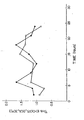
- the attached drawing is a graph showing a relationship between an inherent viscosity and an addition time of phosphorus pentoxide.
- the peptide active ester acid salt of the formula (I) is used as a monomer.
- a-Amino acids having more than 5 amino acid residual units can be obtained by a conventional peptide synthesis (condensation reaction) using the tripeptides and the like mentioned above.
- Preferable examples of the combinations of a-amino acids are Pro-Leu-Gly, Ala-Gly-Gly, Pro-Phe-Gly, Ala-Phe-Gly, Pro-Lys-Gly, Pro-Gly-Gly, Pro-Pro-Gly, etc.
- peptide active ester acid salts of the formula (I) are as follows:
- the peptide active ester acid salts of the formula (I) used as a monomer in this invention preferably have a high purity. They can be prepared by a conventional peptide synthesis method. For example, a methyl or ethyl ester of an amino acid is coupled with an amino group-protected amino acid, the protective group for amino group is selectively removed, followed by coupling with an amino group-protected amino acid. Repeating these procedures, there can be obtained an amino group-protected peptide ester having an amino acid skelton necessary for the monomer.
- the alkyl ester moiety of the resulting product is selectively cut, followed by coupling with an active alcohol such as a chlorinated phenol to produce an amino group-protected peptide active ester. After removing the protective group for amino group, there is obtained the peptide active ester acid salt of the formula (I) used as the monomer.
- the protective group for amino acid there can be used conventional ones such as a benzyloxycarbonyl group, a p-methoxybenzyloxycarbonyl group, a t-butyloxycarbonyl group, a t-amyloxycarbonyl group, an o-nitro- phenylsulfenyl group, a t-butoxycarbonyl-N-c-benzyloxycarbonyl group, etc.
- chlorinated phenols such as pentachlorophenol, 2,4,6-or 2,4,5-trichlorophenol, p-chlorophenol, etc., nitrophenols such as p-nitrophenol, o-nitrophenol, etc., N-hydroxyimides such as N-hydroxysuccinimide, etc.
- the above-mentioned conventional DCC method, active ester method, and NCA method can be used alone or in combination. But since the yield and purity of the product in the peptide synthesis are remarkably influenced by the order of combination and reagents used, and the polymerization reaction is also influenced, much care is necessary for employing these methods.
- an amino acid having no optically active carbon in theory as carboxyl terminal, for example, glycine.
- peptites having 3 to 10 amino acid residues but from the economical point of view, the use of peptites having 3 to 5, more specifically 3 or 4 amino acid residues as the monomer is preferable.
- the peptide active ester acid salt of the formula (I) is dissolved in an aprotic polar solvent.
- aprotic polar solvent there can be used dimethylformamide (DMF), diethylformamide, dimethylacetamide, dimethyl sulfoxide (DMSO), tetramethylurea, hexamethylphosphoramide, N-methyl-2-pyrrolidone, diethyl phosphite, etc. These solvents can be used alone or as a mixture thereof.
- the polycondensation of the peptide active ester acid salt of the formula (I) dissolved in the aprotic polar solvent is carried out in the presence of a tertiary amine.
- tertiary amine there can be used triethylamine, triethanolamine, trimethylamine, N-methyl morpholine, N,N'-dimethyl piperadine, etc. Among them, triethylamine and N-methyl morpholine are preferable.
- the tertiary amine is used preferably in an amount of 1 to 5 equivalent weight per equivalent weight of the monomer of the formula (I). If the amount is too small, the catalytic effect is insufficient, while if the amount is too large, racemization takes place due to a free base.
- Phosphorus pentoxide is added to the reaction mixture preferably after 10 minutes to 48 hours from the beginning of the polymerization (polycondensation) (that is, the addition of a tertiary amine to the aprotic polar solvent dissolving the monomer of the formula (I)) in an amount of preferably 0.01 to 10 equivalent weight per equivalent weight of the monomer of the formula (I). If the amount is too small, the effect for increasing the degree of polymerization is insufficient, while if the amount is too large, the whole polymerization system is solidified to lose practical meaning. More preferable amount of phosphorus pentoxide is 1 to 3 equivalent weight per equivalent weight of the monomer of the formula (I).
- Phosphorus pentoxide can be added to the reaction mixture at one time or at several times without influencing the degree of polymerization or without lowering optical purity of the polyamino acid.
- the polycondensation is preferably carried out at room temperature (20°C) to 100°C for several hours to about 2 weeks, more preferably 3 to 10 days.
- the reaction is mainly carried out in the gel state.
- the resulting sequential polyamino acid resin can be recovered by a conventional method.
- chloroform is added to the reaction solution and the polyamino acid resin is deposited by adding ethyl ether thereto.
- the polyamino acid resin is dissolved in dichloroacetic acid, hexafluoroisopropanol, dimethylformamide, or trifluoroethanol, reprecipitated with ethyl ether, washed with water and then acetone or methanol and dried to give purified polyamino acid resin.
- a water-soluble polymer such as (Pro-Pro-Gly) , it can be purified by dialysis using cellophane film.
- the resulting polyamino acid resin usually has a remarkably high molecular weight [an inherent viscosity ( ⁇ inh) of 0.7 to 3 dl/g (measured in DCA (dichloroacetic acid) at a concentration (C) of 0.075 g/dl at 30°C)] and can be dissolved in dichloroacetic acid, 1,1,1,3,3,3-hexafluoro-2-propanol, 1,1,1-trifluoroethanol, etc.
- Amino acid analytical values of acid hydrolysis product of the resulting polyamino acid resin well agree to the composition of amino acids used as monomer and the elementary analysis values are also in good agreement with the theoretical values. Further, infrared spectra of the polyamino acid resin show characteristic absorptions of polypeptide.
- the thus produced polyamino acid resin can be used as high polymers for medical use, artificial skin, various medicines having gradual and prolonged pharma - cological efficiency, a coating material for burn and a base for mecidines and cosmetics. More in detail, according to this invention, since a peptide having a special combination of minimum units necessary for physiological activity or structure similar to a living body can be polymerized as it is until a very high molecular weight is obtained in contrast to conventional methods wherein random copolymers are obtained, the resulting sequential polyamino acid resin can be used as protein models in diverse areas.
- the deposited dicyclohexylurea was filtered and the solvent in the filtrate was removed by distillation. After extracting the residue with 3 t of ethyl acetate, the extract was washed with 5% citric acid aqueous solution, saturated sodium chloride aqueous solution, 1N sodium bicarbonate aqueous solution and saturated sodium chloride aqueous solution in this order and dried over magnesium sulfate. Then, the solvent was removed by distillation to give white crystals having a melting point of 129-130°C in yield of 256.7 g (73.4%).
- the Rf value in thin layer chromatography (TLC) using silica gel and ethyl acetate as developer was 0.91, when ninhydrin in acetone solution was used as color producing reagent (the same color producing reagent was used in the following Examples).
- N-t-butoxycarbonyl-prolyl-leucyl-glycine methyl ester in an amount of 294.6 g was dissolved in 1.6 l of methanol.
- 1.6 l of 1N-NaOH was added dropwise with ice cooling and the reaction was carried out at room temperature for 2 hours.
- 20% citric acid was added dropwise to the reaction mixture to make the pH 3 to 4.
- the whole reaction mixture was extracted with 5 l of ethyl acetate, and the extract was washed well with 5% citric acid solution and saturated sodium chloride aqueous solution, and dried. After removing the solvent by distillation, a white solid was obtained.
- N-t-Butoxycarbonyl-prolyl-leucyl-glycine in an amount of 115.6 g and 83.9 g of pentachlorophenol were dissolved in 2 1 of methylen chloride.
- a solution obtained by dissolving 65.0 g of DCC in 1 l of methylene chloride was added dropwise with ice cooling (0 - -15°C) and the reaction was carried out overnight.
- the deposited DCU was filtered and methylene chloride was removed by distillation from the filtrate. Then, the residue was dissolved in 6.5 l of ethyl acetate, washed with 5% citric acid solution, saturated sodium chloride aqueous solution, and saturated sodium bicarbonate solution and dried.
- Example 2 The ester obtained in Example 2 in an amount of 81.5 g was dissolved in 1.5 A of ethyl acetate and into this, hydrogen chloride gas was thrown with cooling at 0°C. After standing at room temperature for 3 hours, the precipitate was filtered and washed with ethyl acetate and ether repeatingly to give a solid in yield of 72.3 g (98%).
- Prolyl-leucyl-glycine p-nitrophenyl ester obtained from N-t-butoxycarbonyl-prolyl-leucyl-glicine, p-nitrophenol and DCC by condensation in amount of 5.06 g was treated with 66 ml of 3.3N HCl-ethyl acetate for 1.5 hours.
- N-t-Butoxycarbonyl-prolyl-phenylalanyl-glycine pentachlorophenyl ester in an amount of 36.4 g was dissolved in 410 ml of 2.2N HCl-ethyl acetate. A precipitate was produced soon.
- Prolyl-leucyl-glycine pentachlorophenyl ester hydrochloride obtained in Example 3 in an amount of 1.20 g was dissolved in 1.5 ml of dimethyl sulfoxide (DMSO) in a test tube. Then, 0.42 g of N-methyl morpholine (NMM) was added thereto. After three hours from the addition of NMM , 0.57 g of phosphorus pentoxide (P205) was added to the test tube. The reaction was continued at 40°C for 6 days. The reaction mixture was a reddish brown gelatin-like solid. The reaction mixture solid was diluted with 15 ml of chloroform and then poured into 150 ml of ether to produce a solid. The solid was filtered, washed with acetone, water, acetone, and ether in this order, and dried in vacuum over P 2 0 5 . The product was yielded quantitatively.
- DMSO dimethyl sulfoxide
- NMM N-methyl morph
- ⁇ inh is above about 0.7 irrespective of the time at which P 2 0 5 was added (in one time).
- Glycine ethyl ester ⁇ hydrochloride in an amount of 20.6 g was dissolved in 500 ml of chloroform and 20 ml of triethylamine was added thereto. Then, 57.2 g of carbobenzoxyphenylalanine p-nitorphenyl ester was added to the resulting mixture and the reaction was carried out overnight at room temperature. The resulting mixture was washed with IN-NaHC0 3 , water, IN-HCl and water in this order and the chloroform layer was dried over magnesium sulfate (MgS0 4 ).
- MgS0 4 magnesium sulfate
- the above-mentioned monomer i.e., alanyl-phenylalanyl-glycine pentachlorophenyl ester.hydrobromide in an amount of 1.00 g was mixed with 2 ml of dimethyl sulfoxide (DMSO) and 0.45 g (2 equivalent weight) of triethylamine was added thereto to conduct the polymerization at 40°C for 5'hours. Then, 0.46 g of phosphorus pentoxide was added with agitation to the reaction mixture, which was allowed to stand at 40°C for 7 days for carrying out the polymerization. Then, the reaction mixture was washed with ether, methanol, and water in this order repeatedly and filtered.
- DMSO dimethyl sulfoxide
Landscapes
- Chemical & Material Sciences (AREA)
- Health & Medical Sciences (AREA)
- Chemical Kinetics & Catalysis (AREA)
- Medicinal Chemistry (AREA)
- Polymers & Plastics (AREA)
- Organic Chemistry (AREA)
- Peptides Or Proteins (AREA)
- Medicines That Contain Protein Lipid Enzymes And Other Medicines (AREA)
- Polyamides (AREA)
Applications Claiming Priority (2)
| Application Number | Priority Date | Filing Date | Title |
|---|---|---|---|
| JP161650/83 | 1983-09-02 | ||
| JP58161650A JPS6053535A (ja) | 1983-09-02 | 1983-09-02 | 規則性ポリアミノ酸樹脂の製造方法 |
Publications (2)
| Publication Number | Publication Date |
|---|---|
| EP0142231A1 true EP0142231A1 (fr) | 1985-05-22 |
| EP0142231B1 EP0142231B1 (fr) | 1987-11-11 |
Family
ID=15739217
Family Applications (1)
| Application Number | Title | Priority Date | Filing Date |
|---|---|---|---|
| EP84305973A Expired EP0142231B1 (fr) | 1983-09-02 | 1984-08-31 | Procédé de préparation de résine de polyaminoacides séquencées |
Country Status (4)
| Country | Link |
|---|---|
| US (1) | US4594409A (fr) |
| EP (1) | EP0142231B1 (fr) |
| JP (1) | JPS6053535A (fr) |
| DE (1) | DE3467360D1 (fr) |
Cited By (1)
| Publication number | Priority date | Publication date | Assignee | Title |
|---|---|---|---|---|
| FR2658076A1 (fr) * | 1990-02-12 | 1991-08-16 | Sanofi Sa | Composition cosmetique contenant des copolymeres d'aminoacides, utile comme agent hydratant. |
Families Citing this family (17)
| Publication number | Priority date | Publication date | Assignee | Title |
|---|---|---|---|---|
| JPH0214109U (fr) * | 1988-07-09 | 1990-01-29 | ||
| US4996292A (en) * | 1989-06-30 | 1991-02-26 | Fox Sidney W | Self-sealing artificial skin comprising copoly-alpha-amino acid |
| US5171505A (en) * | 1990-11-28 | 1992-12-15 | E. I. Du Pont De Nemours And Company | Process for spinning polypeptide fibers |
| US5328690A (en) * | 1991-02-21 | 1994-07-12 | University Of South Alabama | Polyamino acid dispersants |
| US5393868A (en) * | 1992-10-13 | 1995-02-28 | Rohm And Haas Company | Production of polysuccinimide by thermal polymerization of maleamic acid |
| US5252277A (en) * | 1992-10-23 | 1993-10-12 | E. I. Du Pont De Nemours And Company | Process for spinning polypeptide fibers from solutions of lithium thiocyanate and liquefied phenol |
| US5527610A (en) * | 1994-05-20 | 1996-06-18 | The Uab Research Foundation | Elastomeric polypeptide matrices for preventing adhesion of biological materials |
| IL113812A (en) | 1994-05-24 | 2000-06-29 | Yeda Res & Dev | Copolymer-1 pharmaceutical compositions containing it and its use |
| WO2000005250A1 (fr) | 1998-07-23 | 2000-02-03 | Yeda Research And Development Co., Ltd | Traitement de maladies auto-immunes a l'aide du copolymere 1 et des copolymeres et peptides apparentes |
| ES2527760T3 (es) * | 1998-07-23 | 2015-01-29 | Yeda Research And Development Co., Ltd. | Tratamiento de enfermedad de Crohn con copolímero 1 y polipéptidos |
| US6800287B2 (en) * | 1998-09-25 | 2004-10-05 | Yeda Research And Development Co., Ltd. | Copolymer 1 related polypeptides for use as molecular weight markers and for therapeutic use |
| WO2002076503A1 (fr) * | 2000-06-20 | 2002-10-03 | Mayo Foundation For Medical Education And Research | Traitement de maladies du systeme nerveux central au moyen d'anticorps diriges contre l'acetate de glatiramere |
| CA2469393C (fr) * | 2001-12-04 | 2010-05-25 | Teva Pharmaceutical Industries, Ltd. | Procedes pour mesurer la puissance de l'acetate de glatiramer |
| DK1797109T3 (en) | 2004-09-09 | 2016-04-11 | Yeda Res & Dev | MIXTURES OF POLYPEPTIDES, compositions containing them and methods for their preparation, and uses thereof |
| NZ554018A (en) * | 2004-09-09 | 2009-06-26 | Teva Pharma | Process for preparation of trifluoroacetyl glatiramer acetate using purified hydrobromic acid |
| WO2006050122A1 (fr) * | 2004-10-29 | 2006-05-11 | Sandoz Ag | Procedes de preparation d'un glatiramere |
| KR100831796B1 (ko) * | 2006-05-29 | 2008-05-28 | 엘지전자 주식회사 | 타임 쉬프트 기능을 내장한 영상표시기기 및 그 재생 방법 |
Citations (1)
| Publication number | Priority date | Publication date | Assignee | Title |
|---|---|---|---|---|
| US4187852A (en) * | 1976-07-09 | 1980-02-12 | The University Of Alabama | Synthetic elastomeric insoluble cross-linked polypentapeptide |
Family Cites Families (3)
| Publication number | Priority date | Publication date | Assignee | Title |
|---|---|---|---|---|
| JPS52137495A (en) * | 1976-05-13 | 1977-11-16 | Agency Of Ind Science & Technol | Preparation of polyamino acid resin with regularity |
| US4132746A (en) * | 1976-07-09 | 1979-01-02 | University Of Alabama, Birmingham Medical & Education Foundation | Synthetic elastomeric insoluble cross-linked polypentapeptide |
| JPS6086124A (ja) * | 1983-10-17 | 1985-05-15 | Nitto Boseki Co Ltd | 規則性ポリアミノ酸樹脂の製造方法 |
-
1983
- 1983-09-02 JP JP58161650A patent/JPS6053535A/ja active Pending
-
1984
- 1984-08-30 US US06/646,317 patent/US4594409A/en not_active Expired - Fee Related
- 1984-08-31 EP EP84305973A patent/EP0142231B1/fr not_active Expired
- 1984-08-31 DE DE8484305973T patent/DE3467360D1/de not_active Expired
Patent Citations (1)
| Publication number | Priority date | Publication date | Assignee | Title |
|---|---|---|---|---|
| US4187852A (en) * | 1976-07-09 | 1980-02-12 | The University Of Alabama | Synthetic elastomeric insoluble cross-linked polypentapeptide |
Non-Patent Citations (1)
| Title |
|---|
| CHEMICAL ABSTRACTS, vol. 78, no. 6, 12th February 1973, page 2, no. 30246n, Columbus, Ohio, USA; R. FAIRWEATHER et al.: "Sequential polypeptides. VI. Synthesis of sequential polypeptide collagen models containing proline analogs" & J. CHEM. SOC., PERKIN TRANS. I, 1972, (19), 2475-2481 * |
Cited By (3)
| Publication number | Priority date | Publication date | Assignee | Title |
|---|---|---|---|---|
| FR2658076A1 (fr) * | 1990-02-12 | 1991-08-16 | Sanofi Sa | Composition cosmetique contenant des copolymeres d'aminoacides, utile comme agent hydratant. |
| EP0452161A1 (fr) * | 1990-02-12 | 1991-10-16 | Elf Sanofi | Composition cosmétique contenant des copolymères d'aminoacides, utile comme agent hydratant |
| US5204099A (en) * | 1990-02-12 | 1993-04-20 | Sanofi | Cosmetic composition containing amino acid copolymers which is useful as a moisturizer |
Also Published As
| Publication number | Publication date |
|---|---|
| DE3467360D1 (en) | 1987-12-17 |
| JPS6053535A (ja) | 1985-03-27 |
| EP0142231B1 (fr) | 1987-11-11 |
| US4594409A (en) | 1986-06-10 |
Similar Documents
| Publication | Publication Date | Title |
|---|---|---|
| US4594409A (en) | Producing sequential polyamino acid resin | |
| US4743677A (en) | Calcitonin gene related peptide derivatives | |
| FI70234B (fi) | Foerfarande foer framstaellning av aminofunktionaliserade akrylkopolymerer | |
| FR2465713A1 (fr) | Nouveaux peptides biologiquement actifs et leur emploi comme medicaments | |
| EP0168063A2 (fr) | Peptide servant d'intermédiaire dans la production d'un peptide physiologiquement actif | |
| AU2006279557A1 (en) | Process for the preparation of copolymer-1 | |
| DK146623B (da) | Fremgangsmaade til fremstilling af bifunktionelt tvaerbundet insulin | |
| Hudecz et al. | Synthesis of new branched polypeptides with poly (lysine) back bone | |
| US5011825A (en) | Peptides influencing diuresis and natriuresis, a process for their preparation, agents containing them, and their use | |
| US5095004A (en) | Fluorine containing atrial natriuretic peptides | |
| JPH0153268B2 (fr) | ||
| US4525576A (en) | Process for producing sequential polyamino acid resin | |
| US4133805A (en) | Cyclic undecapeptides related to somatostatin and intermediates therefor | |
| Nomizu et al. | Synthesis of phosphonomethyl-phenylalanine and phosphotyrosine containing cyclic peptides as inhibitors of protein tyrosine kinase/SH2 interactions. | |
| US4764589A (en) | [N-alpha-acyl,8-glycine, des-19-leucine]-calcitonin | |
| US20090035816A1 (en) | Process for the preparation of a polypeptide | |
| SU1182051A1 (ru) | Политрипептиды,обладающие энантовой селективностью в реакци х гидролиза @ -нитрофениловых эфиров карбобензокси - @ - и @ -аланина | |
| CA1157466A (fr) | Peptides ayant des proprietes ressemblant a celles de la thymopoietine | |
| Nishi et al. | Polymerization reaction with diphenylphosphoryl azide. Preparation of poly (α‐amino acid) s by direct polycondensation of α‐amino acids | |
| FR2557114A1 (fr) | Nouveaux derives de la gonadoliberine, procede pour leur preparation et compositions pharmaceutiques les contenant | |
| Pawlak et al. | Synthesis of a novel side‐chain to side‐chain cyclized enkephalin analogue containing a carbonyl bridge | |
| Fukushima | Secondary structural analysis in the solid state for analogous sequential polypeptides of glycine-rich sequence of spider dragline silk | |
| Fairweather et al. | Sequential polypeptides. Part IV. The synthesis of poly-(L-alanyl-giycyi-L-proline) and its stereoisomers | |
| KR0141973B1 (ko) | 신규의 생리활성 펩티드 및 이를 유효성분으로서 함유한 칼슘대사 조절제 | |
| NO308951B1 (no) | AnalogifremgangsmÕte for fremstilling av terapeutisk aktive korte peptider med insulinvirkning |
Legal Events
| Date | Code | Title | Description |
|---|---|---|---|
| PUAI | Public reference made under article 153(3) epc to a published international application that has entered the european phase |
Free format text: ORIGINAL CODE: 0009012 |
|
| AK | Designated contracting states |
Designated state(s): DE FR GB |
|
| 17P | Request for examination filed |
Effective date: 19850902 |
|
| 17Q | First examination report despatched |
Effective date: 19860828 |
|
| GRAA | (expected) grant |
Free format text: ORIGINAL CODE: 0009210 |
|
| AK | Designated contracting states |
Kind code of ref document: B1 Designated state(s): DE FR GB |
|
| REF | Corresponds to: |
Ref document number: 3467360 Country of ref document: DE Date of ref document: 19871217 |
|
| ET | Fr: translation filed | ||
| PG25 | Lapsed in a contracting state [announced via postgrant information from national office to epo] |
Ref country code: GB Free format text: LAPSE BECAUSE OF NON-PAYMENT OF DUE FEES Effective date: 19880831 |
|
| PLBE | No opposition filed within time limit |
Free format text: ORIGINAL CODE: 0009261 |
|
| STAA | Information on the status of an ep patent application or granted ep patent |
Free format text: STATUS: NO OPPOSITION FILED WITHIN TIME LIMIT |
|
| 26N | No opposition filed | ||
| PG25 | Lapsed in a contracting state [announced via postgrant information from national office to epo] |
Ref country code: FR Free format text: LAPSE BECAUSE OF NON-PAYMENT OF DUE FEES Effective date: 19890428 |
|
| PG25 | Lapsed in a contracting state [announced via postgrant information from national office to epo] |
Ref country code: DE Effective date: 19890503 |
|
| GBPC | Gb: european patent ceased through non-payment of renewal fee | ||
| REG | Reference to a national code |
Ref country code: FR Ref legal event code: ST |