EP0142377A2 - Appareil de pulvérisation de liquide et procédé de pulvérisation - Google Patents
Appareil de pulvérisation de liquide et procédé de pulvérisation Download PDFInfo
- Publication number
- EP0142377A2 EP0142377A2 EP84307927A EP84307927A EP0142377A2 EP 0142377 A2 EP0142377 A2 EP 0142377A2 EP 84307927 A EP84307927 A EP 84307927A EP 84307927 A EP84307927 A EP 84307927A EP 0142377 A2 EP0142377 A2 EP 0142377A2
- Authority
- EP
- European Patent Office
- Prior art keywords
- cup
- liquid
- spray
- distributor
- gas
- Prior art date
- Legal status (The legal status is an assumption and is not a legal conclusion. Google has not performed a legal analysis and makes no representation as to the accuracy of the status listed.)
- Granted
Links
Images



Classifications
-
- B—PERFORMING OPERATIONS; TRANSPORTING
- B05—SPRAYING OR ATOMISING IN GENERAL; APPLYING FLUENT MATERIALS TO SURFACES, IN GENERAL
- B05B—SPRAYING APPARATUS; ATOMISING APPARATUS; NOZZLES
- B05B3/00—Spraying or sprinkling apparatus with moving outlet elements or moving deflecting elements
- B05B3/02—Spraying or sprinkling apparatus with moving outlet elements or moving deflecting elements with rotating elements
- B05B3/10—Spraying or sprinkling apparatus with moving outlet elements or moving deflecting elements with rotating elements discharging over substantially the whole periphery of the rotating member
- B05B3/1057—Spraying or sprinkling apparatus with moving outlet elements or moving deflecting elements with rotating elements discharging over substantially the whole periphery of the rotating member with at least two outlets, other than gas and cleaning fluid outlets, for discharging, selectively or not, different or identical liquids or other fluent materials on the rotating element
-
- B—PERFORMING OPERATIONS; TRANSPORTING
- B01—PHYSICAL OR CHEMICAL PROCESSES OR APPARATUS IN GENERAL
- B01D—SEPARATION
- B01D53/00—Separation of gases or vapours; Recovering vapours of volatile solvents from gases; Chemical or biological purification of waste gases, e.g. engine exhaust gases, smoke, fumes, flue gases, aerosols
- B01D53/34—Chemical or biological purification of waste gases
- B01D53/46—Removing components of defined structure
- B01D53/48—Sulfur compounds
- B01D53/50—Sulfur oxides
- B01D53/501—Sulfur oxides by treating the gases with a solution or a suspension of an alkali or earth-alkali or ammonium compound
-
- B—PERFORMING OPERATIONS; TRANSPORTING
- B05—SPRAYING OR ATOMISING IN GENERAL; APPLYING FLUENT MATERIALS TO SURFACES, IN GENERAL
- B05B—SPRAYING APPARATUS; ATOMISING APPARATUS; NOZZLES
- B05B3/00—Spraying or sprinkling apparatus with moving outlet elements or moving deflecting elements
- B05B3/02—Spraying or sprinkling apparatus with moving outlet elements or moving deflecting elements with rotating elements
- B05B3/10—Spraying or sprinkling apparatus with moving outlet elements or moving deflecting elements with rotating elements discharging over substantially the whole periphery of the rotating member
- B05B3/1007—Spraying or sprinkling apparatus with moving outlet elements or moving deflecting elements with rotating elements discharging over substantially the whole periphery of the rotating member characterised by the rotating member
- B05B3/1014—Spraying or sprinkling apparatus with moving outlet elements or moving deflecting elements with rotating elements discharging over substantially the whole periphery of the rotating member characterised by the rotating member with a spraying edge, e.g. like a cup or a bell
-
- B—PERFORMING OPERATIONS; TRANSPORTING
- B05—SPRAYING OR ATOMISING IN GENERAL; APPLYING FLUENT MATERIALS TO SURFACES, IN GENERAL
- B05B—SPRAYING APPARATUS; ATOMISING APPARATUS; NOZZLES
- B05B3/00—Spraying or sprinkling apparatus with moving outlet elements or moving deflecting elements
- B05B3/02—Spraying or sprinkling apparatus with moving outlet elements or moving deflecting elements with rotating elements
- B05B3/10—Spraying or sprinkling apparatus with moving outlet elements or moving deflecting elements with rotating elements discharging over substantially the whole periphery of the rotating member
- B05B3/1064—Spraying or sprinkling apparatus with moving outlet elements or moving deflecting elements with rotating elements discharging over substantially the whole periphery of the rotating member the liquid or other fluent material to be sprayed being axially supplied to the rotating member through a hollow rotating shaft
-
- B—PERFORMING OPERATIONS; TRANSPORTING
- B05—SPRAYING OR ATOMISING IN GENERAL; APPLYING FLUENT MATERIALS TO SURFACES, IN GENERAL
- B05B—SPRAYING APPARATUS; ATOMISING APPARATUS; NOZZLES
- B05B3/00—Spraying or sprinkling apparatus with moving outlet elements or moving deflecting elements
- B05B3/02—Spraying or sprinkling apparatus with moving outlet elements or moving deflecting elements with rotating elements
- B05B3/10—Spraying or sprinkling apparatus with moving outlet elements or moving deflecting elements with rotating elements discharging over substantially the whole periphery of the rotating member
- B05B3/1092—Means for supplying shaping gas
Definitions
- This invention is concerned with improvements in or relating to liquid spraying particularly but not exclusively the spraying of a liquid/solid slurry.
- Patent Application 2,084,896 for this spray device is the treatment of a polluted gas e.g. containing sulphur dioxide, by the spraying into the gas of a liquid/solid slurry e.g. an aqueous lime slurry.
- a polluted gas e.g. containing sulphur dioxide
- Patent Application No. 2,084,896 is the use of a sodium carbonate solution in replacement of the aqueous lime slurry; other technical applications described therein are conditioning of a gas with water prior to passage through an electro-precipitator, and the evaporative cooling with water of a hot polluted gas; in all these cases build-up of solids can arise e.g. if the liquid being sprayed contains solid particulate impurities; or the risk of build-up of solids may arise from the nature of the polluted gas e.g. in the case of the evaporative cooling of polluted gas from a cement plant.
- the invention provides a method of treating a polluted gas with a liquid, wherein the liquid is directed from an extended surface of a spray device into the polluted gas to cool and/or clean the gas, the spray device comprising: (a) an axially symmetrical spray cup having an outer rim and an interior surface which provides said-extended surface; (b) distribution means, arranged symmetrically with respect to the cup, for directing liquid onto the extended surface and for providing a film of liquid on the extended surface preparatory to directing the liquid from the surface past the outer rim, which distribution means is stationary where it directs the liquid onto the extended surface; and (c) means for supplying a gas stream to impact the liquid immediately beyond the rim, to produce a spray of liquid droplets.
- the invention also provides apparatus adapted for use in absorbing a gaseous pollutant from a pollutant-containing gas under spray drying conditions comprising: (a) a spray dryer vessel; (b) means for conducting a pollutant-containing gas to the vessel; (c) a spray device adapted to spray an aqueous absorbent liquid into the vessel for reaction with the pollutant in the gas under the spray drying conditions to produce a solid reaction product; (d) means for separating solid reaction product from the gas; and (e) means for conducting the gas from the spray dryer vessel to the separating means; the spray device comprising: (f) an axially symmetical spray cup having an outer rim and an interior surface; (g) distribution means, arranged symmetrically with respect to the cup, for directing liquid onto the interior surface and for providing a film of liquid on the interior surface preparatory to directing the liquid from the surface past the outer rim, which distribution means is stationary where it directs the liquid onto the interior surface; and (h) means for supplying a gas
- the cup is rotated, but we believe under certain conditions it may also be possible to operate satisfactorily with the cup stationary.
- the gas may, for example, contain a solid pullutant e.g. fly ash or cement dust and/or a gaseous pollutant e.g. sulphur dioxide, nitrogen oxide, hydrogen chloride and mixtures thereof.
- a solid pullutant e.g. fly ash or cement dust
- a gaseous pollutant e.g. sulphur dioxide, nitrogen oxide, hydrogen chloride and mixtures thereof.
- the distribution means provides a swirl component of motion in the liquid being directed onto the extended surface.
- the extended surface for example converges generally frusto-conically from the outer rim of the cup, and the included frusto-conical angle is e.g. from 20° to 160°, preferably from 60° to 120°, and more preferably from 70° to 100°.
- the cup in external profile comprises for example a cylindrical upstream portion and a frusto-conical downstream portion; the ratio between the axial height of the frusto-conical portion and the height of the cylindrical portion is for example from 3:1 to 1:3, preferably from 2:1 to 1:3.
- the distribution means comprises for example an axially symmetrical baffle to gas flow extending into the cup coaxially therewith, an annular gap being provided between the baffle and the interior of the cup.
- the ratio of the diameter (D) of the cup at its outer rim to the axial distance (d) from the outer rim to a point where the liquid enters the interior of the cup is (D:d) from 3:1 to 6:1, preferably from 3:1 to 4:1.
- the spray device has a capacity up to about 15 Imperial gallons per minute (e.g. a capacity in the range from 2 to 15 Imperial gallons per minute):
- the spray device has a higher capacity e.g. up to 30 or 50 Imperial gallons per minute then the numerical upper limits are likely to be increased.
- the major diameter of the baffle is for example at least 70% and more preferably at least 75% of the diameter of the interior surface of the cup at the plane of said major diameter.
- the baffle is for example inverted frusto-conical with its included angle not exceeding about 140°, preferably not exceeding about 120°, and more preferably from 70° to 110°.
- the distribution means comprises for example an axially symmetrical upstream conical portion with the apex of the cone leading with respect to the flow of liquid.
- the included conical angle of this upstream conical portion is for example from 20 0 to 85°, preferably from 20 to 40 , more preferably from 20 to 30°.
- the baffle is for example set back from the outer rim of the cup so that the ratio between the diameter (D) and the axial distance (d') from the outer rim to the baffle is (D:d') from 4:1 to 8:1, preferably from 5:1 to 8:1.
- the distribution means is adapted to accelerate the liquid onto a distribution cup which then directs it onto the extended surface in a direction generally opposed to the direction of the liquid past the outer rim of the cup.
- the extended surface is for example curved in radial cross section with an apex and the ratio of the diameter (D') of the cup at its outer rim to the axial distance (d") from the rim to the apex is (D':d") from 3:1 to 8:1.
- the spray device of this embodiment has a capacity up to about 15 Imperial gallons per minute (e.g. a capacity in the range from 2 to 15 Imperial gallons per minute);
- the invention also provides a spray device comprising: (a) a massive axially symmetrical spray cup having an outer rim and an interior surface; (b) means for rotating the cup; (c) stationary distribution means, arranged symmetrically with respect to the cup, for directing liquid onto the interior surface of the cup and for providing a film of liquid on the interior surface preparatory to directing the liquid from the surface past the outer rim; and (d) means for supplying a gas stream to impact the liquid immediately beyond the rim to produce a spray of liquid droplets; the distribution means comprising: (e) a downstream end portion in the form of an axially symmetrical distributor cup coaxial with and facing the spray cup, the distributor cup having an outer rim of lesser diameter than the outer rim of the spray cup; and (f) a passage of generally venturi configuration adjacent to the distributor cup upstream thereof.
- the invention also provides a spray device comprising: (a) a massive axially symmetrical spray cup having an outer rim and an interior surface; (b) means for rotating the cup; (c) stationary distribution means, arranged symmetrically with respect to the cup, for directing liquid onto the interior surface of the cup and for providing a film of liquid on the interior surface preparatory to directing the liquid from the surface past the outer rim; and (d) means for supplying a gas stream to impact the liquid immediately beyond the rim to produce a spray of liquid droplets; the distribution means comprising: (e) a downstream duct portion; and (f) stationary swirl means for providing a swirl component of motion in the liquid being directed onto the extended surface; the swirl means comprising: (g) a stationary swirl member axially symmetrically located within the downstream duct portion of the distribution means, and wherein an annular passage is defined between the swirl member and the duct portion; the swirl member comprising: (h) a plurality of symmetrically arranged swirl blades; and (i) an
- the spray devices embodying the invention find particular, but not exclusive technical application in an apparatus and method for desulphurising a sulphur- dioxide containing gas by spray drying using an aqueous lime slurry, as described in Patent Application No. 2,084,896.
- the spray devices embodying the invention may also be employed in the other technical applications described in Patent Application No. 2,084,896; a further possible technical application is in the treatment of a polluted gas from an incinerator plant where for example a sodium carbonate solution is used to remove inter alia hydrogen chloride from the gas.
- FIG. 1 Apparatus adapted for use in desulphurising flue gas from a coal-fired installation is illustrated schematically in Figure 1.
- a unit shown at 5 for treating the flue gas after a tall thin spray drier tower 6, comprises a bag filter or an electro-precipitator. Slurries of slaked lime or limestone are prepared in a vessel 7 and pumped by a pump 8 via a line 36 to a rotating cup atomiser 9 at the top of tower 6.
- Hot gas for example boiler flue gas at a temperature between 120°C and 200°C containing sulphur dioxide as a pollutant (e.g. 300-3,000 p.p.m. S0 2 by volume) is directed to the top of the tower 6 via line 10.
- a pollutant e.g. 300-3,000 p.p.m. S0 2 by volume
- Spray drying occurs in the tower 6 upon contact of the hot gas and the atomised slurry, and dry powder effluent is collected at the bottom of tower 6 and removed via a valve 6a.
- the flue gas then passes via line 10a through bag filter or electro-precipitator 5 and further powder effluent and fly ash (including some spent absorbent) is separated from the gas, collected in hoppers 12 and removed via valves 12a.
- the substantially desulphurised flue gas is then exhausted by a fan 11 to the atmosphere via a stack 13.
- the tower 6 and its operation are generally similar to the tower described in Patent Application No. 2,084,896 with reference to Figures 6, 7 and 8 thereof.
- a single tower 6 handles up to 500,000 cubic feet (ambient conditions) per minute of flue gas (14,000 cubic metres per minute), and a 500 Megawatt coal burning power station would require 4 or 5 such towers to handle its entire flue gas effluent.
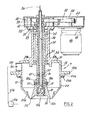
- a liquid supply path comprises a hollow vertical stationary duct portion 56, and a vertical downstream duct portion 17 ( Figure 3) of a generally axially symmetrical stationary distributor assembly 17a which is screwed onto a lower stub end portion 20 of the duct portion 56, and leads symmetrically to the interior 18b of a massive axially symmetrical rotating cup 18 of integral form.
- the slurry line 36 leads into the duct portion 56.
- liquid supply path from the top of duct 56 downwardly is generally symmetrical about the axis of the duct portion 56, and about the axis of rotation of the cup 18.
- the cup 18 of integral form is secured to a lower end portion of a rotatable hollow shaft 16, by radially spaced set screws 18a.
- the cup 18 rotates with the shaft 16 about its axis in the operation of the atomiser, but it will be realized the duct portion 56, and the distributor assembly 17a remain stationary; the shaft 16 is spaced from the duct portion 56 by ball bearings 57,59.
- the duct portion 56 is telescoped at 61 to accomodate the ball bearing 57.
- Air is supplied to the atomiser 9 through an annular chamber 21 external to the cup 18 by, for example, a blower 21a connected to the chamber 21 via a line 21b which includes a control valve 21c.
- the air exits the chamber 21 at high velocity (at least 280 feet/second) via an annular nozzle aperture 22 defined around a lower, outer, rim 22a of the rotary cup 18 and between the cup 18 and a stationary cup shroud 23 which defines an outer wall of the chamber 21.
- the shroud 23 comprises a lower ring portion 22b the interior of which converges downwardly to define the outer boundary of the nozzle aperture 22.
- the shroud 23 is bolted at 23b to a housing element 15 via respective flanges 23a, and 15a; the flange 15a is used in mounting the atomiser 9 in the tower 6.
- the shaft 16 extends upwardly through a housing element 30 where it is mounted in axially spaced ball bearings 32,34.
- the housing element 30 is bolted at 33 to the housing element 15 via a flange 31, and extends downwardly a short distance from the flange 31 into the housing element 15.
- An upper end portion of the shaft 16 extends into a belt housing 38 which is bolted at 37 to the housing element 30 via a flange 35; the housing 38 is reinforced by pillars 39.
- a belt pulley 40 is secured by two set screws 41 (only one of which is shown) to the upper end portion of the shaft 16 within the housing 38 and a drive belt 42 is tensioned within the housing 38 around the pulley 40 and a drive pulley 44 of an electric motor 46.
- the electric motor 46 is bolted to the housing 38 at 48.
- the cup 18 is rotated by the electric motor 46 at a speed of e.g. from 3,000 to 5,000 or 6,000 r.p.m., and the aqueous slurry of e.g. calcium hydroxide is continuously supplied to the interior 18b of the rotating cup 18 via the supply path including the distributor assembly 17a and is continuously distributed around an extended interior surface 74 of the cup 18 as a uniform thin film.
- the aqueous slurry of e.g. calcium hydroxide is continuously supplied to the interior 18b of the rotating cup 18 via the supply path including the distributor assembly 17a and is continuously distributed around an extended interior surface 74 of the cup 18 as a uniform thin film.
- centrifugal force directs the suspension past the rim 22a of the cup it is atomised immediately beyond the rim 22a by impaction with the high velocity stream of air exiting downwardly through aperture 22.
- the massive integral cup 18 comprises an upper externally circular cylindrical portion 76 which is secured to the shaft 16 by the set screws 18a and a lower externally frusto-conical portion 78 which converges upwardly from the rim 22a.
- the rim 22a of the cup 18 is sharply pointed and the interior surface 74 is again upwardly converging frusto-conical.
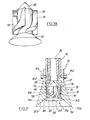
- the included frusto-conical angle ⁇ ( Figure 5) of the surface 74 is about 103°; the overall height of the cup 18 from the rim 22a to the top of the cylindrical portion 76 is about 83 mm; the diameter (D) of the cup 18 at the rim 22a is about 75 mm.
- the ratio of the axial height of the frusto-conical portion 78 to the cylindrical portion 76 is about 2.25:1.
- a lower portion 80 of the stationary distributor assembly 17a forms a frusto-conical baffle portion within the cup 18 coaxially therewith, leaving an annular gap 82 between the baffle portion 80 and the interior of the cup 18.
- a lower horizontal surface 84 of the baffle portion 80 is set back upwardly from the rim 22a of the cup 18.
- the axial distance (d) from the rim 22a to the upper extremity of the surface 74 is about 20 mm and the ratio (D:d) therefore about 3.75:1.
- the diameter of the surface 84 i.e.
- the major diameter of the frusto-conical baffle portion 80) is about 78% of the horizontal diameter of the surface 74 at the plane of the surface 84, and the annular gap 82 is at least sufficiently wide so as to avoid the possibility of obstruction by solid particles in the slurry.
- the included conical angle of the baffle is about 103°.
- the axial distance (d') from the rim 22a to the surface 84 is about 12 mm and the ratio (D:d') therefore about 6.25:1.
- the distributor assembly 17a also comprises a stationary swirl member 86 located axially symmetrically within the duct portion 17, an annular passage being defined between the swirl member 86 and the duct portion 17.
- the swirl member 86 comprises an upright sharply pointed conical upper end portion 88 and a cylindrical lower end portion 90 from which extend outwardly four symmetrically arranged swirl blades 92 (only three of which are shown).
- the included conical angle of the upper end portion 88 is about 80°.
- the baffle portion 80 is secured to the cylindrical portion 90 by a screw 94, and the swirl member 86 is secured within the duct 17 by locking pins 96 which engage the swirl blades 92.
- Each swirl blade 9 2 (as viewed in Figure 3) has a distorted L-configuration with the lower limb 93 of the L inclined generally at the same angle as the surface 74 of the cup 18.
- the duct portion 17 comprises an upright frusto-conical upper portion 104 vertically co-extensive with the conical portion 88 of the swirl member 86, and a lower cylindrical portion 106 which terminates in a frusto-conical end surface 102 collinear with the surface 74 of the cup 18 and terminating in a rim 103.
- the lower portion 90 of the swirl member 86 and the swirl blades 92 terminate in the plane of the rim 103.
- the slurry supplied via the interior of the stationary duct 56 and being directed onto the extended surface 74 by the distributor assembly 17a is given a swirling component of motion by the blades 92; and the slurry forms a thin continuous film on the surface 74 as previously described herein; the cup 18 rotates in the same sense as the swirling motion. Acceleration of the slurry does not take place until it reaches the surface 74, where it is caused by the rotation of the cup 18.
- annular gap 82 is unobstructed downstream of the blades 92 and this further minimises the risk of blockage of the flow of slurry due to solids build-up. It will be noted also that there are no slurry passages of significantly restricted cross section upstream of the gap 82.
- the atomiser 9 operates satisfactorily with flow rates of slurry e.g. from 1 to 10 Imperial gallons per minute and with slurry concentrations up to e.g. 40% lime solids by weight.
- the atomiser 9 provides for minimum liquid or slurry contact time and thin film formation on the extended surface of the cup, to reduce the tendency for build-up of solids either through chemical or mechanical action.
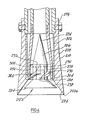
- the modified cup and distributor assembly shown in Figure 4 resembles that shown in Figure 3 in many respects of construction and arrangement, and is described insofar as it differs therefrom.
- the distributor assembly 217a of Figure 4 is generally longer and more streamlined than the distributor assembly 17a.
- the assembly 217a comprises a swirl assembly 286 which comprises a cylindrical central portion 288 from which extend four swirl blades 292.
- the central portion 288 comprises an axial bore 290 into which are screwed a stub 293 of a conical upper end portion 294, and a stub 296 of a lower frusto-conical baffle portion 298; the stubs 292,296 are secured in the bore 290 by locking pins 300.
- a cylindrical plastics bush 302 is secured within the cup 218 and a lower annular inwardly projecting portion 304 thereof provides a bearing surface closely adjacent the distributor assembly 217a.
- the included frusto-conical angle ⁇ ( Figure 5) of the surface 274 of the cup 218 of Figure 4 is about 94°; the overall height of the cup 218 from the rim 222a to the top of the cylindrical portion 276 is about 125 mm; the diameter (D) of the cup 218 at the rim 222a is about 75 mm.
- the ratio of the axial height of the frusto-conical portion 278 of the cup 218 to the cylindrical portion 276 is about 1.5:1.
- the axial distance (d) from the rim 222a to the upper extremity of the surface 274 is about 20 mm and the ratio D:d therefore about 3.75:1.
- the diameter of the surface 284 is about 81% of the horizontal diameter of the surface 274 at the plane of the surface 284.
- the included conical angle of the baffle 298 is about 102° or 108°.
- the included conical angle of the upper end portion 294 is about 24° or 28°.
- the axial distance (d') from the rim 222a to the surface 284 is about 10 mm and the ratio (D:d') therefore about 7.5:1.
- the modified cup and distributor assembly shown in Figure 6 again resembles that shown in Figure 3 in many respects of construction and arrangement, and is described insofar as it differs therefrom.
- a massive integral cup 418 comprises an upper externally circular cylindrical portion 476 which is secured to a shaft 416 by set screws 418a, an intermediate externally frusto-conical portion 478, and a lower externally cylindrical portion 479 which terminates in a rim 422a.
- the rim 422a is sharply pointed and an interior surface 474 of the cup 418 has a radial cross section comprising two merging part circles 477,479a of different radii; the inner part circle 477 is of smaller radius than the outer part circle 479a.
- the two radii provide a relatively large surface area for a small depth of cup.
- the overall height of the cup 418 from the rim 422a to the top of the cylindrical portion 476 is about 85 mm; the diameter (D') of the cup 418 at the rim 422a is about 115 mm.
- the ratio of the diameter (D) to the axial distance (d") from the level of the rim 422a to the apex of the surface 474 is about 6:1.
- a lower downstream end portion of a distributor assembly 417a is in the form of an axially symmetrical distributor cup 480, which also serves as a baffle to gas flow; the cup 480 is coaxial with the cup 418, and comprises a sharply pointed inverted conical lower portion 480a and an inverted frusto-conical upper portion 480b; the conical angle of the lower portion 480a is more acute than the conical angle of the upper portion 480b.
- the distributor cup 480 comprises an interior surface 482 of part-circular radial cross section facing the portion 477 of the surface 474 of the cup 418 and terminating in a sharply pointed outer rim 484.
- the distributor cup 480 is of much less diameter at its rim 484 than the cup 418; the ratio of the respective diameters at the rims422a,484 is from 3:1 to 5:1 preferably about 3.6:1.
- the surface 482 as it approaches the rim 484 is approximately parallel to the facing portion of the surface 474.
- a spider 487 Sandwiched between a stub end portion 420 of the duct 456 and an annular step 486 within a duct 417 is a spider 487 comprising an axial boss 488 with six (only two shown) symmetrically spaced radial ribs 490 and a lower circular cylindrical portion 493 from which the ribs 490 extend; the boss 488 comprises an upright upper sharply pointed conical portion 492.
- the distributor cup 480 is integral with an axial stem 494 which is screwed into the boss 488.
- an annular formation 496 Mounted within a lower portion of the duct 417 is an annular formation 496, which is secured to the duct by a locking pin 497.
- the stem 494 and the formation 496 are shaped to provide a passageway from the ribs 490 to the distributor cup 480 having a uniform annular upstream cross section 498, followed by a slightly diverging cross section 500, then downstream a passage 502 of generally venturi configuration.
- the stem 494 comprises an upper circular cylindrical portion 510 followed by an inverted frusto-conical portion 512, and then a lower circular cylindrical portion 514;
- the formation 496 surrounds the lower portion 514 of the stem 494 and comprises a downwardly converging upper surface 516 followed by a circular cylindrical surface 518 and a lower part-circular end portion 520 which merges into a complementary part-circular end portion 522 of the duct 417; the end portions 520,522 together form a semi-circular annular cross section facing the surface 482 of the distributor cup 480.
- the slurry In operation the slurry is accelerated as it passes through the venturi passage 502 prior to reaching the surface 482 of the distributor cup 480; the acceleration factor in terms of linear velocity is about 10:1.
- the slurry is directed by the part-circular surface 482 smoothly from the cup 480 onto the surface 474 of the cup 418.
- the slurry then distributes as a continuous thin film over the surface 474 of the rotating cup 418 as previously described herein. It will be noted that the liquid is directed by the surface 482 onto the surface 474 in a direction (upwards) generally opposed to the general direction (downwards) of the liquid sprayed into the gas.
- Acceleration of the slurry in the venturi passage 502 is believed not only to provide for even distribution of the slurry but also to minimise the risk of back circulation of the polluted gas causing chemical reaction and blockages upstream of the cup 480; the cup 480 also acts as a baffle against back circulation of gas. Furthermore it will be noted that the distributor assembly is free from any substantial restriction to liquid flow downstream of the venturi passage 502 and this again minimises the risk of blockage. The risk of blockage due to particulate impurities in the slurry is also minimised, and this applies equally where a sodium carbonate solution is used as the absorbent instead of a lime slurry.
Landscapes
- Engineering & Computer Science (AREA)
- Chemical & Material Sciences (AREA)
- Health & Medical Sciences (AREA)
- Biomedical Technology (AREA)
- Environmental & Geological Engineering (AREA)
- Analytical Chemistry (AREA)
- General Chemical & Material Sciences (AREA)
- Oil, Petroleum & Natural Gas (AREA)
- Chemical Kinetics & Catalysis (AREA)
- Treating Waste Gases (AREA)
Priority Applications (1)
| Application Number | Priority Date | Filing Date | Title |
|---|---|---|---|
| AT84307927T ATE39856T1 (de) | 1983-11-17 | 1984-11-15 | Fluessigkeitsspritzgeraet und verfahren zum spruehen. |
Applications Claiming Priority (4)
| Application Number | Priority Date | Filing Date | Title |
|---|---|---|---|
| GB838330663A GB8330663D0 (en) | 1983-11-17 | 1983-11-17 | Liquid spraying |
| GB8330663 | 1983-11-17 | ||
| GB838330662A GB8330662D0 (en) | 1983-11-17 | 1983-11-17 | Liquid spraying |
| GB8330662 | 1983-11-17 |
Publications (3)
| Publication Number | Publication Date |
|---|---|
| EP0142377A2 true EP0142377A2 (fr) | 1985-05-22 |
| EP0142377A3 EP0142377A3 (en) | 1986-02-12 |
| EP0142377B1 EP0142377B1 (fr) | 1989-01-11 |
Family
ID=26287012
Family Applications (1)
| Application Number | Title | Priority Date | Filing Date |
|---|---|---|---|
| EP84307927A Expired EP0142377B1 (fr) | 1983-11-17 | 1984-11-15 | Appareil de pulvérisation de liquide et procédé de pulvérisation |
Country Status (3)
| Country | Link |
|---|---|
| EP (1) | EP0142377B1 (fr) |
| DE (1) | DE3476029D1 (fr) |
| GB (1) | GB2149685B (fr) |
Cited By (6)
| Publication number | Priority date | Publication date | Assignee | Title |
|---|---|---|---|---|
| EP0216173A3 (en) * | 1985-08-26 | 1987-04-29 | Kabushiki Kaisha Toyota Chuo Kenkyusho | Rotating spraying type coating apparatus |
| US4798335A (en) * | 1986-09-16 | 1989-01-17 | Kabushiki Kaisha Toyota Chuo Kenkyusho | Rotating spraying type coating apparatus |
| EP0310151A1 (fr) * | 1987-09-25 | 1989-04-05 | Metallgesellschaft Ag | Dispositif pour la précipitation de polluants gazeux d'un gaz d'échappement |
| DE10053305A1 (de) * | 2000-10-27 | 2002-05-16 | Weitmann & Konrad Fa | Flüssigkeitsauftragsvorrichtung |
| EP2338586A4 (fr) * | 2008-08-12 | 2012-02-01 | Mitsubishi Heavy Ind Ltd | Dispositif de traitement d un gaz d échappement et système de traitement d un gaz d échappement |
| CN115445425A (zh) * | 2022-10-17 | 2022-12-09 | 山东省济南生态环境监测中心 | 一种工业废气处理设备 |
Families Citing this family (2)
| Publication number | Priority date | Publication date | Assignee | Title |
|---|---|---|---|---|
| GB8330663D0 (en) * | 1983-11-17 | 1983-12-29 | Dresser Ind | Liquid spraying |
| DE4300751C2 (de) * | 1993-01-14 | 1994-10-27 | Bernhard Reintanz | Vorrichtung zum Versprühen von Flüssigkeit, insbesondere von einer Kalkmilchsuspension in Rauchgase von Rauchgas-Entschwefelungsanlagen von Kraftwerken und Müllverbrennungsanlagen von Kraftwerken und Müllverbrennungsanlagen |
Family Cites Families (7)
| Publication number | Priority date | Publication date | Assignee | Title |
|---|---|---|---|---|
| GB463727A (en) * | 1935-09-03 | 1937-04-05 | Babcock & Wilcox Ltd | Improvements connected with evaporators |
| GB504392A (en) * | 1937-10-27 | 1939-04-25 | Joseph Darius Griffin | Improved apparatus for bringing fluids into intimate contact with one another |
| US2728607A (en) * | 1954-05-24 | 1955-12-27 | Ransburg Electro Coating Corp | Liquid feeding apparatus |
| CA846076A (en) * | 1965-04-17 | 1970-07-07 | Polycarbona-Chemie G.M.B.H. | Centrifugal atomizer |
| US3469718A (en) * | 1968-02-01 | 1969-09-30 | Grove Mfg Co | Spreader for grain bins |
| GB2084896B (en) * | 1980-10-03 | 1984-05-16 | Lodge Cottrell Ltd | Spray gas scrubbers |
| GB2131328B (en) * | 1982-12-10 | 1986-03-19 | Dresser Ind | Improvements in or relating to liquid spraying |
-
1984
- 1984-11-15 GB GB08428875A patent/GB2149685B/en not_active Expired
- 1984-11-15 DE DE8484307927T patent/DE3476029D1/de not_active Expired
- 1984-11-15 EP EP84307927A patent/EP0142377B1/fr not_active Expired
Cited By (11)
| Publication number | Priority date | Publication date | Assignee | Title |
|---|---|---|---|---|
| EP0216173A3 (en) * | 1985-08-26 | 1987-04-29 | Kabushiki Kaisha Toyota Chuo Kenkyusho | Rotating spraying type coating apparatus |
| US4792094A (en) * | 1985-08-26 | 1988-12-20 | Kabushiki Kaisha Toyota Chuo Kenkyusho | Rotating spraying type coating apparatus |
| US4798335A (en) * | 1986-09-16 | 1989-01-17 | Kabushiki Kaisha Toyota Chuo Kenkyusho | Rotating spraying type coating apparatus |
| EP0310151A1 (fr) * | 1987-09-25 | 1989-04-05 | Metallgesellschaft Ag | Dispositif pour la précipitation de polluants gazeux d'un gaz d'échappement |
| DE10053305A1 (de) * | 2000-10-27 | 2002-05-16 | Weitmann & Konrad Fa | Flüssigkeitsauftragsvorrichtung |
| DE10053305C2 (de) * | 2000-10-27 | 2003-02-27 | Weitmann & Konrad Fa | Flüssigkeitsauftragsvorrichtung |
| US6746536B2 (en) | 2000-10-27 | 2004-06-08 | Weitmann & Konrad Gmbh & Co. Kg | Liquid coating device with rotating spray disks |
| EP2338586A4 (fr) * | 2008-08-12 | 2012-02-01 | Mitsubishi Heavy Ind Ltd | Dispositif de traitement d un gaz d échappement et système de traitement d un gaz d échappement |
| US8840843B2 (en) | 2008-08-12 | 2014-09-23 | Mitsubishi Heavy Industries, Ltd. | Air pollution control apparatus and air pollution control system |
| CN115445425A (zh) * | 2022-10-17 | 2022-12-09 | 山东省济南生态环境监测中心 | 一种工业废气处理设备 |
| CN115445425B (zh) * | 2022-10-17 | 2023-07-25 | 山东省济南生态环境监测中心 | 一种工业废气处理设备 |
Also Published As
| Publication number | Publication date |
|---|---|
| GB2149685A (en) | 1985-06-19 |
| DE3476029D1 (en) | 1989-02-16 |
| EP0142377A3 (en) | 1986-02-12 |
| EP0142377B1 (fr) | 1989-01-11 |
| GB8428875D0 (en) | 1984-12-27 |
| GB2149685B (en) | 1987-08-12 |
Similar Documents
| Publication | Publication Date | Title |
|---|---|---|
| US4584000A (en) | Liquid spraying | |
| EP0049585B1 (fr) | Procédé et dispositif pour le traitement, en particulier la désulfurisation, d'un gaz pollué | |
| US4273750A (en) | Flue gas desulfurization apparatus and method | |
| KR0136372B1 (ko) | 습식 배기가스 탈황장치 | |
| EP0112101B1 (fr) | Pulvérisation de liquide | |
| US9403123B2 (en) | High rotational momentum disperser and use | |
| EP0142377B1 (fr) | Appareil de pulvérisation de liquide et procédé de pulvérisation | |
| EP3332199B1 (fr) | Équilibreur harmonique pour un atomiseur d'un absorbeur-sécheur à pulvérisation | |
| US4624688A (en) | Device for the purification of gases | |
| US4501722A (en) | Absorption of pollutant material from a polluted gas | |
| US5439618A (en) | Turbine water atomizer | |
| US5151112A (en) | Pressure generator/gas scrubber | |
| US4218411A (en) | Method and apparatus for producing particulate sulfur | |
| US4512759A (en) | Device for the separation of particles from a stream of gas | |
| RU2027526C1 (ru) | Способ очистки газов от пыли | |
| JPS6251643B2 (fr) | ||
| WO1981003128A1 (fr) | Appareil d'epuration ameliore | |
| JPS629365B2 (fr) | ||
| RU2667548C1 (ru) | Способ дисперсно-жидкостной очистки газов в поле центробежных сил и устройство для его осуществления | |
| Patel | Efficient Operation of Wet Scrubbing System in Pollution Containment | |
| CN219091642U (zh) | 一种半干法脱硫用烟气除尘装置 | |
| KR0154420B1 (ko) | 이류체식 노즐 | |
| RU2317150C1 (ru) | Золоуловитель рудницкого | |
| RU2320240C1 (ru) | Сушильная установка с инертной насадкой | |
| SU1407569A1 (ru) | Дисковый распылитель жидкости |
Legal Events
| Date | Code | Title | Description |
|---|---|---|---|
| PUAI | Public reference made under article 153(3) epc to a published international application that has entered the european phase |
Free format text: ORIGINAL CODE: 0009012 |
|
| AK | Designated contracting states |
Designated state(s): AT BE CH DE FR GB IT LI LU NL SE |
|
| PUAL | Search report despatched |
Free format text: ORIGINAL CODE: 0009013 |
|
| AK | Designated contracting states |
Designated state(s): AT BE CH DE FR GB IT LI LU NL SE |
|
| 17P | Request for examination filed |
Effective date: 19860714 |
|
| 17Q | First examination report despatched |
Effective date: 19870717 |
|
| RBV | Designated contracting states (corrected) |
Designated state(s): AT BE CH DE FR IT LI LU NL SE |
|
| ITF | It: translation for a ep patent filed | ||
| GRAA | (expected) grant |
Free format text: ORIGINAL CODE: 0009210 |
|
| AK | Designated contracting states |
Kind code of ref document: B1 Designated state(s): AT BE CH DE FR IT LI LU NL SE |
|
| PG25 | Lapsed in a contracting state [announced via postgrant information from national office to epo] |
Ref country code: SE Effective date: 19890111 Ref country code: NL Effective date: 19890111 Ref country code: LI Effective date: 19890111 Ref country code: CH Effective date: 19890111 Ref country code: BE Effective date: 19890111 Ref country code: AT Effective date: 19890111 |
|
| REF | Corresponds to: |
Ref document number: 39856 Country of ref document: AT Date of ref document: 19890115 Kind code of ref document: T |
|
| REF | Corresponds to: |
Ref document number: 3476029 Country of ref document: DE Date of ref document: 19890216 |
|
| ET | Fr: translation filed | ||
| REG | Reference to a national code |
Ref country code: CH Ref legal event code: PL |
|
| NLV1 | Nl: lapsed or annulled due to failure to fulfill the requirements of art. 29p and 29m of the patents act | ||
| PLBE | No opposition filed within time limit |
Free format text: ORIGINAL CODE: 0009261 |
|
| STAA | Information on the status of an ep patent application or granted ep patent |
Free format text: STATUS: NO OPPOSITION FILED WITHIN TIME LIMIT |
|
| PG25 | Lapsed in a contracting state [announced via postgrant information from national office to epo] |
Ref country code: LU Free format text: LAPSE BECAUSE OF NON-PAYMENT OF DUE FEES Effective date: 19891130 |
|
| 26N | No opposition filed | ||
| ITTA | It: last paid annual fee | ||
| PGFP | Annual fee paid to national office [announced via postgrant information from national office to epo] |
Ref country code: FR Payment date: 19950920 Year of fee payment: 12 |
|
| PGFP | Annual fee paid to national office [announced via postgrant information from national office to epo] |
Ref country code: DE Payment date: 19951229 Year of fee payment: 12 |
|
| PG25 | Lapsed in a contracting state [announced via postgrant information from national office to epo] |
Ref country code: FR Effective date: 19970731 |
|
| PG25 | Lapsed in a contracting state [announced via postgrant information from national office to epo] |
Ref country code: DE Effective date: 19970801 |
|
| REG | Reference to a national code |
Ref country code: FR Ref legal event code: ST |