EP0142468B1 - Procédé pour obturer des fissures affectant des ouvrages de maçonnerie - Google Patents
Procédé pour obturer des fissures affectant des ouvrages de maçonnerie Download PDFInfo
- Publication number
- EP0142468B1 EP0142468B1 EP84810499A EP84810499A EP0142468B1 EP 0142468 B1 EP0142468 B1 EP 0142468B1 EP 84810499 A EP84810499 A EP 84810499A EP 84810499 A EP84810499 A EP 84810499A EP 0142468 B1 EP0142468 B1 EP 0142468B1
- Authority
- EP
- European Patent Office
- Prior art keywords
- cracks
- layer
- composition
- moveable
- liquid composition
- Prior art date
- Legal status (The legal status is an assumption and is not a legal conclusion. Google has not performed a legal analysis and makes no representation as to the accuracy of the status listed.)
- Expired
Links
- 238000000034 method Methods 0.000 title claims abstract description 10
- 238000010276 construction Methods 0.000 title 1
- 239000000203 mixture Substances 0.000 claims abstract description 23
- 239000007788 liquid Substances 0.000 claims abstract description 14
- 238000007789 sealing Methods 0.000 claims abstract description 7
- 239000011150 reinforced concrete Substances 0.000 claims abstract description 5
- 230000005484 gravity Effects 0.000 claims abstract description 4
- 239000007787 solid Substances 0.000 claims abstract description 4
- 239000002245 particle Substances 0.000 claims abstract description 3
- 239000000463 material Substances 0.000 claims abstract 3
- 239000012530 fluid Substances 0.000 claims description 2
- 239000002904 solvent Substances 0.000 description 3
- 239000000057 synthetic resin Substances 0.000 description 3
- 229920003002 synthetic resin Polymers 0.000 description 3
- 239000003795 chemical substances by application Substances 0.000 description 2
- 239000000839 emulsion Substances 0.000 description 2
- 230000008023 solidification Effects 0.000 description 2
- 238000007711 solidification Methods 0.000 description 2
- XLYOFNOQVPJJNP-UHFFFAOYSA-N water Substances O XLYOFNOQVPJJNP-UHFFFAOYSA-N 0.000 description 2
- CERQOIWHTDAKMF-UHFFFAOYSA-M Methacrylate Chemical compound CC(=C)C([O-])=O CERQOIWHTDAKMF-UHFFFAOYSA-M 0.000 description 1
- 230000015271 coagulation Effects 0.000 description 1
- 238000005345 coagulation Methods 0.000 description 1
- 230000000694 effects Effects 0.000 description 1
- 230000008020 evaporation Effects 0.000 description 1
- 238000001704 evaporation Methods 0.000 description 1
- 239000011236 particulate material Substances 0.000 description 1
- 239000013618 particulate matter Substances 0.000 description 1
- 239000004033 plastic Substances 0.000 description 1
- 239000004848 polyfunctional curative Substances 0.000 description 1
- 229920001451 polypropylene glycol Polymers 0.000 description 1
- 229920001296 polysiloxane Polymers 0.000 description 1
- 239000011347 resin Substances 0.000 description 1
- 229920005989 resin Polymers 0.000 description 1
- 239000011343 solid material Substances 0.000 description 1
Images
Classifications
-
- E—FIXED CONSTRUCTIONS
- E01—CONSTRUCTION OF ROADS, RAILWAYS, OR BRIDGES
- E01B—PERMANENT WAY; PERMANENT-WAY TOOLS; MACHINES FOR MAKING RAILWAYS OF ALL KINDS
- E01B2/00—General structure of permanent way
- E01B2/003—Arrangement of tracks on bridges or in tunnels
-
- E—FIXED CONSTRUCTIONS
- E01—CONSTRUCTION OF ROADS, RAILWAYS, OR BRIDGES
- E01B—PERMANENT WAY; PERMANENT-WAY TOOLS; MACHINES FOR MAKING RAILWAYS OF ALL KINDS
- E01B1/00—Ballastway; Other means for supporting the sleepers or the track; Drainage of the ballastway
-
- E—FIXED CONSTRUCTIONS
- E01—CONSTRUCTION OF ROADS, RAILWAYS, OR BRIDGES
- E01D—CONSTRUCTION OF BRIDGES, ELEVATED ROADWAYS OR VIADUCTS; ASSEMBLY OF BRIDGES
- E01D22/00—Methods or apparatus for repairing or strengthening existing bridges ; Methods or apparatus for dismantling bridges
-
- E—FIXED CONSTRUCTIONS
- E02—HYDRAULIC ENGINEERING; FOUNDATIONS; SOIL SHIFTING
- E02D—FOUNDATIONS; EXCAVATIONS; EMBANKMENTS; UNDERGROUND OR UNDERWATER STRUCTURES
- E02D3/00—Improving or preserving soil or rock, e.g. preserving permafrost soil
- E02D3/12—Consolidating by placing solidifying or pore-filling substances in the soil
-
- E—FIXED CONSTRUCTIONS
- E01—CONSTRUCTION OF ROADS, RAILWAYS, OR BRIDGES
- E01B—PERMANENT WAY; PERMANENT-WAY TOOLS; MACHINES FOR MAKING RAILWAYS OF ALL KINDS
- E01B1/00—Ballastway; Other means for supporting the sleepers or the track; Drainage of the ballastway
- E01B1/001—Track with ballast
-
- E—FIXED CONSTRUCTIONS
- E01—CONSTRUCTION OF ROADS, RAILWAYS, OR BRIDGES
- E01B—PERMANENT WAY; PERMANENT-WAY TOOLS; MACHINES FOR MAKING RAILWAYS OF ALL KINDS
- E01B1/00—Ballastway; Other means for supporting the sleepers or the track; Drainage of the ballastway
- E01B1/002—Ballastless track, e.g. concrete slab trackway, or with asphalt layers
-
- E—FIXED CONSTRUCTIONS
- E01—CONSTRUCTION OF ROADS, RAILWAYS, OR BRIDGES
- E01B—PERMANENT WAY; PERMANENT-WAY TOOLS; MACHINES FOR MAKING RAILWAYS OF ALL KINDS
- E01B2204/00—Characteristics of the track and its foundations
- E01B2204/03—Injecting, mixing or spraying additives into or onto ballast or underground
Definitions
- Certain masonry or reinforced concrete structures have an upper surface covered with a layer of mobile particulate matter.
- Railway viaducts whose tracks are laid on a layer of ballast are typical examples of such works.
- the invention relates to a method for sealing cracks affecting masonry or reinforced concrete structures having an upper surface covered with a layer of mobile particulate material, said cracks opening in said surface, in particular for sealing cracks affecting the deck. of reinforced concrete railway viaducts, the tracks of which are laid on a layer of ballast.
- a liquid composition at least part of which is transformed at ordinary temperature into an impermeable plastic mass, in sufficient quantity, is sent onto said surface, above the cracks to be closed off and without displacing the particles of said layer. to close the cracks, taking advantage of the natural tendency of the applied composition to move by gravity until the cracks are filled.
- the liquid compositions which can be used in the process according to the intervention can be solutions of synthetic resins, aqueous emulsions of synthetic resins such as latexes or mixtures of liquid synthetic resins with hardeners for these resins, with or without reactive solvent, or still asphaltic or silicone-based compositions.
- All the curable liquid compositions already known as sealing agents can in principle be used, provided that their solidification occurs at ordinary temperature. It is understood that the solidification of the components dissolved in a non-reactive solvent or emulsified in water requires the evaporation of the solvent or of the water, which allows the porosity of the particulate layer kept in place.
- liquid composition used gives rise to a flexible and elastic solid mass.
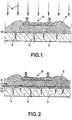
- Figures 1 and 2 of the drawing are fragmentary cross sections of railway viaducts.
- ballast For greater clarity of the drawing, we omitted to include a possible faulty sealing layer between ballast and masonry.
- the deck 2 of the viaduct has longitudinal cracks 4, the width of which has been exaggerated for the clarity of the drawing.
- One of the cracks, designated 4 ′, opens in the lower surface of the deck and could in principle be closed from the bottom, but the other cracks only open in the upper surface of the deck.
- the deck 2 carries a layer of ballast 6 which covers the cracks 4 and 4 ′ and a railroad track 8 is placed on the layer of ballast 6.
- the liquid composition is spread over the ballast layer as shown diagrammatically by the vertical arrows A.
- the composition is sufficiently fluid to pass through the ballast layer and form at its base a layer 10 of a few millimeters thick, which seeps into the interstices of the ballast and enters cracks 4 and 4 '.
- the composition can be heated for its application in order to acquire the desired fluidity.
- the liquid composition is transformed into a solid mass, preferably flexible, which closes the cracks.
- blind tubes 12 with an openwork wall for example pierced with multiple holes, are inserted at the base of the ballast layer 6, parallel to the upper surface of the deck 2.
- Liquid compositions allowing the desired effects to be obtained can be obtained from products such as mixtures of polypropylene glycol and dimethyldiisocyanate or methacrylate emulsions containing a coagulation agent.
Landscapes
- Engineering & Computer Science (AREA)
- Structural Engineering (AREA)
- Civil Engineering (AREA)
- Architecture (AREA)
- Life Sciences & Earth Sciences (AREA)
- Environmental & Geological Engineering (AREA)
- Agronomy & Crop Science (AREA)
- Soil Sciences (AREA)
- General Life Sciences & Earth Sciences (AREA)
- Mining & Mineral Resources (AREA)
- Paleontology (AREA)
- General Engineering & Computer Science (AREA)
- Bridges Or Land Bridges (AREA)
- Drilling And Exploitation, And Mining Machines And Methods (AREA)
- Aftertreatments Of Artificial And Natural Stones (AREA)
Description
- Certains ouvrages de maçonnerie ou en béton armé, présentent une surface supérieure recouverte d'une couche de matière particulaire mobile. Les viaducs ferroviaires dont les voies sont posées sur une couche de ballast sont des exemples typiques de tels ouvrages. Lorsque des fissures affectent le tablier, il était jusqu'ici nécessaire de déposer la voie et de retirer le ballast pour refaire l'étanchéité et obturer les fissures afin de prévenir des dégâts ultérieurs causés par le gel, ce qui nécessitait une interruption du trafic, à moins que les fissures soient aisément accessibles depuis le dessous du tablier, ce qui est rarement le cas, compte tenu des sujétions d'échafaudage.
- L'invention concerne un procédé pour obturer des fissures affectant des ouvrages de maçonnerie ou en béton armé présentant une surface supérieure recouverte d'une couche de matière particulaire mobile, lesdites fissures s'ouvrant dans ladite surface, notamment pour obturer des fissures affectant le tablier de viaducs ferroviaires en béton armé et dont les voies sont posées sur une couche de ballast.
- Conformément au procédé, on fait parvenir sur ladite surface, au-dessus des fissures à obturer et sans déplacer les particules de ladite couche, une composition liquide dont au moins une partie se transforme à la température ordinaire en une masse plastique imperméable, en quantité suffisante pour obturer les fissures, en profitant de la tendance naturelle de la composition appliquée à se déplacer par gravité jusqu'au remplissage des fissures.
- Les compositions liquides utilisables dans le procédé selon l'intervention peuvent être des solutions de résines synthétiques, des émulsions aqueuses de résines synthétiques telles que des latex ou des mélanges de résines synthétiques liquides avec des durcisseurs pour ces résines, avec ou sans solvant réactif, ou encore des compositions asphaltiques ou à base de silicones. Toutes les compositions liquides durcissables déjà connues en tant qu'agents d'étanchéification sont en principe utilisables, pour autant que leur solidification se produise à la température ordinaire. Il est entendu que la solidification des composants dissous dans un solvant non réactif ou émulsionnés dans l'eau nécessite l'évaporation du solvant ou de l'eau, ce que permet la porosité de la couche particulaire maintenue en place.
- Pour une bonne obturation, il est souhaitable que la composition liquide utilisée donne naissance à une masse solide souple et élastique.
- Deux exemples de mise en oeuvre du procédé selon l'invention sont illustrés par les figures 1 et 2 du dessin, qui sont des coupes transversales fragmentaires de viaducs ferroviaires.
- Pour une plus grande clarté du dessin on a omis de faire figurer une éventuelle couche d'étanchéité défaillante entre ballast et maçonnerie.
- Dans les deux figures, le tablier 2 du viaduc présente des fissures longitudinales 4, dont la largeur a été exagérée pour la clarté du dessin. L'une des fissures, désignée 4', s'ouvre dans la surface inférieure du tablier et pourrait en principe être obturée depuis le bas mais les autres fissures s'ouvrent uniquement dans la surface supérieure du tablier.
- Le tablier 2 porte une couche de ballast 6 qui recouvre les fissures 4 et 4' et une voie ferrée 8 est posée sur la couche de ballast 6.
- Dans le premier exemple, illustré par la figure 1, la composition liquide est épandue sur la couche de ballast comme schématisé par les flèches verticales A. La composition est suffisamment fluide pour traverser la couche de ballast et former à sa base une couche 10 de quelques millimètres d'épaisseur, qui s'infiltre dans les interstices du ballast et pénètre dans les fissures 4 et 4'. Si nécessaire, la composition peut être chauffée pour son application afin d'acquérir la fluidité désirée. Après l'application, la composition liquide se transforme en une masse solide, de préférence souple, qui obture les fissures.
- Dans le second exemple, illustré par la figure 2, des tubes borgnes 12 à paroi ajourée, par exemple percée de trous multiples, sont insérés à la base de la couche de ballast 6, parallèlement à la surface supérieure du tablier 2. La composition liquide est refoulée à travers les tubes 12 en direction de la flèche B afin de former, après durcissement, une couche de matière solide obtu= rant les fissures comme dans le premier exemple.
- On notera que, dans les deux exemples, la composition liquide tend naturellement à remplir les fissures par gravité, alors que le remplissage des fissures depuis le dessous du tablier serait beaucoup plus incertain.
- Des compositions liquides permettant d'obtenir les effets désirés peuvent être obtenues à partir de produits tels que des mélanges de polypropylène glycol et de diméthyldiisocyanate ou des émulsions de méthacrylate contenant un agent de coagulation.
Claims (4)
Priority Applications (1)
| Application Number | Priority Date | Filing Date | Title |
|---|---|---|---|
| AT84810499T ATE25120T1 (de) | 1983-10-14 | 1984-10-11 | Verfahren zum ausfuellen von rissen in mauerwerk. |
Applications Claiming Priority (2)
| Application Number | Priority Date | Filing Date | Title |
|---|---|---|---|
| CH5621/83A CH658483A5 (fr) | 1983-10-14 | 1983-10-14 | Procede pour obturer des fissures affectant des ouvrages de maconnerie ou en beton arme. |
| CH5621/83 | 1983-10-14 |
Publications (2)
| Publication Number | Publication Date |
|---|---|
| EP0142468A1 EP0142468A1 (fr) | 1985-05-22 |
| EP0142468B1 true EP0142468B1 (fr) | 1987-01-21 |
Family
ID=4296669
Family Applications (1)
| Application Number | Title | Priority Date | Filing Date |
|---|---|---|---|
| EP84810499A Expired EP0142468B1 (fr) | 1983-10-14 | 1984-10-11 | Procédé pour obturer des fissures affectant des ouvrages de maçonnerie |
Country Status (4)
| Country | Link |
|---|---|
| EP (1) | EP0142468B1 (fr) |
| AT (1) | ATE25120T1 (fr) |
| CH (1) | CH658483A5 (fr) |
| DE (1) | DE3462164D1 (fr) |
Families Citing this family (3)
| Publication number | Priority date | Publication date | Assignee | Title |
|---|---|---|---|---|
| CH673667A5 (fr) * | 1987-08-11 | 1990-03-30 | Irete Sa | |
| CN107165003B (zh) * | 2017-05-18 | 2018-03-16 | 浙江大学 | 一种用于治理板式无砟轨道铁路路基翻浆冒泥的整治方法 |
| CN113005923B (zh) * | 2021-03-08 | 2022-07-15 | 张海伟 | 一种道路桥梁裂缝加固结构 |
Family Cites Families (5)
| Publication number | Priority date | Publication date | Assignee | Title |
|---|---|---|---|---|
| US2357769A (en) * | 1942-12-31 | 1944-09-05 | Rushmer John Robbins | Stabilizing material introducing device |
| US2440921A (en) * | 1946-02-20 | 1948-05-04 | Robert S Stephens | Grouting device |
| DE1914712C3 (de) * | 1969-03-22 | 1973-09-27 | Stahlwerke Peine-Salzgitter Ag, 3150 Peine | Verfahren zum Herstellen eines Eisen bahngleises |
| US3841554A (en) * | 1972-05-03 | 1974-10-15 | Phillips Petroleum Co | Stabilized railway bed and method of construction |
| US4156440A (en) * | 1976-07-23 | 1979-05-29 | Japanese National Railways | Railroad track bed using injection materials and method therefor |
-
1983
- 1983-10-14 CH CH5621/83A patent/CH658483A5/fr not_active IP Right Cessation
-
1984
- 1984-10-11 EP EP84810499A patent/EP0142468B1/fr not_active Expired
- 1984-10-11 AT AT84810499T patent/ATE25120T1/de not_active IP Right Cessation
- 1984-10-11 DE DE8484810499T patent/DE3462164D1/de not_active Expired
Also Published As
| Publication number | Publication date |
|---|---|
| CH658483A5 (fr) | 1986-11-14 |
| DE3462164D1 (en) | 1987-02-26 |
| ATE25120T1 (de) | 1987-02-15 |
| EP0142468A1 (fr) | 1985-05-22 |
Similar Documents
| Publication | Publication Date | Title |
|---|---|---|
| CN107201910A (zh) | 用于震动扰动环境下的交通隧道裂缝堵漏及加固方法 | |
| CN106013259A (zh) | 震动扰动环境下的地下工程混凝土结构变形缝堵漏方法 | |
| CA2683236A1 (fr) | Procede et appareil pour former un bouchon en alliage dans un puits de petrole ou de gaz | |
| CA1314714C (fr) | Methode d'abandon accelere de gros gisements epuises de sel gemme | |
| US3180238A (en) | Groove filler | |
| EP0320393A1 (fr) | Procédé de confinement souterrain de déchets dans une cavitée creusée par lessivage dans le sel | |
| EP0142468A1 (fr) | Procédé pour obturer des fissures affectant des ouvrages de maçonnerie | |
| CN212335690U (zh) | 防渗水路面接缝结构 | |
| FR2713699A1 (fr) | Forage pour capter l'eau d'une nappe aquifère située sous une nappe géologiquement imperméable. | |
| EP0028558A1 (fr) | Procédé pour l'amélioration de la résistance au glissement d'un ouvrage de génie civil et fondation s'y rapportant | |
| EP0770735B1 (fr) | Bassin tampon enterré de stockage et de traitement des eaux pluviales | |
| CH673667A5 (fr) | ||
| JP2013111547A (ja) | 鉛直遮水層構築工法 | |
| CN111501578A (zh) | 桥墩裂缝的加固结构及其加固方法 | |
| JP2005315063A (ja) | 融雪パネル及びその製造方法並びに融雪路盤 | |
| US1503942A (en) | Elastic and expansible paving joint | |
| US303506A (en) | goodbidge | |
| EP1457599B1 (fr) | Procédé de réalisation d'une voie de type plate-forme circulable | |
| RU2132898C1 (ru) | Способ создания ледяной переправы | |
| RU2137972C1 (ru) | Водопропускное сооружение под насыпью | |
| CN105926437A (zh) | 一种铰缝排水结构及其施工方法 | |
| FR2509341A1 (fr) | Procede pour la fixation et/ou la stabilisation de sols | |
| JP4433302B2 (ja) | コンクリート構造物の防水工法 | |
| BE407300A (fr) | ||
| BE627272A (fr) |
Legal Events
| Date | Code | Title | Description |
|---|---|---|---|
| PUAI | Public reference made under article 153(3) epc to a published international application that has entered the european phase |
Free format text: ORIGINAL CODE: 0009012 |
|
| AK | Designated contracting states |
Designated state(s): AT BE CH DE FR GB IT LI LU NL SE |
|
| 17P | Request for examination filed |
Effective date: 19851025 |
|
| 17Q | First examination report despatched |
Effective date: 19860527 |
|
| ITF | It: translation for a ep patent filed | ||
| GRAA | (expected) grant |
Free format text: ORIGINAL CODE: 0009210 |
|
| RAP1 | Party data changed (applicant data changed or rights of an application transferred) |
Owner name: IRETE S.A. |
|
| AK | Designated contracting states |
Kind code of ref document: B1 Designated state(s): AT BE CH DE FR GB IT LI LU NL SE |
|
| REF | Corresponds to: |
Ref document number: 25120 Country of ref document: AT Date of ref document: 19870215 Kind code of ref document: T |
|
| REF | Corresponds to: |
Ref document number: 3462164 Country of ref document: DE Date of ref document: 19870226 |
|
| PLBE | No opposition filed within time limit |
Free format text: ORIGINAL CODE: 0009261 |
|
| STAA | Information on the status of an ep patent application or granted ep patent |
Free format text: STATUS: NO OPPOSITION FILED WITHIN TIME LIMIT |
|
| 26N | No opposition filed | ||
| ITTA | It: last paid annual fee | ||
| PGFP | Annual fee paid to national office [announced via postgrant information from national office to epo] |
Ref country code: LU Payment date: 19910930 Year of fee payment: 8 |
|
| PGFP | Annual fee paid to national office [announced via postgrant information from national office to epo] |
Ref country code: GB Payment date: 19911008 Year of fee payment: 8 |
|
| PGFP | Annual fee paid to national office [announced via postgrant information from national office to epo] |
Ref country code: SE Payment date: 19911014 Year of fee payment: 8 |
|
| PGFP | Annual fee paid to national office [announced via postgrant information from national office to epo] |
Ref country code: NL Payment date: 19911031 Year of fee payment: 8 |
|
| PGFP | Annual fee paid to national office [announced via postgrant information from national office to epo] |
Ref country code: BE Payment date: 19911106 Year of fee payment: 8 |
|
| PGFP | Annual fee paid to national office [announced via postgrant information from national office to epo] |
Ref country code: DE Payment date: 19911230 Year of fee payment: 8 |
|
| EPTA | Lu: last paid annual fee | ||
| PG25 | Lapsed in a contracting state [announced via postgrant information from national office to epo] |
Ref country code: LU Free format text: LAPSE BECAUSE OF NON-PAYMENT OF DUE FEES Effective date: 19921011 Ref country code: GB Effective date: 19921011 |
|
| PG25 | Lapsed in a contracting state [announced via postgrant information from national office to epo] |
Ref country code: SE Effective date: 19921012 |
|
| PG25 | Lapsed in a contracting state [announced via postgrant information from national office to epo] |
Ref country code: BE Effective date: 19921031 |
|
| PGFP | Annual fee paid to national office [announced via postgrant information from national office to epo] |
Ref country code: CH Payment date: 19921221 Year of fee payment: 9 |
|
| PGFP | Annual fee paid to national office [announced via postgrant information from national office to epo] |
Ref country code: FR Payment date: 19921230 Year of fee payment: 9 |
|
| PGFP | Annual fee paid to national office [announced via postgrant information from national office to epo] |
Ref country code: AT Payment date: 19930120 Year of fee payment: 9 |
|
| BERE | Be: lapsed |
Owner name: IRETE S.A. Effective date: 19921031 |
|
| PG25 | Lapsed in a contracting state [announced via postgrant information from national office to epo] |
Ref country code: NL Effective date: 19930501 |
|
| GBPC | Gb: european patent ceased through non-payment of renewal fee |
Effective date: 19921011 |
|
| NLV4 | Nl: lapsed or anulled due to non-payment of the annual fee | ||
| PG25 | Lapsed in a contracting state [announced via postgrant information from national office to epo] |
Ref country code: DE Effective date: 19930701 |
|
| PG25 | Lapsed in a contracting state [announced via postgrant information from national office to epo] |
Ref country code: AT Effective date: 19931011 |
|
| PG25 | Lapsed in a contracting state [announced via postgrant information from national office to epo] |
Ref country code: LI Effective date: 19931031 Ref country code: CH Effective date: 19931031 |
|
| PG25 | Lapsed in a contracting state [announced via postgrant information from national office to epo] |
Ref country code: FR Effective date: 19940630 |
|
| REG | Reference to a national code |
Ref country code: CH Ref legal event code: PL |
|
| REG | Reference to a national code |
Ref country code: FR Ref legal event code: ST |
|
| EUG | Se: european patent has lapsed |
Ref document number: 84810499.8 Effective date: 19930510 |