EP0143107A1 - Méthode pour la détection de virus dans des cultures pures d'organismes microscopiques ainsi que dans des comestibles et dans des produits technologiques - Google Patents
Méthode pour la détection de virus dans des cultures pures d'organismes microscopiques ainsi que dans des comestibles et dans des produits technologiques Download PDFInfo
- Publication number
- EP0143107A1 EP0143107A1 EP83110080A EP83110080A EP0143107A1 EP 0143107 A1 EP0143107 A1 EP 0143107A1 EP 83110080 A EP83110080 A EP 83110080A EP 83110080 A EP83110080 A EP 83110080A EP 0143107 A1 EP0143107 A1 EP 0143107A1
- Authority
- EP
- European Patent Office
- Prior art keywords
- detection
- bacterial
- bacteria
- fermentation
- specific
- Prior art date
- Legal status (The legal status is an assumption and is not a legal conclusion. Google has not performed a legal analysis and makes no representation as to the accuracy of the status listed.)
- Granted
Links
- 238000000034 method Methods 0.000 title claims abstract description 16
- 230000010460 detection of virus Effects 0.000 title description 2
- 230000001580 bacterial effect Effects 0.000 claims abstract description 17
- 241001515965 unidentified phage Species 0.000 claims abstract description 13
- 238000011534 incubation Methods 0.000 claims abstract description 5
- 241000700605 Viruses Species 0.000 claims description 13
- 241000894006 Bacteria Species 0.000 claims description 11
- 108090000790 Enzymes Proteins 0.000 claims description 8
- 102000004190 Enzymes Human genes 0.000 claims description 8
- 238000001514 detection method Methods 0.000 claims description 8
- 238000006243 chemical reaction Methods 0.000 claims description 5
- 238000004519 manufacturing process Methods 0.000 claims description 4
- 241000894007 species Species 0.000 claims description 4
- 239000000725 suspension Substances 0.000 claims description 4
- 230000035945 sensitivity Effects 0.000 claims description 3
- 238000002360 preparation method Methods 0.000 claims description 2
- 238000000855 fermentation Methods 0.000 claims 3
- 230000004151 fermentation Effects 0.000 claims 3
- CSCPPACGZOOCGX-UHFFFAOYSA-N Acetone Chemical compound CC(C)=O CSCPPACGZOOCGX-UHFFFAOYSA-N 0.000 claims 2
- LRHPLDYGYMQRHN-UHFFFAOYSA-N N-Butanol Chemical compound CCCCO LRHPLDYGYMQRHN-UHFFFAOYSA-N 0.000 claims 2
- JVTAAEKCZFNVCJ-UHFFFAOYSA-N lactic acid Chemical compound CC(O)C(O)=O JVTAAEKCZFNVCJ-UHFFFAOYSA-N 0.000 claims 2
- 239000008267 milk Substances 0.000 claims 2
- 210000004080 milk Anatomy 0.000 claims 2
- 235000013336 milk Nutrition 0.000 claims 2
- 235000021419 vinegar Nutrition 0.000 claims 2
- 239000000052 vinegar Substances 0.000 claims 2
- 239000004382 Amylase Substances 0.000 claims 1
- 108010065511 Amylases Proteins 0.000 claims 1
- 102000013142 Amylases Human genes 0.000 claims 1
- 102000003855 L-lactate dehydrogenase Human genes 0.000 claims 1
- 108700023483 L-lactate dehydrogenases Proteins 0.000 claims 1
- 150000001413 amino acids Chemical class 0.000 claims 1
- 235000019418 amylase Nutrition 0.000 claims 1
- 108010051210 beta-Fructofuranosidase Proteins 0.000 claims 1
- 235000011389 fruit/vegetable juice Nutrition 0.000 claims 1
- 235000012055 fruits and vegetables Nutrition 0.000 claims 1
- 230000003100 immobilizing effect Effects 0.000 claims 1
- 235000011073 invertase Nutrition 0.000 claims 1
- 235000014655 lactic acid Nutrition 0.000 claims 1
- 239000004310 lactic acid Substances 0.000 claims 1
- 235000021108 sauerkraut Nutrition 0.000 claims 1
- 239000004460 silage Substances 0.000 claims 1
- 239000000126 substance Substances 0.000 claims 1
- SXRSQZLOMIGNAQ-UHFFFAOYSA-N Glutaraldehyde Chemical compound O=CCCCC=O SXRSQZLOMIGNAQ-UHFFFAOYSA-N 0.000 description 5
- 210000004027 cell Anatomy 0.000 description 5
- 235000015097 nutrients Nutrition 0.000 description 4
- 239000002245 particle Substances 0.000 description 4
- 239000000872 buffer Substances 0.000 description 3
- 239000000243 solution Substances 0.000 description 3
- 238000005406 washing Methods 0.000 description 3
- 238000002965 ELISA Methods 0.000 description 2
- DHMQDGOQFOQNFH-UHFFFAOYSA-N Glycine Chemical compound NCC(O)=O DHMQDGOQFOQNFH-UHFFFAOYSA-N 0.000 description 2
- XBDQKXXYIPTUBI-UHFFFAOYSA-N dimethylselenoniopropionate Natural products CCC(O)=O XBDQKXXYIPTUBI-UHFFFAOYSA-N 0.000 description 2
- 239000000463 material Substances 0.000 description 2
- 239000012487 rinsing solution Substances 0.000 description 2
- 239000008223 sterile water Substances 0.000 description 2
- 239000000758 substrate Substances 0.000 description 2
- XLYOFNOQVPJJNP-UHFFFAOYSA-N water Chemical compound O XLYOFNOQVPJJNP-UHFFFAOYSA-N 0.000 description 2
- GEYOCULIXLDCMW-UHFFFAOYSA-N 1,2-phenylenediamine Chemical compound NC1=CC=CC=C1N GEYOCULIXLDCMW-UHFFFAOYSA-N 0.000 description 1
- 108091003079 Bovine Serum Albumin Proteins 0.000 description 1
- 239000004471 Glycine Substances 0.000 description 1
- JVTAAEKCZFNVCJ-UHFFFAOYSA-M Lactate Chemical compound CC(O)C([O-])=O JVTAAEKCZFNVCJ-UHFFFAOYSA-M 0.000 description 1
- 240000002605 Lactobacillus helveticus Species 0.000 description 1
- 235000013967 Lactobacillus helveticus Nutrition 0.000 description 1
- 229920001213 Polysorbate 20 Polymers 0.000 description 1
- 241000194017 Streptococcus Species 0.000 description 1
- 150000001299 aldehydes Chemical class 0.000 description 1
- 230000015572 biosynthetic process Effects 0.000 description 1
- 229940098773 bovine serum albumin Drugs 0.000 description 1
- 239000007853 buffer solution Substances 0.000 description 1
- 244000309466 calf Species 0.000 description 1
- 230000021164 cell adhesion Effects 0.000 description 1
- 230000032823 cell division Effects 0.000 description 1
- 239000006285 cell suspension Substances 0.000 description 1
- 238000012512 characterization method Methods 0.000 description 1
- 235000013351 cheese Nutrition 0.000 description 1
- 239000006071 cream Substances 0.000 description 1
- 235000015142 cultured sour cream Nutrition 0.000 description 1
- 235000013365 dairy product Nutrition 0.000 description 1
- 238000010790 dilution Methods 0.000 description 1
- 239000012895 dilution Substances 0.000 description 1
- 239000000796 flavoring agent Substances 0.000 description 1
- 235000019634 flavors Nutrition 0.000 description 1
- 230000002068 genetic effect Effects 0.000 description 1
- 210000004201 immune sera Anatomy 0.000 description 1
- 229940042743 immune sera Drugs 0.000 description 1
- 239000003547 immunosorbent Substances 0.000 description 1
- 208000015181 infectious disease Diseases 0.000 description 1
- 229940054346 lactobacillus helveticus Drugs 0.000 description 1
- 244000005700 microbiome Species 0.000 description 1
- 239000006916 nutrient agar Substances 0.000 description 1
- 230000020477 pH reduction Effects 0.000 description 1
- 102000013415 peroxidase activity proteins Human genes 0.000 description 1
- 108040007629 peroxidase activity proteins Proteins 0.000 description 1
- 239000000256 polyoxyethylene sorbitan monolaurate Substances 0.000 description 1
- 235000010486 polyoxyethylene sorbitan monolaurate Nutrition 0.000 description 1
- 235000019260 propionic acid Nutrition 0.000 description 1
- 230000017854 proteolysis Effects 0.000 description 1
- IUVKMZGDUIUOCP-BTNSXGMBSA-N quinbolone Chemical compound O([C@H]1CC[C@H]2[C@H]3[C@@H]([C@]4(C=CC(=O)C=C4CC3)C)CC[C@@]21C)C1=CCCC1 IUVKMZGDUIUOCP-BTNSXGMBSA-N 0.000 description 1
- 210000005132 reproductive cell Anatomy 0.000 description 1
- 230000005070 ripening Effects 0.000 description 1
- 210000002966 serum Anatomy 0.000 description 1
- 238000003786 synthesis reaction Methods 0.000 description 1
- 230000036962 time dependent Effects 0.000 description 1
- 230000029812 viral genome replication Effects 0.000 description 1
- 238000012800 visualization Methods 0.000 description 1
- 235000013343 vitamin Nutrition 0.000 description 1
- 229940088594 vitamin Drugs 0.000 description 1
- 229930003231 vitamin Natural products 0.000 description 1
- 239000011782 vitamin Substances 0.000 description 1
Images

Classifications
-
- G—PHYSICS
- G01—MEASURING; TESTING
- G01N—INVESTIGATING OR ANALYSING MATERIALS BY DETERMINING THEIR CHEMICAL OR PHYSICAL PROPERTIES
- G01N33/00—Investigating or analysing materials by specific methods not covered by groups G01N1/00 - G01N31/00
- G01N33/48—Biological material, e.g. blood, urine; Haemocytometers
- G01N33/50—Chemical analysis of biological material, e.g. blood, urine; Testing involving biospecific ligand binding methods; Immunological testing
- G01N33/58—Chemical analysis of biological material, e.g. blood, urine; Testing involving biospecific ligand binding methods; Immunological testing involving labelled substances
- G01N33/585—Chemical analysis of biological material, e.g. blood, urine; Testing involving biospecific ligand binding methods; Immunological testing involving labelled substances with a particulate label, e.g. coloured latex
- G01N33/586—Liposomes, microcapsules or cells
-
- G—PHYSICS
- G01—MEASURING; TESTING
- G01N—INVESTIGATING OR ANALYSING MATERIALS BY DETERMINING THEIR CHEMICAL OR PHYSICAL PROPERTIES
- G01N33/00—Investigating or analysing materials by specific methods not covered by groups G01N1/00 - G01N31/00
- G01N33/48—Biological material, e.g. blood, urine; Haemocytometers
- G01N33/50—Chemical analysis of biological material, e.g. blood, urine; Testing involving biospecific ligand binding methods; Immunological testing
- G01N33/53—Immunoassay; Biospecific binding assay; Materials therefor
- G01N33/543—Immunoassay; Biospecific binding assay; Materials therefor with an insoluble carrier for immobilising immunochemicals
- G01N33/54306—Solid-phase reaction mechanisms
-
- G—PHYSICS
- G01—MEASURING; TESTING
- G01N—INVESTIGATING OR ANALYSING MATERIALS BY DETERMINING THEIR CHEMICAL OR PHYSICAL PROPERTIES
- G01N33/00—Investigating or analysing materials by specific methods not covered by groups G01N1/00 - G01N31/00
- G01N33/48—Biological material, e.g. blood, urine; Haemocytometers
- G01N33/50—Chemical analysis of biological material, e.g. blood, urine; Testing involving biospecific ligand binding methods; Immunological testing
- G01N33/53—Immunoassay; Biospecific binding assay; Materials therefor
- G01N33/569—Immunoassay; Biospecific binding assay; Materials therefor for microorganisms, e.g. protozoa, bacteria, viruses
- G01N33/56911—Bacteria
-
- G—PHYSICS
- G01—MEASURING; TESTING
- G01N—INVESTIGATING OR ANALYSING MATERIALS BY DETERMINING THEIR CHEMICAL OR PHYSICAL PROPERTIES
- G01N33/00—Investigating or analysing materials by specific methods not covered by groups G01N1/00 - G01N31/00
- G01N33/48—Biological material, e.g. blood, urine; Haemocytometers
- G01N33/50—Chemical analysis of biological material, e.g. blood, urine; Testing involving biospecific ligand binding methods; Immunological testing
- G01N33/53—Immunoassay; Biospecific binding assay; Materials therefor
- G01N33/569—Immunoassay; Biospecific binding assay; Materials therefor for microorganisms, e.g. protozoa, bacteria, viruses
- G01N33/56983—Viruses
Definitions
- the invention relates to a method for selectivating and K on- troll virus-resistant bacterial cultures for medical and t ECH gical purposes by means of immobilization of the bacterial cells without damage to their specific receptors for the binding of bacteriophage and the enhanced sensitivity of this reaction by. Incubation with reproductive cells.
- Microorganisms are used for a variety of medical and technological purposes, e.g. used for the biosynthesis of nutrients and vitamins as well as for organic chemical synthesis. Almost without exception one uses pure cultures with specific abilities that are isolated from natural locations.
- Bacteriophages normally destroy the bacterial cell, but they can also be passed on several times during cell division as so-called temperate phages.
- temperate phages As a result, great practical damage can initially be undetected when using pure cultures For this reason, in practical use so-called multi stocks that individual in case of failure strains the desired F he men - tation to finish.
- multi stocks that individual in case of failure strains the desired F he men - tation to finish.
- a larger number of multi-strain cultures are exchanged according to a certain schedule in order to prevent bacteriophages from adapting to certain cultures. It is therefore of great importance in B e-driven cultures existing phage or phages - to identify sensitive bacterial strains quickly or eliminate.
- the present invention serves this purpose.
- the receptors for the adherence of the bacteriophages on the cell surface are not denatured by the immobilization with glutaraldehyde, so that they are still able to bind phages.
- Vessels suitable for phage detection can each be coated with bacteria and stored for a long time.
- Bound phages can be detected using an enzyme-linked immunosorbent test (ELISA), which was first used by Clark (1977) to detect plant viruses. By adding specific antibodies for the respective phage, this can be detected in a known manner directly or indirectly by adding a second enzyme-labeled antibody.
- ELISA enzyme-linked immunosorbent test
- This modified ELISA test is so sensitive that 10 5 virus particles / ml can already be detected; the sensitivity of the test is insufficient for assessing the virus freedom of pure cultures.
- living, metabolizing bacteria of the same species are therefore additionally introduced into the system with immobilized bacteria, which multiply by reproduction even with the presence of only one virus particle / ml to such an extent that already after short time (1-10 hours) a positive result can be obtained.
- a sample is taken from a commercially available pure culture for the preparation of sour cream under sterile cautery, diluted to the order of ten with sterile water so that when the last dilution stage is transferred to nutrient agar plates, the existing pure cultures appear through colony growth.
- the Im p f eyelet approx. 0.1 - 1 mg of material is taken from each of the colonies and transferred to a known amount of sterile water, which then appears to be slightly cloudy. 10 - 20 ⁇ l of this suspension is transferred, for example, into the troughs of a microtiter plate filled with approx. 300 ⁇ l of a nutrient solution and incubated for 20 hours.
- the nutrient solution is then removed from the wells, leaving behind the complete bacteria adhering to the trough walls, which are now fixed by the action of glutaraldehyde (0.1-0.2% in buffer, pH 6-7) and bound to the walls .
- glutaraldehyde (0.1-0.2% in buffer, pH 6-7) and bound to the walls .
- the tubes or microtiter plates must be washed thoroughly several times (approx. 3-5x for 10 minutes each).
- the rinsing solution contains 0.1% glycine, 0.2% Tween 20, 0.5% bovine serum albumin and 2% calf serum. Following this procedure, the samples to be examined can be introduced into the troughs.
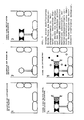
- the "suitable" bacteriophage for the immobilized bacterial strain is present in the sample, it is bound by the undenatured receptors on the bacterial surface. After 1-12 hours, the phage present was completely bound so that it can be washed again with rinsing solution. Now a specific phage antibody is introduced into the system and unbound antibodies are removed by repeated washing after incubation with the buffer solution described for one to several hours. Then a specific enzyme-labeled antibody, which is directed against the phage antibody (indirect detection), is added to the system. After binding, washing is carried out again and enzyme substrate (for example o-phenylenediamine for peroxidase) is added; after 20 minutes the presence of phages can be clearly read from the color reaction that has occurred (see Fig. 1).
- enzyme substrate for example o-phenylenediamine for peroxidase
- Direct evidence of the presence of phage can be guided by the fact that with the above-described inventive Ver - drive for the immobilization of bacteria directly enzyme-linked phage antibody is introduced into the system, the adsorbed in the presence of phages and, after addition of an enzyme substrate F t on ARB releases (direct method).
- This technology saves a considerable amount of time, which can be of great importance with regard to operational disruptions.
- the specificity of the system according to the invention for the detection of viruses can also be used for the typing of closely related bacterial species when using monoclonal virus antibodies, which is not possible using conventional immune sera.
- the methods described above according to Examples 1, 2 and 3 can be modified in such a way that an existing characterized virus suspension is added to the prepared immobilized pure cultures of bacterial strains, which adheres to the specific receptors and can be detected by means of antibodies.
Landscapes
- Health & Medical Sciences (AREA)
- Life Sciences & Earth Sciences (AREA)
- Engineering & Computer Science (AREA)
- Immunology (AREA)
- Chemical & Material Sciences (AREA)
- Urology & Nephrology (AREA)
- Molecular Biology (AREA)
- Biomedical Technology (AREA)
- Hematology (AREA)
- Cell Biology (AREA)
- Analytical Chemistry (AREA)
- Biochemistry (AREA)
- Pathology (AREA)
- Food Science & Technology (AREA)
- Medicinal Chemistry (AREA)
- Physics & Mathematics (AREA)
- Biotechnology (AREA)
- Microbiology (AREA)
- General Health & Medical Sciences (AREA)
- General Physics & Mathematics (AREA)
- Virology (AREA)
- Tropical Medicine & Parasitology (AREA)
- Chemical Kinetics & Catalysis (AREA)
- Measuring Or Testing Involving Enzymes Or Micro-Organisms (AREA)
- Micro-Organisms Or Cultivation Processes Thereof (AREA)
- Investigating Or Analyzing Materials By The Use Of Electric Means (AREA)
Priority Applications (4)
| Application Number | Priority Date | Filing Date | Title |
|---|---|---|---|
| AT83110080T ATE36604T1 (de) | 1983-10-26 | 1983-10-26 | Neues verfahren zum virus-nachweis in reinkulturen mikroskopischer kleinlebewesen sowie in lebensmitteln und in technologischen produkten. |
| EP83110080A EP0143107B1 (fr) | 1983-10-26 | 1983-10-26 | Méthode pour la détection de virus dans des cultures pures d'organismes microscopiques ainsi que dans des comestibles et dans des produits technologiques |
| DE8383110080T DE3377743D1 (en) | 1983-10-26 | 1983-10-26 | Method for the detection of viruses in pure cultures of microscopic organisms, as well as in foodstuffs and in technological products |
| DK481484A DK481484A (da) | 1983-10-26 | 1984-10-08 | Fremgangsmaade til paavisning af virus |
Applications Claiming Priority (1)
| Application Number | Priority Date | Filing Date | Title |
|---|---|---|---|
| EP83110080A EP0143107B1 (fr) | 1983-10-26 | 1983-10-26 | Méthode pour la détection de virus dans des cultures pures d'organismes microscopiques ainsi que dans des comestibles et dans des produits technologiques |
Publications (2)
| Publication Number | Publication Date |
|---|---|
| EP0143107A1 true EP0143107A1 (fr) | 1985-06-05 |
| EP0143107B1 EP0143107B1 (fr) | 1988-08-17 |
Family
ID=8190733
Family Applications (1)
| Application Number | Title | Priority Date | Filing Date |
|---|---|---|---|
| EP83110080A Expired EP0143107B1 (fr) | 1983-10-26 | 1983-10-26 | Méthode pour la détection de virus dans des cultures pures d'organismes microscopiques ainsi que dans des comestibles et dans des produits technologiques |
Country Status (4)
| Country | Link |
|---|---|
| EP (1) | EP0143107B1 (fr) |
| AT (1) | ATE36604T1 (fr) |
| DE (1) | DE3377743D1 (fr) |
| DK (1) | DK481484A (fr) |
Cited By (4)
| Publication number | Priority date | Publication date | Assignee | Title |
|---|---|---|---|---|
| FR2590675A1 (fr) * | 1985-11-27 | 1987-05-29 | Transia | Melange d'anticorps specifiques des bacteriophages de bacteries lactiques et ses applications a la detection et a la neutralisation desdits bacteriophages |
| DE10036931B4 (de) * | 1999-07-30 | 2004-06-03 | Profos Ag | Nachweis und Identifikation von Bakterienstämmen |
| EP1556502A4 (fr) * | 2002-10-15 | 2006-07-19 | Univ Minnesota | Analyses permettant de detecter ou de quantifier des pathogenes et des contaminants bacteriens ou viraux |
| EP2267167A4 (fr) * | 2008-03-17 | 2011-04-20 | Consejo Superior Investigacion | Procédé et système de détection et/ou de quantification de bactériophages susceptibles d'infecter une souche hôte bactérienne prédéterminée, utilisation d'un dispositif capteur micro-électronique pour détecter lesdits bactériophages et dispositif capteur micro-électronique permettant de mettre en oeuvre ce procédé |
Citations (3)
| Publication number | Priority date | Publication date | Assignee | Title |
|---|---|---|---|---|
| FR2439233A1 (fr) * | 1978-10-19 | 1980-05-16 | Harvard College | Ensemble de reactifs et procede pour l'identification des infections virales |
| EP0038150A1 (fr) * | 1980-04-10 | 1981-10-21 | FUJIREBIO KABUSHIKI KAISHA also trading as FUJIREBIO INC. | Procédé de sérodiagnostic pour la syphilis et autres maladies |
| WO1983000505A1 (fr) * | 1981-07-31 | 1983-02-17 | Bucher, Doris, J. | Determination de virus par analyse |
-
1983
- 1983-10-26 AT AT83110080T patent/ATE36604T1/de not_active IP Right Cessation
- 1983-10-26 DE DE8383110080T patent/DE3377743D1/de not_active Expired
- 1983-10-26 EP EP83110080A patent/EP0143107B1/fr not_active Expired
-
1984
- 1984-10-08 DK DK481484A patent/DK481484A/da not_active Application Discontinuation
Patent Citations (3)
| Publication number | Priority date | Publication date | Assignee | Title |
|---|---|---|---|---|
| FR2439233A1 (fr) * | 1978-10-19 | 1980-05-16 | Harvard College | Ensemble de reactifs et procede pour l'identification des infections virales |
| EP0038150A1 (fr) * | 1980-04-10 | 1981-10-21 | FUJIREBIO KABUSHIKI KAISHA also trading as FUJIREBIO INC. | Procédé de sérodiagnostic pour la syphilis et autres maladies |
| WO1983000505A1 (fr) * | 1981-07-31 | 1983-02-17 | Bucher, Doris, J. | Determination de virus par analyse |
Cited By (6)
| Publication number | Priority date | Publication date | Assignee | Title |
|---|---|---|---|---|
| FR2590675A1 (fr) * | 1985-11-27 | 1987-05-29 | Transia | Melange d'anticorps specifiques des bacteriophages de bacteries lactiques et ses applications a la detection et a la neutralisation desdits bacteriophages |
| EP0228975A1 (fr) * | 1985-11-27 | 1987-07-15 | TRANSIA , Société anonyme dite | Mélange d'anticorps spécifiques des bactériophages de bactéries lactiques et ses applications à la détection et à la neutralisation desdits bactériophages |
| DE10036931B4 (de) * | 1999-07-30 | 2004-06-03 | Profos Ag | Nachweis und Identifikation von Bakterienstämmen |
| US7087376B2 (en) | 1999-07-30 | 2006-08-08 | Profos Ag | Detection and identification of bacterial strains |
| EP1556502A4 (fr) * | 2002-10-15 | 2006-07-19 | Univ Minnesota | Analyses permettant de detecter ou de quantifier des pathogenes et des contaminants bacteriens ou viraux |
| EP2267167A4 (fr) * | 2008-03-17 | 2011-04-20 | Consejo Superior Investigacion | Procédé et système de détection et/ou de quantification de bactériophages susceptibles d'infecter une souche hôte bactérienne prédéterminée, utilisation d'un dispositif capteur micro-électronique pour détecter lesdits bactériophages et dispositif capteur micro-électronique permettant de mettre en oeuvre ce procédé |
Also Published As
| Publication number | Publication date |
|---|---|
| EP0143107B1 (fr) | 1988-08-17 |
| DK481484A (da) | 1985-04-27 |
| ATE36604T1 (de) | 1988-09-15 |
| DK481484D0 (da) | 1984-10-08 |
| DE3377743D1 (en) | 1988-09-22 |
Similar Documents
| Publication | Publication Date | Title |
|---|---|---|
| Lin et al. | Epiphytic lactic acid bacteria succession during the pre‐ensiling and ensiling periods of alfalfa and maize | |
| CA2112603C (fr) | Methode de detection de bacteries | |
| DE69421085T2 (de) | Verfahren und testsatz zum nachweis von bakteriophagen | |
| EP0498920B1 (fr) | Méthode d'essai pour détecter la présence de bactéries | |
| EP1356080B1 (fr) | Detection et identification de groupes de bacteries | |
| Collins | Domination among strains of lactic streptococci with attention to antibiotic production | |
| DE60303207T2 (de) | Verfahren zur bindung einer verbindung an eine oberfläche | |
| Unz et al. | The predominant bacteria in natural Zoogloeal colonies: I. Isolation and identification | |
| DE69311134T3 (de) | Bioreaktor mit immobilisierten milchsäurebakterien und seine verwendung | |
| Moreira et al. | Production of cellulases by Thermomonospora sp. | |
| EP0143107A1 (fr) | Méthode pour la détection de virus dans des cultures pures d'organismes microscopiques ainsi que dans des comestibles et dans des produits technologiques | |
| DE69213036T2 (de) | Verfahren zum Nachweis und zur Quantifizierung kariogener Bakterien | |
| JPS59113897A (ja) | 微生物の検出および分離方法 | |
| Zehren et al. | Growth characteristics of streptococcal phages in relation to cheese manufacture | |
| DE2644622A1 (de) | Verfahren zur extraktion von mikroorganismen und diese enthaltende diagnostische mittel | |
| Mitchell et al. | Use of immunomagnetic capture on beads to recover Listeria from environmental samples | |
| Ruehle | The enzymic content of bacterial spores | |
| Hensel et al. | The microflora involved in aerobic-thermophilic sludge stabilization | |
| McEgan et al. | Concentration and detection of Salmonella in mung bean sprout spent irrigation water by use of tangential flow filtration coupled with an amperometric flowthrough enzyme-linked immunosorbent assay | |
| Hegazi et al. | Studies of Azotobacter bacteriophages in Egyptian soils | |
| RU2108384C1 (ru) | Штамм bacillus thuringiensis - продуцент эндотоксина против жесткокрылых насекомых и способ его культивирования | |
| Kumar et al. | Enhanced production of enterocin from Enterococcus faecium LR/6 by statistical optimization of the growth medium. | |
| EP0636884A1 (fr) | Méthode pour la détermination des enzymes exogèns dans des substrats | |
| Carret et al. | Detection of Staphylococcus aureus protein A by passive hemagglutination test using microtiter plates | |
| Bradner | A study of the physiology of bacteria which support the growth of Endamoeba histolytica in vitro |
Legal Events
| Date | Code | Title | Description |
|---|---|---|---|
| PUAI | Public reference made under article 153(3) epc to a published international application that has entered the european phase |
Free format text: ORIGINAL CODE: 0009012 |
|
| AK | Designated contracting states |
Designated state(s): AT BE CH DE FR GB IT LI LU NL SE |
|
| 17P | Request for examination filed |
Effective date: 19851204 |
|
| 17Q | First examination report despatched |
Effective date: 19870605 |
|
| GRAA | (expected) grant |
Free format text: ORIGINAL CODE: 0009210 |
|
| AK | Designated contracting states |
Kind code of ref document: B1 Designated state(s): AT BE CH DE FR GB IT LI LU NL SE |
|
| PG25 | Lapsed in a contracting state [announced via postgrant information from national office to epo] |
Ref country code: SE Effective date: 19880817 Ref country code: NL Effective date: 19880817 Ref country code: IT Free format text: LAPSE BECAUSE OF FAILURE TO SUBMIT A TRANSLATION OF THE DESCRIPTION OR TO PAY THE FEE WITHIN THE PRESCRIBED TIME-LIMIT;WARNING: LAPSES OF ITALIAN PATENTS WITH EFFECTIVE DATE BEFORE 2007 MAY HAVE OCCURRED AT ANY TIME BEFORE 2007. THE CORRECT EFFECTIVE DATE MAY BE DIFFERENT FROM THE ONE RECORDED. Effective date: 19880817 Ref country code: GB Free format text: LAPSE BECAUSE OF NON-PAYMENT OF DUE FEES Effective date: 19880817 Ref country code: FR Free format text: THE PATENT HAS BEEN ANNULLED BY A DECISION OF A NATIONAL AUTHORITY Effective date: 19880817 Ref country code: BE Effective date: 19880817 |
|
| REF | Corresponds to: |
Ref document number: 36604 Country of ref document: AT Date of ref document: 19880915 Kind code of ref document: T |
|
| REF | Corresponds to: |
Ref document number: 3377743 Country of ref document: DE Date of ref document: 19880922 |
|
| PG25 | Lapsed in a contracting state [announced via postgrant information from national office to epo] |
Ref country code: AT Effective date: 19881026 |
|
| PG25 | Lapsed in a contracting state [announced via postgrant information from national office to epo] |
Ref country code: LU Free format text: LAPSE BECAUSE OF NON-PAYMENT OF DUE FEES Effective date: 19881031 Ref country code: LI Effective date: 19881031 Ref country code: CH Effective date: 19881031 |
|
| EN | Fr: translation not filed | ||
| NLV1 | Nl: lapsed or annulled due to failure to fulfill the requirements of art. 29p and 29m of the patents act | ||
| GBV | Gb: ep patent (uk) treated as always having been void in accordance with gb section 77(7)/1977 [no translation filed] | ||
| PLBE | No opposition filed within time limit |
Free format text: ORIGINAL CODE: 0009261 |
|
| STAA | Information on the status of an ep patent application or granted ep patent |
Free format text: STATUS: NO OPPOSITION FILED WITHIN TIME LIMIT |
|
| REG | Reference to a national code |
Ref country code: CH Ref legal event code: PL |
|
| 26N | No opposition filed | ||
| PGFP | Annual fee paid to national office [announced via postgrant information from national office to epo] |
Ref country code: DE Payment date: 19891020 Year of fee payment: 7 |
|
| PG25 | Lapsed in a contracting state [announced via postgrant information from national office to epo] |
Ref country code: DE Effective date: 19910702 |