EP0144594A1 - 5H-[1]Benzopyrano[2,3-d]pyrimidin-Derivate, Verfahren zu deren Herstellung, sowie diese enthaltende Arzneimittel zur Bekämpfung von gastralen und duodenalen Schleimhautläsionen - Google Patents
5H-[1]Benzopyrano[2,3-d]pyrimidin-Derivate, Verfahren zu deren Herstellung, sowie diese enthaltende Arzneimittel zur Bekämpfung von gastralen und duodenalen Schleimhautläsionen Download PDFInfo
- Publication number
- EP0144594A1 EP0144594A1 EP84111732A EP84111732A EP0144594A1 EP 0144594 A1 EP0144594 A1 EP 0144594A1 EP 84111732 A EP84111732 A EP 84111732A EP 84111732 A EP84111732 A EP 84111732A EP 0144594 A1 EP0144594 A1 EP 0144594A1
- Authority
- EP
- European Patent Office
- Prior art keywords
- benzopyrano
- general formula
- group
- carbon atoms
- pyrimidine
- Prior art date
- Legal status (The legal status is an assumption and is not a legal conclusion. Google has not performed a legal analysis and makes no representation as to the accuracy of the status listed.)
- Granted
Links
- 0 CC1=C*(*)C=CC(OC2=C(C3)C(O)=NC(*)N2C)=C3*1 Chemical compound CC1=C*(*)C=CC(OC2=C(C3)C(O)=NC(*)N2C)=C3*1 0.000 description 1
Classifications
-
- C—CHEMISTRY; METALLURGY
- C07—ORGANIC CHEMISTRY
- C07D—HETEROCYCLIC COMPOUNDS
- C07D491/00—Heterocyclic compounds containing in the condensed ring system both one or more rings having oxygen atoms as the only ring hetero atoms and one or more rings having nitrogen atoms as the only ring hetero atoms, not provided for by groups C07D451/00 - C07D459/00, C07D463/00, C07D477/00 or C07D489/00
- C07D491/02—Heterocyclic compounds containing in the condensed ring system both one or more rings having oxygen atoms as the only ring hetero atoms and one or more rings having nitrogen atoms as the only ring hetero atoms, not provided for by groups C07D451/00 - C07D459/00, C07D463/00, C07D477/00 or C07D489/00 in which the condensed system contains two hetero rings
- C07D491/04—Ortho-condensed systems
-
- A—HUMAN NECESSITIES
- A61—MEDICAL OR VETERINARY SCIENCE; HYGIENE
- A61P—SPECIFIC THERAPEUTIC ACTIVITY OF CHEMICAL COMPOUNDS OR MEDICINAL PREPARATIONS
- A61P1/00—Drugs for disorders of the alimentary tract or the digestive system
- A61P1/04—Drugs for disorders of the alimentary tract or the digestive system for ulcers, gastritis or reflux esophagitis, e.g. antacids, inhibitors of acid secretion, mucosal protectants
Definitions
- the invention relates to 5H- [1] benzopyrano- [2,3-d] pyrimidine derivatives of the general formula I.
- R 1 and R 2 which may be the same or different, represent a hydrogen or halogen atom, a hydroxyl group or a straight-chain or branched alkoxy group having up to 4 carbon atoms, or together an alkyleneoxy or an alkylenedioxy group having 1 to 3 carbon atoms or one fused aromatic ring
- R 3 is an optionally substituted phenyl radical
- R 4 is an alkyl group having 1 to 8 carbon atoms or the rest wherein R 5 and R 6 , which may be the same or different, represent a hydrogen atom, a straight-chain or branched alkyl group having up to 6 carbon atoms or, together with the nitrogen atom, a saturated 5- or 6-ring with optionally further heteroatoms and n the numbers 2 to 6.
- R 5 and R 6 which may be the same or different, represent a hydrogen atom
- the aromatic ring R 1 and R 2 is primarily the phenyl ring.
- the unsubstituted phenyl ring in the 6,7 position is preferred.
- Halogen atoms are fluorine, chlorine, bromine and iodine atoms.
- the bromine atom is preferred.
- the alkyleneoxy group in particular is the ethyleneoxy group which forms an oxole ring.
- the methylenedioxy group which forms a 1,3-dioxolen ring is preferred as the alkylenedioxy group.
- Suitable substituents of the phenyl radical R 3 are up to 3 substituents from the group halogen atoms, dialkylamino groups with up to 4 carbon atoms, or alkyl or alkoxy groups with up to 4 carbon atoms, and up to 2 alkylenedioxy groups with up to 2 carbon atoms.
- radicals R 5 and R 6 together with the nitrogen atom to which they are attached, can in particular form pyrrolidino, piperidino-morpholino or piperazino groups.
- R I and R 2 are identical or different and are a hydrogen or bromine atom, a hydroxyl, methoxy or ethoxy group or together an unsubstituted benzene ring which is fused in at the 6,7 position
- R 3 an unsubstituted or substituted by a halogen atom, a dimethylamino, a methyl, a methylenedioxy group or a phenyl radical substituted by up to 3 methoxy groups
- R 4 an alkyl group having up to 6 carbon atoms
- R and R which may be the same or different Hydrogen atom, a methyl or ethyl radical, or together with the nitrogen atom to which they are attached
- a pyrrolidino, piperidino, morpholino or piperazino group and n are the numbers 2 or 3, and their pharmacologically acceptable salts.
- R 1 and R 2 are identical or different and are a hydrogen or bromine atom or a methoxy group
- R 3 is a phenyl, 4-chlorophenyl, 4-dimethylaminophenyl, 4- Methoxyphenyl, 4-hydroxyphenyl-4-methylphenyl, 3,4-methylenedioxyphenyl
- R 4 represents an n-hexyl group
- R 5 and R 6 each represent a methyl group and n represents the numbers 2 or 3, and their pharmacologically acceptable salts.
- Polar solvents are preferably used in the reaction of compounds of general formula II with bases (reaction a)). Suitable here are particularly low alcohols, such as Methanol, ethanol or n-butanol.
- the reaction time is generally between about 5 and 30 minutes.
- Potassium carbonate, potassium hydroxide, sodium methoxide and sodium ethanolate are preferably used as bases. The course of the reaction can be followed well by the clearly visible brightening of the initially deep yellow to orange reaction mixture.
- the starting compounds of the general formula II are likewise new compounds and are obtained by reacting the compounds of the general formula VI known from DE-OS 2801353 in which R 1 and R 2 have the meaning given above, with an aromatic aldehyde of the general formula VII in which R 3 has the meaning given above, obtained in the presence of a catalytic amount of a base, preferably at the reflux temperature.
- a catalytic amount of a base preferably at the reflux temperature.
- Piperidine and triethylamine have proven particularly suitable as bases for this.
- the easiest way to remove the water formed during the reaction is by azeotropically adding a water-immiscible solvent, such as methylene chloride, chloroform, benzene or toluene.
- the response time is usually between 6 and 20 hours.
- the mostly yellow to orange colored compounds of the general formula II usually precipitate out as poorly soluble precipitates in the course of the reaction and can be isolated by suction, washing out and drying, or else they are obtained after removal of the solvent from the residue.
- the thiocarbamoylchromene derivatives of the general formula VI used are obtained in accordance with DE-OS 2801353 according to known regulations by reacting o-hydroxybenzaldehyde derivatives with 2-cyano-thioacetamide.
- the compounds of the general formula IV are preferably not isolated, but instead directly reacted further in a type of one-pot process with compounds of the general formula V.
- reactive ester groups esters or half esters of strong mineral acids such as Understood hydrohalic acids or sulfuric acid. The bromides and chlorides are preferred.
- the compounds V are used in the form of their hydrobromides or hydrochlorides. Used in this case ; 2 molar equivalents of the base are used for the alkylation reaction.
- the compounds of the formula VI are preferably reacted in the presence of a base such as sodium methoxide or sodium methoxide in a polar solvent.
- the compounds of the general formula I crystallize directly from the filtrate or, after concentration of the reaction mixture and partitioning of the residue between a water-immiscible organic solvent such as e.g. Methylene chloride or chloroform, and water after concentrating the organic phase and crystallizing from a suitable solvent.
- a water-immiscible organic solvent such as e.g. Methylene chloride or chloroform
- the salts are obtained in the usual way by neutralizing the bases with appropriate inorganic or organic acids.
- acids come e.g. Hydrochloric acid, sulfuric acid, phosphoric acid, hydrobromic acid, acetic acid, tartaric acid, lactic acid, citric acid, malic acid, salicylic acid, ascorbic acid, malonic acid or succinic acid.
- the compounds of general formula I are valuable agents for combating gastric and duodenal mucosal lesions.
- Current peptic ulcer therapy is either to inhibit acid secretion from the parietal cells of the stomach or to neutralize the stomach acid before it comes into contact with the ulcerated areas.
- pharmaceuticals from the series of anti-cholinergics or antacids have been used in particular.
- the former have well-known side effects, antacids must be administered frequently and in large quantities.
- the present invention is based on the idea that the support of physiological mechanisms of gastrointestinal mucoprotection, that is to say the therapeutic prevention of lesions of the mucosal epithelium, should be superior to any other, ultimately, unphysiological therapy of ulcerative diseases.
- the inhibition or even blockade of peptic secretion as the goal of ulcer therapy has considerable disadvantages for the patient. Reports of duodenal mycoses, erosive, mycotic gastritis and systemic candidiasis are increasing as a result of the reduced gastric cellular resistance on the one hand and the pH increase due to anti-secretion on the other.
- the present compounds according to the invention are distinguished by a pronounced ulcer-protective action in the complete absence of antisecretory effects.
- the compounds of this invention can be used for all customary forms of administration; however, the oral forms are preferred.
- the application forms contain the usual excipients, fillers and lubricants and disintegrating additives.
- additives are, for example, tartrate and citrate buffers, ethanol, complexing agents (such as ethylenediamine tetraacetic acid and its non-toxic salts) as well as high molecular weight polymers (such as liquid polyethylene oxide) for viscosity regulation.
- Solid carriers are, for example, starch, lactose, mannitol, methyl cellulose, talc, highly disperse silica, higher molecular weight fatty acids (such as stearic acid), gelatin, agar-agar, calcium phosphate, magnesium stearate, animal and vegetable fats, solid high molecular weight polymers (such as polyethylene glycol) suitable for oral application may TION Z ube- if desired, additional flavorings and / or sweetening agents.
- the preferred individual dosages are between 10 and 500 mg of the corresponding active ingredient.
- the invention therefore furthermore relates to medicaments which are characterized in that, in addition to customary fillers and auxiliaries, they contain at least one compound of the general formula I, and the use of compounds of the general formula I in combating gastric and duodenal mucosal lesions .
- customary fillers and auxiliaries they contain at least one compound of the general formula I, and the use of compounds of the general formula I in combating gastric and duodenal mucosal lesions .
- the 2,3-dihydro-2-phenyl-4-thioxo [1] benzopyrano [2,3-d) pyrimidine (28) used as the starting product is prepared as follows: 10.0 g of 2-imino-3-thiocarbamoyl- (2H ) -chromene, 5.2 g benzaldehyde and 5 drops piperidine are boiled in 1 1 benzene in a water separator for 6 hours. After cooling, the precipitated yellow reaction product is filtered off, washed with a little benzene and dried in vacuo. Yield 11.0 g of yellow crystals, mp. 220 ° C, dec.
Landscapes
- Chemical & Material Sciences (AREA)
- Organic Chemistry (AREA)
- Health & Medical Sciences (AREA)
- Life Sciences & Earth Sciences (AREA)
- General Health & Medical Sciences (AREA)
- General Chemical & Material Sciences (AREA)
- Medicinal Chemistry (AREA)
- Nuclear Medicine, Radiotherapy & Molecular Imaging (AREA)
- Bioinformatics & Cheminformatics (AREA)
- Pharmacology & Pharmacy (AREA)
- Engineering & Computer Science (AREA)
- Animal Behavior & Ethology (AREA)
- Chemical Kinetics & Catalysis (AREA)
- Public Health (AREA)
- Veterinary Medicine (AREA)
- Pharmaceuticals Containing Other Organic And Inorganic Compounds (AREA)
- Plural Heterocyclic Compounds (AREA)
- Pyrane Compounds (AREA)
- Nitrogen Condensed Heterocyclic Rings (AREA)
- Heterocyclic Carbon Compounds Containing A Hetero Ring Having Oxygen Or Sulfur (AREA)
- Saccharide Compounds (AREA)
Abstract
Description
- Gegenstand der Erfindung sind 5H- [1] Benzopyrano- [2,3-d] pyrimidin-Derivate der allgemeinen Formel I
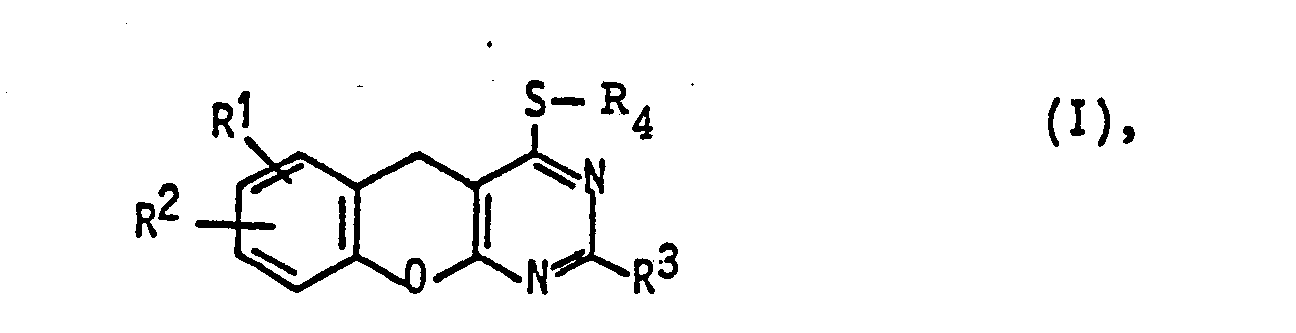

sowie deren pharmakologisch verträgliche Salze mit organischen oder anorganischen Säuren. - Als aromatischer Ring Rl und R2 kommt vor allem der Phenylring infrage..Bevorzugt ist der unsubstituierte Phenylring in 6,7- Position. Als Halogenatome kommen Fluor, Chlor, Brom- und Jodatome infrage. Bevorzugt ist das Bromatom. Als Alkylenoxygruppe kommt vor allem die einen Oxolenring bildende Ethylenoxygruppe infrage. Als Alkylendioxygruppe ist der Methylendioxyrest bevorzugt, der einen 1,3-Dioxolenring bildet. Als Substituenten des Phenylrests R3 kommen bis zu 3 Substituenten aus der Gruppe Halogenatome, Dialkylaminogruppen mit bis zu 4 Kohlenstoffatomen, oder Alkyl- oder Alkoxygruppen mit bis zu 4 Kohlenstoffatomen, sowie bis zu 2 Alkylendioxygruppen mit bis zu 2 Kohlenstoffatomen infrage.
- Die Reste R5 und R6 können gemeinsam mit dem Stickstoffatom, an das sie gebunden sind vor allem Pyrrolidino-, Piperidino-Morpholino- oder Piperazinogruppen bilden.
- Bevorzugt sind Verbindungen der allgemeinen Formel I, in welcher RI und R2 gleich oder verschieden sind und ein Wasserstoff- oder Bromatom, eine Hydroxyl-, Methoxy-, oder Ethoxygruppe oder gemeinsam einen unsubstituierten, in 6,7-Position ankondensierten Benzolring, R3 einen unsubstituierten oder durch ein Halogenatom, eine Dimethylamino-, eine Methyl-, eine Methylendioxygruppe oder einen durch bis zu 3 Methoxygruppen substituierten Phenylrest, R4 eine Alkylgruppe mit bis zu 6 Kohlenstoffatomen, R und R , die gleich oder verschieden sein können, ein Wasserstoffatom, einen Methyl- oder Ethylrest, oder zusammen mit dem Stickstoffatom, an das sie gebunden sind, eine Pyrrolidino-, Piperidino-, Morpholino- oder Piperazinogruppe und n die Zahlen 2 oder 3 bedeuten, sowie deren pharmakologisch verträgliche Salze.
- Besonders bevorzugt sind Verbindungen der allgemeinen Formel I, in welcher die Reste Rl und R2 gleich oder verschieden sind und ein Wasserstoff-oder Bromatom oder eine Methoxygruppe, R 3 einen Phenyl-, 4-Chlorphenyl-, 4-Dimethylaminophenyl-, 4-Methoxyphenyl-, 4-Hydroxyphenyl-4-Methylphenyl-, 3,4-Methylendioxyphenylrest, R4 eine n-Hexylgruppe, R5 und R 6 jeweils eine Methylgruppe darstellen und n die Zahlen 2 oder 3 bedeutet, sowie deren pharmakologisch verträglichen Salze.
- Ein weiterer Gegenstand der Erfindung ist ein chemisch eigenartiges Verfahren zur Herstellung von Verbindungen der allgemeinen Formel I, welches dadurch gekennzeichnet ist, daß man entweder
- a) eine Verbindung der allgemeinen Formel II,

in einem organischen Lösungsmittel mit einer Base tautomerisiert oder in dem man - b) eine Verbindung der allgemeinen Formel III

- 1.) mit Phosphorpentasulfid in Pyridin umsetzt, und,anschließend die gemäß Verfahren a) oder b) erhaltene Verbindung der allgemeinen Formel IV

gegebenenfalls ohne Isolierung, mit einem Alkylierungsmittel der allgemeinen Formel V
- 2.) mit anorganischen Säurehalogeniden, bevorzugt mit Phosphoroxychlorid/ Phosphorpentachlorid za Verbindungen der Formel VI


- Bei der Umsetzung von Verbindungen der allgemeinen Formel II mit Basen (Reaktion a)) werden bevorzugt polare Lösungsmittel verwendet. Hier eignen,sich besonders niedere Alkohole, wie z.B. Methanol, Ethanol oder n-Butanol.
- Bei erhöhter Temperatur,, bevorzugt bei der Rückflußtemperatur des Lösungsmittels beträgt die Reaktionszeit in der Regel zwischen etwa 5 und 30 Minuten. Als Basen werden bevorzugt Kaliumcarbonat, Kaliumhydroxid, Natriummethanolat und Natriumethanolat eingesetzt. Der Reaktionsverlauf kann gut an der deutlich sichtbaren Aufhellung der anfangs meist tief gelb bis orange gefärbten Reaktionsmischung verfolgt werden.
- Die Ausgangsverbindungen der allgemeinen Formel II sind ebenfalls neue Verbindungen und werden durch Umsetzung der aus der DE-OS 2801353 bekannten Verbindungen der allgemeinen Formel VI


in Gegenwart einer katalytischen Menge einer Base, bevorzugt bei Rückflußtemperatur erhalten. Als Basen haben sich hierfür besonders Piperidin und Triethylamin bewährt. Das bei der Reaktion entstehende Wasser entfernt man am einfachsten azeotrop, indem man ein nicht mit Wasser mischbares Lösungsmittel, wie z.B. Methylenchlorid, Chloroform, Benzol oder Toluol als Schlepper zugibt. - Die Reaktionszeit beträgt in der Regel zwischen 6 und 20 Stunden. Die.meist gelb bis orange gefärbten Verbindungen der allgemeinen Formel II fallen im Verlauf der Reaktion meist als schwerlösliche Niederschläge aus und können durch Absaugen, Auswaschen und Trocknen isoliert werden, oder aber sie werden nach Entfernen des Lösungsmittels aus dem Rückstand erhalten.
- Die verwendeten Thiocarbamoylchromen-Derivate der allgemeinen Formel VI werden gemäß DE-OS 2801353 nach bekannten Vorschriften durch Reaktion von o-Hydroxybenzaldehyd-Derivaten mit 2-Cyan-thioacetamid erhalten.
- Die Ausgangsprodukte der allgemeinen Formel III sind in J.Chem. Soc. S. 1335, (1980), beschrieben.
- Die Verbindungen der allgemeinen Formel IV werden vorzugsweise nicht isoliert, sondern in einer Art Eintopfverfahren direkt weiter umgesetzt mit Verbindungen der allgemeinen Formel V. Unter reaktiven Estergruppen werden Ester oder Halbester starker Mineralsäuren wie z.B. Halogenwasserstoffsäuren oder Schwefelsäure verstanden. Bevorzugt werden die Bromide und Chloride.
- Die Verbindungen V werden in Form ihrer Hydrobromide oder Hydrochloride eingesetzt. In diesem Fall verwendet;man für die Alkylierungsreaktion 2 Moläquivalente der Base. Die Umsetzung der Verbindungen der Formel VI erfolgt bevorzugt in Gegenwart einer Base wie Natriummethanolat oder Natriummethanolat in einem polaren Lösungsmittel.
- Die Verbindungen der allgemeinen Formel I kristallisieren nach Filtration vom ausgefallenen Alkalihalogenid direkt aus dem Filtrat aus oder sie werden nach dem Einengen des Reaktionsgemisches und Verteilen des Rückstandes zwischen einem mit Wasser nicht mischbaren organischen Lösungsmittel wie z.B. Methylenchlorid oder Chloroform, und Wasser nach dem Einengen der organischen Phase und Kristallisieren aus einen geeigneten Lösungsmittel erhalten.
- Die Salze werden in üblicher Weise durch Neutralisation der Basen mit entsprechenden anorganischen oder organischen Säuren erhalten. Als Säuren kommen z.B. Salzsäure, Schwefelsäure, Phosphorsäure, Bromwasserstoffsäure, Essigsäure, Weinsäure, Milchsäure, Zitronensäure, Äpfelsäure, Salicylsäure, Ascorbinsäure, Malonsäure oder Bernsteinsäure in Frage.
- Die Verbindungen der allgemeinen Formel I sind wertvolle Mittel zur Bekämpfung von gastralen und duodenalen Schleimhautläsionen.
Die gegenwärtige Therapie des peptischen Ulkus besteht entweder in einer Hemmung der Säuresekretion aus den Parietalzellen des Magens oder in einer Neutralisation der Magensäure bevor sie mit den ulcerierten Arealen in Berührung kommt.
Zur Anwendung kommen bisher insbesondere Pharmaka aus der Reihe der Anti-cholinergica oder Antacida. Erstere besitzen allgemein bekannte Nebenwirkungen, Antacida müssen häufig und in großen Mengen appliziert werden. - Eine Wende in der Therapie war die Einführung des Histamin-H2-Rezeptorenblockers Cimetidin; er erlaubte eine neue Form der antisekretor,ischen Behandlung. Cimetidin besitzt jedoch zentrale und'andere Nebenwirkungen; besonders unangenehm sind die unter Langzeittherapie auftretenden Veränderungen der Magenschleimhaut, weil sich für Rezidiv-Ulcera nach Absetzen von Cimetidin verantwortlich gemacht werden. LInt.J.Clinical Pharmacol., Therapy and Toxicol. 18/3 (1980), S. l40-43J.
- Die vorliegende Erfindung geht aus von dem Gedanken, daß die Unterstützung physiologischer Mechanismen der gastrointestinalen Mucoprotection, also die therapeutische Verhinderung von Läsionen des Schleimhautepithels jeder anderen, letzten Endes unphysiologischen Therapie ulcerativer Erkrankungen überlegen sein müßte. Die Hemmung oder gar Blockade der peptischen Sekretion als Ziel der Ulkustherapie hat nämlich beachtliche Nachteile für den Patienten. So häufen sich die Berichte über duodenale Mycosen, erosive, mykotische Gastritiden und systemische Candidiasis als Folge der verringerten gastralen zellulären Resistenz einerseits und des pH-Wert-Anstiegs durch Antisekretion andererseits. Die vorliegenden, erfindungsgemäßen Verbindungen zeichnen sich durch eine ausgeprägte ulkusprotektive Wirkung bei völliger Abwesenheit von antisekretorischen Effekten aus. Ihre cytoprotektiven Effekte gegen chemische Noxen und Stressfaktoren läßt sie zur Therapie einer Reihe von Krankheitsbildern geeignet erscheinen. Solche sind beispielsweise das gastrische Ulcus, die Gastritis, das duodenale Ulcus und die ulcerative Colitis. Sie eignen sich auch für die Unterstützung bei der Therapie mit Antirheumatica, Steroiden oder Cytostatica.
- Die Verbindungen dieser Erfindung können für alle üblichen Applikationsformen eingesetzt werden; die oralen Formen sind jedoch bevorzugt. Die Applikationsformen enthalten dabei die üblichen Excipientien, Füll- und Gleitstoffe und desintegrierende Zusätze. Derartige Zusätze sind z.B. Tartrat- und Citrat-Puffer, Ethanol, Komplexbildner (wie Äthylendiamintetraessigsäure und deren nichttoxische Salze) sowie hochmolekulare Polymere (wie flüssiges Polyäthylenoxid) zur Viskositätsregulierung. Feste Trägerstoffe sind z.B. Stärke, Lactose, Mannit, Methylcellulose, Talkum, hochdisperse Kieselsäure, höhermolekulare Fettsäuren (wie Stearinsäure), Gelatine, Agar-Agar, Calciumphosphat, Magnesiumstearat, tierische und pflanzliche Fette, feste hochmolekulare Polymere (wie Polyäthylenglykol) für orale Applikation geeignete Zube- reitungen können gewünschtenfalls zusätzliche Geschmacks-und/oder Süßstoffe enthalten.
- Die bevorzugten Einzeldosierungen liegen zwischen 10 und 500 mg des entsprechenden aktiven Inhaltsstoffes. Ein weiterer Gegenstand der Erfindung sind daher Arzneimittel, die dadurch gekennzeichnet sind, daß sie neben üblichen Füll- und Hilfsstoffen mindestens eine Verbindung gemäß der allgemeinen Formel I enthalten, sowie die Verwendung von Verbindungen gemäß der allgemeinen Formel I bei der Bekämpfung von gastralen und duodenalen SchleimhautläsionEn. Die folgenden Beispiele sollen die Erfindung näher erläutern.
- Eine Mischung von 11,7g 2,3-Dihydro-2-phenyl-4-thioxo-[1]-benzopyrano [2,3-d]pyrimidin, 11,5g Kaliumcarbonat und 300m1 Ethanol wird 30 Min. unter Rückfluß erhitzt. Dann tropft man innerhalb von 30 Min. eine Lösung von 6,3g Dimethylaminopropylchlorid Hydrochlorid in 100m1 Etha= nol hinzu und rückflussiert weitere 2 Stunden. Die Reaktionsmischung wird heiß filtriert, eingeengt und der Rückstand aus Isopropanol kristallisiert. Man erhält 8,7g farblose Kristalle, Fp. 94°C.
- Das als Ausgangsprodukt verwendete 2,3-Dihydro-2-phenyl-4-thioxo [1]benzopyrano[2,3-d)pyrimidin(28) wird wie folgt hergestellt: 10,0g 2-Imino-3-thiocarbamoyl-(2H)-chromen, 5,2g Benzaldehyd und 5 Tropfen Piperidin werden 6 Stunden in 1 1 Benzol am Wasserabscheider gekocht. Nach dem Abkühlen wird das ausgefallene gelbe Reaktionsprodukt abgesaugt, mit etwas Benzol ausgewaschen und im Vakuum getrocknet. Ausbeute 11,0g gelbe Kristalle, Fp. 220°C, zers.
- In analoger Weise erhält man folgende Verbindungen:
- Ausbeute 71%, Fp. 109°C
- Man löst 1,6g Natrium in ,500ml abs. Ethanol, gibt 11,4g 2-(4-Chlor= phenyl)-2,3-dihydro-4-thioxo-benzopyrano[2,3-dJpyrimidin hinzu und erhitzt 30 Min. zum Sieden. Dann tropft man eine Lösung von 6,4g N-(2-Chlorethyl)piperidin Hydrochlorid in 100m1 abs. Ethanol hinzu und rückflussiert 1 Stunde weiter. Man kühlt ab, saugt den ausgefallenen Niederschlag ab und wäscht gut mit Wasser aus. Schließlich kristallisiert man aus Dimethylformamid. Man erhält 12,lg gelbliche Kristalle vom Fp. 179°C
- In analoger Weise werden erhalten:
- 2-(4-Chlorphenyl)-4-(3-dimethylaminopropylthio)-5H-[1]benzopyrano [2,3-d]pyrimidin (5) Ausbeute 57%, Fp. 118°C
- 2-(4-Chlorphenyl)-4-(2-diethylaminoethylthio)-5H-[1]benzopyrano [2,3-d]pyrimidin (6) Ausbeute 59%, Fp. 116°C
- 2-(4-Dimethylaminophenyl)-4-(2-morpholinoethylthio)-5H-[1]benzopyrano [2,3-d]pyrimidin (7) Ausbeute 93%, Fp. 181°C
- 2-(4-Dimethylaminophenyl)-4-(3-dimethylaminopropylthio)-5H-[1]benzopy= rano[2,3-d]pyrimidin (8) Ausbeute 60%, Fp. 131°C
- 2-(4-Dimethylaminophenyl)-4-(2-piperidinoethylthio)-5H-[1]benzopyrano [2,3-d]pyrimidin (9) Ausbeute 87%, Fp. 162°C
- 4-(3-Dimethylaminopropylthio)-2-(3,4-methylendioxyphenyl)-5H-[1]benzo= pyrano[2,3-d]pyrimidin (12) Ausbeute 66%, Fp. 125°C
- 4-(2-Dimethylaiminoethylthio)-2-(3,4-methylendioxyphenyl)-5H-[1]benzo= pyrano[2,3-d]pyrimidin (13) Ausbeute 70%, Fp. 167°C
- 4-(2-Piperidinoethylthio)-2-(3,4,5-trimethoxyphenyl)-5H-[1]benzo= pyrano[2,3-d]pyrimidin (14) Ausbeute 84%, Fp. 168°C
- 4-(2-Diethylaminoethylthio)-2-(4-methylphenyl)-5H-[1]benzopyrano[2,3-d] pyrimidin (15) Ausbeute 59%, Fp. 118°C
- 4-(-3-Dimethylaminopropylthio)-2-(4-methylphenyl)-5H-[1]benzopyrano [2,3-d]pyrimidin (16) Ausbeute 65%, Fp. 109°C
- 4-(2-Morpholinoethylthin)-2-(4-methylphenyl)-5H-[1]benzopyrano[2,3-d] pyrimidin (17) Ausbeute 87%, Fp. 178°C
- 4-(3-Dimethylaminopropylthio)-2-(4-methoxyphenyl)-5H-[1]benzopyrano [2,3-d]pyrimidin (18) Ausbeute 70%, Fp. 100°C
- 4-(2-Dimethylaminoethylthio)-7-methoxy-2-phenyl-5H-[1]benzopyrano [2,3-d]pyrimidin (19) Ausbeute 61%, Fp. 140°C
- 7-Brom-4-(2-morpholinoethylthio)-2-phenyl-5H-[1]benzopyrano[2,3-d]pyri= midin (20) Ausbeute 73%, Fp. 190°C
- 9-Ethoxy-2-phenyl-4-(2-pyrrolidinoethyithio)-5H-[1]benzopyrano[2,3-d] pyrimidin (21) Ausbeute 52%, Fp. 150°C
- 6,8-Dimethoxy-2-phenyl-4-(2-piperidinoethylthio)-5H-[1]benzopyrano [2,3-d]pyrimidin (22) Ausbeute 55%, Fp. 165°C
- 4-(2-Aminoethylthio)-2-phenyl-5H-[1]benzopyrano[2,3-d]pyrimidin (23) Ausbeute 70%, Fp. 152°C
- 4-(2-Aminoethylthio)-7-methoxy-2-(4-methoxyphenyl)-5H-[ 1 ]benzopyrano [2,3-d]pyrimidin (24) Ausbeute 78%, Fp. 153°C
- 4-(2-Aminoethylthio)-7-brom-2-(4-methoxyphenyl)-5H-[1]benzopyrano [2,3-d]pyrimidin (25) Ausbeute 60%, Fp. 196°C
- 2-(4-Methylphenyl)-4-(3-morpho7inopropylthio)-5H-[1]benzopyrano [2,3-d]pyrimidin (26) Ausbeute 73%, Fp. 139°C
- 4-(3-Aminopropylthio)-2-(4-methylphenyl)-5H-[1]benzopyrano[2,3-d]pyri= midin (27) Ausbeute 32%, Fp. 131°C
- 11-(2-Diethylaminoethylthio)-9-phenyl-12H-naphto[1',2':5,6]pyrano [2,3-d]pyrimidin (27b) Ausbeute 70%, Fp. 174°C
- 4-(3-Methylaminopropylthio)-2-(4-methylphenyl)-5H-[1] benzopyrano [2,3-d] pyrimidin (27a) Ausbeute 46%, Fp. 125-127°C
- 4-(2-Diethylaminoethylthio)-2-(4-hydroxyphenyl)-5H-[1]benzapyrano [2,3-d]pyrimidin (10) Ausbeute 59%, Fp. 178°C
- 2-(4-Hydroxyphenyl)-4-(2-morpholinaethylthio)-5H-[1]benzopyrano [2,3-d]pyrimidin (11) Ausbeute 47%, Fp. 225°C
- 4-Hexylthio-2-(3,4-methylendioxyphenyl)-5H-[1] benzopyrano[2,3-d] pyrimidin (35) Ausbeute 68%, Fp 111°C,
- 4-(3-Dimethylaminopropylthio)-2-(3, 4,5-trimethoxyphenyl)-5H-[1] benzopyrano [2,3-d]pyrimidin (36) Ausbeute 70%, Fp 162°C,
- 4-(3-Dimethylaminopropylthio)-7,8-methylendioxy-2-(3,4-methylendioxyphenyl)-5H- [1 ]benzopyrano [2, 3-d]pyrimidin (37 Ausbeute 49%, Fp 164°C,
- 4-(6-Dimethylaminohexylthio)-2-(3,4-methylendioxyphenyl)-5H-[1]benzopyrano[2,3-d]pyrimidin (38) Ausbeute 56%, Fp 96°C,
- 6-(3-Dimethylaminopropylthio)-2,3-dihydro-8-(4-methylphenyl)-5H-furo[2',3':7,8][1]benzopyrano[2,3-d]pyrimidin (39) Ausbeute 69%, Fp 171°C,
- Bei der Herstellung der Verbindungen (10) und (11) verwendet man für die Tautomerisierungsreaktion 3 Molequivalente Natrium und arbeitet den Ansatz wie folgt auf:
- Man engt die Reaktionsmischung am Rotationsverdampfer ein, gießt den Rückstand in 300 ml Wasser und stellt mit verd. Salzsäure ein pH von 7 ein. Der hierbei ausgefallene Niederschlag wird abgesaugt und aus Ethanol kristallisiert.
- Die zur Herstellung der genannten Verbindungen verwendeten 2-Aryl-2,3-dihydro-4-thioxo-benzopyrano(2,3-d)pyrimidine der allgemeinen Formel II werdew gemäß Beispiel 1 durch Kondensation von 2-Imino-3-thiocarbamoyl-(2H)-chromenen der allgemeinen Formel VI mit geeigneten Aldehyden der allgemeinen Formel VII erhalten:
- 2-(4-Chlorphenyl)-2,3-dihydro-4-thioxo-[1]benzopyrano[2,3-d] pyrimidin Ausbeute 61%, gelbe Kristalle, Fp. 246°C, zers.
- 2- (4 Dimethylaminophenyl) -2,3-dihydro-4-thioxo- [1] benzopyrano [2, 3-d] pyrimidin Ausbeute 63%, orangefarbene Kristalle, Fp..218'C, zers.
- 2,3-Dihydro-2-(4-hydroxyphenyl)-4-thioxo-[1]benzopyrano[2,3-d] pyrimidin Ausbeute 80%, gelbe Kristalle, Fp. 248'C, zers.
- 2,3-Dihydro-2-(4-methylphenyl)-4-thioxo-[1]benzopyrano[2,3-d] pyrimidin Ausbeute 52%, gelbe Kristalle, Fp. 205'C, zers.
- 2,3-Dihydro-2-(4-methoxyphenyl)-4-thioxo-[1]benzopyrano[2,3-d]pyrimi= din Ausbeute 52%, gelbe Kristalle, Fp. 202'C, zers.
- 2,3-Dihydro-2-(3,4-methylendioxyphenyl)-4-thioxy-[1]benzopyrano[2,3-d] pyrimidin Ausbeute 56%, gelbe Kristalle, Fp. 226'C, zers.
- 2,3-Dihydro-2-(3,4,5-trimethoxypheny1)-4-thioxo-n]benzopyrano[2,3-d] pyrimidin Ausbeute 85%, gelbe Kristalle, Fp. 290'C, zers.
- 2,3-Dihydro-7-methoxy-2-phenyl-4-thioxo-[1]benzopyrano[2,3-d] pyrimidin Ausbeute 87%, gelbe Kristalle, Fp. 223'C, zers.
- 9,10-Dihydro-9-phenyl-11-thioxo-naphto[1',2':5,6]pyrano[2,3-d]pyrimidin Ausbeute 85%, Fp. 320°C, zers.
- 7-Brom-2,3-dihydro-2-phenyl-4-thioxo-[1]benzopyrano[2,3-d]pyrimidin Ausbeute 80%, Fp. 330'C zers.
- 9-Ethoxy-2,3-dihydro-2-phenyl-4-thioxo-[l]benzopyrano[2,3-dJpyrimidin Ausbeute 77%, Fp.215°C, zers.
- 2,3-Dihydro-6,8-dimethoxy-2-phenyl-4-thioxo-[1]benzopyrano[2,3-d] pyrimidin Ausbeute 68%, Fp. 298°C, zers.
- 2,3-Dihydro-7-Methoxy-2-(4-methoxyphenyl)-4-thioxo-[1]benzopyrano [2,3-d]pyrimidin Ausbeute 72%, Fp. 250°C, zers.
- 7-Brom-2,3-dihydro-2-(4-methoxyphenyl)-4-thioxo-[1]benzopyrano[2,3-d] pyrimidin Ausbeute 75%, Fp. 235°C, zers..
- 2,3-Dihydro-7,8-methylendioxy-2-(3,4-methylendioxyphenyl)-4-thioxo- [1]benzopyrano[2,3-d]pyrimidin Ausbeute 93%, Fp 270°C, zers.
- 2,3,7,8-Tetrahydro-8-(4-methlphenyl)-6-thioxo-furo[2',3':7,8][1] benzopyrano[2,3-d]pyrimidin Ausbeute 80%, Fp ab 210°C, zers.
- Man löst 1,1g Natrium in 300 ml abs. Ethanol, gibt 14,6g 2,3-Dihydro-2-phenyl-4-thioxo-[1]-benzopyrano[2,3-d]pyrimidin hinzu und erhitzt 1 Stunde zum Sieden. Danach engt man die Reaktionsmischung am Rotationsverdampfer ein, gießt in 300 ml Wasser und säuert vorsichtig mit verd. Salzsäure an. Der ausgefallene Niederschlag wird abgesaugt und aus Dimethylformamid / Ethanol kristallisiert. Ausbeute 80% gelbe Kristalle, Fp. 245°C, (zers.)
- In analoger Weise werden erhalten:
- 2-(4-Dimethylaminophenyl)-4-thioxo-3H,5H-[1]benzopyrano[2,3-d] pyrimidin (30) Ausbeute 76%, gelbe Kristalle, Fp. 245°C, zers.
- 2-(4-Methoxyphenyl)-4-thioxo-3H,5H-[1]benzopyrano[2,3-d]pyrimidin (31) Ausbeute 74%, gelbe Kristalle, Fp. 265°C zers.
- 2-(4-Chlorphenyl)-4-thioxo-3H,5H-[1]benzopyrano[2,3-d]pyrimidin (32) Ausbeute 70%, gelbe Kristalle, Fp. 340°C zers.
- 4-Thioxo-2-(3,4,5-trimethoxyphenyl)-3H,5H-[1]benzopyrano[2,3-d] pyrimidin (33.) Ausbeute 79%, ockerfarbene Kristalle, Fp. 290°C, zers.
- 2-(4-Hydroxyphenyl)-4-thioxo-3H,5H-[1]benzopyrano[2,3-d]pyrimidin (34) Ausbeute 65%, gelbliche Kristalle, Fp. 274°C, zers.
- 8,1g 4-Hydroxy-2-phenyl-[1]benzopyrano[2,3-d]pyrimidin, 9,0g Phosphorpentachlorid und 36m1 Phosphoroxychlorid werden 2 Stunden unter Rückfluß erhitzt. Danach wird das überschüssige Phosphoroxychlorid im Wasserstrahlvakuum abdestilliert und der Rückstand zwischen Chloroform und Wasser verteilt, wobei durch Zugabe von 10% iger Natronlauge ein pH Wert von ca. 6 eingestellt wird. Die organische Phase wird abgetrennt, das Chloroform am Rotationsver- dampfer entfernt und der Rückstand an Kieselgel mit Cyclohexan/Chloroform (1:1) als Elutionsmittel chromatographiert. Man erhält 4,0g 4-Chlor-2-phenyl-[1]benzopyrano[2,3-d] pyrimidin, Fp 168-170 °C in Form farbloser Kristalle. 0,05g Natrium werden in 10m1 abs. Ethanol gelöst, und die Lösung mit 0,25g 3-Dimethylamino-1-propanthiol versetzt. Diese Lösung tropft man bei Rückflußtemperatur in eine Lösung von 0,6g 4-Chlor-2-phenyl [1]benzopyrano[2,3-d]pyrimidin und hält danach 2 Stunden unter Rückfluß. Nach dem Abkühlen wird filtriert, das Filtrat zur Trockene eingeengt und der Rückstand zwischen Chloroform und Wasser verteilt. Die organische Phase wird abgetrennt, das Chloroform abgezogen und der Rückstand aus Ethanol kristallisiert. Man erhält 0,4g farblose Kristalle, Fp 93°C.
- In analoger Weise erhält man
- Ausbeute 64%, Fp 97-98°C.
Claims (8)

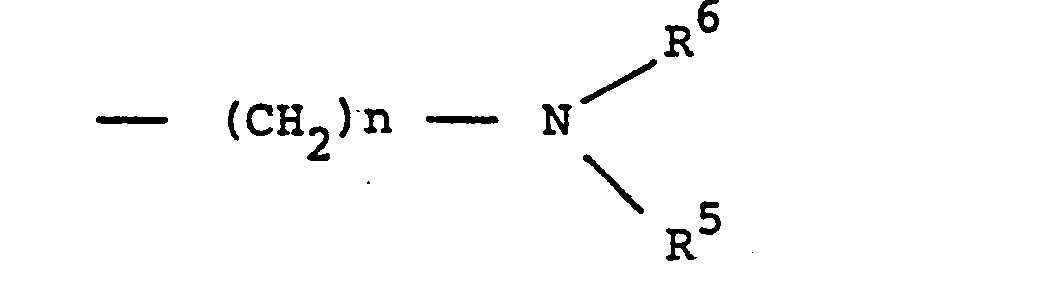
sowie von deren pharmakologisch verträglichen Salzen mit organischen oder anorganischen Säuren dadurch gekennzeichnet, daß man entweder


zur Reaktion bringt und die so erhaltenen Basen der allgemeinen Formel I gewünschtenfalls anschließend in an sich bekannter Weise mit organischen oder anorganischen Säuren in deren pharmakologisch unbedenkliche Salze überführt.
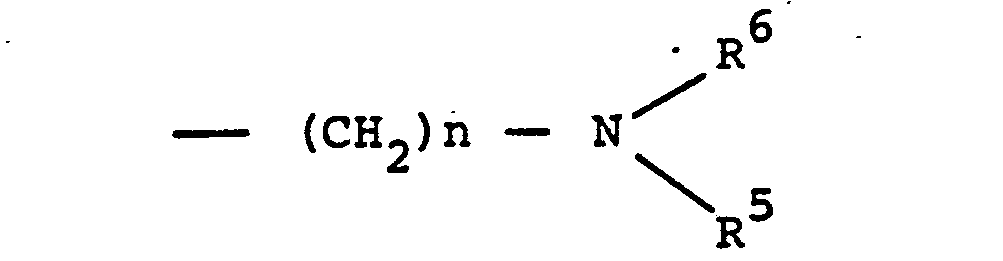
Priority Applications (1)
| Application Number | Priority Date | Filing Date | Title |
|---|---|---|---|
| AT84111732T ATE30158T1 (de) | 1983-09-30 | 1984-10-01 | 5h-(1>benzopyrano(2,3-d>pyrimidin-derivate, verfahren zu deren herstellung, sowie diese enthaltende arzneimittel zur bekaempfung von gastralen und duodenalen schleimhautlaesionen. |
Applications Claiming Priority (2)
| Application Number | Priority Date | Filing Date | Title |
|---|---|---|---|
| DE3335472 | 1983-09-30 | ||
| DE19833335472 DE3335472A1 (de) | 1983-09-30 | 1983-09-30 | 5h-(1)benzopyrano-(2,3,-d)pyrimidin-derivate, verfahren zu deren herstellung sowie deren verwendung bei der bekaempfung von gastralen und duodenalen schleimhautlaesionen |
Publications (2)
| Publication Number | Publication Date |
|---|---|
| EP0144594A1 true EP0144594A1 (de) | 1985-06-19 |
| EP0144594B1 EP0144594B1 (de) | 1987-10-07 |
Family
ID=6210536
Family Applications (1)
| Application Number | Title | Priority Date | Filing Date |
|---|---|---|---|
| EP84111732A Expired EP0144594B1 (de) | 1983-09-30 | 1984-10-01 | 5H-[1]Benzopyrano[2,3-d]pyrimidin-Derivate, Verfahren zu deren Herstellung, sowie diese enthaltende Arzneimittel zur Bekämpfung von gastralen und duodenalen Schleimhautläsionen |
Country Status (16)
| Country | Link |
|---|---|
| US (1) | US4578380A (de) |
| EP (1) | EP0144594B1 (de) |
| JP (1) | JPS6092288A (de) |
| AT (1) | ATE30158T1 (de) |
| AU (1) | AU3366884A (de) |
| CA (1) | CA1249814A (de) |
| DD (1) | DD232705A5 (de) |
| DE (2) | DE3335472A1 (de) |
| DK (1) | DK468384A (de) |
| ES (1) | ES536342A0 (de) |
| FI (1) | FI843778L (de) |
| GR (1) | GR80470B (de) |
| HU (1) | HUT36123A (de) |
| IL (1) | IL73090A0 (de) |
| NO (1) | NO843918L (de) |
| ZA (1) | ZA847662B (de) |
Families Citing this family (10)
| Publication number | Priority date | Publication date | Assignee | Title |
|---|---|---|---|---|
| DE19742508A1 (de) * | 1997-09-26 | 1999-04-01 | Hoechst Marion Roussel De Gmbh | Sulfonamid-substituierte Chromane, Verfahren zu ihrer Herstellung, ihre Verwendung als Medikament oder Diagnostikum sowie sie enthaltende pharmazeutische Zubereitungen |
| DE19748469A1 (de) * | 1997-11-03 | 1999-05-06 | Hoechst Marion Roussel De Gmbh | Sulfonamid-substituierte Benzopyranderivate, Verfahren zu ihrer Herstellung, ihre Verwendung als Medikament sowie sie enthaltende pharmazeutische Zubereitungen |
| US6340755B1 (en) * | 1997-11-19 | 2002-01-22 | Natural Drug Sciences Llc | 5H-Pyrano[2,3-d: 6,5-d']dipyrimidine derivatives having an antibacterial, antiviral and immuno-modulating activity |
| RU2188201C2 (ru) * | 1997-11-19 | 2002-08-27 | Ашкинази Римма Ильинична | Производные 5h-пирано[2,3-d:6,5-d']дипиримидина, обладающие антимикробным, противовирусным и иммуномодулирующим действием |
| CN102977111B (zh) * | 2012-12-12 | 2015-04-15 | 中国药科大学 | 一类具有改善阿尔兹海默病作用的β1-肾上腺素受体激动剂 |
| RU2595038C1 (ru) * | 2015-04-03 | 2016-08-20 | Виктор Вениаминович Тец | Лекарственное средство с противовирусной активностью (варианты) |
| CN108078976B (zh) * | 2017-11-13 | 2019-12-03 | 河南大学 | Imca在制备抗胃癌药物中的应用 |
| CN108014103B (zh) * | 2017-11-13 | 2019-12-03 | 河南大学 | Imca在制备抗甲状腺癌药物中的应用 |
| CN108175766B (zh) * | 2017-12-05 | 2019-12-03 | 河南大学 | Imca在制备抗结直肠癌药物中的应用 |
| CN115974828B (zh) * | 2023-02-14 | 2025-02-11 | 中国药科大学 | 作为蛋白磷酸酶5激动剂的化合物及其制备方法与用途 |
Citations (2)
| Publication number | Priority date | Publication date | Assignee | Title |
|---|---|---|---|---|
| EP0029934A1 (de) * | 1979-11-15 | 1981-06-10 | Schering Corporation | Bezopyranderivate, sie enthaltende pharmazeutische Zusammensetzungen und Verfahren zur Herstellung der Verbindungen und der Zusammensetzungen |
| EP0008277B1 (de) * | 1978-07-31 | 1981-09-02 | Technobiotic Ltd. | Benzopyranderivate, sie enthaltende pharmazeutische Zusammensetzungen und Verfahren zum Herstellen der Verbindungen und Zusammensetzungen |
Family Cites Families (5)
| Publication number | Priority date | Publication date | Assignee | Title |
|---|---|---|---|---|
| DE1470336A1 (de) * | 1962-07-04 | 1969-03-20 | Thomae Gmbh Dr K | Neue Dihydrothieno-[3,4-d]-pyrimidine und Verfahren zu ihrer Herstellung |
| US3468888A (en) * | 1967-04-11 | 1969-09-23 | Smithkline Corp | 2-substituted pyrimido(1,2-a) benzimidazoles |
| US3578666A (en) * | 1968-08-26 | 1971-05-11 | Sandoz Ag | Substituted imidazolines,pyrimidines and diazepines |
| US3772230A (en) * | 1969-05-28 | 1973-11-13 | Sandoz Ag | Polyhydro-imidazo(1,5-a)pyrimidine-3(2h)-thione and pyrido(1,2-c)pyrimidine-1-thione |
| US4272535A (en) * | 1978-07-31 | 1981-06-09 | Schering Corporation | 2,4-[1H,3H,5H]-(1)-Benzopyrano-[2,3-d]-pyrimidinediones and their use as anti-allergy agents |
-
1983
- 1983-09-30 DE DE19833335472 patent/DE3335472A1/de active Granted
-
1984
- 1984-09-24 US US06/653,175 patent/US4578380A/en not_active Expired - Fee Related
- 1984-09-25 GR GR80470A patent/GR80470B/el unknown
- 1984-09-26 FI FI843778A patent/FI843778L/fi not_active Application Discontinuation
- 1984-09-26 IL IL73090A patent/IL73090A0/xx unknown
- 1984-09-28 DD DD84267756A patent/DD232705A5/de unknown
- 1984-09-28 AU AU33668/84A patent/AU3366884A/en not_active Abandoned
- 1984-09-28 CA CA000464282A patent/CA1249814A/en not_active Expired
- 1984-09-28 ZA ZA847662A patent/ZA847662B/xx unknown
- 1984-09-28 JP JP59203933A patent/JPS6092288A/ja active Granted
- 1984-09-28 NO NO843918A patent/NO843918L/no unknown
- 1984-09-28 DK DK468384A patent/DK468384A/da not_active Application Discontinuation
- 1984-09-28 HU HU843699A patent/HUT36123A/hu unknown
- 1984-09-28 ES ES536342A patent/ES536342A0/es active Granted
- 1984-10-01 DE DE8484111732T patent/DE3466692D1/de not_active Expired
- 1984-10-01 EP EP84111732A patent/EP0144594B1/de not_active Expired
- 1984-10-01 AT AT84111732T patent/ATE30158T1/de not_active IP Right Cessation
Patent Citations (2)
| Publication number | Priority date | Publication date | Assignee | Title |
|---|---|---|---|---|
| EP0008277B1 (de) * | 1978-07-31 | 1981-09-02 | Technobiotic Ltd. | Benzopyranderivate, sie enthaltende pharmazeutische Zusammensetzungen und Verfahren zum Herstellen der Verbindungen und Zusammensetzungen |
| EP0029934A1 (de) * | 1979-11-15 | 1981-06-10 | Schering Corporation | Bezopyranderivate, sie enthaltende pharmazeutische Zusammensetzungen und Verfahren zur Herstellung der Verbindungen und der Zusammensetzungen |
Also Published As
| Publication number | Publication date |
|---|---|
| FI843778A0 (fi) | 1984-09-26 |
| US4578380A (en) | 1986-03-25 |
| ES8601209A1 (es) | 1985-10-16 |
| FI843778A7 (fi) | 1985-03-31 |
| ES536342A0 (es) | 1985-10-16 |
| ZA847662B (en) | 1985-05-29 |
| DD232705A5 (de) | 1986-02-05 |
| ATE30158T1 (de) | 1987-10-15 |
| FI843778L (fi) | 1985-03-31 |
| CA1249814A (en) | 1989-02-07 |
| DK468384D0 (da) | 1984-09-28 |
| AU3366884A (en) | 1985-04-04 |
| DE3335472C2 (de) | 1989-08-03 |
| HUT36123A (en) | 1985-08-28 |
| DE3466692D1 (en) | 1987-11-12 |
| DK468384A (da) | 1985-03-31 |
| EP0144594B1 (de) | 1987-10-07 |
| IL73090A0 (en) | 1984-12-31 |
| GR80470B (en) | 1985-01-28 |
| DE3335472A1 (de) | 1985-04-11 |
| JPS6092288A (ja) | 1985-05-23 |
| JPH0447674B2 (de) | 1992-08-04 |
| NO843918L (no) | 1985-04-01 |
Similar Documents
| Publication | Publication Date | Title |
|---|---|---|
| DE3888821T2 (de) | Tricyclische Verbindungen. | |
| DE2614406C2 (de) | ||
| EP0230942B1 (de) | Thieno-1,4-diazepine | |
| DE1470157A1 (de) | Verfahren zur Herstellung substituierter Thioxanthensulfonamide und ihrer Saeureanlagerungssalze | |
| CH630912A5 (de) | Verfahren zur herstellung von 1,2-dihydronaphthalinderivaten. | |
| DE3533331A1 (de) | Pyridothiazolderivate, verfahren zu ihrer herstellung und diese verbindungen enthaltende arzneimittel | |
| EP0144594B1 (de) | 5H-[1]Benzopyrano[2,3-d]pyrimidin-Derivate, Verfahren zu deren Herstellung, sowie diese enthaltende Arzneimittel zur Bekämpfung von gastralen und duodenalen Schleimhautläsionen | |
| DE1695132A1 (de) | Verfahren zur Herstellung von heterocyclischen Verbindungen | |
| EP0621037B1 (de) | Pyrido-pyrimidindione, Verfahren zu ihrer Herstellung und ihre Verwendung als Arzneimittel | |
| DD202023A5 (de) | Verfahren zur herstellung von in 5-stellung substituierten 5,10-dihxdro-11h-dibenzo (b,e) (1,4) diazepin-11-onen | |
| DE69028355T2 (de) | 4,5-Dihydro-6H-imidazo[4,5,1-ij]chinolin-6-on-6-oxim-O-sulfonsäurederivate | |
| AT400845B (de) | Neue thienothiazinderivate, ein verfahren zu ihrer herstellung und ihre verwendung | |
| EP0138137B1 (de) | 4-Thioxo-benzopyrano(2,3-d)pyrimidin-derivate sowie Verfahren zu deren Herstellung | |
| EP0390842A1 (de) | Neue benzimidazolderivate | |
| DE68919512T2 (de) | Chinoxalin-Derivate und antiulzerierendes Mittel. | |
| EP0138034B1 (de) | Substituierte Pyrido(1,2-c)imidazo((1,2-a)benzimidazole, Verfahren zu ihrer Herstellung, ihre Verwendung sowie pharmazeutische Präparate auf Basis dieser Verbindungen | |
| US3042674A (en) | Xanthene and thiaxanthene cyclic amidines | |
| EP0232399A1 (de) | Neue amine, verfahren zu ihrer herstellung, ihre anwendung und sie enthaltende arzneimittel | |
| DE2549901A1 (de) | 1,2,3,4-tetrahydroisochinoline, verfahren zu ihrer herstellung und sie enthaltende pharmazeutische mittel | |
| DE2435041C3 (de) | 8-Substituierte 6-Aryl-4H-s-triazolo [3,4c] thieno [23e] 1,4-diazepine, Verfahren zu ihrer Herstellung, ihre Verwendung in Arzneimitteln und diese enthaltende pharmazeutische Präparate | |
| CH660011A5 (de) | Substituierte carboxy-thiazolo-(3,2-a)-pyrimidin-derivate. | |
| US3285919A (en) | Piperazinyl alkyl thiaxanthene derivatives | |
| DE3212591A1 (de) | 2-pyrrolin-3-carbonitril-derivate, verfahren zu deren herstellung und diese enthaltende arzneimittel | |
| DE2628751A1 (de) | 6-substituierte 1-oxo-1h-pyrimido eckige klammer auf 1,2-a eckige klammer zu chinolin-2-carbonsaeuren, deren salze und ester | |
| AT325620B (de) | Verfahren zur herstellung von neuen triazolothienodiazepinverbindungen und deren säureadditionssalzen |
Legal Events
| Date | Code | Title | Description |
|---|---|---|---|
| PUAI | Public reference made under article 153(3) epc to a published international application that has entered the european phase |
Free format text: ORIGINAL CODE: 0009012 |
|
| 17P | Request for examination filed |
Effective date: 19841001 |
|
| AK | Designated contracting states |
Designated state(s): AT BE CH DE FR GB IT LI LU NL SE |
|
| RTI1 | Title (correction) | ||
| 17Q | First examination report despatched |
Effective date: 19860826 |
|
| ITF | It: translation for a ep patent filed | ||
| GRAA | (expected) grant |
Free format text: ORIGINAL CODE: 0009210 |
|
| AK | Designated contracting states |
Kind code of ref document: B1 Designated state(s): AT BE CH DE FR GB IT LI LU NL SE |
|
| PG25 | Lapsed in a contracting state [announced via postgrant information from national office to epo] |
Ref country code: NL Effective date: 19871007 Ref country code: BE Effective date: 19871007 |
|
| REF | Corresponds to: |
Ref document number: 30158 Country of ref document: AT Date of ref document: 19871015 Kind code of ref document: T |
|
| PG25 | Lapsed in a contracting state [announced via postgrant information from national office to epo] |
Ref country code: SE Effective date: 19871031 |
|
| ET | Fr: translation filed | ||
| REF | Corresponds to: |
Ref document number: 3466692 Country of ref document: DE Date of ref document: 19871112 |
|
| GBT | Gb: translation of ep patent filed (gb section 77(6)(a)/1977) | ||
| NLV1 | Nl: lapsed or annulled due to failure to fulfill the requirements of art. 29p and 29m of the patents act | ||
| PLBE | No opposition filed within time limit |
Free format text: ORIGINAL CODE: 0009261 |
|
| STAA | Information on the status of an ep patent application or granted ep patent |
Free format text: STATUS: NO OPPOSITION FILED WITHIN TIME LIMIT |
|
| 26N | No opposition filed | ||
| PG25 | Lapsed in a contracting state [announced via postgrant information from national office to epo] |
Ref country code: LU Free format text: LAPSE BECAUSE OF NON-PAYMENT OF DUE FEES Effective date: 19881031 |
|
| PGFP | Annual fee paid to national office [announced via postgrant information from national office to epo] |
Ref country code: GB Payment date: 19910926 Year of fee payment: 8 |
|
| PGFP | Annual fee paid to national office [announced via postgrant information from national office to epo] |
Ref country code: AT Payment date: 19910927 Year of fee payment: 8 |
|
| PGFP | Annual fee paid to national office [announced via postgrant information from national office to epo] |
Ref country code: FR Payment date: 19911021 Year of fee payment: 8 |
|
| ITTA | It: last paid annual fee | ||
| PGFP | Annual fee paid to national office [announced via postgrant information from national office to epo] |
Ref country code: DE Payment date: 19911126 Year of fee payment: 8 |
|
| PGFP | Annual fee paid to national office [announced via postgrant information from national office to epo] |
Ref country code: CH Payment date: 19920113 Year of fee payment: 8 |
|
| PG25 | Lapsed in a contracting state [announced via postgrant information from national office to epo] |
Ref country code: GB Effective date: 19921001 Ref country code: AT Effective date: 19921001 |
|
| PG25 | Lapsed in a contracting state [announced via postgrant information from national office to epo] |
Ref country code: LI Effective date: 19921031 Ref country code: CH Effective date: 19921031 |
|
| GBPC | Gb: european patent ceased through non-payment of renewal fee |
Effective date: 19921001 |
|
| PG25 | Lapsed in a contracting state [announced via postgrant information from national office to epo] |
Ref country code: FR Effective date: 19930630 |
|
| REG | Reference to a national code |
Ref country code: CH Ref legal event code: PL |
|
| PG25 | Lapsed in a contracting state [announced via postgrant information from national office to epo] |
Ref country code: DE Effective date: 19930701 |
|
| REG | Reference to a national code |
Ref country code: FR Ref legal event code: ST |