EP0144594B1 - Dérivés de la 5H-[1]Benzopyranno[2,3,-d]pyrimidine, procédé pour leur préparation ainsi que médicaments les contenant pour la lutte contre les lésions muqueuses stomacales et duodénales - Google Patents
Dérivés de la 5H-[1]Benzopyranno[2,3,-d]pyrimidine, procédé pour leur préparation ainsi que médicaments les contenant pour la lutte contre les lésions muqueuses stomacales et duodénales Download PDFInfo
- Publication number
- EP0144594B1 EP0144594B1 EP84111732A EP84111732A EP0144594B1 EP 0144594 B1 EP0144594 B1 EP 0144594B1 EP 84111732 A EP84111732 A EP 84111732A EP 84111732 A EP84111732 A EP 84111732A EP 0144594 B1 EP0144594 B1 EP 0144594B1
- Authority
- EP
- European Patent Office
- Prior art keywords
- benzopyrano
- general formula
- group
- pyrimidine
- carbon atoms
- Prior art date
- Legal status (The legal status is an assumption and is not a legal conclusion. Google has not performed a legal analysis and makes no representation as to the accuracy of the status listed.)
- Expired
Links
Classifications
-
- C—CHEMISTRY; METALLURGY
- C07—ORGANIC CHEMISTRY
- C07D—HETEROCYCLIC COMPOUNDS
- C07D491/00—Heterocyclic compounds containing in the condensed ring system both one or more rings having oxygen atoms as the only ring hetero atoms and one or more rings having nitrogen atoms as the only ring hetero atoms, not provided for by groups C07D451/00 - C07D459/00, C07D463/00, C07D477/00 or C07D489/00
- C07D491/02—Heterocyclic compounds containing in the condensed ring system both one or more rings having oxygen atoms as the only ring hetero atoms and one or more rings having nitrogen atoms as the only ring hetero atoms, not provided for by groups C07D451/00 - C07D459/00, C07D463/00, C07D477/00 or C07D489/00 in which the condensed system contains two hetero rings
- C07D491/04—Ortho-condensed systems
-
- A—HUMAN NECESSITIES
- A61—MEDICAL OR VETERINARY SCIENCE; HYGIENE
- A61P—SPECIFIC THERAPEUTIC ACTIVITY OF CHEMICAL COMPOUNDS OR MEDICINAL PREPARATIONS
- A61P1/00—Drugs for disorders of the alimentary tract or the digestive system
- A61P1/04—Drugs for disorders of the alimentary tract or the digestive system for ulcers, gastritis or reflux esophagitis, e.g. antacids, inhibitors of acid secretion, mucosal protectants
Definitions
- the invention relates to 5H- [1] benzopyrano- [2,3-d] pyrimidine derivatives of the general formula I.
- R I and R 2 which may be the same or different, represent a hydrogen or halogen atom, a hydroxyl group or a straight-chain or branched alkoxy group having up to 4 carbon atoms, or together an alkyleneoxy or an alkylenedioxy group having 1 to 3 carbon atoms or one fused benzene ring
- R 3 is an unsubstituted or substituted by up to 3 substituents from the group halogen atoms, dialkylamino groups with up to 4 carbon atoms, alkyl or alkoxy groups with up to 4 carbon atoms and up to 2 alkylenedioxy groups with up to 2 carbon atoms
- R 4 is a straight-chain or branched alkyl group with 1-8 carbon atoms or the rest wherein R 5 and R 6 , which may be the same or different, form a
- the aromatic ring R 1 and R 2 is preferably the unsubstituted phenyl ring in the 6,7 position.
- Halogen atoms are fluorine, chlorine, bromine and iodine atoms.
- the bromine atom is preferred.
- the alkyleneoxy group which can be used is in particular the ethyleneoxy group which forms an oxole ring.
- the methylenedioxy group which forms a 1,3-dioxoien ring is preferred as the alkylenedioxy group.
- Suitable substituents of the phenyl radical R 3 are up to 3 substituents from the group consisting of halogen atoms, dialkylamino groups with up to 4 carbon atoms, or alkyl or alkoxy groups with up to 4 carbon atoms, and up to 2 alkylenedioxy groups with up to 2 carbon atoms.
- radicals R 5 and R 6 together with the nitrogen atom to which they are attached form a pyrrolidino, piperidino, morpholino or piperazino group.
- R 1 and R 2 are identical or different and are a hydrogen or bromine atom or a methoxy group
- R 3 is a phenyl, 4-chlorophenyl, 4-dimethylaminophenyl, 4- Methoxyphenyl, 4-hydroxyphenyl, 4-methylphenyl, 3,4-methylenedioxyphenyl
- R 4 is an n-hexyl group
- R 5 and R 6 each represent a methyl group and n is the numbers 2 or 3, and their pharmacologically acceptable salts.
- Polar solvents are preferably used in the reaction of compounds of general formula 11 with bases [reaction a)].
- Lower alcohols are particularly suitable here, e.g. Methanol, ethanol or n-butanol.
- reaction time is generally between about 5 and 30 minutes.
- Potassium carbonate, potassium hydroxide, sodium methoxide and sodium ethanolate are preferably used as bases.
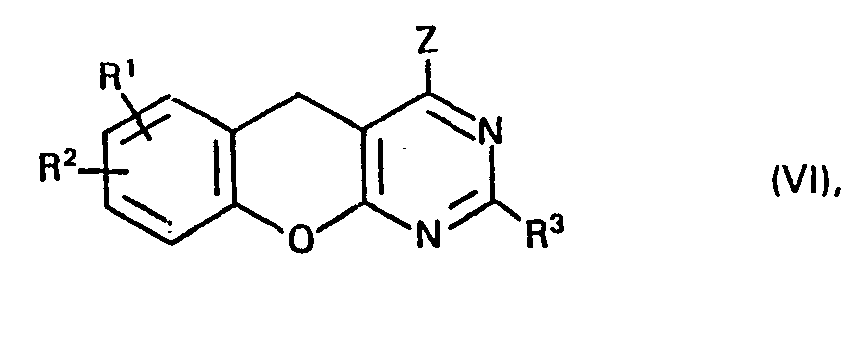
- the starting compounds of the general formula II are likewise new compounds and are obtained by reacting the compounds of the general formula VI known from DE-OS 2 801 353 in which R I and R 2 have the meaning given above, with an aromatic aldehyde of the general formula VII in which R 3 has the meaning given above, in the presence of a catalytic amount of a base, preferably obtained at the reflux temperature.
- a catalytic amount of a base preferably obtained at the reflux temperature.
- Piperidine and triethylamine have proven particularly suitable as bases for this.
- the easiest way to remove the water formed during the reaction is by azeotropically adding a water-immiscible solvent, such as methylene chloride, chloroform, benzene or toluene.
- the response time is usually between 6 and 20 hours.
- the mostly yellow to orange colored compounds of general formula 11 usually precipitate as poorly soluble precipitates in the course of the reaction and can be isolated by suction, washing and drying, or else they are obtained after removal of the solvent from the residue.
- the thiocarbamoylchromene derivatives of the general formula VI used are obtained according to DE-OS 2 801 353 according to known regulations by reaction of o-hydroxybenzaldehyde derivatives with 2-cyano-thioacetamide.
- the compounds of the general formula IV are preferably not isolated, but instead directly reacted further in a type of one-pot process with compounds of the general formula V.
- reactive ester groups esters or half esters of strong mineral acids such as Understood hydrohalic acids or sulfuric acid.
- the bromides and chlorides are preferred.
- the compounds V are used in the form of their hydrobromides or hydrochlorides. In this case, 2 molar equivalents of the base are used for the alkylation reaction.
- the compounds of the formula VI are preferably reacted in the presence of a base such as sodium methoxide or sodium methoxide in a polar solvent.
- the compounds of the general formula I crystallize directly from the filtrate or, after concentration of the reaction mixture and partitioning of the residue between a water-immiscible organic solvent such as e.g. Methylene chloride or chloroform, and water after concentrating the organic phase and crystallizing from a suitable solvent.
- a water-immiscible organic solvent such as e.g. Methylene chloride or chloroform
- the salts are obtained in the usual way by neutralizing the bases with appropriate inorganic or organic acids.
- acids come e.g. Hydrochloric acid, sulfuric acid, phosphoric acid, hydrobromic acid, acetic acid, tartaric acid, lactic acid, citric acid, malic acid, salicylic acid, ascorbic acid, malonic acid or succinic acid.
- the compounds of the general formula are valuable agents for combating gastric and duodenal mucosal lesions.
- cimetidine has central and other side effects; The changes in the gastric mucosa that occur during long-term therapy are particularly unpleasant because they are held responsible for recurrent ulcers after discontinuation of cimetidine.
- the present invention is based on the idea that the support of physiological mechanisms of gastrointestinal mucoprotection, that is to say the therapeutic prevention of lesions of the mucosal epithelium, should be superior to any other, ultimately, unphysiological therapy of ulcerative diseases.
- the inhibition or even blockade of peptic secretion as the goal of ulcer therapy has considerable disadvantages for the patient. Reports of duodenal mycoses, erosive, mycotic gastritis and systemic candidiasis are increasing as a result of the reduced gastric cellular resistance on the one hand and the pH increase due to anti-secretion on the other.
- the present compounds according to the invention are notable for a pronounced ulcer-protective action in the complete absence of antisecretory effects.
- the compounds of this invention can be used for all customary forms of administration; however, the oral forms are preferred.
- the application forms contain the usual excipients, fillers and lubricants and disintegrating additives.
- additives are e.g. Tartrate and citrate buffers, ethanol, complexing agents (such as ethylenediaminetetraacetic acid and its non-toxic salts) as well as high molecular weight polymers (such as liquid polyethylene oxide) for viscosity regulation.
- Solid carriers are e.g.
- the preferred individual dosages are between 10 and 500 mg of the corresponding active ingredient.
- the invention therefore furthermore relates to medicaments which are characterized in that, in addition to customary fillers and auxiliaries, they contain at least one compound of the general formula I and the use of compounds of the general formula 1 in combating gastric and duodenal mucosal lesions .
- customary fillers and auxiliaries they contain at least one compound of the general formula I and the use of compounds of the general formula 1 in combating gastric and duodenal mucosal lesions .
- reaction mixture is concentrated on a rotary evaporator, the residue is poured into 300 ml of water and the pH is adjusted to 7 using dilute hydrochloric acid. The precipitate is filtered off and crystallized from ethanol.
- Test animals were male rats (Sprague Dawley SIV 50) with a body weight of 150-200 g. The animals were deprived of food 24 hours before the start of the experiment. Drinking water was available ad libitum. The animals were divided into 3 groups of 10 rats each. To produce the ulcerations, indomethacin was applied to all animals at a dose of 40 mg / kg. At the same time, the groups received the vehicle (control group), the substance suspension (test group) or a comparison substance (cimetidine 100/200 mg / kg). 5 hours after the application, the animals were killed by CO 2 gas, the stomach was extirpated and opened along the large curvature.
- mice Male rats (Sprague Dawley SIV 57) with a body weight between 110 and 150 g served as test animals. The animals were deprived of their food 24 hours before the start of the experiment; Drinking water was available ad libitum.
- the rats were divided into 3 groups of 10 animals each, one group the vehicle (0.8% Methocel), the second group the test substance as a suspension in 0.8% Methocel and the third group a comparison standard (cimetidine 50 mg / kg ) ig was applied.
- the animals were anesthetized with penthrans and fixed on a wooden board lying on their back with adhesive tape.
- the animals were immobilized in this way for 14 hours in a permanently illuminated room at a temperature of + 15 ° C with a relative humidity of 50-60%.
- the rats were killed with CO 2 , the stomach was extirpated and opened along the large curvature.
- the gastric mucosa was examined for ulcerations by magnifying the magnifying glass.
- the evaluation of the ulcerations and the calculation of the ulcer index (UI) was carried out as in experiment 1, the effect of the substances being stated as a percentage inhibition of ulcer formation in comparison to the untreated control group.
- Male rats Male rats (Sprague Dawley SIV 50) weighing 300-450 g were used as test animals. The feed was withdrawn 24 hours before the start of the experiment, and water was available ad libitum.
- the animals were injected with 1.25 g / kg urethane i.p. anesthetized.
- the trachea, jugular vein, carotid artery and esophagus were dissected, and then a pyloric fistula was created.
- the stomach was perfused with 1/4000 N NaOH at a flow rate of 3 ml / min via an esophageal probe. With the aid of NaOH perfusion, the pH of the gastric juice was adjusted to approximately pH 7 and continuously measured using a measuring electrode.
- the acid-stimulating substance (carbachol 0.25 pg / kg / min or pentagastrin 1 pg / kg / min) was then infused via the jugular vein. When a maximum secretion (pH 3.5) was reached, the test substance could be administered as a suspension in 0.8% methocel via a duodenal catheter.
- Acute toxicity was determined on male mice (NMRI) with a body weight of 20 to 25 g. All test animals were fasted 20 hours before the start of the test. Water was available ad libitum. There were 4 animals in each dose group. The sequence of doses was logarithmic. The test substances were administered intragastric as a suspension in 0.8% methocel. The application volume was 20 ml / kg body weight. The animals were observed for a total of 7 days.
Landscapes
- Organic Chemistry (AREA)
- Chemical & Material Sciences (AREA)
- Health & Medical Sciences (AREA)
- Life Sciences & Earth Sciences (AREA)
- General Health & Medical Sciences (AREA)
- Chemical Kinetics & Catalysis (AREA)
- General Chemical & Material Sciences (AREA)
- Medicinal Chemistry (AREA)
- Nuclear Medicine, Radiotherapy & Molecular Imaging (AREA)
- Pharmacology & Pharmacy (AREA)
- Engineering & Computer Science (AREA)
- Animal Behavior & Ethology (AREA)
- Bioinformatics & Cheminformatics (AREA)
- Public Health (AREA)
- Veterinary Medicine (AREA)
- Pharmaceuticals Containing Other Organic And Inorganic Compounds (AREA)
- Plural Heterocyclic Compounds (AREA)
- Pyrane Compounds (AREA)
- Nitrogen Condensed Heterocyclic Rings (AREA)
- Heterocyclic Carbon Compounds Containing A Hetero Ring Having Oxygen Or Sulfur (AREA)
- Saccharide Compounds (AREA)
Claims (6)


dans un solvant organique avec une base,

soit:

le cas échéant sans isolement, par réaction avec un produit d'alkylation selon la formule générale V:

soit

Priority Applications (1)
| Application Number | Priority Date | Filing Date | Title |
|---|---|---|---|
| AT84111732T ATE30158T1 (de) | 1983-09-30 | 1984-10-01 | 5h-(1>benzopyrano(2,3-d>pyrimidin-derivate, verfahren zu deren herstellung, sowie diese enthaltende arzneimittel zur bekaempfung von gastralen und duodenalen schleimhautlaesionen. |
Applications Claiming Priority (2)
| Application Number | Priority Date | Filing Date | Title |
|---|---|---|---|
| DE3335472 | 1983-09-30 | ||
| DE19833335472 DE3335472A1 (de) | 1983-09-30 | 1983-09-30 | 5h-(1)benzopyrano-(2,3,-d)pyrimidin-derivate, verfahren zu deren herstellung sowie deren verwendung bei der bekaempfung von gastralen und duodenalen schleimhautlaesionen |
Publications (2)
| Publication Number | Publication Date |
|---|---|
| EP0144594A1 EP0144594A1 (fr) | 1985-06-19 |
| EP0144594B1 true EP0144594B1 (fr) | 1987-10-07 |
Family
ID=6210536
Family Applications (1)
| Application Number | Title | Priority Date | Filing Date |
|---|---|---|---|
| EP84111732A Expired EP0144594B1 (fr) | 1983-09-30 | 1984-10-01 | Dérivés de la 5H-[1]Benzopyranno[2,3,-d]pyrimidine, procédé pour leur préparation ainsi que médicaments les contenant pour la lutte contre les lésions muqueuses stomacales et duodénales |
Country Status (16)
| Country | Link |
|---|---|
| US (1) | US4578380A (fr) |
| EP (1) | EP0144594B1 (fr) |
| JP (1) | JPS6092288A (fr) |
| AT (1) | ATE30158T1 (fr) |
| AU (1) | AU3366884A (fr) |
| CA (1) | CA1249814A (fr) |
| DD (1) | DD232705A5 (fr) |
| DE (2) | DE3335472A1 (fr) |
| DK (1) | DK468384A (fr) |
| ES (1) | ES536342A0 (fr) |
| FI (1) | FI843778A7 (fr) |
| GR (1) | GR80470B (fr) |
| HU (1) | HUT36123A (fr) |
| IL (1) | IL73090A0 (fr) |
| NO (1) | NO843918L (fr) |
| ZA (1) | ZA847662B (fr) |
Cited By (3)
| Publication number | Priority date | Publication date | Assignee | Title |
|---|---|---|---|---|
| CN108014103A (zh) * | 2017-11-13 | 2018-05-11 | 河南大学 | Imca在制备抗甲状腺癌药物中的应用 |
| CN108078976A (zh) * | 2017-11-13 | 2018-05-29 | 河南大学 | Imca在制备抗胃癌药物中的应用 |
| CN108175766A (zh) * | 2017-12-05 | 2018-06-19 | 河南大学 | Imca在制备抗结直肠癌药物中的应用 |
Families Citing this family (7)
| Publication number | Priority date | Publication date | Assignee | Title |
|---|---|---|---|---|
| DE19742508A1 (de) * | 1997-09-26 | 1999-04-01 | Hoechst Marion Roussel De Gmbh | Sulfonamid-substituierte Chromane, Verfahren zu ihrer Herstellung, ihre Verwendung als Medikament oder Diagnostikum sowie sie enthaltende pharmazeutische Zubereitungen |
| DE19748469A1 (de) * | 1997-11-03 | 1999-05-06 | Hoechst Marion Roussel De Gmbh | Sulfonamid-substituierte Benzopyranderivate, Verfahren zu ihrer Herstellung, ihre Verwendung als Medikament sowie sie enthaltende pharmazeutische Zubereitungen |
| IL136181A0 (en) * | 1997-11-19 | 2001-05-20 | Natural Drug Sciences Llc | 5H-PYRANO[2,3-d:6,5-d'] DIPYRIMIDINE DERIVATIVES HAVING AN ANTIBACTERIAL, ANTIVIRAL, AND IMMUNO-MODULATING ACTIVITY |
| RU2188201C2 (ru) * | 1997-11-19 | 2002-08-27 | Ашкинази Римма Ильинична | Производные 5h-пирано[2,3-d:6,5-d']дипиримидина, обладающие антимикробным, противовирусным и иммуномодулирующим действием |
| CN102977111B (zh) * | 2012-12-12 | 2015-04-15 | 中国药科大学 | 一类具有改善阿尔兹海默病作用的β1-肾上腺素受体激动剂 |
| RU2595038C1 (ru) | 2015-04-03 | 2016-08-20 | Виктор Вениаминович Тец | Лекарственное средство с противовирусной активностью (варианты) |
| CN115974828B (zh) * | 2023-02-14 | 2025-02-11 | 中国药科大学 | 作为蛋白磷酸酶5激动剂的化合物及其制备方法与用途 |
Family Cites Families (7)
| Publication number | Priority date | Publication date | Assignee | Title |
|---|---|---|---|---|
| DE1470336A1 (de) * | 1962-07-04 | 1969-03-20 | Thomae Gmbh Dr K | Neue Dihydrothieno-[3,4-d]-pyrimidine und Verfahren zu ihrer Herstellung |
| US3468888A (en) * | 1967-04-11 | 1969-09-23 | Smithkline Corp | 2-substituted pyrimido(1,2-a) benzimidazoles |
| US3578666A (en) * | 1968-08-26 | 1971-05-11 | Sandoz Ag | Substituted imidazolines,pyrimidines and diazepines |
| US3772230A (en) * | 1969-05-28 | 1973-11-13 | Sandoz Ag | Polyhydro-imidazo(1,5-a)pyrimidine-3(2h)-thione and pyrido(1,2-c)pyrimidine-1-thione |
| ATE183T1 (de) * | 1978-07-31 | 1981-09-15 | Scherico Ltd. | Benzopyranderivate, sie enthaltende pharmazeutische zusammensetzungen und verfahren zum herstellen der verbindungen und zusammensetzungen. |
| US4272535A (en) * | 1978-07-31 | 1981-06-09 | Schering Corporation | 2,4-[1H,3H,5H]-(1)-Benzopyrano-[2,3-d]-pyrimidinediones and their use as anti-allergy agents |
| US4297355A (en) * | 1979-11-15 | 1981-10-27 | Schering Corporation | (1H,3H,5H)-(1)-Benzopyrano-(2,3-d)-pyrimidine-4-one-2-thiones and their use as anti-allergy agents |
-
1983
- 1983-09-30 DE DE19833335472 patent/DE3335472A1/de active Granted
-
1984
- 1984-09-24 US US06/653,175 patent/US4578380A/en not_active Expired - Fee Related
- 1984-09-25 GR GR80470A patent/GR80470B/el unknown
- 1984-09-26 IL IL73090A patent/IL73090A0/xx unknown
- 1984-09-26 FI FI843778A patent/FI843778A7/fi not_active Application Discontinuation
- 1984-09-28 JP JP59203933A patent/JPS6092288A/ja active Granted
- 1984-09-28 CA CA000464282A patent/CA1249814A/fr not_active Expired
- 1984-09-28 ES ES536342A patent/ES536342A0/es active Granted
- 1984-09-28 DK DK468384A patent/DK468384A/da not_active Application Discontinuation
- 1984-09-28 ZA ZA847662A patent/ZA847662B/xx unknown
- 1984-09-28 HU HU843699A patent/HUT36123A/hu unknown
- 1984-09-28 NO NO843918A patent/NO843918L/no unknown
- 1984-09-28 AU AU33668/84A patent/AU3366884A/en not_active Abandoned
- 1984-09-28 DD DD84267756A patent/DD232705A5/de unknown
- 1984-10-01 DE DE8484111732T patent/DE3466692D1/de not_active Expired
- 1984-10-01 EP EP84111732A patent/EP0144594B1/fr not_active Expired
- 1984-10-01 AT AT84111732T patent/ATE30158T1/de not_active IP Right Cessation
Cited By (5)
| Publication number | Priority date | Publication date | Assignee | Title |
|---|---|---|---|---|
| CN108014103A (zh) * | 2017-11-13 | 2018-05-11 | 河南大学 | Imca在制备抗甲状腺癌药物中的应用 |
| CN108078976A (zh) * | 2017-11-13 | 2018-05-29 | 河南大学 | Imca在制备抗胃癌药物中的应用 |
| CN108014103B (zh) * | 2017-11-13 | 2019-12-03 | 河南大学 | Imca在制备抗甲状腺癌药物中的应用 |
| CN108078976B (zh) * | 2017-11-13 | 2019-12-03 | 河南大学 | Imca在制备抗胃癌药物中的应用 |
| CN108175766A (zh) * | 2017-12-05 | 2018-06-19 | 河南大学 | Imca在制备抗结直肠癌药物中的应用 |
Also Published As
| Publication number | Publication date |
|---|---|
| ATE30158T1 (de) | 1987-10-15 |
| ES8601209A1 (es) | 1985-10-16 |
| HUT36123A (en) | 1985-08-28 |
| NO843918L (no) | 1985-04-01 |
| FI843778L (fi) | 1985-03-31 |
| IL73090A0 (en) | 1984-12-31 |
| GR80470B (en) | 1985-01-28 |
| DK468384D0 (da) | 1984-09-28 |
| US4578380A (en) | 1986-03-25 |
| DE3335472C2 (fr) | 1989-08-03 |
| FI843778A7 (fi) | 1985-03-31 |
| DE3466692D1 (en) | 1987-11-12 |
| JPH0447674B2 (fr) | 1992-08-04 |
| AU3366884A (en) | 1985-04-04 |
| FI843778A0 (fi) | 1984-09-26 |
| CA1249814A (fr) | 1989-02-07 |
| DD232705A5 (de) | 1986-02-05 |
| DE3335472A1 (de) | 1985-04-11 |
| ZA847662B (en) | 1985-05-29 |
| EP0144594A1 (fr) | 1985-06-19 |
| DK468384A (da) | 1985-03-31 |
| JPS6092288A (ja) | 1985-05-23 |
| ES536342A0 (es) | 1985-10-16 |
Similar Documents
| Publication | Publication Date | Title |
|---|---|---|
| DE2623567C2 (de) | Thienopyridinderivate, Verfahren zu ihrer Herstellung und sie enthaltende Arzneimittelzubereitungen | |
| DE69905178T2 (de) | Tetrahydropyridoether | |
| DE2305339C3 (de) | Imidazo [4,5-b] pyridine, ihre Herstellung und ihre Verwendung als Cardiötonica | |
| DE3240248A1 (de) | Substituierte benzimidazole, verfahren zu ihrer herstellung, ihre anwendung und sie enthaltende arzneimittel | |
| CH630912A5 (de) | Verfahren zur herstellung von 1,2-dihydronaphthalinderivaten. | |
| DE2740588A1 (de) | Imidazo- eckige klammer auf 1,2-a eckige klammer zu -chinolin-2-carbon- saeuren und deren derivate sowie pharmazeutische zubereitungen, die diese verbindungen enthalten | |
| DE2720085C2 (fr) | ||
| DE3335472C2 (fr) | ||
| EP0000220A1 (fr) | Dihydrouraciles, procédé pour leur préparation et médicaments les contenant | |
| EP0071935B1 (fr) | Composés du 1-phényl-2-aminocarbonylindole, procédé de préparation et intermédiaires et médicaments contenant ces composés | |
| DE3046366A1 (de) | Tricyclische cytosinderivate zur verwendung in arzneimitteln und verfahren zu ihrer herstellung | |
| EP0387821A2 (fr) | 2-Alkyl-4-arylméthylaminoquinoléines, leur utilisation et médicaments les contenant | |
| DE3028001A1 (de) | Neue, in 5-stellung substituierte 5,10-dihydro-11h-dibenzo (b,e)(1,4) diazepin-11-one, verfahren zu ihrer herstellung und diese verbindung enthaltende arzneimittel | |
| DE69028355T2 (de) | 4,5-Dihydro-6H-imidazo[4,5,1-ij]chinolin-6-on-6-oxim-O-sulfonsäurederivate | |
| DE3118521A1 (de) | Dibenzo(de,g)chinolin-derivate, verfahren zu deren herstellung und deren verwendung bei der bekaempfung von erkaeltungskrankheiten und allergien | |
| AT400845B (de) | Neue thienothiazinderivate, ein verfahren zu ihrer herstellung und ihre verwendung | |
| DE3335473A1 (de) | 4-thioxo-benzopyrano(2,3-d)pyrimidin-derivate sowie verfahren zu deren herstellung | |
| EP0138034B1 (fr) | Pyrido[1,2-c]imidazo[1,2-a]benzimidazoles substitués, procédé pour leur préparation, leur application et compositions pharmaceutiques à base de ces composés | |
| EP0180833B1 (fr) | Dérivés de la 4-oxopyrido[2,3-d]pyrimidine, procédé pour leur préparation et médicaments les contenant | |
| DE2234255B2 (de) | Xanthon-2-carbonsäuren, deren pharmakologisch nicht toxische Salze sowie Alkylester mit 1 bis 5 Kohlenstoffatomen, Verfahren zu ihrer Herstellung und diese Verbindungen enthaltende Mittel | |
| EP0091045B1 (fr) | Dérivés de 2-pyrrolin-3-carbonitrile, procédé de préparation et médicaments les contenant | |
| DE2703522A1 (de) | Chinolopyran-4-on-2-carbonsaeurederivate und deren salze als medikamente zur behandlung von allergischem asthma | |
| WO1996003402A1 (fr) | Imidazopyridines halogenees | |
| DE2628751A1 (de) | 6-substituierte 1-oxo-1h-pyrimido eckige klammer auf 1,2-a eckige klammer zu chinolin-2-carbonsaeuren, deren salze und ester | |
| DE2818395A1 (de) | Derivate von triazolthiadiazinen, verfahren zu ihrer herstellung und sie enthaltende arzneimittel |
Legal Events
| Date | Code | Title | Description |
|---|---|---|---|
| PUAI | Public reference made under article 153(3) epc to a published international application that has entered the european phase |
Free format text: ORIGINAL CODE: 0009012 |
|
| 17P | Request for examination filed |
Effective date: 19841001 |
|
| AK | Designated contracting states |
Designated state(s): AT BE CH DE FR GB IT LI LU NL SE |
|
| RTI1 | Title (correction) | ||
| 17Q | First examination report despatched |
Effective date: 19860826 |
|
| ITF | It: translation for a ep patent filed | ||
| GRAA | (expected) grant |
Free format text: ORIGINAL CODE: 0009210 |
|
| AK | Designated contracting states |
Kind code of ref document: B1 Designated state(s): AT BE CH DE FR GB IT LI LU NL SE |
|
| PG25 | Lapsed in a contracting state [announced via postgrant information from national office to epo] |
Ref country code: NL Effective date: 19871007 Ref country code: BE Effective date: 19871007 |
|
| REF | Corresponds to: |
Ref document number: 30158 Country of ref document: AT Date of ref document: 19871015 Kind code of ref document: T |
|
| PG25 | Lapsed in a contracting state [announced via postgrant information from national office to epo] |
Ref country code: SE Effective date: 19871031 |
|
| ET | Fr: translation filed | ||
| REF | Corresponds to: |
Ref document number: 3466692 Country of ref document: DE Date of ref document: 19871112 |
|
| GBT | Gb: translation of ep patent filed (gb section 77(6)(a)/1977) | ||
| NLV1 | Nl: lapsed or annulled due to failure to fulfill the requirements of art. 29p and 29m of the patents act | ||
| PLBE | No opposition filed within time limit |
Free format text: ORIGINAL CODE: 0009261 |
|
| STAA | Information on the status of an ep patent application or granted ep patent |
Free format text: STATUS: NO OPPOSITION FILED WITHIN TIME LIMIT |
|
| 26N | No opposition filed | ||
| PG25 | Lapsed in a contracting state [announced via postgrant information from national office to epo] |
Ref country code: LU Free format text: LAPSE BECAUSE OF NON-PAYMENT OF DUE FEES Effective date: 19881031 |
|
| PGFP | Annual fee paid to national office [announced via postgrant information from national office to epo] |
Ref country code: GB Payment date: 19910926 Year of fee payment: 8 |
|
| PGFP | Annual fee paid to national office [announced via postgrant information from national office to epo] |
Ref country code: AT Payment date: 19910927 Year of fee payment: 8 |
|
| PGFP | Annual fee paid to national office [announced via postgrant information from national office to epo] |
Ref country code: FR Payment date: 19911021 Year of fee payment: 8 |
|
| ITTA | It: last paid annual fee | ||
| PGFP | Annual fee paid to national office [announced via postgrant information from national office to epo] |
Ref country code: DE Payment date: 19911126 Year of fee payment: 8 |
|
| PGFP | Annual fee paid to national office [announced via postgrant information from national office to epo] |
Ref country code: CH Payment date: 19920113 Year of fee payment: 8 |
|
| PG25 | Lapsed in a contracting state [announced via postgrant information from national office to epo] |
Ref country code: GB Effective date: 19921001 Ref country code: AT Effective date: 19921001 |
|
| PG25 | Lapsed in a contracting state [announced via postgrant information from national office to epo] |
Ref country code: LI Effective date: 19921031 Ref country code: CH Effective date: 19921031 |
|
| GBPC | Gb: european patent ceased through non-payment of renewal fee |
Effective date: 19921001 |
|
| PG25 | Lapsed in a contracting state [announced via postgrant information from national office to epo] |
Ref country code: FR Effective date: 19930630 |
|
| REG | Reference to a national code |
Ref country code: CH Ref legal event code: PL |
|
| PG25 | Lapsed in a contracting state [announced via postgrant information from national office to epo] |
Ref country code: DE Effective date: 19930701 |
|
| REG | Reference to a national code |
Ref country code: FR Ref legal event code: ST |