EP0144896B1 - Triphendioxazinfarbstoffe - Google Patents
Triphendioxazinfarbstoffe Download PDFInfo
- Publication number
- EP0144896B1 EP0144896B1 EP84114315A EP84114315A EP0144896B1 EP 0144896 B1 EP0144896 B1 EP 0144896B1 EP 84114315 A EP84114315 A EP 84114315A EP 84114315 A EP84114315 A EP 84114315A EP 0144896 B1 EP0144896 B1 EP 0144896B1
- Authority
- EP
- European Patent Office
- Prior art keywords
- alkyl
- radicals
- formula
- dyes
- aryl
- Prior art date
- Legal status (The legal status is an assumption and is not a legal conclusion. Google has not performed a legal analysis and makes no representation as to the accuracy of the status listed.)
- Expired
Links
- 0 Cc(cc1)ccc1ClC* Chemical compound Cc(cc1)ccc1ClC* 0.000 description 4
Classifications
-
- C—CHEMISTRY; METALLURGY
- C09—DYES; PAINTS; POLISHES; NATURAL RESINS; ADHESIVES; COMPOSITIONS NOT OTHERWISE PROVIDED FOR; APPLICATIONS OF MATERIALS NOT OTHERWISE PROVIDED FOR
- C09B—ORGANIC DYES OR CLOSELY-RELATED COMPOUNDS FOR PRODUCING DYES, e.g. PIGMENTS; MORDANTS; LAKES
- C09B19/00—Oxazine dyes
- C09B19/02—Bisoxazines prepared from aminoquinones
Definitions
- alkyl, aryl, alkoxy, aralkyl, phenyl and naphthyl radicals can optionally have substituents customary in dyes.
- Suitable aryl radicals are in particular optionally substituted phenyl radicals or naphthyl radicals, the substituents being in particular C 1 -C 4 alkyl, C 1 -C 4 alkoxy, chlorine, bromine, nitro, carbo-C 1 -C 4 alkoxy, carboxy and sulfo come.
- Suitable aralkyl radicals are, in particular, phenyl-C 1 -C 4 -alkyl which can optionally be substituted by the abovementioned substituents.
- Suitable aliphatic radicals are, for example, straight-chain or branched C2-Ce alkylene which is interrupted, for example, by heteroatoms such as N, 0 or S or arylene radicals or CO groups or by substituents, for example OH, sulfo, carboxy, optionally substituted phenyl or C 1 -C 4 -Alkoxycarbonyl can be substituted.
- Suitable araliphatic radicals are, for example, phenylalkylene radicals, where the phenyl radicals can be substituted as indicated above and alkylene preferably represents C 1 -C 4 alkylene.
- Suitable alkyl radicals are in particular C 1 -C 4 -alkyl, which can be substituted, for example, by OH, sulfo, C 1 -C 4 -alkoxy.
- Suitable radicals Y are, for example: 1,2-ethylene, 1,2- or 1,3-propylene, 2-0xy-1,3-propylene, 1- and 2-phenyl-1,3-propylene, 2- (4th '-Sulfophenyl) -1,3-propylene, 1,4-, 2,3- and 2,4-butylene, 2-methyl-1,3-propylene, 2-methyl-2,4-pentylene, 2.2 -Dimethyl-1,3-propylene, 1-phenylethylene, 1-chloro-2,3-propylene, 1,6- and 2,5-hexylene, 2,3-diphenyl-1,4-butylene, 1-methoxycarbonyl- 1,5-pentylene, 1-carboxy-1,5-pentylene, 2,7-heptylene, 3-methyl-1,6-hexylene, -CH 2 CH 2 OCH 2 CH 2 -, -CH 2 CH 2 SCH 2 CH 2 -, Y preferably represents a straight-
- Suitable substituents B are, in particular, phenyl and naphthyl which can be substituted, for example, by methyl, ethyl, methoxy, ethoxy, chlorine, bromine, nitro, ethoxycarbonyl, carboxy, methoxycarbonyl and sulfo, and also C 1 -C 10 -alkyl radicals which, for example, by methoxy, Chlorine, methoxycarbonyl and carboxy can be substituted.
- Suitable cycloalkyl radicals B are, for example, cyclohexyl radicals which can be substituted, for example, by methyl or ethyl.
- Suitable aralkyl radicals B are in particular benzyl radicals which can be substituted as indicated for the phenyl radicals B.
- the condensation of the color base (2) with the acylation components (3) and (4) is generally stated in water, at temperatures between 0 and 60 ° C. and in the pH range from 3 to 12. It is useful to add an acid-binding agent with (3) during the acylation reaction in order to keep the pH in the desired range.
- Examples of sulfonic acid chlorides of the formula (3) are: CH 3 SO 2 Cl, C 2 H 5 SO 2 Cl, Cl (CH 2 ) 4 SO 2 Cl, CICH 2 S0 2 CI, Examples of isocyanates of the formula (4) are: CH 3 NCO, C 2 H 5 NCO,
- the color bases of the formula (2) are known. They can be made according to the specifications of British Patent 1,559,752, 1,450,746 and 2,059,985.
- the dyes of the invention are suitable for dyeing fiber materials to which the dyes can be applied in the form of an aqueous solution by dyeing, padding or printing processes.
- Textile materials that can be dyed are e.g. B. materials made of natural cellulose fibers such. B. paper, cotton, regenerated cellulose fibers such. As viscose rayon, natural protein fibers, such as. As wool and silk, and synthetic polyamide fibers, such as. Nylon-66 (R) and nylon-6 (R).
- the dyes are particularly suitable for dyeing synthetic polyamide textile materials, on which they give dyeings with a surprisingly high degree of fastness to wet treatments.
- the polyamides can be in any convenient form, such as. B. in the form of threads, staple fibers, textiles or films, and the application conditions can be such as it is already known for the application of water-soluble dyes to synthetic polyamides.
- the formulas given are those of the corresponding free acids.
- the dyes were generally isolated in the form of the alkali salts, in particular the Na salts, and used for dyeing.
- the weight data in the examples relate to the free acid.
- the color indicators given in the examples refer to the Color Index Hue Indication Chart (Indicator Numbers).
- the dyes according to the invention with an acylated amino group show surprisingly better dyeing properties (build-up on wool and polyamide) than the dyes of the closest prior art (DE-A-2503611) with a non-acylated amino group.
Landscapes
- Chemical & Material Sciences (AREA)
- Organic Chemistry (AREA)
- Coloring (AREA)
Description
-


- X = -0-, -S-, -NR1-,
- R1 = H, C1 -C4 -Alkyl oder zusammen mit R2 = Alkylen,
- Y = aliphatischer oder araliphatischer Rest
- R2 = H, C1 -C4 -Alkyl, Aralkyl, Aryl,
- Z = nicht faserreaktiver Rest der Formel -SO2B oder -CONHB worin
- B = Alkyl, Cycloalkyl, Aralkyl, Aryl,
- T1,T2 = H, Halogen, C1-C4-Alkyl, C1-C4-Alkoxy, Aryl,
- R = Halogen, Carboxy, C1-C4-Alkyl, C1-C4-Alkoxy,
- n = 0 oder 1
- a,b = 0 oder 1, wobei a+b = 1 oder 2 und
- wobei die Sulfogruppen jeweils in o-Stellung zu A stehen,
- sowie deren Herstellung und Verwendung zum Färben von natürlichen oder synthetischen Fasermaterialien.
- Bevorzugte Farbstoffe sind dabei solche mit T1, T2 = Cl, n = 0 und X = NR1, insbesondere X = -NH.
- Die Alkyl-, Aryl-, Alkoxy-, Aralkyl-, Phenyl- und Naphthylreste können gegebenenfalls in Farbstoffen übliche Substituenten aufweisen.
- Geeignete Arylreste sind insbesondere gegebenenfalls substituierte Phenylreste oder Naphthylreste wobei als Substituenten insbesondere C1-C4-Alkyl, Cl-C4-Alkoxy, Chlor, Brom, Nitro, Carbo-C1-C4-alkoxy, Carboxy und Sulfo in Frage kommen.
- Geeignete Aralkylreste sind insbesondere Phenyl-C1-C4-alkyl die gegebenenfalls durch die obengenannten Substituenten substituiert sein können.
- Geeignete aliphatische Reste sind beispielsweise geradkettige oder verzweigtes C2-Ce-Alkylen, das beispielsweise durch Heteroatome wie N, 0 oder S oder Arylenreste oder CO-Gruppen unterbrochen oder durch Substituenten beispielsweise OH, Sulfo, Carboxy, gegebenenfalls substituiertes Phenyl oder C1-C4-Alkoxycarbonyl substituiert sein kann.
- Geeignete araliphatische Reste sind beispielsweise Phenylalkylenreste, wobei die Phenylreste wie oben angegeben substituiert sein können und Alkylen bevorzugt für C1-C4-Alkylen steht.
- Geeignete Alkylreste sind insbesondere C1-C4-Alkyl, das beispielsweise durch OH, Sulfo, C1-C4-Alkoxy substituiert sein kann.
- Geeignete Reste Y sind beispielsweise: 1,2-Ethylen, 1,2- oder 1,3-Propylen, 2-0xy-1,3-propylen, 1- und 2-Phenyl-1,3-propylen, 2-(4'-Sulfophenyl)-1,3-propylen, 1,4-, 2,3- und 2,4-Butylen, 2-Methyl-1,3-propylen, 2-Methyl-2,4-pentylen, 2,2-Dimethyl-1,3-propylen, 1-Phenylethylen, 1-Chlor-2,3-propylen, 1,6- und 2,5-Hexylen, 2,3-Diphenyl-1,4-butylen, 1-Methoxycarbonyl-1,5-pentylen, 1-Carboxy-1,5-pentylen, 2,7-Heptylen, 3-Methyl-1,6-hexylen, -CH2CH2OCH2CH2-, -CH2CH2SCH2CH2-,


- Geeignete Substituenten B sind insbesondere Phenyl- und Naphthyl die beispielsweise durch Methyl, Ethyl, Methoxy, Ethoxy, Chlor, Brom, Nitro, Ethoxycarbonyl, Carboxy, Methoxycarbonyl und Sulfo substituiert sein können, sowie C1-C10-Alkylreste die beispielsweise durch Methoxy, Chlor, Methoxycarbonyl und Carboxy substituiert sein können.
- Geeignete Cycloalkylreste B sind beispielsweise Cyclohexylreste, die beispielsweise durch Methyl oder Ethyl substituiert sein können.
- Geeignete Aralkylreste B sind insbesondere Benzylreste die wie für die Phenylreste B angegeben substituiert sein können.
- Geeignete Reste Z sind beispielsweise -SO2CH3, -SO2C2H5, -SO2CH2Cl, -S02(CH2)4C1,


- CIS02B (3)
- unter Abspaltung von 2 Mol HCI kondensiert oder mit 2 Mol eines Isocyanats der Formel
- B - NCO (4)
- kondensiert.
- Die Kondensation der Farbbase (2) mit den Acylierungskomponenten (3) und (4) wird im allgemeinen in Wasser, bei Temperaturen zwischen 0 und 60°C und im pH-Bereich von 3 bis 12 angeführt. Zweckmäßig wird man während der Acylierungsreaktion mit (3) ein säurebindendes Mittel zusetzen um den pH im gewünschten Bereich zu halten.
- Beispiele für Sulfonsäurechloride der Formel (3) sind: CH3SO2Cl, C2H5SO2Cl, Cl(CH2)4SO2Cl, CICH2S02CI,



- Die erfindungsgemäßen Farbstoffe eignen sich zum Färben von Fasermaterialien, auf welche die Farbstoffe in Form einer wäßrigen Lösung durch Färbe-, Klotz- oder Druckverfahren aufgebracht werden können. Textilmaterialien, welche gefärbt werden können, sind z. B. Materialien, die natürliche Cellulosefasern, wie z. B. Papier, Baumwolle, regenerierte Cellulosefasern, wie z. B. Viskoserayon, natürliche Proteinfasern, wie z. B. Wolle und Seide, und synthetische Polyamidfasern, wie z. B. Nylon-66 (R) und Nylon-6 (R), enthalten. Die Farbstoffe eignen sich besonders zum Färben von synthetischen Polyamidtextilmaterialien, auf denen sie Färbungen mit einem überraschend hohen Grad von Echtheit gegenüber nassen Behandlungen ergeben. Die Polyamide können in jeder zweckmäßigen Form, wie z. B. in Form von Fäden, Stapelfasern, Textilstoffen oder Filmen, verwendet werden, und die Aufbringbedingungen können derart sein, wie es bereits für die Aufbringung von wasserlöslichen Farbstoffen auf synthetische Polyamide bekannt ist.
- Die angegebenen Formeln sind die der entsprechenden freien Säuren. Die Farbstoffe wurden im allgemeinen in Form der Alkalisalze, insbesondere der Na-Salze isoliert und zum Färben eingesetzt.
- Die angegebenen Formeln beziehen sich auf jeweils eines der bei der Umsetzung entstehenden isomeren Reaktionsprodukte.
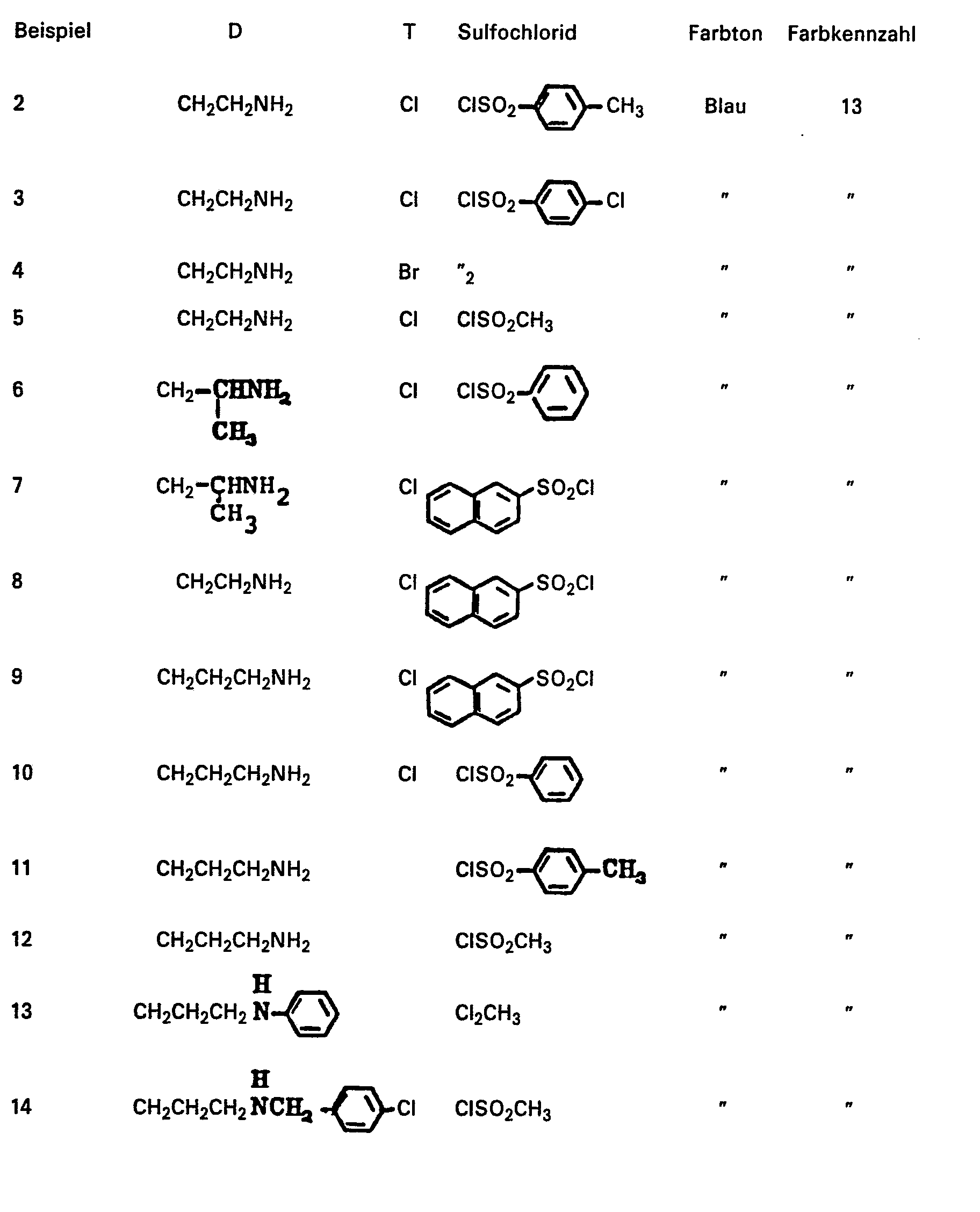
- Die Gewichtsangaben in den Beispielen beziehen sich auf die freie Säure. Die in den Beispielen angegebenen Farbkennzahlen beziehen sich auf Colour Index Hue Indication Chart (Indicator Numbers).
- Die erfindungsgemäßen Farbstoffe mit acylierter Aminogruppe zeigen überraschend bessere färberische Eigenschaften (Aufbauvermögen auf Wolle und Polyamid) als die Farbstoffe des nächsten Standes der Technik (DE-A-2503611 ) mit nicht-acylierter Aminogruppe.
- 63,1 g der Farbstoffbase der Formel


-


Claims (4)


oder -CONHB worin
wobei die Sulfogruppen jeweils in o-Stellung zu A stehen.
Applications Claiming Priority (2)
| Application Number | Priority Date | Filing Date | Title |
|---|---|---|---|
| DE19833344254 DE3344254A1 (de) | 1983-12-07 | 1983-12-07 | Triphendioxazinfarbstoffe |
| DE3344254 | 1983-12-07 |
Publications (3)
| Publication Number | Publication Date |
|---|---|
| EP0144896A2 EP0144896A2 (de) | 1985-06-19 |
| EP0144896A3 EP0144896A3 (en) | 1986-03-19 |
| EP0144896B1 true EP0144896B1 (de) | 1988-03-16 |
Family
ID=6216277
Family Applications (1)
| Application Number | Title | Priority Date | Filing Date |
|---|---|---|---|
| EP84114315A Expired EP0144896B1 (de) | 1983-12-07 | 1984-11-27 | Triphendioxazinfarbstoffe |
Country Status (3)
| Country | Link |
|---|---|
| US (1) | US4578461A (de) |
| EP (1) | EP0144896B1 (de) |
| DE (2) | DE3344254A1 (de) |
Families Citing this family (6)
| Publication number | Priority date | Publication date | Assignee | Title |
|---|---|---|---|---|
| DE3628084A1 (de) * | 1986-08-19 | 1988-03-03 | Hoechst Ag | Wasserloesliche triphendioxazine, deren herstellung, verwendung als farbstoffe sowie nitro- und aminobenzolsulfon-vorprodukte |
| US4841049A (en) * | 1986-09-12 | 1989-06-20 | Ciba-Geigy Corporation | Reactive dyes of the dioxazine series |
| DE3703732A1 (de) * | 1987-02-07 | 1988-08-18 | Bayer Ag | Verfahren zur herstellung einer konzentrierten waessrigen reaktivfarbstoff-loesung |
| TW208012B (de) * | 1990-10-30 | 1993-06-21 | Ciba Geigy Ag | |
| ES2099150T3 (es) * | 1990-10-30 | 1997-05-16 | Ciba Geigy Ag | Mezclas de oligomeros de compuestos de trifenodioxazina, procedimiento para su obtencion y uso de las mismas. |
| DE4422484A1 (de) | 1994-06-28 | 1996-01-04 | Roehm Gmbh | Pfropfpolymerisate zur Beschichtung von Flächengebilden |
Family Cites Families (9)
| Publication number | Priority date | Publication date | Assignee | Title |
|---|---|---|---|---|
| FR1116564A (fr) * | 1953-12-29 | 1956-05-09 | Ciba Geigy | Nouveaux colorants de la série oxazinique, leur préparation et leur emploi |
| CH525931A (de) * | 1969-09-30 | 1972-07-31 | Ciba Geigy Ag | Verfahren zur Herstellung neuer Dioxazine |
| GB1450746A (en) * | 1974-01-31 | 1976-09-29 | Ici Ltd | Tripendioxazine dyestuffs |
| AU497288B2 (en) * | 1975-04-15 | 1978-12-07 | Imperial Chemical Industries Limited | Dyestuffs |
| US4336377A (en) * | 1979-02-02 | 1982-06-22 | Ciba-Geigy Corporation | Basic dioxazine compounds |
| DE3045471A1 (de) * | 1980-12-02 | 1982-07-08 | Bayer Ag, 5090 Leverkusen | Dioxazin-reaktivfarbstoffe, verfahren zu ihrer herstellung und ihre verwendung zum faerben und bedrucken von hydroxyl- oder amidgruppenhaltigen fasermaterialien |
| DE3270683D1 (de) * | 1982-01-27 | 1986-05-22 | Ici Plc | Triphendioxazine dyestuffs |
| GB2131823A (en) * | 1982-05-24 | 1984-06-27 | Ici Plc | Triphendioxazine dyes, methods for their manufacture and their use for dying cecculosic substrates |
| EP0101665A3 (de) * | 1982-08-19 | 1984-10-10 | Ciba-Geigy Ag | Reaktivfarbstoffe der Dioxazinreihe, deren Herstellung und Verwendung |
-
1983
- 1983-12-07 DE DE19833344254 patent/DE3344254A1/de not_active Withdrawn
-
1984
- 1984-11-20 US US06/673,259 patent/US4578461A/en not_active Expired - Fee Related
- 1984-11-27 EP EP84114315A patent/EP0144896B1/de not_active Expired
- 1984-11-27 DE DE8484114315T patent/DE3469908D1/de not_active Expired
Also Published As
| Publication number | Publication date |
|---|---|
| EP0144896A2 (de) | 1985-06-19 |
| US4578461A (en) | 1986-03-25 |
| DE3469908D1 (de) | 1988-04-21 |
| DE3344254A1 (de) | 1985-06-20 |
| EP0144896A3 (en) | 1986-03-19 |
Similar Documents
| Publication | Publication Date | Title |
|---|---|---|
| EP1247842A1 (de) | Faserreaktive Anthrachinonfarbstoffe, deren Herstellung und deren Verwendung | |
| DE3423581A1 (de) | Reaktivfarbstoffe | |
| EP0357915B1 (de) | Disazoreaktivfarbstoffe | |
| EP1062279B1 (de) | Reaktivfarbstoffe mit einem kombinationsanker | |
| EP0144896A2 (de) | Triphendioxazinfarbstoffe | |
| EP0425907B1 (de) | Triphendioxazinfarbstoffe | |
| EP0356681B1 (de) | Disazoreaktivfarbstoffe | |
| DE2822755C3 (de) | Neue wasserlösliche Anthrachinonfarbstoffe | |
| EP0277600B1 (de) | Verfahren zur Herstellung von Azo-Reaktivfarbstoffen | |
| EP0198349B1 (de) | Disazoreaktivfarbstoffe | |
| EP0690103B1 (de) | Azofarbstoffe, Verfahren zu deren Herstellung und deren Verwendung | |
| EP0672727B1 (de) | Anthrachinonfarbstoffe, Verfahren zu deren Herstellung und deren Verwendung | |
| EP0319845A2 (de) | Wasserlösliche Disazoverbindungen, Verfahren zu ihrer Herstellung und ihre Verwendung als Farbstoffe | |
| EP0448815B1 (de) | Triphendioxazinfarbstoffe | |
| EP0198350B1 (de) | Disazoreaktivfarbstoffe | |
| CH492766A (de) | Verfahren zur Herstellung von Reaktivfarbstoffen | |
| DE1913400C3 (de) | Wasserlösliche Monoazofarbstoffe, Verfahren zu ihrer Herstellung und ihre Verwendung | |
| EP0601970A1 (de) | Anthrachinonfarbstoffe, Verfahren zu deren Herstellung und deren Verwendung | |
| DE948347C (de) | Verfahren zur Herstellung von Farbstoffen der Dioxazinreihe | |
| DE2725316A1 (de) | Reaktivfarbstoffe | |
| DE734667C (de) | Verfahren zur Herstellung von Azofarbstoffen | |
| EP0739952A2 (de) | Azofarbstoffmischungen und deren Verwendung | |
| DE2933277A1 (de) | Anthrachinonfarbstoffe, verfahren zu ihrer herstellung und ihre verwendung zum faerben von textilmaterialien | |
| DE3828849A1 (de) | Wasserloesliche azoverbindungen, verfahren zu ihrer herstellung und ihre verwendung als farbstoffe | |
| DE3833380A1 (de) | Disazoreaktivfarbstoffe |
Legal Events
| Date | Code | Title | Description |
|---|---|---|---|
| PUAI | Public reference made under article 153(3) epc to a published international application that has entered the european phase |
Free format text: ORIGINAL CODE: 0009012 |
|
| 17P | Request for examination filed |
Effective date: 19841127 |
|
| AK | Designated contracting states |
Designated state(s): CH DE FR GB LI |
|
| PUAL | Search report despatched |
Free format text: ORIGINAL CODE: 0009013 |
|
| AK | Designated contracting states |
Kind code of ref document: A3 Designated state(s): CH DE FR GB LI |
|
| 17Q | First examination report despatched |
Effective date: 19861014 |
|
| GRAA | (expected) grant |
Free format text: ORIGINAL CODE: 0009210 |
|
| AK | Designated contracting states |
Kind code of ref document: B1 Designated state(s): CH DE FR GB LI |
|
| GBT | Gb: translation of ep patent filed (gb section 77(6)(a)/1977) | ||
| REF | Corresponds to: |
Ref document number: 3469908 Country of ref document: DE Date of ref document: 19880421 |
|
| ET | Fr: translation filed | ||
| PG25 | Lapsed in a contracting state [announced via postgrant information from national office to epo] |
Ref country code: GB Effective date: 19881127 |
|
| PG25 | Lapsed in a contracting state [announced via postgrant information from national office to epo] |
Ref country code: LI Effective date: 19881130 Ref country code: CH Effective date: 19881130 |
|
| PLBE | No opposition filed within time limit |
Free format text: ORIGINAL CODE: 0009261 |
|
| STAA | Information on the status of an ep patent application or granted ep patent |
Free format text: STATUS: NO OPPOSITION FILED WITHIN TIME LIMIT |
|
| 26N | No opposition filed | ||
| GBPC | Gb: european patent ceased through non-payment of renewal fee | ||
| PG25 | Lapsed in a contracting state [announced via postgrant information from national office to epo] |
Ref country code: FR Free format text: LAPSE BECAUSE OF NON-PAYMENT OF DUE FEES Effective date: 19890731 |
|
| REG | Reference to a national code |
Ref country code: CH Ref legal event code: PL |
|
| PG25 | Lapsed in a contracting state [announced via postgrant information from national office to epo] |
Ref country code: DE Effective date: 19890801 |
|
| REG | Reference to a national code |
Ref country code: FR Ref legal event code: ST |