EP0144940A2 - Préparations pigmentaires et tinctoriales durablement non poudroyantes, leur procédé de préparation - Google Patents
Préparations pigmentaires et tinctoriales durablement non poudroyantes, leur procédé de préparation Download PDFInfo
- Publication number
- EP0144940A2 EP0144940A2 EP84114591A EP84114591A EP0144940A2 EP 0144940 A2 EP0144940 A2 EP 0144940A2 EP 84114591 A EP84114591 A EP 84114591A EP 84114591 A EP84114591 A EP 84114591A EP 0144940 A2 EP0144940 A2 EP 0144940A2
- Authority
- EP
- European Patent Office
- Prior art keywords
- pigment
- dye
- dust
- und
- active substance
- Prior art date
- Legal status (The legal status is an assumption and is not a legal conclusion. Google has not performed a legal analysis and makes no representation as to the accuracy of the status listed.)
- Granted
Links
- 239000000049 pigment Substances 0.000 title claims abstract description 75
- 238000002360 preparation method Methods 0.000 title claims abstract description 27
- 238000000034 method Methods 0.000 title claims abstract description 20
- 239000000975 dye Substances 0.000 title claims description 27
- 238000010410 dusting Methods 0.000 title claims description 8
- 238000004519 manufacturing process Methods 0.000 title description 4
- 239000000428 dust Substances 0.000 claims abstract description 39
- 239000004094 surface-active agent Substances 0.000 claims abstract description 36
- 238000005461 lubrication Methods 0.000 claims abstract description 26
- 239000000203 mixture Substances 0.000 claims abstract description 22
- 239000007788 liquid Substances 0.000 claims abstract description 17
- 239000010802 sludge Substances 0.000 claims abstract description 14
- 239000000126 substance Substances 0.000 claims abstract description 14
- 238000002156 mixing Methods 0.000 claims abstract description 13
- 239000003795 chemical substances by application Substances 0.000 claims abstract description 12
- 238000009826 distribution Methods 0.000 claims abstract description 6
- 238000002955 isolation Methods 0.000 claims abstract description 5
- 230000009969 flowable effect Effects 0.000 claims abstract 3
- 239000011363 dried mixture Substances 0.000 claims abstract 2
- XLYOFNOQVPJJNP-UHFFFAOYSA-N water Chemical compound O XLYOFNOQVPJJNP-UHFFFAOYSA-N 0.000 claims description 17
- 239000002480 mineral oil Substances 0.000 claims description 16
- 239000000047 product Substances 0.000 claims description 13
- 239000000654 additive Substances 0.000 claims description 12
- 229920000728 polyester Polymers 0.000 claims description 9
- 239000007795 chemical reaction product Substances 0.000 claims description 6
- 239000001993 wax Substances 0.000 claims description 6
- 125000004432 carbon atom Chemical group C* 0.000 claims description 5
- 238000011161 development Methods 0.000 claims description 5
- 125000002887 hydroxy group Chemical group [H]O* 0.000 claims description 4
- 238000002844 melting Methods 0.000 claims description 4
- 230000008018 melting Effects 0.000 claims description 4
- 239000002245 particle Substances 0.000 claims description 4
- 239000013543 active substance Substances 0.000 claims description 3
- 125000001931 aliphatic group Chemical group 0.000 claims description 3
- 239000002270 dispersing agent Substances 0.000 claims description 3
- 229910052799 carbon Inorganic materials 0.000 claims description 2
- BVKZGUZCCUSVTD-UHFFFAOYSA-N carbonic acid Chemical compound OC(O)=O BVKZGUZCCUSVTD-UHFFFAOYSA-N 0.000 claims description 2
- 125000003178 carboxy group Chemical group [H]OC(*)=O 0.000 claims description 2
- 150000001732 carboxylic acid derivatives Chemical class 0.000 claims description 2
- 125000002843 carboxylic acid group Chemical group 0.000 claims description 2
- 239000012188 paraffin wax Substances 0.000 claims description 2
- 229920006395 saturated elastomer Polymers 0.000 claims description 2
- 238000010438 heat treatment Methods 0.000 claims 1
- 230000014759 maintenance of location Effects 0.000 claims 1
- 239000007858 starting material Substances 0.000 claims 1
- 230000015572 biosynthetic process Effects 0.000 abstract description 3
- 235000010446 mineral oil Nutrition 0.000 description 13
- 238000001035 drying Methods 0.000 description 11
- 239000008187 granular material Substances 0.000 description 8
- 230000000996 additive effect Effects 0.000 description 7
- 239000000463 material Substances 0.000 description 5
- 239000002002 slurry Substances 0.000 description 5
- 238000009835 boiling Methods 0.000 description 4
- 230000000694 effects Effects 0.000 description 4
- 239000003921 oil Substances 0.000 description 4
- 239000007787 solid Substances 0.000 description 4
- 150000004056 anthraquinones Chemical class 0.000 description 3
- 239000011230 binding agent Substances 0.000 description 3
- ZCDOYSPFYFSLEW-UHFFFAOYSA-N chromate(2-) Chemical class [O-][Cr]([O-])(=O)=O ZCDOYSPFYFSLEW-UHFFFAOYSA-N 0.000 description 3
- 238000005259 measurement Methods 0.000 description 3
- KFZMGEQAYNKOFK-UHFFFAOYSA-N Isopropanol Chemical compound CC(C)O KFZMGEQAYNKOFK-UHFFFAOYSA-N 0.000 description 2
- KKEYFWRCBNTPAC-UHFFFAOYSA-N Terephthalic acid Chemical compound OC(=O)C1=CC=C(C(O)=O)C=C1 KKEYFWRCBNTPAC-UHFFFAOYSA-N 0.000 description 2
- 238000005299 abrasion Methods 0.000 description 2
- PYKYMHQGRFAEBM-UHFFFAOYSA-N anthraquinone Natural products CCC(=O)c1c(O)c2C(=O)C3C(C=CC=C3O)C(=O)c2cc1CC(=O)OC PYKYMHQGRFAEBM-UHFFFAOYSA-N 0.000 description 2
- 150000004945 aromatic hydrocarbons Chemical class 0.000 description 2
- 150000002148 esters Chemical class 0.000 description 2
- 229930195733 hydrocarbon Natural products 0.000 description 2
- 150000002430 hydrocarbons Chemical class 0.000 description 2
- 239000003208 petroleum Substances 0.000 description 2
- 238000012545 processing Methods 0.000 description 2
- 238000012360 testing method Methods 0.000 description 2
- 238000009827 uniform distribution Methods 0.000 description 2
- NDKWCCLKSWNDBG-UHFFFAOYSA-N zinc;dioxido(dioxo)chromium Chemical compound [Zn+2].[O-][Cr]([O-])(=O)=O NDKWCCLKSWNDBG-UHFFFAOYSA-N 0.000 description 2
- YSGQGNQWBLYHPE-CFUSNLFHSA-N (7r,8r,9s,10r,13s,14s,17s)-17-hydroxy-7,13-dimethyl-2,6,7,8,9,10,11,12,14,15,16,17-dodecahydro-1h-cyclopenta[a]phenanthren-3-one Chemical compound C1C[C@]2(C)[C@@H](O)CC[C@H]2[C@@H]2[C@H](C)CC3=CC(=O)CC[C@@H]3[C@H]21 YSGQGNQWBLYHPE-CFUSNLFHSA-N 0.000 description 1
- 235000000177 Indigofera tinctoria Nutrition 0.000 description 1
- 238000006887 Ullmann reaction Methods 0.000 description 1
- 238000007605 air drying Methods 0.000 description 1
- 125000002723 alicyclic group Chemical group 0.000 description 1
- 150000001338 aliphatic hydrocarbons Chemical class 0.000 description 1
- CBTVGIZVANVGBH-UHFFFAOYSA-N aminomethyl propanol Chemical compound CC(C)(N)CO CBTVGIZVANVGBH-UHFFFAOYSA-N 0.000 description 1
- 239000002518 antifoaming agent Substances 0.000 description 1
- 238000004140 cleaning Methods 0.000 description 1
- 238000004040 coloring Methods 0.000 description 1
- 238000009833 condensation Methods 0.000 description 1
- 230000005494 condensation Effects 0.000 description 1
- 238000011109 contamination Methods 0.000 description 1
- XCJYREBRNVKWGJ-UHFFFAOYSA-N copper(II) phthalocyanine Chemical compound [Cu+2].C12=CC=CC=C2C(N=C2[N-]C(C3=CC=CC=C32)=N2)=NC1=NC([C]1C=CC=CC1=1)=NC=1N=C1[C]3C=CC=CC3=C2[N-]1 XCJYREBRNVKWGJ-UHFFFAOYSA-N 0.000 description 1
- 239000013530 defoamer Substances 0.000 description 1
- 125000000664 diazo group Chemical group [N-]=[N+]=[*] 0.000 description 1
- 235000014113 dietary fatty acids Nutrition 0.000 description 1
- XJUNRGGMKUAPAP-UHFFFAOYSA-N dioxido(dioxo)molybdenum;lead(2+) Chemical compound [Pb+2].[O-][Mo]([O-])(=O)=O XJUNRGGMKUAPAP-UHFFFAOYSA-N 0.000 description 1
- 238000004821 distillation Methods 0.000 description 1
- 238000001704 evaporation Methods 0.000 description 1
- 230000008020 evaporation Effects 0.000 description 1
- 239000000194 fatty acid Substances 0.000 description 1
- 229930195729 fatty acid Natural products 0.000 description 1
- 150000004665 fatty acids Chemical class 0.000 description 1
- 238000005429 filling process Methods 0.000 description 1
- 238000001914 filtration Methods 0.000 description 1
- 239000010419 fine particle Substances 0.000 description 1
- 238000005187 foaming Methods 0.000 description 1
- 238000000227 grinding Methods 0.000 description 1
- 239000008240 homogeneous mixture Substances 0.000 description 1
- 238000000265 homogenisation Methods 0.000 description 1
- 229940097275 indigo Drugs 0.000 description 1
- COHYTHOBJLSHDF-UHFFFAOYSA-N indigo powder Natural products N1C2=CC=CC=C2C(=O)C1=C1C(=O)C2=CC=CC=C2N1 COHYTHOBJLSHDF-UHFFFAOYSA-N 0.000 description 1
- 239000000976 ink Substances 0.000 description 1
- 239000001023 inorganic pigment Substances 0.000 description 1
- GWVMLCQWXVFZCN-UHFFFAOYSA-N isoindoline Chemical class C1=CC=C2CNCC2=C1 GWVMLCQWXVFZCN-UHFFFAOYSA-N 0.000 description 1
- 238000004898 kneading Methods 0.000 description 1
- MOUPNEIJQCETIW-UHFFFAOYSA-N lead chromate Chemical compound [Pb+2].[O-][Cr]([O-])(=O)=O MOUPNEIJQCETIW-UHFFFAOYSA-N 0.000 description 1
- 230000001050 lubricating effect Effects 0.000 description 1
- 239000002184 metal Substances 0.000 description 1
- 229910052751 metal Inorganic materials 0.000 description 1
- XNGIFLGASWRNHJ-UHFFFAOYSA-N o-dicarboxybenzene Natural products OC(=O)C1=CC=CC=C1C(O)=O XNGIFLGASWRNHJ-UHFFFAOYSA-N 0.000 description 1
- 239000012860 organic pigment Substances 0.000 description 1
- 239000003960 organic solvent Substances 0.000 description 1
- 238000013021 overheating Methods 0.000 description 1
- 238000004806 packaging method and process Methods 0.000 description 1
- 239000003973 paint Substances 0.000 description 1
- 235000011837 pasties Nutrition 0.000 description 1
- 150000002979 perylenes Chemical class 0.000 description 1
- ZFACJPAPCXRZMQ-UHFFFAOYSA-N phthalic acid Chemical compound OC(=O)C1=CC=CC=C1C(O)=O.OC(=O)C1=CC=CC=C1C(O)=O ZFACJPAPCXRZMQ-UHFFFAOYSA-N 0.000 description 1
- IEQIEDJGQAUEQZ-UHFFFAOYSA-N phthalocyanine Chemical compound N1C(N=C2C3=CC=CC=C3C(N=C3C4=CC=CC=C4C(=N4)N3)=N2)=C(C=CC=C2)C2=C1N=C1C2=CC=CC=C2C4=N1 IEQIEDJGQAUEQZ-UHFFFAOYSA-N 0.000 description 1
- 239000004033 plastic Substances 0.000 description 1
- 239000004014 plasticizer Substances 0.000 description 1
- 239000000843 powder Substances 0.000 description 1
- 230000000717 retained effect Effects 0.000 description 1
- 239000002904 solvent Substances 0.000 description 1
- 238000003756 stirring Methods 0.000 description 1
- 231100000331 toxic Toxicity 0.000 description 1
- 230000002588 toxic effect Effects 0.000 description 1
- 239000002966 varnish Substances 0.000 description 1
- 238000007601 warm air drying Methods 0.000 description 1
- 230000003313 weakening effect Effects 0.000 description 1
- 238000005303 weighing Methods 0.000 description 1
- 238000009736 wetting Methods 0.000 description 1
Images
Classifications
-
- C—CHEMISTRY; METALLURGY
- C09—DYES; PAINTS; POLISHES; NATURAL RESINS; ADHESIVES; COMPOSITIONS NOT OTHERWISE PROVIDED FOR; APPLICATIONS OF MATERIALS NOT OTHERWISE PROVIDED FOR
- C09B—ORGANIC DYES OR CLOSELY-RELATED COMPOUNDS FOR PRODUCING DYES, e.g. PIGMENTS; MORDANTS; LAKES
- C09B67/00—Influencing the physical, e.g. the dyeing or printing properties of dyestuffs without chemical reactions, e.g. by treating with solvents grinding or grinding assistants, coating of pigments or dyes; Process features in the making of dyestuff preparations; Dyestuff preparations of a special physical nature, e.g. tablets, films
- C09B67/0071—Process features in the making of dyestuff preparations; Dehydrating agents; Dispersing agents; Dustfree compositions
- C09B67/0092—Dyes in solid form
- C09B67/0094—Treatment of powders, e.g. antidusting
-
- G—PHYSICS
- G01—MEASURING; TESTING
- G01N—INVESTIGATING OR ANALYSING MATERIALS BY DETERMINING THEIR CHEMICAL OR PHYSICAL PROPERTIES
- G01N15/00—Investigating characteristics of particles; Investigating permeability, pore-volume or surface-area of porous materials
- G01N15/06—Investigating concentration of particle suspensions
- G01N15/0606—Investigating concentration of particle suspensions by collecting particles on a support
- G01N15/0618—Investigating concentration of particle suspensions by collecting particles on a support of the filter type
Definitions
- the safest way is via paste preparations, with so much of additives, such as surface-active substances and solvents, being added that a non-dusting, pasty state is achieved.
- additives such as surface-active substances and solvents
- the agents that are still required for the particular application such as dispersing aids, anti-settling agents and binders, are often incorporated straight away.
- the pigment concentration in such pastes depends on the fineness, the texture and the binder requirement of the respective pigment and can be between approx. 30 and 90%. Dried pigment is used in the production of pigment pastes and mixed with the respective components.
- Object of the present invention is to manufacture it, dusting-free P and Ig MENT dye preparations which are still free-flowing and thereby permit easy dosing and weighing and maintain this state permanently.
- the present invention relates to permanently dust-free pigment and dye preparations which, in addition to 75 to 97.5% pigment, a surface-active substance in an amount of 0.5-10% and an agent which, in the case of severe shear stress, the dried homogeneous mixture of pigment or Brings dye and surfactant to the lubrication point, contained in an amount of 2 to 25%, and is at the lubrication point as defined.
- a surface-active substance in an amount of 0.5-10%
- an agent which, in the case of severe shear stress, the dried homogeneous mixture of pigment or Brings dye and surfactant to the lubrication point, contained in an amount of 2 to 25%, and is at the lubrication point as defined.
- Any suitable surface-active agent which is suitable for the respective pigment or dye type and the later use, e.g. Ionic or non-ionic commercial agents.
- a long-chain polyester of the "highly effective dispersant" type is particularly preferred, in particular a polyester which is derived from a saturated or unsaturated aliphatic cJ-hydroxycarboxylic acid having at least 4 carbon atoms between the hydroxyl group and the carboxylic acid group and a total of at least 9 carbon atoms including the carboxy group or from a mixture such a hydroxyl carboxylic acid and a carboxylic acid free of hydroxyl groups, in particular one containing up to 20 carbon atoms.
- polyesters also include those described in DE-OS 21 62 484, to which express reference is made here.
- the surface-active substance is not applied to the dry pigment, or the pigment has already been dried, but that the still moist pigment, as it comes from production, is treated with the surface-active substance, since otherwise the Set the desired surface properties.
- the agent is therefore appropriately mixed with the sludge of the pigment and only then is it dried.
- pigment also includes dyes.
- any substance which causes this effect to occur can be used as the substance which, after being introduced into the dry mixture of pigment and surfactant to be obtained under high shear stress, leads to the lubrication point of the mixture. Paints, varnishes, printing inks and plastic coloring can be taken into account. Worth mentioning are water, organic solvents, plasticizers and substances that become liquid due to higher temperatures, e.g. Waxes. Means are expedient here that do not volatilize, or do not evaporate to a significant extent. For economic reasons, mineral oil is usually preferred because it gives excellent results and is inexpensive.
- Suitable mineral oils are, in particular, aliphatic, alicyclic and / or aromatic hydrocarbons which are liquid at room temperature and whose boiling point is above 70.degree.
- aliphatic hydrocarbons which may have different amounts of cycloaliphatic and / or aromatic hydrocarbons substances can contain: This includes both technical mineral oils from differently refined petroleum as well as synthetic hydrocarbons, for example Fischer-Tropsch mixtures with the specified boiling ranges. This includes so all unsaponifiable consisting predominantly of hydrocarbons substances of any origin, such as petroleum, eeren from T or their distillation products or from smoldering.
- Synthetic isoparaffins are particularly preferred.
- water is also suitable, with 10 to 15% water in particular being used with small amounts of surface-active agent.
- the end product should then be packed in a watertight or vapor-tight manner so that no appreciable amounts of water can escape.
- These permanently dust-free pigment preparations are produced by adding a suitable surface-active substance to the filter sludge of the pigment in an amount of 0.5 to 10% by weight, based on the total weight of the end product, and, after homogeneous distribution, the combination of pigment and surface-active substance, if necessary After isolation as a press cake, the dried product is then dried with an agent which, when subjected to strong shear forces, leads the mixture to the lubrication point, in particular mineral oil with a boiling range of 70 to 360 ° C., preferably 180 to 280 ° C. and especially 180 to 250 ° C mixes using an intensive shear stress until the lubrication point is reached and then granulated if necessary in a manner known per se.
- an agent which, when subjected to strong shear forces, leads the mixture to the lubrication point, in particular mineral oil with a boiling range of 70 to 360 ° C., preferably 180 to 280 ° C. and especially 180 to 250 ° C mixes using an intensive shear stress until the
- this water can be added subsequently or the mixture of pigment or dye and surface-active agent, which can also be in the form of a press cake, is only incompletely dried, so that a residual water content of 2 to 25 %, in particular 10 to 15 remains and then the moist mixture obtained in this way is brought to the lubrication point under shear stress and, if necessary, re-granulated. Apart from minor changes during further processing, this water content is then also contained in the end product.
- the homogeneous distribution of the surface-active substance in the filter sludge of the pigment is carried out by thorough mixing in a known manner.
- the isolation as a press cake is carried out by means of suitable filter equipment, e.g. Filter presses, drum filters, suction filters, etc., which result in a press cake or an equivalent product sufficiently freed from water, which can be fed to the drying in a technically sensible manner.
- the treatment with the agent leading to the lubrication point takes place, for example, in mixing apparatuses such as kneaders, intensive mixers, paddle mixers or any other suitable device which generates sufficient shear stress and leads to the product reaching the lubrication point within a maximum of about 2 hours during the treatment. Degrees of shear stress that lead to the lubrication point within 15 to 45 min ., In particular within about half an hour, are preferred.
- the product is usually produced as free-flowing fine granules that are practically dust-free.
- the lubrication point in the sense of this patent application is reached if a putty-like mass has not yet adhered to one another, as defined, for example, according to the oil number determination according to D IN 53199 (see also Ullmanns Encyklopaedie der technical chemistry, 4th edition, volume 18, page 565) is.
- the lubrication point specified in the sense of this patent application is reached when the free-flowing fine granules specified above have formed, which are dust-free and, to a small extent, lead to a lubrication effect on the walls of the mixing units.
- the amount of dust-binding agent, such as oil, required to achieve this lubrication point is therefore less than the amount of oil required to determine the oil number according to DIN 53199.
- This method can basically be applied to all pigments and dyes that are obtained in the wet state and are separated off as filter sludge. It can be equally applicable for inorganic and organic pigments and dyes, such as lead chromate, lead molybdate, zinc chromate, mixed-phase pigments such as Nickeltitanqelb, C hromtitan g elb etc ,. Phthalocyanines, anthraquinones, azo pigments, lacquered azo pigments, disazo condensation pigments, isoindolines, indigo dyes, quinachridones, perylenes and others
- the mixture of pigment or dye sludge which usually contains approx. 50% water, and surface-active agents, is either directly dried after thorough homogenization or, if you want to further reduce the water content, it is in a suitable press, e.g. High-pressure press, further dewatered and only then dried, which saves drying costs. Press cakes with a solids content of up to 85% can be obtained in this way.
- This mixture can be dried in a conventional manner, for example on belt or overhead belt dryers with an ambient temperature of 120 to 130 ° C or in vacuum dryers where temperatures of 100 to 120 ° C are normally used. Since the mixture contains or- g anisches material is to ensure that the drying conditions, particularly the temperature, not lead to damage of the material by, for example, local overheating can be avoided.
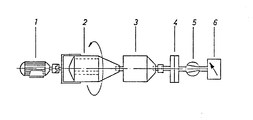
- This dust measuring device was developed in order to be able to carry out a precise analysis of the tendency to dust of powdered and granulated substances, since quantitative statements about the dust behavior are important for process and operational safety. So far, the tendency to dust has often been assessed in analogy to the fine particles present in the source material or by estimating, but such methods can lead to considerable errors because dust particles often only result from the type of movement and abrasion, here the tendency to dust when handling materials becomes practical detected. For this purpose, the test material remains in Beweauna during the entire measuring process.
- this device Compared to a dust measuring device, or dust value is measured by the weakening of a light beam passing through a collecting container, which is caused by the swirling up of dye dust when falling once in this container, this device has the advantage that an actual, practical measurement of the condition as in Conveying, mixing and filling processes occur, is measured.
- 300 g of phthalocyanine blue press cake (solids approx. 36%) were mixed with a mixture of 150 g of isopropanol, 5.5 g of A minomethylpropanol and 8.2 g of the polyester-based surface-active substance and after adding 100 g of water stirred for about 30 minutes with a issolver D.
- the pigment slurry prepared in this way was dried in a drying cabinet and, after intermediate grinding on a laboratory mill, mixed with 20% mineral oil (based on solids) in a mixing apparatus and the intensive mixing process was continued until a uniform distribution of the additives was achieved.
- Non-prepared phthalocyanine pigments have dust levels of 2500 to 3500 mg / 100 g.
- a mixture of 23 g of aminomethylpropanol and 25 g of the surface-active substance based on polyester was added to 1568 g of an anthraquinone pigment slurry (solid approx. 28%) and stirred in a dissolver for approx. 30 minutes. 7.5 g of a defoamer were added to prevent foaming.
- the sludge thus prepared was dried in a drying cabinet and then pre-ground on a laboratory mill.
- the preparation was placed in a mixer with 20% mineral oil and the mixing process continued for about 30 minutes. Then a free-flowing, non-dust-tight fine granulate with a dust value of less than 5 mg / 100 g pigment measured with the Heubacn dust meter. Dried unprepared anthraquinone pigments have extremely high dust levels of 3500 to 4500 mg / 100 g.
- chromate pigment slurry 50 big 1 kg was mixed with 15 g of the surface-active substance based on polyester and mixed well with the aid of a stirrer. After drying, the pigment was mixed with 15% melted wax in a heatable kneader and the intensive mixing process was continued until a uniform distribution of the additive was achieved. This can be recognized by the formation of a free-flowing, non-jamming granulate. This usually takes about 30 minutes. The pigment was brought up to a temperature above the melting point of the wax. It was worked with a wax whose melting point was 79 ° C.
- the dust measurement of the preparation thus produced was 5 mg / 100 g. It was measured with the Heubach dust meter.
- auxiliaries required for the particular application such as dispersing agents or anti-abrasion agents, can of course also be added to the preparations according to the invention.
- the addition is advantageously carried out with the addition of the agent b) causing the lubrication point.
- the still moist pigment is treated which is only mechanically dewatered, e.g. pressed or centrifuged, but even if a slight drying effect e.g. by air or warm air drying, is still moist overall, i.e. the surfaces of the pigment particles are not dried but are still moist, even if the moisture on these surfaces is reduced compared to the moisture present in the press cake of the filter sludge.
- the term pigment here also includes dyes.
Landscapes
- Chemical & Material Sciences (AREA)
- Dispersion Chemistry (AREA)
- Physics & Mathematics (AREA)
- Health & Medical Sciences (AREA)
- Life Sciences & Earth Sciences (AREA)
- Analytical Chemistry (AREA)
- Biochemistry (AREA)
- General Health & Medical Sciences (AREA)
- General Physics & Mathematics (AREA)
- Immunology (AREA)
- Pathology (AREA)
- Chemical Kinetics & Catalysis (AREA)
- Organic Chemistry (AREA)
- Pigments, Carbon Blacks, Or Wood Stains (AREA)
- Paints Or Removers (AREA)
- Sampling And Sample Adjustment (AREA)
Priority Applications (1)
| Application Number | Priority Date | Filing Date | Title |
|---|---|---|---|
| DE8686114420T DE3480560D1 (en) | 1983-12-02 | 1984-11-30 | Device for the measurement of the powdering behaviour of powdery and granular materials |
Applications Claiming Priority (8)
| Application Number | Priority Date | Filing Date | Title |
|---|---|---|---|
| DE3343743 | 1983-12-02 | ||
| DE3343742 | 1983-12-02 | ||
| DE3343742 | 1983-12-02 | ||
| DE3343743 | 1983-12-02 | ||
| DE3344464 | 1983-12-08 | ||
| DE3344463 | 1983-12-08 | ||
| DE19833344463 DE3344463A1 (de) | 1983-12-02 | 1983-12-08 | Dauerhaft staubungsfreie pigmentpraeparate |
| DE19833344464 DE3344464A1 (de) | 1983-12-02 | 1983-12-08 | Dauerhaft staubungsfreie pigment- und farbstoffpraeparate und verfahren zu ihrer herstellung |
Related Child Applications (2)
| Application Number | Title | Priority Date | Filing Date |
|---|---|---|---|
| EP86114420A Division EP0221421B1 (fr) | 1983-12-02 | 1984-11-30 | Dispositif de mesure de propriétés de pulvérisation de corps poudreux et granuleux |
| EP86114420.2 Division-Into | 1986-10-17 |
Publications (3)
| Publication Number | Publication Date |
|---|---|
| EP0144940A2 true EP0144940A2 (fr) | 1985-06-19 |
| EP0144940A3 EP0144940A3 (en) | 1985-11-06 |
| EP0144940B1 EP0144940B1 (fr) | 1988-03-09 |
Family
ID=27433037
Family Applications (2)
| Application Number | Title | Priority Date | Filing Date |
|---|---|---|---|
| EP86114420A Expired EP0221421B1 (fr) | 1983-12-02 | 1984-11-30 | Dispositif de mesure de propriétés de pulvérisation de corps poudreux et granuleux |
| EP84114591A Expired EP0144940B1 (fr) | 1983-12-02 | 1984-11-30 | Préparations pigmentaires et tinctoriales durablement non poudroyantes, leur procédé de préparation |
Family Applications Before (1)
| Application Number | Title | Priority Date | Filing Date |
|---|---|---|---|
| EP86114420A Expired EP0221421B1 (fr) | 1983-12-02 | 1984-11-30 | Dispositif de mesure de propriétés de pulvérisation de corps poudreux et granuleux |
Country Status (8)
| Country | Link |
|---|---|
| US (2) | US4762523A (fr) |
| EP (2) | EP0221421B1 (fr) |
| AU (1) | AU578445B2 (fr) |
| BR (1) | BR8407203A (fr) |
| CA (1) | CA1235256A (fr) |
| DE (4) | DE3344463A1 (fr) |
| DK (1) | DK156273C (fr) |
| WO (1) | WO1985002407A2 (fr) |
Cited By (4)
| Publication number | Priority date | Publication date | Assignee | Title |
|---|---|---|---|---|
| DE4336612A1 (de) * | 1993-10-27 | 1995-05-04 | Bayer Ag | Verfahren zur Einfärbung von organischen Medien |
| US6079644A (en) * | 1996-04-18 | 2000-06-27 | Bayer Aktiengesellschaft | Process for producing briquetted and pressed granular material and use thereof |
| US6132505A (en) * | 1997-02-10 | 2000-10-17 | Bayer Aktiengesellschaft | Inorganic pigment pellets for coloring plastics, lacquers and building materials and a process for the production thereof |
| EP1067156A1 (fr) * | 1999-07-07 | 2001-01-10 | Clariant GmbH | Procédé de fabrication de gâteaux de filtration de pigments haut concentrés |
Families Citing this family (39)
| Publication number | Priority date | Publication date | Assignee | Title |
|---|---|---|---|---|
| US4761990A (en) * | 1987-01-27 | 1988-08-09 | Atlantic Richfield Company | Method and apparatus for measurement of attrition rate of particulate material |
| DE3919940A1 (de) * | 1989-06-19 | 1990-12-20 | Merck Patent Gmbh | Dispersionen kugelfoermiger anorganischer partikel |
| DE4139993A1 (de) * | 1991-12-04 | 1993-06-09 | Merck Patent Gmbh, 6100 Darmstadt, De | Pigmentzubereitung |
| WO1994022940A1 (fr) * | 1993-03-29 | 1994-10-13 | The Dow Chemical Company | Polymere absorbant avec une tendance diminuee a former de la poussiere |
| US6786153B2 (en) * | 2002-09-19 | 2004-09-07 | Interflex Laser Engravers, Llc | Printing rolls having wear indicators and methods for determining wear of printing and anilox rolls and sleeves |
| GB2315505B (en) * | 1996-07-24 | 1998-07-22 | Sofitech Nv | An additive for increasing the density of a fluid and fluid comprising such additve |
| US20030203822A1 (en) * | 1996-07-24 | 2003-10-30 | Bradbury Andrew J. | Additive for increasing the density of a fluid for casing annulus pressure control |
| US7267291B2 (en) * | 1996-07-24 | 2007-09-11 | M-I Llc | Additive for increasing the density of an oil-based fluid and fluid comprising such additive |
| DE19941061A1 (de) * | 1999-08-28 | 2001-03-01 | Clariant Gmbh | Verfahren zur Herstellung von Pigmentgranulaten |
| DE19958489A1 (de) * | 1999-12-04 | 2001-06-21 | Dupont Performance Coatings | Verfahren und Vorrichtung zur Scherbelastung flüssiger Medien, insbesondere Überzugsmittel |
| WO2002068542A1 (fr) * | 2001-02-22 | 2002-09-06 | Sun Chemical Corporation | Procede de production d'une dispersion de pigment renfermant un vehicule tel que de l'huile de ricin ou une cire |
| DE10207370A1 (de) * | 2002-02-22 | 2003-09-04 | Clariant Gmbh | Feuchtgranulate organischer Pigmente, Verfahren zu ihrer Herstellung und ihre Verwendung |
| US7566497B2 (en) * | 2002-04-22 | 2009-07-28 | Manufacturing and Process Technologies, L.L.C. | Method for forming pigment pseudoparticles |
| US20060046058A1 (en) * | 2004-08-30 | 2006-03-02 | Craig Daniel H | Process for manufacturing thermoplastic materials containing inorganic particulates |
| US20060042513A1 (en) * | 2004-08-30 | 2006-03-02 | Craig Daniel H | Process for manufacturing thermoplastic materials containing inorganic particulates |
| US20060047022A1 (en) * | 2004-08-30 | 2006-03-02 | Craig Daniel H | Thermoplastic compositions including inorganic particulates |
| US20060047023A1 (en) * | 2004-08-30 | 2006-03-02 | Craig Daniel H | Process for manufacturing thermoplastic materials containing inorganic particulates |
| US20060042511A1 (en) * | 2004-08-30 | 2006-03-02 | Craig Daniel H | Surface-treated pigments |
| US20060042512A1 (en) * | 2004-08-30 | 2006-03-02 | Craig Daniel H | Surface-treated pigments |
| US20060047021A1 (en) * | 2004-08-30 | 2006-03-02 | Craig Daniel H | Thermoplastic compositions including inorganic particulates |
| US20060045841A1 (en) * | 2004-08-30 | 2006-03-02 | Craig Daniel H | Process for making titanium dioxide and resulting product |
| US20060047020A1 (en) * | 2004-08-30 | 2006-03-02 | Craig Daniel H | Thermoplastic compositions including inorganic particulates |
| US6958091B1 (en) | 2004-09-07 | 2005-10-25 | Kerr-Mcgee Chemical Llc | Surface-treated pigments |
| US20060048677A1 (en) * | 2004-09-07 | 2006-03-09 | Craig Daniel H | Process for manufacturing thermoplastic materials containing inorganic particulates |
| US20060052482A1 (en) * | 2004-09-07 | 2006-03-09 | Craig Daniel H | Thermoplastic compositions including inorganic particulates |
| US7138011B2 (en) * | 2004-09-07 | 2006-11-21 | Tronox Llc | Surface treated pigments |
| US20060051503A1 (en) * | 2004-09-07 | 2006-03-09 | Craig Daniel H | Process for manufacturing thermoplastic materials containing inorganic particulates |
| US6946028B1 (en) | 2004-09-07 | 2005-09-20 | Kerr-Mcgee Chemical Llc | Surface-treated pigments |
| US20060051504A1 (en) * | 2004-09-07 | 2006-03-09 | Craig Daniel H | Process for manufacturing thermoplastic materials containing inorganic particulates |
| US20060048674A1 (en) * | 2004-09-07 | 2006-03-09 | Craig Daniel H | Process for manufacturing thermoplastic materials containing inorganic particulates |
| US20060052485A1 (en) * | 2004-09-07 | 2006-03-09 | Craig Daniel H | Thermoplastic compositions including inorganic particulates |
| US20060052484A1 (en) * | 2004-09-07 | 2006-03-09 | Craig Daniel H | Thermoplastic compositions including inorganic particulates |
| DE102006017109A1 (de) * | 2006-04-10 | 2007-10-11 | Lanxess Deutschland Gmbh | Verfahren zur Herstellung von Pigmentgranulaten und deren Verwendung |
| US7935753B2 (en) * | 2006-11-13 | 2011-05-03 | Tronox Llc | Surface treated pigment |
| EP2915837B1 (fr) * | 2014-03-03 | 2017-05-03 | Ricoh Company, Ltd. | PROCÉDÉ ET DISPOSITIF DESTINÉ À PRÉPARER UN MÉLANGE MAîTRE À PARTIR DE LA POUDRE DE TONER USAGÉ |
| CN104849188A (zh) * | 2015-05-14 | 2015-08-19 | 常熟市德虞矿山机电有限公司 | 粉尘环境模拟系统的除尘装置 |
| CN105092428B (zh) * | 2015-08-31 | 2018-05-04 | 山东大学 | 一种基于休止角的细集料饱和面干状态的定量测定方法 |
| US10370540B2 (en) | 2015-09-11 | 2019-08-06 | Tronox Llc | Inorganic pigments surface treated with polyol esters |
| CN107957387B (zh) * | 2017-12-23 | 2023-06-09 | 安徽工程大学 | 羽绒制品粉尘含量的评价方法 |
Family Cites Families (21)
| Publication number | Priority date | Publication date | Assignee | Title |
|---|---|---|---|---|
| DE274642C (fr) * | ||||
| GB576100A (en) * | 1942-12-09 | 1946-03-19 | Cecil Edwin Henry Bawn | Protective coating of dyestuff powders |
| FR1061307A (fr) * | 1952-04-22 | 1954-04-12 | Appareil de mesure des poussières pour les mesures quantitatives et qualitatives | |
| US3560134A (en) * | 1967-06-19 | 1971-02-02 | Gaf Corp | Azo,vat and fluorescent dyes dustproofed with a light mineral oil and a fatty acid of polyoxyalkylated sorbitan |
| US3499315A (en) * | 1967-08-31 | 1970-03-10 | Us Navy | Contamination determination in a fluid system |
| US3636772A (en) * | 1970-02-24 | 1972-01-25 | Dow Chemical Co | Device for measuring the friability of particulate solid materials |
| US3778287A (en) * | 1970-12-22 | 1973-12-11 | Ici Ltd | Pigment dispersions |
| GB1343963A (en) * | 1971-11-17 | 1974-01-16 | Procter & Gamble Ltd | Method and apparatus for measuring dust properties of granular materials |
| CH552207A (de) * | 1973-02-15 | 1974-07-31 | Gertsch & Co Ag | Freiluftgeraet fuer die bestimmung des staubgehaltes der aussenluft. |
| SU894183A1 (ru) * | 1973-02-26 | 1981-12-30 | Государственный научно-исследовательский институт горнохимического сырья | Способ виброзащиты бурового станка |
| GB1442583A (en) * | 1975-01-31 | 1976-07-14 | Matsushita Electronics Corp | Camera tube envelope |
| DE2523096B2 (de) * | 1975-05-24 | 1978-09-07 | Cassella Farbwerke Mainkur Ag, 6000 Frankfurt | Dauerhaft staubfreie oder staubarme Farbstoffpulver, Verfahren zu ihrer Herstellung und ihre Verwendung |
| US4143539A (en) * | 1976-02-23 | 1979-03-13 | Atlantic Richfield Company | Apparatus and method for determining the attrition properties of a mass of solid particles |
| US4079621A (en) * | 1976-05-28 | 1978-03-21 | E. I. Du Pont De Nemours And Company | Apparatus for determining the dust index of a particulate solid |
| GB1558183A (en) * | 1976-09-10 | 1979-12-19 | Secr Defence | Dust dispenser |
| DE2656408C2 (de) * | 1976-12-13 | 1983-12-15 | CIBA-GEIGY AG, 4002 Basel | Verfahren zur Herstellung von staubarmen Präparaten und deren Verwendung |
| US4117717A (en) * | 1977-06-23 | 1978-10-03 | Teledyne Industries, Inc. | Solid impurity detector |
| DE2841566A1 (de) * | 1978-09-23 | 1980-04-03 | Basf Farben & Fasern | Verringerung des staeubens von pigmenten |
| DE2931771A1 (de) * | 1979-08-04 | 1981-02-26 | Basf Ag | Staubbindende mittel und damit dauerhaft entstaubte farbstoffe oder farbstoffzubereitungen |
| EP0026489B1 (fr) * | 1979-10-02 | 1984-05-02 | Ciba-Geigy Ag | Granulés de colorants solubles dans l'eau, procédé pour leur fabrication et leur utilisation en teinture |
| DE3100353A1 (de) * | 1981-01-08 | 1982-08-05 | Bayer Ag, 5090 Leverkusen | Staubarme farbstoffpraeparationen |
-
1983
- 1983-12-08 DE DE19833344463 patent/DE3344463A1/de not_active Withdrawn
- 1983-12-08 DE DE19833344464 patent/DE3344464A1/de active Granted
-
1984
- 1984-11-30 WO PCT/EP1984/000380 patent/WO1985002407A2/fr not_active Ceased
- 1984-11-30 EP EP86114420A patent/EP0221421B1/fr not_active Expired
- 1984-11-30 DE DE8686114420T patent/DE3480560D1/de not_active Expired
- 1984-11-30 BR BR8407203A patent/BR8407203A/pt unknown
- 1984-11-30 US US06/763,437 patent/US4762523A/en not_active Expired - Fee Related
- 1984-11-30 AU AU37867/85A patent/AU578445B2/en not_active Ceased
- 1984-11-30 DE DE8484114591T patent/DE3469755D1/de not_active Expired
- 1984-11-30 EP EP84114591A patent/EP0144940B1/fr not_active Expired
- 1984-11-30 CA CA000469019A patent/CA1235256A/fr not_active Expired
-
1985
- 1985-08-01 DK DK350585A patent/DK156273C/da not_active IP Right Cessation
-
1986
- 1986-06-12 US US06/873,367 patent/US4702116A/en not_active Expired - Fee Related
Cited By (7)
| Publication number | Priority date | Publication date | Assignee | Title |
|---|---|---|---|---|
| DE4336612A1 (de) * | 1993-10-27 | 1995-05-04 | Bayer Ag | Verfahren zur Einfärbung von organischen Medien |
| US5634970A (en) * | 1993-10-27 | 1997-06-03 | Bayer Ag | Process for the coloration of organic media |
| US6079644A (en) * | 1996-04-18 | 2000-06-27 | Bayer Aktiengesellschaft | Process for producing briquetted and pressed granular material and use thereof |
| US6364223B2 (en) | 1996-04-18 | 2002-04-02 | Bayer Aktiengesellschaft | Process for producing briquetted and pressed granular material and use thereof |
| US6132505A (en) * | 1997-02-10 | 2000-10-17 | Bayer Aktiengesellschaft | Inorganic pigment pellets for coloring plastics, lacquers and building materials and a process for the production thereof |
| EP1067156A1 (fr) * | 1999-07-07 | 2001-01-10 | Clariant GmbH | Procédé de fabrication de gâteaux de filtration de pigments haut concentrés |
| US6436182B1 (en) | 1999-07-07 | 2002-08-20 | Clariant Gmbh | Process for producing highly concentrated pigment presscakes |
Also Published As
| Publication number | Publication date |
|---|---|
| US4702116A (en) | 1987-10-27 |
| US4762523A (en) | 1988-08-09 |
| BR8407203A (pt) | 1985-11-05 |
| WO1985002407A3 (fr) | 1985-09-12 |
| DK156273C (da) | 1989-12-11 |
| AU578445B2 (en) | 1988-10-27 |
| EP0144940A3 (en) | 1985-11-06 |
| WO1985002407A2 (fr) | 1985-06-06 |
| CA1235256A (fr) | 1988-04-19 |
| DK156273B (da) | 1989-07-24 |
| EP0144940B1 (fr) | 1988-03-09 |
| DE3469755D1 (en) | 1988-04-14 |
| AU3786785A (en) | 1985-06-13 |
| DK350585D0 (da) | 1985-08-01 |
| EP0221421B1 (fr) | 1989-11-23 |
| DE3480560D1 (en) | 1989-12-28 |
| EP0221421A2 (fr) | 1987-05-13 |
| DE3344464C2 (fr) | 1987-08-20 |
| DK350585A (da) | 1985-08-01 |
| EP0221421A3 (en) | 1988-03-16 |
| DE3344463A1 (de) | 1985-06-13 |
| DE3344464A1 (de) | 1985-07-25 |
Similar Documents
| Publication | Publication Date | Title |
|---|---|---|
| EP0144940B1 (fr) | Préparations pigmentaires et tinctoriales durablement non poudroyantes, leur procédé de préparation | |
| CH381781A (de) | Verfahren zur Behandlung von organischen rohen Pigmenten | |
| DE2316536C3 (de) | Verfahren zur Herstellung von farbstarken und leicht verteilbaren Perylen- 3,4,9,10-tetracarbonsäurediimiden | |
| DE69613195T3 (de) | Verfahren zur Herstellung von einem Tintenkonzentrat | |
| DE2263968B2 (de) | Verfahren zur Herstellung von nichtstaubenden oder praktisch nichtstaubenden Farbstoffkörpern | |
| DE2523096B2 (de) | Dauerhaft staubfreie oder staubarme Farbstoffpulver, Verfahren zu ihrer Herstellung und ihre Verwendung | |
| EP0028342B1 (fr) | Utilisation de composés polyoxalkylés estérifiés comme adjuvants de préparations tinctoriales et préparations tinctoriales correspondantes | |
| EP0064225B1 (fr) | Utilisation d'oxalkylates estérifiés comme adjuvants pour colorants et les préparations tinctoriales correspondantes | |
| EP0023638B1 (fr) | Colorants ou compositions de colorants non-poussiéreux | |
| CH639006A5 (de) | Verfahren zum herstellen von in waessrigen und/oder organischen medien leicht dispergierbaren, konzentrierten praeparaten von in wasser schwerloeslichen bis unloeslichen wirksubstanzen. | |
| DE4111036A1 (de) | Universalfarbpaste | |
| DE2646211A1 (de) | Verfahren zum zerkleinern | |
| DE2500865C3 (de) | Trockene, wasserdispergierbare Pigmentmassen und Verfahren zu ihrer Herstellung | |
| DE743398C (de) | Verfahren zur Herstellung von pigmenthaltigen Kunstfasern und -faeden | |
| DE2635214C2 (de) | In Wasser leicht dispergierbare Zubereitungen von Phthalocyaninen, ihre Herstellung und Verwendung | |
| DE69406912T2 (de) | Dispersion | |
| DE1592862C3 (de) | Verfahren zur Herstellung von Pigmentpräparationen | |
| EP0056991B1 (fr) | Préparations tinctoriales liquides | |
| DE1792462C3 (de) | Verfahren zur Herstellung eines Pigmentpräparats | |
| DE3413688A1 (de) | Verfahren zum entfernen von benzol aus einem carboxypolymethylenharz | |
| DE834236C (de) | In Wasser dispersibles pulverfoermiges Faerbepraeparat und Verfahren zu dessen Herstellung | |
| DE924481C (de) | Verfahren zur Herstellung von Pigmentdispersionen | |
| DE2250402C3 (de) | Nichtstaubende Zusammensetzung und Verfahren zu deren Herstellung | |
| DE1120622B (de) | Verfahren zur Herstellung fluessiger, kolloidales Eisenhydroxyd als Farbkoerper und Polymere von Methacrylsaeuremethylestern als wesentliche Filmbildner enthaltender Anstrichmassen | |
| DE1940411C (de) | Verfahren zur Herstellung von Pigment/ Harz Präparaten |
Legal Events
| Date | Code | Title | Description |
|---|---|---|---|
| PUAI | Public reference made under article 153(3) epc to a published international application that has entered the european phase |
Free format text: ORIGINAL CODE: 0009012 |
|
| AK | Designated contracting states |
Designated state(s): BE DE FR GB IT NL SE |
|
| PUAL | Search report despatched |
Free format text: ORIGINAL CODE: 0009013 |
|
| AK | Designated contracting states |
Designated state(s): BE DE FR GB IT NL SE |
|
| 17P | Request for examination filed |
Effective date: 19851024 |
|
| 17Q | First examination report despatched |
Effective date: 19860616 |
|
| ITF | It: translation for a ep patent filed | ||
| GRAA | (expected) grant |
Free format text: ORIGINAL CODE: 0009210 |
|
| AK | Designated contracting states |
Kind code of ref document: B1 Designated state(s): BE DE FR GB IT NL SE |
|
| REF | Corresponds to: |
Ref document number: 3469755 Country of ref document: DE Date of ref document: 19880414 |
|
| ET | Fr: translation filed | ||
| GBT | Gb: translation of ep patent filed (gb section 77(6)(a)/1977) | ||
| PLBE | No opposition filed within time limit |
Free format text: ORIGINAL CODE: 0009261 |
|
| STAA | Information on the status of an ep patent application or granted ep patent |
Free format text: STATUS: NO OPPOSITION FILED WITHIN TIME LIMIT |
|
| 26N | No opposition filed | ||
| PG25 | Lapsed in a contracting state [announced via postgrant information from national office to epo] |
Ref country code: GB Effective date: 19891130 Ref country code: BE Effective date: 19891130 |
|
| PG25 | Lapsed in a contracting state [announced via postgrant information from national office to epo] |
Ref country code: SE Effective date: 19891201 |
|
| BERE | Be: lapsed |
Owner name: DR. HANS HEUBACH G.M.B.H. & CO. K.G. Effective date: 19891130 |
|
| PG25 | Lapsed in a contracting state [announced via postgrant information from national office to epo] |
Ref country code: NL Effective date: 19900601 |
|
| NLV4 | Nl: lapsed or anulled due to non-payment of the annual fee | ||
| GBPC | Gb: european patent ceased through non-payment of renewal fee | ||
| PG25 | Lapsed in a contracting state [announced via postgrant information from national office to epo] |
Ref country code: FR Effective date: 19900731 |
|
| REG | Reference to a national code |
Ref country code: FR Ref legal event code: ST |
|
| EUG | Se: european patent has lapsed |
Ref document number: 84114591.5 Effective date: 19900830 |
|
| PGFP | Annual fee paid to national office [announced via postgrant information from national office to epo] |
Ref country code: DE Payment date: 19950131 Year of fee payment: 11 |
|
| PG25 | Lapsed in a contracting state [announced via postgrant information from national office to epo] |
Ref country code: DE Effective date: 19960801 |