EP0145203A2 - Laser à semi-conducteur - Google Patents
Laser à semi-conducteur Download PDFInfo
- Publication number
- EP0145203A2 EP0145203A2 EP84307353A EP84307353A EP0145203A2 EP 0145203 A2 EP0145203 A2 EP 0145203A2 EP 84307353 A EP84307353 A EP 84307353A EP 84307353 A EP84307353 A EP 84307353A EP 0145203 A2 EP0145203 A2 EP 0145203A2
- Authority
- EP
- European Patent Office
- Prior art keywords
- semiconductor laser
- laser
- inner stripe
- vsis
- cladding
- Prior art date
- Legal status (The legal status is an assumption and is not a legal conclusion. Google has not performed a legal analysis and makes no representation as to the accuracy of the status listed.)
- Granted
Links
Images


Classifications
-
- H—ELECTRICITY
- H01—ELECTRIC ELEMENTS
- H01S—DEVICES USING THE PROCESS OF LIGHT AMPLIFICATION BY STIMULATED EMISSION OF RADIATION [LASER] TO AMPLIFY OR GENERATE LIGHT; DEVICES USING STIMULATED EMISSION OF ELECTROMAGNETIC RADIATION IN WAVE RANGES OTHER THAN OPTICAL
- H01S5/00—Semiconductor lasers
- H01S5/20—Structure or shape of the semiconductor body to guide the optical wave ; Confining structures perpendicular to the optical axis, e.g. index or gain guiding, stripe geometry, broad area lasers, gain tailoring, transverse or lateral reflectors, special cladding structures, MQW barrier reflection layers
- H01S5/24—Structure or shape of the semiconductor body to guide the optical wave ; Confining structures perpendicular to the optical axis, e.g. index or gain guiding, stripe geometry, broad area lasers, gain tailoring, transverse or lateral reflectors, special cladding structures, MQW barrier reflection layers having a grooved structure, e.g. V-grooved, crescent active layer in groove, VSIS laser
-
- H—ELECTRICITY
- H01—ELECTRIC ELEMENTS
- H01S—DEVICES USING THE PROCESS OF LIGHT AMPLIFICATION BY STIMULATED EMISSION OF RADIATION [LASER] TO AMPLIFY OR GENERATE LIGHT; DEVICES USING STIMULATED EMISSION OF ELECTROMAGNETIC RADIATION IN WAVE RANGES OTHER THAN OPTICAL
- H01S5/00—Semiconductor lasers
- H01S5/02—Structural details or components not essential to laser action
- H01S5/028—Coatings ; Treatment of the laser facets, e.g. etching, passivation layers or reflecting layers
-
- H—ELECTRICITY
- H01—ELECTRIC ELEMENTS
- H01S—DEVICES USING THE PROCESS OF LIGHT AMPLIFICATION BY STIMULATED EMISSION OF RADIATION [LASER] TO AMPLIFY OR GENERATE LIGHT; DEVICES USING STIMULATED EMISSION OF ELECTROMAGNETIC RADIATION IN WAVE RANGES OTHER THAN OPTICAL
- H01S5/00—Semiconductor lasers
- H01S5/10—Construction or shape of the optical resonator, e.g. extended or external cavity, coupled cavities, bent-guide, varying width, thickness or composition of the active region
- H01S5/1039—Details on the cavity length
-
- H—ELECTRICITY
- H01—ELECTRIC ELEMENTS
- H01S—DEVICES USING THE PROCESS OF LIGHT AMPLIFICATION BY STIMULATED EMISSION OF RADIATION [LASER] TO AMPLIFY OR GENERATE LIGHT; DEVICES USING STIMULATED EMISSION OF ELECTROMAGNETIC RADIATION IN WAVE RANGES OTHER THAN OPTICAL
- H01S5/00—Semiconductor lasers
- H01S5/20—Structure or shape of the semiconductor body to guide the optical wave ; Confining structures perpendicular to the optical axis, e.g. index or gain guiding, stripe geometry, broad area lasers, gain tailoring, transverse or lateral reflectors, special cladding structures, MQW barrier reflection layers
Definitions
- the present invention relates to a semiconductor laser and, more particlularly, to a semiconductor laser structure which minimizes mode competition noise derived from unstable longitudinal mode transition caused by temperature variations.
- a semiconductor laser oscillating at the single longitudinal mode is widely used as a light source in an optical information processing system such as an information recording/drawing disc system.
- an optical information processing system such as an information recording/drawing disc system.
- unstable longitudinal mode transition occurs and mode competition noise is generated when the ambient temperature rises. The thus produced mode competition noise will preclude an accurate operation of the optical information processing system.
- an object of the present invention is to provide a semiconductor laser which ensures a stable operation even when the ambient temperature is considerably high.
- Another object of the present invention is to provide a V-channeled substrate inner stripe (VSIS) semiconductor laser which minimizes the occurrence of the mode competition noise caused by the unstable longitudinal mode transition.
- VSIS V-channeled substrate inner stripe
- the mole fraction of a cladding layer and the cavity length are selected at preferable values so that the mode competition noise occurs at a temperature higher than the normal operating temperature.
- the mode competition noise is minimized, whereby the semiconductor laser of the present invention is suited for a light source in an optical information processing system.
- FIGURE 1 shows the S/N ratio of the laser output varying depending on the ambient temperature.
- the mode competition noise occurs when the lasing longitudinal mode goes and returns between a plurality of longitudinal modes. Generally, the mode competition noise occurs when the semiconductor laser is operated at a considerably high temperature. In FIGURE 1, the mode competition noise occurs when the ambient temperature rises above 45 °C. When the mode competition noise occurs, the S/N ratio of the laser output (center frequency 8 MHz with 10 KHz bandwidth) reduces to 70 through 80 dB. Accordingly, the laser beam having the mode comeptition noise is not suited for the light source in an optical information processing system.
- An index guided semiconductor laser generally oscillates in a single longitudinal mode at room temperature. However, the mode competition noise occurs as the ambinet temperature rises.
- An index guided semiconductor laser having the. inner stripe structure such as a V-channeled substrate inner stripe (VSIS) semiconductor laser wherein an optical wave guide and a current confinement structure are formed at a same time, shows a stable operation as compared with the index guided semiconductor laser of the planer structure.
- the index guided semiconductor laser having the inner stripe generally includes a current blocking layer formed on a substrate. A V-shaped groove is formed in the current blockng layer, which operates as a current path. A multi layered crystal is formed on the current blocking layer.
- the index guided semiconductor laser having the inner stripe structure ensures a stable operation because the transverse optical intensity distribution in the optical waveguide and the carrier distribution in the active layer caused by the injection current coincide with each other. Furthermore, the index guided semiconductor laser having the inner stripe structure does not produce the mode competition noise even at a considerably high temperature, for example, 40 °C through 50 °C. However, when the semiconductor laser is installed in an optical information processing system, the ambiment temperature becomes about 50 °C through 60 °C. Thus, there is a great possibility that the mode competition noise occurs when the normal index guided semiconductor laser having the inner stripe structure is used as the light source in the optical information processing system.
- FIGURE 2 shows an embodiment of a GaAs-GaAlAs V-channeled substrate inner stripe (VSIS) semiconductor laser of the present invention.
- a Te doped n-GaAs current blocking layer 2 having the carrier density of 2 x 10 18 cm -3 is formed, through the use of the liquid phase epitaxial growth method, to a thickness of about 0.8 ⁇ m on a Zn doped p-GaAs substrate 1 having the carrier density of 1 x 10 18 cm -3 .
- a V-shaped groove 3 is formed in the current blocking layer 2 to reach the substrate 1 through the use of the etching method.
- the V-shaped groove 3 preferably has the width of about 3 through 4 ⁇ m, and the V-shaped groove 3 functions as a current path.
- a plurality of V-shaped grooves 3 are formed in the current blocking layer 2 with the pitch of 300 ⁇ m.
- a Mg doped p-Ga Al As first cladding layer 4 is formed on the current blocking layer 2 to a thickness of about 0.1 ⁇ m through 0.2 ⁇ m by the liquid phase epitaxial growth method.
- a Mg doped p-Ga 1-y Al y As active layer 5 of a thickness of about 0.1 ⁇ m is formed on the first cladding layer 4 by the liquid phase epitaxial growth method.
- a Te doped n-Ga 1-x Al x As second cladding layer 6 of a thickness of 1 pm is formed on the active layer 5 by the liquid phase epitaxial growth method.
- n-GaAs cap layer 7 is formed on the second cladding layer 6 to a thickness of about 3 ⁇ m by the liquid phase epitaxial growth method.
- a p-electrode 8 and an n-electrode 9 are secured to the p-GaAs substrate 1 and the n-GaAs cap layer 7, respectively, through the use of the evaporation method.
- the thus formed wafer is divided in the 300 ⁇ m width so that the V-shaped groove 3 is positioned at the center of the width.
- the cleaved facets are formed at the both ends of the laser device.
- a multi-layered reflection film 10 is deposited on both the cleaved facets by the evaporation method. The laser oscillation is carried out when the carrier is injected from the p-electrode 8 and the n-electrode 9.
- FIGURE 3 shows the temperature at which the mode competition noise occurs when the AlAs mole fraction x of the first and second cladding layers 4 and 6 is changed.
- the measurment is carried out when the VSIS semiconductor laser of the construction of FIGURE 2 emits the laser beam at 3 mW.
- the VSIS semiconductor laser used herein has the cavity length of 250 pm, and the cleaved facets on both ends have the same reflectivity R l and R 2 of 0.32. It will be clear from FIGURE 3 that the mode competition noise does not occur below 50°C when the mole fraction x is selected higher than about 0.45.
- the AlAs mole fraction x of the first and second cladding layers should be selected between about 0.45 and 0.52 so as to ensure the single longitudinal mode oscillation without the mode competition noise.
- FIGURE 4 shows the temperature at which the mode competition noise occurs when the cavity length is changed in the VSIS semiconductor laser of the above-mentioned construction wherein the AlAs mole fraction x of the first and second cladding layers is selected between 0.45 and 0.52.
- the output power is set at 3 mW, and the cleaved facets on both ends have the same reflectivity R 1 and R 2 of 0.32. It will be clear from FIGURE 4 that the mode competition noise does not occur when the ambient temperature is less than 60 °C if the cavity length is selected longer than about 300 pm even though the normal cavity length of the conventional semiconductor laser is 250 ⁇ m through 300 ⁇ m.
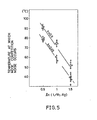
- FIGURE 5 shows the temperature at which the mode competition noise occurs when the reflectivities R 1 and R 2 at the cleaved facets are changed while the AlAs mole fraction x of the first and second cladding layers is selected at 0.45 or 0.5.
- the reflectivity R 1 represents the reflectivity on the front facet
- R 2 represents the reflectivity at the rear facet.
- R 2 is greater than or equal to R 1 .
- the laser beam output level is 3 mW, and the cavity length is 250 ⁇ m. It will be clear from FIGURE 5 that the mode competition noise does not occur below 75 °C even in the semiconductor laser of the conventional construction if the- reflectivities R 1 and R 2 are selected to satisfy the following condition.
- the reflectivities R 1 and R 2 should be selected to satisfy the following condition.
- the concept of the present invention is applicable to the compound semiconductor laser, such as a GaP laser or a GaAIP laser in addition to the above discussed GaAs-GaAlAs semiconductor laser.
Landscapes
- Physics & Mathematics (AREA)
- Geometry (AREA)
- Condensed Matter Physics & Semiconductors (AREA)
- General Physics & Mathematics (AREA)
- Electromagnetism (AREA)
- Optics & Photonics (AREA)
- Semiconductor Lasers (AREA)
Applications Claiming Priority (2)
| Application Number | Priority Date | Filing Date | Title |
|---|---|---|---|
| JP58200261A JPS6091692A (ja) | 1983-10-25 | 1983-10-25 | 半導体レ−ザ装置 |
| JP200261/83 | 1983-10-25 |
Publications (3)
| Publication Number | Publication Date |
|---|---|
| EP0145203A2 true EP0145203A2 (fr) | 1985-06-19 |
| EP0145203A3 EP0145203A3 (en) | 1986-06-04 |
| EP0145203B1 EP0145203B1 (fr) | 1990-05-16 |
Family
ID=16421405
Family Applications (1)
| Application Number | Title | Priority Date | Filing Date |
|---|---|---|---|
| EP84307353A Expired - Lifetime EP0145203B1 (fr) | 1983-10-25 | 1984-10-25 | Laser à semi-conducteur |
Country Status (4)
| Country | Link |
|---|---|
| US (1) | US4901328A (fr) |
| EP (1) | EP0145203B1 (fr) |
| JP (1) | JPS6091692A (fr) |
| DE (1) | DE3482297D1 (fr) |
Cited By (1)
| Publication number | Priority date | Publication date | Assignee | Title |
|---|---|---|---|---|
| EP0160490A3 (en) * | 1984-04-24 | 1987-07-15 | Sharp Kabushiki Kaisha | A semiconductor laser |
Families Citing this family (6)
| Publication number | Priority date | Publication date | Assignee | Title |
|---|---|---|---|---|
| JPS621295A (ja) * | 1985-06-26 | 1987-01-07 | Sharp Corp | 半導体レ−ザ |
| US5228047A (en) * | 1990-09-21 | 1993-07-13 | Sharp Kabushiki Kaisha | Semiconductor laser device and a method for producing the same |
| JPH05259016A (ja) * | 1992-03-12 | 1993-10-08 | Mitsubishi Electric Corp | ウエハ作製用基板及び半導体ウエハの製造方法 |
| DE69934504T2 (de) | 1998-10-07 | 2007-10-04 | Sharp K.K. | Halbleiterlaser |
| US6590920B1 (en) | 1998-10-08 | 2003-07-08 | Adc Telecommunications, Inc. | Semiconductor lasers having single crystal mirror layers grown directly on facet |
| EP1143582B1 (fr) * | 1999-09-29 | 2003-03-19 | The Furukawa Electric Co., Ltd. | Laser a semi-conducteur a retroaction repartie et a couplage de gain |
Family Cites Families (2)
| Publication number | Priority date | Publication date | Assignee | Title |
|---|---|---|---|---|
| US4317085A (en) * | 1979-09-12 | 1982-02-23 | Xerox Corporation | Channeled mesa laser |
| JPS5856377A (ja) * | 1981-09-29 | 1983-04-04 | Matsushita Electric Ind Co Ltd | 半導体レ−ザ装置 |
-
1983
- 1983-10-25 JP JP58200261A patent/JPS6091692A/ja active Pending
-
1984
- 1984-10-25 DE DE8484307353T patent/DE3482297D1/de not_active Expired - Lifetime
- 1984-10-25 EP EP84307353A patent/EP0145203B1/fr not_active Expired - Lifetime
-
1989
- 1989-07-17 US US07/380,745 patent/US4901328A/en not_active Expired - Lifetime
Cited By (2)
| Publication number | Priority date | Publication date | Assignee | Title |
|---|---|---|---|---|
| EP0160490A3 (en) * | 1984-04-24 | 1987-07-15 | Sharp Kabushiki Kaisha | A semiconductor laser |
| US4792960A (en) * | 1984-04-24 | 1988-12-20 | Sharp Kabushiki Kaisha | Semiconductor laser |
Also Published As
| Publication number | Publication date |
|---|---|
| US4901328A (en) | 1990-02-13 |
| EP0145203B1 (fr) | 1990-05-16 |
| EP0145203A3 (en) | 1986-06-04 |
| DE3482297D1 (de) | 1990-06-21 |
| JPS6091692A (ja) | 1985-05-23 |
Similar Documents
| Publication | Publication Date | Title |
|---|---|---|
| US4594718A (en) | Combination index/gain guided semiconductor lasers | |
| US4615032A (en) | Self-aligned rib-waveguide high power laser | |
| US4815089A (en) | Semiconductor laser | |
| EP0200306A2 (fr) | Diode électroluminescente et méthode afférente | |
| EP0149563B1 (fr) | Laser à semi-conducteur | |
| US6487225B2 (en) | Surface-emitting laser device | |
| US5608752A (en) | Semiconductor laser device and method of designing the same | |
| EP0155151B1 (fr) | Laser à semi-conducteur | |
| US4901328A (en) | Semiconductor VSIS laser | |
| US5953358A (en) | Semiconductor laser device | |
| EP0302732B1 (fr) | Dispositif laser à semi-conducteur | |
| EP0209372B1 (fr) | Dispositif laser à semi-conducteur | |
| EP0206745B1 (fr) | Dispositif laser à semi-conducteur | |
| US4754462A (en) | Semiconductor laser device with a V-channel and a mesa | |
| US4651322A (en) | Semiconductor laser | |
| US5894491A (en) | Semiconductor laser device operable with low noise even in high ambient temperature | |
| EP0306314B1 (fr) | Dispositif laser à semi-conducteur | |
| US4764936A (en) | Semiconductor laser array device | |
| JP2927661B2 (ja) | スーパールミネッセントダイオード素子およびその製造方法 | |
| JPH10154843A (ja) | 半導体レーザ素子及びそれを用いた光ディスク装置 | |
| US4847847A (en) | Semiconductor laser array | |
| JP2863340B2 (ja) | 半導体レーザ素子 | |
| JP3785429B2 (ja) | 半導体レーザー素子及びその製造方法 | |
| JPH071818B2 (ja) | 集積型半導体レーザ | |
| EP0156365B1 (fr) | Laser à semi-conducteur |
Legal Events
| Date | Code | Title | Description |
|---|---|---|---|
| PUAI | Public reference made under article 153(3) epc to a published international application that has entered the european phase |
Free format text: ORIGINAL CODE: 0009012 |
|
| AK | Designated contracting states |
Designated state(s): DE GB NL |
|
| PUAL | Search report despatched |
Free format text: ORIGINAL CODE: 0009013 |
|
| AK | Designated contracting states |
Kind code of ref document: A3 Designated state(s): DE GB NL |
|
| 17P | Request for examination filed |
Effective date: 19861110 |
|
| 17Q | First examination report despatched |
Effective date: 19880516 |
|
| GRAA | (expected) grant |
Free format text: ORIGINAL CODE: 0009210 |
|
| AK | Designated contracting states |
Kind code of ref document: B1 Designated state(s): DE GB NL |
|
| REF | Corresponds to: |
Ref document number: 3482297 Country of ref document: DE Date of ref document: 19900621 |
|
| PLBE | No opposition filed within time limit |
Free format text: ORIGINAL CODE: 0009261 |
|
| STAA | Information on the status of an ep patent application or granted ep patent |
Free format text: STATUS: NO OPPOSITION FILED WITHIN TIME LIMIT |
|
| 26N | No opposition filed | ||
| REG | Reference to a national code |
Ref country code: GB Ref legal event code: IF02 |
|
| PGFP | Annual fee paid to national office [announced via postgrant information from national office to epo] |
Ref country code: NL Payment date: 20031008 Year of fee payment: 20 |
|
| PGFP | Annual fee paid to national office [announced via postgrant information from national office to epo] |
Ref country code: GB Payment date: 20031022 Year of fee payment: 20 |
|
| PGFP | Annual fee paid to national office [announced via postgrant information from national office to epo] |
Ref country code: DE Payment date: 20031103 Year of fee payment: 20 |
|
| PG25 | Lapsed in a contracting state [announced via postgrant information from national office to epo] |
Ref country code: GB Free format text: LAPSE BECAUSE OF EXPIRATION OF PROTECTION Effective date: 20041024 |
|
| PG25 | Lapsed in a contracting state [announced via postgrant information from national office to epo] |
Ref country code: NL Free format text: LAPSE BECAUSE OF EXPIRATION OF PROTECTION Effective date: 20041025 |
|
| REG | Reference to a national code |
Ref country code: GB Ref legal event code: PE20 |
|
| NLV7 | Nl: ceased due to reaching the maximum lifetime of a patent |
Effective date: 20041025 |