EP0146004A2 - Luftlagerung für laufende Bänder - Google Patents
Luftlagerung für laufende Bänder Download PDFInfo
- Publication number
- EP0146004A2 EP0146004A2 EP84114146A EP84114146A EP0146004A2 EP 0146004 A2 EP0146004 A2 EP 0146004A2 EP 84114146 A EP84114146 A EP 84114146A EP 84114146 A EP84114146 A EP 84114146A EP 0146004 A2 EP0146004 A2 EP 0146004A2
- Authority
- EP
- European Patent Office
- Prior art keywords
- air
- tape
- bearing
- walls
- web
- Prior art date
- Legal status (The legal status is an assumption and is not a legal conclusion. Google has not performed a legal analysis and makes no representation as to the accuracy of the status listed.)
- Granted
Links
- 238000000034 method Methods 0.000 claims description 16
- 239000003570 air Substances 0.000 description 81
- 230000008859 change Effects 0.000 description 5
- 238000005192 partition Methods 0.000 description 5
- 238000009826 distribution Methods 0.000 description 4
- 239000012080 ambient air Substances 0.000 description 3
- 230000004048 modification Effects 0.000 description 3
- 238000012986 modification Methods 0.000 description 3
- 230000001133 acceleration Effects 0.000 description 2
- 230000000694 effects Effects 0.000 description 2
- 230000007704 transition Effects 0.000 description 2
- 230000032258 transport Effects 0.000 description 2
- 208000002193 Pain Diseases 0.000 description 1
- 206010000496 acne Diseases 0.000 description 1
- 238000005266 casting Methods 0.000 description 1
- 238000010276 construction Methods 0.000 description 1
- 238000005520 cutting process Methods 0.000 description 1
- 238000005516 engineering process Methods 0.000 description 1
- 238000002347 injection Methods 0.000 description 1
- 239000007924 injection Substances 0.000 description 1
- 238000004519 manufacturing process Methods 0.000 description 1
- 239000000463 material Substances 0.000 description 1
- 239000000203 mixture Substances 0.000 description 1
- 239000002991 molded plastic Substances 0.000 description 1
- 238000000465 moulding Methods 0.000 description 1
- 230000036407 pain Effects 0.000 description 1
- 230000002093 peripheral effect Effects 0.000 description 1
- 238000005498 polishing Methods 0.000 description 1
- 230000008569 process Effects 0.000 description 1
- 238000009877 rendering Methods 0.000 description 1
- 239000013598 vector Substances 0.000 description 1
Images



Classifications
-
- G—PHYSICS
- G11—INFORMATION STORAGE
- G11B—INFORMATION STORAGE BASED ON RELATIVE MOVEMENT BETWEEN RECORD CARRIER AND TRANSDUCER
- G11B15/00—Driving, starting or stopping record carriers of filamentary or web form; Driving both such record carriers and heads; Guiding such record carriers or containers therefor; Control thereof; Control of operating function
- G11B15/60—Guiding record carrier
- G11B15/605—Guiding record carrier without displacing the guiding means
- G11B15/607—Pneumatic guiding
-
- F—MECHANICAL ENGINEERING; LIGHTING; HEATING; WEAPONS; BLASTING
- F16—ENGINEERING ELEMENTS AND UNITS; GENERAL MEASURES FOR PRODUCING AND MAINTAINING EFFECTIVE FUNCTIONING OF MACHINES OR INSTALLATIONS; THERMAL INSULATION IN GENERAL
- F16C—SHAFTS; FLEXIBLE SHAFTS; ELEMENTS OR CRANKSHAFT MECHANISMS; ROTARY BODIES OTHER THAN GEARING ELEMENTS; BEARINGS
- F16C32/00—Bearings not otherwise provided for
- F16C32/06—Bearings not otherwise provided for with moving member supported by a fluid cushion formed, at least to a large extent, otherwise than by movement of the shaft, e.g. hydrostatic air-cushion bearings
Definitions
- This invention relates to a precision air bearing means for supporting a moving web and, more particularly, for such means as adapted for a magnetic tape recording/reproducing apparatus.
- air bearings are bearing surfaces which support a load on a layer or cushion of air. Air bearings used in magnetic tape transports support the magnetic tape as it changes direction in the tape path. Usually these bearings are supplied with air from an air pump housed in the tape drive.
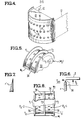
- a typical design 10 is shown in Figures 4 and 9. This class of bearing is semicircular and has holes 14 (FIG. 4) in the surface 16 leading from a supply chamber or plenum. When the tape 12 is drawn in tension, it rides over the air bearing surface 16, supported by the air pressure beneath.
- the subject design is characterized by a "deep trough” on the air bearing surface, i.e., by a “troughed” air bearing surface.
- the bearing pressure will unfortunately vary rather widely from tape edge to tape edge across a conventional air-bearing surface. This is shown in an exaggerated sense at FIG. 2 where one will assume a tape segment TT moving above an air bearing surface b-s, with tape TT assumed as (at least slightly) “buckled” across its medial portions -- there, the "inner” pressure p2 will be understood as relatively greater than ambient air pressure pl than just beyond the tape edges.
- a bearing surface b-s' here idealized - FIG. 3
- trough such as trough b-t' (defined by side-walls r and end-walls w -- see FIG.
- performance can be improved (e.g., wear reduced) by raising purposely-thin side-walls and end-walls (skirt of constant heights, surrounding air bearing surface) -- to define one or several "troughs" thereon positively demarking the elevated-pressure, "under-tape”zone from ambient.
- the thin-wall-enclosure (trough) -- rather surprisingly -makes the pressure distribution under the tape much more uniform, especially adjacent tape-edges (e.g., as explained elsewhere -- see FIGS. 2, 3).
- Such precision-finish surfaces are presumed necessary today -- e.g., for accelerating a tape from virtually a standstill to several hundred ips (e.g., from 0.3 ips to about 200 ips in just a few milliseconds). Workers recognize that such high-speed high-acceleration tape drives typically must include air bearing surfaces which are finished to be ultra-smooth in very painstaking, very fussy, expensive processes, having closely controlled radius tolerances, etc.
- the invention on the other hand, will be seen as a radical departure from such "air bearing rules” allowing one to use a "rough-finish"/"deep trough” air bearing surface, i.e., one that is quite simple, inexpensive, and easy to fabricate (e.g., a molded plastic surface which needn't be finished at all) -something quite surprising in the art, as workers will attest. Indeed, my "deep trough” bearing requires, essentially, that one merely box-in a relatively crude air-flow bearing surface with proper walls (and avoid “touch down” in any case).
- FIG. 1 Another conventional approach to rendering such high-speed high-acceleration air bearings is indicated in FIG. 1 (see also FIG. 9 for idealized depiction) where, in an air bearing 20 analogous to that in FIG. 4, the smooth, carefully-dimensioned, carefully-finished surface 26 across which a tape web segment 22 is to be flown, is interspersed with slotted gas vents 24 adapted for injection of pressurized air (to support the passing tape 22, as is well understood in the art).
- FIG. 1 shows a full exemplary plan view of such a relatively conventional air bearing, with the path of the passing tape web 22 very schematically and idealistically shown as a dotted line, with the entry point T in and the exit point Tout being indicated, and in out with the intermediate (slotted) bearing surface 26 understood as defining the "wrap" of the so-supported tape.
- a precision-finish bearing can reduce, or eliminate, such "touchdown” but is enormously more expensive and fussy to produce, requiring a carefully controlled micro-inch flying height, etc., etc., as mentioned above.
- the invention as described below, will be seen to obtain the superior results of a "precision-finish" bearing without its associated expense, etc., as mentioned above; and will even allow one to resort to a "slotted surface” configuration (as in FIG. 9, with 1+ “troughs” added of course), yet without serious danger of "touchdown” or related problems, and without the need for a high capacity pump.
- the invention does this in a relatively simple design, unlike conventional air bearings, while yet maintaining a relatively constant pressure under the tape.
- the invention achieves this, according to one feature, simply by providing an air bearing surface with one or several "deep troughs" as detailed below.
- FIG. 5 schematically illustrates an air bearing constructed according to principles of this invention.
- This, and other air bearing means discussed herein will generally be understood as constructed and operating as presently known in the art, except where otherwise specified. And, except as otherwise specified, all materials, methods and devices and apparatus herein will be understood as implemented by known expedients according to present good practice.
- FIG. 5 is a perspective view of a portion of a novel "deep trough” air bearing 30, according to the invention.
- Air bearing 30 includes a convex tape-guiding (air-flow) surface 36 (shown idealistically in “flattened-out” plan view in FIG. 8), including air inlets h (holes) and at least one "deep trough” pocket P.
- two pockets P K -l, P K -2 are depicted, each being defined by an exit wall w 1 and, preferably, an entry wall w 2 , plus a pair of thin side-walls or ribs (outer ribs r l , r 3 , with intermediate rib r 2 shared in common), as further discussed below.
- a single deep trough (or pocket P) may be visualized as defined by walls w 1 , w 2 and ribs r l , r 3 , with this being split into two like troughs P K -l, P K -2 by intermediate rib r 2 , as workers will understand.
- Pockets PK-l, P K -2 are better depicted in FIG. 8, where the air-bearing surface 36 will be visualized as "flattened-out”.
- the "end-walls” i.e., entrance wall w 2 and exit wall w 1
- the "pointy” or knife- like
- the "bend" on a passing tape segment can be executed as quickly as possible (i.e., go from a straight path, or "infinite-radius- path", as induced by ambient pressure, to the constant, predictable bend-radius along the pockets -- This is to avoid “touchdown” on entrance or exit!).
- bearing surface 36 includes air-inlets h and is adapted for generating a thin air film to guide and support passing segments of magnetic tape adapted to be transported under the mentioned high velocity/high acceleration mode, as is known in the art (e.g., with tension on the order of 7-8 oz.). While bearing surface 36 might be used with the various widths of tapes and might be adjusted in size depending upon tape width, the bearing will be found particularly useful for supporting "wide" magnetic tape (e.g., 1-3 inches as is often used on the "rotating head” tape recording technology -- for instance, if the tape were approximately 2.7 inches, the guiding surface 36 of bearing 30 would have a width of approximately 0.5 inches and a radius of the order of 0.2-1.0 inches.
- the inlet apertures (air holes) h will be of uniform size and spacing (e.g., for convenience of tooling and equal air distribution), being generally as is conventional in the art, except that here, hole- spacing is not critical, and the total cross-sectional hole-area HA will be a constant for all bearings used in a given "air-bearing situation" (the number, size, etc. of individual holes being variable within this constant factor).
- the diameter of holes h in the surface 36 of bearing 30 would typically range from about 30 to 60 mils, and may be placed in any known pattern, as workers will appreciate. As shown, there is at least one row of holes h along each of the deep troughs, uniformly and symmetrically arranged between walls w l , w 2 and the side ribs (one row usually suffices). Alternative aperture shapes, patterns and sizes will be contemplated. There is nothing particularly critical in the hole-pattern chosen, just as long as one delivers a uniform air-film- support of the tape along surface 36.
- the walls and ribs will be understood as essentially orthogonal to surface 36 and may be of various widths, but are preferably made as thin and narrow as possible, e.g., on the order of 20-50 mils. This is most important for the "end-walls" w l , w 2 -- less so for the side-walls (r l , r 3 , FIG. 5). Optimally, the outer exposed tip of each "outer" partition (rib r l , r 3 , walls w 1 , w 2 ) will be sharp and "pointed" (knife- like) as in FIG. 6 so as to establish a maximally-sharp discontinuity between ambient pressure P am and bearing pressure P b (in the "trough" between passing tape T and bearing surface 36).
- Such thin, pointed edges, defining the "trough” area should be understood as very important in general -- and in particular as a means of avoiding “touchdown", especially at the "end-walls" (see w l , w 21 FIG. 8, with corner lengths T d , T d ' being minimized since touchdown usually occurs there first -- evidently "touchdown” is most likely where the tape segment traverses a "bend- transition" very quickly, passing from a zone of constant, predictable radius (bend constant) to a zone of infinite radius (straight path).
- FIGS. 13, 14 depict the air-bearing of FIG. 1 modified with a "deep-pocket" insert b at the exit-end of the air-bearing surface.
- Slight wear-marks w, w' are indicated in FIG. 14 (90° displaced from view of FIG. 13) where passing tape (T a ) is understood as having "touched-down”.
- the exposed edges of the outer partitions (walls w l , w 2 and outer ribs r l , r 3 ) will be made as sharp as possible to accentuate the change in pressure as mentioned.
- the side-walls or ribs r l , r 2 , etc. are provided only to define (one or more) "deep troughs" and are not needed for mechanical strength.
- the partitions are definitely to avoid any sliding contact with the tape (e.g., should air flow through holes h be interrupted) -- especially since most are preferably made sharp and likely to cut the tape. Workers will find this quite unexpected in that sharp edges and the like have been strictly avoided heretofore on virtually all air bearing surfaces!
- the side-walls (e.g., r l , r 2 , r 3 ) needn't be precisely perpendicular to the bearing surface 36. Also, they may be replaced by "rounded mounds”, “dots”, “pimples”, etc. (instead of a continuous wall)-- anything affording proper containment of the "trough-air”.
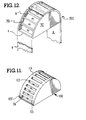
- FIG. 11 where an air bearing 100 is idealizedly depicted comprising an air-bearing surface 101 including a number of "air pockets" 103, each provided (via holes) with a like in-flow of pressurized tape-supporting air (analogous to the smooth bearing surface in FIG. 4).
- the thin walls and flanges allow air pressure during escape thereof to change abruptly as it exits (between the tape and the flanges or walls). This effect is enhanced by forming walls and flanges which come to a sharp point. While the wall or flange should be made as thin as possible, the minimum thickness is limited by the structural strength of the bearing and by production considerations.
- a single trough will suffice in many cases, while in other cases, a plurality of relatively identical troughs will be preferred in certain cases (e.g., to accommodate a "variable-wrap"; cf. FIG. 12). Also, a single trough and one which uses slots instead of holes is acceptable for many cases (e.g., see FIG. 10).
- the means and methods disclosed herein are applicable to magnetic tape drives, video tape systems and the like.
- the present invention is applicable for providing the air bearings required in other forms of recording and/or reproducing systems, such as those in which data is recorded and reproduced optically.
Landscapes
- Engineering & Computer Science (AREA)
- General Engineering & Computer Science (AREA)
- Mechanical Engineering (AREA)
- Advancing Webs (AREA)
- Magnetic Bearings And Hydrostatic Bearings (AREA)
Applications Claiming Priority (2)
| Application Number | Priority Date | Filing Date | Title |
|---|---|---|---|
| US56071683A | 1983-12-12 | 1983-12-12 | |
| US560716 | 1983-12-12 |
Publications (3)
| Publication Number | Publication Date |
|---|---|
| EP0146004A2 true EP0146004A2 (de) | 1985-06-26 |
| EP0146004A3 EP0146004A3 (en) | 1986-05-28 |
| EP0146004B1 EP0146004B1 (de) | 1989-09-27 |
Family
ID=24239045
Family Applications (1)
| Application Number | Title | Priority Date | Filing Date |
|---|---|---|---|
| EP19840114146 Expired EP0146004B1 (de) | 1983-12-12 | 1984-11-23 | Luftlagerung für laufende Bänder |
Country Status (3)
| Country | Link |
|---|---|
| EP (1) | EP0146004B1 (de) |
| JP (1) | JPS60193154A (de) |
| DE (1) | DE3479936D1 (de) |
Cited By (7)
| Publication number | Priority date | Publication date | Assignee | Title |
|---|---|---|---|---|
| GB2196466A (en) * | 1986-10-14 | 1988-04-27 | Minnesota Mining & Mfg | Tape guide for videotape cassette |
| WO1993023849A1 (en) * | 1992-05-15 | 1993-11-25 | Samsung Electronics Co., Ltd. | Device for imparting curvature across the width of an optical recording medium |
| GB2279489A (en) * | 1993-06-30 | 1995-01-04 | M4 Data Ltd | A tape guide roller with fixed edge guides |
| EP0706855A3 (de) * | 1994-10-11 | 1996-07-31 | Ontrak Systems Inc | Vorrichtung zum Polieren eines Halbleiters |
| US6083082A (en) * | 1999-08-30 | 2000-07-04 | Lam Research Corporation | Spindle assembly for force controlled polishing |
| WO2011076677A1 (en) * | 2009-12-23 | 2011-06-30 | Eastman Kodak Company | Device for turning sheet-like substrates |
| CN113501148A (zh) * | 2021-08-18 | 2021-10-15 | 哈尔滨工业大学 | 极坐标跟踪式气浮滑轮导向配重悬吊微低重力模拟系统 |
Families Citing this family (1)
| Publication number | Priority date | Publication date | Assignee | Title |
|---|---|---|---|---|
| JPS62171855A (ja) * | 1986-01-22 | 1987-07-28 | Inoue Kinzoku Kogyo Kk | シ−ト搬送方向変換装置 |
Family Cites Families (3)
| Publication number | Priority date | Publication date | Assignee | Title |
|---|---|---|---|---|
| CH599893A5 (de) * | 1976-12-17 | 1978-06-15 | Bachofen & Meier Maschf | |
| US4182472A (en) * | 1978-07-13 | 1980-01-08 | W. R. Grace & Co. | Contactless turning guide for running webs |
| US4301687A (en) * | 1980-05-19 | 1981-11-24 | Computer Peripherals, Inc. | Pneumatic tension sensor |
-
1984
- 1984-11-23 DE DE8484114146T patent/DE3479936D1/de not_active Expired
- 1984-11-23 EP EP19840114146 patent/EP0146004B1/de not_active Expired
- 1984-12-12 JP JP26265284A patent/JPS60193154A/ja active Granted
Cited By (9)
| Publication number | Priority date | Publication date | Assignee | Title |
|---|---|---|---|---|
| GB2196466A (en) * | 1986-10-14 | 1988-04-27 | Minnesota Mining & Mfg | Tape guide for videotape cassette |
| WO1993023849A1 (en) * | 1992-05-15 | 1993-11-25 | Samsung Electronics Co., Ltd. | Device for imparting curvature across the width of an optical recording medium |
| GB2279489A (en) * | 1993-06-30 | 1995-01-04 | M4 Data Ltd | A tape guide roller with fixed edge guides |
| GB2279489B (en) * | 1993-06-30 | 1997-04-02 | M4 Data Ltd | Tape drive machines |
| EP0706855A3 (de) * | 1994-10-11 | 1996-07-31 | Ontrak Systems Inc | Vorrichtung zum Polieren eines Halbleiters |
| US5593344A (en) * | 1994-10-11 | 1997-01-14 | Ontrak Systems, Inc. | Wafer polishing machine with fluid bearings and drive systems |
| US6083082A (en) * | 1999-08-30 | 2000-07-04 | Lam Research Corporation | Spindle assembly for force controlled polishing |
| WO2011076677A1 (en) * | 2009-12-23 | 2011-06-30 | Eastman Kodak Company | Device for turning sheet-like substrates |
| CN113501148A (zh) * | 2021-08-18 | 2021-10-15 | 哈尔滨工业大学 | 极坐标跟踪式气浮滑轮导向配重悬吊微低重力模拟系统 |
Also Published As
| Publication number | Publication date |
|---|---|
| EP0146004B1 (de) | 1989-09-27 |
| JPS60193154A (ja) | 1985-10-01 |
| EP0146004A3 (en) | 1986-05-28 |
| DE3479936D1 (en) | 1989-11-02 |
| JPS6129059B2 (de) | 1986-07-04 |
Similar Documents
| Publication | Publication Date | Title |
|---|---|---|
| US5224641A (en) | Air bearing for tape drive | |
| US5086360A (en) | Constant flying height slider | |
| EP0146004B1 (de) | Luftlagerung für laufende Bänder | |
| CA1040305A (en) | Slotted rotating head which files relative to flexible magnetic media | |
| EP1286347B1 (de) | Mit Rillen versehene Bandführungsvorrichtung | |
| US5893526A (en) | Tape guides for data cartridges | |
| US4790468A (en) | Floating type web guiding device | |
| US4337885A (en) | Apparatus for guiding tape | |
| EP0882254A1 (de) | Flauschspule mit anpassungsteil zur gleichmassigen wicklung von bandmaterial | |
| US4305536A (en) | Air guide for tape transports having air jets at tangent points | |
| US4123791A (en) | Magnetic transducer device with outrigger bars | |
| US4447019A (en) | Magnetic tape cartridge with resilient belt driving means and separate tape and belt idlers | |
| US3435442A (en) | Fluid lubricated magnetic tape transducer | |
| US3761002A (en) | Fluid bearing having discrete holes formed by vortex restrictors | |
| US5490029A (en) | Compliant tape guide for data cartridges | |
| US3533058A (en) | Edge curl control for a flat vacuum head | |
| US5220475A (en) | Rotary head drum unit with grooves or protrusions on a stationary drum for lessening tape contact during rewinding | |
| JP2003115142A (ja) | 記憶テープの横方向の動きを低減するためのガイドアセンブリ | |
| US3653568A (en) | Tape transport mechanism | |
| EP0754340B1 (de) | Magazinspeicherverfahren für speicherstreifen | |
| US6381096B1 (en) | Tape transport with air bearings | |
| JP2933940B2 (ja) | 磁気テープ装置の磁気ヘッド | |
| JPS599429Y2 (ja) | テ−プ送り用の自動定心作用を有するテ−プ案内装置 | |
| US5432653A (en) | Loop-shaped pneumatic drive | |
| KR850002764Y1 (ko) | 테이프 가이드(guide)시스템 |
Legal Events
| Date | Code | Title | Description |
|---|---|---|---|
| PUAI | Public reference made under article 153(3) epc to a published international application that has entered the european phase |
Free format text: ORIGINAL CODE: 0009012 |
|
| AK | Designated contracting states |
Designated state(s): BE DE FR GB NL SE |
|
| PUAL | Search report despatched |
Free format text: ORIGINAL CODE: 0009013 |
|
| AK | Designated contracting states |
Kind code of ref document: A3 Designated state(s): BE DE FR GB NL SE |
|
| 17P | Request for examination filed |
Effective date: 19860614 |
|
| RAP1 | Party data changed (applicant data changed or rights of an application transferred) |
Owner name: UNISYS CORPORATION |
|
| 17Q | First examination report despatched |
Effective date: 19880322 |
|
| GRAA | (expected) grant |
Free format text: ORIGINAL CODE: 0009210 |
|
| AK | Designated contracting states |
Kind code of ref document: B1 Designated state(s): BE DE FR GB NL SE |
|
| REF | Corresponds to: |
Ref document number: 3479936 Country of ref document: DE Date of ref document: 19891102 |
|
| ET | Fr: translation filed | ||
| PLBE | No opposition filed within time limit |
Free format text: ORIGINAL CODE: 0009261 |
|
| STAA | Information on the status of an ep patent application or granted ep patent |
Free format text: STATUS: NO OPPOSITION FILED WITHIN TIME LIMIT |
|
| 26N | No opposition filed | ||
| PGFP | Annual fee paid to national office [announced via postgrant information from national office to epo] |
Ref country code: SE Payment date: 19921016 Year of fee payment: 9 |
|
| PGFP | Annual fee paid to national office [announced via postgrant information from national office to epo] |
Ref country code: FR Payment date: 19921111 Year of fee payment: 9 |
|
| PGFP | Annual fee paid to national office [announced via postgrant information from national office to epo] |
Ref country code: NL Payment date: 19921130 Year of fee payment: 9 Ref country code: DE Payment date: 19921130 Year of fee payment: 9 |
|
| PGFP | Annual fee paid to national office [announced via postgrant information from national office to epo] |
Ref country code: BE Payment date: 19921210 Year of fee payment: 9 |
|
| PGFP | Annual fee paid to national office [announced via postgrant information from national office to epo] |
Ref country code: GB Payment date: 19931011 Year of fee payment: 10 |
|
| PG25 | Lapsed in a contracting state [announced via postgrant information from national office to epo] |
Ref country code: SE Effective date: 19931124 |
|
| PG25 | Lapsed in a contracting state [announced via postgrant information from national office to epo] |
Ref country code: BE Effective date: 19931130 |
|
| BERE | Be: lapsed |
Owner name: UNISYS CORP. Effective date: 19931130 |
|
| PG25 | Lapsed in a contracting state [announced via postgrant information from national office to epo] |
Ref country code: NL Effective date: 19940601 |
|
| NLV4 | Nl: lapsed or anulled due to non-payment of the annual fee | ||
| PG25 | Lapsed in a contracting state [announced via postgrant information from national office to epo] |
Ref country code: FR Effective date: 19940729 |
|
| PG25 | Lapsed in a contracting state [announced via postgrant information from national office to epo] |
Ref country code: DE Effective date: 19940802 |
|
| REG | Reference to a national code |
Ref country code: FR Ref legal event code: ST |
|
| PG25 | Lapsed in a contracting state [announced via postgrant information from national office to epo] |
Ref country code: GB Effective date: 19941123 |
|
| EUG | Se: european patent has lapsed |
Ref document number: 84114146.8 Effective date: 19940610 |
|
| GBPC | Gb: european patent ceased through non-payment of renewal fee |
Effective date: 19941123 |