EP0146129A2 - Gerät für die Aufzeichnung und Wiedergabe eines Videosignals - Google Patents
Gerät für die Aufzeichnung und Wiedergabe eines Videosignals Download PDFInfo
- Publication number
- EP0146129A2 EP0146129A2 EP84115445A EP84115445A EP0146129A2 EP 0146129 A2 EP0146129 A2 EP 0146129A2 EP 84115445 A EP84115445 A EP 84115445A EP 84115445 A EP84115445 A EP 84115445A EP 0146129 A2 EP0146129 A2 EP 0146129A2
- Authority
- EP
- European Patent Office
- Prior art keywords
- signal
- frequency band
- frequency
- time
- video signal
- Prior art date
- Legal status (The legal status is an assumption and is not a legal conclusion. Google has not performed a legal analysis and makes no representation as to the accuracy of the status listed.)
- Withdrawn
Links
Images


Classifications
-
- H—ELECTRICITY
- H04—ELECTRIC COMMUNICATION TECHNIQUE
- H04N—PICTORIAL COMMUNICATION, e.g. TELEVISION
- H04N9/00—Details of colour television systems
- H04N9/64—Circuits for processing colour signals
-
- H—ELECTRICITY
- H04—ELECTRIC COMMUNICATION TECHNIQUE
- H04N—PICTORIAL COMMUNICATION, e.g. TELEVISION
- H04N9/00—Details of colour television systems
- H04N9/79—Processing of colour television signals in connection with recording
- H04N9/80—Transformation of the television signal for recording, e.g. modulation, frequency changing; Inverse transformation for playback
- H04N9/81—Transformation of the television signal for recording, e.g. modulation, frequency changing; Inverse transformation for playback the individual colour picture signal components being recorded sequentially only
Definitions
- the present invention relates generally to a color television signal transmitting system and more particularly relates to an apparatus for recording and reproducing a video signal on a recording medium by frequency modulation and demodulation.
- VTR broadcasting video tape recorder
- a carrier wave is directly FM (frequency modulation) - modulated by a composite video signal
- this FM-modulated video signal is recorded on a magnetic tape
- the recorded video signal is reproduced therefrom and then demodulated, whereby obtained is a reproduced picture of high quality.
- the frequency of the FM carrier wave is close to the frequency band of the video signal so that particularly when recording and reproducing a composite color television signal that has a color subcarrier wave in a relatively high-jfrequency band of the video signal frequency, thereis an essential problem such as moire, over-modulation, deterioration of DP (differential phase) and DG (differential gain) characteristics and so on.
- DP differential phase
- DG differential gain
- a technique in which a video signal is transmitted in the form of a component signal is disclosed in, for example, a document of a Japanese patent application examined No. 13538/1969.
- the composite video signal can be transmitted via one transmission system, strict requirements for S/N (signal-to-noise) ratio, phase characteristic, jitter of the transmission system and so on are not completely satisfied.
- a chromaticity signal derived from a parallel color signal formed of a luminance signal and at least two chromaticity signals is time-compressed so as to make its frequency band substantially the same as that of the luminance signal. This time-compressed chromaticity signal is inserted into a horizontal blanking period of the luminance signal or the nearby portion thereof, to thereby provide a serial color . signal and then this serial color signal is transmitted.
- the component video signal When the component video signal is directly obtained from a video camera, it is possible to transmit the video signal with high quality by using the above technique.
- most of the existing broadcasting video camera is adapted to produce the composite video signal so that in order to obtain the above time-compressed serial color signal, it is unavoidable to carry out a separation of the luminance signal Y and the chromaticity signal C (hereinafter simply referred to as Y/C separation).
- an object of this invention is to provide an improved color television signal transmitting apparatus.
- Another object of this invention is to provide an apparatus for recording and reproducing a video signal on a recording medium in which a color television signal transmitting apparatus, which can remove an influencerxexerted by a color subcarrier signal, is employed.
- a further object of this invention is to provide an apparatus for recording and reproducing a video signal on a recording medium in which a color television signal transmitting apparatus capable of carrying out the signal transmission, which is equivalent to that of a component video signal in quality, is employed.
- an apparatus for recording and reproducing a video signal on a recording medium by frequency modulation and demodulation, said video signal being applied thereto and being obtained therefrom as an analog composite color video signal comprising:
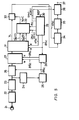
- Fig. 1 schematically illustrates an example of a recording system of the VTR to which this invention is applied.
- a composite color video signal of, for example, NTSC (national television systems committee) is applied to an input terminal 1 and then commonly supplied to an A/D (analog-to-digital) converter 2, a synchronizing signal separating circuit 3 and a burst signal separating circuit 4.
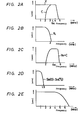
- the frequency spectrum of this composite color video signal consists of, as shown in Fig. 2A, a frequency band of a luminance signal Y of 0 to 4.2 MHz and a frequency band of a carrier chrominance signal C of ⁇ 1.5 MHz7- with 3.58 MHz as the center.
- Reference numeral 5 designates a digital band-pass filter (hereinafter simply referred to as BPF) and reference numeral 6 designates a frequency converter.
- BPF digital band-pass filter
- the output of the A/D converter 2 is supplied to the BPF 5 and the output of the BPF 5 is in turn supplied to the frequency converter 6 and a subtracter 7.
- Supplied to the subtracter 7 is the output of the A/D converter 2 that is delayed by an appropriate delay time by a delay line 8 and in the subtracter 7, the output of the BPF 5 is subtracted from the delayed output supplied thereto as above.
- Reference numeral 9 designates a clock signal generator to which a synchronizing pulse and a burst signal with color subcarrier frequency f SC are respectively supplied from the synchronizing signal separating circuit 3 and the burst signal separating circuit 4.
- a clock signal with frequency of, for example, 4 f SC which then is fed to the A/D converter 2 and the BPF 5 and, a two-phase signal with frequency of, for example, 2 f SC and then phase of which is 0 (zero) and ⁇ and a pulse with frequency f SC which are both supplied to the frequency converter 6.
- Reference numeral 10 designates a time-compressing multiplexer to which a pair of outputs from the frequency converter 6, the output from the subtracter 7 and the clock signal with the frequency of, for example, 8 f sc from the clock signal generator 9 are respectively supplied.
- Reference numeral 11 designates a pilot signal adding circuit to which the output from the time-compressing multiplexer 10 and the pilot signal (formed of the synchronizing signal and the burst signal) from the clock signal generator 9 are respectively supplied.
- the output of the pilot signal adding circuit 11 is sequentially supplied through a D/A (digital-to-analog) converter 12 and a low-pass filter 13 to an FM-modula-tor 14.
- the output of the FM-modulator 14 is supplied through a recording amplifier 15 to a magnetic recording head (rotary magnetic head) 16 and then recorded on a recording medium (not shown).
- a high frequency band signal S H that is the output of the BPF 5 is a digital signal corresponding to the high frequency component Y H of the luminance signal Y and the chromaticity signal (carrier chrominance signal) C, and the equivalent frequency spectrum thereof is as shown in Fig. 2C.
- term,frequency, waveform and so on of the original analog signal are used for those of the transmission signal in the digital signal period, hereinafter.
- the output of the BPF 5 is subtracted from the output of the A/D converter 2, namely, the digital composite signal Y + C in the subtracter 7, the output of the subtracter 7 becomes a low frequency component Y L of the digital luminance signal Y and the frequency spectrum thereof becomes as shown in Fig. 2B.
- the color subcarrier signal is orthogonal two-phase amplitude-modulated by two chrominance signals
- one of the sampling points by the above two-phase signals is selected to be a zero-cross point of the subcarrier signal in the original composite signal
- the zero-phase chrominance signal C 2 (O) and the ⁇ -phase chrominance signal C 2 ( ⁇ /2) provided by the two-phase sampling respectively become to correspond to color difference components (R - Y) and (B - Y) of the original composite signal.
- the frequency spectrum (Fig. 2C) of the high frequency band signal Y H +IC with the frequency f SC as its center is folded at a point of zero frequency (Fig. 2D).
- the two-phase base band signals S B (O) and S B ( ⁇ /2) thus obtained contain no color subcarrier wave and are equivalent to the component signal in this standpoint.
- the base band signals Y HA (O) , Y HB (O) , Y HA ( ⁇ /2) and Y HB ( ⁇ /2) are respectively expressed as by the following equations (1) to (4). where the sum frequency component is removed by the low-pass filter 13.
- the two-phase base band signals S B (O) and S B ( ⁇ /2) from the frequency converter 6 and the signal Y L from the subtracter 7 are supplied to the time-compressing multiplexer 10 and then written in a RAM (random access memory), that is incorporated in the multiplexer 10 under such address control that on the basis of the clock signal with the repetitive frequency of 8 f SC , the first data of the line thereof becomes the 0-address of the RAM.
- the sampling frequency in the A/D converter 2 and the BPF 5 is 4 f SC
- the sampling frequency of the signal Y L that is the difference signal between the both outputs is also 4 f SC .
- the sampling frequency of the two-phase base band signals S B (O) and S B ( ⁇ /2) is 2 f sc
- the time-compressed low frequency band luminance signals and the time-compressed base band signals thus made are respectively read out from the RAM by known read control means on the basis of the clock signal of 8 f SC in such a manner that they may be inserted into one horizontal period (lH).
- the frequency band of each signal after being time-compressed is made the same, it is possible to use the transmission line efficiently.
- the output signal from the time-compressing multiplexer 10 is supplied to and added with a pilot signal (consisting of the synchronizing signal and the burst signal) indicative of the sampled phase of the incoming composite color video signal in the pilot signal adding circuit 11. Thereafter, it is reconvered to the analog signal by the D/A converter 12.
- This analog signal is a time-compressed serial color signal (hereinafter simply referred to as a time-compressed serial signal) that - consists of,' as shown in Fig.
- this analog signal is used to directly FM-modulate the carrier wave of the FM-modulatc 14 and this FM-modulated signal is supplied through the recordii amplifier 15 of appropriate characteristic to the recording head 16 to be recorded on the recording medium.
- reproduced output by a playback head 21 from a recording medium is supplied through a playback amplifier 22 to an FM-modulator 23.
- Reference numerals 24 and 25 respectively designate a pilot signal separating circuit and a clock signal generator.
- a pilot signal separated from the output of the FM-demodulator 23 shown in Fig. 4 by the pilot signal separating circuit 24 is supplied to the clock signal generator 25.
- Reference numeral 26 designates an A/D converter and reference numeral 27 designates a memory.
- the A/D converter 26 is supplied with the analog output of the FM-demodulator 23 and also with a clock signal of frequency 8 f SC ' from the clock signal generator 25.
- the digital output of the A/D converter 26 is supplied to the memory 27.
- Reference numeral 28 designates a memory control circuit and reference numeral 29 designates a signal generator.
- the memory control circuit 28 is supplied with the output signal of frequency 8 f SC ' from the clock signal generator 25 and the output of frequency,8 f SC from the signal generator 29 which is generated on the basis of a reference signal REF applied thereto through an input terminal 30. Then, the control-signal is supplied from the control circuit 28 to the memory 27.
- Reference numeral 31 designates a multiplexing separating and time- expander (hereinafter simply referred to as separating/time-expander) and reference numeral 32 designates a frequency converter.
- the separating/time-expander 31 is supplied with the time-compressed serial signal that is read out from the memory 27 and the output from the signal generator 29.
- the frequency converter 32 is supplied with a pair of two-phase base band signals from the separating/time-expander 31, the two-phase signals of frequency 2 f SC and the signal with frequency f sc both from the signal generator 29.
- the low frequency band luminance signal that is another output of the separating/time-expander 31 and the output of the frequency converter 32 are supplied to anmadder 33.
- the digital output from the adder 33 and the clock signal with frequency 4 f SC from the signal generator 29 are supplied to a D/A converter 34.
- Reference numeral 36 designates a processor which is supplied with the analog output of the D/A converter 34 through a low-pass filter 35 and the synchronizing signal and the burst signal from the signal generator 29. The output from the processor 36 is delivered to an output terminal 37.
- the pilot signal ( consisting of the synchronizing signal and the burst signal) that is separated by the pilot signal separating circuit 24 indicates the sampling phase of the recording system as mentioned before in connection of Fig. 1.
- This pilot signal is affected by the jitter caused by the tape transporting system of the VTR and hence contains an time base error.
- the analog output of the FM-democulator 23, namely, the time-compressed serial signal is A/D-converted by the A/D converter 26 and the output of the A/D converter 26 is written in the memory 27 that forms a time base corrector while controlling its address by the memory control circuit 28.
- the content or data stored in the memory 27 is sequentially read out therefrom on the basis of the clock signal with very stable frequency 8 f SC that is supplied thereto through the control circuit 28 from the signal generator 29.
- the jitter of the VTR is absorbed at this stage.
- the separating/time-expander 31 includes the RAM and the time-compressed serial signal that is read out in turn from the memory 27 is sequentially written in the RAM of the separating/time-expander 31 on the basis of the clock signal with frequency 8 f SC from the signal generator 29.
- the time-compressed low frequency band luminance signal Y LC is sequantially read out from the RAM on the basis of the clock signal with frequency 4 fsè from the signal generator 29.
- the time-compressed low frequency band luminance signal Y LC is restored to the low frequency band luminance signal Y L .
- the zero-phase and ⁇ -phase time-compressed base band signals S BC (O) and SBC( ⁇ /2) are read out from the RAM in parallel on the basis of the clock signal with frequency 4 f SC from the signal generator 29.
- the half time-expanded base band signals S B '(O) and S B '( ⁇ /2) from the senparating/time/expander 31 are respectively supplied to the frequency-converter 32 and then sampled by the zero-phase and ⁇ -phase sampling signals of frequency 2 f SC that are supplied from the signal generator 29.
- each of the half time-expanded base band signals is again time-expanded with the time-expanding ratio 2 and frequency-converted so as to restore the two-phase high frequency band signals S H (0) and S H ( ⁇ /2).
- the two-phase high frequency band signal is again frequency-converted in the frequency converter 32 by the pulse signal with frequency f SC supplied thereto from the signal generator 29, thus the original high frequency band signal Y H + C being produced.
- This high frequency band signal Y H + C and the low frequency band luminance signal Y L from the separating/time-expander 31 are added together in the adder 33 and then converted to the analog video signal by the D/A converter 34.
- This analog video signal is supplied through the low-pass filter 35 to the processor 36, in which it is added with the synchronizing signal and the burst signal from the signal generator 29 to become the original composite color video signal, which then is delivered to the output terminal 37.
- the high frequency band luminance signal component and the carrier chrominance signal component (Y H + C) are frequency-converted and re-converted in the form of the analog signal, it is extremely difficult to completely match the characteristics of the separation filter for the signal component (Y H + C), the low-pass filter after being converted to the base band, and the band-pass filter after being re-converted upon playback, level of each signal, group delay characteristic, phase of the frequency-converted signal and the like and to maintain them.
- Each second term of the equations (8) to (11) is an unnecessary component.
- ⁇ YH comes close to ⁇ SC
- each frequency of the unnecessary component becomes close bo ⁇ SC and becomes unable to be separated by the ordinary filter.
- the unnecessary component can be cancelled out.
- the unnecessary component of the carrier chrominance signal C can be cancelled out perfectly similarly.
- the time-compressed low frequency band luminance signal and the both time-compressed base band signals are time-compressed so as to be inserted into the 1H period and then transmitted through one transmission channel, they can be transmitted through two transmission channels. That is, it is possible that the low frequency band luminance signal is not time-compressed and then transmitted through one transmission channel but the both base band signals are time-compressed with time-compressing ratio 2 so as to be inserted into the 1 H period and then transmitted through other one channel. In this case, it is possible that a necessary frequency band of the transmitting apparatus is narrow as compared with that of the transmission of the original signal.
- the frequency-conversion of the two-phase sampling frequencies is employed to remove the influence of the color subcarrier wave and the time-compressed serial color signal that corresponds to the transmission of the component video signal is obtained and hence the signal transmission of high quality becomes possible.
Landscapes
- Engineering & Computer Science (AREA)
- Multimedia (AREA)
- Signal Processing (AREA)
- Color Television Systems (AREA)
- Television Signal Processing For Recording (AREA)
- Signal Processing Not Specific To The Method Of Recording And Reproducing (AREA)
Applications Claiming Priority (2)
| Application Number | Priority Date | Filing Date | Title |
|---|---|---|---|
| JP58236786A JPS60127893A (ja) | 1983-12-15 | 1983-12-15 | カラ−テレビジヨン信号伝送方式 |
| JP236786/83 | 1983-12-15 |
Publications (2)
| Publication Number | Publication Date |
|---|---|
| EP0146129A2 true EP0146129A2 (de) | 1985-06-26 |
| EP0146129A3 EP0146129A3 (de) | 1987-12-02 |
Family
ID=17005770
Family Applications (1)
| Application Number | Title | Priority Date | Filing Date |
|---|---|---|---|
| EP84115445A Withdrawn EP0146129A3 (de) | 1983-12-15 | 1984-12-14 | Gerät für die Aufzeichnung und Wiedergabe eines Videosignals |
Country Status (4)
| Country | Link |
|---|---|
| US (1) | US4677497A (de) |
| EP (1) | EP0146129A3 (de) |
| JP (1) | JPS60127893A (de) |
| CA (1) | CA1274907A (de) |
Families Citing this family (11)
| Publication number | Priority date | Publication date | Assignee | Title |
|---|---|---|---|---|
| EP0213207B1 (de) * | 1985-02-04 | 1993-01-13 | Matsushita Electric Industrial Co., Ltd. | Videosignalprozessor |
| JPS61224694A (ja) * | 1985-03-29 | 1986-10-06 | Matsushita Electric Ind Co Ltd | 映像信号伝送装置 |
| US4763202A (en) * | 1986-10-06 | 1988-08-09 | Eastman Kodak Company | Time division multiplex video recorder with high resolution |
| JPS6436186A (en) * | 1987-07-30 | 1989-02-07 | Mitsubishi Electric Corp | Low frequency chrominance signal converter |
| EP0335401A3 (de) * | 1988-03-30 | 1992-04-01 | Nec Home Electronics, Ltd. | Vorrichtung zur magnetischen Aufnahme und Wiedergabe |
| JPH02282974A (ja) * | 1989-04-24 | 1990-11-20 | Canon Inc | 画像信号記録再生装置 |
| JPH03198596A (ja) * | 1989-12-27 | 1991-08-29 | Sharp Corp | 磁気記録再生装置 |
| JPH04195824A (ja) * | 1990-11-27 | 1992-07-15 | Matsushita Electric Ind Co Ltd | 光ディスク及び光ディスク記録装置及び光ディスク再生装置 |
| US5293248A (en) * | 1991-05-06 | 1994-03-08 | U.S. Philips Corporation | System and apparatus for recording and reproducing and extended definition video signal in/from a track on a magnetic carrier |
| JP3158614B2 (ja) * | 1992-03-26 | 2001-04-23 | ソニー株式会社 | デジタル復調装置 |
| JP4970425B2 (ja) * | 2006-03-24 | 2012-07-04 | パナソニック株式会社 | 信号処理方法および信号処理回路 |
Family Cites Families (7)
| Publication number | Priority date | Publication date | Assignee | Title |
|---|---|---|---|---|
| US4220964A (en) * | 1977-11-21 | 1980-09-02 | Sony Corporation | Secam recording and reproducing system |
| GB2050746B (en) * | 1979-06-22 | 1983-11-02 | British Broadcasting Corp | Decoding digital colour television signals |
| JPS56144682A (en) * | 1980-04-11 | 1981-11-11 | Sony Corp | Recording and reproducing device for digital video signal and audio signal |
| US4335393A (en) * | 1980-04-15 | 1982-06-15 | Harris Video Systems, Inc. | Method and system using sequentially encoded color and luminance processing of video type signals to improve picture quality |
| CA1159949A (en) * | 1980-04-18 | 1984-01-03 | Yoshitaka Hashimoto | Digital video data recording apparatus |
| JPS5871783A (ja) * | 1981-10-23 | 1983-04-28 | Sony Corp | 分離回路 |
| US4502074A (en) * | 1981-11-09 | 1985-02-26 | Rca Corporation | Digital television signal processing system |
-
1983
- 1983-12-15 JP JP58236786A patent/JPS60127893A/ja active Granted
-
1984
- 1984-12-10 US US06/680,283 patent/US4677497A/en not_active Expired - Lifetime
- 1984-12-14 CA CA000470099A patent/CA1274907A/en not_active Expired
- 1984-12-14 EP EP84115445A patent/EP0146129A3/de not_active Withdrawn
Also Published As
| Publication number | Publication date |
|---|---|
| EP0146129A3 (de) | 1987-12-02 |
| JPS60127893A (ja) | 1985-07-08 |
| US4677497A (en) | 1987-06-30 |
| JPH0473678B2 (de) | 1992-11-24 |
| CA1274907A (en) | 1990-10-02 |
Similar Documents
| Publication | Publication Date | Title |
|---|---|---|
| US5940572A (en) | Integrated television and video cassette recorder system | |
| US5359426A (en) | Reproducing a bandwidth expanded chroma signal with reduced noise and reduced flicker | |
| US4677497A (en) | Apparatus for recording and reproducing a video signal with reduced color subcarrier interference | |
| JPH01114291A (ja) | 改善されたカラー記録付ビデオレコーダ | |
| JPS594287A (ja) | カラ−テレビジヨン伝送方式 | |
| EP0599663A2 (de) | Chrominanzsignalverarbeitung | |
| US4851928A (en) | Apparatus for recording low and high bond components of a chrominance signal | |
| EP0241935B1 (de) | Schaltungen zur Verarbeitung eines Farbvideosignales | |
| US4672426A (en) | Chrominance signal processing apparatus | |
| EP0076047B1 (de) | Farbvideosignal-Aufzeichnungs- und -Wiedergabeeinrichtung | |
| US5822490A (en) | Apparatus and method for color-under chroma channel encoded with a high frequency luminance signal | |
| US5153741A (en) | Crosstalk cancelling circuit for playback chrominance signal of VTR | |
| JP2683533B2 (ja) | 放送受信装置ならびに受信方式、およびカラー信号記録/再生装置ならびに記録/再生方式 | |
| US5729828A (en) | Frequency processing circuit with lower sideband suppression and emphasis | |
| KR880000412Y1 (ko) | 칼러 영상신호 기록장치 | |
| EP0289326A1 (de) | Magnetische Aufzeichnungs- und Wiedergabevorrichtung | |
| US4882632A (en) | Color video signal reproducing apparatus using frequency converted chrominance signal | |
| JP2635846B2 (ja) | 磁気記録装置 | |
| JPS634393B2 (de) | ||
| JPS63155986A (ja) | 記録再生装置 | |
| JPH0732490B2 (ja) | 磁気映像記録再生方式 | |
| JPH0421396B2 (de) | ||
| JPH0191595A (ja) | カラー映像信号記録再生装置 | |
| JPS6019190B2 (ja) | 磁気記録再生方法 | |
| JPS6026355B2 (ja) | 磁気記録再生装置用ダビング機構 |
Legal Events
| Date | Code | Title | Description |
|---|---|---|---|
| PUAI | Public reference made under article 153(3) epc to a published international application that has entered the european phase |
Free format text: ORIGINAL CODE: 0009012 |
|
| AK | Designated contracting states |
Designated state(s): AT DE FR GB NL |
|
| PUAL | Search report despatched |
Free format text: ORIGINAL CODE: 0009013 |
|
| AK | Designated contracting states |
Kind code of ref document: A3 Designated state(s): AT DE FR GB NL |
|
| 17P | Request for examination filed |
Effective date: 19880530 |
|
| 17Q | First examination report despatched |
Effective date: 19900402 |
|
| STAA | Information on the status of an ep patent application or granted ep patent |
Free format text: STATUS: THE APPLICATION IS DEEMED TO BE WITHDRAWN |
|
| 18D | Application deemed to be withdrawn |
Effective date: 19910814 |
|
| RIN1 | Information on inventor provided before grant (corrected) |
Inventor name: YOSHINAKA, TADAAKI |