EP0147820A2 - Entraîneur double cavité avec des moyens alternatifs de conformation à la fréquence - Google Patents
Entraîneur double cavité avec des moyens alternatifs de conformation à la fréquence Download PDFInfo
- Publication number
- EP0147820A2 EP0147820A2 EP84116055A EP84116055A EP0147820A2 EP 0147820 A2 EP0147820 A2 EP 0147820A2 EP 84116055 A EP84116055 A EP 84116055A EP 84116055 A EP84116055 A EP 84116055A EP 0147820 A2 EP0147820 A2 EP 0147820A2
- Authority
- EP
- European Patent Office
- Prior art keywords
- rate
- atrial
- pacemaker
- mode
- dual chamber
- Prior art date
- Legal status (The legal status is an assumption and is not a legal conclusion. Google has not performed a legal analysis and makes no representation as to the accuracy of the status listed.)
- Granted
Links
- 230000009977 dual effect Effects 0.000 title claims abstract description 29
- 230000003044 adaptive effect Effects 0.000 title abstract description 15
- 102100026827 Protein associated with UVRAG as autophagy enhancer Human genes 0.000 title description 17
- 101710102978 Protein associated with UVRAG as autophagy enhancer Proteins 0.000 title description 17
- 230000001746 atrial effect Effects 0.000 claims abstract description 85
- 230000001360 synchronised effect Effects 0.000 claims abstract description 25
- 238000012360 testing method Methods 0.000 claims abstract description 5
- 230000002861 ventricular Effects 0.000 claims description 26
- 230000000747 cardiac effect Effects 0.000 claims description 8
- 210000002837 heart atrium Anatomy 0.000 claims description 5
- 230000033764 rhythmic process Effects 0.000 claims description 3
- 230000035945 sensitivity Effects 0.000 claims description 3
- 230000000737 periodic effect Effects 0.000 claims 1
- 230000002269 spontaneous effect Effects 0.000 claims 1
- 230000000763 evoking effect Effects 0.000 description 10
- 230000036279 refractory period Effects 0.000 description 8
- 238000010586 diagram Methods 0.000 description 7
- 230000002503 metabolic effect Effects 0.000 description 6
- 230000000694 effects Effects 0.000 description 5
- 230000006870 function Effects 0.000 description 5
- 230000008901 benefit Effects 0.000 description 4
- 238000004891 communication Methods 0.000 description 4
- 238000013459 approach Methods 0.000 description 3
- 238000011161 development Methods 0.000 description 3
- 238000000034 method Methods 0.000 description 3
- 238000012546 transfer Methods 0.000 description 3
- YMHOBZXQZVXHBM-UHFFFAOYSA-N 2,5-dimethoxy-4-bromophenethylamine Chemical compound COC1=CC(CCN)=C(OC)C=C1Br YMHOBZXQZVXHBM-UHFFFAOYSA-N 0.000 description 2
- 206010053486 Pacemaker generated arrhythmia Diseases 0.000 description 2
- 241000545067 Venus Species 0.000 description 2
- 230000002159 abnormal effect Effects 0.000 description 2
- QVGXLLKOCUKJST-UHFFFAOYSA-N atomic oxygen Chemical compound [O] QVGXLLKOCUKJST-UHFFFAOYSA-N 0.000 description 2
- 238000013461 design Methods 0.000 description 2
- 238000001514 detection method Methods 0.000 description 2
- 201000010099 disease Diseases 0.000 description 2
- 208000037265 diseases, disorders, signs and symptoms Diseases 0.000 description 2
- 230000001435 haemodynamic effect Effects 0.000 description 2
- 230000002401 inhibitory effect Effects 0.000 description 2
- 238000005259 measurement Methods 0.000 description 2
- 229910052760 oxygen Inorganic materials 0.000 description 2
- 239000001301 oxygen Substances 0.000 description 2
- 230000004044 response Effects 0.000 description 2
- 210000001013 sinoatrial node Anatomy 0.000 description 2
- 206010003673 Atrioventricular block complete Diseases 0.000 description 1
- 230000003466 anti-cipated effect Effects 0.000 description 1
- 206010003668 atrial tachycardia Diseases 0.000 description 1
- 230000036760 body temperature Effects 0.000 description 1
- 208000006218 bradycardia Diseases 0.000 description 1
- 230000036471 bradycardia Effects 0.000 description 1
- 210000000748 cardiovascular system Anatomy 0.000 description 1
- 150000003943 catecholamines Chemical class 0.000 description 1
- 230000002860 competitive effect Effects 0.000 description 1
- 230000008602 contraction Effects 0.000 description 1
- 238000007796 conventional method Methods 0.000 description 1
- 239000003814 drug Substances 0.000 description 1
- 229940079593 drug Drugs 0.000 description 1
- 230000008451 emotion Effects 0.000 description 1
- 238000011156 evaluation Methods 0.000 description 1
- 239000000463 material Substances 0.000 description 1
- 230000001404 mediated effect Effects 0.000 description 1
- 238000012544 monitoring process Methods 0.000 description 1
- 230000001575 pathological effect Effects 0.000 description 1
- 230000029058 respiratory gaseous exchange Effects 0.000 description 1
- 230000024977 response to activity Effects 0.000 description 1
- 201000002931 third-degree atrioventricular block Diseases 0.000 description 1
Images


Classifications
-
- A—HUMAN NECESSITIES
- A61—MEDICAL OR VETERINARY SCIENCE; HYGIENE
- A61N—ELECTROTHERAPY; MAGNETOTHERAPY; RADIATION THERAPY; ULTRASOUND THERAPY
- A61N1/00—Electrotherapy; Circuits therefor
- A61N1/18—Applying electric currents by contact electrodes
- A61N1/32—Applying electric currents by contact electrodes alternating or intermittent currents
- A61N1/36—Applying electric currents by contact electrodes alternating or intermittent currents for stimulation
- A61N1/362—Heart stimulators
- A61N1/365—Heart stimulators controlled by a physiological parameter, e.g. heart potential
- A61N1/368—Heart stimulators controlled by a physiological parameter, e.g. heart potential comprising more than one electrode co-operating with different heart regions
Definitions
- This invention relates to pacemaker systems and the use thereof, and in particular pacemaker systems which are automatically rate adaptable.
- rate adaptive or physiological pacemakers is now gaining an increasing acceptance, although it has been slow coming.
- the principle of using atrial activity to trigger ventricular pacing has been implemented in implantable devices for about two decades, but even to date such pacemakers are very much in the minority.
- the reasons for the historical limited acceptance of atrial synchronous pacemakers, and other types of dual chamber pacemakers are being overcome by the industry.
- the problems with reliable sensing of atrial activity, bulky short-lived generators and ventricular competitive pacing are being solved in varying degrees.
- the object is to define a pacing system able to confer physiological benefit under a wide variety of conditions and cardiac rhythms.
- the ability to adjust cardiac output in relation to metabolic needs is a fundamental property of the intact cardiovascular system, and increase of heart rate alone can increment cardiac output by 300 percent in normal adults; combined with stroke volumne increases of around 50 percent this produces the normal 4 to 5 - fold increase of cardiac output found in exercise.
- the loss of rate control thus has a profound effect on exercise haemodynamics.
- loss of rate control applies not only to patients with atrioventricular disociation, but also to subjects with an abnormal sinus response to exercise, even though atrial synchrony may be maintained.
- the dual chamber pacemaker e.g. use of atrial synchronous ventricular pacing. If the atrium is normally responsive to metabolic demands, this pacing system represents the ideal pacing modality. Such a pacing system has the advantage that it not only provides rate control mediated by the sinus node, but also allows physiological A-V synchrony to be maintained.
- the haemodynamic benefit of dual chamber devices has been established'both in the long and short term, and the use of such in patients with predominated or exercise-induced high grade A-V block and normal sinus function is clearly mandated.
- a pacemaker using the basic evoked QT sensing arrangement has been developed by the assignee of this application, and is hereinafter referred to as operating in the T mode.
- the advantages of this system include its inability to induce pacemaker mediated tachycardias. Of course, it does not provide suitably timed atrial contraction.
- T mode rate adaptive pacer In addition to the T mode rate adaptive pacer, other systems are under development which use body sensors for monitoring different body parameters, the pacemaker having means for controlling and adapting rate as a function of the sensed body parameter. Such systems include sensors for pH control, control by central venus oxygen content, temperature control, and resperation rate control. Reference is made to the paper titled “Rate Responsive Pacing", Rickards et al, Vol. 1, No. 1, 1983, Clin. Prog. Pacing and Electrophysiol.
- It is another object of this invention to provide a pacemaker system comprising means for atrial synchronous operation, having the further facility of determining when the atrial rate indication is no longer reliable and for switching to an alternate mode of rate adaptive pacing.
- a dual chamber pacemaker system comprising atrial control means for controlling the pacing rate as a function of sensed atrial signals, e.g. atrial synchronous pacing, in combination with alternate rate control means such as QT sensing or body parameter sensing for alternate controlling of the pacing rate, and automatic means for determining when the pacing rate is to be atrial controlled and when alternate rate controlled.
- atrial control means for controlling the pacing rate as a function of sensed atrial signals, e.g. atrial synchronous pacing
- alternate rate control means such as QT sensing or body parameter sensing for alternate controlling of the pacing rate
- automatic means for determining when the pacing rate is to be atrial controlled and when alternate rate controlled.
- a sense - this refers to sensing a natural atrial signal (P wave).
- enabling the A sense refers to enabling the sensing of a P wave through the A sense detection circuitry.
- V sense - this refers to sensing a natural ventricular signal (QRS); enabling V sense refers to enabling the V sense detection circuitry.
- QRS natural ventricular signal
- TAV - The AV time delay between an atrial signal (sensed or delivered) and the following ventricular stimulus.
- TAA - The pacing cycle, from atrial event (natural or delivered stimulus) to next atrial event.
- Overdrive The technique of setting the pacing interval to overdrive the natural rate, so that a stimulus is delivered instead of inhibiting stimulus delivery.
- T refr - The refractory interval time.
- Extra sensor - This refers to any body parameter sensor or means of sensing a body parameter.
- this may include means for sensing pH, venus oxygen content, body temperature, respiration rate, etc.
- Sensor rate - an indicated pacing rate derived from sensor data.
- T pi The time interval corresponding to one pacing cycle, i.e., T AA between two delivered atrial stimulus pulses.
- DVI The sequential mode of dual chamber pacing, characterized by pacing in both the atrium and the ventricle (D); sensing in the ventricle (V); and inhibiting (I) in response to a natural ventricular signal.
- T - The mode of rate control wherein rate information is obtained by determining the time interval between a delivered stimulus and the evoked QRS.”
- V stim - Delivered ventricular stimulus V stim - Delivered ventricular stimulus.
- Timer - The microprocessor controlled timer means for timing elapsed time since the start of the pacemaker cycle.
- T sense window - The period of time spanning both sides of the expected evoked T wave signal during which the pacemaker looks for an evoked T wave.
- Q-T - The interval between a delivered ventricular stimulus and an evoked T wave.
- a pacemaker 40 is illustrated, which contains therein a microprocessor 41.
- the microprocessor controls pacemaker activity as set forth in referenced Applications 436,411 and 465,890.
- the pacemaker is in two way communication with external programmer apparatus 43, which may be of the type as described in referenced U.S. Application S.N. 465,891.
- the pacemaker communicates through lead 46 with atrial terminal or terminals A, for sensing and/or pacing in the atrium.
- the atrial lead may be either unipolar or bipolar.
- lead 47 connects the pacer with the patient's ventricle, for either unipolar or bipolar pacing and/or sensing.
- a third lead 48 is illustrated as connecting the pacer with a sensor designated S, which is suitably a body parameter sensor of the type described. It is to be understood that S may represent one or more different types of body parameter sensors or sensing means.
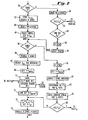
- Figs. 2, 3 and 4 Three microprocessor rate control flow paths are shown in Figs. 2, 3 and 4.
- Fig. 2 shows a flow diagram which controls operation when the pacing rate is being derived from the sensed atrial signals.
- Fig. 3 illustrates a DVI/T x mode which incorporates T control.
- Fig. 4 illustrates an extra sensor mode which covers control by one or more extra body sensors.
- steps material to the invention are included, while steps unnecessary for the purpose of illustrating the invention are omitted.
- the first block 51 represents a determination of whether an atrial signal has been sensed, or whether there has been a time out of the pacing interval. An A sense flag is set or not, depending upon this determination. If yes, meaning an atrial signal has been sensed, the cycle time T A-A is stored and the A sense circuitry is disabled at 52. The "No A sense" counter is reset to zero at block 54.
- the timer is set to zero, indicating the start of timing of a new cycle; the time T is set to the AV delay time T AV and the pacemaker waits to see whether the AV delay times out or whether a natural ventricular QRS is sensed. If a natural QRS is sensed at block 65, the program proceeds at block 66 to disable V sense. If no natural QRS is sensed, meaning the AV delay timed out, the program branches to the right for delivery of a ventricular stimulus at block 79.
- the program branches to block 56 and increments the "No A sense" counter.
- the count of successive failures to sense a P wave is done so that if a predetermined number of atrial signals are missed, the pacemaker is caused to switch to T rate control.
- the pacemaker examines the count, and determines whether to stay with the synchronous mode of operation, or branch to the DVI/T routine. For example, the decision to branch may be programmed to occur when the No A sense count reaches 10. Assuming that it stays in the synchronous mode, the pacemaker next confirms a time out of the pacing interval T . at 58, and delivers an atrial stimulus at 60. The timer is reset to zero at 61, starting a new cycle. The pacemaker then branches to the "sense V?" block 65 and waits.
- the V sense is disabled at block 66 and the program then proceeds at block 67 to determine whether to adjust T AV for overdrive, i.e., make the'AV delay shorter.
- the effect of a shorter AV delay is to promote pacing of the ventricle earlier than the anticipated natural QRS, so as to enable the measurement of a Q-T interval and get a T rate evaluation.
- the value of t 2 is a small value designed to decrease the AV delay in order to attempt to override the natural QRS.
- the pacemaker microprocessor may be programmed to periodically decrease.the value of T AV , e.g., every 10 or 100 pacer cycles, so as to obtain a Q-T measurement.
- the programming of the pacemaker for adjustment of T AV for overdrive is a matter of operator judgment, and may be controlled by external programming of the imolante.d pacemaker.
- the pacemaker may adjust T AV for overdrive as part of the operation at block 61, in order to more vigorously ensure a QT determination immediately following the absence of a natural P wave.
- the time T is set to the refractory period, and at block 71 a logic analysis is performed during the time that the microprocessor waits for the time out of the refractory period.
- data on the sensed P waves may be analyzed, to determine whether the atrial rate is appropriate. If not, the pacer branches to the appropriate point in the DVI/T x path. Alternately, or in addition, the pacer may check data from the extra body sensor or sensors, and make a similar analysis. If the sensor analysis indicates that atrial rate control is inappropriate, the pacer branches to the appropriate block of the extra sensor loop. Assuming that atrial control is maintained, the pacemaker waits for time out of the refractory period at block 72.
- pacing interval is then set equal to the last sensed cycle length (T A-A ) plus t, , where tl is a small value.
- T is set to the new Tp i .
- the setting of the pacing rate is subject to maximum and minimum limitations, not shown.
- the algorithm of block 73 suitably limits the change in pacing rate from cycle to cycle, providing a "fly wheel” effect in a known manner.
- the A sense and V sense circuits are then enabled at block 75, and the program waits for the next cycle to start at block 51.
- a V stimulus is delivered at 79 and the time thereof is stored, and T is set equal to the refractory period at 80.
- the T wave sense window is enabled at 82, for sensing an evoked T wave during a predetermined window of time.
- the pacemaker senses the evoked T wave and determines the QT interval and desirable T rate.
- the microprocessor compares x the atrial and T rates, and determines whether it is appropriate to maintain atrial control or switch to T control.
- This comparison may comprise simply comparing the difference of the atrial and T x determined rates to a predetermined value, or may comprise a more complex algorithm. If it is determined appropriate to switch, the pacer branches to the appropriate point in the DVI/T x loop. If atrial control is to be maintained, pacing rate is set at block 73 and A sense and V sense are enabled at block 75.
- Fig. 3 which illustrates the DVI/T sub-routine
- the pacemaker checks to see whether it is desired to test the synchronous mode. This feature is utilized so that the pacemaker can be programmed to return to the normal dual chamber atrial rate controlled mode of operation, if this is appropriate. For example, the mode switch can be made after 100 or 1000 pacer cycles. If the pacer does call for transfer to the synchronous mode, A sense is enabled at block 102, and the pacer proceeds to block 51 of the synch routine. If not, the pacemaker waits for time out of the pacing interval at 104 and then delivers an atrial stimulus at 105.
- the timer is then reset to zero at 106 for the start of the new cycle, and the time T is set equal to T AV at 108. If, at block 110, a natural ventricular signal is sensed, the pacer sets T to the refractory period at block 120 and disables V sense at 121. Upon time out of the refractory period, T is set to the pacing interval at 125, and V sense is enabled at 126. Following this, the pacer loops back to block 101. Note that for this loop, there is no atrial sense, since the pacemaker is operating in the DVI mode subject to the T rate control, i.e., DVI/T x.
- V sense block 110 if there is no QRS sensed, then a ventricular stimulus is delivered at 112. The time of the delivered V stim is recorded, for the purpose of determining the QT interval. Following this, V sense is disabled and the T sense window is enabled-at 113. The evoked T wave is sensed, the QT interval is measured and the indicated T x rate is determined at block 115. Following this, at block 116 the pacing interval T pi is set as a function of the T x rate. The algorithm of block 116 limits the change in rate for any given cycles so as to ensure a gradual change in rate when, for example, control has been passed from atrial to T x . The program then sets T pi to the timer, enables V sense and exists.
- the extra sensor is monitored at block 142, and the pacing rate as indicated by the sensor information is determined.
- a conventional technique for translating sensor data into an indicated pacing rate may be used.
- a modified T . is set at block 143.
- T is set equal to Tp i at block 146 and V sense is enabled at block 147, whereupon the program exists and returns to the start.
Landscapes
- Health & Medical Sciences (AREA)
- Cardiology (AREA)
- Heart & Thoracic Surgery (AREA)
- Life Sciences & Earth Sciences (AREA)
- Biophysics (AREA)
- Physiology (AREA)
- Engineering & Computer Science (AREA)
- Biomedical Technology (AREA)
- Nuclear Medicine, Radiotherapy & Molecular Imaging (AREA)
- Radiology & Medical Imaging (AREA)
- Animal Behavior & Ethology (AREA)
- General Health & Medical Sciences (AREA)
- Public Health (AREA)
- Veterinary Medicine (AREA)
- Electrotherapy Devices (AREA)
Applications Claiming Priority (2)
| Application Number | Priority Date | Filing Date | Title |
|---|---|---|---|
| US06/566,101 US4527568A (en) | 1983-12-27 | 1983-12-27 | Dual chamber pacer with alternative rate adaptive means and method |
| US566101 | 1983-12-27 |
Publications (3)
| Publication Number | Publication Date |
|---|---|
| EP0147820A2 true EP0147820A2 (fr) | 1985-07-10 |
| EP0147820A3 EP0147820A3 (en) | 1988-06-08 |
| EP0147820B1 EP0147820B1 (fr) | 1993-03-24 |
Family
ID=24261489
Family Applications (1)
| Application Number | Title | Priority Date | Filing Date |
|---|---|---|---|
| EP84116055A Expired - Lifetime EP0147820B1 (fr) | 1983-12-27 | 1984-12-21 | Entraîneur double cavité avec des moyens alternatifs de conformation à la fréquence |
Country Status (3)
| Country | Link |
|---|---|
| US (1) | US4527568A (fr) |
| EP (1) | EP0147820B1 (fr) |
| DE (1) | DE3486112T2 (fr) |
Cited By (13)
| Publication number | Priority date | Publication date | Assignee | Title |
|---|---|---|---|---|
| EP0238966A1 (fr) * | 1986-03-18 | 1987-09-30 | Siemens-Elema AB | Stimulateur cardiaque commandé par l'action atriale |
| EP0219943A3 (en) * | 1985-08-28 | 1989-08-30 | Raul Chirife | Cardiac pacemaker adaptive to physiological requirements |
| EP0381799A1 (fr) * | 1989-02-10 | 1990-08-16 | Pacesetter AB | Stimulateur cardiaque implantable et procédé de commande d un stimulateur cardiaque avec une fréquence synchrone de stimulation du muscle cardiaque limitée à une valeur maximale |
| EP0360668A3 (fr) * | 1988-09-23 | 1991-09-11 | Medtronic, Inc. | Stimulateur cardiaque bicavitaire sensible au rythme |
| WO1992016258A1 (fr) * | 1991-03-15 | 1992-10-01 | Medtronic, Inc. | Stimulateur cardiaque reagissant au rythme a deux chambres avec commutateur automatique de mode |
| EP0426828A4 (en) * | 1989-05-23 | 1993-02-10 | Siemens Aktiengesellschaft | Programmable pacemaker |
| EP0148486B1 (fr) * | 1984-01-10 | 1993-03-24 | Vitatron Medical B.V. | Appareil d'entraînement se conformant à la fréquence |
| EP0216725B1 (fr) * | 1985-09-17 | 1993-12-01 | BIOTRONIK Mess- und Therapiegeräte GmbH & Co Ingenieurbüro Berlin | Stimulateur cardiaque |
| EP0867199A3 (fr) * | 1997-03-26 | 1999-11-17 | Vitatron Medical B.V. | Système de stimulation cardiaque avec asservissement aux contractions auriculaires prematurées basée sur les données QT |
| WO2000023145A1 (fr) * | 1998-10-20 | 2000-04-27 | St. Jude Medical Ab | Dispositif de stimulation cardiaque implantable |
| EP1013307A2 (fr) | 1998-12-15 | 2000-06-28 | BIOTRONIK Mess- und Therapiegeräte GmbH & Co Ingenieurbüro Berlin | Stimulateur cardiaque à fréquence adaptable et à autocalibration |
| US9393424B2 (en) | 2014-09-08 | 2016-07-19 | Medtronic, Inc. | System and method for dual-chamber pacing |
| US9687654B2 (en) | 2015-04-23 | 2017-06-27 | Medtronic, Inc. | System and method for dual-chamber pacing |
Families Citing this family (77)
| Publication number | Priority date | Publication date | Assignee | Title |
|---|---|---|---|---|
| DE3422913A1 (de) * | 1984-06-20 | 1986-01-02 | Siemens AG, 1000 Berlin und 8000 München | Regelschaltung zur anpassung der stimulationsfrequenz eines herzschrittmachers an die belastung eines patienten |
| US4802481A (en) * | 1984-07-19 | 1989-02-07 | Cordis Leads, Inc. | Apparatus for controlling pacing of a heart in response to changes in stroke volume |
| US4686988A (en) * | 1984-10-19 | 1987-08-18 | Sholder Jason A | Pacemaker system and method for measuring and monitoring cardiac activity and for determining and maintaining capture |
| US4860751A (en) * | 1985-02-04 | 1989-08-29 | Cordis Corporation | Activity sensor for pacemaker control |
| DE3506791A1 (de) * | 1985-02-22 | 1986-08-28 | Biotronik Meß- und Therapiegeräte GmbH & Co Ingenieurbüro Berlin, 1000 Berlin | Herzschrittmacher mit physiologischer steuerung |
| WO1986005698A1 (fr) * | 1985-03-27 | 1986-10-09 | Siemens-Elema Ab | Mesure de l'intervalle de stimulation d'un coeur, stimulateur adaptatif et mode de fonctionnement |
| DE3687206D1 (de) * | 1985-09-17 | 1993-01-14 | Biotronik Mess & Therapieg | Herzschrittmacher. |
| EP0215731B1 (fr) * | 1985-09-17 | 1992-12-30 | BIOTRONIK Mess- und Therapiegeräte GmbH & Co Ingenieurbüro Berlin | Stimulateur cardiaque |
| EP0225839B1 (fr) * | 1985-09-17 | 1993-12-01 | BIOTRONIK Mess- und Therapiegeräte GmbH & Co Ingenieurbüro Berlin | Stimulateur cardiaque |
| EP0215730B1 (fr) * | 1985-09-17 | 1993-06-16 | BIOTRONIK Mess- und Therapiegeräte GmbH & Co Ingenieurbüro Berlin | Stimulateur cardiaque |
| DE3535543A1 (de) * | 1985-10-04 | 1987-04-09 | Siemens Ag | Vorhofgesteuerter herzschrittmacher |
| DE3541598A1 (de) * | 1985-11-25 | 1987-11-19 | Alt Eckhard | Belastungsabhaengig frequenzvariabler herzschrittmacher |
| US4722342A (en) * | 1986-06-16 | 1988-02-02 | Siemens Aktiengesellschaft | Cardiac pacer for pacing a human heart and pacing method |
| EP0255899B1 (fr) * | 1986-07-31 | 1992-07-15 | Werner Prof. Dr.-Ing. Irnich | Stimulateur cardiaque à fréquence adaptable |
| US4856523A (en) * | 1987-10-08 | 1989-08-15 | Siemens-Pacesetter, Inc. | Rate-responsive pacemaker with automatic mode switching and/or variable hysteresis rate |
| US4972834A (en) * | 1988-09-30 | 1990-11-27 | Vitatron Medical B.V. | Pacemaker with improved dynamic rate responsiveness |
| US5024222A (en) * | 1990-02-21 | 1991-06-18 | Siemens-Pacesetter, Inc. | Hemodynamically rate responsive pacemaker and method of automatically adjusting the escape and A-V intervals |
| US5085215A (en) * | 1990-03-20 | 1992-02-04 | Telectronics Pacing Systems, Inc. | Metabolic demand driven rate-responsive pacemaker |
| US5144950A (en) * | 1990-08-30 | 1992-09-08 | Vitatron Medical B.V. | Rate controlled pacemaker system using ar interval for rate control |
| US5065759A (en) * | 1990-08-30 | 1991-11-19 | Vitatron Medical B.V. | Pacemaker with optimized rate responsiveness and method of rate control |
| US5184614A (en) * | 1990-10-19 | 1993-02-09 | Telectronics Pacing Systems, Inc. | Implantable haemodynamically responsive cardioverting/defibrillating pacemaker |
| US5188106A (en) * | 1991-03-08 | 1993-02-23 | Telectronics Pacing Systems, Inc. | Method and apparatus for chronically monitoring the hemodynamic state of a patient using doppler ultrasound |
| US5139020A (en) * | 1991-03-08 | 1992-08-18 | Telectronics Pacing Systems, Inc. | Method and apparatus for controlling the hemodynamic state of a patient based on systolic time interval measurements detecting using doppler ultrasound techniques |
| US5247930A (en) * | 1992-02-04 | 1993-09-28 | Vitatron Medical, B.V. | Dual chamber pacing system with dynamic physiological tracking and method of timing delivered stimulus for optimized synchronous pacing |
| US5330511A (en) * | 1993-01-19 | 1994-07-19 | Vitatron Medical B.V. | Dual chamber pacemaker with automatically optimized AV delay |
| US5350409A (en) * | 1993-04-19 | 1994-09-27 | Vitatron Medical, B.V. | Rate adaptive pacemaker with adjustment of sensor rate as a function of sensed sinus rate |
| US5441524A (en) * | 1993-08-30 | 1995-08-15 | Medtronic, Inc. | Energy efficient multiple sensor cardiac pacemaker |
| US5391189A (en) * | 1993-11-04 | 1995-02-21 | Vitatron Medical, B.V. | Rate adaptive dual chamber pacing system and method with automatic adjustment of operating parameters for minimizing sensor-sinus competition |
| US5531771A (en) * | 1994-10-26 | 1996-07-02 | Vitatron Medical, B.V. | Dual chamber pacemaker system and method with improved switching between synchronous and asyncrhonous behavior |
| US5562711A (en) * | 1994-11-30 | 1996-10-08 | Medtronic, Inc. | Method and apparatus for rate-responsive cardiac pacing |
| US5534017A (en) | 1994-12-02 | 1996-07-09 | Vitatron Medical, B.V. | Dual chamber pacemaker system with improved response to retrograde conduction |
| US5549648A (en) * | 1995-03-29 | 1996-08-27 | Vitatron Medical, B.V. | Pacemaker system and method with improved detection of end of retrograde conduction |
| US5653735A (en) * | 1995-06-28 | 1997-08-05 | Pacesetter, Inc. | Implantable cardiac stimulation device having an improved backup mode of operation and method thereof |
| US5713930A (en) * | 1996-11-06 | 1998-02-03 | Vitatron Medical, B.V. | Dual chamber pacing system and method with control of AV interval |
| US5800466A (en) * | 1997-04-14 | 1998-09-01 | Sulzer Intermedics Inc. | Dynamic atrial detection sensitivity control in an implantable medical cardiac simulator |
| US5772691A (en) * | 1997-04-14 | 1998-06-30 | Sulzer Intermedics Inc. | Implantable cardiac stimulator with polarity detection for detecting ectopic beats |
| US5843133A (en) * | 1997-04-14 | 1998-12-01 | Sulzer Intermedics Inc. | Dynamic bandwidth control in an implantable medical cardiac stimulator |
| US5735881A (en) * | 1997-04-14 | 1998-04-07 | Sulzer Intermedics Inc. | Variable atrail blanking period in an implantable medical device |
| US5792200A (en) * | 1997-04-28 | 1998-08-11 | Sulzer Intermedics Inc. | Adaptive mode switching in a rate-adaptive pacemaker and hysteresis for mode switching |
| US5861009A (en) * | 1997-10-21 | 1999-01-19 | Sulzer Intermedics, Inc. | Implantable cardiac stimulator with rate-adaptive T-wave detection |
| DE19929553A1 (de) | 1999-06-23 | 2001-01-04 | Biotronik Mess & Therapieg | Herzschrittmacher |
| US6370432B1 (en) * | 1999-08-20 | 2002-04-09 | Cardiac Pacemakers, Inc. | Pacemaker passive measurement testing system and method |
| EP1142608A2 (fr) | 2000-04-05 | 2001-10-10 | Pacesetter, Inc. | Procédé et système de prévention d'une syncope vaso-vagale récurrente utilisant la stimulation cardiaque |
| US6449510B1 (en) | 2000-04-27 | 2002-09-10 | Medtronic, Inc. | Method and system for operating an implantable medical device |
| US6604001B2 (en) * | 2001-03-19 | 2003-08-05 | Cardiac Pacemakers, Inc. | Implantable cardiac rhythm management device incorporating a programmable watchdog timer |
| US6668195B2 (en) | 2001-10-30 | 2003-12-23 | Medtronic, Inc. | Methods and apparatus for reducing the likelihood of atrial fibrillation |
| US6885891B2 (en) * | 2001-12-31 | 2005-04-26 | Medtronic, Inc. | Automatic rate response sensor mode switch |
| US6963778B2 (en) * | 2002-01-17 | 2005-11-08 | Cardiac Pacemakers, Inc. | Maximum pacing rate limiter implemented using the evoked response-T-wave interval |
| US6922587B2 (en) * | 2002-06-26 | 2005-07-26 | Pacesetter, Inc. | System and method for tracking progression of left ventricular dysfunction using implantable cardiac stimulation device |
| US7215998B2 (en) * | 2003-01-06 | 2007-05-08 | Medtronic, Inc. | Synchronous pacemaker with AV interval optimization |
| US7363078B2 (en) * | 2003-04-24 | 2008-04-22 | Medtronic, Inc. | Intracardiac polarization signal stabilization |
| US8150509B2 (en) * | 2004-10-21 | 2012-04-03 | Cardiac Pacemakers, Inc. | Systems and methods for drug therapy enhancement using expected pharmacodynamic models |
| US7775966B2 (en) | 2005-02-24 | 2010-08-17 | Ethicon Endo-Surgery, Inc. | Non-invasive pressure measurement in a fluid adjustable restrictive device |
| US7775215B2 (en) | 2005-02-24 | 2010-08-17 | Ethicon Endo-Surgery, Inc. | System and method for determining implanted device positioning and obtaining pressure data |
| US7699770B2 (en) | 2005-02-24 | 2010-04-20 | Ethicon Endo-Surgery, Inc. | Device for non-invasive measurement of fluid pressure in an adjustable restriction device |
| US8016744B2 (en) | 2005-02-24 | 2011-09-13 | Ethicon Endo-Surgery, Inc. | External pressure-based gastric band adjustment system and method |
| US7658196B2 (en) | 2005-02-24 | 2010-02-09 | Ethicon Endo-Surgery, Inc. | System and method for determining implanted device orientation |
| US7927270B2 (en) | 2005-02-24 | 2011-04-19 | Ethicon Endo-Surgery, Inc. | External mechanical pressure sensor for gastric band pressure measurements |
| US8066629B2 (en) | 2005-02-24 | 2011-11-29 | Ethicon Endo-Surgery, Inc. | Apparatus for adjustment and sensing of gastric band pressure |
| US20080234775A1 (en) * | 2005-03-10 | 2008-09-25 | Hans Schuller | Implantable Heart Stimulator for Enabling Normal Atrio-Ventricular Stimulation Sequence in the Presence of Av-Nodal Interference |
| US8870742B2 (en) | 2006-04-06 | 2014-10-28 | Ethicon Endo-Surgery, Inc. | GUI for an implantable restriction device and a data logger |
| US8152710B2 (en) | 2006-04-06 | 2012-04-10 | Ethicon Endo-Surgery, Inc. | Physiological parameter analysis for an implantable restriction device and a data logger |
| US8187163B2 (en) | 2007-12-10 | 2012-05-29 | Ethicon Endo-Surgery, Inc. | Methods for implanting a gastric restriction device |
| US8100870B2 (en) | 2007-12-14 | 2012-01-24 | Ethicon Endo-Surgery, Inc. | Adjustable height gastric restriction devices and methods |
| US8377079B2 (en) | 2007-12-27 | 2013-02-19 | Ethicon Endo-Surgery, Inc. | Constant force mechanisms for regulating restriction devices |
| US8142452B2 (en) | 2007-12-27 | 2012-03-27 | Ethicon Endo-Surgery, Inc. | Controlling pressure in adjustable restriction devices |
| US8192350B2 (en) | 2008-01-28 | 2012-06-05 | Ethicon Endo-Surgery, Inc. | Methods and devices for measuring impedance in a gastric restriction system |
| US8337389B2 (en) | 2008-01-28 | 2012-12-25 | Ethicon Endo-Surgery, Inc. | Methods and devices for diagnosing performance of a gastric restriction system |
| US8591395B2 (en) | 2008-01-28 | 2013-11-26 | Ethicon Endo-Surgery, Inc. | Gastric restriction device data handling devices and methods |
| US8221439B2 (en) | 2008-02-07 | 2012-07-17 | Ethicon Endo-Surgery, Inc. | Powering implantable restriction systems using kinetic motion |
| US7844342B2 (en) | 2008-02-07 | 2010-11-30 | Ethicon Endo-Surgery, Inc. | Powering implantable restriction systems using light |
| US8114345B2 (en) | 2008-02-08 | 2012-02-14 | Ethicon Endo-Surgery, Inc. | System and method of sterilizing an implantable medical device |
| US8591532B2 (en) | 2008-02-12 | 2013-11-26 | Ethicon Endo-Sugery, Inc. | Automatically adjusting band system |
| US8057492B2 (en) | 2008-02-12 | 2011-11-15 | Ethicon Endo-Surgery, Inc. | Automatically adjusting band system with MEMS pump |
| US8034065B2 (en) | 2008-02-26 | 2011-10-11 | Ethicon Endo-Surgery, Inc. | Controlling pressure in adjustable restriction devices |
| US8187162B2 (en) | 2008-03-06 | 2012-05-29 | Ethicon Endo-Surgery, Inc. | Reorientation port |
| US8233995B2 (en) | 2008-03-06 | 2012-07-31 | Ethicon Endo-Surgery, Inc. | System and method of aligning an implantable antenna |
Family Cites Families (18)
| Publication number | Priority date | Publication date | Assignee | Title |
|---|---|---|---|---|
| US3593718A (en) * | 1967-07-13 | 1971-07-20 | Biocybernetics Inc | Physiologically controlled cardiac pacer |
| US3921642A (en) * | 1974-07-01 | 1975-11-25 | Thomas A Preston | Automatic rate adjustment pacer with natural rate searching means and method of operation |
| US4228803A (en) * | 1978-06-23 | 1980-10-21 | Credit Du Nord International N.V. | Physiologically adaptive cardiac pacemaker |
| US4305396A (en) * | 1979-04-16 | 1981-12-15 | Vitatron Medical B.V. | Rate adaptive pacemaker and method of cardiac pacing |
| US4373531A (en) * | 1979-04-16 | 1983-02-15 | Vitafin N.V. | Apparatus for physiological stimulation and detection of evoked response |
| US4284082A (en) * | 1979-12-12 | 1981-08-18 | Medtronic B.V.Kerkrade | Ventricular synchronized atrial pacemaker and method of operation |
| US4303075A (en) * | 1980-02-11 | 1981-12-01 | Mieczyslaw Mirowski | Method and apparatus for maximizing stroke volume through atrioventricular pacing using implanted cardioverter/pacer |
| US4333470A (en) * | 1980-04-07 | 1982-06-08 | Medtronic, Inc. | Output pulse artifact rejection in demand pacemakers |
| US4386610A (en) * | 1980-05-27 | 1983-06-07 | Cordis Corporation | Ventricular-inhibited cardiac pacer |
| US4298007A (en) * | 1980-07-21 | 1981-11-03 | Cardiac Pacemakers, Inc. | Atrial rate sensitive cardiac pacer circuit |
| US4387717A (en) * | 1980-10-03 | 1983-06-14 | Research Corporation | Pacer internal cardiac electrogram sensing system |
| US4401119A (en) * | 1981-02-17 | 1983-08-30 | Medtronic, Inc. | Prolongation of timing intervals in response to ectopic heart beats in atrial and ventricular pacemakers |
| US4390022A (en) * | 1981-05-18 | 1983-06-28 | Intermedics, Inc. | Implantable device with microprocessor control |
| EP0077844B1 (fr) * | 1981-10-26 | 1987-01-21 | Vitafin N.V. | Stimulateur cardiaque utilisant l'accès direct en mémoire d'un microprocesseur afin de produire des séquences d'impulsions de sortie |
| US4428378A (en) * | 1981-11-19 | 1984-01-31 | Medtronic, Inc. | Rate adaptive pacer |
| US4467807A (en) * | 1981-11-23 | 1984-08-28 | Medtronic, Inc. | Rate adaptive demand pacemaker |
| US4436092A (en) * | 1982-05-19 | 1984-03-13 | Purdue Research Foundation | Exercise responsive cardiac pacemaker |
| US4467810A (en) * | 1982-09-30 | 1984-08-28 | Cordis Corporation | Multi-mode microprocessor-based programmable cardiac pacer |
-
1983
- 1983-12-27 US US06/566,101 patent/US4527568A/en not_active Expired - Lifetime
-
1984
- 1984-12-21 EP EP84116055A patent/EP0147820B1/fr not_active Expired - Lifetime
- 1984-12-21 DE DE84116055T patent/DE3486112T2/de not_active Expired - Lifetime
Cited By (18)
| Publication number | Priority date | Publication date | Assignee | Title |
|---|---|---|---|---|
| EP0148486B1 (fr) * | 1984-01-10 | 1993-03-24 | Vitatron Medical B.V. | Appareil d'entraînement se conformant à la fréquence |
| EP0219943A3 (en) * | 1985-08-28 | 1989-08-30 | Raul Chirife | Cardiac pacemaker adaptive to physiological requirements |
| EP0216725B1 (fr) * | 1985-09-17 | 1993-12-01 | BIOTRONIK Mess- und Therapiegeräte GmbH & Co Ingenieurbüro Berlin | Stimulateur cardiaque |
| US4802483A (en) * | 1986-03-18 | 1989-02-07 | Siemens Aktiengesellschaft | Heart pacemaker for avoiding pacemaker mediated tachycardia at mode switching |
| EP0238966A1 (fr) * | 1986-03-18 | 1987-09-30 | Siemens-Elema AB | Stimulateur cardiaque commandé par l'action atriale |
| EP0360668A3 (fr) * | 1988-09-23 | 1991-09-11 | Medtronic, Inc. | Stimulateur cardiaque bicavitaire sensible au rythme |
| US5074304A (en) * | 1989-02-10 | 1991-12-24 | Siemens Aktiengesellschaft | Implantable heart pacemaker and method for stimulating the heart with the repetition rate of the stimulations of heart muscle contractions limited to a maximum value |
| EP0381799A1 (fr) * | 1989-02-10 | 1990-08-16 | Pacesetter AB | Stimulateur cardiaque implantable et procédé de commande d un stimulateur cardiaque avec une fréquence synchrone de stimulation du muscle cardiaque limitée à une valeur maximale |
| EP0426828A4 (en) * | 1989-05-23 | 1993-02-10 | Siemens Aktiengesellschaft | Programmable pacemaker |
| WO1992016258A1 (fr) * | 1991-03-15 | 1992-10-01 | Medtronic, Inc. | Stimulateur cardiaque reagissant au rythme a deux chambres avec commutateur automatique de mode |
| EP0867199A3 (fr) * | 1997-03-26 | 1999-11-17 | Vitatron Medical B.V. | Système de stimulation cardiaque avec asservissement aux contractions auriculaires prematurées basée sur les données QT |
| WO2000023145A1 (fr) * | 1998-10-20 | 2000-04-27 | St. Jude Medical Ab | Dispositif de stimulation cardiaque implantable |
| US6611711B1 (en) | 1998-10-20 | 2003-08-26 | St. Jude Medical Ab | Implantable cardiac stimulation device with parameter control |
| EP1013307A2 (fr) | 1998-12-15 | 2000-06-28 | BIOTRONIK Mess- und Therapiegeräte GmbH & Co Ingenieurbüro Berlin | Stimulateur cardiaque à fréquence adaptable et à autocalibration |
| US6463325B1 (en) | 1998-12-15 | 2002-10-08 | Biotronki Mess-Und Therapeigerate Gmbh & Co. Ingenieurburo Berlin | Self-calibrating rate-adaptive cardiac pacemaker |
| US9393424B2 (en) | 2014-09-08 | 2016-07-19 | Medtronic, Inc. | System and method for dual-chamber pacing |
| US9399139B2 (en) | 2014-09-08 | 2016-07-26 | Medtronic, Inc. | System and method for dual-chamber pacing |
| US9687654B2 (en) | 2015-04-23 | 2017-06-27 | Medtronic, Inc. | System and method for dual-chamber pacing |
Also Published As
| Publication number | Publication date |
|---|---|
| US4527568A (en) | 1985-07-09 |
| DE3486112T2 (de) | 1993-10-21 |
| EP0147820A3 (en) | 1988-06-08 |
| EP0147820B1 (fr) | 1993-03-24 |
| DE3486112D1 (de) | 1993-04-29 |
Similar Documents
| Publication | Publication Date | Title |
|---|---|---|
| US4527568A (en) | Dual chamber pacer with alternative rate adaptive means and method | |
| US5292340A (en) | Physiologically-calibrated rate adaptive, dual chamber pacemaker | |
| US4856524A (en) | A-V responsive rate adaptive pacemaker | |
| CA2076384C (fr) | Stimulateur nerveux implantable avec detecteur d'ischemie pour diminuer la charge de travail cardiaque | |
| EP0681851B1 (fr) | Stimulateur cardiaque double chambre à synchronisme atriventriculaire forcé | |
| US6129744A (en) | Cardiac treatment system and method for sensing and responding to heart failure | |
| US4941471A (en) | Rate stabilization pacemaker | |
| US5431689A (en) | Implantable stimulation system and method for terminating cardiac arrhythmias | |
| EP0929344B1 (fr) | Dispositif implantable | |
| US4644954A (en) | Rate adaptive pacemaker apparatus and method | |
| US5824019A (en) | Pacing system with physiologically timed ventricular pacing | |
| EP0830877A2 (fr) | Stimulateur cardiaque à stimulation de sécurité | |
| US5534017A (en) | Dual chamber pacemaker system with improved response to retrograde conduction | |
| US5496350A (en) | Apparatus and method for detecting, confirming and terminating pacemaker mediated tachycardia | |
| US5423868A (en) | Dual chamber pacemaker which detects, confirms and terminates pacemaker mediated tachycardia | |
| CA1272763A (fr) | Capteur physiologique pour le reglage automatique de l'intervalle de stimulation d'un stimulateur cardiaque | |
| CA2204740A1 (fr) | Detection de tachyarythmie auriculaire dans des generateurs d'impulsions implantables | |
| US5253644A (en) | PMT detecting pacemaker | |
| US5454836A (en) | VDD (R) pacing system | |
| US5549648A (en) | Pacemaker system and method with improved detection of end of retrograde conduction | |
| US5792192A (en) | Pacemaker with automatic mode switching using detection of hidden intrinsic cardiac pulses | |
| EP0709114B1 (fr) | Système de stimulation cardiaque à chambre double avec commutation améliorée entre le mode synchrone et le mode asynchrone | |
| EP1617898B1 (fr) | Stimulateur cardiaque a fonction amelioree permettant de detecter l'apparition de tachyarythmies et d'une insuffisance cardiaque | |
| EP0876827B1 (fr) | Système de stimulation double chambre avec conducteur à une seule passe, comportant des moyens pour évaluer l'efficacité de la stimulation auriculaire | |
| EP0148486B1 (fr) | Appareil d'entraînement se conformant à la fréquence |
Legal Events
| Date | Code | Title | Description |
|---|---|---|---|
| PUAI | Public reference made under article 153(3) epc to a published international application that has entered the european phase |
Free format text: ORIGINAL CODE: 0009012 |
|
| AK | Designated contracting states |
Kind code of ref document: A2 Designated state(s): CH DE FR GB IT LI NL Designated state(s): CH DE FR GB IT LI NL |
|
| RAP1 | Party data changed (applicant data changed or rights of an application transferred) |
Owner name: VITAFIN N.V. |
|
| PUAL | Search report despatched |
Free format text: ORIGINAL CODE: 0009013 |
|
| AK | Designated contracting states |
Kind code of ref document: A3 Designated state(s): CH DE FR GB IT LI NL |
|
| 17P | Request for examination filed |
Effective date: 19880812 |
|
| RAP1 | Party data changed (applicant data changed or rights of an application transferred) |
Owner name: VITATRON MEDICAL B.V. |
|
| 17Q | First examination report despatched |
Effective date: 19910423 |
|
| RTI1 | Title (correction) | ||
| ITF | It: translation for a ep patent filed | ||
| GRAA | (expected) grant |
Free format text: ORIGINAL CODE: 0009210 |
|
| AK | Designated contracting states |
Kind code of ref document: B1 Designated state(s): CH DE FR GB IT LI NL |
|
| PG25 | Lapsed in a contracting state [announced via postgrant information from national office to epo] |
Ref country code: LI Effective date: 19930324 Ref country code: CH Effective date: 19930324 |
|
| REF | Corresponds to: |
Ref document number: 3486112 Country of ref document: DE Date of ref document: 19930429 |
|
| ET | Fr: translation filed | ||
| REG | Reference to a national code |
Ref country code: CH Ref legal event code: PL |
|
| ITTA | It: last paid annual fee | ||
| PLBE | No opposition filed within time limit |
Free format text: ORIGINAL CODE: 0009261 |
|
| STAA | Information on the status of an ep patent application or granted ep patent |
Free format text: STATUS: NO OPPOSITION FILED WITHIN TIME LIMIT |
|
| 26N | No opposition filed | ||
| PGFP | Annual fee paid to national office [announced via postgrant information from national office to epo] |
Ref country code: GB Payment date: 19961218 Year of fee payment: 13 |
|
| PGFP | Annual fee paid to national office [announced via postgrant information from national office to epo] |
Ref country code: FR Payment date: 19961230 Year of fee payment: 13 |
|
| PGFP | Annual fee paid to national office [announced via postgrant information from national office to epo] |
Ref country code: NL Payment date: 19961231 Year of fee payment: 13 |
|
| PG25 | Lapsed in a contracting state [announced via postgrant information from national office to epo] |
Ref country code: GB Free format text: LAPSE BECAUSE OF NON-PAYMENT OF DUE FEES Effective date: 19971221 |
|
| PG25 | Lapsed in a contracting state [announced via postgrant information from national office to epo] |
Ref country code: FR Free format text: THE PATENT HAS BEEN ANNULLED BY A DECISION OF A NATIONAL AUTHORITY Effective date: 19971231 |
|
| PG25 | Lapsed in a contracting state [announced via postgrant information from national office to epo] |
Ref country code: NL Free format text: LAPSE BECAUSE OF NON-PAYMENT OF DUE FEES Effective date: 19980701 |
|
| GBPC | Gb: european patent ceased through non-payment of renewal fee |
Effective date: 19971221 |
|
| NLV4 | Nl: lapsed or anulled due to non-payment of the annual fee |
Effective date: 19980701 |
|
| REG | Reference to a national code |
Ref country code: FR Ref legal event code: ST |
|
| PGFP | Annual fee paid to national office [announced via postgrant information from national office to epo] |
Ref country code: DE Payment date: 20031230 Year of fee payment: 20 |