EP0148167A2 - Nouveaux dérivés de la quinoléine, leur procédé de préparation et les compositions pharmaceutiques les renfermant - Google Patents
Nouveaux dérivés de la quinoléine, leur procédé de préparation et les compositions pharmaceutiques les renfermant Download PDFInfo
- Publication number
- EP0148167A2 EP0148167A2 EP85400004A EP85400004A EP0148167A2 EP 0148167 A2 EP0148167 A2 EP 0148167A2 EP 85400004 A EP85400004 A EP 85400004A EP 85400004 A EP85400004 A EP 85400004A EP 0148167 A2 EP0148167 A2 EP 0148167A2
- Authority
- EP
- European Patent Office
- Prior art keywords
- general formula
- quinoline
- radical
- ethyl
- piperazinyl
- Prior art date
- Legal status (The legal status is an assumption and is not a legal conclusion. Google has not performed a legal analysis and makes no representation as to the accuracy of the status listed.)
- Granted
Links
- 0 CC(C=C[C@]1C(*)=CC=C(C)C1N)=C Chemical compound CC(C=C[C@]1C(*)=CC=C(C)C1N)=C 0.000 description 3
- MXJYVLYENVWKQX-UHFFFAOYSA-N CCNCCNC Chemical compound CCNCCNC MXJYVLYENVWKQX-UHFFFAOYSA-N 0.000 description 1
- IKWXQXQFPHFBRN-UHFFFAOYSA-N Cc(cc1)c(C=CCN2)c2c1O Chemical compound Cc(cc1)c(C=CCN2)c2c1O IKWXQXQFPHFBRN-UHFFFAOYSA-N 0.000 description 1
Classifications
-
- C—CHEMISTRY; METALLURGY
- C07—ORGANIC CHEMISTRY
- C07D—HETEROCYCLIC COMPOUNDS
- C07D401/00—Heterocyclic compounds containing two or more hetero rings, having nitrogen atoms as the only ring hetero atoms, at least one ring being a six-membered ring with only one nitrogen atom
- C07D401/02—Heterocyclic compounds containing two or more hetero rings, having nitrogen atoms as the only ring hetero atoms, at least one ring being a six-membered ring with only one nitrogen atom containing two hetero rings
- C07D401/12—Heterocyclic compounds containing two or more hetero rings, having nitrogen atoms as the only ring hetero atoms, at least one ring being a six-membered ring with only one nitrogen atom containing two hetero rings linked by a chain containing hetero atoms as chain links
-
- A—HUMAN NECESSITIES
- A61—MEDICAL OR VETERINARY SCIENCE; HYGIENE
- A61P—SPECIFIC THERAPEUTIC ACTIVITY OF CHEMICAL COMPOUNDS OR MEDICINAL PREPARATIONS
- A61P3/00—Drugs for disorders of the metabolism
-
- A—HUMAN NECESSITIES
- A61—MEDICAL OR VETERINARY SCIENCE; HYGIENE
- A61P—SPECIFIC THERAPEUTIC ACTIVITY OF CHEMICAL COMPOUNDS OR MEDICINAL PREPARATIONS
- A61P7/00—Drugs for disorders of the blood or the extracellular fluid
- A61P7/06—Antianaemics
-
- C—CHEMISTRY; METALLURGY
- C07—ORGANIC CHEMISTRY
- C07D—HETEROCYCLIC COMPOUNDS
- C07D215/00—Heterocyclic compounds containing quinoline or hydrogenated quinoline ring systems
- C07D215/02—Heterocyclic compounds containing quinoline or hydrogenated quinoline ring systems having no bond between the ring nitrogen atom and a non-ring member or having only hydrogen atoms or carbon atoms directly attached to the ring nitrogen atom
- C07D215/16—Heterocyclic compounds containing quinoline or hydrogenated quinoline ring systems having no bond between the ring nitrogen atom and a non-ring member or having only hydrogen atoms or carbon atoms directly attached to the ring nitrogen atom with hetero atoms or with carbon atoms having three bonds to hetero atoms with at the most one bond to halogen, e.g. ester or nitrile radicals, directly attached to ring carbon atoms
- C07D215/20—Oxygen atoms
- C07D215/24—Oxygen atoms attached in position 8
- C07D215/26—Alcohols; Ethers thereof
-
- C—CHEMISTRY; METALLURGY
- C07—ORGANIC CHEMISTRY
- C07D—HETEROCYCLIC COMPOUNDS
- C07D417/00—Heterocyclic compounds containing two or more hetero rings, at least one ring having nitrogen and sulfur atoms as the only ring hetero atoms, not provided for by group C07D415/00
- C07D417/02—Heterocyclic compounds containing two or more hetero rings, at least one ring having nitrogen and sulfur atoms as the only ring hetero atoms, not provided for by group C07D415/00 containing two hetero rings
- C07D417/12—Heterocyclic compounds containing two or more hetero rings, at least one ring having nitrogen and sulfur atoms as the only ring hetero atoms, not provided for by group C07D415/00 containing two hetero rings linked by a chain containing hetero atoms as chain links
-
- C—CHEMISTRY; METALLURGY
- C07—ORGANIC CHEMISTRY
- C07F—ACYCLIC, CARBOCYCLIC OR HETEROCYCLIC COMPOUNDS CONTAINING ELEMENTS OTHER THAN CARBON, HYDROGEN, HALOGEN, OXYGEN, NITROGEN, SULFUR, SELENIUM OR TELLURIUM
- C07F9/00—Compounds containing elements of Groups 5 or 15 of the Periodic Table
- C07F9/02—Phosphorus compounds
- C07F9/547—Heterocyclic compounds, e.g. containing phosphorus as a ring hetero atom
- C07F9/6558—Heterocyclic compounds, e.g. containing phosphorus as a ring hetero atom containing at least two different or differently substituted hetero rings neither condensed among themselves nor condensed with a common carbocyclic ring or ring system
- C07F9/65586—Heterocyclic compounds, e.g. containing phosphorus as a ring hetero atom containing at least two different or differently substituted hetero rings neither condensed among themselves nor condensed with a common carbocyclic ring or ring system at least one of the hetero rings does not contain nitrogen as ring hetero atom
Definitions
- the subject of the present invention is new quinoline derivatives, their preparation process and the pharmaceutical compositions containing them.
- the condensation of derivatives (II) and (III) can be carried out in a polar solvent such as for example an alcohol having from 1 to 4 carbon atoms, or dimethylformamide, at a temperature between 60 and 120 ° C, in the presence of a hydracid acceptor formed during the reaction.
- a polar solvent such as for example an alcohol having from 1 to 4 carbon atoms, or dimethylformamide
- an acceptor triethylamine, pyridine, alkali carbonates or an excess of the piperazine of formula III can be used, for example.
- the diethylphosphates of the derivatives (IV) can be prepared by phosphating the derivatives ( IV ) using of (C 2 H 5 O) 2 -PH in an aprotic solvent (C Cl 4 ), at reflux, in the presence of triethylamine, according to a technique described in J. Org. Chem. 42, (2), 345, (1977).
- esters of the derivatives (IV) can be prepared according to a conventional method, from the corresponding acid chlorides in pyridine or tetrahydrofuran in the presence of a tertiary base (triethylamine or pyridine), at a temperature between 20 and 50 ° C.
- a tertiary base triethylamine or pyridine
- the ethers of the derivatives (IV) can be prepared according to conventional methods such as alkylation of the derivatives (IV) (in the form of an alkaline salt), using alkyl iodide or alkyl sulfonate, in a solvent polar, for example a low boiling alcohol or dimethylformamide, at a temperature between 60 and 90 D C.
- the passage of derivative I 'into derivative II' can be carried out by reduction with hydrogen in the presence of a catalyst of the 8th group such as nickel or paladium on carbon, in a polar solvent such as a low point alcohol. boiling, under a pressure of 3.10 to 11.10 Pa, at a temperature between 50 and 80 ° C.
- a catalyst of the 8th group such as nickel or paladium on carbon
- a polar solvent such as a low point alcohol. boiling, under a pressure of 3.10 to 11.10 Pa, at a temperature between 50 and 80 ° C.
- the derivatives of formula I "in which the meaning of R" is limited to an optionally substituted acyl radical can be prepared by a conventional method analogous to that described previously in the process for the preparation of derivatives I ', from a halide d acyl in pyridine or in tetrahydrofuran, in the presence of triethylamine at a temperature between 20 and 60 ° C.
- the derivatives of formula I "in which the meaning of R” is limited to an alkyl radical can be prepared, according to known methods, by alkylation of the derivatives II 'by means of an iodide or an alkyl sulfonate in a polar solvent (alcohol, dimethylformamide) at a temperature between 10 and 25 ° C, optionally in the presence of an acceptor of the hydracid formed (triethylamine for example), or by methods involving an alkylating reduction (HCHO - HCOOH, or RCHO - H 2 / Pt or Pd / C, or NaBH 3 OOCR - RCOOH) or by reduction of the corresponding amides by means of AlLiH 4 .
- a polar solvent alcohol, dimethylformamide
- the starting N-monosubstituted piperazines (III) are known products.
- the new derivatives of general formula I can be converted into addition salts with acids, salts which are, as such, part of the invention.
- acids which can be used for the formation of these salts there may be mentioned, for example, in the mineral series: hydrochloric, hydrobromic, sulfuric, phosphoric acids, and in the organic series: acetic, propionic, maleic, fumaric, tartaric acids, citric, oxalic, benzoic, methane sulfonic and isethionic.
- the derivatives of general formula 1 have interesting pharmacological and therapeutic properties. They oppose on the one hand, the pathological manifestations linked to the ischemic attack and on the other hand to the symptoms which accompany aging, in particular cerebral. These properties are exerted more intensely than those of antiischemic compounds taken as a reference whose activity has been recognized for a long time.
- the compounds of general formula I are tested for their capacity to prolong the survival of mice subjected to an acute global ischemic syndrome by intravenous injection of magnesium chloride.
- these compounds when administered intraperitoneally, are capable of significantly prolonging the survival of ischemic mice from the dose of 1 mg / kg as is the case for example for the derivatives of Examples 30, 38, 40 and 54 described below.
- Administered per os they exert a comparable protective effect, which is not the case with reference substances, in particular dihydroergotoxine which proves inactive up to 10 mg / kg per os, nor vincamine and Ginkgo biloba extract which have no effect at doses below 100 mg / kg per os.
- the compounds of general formula I have a protective effect in mice during an acute global hypoxic syndrome by inhalation of pure nitrogen. This beneficial action is exerted at the same doses as during the previous test. The same effective dose ratio is found with the reference substances.
- the average effective dose (ED 50 ) increasing the survival time by 50% compared to the control animals is approximately 3 mg / kg when these compounds are administered intraperitoneally or by the oral route, in particular with the derivatives of examples 38 , 40, 51 and 54 described below.
- the therapeutic index evaluated by the LD 50 / DE 50 ratio is very in favor of the compounds of general formula I since it is 30 times greater than that of the reference compounds -vincamine, nicergoline, eburnamonine, for the route intraperitoneal and more than 5 times higher for the oral route.
- the protective activity with respect to losses of cortical electrogenesis linked to ischemic or hypoxic syndrome is evaluated by the iterative anoxia test in rats. This test is modified from its initial description to make it more severe and therefore more selective. After the second anoxia, while the control animals will no longer recover their electrocortical activity, the animals treated with the compounds, in particular the derivatives described in examples 30, 37, 38, 40 and 54, restore it when they have received by infusion IV 33 micro g / kg of these. The reference substances only restore it later, at the 120th second for Eburnamonin or nicergoline. Only dihydroergotoxin has comparable activity since it is administered intravenously.
- the compounds of general formula I have been tested for their possible cerebral metabolic properties with respect to an ischemic syndrome by hypoperfusion of 1 hour, therefore of extreme severity, or with respect to an edematous impregnation generated by triethyl tin per bone.
- the compounds exert protective activities and boost metabolic functions, since they totally or largely oppose the appearance of edema.
- the derivatives of Examples 30, 37, 51 and 54 described below administered chronically for 4 days at a rate of 10 mg / kg, twice a day intraperitoneally, reduce the percentage water in the brain near or normal.
- This protective activity has the same intensity for the reference substances only in "higher doses, 5 times more for vincamine, 3 times more for nicergoline or Ginkgo biloba extract, known as powerful anti-edematous agents. cerebral.
- the compounds of general formula I can therefore be used in oral or parenteral treatment in humans in the case of ischemic syndrome of any acute, transient or progressive location since they exercise their pharmacological properties with regard to the numerous pathological manifestations which accompany accidents . More generally, they are useful in the correction of disorders linked to hypoxemia and energy metabolic insufficiency, for example during cerebral aging.
- the present invention also relates to pharmaceutical compositions containing as active ingredient a derivative of general formula I mixed or associated with a pharmaceutically suitable excipient.
- These compositions are presented in various forms such as tablets, dragees, capsules or preparations for sublingual, injectable or oral administration.
- the unit dosage can be from 1 to 30 mg for a treatment of 1 to 3 taken per day.
- a mixture of 50.4 g of 5-bromoethyl-5-hydroxy-8-quinoline, melting at 116 ° C. and 80.6 g of O.methoxyphenyl piperazine in 1 l of ethanol is heated for 24 hours under reflux. At the end of this time, the crystals formed are drained, washed with a little ethanol and the crystallized product is taken up with 600 ml of 10% Na 2 CO 3 with stirring for 3 hours. Then, the product is drained, washed with water and dried under vacuum, 63.5 g of ⁇ [2-methoxy-phenyl) -4 piperazinyl] -2 ethyl ⁇ -5 hydroxy-8 quinoline in the form of beige crystals are obtained. melting (capillary) at 170 ° C.
Landscapes
- Chemical & Material Sciences (AREA)
- Organic Chemistry (AREA)
- Health & Medical Sciences (AREA)
- General Health & Medical Sciences (AREA)
- Life Sciences & Earth Sciences (AREA)
- Chemical Kinetics & Catalysis (AREA)
- Veterinary Medicine (AREA)
- General Chemical & Material Sciences (AREA)
- Medicinal Chemistry (AREA)
- Nuclear Medicine, Radiotherapy & Molecular Imaging (AREA)
- Diabetes (AREA)
- Pharmacology & Pharmacy (AREA)
- Bioinformatics & Cheminformatics (AREA)
- Animal Behavior & Ethology (AREA)
- Engineering & Computer Science (AREA)
- Public Health (AREA)
- Hematology (AREA)
- Molecular Biology (AREA)
- Biochemistry (AREA)
- Obesity (AREA)
- Pharmaceuticals Containing Other Organic And Inorganic Compounds (AREA)
- Plural Heterocyclic Compounds (AREA)
- Quinoline Compounds (AREA)
- Nitrogen Condensed Heterocyclic Rings (AREA)
- Medicinal Preparation (AREA)
- Medicines Containing Antibodies Or Antigens For Use As Internal Diagnostic Agents (AREA)
Abstract


- - R' est hydrogène ou méthyle,
- - R et R" identiques ou différents sont hydrogène, alcoyle de C1 à C5, acyle de C1 à C5 portant éventuellement des substituants halogène ou amino.
- - alkylsulfonyl de C1 à C3, ou diéthylphosphonyl,
- - n est un nombre entier de 1 à 4, et
- - T est phényle éventuellement substitué par halogène, trifluorométhyle, hydroxy, alcoyle ou alcoxy de C1 à C5, ou un radical hétérocyclique azoté et ou soufré penta ou hexagonal éventuellement substitué.
Description
- La présente invention a pour objet de nouveaux dérivés de la quinoléine, leur procédé de préparation et les compositions pharmaceutiques les renfermant.
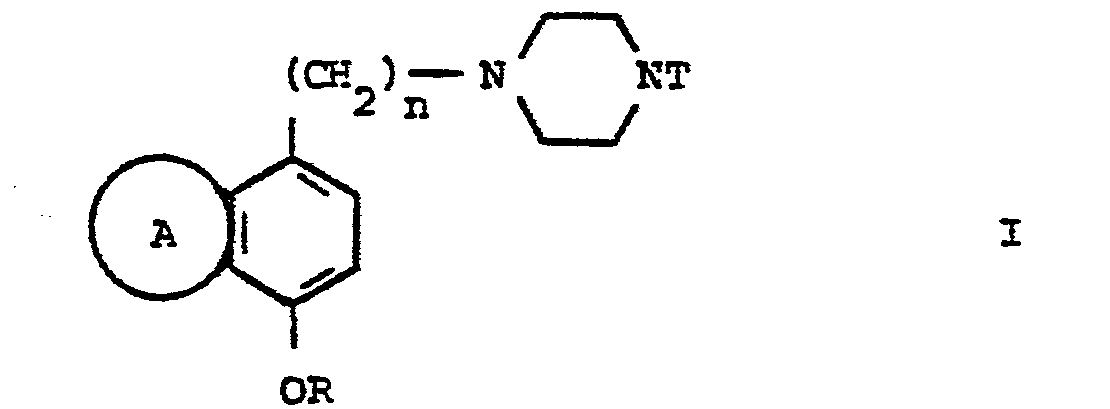
- Elle concerne particulièrement les dérivés de la quinoléine de formule générale I :


- R' représente un atome d'hydrogène ou un radical méthyle ;
- R et R", identiques ou différents représentent chacun :
- un atome d'hydrogène,
- un radical alcoyle ayant de 1 à 5 atomes de carbone,
- un radical acyle ayant de 1 à 5 atomes de carbone, comportant éventuellement des atomes d'halogène ou des groupes amino,
- un radical alkylsulfonyl renfermant de 1 à 3 atomes de carbone, ou
- un radical diéthylphosphonyl ;
- n est un nombre entier de 1 à 4 ;
- T est :
- - un radical phényle éventuellement mono- ou poly-substitué par un atome d'halogène, tel que par exemple un atome de chlore ou de fluor, un radical trifluorométhyle, un radical hydroxy, ou un radical alcoyle ou alcoxy ayant chacun de 1 à 5 atomes de carbone, ou
- - un radical hétérocyclique penta- ou hexagonal comportant un ou plusieurs atomes d'azote et de soufre et éventuellement mono- ou polysubstitué par un radical alcoyle ou alcoxy ayant chacun de 1 à 5 atomes de carbone.
- La présente invention a pour objet le procédé de préparation des dérivés de formule générale I' :

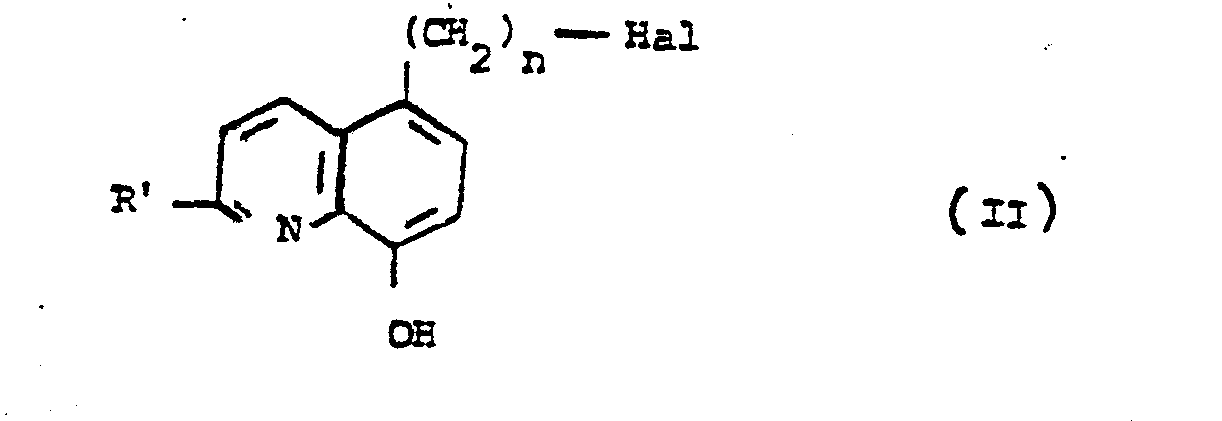
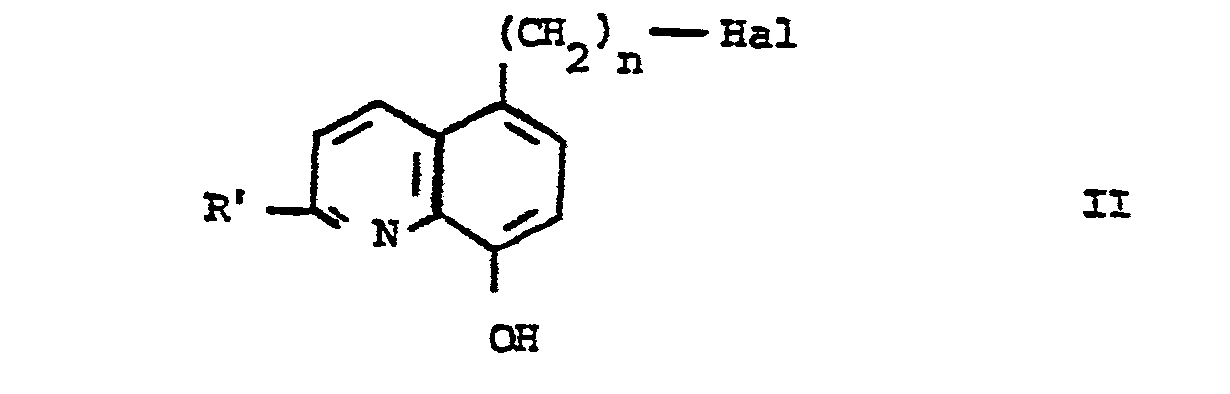
- - caractérisé en ce que l'on condense un dérivé halogéné de formule générale II :

- - puis l'on traite le dérivé ainsi obtenu de formule générale IV :

avec un dérivé de formule générale V :
- La condensation des dérivés (II) et (III) peut être effectuée dans un solvant polaire tel que par exemple un alcool ayant de 1 à 4 atomes de carbone, ou le diméthylformamide, à une température comprise entre 60 et 120°C, en présence d'un accepteur de l'hydracide formé au cours de la réaction. Comme accepteur, on peut utiliser par exemple la triéthylamine, la pyridine, les carbonates alcalins ou un excès de la pipérazine de formule III.
- Pour la transformation des composés (IV) en composés (I'), on peut employer différents réactifs RZ, selon la nature de R. Par exemple, les diéthylphosphates des dérivés (IV) peuvent être préparés par phosphatation des dérivés (IV) au moyen de (C2H5O)2-PH dans un solvant aprotique (C Cl4), à reflux, en présence de triéthylamine, selon une technique décrite dans J. Org. Chem. 42, (2), 345, (1977).
- Les esters des dérivés (IV) peuvent être préparés selon une méthode classique, à partir des chlorures d'acides correspondants dans la pyridine ou le tétrahydrofuranne en présence d'une base tertiaire (triéthylamine ou pyridine), à une température comprise entre 20 et 50°C.
- Les éthers des dérivés (IV) peuvent être préparés selon des méthodes classiques telles que alkylation des dérivés (IV) (à l'état de sel alcalin), au moyen d'iodure d'alkyle ou de sulfonate d'alkyle, dans un solvant polaire, comme par exemple un alcool à bas point d'ébullition ou la diméthylformamide, à une température comprise entre 60 et 90DC.
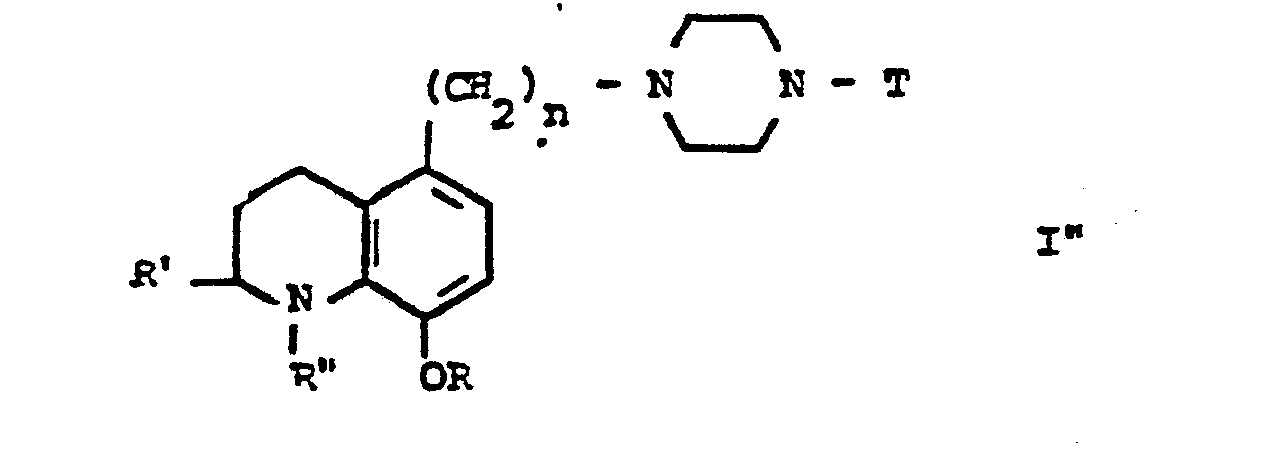
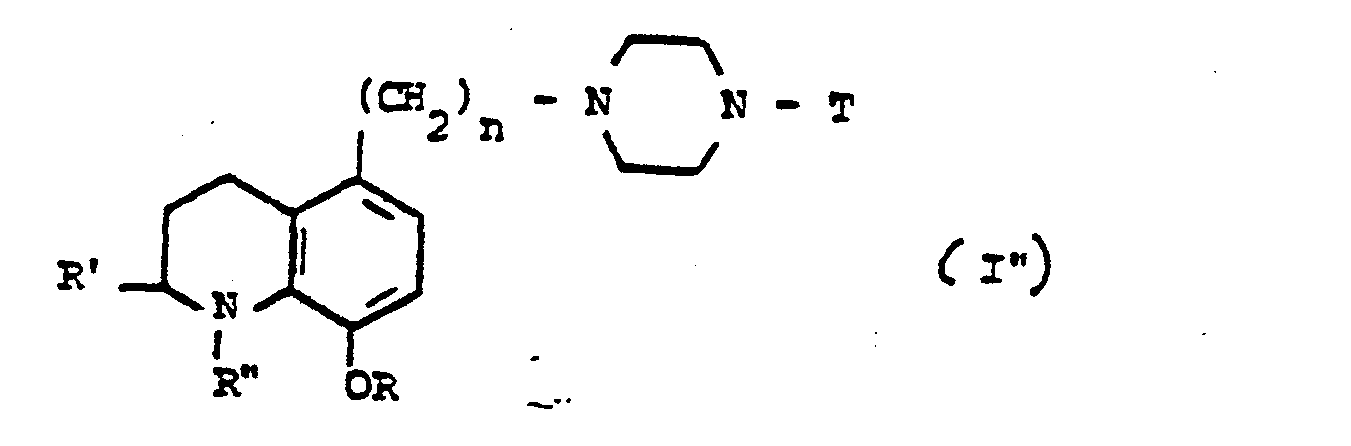
- La présente invention a aussi pour objet le procédé de préparation des dérivés de formule générale I" :
- - caractérisé en ce que :
- l'on réduit le dérivé précédemment préparé de formule générale I' :


- l'on réduit le dérivé précédemment préparé de formule générale I' :
- Le passage du dérivé I' en dérivé II' peut être effectué par réduction à l'hydrogène en présence d'un catalyseur du 8ème groupe tel que nickel ou paladium sur charbon, dans un solvant polaire tel qu'un alcool à bas point d'ébullition, sous une pression de 3.10 à 11.10 Pa, à une température comprise entre 50 et 80°C.
- Les dérivés de formule I" dans laquelle la signification de R" est limitée à un radical acyle éventuellement substitué peuvent être préparés par une méthode classique analogue à celle décrite précédemment dans le procédé de préparation des dérivés I', à partir d'un halogénure d'acyle dans la pyridine ou dans le tétrahydrofuranne, en présence de triéthylamine à une température comprise entre 20 et 60°C.
- Les dérivés de formule I" dans laquelle la signification de R" est limitée à un radical alcoyle, peuvent être préparés, selon des méthodes connues, par alcoylation des dérivés II' au moyen d'un iodure ou d'un sulfonate d'alcoyle dans un solvant polaire (alcool, diméthylformamide) à une température comprise entre 10 et 25°C, éventuellement en présence d'un accepteur de l'hydracide formé (triéthylamine par exemple), ou par des méthodes mettant en jeu une réduction alcoylante (HCHO - HCOOH, ou RCHO - H2/Pt ou Pd/C, ou NaBH3OOCR - RCOOH) ou par réduction des amides correspondantes au moyen de AlLiH4.
- L'ensemble des dérivés de formule générale I' et I" forme l'ensemble des dérivés de formule générale I.
- Les matières premières de formule générale II ont été préparées selon le schéma opératoire suivant, à partir des nitriles de formule (a), eux-mêmes préparés selon la méthode de V. Warner et coll., J. Med. Chem. 9,167-169(1976).

- Tous les dérivés peuvent se regrouper sous la formule générale


- Les pipérazines N-monosubstitués (III) de départ sont des produits connus.
- Les nouveaux dérivés de formule générale I peuvent être transformés en sels d'addition avec les acides, sels qui font, à ce titre, partie de l'invention. Comme acides utilisables pour la formation de ces sels, on peut citer, par exemple, dans la série minérale : les acides chlorhydrique, bromhydrique, sulfurique, phosphorique, et dans la série organique : les acides acétique, propionique, maléique, fumarique, tartrique, citrique, oxalique, benzoïque, méthane sulfonique et iséthionique.
- Les dérivés de formule générale 1 possèdent des propriétés pharmacologiques et thérapeutiques intéressantes. Ils s'opposent d'une part, aux manifestations pathologiques liées à l'accident ischémique et d'autre part aux symptômes qui accompagnent le vieillisement, notamment cérébral. Ces propriétés s'exercent de manière plus intense que celles des composés antiischémiques pris comme référence dont l'activité est reconnue depuis longtemps.
- Les composés de formule générale I sont testés par leur capacité à prolonger la survie de souris soumises à un syndrome ischémique global aigu par injection intraveineuse de chlorure de magnésium. Ainsi lorsqu'ils.sont administrés par voie intrapéritonéale, ces composés sont capables de prolonger significativement la survie des souris ischémiées dès la dose de 1 mg/kg comme c'est le cas par exemple pour les dérivés des exemples 30, 38, 40 et 54 décrits ci-après. Administrés per os, ils exercent de façon comparable le même effet protecteur, ce qui n'est pas le cas des substances de référence, notamment de la dihydroergotoxine qui s'avère inactive jusqu'à 10 mg/kg per os, ni de la vincamine et de l'extrait de Ginkgo biloba qui n'exercent aucun effet aux doses inférieures à 100 mg/kg per os.
- De la même façon, les composés de formule générale I présentent un effet protecteur chez la souris lors d'un syndrome hypoxique global aigu par inhalation d'azote pur. Cette action bénéfique s'exerce aux mêmes doses que lors du test précédent. Un même rapport de dose efficace est trouvé avec les substances de référence.
- La dose efficace moyenne (DE50) augmentant le temps de survie de 50 % par rapport aux animaux témoins est d'environ de 3 mg/kg lorsque ces composés sont administrés par voie intrapéritoniale ou par voie per os notamment avec les dérivés des exemples 38, 40, 51 et 54 décrits ci-après.
- Sur ce test, l'index thérapeutique évalué par le rapport DL50/DE50 est très en faveur des composés de formule générale I puisqu'il est 30 fois supérieur à celui des composés de référence -vincamine, nicergoline, eburnamonine, pour la voie intrapéritonéale et plus de 5 fois supérieur pour la voie orale.
- L'activité protectrice vis à vis des pertes de l'électrogénèse corticale liées au syndrome ischémique ou hypoxique est évaluée par le test d'anoxies itératives chez le rat. Cette épreuve est modifiée par rapport à sa description initiale pour la rendre plus sévère donc plus sélective. Après la seconde anoxie, alors que les animaux témoins ne récupéreront plus leur activité électrocorticale, les animaux traités par les composés, notamment les dérivés décrits dans les exemples 30, 37, 38, 40 et 54, la restaurent lorsqu'ils ont reçu par perfusion I.V. 33 micro g/kg de ceux-ci. Les substances de référence ne la restaurent que plus tardivement, à la 120ème seconde pour la Eburnamonine ou la nicergoline. Seule la dihydroergotoxine présente, puisque administrée par voie intraveineuse, une activité comparable.
- Les composés de formule générale I ont été testés pour leurs éventuelles propriétés métaboliques cérébrales vis à vis d'un syndrome ischémique par hypoperfusion de 1 heure donc d'une sévérité extrême, ou vis à vis d'une imprégnation oedémateuse engendrée par le triéthyl étain per os.
- Dans les deux cas, les composés exercent des activités de protection et de relance des fonctions métaboliques, puisqu'ils s'opposent totalement, ou en grande partie, à l'apparition de l'oedème. Par exemple, les dérivés des exemples 30, 37, 51 et 54 ci-après décrits, administrés chroniquement durant 4 jours à raison de 10 mg/kg , 2 fois par jour par voie intrapéritonéale, ramènent le pourcentage d'eau contenue dans le cerveau près de ou a la normale. Cette activité protectrice n'a la même intensité pour les substances de référence qu'à" des doses supérieures, 5 fois plus pour la vincamine, 3 fois plus pour la nicergoline ou l'extrait de Ginkgo biloba, réputés comme puissants agents anti-oedémateux cérébraux.
- Ces mêmes composés exercent leur action pharmacologique vis à vis des pertes de capacité de phosphorylation oxydative des mitochondries du cortex cérébral obtenues après un syndrome ischémique chez le rat. Ils restaurent la consommation d'oxygène de la mitochondrie stimulée par l'ADP lorsque le rat ischémié a reçu en perfusion intraveineuse 0,1 mg/kg de composé I, notamment des dérivés des exemples 30, 38 et 54 décrits ci-après. La même activité n'est obtenue pour les produits de référence qu'avec la déhydroergotoxine.
- Les composés de formule générale I sont donc utilisables en traitement oral ou parentéral chez l'homme dans les cas de syndrome ischémique de toute localisation aigü, transitoire ou progressif puisqu'ils exercent leurs propriétés pharmacologiques vis à vis des nombreuses manifestations pathologiques qui accompagnent des accidents. Plus généralement, ils sont utiles dans la correction des désordres liés à l'hypoxémie et à l'insuffisance métabolique énergétique, par exemple lors du vieillissement cérébral.
- La présente invention a également pour objet les compositions pharmaceutiques contenant comme principe actif un dérivé de formule générale I mélangé ou associé à un excipient pharmaceutiquement approprié. Ces compositions sont présentées sous diverses formes telles que comprimés, dragées, gélules ou préparations pour administration sublinguale, injectable ou buvable.
- Le dosage unitaire peut être de 1 à 30 mg pour un traitement de 1 à 3 prises par jour.
- Les exemples suivants, donnés à titre non-limitatif, illustrent l'invention. Les points de fusion, sauf mention contraire, ont été déterminés à la platine chauffante de Kofler.
-

- On chauffe pendant 24 heures à reflux un mélange de 50,4 g de bromoéthyl-5 hydroxy-8 quinoléine, fondant à 116°C et de 80,6 g d'O.méthoxyphényl pipérazine dans 1 1 d'éthanol. Au bout de ce temps, on essore les cristaux formés, lave avec un peu d'éthanol et reprend le produit cristallisé avec 600 ml de Na2CO3 à 10 % en agitant pendant 3 heures. Ensuite, le produit est essoré, lavé à l'eau et séché sous vide, on obtient 63,5 g de {[méthoxy-2 phényl)-4 pipérazinyl] -2 éthyl} -5 hydroxy-8 quinoléine sous forme de cristaux beiges fondant (capillaire) à 170°C.
- Les dérivés suivants ont été préparés selon la méthode décrite dans l'exemple 1.
- 2) méthyl-2 {[(méthoxy-2 phényl)-4 pipérazinyl]-2 éthyl}-5 hydroxy-8 quinoléine, P.F. : 113°C (cyclohexane).
- 3) {[(thiazol-1,3 yl-2)-4 piperazinyl] -2 éthyl} -5 hydroxy-8 quinoléine, P.F. : 158°C (éthanol/eau).
- 4) [(méthoxy-2 phényl)-4 pipérazinyl méthyl] -5 hydroxy-8 quinoléine, P.F. (capillaire) du dichlorhydrate correspondant : 205-215°C, avec décomposition , (isopropanol).
- 5) {[(méthoxy-2 phényl)-4 pipérazinyl] -3 propyl} -5 hydroxy-8 quinoléine, P.F. (capillaire) du dichlorhydrate correspondant : 252-254°C (isopropanol/méthanol).
- 6) [(phényl-4 pipérazinyl)-2 éthyl] -5 hydroxy-8 quinoléine, P.F. : 186°C (eau).
- 7) {[(pyridyl-2 )-4 pipérazinyl] -2 éthyl} -5 hydroxy-8 quinoléine, P.F. : 147°C (eau).
- 8) {[(pyridyl-4)-4 pipérazinyl] -2 éthyl} -5 hydroxy-8 quinoléine, P.F. (capillaire) du trichlorhydrate : 246-252°C (méthanol).
- 9) {[(méthoxy-6 pyridyl-2)-4 pipérazinyl] -2 éthyl} -5 hydroxy-8 quinoléine, P.F. : 138°C (isopropanol).
- 10) { [(méthyl-2 phényl)-4 pipérazinyl] -2 éthyl} -5 hydroxy-8 quinoléine, P.F. : 144°C (n.propanol).
- 11) {[(chloro-3 phényl)-4 pipérazinyl ] -2 éthyl} -5 hydroxy-8 quinoléine, P.F. : 136°C (n.propanol).
- 12) {[ (trifluoroméhtyl-3 phényl)-4 pipérazinyl]-2 éthyl}-5 hydroxy-8 quinoléine, P.F. : 139°C (n.propanol).
- 13) { [(fluoro-4 phényl)-4 pipérazinyl] -2 éthyl} -5 hydroxy-8 quinoléine, P.F. : 170°C (éthanol).
- 14) {[ (pyrimidinyl-2 )-4 pipérazinyl] -2 éthyl} -5 hydroxy-8 quinoléine, P.F. : 179°C (eau).
- 15) {[(thiadiazol-1,3,4 yl-2)-4 pipérazinyl] -2 éthyl}-5 hydroxy-8 quinoléine, P.F. (capillaire) : 183-184°C (eau).
- 16) {[(méthyl-3 thiadiazol-1,2,4 yl-5)-4 pipérazinyl] -2 éthyl}-5 hydroxy-8 quinoléine, P.F. (capillaire) : 204-214°C (isopropanol/eau).
- 17) {[(thiadiazol-1,2,4 yl-5)-4 pipérazinyl] -2 éthyl}-5 hydroxy-8 quinoléine, P.F. : 190°C (éthanol).
- 18) {[(méthoxy-4 phényl)-4 pipérazinyl ] -2 éthyl} -5 hydroxy-8 quinoléine, P.F. : 177°C (eau).
- 19) {[(méthoxy-3 phényl)-4 pipérazinyl] -2 éthyl} -5 hydroxy-8 quinoléine, P.F. : 136°C (eau).
- 20) méthyl-2 {[(pyridyl-2)-4 pipérazinyl] -2 éthyl} -5 hydroxy-8 quinoléine, P.F. : 136°C (éthanol).
-

- On chauffe, pendant 1 heure à 80°C, une solution de 56,4 g de {[(méthoxy-2 phenyl)-4 pipérazinyl] -2 éthyl}-5 hydroxy-8 quinoléine, dans 540 ml de diméthylformamide anhydre avec 3,72 g d'hydrure de sodium à 50 % dans l'huile. Ensuite, on ajoute 30,3 g de p.toluène sulfonate de méthyle et on chauffe le mélange 3 heures à 90°C. Au bout.de ce temps, on évapore le diméthylformamide sous pression réduite et reprend le résidu avec 500 ml d'eau et 500 ml de chloroforme. On lave plusieurs fois à l'eau la solution chloroformique et évapore le chloroforme sous pression réduite. Le résidu huileux pesant 58 g est purifié par chromatoflash sur 2,2 g de silice (230-240 mesh) en éluant avec le mélange CH2Cl2/CH3OH ; 95/5). On obtient 46 g de {[(méthoxy-2 phényl)-4 pipérazinyl J -2 éthyl} -5 méthoxy-8 quinoléine, sous forme de produit huileux, dont le fumarate fond (capillaire) à 168°C (éthanol).
- Les produits suivants ont été préparés selon la méthode décrite dans l'exemple 21 :
- 22) {[(pyridyl-2)-4 pipérazinyl] -2 éthyl} -5 méthoxy-8 quinoléine, P.F. : 94°C (chlorure de méthylène).
- 23) méthyl-1 {[(pyridyl-2)-4 pipérazinyl] -2 éthyl]- 5 méthoxy-8 tétrahydro-1,2,3,4 quinoléine, P.F. : 116°C (acétate d'éthyle).
- 24) méthyl-1 {[(méthoxy-2 phényl)-4 pipérazinyl] -2 éthyl}-5 méthoxy-8 tétrahydro-1,2,3,4 quinoléine, P.F. : 94°C (acétate d'éthyle).
- D'autre part, en opérant comme dans l'exemple 21 mais en remplaçant le p.toluène sulfonate de méthyle par le p.toluène sulfonate d'éthyle, on obtient de la même façon les dérivés éthoxy-8.
-

- On laisse agiter pendant 48 heures à température ambiante un mélange de 7,27 g de {[(méthoxy-2 phényl)-4 pipérazinyl] -2 éthyl} -5 hydroxy-8 quinoléine dans 150 ml de tétrahydrofuranne anhydre en présence de 3,1 ml de triéthylamine et 5 ml de chlorure de pivaloyle. Après évaporation du tétrahydrofuranne, on reprend le résidu par le chloroforme et lave avec une solution à 10 % de Na HCO3. Après évaporation du chloroforme, on obtient un résidu cristallin que l'on recristallise dans 80 ml d'isopropanol. On obtient finalement 6,45 g de cristaux de {[(méthoxy-2 phényl)-4 pipérazinyl] -2 éthyl} -5 pivaloyloxy-8 quinoléine, fondant à 115°C.
- De la même façon a été préparé le dérivé objet de l'exemple suivant :
- diéthylphosphate d'hydroxy-8 {[(méthoxy-2 phényl)-4 pipérazinyl] -2 éthyl} -5 quinoléine.

- A une solution de 14,5 g de {[méthoxy-2 phényl)-4 pipérazinyl]-2 éthyl} -5 hydroxy-8 quinoléine dans 320 ml de tétrachlorure de carbone à 55°C, on ajoute 5,85 ml de àiéthylphosphate fraichement distillé et 6,28 ml de triéthylamine. Après 22 heures de reflux, on filtre l'insoluble et évapore le solvant sous pression réduite. On reprend le résidu dans 200 ml de cyclohexane à reflux, filtre l'insoluble gommmeux et observe une cristallisation par refroidissement. On obtient 18 g de cristaux de diéthylphosphate d'hydroxy-8 {(méthoxy-2 phényl)-4 pipérazinyl] -2 éthyl} -5 quinoléine, fondant (capillaire) à 88-890C (cyclohexane).
- Selon la même méthode a été préparé le dérivé objet de l'exemple suivant :
- Diéthylphosphate d'hydroxy-8{[(pyridyl-2)-4 pipérazinyl]-2 éthyl}-5 quinoléine, P.F. : 70°C (chlorure de méthylène).
-

- Les dérivés suivants ont été préparés selon la méthode décrite dans l'exemple 29 :
- 30) [(méthoxy-2 phényl)-4 pipérazinyl] -2 éthyl} -5 méthylsulfonyloxy-8 tétrahydro-1,2,3,4 quinoléine, P.F. (capillaire) du fumarate correspondant : 184-186°C (éthanol).
- 31) [ (phényl-4 pipérazinyl)-2 éthyl] -5 hydroxy-8 tétrahydro-1,2,3,4 quinoléine, P.F. : 184°C (isopropanol).
- 32) { [(pyridyl-2)-4 pipérazinyl] -2 éthyl} -5 hydroxy-8 tétrahydro-1,2,3,4 quinoléine, produit amorphe.
- 33) {[(méthoxy-2 phényl)-4 pipérazinyl] -2 éthyl} -5 méthoxy-8 tétrahydro-1,2,3,4 quinoléine, P.F. : 88°C (chlorure de méthylène).
- 34) { [(pyridyl-2)-4 pipérazinyl] -2 éthyl}-5 méthoxy-8 tétrahydro-1,2,3,4 quinoléine, P.F. : 109°C (acétate d'éthyle).
- 35) {[(trifluorométhyl-3 phényl}-4 piérazinyl]-2 éthyl}-5 méthylsulfonyloxy-8 tétrahydro-1,2,3,4 quinoléine, P.F. : 132°C (acétate d'éthyle).
- 36) { [(méthoxy-2 phényl)-4 pipérazinyl] -2 éthyl} -5 phénylsulfonyloxy-8 tétrahydro-1,2,3,4 quinoléine, P.F. (capillaire) du dichlorhydrate correspondant : 196-200°C (éthanol).
-

- A une solution de 7,34 g de {[méthoxy-2 phényl)-4 pipérazinyl]-2 éthyl -5 hydroxy-8 tétrahydro-1,2,3,4 quinoléine dans 140 ml de tétrahydrofuranne anhydre contenant 2,8 ml de triéthylamine, on ajoute, à 5°C, une solution de 1,45 ml de chlorure d'acétyle dans 20 ml de tétrahydrofuranne. On agite pendant 2 heures à 5°C puis 1 heure à température ambiante. Ensuite, on filtre l'insoluble et concentre à sec sous pression réduite. Le résidu est purifié par chromato flash sur 750 g de silice (70-230 mesh) en éluant avec le mélange CH2Cl3-CH3OH (95/5).
- On obtient finalement 5 g de cristaux de chlorhydrate d'acétyl-1{[(méthoxy-2 phényl)-4 pipérazinyl]-2 éthyl} -5 hydroxy-8 tétrahydro-1,2,3,4 quinoléine, fondant (capillaire) à 263-265°C.
- Les dérivés suivants ont été préparés selon la méthode décrite dans l'exemple 37 :
- 38) acétyl-1{[(pyridyl-2)-4 pipérazinyl]-2 éthyl} -5 hydroxy-8 tétrahydro-1,2,3,4 quinoléine, P.F. : 168°C (acétate d'éthyle).
- 39) acétyl-1{[(pyridyl-2)-4 pipérazinyl]-2 éthyl}-5 méthoxy-8 tétrahydro-1,2,3,4 quinoléine, P.F. :111°C (acétate d'éthyle).
- 40) acétyl-1 {[(méthoxy-2 phényl)-4 pipérazinyl] -2 éthyl} -5 méthoxy-8 tétrahydro-1,2,3,4 quinoléine, P.F. : 112°C (acétate d'éthyle).
- 41) acétyl-1 {[(pyridyl-2)-4 pipérazinyl] -2 éthyl} -5 acétoxy-8 tétrahydro-1,2,3,4 quinoléine, P.F. : 129°C (chlorure de méthylène)
- 42) {[méthoxy-2 phényl)-4 pipérazinyl] -2 éthyl}-5 dichloro-acétyloxy-8 tétrahydro-1,2,3,4 quinoléine.
- 43) { [(pyridyl-2)-4 pipérazinyll -2 éthyl} -5 dichloro-acétyloxy-8 tétrahydro-1,2,3,4 quinoléine.
- 44) acétyl-1 {(méthoxy-2 phényl)-4 pipérazinyl] -2 éthyl} -5 méthylsulfonyloxy-8 tétrahydro-1,2,3,4 quinoléine, P.F. (capillaire) du dichlorydrate correspondant : 189-197°C (isopropanol).
- 45) {[méthoxy-2 phényl)-4 pipérazinyl ] -2 éthyl} -5 méthoxy-8 tétrahydro-1,2,3,4 quinoléine, produit amorphe.
- 46) acétyl-1 {(pyridyl-2)-4 pipérazinyl] -2 éthyl} -5 méthylsulfonyloxy-8 tétrahydro-1,2,3,4 quinoléine, P.F. (capillaire) du dichlorhydrate correspondant : 199-201°C. (isopropanol/éther).
- 47) propionyl-1 {[(pyridyl-2)-4 pipérazinyl] -2 éthyl} -5 méthanesulfonyloxy-8 tétrahydro-1,2,3,4 quinoléine, P.F. (capillaire) du dichlorhydrate correspondant : 147-154°C (isopropanol/éther).
- 48) acétyl-1 {[(trifluorométhyl-3 phényl)-4 pipérazinyl ] -2 éthyl} -5 méthanesulfonyloxy-8 tétrahydro-1,2,3,4 quinoléine, P.F. (capillaire) du chlorhydrate correspondant : 118-123°C (isopropanol/éther).
- 49) acétyl-1 {[(méthoxy-2 phényl)-4 pipérazinyl] -2 éthyl}-5 acétoxy-8 tétrahydro-1,2,3,4 quinoléine, P.F. (capillaire) du dichlorhydrate correspondant : 249-252°C (avec décomposition) (isopropanol/éther).
- 50) acétyl-1 {[(méthoxy-2 phényl)-4 pipérazinyl ] -2 éthyl} - 5 benzènesulfonyloxy-8 tétrahydro-1,2,3,4 quinoléine, P.F. (capillaire) du dichlorhydrate correspondant : 165-168°C, (éthanol).
-
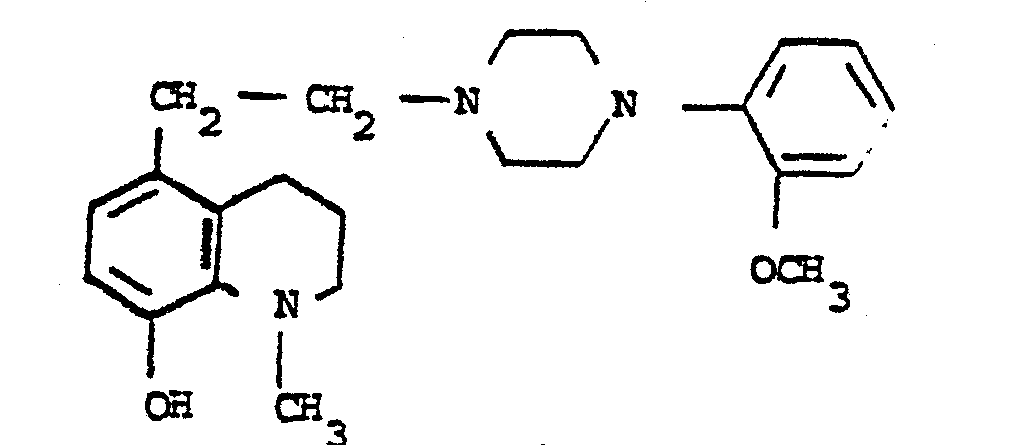
- A une solution de 7,35 g de {[(méthoxy-2 phényl)-4 pipérazinyl] -2 éthyl}-5 hydroxy-8 tétrahydro-1,2,3,4 quinoléine, dans 80 ml d'éthanol absolu, on ajoute à 5°C, 3,1 g d'iodure de méthyle dans 40 ml d'éthanol absolu. Au bout de 24 heures à température ambiante, on ajoute à nouveau 0,5 g d'iodure de méthyle et on maintient l'agitation pendant 24 heures. Ensuite, on concentre à sec sous pression réduite et reprend le résidu par une solution de NaHC03 à 10 % et du chloroforme. On décante et évapore à sec le chloroforme. Le résidu est purifié par chromato flash sur 700 g de silice en éluant avec un mélange CH2Cl2-CH3OH (95/5).
- On obtient 2,5 g de produit résineux pur dont on forme le dichlorhydrate au sein de l'isopropanol. On recueille finalement 2,3 g de cristaux blancs fondant (capillaire) à 168-175°C.
- De la même façon a été préparé le dérivé de l'exemple suivant :
-

- En opérant comme dans l'exemple 21, à partir de 3 g de méthyl-1{[(méthoxy-2 phényl)-4 pipérazinyl]-2 éthyl} -5 hydroxy- tétrahydro-1,2,3,4 quinoléine, on obtient 1,9 g de cristaux de méthyl-1 {(méthoxy--2 phényl)-4 pipérazinyl]-2 éthyl}-5-méthoxy-8 quinoléine, fondant (capillaire) à 94°C.
- En opérant de la même manière, on a également préparée la méthyl-1{[(pyridyl-2)-4 pipérazinyl]-2 éthyl} -5 méthoxy-8 tétrahydro-1,2,3,4 quinoléine déjà décrite dans l'exemple 23.
- La méthyl-1 {[(méthoxy-2 phényl)-4 pipérazinyl] -2 éthyl} -5 méthoxy-8 tétrahydro-1,2,3,4 quinoléine a également eté préparée par réduction au moyen de Li Al H4 dans le tétrahydrofuranne à ébullition de la formyl-1{[(méthoxy-2 phényl)-4 pipérazinyl] -2 éthyl} -5 méthoxy-8 tétrahydro-1,2,3,4 quinoléine, objet de l'exemple suivant :
- Formyl-1{[(méthoxy-2 phényl)-4 pipérazinyl] -2 éthyl) -5 méthoxy-8 tétrahydro-1,2,3,4 quinoléine, P.F. : 110°C (acétate d'éthyle). Ce dérivé a été préparé par formylation avec HCO OH à 98 % à l'ébullition de la {[ (méthoxy-2 phényl)-4 pipérazinyl] -2 éthyl}-5 méthoxy-8 tétrahydro-1,2,3,4 quinoléine, P.F. : 88°C.
- En opérant comme dans l'exemple 53 b), à partir des acétyl-1{[(pyridyl-2)-4 pipérazinyl] -2 éthyl} -5 méthoxy-8 tétrahydro-1,2,3,4 quinoléine, et acétyl-1 {[(méthoxy-2 phényl)-4 pipérazinyl] -2 éthyl} -5 méthoxy-8 tétrahydro-1,2,3,4 quinoléine, on obtient respectivement les dérivés suivants :
- 55) éthyl-1 {[(pyridyl-2)-4 pipérazinyl] -2 éthyl} -5 méthoxy-8 tétrahydro-1,2,3,4 quinoléine.
- 56) éthyl-1{[(méthoxy-2 phényl)-4 pipérazinyl] -2 éthyl -5 méthoxy-8 tétrahydro-1,2,3,4 quinoléine.
Claims (19)





T est :
caractérisé en ce que :






et si on le désire, on traite les dérivés (I') et (I") ainsi obtenus, avec des acides appropriés pour donner les sels d'addition correspondants.
Priority Applications (1)
| Application Number | Priority Date | Filing Date | Title |
|---|---|---|---|
| AT85400004T ATE43583T1 (de) | 1984-01-04 | 1985-01-04 | Quinolinderivate, verfahren zu ihrer herstellung und sie enthaltende pharmazeutische mittel. |
Applications Claiming Priority (2)
| Application Number | Priority Date | Filing Date | Title |
|---|---|---|---|
| FR8400058A FR2557570B1 (fr) | 1984-01-04 | 1984-01-04 | Nouveaux derives de la quinoleine, leur procede de preparation et les compositions pharmaceutiques les renfermant |
| FR8400058 | 1984-01-04 |
Publications (3)
| Publication Number | Publication Date |
|---|---|
| EP0148167A2 true EP0148167A2 (fr) | 1985-07-10 |
| EP0148167A3 EP0148167A3 (en) | 1985-08-28 |
| EP0148167B1 EP0148167B1 (fr) | 1989-05-31 |
Family
ID=9299814
Family Applications (1)
| Application Number | Title | Priority Date | Filing Date |
|---|---|---|---|
| EP85400004A Expired EP0148167B1 (fr) | 1984-01-04 | 1985-01-04 | Nouveaux dérivés de la quinoléine, leur procédé de préparation et les compositions pharmaceutiques les renfermant |
Country Status (15)
| Country | Link |
|---|---|
| US (1) | US4629728A (fr) |
| EP (1) | EP0148167B1 (fr) |
| JP (1) | JPS60248673A (fr) |
| AT (1) | ATE43583T1 (fr) |
| AU (1) | AU569208B2 (fr) |
| CA (1) | CA1228359A (fr) |
| DE (1) | DE3570658D1 (fr) |
| ES (1) | ES8605796A1 (fr) |
| FR (1) | FR2557570B1 (fr) |
| GR (1) | GR850033B (fr) |
| IE (1) | IE57934B1 (fr) |
| NZ (1) | NZ210762A (fr) |
| OA (1) | OA07926A (fr) |
| PT (1) | PT79795B (fr) |
| ZA (1) | ZA8594B (fr) |
Cited By (2)
| Publication number | Priority date | Publication date | Assignee | Title |
|---|---|---|---|---|
| EP0383504A3 (fr) * | 1989-02-13 | 1991-04-10 | Eli Lilly And Company | Dérivés de décahydroisoquinolène, procédé pour leur préparation et leur utilisation comme médicaments |
| WO1993011761A1 (fr) * | 1991-12-18 | 1993-06-24 | H. Lundbeck A/S | Aryltriflates et composes associes |
Families Citing this family (10)
| Publication number | Priority date | Publication date | Assignee | Title |
|---|---|---|---|---|
| US5116827A (en) * | 1986-10-23 | 1992-05-26 | American Cyanamid Company | Quinolinecarboxylic acid derivatives as solubilized pro-drugs |
| IL115420A0 (en) | 1994-09-26 | 1995-12-31 | Zeneca Ltd | Aminoheterocyclic derivatives |
| US6313127B1 (en) * | 1996-02-02 | 2001-11-06 | Zeneca Limited | Heterocyclic compounds useful as pharmaceutical agents |
| GB9602166D0 (en) * | 1996-02-02 | 1996-04-03 | Zeneca Ltd | Aminoheterocyclic derivatives |
| UA56197C2 (uk) * | 1996-11-08 | 2003-05-15 | Зенека Лімітед | Гетероциклічні похідні |
| JP2001511799A (ja) | 1997-02-13 | 2001-08-14 | ゼネカ・リミテッド | オキシド−スクアレンシクラーゼ阻害剤として有用なヘテロ環式化合物 |
| WO1998035956A1 (fr) | 1997-02-13 | 1998-08-20 | Zeneca Limited | Composes heterocycliques utilises comme inhibiteurs de l'oxydo-squalene cyclase |
| GB9715895D0 (en) | 1997-07-29 | 1997-10-01 | Zeneca Ltd | Heterocyclic compounds |
| GB9902989D0 (en) | 1999-02-11 | 1999-03-31 | Zeneca Ltd | Heterocyclic derivatives |
| WO2013115793A1 (fr) * | 2012-01-31 | 2013-08-08 | Varinel, Inc. | Agents chélatants du fer et utilisations de ceux-ci |
Family Cites Families (8)
| Publication number | Priority date | Publication date | Assignee | Title |
|---|---|---|---|---|
| NL148312B (nl) * | 1965-03-10 | 1976-01-15 | Pfizer | Werkwijze voor het bereiden van een geneesmiddel dat een of een aantal 1-chinolyl-2-alkylaminoethanolderivaten en/of de zuuradditiezouten daarvan bevat en de onder toepassing van deze werkwijze verkregen gevormde geneesmiddelen, alsmede werkwijze voor het bereiden van deze geneeskrachtige derivaten en de zuuradditiezouten daarvan. |
| US3362956A (en) * | 1965-08-19 | 1968-01-09 | Sterling Drug Inc | 1-[(heterocyclyl)-lower-alkyl]-4-substituted-piperazines |
| GB1369379A (en) * | 1972-04-07 | 1974-10-09 | Science Union & Cie | Benzodioxole derivatives and processes for preparing them |
| DE2818423A1 (de) * | 1978-04-27 | 1979-11-08 | Hoechst Ag | Neue isochinolinderivate und verfahren zu ihrer herstellung |
| DE3034001A1 (de) * | 1980-09-10 | 1982-04-22 | Hoechst Ag, 6000 Frankfurt | Isochinolinderivate, verfahren zu ihrer hersellung, sie enthaltende pharmazeutische zubereitungen und ihre verwendung |
| HU190796B (en) * | 1981-06-12 | 1986-11-28 | Roussel Uclaf,Fr | Process for producing n-dihydrothiazolyl-3-quinoline-carboxamide derivatives |
| AU532361B2 (en) * | 1981-09-01 | 1983-09-29 | Otsuka Pharmaceutical Co., Ltd. | Carbostyril derivatives |
| FR2519986A1 (fr) * | 1982-01-21 | 1983-07-22 | Adir | Nouveaux derives de benzodioxine, leurs procedes de preparation et les compositions pharmaceutiques les renfermant |
-
1984
- 1984-01-04 FR FR8400058A patent/FR2557570B1/fr not_active Expired
- 1984-12-26 US US06/686,247 patent/US4629728A/en not_active Expired - Fee Related
-
1985
- 1985-01-03 AU AU37347/85A patent/AU569208B2/en not_active Ceased
- 1985-01-03 CA CA000471438A patent/CA1228359A/fr not_active Expired
- 1985-01-03 PT PT79795A patent/PT79795B/fr unknown
- 1985-01-03 GR GR850033A patent/GR850033B/el unknown
- 1985-01-04 JP JP60000080A patent/JPS60248673A/ja active Granted
- 1985-01-04 DE DE8585400004T patent/DE3570658D1/de not_active Expired
- 1985-01-04 ES ES539373A patent/ES8605796A1/es not_active Expired
- 1985-01-04 ZA ZA8594A patent/ZA8594B/xx unknown
- 1985-01-04 AT AT85400004T patent/ATE43583T1/de active
- 1985-01-04 NZ NZ210762A patent/NZ210762A/en unknown
- 1985-01-04 EP EP85400004A patent/EP0148167B1/fr not_active Expired
- 1985-01-04 IE IE21/85A patent/IE57934B1/en not_active IP Right Cessation
- 1985-01-04 OA OA58499A patent/OA07926A/fr unknown
Cited By (2)
| Publication number | Priority date | Publication date | Assignee | Title |
|---|---|---|---|---|
| EP0383504A3 (fr) * | 1989-02-13 | 1991-04-10 | Eli Lilly And Company | Dérivés de décahydroisoquinolène, procédé pour leur préparation et leur utilisation comme médicaments |
| WO1993011761A1 (fr) * | 1991-12-18 | 1993-06-24 | H. Lundbeck A/S | Aryltriflates et composes associes |
Also Published As
| Publication number | Publication date |
|---|---|
| ES539373A0 (es) | 1986-04-01 |
| IE57934B1 (en) | 1993-05-19 |
| OA07926A (fr) | 1987-01-31 |
| IE850021L (en) | 1985-07-04 |
| NZ210762A (en) | 1988-02-29 |
| DE3570658D1 (en) | 1989-07-06 |
| JPH0344069B2 (fr) | 1991-07-04 |
| ATE43583T1 (de) | 1989-06-15 |
| CA1228359A (fr) | 1987-10-20 |
| AU569208B2 (en) | 1988-01-21 |
| EP0148167A3 (en) | 1985-08-28 |
| PT79795B (fr) | 1987-01-07 |
| AU3734785A (en) | 1985-07-18 |
| FR2557570A1 (fr) | 1985-07-05 |
| JPS60248673A (ja) | 1985-12-09 |
| FR2557570B1 (fr) | 1986-04-18 |
| US4629728A (en) | 1986-12-16 |
| ES8605796A1 (es) | 1986-04-01 |
| GR850033B (fr) | 1985-05-03 |
| ZA8594B (en) | 1985-08-28 |
| EP0148167B1 (fr) | 1989-05-31 |
| PT79795A (fr) | 1985-02-01 |
Similar Documents
| Publication | Publication Date | Title |
|---|---|---|
| EP0202164B1 (fr) | Dérivés de (benzoyl-4 pipéridino)-2 phenyl-1 alcanols, leur préparation et leur application en thérapeutique | |
| EP0103497B1 (fr) | Nouveaux dérivés de la xanthine, leur procédé de préparation et les compositions pharmaceutiques les renfermant | |
| EP0399856B1 (fr) | Pteridin-4 (3H)-ones, procédés de préparation et médicaments les contenant | |
| CH651561A5 (fr) | Derives des nor-tropane et granatane et leur procede de preparation. | |
| EP0042781B1 (fr) | Nouveaux dérivés de (quinolyl-4)-1 (pipéridyl ou pyrrolidinyl-2 ou -3)-2 ou -3 éthanone ou propanone, procédés pour leur préparation, et leur utilisation comme médicaments | |
| FR2476088A2 (fr) | Nouveaux derives du nor-tropane, leur procede de preparation et leur application en therapeutique | |
| EP0296975A1 (fr) | Dérivés du diméthyl-2,2 chromannol-3, procédé d'obtention et compositions pharmaceutiques les contenant | |
| EP0148167B1 (fr) | Nouveaux dérivés de la quinoléine, leur procédé de préparation et les compositions pharmaceutiques les renfermant | |
| EP0538080A1 (fr) | Dérivés de l'aminométhyl-4 pipéridine, leur préparation et leur application en thérapeutique | |
| EP0343050B1 (fr) | Dérivés de phényl-6 pipérazinyl-alkyl-3 1H,3H-pyrimidinedione-2,4, leur préparation et leur application en thérapeutique | |
| FR2548666A1 (fr) | Nouveaux derives du nor-tropane et du granatane, leur procede de preparation et leur application en therapeutique | |
| EP0351255B1 (fr) | Dérivés de [(pipéridinyl-4)méthyl]-2 tétrahydro-1,2,3,4 isoquinoléine, leur préparation et leur application en thérapeutique | |
| EP0008249A2 (fr) | Dérivés de fluorènes et fluoranthènes, leur procédé de préparation et leur application en thérapeutique | |
| EP0527081A1 (fr) | Nouvelles pipérazinylalcoyl-3 dihydro-2,3 4H-benzoxazine-1,3 ones-4 substituées, leur préparation et leur application en thérapeutique | |
| EP0031753A1 (fr) | Nouveaux dérivés de la (pipéridyl-4)-2 (quinolyl-4)-1 éthanone, produits intermédiaires et procédés pour leur préparation, et leur utilisation comme médicaments | |
| FR2632639A1 (fr) | Derives d'amino-4 carboxy-3 naphtyridines, leur preparation et compositions pharmaceutiques qui les contiennent | |
| EP0556872A1 (fr) | Utilisation de dérivés du diméthyl-2,2 chromène dans le traitement de l'asthme | |
| EP0709383A1 (fr) | Dérivés de la diosmétine, leur procédé de préparation et les compositions pharmaceutiques les contenant | |
| EP0412899A2 (fr) | Dérivés d'oxazolo pyridines, leur procédé de préparation et les compositions pharmaceutiques qui les contiennent | |
| EP0099303A2 (fr) | Nouvelles benzothiopyranopyridinones et leurs sels, leur préparation, leur application comme médicaments et les compositions les renfermant | |
| FR2551063A1 (fr) | Nouveaux dimethyl-2,5 pyrroles, leur procede de preparation et leur application en therapeutique | |
| FR2547822A1 (fr) | Acylpiperazinoquinazolines substituees utiles comme medicaments et procede pour leur preparation | |
| EP0433167B1 (fr) | Nouveaux dérivés de la pipéridine, leur procédé de préparation et les compositions pharmaceutiques les renfermant | |
| FR2565586A1 (fr) | Derives de la naphtoxazine, leur preparation, leur application comme medicaments et compositions pharmaceutiques les contenant | |
| EP0351283A1 (fr) | Dérivés de [(pipéridinyl-4) méthyl]-2 dihydro-2,3 1H-isoindole et tétrahydro-2,3,4,5 1H-benzazépines, leur préparation et leur application en thérapeutique |
Legal Events
| Date | Code | Title | Description |
|---|---|---|---|
| PUAI | Public reference made under article 153(3) epc to a published international application that has entered the european phase |
Free format text: ORIGINAL CODE: 0009012 |
|
| PUAL | Search report despatched |
Free format text: ORIGINAL CODE: 0009013 |
|
| 17P | Request for examination filed |
Effective date: 19850109 |
|
| AK | Designated contracting states |
Designated state(s): AT BE CH DE FR GB IT LI LU NL SE |
|
| AK | Designated contracting states |
Designated state(s): AT BE CH DE FR GB IT LI LU NL SE |
|
| 17Q | First examination report despatched |
Effective date: 19861017 |
|
| D17Q | First examination report despatched (deleted) | ||
| GRAA | (expected) grant |
Free format text: ORIGINAL CODE: 0009210 |
|
| AK | Designated contracting states |
Kind code of ref document: B1 Designated state(s): AT BE CH DE FR GB IT LI LU NL SE |
|
| REF | Corresponds to: |
Ref document number: 43583 Country of ref document: AT Date of ref document: 19890615 Kind code of ref document: T |
|
| ITF | It: translation for a ep patent filed | ||
| REF | Corresponds to: |
Ref document number: 3570658 Country of ref document: DE Date of ref document: 19890706 |
|
| GBT | Gb: translation of ep patent filed (gb section 77(6)(a)/1977) | ||
| PLBE | No opposition filed within time limit |
Free format text: ORIGINAL CODE: 0009261 |
|
| STAA | Information on the status of an ep patent application or granted ep patent |
Free format text: STATUS: NO OPPOSITION FILED WITHIN TIME LIMIT |
|
| 26N | No opposition filed | ||
| EPTA | Lu: last paid annual fee | ||
| EAL | Se: european patent in force in sweden |
Ref document number: 85400004.9 |
|
| ITTA | It: last paid annual fee | ||
| PGFP | Annual fee paid to national office [announced via postgrant information from national office to epo] |
Ref country code: AT Payment date: 19961129 Year of fee payment: 13 |
|
| PGFP | Annual fee paid to national office [announced via postgrant information from national office to epo] |
Ref country code: LU Payment date: 19961201 Year of fee payment: 13 |
|
| PGFP | Annual fee paid to national office [announced via postgrant information from national office to epo] |
Ref country code: GB Payment date: 19961227 Year of fee payment: 13 |
|
| PGFP | Annual fee paid to national office [announced via postgrant information from national office to epo] |
Ref country code: CH Payment date: 19961230 Year of fee payment: 13 |
|
| PGFP | Annual fee paid to national office [announced via postgrant information from national office to epo] |
Ref country code: FR Payment date: 19970127 Year of fee payment: 13 |
|
| PGFP | Annual fee paid to national office [announced via postgrant information from national office to epo] |
Ref country code: NL Payment date: 19970128 Year of fee payment: 13 |
|
| PGFP | Annual fee paid to national office [announced via postgrant information from national office to epo] |
Ref country code: DE Payment date: 19970129 Year of fee payment: 13 |
|
| PGFP | Annual fee paid to national office [announced via postgrant information from national office to epo] |
Ref country code: BE Payment date: 19970203 Year of fee payment: 13 |
|
| PG25 | Lapsed in a contracting state [announced via postgrant information from national office to epo] |
Ref country code: LU Free format text: LAPSE BECAUSE OF NON-PAYMENT OF DUE FEES Effective date: 19980104 Ref country code: GB Free format text: LAPSE BECAUSE OF NON-PAYMENT OF DUE FEES Effective date: 19980104 Ref country code: AT Free format text: LAPSE BECAUSE OF NON-PAYMENT OF DUE FEES Effective date: 19980104 |
|
| PGFP | Annual fee paid to national office [announced via postgrant information from national office to epo] |
Ref country code: SE Payment date: 19980126 Year of fee payment: 14 |
|
| PG25 | Lapsed in a contracting state [announced via postgrant information from national office to epo] |
Ref country code: LI Free format text: LAPSE BECAUSE OF NON-PAYMENT OF DUE FEES Effective date: 19980131 Ref country code: FR Free format text: THE PATENT HAS BEEN ANNULLED BY A DECISION OF A NATIONAL AUTHORITY Effective date: 19980131 Ref country code: CH Free format text: LAPSE BECAUSE OF NON-PAYMENT OF DUE FEES Effective date: 19980131 Ref country code: BE Free format text: LAPSE BECAUSE OF NON-PAYMENT OF DUE FEES Effective date: 19980131 |
|
| BERE | Be: lapsed |
Owner name: ADIR Effective date: 19980131 |
|
| PG25 | Lapsed in a contracting state [announced via postgrant information from national office to epo] |
Ref country code: NL Free format text: LAPSE BECAUSE OF NON-PAYMENT OF DUE FEES Effective date: 19980801 |
|
| GBPC | Gb: european patent ceased through non-payment of renewal fee |
Effective date: 19980104 |
|
| REG | Reference to a national code |
Ref country code: CH Ref legal event code: PL |
|
| NLV4 | Nl: lapsed or anulled due to non-payment of the annual fee |
Effective date: 19980801 |
|
| PG25 | Lapsed in a contracting state [announced via postgrant information from national office to epo] |
Ref country code: DE Free format text: LAPSE BECAUSE OF NON-PAYMENT OF DUE FEES Effective date: 19981001 |
|
| REG | Reference to a national code |
Ref country code: FR Ref legal event code: ST |
|
| PG25 | Lapsed in a contracting state [announced via postgrant information from national office to epo] |
Ref country code: SE Free format text: LAPSE BECAUSE OF NON-PAYMENT OF DUE FEES Effective date: 19990105 |