EP0148385A2 - Dispositif et procédé pour sécher et stériliser des tissus - Google Patents
Dispositif et procédé pour sécher et stériliser des tissus Download PDFInfo
- Publication number
- EP0148385A2 EP0148385A2 EP84114221A EP84114221A EP0148385A2 EP 0148385 A2 EP0148385 A2 EP 0148385A2 EP 84114221 A EP84114221 A EP 84114221A EP 84114221 A EP84114221 A EP 84114221A EP 0148385 A2 EP0148385 A2 EP 0148385A2
- Authority
- EP
- European Patent Office
- Prior art keywords
- drying
- cabinet
- air
- rod
- drying cabinet
- Prior art date
- Legal status (The legal status is an assumption and is not a legal conclusion. Google has not performed a legal analysis and makes no representation as to the accuracy of the status listed.)
- Granted
Links
Images


Classifications
-
- A—HUMAN NECESSITIES
- A61—MEDICAL OR VETERINARY SCIENCE; HYGIENE
- A61L—METHODS OR APPARATUS FOR STERILISING MATERIALS OR OBJECTS IN GENERAL; DISINFECTION, STERILISATION OR DEODORISATION OF AIR; CHEMICAL ASPECTS OF BANDAGES, DRESSINGS, ABSORBENT PADS OR SURGICAL ARTICLES; MATERIALS FOR BANDAGES, DRESSINGS, ABSORBENT PADS OR SURGICAL ARTICLES
- A61L2/00—Disinfection or sterilisation of materials or objects, in general; Accessories therefor
- A61L2/16—Disinfection or sterilisation of materials or objects, in general; Accessories therefor using chemical substances
- A61L2/20—Gaseous substances, e.g. vapours
- A61L2/202—Ozone
-
- A—HUMAN NECESSITIES
- A61—MEDICAL OR VETERINARY SCIENCE; HYGIENE
- A61L—METHODS OR APPARATUS FOR STERILISING MATERIALS OR OBJECTS IN GENERAL; DISINFECTION, STERILISATION OR DEODORISATION OF AIR; CHEMICAL ASPECTS OF BANDAGES, DRESSINGS, ABSORBENT PADS OR SURGICAL ARTICLES; MATERIALS FOR BANDAGES, DRESSINGS, ABSORBENT PADS OR SURGICAL ARTICLES
- A61L2/00—Disinfection or sterilisation of materials or objects, in general; Accessories therefor
- A61L2/02—Disinfection or sterilisation of materials or objects, in general; Accessories therefor using physical processes
- A61L2/04—Heat
- A61L2/06—Hot gas
-
- A—HUMAN NECESSITIES
- A61—MEDICAL OR VETERINARY SCIENCE; HYGIENE
- A61L—METHODS OR APPARATUS FOR STERILISING MATERIALS OR OBJECTS IN GENERAL; DISINFECTION, STERILISATION OR DEODORISATION OF AIR; CHEMICAL ASPECTS OF BANDAGES, DRESSINGS, ABSORBENT PADS OR SURGICAL ARTICLES; MATERIALS FOR BANDAGES, DRESSINGS, ABSORBENT PADS OR SURGICAL ARTICLES
- A61L2/00—Disinfection or sterilisation of materials or objects, in general; Accessories therefor
- A61L2/24—Apparatus using programmed or automatic operation
-
- D—TEXTILES; PAPER
- D06—TREATMENT OF TEXTILES OR THE LIKE; LAUNDERING; FLEXIBLE MATERIALS NOT OTHERWISE PROVIDED FOR
- D06F—LAUNDERING, DRYING, IRONING, PRESSING OR FOLDING TEXTILE ARTICLES
- D06F58/00—Domestic laundry dryers
- D06F58/10—Drying cabinets or drying chambers having heating or ventilating means
-
- D—TEXTILES; PAPER
- D06—TREATMENT OF TEXTILES OR THE LIKE; LAUNDERING; FLEXIBLE MATERIALS NOT OTHERWISE PROVIDED FOR
- D06F—LAUNDERING, DRYING, IRONING, PRESSING OR FOLDING TEXTILE ARTICLES
- D06F58/00—Domestic laundry dryers
- D06F58/20—General details of domestic laundry dryers
Definitions
- the invention relates to an apparatus and a method for drying and sterilizing tissues.
- drum dryers can not be particularly sensitive fabrics such. B. pure wool or acrylic, dry. For less sensitive blended fabrics, they also have an o lower heating level for drying at only 50 to 60 ° C.
- the synthetic fibers which are exposed to the sterilization temperature in the folded state of the tissue, tend to become brittle and, when they are separated, to break fibers at the kinks.
- Another disadvantage is the amount of work involved in removing the dried laundry from the drum dryer, smoothing it out, folding it up, layering it in the sterilizer. After sterilization, the laundry must be removed and unfolded again.
- the invention has for its object to overcome the indicated. Limits and difficulties to specify a device and a corresponding method with which it is possible to carry out the drying and sterilization of sensitive synthetic fibers or blended fabrics easily and with the greatest possible protection of the fabrics. The workload required for this should be significantly reduced.
- a device provided for this purpose should be simple and uncomplicated to use, economical in terms of energy consumption and economical to manufacture.
- a device for drying and sterilizing tissues which is a drying cabinet with devices for hanging tissue parts and with means for generating, distributing and, in particular, recirculating warm air for drying and hot air for sterilizing the tissue parts.
- both the drying process and the sterilization process can be carried out as far as possible without subjecting the tissue to movement, kinking or folding, the greatest possible protection of the tissue is achieved, in particular if the sterilization is carried out immediately after drying in the drying cabinet.
- filtered fresh air drawn in through at least one inlet opening can be led through both outer sides and also through the rear wall and front door for cooling. This additional design effort is more than offset by more intensive heat exchange.
- the exhaust air is expediently discharged through at least one opening in the floor or in the ceiling of the cabinet.
- the blower has a device for adjusting the air conveying speed, preferably in at least two stages.
- a device for adjusting the air conveying speed By reducing the air delivery speed, a longer dwell time of the air when flowing through the Heating register and thus an increased heat exchange and consequently a temperature increase in the circulated air. Because the amount of circulated hot air can be greatly reduced in any case during the sterilization process, in contrast to the drying process, reducing the conveying speed of the fan when generating hot air is an ingeniously simple measure, which can also be achieved with a minimum of technical effort.
- the drying cabinet is advantageously designed such that drying at hot air temperatures below 100 ° C. and sterilization at hot air temperatures in the range between 120 ° C. and 145 ° C., preferably between 125 ° C. and 135 ° C.
- the upper possible limit of the sterilization temperature can be used for the sterilization of hanging pieces of tissue in the drying cabinet, because the gentle operation means that the tissues are not subjected to any other damaging loads such as movement, kinking etc. other than the effects of temperature.
- bactericidal substances in the form of gases, vapors or aerosols are added to the hot air, e.g. B. halogenated hydrocarbons such as carbon tetrachloride, trichlorethylene and.
- chlorine is added to the hot air, preferably by spraying chlorinated water.
- bactericidal substances can therefore be an effective sterile be carried out at the highest tissue protection in a lower temperature level.
- the devices for hanging fabric parts in the drying cabinet are advantageously rods which can be pivoted about a horizontal axis and which can be detachably latched in an approximately horizontal position, a pivot pin forming the horizontal pivot axis having a circular profile with a notch forming a horizontal latching surface on the side facing away from the rod , and wherein in the head part of the rod, a bore in the profile is formed as an elongated hole with a profile axis running parallel to the rod axis and with a locking lug protruding on the side facing away from the rods and forming a horizontal counter-locking surface, the notch in cooperation with the locking lug locking elements one Form lock, and that on the opposite side of the locking elements of the elongated hole profile in the head part is arranged a resilient return element holding the locking elements in engagement.
- a shifting gate which is pushed onto the joint pin with a circular opening is arranged and pivotably articulated with the fork head in a joint arranged above the elongated hole and with an over the clevis protrudes rearward protruding manual actuation cam.
- This is advantageously designed with a cup-shaped widening to form an actuation button and is clearly marked with a color code in a signal color, preferably with red.
- a further advantageous embodiment is that the pivot pin on the upper side of its profile has a second notch offset from the notch by 90 ° C., forming a vertical latching surface, which in cooperation with the counter-latching surface of the latching lug has a lock when the rod is pivoted vertically against swiveling beyond the vertical results.
- a pivot pin equipped with rods or an arrangement of several pivot pins can be moved individually or together via one or more telescopic rails from a position inside the cabinet to a position outside the cabinet. The entire bar arrangement can thus be pulled out of the cabinet and hung with laundry unhindered.
- a further improvement of these arrangements is achieved in that at least two pivot pins equipped with rods are connected to vertical bars with telescopic rails as a prefabricated assembly group for installation in the drying cabinet.
- the shifting gate can also advantageously be a molded part made of plastic.
- the drying cabinet described is operated in a process in which the air for drying or steri lization is partially carried out in a cycle, whereby an optimal use of the thermal energy is achieved.
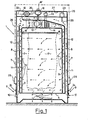
- the drying cabinet 1 has an interior 2 that holds laundry items 17 in a hanging manner.
- the drying cabinet has pivotable hanging devices 16 for hanging it with laundry 17.
- Such laundry holders for the drying cabinet are known, for example, from the older patent or the older patent application No. 21 49 873 or P 27 05 116, to which reference is expressly made here .
- the interior 2 of the drying cabinet 1 is enclosed by walls 3, 4, which in turn have air circulation openings 5.
- Air outlet openings 6 are arranged in the lower wall 4. Due to the type of air flow in the cross flow and made uniform with arrows in the figure, and evenly in all levels of the interior 2, the laundry 17 suspended therein is grasped and aired uniformly everywhere by the air flow.
- the drying cabinet has an outer casing 7 made of sheet metal or plastic.
- Heat exchange walls 8 are arranged between this and the inner walls 3.
- Fresh air inlet openings 10 are located in the lower area 9 of the outer casing 7.
- system air flows from the inside of the cabinet through the recirculation air ducts 12 in cocurrent (left side of the cabinet) or in countercurrent (right side of the cabinet).
- the fan 13 is located in the upper area of the drying cabinet 1. This is followed by the heating register 14.
- the fan 13 is equipped with a device for setting different speeds, for example with a pole-changing asynchronous motor for two speed ranges.
- the desired speed range can be set manually by means of the step switch 18 using the switching head 18 1 .
- the tap changer 18 is connected via the control line 26 to a timer 19, with the aid of which a work program can be selected digitally or via program cards, in which, for example, items of laundry 17 used after washing in a moist state are initially subjected to a drying process at warm air temperatures and after completion of the Drying undergo a sterilization process at sterilization temperatures.
- Warm air temperatures can usually be selected for drying below 1000C, while a temperature of 0 to 125C is required for sterilization.
- the fan 13 runs at a higher speed level, with more air being circulated at a lower temperature.
- the drying cabinet 1 is additionally equipped with an overheating switch 23.
- This has a temperature sensor 20 with which the temperature of a gas flow at a suitable point in the flow channels for example in the return channel 11.
- This overheating switch 23 is connected to the switching relay 22 with a control line 27. This results in a very simple function of the overheating protection in the go-stop-go-stop method, the heating register 14 being switched off each time the upper temperature limit is reached or exceeded, and is switched on again after the temperature has dropped to a permissible temperature level.
- the sterilization temperature is expediently maintained within a permissible range o between 125 and 130 ° C. It is advisable to largely restrict the inflow of fresh air desired during drying and at the same time to greatly reduce the amount of system air circulated.
- the drying cabinet 1 equipped for the sterilization process has a slide valve 24 at the air inlet openings 10 as an additional device.
- these can be actuated automatically with electromechanical actuation devices 29, preferably designed as lifting magnets. It is controlled by the program of the switching mechanism 19 via control lines 28.
- electromechanical actuation devices 29 preferably designed as lifting magnets. It is controlled by the program of the switching mechanism 19 via control lines 28.
- the drying cabinet 1 has an ozone generation chamber 15 for this purpose, which is also controlled by the program of the time switch 19 via the control line 30. Furthermore, the drying cabinet can be provided with a device for adding any bactericidal agent, but this is not shown in the drawing.
- the arrangement of the ozone generation chamber 15 is of course not mandatory. Furthermore, instead of electromechanically controlled gate valves 24 hand operable gate valves on the air inlet openings 10, as well as on the air outlet openings 6 may be provided.
- the drying cabinet requires only a slightly higher technical outlay for use as a sterilization apparatus than in its previous, known use as a pure drying cabinet.
- the task stated at the outset is ideally achieved with the device described.
- the air flow and arrangement of the controls can also be arranged with a small wall cabinet so that it can be hung over the head or foot end of a bathtub if necessary.
- the special advantage of the cabinet is that, despite the high temperatures used, there is no risk of fire because lint does not settle at any point and drying is possible even without heating.
- not only the side walls, but also the rear wall, the door, the ceiling and the floor can be designed with two shells and one have an external cold air duct.
- the walls can optionally also be designed as insulation walls.
- the cold air is sucked into the cabinet floor and flows upwards in one cabinet wall, then flows through the ceiling and is directed downwards in the other cabinet wall and is blown out again after flowing through the drying room.
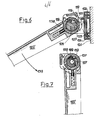
- the drying cabinet according to the invention has a joint arrangement 101 with rods 102, 102 'for hanging laundry items and the like.
- the rods 102 are shown in a ready-to-receive horizontal position, while the rod 102 'is folded down and is in a vertical position.
- the rods 102, 102 ' are formed on the joint side with a hub-shaped head part 103 which is transverse to the rod axis YY.
- the head parts have bores 130, by means of which they are arranged pivotably about a horizontally extending hinge pin 104 and either held in a horizontal position which can be locked by latching elements or received in a hinged manner after the lock has been released into the vertical position.
- the pivot pin 104 has a circular profile with a notch 107 forming a horizontal latching surface 106 and running parallel to its axis x - x on the side facing away from a horizontally standing rod 102.
- the bore 130 in the head part 103 is formed in the profile as an elongated hole 105 with a profile axis that is parallel to the rod axis yy.
- a locking lug 109 projects into the elongated hole 105 and forms a counter-locking surface 108 which runs parallel to the rod axis yy.
- the detent 109 engages in the notch 107, the detent and notch forming detent elements of a lock.
- the head part 103 and the pivot pin 104 are held by the action of the resilient return element 110.
- the latching surface 106 and the counter-latching surface 108 are each designed so that they lie flat against one another in engagement.
- the head part 103 is formed with a central recess 113 as a fork head.
- a bore 135 is made running in the direction of the axis y-y and receives the restoring element 110 in the form of a pressure pin 111 loaded with a spring 112.
- a shifting link 114 pushed onto the pivot pin 104 with a circular opening 136 is arranged in the recess 113 of the fork head and pivotable with the fork head 104 in a joint 115 arranged centrally above the elongated hole 105 articulated.
- the shifting gate 114 is formed in a rearward upward direction with a manually actuable actuating cam 116 protruding beyond the fork head. This is formed with a cup-shaped widening 117 to an actuation button.
- this button When this button is depressed by means of finger actuation, it makes a pivoting movement against the restoring force of the restoring element 110 about the joint 115 and thereby displaces the joint pin 104 relative to the rod 102 or to the head part 103 in the degree of freedom given by the elongated hole 105 up to the stop at the rod-side end 138 of the elongated hole 105.
- This position of the pivot pin 104 relative to the elongated hole 105 can be clearly seen from the illustration in FIG. 6.
- the latching surface 106 is released from engagement with the counter-latching surface 108 and the rod 102 can move into the vertical position according to the arrow 139 can be pivoted in Fig. 6.
- the pivot pin 104 has a second notch 119, which is o offset by 90 from the first notch 107.
- the latching nose 109 engages in the vertical position, the counter-latching surface 108 being brought into flat contact against the vertical latching surface 118 of the second notch 119. In this position, there is therefore a locking in the vertical position of the rod 102, which surely prevents swiveling over the vertical position and thus preventing the rods 102 from striking the inner wall of the cabinet 1.
- the notches 107 and 119 are formed parallel to one another and to the axis x-x of the pivot pin 104.
- the clear operation also contributes in a particularly impressive manner that the actuating cam 116 of the switching link 114 is designed with a color code in a signal color, preferably with red. As a result, even the most inexperienced immediately notice the "push button" which is to be pressed to fold down a rod 102, 102 '.
- the pivot pin 104 equipped with the rods 102, 102 ' is arranged in a telescopic rail guide.
- the pivot pin 104 is firmly connected to the telescopic rail 122 and the wall of the cabinet 1 to the telescopic rail 123.
- a telescopic rail 124 which is displaceable between them in relation to one another, enables an almost smooth displacement in the horizontal direction parallel to the xx axis until the joint arrangement 101 is completely pulled out the interior of the cabinet 1.
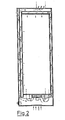
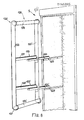
- a further improvement compared to this arrangement is achieved, as shown in FIG. 8, in that at least two pivot pins 104, 104 'with vertical bars 125, 125' form a rigid rectangular frame 128.
- the rods 102, 102 ' have been omitted for reasons of clarity, which of course are pushed onto the pivot pins 104, 104' in the case of installation and assembly. These are each firmly connected to the upper ends 126 and the lower ends 127 of the vertical bars 125, 125 '.
- Such a connection is very expediently obtained according to a further design suggestion that the pivot pins 104, as shown in FIG. 7, are produced as extruded light metal hollow profiles.
- a tie rod (not shown) can then be pushed through the profile opening 137 and screwed to the ends 126, 127 of the vertical bars 125, 125 'under prestress.
- the frame 128 is further stiffened by cross bars 129, 129 '.
- these are designed as telescopic rails 122, while telescopic rails 123, 123 'are screwed tightly inside the cabinet 1.
- These telescopic rails 122, 122 'and 123, 123' are connected by telescopic intermediate rails 124, 124 ', as is known per se.
- the arrangement of the pivot pins 104, 104 'within the rigid frame 128 with the vertical bars 125, 125' as a structural unit forms a prefabricated assembly group for installation in the drying cabinet I. This results in a significant saving in production times and an independent cycle production option for this assembly. On the one hand, this saves production costs, on the other hand, changing requirements for equipping a drying cabinet with rod internals can be taken into account considerably more flexibly, and finally the pull-out assembly group makes it much easier for the user the relevant handouts.
- FIG. 9 The arrangement of a vertical spar 125 on telescopic rails 122 to 124 is shown in FIG. 9.
- a rung 129 forms the uppermost telescopic rail 122 and an S-shaped angle profile the lower telescopic rail 123 fastened in the cabinet 1 with a telescopic intermediate rail 124 arranged movably therebetween.
- FIG. 10 schematically shows a vertical spar 125 with rods 102 'folded down into the vertical position and with telescopic guides 140, 141 in a side view.
- FIG. 11 shows an enlarged scale of one of the many available options for executing such a known telescopic rail arrangement.
- the device according to the invention clearly combines an optimal function with maximum ease of use with an ingeniously simple design and, as a result, a very economical manufacturability while overcoming the previously existing difficulties and limits.
- a particularly large length of the rods which enables a corresponding hanging length, results from the arrangement of the telescopic rails 122, 124 and 123 one above the other.
- the vertical spar 125 'on the cabinet side has a recess for the passage of the lower rails 122 and 124 when the rods are moved into the interior of the cabinet.
Landscapes
- Health & Medical Sciences (AREA)
- Public Health (AREA)
- Textile Engineering (AREA)
- Engineering & Computer Science (AREA)
- Epidemiology (AREA)
- Life Sciences & Earth Sciences (AREA)
- Animal Behavior & Ethology (AREA)
- General Health & Medical Sciences (AREA)
- Veterinary Medicine (AREA)
- General Chemical & Material Sciences (AREA)
- Chemical Kinetics & Catalysis (AREA)
- Chemical & Material Sciences (AREA)
- Drying Of Solid Materials (AREA)
- Apparatus For Disinfection Or Sterilisation (AREA)
- Accessory Of Washing/Drying Machine, Commercial Washing/Drying Machine, Other Washing/Drying Machine (AREA)
- Treatment Of Fiber Materials (AREA)
Applications Claiming Priority (4)
| Application Number | Priority Date | Filing Date | Title |
|---|---|---|---|
| DE19833343111 DE3343111A1 (de) | 1983-11-29 | 1983-11-29 | Gelenkanordnung fuer klappbare gegenstaende, insbesondere stangen zum aufhaengen von waesche |
| DE3343111 | 1983-11-29 | ||
| DE19833343236 DE3343236A1 (de) | 1983-11-30 | 1983-11-30 | Verfahren und vorrichtung zum trocknen und sterilisieren von geweben, insbesondere von empflindlichen geweben |
| DE3343236 | 1983-11-30 |
Publications (3)
| Publication Number | Publication Date |
|---|---|
| EP0148385A2 true EP0148385A2 (fr) | 1985-07-17 |
| EP0148385A3 EP0148385A3 (fr) | 1987-09-16 |
| EP0148385B1 EP0148385B1 (fr) | 1997-10-29 |
Family
ID=25815982
Family Applications (1)
| Application Number | Title | Priority Date | Filing Date |
|---|---|---|---|
| EP84114221A Expired - Lifetime EP0148385B1 (fr) | 1983-11-29 | 1984-11-24 | Armoire de séchage et procédé pour sécher et stériliser des tissus |
Country Status (4)
| Country | Link |
|---|---|
| EP (1) | EP0148385B1 (fr) |
| JP (1) | JPS60156498A (fr) |
| AT (1) | ATE159775T1 (fr) |
| CA (1) | CA1257087A (fr) |
Cited By (13)
| Publication number | Priority date | Publication date | Assignee | Title |
|---|---|---|---|---|
| EP0262451A3 (en) * | 1986-09-26 | 1988-08-10 | Hans Baltes | Method for drying and sterilizing goods in a closed circulation system |
| FR2710350A1 (fr) * | 1993-09-20 | 1995-03-31 | Blanc Roger | Armoire pour le séchage et l'aseptisation de vêtements. |
| EP1491677A1 (fr) * | 2003-06-25 | 2004-12-29 | Electrolux Home Products Corporation N.V. | Appareil de traitement de linge |
| WO2005113025A1 (fr) * | 2004-05-21 | 2005-12-01 | Owr Ag | Conteneur de decontamination mobile |
| EP1700944A1 (fr) * | 2005-03-08 | 2006-09-13 | Electrolux Home Products Corporation N.V. | Sèche-linge domestique avec cycle de désinfection du linge |
| EP1722027A1 (fr) * | 2005-05-10 | 2006-11-15 | Günther Schöttle | Dispositif pour nettoyer et stériliser des matelas |
| WO2007051456A1 (fr) * | 2005-11-03 | 2007-05-10 | Biotroc-Patentverwertungsgesellschaft Mbh & Co. Kg | Dispositif de lavage et de sechage de linge en forme d'armoire |
| DE102011075501A1 (de) * | 2011-05-09 | 2012-11-15 | BSH Bosch und Siemens Hausgeräte GmbH | Verfahren zum schonenden Entkeimen von Wäsche und Waschtrockeneinheit |
| CN112726151A (zh) * | 2020-12-23 | 2021-04-30 | 王德有 | 一种防雨防暴晒的自动晾衣杆 |
| DE102020111233A1 (de) | 2020-04-24 | 2021-10-28 | Gottlob Stahl Wäschereimaschinenbau GmbH | Anlage zur Behandlung von Objekten |
| EP3903834A3 (fr) * | 2020-04-06 | 2021-12-08 | Herbert Kannegiesser GmbH | Procédé de désinfection des objets biologiquement contaminés |
| AT524514A1 (de) * | 2020-12-03 | 2022-06-15 | Helmut Jannach | Trockenanlage |
| CN116182541A (zh) * | 2023-04-28 | 2023-05-30 | 山东奥诺能源科技股份有限公司 | 一种过热蒸汽热源干燥系统热能梯级利用及余热回收装置 |
Families Citing this family (2)
| Publication number | Priority date | Publication date | Assignee | Title |
|---|---|---|---|---|
| JPWO2023063338A1 (fr) * | 2021-10-15 | 2023-04-20 | ||
| JP7496907B1 (ja) * | 2023-02-14 | 2024-06-07 | 日本エアーテック株式会社 | オゾン消臭除菌装置 |
Family Cites Families (10)
| Publication number | Priority date | Publication date | Assignee | Title |
|---|---|---|---|---|
| DE969018C (de) * | 1953-11-15 | 1958-04-17 | Erich Kiefer Konstruktions Kom | Anlage zum Desinfizieren von Gegenstaenden |
| DE1128601B (de) * | 1956-09-12 | 1962-04-26 | E F G Kuester G M B H | Heissluft-Sterilisator |
| DE1105562B (de) * | 1957-04-10 | 1961-04-27 | E F G Kuester G M B H | Heissluftsterilisator |
| FR1571470A (fr) * | 1968-04-29 | 1969-06-20 | ||
| DE2149873C3 (de) * | 1971-10-06 | 1981-08-13 | Hans 4600 Dortmund Baltes | Trockenschrank |
| CH594774A5 (fr) * | 1976-01-20 | 1978-01-31 | Bieber Max | |
| DE2705116A1 (de) * | 1977-02-08 | 1978-08-10 | Hans Baltes | Trockenschrank zum trocknen von waesche u.dgl. |
| NL7711292A (nl) * | 1976-10-18 | 1978-04-20 | Baltes Hans | Werkwijze voor het drogen van wasgoed en droog- kast voor toepassing van deze werkwijze. |
| DE2818693A1 (de) * | 1978-04-28 | 1979-10-31 | Hans Baltes | Trockenverfahren zum trocknen von feuchtem oder nassem gut und trockengeraet zur durchfuehrung dieses verfahrens |
| DE2919762A1 (de) * | 1979-05-16 | 1980-11-27 | Hans Baltes | Verfahren zum trocknen von flachem gut und trockenschrank zur durchfuehrung dieses verfahrens |
-
1984
- 1984-11-24 AT AT84114221T patent/ATE159775T1/de active
- 1984-11-24 EP EP84114221A patent/EP0148385B1/fr not_active Expired - Lifetime
- 1984-11-28 CA CA000468812A patent/CA1257087A/fr not_active Expired
- 1984-11-29 JP JP59253891A patent/JPS60156498A/ja active Pending
Cited By (19)
| Publication number | Priority date | Publication date | Assignee | Title |
|---|---|---|---|---|
| EP0262451A3 (en) * | 1986-09-26 | 1988-08-10 | Hans Baltes | Method for drying and sterilizing goods in a closed circulation system |
| FR2710350A1 (fr) * | 1993-09-20 | 1995-03-31 | Blanc Roger | Armoire pour le séchage et l'aseptisation de vêtements. |
| US7367137B2 (en) | 2003-06-25 | 2008-05-06 | Electrolux Home Products Corporation N.V. | Clothes treating ultrasonic nebulizing cabinet apparatus |
| EP1491677A1 (fr) * | 2003-06-25 | 2004-12-29 | Electrolux Home Products Corporation N.V. | Appareil de traitement de linge |
| WO2005001191A1 (fr) * | 2003-06-25 | 2005-01-06 | Electrolux Home Products Corporation N.V. | Dispositif de traitement de vetements |
| AU2004252239B2 (en) * | 2003-06-25 | 2008-11-20 | Electrolux Home Products Corporation N.V. | Clothes treating apparatus |
| WO2005113025A1 (fr) * | 2004-05-21 | 2005-12-01 | Owr Ag | Conteneur de decontamination mobile |
| EP1700944A1 (fr) * | 2005-03-08 | 2006-09-13 | Electrolux Home Products Corporation N.V. | Sèche-linge domestique avec cycle de désinfection du linge |
| EP1722027A1 (fr) * | 2005-05-10 | 2006-11-15 | Günther Schöttle | Dispositif pour nettoyer et stériliser des matelas |
| WO2007051456A1 (fr) * | 2005-11-03 | 2007-05-10 | Biotroc-Patentverwertungsgesellschaft Mbh & Co. Kg | Dispositif de lavage et de sechage de linge en forme d'armoire |
| DE102011075501A1 (de) * | 2011-05-09 | 2012-11-15 | BSH Bosch und Siemens Hausgeräte GmbH | Verfahren zum schonenden Entkeimen von Wäsche und Waschtrockeneinheit |
| US9109320B2 (en) | 2011-05-09 | 2015-08-18 | BSH Hausgeräte GmbH | Method for sterilizing laundry, and washing-drying unit |
| EP3903834A3 (fr) * | 2020-04-06 | 2021-12-08 | Herbert Kannegiesser GmbH | Procédé de désinfection des objets biologiquement contaminés |
| DE102020111233A1 (de) | 2020-04-24 | 2021-10-28 | Gottlob Stahl Wäschereimaschinenbau GmbH | Anlage zur Behandlung von Objekten |
| EP3901546A3 (fr) * | 2020-04-24 | 2021-12-29 | Gottlob Stahl Wäschereimaschinenbau GmbH | Installation de traitement d'objets |
| AT524514A1 (de) * | 2020-12-03 | 2022-06-15 | Helmut Jannach | Trockenanlage |
| CN112726151A (zh) * | 2020-12-23 | 2021-04-30 | 王德有 | 一种防雨防暴晒的自动晾衣杆 |
| CN116182541A (zh) * | 2023-04-28 | 2023-05-30 | 山东奥诺能源科技股份有限公司 | 一种过热蒸汽热源干燥系统热能梯级利用及余热回收装置 |
| CN116182541B (zh) * | 2023-04-28 | 2023-06-27 | 山东奥诺能源科技股份有限公司 | 一种过热蒸汽热源干燥系统热能梯级利用及余热回收装置 |
Also Published As
| Publication number | Publication date |
|---|---|
| JPS60156498A (ja) | 1985-08-16 |
| EP0148385B1 (fr) | 1997-10-29 |
| EP0148385A3 (fr) | 1987-09-16 |
| ATE159775T1 (de) | 1997-11-15 |
| CA1257087A (fr) | 1989-07-11 |
Similar Documents
| Publication | Publication Date | Title |
|---|---|---|
| EP0148385B1 (fr) | Armoire de séchage et procédé pour sécher et stériliser des tissus | |
| DE3343236A1 (de) | Verfahren und vorrichtung zum trocknen und sterilisieren von geweben, insbesondere von empflindlichen geweben | |
| DE3842997C2 (de) | Geschirrspülmaschine | |
| EP0594085B1 (fr) | Procédé et dispositif pour desintoxiquer, aérer, sécher et stériliser des tissus ou similaire | |
| DE102009018699B4 (de) | Heizteil und Maschine zum Behandeln von Textil- und Lederwaren mit diesem | |
| DE2037592C3 (de) | Verfahren zur Dauerausrüstung von zellulosehaltigen Gewebeartikeln, sowie Vorrichtung zur Durchführung des Verfahrens | |
| DE2156405B2 (de) | Verfahren und Vorrichtung zum Dämpfen und Glätten von Bekleidungsstücken in einem abgeschlossenen Raum | |
| DE69211611T2 (de) | Kochgerät | |
| EP2492389A1 (fr) | Sèche-linge doté d'un dispositif de filtre à peluches jetable | |
| DE69620225T2 (de) | Trocknungskabine | |
| DE19500371A1 (de) | Backofenmuffel für Haushalts-Backöfen | |
| DE20122486U1 (de) | Trockengestell für einen Wäschetrockner | |
| DE7341276U (de) | Trockenvorrichtung für Textilien | |
| WO2007051456A1 (fr) | Dispositif de lavage et de sechage de linge en forme d'armoire | |
| DE2016357A1 (de) | Haushaltsvorrichtung zum Waschen und Trocknen von Wasche, Bekleidungs stucken und dgl | |
| EP4025735A1 (fr) | Accessoire perméable à la vapeur avec éléments de repassage | |
| DE7604014U1 (de) | Trocknungsgeraet fuer tiere, insbesondere fuer hunde nach dem waschen | |
| WO2010075840A1 (fr) | Procédé et dispositif pour nettoyer, désinfecter et/ou stériliser des oreillers, couettes, matelas ou analogue | |
| DE2149873C3 (de) | Trockenschrank | |
| DE102010038751A1 (de) | Waschvorrichtung für Matratzen | |
| DE9102303U1 (de) | Trockenvorrichtung für Waschgut, insbesondere Kleidungsstücke | |
| DE2705116A1 (de) | Trockenschrank zum trocknen von waesche u.dgl. | |
| DE60205775T2 (de) | Verfahren und system zum reinigen von arbeitsutensilien, insbesondere in der nahrungsmittelverarbeitungsindustrie | |
| DE2646903C2 (de) | Verfahren zum Trocknen von flachem Gut und Trockenschrank zur Durchführung dieses Verfahrens | |
| DE7423996U (de) | Gerät zur Pflege von Kleidungsstücken |
Legal Events
| Date | Code | Title | Description |
|---|---|---|---|
| PUAI | Public reference made under article 153(3) epc to a published international application that has entered the european phase |
Free format text: ORIGINAL CODE: 0009012 |
|
| AK | Designated contracting states |
Designated state(s): AT BE CH FR GB IT LI NL SE |
|
| PUAL | Search report despatched |
Free format text: ORIGINAL CODE: 0009013 |
|
| 111Z | Information provided on other rights and legal means of execution | ||
| AK | Designated contracting states |
Kind code of ref document: A3 Designated state(s): AT BE CH FR GB IT LI NL SE |
|
| 17P | Request for examination filed |
Effective date: 19880222 |
|
| 17Q | First examination report despatched |
Effective date: 19880914 |
|
| GRAG | Despatch of communication of intention to grant |
Free format text: ORIGINAL CODE: EPIDOS AGRA |
|
| GRAH | Despatch of communication of intention to grant a patent |
Free format text: ORIGINAL CODE: EPIDOS IGRA |
|
| GRAH | Despatch of communication of intention to grant a patent |
Free format text: ORIGINAL CODE: EPIDOS IGRA |
|
| GRAA | (expected) grant |
Free format text: ORIGINAL CODE: 0009210 |
|
| AK | Designated contracting states |
Kind code of ref document: B1 Designated state(s): AT BE CH FR GB IT LI NL SE |
|
| REF | Corresponds to: |
Ref document number: 159775 Country of ref document: AT Date of ref document: 19971115 Kind code of ref document: T |
|
| REG | Reference to a national code |
Ref country code: CH Ref legal event code: EP |
|
| PG25 | Lapsed in a contracting state [announced via postgrant information from national office to epo] |
Ref country code: AT Free format text: LAPSE BECAUSE OF NON-PAYMENT OF DUE FEES Effective date: 19971124 |
|
| PG25 | Lapsed in a contracting state [announced via postgrant information from national office to epo] |
Ref country code: LI Free format text: LAPSE BECAUSE OF NON-PAYMENT OF DUE FEES Effective date: 19971130 Ref country code: CH Free format text: LAPSE BECAUSE OF NON-PAYMENT OF DUE FEES Effective date: 19971130 Ref country code: BE Free format text: LAPSE BECAUSE OF NON-PAYMENT OF DUE FEES Effective date: 19971130 |
|
| GBT | Gb: translation of ep patent filed (gb section 77(6)(a)/1977) |
Effective date: 19971219 |
|
| ITF | It: translation for a ep patent filed | ||
| ET | Fr: translation filed | ||
| BERE | Be: lapsed |
Owner name: BALTES HANS Effective date: 19971130 |
|
| REG | Reference to a national code |
Ref country code: CH Ref legal event code: PL |
|
| PLBE | No opposition filed within time limit |
Free format text: ORIGINAL CODE: 0009261 |
|
| STAA | Information on the status of an ep patent application or granted ep patent |
Free format text: STATUS: NO OPPOSITION FILED WITHIN TIME LIMIT |
|
| 26N | No opposition filed | ||
| PGFP | Annual fee paid to national office [announced via postgrant information from national office to epo] |
Ref country code: FR Payment date: 19991123 Year of fee payment: 16 |
|
| PGFP | Annual fee paid to national office [announced via postgrant information from national office to epo] |
Ref country code: GB Payment date: 19991124 Year of fee payment: 16 |
|
| PGFP | Annual fee paid to national office [announced via postgrant information from national office to epo] |
Ref country code: NL Payment date: 19991130 Year of fee payment: 16 |
|
| PG25 | Lapsed in a contracting state [announced via postgrant information from national office to epo] |
Ref country code: GB Free format text: LAPSE BECAUSE OF NON-PAYMENT OF DUE FEES Effective date: 20001124 |
|
| PG25 | Lapsed in a contracting state [announced via postgrant information from national office to epo] |
Ref country code: NL Free format text: LAPSE BECAUSE OF NON-PAYMENT OF DUE FEES Effective date: 20010601 |
|
| GBPC | Gb: european patent ceased through non-payment of renewal fee |
Effective date: 20001124 |
|
| PG25 | Lapsed in a contracting state [announced via postgrant information from national office to epo] |
Ref country code: FR Free format text: LAPSE BECAUSE OF NON-PAYMENT OF DUE FEES Effective date: 20010731 |
|
| NLV4 | Nl: lapsed or anulled due to non-payment of the annual fee |
Effective date: 20010601 |
|
| REG | Reference to a national code |
Ref country code: FR Ref legal event code: ST |
|
| PGFP | Annual fee paid to national office [announced via postgrant information from national office to epo] |
Ref country code: SE Payment date: 20020322 Year of fee payment: 18 |
|
| PG25 | Lapsed in a contracting state [announced via postgrant information from national office to epo] |
Ref country code: SE Free format text: LAPSE BECAUSE OF NON-PAYMENT OF DUE FEES Effective date: 20021125 |
|
| EUG | Se: european patent has lapsed | ||
| APAH | Appeal reference modified |
Free format text: ORIGINAL CODE: EPIDOSCREFNO |