EP0148392A1 - Verwendung von Polyisocyanat-Polyadditionsprodukten als bzw.zur Herstellung von Klebemitteln - Google Patents
Verwendung von Polyisocyanat-Polyadditionsprodukten als bzw.zur Herstellung von Klebemitteln Download PDFInfo
- Publication number
- EP0148392A1 EP0148392A1 EP84114310A EP84114310A EP0148392A1 EP 0148392 A1 EP0148392 A1 EP 0148392A1 EP 84114310 A EP84114310 A EP 84114310A EP 84114310 A EP84114310 A EP 84114310A EP 0148392 A1 EP0148392 A1 EP 0148392A1
- Authority
- EP
- European Patent Office
- Prior art keywords
- molecular weight
- groups
- dispersions
- weight range
- component
- Prior art date
- Legal status (The legal status is an assumption and is not a legal conclusion. Google has not performed a legal analysis and makes no representation as to the accuracy of the status listed.)
- Granted
Links
- 239000005056 polyisocyanate Substances 0.000 title claims abstract description 30
- 229920001228 polyisocyanate Polymers 0.000 title claims abstract description 30
- 230000001070 adhesive effect Effects 0.000 title claims abstract description 18
- 239000000853 adhesive Substances 0.000 title claims abstract description 17
- 238000002360 preparation method Methods 0.000 title claims abstract description 10
- 239000006185 dispersion Substances 0.000 claims abstract description 54
- 238000000034 method Methods 0.000 claims abstract description 34
- 239000007787 solid Substances 0.000 claims abstract description 25
- 229920005906 polyester polyol Polymers 0.000 claims abstract description 23
- 239000004721 Polyphenylene oxide Substances 0.000 claims abstract description 22
- 150000002596 lactones Chemical class 0.000 claims abstract description 22
- 229920000570 polyether Polymers 0.000 claims abstract description 22
- IAYPIBMASNFSPL-UHFFFAOYSA-N Ethylene oxide Chemical group C1CO1 IAYPIBMASNFSPL-UHFFFAOYSA-N 0.000 claims abstract description 21
- 239000000243 solution Substances 0.000 claims abstract description 20
- 239000007864 aqueous solution Substances 0.000 claims abstract description 17
- 229920000728 polyester Polymers 0.000 claims abstract description 16
- OFOBLEOULBTSOW-UHFFFAOYSA-N Malonic acid Chemical compound OC(=O)CC(O)=O OFOBLEOULBTSOW-UHFFFAOYSA-N 0.000 claims abstract description 14
- 125000001453 quaternary ammonium group Chemical group 0.000 claims abstract description 13
- 229920001577 copolymer Polymers 0.000 claims abstract description 10
- 229920001971 elastomer Polymers 0.000 claims abstract description 10
- 229920001519 homopolymer Polymers 0.000 claims abstract description 10
- 239000005060 rubber Substances 0.000 claims abstract description 10
- 238000004519 manufacturing process Methods 0.000 claims abstract description 6
- 239000000758 substrate Substances 0.000 claims abstract description 6
- JOYRKODLDBILNP-UHFFFAOYSA-N urethane group Chemical group NC(=O)OCC JOYRKODLDBILNP-UHFFFAOYSA-N 0.000 claims abstract description 5
- XLYOFNOQVPJJNP-UHFFFAOYSA-N water Substances O XLYOFNOQVPJJNP-UHFFFAOYSA-N 0.000 claims description 29
- 150000001875 compounds Chemical class 0.000 claims description 21
- 125000002887 hydroxy group Chemical group [H]O* 0.000 claims description 21
- 238000006243 chemical reaction Methods 0.000 claims description 13
- 239000000463 material Substances 0.000 claims description 11
- 239000004970 Chain extender Substances 0.000 claims description 10
- QGZKDVFQNNGYKY-UHFFFAOYSA-O ammonium group Chemical group [NH4+] QGZKDVFQNNGYKY-UHFFFAOYSA-O 0.000 claims description 10
- 150000002009 diols Chemical class 0.000 claims description 10
- OAKJQQAXSVQMHS-UHFFFAOYSA-N hydrazine group Chemical group NN OAKJQQAXSVQMHS-UHFFFAOYSA-N 0.000 claims description 10
- 150000001298 alcohols Chemical class 0.000 claims description 9
- 150000001412 amines Chemical class 0.000 claims description 7
- IQPQWNKOIGAROB-UHFFFAOYSA-N isocyanate group Chemical group [N-]=C=O IQPQWNKOIGAROB-UHFFFAOYSA-N 0.000 claims description 7
- WNLRTRBMVRJNCN-UHFFFAOYSA-N adipic acid Chemical compound OC(=O)CCCCC(O)=O WNLRTRBMVRJNCN-UHFFFAOYSA-N 0.000 claims description 6
- 229920005862 polyol Polymers 0.000 claims description 6
- 150000003077 polyols Chemical class 0.000 claims description 6
- 239000012948 isocyanate Substances 0.000 claims description 5
- 150000002513 isocyanates Chemical class 0.000 claims description 5
- 150000005846 sugar alcohols Polymers 0.000 claims description 4
- 239000001361 adipic acid Substances 0.000 claims description 3
- 235000011037 adipic acid Nutrition 0.000 claims description 3
- 125000003178 carboxy group Chemical group [H]OC(*)=O 0.000 claims description 3
- 125000001302 tertiary amino group Chemical group 0.000 claims description 3
- 238000007259 addition reaction Methods 0.000 claims description 2
- 238000004026 adhesive bonding Methods 0.000 claims description 2
- 239000012736 aqueous medium Substances 0.000 claims description 2
- GPCIDUIBGGUBJG-UHFFFAOYSA-N hexanedioic acid;hexane-1,1-diol Chemical compound CCCCCC(O)O.OC(=O)CCCCC(O)=O GPCIDUIBGGUBJG-UHFFFAOYSA-N 0.000 claims 1
- 239000007858 starting material Substances 0.000 abstract description 9
- 238000010348 incorporation Methods 0.000 abstract 1
- CSCPPACGZOOCGX-UHFFFAOYSA-N Acetone Chemical compound CC(C)=O CSCPPACGZOOCGX-UHFFFAOYSA-N 0.000 description 27
- 239000000047 product Substances 0.000 description 15
- LYCAIKOWRPUZTN-UHFFFAOYSA-N Ethylene glycol Chemical compound OCCO LYCAIKOWRPUZTN-UHFFFAOYSA-N 0.000 description 13
- 238000013459 approach Methods 0.000 description 13
- JVTAAEKCZFNVCJ-UHFFFAOYSA-N lactic acid Chemical compound CC(O)C(O)=O JVTAAEKCZFNVCJ-UHFFFAOYSA-N 0.000 description 13
- 239000000203 mixture Substances 0.000 description 10
- 125000003277 amino group Chemical group 0.000 description 9
- MTHSVFCYNBDYFN-UHFFFAOYSA-N diethylene glycol Chemical compound OCCOCCO MTHSVFCYNBDYFN-UHFFFAOYSA-N 0.000 description 9
- WERYXYBDKMZEQL-UHFFFAOYSA-N butane-1,4-diol Chemical compound OCCCCO WERYXYBDKMZEQL-UHFFFAOYSA-N 0.000 description 8
- -1 oleic acid Chemical class 0.000 description 7
- 239000004814 polyurethane Substances 0.000 description 7
- 229920002635 polyurethane Polymers 0.000 description 7
- DNIAPMSPPWPWGF-UHFFFAOYSA-N Propylene glycol Chemical compound CC(O)CO DNIAPMSPPWPWGF-UHFFFAOYSA-N 0.000 description 6
- 238000006386 neutralization reaction Methods 0.000 description 6
- 229920000642 polymer Polymers 0.000 description 6
- 238000005956 quaternization reaction Methods 0.000 description 6
- NWZSZGALRFJKBT-KNIFDHDWSA-N (2s)-2,6-diaminohexanoic acid;(2s)-2-hydroxybutanedioic acid Chemical compound OC(=O)[C@@H](O)CC(O)=O.NCCCC[C@H](N)C(O)=O NWZSZGALRFJKBT-KNIFDHDWSA-N 0.000 description 5
- PEDCQBHIVMGVHV-UHFFFAOYSA-N Glycerine Chemical compound OCC(O)CO PEDCQBHIVMGVHV-UHFFFAOYSA-N 0.000 description 5
- 239000002253 acid Substances 0.000 description 5
- IKDUDTNKRLTJSI-UHFFFAOYSA-N hydrazine monohydrate Substances O.NN IKDUDTNKRLTJSI-UHFFFAOYSA-N 0.000 description 5
- 229960000448 lactic acid Drugs 0.000 description 5
- 238000012360 testing method Methods 0.000 description 5
- VZCYOOQTPOCHFL-OWOJBTEDSA-N Fumaric acid Chemical compound OC(=O)\C=C\C(O)=O VZCYOOQTPOCHFL-OWOJBTEDSA-N 0.000 description 4
- LRHPLDYGYMQRHN-UHFFFAOYSA-N N-Butanol Chemical compound CCCCO LRHPLDYGYMQRHN-UHFFFAOYSA-N 0.000 description 4
- 125000004432 carbon atom Chemical group C* 0.000 description 4
- 230000000052 comparative effect Effects 0.000 description 4
- XXMIOPMDWAUFGU-UHFFFAOYSA-N hexane-1,6-diol Chemical compound OCCCCCCO XXMIOPMDWAUFGU-UHFFFAOYSA-N 0.000 description 4
- RNLHGQLZWXBQNY-UHFFFAOYSA-N 3-(aminomethyl)-3,5,5-trimethylcyclohexan-1-amine Chemical compound CC1(C)CC(N)CC(C)(CN)C1 RNLHGQLZWXBQNY-UHFFFAOYSA-N 0.000 description 3
- QTBSBXVTEAMEQO-UHFFFAOYSA-N Acetic acid Chemical compound CC(O)=O QTBSBXVTEAMEQO-UHFFFAOYSA-N 0.000 description 3
- 239000004215 Carbon black (E152) Substances 0.000 description 3
- LFQSCWFLJHTTHZ-UHFFFAOYSA-N Ethanol Chemical compound CCO LFQSCWFLJHTTHZ-UHFFFAOYSA-N 0.000 description 3
- OKKJLVBELUTLKV-UHFFFAOYSA-N Methanol Chemical compound OC OKKJLVBELUTLKV-UHFFFAOYSA-N 0.000 description 3
- MUBZPKHOEPUJKR-UHFFFAOYSA-N Oxalic acid Chemical compound OC(=O)C(O)=O MUBZPKHOEPUJKR-UHFFFAOYSA-N 0.000 description 3
- GLUUGHFHXGJENI-UHFFFAOYSA-N Piperazine Chemical compound C1CNCCN1 GLUUGHFHXGJENI-UHFFFAOYSA-N 0.000 description 3
- GOOHAUXETOMSMM-UHFFFAOYSA-N Propylene oxide Chemical compound CC1CO1 GOOHAUXETOMSMM-UHFFFAOYSA-N 0.000 description 3
- KDYFGRWQOYBRFD-UHFFFAOYSA-N Succinic acid Natural products OC(=O)CCC(O)=O KDYFGRWQOYBRFD-UHFFFAOYSA-N 0.000 description 3
- UWHCKJMYHZGTIT-UHFFFAOYSA-N Tetraethylene glycol, Natural products OCCOCCOCCOCCO UWHCKJMYHZGTIT-UHFFFAOYSA-N 0.000 description 3
- WYURNTSHIVDZCO-UHFFFAOYSA-N Tetrahydrofuran Chemical compound C1CCOC1 WYURNTSHIVDZCO-UHFFFAOYSA-N 0.000 description 3
- 150000007513 acids Chemical class 0.000 description 3
- 239000003795 chemical substances by application Substances 0.000 description 3
- 150000004985 diamines Chemical class 0.000 description 3
- 125000005442 diisocyanate group Chemical group 0.000 description 3
- 229930195733 hydrocarbon Natural products 0.000 description 3
- 229910052757 nitrogen Inorganic materials 0.000 description 3
- VZCYOOQTPOCHFL-UHFFFAOYSA-N trans-butenedioic acid Natural products OC(=O)C=CC(O)=O VZCYOOQTPOCHFL-UHFFFAOYSA-N 0.000 description 3
- ZIBGPFATKBEMQZ-UHFFFAOYSA-N triethylene glycol Chemical compound OCCOCCOCCO ZIBGPFATKBEMQZ-UHFFFAOYSA-N 0.000 description 3
- YEJRWHAVMIAJKC-UHFFFAOYSA-N 4-Butyrolactone Chemical compound O=C1CCCO1 YEJRWHAVMIAJKC-UHFFFAOYSA-N 0.000 description 2
- PAYRUJLWNCNPSJ-UHFFFAOYSA-N Aniline Chemical compound NC1=CC=CC=C1 PAYRUJLWNCNPSJ-UHFFFAOYSA-N 0.000 description 2
- IJGRMHOSHXDMSA-UHFFFAOYSA-N Atomic nitrogen Chemical compound N#N IJGRMHOSHXDMSA-UHFFFAOYSA-N 0.000 description 2
- RTZKZFJDLAIYFH-UHFFFAOYSA-N Diethyl ether Chemical compound CCOCC RTZKZFJDLAIYFH-UHFFFAOYSA-N 0.000 description 2
- VEXZGXHMUGYJMC-UHFFFAOYSA-N Hydrochloric acid Chemical compound Cl VEXZGXHMUGYJMC-UHFFFAOYSA-N 0.000 description 2
- SECXISVLQFMRJM-UHFFFAOYSA-N N-Methylpyrrolidone Chemical compound CN1CCCC1=O SECXISVLQFMRJM-UHFFFAOYSA-N 0.000 description 2
- NBIIXXVUZAFLBC-UHFFFAOYSA-N Phosphoric acid Chemical compound OP(O)(O)=O NBIIXXVUZAFLBC-UHFFFAOYSA-N 0.000 description 2
- ZJCCRDAZUWHFQH-UHFFFAOYSA-N Trimethylolpropane Chemical compound CCC(CO)(CO)CO ZJCCRDAZUWHFQH-UHFFFAOYSA-N 0.000 description 2
- 125000002947 alkylene group Chemical group 0.000 description 2
- 150000001413 amino acids Chemical class 0.000 description 2
- 150000001414 amino alcohols Chemical class 0.000 description 2
- BVKZGUZCCUSVTD-UHFFFAOYSA-N carbonic acid Chemical class OC(O)=O BVKZGUZCCUSVTD-UHFFFAOYSA-N 0.000 description 2
- 235000014113 dietary fatty acids Nutrition 0.000 description 2
- WOZVHXUHUFLZGK-UHFFFAOYSA-N dimethyl terephthalate Chemical compound COC(=O)C1=CC=C(C(=O)OC)C=C1 WOZVHXUHUFLZGK-UHFFFAOYSA-N 0.000 description 2
- SZXQTJUDPRGNJN-UHFFFAOYSA-N dipropylene glycol Chemical compound OCCCOCCCO SZXQTJUDPRGNJN-UHFFFAOYSA-N 0.000 description 2
- 238000004821 distillation Methods 0.000 description 2
- LQZZUXJYWNFBMV-UHFFFAOYSA-N dodecan-1-ol Chemical compound CCCCCCCCCCCCO LQZZUXJYWNFBMV-UHFFFAOYSA-N 0.000 description 2
- 229930195729 fatty acid Natural products 0.000 description 2
- 239000000194 fatty acid Substances 0.000 description 2
- 150000004665 fatty acids Chemical class 0.000 description 2
- 239000001530 fumaric acid Substances 0.000 description 2
- 235000011187 glycerol Nutrition 0.000 description 2
- NAQMVNRVTILPCV-UHFFFAOYSA-N hexane-1,6-diamine Chemical compound NCCCCCCN NAQMVNRVTILPCV-UHFFFAOYSA-N 0.000 description 2
- 229940042795 hydrazides for tuberculosis treatment Drugs 0.000 description 2
- WGCNASOHLSPBMP-UHFFFAOYSA-N hydroxyacetaldehyde Natural products OCC=O WGCNASOHLSPBMP-UHFFFAOYSA-N 0.000 description 2
- 239000012442 inert solvent Substances 0.000 description 2
- NIMLQBUJDJZYEJ-UHFFFAOYSA-N isophorone diisocyanate Chemical compound CC1(C)CC(N=C=O)CC(C)(CN=C=O)C1 NIMLQBUJDJZYEJ-UHFFFAOYSA-N 0.000 description 2
- 239000004310 lactic acid Substances 0.000 description 2
- 235000014655 lactic acid Nutrition 0.000 description 2
- 238000012986 modification Methods 0.000 description 2
- 230000004048 modification Effects 0.000 description 2
- KMBPCQSCMCEPMU-UHFFFAOYSA-N n'-(3-aminopropyl)-n'-methylpropane-1,3-diamine Chemical compound NCCCN(C)CCCN KMBPCQSCMCEPMU-UHFFFAOYSA-N 0.000 description 2
- 230000003472 neutralizing effect Effects 0.000 description 2
- BDJRBEYXGGNYIS-UHFFFAOYSA-N nonanedioic acid Chemical compound OC(=O)CCCCCCCC(O)=O BDJRBEYXGGNYIS-UHFFFAOYSA-N 0.000 description 2
- GLDOVTGHNKAZLK-UHFFFAOYSA-N octadecan-1-ol Chemical compound CCCCCCCCCCCCCCCCCCO GLDOVTGHNKAZLK-UHFFFAOYSA-N 0.000 description 2
- 150000002924 oxiranes Chemical class 0.000 description 2
- XNGIFLGASWRNHJ-UHFFFAOYSA-N phthalic acid Chemical compound OC(=O)C1=CC=CC=C1C(O)=O XNGIFLGASWRNHJ-UHFFFAOYSA-N 0.000 description 2
- 229920001223 polyethylene glycol Polymers 0.000 description 2
- 238000012545 processing Methods 0.000 description 2
- PAPBSGBWRJIAAV-UHFFFAOYSA-N ε-Caprolactone Chemical compound O=C1CCCCCO1 PAPBSGBWRJIAAV-UHFFFAOYSA-N 0.000 description 2
- PUPZLCDOIYMWBV-UHFFFAOYSA-N (+/-)-1,3-Butanediol Chemical compound CC(O)CCO PUPZLCDOIYMWBV-UHFFFAOYSA-N 0.000 description 1
- MUTGBJKUEZFXGO-OLQVQODUSA-N (3as,7ar)-3a,4,5,6,7,7a-hexahydro-2-benzofuran-1,3-dione Chemical compound C1CCC[C@@H]2C(=O)OC(=O)[C@@H]21 MUTGBJKUEZFXGO-OLQVQODUSA-N 0.000 description 1
- WRIDQFICGBMAFQ-UHFFFAOYSA-N (E)-8-Octadecenoic acid Natural products CCCCCCCCCC=CCCCCCCC(O)=O WRIDQFICGBMAFQ-UHFFFAOYSA-N 0.000 description 1
- GFNDFCFPJQPVQL-UHFFFAOYSA-N 1,12-diisocyanatododecane Chemical compound O=C=NCCCCCCCCCCCCN=C=O GFNDFCFPJQPVQL-UHFFFAOYSA-N 0.000 description 1
- ZWVMLYRJXORSEP-UHFFFAOYSA-N 1,2,6-Hexanetriol Chemical compound OCCCCC(O)CO ZWVMLYRJXORSEP-UHFFFAOYSA-N 0.000 description 1
- OHLKMGYGBHFODF-UHFFFAOYSA-N 1,4-bis(isocyanatomethyl)benzene Chemical compound O=C=NCC1=CC=C(CN=C=O)C=C1 OHLKMGYGBHFODF-UHFFFAOYSA-N 0.000 description 1
- ALQLPWJFHRMHIU-UHFFFAOYSA-N 1,4-diisocyanatobenzene Chemical compound O=C=NC1=CC=C(N=C=O)C=C1 ALQLPWJFHRMHIU-UHFFFAOYSA-N 0.000 description 1
- OVBFMUAFNIIQAL-UHFFFAOYSA-N 1,4-diisocyanatobutane Chemical compound O=C=NCCCCN=C=O OVBFMUAFNIIQAL-UHFFFAOYSA-N 0.000 description 1
- CDMDQYCEEKCBGR-UHFFFAOYSA-N 1,4-diisocyanatocyclohexane Chemical compound O=C=NC1CCC(N=C=O)CC1 CDMDQYCEEKCBGR-UHFFFAOYSA-N 0.000 description 1
- XKQMKMVTDKYWOX-UHFFFAOYSA-N 1-[2-hydroxypropyl(methyl)amino]propan-2-ol Chemical compound CC(O)CN(C)CC(C)O XKQMKMVTDKYWOX-UHFFFAOYSA-N 0.000 description 1
- YIDSTEJLDQMWBR-UHFFFAOYSA-N 1-isocyanatododecane Chemical compound CCCCCCCCCCCCN=C=O YIDSTEJLDQMWBR-UHFFFAOYSA-N 0.000 description 1
- NSMWYRLQHIXVAP-UHFFFAOYSA-N 2,5-dimethylpiperazine Chemical compound CC1CNC(C)CN1 NSMWYRLQHIXVAP-UHFFFAOYSA-N 0.000 description 1
- LCZVSXRMYJUNFX-UHFFFAOYSA-N 2-[2-(2-hydroxypropoxy)propoxy]propan-1-ol Chemical compound CC(O)COC(C)COC(C)CO LCZVSXRMYJUNFX-UHFFFAOYSA-N 0.000 description 1
- HAZOZRAPGZDOEM-UHFFFAOYSA-N 2-aminoacetohydrazide Chemical compound NCC(=O)NN HAZOZRAPGZDOEM-UHFFFAOYSA-N 0.000 description 1
- JUIKUQOUMZUFQT-UHFFFAOYSA-N 2-bromoacetamide Chemical compound NC(=O)CBr JUIKUQOUMZUFQT-UHFFFAOYSA-N 0.000 description 1
- 125000000954 2-hydroxyethyl group Chemical group [H]C([*])([H])C([H])([H])O[H] 0.000 description 1
- IYBOGQYZTIIPNI-UHFFFAOYSA-N 2-methylhexano-6-lactone Chemical compound CC1CCCCOC1=O IYBOGQYZTIIPNI-UHFFFAOYSA-N 0.000 description 1
- QWGRWMMWNDWRQN-UHFFFAOYSA-N 2-methylpropane-1,3-diol Chemical compound OCC(C)CO QWGRWMMWNDWRQN-UHFFFAOYSA-N 0.000 description 1
- LQJBNNIYVWPHFW-UHFFFAOYSA-N 20:1omega9c fatty acid Natural products CCCCCCCCCCC=CCCCCCCCC(O)=O LQJBNNIYVWPHFW-UHFFFAOYSA-N 0.000 description 1
- UPMLOUAZCHDJJD-UHFFFAOYSA-N 4,4'-Diphenylmethane Diisocyanate Chemical compound C1=CC(N=C=O)=CC=C1CC1=CC=C(N=C=O)C=C1 UPMLOUAZCHDJJD-UHFFFAOYSA-N 0.000 description 1
- DZIHTWJGPDVSGE-UHFFFAOYSA-N 4-[(4-aminocyclohexyl)methyl]cyclohexan-1-amine Chemical compound C1CC(N)CCC1CC1CCC(N)CC1 DZIHTWJGPDVSGE-UHFFFAOYSA-N 0.000 description 1
- QSBYPNXLFMSGKH-UHFFFAOYSA-N 9-Heptadecensaeure Natural products CCCCCCCC=CCCCCCCCC(O)=O QSBYPNXLFMSGKH-UHFFFAOYSA-N 0.000 description 1
- 239000004971 Cross linker Substances 0.000 description 1
- FEWJPZIEWOKRBE-JCYAYHJZSA-N Dextrotartaric acid Chemical compound OC(=O)[C@H](O)[C@@H](O)C(O)=O FEWJPZIEWOKRBE-JCYAYHJZSA-N 0.000 description 1
- BRLQWZUYTZBJKN-UHFFFAOYSA-N Epichlorohydrin Chemical compound ClCC1CO1 BRLQWZUYTZBJKN-UHFFFAOYSA-N 0.000 description 1
- PIICEJLVQHRZGT-UHFFFAOYSA-N Ethylenediamine Chemical compound NCCN PIICEJLVQHRZGT-UHFFFAOYSA-N 0.000 description 1
- 239000005057 Hexamethylene diisocyanate Substances 0.000 description 1
- 239000005058 Isophorone diisocyanate Substances 0.000 description 1
- AKNUHUCEWALCOI-UHFFFAOYSA-N N-ethyldiethanolamine Chemical compound OCCN(CC)CCO AKNUHUCEWALCOI-UHFFFAOYSA-N 0.000 description 1
- 239000005642 Oleic acid Substances 0.000 description 1
- ZQPPMHVWECSIRJ-UHFFFAOYSA-N Oleic acid Natural products CCCCCCCCC=CCCCCCCCC(O)=O ZQPPMHVWECSIRJ-UHFFFAOYSA-N 0.000 description 1
- QVHMSMOUDQXMRS-UHFFFAOYSA-N PPG n4 Chemical compound CC(O)COC(C)COC(C)COC(C)CO QVHMSMOUDQXMRS-UHFFFAOYSA-N 0.000 description 1
- YGYAWVDWMABLBF-UHFFFAOYSA-N Phosgene Chemical compound ClC(Cl)=O YGYAWVDWMABLBF-UHFFFAOYSA-N 0.000 description 1
- LGRFSURHDFAFJT-UHFFFAOYSA-N Phthalic anhydride Natural products C1=CC=C2C(=O)OC(=O)C2=C1 LGRFSURHDFAFJT-UHFFFAOYSA-N 0.000 description 1
- 239000002202 Polyethylene glycol Substances 0.000 description 1
- 229920002396 Polyurea Polymers 0.000 description 1
- AWMVMTVKBNGEAK-UHFFFAOYSA-N Styrene oxide Chemical compound C1OC1C1=CC=CC=C1 AWMVMTVKBNGEAK-UHFFFAOYSA-N 0.000 description 1
- FEWJPZIEWOKRBE-UHFFFAOYSA-N Tartaric acid Natural products [H+].[H+].[O-]C(=O)C(O)C(O)C([O-])=O FEWJPZIEWOKRBE-UHFFFAOYSA-N 0.000 description 1
- JOZSCPCCPRBYNA-UHFFFAOYSA-N [1-(hydroxymethyl)cyclohexyl]methanol;[4-(hydroxymethyl)cyclohexyl]methanol Chemical compound OCC1CCC(CO)CC1.OCC1(CO)CCCCC1 JOZSCPCCPRBYNA-UHFFFAOYSA-N 0.000 description 1
- 239000000654 additive Substances 0.000 description 1
- 239000012790 adhesive layer Substances 0.000 description 1
- 125000001931 aliphatic group Chemical group 0.000 description 1
- 229910000147 aluminium phosphate Inorganic materials 0.000 description 1
- 150000008064 anhydrides Chemical class 0.000 description 1
- 125000003118 aryl group Chemical group 0.000 description 1
- KCXMKQUNVWSEMD-UHFFFAOYSA-N benzyl chloride Chemical compound ClCC1=CC=CC=C1 KCXMKQUNVWSEMD-UHFFFAOYSA-N 0.000 description 1
- 229940073608 benzyl chloride Drugs 0.000 description 1
- VEZXCJBBBCKRPI-UHFFFAOYSA-N beta-propiolactone Chemical compound O=C1CCO1 VEZXCJBBBCKRPI-UHFFFAOYSA-N 0.000 description 1
- RCZKTFHQZNLYAR-UHFFFAOYSA-N bis(2-hydroxyethyl) hexanedioate Chemical class OCCOC(=O)CCCCC(=O)OCCO RCZKTFHQZNLYAR-UHFFFAOYSA-N 0.000 description 1
- IISBACLAFKSPIT-UHFFFAOYSA-N bisphenol A Chemical compound C=1C=C(O)C=CC=1C(C)(C)C1=CC=C(O)C=C1 IISBACLAFKSPIT-UHFFFAOYSA-N 0.000 description 1
- OHJMTUPIZMNBFR-UHFFFAOYSA-N biuret Chemical group NC(=O)NC(N)=O OHJMTUPIZMNBFR-UHFFFAOYSA-N 0.000 description 1
- CDQSJQSWAWPGKG-UHFFFAOYSA-N butane-1,1-diol Chemical compound CCCC(O)O CDQSJQSWAWPGKG-UHFFFAOYSA-N 0.000 description 1
- KDYFGRWQOYBRFD-NUQCWPJISA-N butanedioic acid Chemical compound O[14C](=O)CC[14C](O)=O KDYFGRWQOYBRFD-NUQCWPJISA-N 0.000 description 1
- JHIWVOJDXOSYLW-UHFFFAOYSA-N butyl 2,2-difluorocyclopropane-1-carboxylate Chemical compound CCCCOC(=O)C1CC1(F)F JHIWVOJDXOSYLW-UHFFFAOYSA-N 0.000 description 1
- VPKDCDLSJZCGKE-UHFFFAOYSA-N carbodiimide group Chemical group N=C=N VPKDCDLSJZCGKE-UHFFFAOYSA-N 0.000 description 1
- 150000001735 carboxylic acids Chemical class 0.000 description 1
- 239000007795 chemical reaction product Substances 0.000 description 1
- NEHMKBQYUWJMIP-NJFSPNSNSA-N chloro(114C)methane Chemical compound [14CH3]Cl NEHMKBQYUWJMIP-NJFSPNSNSA-N 0.000 description 1
- 239000011248 coating agent Substances 0.000 description 1
- 238000000576 coating method Methods 0.000 description 1
- 101150038956 cup-4 gene Proteins 0.000 description 1
- VKIRRGRTJUUZHS-UHFFFAOYSA-N cyclohexane-1,4-diamine Chemical compound NC1CCC(N)CC1 VKIRRGRTJUUZHS-UHFFFAOYSA-N 0.000 description 1
- 229940043276 diisopropanolamine Drugs 0.000 description 1
- VAYGXNSJCAHWJZ-UHFFFAOYSA-N dimethyl sulfate Chemical compound COS(=O)(=O)OC VAYGXNSJCAHWJZ-UHFFFAOYSA-N 0.000 description 1
- ROORDVPLFPIABK-UHFFFAOYSA-N diphenyl carbonate Chemical compound C=1C=CC=CC=1OC(=O)OC1=CC=CC=C1 ROORDVPLFPIABK-UHFFFAOYSA-N 0.000 description 1
- 125000004185 ester group Chemical group 0.000 description 1
- 150000002148 esters Chemical class 0.000 description 1
- 125000001033 ether group Chemical group 0.000 description 1
- VEUUMBGHMNQHGO-UHFFFAOYSA-N ethyl chloroacetate Chemical compound CCOC(=O)CCl VEUUMBGHMNQHGO-UHFFFAOYSA-N 0.000 description 1
- 239000000945 filler Substances 0.000 description 1
- VANNPISTIUFMLH-UHFFFAOYSA-N glutaric anhydride Chemical compound O=C1CCCC(=O)O1 VANNPISTIUFMLH-UHFFFAOYSA-N 0.000 description 1
- 229940093915 gynecological organic acid Drugs 0.000 description 1
- 125000005843 halogen group Chemical group 0.000 description 1
- 125000000623 heterocyclic group Chemical group 0.000 description 1
- RRAMGCGOFNQTLD-UHFFFAOYSA-N hexamethylene diisocyanate Chemical compound O=C=NCCCCCCN=C=O RRAMGCGOFNQTLD-UHFFFAOYSA-N 0.000 description 1
- ANJPRQPHZGHVQB-UHFFFAOYSA-N hexyl isocyanate Chemical compound CCCCCCN=C=O ANJPRQPHZGHVQB-UHFFFAOYSA-N 0.000 description 1
- 239000012943 hotmelt Substances 0.000 description 1
- 125000004435 hydrogen atom Chemical group [H]* 0.000 description 1
- 230000007062 hydrolysis Effects 0.000 description 1
- 238000006460 hydrolysis reaction Methods 0.000 description 1
- INQOMBQAUSQDDS-UHFFFAOYSA-N iodomethane Chemical compound IC INQOMBQAUSQDDS-UHFFFAOYSA-N 0.000 description 1
- 125000003010 ionic group Chemical group 0.000 description 1
- HLJDOURGTRAFHE-UHFFFAOYSA-N isocyanic acid;3,5,5-trimethylcyclohex-2-en-1-one Chemical compound N=C=O.N=C=O.CC1=CC(=O)CC(C)(C)C1 HLJDOURGTRAFHE-UHFFFAOYSA-N 0.000 description 1
- ZFSLODLOARCGLH-UHFFFAOYSA-N isocyanuric acid Chemical group OC1=NC(O)=NC(O)=N1 ZFSLODLOARCGLH-UHFFFAOYSA-N 0.000 description 1
- QXJSBBXBKPUZAA-UHFFFAOYSA-N isooleic acid Natural products CCCCCCCC=CCCCCCCCCC(O)=O QXJSBBXBKPUZAA-UHFFFAOYSA-N 0.000 description 1
- 150000004658 ketimines Chemical class 0.000 description 1
- VZCYOOQTPOCHFL-UPHRSURJSA-N maleic acid Chemical compound OC(=O)\C=C/C(O)=O VZCYOOQTPOCHFL-UPHRSURJSA-N 0.000 description 1
- 239000011976 maleic acid Substances 0.000 description 1
- FPYJFEHAWHCUMM-UHFFFAOYSA-N maleic anhydride Chemical compound O=C1OC(=O)C=C1 FPYJFEHAWHCUMM-UHFFFAOYSA-N 0.000 description 1
- 239000000155 melt Substances 0.000 description 1
- CRVGTESFCCXCTH-UHFFFAOYSA-N methyl diethanolamine Chemical compound OCCN(C)CCO CRVGTESFCCXCTH-UHFFFAOYSA-N 0.000 description 1
- 150000007522 mineralic acids Chemical class 0.000 description 1
- 238000002156 mixing Methods 0.000 description 1
- ODZZIKZQNODXFS-UHFFFAOYSA-N n,n'-dimethyl-n'-[2-(methylamino)ethyl]ethane-1,2-diamine Chemical compound CNCCN(C)CCNC ODZZIKZQNODXFS-UHFFFAOYSA-N 0.000 description 1
- GOQYKNQRPGWPLP-UHFFFAOYSA-N n-heptadecyl alcohol Natural products CCCCCCCCCCCCCCCCCO GOQYKNQRPGWPLP-UHFFFAOYSA-N 0.000 description 1
- 239000000025 natural resin Substances 0.000 description 1
- SLCVBVWXLSEKPL-UHFFFAOYSA-N neopentyl glycol Chemical compound OCC(C)(C)CO SLCVBVWXLSEKPL-UHFFFAOYSA-N 0.000 description 1
- 125000004433 nitrogen atom Chemical group N* 0.000 description 1
- QJGQUHMNIGDVPM-UHFFFAOYSA-N nitrogen group Chemical group [N] QJGQUHMNIGDVPM-UHFFFAOYSA-N 0.000 description 1
- OEIJHBUUFURJLI-UHFFFAOYSA-N octane-1,8-diol Chemical compound OCCCCCCCCO OEIJHBUUFURJLI-UHFFFAOYSA-N 0.000 description 1
- ZQPPMHVWECSIRJ-KTKRTIGZSA-N oleic acid Chemical compound CCCCCCCC\C=C/CCCCCCCC(O)=O ZQPPMHVWECSIRJ-KTKRTIGZSA-N 0.000 description 1
- 150000007524 organic acids Chemical class 0.000 description 1
- 235000005985 organic acids Nutrition 0.000 description 1
- 150000002894 organic compounds Chemical class 0.000 description 1
- 235000006408 oxalic acid Nutrition 0.000 description 1
- 150000002917 oxazolidines Chemical class 0.000 description 1
- DGTNSSLYPYDJGL-UHFFFAOYSA-N phenyl isocyanate Chemical compound O=C=NC1=CC=CC=C1 DGTNSSLYPYDJGL-UHFFFAOYSA-N 0.000 description 1
- 235000011007 phosphoric acid Nutrition 0.000 description 1
- 229920003023 plastic Polymers 0.000 description 1
- 239000004033 plastic Substances 0.000 description 1
- 239000004014 plasticizer Substances 0.000 description 1
- 229920000768 polyamine Polymers 0.000 description 1
- 229920001748 polybutylene Polymers 0.000 description 1
- 239000004417 polycarbonate Substances 0.000 description 1
- 229920000515 polycarbonate Polymers 0.000 description 1
- 238000006116 polymerization reaction Methods 0.000 description 1
- 230000000379 polymerizing effect Effects 0.000 description 1
- 229920001451 polypropylene glycol Polymers 0.000 description 1
- 229920002689 polyvinyl acetate Polymers 0.000 description 1
- 239000011118 polyvinyl acetate Substances 0.000 description 1
- 230000002028 premature Effects 0.000 description 1
- 125000002924 primary amino group Chemical group [H]N([H])* 0.000 description 1
- 229960000380 propiolactone Drugs 0.000 description 1
- AOHJOMMDDJHIJH-UHFFFAOYSA-N propylenediamine Chemical compound CC(N)CN AOHJOMMDDJHIJH-UHFFFAOYSA-N 0.000 description 1
- 230000035484 reaction time Effects 0.000 description 1
- 238000010992 reflux Methods 0.000 description 1
- 125000000467 secondary amino group Chemical group [H]N([*:1])[*:2] 0.000 description 1
- 238000001612 separation test Methods 0.000 description 1
- 239000002904 solvent Substances 0.000 description 1
- 238000003756 stirring Methods 0.000 description 1
- 229920003048 styrene butadiene rubber Polymers 0.000 description 1
- 239000001384 succinic acid Substances 0.000 description 1
- 239000000057 synthetic resin Substances 0.000 description 1
- 239000011975 tartaric acid Substances 0.000 description 1
- 235000002906 tartaric acid Nutrition 0.000 description 1
- KKEYFWRCBNTPAC-UHFFFAOYSA-L terephthalate(2-) Chemical compound [O-]C(=O)C1=CC=C(C([O-])=O)C=C1 KKEYFWRCBNTPAC-UHFFFAOYSA-L 0.000 description 1
- YLQBMQCUIZJEEH-UHFFFAOYSA-N tetrahydrofuran Natural products C=1C=COC=1 YLQBMQCUIZJEEH-UHFFFAOYSA-N 0.000 description 1
- DVKJHBMWWAPEIU-UHFFFAOYSA-N toluene 2,4-diisocyanate Chemical compound CC1=CC=C(N=C=O)C=C1N=C=O DVKJHBMWWAPEIU-UHFFFAOYSA-N 0.000 description 1
- RUELTTOHQODFPA-UHFFFAOYSA-N toluene 2,6-diisocyanate Chemical compound CC1=C(N=C=O)C=CC=C1N=C=O RUELTTOHQODFPA-UHFFFAOYSA-N 0.000 description 1
- 238000012546 transfer Methods 0.000 description 1
- SRPWOOOHEPICQU-UHFFFAOYSA-N trimellitic anhydride Chemical compound OC(=O)C1=CC=C2C(=O)OC(=O)C2=C1 SRPWOOOHEPICQU-UHFFFAOYSA-N 0.000 description 1
- QXJQHYBHAIHNGG-UHFFFAOYSA-N trimethylolethane Chemical compound OCC(C)(CO)CO QXJQHYBHAIHNGG-UHFFFAOYSA-N 0.000 description 1
- AVWRKZWQTYIKIY-UHFFFAOYSA-N urea-1-carboxylic acid Chemical group NC(=O)NC(O)=O AVWRKZWQTYIKIY-UHFFFAOYSA-N 0.000 description 1
Classifications
-
- C—CHEMISTRY; METALLURGY
- C09—DYES; PAINTS; POLISHES; NATURAL RESINS; ADHESIVES; COMPOSITIONS NOT OTHERWISE PROVIDED FOR; APPLICATIONS OF MATERIALS NOT OTHERWISE PROVIDED FOR
- C09J—ADHESIVES; NON-MECHANICAL ASPECTS OF ADHESIVE PROCESSES IN GENERAL; ADHESIVE PROCESSES NOT PROVIDED FOR ELSEWHERE; USE OF MATERIALS AS ADHESIVES
- C09J175/00—Adhesives based on polyureas or polyurethanes; Adhesives based on derivatives of such polymers
- C09J175/04—Polyurethanes
- C09J175/06—Polyurethanes from polyesters
-
- C—CHEMISTRY; METALLURGY
- C08—ORGANIC MACROMOLECULAR COMPOUNDS; THEIR PREPARATION OR CHEMICAL WORKING-UP; COMPOSITIONS BASED THEREON
- C08G—MACROMOLECULAR COMPOUNDS OBTAINED OTHERWISE THAN BY REACTIONS ONLY INVOLVING UNSATURATED CARBON-TO-CARBON BONDS
- C08G18/00—Polymeric products of isocyanates or isothiocyanates
- C08G18/06—Polymeric products of isocyanates or isothiocyanates with compounds having active hydrogen
- C08G18/08—Processes
- C08G18/0804—Manufacture of polymers containing ionic or ionogenic groups
- C08G18/0809—Manufacture of polymers containing ionic or ionogenic groups containing cationic or cationogenic groups
- C08G18/0814—Manufacture of polymers containing ionic or ionogenic groups containing cationic or cationogenic groups containing ammonium groups or groups forming them
-
- C—CHEMISTRY; METALLURGY
- C08—ORGANIC MACROMOLECULAR COMPOUNDS; THEIR PREPARATION OR CHEMICAL WORKING-UP; COMPOSITIONS BASED THEREON
- C08G—MACROMOLECULAR COMPOUNDS OBTAINED OTHERWISE THAN BY REACTIONS ONLY INVOLVING UNSATURATED CARBON-TO-CARBON BONDS
- C08G18/00—Polymeric products of isocyanates or isothiocyanates
- C08G18/06—Polymeric products of isocyanates or isothiocyanates with compounds having active hydrogen
- C08G18/08—Processes
- C08G18/10—Prepolymer processes involving reaction of isocyanates or isothiocyanates with compounds having active hydrogen in a first reaction step
- C08G18/12—Prepolymer processes involving reaction of isocyanates or isothiocyanates with compounds having active hydrogen in a first reaction step using two or more compounds having active hydrogen in the first polymerisation step
-
- C—CHEMISTRY; METALLURGY
- C08—ORGANIC MACROMOLECULAR COMPOUNDS; THEIR PREPARATION OR CHEMICAL WORKING-UP; COMPOSITIONS BASED THEREON
- C08G—MACROMOLECULAR COMPOUNDS OBTAINED OTHERWISE THAN BY REACTIONS ONLY INVOLVING UNSATURATED CARBON-TO-CARBON BONDS
- C08G18/00—Polymeric products of isocyanates or isothiocyanates
- C08G18/06—Polymeric products of isocyanates or isothiocyanates with compounds having active hydrogen
- C08G18/28—Polymeric products of isocyanates or isothiocyanates with compounds having active hydrogen characterised by the compounds used containing active hydrogen
- C08G18/2805—Compounds having only one group containing active hydrogen
- C08G18/2815—Monohydroxy compounds
- C08G18/283—Compounds containing ether groups, e.g. oxyalkylated monohydroxy compounds
-
- C—CHEMISTRY; METALLURGY
- C08—ORGANIC MACROMOLECULAR COMPOUNDS; THEIR PREPARATION OR CHEMICAL WORKING-UP; COMPOSITIONS BASED THEREON
- C08G—MACROMOLECULAR COMPOUNDS OBTAINED OTHERWISE THAN BY REACTIONS ONLY INVOLVING UNSATURATED CARBON-TO-CARBON BONDS
- C08G18/00—Polymeric products of isocyanates or isothiocyanates
- C08G18/06—Polymeric products of isocyanates or isothiocyanates with compounds having active hydrogen
- C08G18/28—Polymeric products of isocyanates or isothiocyanates with compounds having active hydrogen characterised by the compounds used containing active hydrogen
- C08G18/40—High-molecular-weight compounds
- C08G18/42—Polycondensates having carboxylic or carbonic ester groups in the main chain
-
- C—CHEMISTRY; METALLURGY
- C08—ORGANIC MACROMOLECULAR COMPOUNDS; THEIR PREPARATION OR CHEMICAL WORKING-UP; COMPOSITIONS BASED THEREON
- C08G—MACROMOLECULAR COMPOUNDS OBTAINED OTHERWISE THAN BY REACTIONS ONLY INVOLVING UNSATURATED CARBON-TO-CARBON BONDS
- C08G18/00—Polymeric products of isocyanates or isothiocyanates
- C08G18/06—Polymeric products of isocyanates or isothiocyanates with compounds having active hydrogen
- C08G18/28—Polymeric products of isocyanates or isothiocyanates with compounds having active hydrogen characterised by the compounds used containing active hydrogen
- C08G18/40—High-molecular-weight compounds
- C08G18/42—Polycondensates having carboxylic or carbonic ester groups in the main chain
- C08G18/4266—Polycondensates having carboxylic or carbonic ester groups in the main chain prepared from hydroxycarboxylic acids and/or lactones
- C08G18/4269—Lactones
-
- C—CHEMISTRY; METALLURGY
- C08—ORGANIC MACROMOLECULAR COMPOUNDS; THEIR PREPARATION OR CHEMICAL WORKING-UP; COMPOSITIONS BASED THEREON
- C08G—MACROMOLECULAR COMPOUNDS OBTAINED OTHERWISE THAN BY REACTIONS ONLY INVOLVING UNSATURATED CARBON-TO-CARBON BONDS
- C08G2170/00—Compositions for adhesives
- C08G2170/80—Compositions for aqueous adhesives
-
- Y—GENERAL TAGGING OF NEW TECHNOLOGICAL DEVELOPMENTS; GENERAL TAGGING OF CROSS-SECTIONAL TECHNOLOGIES SPANNING OVER SEVERAL SECTIONS OF THE IPC; TECHNICAL SUBJECTS COVERED BY FORMER USPC CROSS-REFERENCE ART COLLECTIONS [XRACs] AND DIGESTS
- Y10—TECHNICAL SUBJECTS COVERED BY FORMER USPC
- Y10T—TECHNICAL SUBJECTS COVERED BY FORMER US CLASSIFICATION
- Y10T428/00—Stock material or miscellaneous articles
- Y10T428/31504—Composite [nonstructural laminate]
- Y10T428/31551—Of polyamidoester [polyurethane, polyisocyanate, polycarbamate, etc.]
- Y10T428/31573—Next to addition polymer of ethylenically unsaturated monomer
- Y10T428/31587—Hydrocarbon polymer [polyethylene, polybutadiene, etc.]
Definitions
- the present invention relates to aqueous solutions or dispersions of special polyisocyanate polyadducts which, owing to the selection of the polyhydroxyl compounds used for their preparation, are outstandingly suitable as adhesives, in particular for rubber, a process for the preparation of the aqueous solutions or dispersions, and their use as or for the production of adhesives.
- Aqueous solutions or dispersions of polyisocyanate polyadducts i.e. aqueous solutions or dispersions of polyurethanes or polyurethane polyureas are known. Their preparation is described, for example, in the following references: DE-PS 880 485, DE-AS 1 044 404, US-PS 3 036 998, DE-PS 1 178 586, DE-PS 1 134 946, DE-AS 1 237 306 , DE-OS 1 595 602, US-PS 3 756 992, DE-OS 2 019 324, DE-OS 2 035 732, DE-OS 2 446 440, US-PS 3 479 310 and applied chemistry 82, 35 (1970 ).
- aqueous solutions or dispersions are suitable for a wide variety of applications, including also for coating or bonding any substrates.
- a disadvantage of the solutions or dispersions of the prior art mentioned is that they are only of limited suitability for bonding polymers, in particular rubber, to themselves and other materials.
- the invention also relates to the use of the new solutions or dispersions as adhesives or for the production of adhesives for any substrates, in particular for bonding rubber to itself or other materials.
- Organic polyisocyanates suitable as starting materials a) for the process according to the invention are any organic compounds which have at least two free isocyanate groups.
- Diisocyanates X (NCO) 2 are preferably used, where X is an aliphatic hydrocarbon radical having 4 to 12 carbon atoms, a cycloaliphatic hydrocarbon radical having 6 to 15 carbon atoms, an aromatic hydrocarbon radical having 6 to 15 carbon atoms or an araliphatic hydrocarbon radical having 7 to 15 carbon atoms.
- diisocyanates examples include tetramethylene diisocyanate, hexamethylene diisocyanate, dodecamethylene diisocyanate, 1,4-diisocyanatocyclohexane, 1-isocyanato-3,3,5-trimethyl-5-isocyanatomethylcyclohexane, 4,4'-diisocyanatodicyclohexylmethyl, 4,4'- Diisocyanato-dicyclohexylpropane- (2,2), 1,4-diisocyanatobenzene, 2,4-diisocyanatotoluene, 2,6-diisocyanatotoluene, 4,4'-diisocyanato-diphenylmethane, p-xylylene diisocyanate, and mixtures consisting of these compounds.
- polyisocyanates known per se in polyurethane chemistry, or also modified ones known per se, for example carbodiimide groups, allophanate groups, isocyanurate groups, urethane groups and / or biuret groups.
- monoisocyanates such as phenyl isocyanate, hexyl isocyanate or dodecyl isocyanate can also be used in minor amounts, ie in up to 10 NCO equivalent%, in the production of the polyadducts, but premature chain termination must be prevented by the simultaneous use of higher than difunctional structural components .
- Reaction partners for the polyisocyanates a) are b) organic polyhydroxyl compounds of the molecular weight range 500 to 5000, if appropriate c) organic polyhydroxyl compounds of the molecular weight range 62 to 499, if appropriate d) monohydric alcohols of molecular weight range 800 to 10,000 having ethylene oxide units incorporated within polyether chains and e) amine or hydrazine chain extenders.
- the organic polyhydroxyl compounds b) of the molecular weight range 500 to 5000 are b1) polyester polyols of the stated molecular weight range and optionally b2) other polyols of the stated molecular weight range of the type known per se from polyurethane chemistry. It is essential here that the polyester polyols b1) the implementation of the process according to the invention are used in such amounts and are composed such that ultimately in the polyisocyanate polyadducts obtained 20 to 95% by weight, preferably 25 to 80% by weight, of polyester segments Q of the type mentioned above which are incorporated via urethane groups.
- polyester polyols b1) consist of at least 50, preferably at least 80, hydroxyl equivalent% of dicarboxylic acid polyester polyols, in particular dicarboxylic acid polyester diols of the molecular weight range 700 to 1400 and / or of hydroxyl-containing homopolymers or copolymers Compose lactones in the molecular weight range 700 to 2500 and that the total amount of component b1) is dimensioned such that the content of structural units Q essential to the invention results.
- the dicarboxylic acid polyester polyols mentioned, in particular diols are moreover preferably those whose dicarboxylic acid component is at least 50% carboxyl equivalent, particularly preferably exclusively from adipic acid and whose polyol component is preferably at least 50% hydroxyl equivalent%, particularly preferably exclusively 1,6-dihydroxyhexane exist.
- the polyester polyols essential to the invention may also contain other structural components of the type exemplified below.
- the homopolymers or copolymers of lactones are preferably difunctional, hydroxyl-containing addition products of lactones or lactone mixtures, for example & caprolactone, ⁇ -propiolactone, ⁇ -butyrolactone and / or methyl-caprolactone, to suitable difunctional starter molecules, such as eg the following as a structural component for the low molecular weight, dihydric alcohols mentioned for the polyester polyols.
- suitable difunctional starter molecules such as eg the following as a structural component for the low molecular weight, dihydric alcohols mentioned for the polyester polyols.
- the corresponding polymers of ⁇ -caprolactone are particularly preferred.
- Lower polyester diols or polyether diols can also be used as starters for the preparation of the lactone polymers.
- lactone polymers it is essential for the suitability of the lactone polymers that they consist of at least 50% by weight of polymerized lactones or polycondensed LO-hydroxycarboxylic acids corresponding to the lactones.
- lactones consist of at least 50% by weight of polymerized lactones or polycondensed LO-hydroxycarboxylic acids corresponding to the lactones.
- component b1) can also contain other polyester polyols in the molecular weight range 500 to 5000 of the type known per se from polyurethane chemistry.
- these are the known reaction products of polyhydric, preferably dihydric and optionally additionally trihydric alcohols with polyhydric, preferably dihydric, carboxylic acids.
- the corresponding polycarboxylic anhydrides or corresponding polycarboxylic esters of lower alcohols or mixtures thereof can also be used to produce the polyesters.
- the polycarboxylic acids can be more aliphatic, cycloaliphatic, be aromatic and / or heterocyclic in nature and optionally substituted, for example by halogen atoms, and / or unsaturated. Examples of these are: succinic acid, adipic acid, azelaic acid, phthalic acid, trimellitic anhydride, phthalic anhydride, hexahydrophthalic anhydride, tetrachlorophthalic endomethylenetetrahydrophthalic, glutaric anhydride, maleic anhydride, fumaric acid, dimeric and trimeric fatty acids such as oleic acid, optionally mixed with monomeric fatty acids, dimethyl terephthalate, bis-glycol terephthalate.
- Polyhydric alcohols include, for example, ethylene glycol, propylene glycol (1,2) and - (1,3), butylene glycol (1,4) and - (2,3), hexanediol (1,6), octanediol (1, 8), neopentyl glycol, cyclohexanedimethanol (1,4-bis-hydroxymethylcyclohexane), 2-methyl-1,3-propanediol, glycerin, trimethylolpropane, hexanetriol- (1,2,6), butanetriol- (1,2,4), Trimethylolethane, also diethylene glycol, triethylene glycol, tetraethylene glycol, polyethylene glycol, dipropylene glycol, polypropylene glycol, dibutylene glycol and polybutylene glycol in question.
- the polyesters can have a proportion of terminal carboxyl groups. Polyesters of lactones with respect to their molecular weight, essential to the invention Ver - do not correspond to compounds, such as G-caprolactone or hydroxycarboxylic acids, eg ⁇ -hydroxycaproic acid, can be used.
- Polycarbonates containing hydroxyl groups are also included in Be as part of the polyester polyol component b1) traditional, for example those obtained by reacting diols such as prapanediol (1,3), butanediol (1,4) and / or hexanediol (1,6), diethylene glycol, triethylene glycol, tetraethylene glycol with diaryl carbonates, for example diphenyl carbonate or phosgene, can be produced.
- diols such as prapanediol (1,3), butanediol (1,4) and / or hexanediol (1,6)
- diethylene glycol triethylene glycol
- tetraethylene glycol for example diphenyl carbonate or phosgene
- component b) may optionally contain further hydroxyl-containing compounds b2) of the molecular weight range 500 to 5000.
- further compounds b2) containing hydroxyl groups are the polyether polyols, in particular diols, known per se from polyurethane chemistry, such as those obtained by polymerizing epoxides such as ethylene oxide, propylene oxide, butylene oxide, tetrahydrofuran, styrene oxide or epichlorohydrin with themselves, for example in the presence of BF 3 or by addition of these epoxides, optionally in a mixture or in succession, to starting components with reactive hydrogen atoms such as alcohols and amines, for example water, ethylene glycol, (1,3) or - (1,2), 4,4'- Dihydroxy-diphenylpropane, aniline, can be produced.
- epoxides such as ethylene oxide, propylene oxide, butylene oxide, tetrahydrofuran, styren
- Organic dihydroxy compounds with ethylene oxide units of the type mentioned below, which are incorporated within laterally arranged polyether chains, can also be used as structural component b2) when carrying out the process according to the invention in order to incorporate hydrophilic, lateral polyether chains into the process products.
- the structural components c) to be optionally used in the process according to the invention are organic preferably 2- and / or trivalent and in particular divalent polyhydroxyl compounds of the molecular weight range 62 to 499, preferably 62 to 250. These compounds are generally used in an amount of 0 to 60 hydroxyl equivalent%, based on the total amount of components b) and c).
- These structural components c) are either nitrogen-free, possibly containing ether or ester groups, or at least two hydroxyl-containing amino alcohols with tertiary amine nitrogen atoms, the tertiary nitrogen atoms of which are neutralized or neutralized during or after completion of the isocyanate polyaddition reaction by neutralization or quaternization quaternary ammonium groups can be transferred.
- the first-mentioned representatives of structural components c) include, for example, simple, polyhydric alcohols such as ethylene glycol, propylene glycol, 1,4-propanediol, 1,4-butanediol, 1,6-hexanediol, trimethylolpropane or glycerol.
- Low molecular weight polyester diols such as adipic acid bis (hydroxyethyl) esters or low molecular weight diols containing ether groups such as diethylene glycol, triethylene glycol, tetraethylene glycol, dipropylene glycol, tripropylene glycol or tetrapropylene glycol can also be used as nitrogen-free structural component c).
- Suitable amino alcohols include, for example, compounds such as N-methyl-diethanolamine, N-methyl-diisopropanolamine, N-ethyl-diethanolamine, N-ethyl-diisopropanolamine or N, N'-bis (2-hydroxyethyl) perhydropyrazine.
- Any structural components d) to be used are monohydric polyether alcohols in the molecular weight range 800 to 10,000, preferably 1000 to 5000, which can be obtained by alkoxylation of monovalent starter molecules such as, for example, methanol, ethanol or n-butanol, ethylene oxide or mixtures of ethylene oxide with other alkylene oxides as alkoxylating agents in particular propylene oxide can be used.
- alkylene oxide mixtures contain at least 40, preferably at least 65 mol% of ethylene oxide.
- the optional use of such build-up components d) takes place in order to incorporate terminally hydrophilic ethylene oxide units built into polyether chains in the process products according to the invention.
- the structural component e) to be used in the process according to the invention is an amine or hydrazine chain extender or crosslinker of the molecular weight range 32-500, preferably 60 to 300.
- This group also includes both tert. Amino groups, ie compounds containing ternary or quaternary ammonium groups as well as polyamines which do not contain tert. Have amino groups.
- the first-mentioned group includes, for example, compounds such as N-methyl-bis (3-aminopropyl) amine, N-methyl-bis (2-aminoethyl) amine or N, N ', N "-trimethyl-diethylenetriamine.
- Amine or hydrazine chain extenders which do not contain tertiary amino groups
- Examples include ethylene diamine, hexamethylene diamine, piperazine, 2,5-dimethylpiperazine, 1-amino-3-aminomethyl-3,5,5-trimethyl-cyclohexane (isophorone diamine, IPDA), 4,4'-diaminodicyclohexylmethane, 1,4-diamino -cyclohexane, 1,2-diamino-propane, hydrazine, hydrazine hydrate, amino acid hydrazides such as 2-aminoacetic acid hydrazide or bis-hydrazides such as succinic acid bis-hydrazide.
- aminic or hydrazine chain extenders which do not have a tert.
- nitrogen can also be present in blocked form, i.e. in the form of the corresponding ketimines (DE-OS 2 725 589), ketazines (DE-OS 2 811 148, US Pat. No. 4,269,748) or amine salts (US Pat. No. 4,292,226) are used.
- oxazolidines such as those used according to DE-OS 2 732 131 or US Pat. No. 4,192,937, represent blocked diamines which can be used in the process according to the invention in analogy to the previously mentioned publications for chain extension of the NCO prepolymers.
- capped diamines When such capped diamines are used, they are generally mixed with the NCO prepolymers in the absence of water and this mixture is then mixed with the dispersion water or part of the dispersion water, so that the corresponding diamines are released as an intermediate hydrolysis.
- trifunctional or higher functional compounds in the sense of the isocyanate polyaddition reaction in small proportions to achieve a certain degree of branching is possible, as is the possible use of trifunctional or higher functional polyisocyanates already mentioned for the same purpose.
- Monohydric alcohols such as Small amounts of n-butanol or n-dodecanol and stearyl alcohol can also be used.
- the ionic groups ie the ternary or quaternary ammonium groups
- tert Structure components c) and / or e) having amino groups with subsequent transfer of the tert.
- Amino groups into the corresponding ammonium groups by neutralization with inorganic or organic acids such as hydrochloric acid, acetic acid, fumaric acid, maleic acid, lactic acid, tartaric acid, Oxalic acid or phosphoric acid or by quaternization with suitable quaternizing agents such as methyl chloride, methyl iodide, dimethyl sulfate, benzyl chloride, ethyl chloroacetate or bromoacetamide.
- this neutralization or quaternization of the tert Nitrogen-containing components also take place before or during the isocyanate polyaddition reaction, although this is less preferred. It is also possible to use tertiary or quaternary ammonium groups in the polyisocyanate polyadducts. Polyether polyols containing amino groups and used as structural component b2) with subsequent neutralization or quaternization of the tert. Introduce amino groups. However, this is also not a preferred embodiment of the method according to the invention.
- the amount of tert. Amino groups or ammonium group-containing structural components or the degree of neutralization or quaternization are selected such that 2 to 200, preferably 2 to 100 and particularly preferably 5 to 50 milliequivalents per 100 g of solid of ternary or quaternary ammonium groups are present in the process products according to the invention.
- the process products according to the invention can also be used within present and / or laterally arranged polyether chains present ethylene oxide units as further hydrophilic structural units.
- the introduction of pendant hydrophilic polyether chains is preferably carried out by using structural components b2) of the molecular weight range 500 to 5000, preferably 1000 to 3000 with pendant, at least 40, preferably at least 65 mol%, ethylene oxide units (in particular in addition to propylene oxide units). Examples of such hydrophilic structural components are described in US Pat. No. 3,905,929, US Pat. No. 4,092,286 or US Pat. No. 4,190,566.
- connections of the type mentioned by way of example are arranged within terminal and / or laterally Polyether chains present ethylene oxide units are used, if at all, in amounts such that from 0 to 25, preferably 0.5 to 10% by weight of ethylene oxide units incorporated within terminal and / or laterally arranged polyether chains are present in the process products according to the invention.
- the total amount of the hydrophilic structural units (ammonium groups and ethylene oxide units of the last-mentioned type) must always be chosen so that the solubility or dispersibility of the process products according to the invention is ensured in water.
- the procedure is preferably such that first of all the starting components a), b), optionally c) and optionally d) in the melt or in the presence of an inert solvent such as, for example, acetone or N-methylpyrrolidone, contain a free isocyanate group-containing prepolymer is produced, for which the starting materials mentioned are reacted with an NCO / OH equivalent ratio of 1.2: 1 to 2.5: 1, preferably 1.2: 1 to 2: 1.
- the reaction temperature is generally 5 to 160 ° C, preferably 50-100 ° C.
- the NCO prepolymers obtained in this way are converted into the high molecular weight products by reaction with component e), ie the aminic or hydrazine chain extenders and, if appropriate, water.
- component e), ie the amine or hydrazine chain extension used in such an amount that an NCO / NH equivalent ratio, based on the isocyanate groups of the prepolymers on the one hand and reactive primary or secondary amino groups of the chain extenders on the other hand, from 0.8: 1 to 2.5: 1, preferably 0.8: 1 corresponds to 2: 1.
- This chain extension reaction can be carried out in several different ways.
- NCO prepolymers for example, it is possible to carry out the reaction of the NCO prepolymers with component e) in an inert solvent such as, for example, acetone or N-methylpyrrolidone and to mix the organic solution thus obtained with the water of dispersion, optionally with subsequent removal of the solvent by distillation.
- an inert solvent such as, for example, acetone or N-methylpyrrolidone
- the introduction of the ammonium groups could, for example, by neutralizing or quaternizing the tert in the former variant.
- Amino groups are carried out before mixing with the water or by using an aqueous solution of the acid serving as neutralizing agent.
- the second variant it is possible, for example, to neutralize the tert.
- tert present in the NCO prepolymers.
- the chain extension reaction i.e. the reaction of the NCO prepolymers with component e) and the dispersion in water generally takes place within the temperature range from 20-100 ° C., preferably 20 to 80 ° C.
- the amount of the dispersion water is generally such that 10 to 60, preferably 20 to 50% by weight solutions or dispersions of the polyisocyanate polyaddition products result.
- solutions or dispersions according to the invention are characterized by the abovementioned content of the dissolved or dispersed solid in ternary or quaternary ammonium groups and in particular by the abovementioned content of polyester segments essential to the invention.
- These essential polyester segments result from the essential use of dicarboxylic acid polyester polyols in the molecular weight range 700-1400 and / or from homopolymers or copolymers of lactones of the type exemplified above.
- Q for one Polyester radical is as it is obtained by removing the hydroxyl groups from a polyester polyol of the type mentioned, and where n stands for a whole or (on statistical average) broken number from 2 to 3, preferably 2.
- the rest Q consists of at least 50% by weight of polymerized lactone units, in particular polymerized lactone units -OX-CO- resulting from the polymerization of JE-caprolactone, where X is the indifferent hydrocarbon radical of the respective lactone stands.
- the polyisocyanate polyaddition products present as solutions or dispersions according to the invention generally contain from 20 to 95, preferably from 25 to 80,% by weight of such residues Q.
- solutions or dispersions of polyisocyanate polyaddition products according to the invention can be used as such directly for bonding any substrates.
- the dispersions according to the invention can be combined with others Dispersions such as polyvinyl acetate dispersions are mixed.
- Additives such as synthetic or natural resins, plasticizers and fillers can also be added.
- the dispersions were tested for their adhesive properties in accordance with DIN 53 273 on the same styrene-butadiene rubber sole material with Shore A hardness 90 (Nora test material from Freudenberg, Weinheim).
- test specimens were produced from the test materials. Before applying the adhesive, the rubber material was thoroughly roughened with 40-grit sandpaper. The adhesive was applied twice on both sides, so that about 50 g / m 2 , based on solids, of the adhesive were present on each side. The adhesive layers were then in 4 minutes with 250 watt infrared lamps irradiated at a distance of 25 cm, then the bond folded and pressed at 0.35 MPa for 5 minutes. After gluing, the test specimens were initially stored at 23 ° C. for 5 days. The peeling resistance determined in the separation test with a spindle feed of 100 mm / min according to DIN 53 273 at 23 ° C is listed in the table below.
- Component A is dewatered for 30 minutes at 120 ° C. with stirring in vacuo.
- the polyisocyanates are added at 80.degree.
- 1,4-butanediol is added and the mixture is stirred at 95 to 100 ° C. until a constant NCO value of 4.6%.
- the acetone is then added dropwise to the hot melt, sufficient reflux being ensured with the aid of a cooler.
- the clear acetonic solution is cooled to 50 ° C. and it is extended with hydrazine hydrate and at 5-minute intervals with N-methyl-bis (3-aminopropyl) amine. After 5 minutes, salted with DL-lactic acid at 50 ° C and dispersed with water after a further 5 minutes.
- the acetone is then removed by distillation. A finely divided, sedimentation-stable dispersion with a viscosity of 31.7 seconds is obtained. (Ford cup 4 mm nozzle) with a solid of 30%.
- the result is a finely divided dispersion with a solids content of 32.7% and a Ford cup viscosity (4 mm nozzle) of 13 seconds.
- a finely divided dispersion is formed with a solid of 37% and a Ford cup viscosity (4 mm nozzle) of 15 seconds.
- a finely divided dispersion is formed with a solids content of 32.4% and a Ford cup viscosity (4 mm nozzle) of 13.1 seconds.
- the result is a finely divided dispersion with a solids content of 32.7% and a Ford cup viscosity (4 mm nozzle) of 13.1 seconds.
- the result is a finely divided dispersion with a solids content of 31% and a Ford cup viscosity (4 mm nozzle) of 13 seconds.
- the result is a finely divided dispersion with a solids content of 32% and a Ford cup viscosity (4 mm nozzle) of 12.5 seconds.
- the result is a finely divided dispersion with a solids content of 41.36% and a viscosity of 37 seconds. (Ford cup, 4 mm nozzle).
- a finely divided dispersion is formed with a solids content of 31.7% and a viscosity of 17.7 seconds. (Ford cup, 4 mm nozzle).
- a finely divided dispersion with a solids content of 33% and a viscosity of 12 seconds is formed. (Ford cup, 4 mm nozzle).
Landscapes
- Chemical & Material Sciences (AREA)
- Organic Chemistry (AREA)
- Health & Medical Sciences (AREA)
- Chemical Kinetics & Catalysis (AREA)
- Medicinal Chemistry (AREA)
- Polymers & Plastics (AREA)
- Engineering & Computer Science (AREA)
- Manufacturing & Machinery (AREA)
- Polyurethanes Or Polyureas (AREA)
- Adhesives Or Adhesive Processes (AREA)
Abstract
Description
- Die vorliegende Erfindung betrifft wäßrige Lösungen oder Dispersionen von speziellen Polyisocyanat-Polyadditionsprodukten, die sich aufgrund der Auswahl der zu ihrer Herstellung eingesetzten Polyhydroxylverbindungen hervorragend als Klebemittel, insbesondere für Gummi eignen, ein Verfahren zur Herstellung der wäßrigen Lösungen oder Dispersionen, sowie ihre Verwendung als bzw. zur Herstellung von Klebemittel.
- Wäßrige Lösungen oder Dispersionen von Polyisocyanat-Polyadditionsprodukten, d.h. wäßrige Lösungen oder Dispersionen von Polyurethanen bzw. Polyurethan-Polyharnstoffen sind bekannt. Ihre Herstellung wird beispielsweise in den folgenden Literaturstellen beschrieben: DE-PS 880 485, DE-AS 1 044 404, US-PS 3 036 998, DE-PS 1 178 586, DE-PS 1 134 946, DE-AS 1 237 306, DE-OS 1 595 602, US-PS 3 756 992, DE-OS 2 019 324, DE-OS 2 035 732, DE-OS 2 446 440, US-PS 3 479 310 und angewandte Chemie 82, 35 (1970).
- Die bekannten wäßrigen Lösungen oder Dispersionen eignen sich für die verschiedensten Einsatzgebiete, u.a. auch zur Beschichtung bzw. Verklebung beliebiger Substrate. Ein Nachteil der Lösungen bzw. Dispersionen des genannten Standes der Technik ist darin zu sehen, daß sie zum Verkleben von Polymerisaten, insbesondere von Gummi mit sich selbst und anderen Materialien nur bedingt geeignet sind.
- Auch die in DE-OS 2 804 603 bzw. EP-OS 3521 beschriebenen wäßrigen Lösungen oder Dispersionen, die speziell als Klebemittel für Gummi entwickelt worden waren, erfüllen noch nicht alle diesbezüglichen Anforderungen der Praxis.
- Es war daher die der Erfindung zugrunde liegende Aufgabe, neue wäßrige Lösungen oder Dispersionen von Polyisocyanat-Polyadditionsprodukten zur Verfügung zu stellen, die als Klebemittel für beliebige Substrate, insbesondere für Gummimaterialien besser geeignet sind als die Lösungen bzw. Dispersionen des Standes der Technik.
- Diese Aufgabe konnte überraschenderweise mit den nachstehend näher beschriebenen erfindungsgemäßen Lösungen oder Dispersionen bzw. dem erfindungsgemäßen Verfahren zu ihrer Herstellung gelöst werden. Mit den erfindungsgemäßen Lösungen oder Dispersionen hergestellte Verklebungen, insbesondere von Gummi mit sich selbst oder anderen Materialien weisen Trennfestigkeiten auf, die noch über den Anforderungen der Praxis liegen, so daß oftmals eine Trennung der verklebten Materialien ohne Materialeinriß nicht mehr möglich ist.
- Gegenstand der Erfindung sind wäßrige Lösungen oder Dispersionen von Polyisocyanat-Polyadditionsprodukten mit einem Gehalt von 2 bis 200 Milliäquivalenten pro 100 g Feststoff an chemisch eingebauten ternären oder quaternären Ammoniumgruppen, von 0 bis 25 Gew.-%, bezogen auf Feststoff, an eingebauten, innerhalb von end- und/oder seitenständig angeordneten Polyetherketten vorliegenden Ethylenoxideinheiten, dadurch gekennzeichnet, daß die Polyisocyanat-Polyadditionsprodukte von 20 bis 95 Gew.-% an Polyestersegmenten Q in über Urethangruppen eingebauter Form aufweisen, wobei
- Q für einen Rest steht, wie er durch Entfernung der Hydroxylgruppen aus
- i) Dicarbonsäurepolyesterpolyolen des Molekulargewichtsbereichs 700 bis 1400
- ii) endständige Hydroxylgruppen aufweisenden Homo- oder Mischpolymerisaten des Molekulargewichtsbereichs 700 bis 2500 von Lactonen
- Gegenstand der Erfindung ist auch ein Verfahren zur Herstellung dieser wäßrigen Lösungen oder Dispersionen durch Umsetzung von
- a) organischen Polyisocyanaten, gegebenenfalls unter gleichzeitiger Mitverwendung von untergeordneten Mengen an organischen Monoisocyanaten, mit
- b) organischen Polyhydroxylverbindungen des Molekulargewichtsbereichs 500 bis 5000, die sich aus
- b1) Polyesterpolyolen und gegebenenfalls
- b2) anderen Polyolen zusammensetzen,
- c) gegebenenfalls mehrwertigen Alkoholen des Molekulargewichtsbereichs 62 bis 499 in einer Menge von 0 bis 60 Hydroxyläquivalent-%, bezogen auf die Gesamtmenge der Komponenten b) und c), und
- d) gegebenenfalls einwertigen, innerhalb von Polyetherketten eingebaute Ethylenoxideinheiten aufweisenden Alkoholen unter Einhaltung eines NCO/OH-Äquivalentverhältnisses von 1,2:1 bis 2,5:1 und anschließende Kettenverlängerung der so erhaltenen, Isocyanatgruppen aufweisenden Prepolymeren mit
- e) aminischen oder hydrazinischen Kettenverlängerungsmitteln unter Einhaltung eines NCO/NH-Äquivalentverhältnisses von 0,8:1 bis 2,5:1
- (i) mindestens ein Teil der Aufbaukomponenten b2), c) und/oder e) eingebaute ternäre oder quaternäre Ammoniumgruppen oder in solche Gruppen überführbare tertiäre Aminogruppen aufweist, die vor, während oder im Anschluß an die Isocyanatadditionsreaktion zumindest teilweise in ternäre oder quaternäre Ammoniumgruppen überführt werden, so daß in den Polyisocyanat-Polyadditionsprodukten von 2 bis 200 Milliäquivalente pro 100 g Feststoff an Ammoniumgruppen vorliegen,
- (ii) gegebenenfalls als Komponente b2) organische Dihydroxyverbindungen mit seitenständigen, innerhalb von Polyetherketten vorliegenden Ethylenoxideinheiten und/oder Verbindungen der unter d) genannten Art in solchen Mengen mitverwendet werden, daß in den Polyisocyanat-Polyadditionsprodukten von 0 bis 25 Gew.-%, bezogen auf Feststoff, innerhalb von end-und/oder seitenständig angeordneten Polyetherketten vorliegenden Ethylenoxideinheiten vorliegen und
- (iii) der Aufbau der Polyisocyanat-Polyadditionsprodukte in Abwesenheit von Wasser unter anschließender Lösung oder Dispergierung in Wasser erfolgt, oder wobei die Kettenverlängerungsreaktion durch Umsetzung der Isocyanatgruppen aufweisenden Prepolymere mit der Komponente e) in wäßrigem Milieu erfolgt,
- Gegenstand der Erfindung ist schließlich auch die Verwendung der neuen Lösungen oder Dispersionen als Klebemittel oder zur Herstellung von Klebemitteln für beliebige Substrate, insbesondere zum Verkleben von Gummi mit sich selbst oder anderen Materialien.
- Für das erfindungsgemäße Verfahren als Ausgangsmaterialien a) geeignete organische Polyisocyanate sind beliebige organische Verbindungen, die mindestens zwei freie Isocyanatgruppen aufweisen. Vorzugsweise werden Diisocyanate X(NCO)2 eingesetzt, wobei X einen aliphatischen Kohlenwasserstoffrest mit 4 bis 12 Kohlenstoffatomen, einen cycloaliphatischen Kohlenwasserstoffrest mit 6 bis 15 Kohlenstoffatomen, einen aromatischen Kohlenwasserstoffrest mit 6 bis 15 Kohlenstoffatomen oder einen araliphatischen Kohlenwasserstoffrest mit 7 bis 15 Kohlenstoffatomen bedeutet. Beispiele derartiger bevorzugt einzusetzender Diisocyanate sind Tetramethylendiisocyanat, Hexamethylendiisocyanat, Dodecamethylendiisocyanat, 1,4-Diisocyanato-cyclohexan, 1-Isocyanato-3,3,5-trimethyl-5-isocyanatomethylcyclohexan, 4,4'-Diisocyanatodicyclohexyl-methyl, 4,4'-Diisocyanato-dicyclohexylpropan-(2,2), 1,4-Diisocyanatobenzol, 2,4-Diisocyanatotoluol, 2,6-Diisocyanatotoluol, 4,4'-Diisocyanato-diphenylmethan, p-Xylylendiisocyanat, sowie aus diesen Verbindungen bestehende Gemische.
- Es ist selbstverständlich auch möglich, die in der Polyurethanchemie an sich bekannten höherfunktionellen Polyisocyanate oder auch an sich bekannte modifizierte, beispielsweise Carbodiimidgruppen, Allophanatgruppen, Isocyanuratgruppen, Urethangruppen und/oder Biuretgruppen aufweisende Polyisocyanate anteilig (mit)zuverwenden. Gegebenenfalls können bei der Herstellung der Polyadditionsprodukte auch Monoisocyanate wie z.B. Phenylisocyanat, Hexylisocyanat oder Dodecylisocyanat in untergeordneten, d.h. in bis zu 10 NCO-Äquivalent-% liegenden Mengen mitverwendet werden, wobei jedoch durch gleichzeitige Mitverwendung von höher als difunktionellen Aufbaukomponenten ein vorzeitiger Kettenabbruch verhindert werden muß.
- Reaktionspartner für die Polyisocyanate a) sind b) organische Polyhydroxylverbindungen des Molekulargewichtsbereichs 500 bis 5000, gegebenenfalls c) organische Polyhydroxylverbindungen des Molekulargewichtsbereichs 62 bis 499, gegebenenfalls d) innerhalb von Polyetherketten eingebaute Ethylenoxid- einheiten aufweisende einwertige Alkohole des Molekulargewichtsbereichs 800 bis 10 000 und e) aminische oder hydrazinische Kettenverlängerungsmittel.
- Bei den organischen Polyhydroxylverbindungen b) des Molekulargewichtsbereichs 500 bis 5000 handelt es sich um b1) Polyesterpolyole des genannten Molekulargewichtsbereichs und gegebenenfalls um b2) andere Polyole des genannten Molekulargewichtsbereichs der aus der Polyurethanchemie an sich bekannten Art. Wesentlich ist hierbei, daß die Polyesterpolyole b1) bei der Durchführung des erfindungsgemäßen Verfahrens in solchen Mengen mitverwendet werden und so zusammengesetzt sind, daß letztendlich in den erhaltenen Polyisocyanat-Polyadditionsprodukten 20 bis 95, vorzugsweise 25 bis 80 Gew.-% an über Urethangruppen eingebauten Polyestersegmenten Q der vorstehend genannten Art vorliegen. Dies bedeutet, daß es von entscheidender Bedeutung ist, daß sich die Polyesterpolyole b1) zu mindestens 50, vorzugsweise zu mindestens 80 Hydroxyläquivalent-% aus Dicarbonsäurepolyesterpolyolen, insbesondere Dicarbonsäurepolyesterdiolen des Molekulargewichtsbereichs 700 bis 1400 und/oder aus, endständige Hydroxylgruppen aufweisenden Homo- oder Mischpolymerisaten von Lactonen des Molekulargewichtsbereichs 700 bis 2500 zusammensetzen und daß die Gesamtmenge der Komponente b1) so bemessen wird, daß der erfindungswesentliche Gehalt an erfindungswesentlichen Struktureinheiten Q resultiert.
- Bei den genannten Dicarbonsäurepolyesterpolyolen, insbesondere -diolen handelt es sich im übrigen vorzugsweise um solche, deren Dicarbonsäure-Komponente zu mindestens 50 Carboxyläquivalent-%, besonders bevorzugt ausschließlich aus Adipinsäure und deren Polyol-Komponente vorzugsweise zu mindestens 50 Hydroxyläquivalent-%, besonders bevorzugt ausschließlich aus 1,6-Dihydroxyhexan bestehen. Neben diesen bevorzugten Aufbaukomponenten können die erfindungswesentlichen Polyesterpolyole auch noch andere Aufbaukomponenten der nachstehend beispielhaft genannten Art enthalten. Bei den Homo- oder Mischpolymerisaten von Lactonen handelt es sich vorzugsweise um difunktionelle, endständige Hydroxylgruppen aufweisende Anlagerungsprodukte von Lactonen bzw. Lactongemischen wie z.B. & -Caprolacton, β-Propiolacton, γ-Butyrolacton und/oder Methyl- £- caprolacton an geeignete difunktionelle Startermoleküle wie z.B. die nachstehend als Aufbaukomponente für die Polyesterpolyole genannten niedermolekularen, zweiwertigen Alkohole. Die entsprechenden Polymerisate des ε-Caprolactons sind besonders bevorzugt. Auch niedere Polyesterdiole oder Polyetherdiole können als Starter zur Herstellung der Lacton-Polymerisate eingesetzt werden. Wesentlich für die Eignung der Lactonpolymerisate ist, daß sie zu mindestens 50 Gew.-% aus polymerisierten Lactonen bzw. polykondensierten, den Lactonen entsprechenden LO-Hydroxycarbonsäuren bestehen. Aus der letzten Feststellung geht bereits hervor, daß selbstverständlich anstelle der Polymerisate von Lactonen auch die entsprechenden, chemisch völlig äquivalenten Polykondensate der den Lactonen entsprechenden Hydroxycarbonsäuren eingesetzt werden können.
- Die Komponente b1) kann neben diesen erfindungswesentlichen Polyesterpolyolen auch noch andere Polyesterpolyole des Molekulargewichtsbereichs 500 bis 5000 der aus der Polyurethanchemie an sich bekannten Art enthalten. Es handelt sich hierbei um die an sich bekannten Umsetzungsprodukte von mehrwertigen, vorzugsweise zweiwertigen und gegebenenfalls zusätzlich dreiwertigen Alkoholen mit mehrwertigen, vorzugsweise zweiwertigen, Carbonsäuren. Anstelle der freien Polycarbonsäuren können auch die entsprechenden Polycarbonsäureanhydride oder entsprechende Polycarbonsäureester von niedrigen Alkoholen oder deren Gemische zur Herstellung der Polyester verwendet werden. Die Polycarbonsäuren können aliphatischer, cycloaliphatischer, aromatischer und/oder heterocyclischer Natur sein und gegebenenfalls, z.B. durch Halogenatome, substituiert und/oder ungesättigt sein. Als Beispiele hierfür seien genannt: Bernsteinsäure, Adipinsäure, Korksäure, Azelainsäure, Sebacinsäure, Phthalsäure, Isophthalsäure, Trimellitsäure, Phthalsäureanhydrid, Tetrahydrophthalsäureanhydrid, Hexahydrophthalsäureanhydrid, Tetrachlorphthalsäureanhydrid, Endomethylentetrahydrophthalsäureanhydrid, Glutarsäureanhydrid, Maleinsäure, Maleinsäureanhydrid, Fumarsäure, dimere und trimere Fettsäuren wie ölsäure, gegebenenfalls in Mischung mit monomeren Fettsäuren, Terephthalsäuredimethylester, Terephthalsäure-bis-glykolester. Als mehrwertige Alkohole kommen z.B. Ethylenglykol, Propylenglykol-(1,2) und -(1,3), Butylenglykol-(1,4) und -(2,3), Hexandiol-(1,6), Octandiol-(1,8), Neopentylglykol, Cyclohexandimethanol (1,4-Bis-hydroxymethylcyclohexan), 2-Methyl-1,3-propandiol, Glycerin, Trimethylolpropan, Hexantriol-(1,2,6), Butantriol-(1,2,4), Trimethylolethan, ferner Diethylenglykol, Triethylenglykol, Tetraethylenglykol, Polyethylenglykol, Dipropylenglykol, Polypropylenglykol, Dibutylenglykol und Polybutylenglykole in Frage. Die Polyester können anteilig endständige Carboxylgruppen aufweisen. Auch Polyester aus Lactonen die bezüglich ihres Molekulargewichts den erfindungswesentlichen Ver- bindungen nicht entsprechen, z.B. aus G-caprolacton oder Hydroxycarbonsäuren, wie z.B. ω-Hydroxycapronsäure, sind einsetzbar.
- Auch Hydroxylgruppen aufweisende Polycarbonate kommen als Bestandteil der Polyesterpolyol-Komponente b1) in Betracht, z.B. solche, die durch Umsetzung von Diolen wie Prapandiol-(1,3), Butandiol-(1,4) und/oder Hexandiol-(1,6), Diethylenglykol, Triethylenglykol, Tetraethylenglykol mit Diarylcarbonaten, z.B. Diphenylcarbonat oder Phosgen, hergestellt werden können.
- Die Komponente b) kann neben den beispielhaft genannten Ausgangsmaterialien b1) gegebenenfalls weitere, Hydroxylgruppen aufweisende Verbindungen b2) des Molekulargewichtsbereichs 500 bis 5000 enthalten. Beispielsweise kommen als weitere Hydroxylgruppen aufweisende Verbindungen b2) die aus der Polyurethanchemie an sich bekannten Polyetherpolyole, insbesondere -diole in Betracht, wie sie beispielsweise durch Polymerisation von Epoxiden wie Ethylenoxid, Propylenoxid, Butylenoxid, Tetrahydrofuran, Styroloxid oder Epichlorhydrin mit sich selbst, z.B. in Gegenwart von BF3 oder durch Anlagerung dieser Epoxide, gegebenenfalls im Gemisch oder nacheinander, an Startkomponenten mit reaktionsfähigen Wasserstoffatomen wie Alkohole und Amine, z.B. Wasser, Ethylenglykol, Propylenglykol-(1,3) oder -(1,2), 4,4'-Dihydroxy-diphenylpropan, Anilin, hergestellt werden können. Auch organische Dihydroxyverbindungen mit innerhalb von seitenständig angeordneten Polyetherketten eingebauten Ethylenoxideinheiten der nachstehend genannten Art können als Aufbaukomponente b2) bei der Durchführung des erfindungsgemäßen Verfahrens mitverwendet werden, um in die Verfahrensprodukte hydrophile, seitenständige Polyetherketten einzubauen.
- Bei dem beim erfindungsgemäßen Verfahren gegebenenfalls mitzuverwendenden Aufbaukomponenten c) handelt es sich um organische vorzugsweise 2- und/oder 3-wertige und insbesondere 2-wertige Polyhydroxylverbindungen des Molekulargewichtsbereichs 62 bis 499, vorzugsweise 62 bis 250. Diese Verbindungen werden im allgemeinen in einer Menge von 0 bis 60 Hydroxyläquivalent-%, bezogen auf die Gesamtmenge der Komponenten b) und c) mitverwendet. Es handelt sich bei diesen Aufbaukomponenten c) entweder um stickstofffreie, gegebenenfalls Ether- oder Estergruppen aufweisende Polyole oder um mindestens zwei Hydroxylgruppen aufweisende Aminoalkohole mit tertiären Aminstickstoffatomen, deren tertiäre Stickstoffatome während oder nach Beendigung der Isocyanat-Polyadditionsreaktion durch Neutralisation oder Quaternierung zumindest teilweise in ternäre bzw. quaternäre Ammoniumgruppen überführt werden können. Zu den erstgenannten Vertretern der Aufbaukomponenten c) gehören beispielsweise einfache, mehrwertige Alkohole wie Ethylenglykol, Propylenglykol, Propandiol-(1,3), Butandiol-1,4, Hexandiol-1,6, Trimethylolpropan oder Glycerin. Auch niedermolekulare Polyesterdiole wie z.B. Adipinsäure-bis-(hydroxyethyl)-ester oder niedermolekulare, Ethergruppen aufweisende Diole wie z.B. Diethylenglykol, Triethylenglykol, Tetraethylenglykol, Dipropylenglykol, Tripropylenglykol oder Tetrapropylenglykol können als stickstofffreie Aufbaukomponente c) mitverwendet werden. Zu den geeigneten Aminoalkoholen gehören beispielsweise Verbindungen wie N-Methyl-diethanolamin, N-Methyl-diisopropanolamin, N-Ethyl-diethanolamin, N-Ethyl-diisopropanolamin oder N,N'-Bis-(2-hydroxyethyl)-perhydropyrazin. Gegebenenfalls mitzuverwendende Aufbaukomponenten d) sind einwertige Polyetheralkohole des Molekulargewichtsbereichs 800 bis 10 000, vorzugsweise 1000 bis 5000, die durch Alkoxylierung von einwertigen Startermolekülen wie beispielsweise Methanol, Ethanol oder n-Butanol erhältlich sind, wobei als Alkoxylierungsmittel Ethylenoxid oder Gemische von Ethylenoxid mit anderen Alkylenoxiden wie insbesondere Propylenoxid eingesetzt werden. Im Falle der Verwendung von Alkylenoxidgemischen enthalten diese jedoch mindestens 40, vorzugsweise mindestens 65 Mol-% an Ethylenoxid. Die gegebenenfalls erfolgende Mitverwendung von derartigen Aufbaukomponenten d) erfolgt, um in die erfindungsgemäßen Verfahrensprodukte endständig hydrophile, innerhalb von Polyetherketten eingebaute Ethylenoxid-Einheiten einzubauen.
- Bei der beim erfindungsgemäßen Verfahren einzusetzenden Aufbaukomponente e) handelt es sich um aminische oder hydrazinische Kettenverlängerungsmittel bzw. Vernetzer des Molekulargewichtsbereichs 32-500, vorzugsweise 60 bis 300. Auch zu dieser Gruppe gehören sowohl tert. Aminogruppen, d.h. potentielle ternäre bzw. quaternäre Ammoniumgruppen aufweisende Verbindungen als auch Polyamine, die keine tert. Aminogruppen aufweisen. Zu der erstgenannten Gruppe gehören beispielsweise Verbindungen wie N-Methyl-bis-(3-aminopropyl)-amin, N-Methyl-bis-(2-aminoethyl)-amin oder N,N',N"-Trimethyl-diethylentriamin. Aminische bzw. hydrazinische Kettenverlängerungsmittel, die keine tert. Aminogruppen aufweisen sind beispielsweise Ethylendiamin, Hexamethylendiamin, Piperazin, 2,5-Dimethylpiperazin, 1-Amino-3-aminomethyl-3,5,5-trimethyl-cyclohexan (Isophorondiamin, IPDA), 4,4'-Diaminodicyclohexylmethan, 1,4-Diamino-cyclohexan, 1,2-Diamino-propan, Hydrazin, Hydrazinhydrat, Aminosäurehydrazide wie z.B. 2-Aminoessigsäure-hydrazid oder Bis-Hydrazide wie z.B. Bernsteinsäure-bis-hydrazid.
- Insbesondere die aminischen bzw. hydrazinischen Kettenverlängerungsmittel, die keinen tert. Stickstoff aufweisen, können beim erfindungsgemäßen Verfahren auch in blockierter Form, d.h. in Form der entsprechenden Ketimine (DE-OS 2 725 589), Ketazine (DE-OS 2 811 148, US-PS 4 269 748) oder Aminsalze (US-PS 4 292 226) zum Einsatz gelangen. Auch Oxazolidine, wie sie beispielsweise gemäß DE-OS 2 732 131 bzw. US-PS 4 192 937 zum Einsatz gelangen, stellen verkappte Diamine dar, die beim erfindungsgemäßen Verfahren in Analogie zu den genannten Vorveröffentlichungen zur Kettenverlängerung der NCO-Prepolymeren eingesetzt werden können. Bei der Verwendung derartiger verkappter Diamine werden diese im allgemeinen mit den NCO-Prepolymeren in Abwesenheit von Wasser vermischt und diese Mischung anschließend mit dem Dispersionswasser oder einem Teil des Dispersionswassers vermischt, so daß intermediär hydrolytisch die entsprechenden Diamine freigesetzt werden.
- Weitere Vertreter von beim erfindungsgemäßen Verfahren als Aufbaukomponenten a), b) oder c) einzusetzenden Verbindungen sind z.B. in High Polymers, Vol XVI, "Polyurethanes, Chemistry and Technology", verfaßt von Saunders-Frisch, Interscience Publishers, New York, London, Band I, 1962, Seiten 32 bis 42 und Seiten 44 bis 54 und Band II, 1964, Seiten 5 bis 6 und 198 bis 199, sowie im Kunststoff-Handbuch, Band VII, Vieweg-Höchtlen, Carl-Hanser-Verlag, München, 1966, z.B. auf den Seiten 45 bis 71, beschrieben.
- Die Mitverwendung von im Sinne der Isocyanat-Polyadditionsreaktion tri- oder höherfunktionellen Verbindungen in geringen Anteilen zur Erzielung eines gewissen Verzweigungsgrades ist ebenso möglich wie die bereits erwähnte mögliche Mitverwendung von tri- oder höherfunktionellen Polyisocyanaten zum gleichen Zweck. Auch einwertige Alkohole wie z.B. n-Butanol oder n-Dodecanol und Stearylalkohol können in geringen Mengen mitverwendet werden.
- Beim erfindungsgemäßen Verfahren erfolgt der Einbau der ionischen Gruppen, d.h. der ternären bzw. quaternären Ammoniumgruppen vorzugsweise unter Mitverwendung von tert. Aminogruppen aufweisenden Aufbaukomponenten c) und/oder e) unter anschließender überführung der tert. Aminogruppen in die entsprechenden Ammoniumgruppen durch Neutralisation mit anorganischen oder organischen Säuren wie z.B. Salzsäure, Essigsäure, Fumarsäure, Maleinsäure, Milchsäure, Weinsäure, Oxalsäure oder Phosphorsäure oder durch Quaternierung mit geeigneten Quaternierungsmitteln wie z.B. Methylchlorid, Methyljodid, Dimethylsulfat, Benzylchlorid, Chloressigsäureethylester oder Bromacetamid. Grundsätzlich kann diese Neutralisation oder Quaternierung der tert. Stickstoff aufweisenden Aufbaukomponenten auch vor oder während der Isocyanat-Polyadditionsreaktion erfolgen, obwohl dies weniger bevorzugt ist. Es ist auch möglich ternäre bzw. quaternäre Ammoniumgruppen in die Polyisocyanat-Polyadditionsprodukte über tert. Aminogruppen aufweisende, als Aufbaukomponente b2) eingesetzte Polyetherpolyole unter anschließender Neutralisation bzw. Quaternierung der tert. Aminogruppen einzuführen. Auch dies ist jedoch keine bevorzugte Ausführungsform des erfindungsgemäßen-Verfahrens.
- Bei allen Varianten des erfindungsgemäßen Verfahrens werden die Menge der tert. Aminogruppen bzw. Ammoniumgruppen aufweisenden Aufbaukomponenten bzw. der Neutralisations- oder Quaternierungsgrad so gewählt, daß in den erfindungsgemäßen Verfahrensprodukten 2 bis 200, vorzugsweise 2 bis 100 und besonders bevorzugt 5 bis 50 Milliäquivalente pro 100 g Feststoff an ternären bzw. quaternären Ammoniumgruppen vorliegen.
- Neben derartigen Ammoniumgruppen können in den erfindungsgemäßen Verfahrensprodukten auch innerhalb von end- und/oder seitenständig angeordneten Polyetherketten vorliegende Ethylenoxideinheiten als weitere hydrophile Struktureinheiten vorliegen. Die Einführung von seitenständigen hydrophilen Polyetherketten erfolgt vorzugsweise durch Mitverwendung von Aufbaukomponenten b2) des Molekulargewichtsbereichs 500 bis 5000, vorzugsweise 1000 bis 3000 mit seitenständigen, zumindest zu 40, vorzugsweise zumindest zu 65 Mol-% aus Ethylenoxideinheiten (insbesondere neben Propylenoxideinheiten) bestehen. Beispiele derartiger hydrophiler Aufbaukomponenten sind in US-PS 3 905 929, US-PS 4 092 286 oder US-PS 4 190 566 beschrieben. Grundsätzlich ist es auch möglich, derartige seitenständige, hydrophile Gruppierungen über entsprechend modifizierte Diisocyanate einzuführen, wie dies beispielsweise in US-PS 3 920 598 beschrieben ist, jedoch ist eine dartige Arbeitsweise weniger bevorzugt. Endständige, hydrophil modifizierte Polyetherketten werden beim erfindungsgemäßen Verfahren vorzugsweise unter Mitverwendung der oben unter d) genannten Ausgangsmaterialien eingeführt, wie dies beispielsweise auch in US-PS 4 237 264 oder US-PS 4 238 378 beschrieben ist. Die Verwendung der in diesen Vorveröffentlichungen ebenfalls beschriebenen hydrophilen Monoisocyanate (in Abmischung mit der Komponente a)) wäre zwar prinzipiell ebenfalls möglich, ist jedoch keinesfalls bevorzugt.
- Die Verbindungen der beispielhaft genannten Art mit innerhalb von end- und/oder seitenständig angeordneten Polyetherketten vorliegenden Ethylenoxideinheiten werden, falls überhaupt, in solchen Mengen eingesetzt, daß in den erfindungsgemäßen Verfahrensprodukten von 0 bis 25, vorzugsweise 0,5 bis 10 Gew.-% an innerhalb von end- und/oder seitenständig angeordneten Polyetherketten eingebauten Ethylenoxideinheiten vorliegen. Die Gesamtmenge der hydrophilen Struktureinheiten (Ammoniumgruppen und Ethylenoxideinheiten der zuletzt genannten Art) muß jedoch stets so gewählt werden, daß die Löslichkeit bzw. Dispergierbarkeit der erfindungsgemäßen Verfahrensprodukte in Wasser gewährleistet ist. Bei der Durchführung des erfindungsgemäßen Verfahrens wird vorzugsweise so vorgegangen, daß zunächst aus den Ausgangskomponenten a), b), gegebenenfalls c) und gegebenenfalls d) in der Schmelze oder in Gegenwart eines inerten Lösungsmittels wie z.B. Aceton oder N-Methylpyrrolidon ein freies Isocyanatgruppen aufweisendes Prepolymer hergestellt wird, wozu die genannten Ausgangsmaterialien unter Einhaltung eines NCO/OH-Äquivalentverhältnisses von 1,2:1 bis 2,5:1 vorzugsweise 1,2:1 bis 2:1 zur Umsetzung gebracht werden. Die Reaktionstemperatur liegt hierbei im allgemeinen bei 5 bis 160°C, vorzugsweise bei 50-100°C.
- Im Anschluß hieran werden die so erhaltenen NCO-Prepolymeren durch Umsetzung mit der Komponente e), d.h. den aminischen bzw. hydrazinischen Kettenverlängerungsmitteln und gegebenenfalls Wasser in die hochmolekularen Produkte überführt. Hierbei wird die Komponente e), d.h. das aminische oder hydrazinische Kettenverlängerungsmittel in einer solchen Menge eingesetzt, die einem NCO/NH-Äquivalentverhältnis, bezogen auf Isocyanatgruppen der Prepolymeren einerseits und reaktionsfähigen primären oder sekundären Aminogruppen der Kettenverlängerungsmittel andererseits, von 0,8:1 bis 2,5:1, vorzugsweise 0,8:1 bis 2:1 entspricht. Diese Kettenverlängerungsreaktion kann nach mehreren unterschiedlichen Varianten durchgeführt werden. So ist es beispielsweise möglich, die Umsetzung der NCO-Prepolymeren mit der Komponente e) in einem inerten Lösungsmittel wie z.B. Aceton oder N-Methylpyrrolidon durchzuführen und die so erhaltene organische Lösung mit dem Dispersionswasser, gegebenenfalls unter anschließender destillativer Entfernung des Lösungsmittels zu durchmischen. Gemäß einer weiteren Variante wäre es beispielsweise möglich, die NCO-Prepolymeren mit blockierten Kettenverlängerungsmitteln e) der oben beispielhaft genannten Art zu vermischen und dieses Gemisch anschließend in Wasser zu dispergieren. Die Einführung der Ammoniumgruppen könnte bei der erstgenannten Variante beispielsweise durch Neutralisation oder Quaternierung der tert. Aminogruppen vor der Durchmischung mit dem Wasser oder durch Verwendung einer wäßrigen Lösung der als Neutalisationsmittel dienenden Säure erfolgen. Gemäß der zweiten Variante ist es beispielsweise möglich, die zur Neutralisation der tert. Aminogruppen erforderliche Säure dem Dispersionswasser zuzumischen. Grundsätzlich ist es jedoch auch denkbar, in den NCO-Prepolymeren vorliegende tert. Aminogruppen vor der Umsetzung mit dem Kettenverlängerungsmittel e) bereits durch Quaternierung bzw. Neutralisation zumindest teilweise in Ammoniumgruppen zu überführen oder aber, allerdings weniger bevorzugt, bereits Ammoniumgruppen aufweisende Aufbaukomponenten bei der Herstellung der NCO-Prepolymeren einzusetzen.
- Die Kettenverlängerungsreaktion, d.h. die Umsetzung der NCO-Prepolymeren mit der Komponente e) und die Dispergierung in Wasser erfolgt im allgemeinen innerhalb des Temperaturbereichs von 20-100°C, vorzugsweise 20 bis 80°C.
- Die Menge des Dispersionswassers wird im allgemeinen so bemessen, daß 10- bis 60-, vorzugsweise 20- bis 50-gew.-%ige Lösungen bzw. Dispersionen der Polyisocyanat-Polyadditionsprodukte resultieren.
- Die erfindungsgemäßen Lösungen bzw. Dispersionen sind durch den bereits genannten Gehalt des gelösten bzw. dispergierten Feststoffs an ternären bzw. quaternären Ammoniumgruppen und insbesondere durch den bereits genannten Gehalt an erfindungswesentlichen Polyester- segmenten charakterisiert. Diese erfindungswesentlichen Polyestersegmente resultieren aus der erfindungswesentlichen Mitverwendung von Dicarbonsäurepolyesterpolyolen des Molekulargewichtsbereichs 700-1400 und/oder von Homo- oder Mischpolymerisaten von Lactonen der oben beispielhaft genannten Art. Diese erfindungswesentlichen Aufbaukomponenten können mit der Formel Q(OH)n beschrieben werden, wobei Q für einen Polyesterrest steht, wie er durch Entfernung der Hydroxylgruppen aus einem Polyesterpolyol der genannten Art erhalten wird, und wobei n für eine ganze oder (im statistischen Mittel) gebrochene Zahl von 2 bis 3, vorzugsweise für 2 steht. Im Falle des vorliegens von eingebauten Homo- oder Mischpolymerisaten von Lactonen besteht der Rest Q zu mindestens 50 Gew.-% aus einpolymerisierten Lactoneinheiten, insbesondere einpolymerisierten, durch Polymerisation von JE-Caprolacton resultierenden Lactoneinheiten -O-X-CO-, wobei X für den indifferenten Kohlenwasserstoffrest des jeweiligen Lactons steht. Die erfindungsgemäß als Lösungen oder Dispersionen vorliegenden Polyisocyanat-Polyadditionsprodukte enthalten im allgemeinen von 20 bis 95, vorzugsweise von 25 bis 80 Gew.-% derartiger Reste Q.
- Grundsätzlich ist es auch möglich, erfindungsgemäße wäßrige Lösungen oder Dispersionen von Polyisocyanat-Polyadditionsprodukten nach dem sogenannten Schmelzdispergierverfahren gemäß US-PS 3 756 992 oder auch gemäß der Verfahrensweise der DE-OS 2 543 091 herzustellen, wobei durch geeignete Auswahl der Art und Mengenverhältnisse der eingesetzten Ausgangsmaterialien lediglich darauf zu achten ist, daß die resultierenden Polyisocyanat-Polyadditionsprodukte den genannten Bedingungen bezüglich des Gehalts an Ammoniumgruppen und an erfindungswesentlichen Polyester-Segmenten entsprechen.
- Die erfindungsgemäßen Lösungen oder Dispersionen von Polyisocyanat-Polyadditionsprodukten können als solche unmittelbar zum Verkleben beliebiger Substrate verwendet werden. Zur Erzielung spezieller Eigenschaften können die erfindungsgemäßen Dispersionen mit anderen Dispersionen, wie z.B. Polyvinylacetat-Dispersionen abgemischt werden. Weiter können Zusatzstoffe, wie z.B. synthetische oder natürliche Harze, Weichmacher und Füllstoffe zugesetzt werden.
- Sie eignen sich insbesondere zur Herstellung von Verklebungen von Gummi mit sich selbst oder anderen Materialien. Die Verarbeitung der erfindungsgemäßen Verfahrensprodukte bei der erfindungsgemäßen Verwendung erfolgt nach den an sich bekannten Methoden der Klebetechnologie bei Verarbeitung von wäßrigen Dispersions- bzw. Lösungsklebstoffen.
- In den nachfolgenden Beispielen beziehen sich alle Prozentangaben auf Gewichtsprozente.
- Die Prüfung der Dispersionen bezüglich ihrer klebetechnischen Eigenschaften erfolgte nach DIN 53 273 auf jeweils dem gleichen Styrol-Butadien Gummisohlenmaterial der Shore-A-Härte 90 (Nora-Testmaterial der Fa. Freudenberg, Weinheim).
- Zur Prüfung der Klebstoffe wurden aus den Testmaterialien Prüfkörper hergestellt. Vor dem Aufbringen des Klebstoffes wurde das Gummimaterial mit Schleifpapier der Körnung 40 gründlich gerauht. Der Klebstoffauftrag erfolgte beidseitig zweimal, so daß auf jeder Seite ca. 50 g/m2, bezogen auf Feststoff, des Klebstoffs vorlagen. Anschließend wurden die Klebschichten 4 Minuten mit 250 Watt-Infrarotlampen in einer Entfernung von 25 cm bestrahlt, dann die Klebung zusammengelegt und 5 Minuten bei 0,35 MPa gepreßt. Nach dem Kleben wurden die Prüfkörper zunächst 5 Tage bei 23°C gelagert. Der im Trennversuch bei einem Spindelvorschub von 100 mm/min nach DIN 53 273 bei 23°C ermittelte Schälwiderstand sind in nachfolgender Tabelle aufgeführt.
- Ansatz:

- Die Komponente A wird 30 Minuten bei 120°C unter Rühren im Vakuum entwässert. Bei 80°C werden die Polyisocyanate zugegeben. Nach 1 Stunde Reaktionsdauer bei 80°C wird mit Butandiol-1,4 versetzt und bei 95 bis 100°C bis zu einem konstanten NCO-Wert von 4,6 % verrührt.
- In die heiße Schmelze wird anschließend das Aceton zugetropft, wobei mit Hilfe eines Kühlers für ausreichenden Rückfluß gesorgt wird. Die klare acetonische Lösung wird auf 50°C abgekühlt und es wird mit Hydrazinhydrat und in 5-minütigem Abstand mit N-Methyl-bis(3-aminopropyl)amin verlängert. Nach 5 Minuten wird bei 50°C mit DL-Milchsäure versalzt und nach weiteren 5 Minuten mit Wasser dispergiert. Anschließend wird das Aceton destillativ entfernt. Man erhält eine feinteilige, sedimentationsstabile Dispersion mit einer Viskosität von 31,7 sek. (Ford-Becher 4 mm Düse) bei einem Feststoff von 30 %.
- Ansatz:

- 48,3 g Isophorondiisocyanat
- 9,6 g Butandiol-1,4
- 1000 g Aceton
- 2,1 g Hydrazinhydrat
- 12,01 g N-Methyl-bis-(3-aminopropyl)amin in 50 g Aceton
- 4,47 g Dl-Milchsäure in 30 g Wasser
- 810 g entsalztes Wasser
- Durchführung:
- Vgl. Beispiel 1 (der konstante NCO-Wert stellt sich bei 3,1 % ein)
- Es entsteht eine feinteilige Dispersion mit einem Feststoffgehalt von 32,7 % und einer Fordbecherviskosität (4 mm Düse) von 13 sek.
- Ansatz:

- 13,4 g N-Methyl-bis-(3-aminopropyl)-amin in 25 g Aceton
- 5,0 g DL-Milchsäure in 15 g Wasser
- 600 g entsalztes Wasser
- Durchführung:
- Vgl. Beispiel 1 (der konstante NCO-Wert stellt sich bei 4,8 % ein)
- Es entsteht eine feinteilige Dispersion mit einem Feststoff von 37 % und einer Fordbecherviskosität (4 mm Düse) von 15 sek.
- Ansatz:

- Vgl. Beispiel 1 (Zugabe von Butandiol-1,4 entfällt).
- Der konstante NCO-Wert stellt sich bei 3,35 % ein.
- Es entsteht eine feinteilige Dispersion mit einem Feststoffgehalt von 32,4 % und einer Fordbecherviskosität (4 mm Düse) von 13,1 sek.
- Ansatz:

- Durchführung:
- Die acetonische Lösung des Prepolymeren (konstanter NCO-Wert = 4,8 %) wird wie in Beispiel 1 beschrieben hergestellt und anschließend in 3 Teile aufgeteilt. Die weitere Durchführung der drei Ansätze mit den im folgenden genannten Einwaagen erfolgt wie in Beispiel 1 beschrieben, wobei die DL-Milchsäure aus Beispiel 1 jeweils durch die genannte Säure ersetzt wird.

- Ansatz:

- Durchführung:
- Vgl. Beispiel 1 (der konstante NCO-Wert stellt sich bei 5,02 % ein)
- Es entsteht eine feinteilige Dispersion mit einem Feststoffgehalt von 32,7 % und einer Fordbecherviskosität (4 mm Düse) von 13,1 sek.
- Ansatz:

- Durchführung:
- Vgl. Beispiel 1 (der konstante NCO-Wert stellt sich bei 3,1 % ein)
- Es entsteht eine feinteilige Dispersion mit einem Feststoffgehalt von 31 % und einer Fordbecherviskosität (4 mm Düse) von 13 sek.
- Ansatz:

- Durchführung:
- Vgl. Beispiel 1 (der konstante NCO-Wert stellt sich auf 2,3 % ein).
- Es entsteht eine feinteilige Dispersion mit einem Feststoffgehalt von 32 % und einer Fordbecherviskosität (4 mm Düse) von 12,5 sek.
- Ansatz:
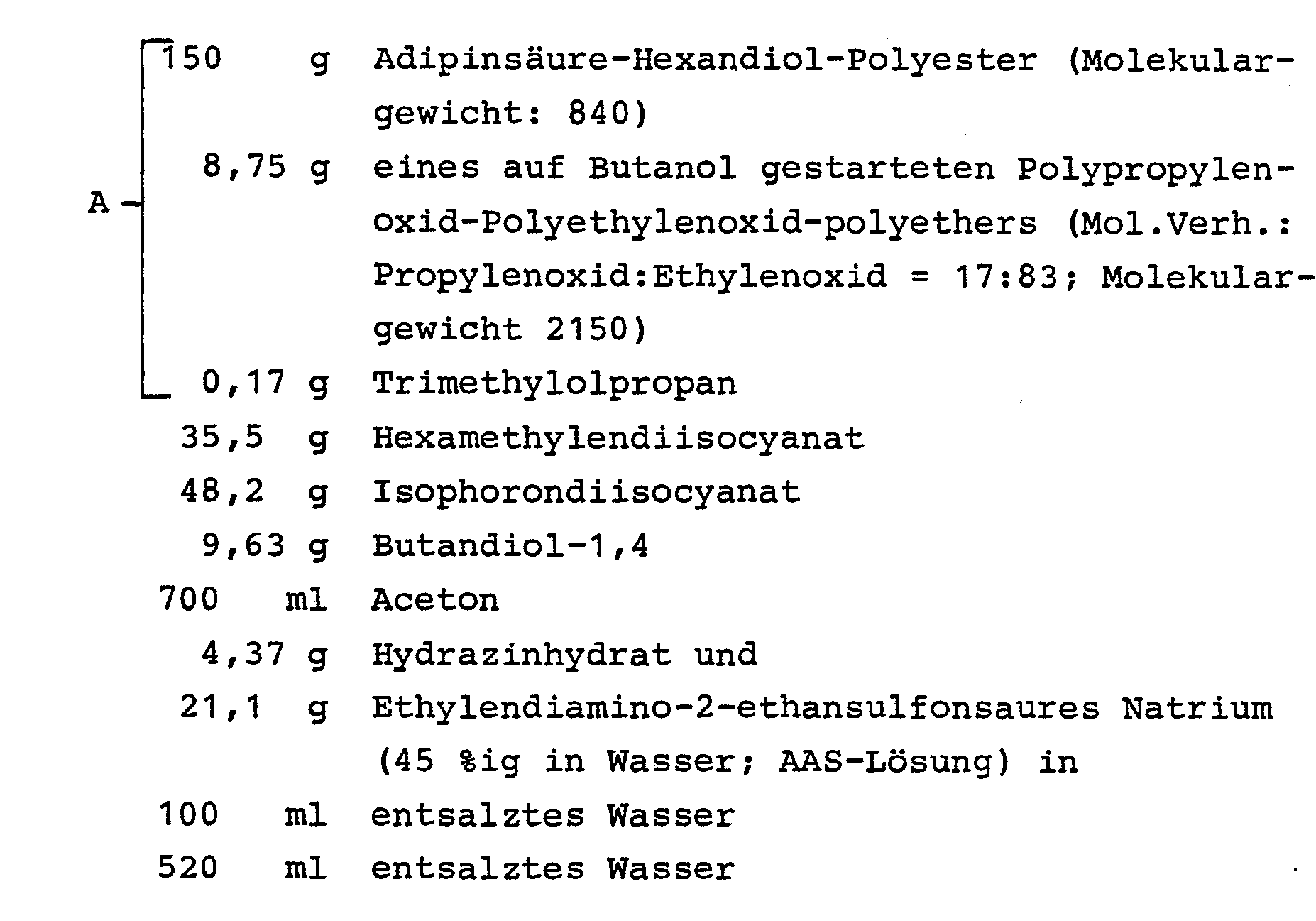
- Durchführung:
- Die Durchführung erfolgt im wesentlichen entsprechend Beispiel 1. Es wird ein NCO-Präpolymer erhalten mit einem NCO-Wert von 4,6 %, welches in Abwandlung zu Beispiel 1 mit Hydrazinhydrat und AAS-Lösung, zusammen in 100 ml Wasser, verlängert wird. Es entsteht eine feinteilige Dispersion mit einem Feststoffgehalt von 32 % und einer Fordbecherviskosität (4 mm Düse) von 78 sek.
- Ansatz:

- Durchführung:
- Die Durchführung erfolgt im wesentlichen entsprechend Beispiel 1. Es wird ein NCO-Prepolymer erhalten mit einem NCO-Wert von 4,1 %, welches in Abwandlung zu Beispiel 1 nur mit Hydrazinhydrat verlängert wird. Es entsteht eine feinteilige Dispersion mit einem Feststoffgehalt von 42 % und einer Fordbecherviskosität (4 mm Düse) von 21,5 sek.
- Ansatz:

- Durchführung:
- Vgl. Beispiel 1 (der konstante NCO-Wert stellt sich bei 4,23 % ein)
- Es entsteht eine feinteilige Dispersion mit einem Feststoffgehalt von 41,36 % und einer Viskosität von 37 sek. (Fordbecher, 4 mm Düse).
- Ansatz:

- Durchführung:
- Vgl. Beispiel 1 (der konstante NCO-Wert stellt sich bei 2,93 % ein).
- Es entsteht eine feinteilige Dispersion mit einem Feststoffgehalt von 31,7 % und einer Viskosität von 17,7 sek. (Ford-Becher, 4 mm Düse).
- Ansatz

- Durchführung
- Vgl. Beispiel 1 (der konstante NCO-Wert stellt sich bei 1,75 % ein)
- Es entsteht eine feinteilige Dispersion mit einem Feststoffgehalt von 33 % und einer Viskosität von 12 sek. (Ford-Becher, 4 mm Düse).
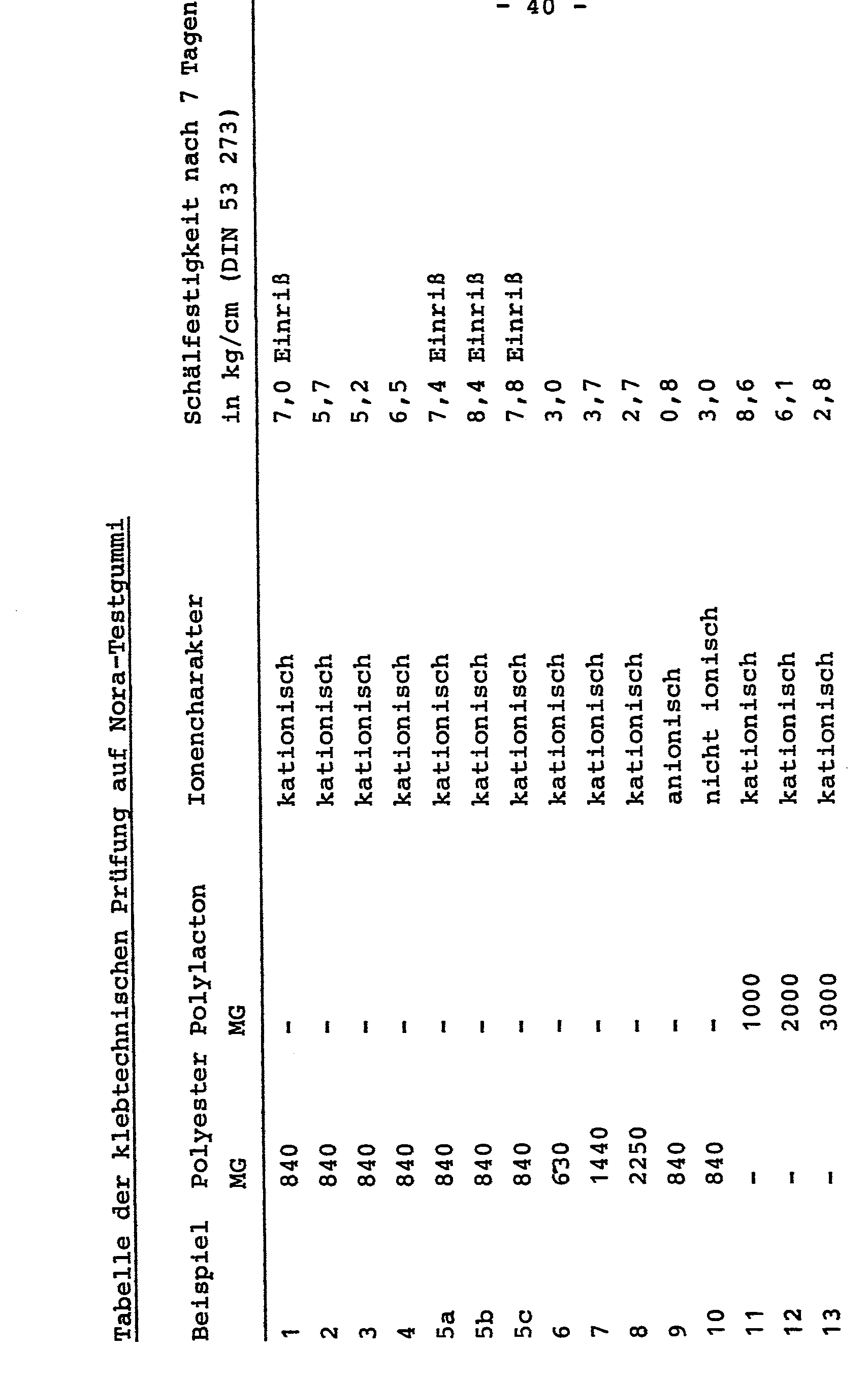
und/oder
erhalten wird.
wobei
dadurch gekennzeichnet, daß man als Komponente b1) Polyesterpolyole verwendet, die zu mindestens 50 Hydroxyläquivalent-% aus Dicarbonsäurepolyesterpolyolen des Molekulargewichtsbereichs 700 bis 1400 und/oder Homo- oder Mischpolymerisaten von Lactonen mit endständigen Hydroxylgruppen und einem Molekulargewicht von 700 bis 2500 bestehen.
Claims (6)
und/oder
unter Einhaltung eines NCO/OH-Äquivalentverhältnisses von 1,2:1 bis 2,5:1 und anschließende Kettenverlängerung der so erhaltenen, Isocyanatgruppen aufweisenden Prepolymeren mit .
wobei
dadurch gekennzeichnet, daß man als Komponente b1) Polyesterpolyole verwendet, die zu mindestens 50 Hydroxyläquivalent-% aus Dicarbonsäurepolyesterpolyolen des Molekulargewichtsbereichs 700 bis 1400 und/oder Homo- oder Mischpolymerisaten von Lactonen mit endständigen Hydroxylgruppen und einem Molekulargewicht von 700 bis 2500 bestehen.
Applications Claiming Priority (2)
| Application Number | Priority Date | Filing Date | Title |
|---|---|---|---|
| DE3344693 | 1983-12-10 | ||
| DE19833344693 DE3344693A1 (de) | 1983-12-10 | 1983-12-10 | Waessrige loesungen oder dispersionen von polyisocyanat-polyadditionsprodukten, ein verfahren zu ihrer herstellung, sowie ihre verwendung als bzw. zur herstellung von klebemittel |
Publications (2)
| Publication Number | Publication Date |
|---|---|
| EP0148392A1 true EP0148392A1 (de) | 1985-07-17 |
| EP0148392B1 EP0148392B1 (de) | 1987-09-16 |
Family
ID=6216578
Family Applications (1)
| Application Number | Title | Priority Date | Filing Date |
|---|---|---|---|
| EP84114310A Expired EP0148392B1 (de) | 1983-12-10 | 1984-11-27 | Verwendung von Polyisocyanat-Polyadditionsprodukten als bzw.zur Herstellung von Klebemitteln |
Country Status (5)
| Country | Link |
|---|---|
| US (1) | US4623416A (de) |
| EP (1) | EP0148392B1 (de) |
| JP (1) | JPH0621143B2 (de) |
| CA (1) | CA1250686A (de) |
| DE (2) | DE3344693A1 (de) |
Cited By (5)
| Publication number | Priority date | Publication date | Assignee | Title |
|---|---|---|---|---|
| EP0259679A1 (de) * | 1986-09-04 | 1988-03-16 | Bayer Ag | Klebbstoff und die Verwendung des Klebstoffs zur Herstellung von Verklebungen |
| EP0272566A3 (en) * | 1986-12-20 | 1989-03-15 | Basf Aktiengesellschaft | Aqueous polyurethane adhesive dispersions |
| EP0422080A4 (en) * | 1988-06-24 | 1992-03-11 | The Dow Chemical Company | The use of monohydric alcohols in molded polyurethane resins |
| EP0596503A1 (de) * | 1992-11-06 | 1994-05-11 | Sakata Inx Corporation | Polyurethanharze, deren Herstellungsverfahren und Verwendung |
| EP2363444A1 (de) | 2006-06-15 | 2011-09-07 | Dow Global Technologies LLC | Funktionalisierte Olefin-Interpolymere, daraus hergestellte Zusammensetzungen und Artikel sowie Herstellungsverfahren dafür |
Families Citing this family (13)
| Publication number | Priority date | Publication date | Assignee | Title |
|---|---|---|---|---|
| DE3523856A1 (de) * | 1985-07-04 | 1987-01-08 | Bayer Ag | Waessrige loesungen oder dispersionen von polyisocyanat-additionsprodukten, ein verfahren zu ihrer herstellung, sowie ihre verwendung als beschichtungsmittel oder als leimungsmittel fuer papier |
| US4851459A (en) * | 1987-12-18 | 1989-07-25 | Century Adhesives Corp. | Aqueous peroxy carbamyl group containing polymer systems and methods of their production and use |
| US5532058A (en) * | 1990-12-10 | 1996-07-02 | H. B. Fuller Licensing & Financing, Inc. | Dry-bonded film laminate employing polyurethane dispersion adhesives with improved crosslinkers |
| US5256227A (en) * | 1991-05-09 | 1993-10-26 | Minnesota Mining And Manufacturing Company | Method of splicing endless abrasive belts and cones |
| AT396245B (de) * | 1991-07-12 | 1993-07-26 | Vianova Kunstharz Ag | Verfahren zur herstellung von wasserverduennbaren lackbindemitteln und deren verwendung |
| DE4125454A1 (de) * | 1991-08-01 | 1993-02-04 | Bayer Ag | Beschichtungsmittel und ihre verwendung zur erzeugung wasserdampfdurchlaessiger beschichtungen |
| JP3521927B2 (ja) * | 1993-02-03 | 2004-04-26 | 大日本インキ化学工業株式会社 | 水性プリントラミネート接着剤組成物およびプリントラミネート方法 |
| US5872182A (en) * | 1994-09-09 | 1999-02-16 | H. B. Fuller Licensing & Financing, Inc. | Water-based polyurethanes for footwear |
| US5616400A (en) * | 1995-11-20 | 1997-04-01 | Century International Adhesives & Coating Corporation | Cold seal adhesives, cold sealable films and packages formed therewith |
| US6156424A (en) * | 1997-10-31 | 2000-12-05 | Andover Coated Products, Inc. | Cohesive products |
| US6162863A (en) * | 1997-12-04 | 2000-12-19 | Henkel Kommanditgesellschaft Auf Aktien | Waterborne polyurethanes with urea-urethane linkages |
| JP2003012748A (ja) * | 2001-06-28 | 2003-01-15 | Daicel Chem Ind Ltd | 水系紫外線吸収性樹脂エマルション及びその製造方法並びにエマルション樹脂組成物 |
| US20060063455A1 (en) * | 2004-09-21 | 2006-03-23 | Andover Coated Products, Inc. | Hand-tearable non-elastic tape |
Citations (7)
| Publication number | Priority date | Publication date | Assignee | Title |
|---|---|---|---|---|
| FR1498317A (fr) * | 1965-04-24 | 1967-10-20 | Bayer Ag | Procédé pour la préparation de fils et de fibres ayant l'élasticité du caoutchouc et une affinité tinctoriale améliorée |
| BE717432A (de) * | 1968-04-20 | 1968-12-16 | ||
| GB1191260A (en) * | 1968-05-17 | 1970-05-13 | Bayer Ag | Bonding Vinyl Chloride Polymer Resins by Polyurethanes |
| DE2624442A1 (de) * | 1975-06-02 | 1976-12-09 | Ppg Industries Inc | Wasserhaltige dispersionen |
| EP0006204A1 (de) * | 1978-06-21 | 1980-01-09 | Bayer Ag | Wässrige Dispersionen von oligomeren oder polymeren Kunststoffen, ein Verfahren zu ihrer Herstellung sowie ihre Verwendung |
| GB2104085A (en) * | 1981-07-24 | 1983-03-02 | Mobay Chemical Corp | Stable colloidal aqueous dispersions of cross-linked urea urethane polymers and their method of production |
| DE3139966A1 (de) * | 1981-10-08 | 1983-04-28 | Bayer Ag, 5090 Leverkusen | Verfahren zur herstellung von waessrigen dispersionen oder loesungen von polyurethanen, sowie deren verwendung zur herstellung von ueberzuegen und beschichtungen |
Family Cites Families (23)
| Publication number | Priority date | Publication date | Assignee | Title |
|---|---|---|---|---|
| DE880485C (de) * | 1944-07-02 | 1953-06-22 | Bayer Ag | Verfahren zur Herstellung von Hochpolymeren |
| DE1044404B (de) * | 1957-02-23 | 1958-11-20 | Hoechst Ag | Verfahren zur Herstellung polyfunktioneller anionaktiver hochmolekularer Polyurethane |
| DE1134946B (de) * | 1957-08-16 | 1962-08-23 | Karl Otto Dipl Ing | Vorrichtung zum Verschliessen des Bohrloches fuer das Stosstraenken, Traenkschiessen oder als Besatz |
| US3036998A (en) * | 1959-05-25 | 1962-05-29 | Grace W R & Co | Polymeric hydrazinium salts |
| BE640789A (de) * | 1962-12-05 | |||
| DE1495745C3 (de) * | 1963-09-19 | 1978-06-01 | Bayer Ag, 5090 Leverkusen | Verfahren zur Herstellung wäßriger, emulgatorfreier Polyurethan-Latices |
| DE1237306B (de) * | 1964-09-26 | 1967-03-23 | Bayer Ag | Verfahren zur Herstellung von Polyurethankunststoffen |
| DE1494610A1 (de) * | 1965-04-24 | 1969-12-04 | Bayer Ag | Verfahren zur Herstellung gummielastischer Faeden und Fasern mit verbesserter Anfaerbbarkeit |
| DE1595603A1 (de) * | 1966-03-12 | 1970-05-14 | Bayer Ag | Stabilisierte Polyamide |
| DE1770068C3 (de) * | 1968-03-27 | 1981-01-15 | Bayer Ag, 5090 Leverkusen | Verfahren zur Herstellung von Polyurethanen Bayer AG, 5090 Leverkusen |
| DE2019324C3 (de) * | 1970-04-22 | 1979-02-22 | Bayer Ag, 5090 Leverkusen | Verfahren zur Herstellung von lichtechten Polyurethanionomeren |
| DE2035732A1 (de) * | 1970-07-18 | 1972-01-27 | Farbenfabriken Bayer AG, 5090 Le verkusen | N (Omega Ammo a/kan) Omega ammo a/kan sulfonsaure salze und ihre Verwendung als anio nische Aufbaukomponente bei der Herstellung von emulgatorfreien Polyurethandispersionen |
| US4108814A (en) * | 1974-09-28 | 1978-08-22 | Bayer Aktiengesellschaft | Aqueous polyurethane dispersions from solvent-free prepolymers using sulfonate diols |
| DE2651505A1 (de) * | 1976-11-11 | 1978-05-24 | Bayer Ag | Kationische elektrolytstabile dispersionen |
| US4066591A (en) * | 1975-06-02 | 1978-01-03 | Ppg Industries, Inc. | Water-reduced urethane coating compositions |
| DE2551094A1 (de) * | 1975-11-14 | 1977-05-26 | Bayer Ag | Verfahren zur herstellung von in wasser dispergierbaren polyurethanen |
| DE2651506C2 (de) * | 1976-11-11 | 1986-04-30 | Bayer Ag, 5090 Leverkusen | Verfahren zur Herstellung von in Wasser dispergierbaren Polyurethanen |
| DE2659617A1 (de) * | 1976-12-30 | 1978-07-06 | Bayer Ag | Elektrolyte enthaltende ionomer- dispersionen |
| DE2804609A1 (de) * | 1978-02-03 | 1979-08-09 | Bayer Ag | Waessrige loesungen oder dispersionen von polyisocyanat-polyadditionsprodukten, ein verfahren zu ihrer herstellung, sowie ihre verwendung als klebemittel |
| DE2804603C2 (de) * | 1978-02-03 | 1982-01-14 | Fa. Wilhelm Dörrenhaus, 5620 Velbert | Riegelblockiervorrichtung in einem Schloß mit schlüsselbetätigbarer Zuhaltung |
| DE3134161A1 (de) * | 1981-08-28 | 1983-08-11 | Bayer Ag, 5090 Leverkusen | Ueberzugsmittel aus polyurethan-dispersionen und ihre verwendung fuer deckstriche und finishs |
| DE3210051A1 (de) * | 1982-03-19 | 1983-09-29 | Basf Farben + Fasern Ag, 2000 Hamburg | Wasserverduennbares ueberzugsmittel zur herstellung der basisschicht eines mehrschichtueberzuges |
| US4540633A (en) * | 1983-04-20 | 1985-09-10 | Textron, Inc. | Water dispersible polyurethane adhesive compositions and adhesive layer formed therefrom |
-
1983
- 1983-12-10 DE DE19833344693 patent/DE3344693A1/de not_active Withdrawn
-
1984
- 1984-11-26 US US06/675,042 patent/US4623416A/en not_active Expired - Fee Related
- 1984-11-27 EP EP84114310A patent/EP0148392B1/de not_active Expired
- 1984-11-27 DE DE8484114310T patent/DE3466229D1/de not_active Expired
- 1984-12-06 CA CA000469504A patent/CA1250686A/en not_active Expired
- 1984-12-10 JP JP59259443A patent/JPH0621143B2/ja not_active Expired - Lifetime
Patent Citations (7)
| Publication number | Priority date | Publication date | Assignee | Title |
|---|---|---|---|---|
| FR1498317A (fr) * | 1965-04-24 | 1967-10-20 | Bayer Ag | Procédé pour la préparation de fils et de fibres ayant l'élasticité du caoutchouc et une affinité tinctoriale améliorée |
| BE717432A (de) * | 1968-04-20 | 1968-12-16 | ||
| GB1191260A (en) * | 1968-05-17 | 1970-05-13 | Bayer Ag | Bonding Vinyl Chloride Polymer Resins by Polyurethanes |
| DE2624442A1 (de) * | 1975-06-02 | 1976-12-09 | Ppg Industries Inc | Wasserhaltige dispersionen |
| EP0006204A1 (de) * | 1978-06-21 | 1980-01-09 | Bayer Ag | Wässrige Dispersionen von oligomeren oder polymeren Kunststoffen, ein Verfahren zu ihrer Herstellung sowie ihre Verwendung |
| GB2104085A (en) * | 1981-07-24 | 1983-03-02 | Mobay Chemical Corp | Stable colloidal aqueous dispersions of cross-linked urea urethane polymers and their method of production |
| DE3139966A1 (de) * | 1981-10-08 | 1983-04-28 | Bayer Ag, 5090 Leverkusen | Verfahren zur herstellung von waessrigen dispersionen oder loesungen von polyurethanen, sowie deren verwendung zur herstellung von ueberzuegen und beschichtungen |
Cited By (7)
| Publication number | Priority date | Publication date | Assignee | Title |
|---|---|---|---|---|
| EP0259679A1 (de) * | 1986-09-04 | 1988-03-16 | Bayer Ag | Klebbstoff und die Verwendung des Klebstoffs zur Herstellung von Verklebungen |
| EP0272566A3 (en) * | 1986-12-20 | 1989-03-15 | Basf Aktiengesellschaft | Aqueous polyurethane adhesive dispersions |
| EP0422080A4 (en) * | 1988-06-24 | 1992-03-11 | The Dow Chemical Company | The use of monohydric alcohols in molded polyurethane resins |
| EP0596503A1 (de) * | 1992-11-06 | 1994-05-11 | Sakata Inx Corporation | Polyurethanharze, deren Herstellungsverfahren und Verwendung |
| US5656701A (en) * | 1992-11-06 | 1997-08-12 | Sakata Inx Corp. | Polyurethane resins, process for producing the same, and uses thereof |
| EP0931802A1 (de) * | 1992-11-06 | 1999-07-28 | Sakata Inx Corporation | Polyurethanharz, dessen Herstellungsverfahren und seine Verwendung |
| EP2363444A1 (de) | 2006-06-15 | 2011-09-07 | Dow Global Technologies LLC | Funktionalisierte Olefin-Interpolymere, daraus hergestellte Zusammensetzungen und Artikel sowie Herstellungsverfahren dafür |
Also Published As
| Publication number | Publication date |
|---|---|
| DE3344693A1 (de) | 1985-06-20 |
| US4623416A (en) | 1986-11-18 |
| JPH0621143B2 (ja) | 1994-03-23 |
| JPS60141711A (ja) | 1985-07-26 |
| EP0148392B1 (de) | 1987-09-16 |
| DE3466229D1 (en) | 1987-10-22 |
| CA1250686A (en) | 1989-02-28 |
Similar Documents
| Publication | Publication Date | Title |
|---|---|---|
| EP0304718B1 (de) | Wässrige Lösungen und Dispersionen von Polyisocyanat-Polyadditionsprodukten, ein Verfahren zur Herstellung der wässrigen Lösungen und Dispersionen sowie ihre Verwendung als Klebstoff | |
| EP0148392B1 (de) | Verwendung von Polyisocyanat-Polyadditionsprodukten als bzw.zur Herstellung von Klebemitteln | |
| EP0272566B1 (de) | Wässrige Polyurethan-Klebstoff-Dispersionen | |
| EP0000029B1 (de) | Verfahren zur Herstellung von wässrigen Polyurethan-Dispersionen und -Lösungen und deren Verwendung zur Beschichtung von flexiblen Substraten | |
| EP0009760B1 (de) | Verfahren zur Herstellung von wässrigen Dispersionen oder Lösungen von Polyurethan-Polyharnstoffen sowie ihre Verwendung | |
| EP0392352B1 (de) | Wässrige Dispersionen von durch Einwirkung von energiereicher Strahlung vernetzbaren Polyurethanen | |
| EP0526472B1 (de) | Haushaltsalleskleber auf polyurethanbasis | |
| EP0269972B2 (de) | Verfahren zur Herstellung von in Wasser löslichen oder dispergierbaren Polyurethanen und ihre Verwendung zur Beschichtung beliebiger Substrate | |
| EP0794204B1 (de) | Latent vernetzende wässerige Polyurethandispersionen | |
| DE2659617C2 (de) | ||
| DE2651505A1 (de) | Kationische elektrolytstabile dispersionen | |
| DE3630045A1 (de) | Klebstoff und die verwendung des klebstoffs zur herstellung von verklebungen | |
| DE3831169A1 (de) | Waessrige dispersionen | |
| DE3831170A1 (de) | Waessrige dispersionen | |
| EP0004069A1 (de) | Verfahren zur Herstellung von wässrigen Lösungen oder Dispersionen von Polyurethanen sowie ihre Verwendung zur Herstellung von Überzügen, Lacken oder Beschichtungen | |
| DE4137247A1 (de) | Verdickungsmittel auf polyurethanbasis | |
| DE10152405A1 (de) | Wässrige Dispersion von Polyurethanharzen und wässrige Klebstoffe | |
| EP1845120B2 (de) | Wässrige polyurethan-Dispersionen mit verbesserter Lagerstabilität | |
| EP0640119B1 (de) | Verwendung einer wässrigen dispersion oder lösung eines polyurethans als basis für einen lagerstabilen kontaktklebstoff | |
| EP0807648A2 (de) | Latent vernetzende wässerige Polyurethandispersionen | |
| DE2804609A1 (de) | Waessrige loesungen oder dispersionen von polyisocyanat-polyadditionsprodukten, ein verfahren zu ihrer herstellung, sowie ihre verwendung als klebemittel | |
| DE102004023768A1 (de) | Wässrige Polyurethan-Dispersionen und ihre Verwendung als Klebstoff | |
| EP0354471A1 (de) | Verwendung von wässrigen Polyurethan-Dispersionen als Haushaltsalleskleber sowie deren Herstellung | |
| EP0538649B1 (de) | Modifizierte Polyharnstoffe | |
| EP0506697B1 (de) | Haushaltsalleskleber auf polyurethanbasis |
Legal Events
| Date | Code | Title | Description |
|---|---|---|---|
| PUAI | Public reference made under article 153(3) epc to a published international application that has entered the european phase |
Free format text: ORIGINAL CODE: 0009012 |
|
| 17P | Request for examination filed |
Effective date: 19841127 |
|
| AK | Designated contracting states |
Designated state(s): DE FR GB NL |
|
| 17Q | First examination report despatched |
Effective date: 19860228 |
|
| GRAA | (expected) grant |
Free format text: ORIGINAL CODE: 0009210 |
|
| AK | Designated contracting states |
Kind code of ref document: B1 Designated state(s): DE FR GB NL |
|
| REF | Corresponds to: |
Ref document number: 3466229 Country of ref document: DE Date of ref document: 19871022 |
|
| ET | Fr: translation filed | ||
| GBT | Gb: translation of ep patent filed (gb section 77(6)(a)/1977) | ||
| PLBE | No opposition filed within time limit |
Free format text: ORIGINAL CODE: 0009261 |
|
| STAA | Information on the status of an ep patent application or granted ep patent |
Free format text: STATUS: NO OPPOSITION FILED WITHIN TIME LIMIT |
|
| 26N | No opposition filed | ||
| PGFP | Annual fee paid to national office [announced via postgrant information from national office to epo] |
Ref country code: DE Payment date: 19931013 Year of fee payment: 10 |
|
| PGFP | Annual fee paid to national office [announced via postgrant information from national office to epo] |
Ref country code: GB Payment date: 19931117 Year of fee payment: 10 Ref country code: FR Payment date: 19931117 Year of fee payment: 10 |
|
| PGFP | Annual fee paid to national office [announced via postgrant information from national office to epo] |
Ref country code: NL Payment date: 19931130 Year of fee payment: 10 |
|
| PG25 | Lapsed in a contracting state [announced via postgrant information from national office to epo] |
Ref country code: GB Effective date: 19941127 |
|
| PG25 | Lapsed in a contracting state [announced via postgrant information from national office to epo] |
Ref country code: NL Effective date: 19950601 |
|
| NLV4 | Nl: lapsed or anulled due to non-payment of the annual fee | ||
| GBPC | Gb: european patent ceased through non-payment of renewal fee |
Effective date: 19941127 |
|
| PG25 | Lapsed in a contracting state [announced via postgrant information from national office to epo] |
Ref country code: FR Effective date: 19950731 |
|
| PG25 | Lapsed in a contracting state [announced via postgrant information from national office to epo] |
Ref country code: DE Effective date: 19950801 |
|
| REG | Reference to a national code |
Ref country code: FR Ref legal event code: ST |