EP0148656B1 - Nouveaux oxydes mixtes pour lasers accordables - Google Patents
Nouveaux oxydes mixtes pour lasers accordables Download PDFInfo
- Publication number
- EP0148656B1 EP0148656B1 EP84402342A EP84402342A EP0148656B1 EP 0148656 B1 EP0148656 B1 EP 0148656B1 EP 84402342 A EP84402342 A EP 84402342A EP 84402342 A EP84402342 A EP 84402342A EP 0148656 B1 EP0148656 B1 EP 0148656B1
- Authority
- EP
- European Patent Office
- Prior art keywords
- formula
- mixed oxide
- tunable laser
- accordance
- chosen
- Prior art date
- Legal status (The legal status is an assumption and is not a legal conclusion. Google has not performed a legal analysis and makes no representation as to the accuracy of the status listed.)
- Expired
Links
Images


Classifications
-
- H—ELECTRICITY
- H01—ELECTRIC ELEMENTS
- H01S—DEVICES USING THE PROCESS OF LIGHT AMPLIFICATION BY STIMULATED EMISSION OF RADIATION [LASER] TO AMPLIFY OR GENERATE LIGHT; DEVICES USING STIMULATED EMISSION OF ELECTROMAGNETIC RADIATION IN WAVE RANGES OTHER THAN OPTICAL
- H01S3/00—Lasers, i.e. devices using stimulated emission of electromagnetic radiation in the infrared, visible or ultraviolet wave range
- H01S3/14—Lasers, i.e. devices using stimulated emission of electromagnetic radiation in the infrared, visible or ultraviolet wave range characterised by the material used as the active medium
- H01S3/16—Solid materials
- H01S3/1688—Stoichiometric laser compounds, i.e. in which the active element forms one component of a stoichiometric formula rather than being merely a dopant
-
- C—CHEMISTRY; METALLURGY
- C01—INORGANIC CHEMISTRY
- C01B—NON-METALLIC ELEMENTS; COMPOUNDS THEREOF; METALLOIDS OR COMPOUNDS THEREOF NOT COVERED BY SUBCLASS C01C
- C01B19/00—Selenium; Tellurium; Compounds thereof
- C01B19/002—Compounds containing, besides selenium or tellurium, more than one other element, with -O- and -OH not being considered as anions
-
- C—CHEMISTRY; METALLURGY
- C01—INORGANIC CHEMISTRY
- C01B—NON-METALLIC ELEMENTS; COMPOUNDS THEREOF; METALLOIDS OR COMPOUNDS THEREOF NOT COVERED BY SUBCLASS C01C
- C01B25/00—Phosphorus; Compounds thereof
- C01B25/16—Oxyacids of phosphorus; Salts thereof
- C01B25/26—Phosphates
- C01B25/45—Phosphates containing plural metal, or metal and ammonium
-
- C—CHEMISTRY; METALLURGY
- C01—INORGANIC CHEMISTRY
- C01B—NON-METALLIC ELEMENTS; COMPOUNDS THEREOF; METALLOIDS OR COMPOUNDS THEREOF NOT COVERED BY SUBCLASS C01C
- C01B33/00—Silicon; Compounds thereof
- C01B33/20—Silicates
-
- C—CHEMISTRY; METALLURGY
- C01—INORGANIC CHEMISTRY
- C01F—COMPOUNDS OF THE METALS BERYLLIUM, MAGNESIUM, ALUMINIUM, CALCIUM, STRONTIUM, BARIUM, RADIUM, THORIUM, OR OF THE RARE-EARTH METALS
- C01F7/00—Compounds of aluminium
- C01F7/02—Aluminium oxide; Aluminium hydroxide; Aluminates
-
- C—CHEMISTRY; METALLURGY
- C01—INORGANIC CHEMISTRY
- C01G—COMPOUNDS CONTAINING METALS NOT COVERED BY SUBCLASSES C01D OR C01F
- C01G31/00—Compounds of vanadium
- C01G31/006—Compounds containing vanadium, with or without oxygen or hydrogen, and containing two or more other elements
-
- C—CHEMISTRY; METALLURGY
- C01—INORGANIC CHEMISTRY
- C01G—COMPOUNDS CONTAINING METALS NOT COVERED BY SUBCLASSES C01D OR C01F
- C01G39/00—Compounds of molybdenum
- C01G39/006—Compounds containing molybdenum, with or without oxygen or hydrogen, and containing two or more other elements
-
- C—CHEMISTRY; METALLURGY
- C01—INORGANIC CHEMISTRY
- C01G—COMPOUNDS CONTAINING METALS NOT COVERED BY SUBCLASSES C01D OR C01F
- C01G45/00—Compounds of manganese
- C01G45/20—Compounds containing manganese, with or without oxygen or hydrogen, and containing one or more other elements
- C01G45/22—Compounds containing manganese, with or without oxygen or hydrogen, and containing two or more other elements
-
- C—CHEMISTRY; METALLURGY
- C01—INORGANIC CHEMISTRY
- C01G—COMPOUNDS CONTAINING METALS NOT COVERED BY SUBCLASSES C01D OR C01F
- C01G51/00—Compounds of cobalt
- C01G51/80—Compounds containing cobalt, with or without oxygen or hydrogen, and containing one or more other elements
- C01G51/82—Compounds containing cobalt, with or without oxygen or hydrogen, and containing two or more other elements
-
- C—CHEMISTRY; METALLURGY
- C01—INORGANIC CHEMISTRY
- C01G—COMPOUNDS CONTAINING METALS NOT COVERED BY SUBCLASSES C01D OR C01F
- C01G53/00—Compounds of nickel
- C01G53/80—Compounds containing nickel, with or without oxygen or hydrogen, and containing one or more other elements
- C01G53/82—Compounds containing nickel, with or without oxygen or hydrogen, and containing two or more other elements
-
- C—CHEMISTRY; METALLURGY
- C30—CRYSTAL GROWTH
- C30B—SINGLE-CRYSTAL GROWTH; UNIDIRECTIONAL SOLIDIFICATION OF EUTECTIC MATERIAL OR UNIDIRECTIONAL DEMIXING OF EUTECTOID MATERIAL; REFINING BY ZONE-MELTING OF MATERIAL; PRODUCTION OF A HOMOGENEOUS POLYCRYSTALLINE MATERIAL WITH DEFINED STRUCTURE; SINGLE CRYSTALS OR HOMOGENEOUS POLYCRYSTALLINE MATERIAL WITH DEFINED STRUCTURE; AFTER-TREATMENT OF SINGLE CRYSTALS OR A HOMOGENEOUS POLYCRYSTALLINE MATERIAL WITH DEFINED STRUCTURE; APPARATUS THEREFOR
- C30B15/00—Single-crystal growth by pulling from a melt, e.g. Czochralski method
-
- C—CHEMISTRY; METALLURGY
- C30—CRYSTAL GROWTH
- C30B—SINGLE-CRYSTAL GROWTH; UNIDIRECTIONAL SOLIDIFICATION OF EUTECTIC MATERIAL OR UNIDIRECTIONAL DEMIXING OF EUTECTOID MATERIAL; REFINING BY ZONE-MELTING OF MATERIAL; PRODUCTION OF A HOMOGENEOUS POLYCRYSTALLINE MATERIAL WITH DEFINED STRUCTURE; SINGLE CRYSTALS OR HOMOGENEOUS POLYCRYSTALLINE MATERIAL WITH DEFINED STRUCTURE; AFTER-TREATMENT OF SINGLE CRYSTALS OR A HOMOGENEOUS POLYCRYSTALLINE MATERIAL WITH DEFINED STRUCTURE; APPARATUS THEREFOR
- C30B29/00—Single crystals or homogeneous polycrystalline material with defined structure characterised by the material or by their shape
- C30B29/10—Inorganic compounds or compositions
- C30B29/16—Oxides
- C30B29/22—Complex oxides
- C30B29/26—Complex oxides with formula BMe2O4, wherein B is Mg, Ni, Co, Al, Zn, or Cd and Me is Fe, Ga, Sc, Cr, Co, or Al
-
- C—CHEMISTRY; METALLURGY
- C01—INORGANIC CHEMISTRY
- C01P—INDEXING SCHEME RELATING TO STRUCTURAL AND PHYSICAL ASPECTS OF SOLID INORGANIC COMPOUNDS
- C01P2002/00—Crystal-structural characteristics
- C01P2002/30—Three-dimensional structures
- C01P2002/32—Three-dimensional structures spinel-type (AB2O4)
-
- C—CHEMISTRY; METALLURGY
- C01—INORGANIC CHEMISTRY
- C01P—INDEXING SCHEME RELATING TO STRUCTURAL AND PHYSICAL ASPECTS OF SOLID INORGANIC COMPOUNDS
- C01P2002/00—Crystal-structural characteristics
- C01P2002/50—Solid solutions
- C01P2002/52—Solid solutions containing elements as dopants
-
- C—CHEMISTRY; METALLURGY
- C01—INORGANIC CHEMISTRY
- C01P—INDEXING SCHEME RELATING TO STRUCTURAL AND PHYSICAL ASPECTS OF SOLID INORGANIC COMPOUNDS
- C01P2002/00—Crystal-structural characteristics
- C01P2002/50—Solid solutions
- C01P2002/52—Solid solutions containing elements as dopants
- C01P2002/54—Solid solutions containing elements as dopants one element only
-
- C—CHEMISTRY; METALLURGY
- C01—INORGANIC CHEMISTRY
- C01P—INDEXING SCHEME RELATING TO STRUCTURAL AND PHYSICAL ASPECTS OF SOLID INORGANIC COMPOUNDS
- C01P2002/00—Crystal-structural characteristics
- C01P2002/80—Crystal-structural characteristics defined by measured data other than those specified in group C01P2002/70
- C01P2002/84—Crystal-structural characteristics defined by measured data other than those specified in group C01P2002/70 by UV- or VIS- data
-
- C—CHEMISTRY; METALLURGY
- C01—INORGANIC CHEMISTRY
- C01P—INDEXING SCHEME RELATING TO STRUCTURAL AND PHYSICAL ASPECTS OF SOLID INORGANIC COMPOUNDS
- C01P2006/00—Physical properties of inorganic compounds
- C01P2006/32—Thermal properties
- C01P2006/33—Phase transition temperatures
- C01P2006/34—Melting temperatures
-
- C—CHEMISTRY; METALLURGY
- C01—INORGANIC CHEMISTRY
- C01P—INDEXING SCHEME RELATING TO STRUCTURAL AND PHYSICAL ASPECTS OF SOLID INORGANIC COMPOUNDS
- C01P2006/00—Physical properties of inorganic compounds
- C01P2006/60—Optical properties, e.g. expressed in CIELAB-values
Definitions
- the present invention relates to new mixed oxides for tunable lasers.
- transition metal ions such as Cr 3+ , V 2+ , Ni 2+ and CO 2+ as doping ions in oxides such as MgO and Be A1 2 0 4 and fluorides such as MgF 2 , ZnF 2 and KZnF 3 .
- oxides such as MgO and Be A1 2 0 4
- fluorides such as MgF 2 , ZnF 2 and KZnF 3 .
- the article “Tunable alexandrite lasers by Walling et Col. in IEEE. J. Quantum Electron Vol. QE-16 n ° 12 p. 1302-1314 (1980) illustrates solid lasers tunable in the range from 0.7 to 0.82 ⁇ m obtained by doping BeA1 2 0 4 with Cr 3+.
- Tunable lasers in the range of 1.85 to 2.05 ⁇ m are also known, which consist of KZnF 3 doped with Co2 + as described in “CW IR laser action of optically pumped CO 2+ : KZnF 3 by W. Kunzel et al., Optics Communications, vol. 36, n ° 5, p. 383-386 (1981).
- V 2+ in MgF 2 has a pattern of energy levels such that the laser emission is reabsorbed from the excited level emitting the laser effect. Also, products containing V 2+ in fluorinated matrices are difficult to use.
- the present invention specifically relates to tunable solid lasers using new mixed oxides to cover the region of wavelengths ranging from 1 to 1.8 ⁇ m, these oxides also having the advantage of having melting temperatures at more than 2000 ° C.
- the element B represents a trivalent element chosen from AI, In and Ga, which can be partially replaced by an optically active trivalent cation such as Cr, V and Ni.
- the mixed oxide corresponds to the formula:
- element B of the general formula represents a tetravalent element chosen from Si, Ge, W, Mo and Te and, in this case only element A of the general formula is replaced partly by an optically active bivalent cation.
- the mixed oxide corresponds to the formula:
- the element B consists of a hexavalent element chosen from W and Mo.
- the mixed oxide corresponds to the formula.
- the mixed oxides corresponding to the above-mentioned formulas have a crystalline field measured according to the Tanabe and Sugano method such that Dq / B is at most equal to 1.8.
- Information on the Tanabe and Sugano method can be found in particular in: "Solid State Physics •, vol. 9 F. SEITZ and D. TURNBULL - Ac-Press p. 399 (1959).
- the mixed oxides of the invention can be prepared by conventional methods, for example, by thoroughly mixing the desired quantities of oxide powders or salts of A, X, B and Y and then calcining the mixture obtained.
- These mixed oxides can also be obtained by coprecipitating hydroxides of A, X, B and Y from a solution of their salts in a solvent and then calcining the coprecipitate obtained.
- the mixed oxide is made from a mixture of oxide powders, it is possible to intimately mix the powders in the solid state in a mortar by grinding for about half an hour, it is also possible to disperse the powders in an organic solvent such as ether or acetone, so as to improve the homogeneity of the mixture, and vigorously stir the suspension for about half an hour. The solvent which has no chemical role is then removed by evaporation.
- an organic solvent such as ether or acetone
- the mixed oxides of the invention are then transformed into single crystals by conventional methods, for example by zone fusion, by drawing from a molten bath according to the Czochralski method, or by Verneuil method.
- FIG. 1 represents the theoretical diagram of Tanabe and Sugano for Ni 2+ .
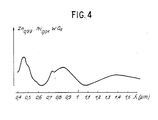
- Figures 2, 3 and 4 show the absorption and emission spectra of mixed oxides according to the invention.
- Example 1 Preparation of Mg a . 99 Ni 0.01 Al 2 O 4 .
- a single crystal is formed from the mixed oxide thus obtained by the Verneuil method.
- the absorption spectrum (in solid lines) and the emission spectrum (in dashes) of this compound are shown. It can be seen that the absorption spectrum allows excitation by commercial krypton lasers having an X wavelength of 640 to 670 nm and yttrium and aluminum garnet lasers of formula Y 3 Al 5 O 12 substituted by neodymium, or Y AG: Nd lasers with a wavelength of 1.06 ⁇ m.
- the emission spectrum shown in dashes shows that the emission corresponds to a tuning range, from 1.1 to 1.5 ⁇ m.
- Example 2 preparation of Mg 1.98 Ni 0.02 GeO 4 .
- the desired quantities of these different powders are mixed to obtain Mg 1.98 Ni 0.02 GeO 4 and they are thoroughly ground in an alumina mortar.
- the mixture is then introduced into a platinum crucible and heated in a muffle furnace at 800 ° C for one hour to decompose the nickel nitrate.
- the mixture is ground again, then heated at 1000 ° C for one hour to decompose the carbonate.
- the mixture is then rewired and the mixture is heated in a rhodium oven to 1300 ° C., then it is maintained at this temperature for approximately 17 hours, so that the reaction in the solid state is complete.
- the mixed oxide thus obtained is then transformed into a single crystal by the Czolchralski method.
- the melting temperature, the crystallographic structure, the strength of the crystal field Dq / B, the refractive index and the optical properties (fluorescence and laser effect) of this mixed oxide are measured.
- the results obtained are given in the appended table. In view of these results, it can be seen that the crystal field Dq / B is equal to 0.82 and that it is slightly lower than that of MgO (0.85).
- the absorption spectrum (in solid lines) and the emission spectrum (in dashes) of this compound are shown.
- the emission can be obtained in the wavelength range from 1.35 to 1.8 ⁇ m and that the excitation of this material can be carried out by lasers known in krypton in the field of wavelengths 0.64-0.67 ⁇ m and 0.75-0.79 ⁇ m, or by a YAG laser: Nd at 1.06 or 1.32 ⁇ m.
- Example 3 preparation of Zn 0.99 Ni 0.01 WO 4 .
Landscapes
- Chemical & Material Sciences (AREA)
- Organic Chemistry (AREA)
- Inorganic Chemistry (AREA)
- Engineering & Computer Science (AREA)
- Materials Engineering (AREA)
- Electromagnetism (AREA)
- Crystallography & Structural Chemistry (AREA)
- Physics & Mathematics (AREA)
- Metallurgy (AREA)
- Plasma & Fusion (AREA)
- Optics & Photonics (AREA)
- Life Sciences & Earth Sciences (AREA)
- Geology (AREA)
- Crystals, And After-Treatments Of Crystals (AREA)
- Luminescent Compositions (AREA)
Description
- La présente invention a pour objet de nouveaux oxydes mixtes pour lasers accordables.
- De façon plus précise, elle concerne des oxydes mixtes présentant un champ cristallin tel que l'émission accordable couvre la gamme de longueurs d'onde allant de 1 µm à 1,8 µm.
- Il existe de nombreux oxydes mixtes et parmi ceux-ci, on connaît par la référence Chemical Abstracts, vol. 81, n° 22, décembre 1974, p. 376, n° 14 23 70 s, des oxydes de formule NixMg1-x Al2O4 et par le brevet DE-A-1 544 279 des spinelles de formule (Mn, Fe) (AI, Cr)204, mais ces oxydes ne sont pas utilisés comme élément actif dans des lasers solides accordables.
- Pour obtenir des lasers solides accordables, il est connu d'utiliser des ions de métaux de transition tels que Cr3+, V2+, Ni2+ et CO2+ comme ions dopants dans des oxydes tels que MgO et Be A12 04 et des fluorures tels que MgF2, ZnF2 et KZnF3. Ainsi, l'article « Tunable alexandrite lasers par Walling et Col. dans IEEE. J. Quantum Electron Vol. QE-16 n° 12 p. 1302-1314 (1980) illustre des lasers solides accordables dans la gamme de 0,7 à 0,82 µm obtenus en dopant BeA1204 par Cr3+. L'article intitulé « Broadly tunable cw operation of Ni : MgF2 and Co : MgF2 lasers de P.F. Moulton et Col. dans Appl. Phys. Lett. vol. 35 (11) p. 838-840 (1979) montre que l'on peut obtenir des lasers accordables dans les gammes 1,61 à 1,74 µm et 1,63 à 2,08 µm en dopant MgF2 respectivement par Ni et par Co.
- On connaît aussi des lasers accordables dans la gamme de 1,85 à 2,05 µm qui sont constitués par du KZnF3 dopé par Co2+ comme cela est décrit dans « CW IR laser action of optically pumped CO2+: KZnF3 par W. Kunzel et Col., Optics Communications, vol. 36, n° 5, p. 383-386 (1981).
- Ainsi, aucun des matériaux mentionnés ci-dessus ne permet de couvrir la zone de longueur d'onde allant de 1,1 à 1,6 µm qui est intéressante, par exemple pour l'étude spectroscopique des alliages quaternaires semi-conducteurs du type In Ga As P. On connaît toutefois d'autres matériaux capables de convenir pour cette application ; ce sont MgF2: V2+ et MgO: Ni2+ qui couvrent respectivement la gamme 1,05-1,3 µm et 1,3-1,4 µm (voir Appl. Phys. Lett. 35, p. 838 (1979)).
- Cependant, l'emploi de tels matériaux présente certains inconvénients. En effet, si l'on veut utiliser MgF2 : V2+, il est difficile de stabiliser le vanadium dans la valence 2, et tout ion résiduel dans un autre état de valence joue le rôle de poison qui réduit le rendement d'émission.
- Par ailleurs, V2+ dans MgF2 possède un schéma de niveaux énergétiques tels que l'émission laser est réabsorbée à partir du niveau excité émettant l'effet laser. Aussi, les produits contenant du V2+ dans des matrices fluorées sont difficiles à utiliser.
- Dans le cas de MgO : Ni2+, la principale difficulté réside dans la fabrication de ce produit sous la forme de monocristaux, car sa température de fusion est très élevée, environ 3 000 °C. Aussi, il est difficile d'obtenir des monocristaux de taille suffisante et de bonne qualité optique par les techniques de tirage classique, par exemple par la méthode de Czolchralski.
- La présente invention a précisément pour objet des lasers solides accordables utilisant de nouveaux oxydes mixtes pour couvrir la zone de longueurs d'ondes allant de 1 à 1,8 µm, ces oxydes présentant par ailleurs l'avantage d'avoir des températures de fusion au plus égales à 2 000 °C.
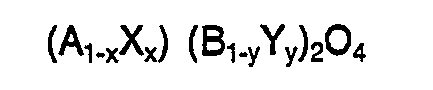
- Le laser accordable selon l'invention comprend un monocristal d'un oxyde mixte répondant à la formule :

- - A représente un élément choisi dans le groupe Mg, Mn et Zn ;
- - X représente un cation bivalent optiquement actif choisi parmi V, Ni et Co ;
- - B représente un élément choisi dans le groupe comprenant Si, Ge, P, Te, W, AI, In, Ga et Mo ;
- - Y représente un cation trivalent optiquement actif choisi parmi Cr, V et Ni ;
- ― x est tel que 0 ≤ x ≤ 0,15 :
- ― y est tel que 0 ≤ y ≤ 0.15 ; et
- - m et n sont des nombres entiers tels que 2n + vm = 8 avec v représentant la valence de B, à condition que y = 0 lorsque B représente un élément choisi parmi Si, Ge, P, Te, W et Mo, et que x et y ne soient pas tous deux égaux à 0.
- Selon un premier mode de réalisation de l'invention, l'élément B représente un élément trivalent choisi parmi AI, In et Ga, qui peut être substitué en partie par un cation trivalent optiquement actif tel que Cr, V et Ni. Dans ce cas, l'oxyde mixte répond à la formule :
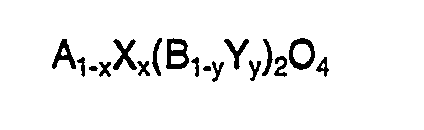
- A titre d'exemples de tels oxydes, on peut citer les oxydes de formule :

- Selon un deuxième mode de réalisation de l'invention, l'élément B de la formule générale représente un élément tétravalent choisi parmi Si, Ge, W, Mo et Te et, dans ce cas seul l'élément A de la formule générale est remplacé en partie par un cation bivalent optiquement actif. Dans ce deuxième mode de réalisation de l'invention, l'oxyde mixte répond à la formule :

- A titre d'exemple de tels oxydes, on peut citer les oxydes de formule :

- Selon un troisième mode de réalisation de l'invention, l'élément B est constitué par un élément hexavalent choisi parmi W et Mo. Dans ce cas, l'oxyde mixte répond à la formule.

- A titre d'exemples de tels oxydes, on peut citer les oxydes de formule :

- Selon une caractéristique de l'invention, les oxydes mixtes répondant aux formules précitées présentent un champ cristallin mesuré selon la méthode de Tanabe et Sugano tel que Dq/B soit au plus égal à 1,8. Des renseignements sur la méthode de Tanabe et Sugano peuvent être trouvés en particulier dans : « Solid State Physics •, vol. 9 F. SEITZ and D. TURNBULL - Ac-Press p. 399 (1959).
- Les oxydes mixtes de l'invention peuvent être préparés par des procédés classiques par exemple, en mélangeant intimement les quantités voulues de poudres d'oxydes ou de sels de A, de X, de B et de Y et en calcinant ensuite le mélange obtenu.
- On peut aussi obtenir ces oxydes mixtes en coprécipitant des hydroxydes de A, de X, de B et de Y à partir d'une solution de leurs sels dans un solvant et en calcinant ensuite le coprécipité obtenu.
- Lorsqu'on fabrique l'oxyde mixte à partir d'un mélange de poudres d'oxydes, on peut effectuer le mélange intime des poudres à l'état solide dans un mortier par broyage durant environ une demi heure, on peut aussi disperser les poudres dans un solvant organique tel que l'éther ou l'acétone, de façon à améliorer l'homogénéité du mélange, et agitervivement la suspension pendant une demi heure environ. On élimine ensuite le solvant qui n'a aucun rôle chimique par évaporation.
- Pour leur utilisation dans des lasers accordables les oxydes mixtes de l'invention sont ensuite transformés en monocristaux par des méthodes classiques, par exemple par fusion de zone, par tirage à partir d'un bain en fusion selon la méthode Czochralski, ou encore par la méthode de Verneuil.
- D'autres caractéristiques et avantages de l'invention apparaitront mieux à la lecture des exemples suivants donnés bien entendu à titre illustratif et non limitatif en référence au dessin annexé sur lequel :
- la figure 1 représente le diagramme théorique de Tanabe et Sugano pour Ni2+, et
- les figures 2, 3 et 4 représentent les spectres d'absorption et d'émission d'oxydes mixtes conformes à l'invention.
- On part de poudres :
- - de carbonate de magnésium MgC03, de qualité pour analyses commercialisé par Prolabo,
- - de nitrate de nickel cristallisé Ni(NO3)2, 6H20 de qualité pour analyses commercialisé par Prolabo, et
- - d'alumine A1203 calcinée fabriquée par la société Merck.
- On pèse des quantités de ces différentes poudres correspondant à la fabrication de l'oxyde mixte de formule : Mg0.99Ni0.01Al2O4, puis on les broie et on les mélange intimement dans un mortier d'alumine. On introduit ensuite le mélange dans un creuset de platine et on le chauffe dans un four à moufle à 800 °C pendant une heure pour la décomposition du nitrate, puis on rebroie le mélange de poudres, on le chauffe alors jusqu'à 1 500-1 600 °C et on le maintient pendant 17 heures à cette température dans un four à rhodium.
- On forme à partir de l'oxyde mixte ainsi obtenu un monocristal par la Méthode de Verneuil.
- On détermine les propriétés physiques (température de fusion, structure cristallographique, force du champ cristallin Dq/B et indice de réfraction) et les propriétés optiques (fluorescence - effet laser) du cristal ainsi obtenu. Les résultats sont donnés dans le tableau joint.
- Au vu de ces résultats, on constate que la force du champ cristallin Dq/B est égale à 1,32 et qu'elle est légèrement supérieure à celle que l'on obtient avec MgO pour lequel Dq/B est égale à 0,85. Aussi, si l'on se réfère au diagramme théorique de Tanabe et Sugano représenté sur la figure 1 pour Ni2+, on voit que l'écart énergétique des niveaux 3T2 et 3A2 est légèrement supérieur à celui obtenu avec MgO. On obtient ainsi un effet laser sur les transitions vibroniques à une longueur d'onde légèrement inférieure par rapport à celle de MgO.
- Sur la figure 2, on a représenté le spectre d'absorption (en trait plein) et le spectre d'émission (en tirets) de ce composé. On voit que le spectre d'absorption permet une excitation par des lasers commerciaux à krypton ayant une longueur d'onde X de 640 à 670 nm et des lasers à grenat d'yttrium et d'aluminium de formule Y3Al5O12 substitué par du néodyme, soit des lasers Y AG : Nd ayant une longueur d'onde de 1,06 µm. Le spectre d'émission représenté en tirets montre que l'émission correspond à une gamme d'accord, de 1,1 à 1,5 µm.
- On part de poudres :
- - d'oxyde de germanium GeO2 de qualité électronique fabriqué par la société Preussag,
- - de carbonate de magnésium MgC03 de qualité pour analyses commercialisé par Prolabo, et
- - de nitrate de nickel cristallisé Ni(N03)2, 6H20 de qualité pour analyses commercialisé par Prolabo.
- On mélange les quantités voulues de ces différentes poudres pour obtenir Mg1.98Ni0.02GeO4 et on les broie intimement dans un mortier d'alumine. On introduit ensuite le mélange dans un creuset de platine et on le chauffe dans un four à moufle à 800 °C pendant une heure pour décomposer le nitrate de nickel. On broie à nouveau le mélange, puis on le chauffe à 1 000 °C pendant une heure pour décomposer le carbonate. On rebroie alors et on chauffe le mélange dans un four à rhodium jusqu'à 1 300 °C, puis on le maintient à cette température pendant 17 heures environ, de sorte que la réaction à l'état solide est complète.
- On transforme alors l'oxyde mixte ainsi obtenu en monocristal par la méthode de Czolchralski.
- On mesure ensuite comme précédemment la température de fusion, la structure cristallographique, la force du champ cristallin Dq/B, l'indice de réfraction et les propriétés optiques (fluorescence et effet laser) de cet oxyde mixte. Les résultats obtenus sont donnés dans le tableau annexé. Au vu de ces résultats, on constate que le champ cristallin Dq/B est égal à 0,82 et qu'il est légèrement inférieur à celui de MgO (0,85).
- Sur la figure 3, on a représenté le spectre d'absorption (en trait plein) et le spectre d'émission (en tirets) de ce composé. Ainsi, on voit que l'émission peut être obtenue dans la gamme de longueurs d'ondes allant de 1,35 à 1,8 µm et que l'excitation de ce matériau peut être effectuée par des lasers connus à krypton dans le domaine des longueurs d'ondes 0,64-0,67 µm et 0,75-0,79 µm, ou par un laser YAG : Nd à 1,06 ou 1,32 µm.
- On part de poudres des composés suivants :
- - anhydride tungstique chimiquement pur fabriqué par la société Riedel,
- _: oxyde de zinc de qualité pour analyses commercialisé par Prolabo, et
- - nitrate de nickel cristallisé Ni(NO3)2, 6H2O de qualité pour analyses de la société Prolabo.
- On pèse les quantités voulues de poudres et on les mélange et on les broie intimement dans un mortier d'alumine. On introduit alors le mélange dans un creuset de platine et on le chauffe dans un four à moufle à 800 °C pendant une heure pour décomposer le nitrate de nickel, puis on le rebroie. On chauffe alors le mélange jusqu'à 1 300 °C et on le maintient à cette température dans un four à rhodium pendant 17 heures. On transforme alors le produit obtenu en monocristal par la méthode de Czolchralski.
- .On détermine alors comme précédemment la température de fusion, la structure cristallographique, l'indice de réfraction et les propriétés optiques (fluorescence et effet laser) de cet oxyde. Les résultats sont donnés dans le tableau annexé.
- Au vu de ces résultats, on constate que le champ cristallin de ce composé Dq/B est de 0,7 et qu'il est relativement faible et à peu près équivalent à celui de MgF2. De ce fait, la gamme d'accords est analogue à celle de MgF2: Ni, c'est-à-dire de 1,6 à 1,75 µm.
- Sur la figure 4, on a représenté le spectre d'absorption de ce composé.

Claims (8)



Applications Claiming Priority (2)
| Application Number | Priority Date | Filing Date | Title |
|---|---|---|---|
| FR8318575A FR2555157B1 (fr) | 1983-11-22 | 1983-11-22 | Nouveaux oxydes mixtes utilisables en particulier dans des lasers accordables |
| FR8318575 | 1983-11-22 |
Publications (2)
| Publication Number | Publication Date |
|---|---|
| EP0148656A1 EP0148656A1 (fr) | 1985-07-17 |
| EP0148656B1 true EP0148656B1 (fr) | 1989-04-26 |
Family
ID=9294389
Family Applications (1)
| Application Number | Title | Priority Date | Filing Date |
|---|---|---|---|
| EP84402342A Expired EP0148656B1 (fr) | 1983-11-22 | 1984-11-16 | Nouveaux oxydes mixtes pour lasers accordables |
Country Status (4)
| Country | Link |
|---|---|
| US (1) | US4627064A (fr) |
| EP (1) | EP0148656B1 (fr) |
| DE (1) | DE3477979D1 (fr) |
| FR (1) | FR2555157B1 (fr) |
Families Citing this family (11)
| Publication number | Priority date | Publication date | Assignee | Title |
|---|---|---|---|---|
| US4797889A (en) * | 1987-06-24 | 1989-01-10 | Boston University | Solid state molecular laser |
| NL8800155A (nl) * | 1988-01-25 | 1989-08-16 | Philips Nv | Granaat en werkwijzen voor het bereiden van een granaat. |
| US5035769A (en) * | 1989-10-04 | 1991-07-30 | The United States Of America As Represented By The United States Department Of Energy | Nondestructive method for chemically machining crucibles or molds from their enclosed ingots and castings |
| US5541948A (en) * | 1994-11-28 | 1996-07-30 | The Regents Of The University Of California | Transition-metal doped sulfide, selenide, and telluride laser crystal and lasers |
| US5717517A (en) * | 1995-01-13 | 1998-02-10 | The Research Foundation Of City College Of New York | Method for amplifying laser signals and an amplifier for use in said method |
| CN1035534C (zh) * | 1995-03-16 | 1997-07-30 | 中国科学院上海光学精密机械研究所 | 590-650纳米可调谐固态染料激光器及其制备方法 |
| US6839362B2 (en) | 2001-05-22 | 2005-01-04 | Saint-Gobain Ceramics & Plastics, Inc. | Cobalt-doped saturable absorber Q-switches and laser systems |
| US6844084B2 (en) * | 2002-04-03 | 2005-01-18 | Saint-Gobain Ceramics & Plastics, Inc. | Spinel substrate and heteroepitaxial growth of III-V materials thereon |
| US7326477B2 (en) | 2003-09-23 | 2008-02-05 | Saint-Gobain Ceramics & Plastics, Inc. | Spinel boules, wafers, and methods for fabricating same |
| US7045223B2 (en) | 2003-09-23 | 2006-05-16 | Saint-Gobain Ceramics & Plastics, Inc. | Spinel articles and methods for forming same |
| US7919815B1 (en) | 2005-02-24 | 2011-04-05 | Saint-Gobain Ceramics & Plastics, Inc. | Spinel wafers and methods of preparation |
Family Cites Families (2)
| Publication number | Priority date | Publication date | Assignee | Title |
|---|---|---|---|---|
| NL292417A (fr) * | 1962-05-07 | 1965-06-12 | ||
| FR1494447A (fr) * | 1965-09-23 | 1967-09-08 | Philips Nv | Procédé de fabrication d'un monocristal d'un composé |
-
1983
- 1983-11-22 FR FR8318575A patent/FR2555157B1/fr not_active Expired
-
1984
- 1984-11-16 DE DE8484402342T patent/DE3477979D1/de not_active Expired
- 1984-11-16 EP EP84402342A patent/EP0148656B1/fr not_active Expired
- 1984-11-20 US US06/673,439 patent/US4627064A/en not_active Expired - Fee Related
Also Published As
| Publication number | Publication date |
|---|---|
| DE3477979D1 (en) | 1989-06-01 |
| US4627064A (en) | 1986-12-02 |
| FR2555157B1 (fr) | 1989-03-03 |
| FR2555157A1 (fr) | 1985-05-24 |
| EP0148656A1 (fr) | 1985-07-17 |
Similar Documents
| Publication | Publication Date | Title |
|---|---|---|
| EP0451001B1 (fr) | Oxydes mixtes de strontium et de lanthanide et laser utilisant des monocristaux de ces oxydes | |
| EP0581621B2 (fr) | Nouveaux luminophores verts à base de phosphate mixte de lanthane, cerium et terbium, précurseurs de ceux-ci et procédés de synthèse | |
| EP0148656A1 (fr) | Nouveaux oxydes mixtes pour lasers accordables | |
| US20110227007A1 (en) | Method of manufacturing quantum dot | |
| EP0043776B1 (fr) | Oxydes mixtes d'aluminium, leur procédé de fabrication et leur application | |
| Voronina et al. | Active Raman media: SrWO~ 4: Nd^ 3^+, BaWO~ 4: Nd^ 3^+. Growth and characterization | |
| EP2185475A2 (fr) | Procédé de synthèse de nanoparticules de ticon, tion et tio par pyrolyse laser. | |
| EP0206885B1 (fr) | Compositions de manganites de métaux de transition sous forme de particules ou sous forme de céramiques, leur préparation et leur application notamment dans la fabrication de thermistances | |
| EP0250305B1 (fr) | Aluminates mixtes de lanthanide-magnésium, lasers utilisant des monocristaux de ces aluminates | |
| EP0252784B1 (fr) | Gallates mixtes de lanthanide-magnésium, laser utilisant des monocristaux de ces gallates | |
| EP0215691A1 (fr) | Procédé de synthèse en flux de cristaux du type du KTiOP04 ou monophosphate de potassium et de titanyle | |
| US6839362B2 (en) | Cobalt-doped saturable absorber Q-switches and laser systems | |
| Petermann et al. | Spectroscopic and laser properties of Cr 3+-doped Al 2 (WO 4) 3 and Sc 2 (WO 4) 3 | |
| US10927296B2 (en) | Single-band upconversion luminescent material and method for producing the same | |
| US5322592A (en) | Potassium-lithium-niobate crystals and the manufacture thereof | |
| US20080083905A1 (en) | Cr4+doped mixed alloy laser materials and lasers and methods using the materials | |
| JP4067845B2 (ja) | マグネシウムニオブ酸リチウム単結晶およびその製造方法 | |
| EP0274298B1 (fr) | Aluminates mixtes de lanthane-magnésium, lasers utilisant des monocristaux de ces aluminates | |
| Bagdasarov et al. | Continuous lasing in La1–x ND x MgAl11O19 crystals | |
| EP4524104A1 (fr) | Nanoparticules de silicium sphériques monocristallines | |
| Streckaitė et al. | Facile synthesis of ytterbium doped cesium lead halide perovskite powder | |
| CA2341611A1 (fr) | Borate de lanthane, de lutecium, d'yttrium ou de gadolinium comprenant deux dopants et son precurseur, utilisation dans les systemes a plasma ou a rayons x | |
| EP2889272A1 (fr) | Procédé de fabrication d'une poudre carbonée comprenant un oxyde mixte d'yttrium et de titane | |
| US5134095A (en) | Matrix glass composition for glass doped with dispersed microcrystallites | |
| Zaldo et al. | Evidence of Yb3+ band broadening and continuous wave laser operation in bismuth modified KY1-x-yBixYby (WO4) 2 mixed single crystals |
Legal Events
| Date | Code | Title | Description |
|---|---|---|---|
| PUAI | Public reference made under article 153(3) epc to a published international application that has entered the european phase |
Free format text: ORIGINAL CODE: 0009012 |
|
| AK | Designated contracting states |
Designated state(s): DE GB NL |
|
| 17P | Request for examination filed |
Effective date: 19851219 |
|
| 17Q | First examination report despatched |
Effective date: 19861120 |
|
| R17C | First examination report despatched (corrected) |
Effective date: 19870615 |
|
| RAP1 | Party data changed (applicant data changed or rights of an application transferred) |
Owner name: ETAT FRANCAIS REPRESENTE PAR LE MINISTRE DES PTT ( |
|
| GRAA | (expected) grant |
Free format text: ORIGINAL CODE: 0009210 |
|
| AK | Designated contracting states |
Kind code of ref document: B1 Designated state(s): DE GB NL |
|
| REF | Corresponds to: |
Ref document number: 3477979 Country of ref document: DE Date of ref document: 19890601 |
|
| GBT | Gb: translation of ep patent filed (gb section 77(6)(a)/1977) | ||
| PLBE | No opposition filed within time limit |
Free format text: ORIGINAL CODE: 0009261 |
|
| STAA | Information on the status of an ep patent application or granted ep patent |
Free format text: STATUS: NO OPPOSITION FILED WITHIN TIME LIMIT |
|
| 26N | No opposition filed | ||
| PGFP | Annual fee paid to national office [announced via postgrant information from national office to epo] |
Ref country code: NL Payment date: 19901130 Year of fee payment: 7 |
|
| PG25 | Lapsed in a contracting state [announced via postgrant information from national office to epo] |
Ref country code: NL Effective date: 19920601 |
|
| NLV4 | Nl: lapsed or anulled due to non-payment of the annual fee | ||
| PGFP | Annual fee paid to national office [announced via postgrant information from national office to epo] |
Ref country code: DE Payment date: 19931102 Year of fee payment: 10 |
|
| PGFP | Annual fee paid to national office [announced via postgrant information from national office to epo] |
Ref country code: GB Payment date: 19931109 Year of fee payment: 10 |
|
| PG25 | Lapsed in a contracting state [announced via postgrant information from national office to epo] |
Ref country code: GB Effective date: 19941116 |
|
| GBPC | Gb: european patent ceased through non-payment of renewal fee |
Effective date: 19941116 |
|
| PG25 | Lapsed in a contracting state [announced via postgrant information from national office to epo] |
Ref country code: DE Effective date: 19950801 |