EP0149202A2 - Récipient couché pour le traitement du moût de vendange - Google Patents
Récipient couché pour le traitement du moût de vendange Download PDFInfo
- Publication number
- EP0149202A2 EP0149202A2 EP84116016A EP84116016A EP0149202A2 EP 0149202 A2 EP0149202 A2 EP 0149202A2 EP 84116016 A EP84116016 A EP 84116016A EP 84116016 A EP84116016 A EP 84116016A EP 0149202 A2 EP0149202 A2 EP 0149202A2
- Authority
- EP
- European Patent Office
- Prior art keywords
- side walls
- shaft
- container according
- agitator
- section
- Prior art date
- Legal status (The legal status is an assumption and is not a legal conclusion. Google has not performed a legal analysis and makes no representation as to the accuracy of the status listed.)
- Granted
Links
Images



Classifications
-
- C—CHEMISTRY; METALLURGY
- C12—BIOCHEMISTRY; BEER; SPIRITS; WINE; VINEGAR; MICROBIOLOGY; ENZYMOLOGY; MUTATION OR GENETIC ENGINEERING
- C12G—WINE; PREPARATION THEREOF; ALCOHOLIC BEVERAGES; PREPARATION OF ALCOHOLIC BEVERAGES NOT PROVIDED FOR IN SUBCLASSES C12C OR C12H
- C12G1/00—Preparation of wine or sparkling wine
- C12G1/02—Preparation of must from grapes; Must treatment and fermentation
- C12G1/0209—Preparation of must from grapes; Must treatment and fermentation in a horizontal or rotatably mounted vessel
Definitions
- the invention relates to a horizontal container for the treatment of wine mash, in particular a fermentation tank, with an agitator, the shaft of which runs parallel to an axis of the container, the shaft being provided with a plurality of substantially radially extending impeller blades, which extend over the length the shaft is distributed at a distance from each other and at least in sections are plate-like, such that the flat side of the
- a container is known from DE-OS 32 00 712.
- Containers of the type mentioned are preferably used in the production of red wine.
- the red color of the red wine grapes is predominantly in the skins and not in the pulp.
- the container mentioned at the beginning is used with an agitator, these containers being designed, for example, as a horizontal tank with a predominantly circular cylindrical shape. In this tank an agitator with plate-like agitator blades rotates, with which an effective mixing of the mash, i.e. the mixture of grape juice and pomace is possible.
- the agitator in the tank to be operated only at intervals, so that the mash can rest during the idle times of the agitator.
- the lighter pomace components of the mash settle on the surface and, due to the high sugar content of the skins, bake there to a more or less firm pomace cake, which in extreme cases forms a hard layer on the surface of the mash . If the agitator is started again after the idle times, the agitator blades must have the pomace cake that has formed break and dip the fragments as gently and effectively as possible into the grape juice downwards, then lift them up again, etc.
- the plate-like impellers mentioned at the outset have proven themselves, which are also known in a form in which the free end of the impellers is angled in the direction of rotation.
- the invention is therefore based on the object of developing a container of the type mentioned in such a way that the mixing of the mash, in particular the dipping of pieces of pomace cake into the juice, takes place even more effectively without the wine quality deteriorating as a result of the wine mash being mixed too intensively entry.
- the impellers in the region of their radially extending edges are at least partially provided with side walls which are inclined with respect to the radial central region of a bottom forming the flat side of the impeller.
- This blade-like design of the agitator blades achieves a considerable advantage. While in the known plate-like stirring blades the fragments of the pomace cake when pressed down into the grape juice laterally could get past the agitator blades up again, this is prevented in the container according to the invention by the inclined side walls. The fragments of the pomace cake are thus forced deep into the grape juice, so that the red dye is washed out particularly effectively from the grape skins. The working speed of the agitator does not need to be increased, so that the intensification of the mixing of the mash does not have to be bought with a loss in quality of the wine. In contrast, the invention merely has the effect that the dwell time of the fragments of the pomace cake in the grape juice and thus the dye leaching of the grape skins is increased.
- the agitator according to the invention can be used to achieve a significantly improved washing out of the red dye from the grape skins. This applies in particular to mashes that are mushy or viscous due to the relatively low liquid content in the grape. A decrease in wine quality could not be determined.
- an embodiment of the invention is preferred in which the side walls run over the entire length of the edges of the agitator blades.
- This measure has the advantage that when the fragments of the pomace cake are pressed down into the grape juice, the fragments are held in the area in the direction of rotation in front of the flat section of the impeller, so that they practically cannot "escape” from the area of the impeller.
- the dwell time of the fragments in the grape juice is therefore particularly large.
- the side walls abut the ends of the shaft adjacent to the shaft in a circular arc on the circumference of the shaft.
- the side walls preferably extend from a distance from the shaft to the free end of the impeller.
- This measure can be used with advantage if the maximum dwell times of the fragments of the pomace cake in the grape juice that can be achieved with the side walls running through to the shaft are not necessary and if an agitator with radially somewhat shortened side walls and thus a lower drive power of the agitator is sufficient.
- the inner end of the side walls can advantageously be closed off by means of a rear wall, so that a closed scoop-like shape is obtained even when the side walls are offset.
- an embodiment of the invention is preferred in which the free end of the side walls is aligned with the circumference of the shaft.
- This measure has the advantage, in particular in the case of side walls extending up to the shaft, that the blades formed by the radial impeller, the side walls and the shaft form uses the maximum available volume.
- the agitator blades are provided at their free end with a front wall which is inclined towards the radial central region of the base and which merges laterally into the side walls.
- Such front walls are known per se - as already mentioned above - as angled ends of plate-like impellers, but they are particularly advantageous in connection with the side walls according to the invention, because those formed by the impeller, the side walls, the front wall and possibly the shaft scoop-like shape ensures that the fragments of the pomace cake reaching their volume are held until the agitator blade moves upwards again through the grape juice.
- Another type of agitator can be produced in an embodiment of the invention in that the essentially radially extending floors are each provided with a pair of side walls opening in the direction of rotation of the shaft and a pair of side walls opening in the opposite direction of rotation.
- This measure has the particular advantage that the agitator can be operated with the side walls in two opposite directions of rotation due to the folding-symmetrical shape of the agitator blades, wherein a pair of side walls in each direction of rotation holds the fragments of the pomace cake and does this in the opposite direction of rotation each other pair of side walls is adopted. Since the fragments move in this operating mode when the direction of rotation is reversed from one pair of side walls of one agitator blade to an opposite pair of another or the same agitator blade, it is possible to further intensify the agitation process and thus the washing out of the grape skins by alternating rotation in both directions of rotation .
- the elements "floor”, “side wall” and “front wall” can be provided as individual elements in the form of flat surfaces; In a preferred embodiment of the invention, however, these elements can be formed together by a concave curved bottom.
- This measure has i.a. the advantage that concave surfaces can be cleaned more easily because of missing corners, so that particularly hygienic operation of the container according to the invention can be ensured.
- the agitator blades with bottoms and side walls and possibly front walls are designed as at least one hollow profile from a preferably one-piece blank.
- This measure has the advantage that the impellers can be manufactured particularly easily and, due to their hollow structure, are light in weight. This is of advantage for the construction of the container, in which only a relatively light agitator has to rotate, and it also reduces the drive power required when starting the agitator, particularly in alternating operation.
- the agitator blades are designed as two fold-symmetrical hollow profiles with a plane of symmetry running radially to the shaft.
- This measure combines the advantages of the alternating operating mode with those of a lightweight construction for the agitator blades.
- the agitator blade is formed as a hollow profile from a blank representing the development of the hollow profile, a variety of possible shapes of the cross section opens up.
- Embodiments of the invention are preferred in which the cross section has a U-shaped shape or the shape of two U lying flat against one another or an I-shaped shape or a C-shaped or a double C-shaped shape.
- the cross section can also have a diabolic shape.
- a further preferred configuration of the cross-sectional area results if the bottom is part of a section which is at least approximately rectangular in cross-section, from the ends of which the side walls are formed as a two-layer fold.
- This cross-sectional shape has the advantage that the rectangular section gives the impeller a stable and simple mechanical shape and the side walls can be formed as a two-layer fold by simply folding over a one-piece cross section, without the need to attach the side walls to the rectangular section as separate components to weld.
- This measure has the advantage that the rectangular section can be kept just as large as is necessary for its mechanical stability.
- the cranked fold ensures a sufficient volume of the blade-like shape of the impeller.
- Another group of containers according to the invention has an agitator, the agitator blades of which are characterized in that the bottom is part of a section which is at least approximately rectangular in cross section, the edges of which form the side walls, two parts of the two rectangular sides and one side wall being in one piece and the third is or are welded.
- This measure has the advantage that, despite the provision of separate parts and thus the need to weld these parts to one another, it is also possible to produce complicated cross-sectional shapes, the development or folding of which would lead to complicated manufacturing processes.
- a further embodiment of the invention provides for the free ends of the pairs of side walls to be connected to one another by means of a radial side wall termination in such agitator blades.
- This measure has the advantage that there are no longer any cavities between the side walls and consequently no constituents can be deposited there. This measure therefore further improves the hygienic operation of the container according to the invention.
- the free ends of the front walls can be connected accordingly by means of a tangential front wall termination.
- the front wall section is curved outwards and is located in the vicinity of the wall of a circular cylindrical section of the container, the curvature running parallel to the wall.
- This measure has the advantage that no cavity can form between the front wall section and the curved wall, as would be the case with a straight front wall section that runs as a chord to the circular-cylindrical section of the container.
- the axial positioning of the agitator blades on the agitator shaft can be varied in different ways, depending on the consistency of the mash.
- the agitator blades are arranged on the shaft at an axial distance from one another that their trajectories do not overlap.
- This embodiment of the invention is to be used advantageously when it is expedient that radial layers are formed between the individual impellers, in which the mash is not in the engagement area of the impellers.
- this embodiment of the invention is suitable for those cases in which a less intensive mixing of the mash is sufficient.
- the agitator blades preferably have an outline that is rectangular in the direction of rotation of the shaft and that their movement paths adjoin one another.
- this embodiment of the invention the thickness of the radial layers running between the impellers, which are not affected by the impellers, is reduced to zero.
- this embodiment of the invention is suitable for those mashes which have to be stirred with a somewhat higher degree of mixing.
- the outlines of the impellers in the direction of rotation of the shaft are chosen so wide that their trajectories overlap.
- the impellers can run straight in the radial direction, i.e. have a rectangular outline, but they can also taper radially outwards or radially inwards.
- the embodiments of the invention with agitator blades whose trajectories overlap have the advantage that maximum mixing of the mash occurs because, with the exception of small wall areas of the container, the entire volume of the mash is stirred, the mash in the overlapping area of the trajectories along a serpentine shape curved path is moved.
- This measure has the essential advantage that once the fermentation is started, the mash is brought to the so-called fermentation start temperature by heating and the other During the fermentation process, in which the fermentation process generates a heat of its own in the mash, excessive heating of the mash can be prevented by introducing a coolant. The start of fermentation can be accelerated by heating up. On the other hand, too much self-heating of the mash and thus a loss of quality can also be avoided by later cooling; this applies in particular if the container is in a warm room or the fermentation takes place at relatively high outside temperatures which act on the container.
- the heat exchange medium can be supplied from the hollow shaft of the agitator.
- This measure has the advantage that the heat exchange medium can be supplied particularly easily to the agitator blades acting as heat exchangers, without this being recognizable from the outside.
- the agitator does not change its external shape and surface and can therefore be cleaned like a normal agitator.
- the cavities are arranged in the manner of a rung ladder, the rungs extending in the axial direction and the rods for supplying and removing the heat exchange medium in the radial direction in or on the respective wall.
- This measure has the advantage that the surfaces of the impeller acting as heat exchangers can be heated or cooled particularly effectively if the rungs are arranged in a correspondingly dense manner.
- cavities are formed by webs between the backs of the fold-symmetrically arranged hollow profiles for heat exchange.
- This measure has the advantage that the cavities can be produced by simple constructive measures without the need for expensive tools for producing the stirring blades acting as heat exchangers.
- a further embodiment of the invention is characterized in that, in order to prevent the wine mash from slipping in the radial direction on the impeller blades, the bottom forming the flat side thereof is provided with at least one hump-like obstacle of at least partially axial extension.
- the obstacle is prismatic or semi-cylindrical in the radial section.
- This measure has the advantage that, in particular when passing through the lower extreme position of the agitator, the solid mash constituents held by the agitator are prevented from slipping up, a danger that exists particularly when the mash ferments intensively and fermentation gases develop when the solid mash constituents are pressed down below the volume of the impeller. These fermentation gases held by the impeller in the mash cause a considerable buoyancy, so that after passing through the lower extreme position in the case mentioned, the held solid mash components can suddenly escape upwards, unless a corresponding obstacle prevents or at least makes this movement difficult.
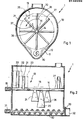
- the container 1 designates a container according to the invention for the treatment of wine mash, in particular red wine mash.
- the container 1 is a lying container, which rests on a floor of a room in a winery with supports not shown in the figures.
- the container 1 is divided into a circular cylindrical section 10 and a conical section 11, which can also be designed as a channel-shaped section 12.
- a stirrer 13 arranged horizontally with a shaft 14 which runs parallel to the axis 15 of the container, but does not have to coincide therewith. 1 and 2, the shaft 14 of the agitator 13 runs somewhat below the axis 15 of the container 1.
- Axially distributed on the shaft 14 are a plurality of agitator blades, some examples of which are shown in FIG. 2. It is understood that the agitator is generally only equipped with one type of paddle, but different paddles can be used on one common shaft 14 may be arranged. It also goes without saying that the impellers can not only be axially distributed over the shaft 14, but also in the circumferential direction, ie a plurality of impellers can protrude radially from an axial position of the shaft 14, which are offset from one another in the direction of rotation by certain angles.
- 20 and 21 are paddle-like stirring blades, which can either be narrow or, as indicated by 22 and 23, wide in the axial direction. As will be explained further below, this means that the movement paths of the impeller blades 20, 21 do not overlap one another, while the movement paths of the impeller blades 22 and 23 axially overlap or overlap.
- a further embodiment of the invention can consist of impellers 24, 25, 26 which taper conically towards the shaft 14.
- the agitator blades 24 to 26 diverge radially outwards so far that their movement paths overlap again in the end region.
- agitator blades can also be conical in such a way that they taper outwards, as indicated by 27 on the right in FIG. 2.
- this container 1 usable for different types of mash in a container 1 by changing the stirring blades.
- the container 1 according to the invention also has a discharge screw 30 in the region of the conical section 11 or the trough-shaped section 12.
- two drive motors are required, namely firstly a first drive motor 16 for the agitator 13 and secondly a second drive motor 31 for the discharge screw 30. It goes without saying, however, that the two units 13, 30 are also driven by a common drive motor via appropriate gears can be.
- the discharge screw 30 finally conveys the material to be discharged to a discharge opening 32 which is closed by the agitator 13 by means of a slide 33 during the treatment of the wine mash.
- the pomace cake is indicated at 35, which settles on the surface of the mash during a standstill of the agitator 13.
- the impeller 20 In the direction of rotation of the agitator 13 indicated by 36 in FIG. 1, in the position shown in FIG. 1 the impeller 20 has just pierced the pomace cake 35, while the impeller 21 is already pressing a fragment 37 of the pomace cake down into the grape juice. Due to the merely plate-like design of the impeller 21 in known containers, the fragment 37 can now slide laterally in a direction 38 past the impeller 21 and up again climb up the area of the pomace cake 35. The dwell time of the fragment 37 in the grape juice is therefore only very short, because in the case of a plate-like design of the stirring blade 21, the fragment 37 cannot be immersed down into the grape juice.
- FIG. 3a now shows a radial section and FIG. 3b shows an axial section through an impeller such as can be used for the impellers 20 to 27 according to FIGS. 1 and 2 and which avoids the disadvantage described above.
- the impeller shown in FIG. 3 has a flat bottom 40 which merges into an angled front wall 41 at the free end of the impeller.
- the bottom 40 is delimited by angled side walls 42 and 43.
- the free edges of the front wall 41 and the side walls 42, 43 are aligned with the circumference of the shaft 14 of the agitator 13, which is designed as a hollow shaft. It thus arises above the floor 40 and delimited by the front wall 41, the side walls 42, 43 and a circumference 44 the shaft 14 a scoop-shaped volume from which a fragment 37 of the pomace cake 35 can no longer escape as long as the impeller moves downward. Only when the agitator blade moves up again after passing through the bottom dead center can the fragment 37 rise from the above-defined volume of the agitator blade, provided the rate of ascent is greater than the rotational speed of the agitator blade.
- a variant of the impeller according to Fig. 3a is possible in that the side walls 42, 43 are not guided over the entire radial length of the edges of the bottom 40, but only over a part, namely in the way that the side walls 42, 43 only begin at a distance from the shaft 14 and extend to the front wall 41.
- the inner part of the side winch 42, 43 can then either be formed by a likewise inclined rear wall 45 or the side walls 42, 43 end in a free inclined edge 50. While in the first case, a scoop-like volume closed on five sides is created, in which only the sloping rear wall 45 is stepped instead of the circumference 44 and a smaller volume is achieved compared to FIG.
- the scoop-like shape is in the variant with free edge 50 open at this point, but this can often be accepted if the speed of rotation of the agitator 13 is so great that the fragments 37 of the pomace cake 35 slide due to the rotation of the impeller anyway on the floor 40, radially after move outside towards the front wall 41.
- the floor 40 in the exemplary embodiment according to FIG. 3a extends exactly in the radial direction
- an embodiment can also be selected in which a floor 40a extends tangentially from the circumference of the shaft 14, a circumference 44a advantageously being provided to avoid cavities which are difficult to clean which forms the transition from the bottom 40a to the circumference of the shaft 14.
- this variant results in an even greater volume of the blade-like agitator blade shape.
- the angle of attack of the front wall 41 to the floor 40 is denoted by 46 and in Fig. 3b the angle of attack of the side walls 42, 43 to the floor 40 by 47.
- the angles 46, 47 can vary within a wide range, but an embodiment is preferred in which these angles are the same and are in the range between 100 ° and 150 °.
- FIGS. 3a and 3b also show the possibility of using the impeller as a heat exchanger.
- a plurality of axially extending cavities 48 are provided in the base 40, which are supplied via suitable stub lines for the inflow or outflow of the heat exchange medium.
- the supply is expediently carried out from the inside of the hollow shaft 14, specifically via a line 49.
- the heat exchange medium in the cavities 48 can serve both for heating and for cooling the mash. If the mash is filled in cold, you can accelerate the start of fermentation by heating the mash. During fermentation, however, a certain self-heat of the mash develops, so that it can be expedient to cool the mash to a certain temperature in order to avoid quality losses and thus to remove the fermentation heat.
- FIGS. 4a to 4d Another embodiment of the invention is shown in FIGS. 4a to 4d.
- the representations of FIGS. 4a and 4b correspond to the representations of FIGS. 3a and 3b.
- the exemplary embodiment according to FIG. 4 shows an impeller, which is effective in both directions of rotation.
- two radial bottoms 55a, 55b are attached to the shaft 14, which at their free ends merge into inclined front walls 56a, 56b.
- Corresponding side walls 57a, 57b and 58a, 58b are provided on the lateral edges.
- transverse webs 60, 61 are provided between the bottoms 55a, 55b in the axial direction, which enclose cavities 62 between them.
- the transverse webs 60, 61 open into the longitudinal webs 63 and 64, respectively, so that overall, in a plan view (from above in FIGS. 4a and 4b), a rung-like structure of cavities is created, as shown in FIG. 4c.
- the arrows indicate that a heat exchange medium can be supplied or discharged through the "rods" of the rung conductors, while the heat exchange medium flows from one to the other "rod” through the cavities 62 which act as "rungs".
- the entire surface of the bottom 55a, 55b of the impeller or, in a corresponding manner, also the side walls 57, 58, the front walls 56 or, if appropriate, rear walls 45 can be used as heat exchange plates.
- the invention is not limited to the rung-like shape of the heat exchanger channels, rather it is understood that serpentine channels or meandering channels or the like. Can find use.
- the entire cavity between the floors 55a, 55b can be penetrated by a heat exchange medium without transverse webs 60, 61 being provided.
- Fig. 4a two variants are also shown in dashed lines, in which the floors 55a and 55b are provided with obstacles 52 and 53, respectively.
- the obstacle 52 has an essentially triangular-prismatic shape and the obstacle 53 has a semi-cylindrical shape, in each case seen in the axial direction.
- a plurality of obstacles 52 and 53 can also be arranged radially distributed over the impeller. The purpose of these obstacles 52, 53 is to prevent the wine mash, in particular its solid components, from slipping in the radial direction when the impeller is immersed in the juice all the way down and starts to move upward again from the lower extreme position.
- the impeller within the volume enclosed by it when the wine mash is pressed down may have collected a considerable amount of fermentation gases which, after passing through the lower extreme position, suddenly escape with the solid mash constituents being carried along.
- the second half of the agitator blade movement cycle in which the agitator blades rotate upwards again due to the grape juice, then remains unused for dye leaching.
- the obstacles 52 to 53 or more of them can prevent this radial slipping or at least prevent it so far that the essential components are still conveyed upwards by the grape juice under the influence of the agitator blade movement.
- a straight front wall termination 65 can therefore be provided, as shown in Fig. 4a.
- the angles enclosed by the side walls 57a, 57b or 58a, 58b can be closed off by a side wall closure 66, so that overall there is a smooth and easy-to-clean surface of the impeller.
- a variant according to FIG. 4d consists in that a curved front wall closure 67 is used which runs parallel to the container wall of the circular cylindrical section 10 of the container 1.
- the curved front wall closure 67 thus does not include a circular section with the container wall, as would be the case with a straight front wall closure 65 according to FIG. 4a.
- Fig. 5a is a schematic plan view of the agitator 13 and without taking into account the perspective conditions due to the circumferential offset of the impeller, the case that the blade-like shape of the impeller does not extend to the shaft 14. Rather, arms 70 extend from the shaft 14, onto which the bottoms 40 with side walls 42, 43 or rear walls 45 are placed.
- the taper of the impeller in the area of the arm 70 is designated 75 and the radial distance of the effective area of the impeller from the axis is 76.
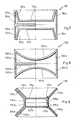
- FIGS. 7 to 11 show different cross-sectional shapes of agitator blades, which can be produced in the manner of hollow profiles with different manufacturing processes. Different embodiments are shown in each of the left and right halves of FIGS. 7 to 11, but another variant is shown in FIGS. 10a and 10b.
- the cross-section 90 according to FIG. 7 can be formed according to the left half thereof by placing two U-shaped hollow profiles with first floors 91a, 91b, inner side walls 92a, 92b, outer side walls 93a, 93b and second floors 94a, 94b.
- the two individual U-shaped, fold-symmetrical hollow profiles can be produced, for example, by folding from a suitable, one-piece blank.
- a material-saving variant can also be produced by omitting the second bottoms 94a, 94b and instead butting the outer side walls 95a, 95b and, if they are not produced in one piece, welded to one another at this point .
- a diabolo-like cross-sectional shape is achieved in that, according to the left half of FIG. 8, two C-shaped, fold-symmetrical hollow profiles with a flat back are placed against one another, so that the cross-section 100 through convex first bases 101a, 101b , Side walls 102a, 102b and second floors 103a, 103b is formed.
- the second floors 103a, 103b are omitted in the exemplary embodiment according to the right half of FIG. 8, so that the side walls 104a, 104b abut each other. It can be seen that the exemplary embodiment according to FIG. 8 has no outer corners and can therefore be cleaned particularly easily.
- a rectangular section is provided, from the corners of which the side walls extend.
- the variant according to the left half of FIG. 9 has floors 111a, 111b, inclined first side walls 112a, 112b, likewise inclined second side walls 113a, 113b and perpendicular third side walls 114a, 114b. It can be seen that the structure of the left half of FIG. 9 can be produced from a single development by folding over, because the side walls are formed by folding from the second and third side walls 112, 113.
- the side walls are designed as fifth, inclined side walls 115a, 115b, which in the region of the corners adjoin the vertical fifth side walls 116a, 116b are welded to welding points 117a, 117b.
- FIG. 10 shows further cross sections 120 and 128 which are similar to those of FIG. 9. These cross sections also assume a rectangular section, from the corners of which the side walls extend. However, the side walls in the embodiment according to Fig. 10a are cranked, i.e. they initially run in the direction of the respective floors and only then diagonally outwards. Accordingly, the cross section 120 of the left half of FIG. 10a consists of floors 121a, 121b, first, inclined side walls 122a, 122b, second, equally inclined side walls 123a, 123b, third side walls 124a, 124b running parallel to the floors 121a, 121b and finally vertical side walls 125a, 125b.
- FIG. 10b A variant of the right half of the figure in FIG. 10a is shown in FIG. 10b with a slightly different cross section 128, in which the side walls are formed by inclined sixth side walls 129, which are integral with the perpendicularly extending side wall 131.
- This one-piece structure is welded to the bottoms 121a, 121b by means of welding points 130a, 130b.
- FIG. 11 shows yet another cross section 141, which again has a diäbolo-like shape, because convex gusts 141a, 141b are used, which simultaneously form the bottom and the inner inclined side walls.
- a cross-section that can be developed in one piece is again shown, in which first convex side walls 142a, 142b and second, vertical side walls 143a, 143b are also provided.
- FIG. 11 Analogous to the preceding FIGS. 9 and 10, the right half of the figure in FIG. 11 again shows a material-saving version in which an integral, vertical third side wall 144 with welding points 145a, 145b is welded between the convex bottoms 141a, 141b.
- 9 to 11 applies generally to the right half of the figure that two of the three elements "bottom", “oblique side wall” and “vertical side wall” are in one piece and the third is welded on.
- FIGS. 7 to 11 in particular are therefore to be understood solely as an explanation, but in no way as a limitation.
- the container and / or the agitator can be made of steel, stainless steel or plastic.
Landscapes
- Chemical & Material Sciences (AREA)
- Organic Chemistry (AREA)
- Genetics & Genomics (AREA)
- Life Sciences & Earth Sciences (AREA)
- Biochemistry (AREA)
- Bioinformatics & Cheminformatics (AREA)
- General Engineering & Computer Science (AREA)
- General Health & Medical Sciences (AREA)
- Health & Medical Sciences (AREA)
- Engineering & Computer Science (AREA)
- Wood Science & Technology (AREA)
- Zoology (AREA)
- Mixers Of The Rotary Stirring Type (AREA)
- Packages (AREA)
- Table Devices Or Equipment (AREA)
- Distillation Of Fermentation Liquor, Processing Of Alcohols, Vinegar And Beer (AREA)
- Apparatus Associated With Microorganisms And Enzymes (AREA)
- Food-Manufacturing Devices (AREA)
Priority Applications (1)
| Application Number | Priority Date | Filing Date | Title |
|---|---|---|---|
| AT84116016T ATE26301T1 (de) | 1984-01-13 | 1984-12-20 | Liegender behaelter zur behandlung von weinmaische. |
Applications Claiming Priority (2)
| Application Number | Priority Date | Filing Date | Title |
|---|---|---|---|
| DE3401023 | 1984-01-13 | ||
| DE19843401023 DE3401023A1 (de) | 1984-01-13 | 1984-01-13 | Liegender behaelter zur behandlung von weinmaische |
Publications (3)
| Publication Number | Publication Date |
|---|---|
| EP0149202A2 true EP0149202A2 (fr) | 1985-07-24 |
| EP0149202A3 EP0149202A3 (en) | 1985-08-21 |
| EP0149202B1 EP0149202B1 (fr) | 1987-04-01 |
Family
ID=6224903
Family Applications (1)
| Application Number | Title | Priority Date | Filing Date |
|---|---|---|---|
| EP84116016A Expired EP0149202B1 (fr) | 1984-01-13 | 1984-12-20 | Récipient couché pour le traitement du moût de vendange |
Country Status (3)
| Country | Link |
|---|---|
| EP (1) | EP0149202B1 (fr) |
| AT (1) | ATE26301T1 (fr) |
| DE (1) | DE3401023A1 (fr) |
Cited By (4)
| Publication number | Priority date | Publication date | Assignee | Title |
|---|---|---|---|---|
| EP1026232A3 (fr) * | 1999-01-29 | 2002-05-29 | VELO Spa | Reservoir melangeur pour liquides contenant des particules solides en suspension, en particulier pour mouts de raisins devant être macérés |
| WO2006095367A1 (fr) * | 2005-03-09 | 2006-09-14 | Catalano, Adriana | Fermenteur produisant du vin par le procede classique de vinification et de maceration carbonique des raisins pour la preparation de vin 'nouveau' |
| AT14090U1 (de) * | 2013-05-06 | 2015-04-15 | Anton Ing Hrdlicka | Primärer Fermentationstank mit einer mechanischen Kühl- und/ oder Entgasungseinrichtung |
| CN106367319A (zh) * | 2016-09-23 | 2017-02-01 | 重庆市风景园林科学研究院 | 一种液态发酵罐 |
Family Cites Families (5)
| Publication number | Priority date | Publication date | Assignee | Title |
|---|---|---|---|---|
| GB724791A (en) * | 1952-02-02 | 1955-02-23 | Anton Enenkel | Apparatus for the aeration of liquids |
| GB757179A (en) * | 1954-10-21 | 1956-09-12 | George Wilfrid Edwards | Improvements in or relating to apparatus for mixing liquids |
| AT231930B (de) * | 1961-11-08 | 1964-02-25 | Karl Holler | Vorrichtung zum Vergären von Rotweinmaische |
| US4312596A (en) * | 1978-05-24 | 1982-01-26 | Tokyo Electric Limited | Beating blade member of beater |
| DE3200712C2 (de) * | 1981-01-19 | 1985-09-19 | Herbert 7121 Ingersheim Rieger | Liegender Behälter zur Behandlung von Rotweinmaische |
-
1984
- 1984-01-13 DE DE19843401023 patent/DE3401023A1/de active Granted
- 1984-12-20 EP EP84116016A patent/EP0149202B1/fr not_active Expired
- 1984-12-20 AT AT84116016T patent/ATE26301T1/de not_active IP Right Cessation
Cited By (4)
| Publication number | Priority date | Publication date | Assignee | Title |
|---|---|---|---|---|
| EP1026232A3 (fr) * | 1999-01-29 | 2002-05-29 | VELO Spa | Reservoir melangeur pour liquides contenant des particules solides en suspension, en particulier pour mouts de raisins devant être macérés |
| WO2006095367A1 (fr) * | 2005-03-09 | 2006-09-14 | Catalano, Adriana | Fermenteur produisant du vin par le procede classique de vinification et de maceration carbonique des raisins pour la preparation de vin 'nouveau' |
| AT14090U1 (de) * | 2013-05-06 | 2015-04-15 | Anton Ing Hrdlicka | Primärer Fermentationstank mit einer mechanischen Kühl- und/ oder Entgasungseinrichtung |
| CN106367319A (zh) * | 2016-09-23 | 2017-02-01 | 重庆市风景园林科学研究院 | 一种液态发酵罐 |
Also Published As
| Publication number | Publication date |
|---|---|
| DE3401023A1 (de) | 1985-07-18 |
| DE3401023C2 (fr) | 1989-08-31 |
| EP0149202B1 (fr) | 1987-04-01 |
| EP0149202A3 (en) | 1985-08-21 |
| ATE26301T1 (de) | 1987-04-15 |
Similar Documents
| Publication | Publication Date | Title |
|---|---|---|
| DE2801549C2 (de) | Vorrichtung zum Mischen von Zutaten zur Herstellung von Soßen | |
| DE1230398C2 (de) | Vorrichtung zur Begasung von Fluessigkeiten in einem Behaelter | |
| DE2856643C2 (de) | Innengekühlte Hohlschaufel für Axialturbinen | |
| DE2354136A1 (de) | Ruehrbottich | |
| DE8111381U1 (de) | Ruehrvorrichtung | |
| DE1657574A1 (de) | Kontinuierlich arbeitende Mehrzweckmisch- und/oder Knetvorrichtung | |
| DE2053718A1 (de) | Wärmeaustauscher | |
| DE3344531A1 (de) | Mischvorrichtung | |
| DE2144102A1 (de) | Filter | |
| EP0052298A2 (fr) | Dispositif agitateur pour récipient de fermentation du moût de raisin | |
| EP0149202B1 (fr) | Récipient couché pour le traitement du moût de vendange | |
| DE19854204C2 (de) | Vorrichtung zum kontinuierlichen Aufbereiten von zu verarbeitenden kakaobutterhaltigen oder ähnlichen fetthaltigen Massen | |
| EP0046477A1 (fr) | Dispositif de fabrication d'un mélange pâteux | |
| EP0105436A2 (fr) | Agitateur à disques avec chauffage et refroidissement | |
| EP0009666B1 (fr) | Outil mélangeur et pétrisseur notamment pour machines à pétrir la pâte à haut régime | |
| DE2643560C2 (de) | Rührvorrichtung | |
| DE7507237U (de) | Kreiselegge | |
| DE3143287C2 (de) | Langsam laufendes Rührwerk in einem stehenden zylindrischen Tank, insbesondere Rotweinmaische-Gärtank | |
| DE652321C (de) | Vorrichtung zum Sulfidieren und Loesen von Alkalicellulose, insbesondere fuer die Herstellung von Spinnloesungen fuer Kunstseide | |
| DE8400877U1 (de) | Liegender Behälter zur Behandlung von Weinmaische | |
| DE3307767A1 (de) | Verfahren und vorrichtung zur herstellung von stahlstreifen | |
| DE2631985C2 (de) | Dialysevorrichtung, vorzugsweise zur Reinigung von Blut | |
| DE3112994C2 (de) | Autoklav zum Aufbereiten von Kakaomasse | |
| DE1213115B (de) | Vorrichtung zur Herstellung von hochmolekularem Poly-(aethylenglykolterephthalat) | |
| DE10112710A1 (de) | Plattenwärmetauscher und Herstellungsverfahren |
Legal Events
| Date | Code | Title | Description |
|---|---|---|---|
| PUAI | Public reference made under article 153(3) epc to a published international application that has entered the european phase |
Free format text: ORIGINAL CODE: 0009012 |
|
| PUAL | Search report despatched |
Free format text: ORIGINAL CODE: 0009013 |
|
| AK | Designated contracting states |
Designated state(s): AT CH FR IT LI |
|
| AK | Designated contracting states |
Designated state(s): AT CH FR IT LI |
|
| 17P | Request for examination filed |
Effective date: 19850812 |
|
| 17Q | First examination report despatched |
Effective date: 19860324 |
|
| GRAA | (expected) grant |
Free format text: ORIGINAL CODE: 0009210 |
|
| AK | Designated contracting states |
Kind code of ref document: B1 Designated state(s): AT CH FR IT LI |
|
| PG25 | Lapsed in a contracting state [announced via postgrant information from national office to epo] |
Ref country code: IT Free format text: LAPSE BECAUSE OF FAILURE TO SUBMIT A TRANSLATION OF THE DESCRIPTION OR TO PAY THE FEE WITHIN THE PRESCRIBED TIME-LIMIT;WARNING: LAPSES OF ITALIAN PATENTS WITH EFFECTIVE DATE BEFORE 2007 MAY HAVE OCCURRED AT ANY TIME BEFORE 2007. THE CORRECT EFFECTIVE DATE MAY BE DIFFERENT FROM THE ONE RECORDED. Effective date: 19870401 |
|
| REF | Corresponds to: |
Ref document number: 26301 Country of ref document: AT Date of ref document: 19870415 Kind code of ref document: T |
|
| ET | Fr: translation filed | ||
| PG25 | Lapsed in a contracting state [announced via postgrant information from national office to epo] |
Ref country code: AT Effective date: 19871220 |
|
| PG25 | Lapsed in a contracting state [announced via postgrant information from national office to epo] |
Ref country code: LI Effective date: 19871231 Ref country code: CH Effective date: 19871231 |
|
| PLBE | No opposition filed within time limit |
Free format text: ORIGINAL CODE: 0009261 |
|
| STAA | Information on the status of an ep patent application or granted ep patent |
Free format text: STATUS: NO OPPOSITION FILED WITHIN TIME LIMIT |
|
| 26N | No opposition filed | ||
| REG | Reference to a national code |
Ref country code: CH Ref legal event code: PL |
|
| PGFP | Annual fee paid to national office [announced via postgrant information from national office to epo] |
Ref country code: FR Payment date: 19911126 Year of fee payment: 8 |
|
| PG25 | Lapsed in a contracting state [announced via postgrant information from national office to epo] |
Ref country code: FR Effective date: 19930831 |
|
| REG | Reference to a national code |
Ref country code: FR Ref legal event code: ST |