EP0149410B1 - Verfahren zum Überwachen der Schweisszeit - Google Patents
Verfahren zum Überwachen der Schweisszeit Download PDFInfo
- Publication number
- EP0149410B1 EP0149410B1 EP84440054A EP84440054A EP0149410B1 EP 0149410 B1 EP0149410 B1 EP 0149410B1 EP 84440054 A EP84440054 A EP 84440054A EP 84440054 A EP84440054 A EP 84440054A EP 0149410 B1 EP0149410 B1 EP 0149410B1
- Authority
- EP
- European Patent Office
- Prior art keywords
- property
- hole
- welding
- sensor
- sensed
- Prior art date
- Legal status (The legal status is an assumption and is not a legal conclusion. Google has not performed a legal analysis and makes no representation as to the accuracy of the status listed.)
- Expired - Lifetime
Links
Images

Classifications
-
- B—PERFORMING OPERATIONS; TRANSPORTING
- B29—WORKING OF PLASTICS; WORKING OF SUBSTANCES IN A PLASTIC STATE IN GENERAL
- B29C—SHAPING OR JOINING OF PLASTICS; SHAPING OF MATERIAL IN A PLASTIC STATE, NOT OTHERWISE PROVIDED FOR; AFTER-TREATMENT OF THE SHAPED PRODUCTS, e.g. REPAIRING
- B29C66/00—General aspects of processes or apparatus for joining preformed parts
- B29C66/50—General aspects of joining tubular articles; General aspects of joining long products, i.e. bars or profiled elements; General aspects of joining single elements to tubular articles, hollow articles or bars; General aspects of joining several hollow-preforms to form hollow or tubular articles
- B29C66/51—Joining tubular articles, profiled elements or bars; Joining single elements to tubular articles, hollow articles or bars; Joining several hollow-preforms to form hollow or tubular articles
- B29C66/52—Joining tubular articles, bars or profiled elements
- B29C66/522—Joining tubular articles
- B29C66/5221—Joining tubular articles for forming coaxial connections, i.e. the tubular articles to be joined forming a zero angle relative to each other
-
- B—PERFORMING OPERATIONS; TRANSPORTING
- B29—WORKING OF PLASTICS; WORKING OF SUBSTANCES IN A PLASTIC STATE IN GENERAL
- B29C—SHAPING OR JOINING OF PLASTICS; SHAPING OF MATERIAL IN A PLASTIC STATE, NOT OTHERWISE PROVIDED FOR; AFTER-TREATMENT OF THE SHAPED PRODUCTS, e.g. REPAIRING
- B29C65/00—Joining or sealing of preformed parts, e.g. welding of plastics materials; Apparatus therefor
- B29C65/02—Joining or sealing of preformed parts, e.g. welding of plastics materials; Apparatus therefor by heating, with or without pressure
- B29C65/34—Joining or sealing of preformed parts, e.g. welding of plastics materials; Apparatus therefor by heating, with or without pressure using heated elements which remain in the joint, e.g. "verlorenes Schweisselement"
- B29C65/3404—Joining or sealing of preformed parts, e.g. welding of plastics materials; Apparatus therefor by heating, with or without pressure using heated elements which remain in the joint, e.g. "verlorenes Schweisselement" characterised by the type of heated elements which remain in the joint
- B29C65/342—Joining or sealing of preformed parts, e.g. welding of plastics materials; Apparatus therefor by heating, with or without pressure using heated elements which remain in the joint, e.g. "verlorenes Schweisselement" characterised by the type of heated elements which remain in the joint comprising at least a single wire, e.g. in the form of a winding
-
- B—PERFORMING OPERATIONS; TRANSPORTING
- B29—WORKING OF PLASTICS; WORKING OF SUBSTANCES IN A PLASTIC STATE IN GENERAL
- B29C—SHAPING OR JOINING OF PLASTICS; SHAPING OF MATERIAL IN A PLASTIC STATE, NOT OTHERWISE PROVIDED FOR; AFTER-TREATMENT OF THE SHAPED PRODUCTS, e.g. REPAIRING
- B29C65/00—Joining or sealing of preformed parts, e.g. welding of plastics materials; Apparatus therefor
- B29C65/02—Joining or sealing of preformed parts, e.g. welding of plastics materials; Apparatus therefor by heating, with or without pressure
- B29C65/34—Joining or sealing of preformed parts, e.g. welding of plastics materials; Apparatus therefor by heating, with or without pressure using heated elements which remain in the joint, e.g. "verlorenes Schweisselement"
- B29C65/3472—Joining or sealing of preformed parts, e.g. welding of plastics materials; Apparatus therefor by heating, with or without pressure using heated elements which remain in the joint, e.g. "verlorenes Schweisselement" characterised by the composition of the heated elements which remain in the joint
- B29C65/3476—Joining or sealing of preformed parts, e.g. welding of plastics materials; Apparatus therefor by heating, with or without pressure using heated elements which remain in the joint, e.g. "verlorenes Schweisselement" characterised by the composition of the heated elements which remain in the joint being metallic
-
- B—PERFORMING OPERATIONS; TRANSPORTING
- B29—WORKING OF PLASTICS; WORKING OF SUBSTANCES IN A PLASTIC STATE IN GENERAL
- B29C—SHAPING OR JOINING OF PLASTICS; SHAPING OF MATERIAL IN A PLASTIC STATE, NOT OTHERWISE PROVIDED FOR; AFTER-TREATMENT OF THE SHAPED PRODUCTS, e.g. REPAIRING
- B29C66/00—General aspects of processes or apparatus for joining preformed parts
- B29C66/50—General aspects of joining tubular articles; General aspects of joining long products, i.e. bars or profiled elements; General aspects of joining single elements to tubular articles, hollow articles or bars; General aspects of joining several hollow-preforms to form hollow or tubular articles
- B29C66/51—Joining tubular articles, profiled elements or bars; Joining single elements to tubular articles, hollow articles or bars; Joining several hollow-preforms to form hollow or tubular articles
- B29C66/52—Joining tubular articles, bars or profiled elements
- B29C66/522—Joining tubular articles
- B29C66/5229—Joining tubular articles involving the use of a socket
-
- B—PERFORMING OPERATIONS; TRANSPORTING
- B29—WORKING OF PLASTICS; WORKING OF SUBSTANCES IN A PLASTIC STATE IN GENERAL
- B29C—SHAPING OR JOINING OF PLASTICS; SHAPING OF MATERIAL IN A PLASTIC STATE, NOT OTHERWISE PROVIDED FOR; AFTER-TREATMENT OF THE SHAPED PRODUCTS, e.g. REPAIRING
- B29C66/00—General aspects of processes or apparatus for joining preformed parts
- B29C66/90—Measuring or controlling the joining process
- B29C66/91—Measuring or controlling the joining process by measuring or controlling the temperature, the heat or the thermal flux
- B29C66/912—Measuring or controlling the joining process by measuring or controlling the temperature, the heat or the thermal flux by measuring the temperature, the heat or the thermal flux
- B29C66/9121—Measuring or controlling the joining process by measuring or controlling the temperature, the heat or the thermal flux by measuring the temperature, the heat or the thermal flux by measuring the temperature
- B29C66/91211—Measuring or controlling the joining process by measuring or controlling the temperature, the heat or the thermal flux by measuring the temperature, the heat or the thermal flux by measuring the temperature with special temperature measurement means or methods
- B29C66/91216—Measuring or controlling the joining process by measuring or controlling the temperature, the heat or the thermal flux by measuring the temperature, the heat or the thermal flux by measuring the temperature with special temperature measurement means or methods enabling contactless temperature measurements, e.g. using a pyrometer
-
- B—PERFORMING OPERATIONS; TRANSPORTING
- B29—WORKING OF PLASTICS; WORKING OF SUBSTANCES IN A PLASTIC STATE IN GENERAL
- B29C—SHAPING OR JOINING OF PLASTICS; SHAPING OF MATERIAL IN A PLASTIC STATE, NOT OTHERWISE PROVIDED FOR; AFTER-TREATMENT OF THE SHAPED PRODUCTS, e.g. REPAIRING
- B29C66/00—General aspects of processes or apparatus for joining preformed parts
- B29C66/90—Measuring or controlling the joining process
- B29C66/91—Measuring or controlling the joining process by measuring or controlling the temperature, the heat or the thermal flux
- B29C66/912—Measuring or controlling the joining process by measuring or controlling the temperature, the heat or the thermal flux by measuring the temperature, the heat or the thermal flux
- B29C66/9121—Measuring or controlling the joining process by measuring or controlling the temperature, the heat or the thermal flux by measuring the temperature, the heat or the thermal flux by measuring the temperature
- B29C66/91221—Measuring or controlling the joining process by measuring or controlling the temperature, the heat or the thermal flux by measuring the temperature, the heat or the thermal flux by measuring the temperature of the parts to be joined
-
- B—PERFORMING OPERATIONS; TRANSPORTING
- B29—WORKING OF PLASTICS; WORKING OF SUBSTANCES IN A PLASTIC STATE IN GENERAL
- B29C—SHAPING OR JOINING OF PLASTICS; SHAPING OF MATERIAL IN A PLASTIC STATE, NOT OTHERWISE PROVIDED FOR; AFTER-TREATMENT OF THE SHAPED PRODUCTS, e.g. REPAIRING
- B29C66/00—General aspects of processes or apparatus for joining preformed parts
- B29C66/90—Measuring or controlling the joining process
- B29C66/91—Measuring or controlling the joining process by measuring or controlling the temperature, the heat or the thermal flux
- B29C66/914—Measuring or controlling the joining process by measuring or controlling the temperature, the heat or the thermal flux by controlling or regulating the temperature, the heat or the thermal flux
- B29C66/9141—Measuring or controlling the joining process by measuring or controlling the temperature, the heat or the thermal flux by controlling or regulating the temperature, the heat or the thermal flux by controlling or regulating the temperature
- B29C66/91411—Measuring or controlling the joining process by measuring or controlling the temperature, the heat or the thermal flux by controlling or regulating the temperature, the heat or the thermal flux by controlling or regulating the temperature of the parts to be joined, e.g. the joining process taking the temperature of the parts to be joined into account
-
- B—PERFORMING OPERATIONS; TRANSPORTING
- B29—WORKING OF PLASTICS; WORKING OF SUBSTANCES IN A PLASTIC STATE IN GENERAL
- B29C—SHAPING OR JOINING OF PLASTICS; SHAPING OF MATERIAL IN A PLASTIC STATE, NOT OTHERWISE PROVIDED FOR; AFTER-TREATMENT OF THE SHAPED PRODUCTS, e.g. REPAIRING
- B29C66/00—General aspects of processes or apparatus for joining preformed parts
- B29C66/90—Measuring or controlling the joining process
- B29C66/91—Measuring or controlling the joining process by measuring or controlling the temperature, the heat or the thermal flux
- B29C66/914—Measuring or controlling the joining process by measuring or controlling the temperature, the heat or the thermal flux by controlling or regulating the temperature, the heat or the thermal flux
- B29C66/9161—Measuring or controlling the joining process by measuring or controlling the temperature, the heat or the thermal flux by controlling or regulating the temperature, the heat or the thermal flux by controlling or regulating the heat or the thermal flux, i.e. the heat flux
- B29C66/91651—Measuring or controlling the joining process by measuring or controlling the temperature, the heat or the thermal flux by controlling or regulating the temperature, the heat or the thermal flux by controlling or regulating the heat or the thermal flux, i.e. the heat flux by controlling or regulating the heat generated by Joule heating or induction heating
- B29C66/91655—Measuring or controlling the joining process by measuring or controlling the temperature, the heat or the thermal flux by controlling or regulating the temperature, the heat or the thermal flux by controlling or regulating the heat or the thermal flux, i.e. the heat flux by controlling or regulating the heat generated by Joule heating or induction heating by controlling or regulating the current intensity
-
- G—PHYSICS
- G05—CONTROLLING; REGULATING
- G05D—SYSTEMS FOR CONTROLLING OR REGULATING NON-ELECTRIC VARIABLES
- G05D23/00—Control of temperature
- G05D23/19—Control of temperature characterised by the use of electric means
- G05D23/275—Control of temperature characterised by the use of electric means with sensing element expanding, contracting, or fusing in response to changes of temperature
- G05D23/27535—Details of the sensing element
- G05D23/27543—Details of the sensing element using the controlled element as sensing element
-
- B—PERFORMING OPERATIONS; TRANSPORTING
- B29—WORKING OF PLASTICS; WORKING OF SUBSTANCES IN A PLASTIC STATE IN GENERAL
- B29C—SHAPING OR JOINING OF PLASTICS; SHAPING OF MATERIAL IN A PLASTIC STATE, NOT OTHERWISE PROVIDED FOR; AFTER-TREATMENT OF THE SHAPED PRODUCTS, e.g. REPAIRING
- B29C66/00—General aspects of processes or apparatus for joining preformed parts
- B29C66/70—General aspects of processes or apparatus for joining preformed parts characterised by the composition, physical properties or the structure of the material of the parts to be joined; Joining with non-plastics material
- B29C66/73—General aspects of processes or apparatus for joining preformed parts characterised by the composition, physical properties or the structure of the material of the parts to be joined; Joining with non-plastics material characterised by the intensive physical properties of the material of the parts to be joined, by the optical properties of the material of the parts to be joined, by the extensive physical properties of the parts to be joined, by the state of the material of the parts to be joined or by the material of the parts to be joined being a thermoplastic or a thermoset
- B29C66/739—General aspects of processes or apparatus for joining preformed parts characterised by the composition, physical properties or the structure of the material of the parts to be joined; Joining with non-plastics material characterised by the intensive physical properties of the material of the parts to be joined, by the optical properties of the material of the parts to be joined, by the extensive physical properties of the parts to be joined, by the state of the material of the parts to be joined or by the material of the parts to be joined being a thermoplastic or a thermoset characterised by the material of the parts to be joined being a thermoplastic or a thermoset
- B29C66/7392—General aspects of processes or apparatus for joining preformed parts characterised by the composition, physical properties or the structure of the material of the parts to be joined; Joining with non-plastics material characterised by the intensive physical properties of the material of the parts to be joined, by the optical properties of the material of the parts to be joined, by the extensive physical properties of the parts to be joined, by the state of the material of the parts to be joined or by the material of the parts to be joined being a thermoplastic or a thermoset characterised by the material of the parts to be joined being a thermoplastic or a thermoset characterised by the material of at least one of the parts being a thermoplastic
- B29C66/73921—General aspects of processes or apparatus for joining preformed parts characterised by the composition, physical properties or the structure of the material of the parts to be joined; Joining with non-plastics material characterised by the intensive physical properties of the material of the parts to be joined, by the optical properties of the material of the parts to be joined, by the extensive physical properties of the parts to be joined, by the state of the material of the parts to be joined or by the material of the parts to be joined being a thermoplastic or a thermoset characterised by the material of the parts to be joined being a thermoplastic or a thermoset characterised by the material of at least one of the parts being a thermoplastic characterised by the materials of both parts being thermoplastics
-
- B—PERFORMING OPERATIONS; TRANSPORTING
- B29—WORKING OF PLASTICS; WORKING OF SUBSTANCES IN A PLASTIC STATE IN GENERAL
- B29C—SHAPING OR JOINING OF PLASTICS; SHAPING OF MATERIAL IN A PLASTIC STATE, NOT OTHERWISE PROVIDED FOR; AFTER-TREATMENT OF THE SHAPED PRODUCTS, e.g. REPAIRING
- B29C66/00—General aspects of processes or apparatus for joining preformed parts
- B29C66/90—Measuring or controlling the joining process
- B29C66/94—Measuring or controlling the joining process by measuring or controlling the time
-
- B—PERFORMING OPERATIONS; TRANSPORTING
- B29—WORKING OF PLASTICS; WORKING OF SUBSTANCES IN A PLASTIC STATE IN GENERAL
- B29C—SHAPING OR JOINING OF PLASTICS; SHAPING OF MATERIAL IN A PLASTIC STATE, NOT OTHERWISE PROVIDED FOR; AFTER-TREATMENT OF THE SHAPED PRODUCTS, e.g. REPAIRING
- B29C66/00—General aspects of processes or apparatus for joining preformed parts
- B29C66/90—Measuring or controlling the joining process
- B29C66/96—Measuring or controlling the joining process characterised by the method for implementing the controlling of the joining process
- B29C66/961—Measuring or controlling the joining process characterised by the method for implementing the controlling of the joining process involving a feedback loop mechanism, e.g. comparison with a desired value
Definitions
- the present invention relates to the use of electrofusion fittings for plastic tubes. It more specifically relates to a method and a device ensuring in this implementation the optimal welding time as a function of the diameter of the tubes.
- fitting is meant here, both a sleeve used to connect the ends of two tubes in the extension of one another, a socket made transversely on another tube, or any other device in which a certain number of tubular elements must be associated with each other.
- This simple process involves a difficulty of control, because it is not visible from the outside, but on the contrary, constitutes a progressive phenomenon, the outcome of which is the formation of a unitary block between the tubes and their sleeve. connection, but that this phenomenon can be followed by physical indices, namely the modification of the intrinsic properties of the plastic material, and in particular of its volume, its thermal conductivity or its hardness.
- this duration can be controlled by measuring the thermal conductivity of the material or its degree of softening.
- the flow of current is automatically interrupted as soon as the properties of the material of the pipe connection corresponding to the optimal weld.
- it is the molten material itself which, by thermally expanding, comes into contact with an electromechanical or electronic component which then intervenes to interrupt the current flow.
- thermoprobe the thermal conductivity of the material which is taken as variable, and which, when it has reached the value corresponding to the desired degree of softening or melting, determines either, l 'sending, by a thermoprobe, of stop information to the current source, that is to say the power cut by rupture, by fusion, of a zone sensitive to the heat of the winding.
- it is an element sensitive to the hardness or the consistency of the material which, by sinking into this softened material, determines the operation of an electro-mechanical or electronic component.
- the invention therefore relates firstly to a method for controlling the welding time of an electrofusion sleeve, this method consisting in using the variations in properties of the molten plastic to act, at the moment when one of these properties reaches its optimal degree, on an electromechanical or electronic component which stops the flow of electric current.
- the flow will be used ment of the molten material through a radial hole in the wall of the sleeve.
- the molten material coming from the internal zone of the sleeve is discharged through this hole, and is flush with the external surface of the sleeve.
- This well-known phenomenon has been exploited in an attempt to exercise visual control of the operation, by placing a "float" in the hole, but such a means is too rustic to constitute true rigorous control.
- a microswitch is placed at the orifice of the hole, of material such that it is actuated by the molten material at the very moment when it reaches its contact, which achieves a really rigorous control. .
- the invention therefore also relates to a device for controlling the welding time of an electrofusion sleeve, of the type in which a hole is drilled radially in the wall of the sleeve up to the vicinity of the winding, the molten material s' flowing through this hole to the vicinity of the external face of the sleeve, this device consisting of an electro-mechanical or electronic element placed in the vicinity of the mouth of the hole and intervening to cut the current as soon as it is reached by said molten material.
- the diameter of the hole must be chosen according to the size of the sleeve so that the quantity of molten material which rises there is such that it reaches the control element at the precise moment when the welding is optimal and where the flow of current must be interrupted.
- a sleeve 1 of thermoplastic material for example high density polyethylene
- two coaxial tubes 2-2 ' for example polyethylene
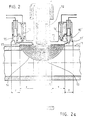
- an outer diameter very slightly smaller than the inner diameter of the sleeve 1 the two tubes 2-2 ′ are introduced into the sleeve 1 in a generally symmetrical manner, so that their ends are located opposite zones of the sleeve in which are embedded windings 3-3 'connected together by terminals 6-6' to a source of electrical energy, as illustrated in Figure 3.
- the supply circuit of the winding torque 3-3 ′ is automatically cut off as soon as the welding is carried out, thanks to to a control circuit controlled by two micro-switches designated by 4-4 'arranged in wells 5-5' near the terminals 6-6 ', and dug in the wall of the sleeve 1 to the vicinity of the windings 3-3 '.
- the welding is carried out on a saddle 10 covering all or parts of a tube 11 and used to practice in this tube a bypass.
- the saddle 10 carries an internally threaded tube 12 to allow, thanks to a threaded punch (not shown), to pierce an orifice 13 in the wall of the tube 11 facing the tube 12.
- the saddle 10 has a winding 14, curved to adapt to the curved shape of the saddle, and excited by a circuit on the main terminals 15-15 ', while microswitches 16-15' are housed in wells 17-17 'in a similar way to the micro-switches 4-4' housed in the wells 5-5 'of figure 1.
- the implementation of the process is similar: as soon as the material, the saddle and the tube has reached the desired degree of fusion, it penetrates into the wells 16-16 'and triggers the microswitches 16-16' by cutting the supply circuits of the winding 14, which ends the welding process.
- FIG. 3 very schematically illustrates the electrical assembly as it has just been described. From a low voltage generator 20, conductors 21-22 will supply main terminals 6-6 '(15-15') of the soldering winding. On the conductor 22 is interposed a control system comprising a relay 23, whose engagement is done manually by a push button 24, and the triggering is done by micro-4-4 '(16-16') including the probes are sensitive to the pressure of the molten material in the wells 5-5 '(17-17') made in the sleeve 1 (or the saddle 10).
- a control system comprising a relay 23, whose engagement is done manually by a push button 24, and the triggering is done by micro-4-4 '(16-16') including the probes are sensitive to the pressure of the molten material in the wells 5-5 '(17-17') made in the sleeve 1 (or the saddle 10).
- these probes can also be sensitive to the thermal conductivity or to the hardness of the material, and the circuit control system can be controlled, either solely from the volume of the material. , or, since there are two wells in each sleeve from the hardness on one side and volume on the other.
Landscapes
- Engineering & Computer Science (AREA)
- Mechanical Engineering (AREA)
- Physics & Mathematics (AREA)
- Thermal Sciences (AREA)
- General Physics & Mathematics (AREA)
- Automation & Control Theory (AREA)
- Lining Or Joining Of Plastics Or The Like (AREA)
- Arc Welding Control (AREA)
- Pressure Welding/Diffusion-Bonding (AREA)
- Heat Treatment Of Articles (AREA)
Claims (8)
Priority Applications (1)
| Application Number | Priority Date | Filing Date | Title |
|---|---|---|---|
| AT84440054T ATE49729T1 (de) | 1983-12-19 | 1984-11-19 | Verfahren zum ueberwachen der schweisszeit. |
Applications Claiming Priority (2)
| Application Number | Priority Date | Filing Date | Title |
|---|---|---|---|
| FR8320429 | 1983-12-19 | ||
| FR8320429A FR2555936B1 (fr) | 1983-12-19 | 1983-12-19 | Procede pour le controle du temps de soudage |
Publications (3)
| Publication Number | Publication Date |
|---|---|
| EP0149410A2 EP0149410A2 (de) | 1985-07-24 |
| EP0149410A3 EP0149410A3 (en) | 1985-12-18 |
| EP0149410B1 true EP0149410B1 (de) | 1990-01-24 |
Family
ID=9295374
Family Applications (1)
| Application Number | Title | Priority Date | Filing Date |
|---|---|---|---|
| EP84440054A Expired - Lifetime EP0149410B1 (de) | 1983-12-19 | 1984-11-19 | Verfahren zum Überwachen der Schweisszeit |
Country Status (4)
| Country | Link |
|---|---|
| EP (1) | EP0149410B1 (de) |
| AT (1) | ATE49729T1 (de) |
| DE (1) | DE3481113D1 (de) |
| FR (1) | FR2555936B1 (de) |
Families Citing this family (12)
| Publication number | Priority date | Publication date | Assignee | Title |
|---|---|---|---|---|
| FR2600008B2 (fr) * | 1983-12-19 | 1988-08-19 | Innoge Sam | Dispositif pour le controle du temps de soudage |
| US4695335A (en) * | 1985-11-08 | 1987-09-22 | R. W. Lyall & Company, Inc. | Method for developing a predetermined fusing temperature in thermoplastic items |
| CH668739A5 (de) * | 1986-01-08 | 1989-01-31 | Geberit Ag | Einrichtung mit einer kunststoff-schweissmuffe und einem anschlusskopf. |
| FR2609933B1 (fr) * | 1986-12-23 | 1989-06-09 | Gaz De France | Procede pour conduire et controler l'elevation de temperature de pieces chauffees electriquement |
| US4852914A (en) * | 1987-06-19 | 1989-08-01 | Milfuse Systems, Inc. | Plastic pipeline having rapidly fusible joints and method of making same |
| US4943706A (en) * | 1988-04-18 | 1990-07-24 | R. W. Lyall & Company, Inc. | Method and apparatus for fusing thermoplastic materials |
| CA1321626C (en) * | 1988-07-21 | 1993-08-24 | Naotake Uda | Electrofusion of electrofusion joint, method of confirming state of fusion and fusion joint suitable for use in the methods |
| FR2643014B1 (fr) * | 1988-12-29 | 1991-05-31 | Gaz De France | Dispositif pour detecter, au cours du soudage, des variations dans l'etat physique de la matiere plastique d'une piece de raccordement prevue pour la jonction de tubes |
| US5369248A (en) * | 1992-09-01 | 1994-11-29 | Gaz De France | Electro-weldable connecting piece having connection terminals and its method of manufacture |
| FR2695173B1 (fr) * | 1992-09-01 | 1994-10-14 | Gaz De France | Pièce d'assemblage de type rivet, ensemble constitué par un tel rivet fixé sur une pièce électriquement conductrice, pièces de raccordement équipées d'un tel ensemble et leur procédé de fabrication. |
| CN101053999B (zh) * | 2007-05-29 | 2010-06-16 | 广东联塑科技实业有限公司 | 使钢带增强聚乙烯螺旋波纹管便于相互连接的加工方法 |
| CN109140103A (zh) * | 2018-09-05 | 2019-01-04 | 浙江伟星新型建材股份有限公司 | 一种熔断式电熔管件 |
Family Cites Families (11)
| Publication number | Priority date | Publication date | Assignee | Title |
|---|---|---|---|---|
| US2524886A (en) * | 1945-11-21 | 1950-10-10 | Collins Radio Co | Temperature control of electrovibratory systems |
| GB802333A (en) * | 1956-02-10 | 1958-10-01 | Marconi Wireless Telegraph Co | Improvements in or relating to electrically heated thermostatically controllable containers |
| US2870297A (en) * | 1957-06-24 | 1959-01-20 | Hagan Chemicals & Controls Inc | Trip thermostats having sharp reference temperatures |
| US3026392A (en) * | 1960-02-01 | 1962-03-20 | L & M Space Res And Electronic | Shunting device |
| US3046536A (en) * | 1960-05-23 | 1962-07-24 | Alfred F Sciuto | Automatic fire alarm energizing means |
| FR1260490A (fr) * | 1960-06-23 | 1961-05-05 | Brown Boveri & Compagnie Sa | Dispositif pour l'assemblage de pièces ou d'éléments de pièces non métalliques,de préférence en matières thermoplastiques |
| GB1106515A (en) * | 1965-10-29 | 1968-03-20 | Maclaren Controls Ltd | Improvements in or relating to thermostats |
| CH437755A (de) * | 1965-11-29 | 1967-06-15 | Von Roll Ag | Elektronisch gesteuertes Schweissgerät zum Verbinden von Rohren und Formstücken aus schweissbarem Kunststoff mittels eines einen elektrischen Heizwiderstand aufweisenden Verbindungsstückes |
| AU8494575A (en) * | 1974-10-04 | 1977-03-24 | Micro Devices Corp | Thermably actuable switch constructions |
| US4117311A (en) * | 1976-03-22 | 1978-09-26 | Von Roll Ag. | Electric welding muff |
| EP0093821B1 (de) * | 1982-05-12 | 1987-05-06 | Geberit AG | Schweissmuffe |
-
1983
- 1983-12-19 FR FR8320429A patent/FR2555936B1/fr not_active Expired
-
1984
- 1984-11-19 DE DE8484440054T patent/DE3481113D1/de not_active Expired - Lifetime
- 1984-11-19 EP EP84440054A patent/EP0149410B1/de not_active Expired - Lifetime
- 1984-11-19 AT AT84440054T patent/ATE49729T1/de not_active IP Right Cessation
Also Published As
| Publication number | Publication date |
|---|---|
| FR2555936B1 (fr) | 1986-11-21 |
| EP0149410A3 (en) | 1985-12-18 |
| ATE49729T1 (de) | 1990-02-15 |
| DE3481113D1 (de) | 1990-03-01 |
| EP0149410A2 (de) | 1985-07-24 |
| FR2555936A1 (fr) | 1985-06-07 |
Similar Documents
| Publication | Publication Date | Title |
|---|---|---|
| MC1581A1 (fr) | Procede pour le controle du temps de soudage | |
| EP0149410A2 (de) | Verfahren zum Überwachen der Schweisszeit | |
| EP0241597B1 (de) | Verbinder mit Schmelzeinsatz und innerer Temperatursteuerung | |
| EP0430762B1 (de) | Verfahren und Vorrichtung zum Ermitteln des Erwärmungszustandes eines Teiles aus thermoplastischem Material und Verbindungsstück zum Verschweissen von Kunststoffteilen | |
| FR2654977A1 (fr) | Procede et piece de raccordement utilisant une resistance electrique pour le soudage d'elements en matiere plastique. | |
| FR2497916A1 (fr) | Manchon soudable en matiere thermoplastique | |
| EP0360811A1 (de) | Vorrichtung zur herstellung einer lötverbindung. | |
| JP2770643B2 (ja) | ポリオレフィンパイプを結合する方法及びカプラ | |
| FR2648078A1 (fr) | Element d'electro-soudage en matiere plastique conductrice et raccord d'electro-soudage pour elements en matiere plastique realise a l'aide de celui-ci | |
| US5189271A (en) | Temperature self-regulating induction apparatus | |
| CA2004035C (fr) | Dispositif pour detecter, au cours du soudage, des variations dans l'etat physique de la matiere plastique d'une piece de raccordement prevue pour la jonction de tubes | |
| EP0615091A1 (de) | Heissschweissbare Rohrverbindung aus Kunststoff und Herstellungsverfahren | |
| CA1255760A (fr) | Procede pour le controle du temps de soudage | |
| EP0183615A2 (de) | Verfahren und Vorrichtung zum Feststellen von Phasenveränderungen | |
| WO1997012374A3 (fr) | Elements combustibles et procede et dispositif de production | |
| CA1334720C (fr) | Procede de jonction de pieces en matiere plastique, en utilisant un agent de reticulation et une resistance electrique de chauffage | |
| WO1991007272A1 (en) | Method of joining hollow plastics members by fusion | |
| FR2572327A2 (fr) | Dispositif pour le controle du temps de soudage. | |
| EP0241348A1 (de) | Verfahren und Vorrichtung zum Schmelzen von Paraffinkristallen in Brennstoffen | |
| BE1004518A5 (fr) | Detecteur pour fluides a haute temperature. | |
| EP0586283B1 (de) | Elektroschweissbares Verbindungsstück mit Anschlussklemmen und Verfahren zur dessen Herstellung | |
| EP1062701A1 (de) | Verfahren und herstellungsapparat für eine mehrzahl von thermoelementen und also hergstellter thermoelektrischer umwandler | |
| BE852653A (fr) | Manchon soudable electriquement en matiere thermoplastique | |
| MC1446A1 (fr) | Derivation electrosoudable pour canalisation en materiau thermoplastique | |
| FR2576362A1 (fr) | Dispositif de chauffage electrique pour prechauffer le carburant de moteurs a combustion interne, en particulier de diesels |
Legal Events
| Date | Code | Title | Description |
|---|---|---|---|
| PUAI | Public reference made under article 153(3) epc to a published international application that has entered the european phase |
Free format text: ORIGINAL CODE: 0009012 |
|
| AK | Designated contracting states |
Designated state(s): AT BE CH DE GB IT LI LU NL SE |
|
| PUAL | Search report despatched |
Free format text: ORIGINAL CODE: 0009013 |
|
| AK | Designated contracting states |
Designated state(s): AT BE CH DE GB IT LI LU NL SE |
|
| 17P | Request for examination filed |
Effective date: 19860606 |
|
| RAP1 | Party data changed (applicant data changed or rights of an application transferred) |
Owner name: INNOVATION GENERALE EN ABREGE INNOGE |
|
| 17Q | First examination report despatched |
Effective date: 19880317 |
|
| GRAA | (expected) grant |
Free format text: ORIGINAL CODE: 0009210 |
|
| AK | Designated contracting states |
Kind code of ref document: B1 Designated state(s): AT BE CH DE GB IT LI LU NL SE |
|
| REF | Corresponds to: |
Ref document number: 49729 Country of ref document: AT Date of ref document: 19900215 Kind code of ref document: T |
|
| ITF | It: translation for a ep patent filed | ||
| REF | Corresponds to: |
Ref document number: 3481113 Country of ref document: DE Date of ref document: 19900301 |
|
| GBT | Gb: translation of ep patent filed (gb section 77(6)(a)/1977) | ||
| PLBE | No opposition filed within time limit |
Free format text: ORIGINAL CODE: 0009261 |
|
| STAA | Information on the status of an ep patent application or granted ep patent |
Free format text: STATUS: NO OPPOSITION FILED WITHIN TIME LIMIT |
|
| 26N | No opposition filed | ||
| ITTA | It: last paid annual fee | ||
| PGFP | Annual fee paid to national office [announced via postgrant information from national office to epo] |
Ref country code: LU Payment date: 19931116 Year of fee payment: 10 |
|
| PGFP | Annual fee paid to national office [announced via postgrant information from national office to epo] |
Ref country code: BE Payment date: 19931122 Year of fee payment: 10 |
|
| EPTA | Lu: last paid annual fee | ||
| PGFP | Annual fee paid to national office [announced via postgrant information from national office to epo] |
Ref country code: SE Payment date: 19940531 Year of fee payment: 10 |
|
| PG25 | Lapsed in a contracting state [announced via postgrant information from national office to epo] |
Ref country code: LU Free format text: LAPSE BECAUSE OF NON-PAYMENT OF DUE FEES Effective date: 19941119 |
|
| PG25 | Lapsed in a contracting state [announced via postgrant information from national office to epo] |
Ref country code: SE Effective date: 19941120 |
|
| PGFP | Annual fee paid to national office [announced via postgrant information from national office to epo] |
Ref country code: CH Payment date: 19941125 Year of fee payment: 11 |
|
| PG25 | Lapsed in a contracting state [announced via postgrant information from national office to epo] |
Ref country code: BE Effective date: 19941130 |
|
| PGFP | Annual fee paid to national office [announced via postgrant information from national office to epo] |
Ref country code: NL Payment date: 19941130 Year of fee payment: 11 |
|
| EAL | Se: european patent in force in sweden |
Ref document number: 84440054.9 |
|
| BERE | Be: lapsed |
Owner name: INNOVATION GENERALE INNOGE Effective date: 19941130 |
|
| EUG | Se: european patent has lapsed |
Ref document number: 84440054.9 |
|
| PG25 | Lapsed in a contracting state [announced via postgrant information from national office to epo] |
Ref country code: LI Effective date: 19951130 Ref country code: CH Effective date: 19951130 |
|
| PGFP | Annual fee paid to national office [announced via postgrant information from national office to epo] |
Ref country code: AT Payment date: 19951215 Year of fee payment: 12 |
|
| PG25 | Lapsed in a contracting state [announced via postgrant information from national office to epo] |
Ref country code: NL Effective date: 19960601 |
|
| REG | Reference to a national code |
Ref country code: CH Ref legal event code: PL |
|
| NLV4 | Nl: lapsed or anulled due to non-payment of the annual fee |
Effective date: 19960601 |
|
| PG25 | Lapsed in a contracting state [announced via postgrant information from national office to epo] |
Ref country code: AT Effective date: 19961119 |
|
| REG | Reference to a national code |
Ref country code: GB Ref legal event code: IF02 |
|
| PGFP | Annual fee paid to national office [announced via postgrant information from national office to epo] |
Ref country code: DE Payment date: 20031028 Year of fee payment: 20 |
|
| PGFP | Annual fee paid to national office [announced via postgrant information from national office to epo] |
Ref country code: GB Payment date: 20031029 Year of fee payment: 20 |
|
| PG25 | Lapsed in a contracting state [announced via postgrant information from national office to epo] |
Ref country code: GB Free format text: LAPSE BECAUSE OF EXPIRATION OF PROTECTION Effective date: 20041118 |
|
| REG | Reference to a national code |
Ref country code: GB Ref legal event code: PE20 |