EP0149836A2 - Kautschuk-Mischungen und daraus hergestellte Gummiartikel und Kraftfahrzugreifen - Google Patents
Kautschuk-Mischungen und daraus hergestellte Gummiartikel und Kraftfahrzugreifen Download PDFInfo
- Publication number
- EP0149836A2 EP0149836A2 EP84116110A EP84116110A EP0149836A2 EP 0149836 A2 EP0149836 A2 EP 0149836A2 EP 84116110 A EP84116110 A EP 84116110A EP 84116110 A EP84116110 A EP 84116110A EP 0149836 A2 EP0149836 A2 EP 0149836A2
- Authority
- EP
- European Patent Office
- Prior art keywords
- weight
- rubber
- copolymer
- ethylenically unsaturated
- rubber mixtures
- Prior art date
- Legal status (The legal status is an assumption and is not a legal conclusion. Google has not performed a legal analysis and makes no representation as to the accuracy of the status listed.)
- Granted
Links
Classifications
-
- C—CHEMISTRY; METALLURGY
- C08—ORGANIC MACROMOLECULAR COMPOUNDS; THEIR PREPARATION OR CHEMICAL WORKING-UP; COMPOSITIONS BASED THEREON
- C08L—COMPOSITIONS OF MACROMOLECULAR COMPOUNDS
- C08L21/00—Compositions of unspecified rubbers
-
- C—CHEMISTRY; METALLURGY
- C08—ORGANIC MACROMOLECULAR COMPOUNDS; THEIR PREPARATION OR CHEMICAL WORKING-UP; COMPOSITIONS BASED THEREON
- C08L—COMPOSITIONS OF MACROMOLECULAR COMPOUNDS
- C08L33/00—Compositions of homopolymers or copolymers of compounds having one or more unsaturated aliphatic radicals, each having only one carbon-to-carbon double bond, and only one being terminated by only one carboxyl radical, or of salts, anhydrides, esters, amides, imides or nitriles thereof; Compositions of derivatives of such polymers
- C08L33/04—Homopolymers or copolymers of esters
- C08L33/06—Homopolymers or copolymers of esters of esters containing only carbon, hydrogen and oxygen, which oxygen atoms are present only as part of the carboxyl radical
-
- C—CHEMISTRY; METALLURGY
- C08—ORGANIC MACROMOLECULAR COMPOUNDS; THEIR PREPARATION OR CHEMICAL WORKING-UP; COMPOSITIONS BASED THEREON
- C08L—COMPOSITIONS OF MACROMOLECULAR COMPOUNDS
- C08L33/00—Compositions of homopolymers or copolymers of compounds having one or more unsaturated aliphatic radicals, each having only one carbon-to-carbon double bond, and only one being terminated by only one carboxyl radical, or of salts, anhydrides, esters, amides, imides or nitriles thereof; Compositions of derivatives of such polymers
- C08L33/04—Homopolymers or copolymers of esters
- C08L33/06—Homopolymers or copolymers of esters of esters containing only carbon, hydrogen and oxygen, which oxygen atoms are present only as part of the carboxyl radical
- C08L33/08—Homopolymers or copolymers of acrylic acid esters
Definitions
- Rubber mixtures are produced according to the prior art with the aid of mixing units, in which the tough, solid, rubber-elastic polymers are mixed intensively with the other components using high shear forces.
- the work to be done and the duration play a major role in the economy of the mixing process, so that a reduction in the amount of energy and time is desirable and is continuously sought.
- many vulcanizates made from the rubber compounds, such as hoses, vehicle tires, conveyor belts and V-belts are not made from a single blank, but are made up of different parts with different formulations, the mixtures of these individual parts are required to have a certain stickiness so that they become temporarily stable Can join blank.
- the mechanical properties such as tensile strength, elongation at break, tension values, etc. desirable.
- the use of copolymers of unsaturated acids as compared to the sole use of the other components of conventional rubber mixtures, allows significant progress both in the production of the mixture and in the production of blanks and also in terms of the mechanical properties of the end products be achieved.
- the technical advantages mentioned can occur individually or together to a particular extent.
- vulcanizates of the rubber mixtures according to the invention are not significantly stronger under heat, both under static loads (measured by the compression set) and under dynamic forces (e.g. in the Goodrich Flexometer test) Deformation suffer as comparable vulcanizates without the addition of copolymers.
- the hardness of the vulcanizates is not reduced by the copolymer.
- the barely noticeable rise in temperature in the vulcanizates produced using the rubber mixtures according to the invention under dynamic stress in the Goodrich flexometer although that in the measurement of the Rebound elasticity found high damping properties suggest a strong energy absorption.
- the melt viscosity of the copolymer is preferably at most 100, in particular at most 70 Pa.s. (180 ° C.) Furthermore, at least one component b) or c) is preferably present, the total amount of components b) and c) preferably between 5 and 15 wt .-%.
- the invention also relates to rubber articles and motor vehicle tires which have been produced by vulcanization from the abovementioned mixtures.
- Suitable alkyl radicals of the ester component a) are e.g. the methyl, ethyl, propyl, butyl, hexyl, octyl such as 2-ethylhexyl, decyl and dodecyl groups and their isomers.
- component a) 2-ethylhexyl acrylate or its mixture with butyl acrylate or in a mixture with other esters, a proportion of more than 50% by weight of 2-ethylhexyl acrylate or its mixture with butyl acrylate is advantageously used. This is particularly the case if the copolymer is formed solely from component a).
- butyl acrylate is e.g. up to 70, preferably 10-50 wt .-%, based on the sum of these esters.
- Butyl acrylate is understood to mean the n-, sec-, tert.- and iso-butyl acrylate, n-butyl acrylate being preferred.
- Suitable amides b) are the mono- and / or diamides of the acids mentioned and the monoamides of the unsaturated dicarboxylic acid monoesters with 1-12 C atoms mentioned for a) in the alkyl group.
- the amides are preferably unsubstituted on nitrogen.
- the carboxylic acid units of components a) to c) are preferably derived from acids having 3 to 5 carbon atoms.
- Suitable carboxylic acids are e.g. Crotonic acid, itaconic acid, maleic acid and / or fumaric acid, and monomers derived from styrene and carboxyl group-containing monomers, but preferably acrylic and / or methacrylic acid.
- Suitable compounds d) are e.g. Styrene, a-methylstyrene, the various vinyl toluenes, ethylene, propylene, vinyl acetate and / or vinyl chloride.
- a copolymer which consists of a) 55 to 65% 2-ethylhexyl acrylate, 15 to 30% butyl acrylate and 3 to 15% methyl methacrylate, b) 2 to 10% acrylamide and c) 0.3 to 5% acrylic acid is built up, the sum of b) and c) preferably being at least 5% (in each case% by weight).
- the copolymers are generally used in the rubber mixtures in an amount of 0.5 to 150, preferably 1 to 100 and in particular 1.5 to 50% by weight, based on the amount of rubbers used.
- the copolymers can be prepared in a customary manner, for example by solution or bulk polymerization in the presence of polymerization initiators and, if appropriate, chain regulators.
- Suitable initiators are the customary peroxides, such as di-tert-butyl, dicumyl, dibenzoyl and methyl ethyl ketone peroxide or also tert-butyl perbenzoate, in each case individually or in a mixture, or azoisobutyronitrile.
- the polymerization is advantageously carried out in suitable solvents, for example aromatic hydrocarbons such as toluene and xylene and mixtures thereof with saturated hydrocarbons such as cyclohexane or Gasoline fractions and / or mixtures with alcohols carried out.
- suitable solvents for example aromatic hydrocarbons such as toluene and xylene and mixtures thereof with saturated hydrocarbons such as cyclohexane or Gasoline fractions and / or mixtures with alcohols carried out.
- the solvents are generally removed after the end of the polymerization by distillation at elevated temperature, ie up to about 200 ° C., if appropriate under reduced pressure.
- the reaction solution obtained after the polymerization can also be freed from the solvent only after addition to other chemicals or auxiliaries (such as plasticizers or resins) also used in the rubber mixtures, so that the copolymer is present in a solvent-free mixture with the other substance and is used in this form.
- the rubber mixtures can be based on the usual rubber types such as natural, butadiene-styrene, butadiene-acrylonitrile, polybutadiene, polyisoprene, butyl, chlorine or bromobutyl, ethylene-propylene-diene terpolymer rubber (EPDM rubber) or mixtures thereof, as are usually used in the rubber industry.
- EPDM rubber ethylene-propylene-diene terpolymer rubber
- Common additives are e.g. Fillers, pigments, processing aids, plasticizers, plasticizers, resins, vulcanizing agents, accelerators and activators.
- Suitable fillers are the commercially available carbon blacks and silicas, as well as kaolins, chalk and the like; suitable pigments are e.g. Iron oxides and phthalocyanines.
- Suitable processing aids are e.g. Zinc oxide, stearic acid, anti-aging agents etc. as well as optionally blowing agents and adhesion-improving additives such as metal salts, e.g. Cobalt naphthenate or other salts of metal cations with saturated or olefinically unsaturated organic acids, optionally in the form of polymers containing acid groups, such as ion exchangers.
- plasticizers and plasticizers e.g. Mineral oils and / or high-boiling dicarboxylic acid esters and / or glycols can be used.
- resins e.g. Phenolic resins into consideration which serve in the form of novolaks and separately or together added conventional curing agents such as hexamethylenetetramine and / or reactive melamine resins for reinforcement or, in the case of non-curable phenolic resins, for tackification.
- resins e.g. Phenolic resins into consideration which serve in the form of novolaks and separately or together added conventional curing agents such as hexamethylenetetramine and / or reactive melamine resins for reinforcement or, in the case of non-curable phenolic resins, for tackification.
- Other resins such as rosin and its derivatives, hydrocarbon resins and butylphenol-acetylene addition products can be used as tackifiers.
- the vulcanization can be carried out with sulfur and suitable customary additives as well as without sulfur with vulcanization resins or in certain cases e.g. with EPDM rubber, with peroxides. Vulcanization in the presence of sulfur is preferred for natural, butadiene-styrene, butadiene-acrylonitrile, polybutadiene and polyisoprene rubber. Their course can be adapted to practical requirements by selecting suitable additives that are common in rubber technology, such as accelerators, activators and regulators.
- copolymers according to the invention can undergo crosslinking reactions due to the presence of reactive groups (carboxyl and carbonamide groups), it is sometimes necessary to add suitable crosslinking agents, such as methylene group donors (paraformaldehyde and / or hexamethylenetetramine and the like) and / or amine and / or Compounds containing methylol and / or hydroxyl groups, for example partially etherified melamine resins, which therefore still contain free methylol groups, are recommended.
- suitable crosslinking agents such as methylene group donors (paraformaldehyde and / or hexamethylenetetramine and the like) and / or amine and / or Compounds containing methylol and / or hydroxyl groups, for example partially etherified melamine resins, which therefore still contain free methylol groups, are recommended.
- the rubber mixtures according to the invention are mixed in a conventional manner in internal mixers or on rollers. In this case, it is advisable to reduce the EIRR rbe i-tung time of the other components and rapid. education add the copolymers to the fur on the rollers at the start of the mixing process.
- the further processing of the raw mixtures and the vulcanization can be carried out according to the usual methods.
- the vulcanizates obtained according to the invention can e.g. used as technical rubber goods such as damping elements, rubber sleeves, pads, hoses, conveyor belts, V-belts, but also for motor vehicle tires.
- T means parts by weight.
- copolymers obtained according to A to C were tested in rubber mixtures.
- the basis used was a butyl rubber commercially available under the trade name Esso-Butyl 268, which is placed on a laboratory mixing roller alone and for comparison with the copolymer A. The time that elapsed before the formation of a rolled hide was observed. The processing of the rubber was easier and faster, the faster the fur was closed.
- example 1 and comparison 1 were repeated with natural rubber, a closed coat was also formed only in the presence of the copolymer in a short time.
- Example 1 was repeated with and without addition (comparison 2) of the copolymer, after about 10 minutes starting with the incorporation of a total of 150 T of carbon black in portions, the mixture according to the invention required about half the working time on the mixing roller for the formation of a hide compared to comparison 2.
- Examples 1 and 2 show the rapid formation of the fur, which enables the mixture to be prepared in a time-saving and energy-saving manner.
- Examples 4 to 6 demonstrate the better processability on the basis of the lower values for the Mooney plasticity of the mixtures and clearly show the more favorable mechanical properties with regard to tensile strength and in particular elongation at break in comparison with comparison 3.
Landscapes
- Chemical & Material Sciences (AREA)
- Health & Medical Sciences (AREA)
- Chemical Kinetics & Catalysis (AREA)
- Medicinal Chemistry (AREA)
- Polymers & Plastics (AREA)
- Organic Chemistry (AREA)
- Compositions Of Macromolecular Compounds (AREA)
- Tires In General (AREA)
Abstract
- a) 20 bis 100 Gew.-% mindestens eines Alkylesters von α, β-äthylenisch ungesättigten Mono- und/oder Dicarbonsäuren, der im Alkoholrest 1 bis 12 C-Atome enthält,
- b) 0 bis 20 Gew.-% mindestens eines Amids α,-ε-äthylenisch ungesättigter Mono- und/oder Dicarbonsäuren,
- c) 0 bis 15 Gew.-% mindestens einer a,ß-äthylenisch ungesättigten Mono- und/oder Dicarbonsäure und
- d) 0 bis 50 Gew.-% mindestens einer anderen a,ß- äthylenisch ungesättigten copolymerisierbaren monomeren Verbindung, wobei die Summe der Prozentangaben jeweils 100 beträgt. Aus diesen Kautschuk-Mischungen lassen sich Gummiartikel und Kraftfahrzeugreifen mit sehr guten mechanischen Eigenschaften herstellen.
Description
- Kautschuk-Mischungen werden gemäß dem Stand der Technik mit Hilfe von Mischaggregaten hergestellt, in welchen die zähen, festen, kautschukelastischen Polymeren intensiv unter Anwendung hoher Scherkräfte mit den übrigen Komponenten gemischt werden. Für die Wirtschaftlichkeit des Mischprozesses spielt die aufzuwendende Arbeit und die Dauer eine große Rolle, so daß eine Verringerung des Energie- und des Zeitaufwandes erwünscht ist und laufend angestrebt wird. Da viele aus den Kautschukmischungen hergestellte Vulkanisate wie Schläuche, Fahrzeugreifen, Transportbänder und Keilriemen nicht aus einem Rohling allein hergestellt, sondern aus verschiedenen Teilen mit unterschiedlicher Formulierung zusammengesetzt werden, fordert man von den Mischungen dieser Einzelteile eine gewisse Klebrigkeit, damit man sie zu einem temporär stabilen Rohling zusammenfügen kann. Bei den Endprodukten ist außerdem auch eine Verbesserung der mechanischen Eigenschaften wie Reißfestigkeit, Reißdehnung, Spannungswerte u.ä. erstrebenswert.
- Gegenstand der Erfindung sind Kautschuk-Mischungen mit guter Verarbeitbarkeit und guten mechanischen Eigenschaften auf Basis von synthetischen und/oder natürlichen Kautschuk-Arten unter Mitverwendung von üblichen Zusätzen, dadurch gekennzeichnet, daß die Mischung ein Copolymerisat mit einer Schmelzviskosität von höchstens 150 Pa.s, gemessen bei 180*C, aus
- a) 20 bis 100, vorzugsweise 40 bis 95 Gew.-% mindestens eines Alkylesters von a,ß-äthylenisch ungesättigten Mono- und/oder Dicarbonsäuren, der im Alkoholrest 1 bis 12 C-Atome enthält,
- b) 0 bis 20, vorzugsweise 0,5 bis 15 Gew.-% mindestens eines Amids a,ß-äthylenisch ungesättigter Mono- und/ oder Dicarbonsäuren,
- c) 0 bis 15, vorzugsweise 0,2 bis 10 Gew.-% mindestens einer a,ß-äthylenisch ungesättigten Mono- und/oder Dicarbonsäure und
- d) 0 bis 50, vorzugsweise 0 bis 30 Gew.-% mindestens einer anderen a,ß-äthylenisch ungesättigten copolymerisierbaren monomeren Verbindung,
- Gemäß der Erfindung kann durch die Mitverwendung von Copolymerisaten ungesättigter Säuren, verglichen mit der alleinigen Anwendung der sonstigen Komponenten von üblichen Kautschuk-Mischungen, ein deutlicher Fortschritt sowohl bei der Herstellung der Mischung als auch bei der Fertigung von Rohlingen und außerdem hinsichtlich der mechanischen Eigenschaften der Endprodukte erzielt werden. Je nach Art der Rezeptur der Kautschuk-Mischung können die genannten technischen Vorteile einzeln oder gemeinsam in besonderem Maße in Erscheinung treten.
- Besonders überraschend ist die Tatsache, daß Vulkanisate der erfindungsgemäßen Kautschuk-Mischungen trotz des darin enthaltenen thermoplastischen Copolymerisats in der Wärme sowohl bei statischer Beanspruchung (gemessen durch den Druckverformungsrest) als auch bei dynamischer Krafteinwirkung (z.B. in der Goodrich-Flexometer-Prüfung) keine nennenswert stärkere Verformung erleiden als vergleichbare Vulkanisate ohne Copolmyerisat-Zusatz. überraschenderweise wird auch die Härte der Vulkanisate durch das Coplymerisat nicht herabgesetzt. Ebenfalls unerwartet ist der kaum merkbare Temperaturanstieg in den unter Verwendung der erfindungsgemäßen Kautschuk-Mischungen hergestellten Vulkanisaten bei dynamischer Beanspruchung im Goodrich-Flexometer, obwohl die bei der Messung der Rückprallelastizität festgestellten hohen Dänpfungseigenschaften auf eine starke Energie-Absorption schließen lassen. In Kautschukmischungen auf Basis Butylkautschuk wird durch den erfindungsgemäßen Zusatz der Copolymerisate die Verarbeitbarkeit in den Mischaggregaten, z.B. auf Mischwalzen, sehr deutlich verbessert, was bei Zusatz anderer Polymerer z.B. Polychloropren nicht eintritt.
- Die Schmelzviskosität des Copolymerisats beträgt vorzugsweise höchstens 100, insbesondere höchstens 70 Pa.s.(180°C) Bevorzugt ist ferner mindestens eine Komponente b) oder c) zugegen, wobei die Gesamtmenge der Komponenten b) und c) bevorzugt zwischen 5 und 15 Gew.-% beträgt.
- Gegenstand der Erfindung sind auch Gummiartikel und Kraftfahrzeugreifen, die durch Vulkanisation aus den vorgenannten Mischungen hergestellt worden sind.
- Geeignete Alkylreste der Esterkomponente a) sind z.B. die Methyl-, Äthyl-, Propyl-, Butyl-, Hexyl-, Octyl- wie 2- Äthylhexyl-, Decyl- und Dodecylgruppen sowie deren Isomere. Vorteilhaft wird als Komponente a) 2-Äthylhexylacrylat oder dessen Mischung mit Butylacrylat oder in einem Gemisch mit anderen Estern ein Anteil von über 50 Gew.-% 2-Äthylhexylacrylat oder dessen Mischung mit Butylacrylat verwendet. Dies ist besonders dann der Fall, wenn das Copolymerisat allein aus der Komponente a) gebildet wird. In dieser Mischung der beiden Ester beträgt der Anteil an Butylacrylat z.B. bis zu 70, vorzugsweise 10 - 50 Gew.-%, bezogen auf die Summe dieser Ester. Unter Butylacrylat werden dabei das n-, sek-, tert.- und iso-Butylacrylat verstanden, wobei n-Butylacrylat bevorzugt ist.
- Als Amide b) eignen sich die Mono- und/oder Diamide der genannten Säuren sowie die Monoamide der zu a) genannten ungesättigten Dicarbonsäuremonoester mit 1 - 12 C-Atomen in der Alkylgruppe. Vorzugsweise sind die Amide am Stickstoff unsubstituiert.
- Die Carbonsäureeinheiten der Komponenten a) bis c) leiten sich vorzugsweise von Säuren mit 3 - 5 C-Atomen ab. Geeignete Carbonsäuren sind z.B. Crotonsäure, Itakonsäure, Maleinsäure und/oder Fumarsäure, sowie vom Styrol abgeleitete, carboxylgruppenhaltige Monomere, vorzugsweise jedoch Acryl- und/oder Methacrylsäure.
- Geeignete Verbindungen d) sind z.B. Styrol, a-Methylstyrol, die verschiedenen Vinyltoluole, Äthylen, Propylen, Vinylacetat und/oder Vinylchlorid.
- Nach einer bevorzugten Ausführungsform wird ein Copolymerisat verwendet, das aus a) 55 bis 65 % 2-Äthylhexylacrylat, 15 bis 30 % Butylacrylat und 3 bis 15 % Methylmethacrylat, b) 2 bis 10 % Acrylamid und c) 0,3 bis 5 % Acrylsäure aufgebaut ist, wobei die Summe von b) und c) vorzugsweise mindestens 5 % (jeweils Gew.-%) beträgt.
- Die Copolymerisate werden in den Kautschuk-Mischungen im allgemeinen in einer Menge von 0,5 bis 150, vorzugsweise 1 bis 100 und insbesondere 1,5 bis 50 Gew.-%, bezogen auf die Menge an eingesetzten Kautschuken, verwendet.
- Die Copolymerisate können in üblicher Weise, z.B. durch Lösungs- oder Substanzpolymerisation in Gegenwart von Polymerisationsinitiatoren und gegebenenfalls auch von Kettenreglern hergestellt sein. Als Initiatoren eignen sich die üblichen Peroxide, wie Di-tert.-butyl-, Dicumyl-, Dibenzoyl- und Methyläthylketonperoxid oder auch tert.-Butyl-perbenzoat, jeweils einzeln oder im Gemisch, oder Azoisobutyronitril. Zweckmäßig wird die Polymerisation in geeigneten Lösemitteln, z.B. aromatischen Kohlenwasserstoffen wie Toluol und Xylol und deren Mischungen mit gesättigten Kohlenwasserstoffen wie Cyclohexan oder Benzinfraktionen und/oder Mischungen mit Alkoholen, durchgeführt. Zur Gewinnung der festen Copolymerisate werden die Lösemittel in der Regel nach Beendigung der Polymerisation durch Destillation bei erhöhter Temperatur, d.h. bis zu etwa 200°C, gegegebenenfalls unter vermindertem Druck, entfernt. Gegebenenfalls kann die nach der Polymerisation erhaltene Reaktionslösung auch erst nach der Zugabe zu anderen, ebenfalls in den Kautschuk-Mischungen verwendeten Chemikalien oder Hilfsstoffen (wie Weichmachern oder Harzen) vom Lösemittel befreit werden, so daß das Copolymerisat mit dem anderen Stoff in einem lösemittelfreien Gemisch vorliegt und in dieser Form zur Anwendung kommt.
- Die Kautschuk-Mischungen können auf Basis der üblichen Kautschuktypen wie Natur-, Butadien-Styrol-, Butadien-Acrylnitril-, Polybutadien-, Polyisopren-, Butyl-, Chlor-oder Brom-Butyl-, Äthylen-Propylen-Dien-Terpolymer-Kautschuk (EPDM-Kautschuk) oder deren Gemischen hergestellt werden, wie sie gewöhnlich in der Gummi-Industrie Verwendung finden.
- Übliche Zusatzstoffe sind z.B. Füllstoffe, Pigmente, Verarbeitungshilfsmittel, Weichmacher, Plastifizierungsmittel, Harze, Vulkanisationsmittel, Beschleuniger und Aktivatoren. Geeignete Füllstoffe sind die handelsüblichen Ruße und Kieselsäuren, ferner Kaoline, Kreide u.dgl.; geeignete Pigmente sind z.B. Eisenoxide und Phthalocyanine. Geeignete Verarbeitungshilfsstoffe sind z.B. Zinkoxyd, Stearinsäure, Alterungsschutzmittel usw. sowie gegebenenfalls auch Treibmittel und haftungsverbessernde Zusätze wie Metallsalze, z.B. Kobaltnaphthenat oder andere Salze von Metallkationen mit gesättigten oder olefinisch ungesättigten organischen Säuren, gegebenenfalls in Form von Säuregruppen enthaltenden Polymeren, wie Ionenaustauschern.
- Als Weichmacher und Plastifizierungsmittel können z.B. Mineralöle und/oder hochsiedende Dicarbonsäureester und/ oder Glykole verwendet werden. Als Harze kommen z.B. Phenolharze in Betracht, die in Form von Novolaken und getrennt oder gemeinsam zugegebenen üblichen Härtungsmitteln wie Hexamethylentetramin und/oder reaktiven Melaminharzen für die Verstärkung oder im Falle der nicht härtbaren Phenolharze für die Klebrigmachung dienen. Andere Harze, wie Kolophonium und dessen Derivate, Kohlenwasserstoffharze und Butylphenol-Acetylen-Additionsprodukte können als Klebrigmacher verwendet werden.
- Die Vulkanisation kann sowohl mit Schwefel und geeigneten üblichen Zusatzstoffen als auch ohne Schwefel mit Vulkanisationsharzen oder in bestimmten Fällen z.B. bei EPDM-Kautschuk, mit Peroxiden erfolgen. Die Vulkanisation in Gegenwart von Schwefel ist aber bei Natur-, Butadien-Styrol-, Butadien-Acrylnitril-, Polybutadien- und Polyisopren-Kautschuk bevorzugt. Ihr Verlauf kann durch Auswahl geeigneter, in der Kautschuktechnologie üblicher Zusatzstoffe wie Beschleuniger, Aktivatoren und Regler den praktischen Erfordernissen angepaßt werden.
- Da die erfindungsgemäßen Copolymerisate aufgrund des Vorhandenseins von reaktionsfähigen Gruppen (Carboxyl- und Carbonamidgruppen) Vernetzungsreaktionen eingehen können, ist mitunter die Zumischung geeigneter Vernetzungsmittel, wie Methylengruppen-Donatoren (Paraformaldehyd und/oder Hexamethylentetramin u.ä.) und/oder Amin- und/oder Methylol-und/oder Hydroxylgruppen enthaltende Verbindungen, z.B. teilweise verätherte Melaminharze, die also noch freie Methylolgruppen enthalten, empfehlenswert.
- Die erfindungsgemäßen Kautschuk-Mischungen werden in üblicher Weise in Innenmischern oder auf Walzen gemischt. Hierbei empfiehlt es sich, zur Verkürzung der Eirrrbei-tungszeit der weiteren Komponenten und zur rasche. Bildung des Fells auf den Walzen die Copolymerisate bereits beim Beginn des Mischvorganges zuzugeben. Die Weiterverarbeitung der rohen Mischungen sowie die Vulkanisation kann nach den üblichen Verfahren erfolgen.
- Die erfindungsgemäß erhaltenen Vulkanisate können z.B. als technische Gummiwaren wie Dämpfungselemente, Gummimanschetten, Beläge, Schläuche, Transportbänder, Keilriemen, aber auch für Kraftfahrzeugreifen verwendet werden. Die nachfolgend beschriebenen Versuche dienen zur Erläuterung der Zusammensetzung und der Eigenschaften der erfindungsgemäß erhaltenen Vulkanisate. T bedeutet Gewichtsteile.
-
- A. Ein Gemisch aus 1 T Acrylsäure, 6 T Acrylamid, 9 T Methylmethacrylat, 61 T 2-Äthylhexylacrylat und 23 T n-Butylacrylat wurde in einer Mischung aus Toluol, Cyclohexan und Isobutanol 3:3:1) unter Einsatz von 0,5 T Di-tert.-butylperoxyd bei 100 bis 130°C copolymerisiert und das Lösemittelgemisch durch Destillation, zuletzt bei 180 bis 190°C unter vermindertem Druck (50 mbar) entfernt. Die Ausbeute betrug mehr als 99 %; Schmelzviskosität 45 Pa.s bei 180°C.
- B. Die unter A beschriebene Polymerisation wurde unter Zusatz von 1 % n-Dodecylmercaptan als Molekulargewichtsregler wiederholt. Schmelzviskosität 25 Pa.s bei 180°C.
- C. In der unter A beschriebenen Weise wurden 2,9 T Acrylsäure, 5,8 T Acrylamid, 8 T Methylmethacrylat, 62,3 T 2- Äthylhexylacrylat und 21 T n-Butylacrylat copolymerisiert. Nach Abtrennung des Lösemittels betrug die Ausbeute, bezogen auf eingesetzte Monomere, über 98 %. Das erhaltene zähelastisch Kunstharz hatte eine Schmelzviskosität von 34 Pa.s bei °C.
- Die gemäß A bis C erhaltenen Copolymerisate wurden in Kautschuk-Mischungen geprüft.
- li Als Basis diente ein unter der Handelsbezeichnung Esso-Butyl 268 kommerziell verfügbarer Butylkautschuk, der zum Vergleich allein und zum anderen mit dem Copolymerisat A auf eine Labormischwalze gegeben wird. Beobachtet wurde die Zeit, die bis zur Bildung eines gewalzten Felles verging. Die Verarbeitung des Kautschuks gestaltete sich um so einfacher und rascher, je schneller sich ein möglichst geschlossenes Fell bildete.

- Höhere Zusätze des Copolymerisats bewirkten keine wesentliche Verkürzung der Dauer für die Bildung des Fells, ergaben aber eine noch glattere und homogenere Struktur und bessere Handhabbarkeit auf der Walze.
- 2) Wiederholte man Beispiel 1 und den Vergleich 1 mit Naturkautschuk, so wurde ebenfalls nur in Gegenwart des Copolymerisats in kurzer Zeit ein geschlossenes Fell gebildet.
- 3) Wiederholte man Beispiel 1 mit und ohne Zugabe (Vergleich 2) des Copolymerisats, wobei nach ca. 10 Minuten mit der portionsweisen Einarbeitung von insgesamt 150 T Ruß begonnen wurde, benötigte man mit der erfindungsgemäßen Mischung für die Bildung eines Felles etwa die Hälfte der Arbeitszeit auf der Mischwalze gegenüber dem Vergleich 2.
- 4 bis 6) Zur Verdeutlichung der Wirkung des Zusatzes des Copolymerisats zu Styrol-Butadien-Kautschuk (SBR) auf die mechanischen Eigenschaften der Vulkanisate wurden Mischungen ohne Füllstoffe gemäß Beispielen 4 bis 6 und dem Vergleich 3 hergestellt und nach einer Vulkanisation von 30 Minuten bei 155°C geprüft.

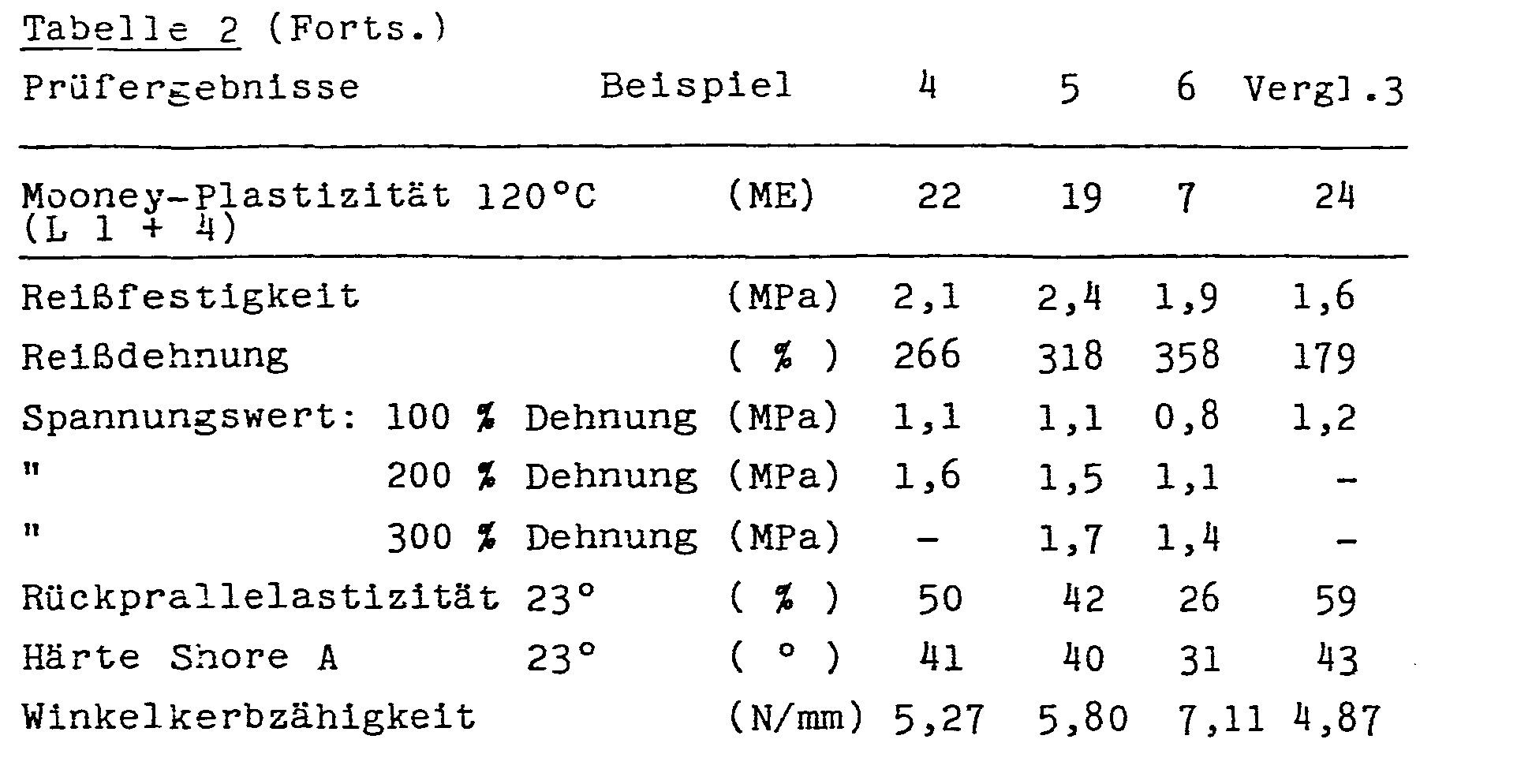
- 7 und 8) Füllstoffhaltige Mischungen aus Naturkautschuk bzw. Styrol-Butadien-Kautschuk unter Zusatz des Copolymerisats A (Beispiele 7 und 8) und die Vergleiche 4 und 5 wurden wie bei den Beispielen 4 bis 6 beschrieben hergestellt und geprüft.


- Die Ergebnisse zeigen deutlich die vorteilhaften Eigenschaften der unter Mitverwendung der Copolymerisate hergestellten Kautschuk-Mischungen. So ist aus den Beispielen 1 und 2 die rasche Bildung des Fells ersichtlich, die eine zeit- und energiesparende Herstellung der Mischung ermöglicht. Beispiele 4 bis 6 demonstrieren anhand der geringeren Werte für die Mooney-Plastizität der Mischungen die bessere Verarbeitbarkeit und lassen deutlich die günstigeren mechanischen Eigenschaften hinsichtlich Reißfestigkeit und insbesondere Reißdehnung gegenüber dem Vergleich 3 erkennen. Außerdem tritt eine Verbesserung der Winkelkerbzähigkeit ein. Bei füllstoffhaltigen Mischungen wird bei Einsatz der Copolymerisate nur etwa die Hälfte der Arbeitszeit für die Bildung eines Felles auf der Mischwalze benötigt. Dadurch erhöht sich die Produktion der aus den Mischungen hergestellten Gummiwaren.
- Bei den Ergebnissen der Beispiele 7 und 8, die unter Einsatz füllstoffhaltiger Mischungen erhalten wurden, zeigen sich hinsichtlich Temperaturanstieg und bleibender Verformung bei der dynamischen Krafteinwirkung im Goodrich-Flexometer sowie beim Druckverformungsrest keine nennenswerten Veränderungen der Werte gegenüber den Vergleichen 4 und 5. Diese Eigenschaften der erfindungsgemäßen Beispiele sind überraschend, da infolge des Zusatzes des thermoplastischen Copolymerisats starke Verformungen und ein deutlicher Temperaturanstieg zu erwarten gewesen wären. Es ist auch eine deutliche Herabsetzung der Rückprallelastizität festzustellen, die auf erhöhte Dämpfungseigenschaften hindeutet. Bei Einsatz des Copolymerisats in der Kautschuk-Mischung werden außerdem die gleichen Vulkanisathärten erhalten wie in den Formulierungen der Vergleichsmischungen, während bekannterweise der Zusatz von organischen Komponenten z.B. Plastifizierungsmitteln wie Mineralölen zu einer Reduzierung der Härte führt.
enthält, wobei die Summe der Prozentangaben jeweils 100 beträgt.
Claims (15)
enthält, wobei die Summe der Prozentangaben jeweils 100 beträgt.
besteht, wobei die Summe von b) und c) vorzugsweise mindestens 5 Gew.-% beträgt.
eingearbeitet wird, wobei die Summe der Prozentangaben jeweils 100 beträgt.
eingearbeitet wird, wobei die Summe von b) und c) vorzugsweise mindestens 5 Gew.-% beträgt.
Priority Applications (1)
| Application Number | Priority Date | Filing Date | Title |
|---|---|---|---|
| AT84116110T ATE48009T1 (de) | 1984-01-07 | 1984-12-21 | Kautschuk-mischungen und daraus hergestellte gummiartikel und kraftfahrzugreifen. |
Applications Claiming Priority (4)
| Application Number | Priority Date | Filing Date | Title |
|---|---|---|---|
| DE3400365 | 1984-01-07 | ||
| DE3400365 | 1984-01-07 | ||
| DE3444087 | 1984-12-04 | ||
| DE19843444087 DE3444087A1 (de) | 1984-01-07 | 1984-12-04 | Kautschuk-mischungen und daraus hergestellte gummiartikel und kraftfahrzeugreifen |
Publications (3)
| Publication Number | Publication Date |
|---|---|
| EP0149836A2 true EP0149836A2 (de) | 1985-07-31 |
| EP0149836A3 EP0149836A3 (en) | 1985-08-21 |
| EP0149836B1 EP0149836B1 (de) | 1989-11-15 |
Family
ID=25817425
Family Applications (1)
| Application Number | Title | Priority Date | Filing Date |
|---|---|---|---|
| EP84116110A Expired EP0149836B1 (de) | 1984-01-07 | 1984-12-21 | Kautschuk-Mischungen und daraus hergestellte Gummiartikel und Kraftfahrzugreifen |
Country Status (5)
| Country | Link |
|---|---|
| US (1) | US4652612A (de) |
| EP (1) | EP0149836B1 (de) |
| JP (1) | JPH0621197B2 (de) |
| CA (1) | CA1251296A (de) |
| DE (2) | DE3444087A1 (de) |
Cited By (1)
| Publication number | Priority date | Publication date | Assignee | Title |
|---|---|---|---|---|
| EP0351054A1 (de) * | 1988-07-02 | 1990-01-17 | Sumitomo Rubber Industries Limited | Luftreifen |
Families Citing this family (1)
| Publication number | Priority date | Publication date | Assignee | Title |
|---|---|---|---|---|
| US5213893A (en) * | 1990-09-14 | 1993-05-25 | Nippon Shokubai Co., Ltd. | Waterproofing agent for cable |
Family Cites Families (10)
| Publication number | Priority date | Publication date | Assignee | Title |
|---|---|---|---|---|
| US2604453A (en) * | 1948-12-30 | 1952-07-22 | Standard Oil Dev Co | New copolymer compositions |
| DE2018337B2 (de) * | 1969-04-16 | 1975-12-04 | Sumitomo Chemical Co., Ltd., Osaka (Japan) | Olefin-AcrylsÄureester-Copolymerisate enthaltende, vernetzbare elastomere Massen und ihre Verwendung |
| BE749019A (fr) * | 1969-04-16 | 1970-09-16 | Sumitomo Chemical Co | Compositions elastomeres contenant au moins un copolymere olefine-esteracrylique |
| US3965055A (en) * | 1972-09-21 | 1976-06-22 | Uniroyal Inc. | Free curing rubber composition |
| US4082705A (en) * | 1976-02-05 | 1978-04-04 | Johnson & Johnson | Pressure sensitive adhesive compositions |
| JPS5323388A (en) * | 1976-08-14 | 1978-03-03 | Rohm & Haas | Plasticizer and plasticizer composition and their production process |
| US4222923A (en) * | 1978-03-02 | 1980-09-16 | John Rhodes | Adhesive composition and method of use |
| US4421900A (en) * | 1982-04-16 | 1983-12-20 | The Firestone Tire & Rubber Company | Blends of natural and synthetic rubbers |
| US4472463A (en) * | 1982-12-06 | 1984-09-18 | The B. F. Goodrich Company | Two-step process for dipping textile cord or fabric and resorcinol/formaldehyde-free composition used therein |
| JPS6063240A (ja) * | 1983-09-19 | 1985-04-11 | Mitsui Petrochem Ind Ltd | 積層物 |
-
1984
- 1984-12-04 DE DE19843444087 patent/DE3444087A1/de not_active Withdrawn
- 1984-12-21 EP EP84116110A patent/EP0149836B1/de not_active Expired
- 1984-12-21 DE DE8484116110T patent/DE3480480D1/de not_active Expired
-
1985
- 1985-01-04 US US06/688,749 patent/US4652612A/en not_active Expired - Fee Related
- 1985-01-04 CA CA000471476A patent/CA1251296A/en not_active Expired
- 1985-01-05 JP JP60000043A patent/JPH0621197B2/ja not_active Expired - Lifetime
Cited By (1)
| Publication number | Priority date | Publication date | Assignee | Title |
|---|---|---|---|---|
| EP0351054A1 (de) * | 1988-07-02 | 1990-01-17 | Sumitomo Rubber Industries Limited | Luftreifen |
Also Published As
| Publication number | Publication date |
|---|---|
| DE3444087A1 (de) | 1985-07-18 |
| EP0149836B1 (de) | 1989-11-15 |
| EP0149836A3 (en) | 1985-08-21 |
| US4652612A (en) | 1987-03-24 |
| JPH0621197B2 (ja) | 1994-03-23 |
| CA1251296A (en) | 1989-03-14 |
| DE3480480D1 (en) | 1989-12-21 |
| JPS60177044A (ja) | 1985-09-11 |
Similar Documents
| Publication | Publication Date | Title |
|---|---|---|
| DE3783161T2 (de) | Haertbare kautschukmischungen mit hohem modul. | |
| DE3689229T2 (de) | Herstellung von Gummi-Mischungen. | |
| DE68903897T2 (de) | Luftreifen. | |
| DE3918929A1 (de) | Haertbare kautschukmasse | |
| DE3311449A1 (de) | Kautschukmischung fuer kraftfahrzeugreifen | |
| DE69216041T2 (de) | Polymere basierend auf einem konjugierten Diolefin, einer Vinyl-substituierten aromatischen Verbindung und einem olefinisch ungesättigtem Nitril | |
| DE69905817T2 (de) | Kautschukzusammensetzung die ein reversionsverhinderndes Mittel enthält und Reifen mit daraus hergestellter Komponente | |
| DE2431393A1 (de) | Latex-asphalt-emulsionsmasse und verfahren zur herstellung derselben | |
| DE1136822B (de) | Alterungsbestaendige, thermoplastische, harte und zaehe Formmassen | |
| DE69315516T2 (de) | Kautschukzusammensetzung | |
| EP0054141A1 (de) | Verfahren zur Herstellung von ABS-Polymerisaten, Verwendung derselben, sowie Formteile aus diesen | |
| DE2452931A1 (de) | Verfahren zur herstellung von synthetischen kautschukmassen | |
| DE112011100053B4 (de) | Verfahren zum Produzieren von Acrylnitril-Butadien-Styrol- (ABS-) Pulver auf Naturkautschukbasis, Verfahren zum Produzieren von Acrylnitril-Butadien-Styrol- (ABS-) Produkt auf Naturkautschukbasis und Acrylnitril-Butadien-Styrol- (ABS-) Pulver auf Naturkautschukbasis | |
| DE2262239A1 (de) | Verfahren zur herstellung schlagfester polymerer massen | |
| EP0149836B1 (de) | Kautschuk-Mischungen und daraus hergestellte Gummiartikel und Kraftfahrzugreifen | |
| DE2423714C3 (de) | Verfahren zur Herstellung eines flüssigen Chloroprenpolymeren | |
| DE1142060B (de) | Verfahren zum Vulkanisieren von im wesentlichen amorphen hochmolekularen Mischpolymerisaten aus ª‡-Olefinen miteinander und/oder mit AEthylen | |
| DE2125546A1 (de) | Verfahren zur Herstellung von aminvulkanisierten Polychloroprenen | |
| EP0046941A1 (de) | Thermoplastische Masse mit erhöhter Kohäsion und geringer Fliessneigung und Verfahren zu ihrer Herstellung | |
| DE19810581A1 (de) | Latex für die Faserverklebung | |
| DE1470920C3 (de) | Verfahren zum Vermischen von Polymerisaten, die durch Losungs polymerisation von konjugierten Dienen hergestellt worden sind, mit üblichen Kautschukzusatzstoffen | |
| DE1136820B (de) | Verfahren zur Herstellung kautschukartiger Gemische | |
| DE1233603B (de) | Verfahren zur Herstellung emulgatorfreier, stabiler, waessriger Polymerisatdispersionen | |
| CH539661A (de) | Verfahren zur Herstellung von Pfropfcopolymeren und Verwendung derselben | |
| EP0278022A2 (de) | Verfahren zur Herstellung von thermoplastischen Formmassen auf Basis von Pfropfmischpolymerisaten und deren Verwendung |
Legal Events
| Date | Code | Title | Description |
|---|---|---|---|
| PUAI | Public reference made under article 153(3) epc to a published international application that has entered the european phase |
Free format text: ORIGINAL CODE: 0009012 |
|
| PUAL | Search report despatched |
Free format text: ORIGINAL CODE: 0009013 |
|
| AK | Designated contracting states |
Designated state(s): AT BE CH DE FR GB IT LI NL SE |
|
| AK | Designated contracting states |
Designated state(s): AT BE CH DE FR GB IT LI NL SE |
|
| 17P | Request for examination filed |
Effective date: 19860213 |
|
| 17Q | First examination report despatched |
Effective date: 19870529 |
|
| GRAA | (expected) grant |
Free format text: ORIGINAL CODE: 0009210 |
|
| AK | Designated contracting states |
Kind code of ref document: B1 Designated state(s): AT BE CH DE FR GB IT LI NL SE |
|
| REF | Corresponds to: |
Ref document number: 48009 Country of ref document: AT Date of ref document: 19891215 Kind code of ref document: T |
|
| REF | Corresponds to: |
Ref document number: 3480480 Country of ref document: DE Date of ref document: 19891221 |
|
| ITF | It: translation for a ep patent filed | ||
| ET | Fr: translation filed | ||
| GBT | Gb: translation of ep patent filed (gb section 77(6)(a)/1977) | ||
| PLBE | No opposition filed within time limit |
Free format text: ORIGINAL CODE: 0009261 |
|
| STAA | Information on the status of an ep patent application or granted ep patent |
Free format text: STATUS: NO OPPOSITION FILED WITHIN TIME LIMIT |
|
| 26N | No opposition filed | ||
| ITTA | It: last paid annual fee | ||
| PGFP | Annual fee paid to national office [announced via postgrant information from national office to epo] |
Ref country code: FR Payment date: 19931119 Year of fee payment: 10 |
|
| PGFP | Annual fee paid to national office [announced via postgrant information from national office to epo] |
Ref country code: CH Payment date: 19931122 Year of fee payment: 10 |
|
| PGFP | Annual fee paid to national office [announced via postgrant information from national office to epo] |
Ref country code: SE Payment date: 19931129 Year of fee payment: 10 Ref country code: GB Payment date: 19931129 Year of fee payment: 10 |
|
| PGFP | Annual fee paid to national office [announced via postgrant information from national office to epo] |
Ref country code: AT Payment date: 19931202 Year of fee payment: 10 |
|
| PGFP | Annual fee paid to national office [announced via postgrant information from national office to epo] |
Ref country code: BE Payment date: 19931224 Year of fee payment: 10 |
|
| PGFP | Annual fee paid to national office [announced via postgrant information from national office to epo] |
Ref country code: NL Payment date: 19931231 Year of fee payment: 10 |
|
| PGFP | Annual fee paid to national office [announced via postgrant information from national office to epo] |
Ref country code: DE Payment date: 19940216 Year of fee payment: 10 |
|
| PG25 | Lapsed in a contracting state [announced via postgrant information from national office to epo] |
Ref country code: GB Effective date: 19941221 Ref country code: AT Effective date: 19941221 |
|
| PG25 | Lapsed in a contracting state [announced via postgrant information from national office to epo] |
Ref country code: SE Effective date: 19941222 |
|
| PG25 | Lapsed in a contracting state [announced via postgrant information from national office to epo] |
Ref country code: LI Effective date: 19941231 Ref country code: CH Effective date: 19941231 Ref country code: BE Effective date: 19941231 |
|
| EAL | Se: european patent in force in sweden |
Ref document number: 84116110.2 |
|
| BERE | Be: lapsed |
Owner name: HOECHST A.G. Effective date: 19941231 |
|
| PG25 | Lapsed in a contracting state [announced via postgrant information from national office to epo] |
Ref country code: NL Effective date: 19950701 |
|
| GBPC | Gb: european patent ceased through non-payment of renewal fee |
Effective date: 19941221 |
|
| PG25 | Lapsed in a contracting state [announced via postgrant information from national office to epo] |
Ref country code: FR Effective date: 19950831 |
|
| REG | Reference to a national code |
Ref country code: CH Ref legal event code: PL |
|
| NLV4 | Nl: lapsed or anulled due to non-payment of the annual fee |
Effective date: 19950701 |
|
| PG25 | Lapsed in a contracting state [announced via postgrant information from national office to epo] |
Ref country code: DE Effective date: 19950901 |
|
| EUG | Se: european patent has lapsed |
Ref document number: 84116110.2 |
|
| REG | Reference to a national code |
Ref country code: FR Ref legal event code: ST |