EP0152665A1 - Kaltgewalzter Dual-Phasen-Stahl mit sehr guter Tiefziehfähigkeit und Herstellungsverfahren - Google Patents
Kaltgewalzter Dual-Phasen-Stahl mit sehr guter Tiefziehfähigkeit und Herstellungsverfahren Download PDFInfo
- Publication number
- EP0152665A1 EP0152665A1 EP84301817A EP84301817A EP0152665A1 EP 0152665 A1 EP0152665 A1 EP 0152665A1 EP 84301817 A EP84301817 A EP 84301817A EP 84301817 A EP84301817 A EP 84301817A EP 0152665 A1 EP0152665 A1 EP 0152665A1
- Authority
- EP
- European Patent Office
- Prior art keywords
- weight
- steel sheet
- temperature
- sec
- less
- Prior art date
- Legal status (The legal status is an assumption and is not a legal conclusion. Google has not performed a legal analysis and makes no representation as to the accuracy of the status listed.)
- Granted
Links
Images


Classifications
-
- C—CHEMISTRY; METALLURGY
- C22—METALLURGY; FERROUS OR NON-FERROUS ALLOYS; TREATMENT OF ALLOYS OR NON-FERROUS METALS
- C22C—ALLOYS
- C22C38/00—Ferrous alloys, e.g. steel alloys
- C22C38/06—Ferrous alloys, e.g. steel alloys containing aluminium
-
- C—CHEMISTRY; METALLURGY
- C21—METALLURGY OF IRON
- C21D—MODIFYING THE PHYSICAL STRUCTURE OF FERROUS METALS; GENERAL DEVICES FOR HEAT TREATMENT OF FERROUS OR NON-FERROUS METALS OR ALLOYS; MAKING METAL MALLEABLE, e.g. BY DECARBURISATION OR TEMPERING
- C21D8/00—Modifying the physical properties of ferrous metals or ferrous alloys by deformation combined with, or followed by, heat treatment
- C21D8/02—Modifying the physical properties of ferrous metals or ferrous alloys by deformation combined with, or followed by, heat treatment during manufacturing of plates or strips
- C21D8/04—Modifying the physical properties of ferrous metals or ferrous alloys by deformation combined with, or followed by, heat treatment during manufacturing of plates or strips to produce plates or strips for drawing, e.g. for deep-drawing
- C21D8/0447—Modifying the physical properties of ferrous metals or ferrous alloys by deformation combined with, or followed by, heat treatment during manufacturing of plates or strips to produce plates or strips for drawing, e.g. for deep-drawing characterised by the heat treatment
- C21D8/0473—Final recrystallisation annealing
-
- C—CHEMISTRY; METALLURGY
- C22—METALLURGY; FERROUS OR NON-FERROUS ALLOYS; TREATMENT OF ALLOYS OR NON-FERROUS METALS
- C22C—ALLOYS
- C22C38/00—Ferrous alloys, e.g. steel alloys
- C22C38/12—Ferrous alloys, e.g. steel alloys containing tungsten, tantalum, molybdenum, vanadium, or niobium
-
- C—CHEMISTRY; METALLURGY
- C21—METALLURGY OF IRON
- C21D—MODIFYING THE PHYSICAL STRUCTURE OF FERROUS METALS; GENERAL DEVICES FOR HEAT TREATMENT OF FERROUS OR NON-FERROUS METALS OR ALLOYS; MAKING METAL MALLEABLE, e.g. BY DECARBURISATION OR TEMPERING
- C21D2211/00—Microstructure comprising significant phases
-
- C—CHEMISTRY; METALLURGY
- C21—METALLURGY OF IRON
- C21D—MODIFYING THE PHYSICAL STRUCTURE OF FERROUS METALS; GENERAL DEVICES FOR HEAT TREATMENT OF FERROUS OR NON-FERROUS METALS OR ALLOYS; MAKING METAL MALLEABLE, e.g. BY DECARBURISATION OR TEMPERING
- C21D2211/00—Microstructure comprising significant phases
- C21D2211/005—Ferrite
-
- C—CHEMISTRY; METALLURGY
- C21—METALLURGY OF IRON
- C21D—MODIFYING THE PHYSICAL STRUCTURE OF FERROUS METALS; GENERAL DEVICES FOR HEAT TREATMENT OF FERROUS OR NON-FERROUS METALS OR ALLOYS; MAKING METAL MALLEABLE, e.g. BY DECARBURISATION OR TEMPERING
- C21D8/00—Modifying the physical properties of ferrous metals or ferrous alloys by deformation combined with, or followed by, heat treatment
- C21D8/02—Modifying the physical properties of ferrous metals or ferrous alloys by deformation combined with, or followed by, heat treatment during manufacturing of plates or strips
- C21D8/04—Modifying the physical properties of ferrous metals or ferrous alloys by deformation combined with, or followed by, heat treatment during manufacturing of plates or strips to produce plates or strips for drawing, e.g. for deep-drawing
- C21D8/0421—Modifying the physical properties of ferrous metals or ferrous alloys by deformation combined with, or followed by, heat treatment during manufacturing of plates or strips to produce plates or strips for drawing, e.g. for deep-drawing characterised by the working steps
- C21D8/0426—Hot rolling
-
- C—CHEMISTRY; METALLURGY
- C21—METALLURGY OF IRON
- C21D—MODIFYING THE PHYSICAL STRUCTURE OF FERROUS METALS; GENERAL DEVICES FOR HEAT TREATMENT OF FERROUS OR NON-FERROUS METALS OR ALLOYS; MAKING METAL MALLEABLE, e.g. BY DECARBURISATION OR TEMPERING
- C21D9/00—Heat treatment, e.g. annealing, hardening, quenching or tempering, adapted for particular articles; Furnaces therefor
- C21D9/52—Heat treatment, e.g. annealing, hardening, quenching or tempering, adapted for particular articles; Furnaces therefor for wires; for strips ; for rods of unlimited length
Definitions
- This invention relates to a cold rolled steel sheet suitable for use in, for example, automobile panels and the like requiring an excellent press formability. More particularly, the invention relates to an improvement in the properties of the above steel sheet through combined addition of Nb and B.
- BH property Since the value YS is required to be low in the press forming, it is generally difficult to simultaneously realize both the press formability and the resistance to denting. However, it is possible to satisfy such conflicting properties in case of steel sheets having a property that it is hardened by the heating treatment (for instance, baked-on finish) subsequent to the press forming (hereinafter referred to as BH property).
- the conventionally known cold rolled steel sheets for press forming are classified as follows:
- an object of the invention to provide a cold rolled steel sheet with a dual-phase structure possessing all of (1) high r-value, (2) high ductility, (3) non-aging property at room temperature, and (4) high BH property.
- a cold rolled dual-phase structure steel sheet having an excellent deep drawability and consisting of ferrite phase and low temperature transformation product phase, which comprises 0.001-0.008% by weight of C, not more than 1.0% by weight of Si, 0.05-1.8% by weight of Mn, not more than 0.15% by weight of P, 0.01-0.10% by weight of AQ, 0.002-0.050% by weight of Nb and 0.0005-0.0050% by weight of B provided that the value of Nb(%)+10B(%) is in a range of 0.010-0.080%, and the balance being substantially Fe with inevitable impurities.
- a cold rolled dual-phase structure steel sheet having an excellent deep drawability and consisting of ferrite phase and low temperature transformation product phase, which comprises 0.001-0.008% by weight of C, not more than 1.0% by weight of Si, 0.05-1.8% by weight of Mn, not more than 0.15% by weight of P, 0.01-0.10% by weight of Al, 0.05-1.00% by weight of Cr, 0.002-0.050% by weight of Nb and 0.0005-0.0050% by weight of B provided that the value of Nb(%)+10B(%) is in a range of 0.010-0.080%, and the balance being substantially Fe with inevitable impurities.
- a cold rolled dual-phase structure steel sheet comprising the steps of:
- Fig. 1 shows the yield point elongation (YEQ), yield strength (YS) and Lankford value (r-value) of a cold rolled steel sheet obtained by hot rolling-cold rolling-continuous annealing of a steel slab with a composition containing C ⁇ 0.004%, Mn-0.3%, N ⁇ 0.004%, A ⁇ 0.05% and variable amounts of Nb and B.
- the continuous annealing was carried out in such a heat cycle that the resulting steel sheet was heated to 910°C, soaked at the same temperature for 20 seconds, and was cooled at an average cooling rate of 3.0°C/sec at a temperature range of from the soaking temperature to 750°C and at an average cooling rate of 27°C/sec at a temperature range of not more than 750°C.
- the measured values of the above properties were obtained with respect to a JIS No. 5 test piece of the aforementioned steel sheet without skin pass rolling.
- the non-aging property at room temperature is obtained only in the steel sheet containing both Nb and B and having YEl of not more than 1%.
- the structure of the steel sheet has a dual-phase structure consisting of a ferrite phase and a low temperature transformation product phase having a high dislocation density (which is different from martensite phase of the conventional dual-phase structure steel sheet).
- the combined addition amount of Nb and B can be well related by a parameter of Nb(%)+10B(%) to the properties of the steel sheet.
- Nb(%)+10B(%) is less than 0.010%, the value of YEQ is too high and no dual-phase structure is obtained, and the r-value is low.
- the value of Nb(%)+10B(%) exceeds 0.080%, the value of YS largely increases and the r-value drops.
- a high r-value, a low YS, and non-aging property at room temperature are first satisfied by setting the parameter value of Nb(%)+10B(%) in a range of 0.010-0.080%. Further, it was found that the steel sheet containing both Nb and B after the continuous annealing develops a property of largely increasing the yield strength (BH property) by applying a preliminary strain corresponding to a pressing force and subjecting to a heat treatment corresponding to a baked-on finish.
- BH property yield strength
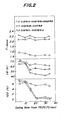
- Fig. 2 shows the relation of the average cooling rate in a temperature range of from 750°C to room temperature at the time of annealing to the yield point elongation (YEQ), the ratio of yield strength to tensile strength (YR) and the r-value when the steel ingot is subjected to hot rolling-cold rolling- recrystallization annealing in laboratory.
- the soaking temperature was 900°C
- the cooling rate in a temperature range of from the soaking temperature to 750°C was 5°C/sec.
- the values of the above properties were measured with respect to a JIS No. 5 test piece of the steel sheet without skin pass rolling.
- the non-aging property at room temperature is not obtained because of the high YEQ irrespective of the cooling rate, and the ductility is poor because the r-value is low and YR is high.
- the Nb-B containing steel can be imparted with the non-aging property at room temperature by controlling the cooling rate in the temperature range of from 750°C to room temperature at not less than 20°C/sec, but YR is about 55% at this cooling rate and the ductility is slightly poor.
- the Cr-Nb-B containing steel satisfies all of high r-value, high ductility, and non-aging property at room temperature.
- the latter steel sheet has a so-called high BH property of increasing the yield strength by applying a light preliminary strain to the sheet and subjecting to a heat treatment at 170°C, and further confirmed that the structure of this steel sheet has the dual-phase structure consisting of a ferrite phase having a low dislocation density and a low temperature transformation product phase having a high dislocation density (which is different from martensite phase of the conventional dual-phase structure steel sheet).
- composition of the steel sheet according to the invention is limited to the above ranges.
- the simultaneous addition of Cr, Nb and B is particularly important and indispensable.
- Cr is particularly effective for obtaining a high r-value and a low YR, i.e. a high ductility. If Cr content is less than 0.05%, the addition effect is not obtained, while if it exceeds 1.00%, not only the addition effect is saturated, but also the effect on the properties, particularly ductility is adversely affected. Therefore, the Cr content is limited to a range of 0.05-1.00%.
- the extremely low carbon steel is most preferably melted by the combination of a bottom-blown converter and an RH degassing device.
- the steel slab may be manufactured by either of blooming or continuous casting.
- the hot rolling may be made by the conventional reheating system or direct hot-rolling method.
- a thin steel sheet of not more than 100 mm in thickness may be directly obtained from molten steel and subjected to hot rolling.
- the optimum finishing temperature in the hot rolling is 950-700°C.
- the cooling means, the coiling temperature and so on of the hot rolled steel sheet are not so important according to the invention, the coiling temperature of not more than 600°C is preferable from the standpoint of pickling.
- the draft in the cold rolling is preferably not less than 50% in order to obtain a high r-value.
- the heating rate in the continuous annealing is not so important, but it is preferably not less than 10°C/sec from the standpoint of the productivity.
- the soaking temperature is preferably in a range of from ⁇ - ⁇ transformation temperature to 1,000°C. The optimum range is 850-950°C.
- the cooling step after the soaking is important for obtaining the intended properties.
- the soaked sheet is subjected to a slow cooling from the soaking temperature to 750°C at a cooling rate of 0.5-20°C/sec and then cooled from 750°C to not more than 300°C at a cooling rate of not less than 20°C/sec. This will be described based on the experimental data below.
- Fig. 3 shows the relation of the rapid cooling start temperature at the time of the annealing to the yield point elongation (YE2), yield strength (YS), tensile strength (TS), total elongation (Ek) and r-value when a steel sheet containing 0.004% of C, 0.50% of Mn, 0.02% of P, 0.056% of Al, 0.015% of Nb and 0.0026% of B was subjected to hot rolling-cold rolling-recrystallization annealing.
- the soaking temperature was 900°C
- the cooling rate up to the rapid cooling start temperature was 2°C/sec
- the rapid cooling rate was 30°C/sec.
- the cooling step after the soaking in the continuous annealing is important for obtaining the desirable cold rolled steel sheet.
- the steel sheet may be subjected to skin pass rolling for the purpose of correcting the profile thereof.
- the draft of the skin pass rolling is sufficient to be not more than 2% because the yield point elongation (YEQ) is low.
- the steel sheet according to the invention may be subjected to a surface treatment such as galvanization or the like without troubles.
- the steel sheet according to the invention is suitable for the production of the surface treated steel sheet by hot dipping in an inline annealing system (including an alloying treatment).
- Eight steel slabs were obtained by continuously casting steels A-H each having a chemical composition as shown in the following Table 1 after the treatment through the bottom-blown converter and RH-degassing device.
- Each steel slab was soaked at 1,200°C, hot rolled at a finishing temperature of 860-900°C and at a coiling temperature of 500-600°C to obtain a steel sheet of 3.2 mm in thickness.
- After the pickling it was cold rolled to be 0.8 mm in thickness and then subjected to a continuous annealing under such conditions that the soaking temperature is 910°C, the average cooling rate in a temperature range of from 910°C to 750°C is 3.2°C/sec, and the average cooling rate in a temperature range of from 750°C to 250°C is 40°C/sec, whereby there was obtained a cold rolled steel sheet having properties as shown in the following Table 2.
- AYS is represented by the increased amount (kg/mm 2 ) of YS after the aging treatment at 35°C for 100 days
- BH is represented by the difference between the deformation stress produced in the application of preliminary strain under a 2% tension and deformation strain produced in the treatment corresponding to a bake-on finish at 170°C for 20 minutes.
- steels (B, C, F and H) the r-value is not less than 2.0, and a high ductility, non-aging property at room temperature, and a high BH property are obtained.
- examples C, H, and F are production examples of high strength cold rolled steel sheets having TS of not less than 35 kg/mm 2 .
- the steel having the composition C of Table 1 was subjected to a continuous annealing under conditions shown in the following Table 3 to obtain a cold rolled steel sheet having properties as shown in the following Table 4.
- Ten steel slabs were obtained by continuously casting steels I-R each having a chemical composition as shown in the following Table 5 after the treatment through the bottom-blown converter and RH-degassing device.
- Each steel slab was soaked at 1,200°C, hot rolled at a finishing temperature of 860-900°C and at a coiling temperature of 500-600°C to obtain a steel sheet of 3.2 mm in thickness.
- After the pickling it was cold rolled to be 0.8 mm in thickness and then subjected to a continuous annealing under such conditions that the soaking temperature is 900°C, the average cooling rate in a temperature range of from 910°C to 750°C is 4.2°C/sec, and the average cooling rate in a temperature range of from 750°C to 280°C is 34°C/sec, whereby there was obtained a cold rolled steel sheet having properties as shown in the following Table 6.
- ⁇ YS is represented by the increased amount (kg/mm 2 ) of YS after the aging treatment at 35°C for 100 days
- BH is represented by the difference between the deformation stress produced in the application of preliminary strain under a 2% tension and deformation strain produced in the treatment corresponding to a bake-on finish at 170°C for 20 minutes.
- steels J, K, L and M
- a high r-value, a high ductility, non-aging property at room temperature, and a high BH property are obtained.
- the steel having the composition L of Table 5 was subjected to a continuous annealing under conditions shown in the following Table 7 to obtain a cold rolled steel sheet having properties as shown in the following Table 8.
- the first and third aspects of the invention it is possible to realize a deep drawability, a high ductility, and non-aging property at room temperature together with a sufficiently high resistance to denting under a low YS before press forming, in case of the cold rolled steel sheets which are required to have an excellent press formability for use in automobile panels and so on, and also these steel sheets can advantageously be manufactured according to the second and fourth aspects of the invention.
Landscapes
- Chemical & Material Sciences (AREA)
- Engineering & Computer Science (AREA)
- Materials Engineering (AREA)
- Mechanical Engineering (AREA)
- Metallurgy (AREA)
- Organic Chemistry (AREA)
- Physics & Mathematics (AREA)
- Thermal Sciences (AREA)
- Crystallography & Structural Chemistry (AREA)
- Heat Treatment Of Sheet Steel (AREA)
- Heat Treatment Of Strip Materials And Filament Materials (AREA)
- Heat Treatment Of Steel (AREA)
Applications Claiming Priority (2)
| Application Number | Priority Date | Filing Date | Title |
|---|---|---|---|
| JP27995/84 | 1984-02-18 | ||
| JP59027995A JPS60174852A (ja) | 1984-02-18 | 1984-02-18 | 深絞り性に優れる複合組織冷延鋼板とその製造方法 |
Publications (2)
| Publication Number | Publication Date |
|---|---|
| EP0152665A1 true EP0152665A1 (de) | 1985-08-28 |
| EP0152665B1 EP0152665B1 (de) | 1988-01-20 |
Family
ID=12236401
Family Applications (1)
| Application Number | Title | Priority Date | Filing Date |
|---|---|---|---|
| EP84301817A Expired EP0152665B1 (de) | 1984-02-18 | 1984-03-16 | Kaltgewalzter Dual-Phasen-Stahl mit sehr guter Tiefziehfähigkeit und Herstellungsverfahren |
Country Status (6)
| Country | Link |
|---|---|
| US (2) | US4615749A (de) |
| EP (1) | EP0152665B1 (de) |
| JP (1) | JPS60174852A (de) |
| CA (1) | CA1229750A (de) |
| DE (1) | DE3468906D1 (de) |
| ES (1) | ES530701A0 (de) |
Cited By (7)
| Publication number | Priority date | Publication date | Assignee | Title |
|---|---|---|---|---|
| EP0273279A3 (en) * | 1986-12-30 | 1990-05-02 | Nisshin Steel Co., Ltd. | Process for the production of a strip of a chromium stainless steel of a duplex structure having high strength and elongation as well as reduced plane anisotropy |
| EP0273278A3 (en) * | 1986-12-30 | 1990-05-30 | Nisshin Steel Co., Ltd. | Process for the production of a strip of a chromium stainless steel of a duplex structure having high strength and elongation as well as reduced plane anisotropy |
| EP0559225A1 (de) * | 1992-03-06 | 1993-09-08 | Kawasaki Steel Corporation | Zugfestiges Stahlblech mit ausgezeichneter Streckbördelverformfähigheit und das Herstellungsverfahren |
| EP0510718A3 (en) * | 1991-04-26 | 1993-09-29 | Kawasaki Steel Corporation | High strength cold rolled steel sheet having excellent non-agin property at room temperature and suitable for drawing and method of producing the same |
| AU652694B2 (en) * | 1992-06-08 | 1994-09-01 | Kawasaki Steel Corporation | High-strength cold-rolled steel sheet excelling in deep drawability and method of producing the same |
| EP0659888A3 (de) * | 1993-12-24 | 1995-10-25 | Kawasaki Steel Co | Verfahren zum Herstellen leicht verformbarer, hochfester, kaltgewalzter Stahlbleche mit guter Beständigkeit gegen Versprödung durch Weiterbearbeitung. |
| EP0691415B1 (de) * | 1991-03-15 | 1999-12-15 | Nippon Steel Corporation | Hochfeste,kaltgewalzte stahlplatte mit exzellenter umformbarkeit,feurverzinktes,kaltgewalztes stahlblech und verfahren zur herstellung dieser bleche |
Families Citing this family (31)
| Publication number | Priority date | Publication date | Assignee | Title |
|---|---|---|---|---|
| JPS60197847A (ja) * | 1984-03-19 | 1985-10-07 | Kawasaki Steel Corp | 高加工性常温非時効性複合組織熱延鋼帯の製造方法 |
| US4889566A (en) * | 1987-06-18 | 1989-12-26 | Kawasaki Steel Corporation | Method for producing cold rolled steel sheets having improved spot weldability |
| JPH01263662A (ja) * | 1988-04-15 | 1989-10-20 | Fuji Xerox Co Ltd | 記録装置およびその消耗部品 |
| DE3917071C1 (de) * | 1988-10-22 | 1990-04-19 | Thyssen Edelstahlwerke Ag, 4000 Duesseldorf, De | |
| JPH06104862B2 (ja) * | 1989-03-06 | 1994-12-21 | 川崎製鉄株式会社 | 焼付け硬化性及び常温非時効性に優れた加工用冷延鋼板の製造方法 |
| JPH06102816B2 (ja) * | 1990-03-28 | 1994-12-14 | 川崎製鉄株式会社 | 加工性、常温非時効性及び焼付け硬化性に優れる複合組織冷延鋼板とその製造方法 |
| JPH05112845A (ja) * | 1991-03-30 | 1993-05-07 | Nippon Steel Corp | 成形後の面形状性が良好で優れた耐デント性を有する深絞り用高強度冷延鋼板 |
| JPH083136B2 (ja) * | 1991-04-25 | 1996-01-17 | 住友金属工業株式会社 | 塗装焼付硬化性高張力薄鋼板とその製造法 |
| JP2818319B2 (ja) * | 1991-04-26 | 1998-10-30 | 川崎製鉄株式会社 | 常温非時効型絞り用高張力冷延鋼板及びその製造方法 |
| EP0608430B1 (de) * | 1992-06-22 | 2000-08-16 | Nippon Steel Corporation | Kaltgewalztes stahlblech mit guter einbrennhärtbarkeit, ohne kaltalterungserscheinungen und exzellenter giessbarkeit, tauchzink-beschichtetes kaltgewalztes stahlblech und deren herstellungsverfahren |
| US5690755A (en) * | 1992-08-31 | 1997-11-25 | Nippon Steel Corporation | Cold-rolled steel sheet and hot-dip galvanized cold-rolled steel sheet having excellent bake hardenability, non-aging properties at room temperature and good formability and process for producing the same |
| KR0121737B1 (ko) * | 1992-08-31 | 1997-12-04 | 다나까 미노루 | 소부 경화성, 상온 비시효성 및 가공성이 우수한 냉연강판 및 용융아연 도금 냉연강판 및 그의 제조방법 |
| EP0694625B9 (de) * | 1994-02-15 | 2001-12-05 | Kawasaki Steel Corporation | Hochfeste feuerverzinkte stahlplatte mit hervorragenden plattierungseigenschaften und herstellungsverfahren |
| US6635361B1 (en) * | 1999-08-11 | 2003-10-21 | Nkk Corporation | Magnetic shielding steel sheet and method for producing the same |
| JP3958921B2 (ja) | 2000-08-04 | 2007-08-15 | 新日本製鐵株式会社 | 塗装焼付硬化性能と耐常温時効性に優れた冷延鋼板及びその製造方法 |
| JP4519373B2 (ja) * | 2000-10-27 | 2010-08-04 | Jfeスチール株式会社 | 成形性、歪時効硬化特性および耐常温時効性に優れた高張力冷延鋼板およびその製造方法 |
| US20040047756A1 (en) * | 2002-09-06 | 2004-03-11 | Rege Jayanta Shantaram | Cold rolled and galvanized or galvannealed dual phase high strength steel and method of its production |
| US7959747B2 (en) * | 2004-11-24 | 2011-06-14 | Nucor Corporation | Method of making cold rolled dual phase steel sheet |
| US8337643B2 (en) * | 2004-11-24 | 2012-12-25 | Nucor Corporation | Hot rolled dual phase steel sheet |
| US7442268B2 (en) * | 2004-11-24 | 2008-10-28 | Nucor Corporation | Method of manufacturing cold rolled dual-phase steel sheet |
| US20080283157A1 (en) * | 2005-03-30 | 2008-11-20 | Makoto Katsube | Method of Production of Hot Dipped Hot Rolled Steel Strip |
| BRPI0520600B1 (pt) | 2005-10-05 | 2014-11-11 | Nippon Steel & Sumitomo Metal Corporation | "método de produção de uma chapa de aço laminada a frio, bem como chapa de aço laminada a frio produzido pelo método". |
| US11155902B2 (en) | 2006-09-27 | 2021-10-26 | Nucor Corporation | High strength, hot dip coated, dual phase, steel sheet and method of manufacturing same |
| US7608155B2 (en) * | 2006-09-27 | 2009-10-27 | Nucor Corporation | High strength, hot dip coated, dual phase, steel sheet and method of manufacturing same |
| EP2209926B1 (de) | 2007-10-10 | 2019-08-07 | Nucor Corporation | Komplexer metallographisch strukturierter stahl und herstellungsverfahren dafür |
| US20090236068A1 (en) | 2008-03-19 | 2009-09-24 | Nucor Corporation | Strip casting apparatus for rapid set and change of casting rolls |
| BRPI0909191A2 (pt) * | 2008-03-19 | 2016-11-01 | Nucor Corp | aparelho para fundição de tira com posicionamento do rolete de fundição |
| US20090288798A1 (en) * | 2008-05-23 | 2009-11-26 | Nucor Corporation | Method and apparatus for controlling temperature of thin cast strip |
| DE102011117572A1 (de) | 2011-01-26 | 2012-08-16 | Salzgitter Flachstahl Gmbh | Höherfester Mehrphasenstahl mit ausgezeichneten Umformeigenschaften |
| CN104120220B (zh) * | 2014-07-29 | 2016-11-23 | 东北大学 | 一种汽车用双相钢的热处理方法 |
| CN109790611A (zh) | 2016-08-24 | 2019-05-21 | 香港大学 | 双相钢及其制造方法 |
Citations (7)
| Publication number | Priority date | Publication date | Assignee | Title |
|---|---|---|---|---|
| US3988173A (en) * | 1972-04-03 | 1976-10-26 | Nippon Steel Corporation | Cold rolled steel sheet having excellent workability and method thereof |
| US4050959A (en) * | 1974-11-18 | 1977-09-27 | Nippon Kokan Kabushiki Kaisha | Process of making a high strength cold reduced steel sheet having high bake-hardenability and excellent non-aging property |
| US4062700A (en) * | 1974-12-30 | 1977-12-13 | Nippon Steel Corporation | Method for producing a steel sheet with dual-phase structure composed of ferrite- and rapidly-cooled-transformed phases |
| EP0064552A1 (de) * | 1980-10-18 | 1982-11-17 | Kawasaki Steel Corporation | Dünnes stahlblech zum tiefziehen mit vorzüglichen aushärtungseigenschaften nach dem lackieren und verfahren zu seiner herstellung |
| EP0085720A1 (de) * | 1981-08-10 | 1983-08-17 | Kawasaki Steel Corporation | Verfahren zur herstellung kaltgewalzter tiefgezogener stahlplatte mit verspäteten alterungseigenschaften und niedriger anisotropie |
| US4426235A (en) * | 1981-01-26 | 1984-01-17 | Kabushiki Kaisha Kobe Seiko Sho | Cold-rolled high strength steel plate with composite steel structure of high r-value and method for producing same |
| EP0101740B1 (de) * | 1982-02-19 | 1987-05-27 | Kawasaki Steel Corporation | Verfahren zur herstellung von kaltgewalztem stahl mit hervorragender pressverformbarkeit |
Family Cites Families (9)
| Publication number | Priority date | Publication date | Assignee | Title |
|---|---|---|---|---|
| JPS5849627B2 (ja) * | 1979-02-27 | 1983-11-05 | 川崎製鉄株式会社 | 非時交性冷延鋼板の製造方法 |
| JPS5747828A (en) * | 1980-09-05 | 1982-03-18 | Kobe Steel Ltd | Production of high strength hot rolled steel plate |
| US4410372A (en) * | 1981-06-10 | 1983-10-18 | Nippon Steel Corporation | Process for producing deep-drawing, non-ageing, cold rolled steel strips having excellent paint bake-hardenability by continuous annealing |
| JPS5867827A (ja) * | 1981-09-18 | 1983-04-22 | Nippon Steel Corp | 深紋り用冷延鋼板の製造方法 |
| JPS5852430A (ja) * | 1981-09-19 | 1983-03-28 | Sumitomo Metal Ind Ltd | 絞り用亜鉛めつき鋼板の製造法 |
| JPS5852440A (ja) * | 1981-09-21 | 1983-03-28 | Nippon Steel Corp | 高い深絞り性を有し、プレス加工性の優れた遅時効性高強度冷延鋼板の連続焼鈍による製造方法 |
| JPS58110659A (ja) * | 1981-12-25 | 1983-07-01 | Nippon Kokan Kk <Nkk> | 深絞り用亜鉛めつき鋼板およびその製造方法 |
| JPS58210125A (ja) * | 1982-06-01 | 1983-12-07 | Sumitomo Metal Ind Ltd | 直接焼入法による強靭高張力鋼板の製造法 |
| JPS60197846A (ja) * | 1984-03-19 | 1985-10-07 | Kawasaki Steel Corp | 人工時効硬化性と深絞り性に優れるフエライト単相混合粒組織冷延鋼板 |
-
1984
- 1984-02-18 JP JP59027995A patent/JPS60174852A/ja active Granted
- 1984-03-16 EP EP84301817A patent/EP0152665B1/de not_active Expired
- 1984-03-16 ES ES530701A patent/ES530701A0/es active Granted
- 1984-03-16 DE DE8484301817T patent/DE3468906D1/de not_active Expired
- 1984-03-19 CA CA000449894A patent/CA1229750A/en not_active Expired
-
1985
- 1985-10-23 US US06/790,641 patent/US4615749A/en not_active Expired - Lifetime
-
1986
- 1986-07-03 US US06/881,915 patent/US4708748A/en not_active Expired - Fee Related
Patent Citations (7)
| Publication number | Priority date | Publication date | Assignee | Title |
|---|---|---|---|---|
| US3988173A (en) * | 1972-04-03 | 1976-10-26 | Nippon Steel Corporation | Cold rolled steel sheet having excellent workability and method thereof |
| US4050959A (en) * | 1974-11-18 | 1977-09-27 | Nippon Kokan Kabushiki Kaisha | Process of making a high strength cold reduced steel sheet having high bake-hardenability and excellent non-aging property |
| US4062700A (en) * | 1974-12-30 | 1977-12-13 | Nippon Steel Corporation | Method for producing a steel sheet with dual-phase structure composed of ferrite- and rapidly-cooled-transformed phases |
| EP0064552A1 (de) * | 1980-10-18 | 1982-11-17 | Kawasaki Steel Corporation | Dünnes stahlblech zum tiefziehen mit vorzüglichen aushärtungseigenschaften nach dem lackieren und verfahren zu seiner herstellung |
| US4426235A (en) * | 1981-01-26 | 1984-01-17 | Kabushiki Kaisha Kobe Seiko Sho | Cold-rolled high strength steel plate with composite steel structure of high r-value and method for producing same |
| EP0085720A1 (de) * | 1981-08-10 | 1983-08-17 | Kawasaki Steel Corporation | Verfahren zur herstellung kaltgewalzter tiefgezogener stahlplatte mit verspäteten alterungseigenschaften und niedriger anisotropie |
| EP0101740B1 (de) * | 1982-02-19 | 1987-05-27 | Kawasaki Steel Corporation | Verfahren zur herstellung von kaltgewalztem stahl mit hervorragender pressverformbarkeit |
Cited By (7)
| Publication number | Priority date | Publication date | Assignee | Title |
|---|---|---|---|---|
| EP0273279A3 (en) * | 1986-12-30 | 1990-05-02 | Nisshin Steel Co., Ltd. | Process for the production of a strip of a chromium stainless steel of a duplex structure having high strength and elongation as well as reduced plane anisotropy |
| EP0273278A3 (en) * | 1986-12-30 | 1990-05-30 | Nisshin Steel Co., Ltd. | Process for the production of a strip of a chromium stainless steel of a duplex structure having high strength and elongation as well as reduced plane anisotropy |
| EP0691415B1 (de) * | 1991-03-15 | 1999-12-15 | Nippon Steel Corporation | Hochfeste,kaltgewalzte stahlplatte mit exzellenter umformbarkeit,feurverzinktes,kaltgewalztes stahlblech und verfahren zur herstellung dieser bleche |
| EP0510718A3 (en) * | 1991-04-26 | 1993-09-29 | Kawasaki Steel Corporation | High strength cold rolled steel sheet having excellent non-agin property at room temperature and suitable for drawing and method of producing the same |
| EP0559225A1 (de) * | 1992-03-06 | 1993-09-08 | Kawasaki Steel Corporation | Zugfestiges Stahlblech mit ausgezeichneter Streckbördelverformfähigheit und das Herstellungsverfahren |
| AU652694B2 (en) * | 1992-06-08 | 1994-09-01 | Kawasaki Steel Corporation | High-strength cold-rolled steel sheet excelling in deep drawability and method of producing the same |
| EP0659888A3 (de) * | 1993-12-24 | 1995-10-25 | Kawasaki Steel Co | Verfahren zum Herstellen leicht verformbarer, hochfester, kaltgewalzter Stahlbleche mit guter Beständigkeit gegen Versprödung durch Weiterbearbeitung. |
Also Published As
| Publication number | Publication date |
|---|---|
| JPS60174852A (ja) | 1985-09-09 |
| CA1229750A (en) | 1987-12-01 |
| DE3468906D1 (en) | 1988-02-25 |
| JPH032224B2 (de) | 1991-01-14 |
| ES8602955A1 (es) | 1985-12-01 |
| EP0152665B1 (de) | 1988-01-20 |
| ES530701A0 (es) | 1985-12-01 |
| US4615749A (en) | 1986-10-07 |
| US4708748A (en) | 1987-11-24 |
Similar Documents
| Publication | Publication Date | Title |
|---|---|---|
| US4615749A (en) | Cold rolled dual-phase structure steel sheet having an excellent deep drawability and a method of manufacturing the same | |
| EP0101740B1 (de) | Verfahren zur herstellung von kaltgewalztem stahl mit hervorragender pressverformbarkeit | |
| EP0085720B1 (de) | Verfahren zur herstellung kaltgewalzter tiefgezogener stahlplatte mit verspäteten alterungseigenschaften und niedriger anisotropie | |
| US5582658A (en) | High strength steel sheet adapted for press forming and method of producing the same | |
| EP0041354A1 (de) | Verfahren zur Herstellung kaltgewalzter Stahlbleche mit guter Verformbarkeit | |
| US4857117A (en) | Method of manufacturing a cold-rolled steel sheet having a good deep drawability | |
| US20240327961A1 (en) | High strength cold rolled steel strip sheet for automotive use having good withstandability to retained austentite decomposition | |
| EP0620288A1 (de) | Kaltgewalztes Stahlblech, gegebenenfalls feuerverzinkt, mit guter Einbrenn-härtbarkeit, gute Kaltalterungsbeständigkeit und Formbarkeit und Verfahrenzur Herstellung dieser Bleche | |
| CA1332520C (en) | Cold-rolled steel sheets and method for producing cold-rolled steel sheets | |
| EP0064552B1 (de) | Dünnes stahlblech zum tiefziehen mit vorzüglichen aushärtungseigenschaften nach dem lackieren und verfahren zu seiner herstellung | |
| EP0319590A1 (de) | KALTGEWALZTER FEINBLECHSTAHL MIT HOHEM r-WERT UND VERFAHREN ZU SEINER HERSTELLUNG | |
| CA2081496C (en) | Method of manufacturing a cold rolled steel sheet exhibiting an excellent resistance to cold-work embrittlement and a small planar anisotropy | |
| US5279683A (en) | Method of producing high-strength cold-rolled steel sheet suitable for working | |
| EP0462380B1 (de) | Verfahren zum Herstellen bearbeitbarer, hochfester, kaltgewalzter Stahlbleche | |
| JPH0542486B2 (de) | ||
| JP2001207234A (ja) | 高延性高穴拡げ性高張力鋼板およびその製造方法 | |
| JPH0321611B2 (de) | ||
| JP2981629B2 (ja) | 深絞り性に優れる複合組織焼付硬化性鋼板の製造方法 | |
| JPH01275736A (ja) | 加工性に優れた連続鋳造製ほうろう用鋼板およびその製造法 | |
| JPH02282421A (ja) | 連続鋳造一連続焼鈍製非時効性ほうろう用鋼板の製造法 | |
| JPH021212B2 (de) | ||
| JPH02145747A (ja) | 深絞り用熱延鋼板及びその製造方法 | |
| JPH026814B2 (de) | ||
| JPS61130423A (ja) | 深絞り性のすぐれた冷延鋼板の製造方法 | |
| JP2821035B2 (ja) | 低密度薄鋼板およびその製造方法 |
Legal Events
| Date | Code | Title | Description |
|---|---|---|---|
| PUAI | Public reference made under article 153(3) epc to a published international application that has entered the european phase |
Free format text: ORIGINAL CODE: 0009012 |
|
| 17P | Request for examination filed |
Effective date: 19850604 |
|
| AK | Designated contracting states |
Designated state(s): DE FR GB NL |
|
| 17Q | First examination report despatched |
Effective date: 19860625 |
|
| GRAA | (expected) grant |
Free format text: ORIGINAL CODE: 0009210 |
|
| AK | Designated contracting states |
Kind code of ref document: B1 Designated state(s): DE FR GB NL |
|
| REF | Corresponds to: |
Ref document number: 3468906 Country of ref document: DE Date of ref document: 19880225 |
|
| ET | Fr: translation filed | ||
| PLBE | No opposition filed within time limit |
Free format text: ORIGINAL CODE: 0009261 |
|
| STAA | Information on the status of an ep patent application or granted ep patent |
Free format text: STATUS: NO OPPOSITION FILED WITHIN TIME LIMIT |
|
| 26N | No opposition filed | ||
| PGFP | Annual fee paid to national office [announced via postgrant information from national office to epo] |
Ref country code: FR Payment date: 19990309 Year of fee payment: 16 |
|
| PGFP | Annual fee paid to national office [announced via postgrant information from national office to epo] |
Ref country code: GB Payment date: 19990318 Year of fee payment: 16 |
|
| PGFP | Annual fee paid to national office [announced via postgrant information from national office to epo] |
Ref country code: DE Payment date: 19990319 Year of fee payment: 16 |
|
| PGFP | Annual fee paid to national office [announced via postgrant information from national office to epo] |
Ref country code: NL Payment date: 19990329 Year of fee payment: 16 |
|
| PG25 | Lapsed in a contracting state [announced via postgrant information from national office to epo] |
Ref country code: GB Free format text: LAPSE BECAUSE OF NON-PAYMENT OF DUE FEES Effective date: 20000316 |
|
| PG25 | Lapsed in a contracting state [announced via postgrant information from national office to epo] |
Ref country code: NL Free format text: LAPSE BECAUSE OF NON-PAYMENT OF DUE FEES Effective date: 20001001 |
|
| GBPC | Gb: european patent ceased through non-payment of renewal fee |
Effective date: 20000316 |
|
| PG25 | Lapsed in a contracting state [announced via postgrant information from national office to epo] |
Ref country code: FR Free format text: LAPSE BECAUSE OF NON-PAYMENT OF DUE FEES Effective date: 20001130 |
|
| NLV4 | Nl: lapsed or anulled due to non-payment of the annual fee |
Effective date: 20001001 |
|
| REG | Reference to a national code |
Ref country code: FR Ref legal event code: ST |
|
| PG25 | Lapsed in a contracting state [announced via postgrant information from national office to epo] |
Ref country code: DE Free format text: LAPSE BECAUSE OF NON-PAYMENT OF DUE FEES Effective date: 20010103 |