EP0152814A2 - Wasserlösliche Polymerisate und deren Verwendung als Bohrspüladditive - Google Patents
Wasserlösliche Polymerisate und deren Verwendung als Bohrspüladditive Download PDFInfo
- Publication number
- EP0152814A2 EP0152814A2 EP85100844A EP85100844A EP0152814A2 EP 0152814 A2 EP0152814 A2 EP 0152814A2 EP 85100844 A EP85100844 A EP 85100844A EP 85100844 A EP85100844 A EP 85100844A EP 0152814 A2 EP0152814 A2 EP 0152814A2
- Authority
- EP
- European Patent Office
- Prior art keywords
- mol
- residues
- formula
- water
- drilling fluids
- Prior art date
- Legal status (The legal status is an assumption and is not a legal conclusion. Google has not performed a legal analysis and makes no representation as to the accuracy of the status listed.)
- Granted
Links
Classifications
-
- C—CHEMISTRY; METALLURGY
- C09—DYES; PAINTS; POLISHES; NATURAL RESINS; ADHESIVES; COMPOSITIONS NOT OTHERWISE PROVIDED FOR; APPLICATIONS OF MATERIALS NOT OTHERWISE PROVIDED FOR
- C09K—MATERIALS FOR MISCELLANEOUS APPLICATIONS, NOT PROVIDED FOR ELSEWHERE
- C09K8/00—Compositions for drilling of boreholes or wells; Compositions for treating boreholes or wells, e.g. for completion or for remedial operations
- C09K8/02—Well-drilling compositions
- C09K8/04—Aqueous well-drilling compositions
- C09K8/14—Clay-containing compositions
- C09K8/18—Clay-containing compositions characterised by the organic compounds
- C09K8/22—Synthetic organic compounds
- C09K8/24—Polymers
-
- C—CHEMISTRY; METALLURGY
- C08—ORGANIC MACROMOLECULAR COMPOUNDS; THEIR PREPARATION OR CHEMICAL WORKING-UP; COMPOSITIONS BASED THEREON
- C08F—MACROMOLECULAR COMPOUNDS OBTAINED BY REACTIONS ONLY INVOLVING CARBON-TO-CARBON UNSATURATED BONDS
- C08F220/00—Copolymers of compounds having one or more unsaturated aliphatic radicals, each having only one carbon-to-carbon double bond, and only one being terminated by only one carboxyl radical or a salt, anhydride ester, amide, imide or nitrile thereof
- C08F220/02—Monocarboxylic acids having less than ten carbon atoms; Derivatives thereof
- C08F220/52—Amides or imides
- C08F220/54—Amides, e.g. N,N-dimethylacrylamide or N-isopropylacrylamide
- C08F220/58—Amides, e.g. N,N-dimethylacrylamide or N-isopropylacrylamide containing oxygen in addition to the carbonamido oxygen, e.g. N-methylolacrylamide, N-(meth)acryloylmorpholine
- C08F220/585—Amides, e.g. N,N-dimethylacrylamide or N-isopropylacrylamide containing oxygen in addition to the carbonamido oxygen, e.g. N-methylolacrylamide, N-(meth)acryloylmorpholine and containing other heteroatoms, e.g. 2-acrylamido-2-methylpropane sulfonic acid [AMPS]
Definitions
- DBP 110 1760 describes a process for the preparation of water-soluble copolymers from vinylsulfonic acid and acrylonitrile or with acrylonitrile, optionally in a mixture with other ethylenically unsaturated compounds.
- Copolymers of vinyl or alkyl sulfonates with acrylamide and vinyl amides are e.g. in DAS 2 444 108.
- Water-soluble copolymers which contain 2-acrylamido-2-methylpropanesulfonic acid (AMPS) as comonomers are described in USP 3,953,342, 3,768,565, DOS 2,502,012, 2,547,773, USP 3,907,927, 3,926,718. 3,948,783.
- AMPS 2-acrylamido-2-methylpropanesulfonic acid
- copolymers of vinylpyrrolidone and AMPS can be produced in accordance with USP 3,929,741, but these polymers are water-insoluble.
- Water-soluble copolymers which may contain AMPS, vinylimidazole- (1) or vinylimidazole- (2) and optionally a number of further monomer units as components are listed in PCT application WO 23/02449.
- API press water loss of less than 10 ml should be aimed for.
- Another object of the invention is the use of the polymers according to the invention as protective colloids in drilling fluid.
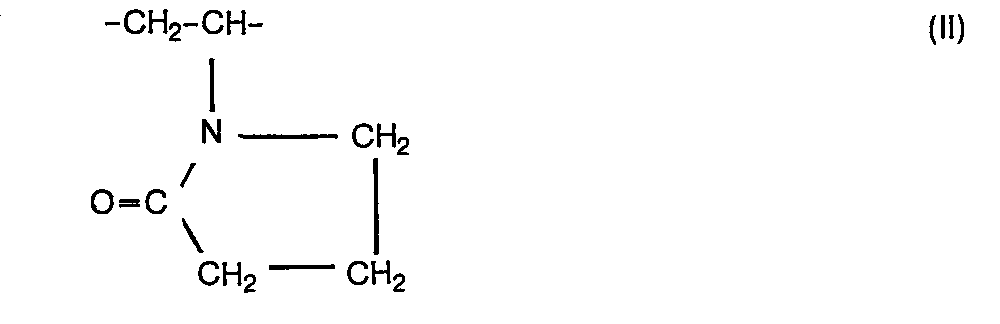
- Preferred copolymers according to the invention are composed of 50-70 mol% of residues of formula I, 15-30 mol% of residues of formula II, 10-30 mol% of residues of formula III and 5-10 mol% of residues of Formula IV built.
- the polymers according to the invention can be used in a manner known per se e.g. can be produced by a radical polymerization in aqueous solution.
- the polymerization is carried out in a protective gas atmosphere, preferably under nitrogen.
- the polymerization temperature should be between 20 and 100 ° C, preferably 30-60 ° C.
- the polymerization can be started by the customary polymerization initiators, for example K 2 S 2 O 8 , H 2 0 2 ' ( NH 4 ) 2 S 2 O 8 , H 2 0 2 / isoascorbic acid mixture.
- the customary polymerization initiators for example K 2 S 2 O 8 , H 2 0 2 ' ( NH 4 ) 2 S 2 O 8 , H 2 0 2 / isoascorbic acid mixture.
- 0.05-1 g of polymerization initiator are used per 100 g of total monomers.
- the monomers are dissolved in water at a concentration of 20-30% by weight and, after a nitrogen purge, the reaction is started.
- the copolymer according to the invention is isolated from the aqueous solution by distilling off the water or precipitating with a water-miscible organic solvent, such as methanol, ethanol, acetone or the like.
- a water-miscible organic solvent such as methanol, ethanol, acetone or the like.
- the aqueous solution obtained from the reaction product is preferably used directly, possibly after setting a desired concentration, as a protective colloid in drilling fluids.
- copolymers according to the invention are outstandingly suitable as auxiliaries in drilling fluids. They show a very good protective colloid effect both at high temperatures and at high electrolyte concentrations. They can therefore be used as a protective colloid for use in high-temperature stable and highly saline drilling fluid systems.
- aqueous drilling fluids typically, in formulating the aqueous drilling fluids copolymers of the invention in concentrations of 0.5 to 50 kg / m 3, preferably 3, inserted up to 30 kg / m l.
- Bentonites are mainly added to the aqueous drilling fluids to increase the viscosity and to seal perforated formations, and to increase the density of the drilling mud, sword spar, chalk and iron oxides.
- These monomer amounts correspond to a composition of 50 mol% AMPS, 20 mol% 1-vinylpyrrolidone-2, 20 mol% acrylamide and 10 mol% acrylonitrile.
- the mixture is stirred at a speed of 350-400 rpm and at about 10 l / h. Flushed with nitrogen to displace the oxygen from the solution. This nitrogen purge is maintained throughout the reaction time.
- the residual oxygen content at the start of the polymerization is advantageously between 1.2 and 1.8 ppm.
- the pH of the reaction mixture is about 8.5.
- the reaction mixture is heated to 33 ° C.
- the polymerization reaction is started by adding 0.05% K 2 S 2 O 8 (all initiator amounts are based on the total weight of monomer). After about 1 hour there is an increase in viscosity and after 2 hours 30 ml of deionized water are added for dilution. By further initiator additions after 4 hours (0.05% K2S208), 8 hours (0.15% K 2 S 2 O 8 ), 10 hours (0.025% H 2 0 2 and 0.025% isoascorbic acid) and 12 hours (0.025% H 2 0 2 and 0.025% isoascorbic acid), the reaction is completed.
- the polymers 2 and 3, the compositions of which can be found in Table I, can be prepared analogously to Example 1.
- Example 2 An apparatus as described in Example 1 is used for the polymerization. 230 g of deionized water are placed in the polymerization flask. Then 138.90 g of 50% strength AMPS solution, corresponding to 0.3355 mol, are added.
- composition results from these monomer weights: 50 mol% AMPS, 25 mol% acrylamide, 25 mol% 1-vinylpyrrolidone-2.
- the pH of the reaction mixture is about 8.5.
- the solution is stirred at 350-400 rpm and heated to 34 ° C. Then a nitrogen flow of approx. 10 l / h is passed through the nitrogen inlet tube. introduced into the reaction solution. This nitrogen purge is maintained throughout the reaction time.
- the residual oxygen content of the solution at the start of the polymerization is advantageously between 1.2 and 1.8 ppm.
- the reaction is started with 0.05 g of K 2 S 2 O 8 (based on the weight of monomer).
- the viscosity increases after about 2 hours.
- 6 hours 0.05% K 2 S 2 O 8
- 8 hours 0.15% R 2 S 2 O 8
- 10 hours 0.025% H 2 0 2 and 0.025% isoascorbic acid
- 12 hours 0.025% H 2 0 2 and 0.025 isoascorbic acid
- copolymers 5-18 the composition of which can be found in Table I, can be prepared in an analogous manner.
- the filterability according to API code 29 serves as an assessment criterion for the drilling muds produced with various protective colloids.
- the quality of the drilling muds and thus the effect of the protective colloids is assessed after the water loss in the filtering test.
- Water loss is to be understood here as the amount of water which passes through a filter press precisely defined in the above-mentioned regulation in a certain time unit (30 min) at a certain predetermined pressure (7 kg / cm 2 ). The lower the amount of water flowing through, the better the resistance of the drilling fluid. The tests are carried out at room temperature. Since the measurement of the water loss in the time from 0-30 min resulted in poorly reproducible values, the API water loss was twice the amount of water which emerges from the rinse in the time from 7.5 to 30 min after the test pressure was applied . These values are reproducible.
- HT-HP high-pressure, high-temperature
- the rinsing which has already been loaded at 180 ° C for 15 hours, is heated to 150 ° C in a test bomb.
- the filtration test is carried out at a pressure of 35 bar at a temperature of 150 ° C. Because of the better reproducibility already explained above, double the amount of water that emerges from the rinsing between 7.5 and 30 minutes after the test pressure was applied was also given as HT / HP water loss in the HT / HP test. This water loss should also be as low as possible.
Landscapes
- Chemical & Material Sciences (AREA)
- Organic Chemistry (AREA)
- Health & Medical Sciences (AREA)
- Chemical Kinetics & Catalysis (AREA)
- Medicinal Chemistry (AREA)
- Polymers & Plastics (AREA)
- Dispersion Chemistry (AREA)
- Life Sciences & Earth Sciences (AREA)
- General Life Sciences & Earth Sciences (AREA)
- Engineering & Computer Science (AREA)
- Materials Engineering (AREA)
- Addition Polymer Or Copolymer, Post-Treatments, Or Chemical Modifications (AREA)
Abstract

- 10-30 Mol-% Resten der Formel II
- 0-30 Mol-% Resten der Formel III

- 0-15 Mol-% der Formel IV (IV)
Description
- Die vorliegende Erfindung betrifft neue wasserlösliche Copolymerisate, die zu 40-80 Mol.-% aus Resten der Formel I

- 10-30 Mol.-% Resten der Formel II

- 0-30 Mol.-% Resten der Formel III

- 0-15 Mol.-% Resten der Formel IV

- Die Herstellung wasserlöslicher Polymerisate, welche Sulfonsäuregruppen in den Polymerketten eingebaut enthalten, ist bereits in zahlreichen'Patentschriften sowie in der Fachliteratur ausführlich beschrieben worden. So ist z.B. die Synthese von Copolymeren die Vinylsulfonsäure mit Acrylamid und Vinylpyrrolidon im Journal of Polymer Science, 38, 147 (1969) veröffentlicht worden.
- In DBP 110 1760 ist ein Verfahren zur Herstellung wasserlöslicher Copolymerisat aus Vinylsulfonsäure und Acrylnitril bzw. mit Acrylnitril, gegebenenfalls im Gemisch mit weiteren ethylenisch ungesättigten Verbindungen, beschrieben worden. Copolymerisate aus Vinyl- bzw. Alkylsulfonaten mit Acrylamid und Vinylamiden sind z.B. in der DAS 2 444 108 offenbart.
- Wasserlösliche Copolymerisate, welche 2-Acrylamido-2-Methylpropansulfonsäure (AMPS) als Comonomeres enthalten, sind in USP 3 953 342, 3 768 565, DOS 2 502 012, 2 547 773, USP 3 907 927, 3 926 718, 3 948 783 beschrieben. So lassen sich zum Beispiel gemäß den Angaben des USP 3 929 741 Copolymere aus Vinylpyrrolidon und AMPS herstellen, wobei diese Polymerisate aber wasserunlöslich sind.
- Wasserlösliche Copolymerisate, die AMPS, Vinylimidazol-(1) oder Vinylimidazol-(2) und gegebenenfalls eine Reihe weiterer Monomerbausteine als Bestandteile enthalten können, sind in der PCT-Anmeldung WO 23/02449 aufgeführt.
- Diese dort genannten Polymerisate können als hochtemperaturstabile Bohrspüladditive verwendet werden, die zwar beim Einsatz bei hohen Elektrolytkonzentrationen ihre Wirkung nicht einbüßen, aber zu zu hohen Wasserverlusten der Bohrspülung führen.
- Erstrebenswert ist es aber, einen möglichst geringen Wasserverlust der Bohrspülung auch bei hohen Temperaturen und bei sehr hohen Salzgehalten zu erreichen. Dabei ist ein sogenannter API-Preßwasserverlust unter 10 ml einzustreben.
- Überraschenderweise gelingt es, mit den erfindunqsqemäßen Polymerisaten hochtemperaturstabile Schutzkolloide bereitzustellen, die selbst bei hohen Salzkonzentrationen nur geringe Preßwasserverluste nach API aufweisen.
- Diese ausgezeichnete Wirksamkeit der erfindungsgemäßen Copolymerisate als Bohrspüladditive war völlig überraschend, da die Copolymerisate, die in der DE-OS 3 027 422 offenbart werden und aus der gleichen Monomerbausteine aufgebaut sind, bei einem Einsatz bei hohen Temperaturen zu völlig zubefriedigenden Resultaten führen.
- Gegenstand der Erfindung sind daher wasserlösliche Polymerisate, die zu 40-80 Mol.-% aus Resten der Formel I;

- 10-30 Mol.-% aus Resten der Formel II:

- 0-30 Mol.-% aus Resten der Formel III:

- 0-15 Mol.-% aus Resten der formel IV:

- Ein weiterer Gegenstand der Erfindung ist die Verwendung der erfindungsgemäßen Polymerisate als Schutzkolloide in Bohrspülmittel.
- Bevorzugte erfindungsgemäße Copolymerisate sind aus 50-70 Mol.-% Resten der Formel I, 15-30 Mol.-% Resten der Formel II, 10-30 Mol.-% Resten der Formel III und 5-10 Mol.-% Resten der Formel IV aufgebaut.
- Die erfindungsgemäßen Polymerisate können in an sich bekannter Weise z.B. durch eine radikalische Polymerisation in wäßriger Lösung hergetellt werden.
- Die Polymerisation wird wie üblich in einer Schutzgasatmosphäre, vorzugsweise unter Stickstoff, durchgeführt. Die Polymerisationstemperatur sollen zwischen 20 und 100°C, vorzugsweise 30-60°C liegen.
- Die Polymerisation kann durch die üblichen Polymerisationsinitiatoren gestartet werden, z.B. K2S2O8, H 2 0 2' (NH 4)2 S2O8, H 2 0 2/Isoascorbinsäuregemisch. Pro 100 g Gesamtmonomere werden in der Regel 0,05-1 g Polymerisationsinitiator eingesetzt.
- Zur Durchführung der Polymerisate werden die Monomeren mit einer Konzentration von 20-30 Gew.-% in Wasser gelöst und nach einer Stickstoffspülung wird die Reaktion gestartet. Aus der wäßrigen Lösung wird das erfindungsgemäße Copolymerisat durch Abdestillieren des Wassers oder Ausfällen mit einem wassermischbaren, organischen Lösungsmittel, wie Methanol, Ethanol, Aceton oder dergleichen, isoliert. Vorzugsweise wird jedoch die das Reaktionsprodukt erhaltene wäßrige Lösung direkt, evtl. nach Einstellen einer gewünschten Konzentration, als Schutzkolloid in Bohrspülungen eingesetzt.
- Die erfindungsgemäßen Copolymerisate sind hervorragend geeignte als Hilfsmittel bei Bohrspülungen. Sie zeigen dabei eine sehr gute Schutzkolloidwirkung sowohl bei hohen Temperaturen als auch bei hohen Elektrolytkonzentrationen. Sie können daher als Schutzkolloid für den Einsatz in hochtemperaturstabilen und hochsalinaren Bohrspülungssystemen verwendet werden.
- Üblicherweise werden zur Formulierung der wässrigen Bohrspülungen die erfindungsgemäßen Copolymerisate in Konzentrationen von 0,5 bis 50 kg/m3, vorzugsweise 3 bis 30 kg/ml, eingesetzt. Den wässrigen Bohrspülungen werden zur Viskositätserhöhung und Abdichtung durchbohrter Formationen vorwiegend Bentonite und zur Dichteerhöhung der Bohrschlämme Schwertspat, Kreide und Eisenoxide zugesetzt.
- Je nach den zu durchbrechenden Formationen können Bentonit, Schwertspat, Kreide und Eisenoxid allein oder in verschiedensten Mischungsverhältnissen den Bohrspülungen zugegeben werden.
- In einem 1 1 Polymerisationskolben mit Rührer, Rückflußkühler und Gaseinleitrohr für Intergas werden 240 g entionisiertes Wasser vorgelegt. Danach werden 142,54 g einer 50 %ige Lösung von 2-Acrylamido-2-Methylpropannatrium-- sulfonat zugegeben. Diese Menge entspricht 0,3442 Mol AMPS.
- Anschließend werden 15,28 g 1-Vinylpyrrolidon-2, entsprechend 0,1377 Mol, und 32,63 g 30 %ige Acrylamidlösung, entsprechend 0,1377 Mol, zugegeben. Danach werden 3,66 g Acrylnitril, entsprechend 0,0689 Mol, zugegeben.
- Diese Monomermengen entsprechen einer Zusammensetzung von 50 mol-% AMPS, 20 mol-% 1-Vinylpyrrolidon-2, 20 mol-% Acrylamid und 10 mol-% Acrylnitril.
- Nach dem Ende der Zugaben wird mit einer Geschwindigkeit von 350-400 Upm gerührt und mit ca. 10 1/Std. Stickstoff gespült, um den Sauerstoff aus der Lösung zu verdrängen. Diese Stickstoffspülung wird während der gesamten Reaktionszeit beibehalten. Der Restsauerstoffgehalt beim Start der Polymerisation liegt vorteilhaft zwischen 1,2 und 1,8 ppm. Der pH-Wert des Reaktionsgemisches liegt bei etwa 8,5. Das Reaktionsgemisch wird auf 33°C erwärmt.
- Nach einer zehnminütigen Sticktoffspülung mit ca. 10 1/Std. wird die Polymerisationsreaktion durch Zugabe von 0,05 % K2S2O8 (alle Initiatormengen sind bezogen auf die Gesamtmonomereinwaage) gestartet. Nach etwa 1 Stunde erfolgt ein Viskositätsanstieg und nach 2 Stunden werden 30 ml entionisiertes Wasser zur Verdünnung zugegeben. Durch weitere Initiatorzugaben nach 4 Stunden (0,05 % K2S208), 8 Stunden (0,15 % K2S2O8), 10 Stunden (0,025 % H202 und 0,025 % Isoascorbinsäure) und 12 Stunden (0,025 % H202 und 0,025 % Isoascorbinsäure), wird die Reaktion zu Ende geführt.
- Nach dem Ende der Reaktion werden 0,26 g 25 %ige Natronlauge und 17 ml Wasser zugegeben. Der pH-Wert steigt durch diese Zugaben auf 6,8.
- Das erhaltene Endprodukt ist durch folgende Angaben charakterisiert:

- Die Polymerisate 2 und 3, deren Zusammensetzungen Tabelle I zu entnehmen sind, können analog zu Beispiel 1 hergestellt werden.
- Für die Polymerisation wird eine wie in Beispiel 1 beschriebene Apparatur eingesetzt. Im Polymerisationskolben werden 230 g entionisiertes Wasser vorgelegt. Danach werden 138,90 g 50 %ige AMPS-Lösung, entsprechend 0,3355 Mol, zugegeben.
- Anschließend erfolgt die Zugabe von 39,76 g 30 %iger Acrylamidlösung, entsprechend 0,1678 Mol, und 18,63 g 1-Vinylpyrrolidon-2, entsprechend 0,1678 Mol.
- Aus diesen Monomereinwaagen resultiert folgende Zusammensetzung: 50 Mol.-% AMPS, 25 Mol.-% Acrylamid, 25 Mol.-% 1-Vinylpyrrolidon-2.
- Zur Regulierung der Kettenlänge werden noch 0,004 % Hydrochinon, bezogen auf die Gesamtmonomereinwaage, zugesetzt.
- Der pH-Wert der Reaktionsmischung liegt bei etwa 8,5.
- Nach der Beendigung der Zugaben wird die Lösung mit 350-400 Upm gerührt und auf 34°C aufgeheizt. Danach wird durch das Stickstoffeinleitrohr ein Stickstoffstrom von ca. 10 1/Std. in die Reaktionslösung eingeleitet. Diese Stickstoffspülung wird während der gesamten Reaktionszeit beibehalten. Der Restsauerstoffgehalt der Lösung beim Start der Polymerisation liegt vorteilhaft zwischen 1,2 und 1,8 ppm.
- Nach einer zehnminütigen Stickstoffspülung wird die Reaktion mit 0,05 g K2S2O8 (bezogen auf die Monomereinwaage) gestartet. Nach etwa 2 Stunden erfolgt ein Viskositätsanstieg. Durch weitere Initiatorzugaben nach 3 Stunden (0,05 R2S2O8), 6 Stunden (0,05 % K2S2O8), 8 Stunden (0,15 % R2S2O8), 10 Stunden (0,025 % H202 und 0,025 % Isoascorbinsäure) und 12 Stunden (0,025 % H202 und 0,025 Isoascorbinsäure), wird die Reaktion zu Ende geführt.
- Nach der Beendigung der Reaktion werden 0,3 g 25 %ige Natronlauge und 52 ml Wasser zugegeben.
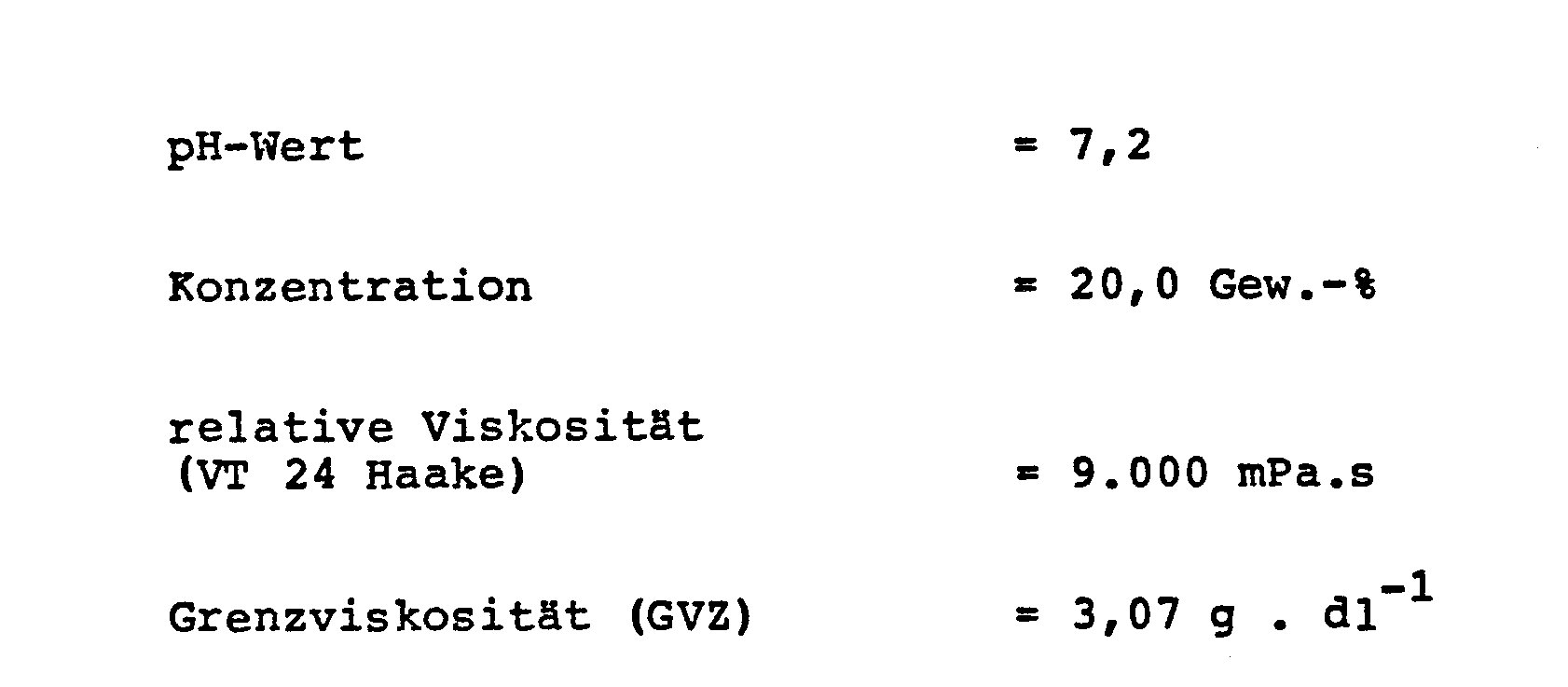
- Das erhaltene Endprodukt ist durch folgende Angaben charakterisiert:
- In analoger Weise können die Copolymerisate 5-18, deren Zusammensetzung der Tabelle I zu entnehmen sind, hergestellt werden.
- Durch Veränderungen des pH-Wertes beim Start und der Startinitiatormenge entstehen Polymerisate mit unterschiedlichen Granzviskositätszahlen (GVZ).
- In der Tabelle werden folgende Abkürzungen verwendet:
- AMPS : 2-Acrylamido-2-Methyl-Propansulfonsäure
- NVPy: l-Vinylpyrrolidon-2
- AAm: Acrylamid
- AN: Acrylnitril
- GVZ: Grenzviskositätszahlen, die in einer 0,1-normalen NaCl-Lösung bei 25°C bestimmt wurde.
-

- In den nachfolgenden Anwendungsbeispielen werden die erfindungsgemäßen Polymerisate mit bekannten Bohrspüladditiven verglichen.
- Als Beurteilungskriterium der mit verschiedenen Schutzkolloiden hergestellten Bohrschlämme dient ihre Filtrierbarkeit nach API-Code 29. Die Güte der Bohrschlämme und damit die Wirkung der Schutzkolloide wird nach dem Wasserverlust bei dem Filtrierversuch beurteilt.
- Unter Wasserverlust ist hierbei die Menge Wasser zu verstehen, welche durch eine in der oben genannten Vorschrift genau definierten Filterpresse in einer bestimmten Zeiteinheit (30 min) bei einem bestimmten vorgegebenen Druck (7 kg/cm2) hindurchläuft. Je geringer die hindurchlaufende Wassermenge ist, um so besser ist die Beständigkeit der Bohrspülung. Die Prüfungen werden bei Raumtemperatur durchgeführt. Da die Messung des Wasserverlustes in der Zeit von 0-30 min schlecht reproduzierbare Werte ergab, wurde als API-Wasserverlust das Doppelte der Wassermenge, die in der Zeit von 7,5 bis 30 min nach dem Anlegen des Prüfdruckes aus der Spülung austritt angegeben. Diese Werte sind reproduzierbar.
- Neben dem API-Test wird dem Hochdruck-Hochtemperatur-(HT-HP)-Wasserverlust in jüngster Zeit eine größere Bedeutung beigemessen, weil man davon ausgeht, daß dieser Wert die tatsächlichen Verhältnisse im Bohrloch besser wiedergeben kann. Zur Durchführung dieses Tests wird die bereits 15 Stunden bei 180°C belastete Spülung in einer Prüfbombe auf 150°C aufgeheizt. Der Filtrationsversuch wird mit einem Druck von 35 bar bei der Temperatur von 150°C durchgeführt. Wegen der oben schon erläuterten besseren Reproduzierbarkeit wurde auch beim HT/HP-Test die doppelte Wassermenge, die zwischen 7,5 und 30 min nach dem Anlegen des Prüfdruckes aus der Spülung austritt, als HT/HP-Wasserverlust angegeben. Auch dieser Wasserverlust sollte möglichst gering sein.
- Für die Untersuchungen wurden folgende Mischpolymerisate eingesetzt:
- A: Copolymerisat hergestellt aus 50 mol-% AMPS, 20 mol-% 1-Vinylpyrrolidon-2, 20 mol-% Acrylamid und 10 mol-% Acrylnitril (Beispiel 1, Tabelle I).
- B. Copolymerisat hergestellt aus 50 mol-% AMPS, 25 mol-% 1-Vinylpyrrolidon-2 und 25 mol-% Acrylamid. (Beispiel 4, Tabelle I).
- C. Copolymerisat, bestehend aus 20,87 mol-% (& 40 Gew.-%) AMPS, 22,40 mol-% (22 Gew.-%) l-Vinylpyrrolidon-2 und 57,73 mol-% ( 38 Gew.-%) Acrylamid (Vergleichsprodukt gemäß DE OS 3 047 422 A 1).

- Bei allen Beispielen wurde folgende Spülmittelrezeptur eingesetzt:

- Alle Prozentangaben der Spülmittel sind bezogen auf die Wassermenge.
- Es wurden die Wasserverluste nach API bei Raumtemperatur und nach einer Lagerung von 15 h bei 180°C gemessen. Zusätzlich wurde der oben beschriebene Hochtemperatur-und Hochdruck-(HT/HP)-Filtrationstest durchgeführt. Die Ergebnisse sind in Tabelle II dargestellt:

- Die Ergebnisse der anwendungstechnischen Tests zeigen eindeutig die hohe Wirksamkeit der erfindungsgemäßen Additive A und B gegenüber dem Vergleichsprodukt C. Das Vergleichsprodukt C versagt nach der Temperaturbelastung völlig.
- Im für dieses Anwendungsgebiet entscheidenden HT/HP-Test werden mit den erfindungsgemäßen Produkten A und B in dieser extrem salzhaltigen Spülung mit einem hohen Anteil an zweiwertigen Kationen sehr niedrige Wasserverluste erreicht, während das Vergleichsprodukt C einen Totalverlust erleidet.
wobei die Reste I - IV im Polymerisat statistisch verteilt sind und jeweils 100 Mol.-% ergeben.
Claims (7)


Applications Claiming Priority (2)
| Application Number | Priority Date | Filing Date | Title |
|---|---|---|---|
| DE19843404491 DE3404491A1 (de) | 1984-02-09 | 1984-02-09 | Wasserloesliche polymerisate und deren verwendung als bohrspueladditive |
| DE3404491 | 1984-02-09 |
Publications (3)
| Publication Number | Publication Date |
|---|---|
| EP0152814A2 true EP0152814A2 (de) | 1985-08-28 |
| EP0152814A3 EP0152814A3 (en) | 1986-05-07 |
| EP0152814B1 EP0152814B1 (de) | 1988-12-28 |
Family
ID=6227161
Family Applications (1)
| Application Number | Title | Priority Date | Filing Date |
|---|---|---|---|
| EP85100844A Expired EP0152814B1 (de) | 1984-02-09 | 1985-01-28 | Wasserlösliche Polymerisate und deren Verwendung als Bohrspüladditive |
Country Status (5)
| Country | Link |
|---|---|
| US (1) | US4749498A (de) |
| EP (1) | EP0152814B1 (de) |
| JP (1) | JPH0676580B2 (de) |
| DE (2) | DE3404491A1 (de) |
| NO (1) | NO164775C (de) |
Cited By (1)
| Publication number | Priority date | Publication date | Assignee | Title |
|---|---|---|---|---|
| EP0213245A1 (de) * | 1983-05-02 | 1987-03-11 | Mobil Oil Corporation | Hochtemperaturbeständige wässrige Lacke mit mittels wasserlöslicher Copolymersalze von Acrylamidomethylpropansulfonsäure verbesserter Viskosität |
Families Citing this family (15)
| Publication number | Priority date | Publication date | Assignee | Title |
|---|---|---|---|---|
| DE3631764A1 (de) * | 1986-09-18 | 1988-03-24 | Henkel Kgaa | Verwendung von quellfaehigen, synthetischen schichtsilikaten in waessrigen bohrspuel- und bohrlochbehandlungsmitteln |
| DE3701600A1 (de) * | 1987-01-21 | 1988-08-04 | Sueddeutsche Kalkstickstoff | Wasserloesliche thermostabile polymerisate |
| US5153240A (en) * | 1987-03-23 | 1992-10-06 | Phillips Petroleum Company | Fluid loss additives for well cementing compositions containing a tetrapolymer |
| US5260391A (en) * | 1987-03-23 | 1993-11-09 | Michael Stephens | Tetrapolymerization product of 2-acrylamido-2-methyl propane sulfonic acid/associated salts, n-vinyl pyrrolidone, acrylamide, and acrylic acid/associated salts |
| US5294651A (en) * | 1987-03-23 | 1994-03-15 | Phillips Petroleum Company | Fluid loss additives for well cementing compositions |
| JP2510246B2 (ja) * | 1988-06-07 | 1996-06-26 | 株式会社フジタ | 泥水掘削工法用高耐腐敗性泥水組成物およびその使用法 |
| DE3833045A1 (de) * | 1988-09-29 | 1990-04-05 | Henkel Kgaa | Bohrspueladditive auf basis eines polymergemiches, deren verwendung sowie verfahren zur herstellung derselben |
| JP2587480B2 (ja) * | 1988-11-09 | 1997-03-05 | 株式会社日本触媒 | 掘削泥水用添加剤 |
| US5032296A (en) * | 1988-12-05 | 1991-07-16 | Phillips Petroleum Company | Well treating fluids and additives therefor |
| US4963632A (en) * | 1988-12-29 | 1990-10-16 | Exxon Research And Engineering Company | Mixed micellar process for preparing hydrophobically associating polymers |
| DE4224537A1 (de) * | 1992-07-27 | 1994-02-03 | Henkel Kgaa | Mineralische Additive zur Einstellung und/oder Regelung der Rheologie und Gelstruktur wässriger Flüssigphasen und ihre Verwendung |
| DE19909231C2 (de) * | 1999-03-03 | 2001-04-19 | Clariant Gmbh | Wasserlösliche Copolymere auf AMPS-Basis und ihre Verwendung als Bohrhilfsmittel |
| US6655475B1 (en) | 2001-01-23 | 2003-12-02 | H. Lester Wald | Product and method for treating well bores |
| DE60202869T2 (de) * | 2002-09-11 | 2006-04-27 | Gkss-Forschungszentrum Geesthacht Gmbh | Polymermasse, Materialien hieraus und deren Anwendungen |
| CN110483686B (zh) * | 2019-07-30 | 2021-08-31 | 石家庄华信泥浆助剂有限公司 | 环保型阳离子降滤失组合物及降滤失剂 |
Family Cites Families (12)
| Publication number | Priority date | Publication date | Assignee | Title |
|---|---|---|---|---|
| NL257856A (de) * | 1959-11-11 | |||
| US3892720A (en) * | 1973-06-29 | 1975-07-01 | Lubrizol Corp | Polymerizable hydroxy-containing esters of amido-substituted sulfonic acids |
| DE2444108C2 (de) * | 1974-09-14 | 1978-01-19 | Hoechst Ag | Wasserbasische tonspuelung fuer tiefbohrungen und verwendung eines mischpolymerisats fuer solche spuelungen |
| US3929741A (en) * | 1974-07-16 | 1975-12-30 | Datascope Corp | Hydrophilic acrylamido polymers |
| JPS5950336B2 (ja) * | 1976-08-12 | 1984-12-07 | 日本ゼオン株式会社 | 抗血栓性医用高分子材料 |
| DE2931897A1 (de) * | 1979-08-06 | 1981-02-26 | Cassella Ag | Wasserloesliches copolymerisat und seine herstellung |
| DE3027422A1 (de) * | 1980-07-19 | 1982-02-25 | Cassella Ag, 6000 Frankfurt | Hochmolekulare wasserloesliche copolymerisate, ihre herstellung und verwendung |
| US4471097A (en) * | 1982-01-11 | 1984-09-11 | Klaus Uhl | Water soluble copolymers containing vinyl imidazole as drilling fluid additives |
| US4619773A (en) * | 1983-05-02 | 1986-10-28 | Mobil Oil Corporation | High temperature stable aqueous brine fluids viscosified by water-soluble copolymers of acrylamidomethylpropanesulfonic acid salts |
| US4609476A (en) * | 1983-05-02 | 1986-09-02 | Mobil Oil Corporation | High temperature stable aqueous brine fluids |
| US4544722A (en) * | 1983-09-09 | 1985-10-01 | Nalco Chemical Company | Water-soluble terpolymers of 2-acrylamido-2-methylpropane-sulfonic acid, sodium salt (AMPS), n-vinylpyrrolidone and acrylonitrile |
| US4608182A (en) * | 1985-01-09 | 1986-08-26 | Mobil Oil Corporation | Vinyl sulfonate amide copolymer and terpolymer combinations for control of filtration in water-based drilling fluids at high temperature |
-
1984
- 1984-02-09 DE DE19843404491 patent/DE3404491A1/de not_active Withdrawn
-
1985
- 1985-01-23 NO NO850283A patent/NO164775C/no unknown
- 1985-01-28 DE DE8585100844T patent/DE3567026D1/de not_active Expired
- 1985-01-28 EP EP85100844A patent/EP0152814B1/de not_active Expired
- 1985-02-05 JP JP60019374A patent/JPH0676580B2/ja not_active Expired - Lifetime
-
1986
- 1986-07-14 US US06/886,282 patent/US4749498A/en not_active Expired - Fee Related
Cited By (1)
| Publication number | Priority date | Publication date | Assignee | Title |
|---|---|---|---|---|
| EP0213245A1 (de) * | 1983-05-02 | 1987-03-11 | Mobil Oil Corporation | Hochtemperaturbeständige wässrige Lacke mit mittels wasserlöslicher Copolymersalze von Acrylamidomethylpropansulfonsäure verbesserter Viskosität |
Also Published As
| Publication number | Publication date |
|---|---|
| EP0152814A3 (en) | 1986-05-07 |
| DE3567026D1 (en) | 1989-02-02 |
| JPS60181109A (ja) | 1985-09-14 |
| NO164775C (no) | 1990-11-14 |
| NO164775B (no) | 1990-08-06 |
| JPH0676580B2 (ja) | 1994-09-28 |
| US4749498A (en) | 1988-06-07 |
| EP0152814B1 (de) | 1988-12-28 |
| DE3404491A1 (de) | 1985-08-14 |
| NO850283L (no) | 1985-08-12 |
Similar Documents
| Publication | Publication Date | Title |
|---|---|---|
| EP0023712B1 (de) | Wasserlösliches Copolymerisat, Verfahren zu seiner Herstellung und seine Verwendung | |
| EP0152814B1 (de) | Wasserlösliche Polymerisate und deren Verwendung als Bohrspüladditive | |
| DE3027422A1 (de) | Hochmolekulare wasserloesliche copolymerisate, ihre herstellung und verwendung | |
| DE3120789C2 (de) | Verfahren zum Verbessern der Salz- und/oder mechanischen Stabilität einer wäßrigen Polymermikrosuspension | |
| DE2142742C2 (de) | Verfahren zur Herstellung von Ammoniumpolyacrylaten | |
| EP0113438B1 (de) | Wasserlösliche Copolymerisate, ihre Herstellung und ihre Verwendung | |
| DE2417656A1 (de) | Makroretikulare vinylbenzylchloridpolymere | |
| EP0123297B1 (de) | Vernetzte hydrophile Copolymerisate, ihre Herstellung und Verwendung | |
| EP0276718A2 (de) | Thermostabile Polymerisate | |
| DE68920131T2 (de) | Hydrophob assoziierende Polymere. | |
| DE2803009C2 (de) | Verwendung eines Copolymeren als Zusatzmittel bei der Sekundär- und Tertiärgewinnung von Erdöl | |
| DE3144770A1 (de) | Wasserloesliches copolymerisat, seine herstellung und verwendung | |
| DE4441940B4 (de) | Lactamring enthaltendes Polymer | |
| DE2241914C3 (de) | Verfahren zur Herstellung von Mischpolymerisaten | |
| DE69003614T2 (de) | Amphotere hydrophile Polymere, Verfahren zu deren Herstellung und deren Verwendung als absorbierende Mittel. | |
| EP0649864A1 (de) | Wasserlösliche Polymerisate und deren Verwendung als Bohrspüladditive | |
| DE1082408B (de) | Polymerisierungsverfahren | |
| DE1233143B (de) | Verfahren zur Herstellung von sulfonierten Mischpolymerisaten | |
| EP0068159A1 (de) | Wasserquellbare vernetzte Copolymerisate, ihre Herstellung und Verwendung | |
| DE2454324C2 (de) | Verfahren zur Herstellung von polymeren Färbeadditiven | |
| AT251880B (de) | Verfahren zur Herstellung von Gelen aus Polyacroleinen | |
| DE1947788C3 (de) | Verfahren zur Herstellung von Polymerisaten | |
| AT233829B (de) | Verfahren zur Herstellung von Acrylnitril-Polymerisaten | |
| AT314824B (de) | Verfahren zur herstellung einer dispersion von kolloidalem latex in wasser | |
| DE1595727C3 (de) | In Wasser, aliphatischen und aromatischen Kohlenwasserstoffen unlösliche vernetzte Acrylsäure-Copolymere |
Legal Events
| Date | Code | Title | Description |
|---|---|---|---|
| PUAI | Public reference made under article 153(3) epc to a published international application that has entered the european phase |
Free format text: ORIGINAL CODE: 0009012 |
|
| 17P | Request for examination filed |
Effective date: 19850128 |
|
| AK | Designated contracting states |
Designated state(s): DE FR GB IT NL SE |
|
| PUAL | Search report despatched |
Free format text: ORIGINAL CODE: 0009013 |
|
| AK | Designated contracting states |
Kind code of ref document: A3 Designated state(s): DE FR GB IT NL SE |
|
| 17Q | First examination report despatched |
Effective date: 19870622 |
|
| GRAA | (expected) grant |
Free format text: ORIGINAL CODE: 0009210 |
|
| ITF | It: translation for a ep patent filed | ||
| AK | Designated contracting states |
Kind code of ref document: B1 Designated state(s): DE FR GB IT NL SE |
|
| REF | Corresponds to: |
Ref document number: 3567026 Country of ref document: DE Date of ref document: 19890202 |
|
| ET | Fr: translation filed | ||
| GBT | Gb: translation of ep patent filed (gb section 77(6)(a)/1977) | ||
| PLBE | No opposition filed within time limit |
Free format text: ORIGINAL CODE: 0009261 |
|
| STAA | Information on the status of an ep patent application or granted ep patent |
Free format text: STATUS: NO OPPOSITION FILED WITHIN TIME LIMIT |
|
| 26N | No opposition filed | ||
| EAL | Se: european patent in force in sweden |
Ref document number: 85100844.1 |
|
| ITTA | It: last paid annual fee | ||
| PGFP | Annual fee paid to national office [announced via postgrant information from national office to epo] |
Ref country code: DE Payment date: 19961212 Year of fee payment: 13 |
|
| PGFP | Annual fee paid to national office [announced via postgrant information from national office to epo] |
Ref country code: SE Payment date: 19961217 Year of fee payment: 13 |
|
| PGFP | Annual fee paid to national office [announced via postgrant information from national office to epo] |
Ref country code: GB Payment date: 19970120 Year of fee payment: 13 |
|
| PGFP | Annual fee paid to national office [announced via postgrant information from national office to epo] |
Ref country code: FR Payment date: 19970122 Year of fee payment: 13 |
|
| PGFP | Annual fee paid to national office [announced via postgrant information from national office to epo] |
Ref country code: NL Payment date: 19970131 Year of fee payment: 13 |
|
| PG25 | Lapsed in a contracting state [announced via postgrant information from national office to epo] |
Ref country code: GB Free format text: LAPSE BECAUSE OF NON-PAYMENT OF DUE FEES Effective date: 19980128 |
|
| PG25 | Lapsed in a contracting state [announced via postgrant information from national office to epo] |
Ref country code: SE Free format text: LAPSE BECAUSE OF NON-PAYMENT OF DUE FEES Effective date: 19980129 |
|
| PG25 | Lapsed in a contracting state [announced via postgrant information from national office to epo] |
Ref country code: FR Free format text: THE PATENT HAS BEEN ANNULLED BY A DECISION OF A NATIONAL AUTHORITY Effective date: 19980131 |
|
| PG25 | Lapsed in a contracting state [announced via postgrant information from national office to epo] |
Ref country code: NL Free format text: LAPSE BECAUSE OF NON-PAYMENT OF DUE FEES Effective date: 19980801 |
|
| GBPC | Gb: european patent ceased through non-payment of renewal fee |
Effective date: 19980128 |
|
| NLV4 | Nl: lapsed or anulled due to non-payment of the annual fee |
Effective date: 19980801 |
|
| PG25 | Lapsed in a contracting state [announced via postgrant information from national office to epo] |
Ref country code: DE Free format text: LAPSE BECAUSE OF NON-PAYMENT OF DUE FEES Effective date: 19981001 |
|
| EUG | Se: european patent has lapsed |
Ref document number: 85100844.1 |
|
| REG | Reference to a national code |
Ref country code: FR Ref legal event code: ST |