EP0152951A2 - Verfahren zum Verstärken von keramischen Körpern - Google Patents
Verfahren zum Verstärken von keramischen Körpern Download PDFInfo
- Publication number
- EP0152951A2 EP0152951A2 EP85101856A EP85101856A EP0152951A2 EP 0152951 A2 EP0152951 A2 EP 0152951A2 EP 85101856 A EP85101856 A EP 85101856A EP 85101856 A EP85101856 A EP 85101856A EP 0152951 A2 EP0152951 A2 EP 0152951A2
- Authority
- EP
- European Patent Office
- Prior art keywords
- ions
- ceramic material
- metal film
- film
- irradiated
- Prior art date
- Legal status (The legal status is an assumption and is not a legal conclusion. Google has not performed a legal analysis and makes no representation as to the accuracy of the status listed.)
- Granted
Links
- 238000000034 method Methods 0.000 title claims abstract description 24
- 238000005728 strengthening Methods 0.000 title claims abstract description 5
- 239000000919 ceramic Substances 0.000 title description 16
- 150000002500 ions Chemical class 0.000 claims abstract description 43
- 229910010293 ceramic material Inorganic materials 0.000 claims abstract description 36
- 229910052751 metal Inorganic materials 0.000 claims abstract description 29
- 239000002184 metal Substances 0.000 claims abstract description 29
- 230000001678 irradiating effect Effects 0.000 claims abstract description 6
- IJGRMHOSHXDMSA-UHFFFAOYSA-N Atomic nitrogen Chemical compound N#N IJGRMHOSHXDMSA-UHFFFAOYSA-N 0.000 claims description 19
- XKRFYHLGVUSROY-UHFFFAOYSA-N Argon Chemical compound [Ar] XKRFYHLGVUSROY-UHFFFAOYSA-N 0.000 claims description 13
- 229910052757 nitrogen Inorganic materials 0.000 claims description 12
- 229910052581 Si3N4 Inorganic materials 0.000 claims description 9
- 229910052786 argon Inorganic materials 0.000 claims description 9
- HQVNEWCFYHHQES-UHFFFAOYSA-N silicon nitride Chemical compound N12[Si]34N5[Si]62N3[Si]51N64 HQVNEWCFYHHQES-UHFFFAOYSA-N 0.000 claims description 9
- MCMNRKCIXSYSNV-UHFFFAOYSA-N Zirconium dioxide Chemical compound O=[Zr]=O MCMNRKCIXSYSNV-UHFFFAOYSA-N 0.000 claims description 7
- HBMJWWWQQXIZIP-UHFFFAOYSA-N silicon carbide Chemical compound [Si+]#[C-] HBMJWWWQQXIZIP-UHFFFAOYSA-N 0.000 claims description 7
- PXHVJJICTQNCMI-UHFFFAOYSA-N Nickel Chemical compound [Ni] PXHVJJICTQNCMI-UHFFFAOYSA-N 0.000 claims description 6
- XUIMIQQOPSSXEZ-UHFFFAOYSA-N Silicon Chemical compound [Si] XUIMIQQOPSSXEZ-UHFFFAOYSA-N 0.000 claims description 6
- 229910052710 silicon Inorganic materials 0.000 claims description 5
- 239000010703 silicon Substances 0.000 claims description 5
- 239000011651 chromium Substances 0.000 claims description 4
- PNEYBMLMFCGWSK-UHFFFAOYSA-N aluminium oxide Inorganic materials [O-2].[O-2].[O-2].[Al+3].[Al+3] PNEYBMLMFCGWSK-UHFFFAOYSA-N 0.000 claims description 3
- 238000005229 chemical vapour deposition Methods 0.000 claims description 3
- 238000005240 physical vapour deposition Methods 0.000 claims description 3
- 238000004544 sputter deposition Methods 0.000 claims description 3
- VYZAMTAEIAYCRO-UHFFFAOYSA-N Chromium Chemical compound [Cr] VYZAMTAEIAYCRO-UHFFFAOYSA-N 0.000 claims description 2
- XEEYBQQBJWHFJM-UHFFFAOYSA-N Iron Chemical compound [Fe] XEEYBQQBJWHFJM-UHFFFAOYSA-N 0.000 claims description 2
- 229910052782 aluminium Inorganic materials 0.000 claims description 2
- XAGFODPZIPBFFR-UHFFFAOYSA-N aluminium Chemical compound [Al] XAGFODPZIPBFFR-UHFFFAOYSA-N 0.000 claims description 2
- 229910052804 chromium Inorganic materials 0.000 claims description 2
- 229910017052 cobalt Inorganic materials 0.000 claims description 2
- 239000010941 cobalt Substances 0.000 claims description 2
- GUTLYIVDDKVIGB-UHFFFAOYSA-N cobalt atom Chemical compound [Co] GUTLYIVDDKVIGB-UHFFFAOYSA-N 0.000 claims description 2
- 239000001307 helium Substances 0.000 claims description 2
- 229910052734 helium Inorganic materials 0.000 claims description 2
- SWQJXJOGLNCZEY-UHFFFAOYSA-N helium atom Chemical compound [He] SWQJXJOGLNCZEY-UHFFFAOYSA-N 0.000 claims description 2
- 229910052759 nickel Inorganic materials 0.000 claims description 2
- 238000007747 plating Methods 0.000 claims description 2
- 238000002207 thermal evaporation Methods 0.000 claims description 2
- 229910052724 xenon Inorganic materials 0.000 claims description 2
- FHNFHKCVQCLJFQ-UHFFFAOYSA-N xenon atom Chemical compound [Xe] FHNFHKCVQCLJFQ-UHFFFAOYSA-N 0.000 claims description 2
- 239000000463 material Substances 0.000 abstract description 9
- 238000010438 heat treatment Methods 0.000 description 10
- -1 nitrogen ions Chemical class 0.000 description 10
- 239000012298 atmosphere Substances 0.000 description 5
- 238000007676 flexural strength test Methods 0.000 description 5
- 229910010271 silicon carbide Inorganic materials 0.000 description 5
- 238000005245 sintering Methods 0.000 description 5
- 230000007547 defect Effects 0.000 description 4
- 230000035945 sensitivity Effects 0.000 description 3
- CSCPPACGZOOCGX-UHFFFAOYSA-N Acetone Chemical compound CC(C)=O CSCPPACGZOOCGX-UHFFFAOYSA-N 0.000 description 2
- 230000001133 acceleration Effects 0.000 description 2
- 239000000654 additive Substances 0.000 description 2
- 230000005684 electric field Effects 0.000 description 2
- 239000007789 gas Substances 0.000 description 2
- 150000002739 metals Chemical class 0.000 description 2
- 239000010955 niobium Substances 0.000 description 2
- 239000012299 nitrogen atmosphere Substances 0.000 description 2
- 229910052575 non-oxide ceramic Inorganic materials 0.000 description 2
- 239000011225 non-oxide ceramic Substances 0.000 description 2
- 239000000843 powder Substances 0.000 description 2
- 239000000126 substance Substances 0.000 description 2
- 238000007740 vapor deposition Methods 0.000 description 2
- 238000005452 bending Methods 0.000 description 1
- 230000015572 biosynthetic process Effects 0.000 description 1
- 230000006378 damage Effects 0.000 description 1
- 238000000354 decomposition reaction Methods 0.000 description 1
- 229910003460 diamond Inorganic materials 0.000 description 1
- 239000010432 diamond Substances 0.000 description 1
- 238000000313 electron-beam-induced deposition Methods 0.000 description 1
- 229910001651 emery Inorganic materials 0.000 description 1
- 229910052735 hafnium Inorganic materials 0.000 description 1
- VBJZVLUMGGDVMO-UHFFFAOYSA-N hafnium atom Chemical compound [Hf] VBJZVLUMGGDVMO-UHFFFAOYSA-N 0.000 description 1
- 238000007731 hot pressing Methods 0.000 description 1
- 239000011261 inert gas Substances 0.000 description 1
- 238000002844 melting Methods 0.000 description 1
- 230000008018 melting Effects 0.000 description 1
- 239000000203 mixture Substances 0.000 description 1
- 229910052758 niobium Inorganic materials 0.000 description 1
- GUCVJGMIXFAOAE-UHFFFAOYSA-N niobium atom Chemical compound [Nb] GUCVJGMIXFAOAE-UHFFFAOYSA-N 0.000 description 1
- 229910052574 oxide ceramic Inorganic materials 0.000 description 1
- 239000011224 oxide ceramic Substances 0.000 description 1
- TWNQGVIAIRXVLR-UHFFFAOYSA-N oxo(oxoalumanyloxy)alumane Chemical compound O=[Al]O[Al]=O TWNQGVIAIRXVLR-UHFFFAOYSA-N 0.000 description 1
- SIWVEOZUMHYXCS-UHFFFAOYSA-N oxo(oxoyttriooxy)yttrium Chemical compound O=[Y]O[Y]=O SIWVEOZUMHYXCS-UHFFFAOYSA-N 0.000 description 1
- VSZWPYCFIRKVQL-UHFFFAOYSA-N selanylidenegallium;selenium Chemical compound [Se].[Se]=[Ga].[Se]=[Ga] VSZWPYCFIRKVQL-UHFFFAOYSA-N 0.000 description 1
- 229910052715 tantalum Inorganic materials 0.000 description 1
- GUVRBAGPIYLISA-UHFFFAOYSA-N tantalum atom Chemical compound [Ta] GUVRBAGPIYLISA-UHFFFAOYSA-N 0.000 description 1
- LEONUFNNVUYDNQ-UHFFFAOYSA-N vanadium atom Chemical compound [V] LEONUFNNVUYDNQ-UHFFFAOYSA-N 0.000 description 1
- 238000005406 washing Methods 0.000 description 1
Images
Classifications
-
- C—CHEMISTRY; METALLURGY
- C23—COATING METALLIC MATERIAL; COATING MATERIAL WITH METALLIC MATERIAL; CHEMICAL SURFACE TREATMENT; DIFFUSION TREATMENT OF METALLIC MATERIAL; COATING BY VACUUM EVAPORATION, BY SPUTTERING, BY ION IMPLANTATION OR BY CHEMICAL VAPOUR DEPOSITION, IN GENERAL; INHIBITING CORROSION OF METALLIC MATERIAL OR INCRUSTATION IN GENERAL
- C23C—COATING METALLIC MATERIAL; COATING MATERIAL WITH METALLIC MATERIAL; SURFACE TREATMENT OF METALLIC MATERIAL BY DIFFUSION INTO THE SURFACE, BY CHEMICAL CONVERSION OR SUBSTITUTION; COATING BY VACUUM EVAPORATION, BY SPUTTERING, BY ION IMPLANTATION OR BY CHEMICAL VAPOUR DEPOSITION, IN GENERAL
- C23C14/00—Coating by vacuum evaporation, by sputtering or by ion implantation of the coating forming material
- C23C14/06—Coating by vacuum evaporation, by sputtering or by ion implantation of the coating forming material characterised by the coating material
- C23C14/14—Metallic material, boron or silicon
- C23C14/18—Metallic material, boron or silicon on other inorganic substrates
-
- C—CHEMISTRY; METALLURGY
- C04—CEMENTS; CONCRETE; ARTIFICIAL STONE; CERAMICS; REFRACTORIES
- C04B—LIME, MAGNESIA; SLAG; CEMENTS; COMPOSITIONS THEREOF, e.g. MORTARS, CONCRETE OR LIKE BUILDING MATERIALS; ARTIFICIAL STONE; CERAMICS; REFRACTORIES; TREATMENT OF NATURAL STONE
- C04B41/00—After-treatment of mortars, concrete, artificial stone or ceramics; Treatment of natural stone
- C04B41/009—After-treatment of mortars, concrete, artificial stone or ceramics; Treatment of natural stone characterised by the material treated
-
- C—CHEMISTRY; METALLURGY
- C04—CEMENTS; CONCRETE; ARTIFICIAL STONE; CERAMICS; REFRACTORIES
- C04B—LIME, MAGNESIA; SLAG; CEMENTS; COMPOSITIONS THEREOF, e.g. MORTARS, CONCRETE OR LIKE BUILDING MATERIALS; ARTIFICIAL STONE; CERAMICS; REFRACTORIES; TREATMENT OF NATURAL STONE
- C04B41/00—After-treatment of mortars, concrete, artificial stone or ceramics; Treatment of natural stone
- C04B41/45—Coating or impregnating, e.g. injection in masonry, partial coating of green or fired ceramics, organic coating compositions for adhering together two concrete elements
- C04B41/50—Coating or impregnating, e.g. injection in masonry, partial coating of green or fired ceramics, organic coating compositions for adhering together two concrete elements with inorganic materials
- C04B41/51—Metallising, e.g. infiltration of sintered ceramic preforms with molten metal
-
- C—CHEMISTRY; METALLURGY
- C04—CEMENTS; CONCRETE; ARTIFICIAL STONE; CERAMICS; REFRACTORIES
- C04B—LIME, MAGNESIA; SLAG; CEMENTS; COMPOSITIONS THEREOF, e.g. MORTARS, CONCRETE OR LIKE BUILDING MATERIALS; ARTIFICIAL STONE; CERAMICS; REFRACTORIES; TREATMENT OF NATURAL STONE
- C04B41/00—After-treatment of mortars, concrete, artificial stone or ceramics; Treatment of natural stone
- C04B41/80—After-treatment of mortars, concrete, artificial stone or ceramics; Treatment of natural stone of only ceramics
- C04B41/81—Coating or impregnation
- C04B41/85—Coating or impregnation with inorganic materials
- C04B41/88—Metals
-
- C—CHEMISTRY; METALLURGY
- C23—COATING METALLIC MATERIAL; COATING MATERIAL WITH METALLIC MATERIAL; CHEMICAL SURFACE TREATMENT; DIFFUSION TREATMENT OF METALLIC MATERIAL; COATING BY VACUUM EVAPORATION, BY SPUTTERING, BY ION IMPLANTATION OR BY CHEMICAL VAPOUR DEPOSITION, IN GENERAL; INHIBITING CORROSION OF METALLIC MATERIAL OR INCRUSTATION IN GENERAL
- C23C—COATING METALLIC MATERIAL; COATING MATERIAL WITH METALLIC MATERIAL; SURFACE TREATMENT OF METALLIC MATERIAL BY DIFFUSION INTO THE SURFACE, BY CHEMICAL CONVERSION OR SUBSTITUTION; COATING BY VACUUM EVAPORATION, BY SPUTTERING, BY ION IMPLANTATION OR BY CHEMICAL VAPOUR DEPOSITION, IN GENERAL
- C23C14/00—Coating by vacuum evaporation, by sputtering or by ion implantation of the coating forming material
- C23C14/58—After-treatment
-
- C—CHEMISTRY; METALLURGY
- C23—COATING METALLIC MATERIAL; COATING MATERIAL WITH METALLIC MATERIAL; CHEMICAL SURFACE TREATMENT; DIFFUSION TREATMENT OF METALLIC MATERIAL; COATING BY VACUUM EVAPORATION, BY SPUTTERING, BY ION IMPLANTATION OR BY CHEMICAL VAPOUR DEPOSITION, IN GENERAL; INHIBITING CORROSION OF METALLIC MATERIAL OR INCRUSTATION IN GENERAL
- C23C—COATING METALLIC MATERIAL; COATING MATERIAL WITH METALLIC MATERIAL; SURFACE TREATMENT OF METALLIC MATERIAL BY DIFFUSION INTO THE SURFACE, BY CHEMICAL CONVERSION OR SUBSTITUTION; COATING BY VACUUM EVAPORATION, BY SPUTTERING, BY ION IMPLANTATION OR BY CHEMICAL VAPOUR DEPOSITION, IN GENERAL
- C23C14/00—Coating by vacuum evaporation, by sputtering or by ion implantation of the coating forming material
- C23C14/58—After-treatment
- C23C14/5806—Thermal treatment
-
- C—CHEMISTRY; METALLURGY
- C23—COATING METALLIC MATERIAL; COATING MATERIAL WITH METALLIC MATERIAL; CHEMICAL SURFACE TREATMENT; DIFFUSION TREATMENT OF METALLIC MATERIAL; COATING BY VACUUM EVAPORATION, BY SPUTTERING, BY ION IMPLANTATION OR BY CHEMICAL VAPOUR DEPOSITION, IN GENERAL; INHIBITING CORROSION OF METALLIC MATERIAL OR INCRUSTATION IN GENERAL
- C23C—COATING METALLIC MATERIAL; COATING MATERIAL WITH METALLIC MATERIAL; SURFACE TREATMENT OF METALLIC MATERIAL BY DIFFUSION INTO THE SURFACE, BY CHEMICAL CONVERSION OR SUBSTITUTION; COATING BY VACUUM EVAPORATION, BY SPUTTERING, BY ION IMPLANTATION OR BY CHEMICAL VAPOUR DEPOSITION, IN GENERAL
- C23C14/00—Coating by vacuum evaporation, by sputtering or by ion implantation of the coating forming material
- C23C14/58—After-treatment
- C23C14/5826—Treatment with charged particles
- C23C14/5833—Ion beam bombardment
-
- C—CHEMISTRY; METALLURGY
- C23—COATING METALLIC MATERIAL; COATING MATERIAL WITH METALLIC MATERIAL; CHEMICAL SURFACE TREATMENT; DIFFUSION TREATMENT OF METALLIC MATERIAL; COATING BY VACUUM EVAPORATION, BY SPUTTERING, BY ION IMPLANTATION OR BY CHEMICAL VAPOUR DEPOSITION, IN GENERAL; INHIBITING CORROSION OF METALLIC MATERIAL OR INCRUSTATION IN GENERAL
- C23C—COATING METALLIC MATERIAL; COATING MATERIAL WITH METALLIC MATERIAL; SURFACE TREATMENT OF METALLIC MATERIAL BY DIFFUSION INTO THE SURFACE, BY CHEMICAL CONVERSION OR SUBSTITUTION; COATING BY VACUUM EVAPORATION, BY SPUTTERING, BY ION IMPLANTATION OR BY CHEMICAL VAPOUR DEPOSITION, IN GENERAL
- C23C16/00—Chemical coating by decomposition of gaseous compounds, without leaving reaction products of surface material in the coating, i.e. chemical vapour deposition [CVD] processes
- C23C16/56—After-treatment
Definitions
- This invention relates to a method of strengthening a ceramic material by forming a metal film on its surface and irradiating ions of high energy thereon.
- Ceramics such as silicon nitride, have been expected to be good structural materials, but have not yet been widely used. This is partly due to the fact that they have a relatively large scattering in mechanical strength.
- Fine cracks or like defects which are present in ceramics, especially on their surfaces, are believed to be one of the causes of their scattering in mechanical strength.
- the action of a critical stress on the fine defects results in their propagation to the interior of the material and eventually its destruction.
- the inventors of this invention have made extensive research on the assumption that the provision of a metal film on the surface of a ceramic material and the irradiation of high energy ions on the film will modify the surface of the material, lower its defect sensitivity and thereby improve the strength of the material.
- a method of strengthening a ceramic material which comprises forming a metal film on the surface of the ceramic material and irradiating ions of high energy on the surface of the film.
- the irradiation of ions of high energy improves the mechanical strength of the ceramic material.
- this method may comprise a step of heat treating of the material after irradiation of the ions, whereby the mechanical strength of the material is still more increased.
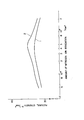
- the figure is a graphical representation of the results of the examples of this invention.
- This invention is applicable to conventionally known ceramics, typically oxide ceramics, such as aluminum oxide (Al 2 0 3 ) and zirconia (Zr0 2 ) and nonoxide ceramics, such as silicon nitride (Si 3 N 4 ) and silicon carbide (SiC).
- the invention is applicable to a product obtained by sintering the powder of any such ceramic material to a desired shape.
- the sintered product may contain a sintering assistant, such as yttrium oxide, and other additives.
- the sintered product may be produced by any method, such as atmospheric pressure sintering or hot pressing.
- the method of this invention includes the step of forming a metal film on the surface of the ceramic product.
- the film may be formed on the whole surface of the product, or only on a portion which is subjected to a substantially concentrated tensile stress when the product is used.
- the film may be formed from any metal.
- the metal film may be formed on the ceramic surface by physical vapor deposition (PVD), such as thermal deposition, sputtering or ionic plating, or by chemical vapor deposition (CVD). It is advisable to clean the ceramic surface by, for example, washing it with acetone before forming the film thereon.
- PVD physical vapor deposition
- CVD chemical vapor deposition
- a uniform film having a smaller thickness is difficult to form, while a film having a larger thickness requires a lot of time for its formation and the irradiation of ions having unduly high energy.
- the film is usually not strongly bonded to the ceramic material. Care should, therefore, be taken for its handling so that the film may not be scratched off from the ceramic material.
- Ions of high energy are, then, irradiated on the ceramic material through the film.
- Ions of any substance may be used if they can be accelerated easily in an electric field.
- Ions of a substance which is gaseous at ambient temperature are, however, preferred, as they are easy to irradiate.
- a plasma is formed from any of such gases and the resulting ions are released into an electrical field for acceleration.
- the acceleration of ions can be carried out by, for example, a Cockcroft-Walton, van de Graaff or linear accelerator or a cyclotron.
- the ions are preferably irradiated so as to reach approximately the boundary between the film and the ceramic material, or a point slightly inside of the ceramic material.
- Such irradiation can be achieved by ions having an energy of, say, 1 KeV to 3 MeV. It is appropriate to irradiate 1 x 10 14 to 1 x 10 18 ions per square centimeter. If more ions are irradiated, no correspondingly better result can be obtained, while the irradiation of less ions is ineffective.
- the irradiation of ions bonds the film to the ceramic material so strongly that it may not be peeled off even if it is scratched by a diamond stylus.
- the flexural strength tests were conducted by the application of a load which would cause the tensile stress on the film.
- the flexural strength was the tensile flexural stress calculated from the load which had caused the fracture of the ceramic material.
- the irradiation of ions increased the flexural strength of the ceramic material until the amount of the irradiated ions reached a certain level at which the flexural strength of the ceramic material showed a peak and began to decrease. The reason for this improvement in the ceramic strength is not clear, but the following assumption would probably be correct.
- the ions of high energy irradiated on the metal film force the metal into the ceramic material and a modified ceramic layer is formed which is composed of a mixture of ceramic material, metal and ions.
- This layer is considered to remove the defects in the ceramic material. Moreover, the modified layer is sometimes likely to develop a residual compressive stress due to an increase in volume. This residual stress is considered to enable the ceramic material to withstand a greater load when a tensile stress acts on its surface. These and other factors are believed to contribute to lowering the fracture sensitivity of the ceramic material.
- a further improvement of the strength of a ceramic material is achieved by the heat treatment of the material after the irradiation of high energy ions.
- This treatment may be carried out by an ordinary heating furnace. It is, however, necessary to employ in the furnace an atmosphere which does not cause the decomposition of the ceramic material. It is preferable to use a nitrogen or other inert gas atmosphere or a vacuum atmosphere for heating nonoxide ceramics, such as Si 3 N 4 or SiC. It is advisable to use a heating temperature which is lower than the melting point of the metal forming the film, and which is in the range of 600°C to 1600°C. Although the heating time may depend on the kinds of the ceramic material and the ions employed, it is advisable to use a period of 0.5 to five hours in order to obtain satisfactory results. The use of any longer heating time is not practical, since it is not expected to realize any further improvement in the strength of the ceramic material.
- the heat treatment enables a further improvement in the strength of ceramics over the results obtained from the first mentioned method. It also improves the bonding strength between the film and the ceramic material.
- Pieces having a width of 4 mm, a thickness of 3 mm and a length of 40 mm were formed from sintered A1 2 0 3 and their surfaces were polished by #600 emery paper to prepare testpieces for a flexural strength test according to JIS.
- nitrogen ions having an accelerated energy of 250 KeV were irradiated on one side of each testpiece.
- the ions were irradiated in six different doses, i.e.
- testpieces were likewise prepared, and heated at 1000°C for two hours in a nitrogen atmosphere to prepare ceramic samples according to the method further comprising a step of heat treating.
- each testpiece was supported over a span of 30 mm and subjected to a flexural strength test conducted by applying a load to its center and bending it at four points.
- the testpiece was supported in a position allowing its ion irradiated side to be stretched during the flexural strength test.
- the tensile flexural stress of each testpiece was obtained from the load which had caused its fracture as a result of its flexural strength test. This stress was employed to express the flexural strength of each testpiece.
- the ordinate shows the flexural strength and the abscissa indicates the amount or dose of irradiated ions.
- the results obtained from the testpiece not subjected to heat treating are shown by curve 1, and the results of the testpiece subjected to heat treating by curve 2.
- the flexural strength of the testpiece on which no ion was irradiated for comparison purposes is shown by a black dot. As is obvious from these results, the irradiation of ions improves the strength of sintered A1 2 0 3 and its heat treatment improves its strength to a further extent.
- Testpieces of the same size and shape as those employed in EXAMPLE 1 were formed from A1 2 0 3 , Zr0 2 , Si 3 N 4 and SiC, and metal films were formed thereon by sputtering from metals shown in TABLES 1 to 8.
- Argon ions were irradiated on some testpieces by a Cockcroft-Walton accelerator through the metal films, while nitrogen ions were irradiated on other testpieces.
- Some of the testpieces on which the ions had been irradiated were heat treated.
- the nitrogen and argon ions were accelerated by the application of a voltage enabling the ions to penetrate exactly through the thickness of the metal film.
- the ions were irradiated in the amount of 5 x 1 0 16 per square centimeter.
- the heat treatment of some of the testpieces was performed for two hours at a temperature of 1000°C, 1200°C or 1400°C in a nitrogen, argon, vacuum or atmospheric air atmosphere (but in a nitrogen or argon gas atmosphere for Si 3 N 4 and SiC).
- each testpiece was tested for flexural strength in accordance with the method employed in EXAMPLE 1.
- the results are shown in TABLES 1 to 8.
- TABLES 1 to 4 show the results obtained on the testpieces on which nitrogen ions were irradiated
- TABLES 5 to 8 show the results on the testpieces on which argon ions were irradiated.
- Each value of flexural strength is the average obtained from five testpieces.
- the tables also show the flexural strength of ceramic testpieces on which no metal film was formed for comparison.
Landscapes
- Chemical & Material Sciences (AREA)
- Engineering & Computer Science (AREA)
- Materials Engineering (AREA)
- Organic Chemistry (AREA)
- Ceramic Engineering (AREA)
- Mechanical Engineering (AREA)
- Metallurgy (AREA)
- Chemical Kinetics & Catalysis (AREA)
- Structural Engineering (AREA)
- Inorganic Chemistry (AREA)
- Physics & Mathematics (AREA)
- Thermal Sciences (AREA)
- General Chemical & Material Sciences (AREA)
- Rolling Contact Bearings (AREA)
- Physical Vapour Deposition (AREA)
- Ceramic Products (AREA)
Applications Claiming Priority (2)
| Application Number | Priority Date | Filing Date | Title |
|---|---|---|---|
| JP59031880A JPS60176981A (ja) | 1984-02-22 | 1984-02-22 | セラミツクスの強化方法 |
| JP31880/84 | 1984-02-22 |
Publications (3)
| Publication Number | Publication Date |
|---|---|
| EP0152951A2 true EP0152951A2 (de) | 1985-08-28 |
| EP0152951A3 EP0152951A3 (en) | 1986-12-30 |
| EP0152951B1 EP0152951B1 (de) | 1989-12-27 |
Family
ID=12343343
Family Applications (1)
| Application Number | Title | Priority Date | Filing Date |
|---|---|---|---|
| EP85101856A Expired EP0152951B1 (de) | 1984-02-22 | 1985-02-20 | Verfahren zum Verstärken von keramischen Körpern |
Country Status (4)
| Country | Link |
|---|---|
| US (1) | US4678678A (de) |
| EP (1) | EP0152951B1 (de) |
| JP (1) | JPS60176981A (de) |
| DE (1) | DE3574963D1 (de) |
Cited By (2)
| Publication number | Priority date | Publication date | Assignee | Title |
|---|---|---|---|---|
| DE3600677A1 (de) * | 1986-01-13 | 1987-07-16 | Rheinhuette Vorm Ludwig Beck G | Schichtkoerper, insbesondere aus siliziumcarbid und nickel |
| EP0245695A1 (de) * | 1986-05-15 | 1987-11-19 | Nukem GmbH | Verfahren zum Metallisieren keramischer Körper |
Families Citing this family (14)
| Publication number | Priority date | Publication date | Assignee | Title |
|---|---|---|---|---|
| JPS62141314A (ja) * | 1985-12-17 | 1987-06-24 | Agency Of Ind Science & Technol | 高温用セラミツク転がり軸受 |
| JPH0324890Y2 (de) * | 1985-12-28 | 1991-05-30 | ||
| JPS6314019U (de) * | 1986-07-14 | 1988-01-29 | ||
| US4824262A (en) * | 1986-09-27 | 1989-04-25 | Kabushiki Kaisha Toyota Chuo Kenkyusho | Unlubricated sliding member |
| EP0282285B1 (de) * | 1987-03-13 | 1990-11-14 | Kabushiki Kaisha Toshiba | Verfahren zur Metallisierung eines nitrid-keramischen Gegenstandes |
| JPH01163217U (de) * | 1988-05-09 | 1989-11-14 | ||
| US5164266A (en) * | 1989-10-24 | 1992-11-17 | Isuzu Ceramics Research Institute Co., Ltd. | Slidable ceramic member and method of manufacturing same |
| DE4141365A1 (de) * | 1991-12-14 | 1993-06-17 | Mathias Dr Herrmann | Siliziumnitridsinterkoerper mit modifizierter oberflaeche und verfahren zur herstellung dieser modifizierten oberflaeche |
| JPH0611277U (ja) * | 1992-01-13 | 1994-02-10 | 株式会社ワカ製作所 | ピンジャック |
| WO1995019884A1 (en) * | 1994-01-21 | 1995-07-27 | The Regents Of The Universtiy Of California | Surface treatment of ceramic articles |
| US5476691A (en) * | 1994-01-21 | 1995-12-19 | International Business Machines, Inc. | Surface treatment of magnetic recording heads |
| JP3124508B2 (ja) * | 1996-04-19 | 2001-01-15 | 韓国科学技術研究院 | 窒化物表面の改質方法及びその方法により表面改質された窒化物 |
| US5885665A (en) * | 1997-05-09 | 1999-03-23 | The United States Of America As Represented By The United States Department Of Energy | VO2 precipitates for self-protected optical surfaces |
| WO2006101989A1 (en) * | 2005-03-18 | 2006-09-28 | The Timken Company | Method of protecting rolling element bearings against oil-out conditions and bearing made thereby |
Family Cites Families (8)
| Publication number | Priority date | Publication date | Assignee | Title |
|---|---|---|---|---|
| JPS499583A (de) * | 1972-05-25 | 1974-01-28 | ||
| JPS50126168A (de) * | 1974-03-23 | 1975-10-03 | ||
| GB1598814A (en) * | 1978-05-15 | 1981-09-23 | Atomic Energy Authority Uk | Cemented carbide cutting tools |
| AU532935B2 (en) * | 1978-11-02 | 1983-10-20 | Ford Motor Co. | Vapour deposition of metals |
| GB2073254B (en) * | 1980-04-09 | 1984-05-23 | Atomic Energy Authority Uk | Ion implanting metal coated ferrous surfaces |
| US4532149A (en) * | 1981-10-21 | 1985-07-30 | The United States Of America As Represented By The United States Department Of Energy | Method for producing hard-surfaced tools and machine components |
| US4526624A (en) * | 1982-07-02 | 1985-07-02 | California Institute Of Technology | Enhanced adhesion of films to semiconductors or metals by high energy bombardment |
| US4526859A (en) * | 1983-12-12 | 1985-07-02 | International Business Machines Corporation | Metallization of a ceramic substrate |
-
1984
- 1984-02-22 JP JP59031880A patent/JPS60176981A/ja active Granted
-
1985
- 1985-01-25 US US06/694,759 patent/US4678678A/en not_active Expired - Fee Related
- 1985-02-20 DE DE8585101856T patent/DE3574963D1/de not_active Expired - Lifetime
- 1985-02-20 EP EP85101856A patent/EP0152951B1/de not_active Expired
Cited By (4)
| Publication number | Priority date | Publication date | Assignee | Title |
|---|---|---|---|---|
| DE3600677A1 (de) * | 1986-01-13 | 1987-07-16 | Rheinhuette Vorm Ludwig Beck G | Schichtkoerper, insbesondere aus siliziumcarbid und nickel |
| DE3600677C2 (de) * | 1986-01-13 | 1988-12-15 | Rheinhuette Vorm. Ludwig Beck Gmbh & Co, 6200 Wiesbaden, De | |
| EP0237704A3 (de) * | 1986-01-13 | 1989-09-06 | RHEINHÜTTE GmbH & Co. | Schichtkörper, insbesondere aus Siliziumcarbid und Nickel |
| EP0245695A1 (de) * | 1986-05-15 | 1987-11-19 | Nukem GmbH | Verfahren zum Metallisieren keramischer Körper |
Also Published As
| Publication number | Publication date |
|---|---|
| EP0152951B1 (de) | 1989-12-27 |
| EP0152951A3 (en) | 1986-12-30 |
| JPS60176981A (ja) | 1985-09-11 |
| JPS6357392B2 (de) | 1988-11-11 |
| US4678678A (en) | 1987-07-07 |
| DE3574963D1 (de) | 1990-02-01 |
Similar Documents
| Publication | Publication Date | Title |
|---|---|---|
| EP0152951B1 (de) | Verfahren zum Verstärken von keramischen Körpern | |
| Janney et al. | Diffusion-controlled processes in microwave-fired oxide ceramics | |
| Suga et al. | Structure of AlAl and AlSi3N4 interfaces bonded at room temperature by means of the surface activation method | |
| Wagner et al. | Effect of interfacial variables on metal‐porcelain bonding | |
| US4697325A (en) | Method for joining ceramic parts to metallic parts | |
| Virkar et al. | Fracture Behavior of ZrO2‐Zr Composites | |
| EP0160301B1 (de) | Verfahren zum Verbinden eines Keramikkörpers | |
| Hioki et al. | Effect of ion implantation on fracture stress of Al2O3 | |
| TWI801404B (zh) | 陶瓷粉末之粒子表面處理方法及由該方法得到之陶瓷粉末粒子 | |
| US4673587A (en) | Method of producing a composite ceramic body | |
| US4702869A (en) | Process for the production of ceramics | |
| JP2009067659A (ja) | 表面硬化高強度セラミックス及びその製造方法 | |
| US4774103A (en) | Method of reinforcing a ceramic body of silicon carbide | |
| Oblas et al. | Topographic/structure changes of implanted Si3N4 | |
| Noda et al. | Metal-ceramic surface composites formed by a high energy ion irradiation and their mechanical properties | |
| Rincon et al. | Microstructure of mullite/ZrO2 and mullite/Al2O3/ZrO2 tough ceramic composites | |
| Milić et al. | The influence of the physicochemical characteristics of the substrate surface on the deposited TiN film properties | |
| US6110855A (en) | Process for strengthening aluminum based ceramics and material | |
| Halitim et al. | The effect of copper implantation on the mechanical, structural properties and residual stress of polycrystalline alumina | |
| Iwamoto et al. | Joining between zirconias using platinum metal | |
| Teresov et al. | Surface Modification of Metal Products Fabricated by Additive Manufacturing by Electron Beam Excited Plasma Processing | |
| Shaw et al. | Bridging Processes in Metal-Reinforced Ceramics | |
| JPH0380172A (ja) | 被覆炭素繊維強化複合材料 | |
| JPS60239378A (ja) | セラミツクスの強化方法 | |
| JPH0547510B2 (de) |
Legal Events
| Date | Code | Title | Description |
|---|---|---|---|
| PUAI | Public reference made under article 153(3) epc to a published international application that has entered the european phase |
Free format text: ORIGINAL CODE: 0009012 |
|
| AK | Designated contracting states |
Designated state(s): DE GB |
|
| PUAL | Search report despatched |
Free format text: ORIGINAL CODE: 0009013 |
|
| AK | Designated contracting states |
Kind code of ref document: A3 Designated state(s): DE GB |
|
| 17P | Request for examination filed |
Effective date: 19870428 |
|
| 17Q | First examination report despatched |
Effective date: 19880224 |
|
| GRAA | (expected) grant |
Free format text: ORIGINAL CODE: 0009210 |
|
| AK | Designated contracting states |
Kind code of ref document: B1 Designated state(s): DE GB |
|
| REF | Corresponds to: |
Ref document number: 3574963 Country of ref document: DE Date of ref document: 19900201 |
|
| PGFP | Annual fee paid to national office [announced via postgrant information from national office to epo] |
Ref country code: DE Payment date: 19900330 Year of fee payment: 6 |
|
| PLBE | No opposition filed within time limit |
Free format text: ORIGINAL CODE: 0009261 |
|
| PLBI | Opposition filed |
Free format text: ORIGINAL CODE: 0009260 |
|
| 26N | No opposition filed | ||
| 26 | Opposition filed |
Opponent name: ROLLS-ROYCE PLC Effective date: 19900926 |
|
| PGFP | Annual fee paid to national office [announced via postgrant information from national office to epo] |
Ref country code: GB Payment date: 19910212 Year of fee payment: 7 |
|
| REG | Reference to a national code |
Ref country code: GB Ref legal event code: 746 |
|
| RDAG | Patent revoked |
Free format text: ORIGINAL CODE: 0009271 |
|
| STAA | Information on the status of an ep patent application or granted ep patent |
Free format text: STATUS: PATENT REVOKED |
|
| 27W | Patent revoked |
Effective date: 19910330 |
|
| GBPR | Gb: patent revoked under art. 102 of the ep convention designating the uk as contracting state |