EP0152962A2 - Herstellung von Sauerstoff mittels geschmolzener Alkalimetallsalze unter Anwendung von mehreren Absorptions-Desorptions-Cyclen - Google Patents
Herstellung von Sauerstoff mittels geschmolzener Alkalimetallsalze unter Anwendung von mehreren Absorptions-Desorptions-Cyclen Download PDFInfo
- Publication number
- EP0152962A2 EP0152962A2 EP85101989A EP85101989A EP0152962A2 EP 0152962 A2 EP0152962 A2 EP 0152962A2 EP 85101989 A EP85101989 A EP 85101989A EP 85101989 A EP85101989 A EP 85101989A EP 0152962 A2 EP0152962 A2 EP 0152962A2
- Authority
- EP
- European Patent Office
- Prior art keywords
- oxygen
- zone
- desorption
- absorption
- acceptor
- Prior art date
- Legal status (The legal status is an assumption and is not a legal conclusion. Google has not performed a legal analysis and makes no representation as to the accuracy of the status listed.)
- Granted
Links
- 239000001301 oxygen Substances 0.000 title claims abstract description 177
- 229910052760 oxygen Inorganic materials 0.000 title claims abstract description 177
- QVGXLLKOCUKJST-UHFFFAOYSA-N atomic oxygen Chemical compound [O] QVGXLLKOCUKJST-UHFFFAOYSA-N 0.000 title claims abstract description 175
- 238000003795 desorption Methods 0.000 title claims abstract description 56
- 229910052783 alkali metal Inorganic materials 0.000 title claims abstract description 15
- -1 alkali metal salts Chemical class 0.000 title claims description 12
- 238000004519 manufacturing process Methods 0.000 title description 2
- 238000010521 absorption reaction Methods 0.000 claims abstract description 57
- 238000000926 separation method Methods 0.000 claims abstract description 20
- 238000011084 recovery Methods 0.000 claims abstract description 15
- 238000000034 method Methods 0.000 claims description 34
- 230000008569 process Effects 0.000 claims description 30
- IJGRMHOSHXDMSA-UHFFFAOYSA-N Atomic nitrogen Chemical compound N#N IJGRMHOSHXDMSA-UHFFFAOYSA-N 0.000 claims description 24
- 239000000203 mixture Substances 0.000 claims description 12
- 229910052757 nitrogen Inorganic materials 0.000 claims description 12
- 230000009467 reduction Effects 0.000 claims description 6
- 229910002651 NO3 Inorganic materials 0.000 claims description 5
- NHNBFGGVMKEFGY-UHFFFAOYSA-N Nitrate Chemical compound [O-][N+]([O-])=O NHNBFGGVMKEFGY-UHFFFAOYSA-N 0.000 claims description 5
- IOVCWXUNBOPUCH-UHFFFAOYSA-M Nitrite anion Chemical compound [O-]N=O IOVCWXUNBOPUCH-UHFFFAOYSA-M 0.000 claims description 4
- DGAQECJNVWCQMB-PUAWFVPOSA-M Ilexoside XXIX Chemical compound C[C@@H]1CC[C@@]2(CC[C@@]3(C(=CC[C@H]4[C@]3(CC[C@@H]5[C@@]4(CC[C@@H](C5(C)C)OS(=O)(=O)[O-])C)C)[C@@H]2[C@]1(C)O)C)C(=O)O[C@H]6[C@@H]([C@H]([C@@H]([C@H](O6)CO)O)O)O.[Na+] DGAQECJNVWCQMB-PUAWFVPOSA-M 0.000 claims description 3
- ZLMJMSJWJFRBEC-UHFFFAOYSA-N Potassium Chemical compound [K] ZLMJMSJWJFRBEC-UHFFFAOYSA-N 0.000 claims description 3
- OUUQCZGPVNCOIJ-UHFFFAOYSA-M Superoxide Chemical class [O-][O] OUUQCZGPVNCOIJ-UHFFFAOYSA-M 0.000 claims description 3
- 238000001311 chemical methods and process Methods 0.000 claims description 3
- 150000002978 peroxides Chemical class 0.000 claims description 3
- 229910052700 potassium Inorganic materials 0.000 claims description 3
- 239000011591 potassium Substances 0.000 claims description 3
- 230000008929 regeneration Effects 0.000 claims description 3
- 238000011069 regeneration method Methods 0.000 claims description 3
- 229910052708 sodium Inorganic materials 0.000 claims description 3
- 239000011734 sodium Substances 0.000 claims description 3
- MYMOFIZGZYHOMD-UHFFFAOYSA-N Dioxygen Chemical compound O=O MYMOFIZGZYHOMD-UHFFFAOYSA-N 0.000 claims description 2
- 229910001963 alkali metal nitrate Inorganic materials 0.000 claims description 2
- 150000001768 cations Chemical class 0.000 claims description 2
- 150000001450 anions Chemical class 0.000 claims 1
- 239000000126 substance Substances 0.000 abstract description 13
- 150000001340 alkali metals Chemical class 0.000 abstract description 4
- 150000003839 salts Chemical class 0.000 abstract description 2
- 239000000370 acceptor Substances 0.000 description 65
- 239000006096 absorbing agent Substances 0.000 description 11
- 239000000047 product Substances 0.000 description 11
- 239000007789 gas Substances 0.000 description 9
- 239000011833 salt mixture Substances 0.000 description 7
- 238000000354 decomposition reaction Methods 0.000 description 5
- 238000007254 oxidation reaction Methods 0.000 description 5
- 230000008901 benefit Effects 0.000 description 4
- 238000006243 chemical reaction Methods 0.000 description 4
- 230000003647 oxidation Effects 0.000 description 4
- 230000002441 reversible effect Effects 0.000 description 3
- 239000000470 constituent Substances 0.000 description 2
- AMWRITDGCCNYAT-UHFFFAOYSA-L hydroxy(oxo)manganese;manganese Chemical compound [Mn].O[Mn]=O.O[Mn]=O AMWRITDGCCNYAT-UHFFFAOYSA-L 0.000 description 2
- 230000003993 interaction Effects 0.000 description 2
- 239000007788 liquid Substances 0.000 description 2
- 238000012986 modification Methods 0.000 description 2
- 230000004048 modification Effects 0.000 description 2
- 150000002823 nitrates Chemical class 0.000 description 2
- 150000002926 oxygen Chemical class 0.000 description 2
- 239000002516 radical scavenger Substances 0.000 description 2
- 239000000243 solution Substances 0.000 description 2
- 238000001179 sorption measurement Methods 0.000 description 2
- 239000003513 alkali Substances 0.000 description 1
- 239000006227 byproduct Substances 0.000 description 1
- 239000013043 chemical agent Substances 0.000 description 1
- 230000006835 compression Effects 0.000 description 1
- 238000007906 compression Methods 0.000 description 1
- 230000001419 dependent effect Effects 0.000 description 1
- 230000003292 diminished effect Effects 0.000 description 1
- 229910001882 dioxygen Inorganic materials 0.000 description 1
- 239000000446 fuel Substances 0.000 description 1
- 230000006872 improvement Effects 0.000 description 1
- 239000012535 impurity Substances 0.000 description 1
- 238000012423 maintenance Methods 0.000 description 1
- 239000000463 material Substances 0.000 description 1
- 150000002826 nitrites Chemical class 0.000 description 1
- 230000001172 regenerating effect Effects 0.000 description 1
- 239000012266 salt solution Substances 0.000 description 1
Images

Classifications
-
- C—CHEMISTRY; METALLURGY
- C01—INORGANIC CHEMISTRY
- C01B—NON-METALLIC ELEMENTS; COMPOUNDS THEREOF; METALLOIDS OR COMPOUNDS THEREOF NOT COVERED BY SUBCLASS C01C
- C01B13/00—Oxygen; Ozone; Oxides or hydroxides in general
- C01B13/02—Preparation of oxygen
-
- B—PERFORMING OPERATIONS; TRANSPORTING
- B01—PHYSICAL OR CHEMICAL PROCESSES OR APPARATUS IN GENERAL
- B01D—SEPARATION
- B01D53/00—Separation of gases or vapours; Recovering vapours of volatile solvents from gases; Chemical or biological purification of waste gases, e.g. engine exhaust gases, smoke, fumes, flue gases, aerosols
- B01D53/14—Separation of gases or vapours; Recovering vapours of volatile solvents from gases; Chemical or biological purification of waste gases, e.g. engine exhaust gases, smoke, fumes, flue gases, aerosols by absorption
- B01D53/1493—Selection of liquid materials for use as absorbents
-
- B—PERFORMING OPERATIONS; TRANSPORTING
- B01—PHYSICAL OR CHEMICAL PROCESSES OR APPARATUS IN GENERAL
- B01D—SEPARATION
- B01D53/00—Separation of gases or vapours; Recovering vapours of volatile solvents from gases; Chemical or biological purification of waste gases, e.g. engine exhaust gases, smoke, fumes, flue gases, aerosols
- B01D53/14—Separation of gases or vapours; Recovering vapours of volatile solvents from gases; Chemical or biological purification of waste gases, e.g. engine exhaust gases, smoke, fumes, flue gases, aerosols by absorption
-
- B—PERFORMING OPERATIONS; TRANSPORTING
- B01—PHYSICAL OR CHEMICAL PROCESSES OR APPARATUS IN GENERAL
- B01D—SEPARATION
- B01D53/00—Separation of gases or vapours; Recovering vapours of volatile solvents from gases; Chemical or biological purification of waste gases, e.g. engine exhaust gases, smoke, fumes, flue gases, aerosols
- B01D53/14—Separation of gases or vapours; Recovering vapours of volatile solvents from gases; Chemical or biological purification of waste gases, e.g. engine exhaust gases, smoke, fumes, flue gases, aerosols by absorption
- B01D53/1406—Multiple stage absorption
-
- C—CHEMISTRY; METALLURGY
- C01—INORGANIC CHEMISTRY
- C01B—NON-METALLIC ELEMENTS; COMPOUNDS THEREOF; METALLOIDS OR COMPOUNDS THEREOF NOT COVERED BY SUBCLASS C01C
- C01B13/00—Oxygen; Ozone; Oxides or hydroxides in general
- C01B13/02—Preparation of oxygen
- C01B13/0292—Preparation from air using a molten phase containing alkali metal nitrite, optionally together with other oxygen acceptors
Definitions
- the present invention is directed to the separation of air in a chemical process using an oxygen acceptor to absorb oxygen by oxidation and to recover the oxygen by desorption under reduced pressure. More particularly, the present invention 1s directed to the production of oxygen from air in a series of chemical oxygen absorption stages using an alkali metal nitrite and nitrate mixture wherein desorption occurs separately for each stage of absorption in a reduced pressure desorption zone.
- adsorption and cryogenic techniques have been successful in recovering large percentages of the constituents of air, namely; nitrogen and oxygen.
- adsorption and cryogenic techniques are highly energy intensive because of the requirements of high pressure and extremely low temperature, respectively.
- a process is set forth for the recovery of nitrogen and oxygen separately from air.
- the process utilizes a first absorption and desorption cycle in which oxygen oxidizes a molten alkali metal salt mixture, and the salt mixture is subsequently depressurized to drive off the recovered oxygen.
- the effluent from the absorption zone which contains residual oxygen, is then passed to a second absorption zone in which residual oxygen is removed by contact with a scavenger, such as manganese oxide.
- the effluent from this absorption zone constitutes a commercially pure nitrogen product.
- the oxidized scavenger is reduced by contact with a reducing gas which produces an exhaust effluent containing residual oxygen and reducing gas in a mixture as a by-product of impure composition.
- U.S. Patent 4,340,578 discloses another process for the separation of air into oxygen and an oxygen-depleted stream, wherein air is compressed, heated and contacted with an alkali metal salt mixture to oxidize the salt-mixture and produce an oxygen-depleted effluent stream.
- the oxidized salt mixture is then depressurized in a desorption zone to recover an oxygen product.
- the regenerated salt mixture is recycled to the absorber or contact zone.
- the effluent from the absorption zone, which constitutes oxygen-depleted gas is then combusted with fuel and expanded and heat exchanged against process streams in order to provide the necessary heat for the reactions and the necessary power for the compression of feed air and product oxygen.
- the patent indicates that multiple stages of absorption and desorption are contemplated, but the exact flowscheme for such stages of absorption and desorption are not set forth.
- the present invention provides an improved process for the recovery of oxygen from air using the molten alkali metal salt mixtures of the above prior art, wherein a greater recovery of high pressure oxygen is achieved from that of the prior art utilizing a unique system of parallel desorption which achieves an improved energy efficiency at lower capital cost as set forth below.
- the present invention is directed to a process for the continuous chemical separation of air into oxygen and nitrogen in which pressurized air is contacted in an absorption zone with an oxygen acceptor which becomes oxidized, the oxidized oxygen acceptor is separately decomposed by pressure reduction in a desorption zone to yield oxygen and regenerated oxygen acceptor and the regenerated oxygen acceptor is recycled to the absorption zone, the Invention characterized in that pressurized air is separated using the oxygen acceptor in a plurality of staged absorption zones in which each zone is connected to a separate desorption zone for the recovery of oxygen and the regeneration of oxygen acceptor.
- the separation can be performed in two stages of absorption with attendant separate desorption zones.
- the first absorption zone may include two attendant desorption stages connected in series in order to recover relatively high pressure oxygen and relatively intermediate pressure oxygen in that discrete desorption zone.
- An advantage of the present process is the recovery of a commercially pure nitrogen product as an effluent stream from the absorption zone of the process.
- the oxygen acceptor comprises a molten solution of alkali metal nitrite and alkali metal nitrate.
- the separation is performed in three absorption zones connected in series, with each absorption zone having an attendant separate desorption zone which operates in parallel with each other desorption zone.
- the chemical separation process recovers oxygen at a high pressure of approximately 15 psia which constitutes approximately 25% of the air treated, an intermediate pressure at approximately 6 psia constituting approximately 52% of the air treated and a low pressure of approximately 2.5 psia which constitutes approximately 13% of the air treated.
- the present invention constitutes an improvement over the prior art related to the chemical separation of air using molten alkali metal salts.
- This prior art is represented by the above cited U.S. Patents 4,132,766, 4,287,170 and 4,340,578, all of which are hereby incorporated by reference into the description of the present invention.
- the present invention utilizes multiple absorption-desorption cycles in which air is contacted with an oxygen acceptor and the oxygen acceptor, in an oxidized condition, is regenerated by pressure reduction.
- the effluent oxygen-depleted stream from each zone of absorption is then directed to the subsequent zone of absorption in order to recover a greater percentage of the oxygen contained in a given quantity of feed air.
- the oxygen acceptor comprised of molten alkali nitrates and nitrites, is contacted with a free oxygen containing gas mixture such as air, under conditions such that it undergoes reaction with part of the free oxygen, yielding a condensed phase oxidized oxygen acceptor.
- a free oxygen containing gas mixture such as air
- the condensed phase material is readily separated from the exhausting oxygen depleted gas, and then is caused to release its oxygen in relatively pure form by a decomposition reaction.
- the decomposition reaction is caused to occur by reducing the pressure and/or supplying heat, and may be aided by also supplying a stripping gas.
- the oxidized oxygen acceptor reverts to oxygen acceptor, and the evolved gas, enriched in oxygen content, is collected. Then the cycle is repeated.
- the prior art discloses both batch and continuous processing modes for chemical air separation, and both modes are applicable to this newly disclosed process. Particularly high energy efficiencies are achieved when the respective oxidation and decomposition reactions are conducted in heat exchange relationship with one another, whereby the exothermic heat from the oxidation reaction supplies the bulk of the heat requirement of the endothermic decomposition reaction.
- the oxygen acceptor constitutes a composition which is liquid and remains liquid when reacted with air at process conditions, and which does not introduce undesirable impurities in the product oxygen.
- the invention consists of a process which takes advantage of the unique characteristics of the oxygen acceptor, thereby substantially reducing the amount of energy necessary to produce oxygen.
- the oxygen acceptor is a molten mixture of alkali metal salts.
- the salt anion composition includes 50 to 94% nitrate, 4 to 25% nitrite, and 0.5 to 25% combined peroxides and superoxides, where % signifies molar percent.
- the cation composition includes sodium and potassium in any proportions, preferably between 30% and 70% sodium, balance potassium.
- the result of the increased recovery of oxygen at the higher pressures of the various desorption zones is that lower mechanical energy is required for recompression of the oxygen product to a desired level and lower capital costs are incurred for the mechanical equipment involved in the process.
- Any number of absorption-desorption cycles are theoretically possible, although the preferred embodiment comprises three absorption zones in series with three desorption zones connected in parallel to the respective absorption zones.
- servicing any serial absorption zone may be a desorption zone having a series of desorption stages which should be arranged in parallel with respect to the remaining desorption zones.
- Absorber pressures ranging from 20 to 6 00 psia are contemplated and desorber pressures ranging from 2 to 100 psia are contemplated.
- the process of the present invention is performed wherein a pressurized and cleaned air feed stream in line 10 is introduced into a multistage absorber 12 with three separate absorption zones 14, 16 and 18, In each zone, the air is passed countercurrently to a molten salt solution of an oxygen acceptor, preferably an alkali metal salt of a nitrite and nitrate mixture.
- An oxygen-depleted effluent stream is removed from the absorber 12 in line 20.
- this effluent stream would be commercially pure nitrogen.
- the initial air feed passing through absorption zone 14 is contacted with fresh or regenerated oxygen acceptor.
- the oxygen acceptor is oxidized in the course of removing oxygen from the air stream.
- the partially oxygen-depleted stream then passes to the subsequent absorption zone 16.
- the oxidized oxygen acceptor is removed in line 22 and reduced in pressure rapidly through valve 24 before being introduced into a desorption zone constituting desorber vessel 26. Under the reduced pressure, the oxygen is released from the oxygen acceptor and exits the vessel 26 in overhead line 28.
- the reduced oxygen acceptor in its regenerated condition is removed in line 30 and returned at elevated pressure to the absorber 12 by means of pump 32 and line 34.
- the Initially oxygen-depleted air stream, still containing residual oxygen, is then contacted with a second quantity of oxygen acceptor in the intermediate zone 16 of the absorber 12. Additional oxygen is removed from the air stream and the fresh or regenerated oxygen acceptor is oxidized by this removal step. Further oxygen-depleted air is then passed to the subsequent zone 18 of the absorber 12.
- the oxidized oxygen acceptor of zone 16 is removed in line 36 and is reduced in pressure rapidly through valve 38.
- the oxygen acceptor is introduced into a desorption zone comprising a desorber vessel 40 wherein the bound oxygen is removed under the conditions of reduced pressure and exits the vessel 40 in overhead line 42.
- this oxygen would be recovered at 6 psia, for a 100 psia feed, and would constitute 52% of the oxygen in the air treated.
- the reduced oxygen acceptor in its regenerated form is removed as a bottom stream from vessel 40 in line 44 and is recycled and returned at elevated pressure through pump 46 and line 48 to the intermediate zone 16 of the absorber 12 of the multistage absorption zone of the process.
- the further oxygen-depleted air stream then contacts additional fresh and regenerated oxygen acceptor in the third and last absorption zone 18 wherein the air stream is further depleted of oxygen by the oxidation of the oxygen acceptor in a countercurrent flow of these two components.
- a commercially pure nitrogen is preferably removed from this final zone 18 of the absorber 12 and is recovered as product in line 20.
- the oxidized oxygen acceptor is removed in line 50 and reduced in pressure rapidly through valve 52 before being introduced into the third desorption zone constituting a desorber vessel 54. Under the conditions of reduced pressure, the bound oxygen is released from the oxygen acceptor and is recovered as an overhead stream in line 56.
- this oxygen is recovered at 2 psia, for a feed stream delivered at 100 psia, and constitutes 13% of the oxygen in the air being treated by the overall system.
- the reduced oxygen acceptor in its regenerated form is then returned to the absorption zone at its original elevated pressure by pump 60 and line 62.
- each absorption-desorption cycle is performed with the same type of oxygen acceptor comprising a molten mixture of alkali metal salts of nitrite and nitrate along with a minor amount of peroxides and superoxides, it is contemplated that each separate absorption-desorption cycle could constitute an individual and distinct oxygen acceptor solution which is custom blended for the recovery of oxygen at the particular concentration and pressure of each of the stages of the absorption zone.
- each serial absorption zone has its own separate and distinct desorption zone.
- the oxygen acceptor regenerated in one desorption zone is not communicated with any other desorption zone.
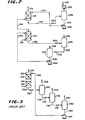
- FIG. 2 An alternate embodiment from the preferred embodiment of FI6 1 is shown in FI6 2.
- an absorption-desorption process for the chemical separation of air is shown wherein distinct absorption zones 212 and 216 are utilized and the parallel desorption zones may include within each cycle a serial arrangement of desorption stages such as 226 and 234.
- the process would operate in a similar manner to the preferred embodiment, wherein air is introduced at elevated pressure in line 210 into an absorption zone 212 comprising an absorber vessel.
- a molten alkali metal salt comprising an oxygen acceptor is introduced in line 220 and contacts the air countercurrently in order to become oxidized and separate the oxygen content of the air stream from the nitrogen and residual constituents.
- the oxygen-depleted effluent is then removed in line 214 for introduction Into the second absorption zone 216.
- the oxidized oxygen acceptor from absorption zone 212 is removed in line 222 and reduced in pressure rapidly through valve 224.
- the oxidized oxygen acceptor is partially regenerated in the desorption zone first stage 226 comprising a desorber vessel wherein bound oxygen is removed at the reduced pressure as a gas phase in overhead line 228.
- the partially regenerated oxygen acceptor is removed as a bottom stream in line 230 and reduced in pressure rapidly to yet a lower pressure level through valve 232 before being introduced into a second serial desorption stage 234 comprising a desorber vessel.
- the partially regenerated oxygen acceptor at the further reduced pressure is fully regenerated by removal of the residual bound oxygen as a gas phase in line 236 at an intermediate pressure.
- the fully regenerated oxygen acceptor is removed as a bottom stream in line.238 and pumped to its initial elevated pressure and returned to the absorption zone 212 by way of pump 240 in line 220.
- the partially oxygen-depleted feed air stream in line 214 is then contacted a second time with a second stream of oxygen acceptor introduced into the absorption zone 216 in line 242.
- the oxygen acceptor contacts the oxygen-depleted air stream countercurrently in the absorption stage and a further oxygen-depleted effluent stream is removed in line 218, which preferably constitutes commercially pure nitrogen.
- the oxidized oxygen acceptor is removed as a bottom stream in line 244 and is reduced in pressure rapidly through valve 246.
- the low pressure oxidized oxygen acceptor is introduced into the desorption zone 248 comprising a further desorber vessel.
- the bound oxygen associated with the oxygen acceptor is released and recovered as an oxygen gas phase in stream 252 wherein the low pressure oxygen may be increased in pressure by a blower compressor 250 to the pressure of the high pressure oxygen recovered in line 228.
- the regenerated oxygen acceptor is removed in line 254 and returned at its initial pressure by pump 256 and line 242.
- This alternate embodiment provides some of the advantage of the parallel arrangement of desorption zones with serial absorption zones. However it constitutes a hybrid of the preferred embodiment in FI6 1 in that the first absorption-desorption cycle of FIG 2 has a serial arrangement of desorption stages in its desorption zone wherein pressure maintenance of the oxygen product is not maintained as high as could be in the preferred embodiment.
- FIG 3 a single absorption vessel 312 is comprised of serial arrangement of absorption zones 314 and 316 although any number of zones have been taught. Air is introduced in line 310 and the oxygen-depleted effluent is removed in line 318. The oxygen acceptor is introduced in line 348 and the oxidized oxygen acceptor is removed in line 320 and reduced in pressure in a valve 322 before being regenerated at several pressure levels in three desorption zones comprising vessels 324, 332 and 340.
- an oxygen product is recovered in line 326, while the partially regenerated oxygen acceptor is removed in line 328 and reduced in pressure in line 330.
- additional oxygen is removed in line 334, while the further regenerated oxygen acceptor is removed in line 336 and reduced in pressure yet again in valve 338.
- the low pressure oxygen acceptor is completely regenerated in vessel 340 wherein a low pressure oxygen is removed in line 342, while the fully regenerated oxygen acceptor in line 344 is pumped to pressure in pump 346 and returned in line 348.
Landscapes
- Chemical & Material Sciences (AREA)
- Engineering & Computer Science (AREA)
- Analytical Chemistry (AREA)
- General Chemical & Material Sciences (AREA)
- Oil, Petroleum & Natural Gas (AREA)
- Chemical Kinetics & Catalysis (AREA)
- Organic Chemistry (AREA)
- Inorganic Chemistry (AREA)
- Oxygen, Ozone, And Oxides In General (AREA)
- Gas Separation By Absorption (AREA)
- Separation By Low-Temperature Treatments (AREA)
- Separation Of Gases By Adsorption (AREA)
Applications Claiming Priority (2)
| Application Number | Priority Date | Filing Date | Title |
|---|---|---|---|
| US06/583,090 US4526775A (en) | 1984-02-23 | 1984-02-23 | Oxygen production by molten alkali metal salts using multiple absorption-desorption cycles |
| US583090 | 1984-02-23 |
Publications (3)
| Publication Number | Publication Date |
|---|---|
| EP0152962A2 true EP0152962A2 (de) | 1985-08-28 |
| EP0152962A3 EP0152962A3 (en) | 1989-04-19 |
| EP0152962B1 EP0152962B1 (de) | 1992-04-08 |
Family
ID=24331642
Family Applications (1)
| Application Number | Title | Priority Date | Filing Date |
|---|---|---|---|
| EP85101989A Expired - Lifetime EP0152962B1 (de) | 1984-02-23 | 1985-02-22 | Herstellung von Sauerstoff mittels geschmolzener Alkalimetallsalze unter Anwendung von mehreren Absorptions-Desorptions-Cyclen |
Country Status (8)
| Country | Link |
|---|---|
| US (1) | US4526775A (de) |
| EP (1) | EP0152962B1 (de) |
| JP (1) | JPS60195006A (de) |
| KR (1) | KR870001733B1 (de) |
| AU (1) | AU555830B2 (de) |
| CA (1) | CA1224016A (de) |
| DE (1) | DE3585798D1 (de) |
| ZA (1) | ZA851327B (de) |
Cited By (2)
| Publication number | Priority date | Publication date | Assignee | Title |
|---|---|---|---|---|
| EP0175306A3 (en) * | 1984-09-14 | 1988-01-27 | Air Products And Chemicals, Inc. | Air separation with temperature and pressure swing |
| CN104030251A (zh) * | 2013-08-22 | 2014-09-10 | 张文昊 | 一种便携制氧装置 |
Families Citing this family (14)
| Publication number | Priority date | Publication date | Assignee | Title |
|---|---|---|---|---|
| US4761164A (en) * | 1985-03-01 | 1988-08-02 | Air Products And Chemicals, Inc. | Method for gas separation |
| US4708860A (en) * | 1986-12-29 | 1987-11-24 | Air Products And Chemicals, Inc. | Split-flow regeneration in absorptive air separation |
| US4859296A (en) * | 1987-09-01 | 1989-08-22 | Institute Of Gas Technology | Electrochemical separation of oxygen |
| US4908113A (en) * | 1987-09-01 | 1990-03-13 | Institute Of Gas Technology | Apparatus for the electrochemical separation of oxygen |
| US4738760A (en) * | 1987-09-01 | 1988-04-19 | Institute Of Gas Technology | Electrochemical separation of oxygen |
| US4988488A (en) * | 1989-10-19 | 1991-01-29 | Air Products And Chemicals, Inc. | Iron aluminides and nickel aluminides as materials for chemical air separation |
| US4944934A (en) * | 1990-01-03 | 1990-07-31 | Air Products And Chemicals, Inc. | High temperature oxygen recovery with reversible chemical reaction |
| US5186793A (en) * | 1990-12-31 | 1993-02-16 | Invacare Corporation | Oxygen concentrator utilizing electrochemical cell |
| US5169506A (en) * | 1990-12-31 | 1992-12-08 | Invacare Corporation | Oxygen concentration system utilizing pressurized air |
| KR100698169B1 (ko) * | 2000-11-16 | 2007-03-22 | 엘지전자 주식회사 | 산소발생기의 제어방법 |
| AT412842B (de) * | 2003-07-24 | 2005-08-25 | Gheczy Rudolf Von | Verfahren zum betrieb einer verbrennungsanlage |
| US7261959B2 (en) * | 2004-12-28 | 2007-08-28 | Walter Juda | Methods of generating oxygen from air via an alkali superoxide |
| US20130251622A1 (en) | 2011-12-19 | 2013-09-26 | Phillips 66 Company | Enhanced oxygen generation from molten salt |
| CN111659229B (zh) * | 2020-06-30 | 2020-12-08 | 浙江勤策空分设备有限公司 | 一种变压吸附氧气设备 |
Family Cites Families (6)
| Publication number | Priority date | Publication date | Assignee | Title |
|---|---|---|---|---|
| US1120436A (en) * | 1913-09-30 | 1914-12-08 | Ludwig Bergfeld | Separation of oxygen from the air. |
| US2418402A (en) * | 1944-08-07 | 1947-04-01 | Socony Vacuum Oil Co Inc | Manufacture of oxygen |
| US4132766A (en) * | 1977-05-24 | 1979-01-02 | Erickson Donald C | Separation of oxygen from gaseous mixtures with molten alkali metal salts |
| US4340578A (en) * | 1977-05-24 | 1982-07-20 | Erickson Donald C | Oxygen production by molten alkali metal salts |
| DE2823211A1 (de) * | 1978-05-27 | 1979-12-06 | Bayer Antwerpen Nv | Verfahren zum betrieb einer druck- wechsel-adsorptionsanlage |
| US4287170A (en) * | 1980-03-06 | 1981-09-01 | Erickson Donald C | Nitrogen and oxygen via chemical air separation |
-
1984
- 1984-02-23 US US06/583,090 patent/US4526775A/en not_active Expired - Lifetime
- 1984-12-13 CA CA000470023A patent/CA1224016A/en not_active Expired
-
1985
- 1985-02-19 AU AU38964/85A patent/AU555830B2/en not_active Ceased
- 1985-02-21 JP JP60033607A patent/JPS60195006A/ja active Granted
- 1985-02-21 ZA ZA851327A patent/ZA851327B/xx unknown
- 1985-02-22 DE DE8585101989T patent/DE3585798D1/de not_active Expired - Lifetime
- 1985-02-22 EP EP85101989A patent/EP0152962B1/de not_active Expired - Lifetime
- 1985-02-23 KR KR1019850001148A patent/KR870001733B1/ko not_active Expired
Cited By (2)
| Publication number | Priority date | Publication date | Assignee | Title |
|---|---|---|---|---|
| EP0175306A3 (en) * | 1984-09-14 | 1988-01-27 | Air Products And Chemicals, Inc. | Air separation with temperature and pressure swing |
| CN104030251A (zh) * | 2013-08-22 | 2014-09-10 | 张文昊 | 一种便携制氧装置 |
Also Published As
| Publication number | Publication date |
|---|---|
| KR870001733B1 (ko) | 1987-09-26 |
| ZA851327B (en) | 1986-10-29 |
| KR850006538A (ko) | 1985-10-14 |
| AU3896485A (en) | 1985-08-29 |
| JPH0154281B2 (de) | 1989-11-17 |
| CA1224016A (en) | 1987-07-14 |
| EP0152962A3 (en) | 1989-04-19 |
| DE3585798D1 (de) | 1992-05-14 |
| US4526775A (en) | 1985-07-02 |
| AU555830B2 (en) | 1986-10-09 |
| JPS60195006A (ja) | 1985-10-03 |
| EP0152962B1 (de) | 1992-04-08 |
Similar Documents
| Publication | Publication Date | Title |
|---|---|---|
| US4526775A (en) | Oxygen production by molten alkali metal salts using multiple absorption-desorption cycles | |
| US4287170A (en) | Nitrogen and oxygen via chemical air separation | |
| EP0302658B1 (de) | Verfahren zur Herstellung von hochreinem Sauerstoffgas aus Luft | |
| EP0307843B1 (de) | Herstellung von Wasserstoff und Kohlenmonoxid | |
| US4702898A (en) | Process for the removal of acid gases from gas mixtures | |
| KR870000758B1 (ko) | 아르곤 분리방법 | |
| EP0349655B1 (de) | Verfahren zur trennung und wiedergewinnung von karbonsäuregas aus einem gasgemisch durch absorption | |
| US4132766A (en) | Separation of oxygen from gaseous mixtures with molten alkali metal salts | |
| EP0170914B1 (de) | Herstellung von Sauerstoff und Stickstoff mittels geschmolzener Alkalisalze | |
| EP0195388A1 (de) | Herstellung von mit Sauerstoff angereicherter Luft | |
| EP0215505B1 (de) | Beseitigen von Schwefelwasserstoff aus einem Gasstrom | |
| NL8203252A (nl) | Werkwijze ter bereiding van ammoniak. | |
| EP0302316A1 (de) | Verfahren zur Herstellung von Argon | |
| JPS6260128B2 (de) | ||
| EP0175306B1 (de) | Lufttrennung mit Temperatur- und Druckwechsel | |
| EP0131920B1 (de) | Kontrollierter Anstieg der Temperatur bei der Herstellung von Sauerstoff durch eine Alkalimetallsalz-Schmelze | |
| EP0174411B1 (de) | Verfahren zur Herstellung von Wasserstoffperoxid | |
| EP0052482B1 (de) | Verfahren zur Behandlung eines Industriegasstromes | |
| US4708860A (en) | Split-flow regeneration in absorptive air separation | |
| US2902347A (en) | Manufacture of hydrogen peroxide | |
| EP0135936A2 (de) | Verfahren zur Herstellung von sauerstoffangereicherter Luft | |
| EP0648728A1 (de) | Verfahren zur Herstellung von Äthanol und Isopropanol | |
| JP2753189B2 (ja) | クリプトン及びキセノンの精製方法 | |
| JP3026103B2 (ja) | アルゴンの回収方法 | |
| JPH069644B2 (ja) | ガス分離方法 |
Legal Events
| Date | Code | Title | Description |
|---|---|---|---|
| PUAI | Public reference made under article 153(3) epc to a published international application that has entered the european phase |
Free format text: ORIGINAL CODE: 0009012 |
|
| AK | Designated contracting states |
Designated state(s): BE DE FR GB IT NL |
|
| PUAL | Search report despatched |
Free format text: ORIGINAL CODE: 0009013 |
|
| AK | Designated contracting states |
Kind code of ref document: A3 Designated state(s): BE DE FR GB IT NL |
|
| 17P | Request for examination filed |
Effective date: 19891002 |
|
| RBV | Designated contracting states (corrected) |
Designated state(s): DE |
|
| RBV | Designated contracting states (corrected) |
Designated state(s): BE DE FR GB IT NL |
|
| 17Q | First examination report despatched |
Effective date: 19910225 |
|
| GRAA | (expected) grant |
Free format text: ORIGINAL CODE: 0009210 |
|
| AK | Designated contracting states |
Kind code of ref document: B1 Designated state(s): BE DE FR GB IT NL |
|
| REF | Corresponds to: |
Ref document number: 3585798 Country of ref document: DE Date of ref document: 19920514 |
|
| ITF | It: translation for a ep patent filed | ||
| ET | Fr: translation filed | ||
| PLBE | No opposition filed within time limit |
Free format text: ORIGINAL CODE: 0009261 |
|
| STAA | Information on the status of an ep patent application or granted ep patent |
Free format text: STATUS: NO OPPOSITION FILED WITHIN TIME LIMIT |
|
| PG25 | Lapsed in a contracting state [announced via postgrant information from national office to epo] |
Ref country code: GB Effective date: 19930222 |
|
| PG25 | Lapsed in a contracting state [announced via postgrant information from national office to epo] |
Ref country code: BE Effective date: 19930228 |
|
| 26N | No opposition filed | ||
| BERE | Be: lapsed |
Owner name: AIR PRODUCTS AND CHEMICALS INC. Effective date: 19930228 |
|
| PG25 | Lapsed in a contracting state [announced via postgrant information from national office to epo] |
Ref country code: NL Effective date: 19930901 |
|
| NLV4 | Nl: lapsed or anulled due to non-payment of the annual fee | ||
| GBPC | Gb: european patent ceased through non-payment of renewal fee |
Effective date: 19930222 |
|
| PG25 | Lapsed in a contracting state [announced via postgrant information from national office to epo] |
Ref country code: FR Effective date: 19931029 |
|
| REG | Reference to a national code |
Ref country code: FR Ref legal event code: ST |
|
| PGFP | Annual fee paid to national office [announced via postgrant information from national office to epo] |
Ref country code: DE Payment date: 19940222 Year of fee payment: 10 |
|
| PG25 | Lapsed in a contracting state [announced via postgrant information from national office to epo] |
Ref country code: DE Effective date: 19951101 |