EP0153464A2 - Verfahren zur Vernetzung eines geformten, expandierten Polyolefingegenständes - Google Patents
Verfahren zur Vernetzung eines geformten, expandierten Polyolefingegenständes Download PDFInfo
- Publication number
- EP0153464A2 EP0153464A2 EP84115031A EP84115031A EP0153464A2 EP 0153464 A2 EP0153464 A2 EP 0153464A2 EP 84115031 A EP84115031 A EP 84115031A EP 84115031 A EP84115031 A EP 84115031A EP 0153464 A2 EP0153464 A2 EP 0153464A2
- Authority
- EP
- European Patent Office
- Prior art keywords
- molded body
- mold
- volume
- curing
- temperature
- Prior art date
- Legal status (The legal status is an assumption and is not a legal conclusion. Google has not performed a legal analysis and makes no representation as to the accuracy of the status listed.)
- Ceased
Links
Images





Classifications
-
- C—CHEMISTRY; METALLURGY
- C08—ORGANIC MACROMOLECULAR COMPOUNDS; THEIR PREPARATION OR CHEMICAL WORKING-UP; COMPOSITIONS BASED THEREON
- C08J—WORKING-UP; GENERAL PROCESSES OF COMPOUNDING; AFTER-TREATMENT NOT COVERED BY SUBCLASSES C08B, C08C, C08F, C08G or C08H
- C08J9/00—Working-up of macromolecular substances to porous or cellular articles or materials; After-treatment thereof
- C08J9/22—After-treatment of expandable particles; Forming foamed products
- C08J9/228—Forming foamed products
- C08J9/232—Forming foamed products by sintering expandable particles
-
- C—CHEMISTRY; METALLURGY
- C08—ORGANIC MACROMOLECULAR COMPOUNDS; THEIR PREPARATION OR CHEMICAL WORKING-UP; COMPOSITIONS BASED THEREON
- C08J—WORKING-UP; GENERAL PROCESSES OF COMPOUNDING; AFTER-TREATMENT NOT COVERED BY SUBCLASSES C08B, C08C, C08F, C08G or C08H
- C08J9/00—Working-up of macromolecular substances to porous or cellular articles or materials; After-treatment thereof
- C08J9/36—After-treatment
-
- C—CHEMISTRY; METALLURGY
- C08—ORGANIC MACROMOLECULAR COMPOUNDS; THEIR PREPARATION OR CHEMICAL WORKING-UP; COMPOSITIONS BASED THEREON
- C08J—WORKING-UP; GENERAL PROCESSES OF COMPOUNDING; AFTER-TREATMENT NOT COVERED BY SUBCLASSES C08B, C08C, C08F, C08G or C08H
- C08J2323/00—Characterised by the use of homopolymers or copolymers of unsaturated aliphatic hydrocarbons having only one carbon-to-carbon double bond; Derivatives of such polymers
- C08J2323/02—Characterised by the use of homopolymers or copolymers of unsaturated aliphatic hydrocarbons having only one carbon-to-carbon double bond; Derivatives of such polymers not modified by chemical after treatment
-
- Y—GENERAL TAGGING OF NEW TECHNOLOGICAL DEVELOPMENTS; GENERAL TAGGING OF CROSS-SECTIONAL TECHNOLOGIES SPANNING OVER SEVERAL SECTIONS OF THE IPC; TECHNICAL SUBJECTS COVERED BY FORMER USPC CROSS-REFERENCE ART COLLECTIONS [XRACs] AND DIGESTS
- Y10—TECHNICAL SUBJECTS COVERED BY FORMER USPC
- Y10S—TECHNICAL SUBJECTS COVERED BY FORMER USPC CROSS-REFERENCE ART COLLECTIONS [XRACs] AND DIGESTS
- Y10S264/00—Plastic and nonmetallic article shaping or treating: processes
- Y10S264/15—Aging of foamed resin products
-
- Y—GENERAL TAGGING OF NEW TECHNOLOGICAL DEVELOPMENTS; GENERAL TAGGING OF CROSS-SECTIONAL TECHNOLOGIES SPANNING OVER SEVERAL SECTIONS OF THE IPC; TECHNICAL SUBJECTS COVERED BY FORMER USPC CROSS-REFERENCE ART COLLECTIONS [XRACs] AND DIGESTS
- Y10—TECHNICAL SUBJECTS COVERED BY FORMER USPC
- Y10S—TECHNICAL SUBJECTS COVERED BY FORMER USPC CROSS-REFERENCE ART COLLECTIONS [XRACs] AND DIGESTS
- Y10S264/00—Plastic and nonmetallic article shaping or treating: processes
- Y10S264/16—Molding foamed polypropylen articles
-
- Y—GENERAL TAGGING OF NEW TECHNOLOGICAL DEVELOPMENTS; GENERAL TAGGING OF CROSS-SECTIONAL TECHNOLOGIES SPANNING OVER SEVERAL SECTIONS OF THE IPC; TECHNICAL SUBJECTS COVERED BY FORMER USPC CROSS-REFERENCE ART COLLECTIONS [XRACs] AND DIGESTS
- Y10—TECHNICAL SUBJECTS COVERED BY FORMER USPC
- Y10S—TECHNICAL SUBJECTS COVERED BY FORMER USPC CROSS-REFERENCE ART COLLECTIONS [XRACs] AND DIGESTS
- Y10S264/00—Plastic and nonmetallic article shaping or treating: processes
- Y10S264/18—Cross-linking a thermoplastic linear foam during molding
Definitions
- the present invention relates to a method of curing expansion-molded bodies of polyolefin prepared from pre-expanded particles of polyolefin. More particularly the invention relates to a method of curing a molded body removed from the mold by placing the molded body in an atmosphere having a specific temperature while the molded body has a specific volume and holding the molded body to obtain in a short period of time an expansion-molded body of polyolefin which is satisfactory in surface smoothness and. adhesion of particles, less susceptible to sink shrinkage and shaped in close conformity to the shape of the mold.
- Expansion molding processes for pre-expanded polyolefin particles employ a mold which is not hermetic but is capable of confining pre-expanded polyolefin particles therein, for example, a mold formed with a multiplicity of small perforations not permitting passage of the pre-expanded particles. .
- pre-expanded particles are filled into the mold, adhered to each other by heating and then cooled.
- expansion molding processes are (1) a process comprising forcing an inorganic gas into pre-expanded particles by the application of pressure to remedy shrinkage and impart additional expansion ability to the particles by preserving a pressure higher than the atomospheric pressure, for instance more than 1.18 atomosphere pressure within cells of the particles,and molding the particles in a mold (Published Examined Japanese Patent Application SHO 52-22951 and Published Unexamined Japanese Patent Application SHO 49-128065), (2) a process wherein pre-expanded particles are compressed and charged into a mold (Published Examined Japanese Patent Application SHO 53-33996), (3) a process wherein a mixture of steam and a specific gas is used for molding (Published Unexamined Japanese Patent Applicaiton SHO 51-88566), etc.
- the process (1) requires -- pressurizing the pre-expanded particles, and the pressurized pre-expanded particles obtained thereby must be molded in a relatively short period of time while the particles retain a certain interior pressure higher thean atmospheric pressure.
- the process (2) wherein pre-expanded particles are compressed and filled into a mold is adapted to give foaming ability by compressing the pellets andi requires a complicated apparatus designed to charge the comapressed particles into a mold. Additionally it is necessary to connect the compressing equipment to the molding macthine in operative relation therewith.
- the molded body obtained by heating is cured by giving the body a thermal history, i.e. by cooling the molded body to a temperature of below the softening point to room temperature, then heating the molded body to a temperature in the range from the softening point of the base material to a temperature 40°C lower than the softening point and then slowly cooling the molded body stepwisely at different temperatures.
- the curing method requires a cumbersome procedure for controlling the temperature with time and also complicated equipment.
- the present invention provides a method of curing an expansion-molded body of polyolefin characterized by removing from the mold a molded body prepared from pre-expanded polyolefin particles by expansion molding, placing the molded body into an atmosphere having a temperature 25 to 55°C lower than the melting point of the base polyolefin resin while the volume of the molded body is 70 to 110% of the interior volume of the mold (hereinafter referred to as the "mold cavity”), and holding the molded body in the atmosphere until the temperature of the molded body equilibrates with the curing temperature of the atmosphere.
- the molded body is prepared by heating the pre-expanded polyolefin particles filled in a mold and is cooled within the mold before removing therefrom. Then, the molded polyolefin body removed from the mold undergoes sink shrinkage and thereafter gradually expands again.
- the molded body removed from the mold is placed into an atmosphere of specified temperature before the molded body shrinks greatly or preferably while the volume of the molded body is larger than the volume of the cured molded body to be obtained, i.e. while the ratio of the volume of the removed molded body to the mold cavity (hereinafter referred to -as the "volume ratio relative to the mold cavity”) is 110 to 70%, preferably 110 to 90%.
- the present invention produces a curing effect also on expansion-molded bodies having a volume ratio of more than 110% relative to the mold, such a molded body develops cracks in its surface as they expand to such an extent in the room-temperature atmosphere and becomes valueless as a commercial product.
- the molded body is less than 70% in the volume ratio relative to the mold cavity, the molded body tends to develop wrinkles which are not removable by curing or requires a prolonged period of curing.
- the time taken for the molded body to exhibit a volume ratio of 110 to 70% relative to the mold varies with the type of expansion molding process, the kind of polyolefin resin as the base material of the molded body, expansion molding conditions, the room temperature into which the molded body is released from the mold, etc.
- a volume ratio is achievable usually in about 0 to about 10 minutes and more perferable ratio is in about 0 to about 5 minutes after the molded body is removed from the mold.
- the molded polyolefin body is removed from the mold after mild cooling, since when cooled excessively in the mold, the molding cycle is prolonged and furthermore the molded body undergoes excessive shrinkage which makes it difficult to remedy the resulting wrinkles.
- the molded body within the mold is cooled within the extent that the molded body in the mold retains it volume substantially 100% equivalent to the volume of the mold cavity without substantial shrinkage.
- the molded body is temporally expandable due to the internal pressure of the expansion-molded body under an atmosphere after being removed from the mold.
- the molded body is temporally expandable to more than 100%, but does not temporally expand to more than 110% in the volume ratio relative to the volume of the mold cavity.
- the expansion-molded body of polyolefin is cured at a temperature which is 25 to 55°C, preferably 30 to 45°C, lower than the melting point (measured by the DSC method) of the base polyolefin resin of the molded body. If the molded body is cured at a temperature higher than the temperature range, the base polyolefin resin becomes too soft to deform the body greatly or to permit shrinkage of the cellular membrane. On the other hand, if the molded body is cured at a temperature lower than the above range, the base polyolefin resin fails to soften sufficiently, retarding diffusion of gas through the cellular membrane and necessitating a very long period of time for curing.
- the curing temperature need not be varied but may be maintained substantially uniformly during curing.
- the expansion-molded body is then released from the curing atmosphere into an atmosphere of room temperature and allowed to stand for a predetermined period of time.
- the internal temperature of the molded body must be at least in equilibrium with the temperature of the curing atmosphere.
- the curing time is a major portion of the period of time taken for the production of finished expansion-molded bodies, so that to shorten the curing time greatly improves the productivity.
- the present invention affords an expansion-molded body of polyolefin having outstanding properties with a curing time of about 4 to about 24 hours or up to about 48 hours if longest.
- Base polyolefin resins useful for the.present invention are polyolefin resins consisting primarily of a polyolefin.
- examples of such resins are low-density and medium- to high-density polyethylenes, copolymers of ethylene and a monomer copolymerizable therewith containing more than 50 weight % of ethylene, such as ethylene-propylene copolymer, ethylene-vinyl acetate copolymer, ethylene-acrylic acid copolymer, ethylene-ethyl acrylate copolymer and ethylene-vinyl chloride copolymer, propylene polymers selected from polypropylene homopolymers, ethylene-propylene copolymers with less content of ethylene such as ethylene-propylene random copolymer and ethylene-propylene block copolymers,polybutene-1, etc.
- Such resins are used singly or in admixture. Also, such resins are used with or without crosslinkage. Of these resins, especially preferred is non-crosslinked linear low-density polyethylene (hereinafter referred to as "LLDPE”) or cross-) linked low-density polyethylene (hereinafter referred to as “crosslinked LDPE”) or non-crosslinked propylene polymers.
- LLDPE linear low-density polyethylene
- crosslinked LDPE cross-linked LDPE
- non-crosslinked propylene polymers non-crosslinked propylene polymers.
- Useful pre-expanded particles of polyolefin are those prepared by various processes, e.g. a process wherein expandable resin pellets containing a blowing agent are foamed within a pressure-resistant container by heating with a heating medium such as steam, a process wherein expanded strands are prepared by an extruder and cut into expanded particles, a process wherein expandable pellets containing a blowing agent are dispersed in water and heated under pressure and then released into an atmosphere of atmospheric pressure to obtain expanded particles, etc.
- Pre-expanded particles thus prepared are usually allowed to stand at room temperature and atmospheric pressure, or when required, are dried in hot air to stabilize the internal pressure of the particles to atmospheric pressure and are then subjected to expansion molding.
- the internal pressure of the particles need not always be atmospheric, it is naturally advantageous to employ pre-expanded particles having almost atmospheric internal pressure for commercial-scale production.
- the curing method of the invention is applicable especially favourably to the expansion molded body obtained by such a aforesaid process (4) which can be practiced by a simple expansion molding apparatus, but the product of which shrinks very greatly, i.e. the process wherein pre-expanded particles retaining an internal pressure substantially equal to atmsopheric pressure are charged into a mold and heated.
- Production Example 1 production of pre-expanded particles
- LLDPE pellets (100 parts by weight,25 kg) containing 0.01 part of talc and having a temperature gradient of melt tension of about 585, a melting point of 117° C as determined by the DSC method, a density of 0.920 g/cm 3 , MI of 0.8 g/10 min and a diameter of 2 mm calculated as spheres were disperesed in 300 parts of water within a pressure-resistant container having a capacity of 100 liters and equipped with a stirrer, using 0.5 part of powdery basic calcium tertiary phosphate and 0.006 part of sodium dodecylbenzenesulfonate as dispersants. While stirring the dispersion, 45 parts of dichlorodifluoromethane was added thereto,.and the mixture was heated to 112°C. At this time, the pressure-resistant container had an internal pressure of about -26 bar (gauge pressure).
- pre-expanded LLDPE particles (A) expanded particles having an apparent expansion ratio of 47 times
- pre-expanded LLDPE particles (B) particles having an apparent expansion ratio of 36 times
- Pellets (2.6 mm in diameter calculated as spheres) of crosslinked LDPE (109° C in melting point, 0.922 in density, 1.5 g/IO min in MI and 49% in gel fraction) obtained by crosslinking low-density polyethylene were placed into a pressure-resistant container and impregnated with dichlorodifluoromethane at 60° C for 2 hours under increased pressure to obtain pellets impregnated with 15 wt. % of the methane.
- pre-expanded crosslinked LDPE particles (C) expanded particles having an apparent expansion ratio of 36 times
- pre-expanded crosslinked LDPE particles (D) particles having an apparent expansion ratio of 20 times
- Pellets (25 kg : 100 parts by weight, 2 mm in diameter calculated as spheres) of ethylene-propylene random copolymer (ethylene content : 4.5 weight %, a melting point of 136° C as determined by the DSC method, a density of 0.900 g/cm 3 , MI of 9.0 g/10 min) containing 0.01 part by weight of talc were dispersed in 300 parts by weight of water within a pressure-resistant container having a capacity of 100 liters and equipped with a stirrer, using 1.2 parts by weight of powdery basic calcium tertiary phosphate. While stirring the dispersion, 35 parts by weight of dichlorodifluoromethane was added thereto, and the mixture was heated to 136 0 C. At this time, the pressure-resistant container had an internal pressure of about 26 bar (gauge).
- a discharge valve at a lower portion of the pressure-resistant container was opened to release the mixture of the pellets and aqueous solution into an atmosphere of atmospheric pressure through a circular orifice, 4 mm in diameter, of an orifice plate attached to the rear end of the valve, giving expanded particles having an apparent expansion ratio of 45 times (hereinafter referred to as "pre-expanded non-crosslinked ethylene-propylene random copolymer particles (E)").
- the pre-expanded LLDPE particles (A) prepared in Production Example 1 were placed into a metal net cage and allowed to stand at room temperature for 48 hours.
- the pre-expanded particles were then filled into a mold 270 x 290 x 50 mm in the inside dimensions of its cavity, capable of confining the particles therein but not hermetic and having perforations for supplying heating steam.
- the particles were heated for 10 to 30 seconds with steam supplied at a pressure of about 0.5 to 1.5 bar (gauge), foamed and adhered to one another within the mold, then cooled with water and thereafter released from the mold into an atmosphere of room temperature.
- the molded body was allowed to stand at room temperature for a period of time listed in Table 1 after having been released from the mold into the room-temperature atmosphere, then placed into an atmosphere having a curing temperature listed in the same table, cured for 4 to 48 hours and thereafter allowed to stand at room temperature for 24 hours.
- the molded body of LLDPE obtained was checked for volume (volume ratio relative to the mold cavity after curing) and thickness (degree of sink shrinkage). Table 1 shows the results.
- Molded body volume ratio refers to the volume ratio of the molded body relative to the mold cavity immediately before it was placed into the curing atmosphere. The volume was measured by completely immersing the body in water in a graduated container and reading the rise of the water level.
- the thickness t of the molded body was measured at a portion (point 50 x 50 mm from corner) where the thickness was most variable to evaluate the degree of sink shrinkage according to the following criteria.
- A gives the most excellent molded body.
- B and C a further shortened curing time, or adjustment of the curing temperature, or extension of the standing time before curing gives an excellent molded body.
- D and E however, a desired molded body is hardly available or the wrinkles can not be remedied even if the curing time is extended to whatever extent.
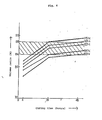
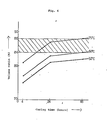
- Figs. 1 to 3 are graphs showing the relationship between the curing time and the volume ratio after curing, as determined when the molded bodies to be cured had varying volume ratios relative to the mold or cured at varying temperatures.
- the hatched area in each of Figs. 1 to 3 represents a range wherein molded bodies of the ethylene polymer were obtained with a smooth surface and good dimensional stability.
- Fig. 1 is a graph showing the results obtained when molded bodies prepared from pre-expanded LLDPE particles (A) and having varying volume ratios were cured at a temperature of 80° C.
- Fig. 2 is a graph showing the results obtained when molded bodies prepared from pre-expanded LLDPE particles (B) and having varying volume ratios were cured at a temperature of 80° C.
- Fig. 3 is a graph showing the results obtained when molded bodies prepared from pre-expanded LLDPE particles (B) and having a volume ratio of 110% were cured at varying temperatures.
- Figs. 1 and 2 show that molded body volume ratios of 110 to 70% provide excellent molded bodies with a shorter curing time, while Fig. 3 reveals that the curing can be completed more rapidly when the curing temperature is 25 to 55° C lower than the melting point (117° C) of LLDPE.
- Expansion-molded bodies of crosslinked LDPE were obtained in the same manner as in Example 1 with the exception of using the pre-expanded crosslinked LDPE particles (C) and (D) prepared in Production Example 2 as pre-expanded particles.
- the molded bodies were cured under the conditions listed in Tables 5 to 8 and thereafter allowed to stand at room temperature for 24 hours.
- the molded bodies obtained were checked for properties in the same manner as in Example 1. The results are given in Tables 5 to 8.
- Tables 5 to 7 show the results achieved with use of the pre-expanded crosslinked LDPE particles (C), and Table 8 shows those achieved with use of the pre-expanded crosslinked LDPE particles (D).
- Figs. 4 to 6 are graphs showing the relationship between the curing time and the volume ratio after curing, as determined when the molded bodies to be cured had varying volume ratios relative to the mold cavity or_cured at varying temperatures.
- the hatched area in each of Figs. 4 to 6 represents 84 to 88% of volume ratios of molded bodies relative to the mold cavity which is a range affording molded bodies of a ethylene polymer with a smooth surface and good dimensional stability.
- Fig. 4 is a graph showing the results obtained when molded bodies prepared from pre-expanded crosslinked LDPE particles (C) and having varying volume ratios were cured at a temperature of 75° C.
- Fig. 5 is a graph showing the results obtained when molded bodies prepared from pre-expanded crosslinked LDPE particles (D) and having varying volume ratios were cured at a temperature of 75° C.
- Fig. 6 is a graph showing the results obtained when molded bodies prepared from pre-expanded crosslinked LDPE particles (C) and having a volume ratio of 110% were cured at varying temperatures.
- Figs. 4 to 5 show that molded body volume ratios of 110 to 70% provide excellent molded bodies with a shorter curing time, while Fig. 6 reveals that the curing can be completed more rapidly when the curing temperature is 25 to 55° C lower than the melting point (109° C) of crosslinked LDPE.
- Expansion-molde6 bodies of non-crosslinked ethylene-propylene random copolymer were obtained in the same manner as in Example 1 with the exceptions of using the pre-expanded non-crosslinked ethylene-propylene random copolyemr particles (E) and of employing steam supplied at a pressure of about 0. 5 to 2.1 bar (gauge) ,
- the molded bodies were cured under the conditions listed in Table 9 to 11 and thereafter allowed to stand at room temperature for 24 hours.
- the molded bodies obtained were checked for properties in the same manner as in Example 1. The results are given in Tables 9 to 11.
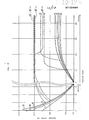
- Figs. 7 to 9 are graphs showing the relationship between the curing time and the volume ratio after curing, as determined when the molded bodies to be cured had varying volume ratios relative to the mold cavity or cured at varying temperature.
- the hatched area in each of Figs. 7 to 9 represents 89 to 96 % of volume ratios of molded bodies relative to the mold cavity which is a range affording molded bodies of a propylene polymer with a smooth surface and good dimensional stability.
- Figs. 7 and 8 are graphs showing the results obtained when molded bodies prepared from pre-expanded non-crosslinked ethylene-propylene random copolymer particles (E) and having varying volume ratios were cured at a temperature of 105° C and 90° C, respectively.
- Fig. 9 is a graph showing the results obtained when molded bodies prepared from pre-expanded non-crosslinked ethylene-propylene random copolymer particles (E) and having the volume ratio fo 92 % were cured at varying temperatures.
- Figs. 7 to 8 show that molded body volume ratios of 110 to 70 % provide excellent molded bodies with a shorter curing time, while Fig. 9 reveals that the curing can be completed more rapidly when the curing temperature is 25 to 55° C lower than the melting point (135° C) of the ethylene-propylene random copolymer employed.
Landscapes
- Chemical & Material Sciences (AREA)
- Engineering & Computer Science (AREA)
- Materials Engineering (AREA)
- Health & Medical Sciences (AREA)
- Chemical Kinetics & Catalysis (AREA)
- Medicinal Chemistry (AREA)
- Polymers & Plastics (AREA)
- Organic Chemistry (AREA)
- Manufacture Of Porous Articles, And Recovery And Treatment Of Waste Products (AREA)
- Molding Of Porous Articles (AREA)
Applications Claiming Priority (2)
| Application Number | Priority Date | Filing Date | Title |
|---|---|---|---|
| JP23716/84 | 1984-02-10 | ||
| JP59023716A JPS60166442A (ja) | 1984-02-10 | 1984-02-10 | ポリオレフイン発泡成形体の養生法 |
Publications (2)
| Publication Number | Publication Date |
|---|---|
| EP0153464A2 true EP0153464A2 (de) | 1985-09-04 |
| EP0153464A3 EP0153464A3 (de) | 1986-11-20 |
Family
ID=12118054
Family Applications (1)
| Application Number | Title | Priority Date | Filing Date |
|---|---|---|---|
| EP84115031A Ceased EP0153464A3 (de) | 1984-02-10 | 1984-12-10 | Verfahren zur Vernetzung eines geformten, expandierten Polyolefingegenständes |
Country Status (3)
| Country | Link |
|---|---|
| US (1) | US4631159A (de) |
| EP (1) | EP0153464A3 (de) |
| JP (1) | JPS60166442A (de) |
Families Citing this family (12)
| Publication number | Priority date | Publication date | Assignee | Title |
|---|---|---|---|---|
| JPH0659694B2 (ja) * | 1986-09-16 | 1994-08-10 | 鐘淵化学工業株式会社 | ポリプロピレン系樹脂型内発泡成形体の製造方法 |
| JPH0629334B2 (ja) * | 1987-02-20 | 1994-04-20 | 鐘淵化学工業株式会社 | 直鎖低密度ポリエチレン樹脂型内発泡成形体の製造方法 |
| DE3708291A1 (de) * | 1987-03-14 | 1988-09-22 | Basf Ag | Verfahren zur herstellung von polyolefinschaumstoffen |
| SE8702840D0 (sv) * | 1987-07-10 | 1987-07-10 | Plm Ab | Barrierforsterkning |
| DE3922207A1 (de) * | 1989-07-06 | 1991-01-17 | Basf Ag | Verfahren zum expandieren von geschrumpften schaumstoffpartikeln aus propylenpolymeren |
| US5080834A (en) * | 1990-10-18 | 1992-01-14 | Lce Partnership | Branched ether esters as viscosity index modifiers |
| TW461855B (en) * | 1997-10-09 | 2001-11-01 | Kao Corp | Mold, blow molded product, and molding method |
| JP5315152B2 (ja) * | 2009-07-17 | 2013-10-16 | 積水化成品工業株式会社 | 発泡成形体の製造方法、発泡成形体及び該発泡成形体からなる車両用ラゲージボックス |
| WO2012124805A1 (ja) | 2011-03-17 | 2012-09-20 | 株式会社カネカ | ポリプロピレン系樹脂予備発泡粒子およびポリプロピレン系樹脂型内発泡成形体およびその製造方法 |
| WO2015133619A1 (ja) * | 2014-03-07 | 2015-09-11 | 株式会社カネカ | ポリオレフィン系樹脂型内発泡成形体の製造方法 |
| DE102019124302A1 (de) * | 2019-09-10 | 2021-03-11 | Werkzeugbau Siegfried Hofmann Gmbh | Vorrichtung zum Verarbeiten eines Partikelschaummaterials zum Herstellen eines Partikelschaumformteils |
| JP2024089256A (ja) | 2022-12-21 | 2024-07-03 | 株式会社ジェイエスピー | ポリエチレン系樹脂発泡粒子成形体及びその製造方法 |
Family Cites Families (8)
| Publication number | Priority date | Publication date | Assignee | Title |
|---|---|---|---|---|
| IT1008525B (it) * | 1972-12-19 | 1976-11-30 | Kanegafuchi Chemical Ind | Collegamento di sci a blocco ad inerzia metodo ed apparecchio di stampag gio per resine poliolefiniche espanse |
| JPS5912455B2 (ja) * | 1973-04-10 | 1984-03-23 | 鐘淵化学工業株式会社 | ポリオレフイン系合成樹脂発泡成形体の製造方法及び装置 |
| JPS5849384B2 (ja) * | 1975-02-07 | 1983-11-04 | 旭化成株式会社 | エチレン系樹脂発泡成形品の製造方法 |
| JPS557816B2 (de) * | 1975-02-10 | 1980-02-28 | ||
| US4272468A (en) * | 1978-01-03 | 1981-06-09 | Conwed Corporation | Method for reducing the aging period of polyethylene foams |
| JPS5698147A (en) * | 1979-12-30 | 1981-08-07 | Kanegafuchi Chem Ind Co Ltd | Foamed polyolefin molding by water-impermeable bead method and preparation |
| JPS5861128A (ja) * | 1981-10-09 | 1983-04-12 | Asahi Chem Ind Co Ltd | プロピレン系樹脂発泡成形体及びその製造方法 |
| JPS58136632A (ja) * | 1982-01-14 | 1983-08-13 | Kanegafuchi Chem Ind Co Ltd | ポリオレフイン系樹脂発泡成形体の製造方法 |
-
1984
- 1984-02-10 JP JP59023716A patent/JPS60166442A/ja active Granted
- 1984-11-29 US US06/676,180 patent/US4631159A/en not_active Expired - Lifetime
- 1984-12-10 EP EP84115031A patent/EP0153464A3/de not_active Ceased
Also Published As
| Publication number | Publication date |
|---|---|
| US4631159A (en) | 1986-12-23 |
| JPS60166442A (ja) | 1985-08-29 |
| EP0153464A3 (de) | 1986-11-20 |
| JPH0365259B2 (de) | 1991-10-11 |
Similar Documents
| Publication | Publication Date | Title |
|---|---|---|
| EP0097504B1 (de) | Kernmaterial für Auto-Stossfänger | |
| US4399087A (en) | Process for producing foamed polyolefin articles from aged pre-foamed particles of polyolefin resins | |
| EP0075897B1 (de) | Verfahren zur Herstellung von vorgeschäumten Teilchen aus Polyolefinharz | |
| EP0168954B2 (de) | Verfahren zur Herstellung von geschäumten Polypropylenharzpartikeln | |
| EP0053333B1 (de) | Verfahren zur Herstellung von vorgeschäumten Polypropylenperlen | |
| US4483809A (en) | Process for preparing polyolefin foam | |
| EP0153464A2 (de) | Verfahren zur Vernetzung eines geformten, expandierten Polyolefingegenständes | |
| CA1274662A (en) | Process for production of foamed articles in mold of polypropylene resins | |
| EP0072499A1 (de) | Verfahren zur Herstellung geschäumter Formkörper aus Polypropylen-Harz | |
| JP3207219B2 (ja) | ポリオレフィン系樹脂の低発泡粒子及びその製造方法 | |
| US4331777A (en) | Foaming synthetic resin compositions stabilized with certain naphthyl amine compounds | |
| GB2140422A (en) | Preparation of foam particles of ethylenic resin and foam moldings prepared therefrom | |
| US3655542A (en) | Modified cellular particle and process for the production thereof | |
| US3222304A (en) | Expandable polyethylene | |
| US4042541A (en) | Expandable polystyrene particles | |
| CA1219417A (en) | Method of curing expansion-molded body of polyolefin | |
| JPH032890B2 (de) | ||
| US4424286A (en) | Expanded shaped article comprising a heat resistant synthetic resin | |
| JPH0561300B2 (de) | ||
| EP0032582B1 (de) | Expandierte Formgegenstände aus hitzebeständigem Kunstharz | |
| JPH0416332B2 (de) | ||
| JPH0218225B2 (de) | ||
| JPS5851019B2 (ja) | ポリオレフィン系樹脂発泡成型体の製造方法 | |
| JPS5833435A (ja) | 予備発泡粒子の製法 | |
| JPS5852328A (ja) | ポリプロピレン系樹脂発泡成型体の製造方法 |
Legal Events
| Date | Code | Title | Description |
|---|---|---|---|
| PUAI | Public reference made under article 153(3) epc to a published international application that has entered the european phase |
Free format text: ORIGINAL CODE: 0009012 |
|
| AK | Designated contracting states |
Designated state(s): BE CH DE FR GB IT LI NL SE |
|
| PUAL | Search report despatched |
Free format text: ORIGINAL CODE: 0009013 |
|
| AK | Designated contracting states |
Kind code of ref document: A3 Designated state(s): BE CH DE FR GB IT LI NL SE |
|
| 17P | Request for examination filed |
Effective date: 19870518 |
|
| 17Q | First examination report despatched |
Effective date: 19870818 |
|
| APAB | Appeal dossier modified |
Free format text: ORIGINAL CODE: EPIDOS NOAPE |
|
| STAA | Information on the status of an ep patent application or granted ep patent |
Free format text: STATUS: THE APPLICATION HAS BEEN REFUSED |
|
| 18R | Application refused |
Effective date: 19951011 |
|
| APAF | Appeal reference modified |
Free format text: ORIGINAL CODE: EPIDOSCREFNE |
|
| RIN1 | Information on inventor provided before grant (corrected) |
Inventor name: MAEDA, HIROFUMI Inventor name: WATANABE, KAZUYOSHI Inventor name: NISHIOKA, SHUNICHI Inventor name: AKAMATSU, NARUHIKO Inventor name: SENDA, KENICHI |