EP0153592A2 - Zwangsgesteuerter Nadelverschluss für Spritzdüsen in Spritzgiessformen - Google Patents
Zwangsgesteuerter Nadelverschluss für Spritzdüsen in Spritzgiessformen Download PDFInfo
- Publication number
- EP0153592A2 EP0153592A2 EP85100808A EP85100808A EP0153592A2 EP 0153592 A2 EP0153592 A2 EP 0153592A2 EP 85100808 A EP85100808 A EP 85100808A EP 85100808 A EP85100808 A EP 85100808A EP 0153592 A2 EP0153592 A2 EP 0153592A2
- Authority
- EP
- European Patent Office
- Prior art keywords
- piston
- needle
- bore
- locking
- plate
- Prior art date
- Legal status (The legal status is an assumption and is not a legal conclusion. Google has not performed a legal analysis and makes no representation as to the accuracy of the status listed.)
- Granted
Links
Images
Classifications
-
- B—PERFORMING OPERATIONS; TRANSPORTING
- B29—WORKING OF PLASTICS; WORKING OF SUBSTANCES IN A PLASTIC STATE IN GENERAL
- B29C—SHAPING OR JOINING OF PLASTICS; SHAPING OF MATERIAL IN A PLASTIC STATE, NOT OTHERWISE PROVIDED FOR; AFTER-TREATMENT OF THE SHAPED PRODUCTS, e.g. REPAIRING
- B29C45/00—Injection moulding, i.e. forcing the required volume of moulding material through a nozzle into a closed mould; Apparatus therefor
- B29C45/17—Component parts, details or accessories; Auxiliary operations
- B29C45/26—Moulds
- B29C45/27—Sprue channels ; Runner channels or runner nozzles
- B29C45/28—Closure devices therefor
- B29C45/2806—Closure devices therefor consisting of needle valve systems
- B29C45/281—Drive means therefor
Definitions
- the invention relates to a positively controlled needle closure for spray nozzles in injection molding molds, in which the closure needle engages with its end facing away from the spray nozzle into a bore in the piston provided on both sides with piston rod attachments of a drive cylinder which can be acted upon with a pressure medium and is fastened in this.
- the piston is provided with a through bore which is provided with an internally threaded section starting from the end of the outer piston rod attachment which is accessible from the outside.
- the locking needle itself is provided with an external thread at its rear end and can be screwed into the piston from the outside. The opening and closing force is transferred via the thread. With the help of the thread is an axial Adjustment of the locking needle in the piston possible. Locking takes place via a lock nut, which rests on the face against the outer piston rod shoulder.
- a needle valve is also known in which the piston of the hydraulic cylinder is provided on one side with a piston rod extension.
- the locking needle is in this case provided at its rear end with a cylindrical head which lies in a counterbore extending from the rear end of the piston and is held therein by a threaded plug. The closing force and the opening force are transmitted to the locking needle through the threaded plug and the annular shoulder at the bottom of the countersink.
- the injection heads are each provided with separate electrical heating elements. Additional heating elements are provided in the distributor plate.
- the heating elements are duck in injection molds Verschl sandwichele E. They are therefore subject to periodic inspections.
- the hot runner area must be exposed to perform these inspections.
- the plate in or on which the individual drive cylinders are attached must be detached from the rest of the shape.
- the plate carrying the drive cylinder can only be dismantled together with the locking needles in the known needle locks with a one-sided piston rod attachment if the drive cylinders have not been individually dismantled beforehand and the needles with the pistons are removed.
- the locking needles can be removed to the outside.
- an assembly space of at least the length of the locking needles is required here. In both cases, the hot runner must be dismantled be heated.
- the object of the invention is to provide a valve gate of the type mentioned in such a way that simple disassembly and reassembly for carrying out inspection work or for eliminating errors of all kinds is possible without heating the mold.
- a stop effective in the closing direction is provided for the outer end of the locking needle in the piston bore, and in that a screw can be screwed into a threaded bore in the end of the locking needle from the outer end of the outer piston rod attachment effective stop in the opening direction.
- a particular advantage of the needle valve according to the invention can also be seen in the fact that during the disassembly and reassembly the drive cylinders, which are normally designed as hydraulic cylinders, do not need to be opened themselves and thus oil contamination is avoided.
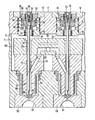
- two plates 2, 4 of a multiple injection mold which are fastened detachably to one another are shown, which abut one another in plane 6 and can be separated from one another in this plane.
- the two plates 2 and 4 normally belong to the machine-fixed part of the injection mold.
- the plate 2 can be a mounting plate at the same time.
- Hydraulic cylinders 8 are arranged in the plate 2 and are inserted into bores 10. The attachment takes place in each case with the aid of a mounting flange 12 embedded in the plate 2.
- the hydraulic cylinder 8 is provided with a piston 14 which can be acted upon on both sides and which is provided on both sides with a piston rod extension 16 or 18.
- the cylinder is provided in one piece on the inside with a cylinder cover 20.
- a cylinder cover 22 is provided on the outside, which is provided on the outside with a thread 24 with which it can be screwed into a threaded bore 2E against a stop 28.
- Piston rod seals are arranged in the cylinder covers 20 and 22 in the usual way.
- the hydraulic cylinder is provided with connections 30, 32, which lead to ring channels on the circumference of the cylinder, which are connected in a known manner to channels in the plate 2, which are not shown in the drawing.
- the ring channels are sealed against each other in the bore 10 via 0-rings.
- a bore 34 extending from the end of the inner piston rod extension 16, which ends in front of an annular shoulder 36, which here in the region of the outer piston rod extension 18 lies.
- the fastening end 38 of a locking needle 40 engages in this bore.
- the bore 34 is formed such that the fastening end 38 of the locking needle is guided radially. In the remaining section of the bore 34, the locking needle 40 is not guided radially.
- a countersunk bore 42 is provided, the bottom of which likewise forms an annular shoulder 44.
- a bore 46 is provided through which a screw 48, preferably designed as an Allen screw, can be screwed into an axial threaded bore 50 in the fastening end 38 of the locking needle.
- the spray heads 52 are accommodated in corresponding bores in a known manner. These spray heads are provided with a hot runner 54, through which the locking needle 40 is guided in the center and engages with its locking part 56 in a sprue ring 58. From the opposite side of the plate 4 are embedded in these shaped elements 59, which is provided on the outside with a mold cavity 61 in the form of a spherical cap, as is used in the production of so-called preforms.
- the hot runner 54 is heated by an electrical heating element 60 which encloses this area on the outside.
- the hot runner 54 is connected to a feed channel 62 which is led obliquely to it, which in turn is connected to a ground channel 64 in a distributor plate 66.
- this distributor plate 66 further heating elements 68 are provided, one of which is shown schematically.
- the locking needles 40 are passed through holes 70 with a diameter larger than that of the fastening end 38 through the plate 66. They are guided in guide bushes 72 in the spray heads 52.
- injection mold need not be described for the explanation of the invention. For example, they can be designed in the manner described in DE-OS 31 40 711.
- the spray heads 52 are inserted into the plate 4 of the mold and the distributor plate 66 is mounted thereon.
- the closure needles 40 can then be used.
- the plate 2 is then assembled, and the plate 2 can be assembled without difficulty even in the case of a multiple mold, for example a mold with 16 individual molds, as is typical for a preform injection mold.
- the locking needles slide in the piston 14 over the wide area of the bore 34 in the area of this bore in which they are guided radially. After the plate 2 has been fastened to the plate 4, the screws 48 are then inserted and tightened.
- the locking needles can of course also be connected to the pistons beforehand.
- the machine is used to carry out maintenance and repair work on an injection mold mounted in the injection molding machine movable part of the mold, which is not shown in the drawing, locked when the mold is closed with the machine-fixed part of the mold and the plate 2 released from the clamping on the injection molding machine.
- the injection molding machine is then operated open.
- the plate 2 is accessible from the fastening side.
- To remove the plate 2 the screws 48 to the individual locking needles 40 and then the fastenings between the plates 2 and 4 are loosened.
- the plate 2 can then be removed, the locking needles remaining. This work is carried out with the heating switched off.
- the needles are therefore stuck in the plastic that has solidified in the hot runner 54.
- the distributor plate 66 After removing the plate, the distributor plate 66 is freely accessible and can also be removed without difficulty. After removal of the distributor plate, the individual spray heads 52 with the locking needles 40 are then exposed and are taken out of the plate 4, inspected and, if necessary, repaired or replaced.
- the locking needles for removing the plate 2 and the distributor plate 66 are only required in the axial direction, which corresponds to the immersion depth of the fastening end of the locking needles in the piston 14.
- a space corresponding to the distance between the fastening side of the plate 2 and the closure end 56 of the closure needles 40 does not need to be made available, as in the known designs.
- valve gate can be carried out in a simple manner maintenance and repair work in the area of the distributor plate and the spray heads including their valve needles on the mold mounted in the injection molding machine. This also contributes to the fact that extremely short operational interruptions for maintenance or repair can be achieved.
Landscapes
- Engineering & Computer Science (AREA)
- Manufacturing & Machinery (AREA)
- Mechanical Engineering (AREA)
- Injection Moulding Of Plastics Or The Like (AREA)
- Moulds For Moulding Plastics Or The Like (AREA)
- Infusion, Injection, And Reservoir Apparatuses (AREA)
- Nozzles (AREA)
- Fuel-Injection Apparatus (AREA)
Abstract
Description
- Die Erfindung betrifft einen zwangsgesteuerten Nadelverschluß für Spritzdüsen in Spritzgießfcrmen, bei dem die Verschlußnadel mit ihrem der Spritzdüse abgewandten Ende in eine Bohrung im beidseitig mit Kolbenstangenansätzen versehenen Kolben eines beidseitig mit einem Druckmedium beaufschlagbaren Antriebszylinders eingreift und in diesem befestigt ist.
- Bei einem bekannten Nadelverschluß der genannten Art (DE-OS 31 40 711) ist der Kolben mit einer durchgehenden Bohrung versehen, die vom von außen zugängigen Ende des äußeren Kolbenstangenansatzes ausgehend mit einem Innengewindeabschnitt versehen ist. Die Verschlußnadel selbst ist an ihrem hinteren Ende mit einem Außengewinde versehen und mit diesem von außen in den Kolben einschraubbar. Über das Gewinde werden die Öffnungs- und Schließkraft übertragen. Mit Hilfe des Gewindes ist eine axiale Verstellung der Verschlußnadel im Kolben möglich. Eine Arretierung erfolgt über eine Kontermutter, die stirnseitig gegen den äußeren Kolbenstangenansatz anliegt.
- Es ist weiter ein Nadelverschluß bekannt, bei dem der Kolben des Hydraulikzylinders einseitig mit einem Kolbenstangenansatz versehen ist. Die Verschlußnadel ist hierbei an ihrem hinteren Ende mit einem zylindrischen Kopf versehen, der in eine vom hinteren Ende des Kolbens ausgehenden Senkbohrung liegt und darin durch einen Gewindestopfen gehaltert ist. Durch den Gewindestopfen und die ringförmige Schulter am Boden der Senkung werden die Schließkraft und die Öffnungskraft auf die Verschlußnadel übertragen.
- Bei Mehrfach-Spritzgießformen, bei denen die Einzelformen jeweils mit einem Nadelverschluß versehen sind, insbesondere sogenannten Preform-Spritzgießformen, sind die Spritzköpfe jeweils mit gesonderten elektrischen Heizelementen versehen. Weitere Heizelemente sind in der Verteilerplatte vorgesehen.
- Die Heizelemente sind in Spritzgießformen VerschleißeleEente. Sie unterliegen daher periodischen Inspektionen. Zur Durchführung dieser Inspektionen muß der Heißkanalbereich freigelegt werden. Zu diesem Zweck muß die Platte, in bzw. an der die einzelnen Antriebszylinder befestigt sind, von der übrigen Form gelöst werden. Die die Antriebszylinder tragende Platte kann dabei bei den bekannten Nadelverschlüssen mit einseitigem Kolbenstangenansatz nur gemeinsam mit den Verschlußnadeln demontiert werden, wenn nicht vorher die Antriebszylinder einzeln demontiert und die Nadeln mit den Kolben entnommen werden. Bei der Ausführung mit beidseitigen Kolbenstangenansätzen können die Verschlußnadeln zwar nach außen herausgenommen werden. Es ist hier aber ein Montageraum von mindestens der Länge der Verschlußnadeln erforderlich. In beiden Fällen muß für eine Demontage der Heißkanal aufgeheizt werden. Beim Abnehmen der Platte mit den Verschlußnadeln muß diese zu den anderen Platten der Forc. genau geführt sein. Eine Montage mit an den Antriebszylindern befestigten Verschlußnadeln ist in der Praxis nicht möglich. Weit schwieriger gestaltet sich noch die Demontage bei Versagen von Heizelementen in Bereichen des Heißkanals, die zu einem Einfrieren der Nadeln führt. In diesem Fall ist eine Demontage der Platte mit dem Antriebszylinder im allgemeinen nur mit einem Abreißen der Nadeln möglich.
- Aufgabe der Erfindung ist es, einen Nadelverschluß der genannten Art so auszubilden, daß eine einfache Demontage und Remontage zur Durchführung von Inspekticnsarbeiten bzw. zur Beseitigung von Fehlern aller Art ohne Aufheizen der Form möglich ist.
- Diese Aufgabe wird gemäß der Erfindung dadurch gelöst, daß in der Kolbenbohrung ein in Schließrichtung wirksamer Anschlag für das äußere Ende der Verschlufinadel vorgesehen ist, und daß vom äußeren Ende des äußeren Kolbenstangenansatzes eine Schraube in eine Gewindebohrung im Ende der Verschlußnadel einschraubbar ist, die gegen einen in Öffnungsrichtung wirksamen Anschlag anliegt.
- Zweckmäßige Ausgestaltungen sind Gegenstand der Unteransprüche.
- Ein besonderer Vorteil des erfindungsgemäßen Nadelverschlusses ist noch darin zu sehen, daß bei der Demontage und Remontage die normalerweise als Hydraulikzylinder ausgebildeten Antriebszylinder selbst nicht geöffnet zu werden brauchen und damit ölverschmutzungen vermieden werden.
- Die Erfindung ist in der Zeichnung beispielsweise veranschaulicht und im nachstehenden im einzelnen anhand der Zeichnung beschrieben, die einen Längsschnitt durch einen der beiden Teile einer Mehrfach-Spritzgießform im Bereich zweier benachbarter Spritzköpfe zeigt.
- In der Zeichnung sind zwei aneinander lösbar befestigte Platten 2, 4 einer Mehrfach-Spritzgießform dargestellt, die in der Ebene 6 aneinander anliegen und in dieser Ebene voneinander trennbar sind. Die beiden Platten 2 und 4 gehören normalerweise zum maschinenfesten Teil der Spritzgießform. Die Platte 2 kann dabei gleichzeitig Befestigungsplatte sein.
- In der Platte 2 sind Hydraulikzylinder 8 angeordnet, die in Bohrungen 10 eingesetzt sind. Die Befestigung erfolgt jeweils mit Hilfe eines in die Platte 2 eingelassenen Befestigungsflansches 12. Der Hydraulikzylinder 8 ist mit einem beidseitig beaufschlagbaren Kolben 14 versehen, der beidseitig mit einem Kolbenstangenansatz 16 bzw. 18 versehen ist. Der Zylinder ist auf der Innenseite einstückig mit einem Zylinderdeckel 20 versehen. Auf der Außenseite ist ein Zylinderdeckel 22 vorgesehen, der außen mit einem Gewinde 24 versehen ist, mit dem er in eine Gewindebohrung 2E gegen einen Anschlag 28 verschaubbar ist.
- In den Zylinderdeckeln 20 und 22 sind in üblicher Weise Kolbenstangendichtungen angeordnet. Der Hydraulikzylinder ist mit Anschlüssen 30, 32 versehen, die zu Ringkanälen am Umfang des Zylinders führen, die in bekannter Weise mit Kanälen in der Platte 2 verbunden sind, die in der Zeichnung nicht dargestellt sind. Die Ringkanäle sind gegeneinander in der Bohrung 10 über 0-Ringe abgedichtet.
- Im Kolben 14 ist eine vom Ende des inneren Kolbenstangenansatzes 16 ausgehende Bohrung 34 vorgesehen, die vor einer Ringschulter 36 endet, die hier im Bereich des äußeren Kolbenstangen Ansatzes 18 liegt. In diese Bohrung greift das Befestigungsende 38 einer Verschlußnadel 40 ein. Im Bereich der Schulter 36 ist die Bohrung 34 so ausgebildet, daß das Befestigungsende 38 der Verschlußnadel radial geführt ist. Im übrigen Abschnitt der Bohrung 34 ist die Verschlußnadel 40 radial ungeführt.
- Vom von außen frei zugängigen Ende des äußeren Kolbenstangenansatzes 18 ausgehend ist eine Senkbohrung 42 vorgesehen, deren Boden gleichfalls eine ringförmige Schulter 44 bildet. Im Bereich zwischen den Schultern 36 und 44 ist eine Bohrung 46 vorgesehen, durch die eine vorzugsweise als Imbusschraube ausgebildete Schraube 48 in eine axiale Gewindebohrung 50 im Befestigungsende 38 der Verschlußnadel einschraubbar ist. Über die Schraube wird die Verschlußnadel mit der Stirnseite des Befestigungsendes 38 gegen die Schulter 36 gezogen, so daß vom Kolben 14 die nach unten gerichteten Schließkräfte auf die Verschlußnadel übertragen werden, während über die mit ihrem Kopf auf der Schulter 11 aufliegende Schraube 48 die öffnungskräfte auf die Verschlußnadel übertragen werden.
- In der Platte 4 sind in entsprechenden Bohrungen in bekannter Weise die Spritzköpfe 52 untergebracht. Diese Spritzköpfe sind mit einem Heißkanal 54 versehen, durch den mittig die Verschlußnadel 40 hindurchgeführt ist, die mit ihrem Verschlußteil 56 in einen Angußring 58 eingreift. Von der gegenüberliegenden Seite der Platte 4 sind in diese Formelemente 59 eingelassen, die auf der Außenseite mit einer Formmulde 61 in Form einer Kugelkalotte versehen ist, wie sie bei der Herstellung von sogenannten Preforms verwendet wird.
- Der Heißkanal 54 wird über ein elektrisches Heizelement 60 beheizt, das diesen Bereich außen umschließt. Der Heißkanal 54 steht mit einem schräg an diesen herangeführten Zufuhrkanal 62 in Verbindung, der seinerseits wiederum in Verbindung steht mit einem Massekanal 64 in einer Verteilerplatte 66. In dieser Verteilerplatte 66 sind weitere Heizelemente 68 vorgesehen, von denen eines schematisch wiedergegeben sind.
- Die Verschlußnadeln 40 sind durch Bohrungen 70 mit einem Durchmesser größer als der des Befestigungsendes 38 durch die Platte 66 hindurchgeführt. Ihre Führung erfolgt in Führungsbuchsen 72 in den Spritzköpfen 52.
- Weitere Einzelheiten der Spritzgießform brauchen für die Erläuterung der Erfindung nicht beschrieben zu werden. Sie können beispielsweise in der Weise ausgebildet sein, wie in der DE-OS 31 40 711 beschrieben.
- Zur Montage der Form werden die Spritzköpfe 52 in die Platte 4 der Form eingesetzt und darauf wird die Verteilerplatte 66 montiert. Es können dann die Verschlußnadeln 40 eingesetzt werden. Anschließend wird die Platte 2 montiert, wobei auch bei einer Mehrfachform, beispielsweise einer Form mit 16 Einzelformen, wie es für eine Preform-Spritzgießform typisch ist, die Platte 2 ohne Schwierigkeiten montierbar ist. Die Verschlußnadeln gleiten dabei in den Kolben 14 über den weiten Bereich der Bohrung 34 in den Bereich dieser Bohrung, in dem sie radial geführt sind. Nach Befestigung der Platte 2 auf der Platte 4 werden dann die Schrauben 48 eingesetzt und angezogen. Für die Montage können die Verschlußnadeln aber selbstverständlich auch vorher mit den Kolben verbunden sein.
- Zur Durchführung von Wartungs- und Reparaturarbeiten einer in der Spritzgießmaschine montierten Spritzgießform wird der maschinenbewegliche Teil der Form, der in der Zeichnung nicht dargestellt ist, bei geschlossener Form mit dem maschinenfesten Teil der Form verriegelt und die Platte 2 von der Aufspannung an der Spitzgießmaschine gelöst. Die Spritzgießmaschine wird dann offen gefahren. Dabei wird die Platte 2 von deren Befestigungsseite her zugängig. Zum`Abnehmen der Platte 2 werden die Schrauben 48 zu den einzelnen Verschlußnadeln 40 und anschließend die Befestigungen zwischen den Platten 2 und 4 gelöst. Darauf kann die Platte 2 abgenommen werden, wobei die Verschlußnadeln stehenbleiben. Diese Arbeiten werden bei ausgeschalteter Heizung durchgeführt. Die Nadeln sitzen daher in dem Kunststoff fest, der in dem Heißkanal 54 erstarrt ist.
- Nach Abnehmen der Platte ist die Verteilerplatte 66 frei zugängig und auch ohne Schwierigkeiten abnehmbar. Nach Abnahme der Verteilerplatte liegen dann die einzelnen Spritzköpfe 52 mit den Verschlußnadeln 40 frei und kennen aus der Platte 4 herausgenommen, inspiziert und notfalls repariert oder ersetzt werden.
- Bei der Montage und bei der Remontage wird in Achsrichtung der Verschlußnadeln für die Abnahme der Platte 2 und der Verteilerplatte 66 lediglich ein Raum benötigt, der der Eintauchtiefe des Befestigungsendes der Verschlußnadeln im Kolben 14 entspricht. Es braucht also nicht wie bei den bekannten Ausführungen ein Raum entsprechend dem Abstand zwischen der Befestigungsseite der Platte 2 und dem Verschlußende 56 der Verschlußnadeln 40 zur Verfügung gestellt zu werden.
- Damit verbleibt zwischen der maschinenfesten Aufspannplatte der Spritzgießmaschine und dem Werkzeug bei der beschriebenen Demontage und Remontage ein ausreichender Raum, in dem sich der Monteur bewegen kann. Wesentlich ist weiter, daß alle Arbeiten bei unbeheizter Form durchgeführt werden können. Mit der beschriebenen Anordnung des Nadelverschlusses lassen sich in einfacher Weise Wartungs- und Reparaturarbeiten im Bereich der Verteilerplatte und der Spritzköpfe einschließlich deren Verschlußnadeln an der in der Spritzgießmaschine montierten Form durchführen. Dies trägt zusätzlich dazu bei, daß extrem kurze Betriebsunterbrechungen für eine Wartung bzw. Reparatur erreichbar sind.
Claims (3)
Priority Applications (1)
| Application Number | Priority Date | Filing Date | Title |
|---|---|---|---|
| AT85100808T ATE66406T1 (de) | 1984-02-02 | 1985-01-26 | Zwangsgesteuerter nadelverschluss fuer spritzduesen in spritzgiessformen. |
Applications Claiming Priority (2)
| Application Number | Priority Date | Filing Date | Title |
|---|---|---|---|
| DE3403603 | 1984-02-02 | ||
| DE3403603A DE3403603C2 (de) | 1984-02-02 | 1984-02-02 | Zwangsgesteuerter Nadelverschluß für Spritzdüsen in Spritzgießformen |
Publications (3)
| Publication Number | Publication Date |
|---|---|
| EP0153592A2 true EP0153592A2 (de) | 1985-09-04 |
| EP0153592A3 EP0153592A3 (en) | 1988-01-20 |
| EP0153592B1 EP0153592B1 (de) | 1991-08-21 |
Family
ID=6226567
Family Applications (1)
| Application Number | Title | Priority Date | Filing Date |
|---|---|---|---|
| EP85100808A Expired - Lifetime EP0153592B1 (de) | 1984-02-02 | 1985-01-26 | Zwangsgesteuerter Nadelverschluss für Spritzdüsen in Spritzgiessformen |
Country Status (6)
| Country | Link |
|---|---|
| EP (1) | EP0153592B1 (de) |
| JP (1) | JPS60247527A (de) |
| AT (1) | ATE66406T1 (de) |
| DE (2) | DE3403603C2 (de) |
| ES (1) | ES295780Y (de) |
| PT (1) | PT79920B (de) |
Cited By (8)
| Publication number | Priority date | Publication date | Assignee | Title |
|---|---|---|---|---|
| EP0264724A3 (en) * | 1986-10-20 | 1989-08-16 | Mold-Masters Limited | Mechanism for valve gated injection molding with resilient retaining ring |
| WO1990009876A1 (de) * | 1989-02-23 | 1990-09-07 | Kurt Paul Cuttat | Verschlussnadel und damit bestückte einheit für spritzgussformen |
| EP0558931A1 (de) * | 1992-02-29 | 1993-09-08 | Otto Männer | Nadelverschlussdüse mit Kolbenantrieb |
| EP0558932A1 (de) * | 1992-02-29 | 1993-09-08 | Otto Männer | Mehrfach-Nadelverschluss-Düse für Spritzgiessformen |
| EP1367664A3 (de) * | 2002-04-14 | 2004-06-09 | Sgl Carbon Ag | Bipolarplatte für eine elektrochemische Zelle |
| EP1648681A4 (de) * | 2003-06-23 | 2008-07-02 | Panos Trakas | Verbesserte verstellbare ventilnadelanordnung und verfahren |
| US7955071B1 (en) * | 2009-11-30 | 2011-06-07 | Dme Company Llc | Apparatus for injection molding |
| EP2633971A1 (de) * | 2012-03-01 | 2013-09-04 | Günther Heisskanaltechnik GmbH | Spritzgießdüse mit von Führungsbuchsen geführten Verschlussnadeln und Spritzgießvorrichtung mit einer solchen |
Families Citing this family (12)
| Publication number | Priority date | Publication date | Assignee | Title |
|---|---|---|---|---|
| DE3641416A1 (de) * | 1986-12-04 | 1988-06-09 | Guenter Strueh | Vorrichtung und verfahren zur verarbeitung pastoeser, aushaertbarer medien |
| DE3642343C2 (de) * | 1986-12-11 | 1997-05-28 | Arnaldo Dipl Ing Glaeser | Vorrichtung zum gleichzeitigen Anspritzen mehrerer Formteile in einem Spritzwerkzeug |
| DE3833220C2 (de) * | 1988-09-30 | 1998-04-30 | Agfa Gevaert Ag | Nadelverschlußdüse in einem Spritzgießwerkzeug zur Verarbeitung thermoplastischer Kunststoffe |
| JPH0767715B2 (ja) * | 1990-11-20 | 1995-07-26 | 三晶技研株式会社 | ホットランナ式合成樹脂金型 |
| JPH05293852A (ja) * | 1992-04-22 | 1993-11-09 | Japan Steel Works Ltd:The | 射出成形機用ノズル孔の調節方法および射出成形機用ノズル |
| DE29809855U1 (de) | 1998-06-03 | 1998-08-20 | Günther Heißkanaltechnik GmbH, 35066 Frankenberg | Nadelverschlußdüse |
| DE20302845U1 (de) | 2003-02-20 | 2003-05-22 | Günther GmbH & Co., Metallverarbeitung, 35066 Frankenberg | Nadelverschlußdüse |
| US7618253B2 (en) | 2007-10-19 | 2009-11-17 | Mold-Masters (2007) Limited | Multiple-gate injection molding apparatus |
| US8091202B2 (en) | 2009-05-06 | 2012-01-10 | Synventive Molding Solutions, Inc. | Method and apparatus for coupling and uncoupling an injection valve pin |
| DE102009024271B4 (de) * | 2009-06-05 | 2017-05-24 | Psg Plastic Service Gmbh | Betätigungsvorrichtung für eine Nadelverschlussdüse |
| DE102012104291B4 (de) | 2012-05-16 | 2014-07-10 | Günther Heisskanaltechnik Gmbh | Düsenmundstück für eine Spritzgießdüse, Spritzgießdüse und Spritzgießwerkzeug |
| DE102016106745A1 (de) | 2016-04-12 | 2017-10-12 | Günther Heisskanaltechnik Gmbh | Führungsbuchse für eine Spritzgießvorrichtung |
Citations (3)
| Publication number | Priority date | Publication date | Assignee | Title |
|---|---|---|---|---|
| DE2919862A1 (de) | 1978-06-06 | 1979-12-20 | Continental Group | Spritzgusseinheit |
| EP0021273A1 (de) | 1979-06-12 | 1981-01-07 | Hendrikus Jacobus Elisabeth Schouenberg | Spritzgussmechanismus zum Giessen von Kunststoffen |
| DE3140711A1 (de) | 1981-10-14 | 1983-04-28 | Maschinenfabrik Köppern GmbH & Co KG, 4320 Hattingen | Mehrfachspritzgiesswerkzeug |
Family Cites Families (5)
| Publication number | Priority date | Publication date | Assignee | Title |
|---|---|---|---|---|
| US3500501A (en) * | 1968-01-30 | 1970-03-17 | Cincinnati Milling Machine Co | Nozzle shut-off device |
| US4268240A (en) * | 1978-01-06 | 1981-05-19 | Husky Injection Molding Systems | Actuating mechanism for gate valve of injection nozzle |
| US4279582A (en) * | 1979-04-02 | 1981-07-21 | Incoe Corporation | Method and apparatus for individual control of injection mold shut-off bushings |
| DE3272910D1 (en) * | 1981-10-14 | 1986-10-02 | Koeppern & Co Kg Maschf | Multiple injection mould |
| CA1193818A (en) * | 1983-03-24 | 1985-09-24 | Jobst U. Gellert | Hydraulically actuated injection molding system with alternate hydraulic connections |
-
1984
- 1984-02-02 DE DE3403603A patent/DE3403603C2/de not_active Expired
-
1985
- 1985-01-26 AT AT85100808T patent/ATE66406T1/de not_active IP Right Cessation
- 1985-01-26 DE DE8585100808T patent/DE3583807D1/de not_active Expired - Fee Related
- 1985-01-26 EP EP85100808A patent/EP0153592B1/de not_active Expired - Lifetime
- 1985-02-01 ES ES1985295780U patent/ES295780Y/es not_active Expired
- 1985-02-01 PT PT79920A patent/PT79920B/de unknown
- 1985-02-01 JP JP60016736A patent/JPS60247527A/ja active Pending
Patent Citations (3)
| Publication number | Priority date | Publication date | Assignee | Title |
|---|---|---|---|---|
| DE2919862A1 (de) | 1978-06-06 | 1979-12-20 | Continental Group | Spritzgusseinheit |
| EP0021273A1 (de) | 1979-06-12 | 1981-01-07 | Hendrikus Jacobus Elisabeth Schouenberg | Spritzgussmechanismus zum Giessen von Kunststoffen |
| DE3140711A1 (de) | 1981-10-14 | 1983-04-28 | Maschinenfabrik Köppern GmbH & Co KG, 4320 Hattingen | Mehrfachspritzgiesswerkzeug |
Cited By (9)
| Publication number | Priority date | Publication date | Assignee | Title |
|---|---|---|---|---|
| EP0264724A3 (en) * | 1986-10-20 | 1989-08-16 | Mold-Masters Limited | Mechanism for valve gated injection molding with resilient retaining ring |
| WO1990009876A1 (de) * | 1989-02-23 | 1990-09-07 | Kurt Paul Cuttat | Verschlussnadel und damit bestückte einheit für spritzgussformen |
| EP0558931A1 (de) * | 1992-02-29 | 1993-09-08 | Otto Männer | Nadelverschlussdüse mit Kolbenantrieb |
| EP0558932A1 (de) * | 1992-02-29 | 1993-09-08 | Otto Männer | Mehrfach-Nadelverschluss-Düse für Spritzgiessformen |
| EP1367664A3 (de) * | 2002-04-14 | 2004-06-09 | Sgl Carbon Ag | Bipolarplatte für eine elektrochemische Zelle |
| EP1648681A4 (de) * | 2003-06-23 | 2008-07-02 | Panos Trakas | Verbesserte verstellbare ventilnadelanordnung und verfahren |
| USRE41280E1 (en) | 2003-06-23 | 2010-04-27 | Panos Trakas | Adjustable valve pin assembly |
| US7955071B1 (en) * | 2009-11-30 | 2011-06-07 | Dme Company Llc | Apparatus for injection molding |
| EP2633971A1 (de) * | 2012-03-01 | 2013-09-04 | Günther Heisskanaltechnik GmbH | Spritzgießdüse mit von Führungsbuchsen geführten Verschlussnadeln und Spritzgießvorrichtung mit einer solchen |
Also Published As
| Publication number | Publication date |
|---|---|
| DE3583807D1 (de) | 1991-09-26 |
| EP0153592A3 (en) | 1988-01-20 |
| ES295780Y (es) | 1987-12-16 |
| EP0153592B1 (de) | 1991-08-21 |
| DE3403603A1 (de) | 1985-08-14 |
| JPS60247527A (ja) | 1985-12-07 |
| PT79920A (de) | 1985-03-01 |
| PT79920B (de) | 1986-09-11 |
| DE3403603C2 (de) | 1985-12-05 |
| ES295780U (es) | 1987-06-16 |
| ATE66406T1 (de) | 1991-09-15 |
Similar Documents
| Publication | Publication Date | Title |
|---|---|---|
| EP0153592B1 (de) | Zwangsgesteuerter Nadelverschluss für Spritzdüsen in Spritzgiessformen | |
| DE19516793B4 (de) | Spritzgießdüsenanordnung und Spritzgießvorrichtung | |
| EP3231577B1 (de) | Blasformanordnung | |
| EP0635350B1 (de) | Pneumatische Steuervorrichtung für Heisskanalnadelventile für Spritzgiesswerkzeuge | |
| DE69106348T2 (de) | Düse für eine Spritzgussmaschine. | |
| EP0558931B1 (de) | Nadelverschlussdüse mit Kolbenantrieb | |
| DE2728820B2 (de) | Verschlußdüse für eine Kunststoff -Spritzgießmaschine | |
| WO2018091499A1 (de) | Werkzeugelement und werkzeug und verfahren zur entnahme eines formeinsatzes aus einem werkzeugelement | |
| DE68912946T2 (de) | Einspritzdüse zum einspritzen von kunststoffen, härtbaren harzen oder kautschuk. | |
| EP3117977B1 (de) | Werkzeughälfte für ein formwerkzeug einer spritzgiessmaschine mit einem heisskanalsystem | |
| EP0925902B1 (de) | Spritzgusswerkzeug | |
| DE2340499B1 (de) | Mehrteilige Schnecke für eine Schnekkenstrangpresse zur Verarbeitung von Kunststoffen | |
| DE3534937C2 (de) | ||
| DE3336203A1 (de) | Spritzgiess- oder presswerkzeug zur verarbeitung von kunststoffmassen | |
| EP0595200B1 (de) | Kupplungseinrichtung an einer Kunststoff-Spritzgiessmachine | |
| EP0585671A1 (de) | Auswerfereinheit für Spritzgiessmaschinen | |
| DE1804640B1 (de) | Spritzkopf zur Herstellung von Kunststoffrohren oder -schlaeuchen | |
| DE2143132A1 (de) | Formwerkzeug, insbesondere fuer die fertigung von teilen aus duromerkunststoffen | |
| DE19524803C1 (de) | Schnellspanneinrichtung, insbesondere für Spritzgußwerkzeuge | |
| DE3140837A1 (de) | Druckgiessmaschine | |
| DE102005015242B4 (de) | Heißkanalverteilerblock für den Anschluß an eine Spritzgießmaschine | |
| DE3307590C2 (de) | Auswerfersystem für teilbare Formen | |
| DE19733257C2 (de) | Rundklinkenzug | |
| DE1113805B (de) | Aus zwei gegeneinander bewegbaren, mehrteiligen Haelften bestehende Form, insbesondere fuer Spritzgussmaschinen zur Verarbeitung thermoplastischer Kunststoffe | |
| DE19718011C1 (de) | Formschließeinheit für eine Spritzgießmaschine für die Verarbeitung von Kunststoffen |
Legal Events
| Date | Code | Title | Description |
|---|---|---|---|
| PUAI | Public reference made under article 153(3) epc to a published international application that has entered the european phase |
Free format text: ORIGINAL CODE: 0009012 |
|
| AK | Designated contracting states |
Designated state(s): AT BE CH DE FR GB IT LI NL SE |
|
| RAP1 | Party data changed (applicant data changed or rights of an application transferred) |
Owner name: FRIED. KRUPP GESELLSCHAFT MIT BESCHRAENKTER HAFTUN |
|
| PUAL | Search report despatched |
Free format text: ORIGINAL CODE: 0009013 |
|
| AK | Designated contracting states |
Kind code of ref document: A3 Designated state(s): AT BE CH DE FR GB IT LI NL SE |
|
| 17P | Request for examination filed |
Effective date: 19880707 |
|
| 17Q | First examination report despatched |
Effective date: 19900216 |
|
| GRAA | (expected) grant |
Free format text: ORIGINAL CODE: 0009210 |
|
| AK | Designated contracting states |
Kind code of ref document: B1 Designated state(s): AT BE CH DE FR GB IT LI NL SE |
|
| REF | Corresponds to: |
Ref document number: 66406 Country of ref document: AT Date of ref document: 19910915 Kind code of ref document: T |
|
| ET | Fr: translation filed | ||
| REF | Corresponds to: |
Ref document number: 3583807 Country of ref document: DE Date of ref document: 19910926 |
|
| GBT | Gb: translation of ep patent filed (gb section 77(6)(a)/1977) | ||
| ITF | It: translation for a ep patent filed | ||
| PLBE | No opposition filed within time limit |
Free format text: ORIGINAL CODE: 0009261 |
|
| 26N | No opposition filed | ||
| PGFP | Annual fee paid to national office [announced via postgrant information from national office to epo] |
Ref country code: GB Payment date: 19921207 Year of fee payment: 9 |
|
| PGFP | Annual fee paid to national office [announced via postgrant information from national office to epo] |
Ref country code: FR Payment date: 19921209 Year of fee payment: 9 |
|
| PGFP | Annual fee paid to national office [announced via postgrant information from national office to epo] |
Ref country code: SE Payment date: 19921216 Year of fee payment: 9 |
|
| PGFP | Annual fee paid to national office [announced via postgrant information from national office to epo] |
Ref country code: BE Payment date: 19930113 Year of fee payment: 9 |
|
| PGFP | Annual fee paid to national office [announced via postgrant information from national office to epo] |
Ref country code: AT Payment date: 19930127 Year of fee payment: 9 |
|
| PG25 | Lapsed in a contracting state [announced via postgrant information from national office to epo] |
Ref country code: GB Effective date: 19940126 Ref country code: AT Effective date: 19940126 |
|
| PG25 | Lapsed in a contracting state [announced via postgrant information from national office to epo] |
Ref country code: SE Effective date: 19940127 |
|
| PG25 | Lapsed in a contracting state [announced via postgrant information from national office to epo] |
Ref country code: BE Effective date: 19940131 |
|
| BERE | Be: lapsed |
Owner name: FRIED. KRUPP G.M.B.H. Effective date: 19940131 |
|
| GBPC | Gb: european patent ceased through non-payment of renewal fee |
Effective date: 19940126 |
|
| PG25 | Lapsed in a contracting state [announced via postgrant information from national office to epo] |
Ref country code: FR Effective date: 19940930 |
|
| REG | Reference to a national code |
Ref country code: FR Ref legal event code: ST |
|
| EUG | Se: european patent has lapsed |
Ref document number: 85100808.6 Effective date: 19940810 |
|
| PGFP | Annual fee paid to national office [announced via postgrant information from national office to epo] |
Ref country code: DE Payment date: 19981214 Year of fee payment: 15 |
|
| PGFP | Annual fee paid to national office [announced via postgrant information from national office to epo] |
Ref country code: NL Payment date: 19990128 Year of fee payment: 15 Ref country code: CH Payment date: 19990128 Year of fee payment: 15 |
|
| PG25 | Lapsed in a contracting state [announced via postgrant information from national office to epo] |
Ref country code: LI Free format text: LAPSE BECAUSE OF NON-PAYMENT OF DUE FEES Effective date: 20000131 Ref country code: CH Free format text: LAPSE BECAUSE OF NON-PAYMENT OF DUE FEES Effective date: 20000131 |
|
| PG25 | Lapsed in a contracting state [announced via postgrant information from national office to epo] |
Ref country code: NL Free format text: LAPSE BECAUSE OF NON-PAYMENT OF DUE FEES Effective date: 20000801 |
|
| REG | Reference to a national code |
Ref country code: CH Ref legal event code: PL |
|
| NLV4 | Nl: lapsed or anulled due to non-payment of the annual fee |
Effective date: 20000801 |
|
| PG25 | Lapsed in a contracting state [announced via postgrant information from national office to epo] |
Ref country code: DE Free format text: LAPSE BECAUSE OF NON-PAYMENT OF DUE FEES Effective date: 20001101 |