EP0153703A2 - Gerät zur Bilderzeugung mittels magnetischer Kernresonanz - Google Patents
Gerät zur Bilderzeugung mittels magnetischer Kernresonanz Download PDFInfo
- Publication number
- EP0153703A2 EP0153703A2 EP85101900A EP85101900A EP0153703A2 EP 0153703 A2 EP0153703 A2 EP 0153703A2 EP 85101900 A EP85101900 A EP 85101900A EP 85101900 A EP85101900 A EP 85101900A EP 0153703 A2 EP0153703 A2 EP 0153703A2
- Authority
- EP
- European Patent Office
- Prior art keywords
- pulse
- magnetic field
- time
- field
- gradient
- Prior art date
- Legal status (The legal status is an assumption and is not a legal conclusion. Google has not performed a legal analysis and makes no representation as to the accuracy of the status listed.)
- Withdrawn
Links
Images


Classifications
-
- G—PHYSICS
- G01—MEASURING; TESTING
- G01R—MEASURING ELECTRIC VARIABLES; MEASURING MAGNETIC VARIABLES
- G01R33/00—Arrangements or instruments for measuring magnetic variables
- G01R33/20—Arrangements or instruments for measuring magnetic variables involving magnetic resonance
- G01R33/44—Arrangements or instruments for measuring magnetic variables involving magnetic resonance using nuclear magnetic resonance [NMR]
- G01R33/48—NMR imaging systems
- G01R33/4818—MR characterised by data acquisition along a specific k-space trajectory or by the temporal order of k-space coverage, e.g. centric or segmented coverage of k-space
- G01R33/482—MR characterised by data acquisition along a specific k-space trajectory or by the temporal order of k-space coverage, e.g. centric or segmented coverage of k-space using a Cartesian trajectory
Definitions
- the present invention relates to NMR imaging apparatuses, and more particularly to an NMR imaging apparatus well- suited for remarkably shortening a scan time as compared with that of a prior art.
- Typical as the latter are the applications of a Fouriermaschinematography method proposed by A. Kumar et al. (Journal of Magnetic Resonance 13, pp. 69 - 83, 1975) and a spin-warp method proposed by W. A. Edelstain et al. (Physics in Medicine & Biology 25, pp. 751 - 756, 1980).
- the nuclear spins of a specified slice plane are excited by selective excitation, and before a spin signal is measured with a magnetic field gradient (Gy) applied in a predetermined direction, the positional information of X-coordinate is phase-encoded in the signal by a magnetic field gradient (Gy) orthogonal to the first- mentioned magnetic field gradient (Gy).
- a plurality of times of measurements are performed while the magnitude of the phase encoding is being changed, and obtained data are subjected to two-dimensional Fourier transformation so as to effect imaging.
- a plurality of times of spin excitations and measurements are required for obtaining a two-dimensional image.
- the wait time in this case depends upon the longitudinal relaxation time T 1 of the object, it is usually several hundred milliseconds to about one second. This wait time accounts for the greater part of a period of time necessary for the imaging.
- An object of the present invention is to provide a new measurement method and measurement apparatus capable of producing an NMR image of high resolution and excellent image quality in a much shorter time than in a prior art by the use of a spin flip-back method.
- the present invention consists in that after a signal has been measured once, a spin system is irradiated with a 180° pulse to invert the time variation of the spin system thereby to create the decayed signal again, and that the created signal is forcibly flipped back in the direction of a magnetostatic field by a 90° pulse, whereby a wait time till the next measurement is shortened to realize high-speed scan.
- Fig. 1 shows a block diagram of the present apparatus.
- the apparatus operates under the control of a CPU 1-1, and is broadly divided into a sequencer 1-2, a transmitting unit 1-3, a receiving unit 1-4, a magnetostatic field generating magnet 1-5, a magnetic field gradient generating unit 1-6 and a signal processing unit 1-7.
- the sequencer 1-2 sends the respective units various instructions necessary for the system of the present invention.
- the transmitting unit 1-3 includes a modulator 31 and an RF amplifier 32.
- RF pulses whose phase and envelope are designated by the sequencer 1-2 are formed using a reference RF signal which is sent from a reference RF signal generator 81.
- the RF pulses are supplied to an RF coil 33 through the RF amplifier 32.
- the receiving unit 1-4 includes a receiving RF amplifier 41, a detector 42 and an A/D converter 43.
- Response signals from the nuclear spin system received by the RF coil 33 are detected by phase- sensitive detection by means of the detector 42, and are converted by the A/D converter 43 into digital signals at a sampling rate of predetermined period. Data put into the digital signals are sent to the signal processing unit 1-7.
- the magnetostatic field generating unit 1-5 is made up of a magnet or a coil through which a fixed direct current is caused to flow, and it applies a fixed magnetostatic field H to the nuclear spin system.
- the magnetic field gradient generating unit 1-6 includes gradient coils 61 which are wound with three directions X, Y and Z as axes, and a driver 62 which drives the respective coils. Pulse currents of timings and shapes designated by the sequencer 1-2 are caused to flow through the respective gradient coils of the axes X, Y and Z, whereby gradient magnetic-field pulses G X , Gy and G Z in the respective directions X, Y and Z are impressed on the nuclear spin system.
- the signal processing unit 1-7 includes the CPU 1-1, a CRT display 7i, a magnetic tape device 72 and a magnetic disk device 73.
- this signal processing unit executes the processes of Fourier transformation and image reconstruction and displays the signal intensity distribution of a section as imaged.
- measurements are repeated while the amplitude of the gradient G X is being changed (in general, however, the period of time of application may well be changed with the intensity held constant), thereby to obtain the sampling data necessary for the imaging of the object.
- the data are subjected to the two-dimensional Fourier transformation with respect to the gradients G X and Gy, a two-dimensional image as desired can be obtained.
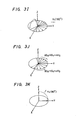
- the embodiment is contrived so that the degradation of image quality ascribable to the spatial inhomogeneity of the RF pulses may be corrected. This will be obvious by supposing a case where, in Figs. 3A - 3K, the gyration angle of a magnetization vector owing to RF pulses shifts at a fixed rate at all times.
- Fig. 2A shows the application sequence of an RF magnetic field H 1
- Figs. 2C, 2D and 2B show the gradient fields G x , Gy and G Z in the directions X, Y and Z respectively
- Fig. 2E shows the sampling interval of a signal
- ⁇ denotes a gyromagnetic ratio inherent in a nuclear spin
- h Planck's constant a gyromagnetic ratio inherent in a nuclear spin
- I i the i-th spin.
- x-, y- and z-coordinates in Figs. 3A - 3K indicate such a rotating coordinate system that X-, Y- and Z-coordinates in a laboratory system are rotating round a Z-axis (the direction of a magnetostatic field) at the frequency ⁇ /(2 ⁇ ) of an RF magnetic field.
- a band-limited RF pulse 90° x of predetermined phase shown at a in Fig. 2A and the gradient field pulse G Z are impressed in combination at the beginning of the interval P1 in Figs. 2A - 2E, to selectively excite the nuclear spin within the two-dimensional plane.
- magnetization vectors at various positions in the two-dimensional plane have precessional frequencies unequal to one another due to G Z and a magnetostatic field inhomogeneity ⁇ H o within the two-dimensional plane.
- the magnetization vector M involves dephasing based on G Z and ⁇ H o when it has fallen down to the xy-plane. Accordingly, G Z is properly inverted after the selective excitation, whereby the dephasing concerning G Z can be canceled as shown in Fig. 3C.
- the dephasing concerning ⁇ H o remains as shown in Fig. 3D.
- a wide-band RF 180° y pulse or 180° -y pulse which shifts in phase by 90 ° from the aforementioned 90° x is impressed after a time ⁇ (b in Fig. 2A).
- G X is applied in the interval P2 in Figs. 2A - 2E thereby to store the spatial information in the X direction into the magnetization vector as phase information (Fig. 3F).
- spatial information in the Y direction is obtained in such a way that an echo signal is observed while Gy is kept impressed upon lapse of a further time ⁇ after the impression of the 180° ⁇ y pulse b in Fig. 2A, thereby to continuously observe phase differences attributed to Gy (Figs. 2A - 2E; interval P3, Fig. 3H).
- the dephasing attributed to ⁇ H o is just canceled at the beginning of the interval P3 (Fig. 3G).
- the operations up to this point of time form a measurement method having hitherto been employed.
- the state of Fig. 3A in which the spin system is sufficiently magnetized is awaited without applying anything to the spin system.
- the wait time needs to be the longitudinal relaxation time T 1 of the object or so, and it is a period of time one or more orders longer than the aforementioned measurement time 3 ⁇ .
- the greater part of a scan time is dissipated here.
- a 180° pulse inphase with the pulse b in Fig. 2A is applied the period of time ⁇ after the point of time at which the signal measurement has been started (Fig. 31), whereupon G x and Gy are applied in the interval P4 so that the product of (amplitude of the field gradient) x (application period of time) may equalize to the product in the case of the gradient fields G X and Gy respectively impressed in the intervals P2 and P3.
- the present embodiment utilizes the Fouriermaschinematography method in which measurements are repeated with the amplitude of G X changed. That is, the measurements of spin signals as based on the pulse sequence of the intervals PI - P4 are repeatedly performed n times (where n denotes the number of elemental areas in the direction X) while the pulse height of G X is successively changed.
- the magnetization vector M is flipped back in the direction of the magnetostatic field as shown in Fig. 3K at the point of time of the end of the interval P4 in Figs. 2A - 2E, so that the magnetization vector of considerable magnitude is prepared in the direction of the magnetostatic field at this point of time. Accordingly, the wait time T r between the successive repeated sequences can be rendered much shorter than in the prior art. That is, the period of time (scan time) for repeating the plurality of times of measurements in order to obtain one image can be remarkably shortened in comparison with that of the prior-art apparatus of the same type.
- a wide-band 180° pulse inphase with or opposite in phase to the band-limited 90° x pulse a that is, a wide-band 180° ⁇ x pulse is used as the pulse b
- a wide-band 180° pulse opposite in phase to the 180° ⁇ x pulse b that is, a 180° ⁇ x pulse is used as the pulse c.
- the wide-band pulses have been used as the 180° pulses and the last 90° pulse d.
- the RF pulses and the pulse sequence are properly contrived, it is also possible to employ only band-limited RF pulses.
- the gradient field pulses have been illustrated,as rising rapidly without considering the switching time of the rise. In actuality, however, transient response is involved in the rise.
- a method of impressing the gradient field pulse Gy as indicated by broken lines in Fig. 2D can avoid the transient response at the rise from adversely affecting the signal measurement. With this method, the gradient field pulse is caused to rise before the beginning of the interval P3 which is the start time of the signal measurement.
- a gradient field pulse G y ' or Gy is applied beforehand
- the present invention is so constructed that gradient magnetic fields and an RF magnetic field after a signal measurement are applied so as to bring the phases of magnetization vectors into agreement and that when the phases have agreed, the magnetization vectors are forcibly flipped back in the direction of a magnetostatic field (spin flip-back).
- a signal amplitude to be thus obtained depends upon the longitudinal relaxation time T 1 and transverse relaxation time T 2 of a spin system, the time interval I between a 90° pulse and a 180° pulse, and a wait time T r . It is possible, however, to obtain a signal approximately equal to a spin density by properly selectiug ⁇ and T .
- a signal having once decayed is created again by the principle of spin flip-back, thereby making it possible to conspicuously shorten the wait time of measurement.
- This method can remarkably shorten the scan time of the present-day NMR-CR and can produce an NMR image of high resolution and excellent image quality, and is greatly effective in that diagnoses can be rendered efficient.
Landscapes
- Physics & Mathematics (AREA)
- High Energy & Nuclear Physics (AREA)
- Condensed Matter Physics & Semiconductors (AREA)
- General Physics & Mathematics (AREA)
- Magnetic Resonance Imaging Apparatus (AREA)
Applications Claiming Priority (2)
| Application Number | Priority Date | Filing Date | Title |
|---|---|---|---|
| JP32309/84 | 1984-02-24 | ||
| JP59032309A JPS60177251A (ja) | 1984-02-24 | 1984-02-24 | Νmrイメ−ジング装置 |
Publications (2)
| Publication Number | Publication Date |
|---|---|
| EP0153703A2 true EP0153703A2 (de) | 1985-09-04 |
| EP0153703A3 EP0153703A3 (de) | 1987-04-15 |
Family
ID=12355337
Family Applications (1)
| Application Number | Title | Priority Date | Filing Date |
|---|---|---|---|
| EP85101900A Withdrawn EP0153703A3 (de) | 1984-02-24 | 1985-02-21 | Gerät zur Bilderzeugung mittels magnetischer Kernresonanz |
Country Status (2)
| Country | Link |
|---|---|
| EP (1) | EP0153703A3 (de) |
| JP (1) | JPS60177251A (de) |
Cited By (2)
| Publication number | Priority date | Publication date | Assignee | Title |
|---|---|---|---|---|
| DE3742490A1 (de) * | 1986-12-15 | 1988-06-23 | Toshiba Kawasaki Kk | Verfahren zur einstellung eines hochfrequenten magnetfeldes |
| EP0278254A1 (de) * | 1987-01-30 | 1988-08-17 | Siemens Aktiengesellschaft | Gerät zur Ermittlung von kernmagnetischen Spektren aus räumlich selektierbaren Bereichen eines Untersuchungsobjektes |
Families Citing this family (1)
| Publication number | Priority date | Publication date | Assignee | Title |
|---|---|---|---|---|
| GB8528551D0 (en) * | 1985-11-20 | 1985-12-24 | Oxford Research Systems Ltd | Performing n m r experiment |
Family Cites Families (3)
| Publication number | Priority date | Publication date | Assignee | Title |
|---|---|---|---|---|
| GB1584948A (en) * | 1978-05-25 | 1981-02-18 | Emi Ltd | Imaging systems |
| GB2052753B (en) * | 1979-05-23 | 1983-08-03 | Emi Ltd | Nmr system |
| US4438400A (en) * | 1982-01-18 | 1984-03-20 | Varian Associates, Inc. | Method for suppression of acoustic ringing in NMR measurements |
-
1984
- 1984-02-24 JP JP59032309A patent/JPS60177251A/ja active Pending
-
1985
- 1985-02-21 EP EP85101900A patent/EP0153703A3/de not_active Withdrawn
Cited By (3)
| Publication number | Priority date | Publication date | Assignee | Title |
|---|---|---|---|---|
| DE3742490A1 (de) * | 1986-12-15 | 1988-06-23 | Toshiba Kawasaki Kk | Verfahren zur einstellung eines hochfrequenten magnetfeldes |
| EP0278254A1 (de) * | 1987-01-30 | 1988-08-17 | Siemens Aktiengesellschaft | Gerät zur Ermittlung von kernmagnetischen Spektren aus räumlich selektierbaren Bereichen eines Untersuchungsobjektes |
| US4801884A (en) * | 1987-01-30 | 1989-01-31 | Siemens Aktiengesellschaft | Apparatus for the identification of nuclear magnetic spectra from spatially selectable regions of an examination subject |
Also Published As
| Publication number | Publication date |
|---|---|
| EP0153703A3 (de) | 1987-04-15 |
| JPS60177251A (ja) | 1985-09-11 |
Similar Documents
| Publication | Publication Date | Title |
|---|---|---|
| US6078176A (en) | Fast spin echo pulse sequence for diffusion weighted imaging | |
| US5168226A (en) | Acquisition of multiple images in fast spin echo nmr scans | |
| US4672320A (en) | Imaging apparatus and method using nuclear magnetic resonance | |
| EP0490528A1 (de) | Korrektur der magnetischen Kernresonanz-Messwerte ermittelt durch Echoplanar-Technik | |
| EP1210614B1 (de) | Verfahren und vorrichtung zur darstellung von bewegungsvorgängen in und an einem objekt mittels phasenmarkierung in der bildgebung mittels magnetischer resonanz | |
| EP0112663B1 (de) | Magnetische Kernresonanzmethode und Vorrichtung | |
| US4553096A (en) | Nuclear magnetic resonance method and apparatus | |
| JPH0351176B2 (de) | ||
| US4642568A (en) | Nuclear magnetic resonance methods and apparatus | |
| EP0165610A2 (de) | Verfahren zur dreidimensionalen Bilderzeugung mit hoher Geschwindigkeit mittels magnetischer Kernresonanz | |
| US4876508A (en) | Method and apparatus for NMR imaging | |
| US4814709A (en) | Method of selecting specific region of sample | |
| EP0470843A2 (de) | Messung der Spinbewegung in KMR-Systemen | |
| US4706023A (en) | Method of reducing artefacts in images formed by means of Fourier zeugmatography | |
| US5233302A (en) | Masking motion ghost artifacts in NMR images | |
| JPH0811112B2 (ja) | 核磁気共鳴を用いた検査装置 | |
| US4786871A (en) | NMR imaging method and apparatus | |
| US4833408A (en) | NMR chemical shift imaging method with influence of intensity distribution of static magnetic field removed | |
| JP3928992B2 (ja) | 磁気共鳴イメージング装置 | |
| EP0207765A2 (de) | Apparat und Verfahren zur Bilderzeugung mittels magnetischer Resonanz durch zusammengesetzte Hochfrequenzimpulse | |
| US4706028A (en) | NMR imaging method | |
| JPH0723929A (ja) | Mri装置 | |
| JPH0244219B2 (de) | ||
| JP4400957B2 (ja) | 磁気共鳴イメージング装置 | |
| JP3332951B2 (ja) | 磁気共鳴イメージング装置 |
Legal Events
| Date | Code | Title | Description |
|---|---|---|---|
| PUAI | Public reference made under article 153(3) epc to a published international application that has entered the european phase |
Free format text: ORIGINAL CODE: 0009012 |
|
| AK | Designated contracting states |
Designated state(s): DE FR GB NL |
|
| PUAL | Search report despatched |
Free format text: ORIGINAL CODE: 0009013 |
|
| AK | Designated contracting states |
Kind code of ref document: A3 Designated state(s): DE FR GB NL |
|
| STAA | Information on the status of an ep patent application or granted ep patent |
Free format text: STATUS: THE APPLICATION IS DEEMED TO BE WITHDRAWN |
|
| 18D | Application deemed to be withdrawn |
Effective date: 19871016 |
|
| RIN1 | Information on inventor provided before grant (corrected) |
Inventor name: KOHNO, HIDEKI Inventor name: KURODA, MASAO Inventor name: MATSUI, SHIGERU Inventor name: SHIONO, HIDEMI Inventor name: YAMAMOTO, ETSUJI |