EP0154343B1 - Adsorbant - Google Patents
Adsorbant Download PDFInfo
- Publication number
- EP0154343B1 EP0154343B1 EP19850102587 EP85102587A EP0154343B1 EP 0154343 B1 EP0154343 B1 EP 0154343B1 EP 19850102587 EP19850102587 EP 19850102587 EP 85102587 A EP85102587 A EP 85102587A EP 0154343 B1 EP0154343 B1 EP 0154343B1
- Authority
- EP
- European Patent Office
- Prior art keywords
- group
- cross
- linked
- amino acid
- stands
- Prior art date
- Legal status (The legal status is an assumption and is not a legal conclusion. Google has not performed a legal analysis and makes no representation as to the accuracy of the status listed.)
- Expired - Lifetime
Links
- 0 C*C(C(*)N(*)*C(C(*)N(*)*)=O)=O Chemical compound C*C(C(*)N(*)*C(C(*)N(*)*)=O)=O 0.000 description 1
Images


Classifications
-
- C—CHEMISTRY; METALLURGY
- C08—ORGANIC MACROMOLECULAR COMPOUNDS; THEIR PREPARATION OR CHEMICAL WORKING-UP; COMPOSITIONS BASED THEREON
- C08G—MACROMOLECULAR COMPOUNDS OBTAINED OTHERWISE THAN BY REACTIONS ONLY INVOLVING UNSATURATED CARBON-TO-CARBON BONDS
- C08G69/00—Macromolecular compounds obtained by reactions forming a carboxylic amide link in the main chain of the macromolecule
- C08G69/02—Polyamides derived from amino-carboxylic acids or from polyamines and polycarboxylic acids
- C08G69/08—Polyamides derived from amino-carboxylic acids or from polyamines and polycarboxylic acids derived from amino-carboxylic acids
-
- B—PERFORMING OPERATIONS; TRANSPORTING
- B01—PHYSICAL OR CHEMICAL PROCESSES OR APPARATUS IN GENERAL
- B01J—CHEMICAL OR PHYSICAL PROCESSES, e.g. CATALYSIS OR COLLOID CHEMISTRY; THEIR RELEVANT APPARATUS
- B01J20/00—Solid sorbent compositions or filter aid compositions; Sorbents for chromatography; Processes for preparing, regenerating or reactivating thereof
- B01J20/281—Sorbents specially adapted for preparative, analytical or investigative chromatography
- B01J20/29—Chiral phases
-
- B—PERFORMING OPERATIONS; TRANSPORTING
- B01—PHYSICAL OR CHEMICAL PROCESSES OR APPARATUS IN GENERAL
- B01J—CHEMICAL OR PHYSICAL PROCESSES, e.g. CATALYSIS OR COLLOID CHEMISTRY; THEIR RELEVANT APPARATUS
- B01J20/00—Solid sorbent compositions or filter aid compositions; Sorbents for chromatography; Processes for preparing, regenerating or reactivating thereof
- B01J20/30—Processes for preparing, regenerating, or reactivating
- B01J20/32—Impregnating or coating ; Solid sorbent compositions obtained from processes involving impregnating or coating
- B01J20/3202—Impregnating or coating ; Solid sorbent compositions obtained from processes involving impregnating or coating characterised by the carrier, support or substrate used for impregnation or coating
- B01J20/3206—Organic carriers, supports or substrates
- B01J20/3208—Polymeric carriers, supports or substrates
- B01J20/321—Polymeric carriers, supports or substrates consisting of a polymer obtained by reactions involving only carbon to carbon unsaturated bonds
-
- B—PERFORMING OPERATIONS; TRANSPORTING
- B01—PHYSICAL OR CHEMICAL PROCESSES OR APPARATUS IN GENERAL
- B01J—CHEMICAL OR PHYSICAL PROCESSES, e.g. CATALYSIS OR COLLOID CHEMISTRY; THEIR RELEVANT APPARATUS
- B01J20/00—Solid sorbent compositions or filter aid compositions; Sorbents for chromatography; Processes for preparing, regenerating or reactivating thereof
- B01J20/30—Processes for preparing, regenerating, or reactivating
- B01J20/32—Impregnating or coating ; Solid sorbent compositions obtained from processes involving impregnating or coating
- B01J20/3202—Impregnating or coating ; Solid sorbent compositions obtained from processes involving impregnating or coating characterised by the carrier, support or substrate used for impregnation or coating
- B01J20/3206—Organic carriers, supports or substrates
- B01J20/3208—Polymeric carriers, supports or substrates
- B01J20/3212—Polymeric carriers, supports or substrates consisting of a polymer obtained by reactions otherwise than involving only carbon to carbon unsaturated bonds
-
- B—PERFORMING OPERATIONS; TRANSPORTING
- B01—PHYSICAL OR CHEMICAL PROCESSES OR APPARATUS IN GENERAL
- B01J—CHEMICAL OR PHYSICAL PROCESSES, e.g. CATALYSIS OR COLLOID CHEMISTRY; THEIR RELEVANT APPARATUS
- B01J20/00—Solid sorbent compositions or filter aid compositions; Sorbents for chromatography; Processes for preparing, regenerating or reactivating thereof
- B01J20/30—Processes for preparing, regenerating, or reactivating
- B01J20/32—Impregnating or coating ; Solid sorbent compositions obtained from processes involving impregnating or coating
- B01J20/3231—Impregnating or coating ; Solid sorbent compositions obtained from processes involving impregnating or coating characterised by the coating or impregnating layer
- B01J20/3242—Layers with a functional group, e.g. an affinity material, a ligand, a reactant or a complexing group
- B01J20/3268—Macromolecular compounds
- B01J20/3272—Polymers obtained by reactions otherwise than involving only carbon to carbon unsaturated bonds
- B01J20/3274—Proteins, nucleic acids, polysaccharides, antibodies or antigens
-
- B—PERFORMING OPERATIONS; TRANSPORTING
- B01—PHYSICAL OR CHEMICAL PROCESSES OR APPARATUS IN GENERAL
- B01J—CHEMICAL OR PHYSICAL PROCESSES, e.g. CATALYSIS OR COLLOID CHEMISTRY; THEIR RELEVANT APPARATUS
- B01J20/00—Solid sorbent compositions or filter aid compositions; Sorbents for chromatography; Processes for preparing, regenerating or reactivating thereof
- B01J20/30—Processes for preparing, regenerating, or reactivating
- B01J20/32—Impregnating or coating ; Solid sorbent compositions obtained from processes involving impregnating or coating
- B01J20/3231—Impregnating or coating ; Solid sorbent compositions obtained from processes involving impregnating or coating characterised by the coating or impregnating layer
- B01J20/3242—Layers with a functional group, e.g. an affinity material, a ligand, a reactant or a complexing group
- B01J20/3268—Macromolecular compounds
- B01J20/328—Polymers on the carrier being further modified
- B01J20/3282—Crosslinked polymers
-
- Y—GENERAL TAGGING OF NEW TECHNOLOGICAL DEVELOPMENTS; GENERAL TAGGING OF CROSS-SECTIONAL TECHNOLOGIES SPANNING OVER SEVERAL SECTIONS OF THE IPC; TECHNICAL SUBJECTS COVERED BY FORMER USPC CROSS-REFERENCE ART COLLECTIONS [XRACs] AND DIGESTS
- Y10—TECHNICAL SUBJECTS COVERED BY FORMER USPC
- Y10T—TECHNICAL SUBJECTS COVERED BY FORMER US CLASSIFICATION
- Y10T428/00—Stock material or miscellaneous articles
- Y10T428/249921—Web or sheet containing structurally defined element or component
- Y10T428/249953—Composite having voids in a component [e.g., porous, cellular, etc.]
-
- Y—GENERAL TAGGING OF NEW TECHNOLOGICAL DEVELOPMENTS; GENERAL TAGGING OF CROSS-SECTIONAL TECHNOLOGIES SPANNING OVER SEVERAL SECTIONS OF THE IPC; TECHNICAL SUBJECTS COVERED BY FORMER USPC CROSS-REFERENCE ART COLLECTIONS [XRACs] AND DIGESTS
- Y10—TECHNICAL SUBJECTS COVERED BY FORMER USPC
- Y10T—TECHNICAL SUBJECTS COVERED BY FORMER US CLASSIFICATION
- Y10T428/00—Stock material or miscellaneous articles
- Y10T428/31504—Composite [nonstructural laminate]
- Y10T428/31725—Of polyamide
- Y10T428/3175—Next to addition polymer from unsaturated monomer[s]
Definitions
- This invention relates to a method of adsorbing substances such as optically active substances with a cross-linked, polymeric material.
- the invention also relates to a cross-linked, polymeric material and the method for the preparation thereof.
- optical resolution namely, the resolution of a racemic mixture into optical antipodes is an extremely important technology in pharmaceutical, agricultural and food industries. According to ordinary procedures, a racemic mixture is converted into a mixture of diastroisomers, which is then separated on the basis of a difference in physical properties. However, the kinds of racemic mixtures which are separable by this method are limited.
- porous silicagel coated with an optically active poly (triphenylmethyl methacrylate).
- an optically active poly triphenylmethyl methacrylate
- the optical resolution is proceeds in an assymmetric area defined by side chains of the poly(amino acid).
- the main chains of the poly(amino acid) must be spased apart from one another, and further the space formed by meshes of the carrier polymer must be filled with a solvent.
- the carrier polymer(skeleton polymer) is hydrophobic (e.g. polystyrene-divinyl benzene) and has no affinity for the solvent (water) used in the racemic resolution of amino acids.
- the Japanese Provisional Publication describes that the affinity of the graft polymer for water can be controlled by varying the ratio of graftic constituents to skeleton polymers.
- a large quantity of poly(amino acid) in exmples: 60.1 % - 82 %) must be grafted, and therefore the main chains of poly(amino acid) are not away with one another.
- the access of optical antipode(amino acid) to the asymmetric area is difficult, and therefore the degree of racemic resolution is very low, or the resolution is impossible.
- the substance to be separated and skeleton polymer can interact with each other such as by adsorption,resulting in the lowering of the selectivity in optical resolution.
- the present invention has been made from a consideration of the above-discussed problems of known techniques of optical resolution of racemic mixtures.
- a cross-linked polymer containing an optically active synthetic poly(amino acid) and a carrier polymer as its constituents can be used as an adsorbent capable of adsorbing one of the racemic bodies preferentially owing to stereostructure of the poly(amino acid) component, asymmetric environment based on such a structure and easiness of access of optical antipode to the assymmetric area, performing optical resolution at a high efficiency.
- the specific stereostructure of the poly(amino acid) permits the use thereof as an adsorbent capable of showing a high preference to specific metal ion unlike known ion exchange resins.
- a method of adsorbing a substance selected from optically active substances, peptides and proteins which comprises contact a solution of the substance in a solvent with an adsorbent, consisting of a cross-linked polymer comprising an optically active, synthetic poly(amino acid) represented by the general formula (I): wherein R stands for an alkyl group, an aromatic group, an aralkyl group or heterocyclic ring containing group, R' stands for hydrogen or an alkyl group and n is an integer of at least 5, and a carrier polymer supporting said synthetic poly(amino acid) thereon, said carrier polymer having an affinity for said solvent.
- an adsorbent consisting of a cross-linked polymer comprising an optically active, synthetic poly(amino acid) represented by the general formula (I): wherein R stands for an alkyl group, an aromatic group, an aralkyl group or heterocyclic ring containing group, R' stands for hydrogen or an alkyl group and n is an integer
- the present invention provides a cross-linked, polymeric material comprising an optically active, synthetic poly(amino acid) represented by the general formula (I) : wherein R stands for an alkyl group, an aromatic group, an aralkyl group or heterocyclic ring containing group, R stands for hydrogen or an alkyl group and n is an integer of at least 5, and a terminal amino group protected as shown by the general formula (II) : wherein R stands for an alkyl group, an aromatic group, an aralkyl group or heterocyclic ring containing group, R' stands for hydrogen or an alkyl group, R" stands for an amino protective group, and m is an integer of at least 4, and a method of producing the above cross-linked polymeric material.
- R stands for an alkyl group, an aromatic group, an aralkyl group or heterocyclic ring containing group
- R stands for hydrogen or an alkyl group
- n is an integer of at least 5
- the present inventor has also found that by protecting the terminal amino group of the poly(amino acid) with a suitable protective group represented by the following general formula (II): wherein R, R' has the same meaning as above, R" stands for an organic group and m is an integer not less than 4, acid-base adsorption which is undesirable in the optical resolution of racemic mixtures can be prevented so that the efficiency of the optical resolution as well as the recovery rate of isomers can be improved markedly.
- a suitable protective group represented by the following general formula (II): wherein R, R' has the same meaning as above, R" stands for an organic group and m is an integer not less than 4, acid-base adsorption which is undesirable in the optical resolution of racemic mixtures can be prevented so that the efficiency of the optical resolution as well as the recovery rate of isomers can be improved markedly.
- the present invention provides an adsorbent, formed of the above cross-linked polymeric material protected at terminal amino group.
- the organic group R may be of any kind, for example, may be an alkyl group, an aromatic group such as a phenyl group, an aralkyl group or a heterocyclic ring-containing group having nitrogen as a ring constituent.
- the group R may form a ring together with the nitrogen atom of the same amino acid unit
- These groups may contain various substituents such as -OH, -COOH, -SH, -NH2 and -SCH3.
- substituents may take the following forms.
- -OH and -SH may be in the form of an ether (e.g., methyl ether and benzyl ether) or the form having an acyl group bonded thereto
- -COOH may be in the form of an ester or amide
- -NH2 may be in the form having a carbobenzoxyl group bonded thereto.
- the group R' is hydrogen or an alkyl group such as a methyl group or an ethyl group.
- the group R" located at the N-terminal represented by general formula(II) is hydrogen or an organic group.
- R, R' has the same meaning as above, m is an integer not less than 4. It is preferred that the group R" be organic group of a type which is capable of lowering the basicity of the terminal amino group since, as the basicity is lowered, the contribution of acid-base adsorption is reduced and, hence, the selectivity of adsorption is improved.
- Examples of the organic group R" include an urethane type protective group which is known as an amino protective group in the field of peptide synthesis, such as a carbobenzoxy group or tert-butoxycarbonyl group; an acyl type protective group such as a formyl group, acetyl group, benzoyl group, phthalyl group or tosyl group; or an alkyl type protective group such as a trityl group.
- the protective group is preferred to be chemically stable and hardly eliminated.
- the acetyl group (CH3CO-) or benzoyl group (C6H5CO-) is preferred to the formyl group (HCO-).
- ⁇ -amino carboxylic acids the constituent monomer unit of the synthetic poly(amino acid) include: optically active amino acids constituting protein, for example, alanine, valine, leucine, phenylalanine, proline and the like; D- or L-type derivatives of protein-forming amino acids such as ⁇ -benzyl aspartate, ⁇ -methyl glutamate, ⁇ -benzyl gultamate, ⁇ -carbobenzoxylysine, ⁇ -carbobenzoxy- ornithine, o-acetyltyrosine, o-benzylserin and the like; and optically active ⁇ -aminocarboxylic acids other than protein forming amino acids, including sarcosine and its derivatives.
- optically active amino acids constituting protein for example, alanine, valine, leucine, phenylalanine, proline and the like
- D- or L-type derivatives of protein-forming amino acids such as ⁇ -
- n is an integer not less than 5 and normally not greater than 100, preferably from 10 to 40.
- the adsorbent used in the present invention comprises the cross-linked polymer which contains as its constituent an optically active synthetic poly(amino acid) and/or its derivative and carrier polymer.
- the cross-linking may be effected either by reacting a cross-linking agent with an optically active, synthetic poly(amino acid), by copolymerizing an optically active, synthetic poly(amino acid) having a polymerizable vinyl group at its terminal with a monomer containing a polymerizable vinyl group, or by grafting a poly(amino acid) onto a cross-linked, polymeric carrier through the reaction of the carrier with an optically active poly(amino acid) or an -amino acid anhydride.
- the structure of the cross-linked portion varies depending on the method of manufacture. Since the excellent substrate selectivity of the adsorbent is attributed to the optically active poly(amino acid) and/or its derivative, other constituents may be of any kind as long as they are polymers. However, they are preferred to be able to swell in a solvent to be used in the adsorbing stage. Namely, it is preferred that the constituents other than the poly(amino acid) be a hydrophilic polymer in a case using water as the solvent e.g. the racemic resolution of amino acids, and be a hydrophobic polymer in a case of using as the solvent an organic compound such as benzene, toluene or the like e.g.
- a hydrophilic carrier polymer has a hydroxyl group or an amide group, examples thereof include a glycidylmethacrylate-ethyleneglycol-dimethacrylate copolymer, an acrylamide-methylenebisacrylamide copolymer.
- a hydrophobic carrier polymer has a non-polar group, example thereof includes a styrene-divinyl benzene copolymer. And poly(amino acid) itself may also be carrier polymer.
- the molecular weight and the cross-linking density of the cross-linked polymer used in the invention are suitable selected according to the substance to be adsorbed.
- the proportion of the synthetic poly(amino acid) in the cross-linked polymer is also suitably selected although it is in the range of 1-99 wt%, preferable in the range of 10-60 wt%.
- the adsorbing action of the polymeric material of this invention varies depending upon the solvent system to be used and also upon the function groups and configuration of the substance to be treated. Therefore, in consideration of these consitions, the kind of the amino acid and the cross-linking density of the polymer of the invention can be varied appropriately.
- poly(amino acids) may be used in the form of a mixture.
- R, R' and R" of the amino acid constituent unit can be varied in various ways within one molecule.
- an optically inactive amino acid like glycine may be incorporated into the abovementioned optically active poly(amino acid), if desired.
- the polymeric material according to the present invention is particularly useful as an adsorbent.
- the adsorption activity is adjustable by varying the cross-linking density and porosity of the polymeric material.
- the cross-linking density is suitably determined according to its substance to be treated and generally is rendered smaller as the molecular weight of the substance to be treated is increased.
- the adsorbent of this invention can be made porous by the use of a diluent as will be described hereinafter.
- the pore diameter is controlled of correspondence to the molecular diameter of the substance to be treated (normally a pore diameter is about 10 times as great as the molecular diameter of the substance).
- the cross-linking adsorbent is varied depending upon its porosity.
- the cross-linking density is preferably in the range of 0.01-50 % more preferably in the range of 0.5-10 %.
- the cross-linking density is preferably 0.1-100 %, more preferably 5-30 %.
- the amino acids of the cross-linked polymer for use as the adsorbent of this invention are to be selected in correspondence to the solvent system used in the adsorption stage.
- hydrophobic amino acids such as valine, leucine and phenylalanine
- acidic amino acids such as lysine and ornithine
- amino acid derivatives having interaction by a hydrophobic bond, hydrogen bond or steric hindrance such as ⁇ -benzyl aspartate, ⁇ -benzyl glutamate, N-benzyl glutamine, N-benzyl asparagine, N-cyclohexyl glutamine and N-cyclohexyl asparagine; may be suitably used as the amino acid components.
- the polymeric material used in the present invention can be suitably produced by the following four separate methods.
- the optically active, synthetic poly(amino acid), which has chemically convertible side chains may be subjected to chemical conversion to convert, for instance, its ester groups to amide groups, thereby forming an optically active synthesized poly(amino acid) with a different chemical structure.
- This chemical conversion is effective to obtain an adsorbent suitable for the adsorption of a particular substance.
- Constituents of the cross-linked polymer except the poly(amino acid), such as the cross-linked polymer carrier and the like, may also be subjected to a chemical conversion for converting their chemical structures.
- the copolymeric carrier may, after supporting thereon the poly(amino acid), be hydrolyzed for the cleavage the rings of the epoxy groups remaining therein in order to impart hydrophilicity thereto.
- This chemical conversion is also effective for obtaining an adsorbent suitable for a particular substance to be separated.
- the poly(amino acid) may be obtained using as an initiator for NCA a customarily used initiator in place of the monofunctional primary amine.
- a customarily used initiator in place of the monofunctional primary amine.
- known initiators are secondary amines, tertiary amines, quaternary ammonium salts, alkali metal alkoxides, boron hydrides, boron oxides, inorganic salts, organometallic compounds and polymers having an amino group at their terminals.
- the N-terminal or terminals of the poly(amino acid) in the cross-linked, polymeric material be protected by an organic group.
- the protection of the N-terminals may be conducted after the preparation of the non-protected polymer.
- the protection of the N-terminals may be done either before or after the chemical conversion.
- it is preferred that the amino terminal be protected subsequent to the conversion reaction.
- the conversion reaction has a possibility of rendering the side chain of the poly(amino acid) susceptible to reaction with a protective reagent, it is preferable to protect the amino terminal prior to the conversion reaction.
- the condition of the reaction for protecting the terminal amino group are determined suitable depending upon the kind of the reagent to be employed. For example, when an acetyl group is introduced as a protecting group, the crosslinked polymer carrying the poly(amino acid) is first swelled with a suitable solvent, for instance, dioxane, and the mixture, after being added with acetic anhydride in an amount of 1-1000 times the amount of the terminal amino group, in terms of chemical equivalent, is then stirred at a temperature of 5°C to 70°C.
- a suitable solvent for instance, dioxane
- the adsorbent of the invention can exhibit markedly improved yield of the resolved substance, showing a sharp peak on the chromatogram with a reduced tailing. It follows that, when the polymeric material of the present invention is used for resolution of a racemic mixture, peaks of the respective optically active units are less overlapped one on another and each one of recovered optically active units has a higher optical purity.
- the polymeric material used in the present invention can be suitable used as an adsorbent for optical resolution.
- the resolution may be either by a batchwise process or by column chromatography. In the case of separation of an optically active substance which is hardly separable, it is desirable to sieve the crosslinked polymer before use in column chromatography.
- the column chromatography is carried out in the manner as follows.
- the adsorbent is suspended in a solvent to be used as an eluent, and the resulting suspension is put into a column.
- the substance to be separated is dissolved in a solvent of as small an amount as possible, and the resulting solution is transferred to the top of the column, treating the column with the eluent and collecting the elute in a number of fractions by ordinary procedures.
- the degree of resolution of the racemic bodies can be determined by measuring the optical rotation of the respective fractions.
- racemic mixtures by the use of the cross-linked polymer adsorbent according to the invention. For instance, racemic mixtures of hydroxycarboxylic acids, amino acids and derivatives of these compounds can be resolved efficiently.
- the crystals had a melting point of 93-94°C and a molecular weight of 263, and the yield was 50 g.
- the polymer had a number-average molecular weight of about 8300.
- a solution containg 5.0 g of the PBLG, 10.0 g of glicidyl methacrylate (hereinafter referred to as GMA), 27.0 g of 1,2-dichloroethane, 3.0 g of DMF and 1.0 g of triethylamine was stirred at 50°C for 1 hour, to which was then added 0.075 g of ⁇ , ⁇ '-azoisobutylonitrile (hereinafter referred to as AIBN) and 1.0 g of 1,2-dichloroethane. After mixing thoroughly, 1.35 g of polyvinylalcohol and 135.0 g of water were added to the mixture.
- GMA glicidyl methacrylate
- AIBN ⁇ , ⁇ '-azoisobutylonitrile
- the resultant mixture was stirred at 60°C for 16 hours in the atmosphere of nitrogen at a revolutional speed of about 600 rotation/min to obtain a cross-linked polymer.
- the polymer was filtered, washed successively with hot water, DMF, methanol and acetone and dried at about 60°C under vacuo.
- the resultant cross-linked polymer was white opaque spherical gel.
- the yield was 10.0 g.
- the elementary analysis value of N is almost zero when no amino acids are used. Therefore, it is evident that the abovementioned N is derived from the amino acid.
- the content of PBLG calculated from the elementary analysis value (N: 2.81 %) is 28.7 %.
- a solution consisting of 2.0 g of chloromethylstyrene, 2.74 g of 55 % divinylbenzene (cross-linking agent), 95.26 g of styrene and 0.67 g of 75 % dibenzoyl peroxide was added to a solution consisting of 4.0 g of polyvinyl alcohol and 400 g of water. This mixture was stirred in the atmosphere of nitrogen at 70°C for 10 hours at a speed of 1000 r.p.m. The resulting cross-linked polymer of chloromethylstyrene-styrene-divinylbenzene copolymer was isolated in the same manner as in Example 2. The cross-linked polymer was translucent sphereical gel.
- a solution containing 35 g of acrylamide, 15 g of methylenebis (acrylamide), 0.05 g of azobis(2-amidinopropane) dihydrochloric acid salt, 50 g acetonitrile and 50 g of water was added to a solution containing 10.5 g of ethyl cellulose and 1050 g of cyhclohexane.
- the mixture was stirred at 50°C for 10 hours in the atmosphere of nitrogen to obtain a cross-linked polymer in the form of a white porous hard spherical gel composed of an acrylamide-methylenelbis (acrylamide) copolymer.
- the cross-linked polymer was isolated in the same manner as that of Example 2, 20 g of which was then dispersed in 150 ml of ethylenediamine. After stirring at 60 °C for 4 hours, the dispersion was filtered and the precipitate was washed and completely dried.
- a solution containing 180 g of GMA, 20 g of ethylene glycol dimethacrylate, 250 g of 1,2-dichloropropane, 62.5 g of lauryl alcohol and 1.0 g of AIBN was mixed to a solution containing 15.4 g of polyvinyl alcohol and 1540 g of water. The mixture was then stirred at 60°C for 10 hours at 1000 r.p.m. The resultant cross-linked polymer was isolated and purified in the same manner as that of Example 2 to give a translucent, porous, spherical gel.
- cross-linked polymer 160 g was dispersed in 640 g of a dioxane solution containing 0.02 % ammonia and the dispersion stirred at 60°C for 6 hours for the introduction of a primary amino group.
- porous, cross-linked polymer carrier 120 g was dispersed in a solution containing 24 g of ⁇ -benzyl-L-aspartate NCA and 840 ml of DMF and the dispersion was stirred at 30°C for 72 hours in the atmosphere of nitrogen to effect the polymerization of the NCA.
- the epoxy rings (derived from GMA) remaining in the PBLA-containing, cross-linked polymer were hydrolyzed in the same manner as Example 2 to open the rings and to impart hydrophilicity to the polymer.
- PCLL cross-linked polymer carrying poly ( ⁇ -carbobenzoxy-L-lysine)
- the content of PCLL was 15.4 % and the degree of polymerization was 10.9.
- the PCLL-carrying, cross-linked polymer was subjected to hydrolysis in the same manner as that of Example 2 for opening the epoxy rings remaining therein.
- the hydrolyzed product was dispersed in 50 ml of a saturated HBr acetic acid solution and the dispersion was stirred at room temperature for 4 hours.
- the resulting cross-linked polymer with its carbobenzoxy groups being removed was filtered, washed with aqueous ammonia and water, and dried under vacuo.
- PBLG polymerization degree (n) of 10 were prepared in the same method as used in Example 2. Then a mixture containing 10 g of the PBLG, 20 g of the cross-linked polymer of Example 6 into which no primary amine was introduced, 60 g of dioxane and 60 g of DMF was stirred at 60 °C for 72 hours, from which a cross-linked polymer of a GMA-ethylene glycol dimethacrylate copolymer carrying PBLG was isolated and purified. The amount of PBLG was 5.3 %.
- the cross-linked polymer was white, porous, spherical gel.
- a cross-linked polymer with its chloromethyl group being converted to an aminomethyl group was 0.18 %.
- cross-linked polymer carrying poly ( ⁇ -benzyl-D-glutamate) was treated in the same manner as in Example 4 to convert benzyl ester into benzyl amide.
- the conversion was about 80 %.
- the IR spectrum showed a new absorption at 2350 cm ⁇ 1 attributed to a nitrile group.
- the results of the elementary analysis are as follows. The increase in nitrogen content is considered to result from the conversion of the methyl ester into cyanoethyl ester.
- the cyanoethyl ester which is so-called active ester may be easily converted into amides by reaction with various amines.
- active ester there may be mentioned esters having an electron-attractive group such as chloroethyl ester, trichloroethyl ester and trifluoroethyl ester.
- the polymer obtained by reaction with benzylamine was found to have substantially the same structure as the cross-linked polymeric material obtained in Example 4.
- the results of this example indicate that various kinds of polymeric materials can be easily obtained by simple modification treatment. This is advantageous because of the availability of polymeric materials suitably for specific substances to be adsorbed thereon.
- PBLA-carrying cross-linked polymer was treated in the same manner as in Example 13 to convert benzyl ester into benzyl amide.
- the porous, cross-linked polymer carrier containing no PBLA (obtained in Example 6) was subjected to hydrolysis in the same manner as that Example 2 for opening the epoxy rings thereof.
- the cross-linked polymers obtained in Examples 3 and 4 were each classified by metal sieves of 250 and 400 mesh to sort out particles of 37-63 ⁇ m in diameter. These classified cross-linked polymers were used as a filler in chromatography for the resolution of DL-mandelic acid. Used for liquid feed and detection was Shimazu LC-4A type high speed liquid chromatography unit, under the following conditions.
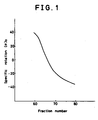
- Fig. 1 there is shown the results of the measurement of specific rotation of each fraction obtained with the use of a fraction collector in the case of the cross-linked polymer of Example 4 (using a polarimeter DIP-140 (Nihon Bunko).
- the fractionation rate was one fraction per minute. Since L-mandelic acid shows a positive specific rotary power, it will be seen from the Fig. 1 that the L-form is eluted before D-form which is more strongly bound to the adsorbent of this invention.
- the difference in adsorptivety difference in elution rate
- Example 16 was repeated in the same manner as described except that the polarimeter DIP-140 was replaced by a flow-cell type polarimeter DIP-181C (Nihon Bunko) connected directly to the column.
- the results are shown in Fig. 2. From Fig. 2, it will be seen that L-form having a positive optical rotation was eluted at an early state of chromatography while the D-form was eluted at a later stage. Similar experiments were conducted using various racemic mixtures.
- the cross-linked polymer obtained in Example 10 was classified to collect particles with a size of 20-40 ⁇ m.
- the resolution of DL-mandelic acid was carried out in the same manner as that in Example 16 with the use of the classified, cross-linked polymer.
- the specific rotation of the initial fraction was -98 while that of the final one was 60.
- the adsorbent adsorbs the L-form so that the D-form is eluted before the L-form.
- the adsorptivity of the D and L-forms is contrary to that in Example 16. This indicates that the adsorption properties of the adsorbent of this invention can be varied by varying the kind of the poly(amino acid).
- the resolution of DL-mandelic acid was carried out in the same manner as that in Example 16 using the cross-linked polymer obtained in Example 7.
- a phosphoric acid buffer solution of pH 4 was used as an eluent.
- the specific rotary power was -55 in the initial fraction and 48 in the final fraction.
- BSA bovine serum albumin
- BSA (25 mg) was dissolved in 25 ml of a phosphoric acid buffer solution of pH 5, to which were mixed 5 g of the cross-linked polymer. The mixture was agitated for a day, followed by filtration of the polymer. The concentration of BSA in the filtrate was measured based on the absorption at 280 nm. The adsorptivity of BSA was 95.9 % in the case of the polymer of Example 6 and 20.2 % in the case of the polymer of Comparative Example 1. The measurement was effected with Hitachi 200-20 type spectrometer.
- cupric chloride 100 mg were dissolved in 25 ml of an acetic acid buffer solution of pH 4.5, to which were added 5 g of the cross-linked polymer. After agitation for a day, the polymer was filtered off. The concentration of copper ion in the filtrate was measured by titration with EDTA, The adsorptivity of copper ion was 98.5 % in the case of the polymer of Example 7, 98.3 % in the case of the polymer of Example 8 and 5.7 % in the case of the polymer of Comparative Example 1.
- the cross-linked polymers obtained before and after the acetylation of the terminal amino group in Example 13 were classified by metal sieves of 250 and 400 mesh to sort out particles of 37-63 ⁇ m in diameter. These classified cross-linked polymers were used as a filler in chromatography to measure the retention time for D- and L-mandelic acids. Used for liquid feed and detection was Shimazu LC-4 type high speed liquid chromatography unit, under the following conditions.
- Fig. 3 Shown in Fig. 3 is the chromatogram for D-mandelic acid, in which curve 1. is of after acetylation and curve 2 is of before acetylation.
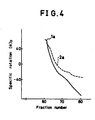
- Fig. 4 shows the results of measurement (by DIP type polarimeter of Nihon Bunko) of specific rotation of the respective fractions in resolution of racemic mixture of DL-mandelic acid using the cross-linked polymer, taking one fraction per minute, in which curve 1a is of after acetylation and curve 2a is of before acetylation.
- This adsorbent has a strong adsorptive power on D-type, so that L-type is firstly eluted as reflected by (+) optical rotation, and then D-type is eluted as reflected by (-) optical rotation.
- the cross-linked polymers obtained before and after benzoylation of the terminal in Example 14 were respectively classified to sort out the sizes of 20-40 ⁇ m. These classified polymers were used for resolution and separation of DL-mandelic acid in the same manner as in Example 22 except that the column temperature was at 25°C. In the case of the cross-linked polymer without benzoylation of the terminal amino group, only 15.6mg out of 100 mg of introduced sample was recovered, with the remainder being adsorbed on the polymer. Accordingly, it was impossible to measure the specific rotary power of the respective fractions obtained.
- This adsorbent had a stronger adsorptive action on L-type, so that D-type was eluted prior to L-type.
- the adsorbent with the benzoylated terminal amino group can perform the resolution and recovery of DL-mandelic acid more efficiently and is found to be a very useful adsorptive separator.
Landscapes
- Chemical & Material Sciences (AREA)
- Analytical Chemistry (AREA)
- Organic Chemistry (AREA)
- Chemical Kinetics & Catalysis (AREA)
- Health & Medical Sciences (AREA)
- Medicinal Chemistry (AREA)
- Polymers & Plastics (AREA)
- Life Sciences & Earth Sciences (AREA)
- Biochemistry (AREA)
- General Health & Medical Sciences (AREA)
- Molecular Biology (AREA)
- Addition Polymer Or Copolymer, Post-Treatments, Or Chemical Modifications (AREA)
- Solid-Sorbent Or Filter-Aiding Compositions (AREA)
Claims (27)
- Un procédé pour adsorber une substance choisie parmi des substances optiquement actives, des peptides et des protéines, qui comprend la mise en contact d'une solution de la substance dans un solvant avec un adsorbant, constitué d'un polymère réticulé comprenant un poly(acide aminé) synthétique, optiquement actif, représenté par la formule générale (I):

- Procédé tel que revendiqué dans la revendication 1, dans lequel le poly(acide aminé) lui-même est le polymère support.
- Procédé tel que revendiqué dans la revendication 1 ou 2, dans lequel la substance est hydrophile, le solvant est l'eau et le polymère support est un polymère hydrophile.
- Procédé tel que revendiqué dans la revendication 3, dans lequel le polymère support hydrophile possède un groupement hydroxyle ou un groupement amide.
- Procédé tel que revendiqué dans la revendication 4, dans lequel le polymère support hydrophile est un copolymère méthacrylate de glycidyle-diméthacrylate d'éthylèneglycol, un copolymère acrylamide-méthylènebis(acrylamide).
- Procédé tel que revendiqué dans la revendication 1 ou 2, dans lequel le solvant est un solvant organique et le polymère support est un polymère hydrophobe.
- Procédé tel que revendiqué dans la revendication 6, dans lequel le polymère support hydrophobe possède un groupement non polaire.
- Procédé tel que revendiqué dans la revendication 7, dans lequel le polymère support hydrophobe est un copolymère styrène-divinylbenzène.
- Un matériau polymère réticulé, comprenant un poly(acide aminé) synthétique, optiquement actif, représenté par la formule générale (I):

un groupement terminal amino protégé, représenté par la formule générale (II):
- Un adsorbant formé d'un matériau polymère réticulé tel que revendiqué dans la revendication 9.
- Un matériau polymère réticulé tel que revendiqué dans la revendication 9 et obtenu par un procédé comprenant les étapes consistant à:
fournir un support polymère réticulé, porteur de groupements amino,
polymériser un anhydride N-carboxylique représenté par la formule générale
protéger les groupements terminaux amino par un groupement protecteur d'amino. - Matériau polymère réticulé tel que revendiqué dans la revendication 11, dans lequel ledit support est un copolymère réticulé chlorométhylstyrène-styrène-divinylbenzène dont le groupement chlorométhyle est converti en un groupement aminométhyle ou en un groupement aminométhyle substitué par un groupement aminoalkylène.
- Matériau polymère réticulé tel que revendiqué dans la revendication 12, dans lequel ledit copolymère réticulé chlorométhylstyrène-styrène-divinylbenzène est obtenu par chlorométhylation de copolymère styrène-divinylbenzène.
- Matériau polymère réticulé tel que revendiqué dans la revendication 11, dans lequel ledit support est un copolymère réticulé acrylamide-méthylènebis(acrylamide) ou un copolymère réticulé méthacrylate de glycidyle-diméthacrylate d'éthylèneglycol au sein duquel est introduite une alkylamine.
- Matériau polymère réticulé tel que revendiqué dans la revendication 11, dans lequel ledit support se présente sous forme poreuse.
- Matériau polymère réticulé tel que revendiqué dans la revendication 9, dans lequel le substituant R porte un groupement choisi parmi -OH, -COOH, -SH, -NH₂ et -SCH₃ et des dérivés de ceux-ci.
- Matériau polymère réticulé tel que revendiqué dans la revendication 16, dans lequel le groupement est un amide.
- Un procédé pour préparer un polymère réticulé comprenant un poly(acide aminé) synthétique, optiquement actif, représenté par la formule générale (I):

polymériser un anhydride N-carboxylique représenté par la formule générale suivante
réticuler le poly(acide aminé) en présence d'un agent de réticulation. - Procédé tel que revendiqué dans la revendication 18, dans lequel ledit initiateur est une polyamine, choisie dans le groupe constitué par l'éthylènediamine, l'hexaméthylènediamine, la diéthylènetriamine et ledit agent de réticulation est choisi dans le groupe constitué par des polyisocyanates et des résines époxydes.
- Un procédé pour préparer un polymère réticulé comprenant un poly(acide aminé) synthétique, optiquement actif, représenté par la formule générale (I):

polymériser un anhydride N-carboxylique représenté par la formule générale suivante:
faire réagir le poly(acide aminé) avec un composé porteur de groupement vinyle polymérisable, pour former un macromère portant le groupement vinyle polymérisable, et
copolymériser le macromère avec un monomère porteur de groupement vinyle copolymérisable. - Procédé tel que revendiqué dans la revendication 20, dans lequel ledit initiateur est une amine choisie dans le groupe constitué par l'éthylènediamine, l'hexaméthylènediamine, la diéthylènetriamine, la n-butylamine, la n-propylamine et la n-hexylamine, ledit composé porteur de groupement vinyle polymérisable est choisi dans le groupe constitué par le chlorure d'acide acrylique, le méthacrylate de glycidyle et le chlorométhylstyrène et ledit monomère porteur de groupement vinyle copolymérisable est choisi dans le groupe constitué par le méthacrylate de 2-hydroxyéthyle, l'acrylamide, l'acétate de vinyle, le méthacrylate de glycidyle, le styrène, le méthacrylate de méthyle, le divinylbenzène, le méthylène-bis(acrylamide) et le diméthacrylate d'éthylèneglycol.
- Un procédé pour préparer un polymère réticulé comprenant un poly(acide amine) synthétique, optiquement actif, représenté par la formule générale (I):

polymériser un anhydride N-carboxylique représenté par la formule générale:
faire réagir ledit poly(acide aminé) avec un support polymère réticulé, de façon que ledit poly(acide aminé) soit supporté par ledit support. - Procédé tel que revendiqué dans la revendication 22, dans lequel ledit initiateur est une alkylamine monofonctionnelle et ledit support possède un groupement fonctionnel capable de réagir avec un groupement amino.
- Procédé tel que revendiqué dans la revendication 22, dans lequel ledit support est un copolymère méthacrylate de glycidyle-diméthacrylate d'éthylèneglycol.
- Procédé tel que revendiqué dans la revendication 22, dans lequel ledit support se présente sous forme poreuse.
- Procédé pour préparer un matériau polymère réticulé tel que revendiqué dans la revendication 18, 20 ou 22, dans lequel le matériau polymère réticulé avec son poly(acide aminé) de formule (I) possède un groupement ester et la procédé comprend de plus la conversion du groupement ester du matériau polymère réticulé en un groupement ester actif, et la conversion du groupement ester actif en un amide.
- Procédé tel que révendiqué dans la revendication 26, dans lequel le groupement ester actif est l'ester cyanoéthylique, l'ester chloroéthylique, l'ester trichloroéthylique ou l'ester trifluoroéthylique.
Applications Claiming Priority (4)
| Application Number | Priority Date | Filing Date | Title |
|---|---|---|---|
| JP4406584A JPS60193538A (ja) | 1984-03-09 | 1984-03-09 | 吸着剤 |
| JP44065/84 | 1984-03-09 | ||
| JP144372/84 | 1984-07-13 | ||
| JP14437284A JPS6125639A (ja) | 1984-07-13 | 1984-07-13 | 吸着剤 |
Publications (3)
| Publication Number | Publication Date |
|---|---|
| EP0154343A2 EP0154343A2 (fr) | 1985-09-11 |
| EP0154343A3 EP0154343A3 (en) | 1986-08-13 |
| EP0154343B1 true EP0154343B1 (fr) | 1991-06-19 |
Family
ID=26383910
Family Applications (1)
| Application Number | Title | Priority Date | Filing Date |
|---|---|---|---|
| EP19850102587 Expired - Lifetime EP0154343B1 (fr) | 1984-03-09 | 1985-03-07 | Adsorbant |
Country Status (3)
| Country | Link |
|---|---|
| US (3) | US4694044A (fr) |
| EP (1) | EP0154343B1 (fr) |
| DE (1) | DE3583248D1 (fr) |
Families Citing this family (45)
| Publication number | Priority date | Publication date | Assignee | Title |
|---|---|---|---|---|
| US4694044A (en) * | 1984-03-09 | 1987-09-15 | Research Development Corp. Of Japan | Adsorbent |
| JPH0657722B2 (ja) * | 1986-05-27 | 1994-08-03 | 三菱化成株式会社 | 水溶性ポリマ−組成物 |
| DE3619303A1 (de) * | 1986-06-07 | 1987-12-10 | Merck Patent Gmbh | Optisch aktive adsorbentien |
| US4923616A (en) * | 1987-09-24 | 1990-05-08 | Mitsubishi Petrochemical Company, Ltd. | Method of separating chemical components in simulated moving bed |
| US5133866A (en) * | 1988-03-24 | 1992-07-28 | Terrapin Technologies, Inc. | Method to identify analyte-bending ligands |
| US4963263A (en) * | 1988-03-24 | 1990-10-16 | Terrapin Technologies, Inc. | Method of identity analyte-binding peptides |
| CA1329800C (fr) * | 1987-12-29 | 1994-05-24 | Hiroaki Takayanagi | Agent composite de separation |
| US5096971A (en) * | 1988-10-24 | 1992-03-17 | Mitsubishi Kasei Corporation | Adsorbent for optical resolution and resolution method employing it |
| US5645717A (en) * | 1989-01-13 | 1997-07-08 | Bio-Rad Laboratories, Inc. | Hydrophobic polymers from water-soluble monomers and their use as chromatography media |
| US5043062A (en) * | 1989-02-21 | 1991-08-27 | Eastman Kodak Company | High performance affinity chromatography column comprising non-porous, nondisperse polymeric packing material |
| EP0467339A1 (fr) * | 1990-07-18 | 1992-01-22 | Mitsubishi Kasei Corporation | Particules polymères réticulées gonflables par l'eau et leur procédé de préparation |
| JP2558007B2 (ja) * | 1990-10-31 | 1996-11-27 | 株式会社資生堂 | 液体クロマトグラフィー用充填剤およびその製造方法 |
| JP3168006B2 (ja) * | 1991-10-21 | 2001-05-21 | コーネル・リサーチ・フアウンデーシヨン・インコーポレーテツド | マクロ細孔ポリマー媒体が備わっているカラム |
| AU675446B2 (en) * | 1992-07-27 | 1997-02-06 | Terrapin Technologies, Inc. | Sorbent families |
| DE69522483T2 (de) * | 1994-03-01 | 2002-04-25 | Mitsubishi Chemical Corp., Tokio/Tokyo | Methode zur Demineralisierung von Wasser oder einer wässerigen Flüssigkeit |
| JP3460340B2 (ja) * | 1994-09-09 | 2003-10-27 | Jsr株式会社 | ポリ−α−アミノ酸のエマルジョンおよびその製造方法並びにポリ−α−アミノ酸の中空ポリマー粒子 |
| US5965635A (en) * | 1995-06-07 | 1999-10-12 | Illinois Tool Works Inc. | Alkylacrylate ester composition for anchoring materials in or to concrete or masonry |
| US5519064A (en) * | 1994-10-28 | 1996-05-21 | The Dow Chemical Company | Surface-modified post-crosslinked adsorbents and a process for making the surface modified post-crosslinked adsorbents |
| US5683800A (en) * | 1994-10-28 | 1997-11-04 | The Dow Chemical Company | Surface-modified post-crosslinked adsorbents and a process for making the surface modified post-crosslinked adsorbents |
| US5935429A (en) * | 1997-01-03 | 1999-08-10 | Bio-Rad Laboratories, Inc. | Chromatography columns with continuous beds formed in situ from aqueous solutions |
| US6013738A (en) * | 1997-09-23 | 2000-01-11 | Board Of Supervisors Of Louisiana State University And Agricultural And Mechanical College | Composition and method for chiral separations |
| US6274041B1 (en) | 1998-12-18 | 2001-08-14 | Kimberly-Clark Worldwide, Inc. | Integrated filter combining physical adsorption and electrokinetic adsorption |
| US6537614B1 (en) | 1998-12-18 | 2003-03-25 | Kimberly-Clark Worldwide, Inc. | Cationically charged coating on hydrophobic polymer fibers with poly (vinyl alcohol) assist |
| US6645388B2 (en) | 1999-12-22 | 2003-11-11 | Kimberly-Clark Corporation | Leukocyte depletion filter media, filter produced therefrom, method of making same and method of using same |
| US6365706B1 (en) | 2000-06-21 | 2002-04-02 | Mississippi Chemical Corporation | Process for production of polyasparagine and the high nitrogen content polymer formed thereby |
| DE10045434B4 (de) * | 2000-09-14 | 2005-07-14 | Fresenius Hemocare Gmbh | Adsorbens mit unterschiedlich modifizierten Oberflächenbereichen, Verfahren zu dessen Herstellung und Verwendung davon |
| WO2002030853A1 (fr) * | 2000-10-13 | 2002-04-18 | Daicel Chemical Industries, Ltd. | Matiere de remplissage pour separation d'isomeres optiques et procede permettant la separation d'isomeres optiques au moyen de cette matiere de remplissage |
| US20040198974A1 (en) * | 2001-08-17 | 2004-10-07 | Kurt Guenther | Chromatographic separation of enantiomers of protected amino acids via smb-method |
| FR2834227A1 (fr) * | 2001-12-27 | 2003-07-04 | Chiralsep Sarl | Materiaux supports optiquement actifs, leur procede de preparation et leurs utilisations |
| US7473367B2 (en) * | 2002-06-26 | 2009-01-06 | Dionex Corporation | Monolithic column |
| US6749749B2 (en) | 2002-06-26 | 2004-06-15 | Isco, Inc. | Separation system, components of a separation system and methods of making and using them |
| US20050061745A1 (en) * | 2002-06-26 | 2005-03-24 | Teledyne Isco, Inc. | Separation system, components of a separation system and methods of making and using them |
| US7160449B2 (en) * | 2003-04-28 | 2007-01-09 | Vanderbilt University | Proline chiral columns with broad chiral selectivity |
| US7141160B2 (en) * | 2003-04-28 | 2006-11-28 | V{dot over (a)}nderbilt University | Chiral columns with broad chiral selectivity |
| CN1988926B (zh) * | 2004-07-23 | 2010-05-05 | 株式会社钟化 | 填充有除去了水不溶性微粒的吸附材料的直接血液灌注用吸附器、与除去了水不溶性微粒的直接血液灌注用吸附材料的取得方法 |
| CA2737764C (fr) * | 2008-10-11 | 2019-02-26 | Rutgers, The State University Of New Jersey | Polymeres biocompatibles pour des dispositifs medicaux |
| EP2459638B1 (fr) | 2009-07-31 | 2017-09-27 | Rutgers, The State University of New Jersey | Monomères et compositions de polymères biocompatibles à phases séparées préparées à partir de ceux-ci pour des utilisations médicales |
| US9605112B2 (en) | 2009-10-11 | 2017-03-28 | Rutgers, The State University Of New Jersey | Biocompatible polymers for medical devices |
| US11472918B2 (en) | 2012-02-03 | 2022-10-18 | Rutgers, The State University Of New Jersey | Polymeric biomaterials derived from phenolic monomers and their medical uses |
| EP2809702B1 (fr) | 2012-02-03 | 2017-12-20 | Rutgers, The State University of New Jersey | Biomatériaux polymères dérivés de monomères phénoliques et leurs utilisations à des fins médicales |
| AU2015370426B2 (en) | 2014-12-23 | 2019-09-12 | Rutgers, The State University Of New Jersey | Biocompatible iodinated diphenol monomers and polymers |
| US10774030B2 (en) | 2014-12-23 | 2020-09-15 | Rutgers, The State University Of New Jersey | Polymeric biomaterials derived from phenolic monomers and their medical uses |
| CN114621381A (zh) * | 2022-03-16 | 2022-06-14 | 中国石油化工股份有限公司 | 一种净化高胶质含量环丁砜的阴离子交换树脂的制备方法 |
| CN114789046B (zh) * | 2022-05-23 | 2024-04-02 | 燕山大学 | 一种重金属捕集剂及其应用 |
| CN119775551A (zh) * | 2024-12-30 | 2025-04-08 | 烟台先进材料与绿色制造山东省实验室 | 一种含有pH响应性聚α-赖氨酸侧链的瓶刷型聚合物及其制备方法与应用 |
Family Cites Families (7)
| Publication number | Priority date | Publication date | Assignee | Title |
|---|---|---|---|---|
| US3948863A (en) * | 1972-10-18 | 1976-04-06 | Ajinomoto Co., Inc. | Solid, water-insoluble polypeptides having ionizable side chains |
| US3966839A (en) * | 1975-01-30 | 1976-06-29 | Foster Grant Co., Inc. | Homogeneous blends of polyamides with vinyl aromatic resins |
| JPS51125451A (en) * | 1975-04-03 | 1976-11-01 | Asahi Chem Ind Co Ltd | Polyamide composition |
| JPS56142216A (en) * | 1980-02-19 | 1981-11-06 | Daicel Chem Ind Ltd | Optical resolution of racemate by optically active polymer |
| US4324681A (en) * | 1980-06-12 | 1982-04-13 | Uop Inc. | Chiral supports for resolution of racemates |
| DE3143726C2 (de) * | 1981-11-04 | 1987-02-05 | Degussa Ag, 6000 Frankfurt | Optisch aktive Prolin-Derivate, Verfahren zu ihrer Herstellung und ihre Verwendung |
| US4694044A (en) * | 1984-03-09 | 1987-09-15 | Research Development Corp. Of Japan | Adsorbent |
-
1985
- 1985-03-06 US US06/708,935 patent/US4694044A/en not_active Expired - Fee Related
- 1985-03-07 DE DE8585102587T patent/DE3583248D1/de not_active Expired - Lifetime
- 1985-03-07 EP EP19850102587 patent/EP0154343B1/fr not_active Expired - Lifetime
-
1987
- 1987-03-17 US US07/026,970 patent/US4747956A/en not_active Expired - Fee Related
-
1988
- 1988-02-05 US US07/152,444 patent/US4785021A/en not_active Expired - Fee Related
Also Published As
| Publication number | Publication date |
|---|---|
| EP0154343A2 (fr) | 1985-09-11 |
| US4694044A (en) | 1987-09-15 |
| US4747956A (en) | 1988-05-31 |
| US4785021A (en) | 1988-11-15 |
| DE3583248D1 (de) | 1991-07-25 |
| EP0154343A3 (en) | 1986-08-13 |
Similar Documents
| Publication | Publication Date | Title |
|---|---|---|
| US4785021A (en) | Adsorbent and method of preparation | |
| JP2665513B2 (ja) | 光学活性吸着剤 | |
| US5786428A (en) | Adsorbents for amino acid and peptide separation | |
| JP3896468B2 (ja) | 光学異性体のクロマトグラフイーによる分離のためのキラルな固定相 | |
| US6956077B1 (en) | Temperature-responsive polymer compound and process for producing the same | |
| US5910554A (en) | Highly cross-linked polymeric supports | |
| US4954399A (en) | Porous polymer particles and preparation method thereof | |
| EP1081492B1 (fr) | Remplissage pour chromatographie ayant une nouvelle caracteristique et procede d'isolation d'une substance utilisant ledit remplissage | |
| EP0320023B1 (fr) | Membranes polymeriques macroporeuses, leur preparation et utilisation pour la séparation de polymères | |
| WO1988007062A1 (fr) | Supports polymeres a reticulation variable | |
| US4804686A (en) | Cation-exchange support materials and method | |
| KR0140099B1 (ko) | 이온 크로마토그라피용 이온교환조성물 및 이를 채운 크로마토그라프관 | |
| US7015281B2 (en) | Alkali-stable hydrophilic sorbents for ion-exchange chromatography | |
| Chen et al. | One‐pot synthesis of polysaccharide 3, 5‐dimethylphenylcarbamates having a random vinyl group for immobilization on silica gel as chiral stationary phases | |
| Brown et al. | Preparation of hydrophilic copolymers in bead form as carriers in affinity chromatography | |
| JPS60193538A (ja) | 吸着剤 | |
| JPH06197B2 (ja) | 吸着剤 | |
| US4133942A (en) | Polymeric carrier for a controlled synthesis of peptides and the method of its preparation | |
| EP0879063A1 (fr) | Preparation et utilisation de particules de polymeres a susceptibilite magnetique | |
| USRE35186E (en) | Separation media containing acyl diazepines | |
| JP3029640B2 (ja) | 吸着剤 | |
| JPS6238238A (ja) | 光学分割方法 | |
| JPH0448497B2 (fr) | ||
| US4988786A (en) | Hydrophobic crosslinked copolymer from ethylenic ester or carbamate with polyethylenic monomer | |
| JPS6125639A (ja) | 吸着剤 |
Legal Events
| Date | Code | Title | Description |
|---|---|---|---|
| PUAI | Public reference made under article 153(3) epc to a published international application that has entered the european phase |
Free format text: ORIGINAL CODE: 0009012 |
|
| 17P | Request for examination filed |
Effective date: 19850307 |
|
| AK | Designated contracting states |
Designated state(s): CH DE FR GB LI |
|
| PUAL | Search report despatched |
Free format text: ORIGINAL CODE: 0009013 |
|
| RHK1 | Main classification (correction) |
Ipc: B01J 20/26 |
|
| AK | Designated contracting states |
Kind code of ref document: A3 Designated state(s): CH DE FR GB LI |
|
| RAP1 | Party data changed (applicant data changed or rights of an application transferred) |
Owner name: MITSUBISHI CHEMICAL INDUSTRIES LIMITED Owner name: RESEARCH DEVELOPMENT CORPORATION OF JAPAN |
|
| RAP1 | Party data changed (applicant data changed or rights of an application transferred) |
Owner name: MITSUBISHI KASEI CORPORATION Owner name: RESEARCH DEVELOPMENT CORPORATION OF JAPAN |
|
| 17Q | First examination report despatched |
Effective date: 19880811 |
|
| GRAA | (expected) grant |
Free format text: ORIGINAL CODE: 0009210 |
|
| AK | Designated contracting states |
Kind code of ref document: B1 Designated state(s): CH DE FR GB LI |
|
| ET | Fr: translation filed | ||
| REF | Corresponds to: |
Ref document number: 3583248 Country of ref document: DE Date of ref document: 19910725 |
|
| PLBE | No opposition filed within time limit |
Free format text: ORIGINAL CODE: 0009261 |
|
| STAA | Information on the status of an ep patent application or granted ep patent |
Free format text: STATUS: NO OPPOSITION FILED WITHIN TIME LIMIT |
|
| 26N | No opposition filed | ||
| PGFP | Annual fee paid to national office [announced via postgrant information from national office to epo] |
Ref country code: GB Payment date: 19970226 Year of fee payment: 13 |
|
| PGFP | Annual fee paid to national office [announced via postgrant information from national office to epo] |
Ref country code: FR Payment date: 19970227 Year of fee payment: 13 |
|
| PGFP | Annual fee paid to national office [announced via postgrant information from national office to epo] |
Ref country code: CH Payment date: 19970304 Year of fee payment: 13 |
|
| PGFP | Annual fee paid to national office [announced via postgrant information from national office to epo] |
Ref country code: DE Payment date: 19970415 Year of fee payment: 13 |
|
| PG25 | Lapsed in a contracting state [announced via postgrant information from national office to epo] |
Ref country code: GB Free format text: LAPSE BECAUSE OF NON-PAYMENT OF DUE FEES Effective date: 19980307 |
|
| PG25 | Lapsed in a contracting state [announced via postgrant information from national office to epo] |
Ref country code: LI Free format text: LAPSE BECAUSE OF NON-PAYMENT OF DUE FEES Effective date: 19980331 Ref country code: FR Free format text: THE PATENT HAS BEEN ANNULLED BY A DECISION OF A NATIONAL AUTHORITY Effective date: 19980331 Ref country code: CH Free format text: LAPSE BECAUSE OF NON-PAYMENT OF DUE FEES Effective date: 19980331 |
|
| GBPC | Gb: european patent ceased through non-payment of renewal fee |
Effective date: 19980307 |
|
| REG | Reference to a national code |
Ref country code: CH Ref legal event code: PL |
|
| PG25 | Lapsed in a contracting state [announced via postgrant information from national office to epo] |
Ref country code: DE Free format text: LAPSE BECAUSE OF NON-PAYMENT OF DUE FEES Effective date: 19981201 |
|
| REG | Reference to a national code |
Ref country code: FR Ref legal event code: ST |