EP0155113A2 - Spannungspegel-Detektorschaltung - Google Patents
Spannungspegel-Detektorschaltung Download PDFInfo
- Publication number
- EP0155113A2 EP0155113A2 EP85301312A EP85301312A EP0155113A2 EP 0155113 A2 EP0155113 A2 EP 0155113A2 EP 85301312 A EP85301312 A EP 85301312A EP 85301312 A EP85301312 A EP 85301312A EP 0155113 A2 EP0155113 A2 EP 0155113A2
- Authority
- EP
- European Patent Office
- Prior art keywords
- voltage level
- level detection
- voltage
- depletion
- detection circuit
- Prior art date
- Legal status (The legal status is an assumption and is not a legal conclusion. Google has not performed a legal analysis and makes no representation as to the accuracy of the status listed.)
- Granted
Links
Images



Classifications
-
- H—ELECTRICITY
- H03—ELECTRONIC CIRCUITRY
- H03K—PULSE TECHNIQUE
- H03K17/00—Electronic switching or gating, i.e. not by contact-making and –breaking
- H03K17/22—Modifications for ensuring a predetermined initial state when the supply voltage has been applied
-
- H—ELECTRICITY
- H03—ELECTRONIC CIRCUITRY
- H03K—PULSE TECHNIQUE
- H03K17/00—Electronic switching or gating, i.e. not by contact-making and –breaking
- H03K17/22—Modifications for ensuring a predetermined initial state when the supply voltage has been applied
- H03K17/223—Modifications for ensuring a predetermined initial state when the supply voltage has been applied in field-effect transistor switches
-
- G—PHYSICS
- G01—MEASURING; TESTING
- G01R—MEASURING ELECTRIC VARIABLES; MEASURING MAGNETIC VARIABLES
- G01R19/00—Arrangements for measuring currents or voltages or for indicating presence or sign thereof
- G01R19/165—Indicating that current or voltage is either above or below a predetermined value or within or outside a predetermined range of values
- G01R19/16504—Indicating that current or voltage is either above or below a predetermined value or within or outside a predetermined range of values characterised by the components employed
- G01R19/16519—Indicating that current or voltage is either above or below a predetermined value or within or outside a predetermined range of values characterised by the components employed using FET's
-
- G—PHYSICS
- G11—INFORMATION STORAGE
- G11C—STATIC STORES
- G11C7/00—Arrangements for writing information into, or reading information out from, a digital store
- G11C7/22—Read-write [R-W] timing or clocking circuits; Read-write [R-W] control signal generators or management
Definitions
- the present invention relates to a circuit for detecting a voltage level of a direct current (DC) power supply.
- a circuit may become operable when a voltage level applied thereto from the DC power supply reaches a predetermined level lower than a rated level.
- a predetermined level lower than a rated level.
- an integrated circuit (IC) having a nominal voltage value of 5 V(DC) may become operable when the voltage value applied thereto exceeds 3 V(DC).
- IC integrated circuit
- the active circuit After detecting the voltage value, the active circuit receives a detection signal and may become operable in response to an external signal.
- a number of voltage level detection circuits are known.
- One example of a prior art voltage level detection circuit consists of two series-connected enhancement-type metal oxide field effect transistors (MOSFETs) provided between a power feed line connected to the power supply having a voltage value to be detected, and a ground.
- MOSFETs enhancement-type metal oxide field effect transistors
- This voltage level detection circuit is advantageous in that it has a simple circuit construction and a simple manufacturing process. On the other hand, this voltage level detection circuit demands a large power consumption in itself and has a questionable accuracy in voltage value detection.
- Another prior art voltage level detection circuit consists of series-connected enhancement-type and depletion-type MOSFETs (e.g., Japanese Unexamined Patent Publication (Kokai) No. 57-168525, by K. OOTA, et. al).
- This voltage level detection circuit may solve the defects of the above mentioned voltage level detection circuit, however, the problem of inaccurate voltage value detection still remains, since the voltage detecting value thereof may vary in response to variations in the manufacturing process parameters, which frequently occur during the production process and have an adverse affect on the detection accuracy.
- An embodiment of the present invention can provide a voltage level detection circuit which can accurately detect voltage levels above or below the predetermined level, with a simple circuit and a low power consumption.
- a voltage level detection circuit connected between first and second feed lines, including a first depletion-type metal insulator semiconductor (MIS) transistor connected between the first feed line and a common node and having a gate connected to the first feed line, a second depletion-type MIS transistor connected between the common node and the second feed line and having a gate connected to the second feed line, and a circuit connected to the common node for generating an output signal when a potential at the common node reaches a predetermined value.
- MIS metal insulator semiconductor
- the voltage level detection circuit may further comprise a third depletion-type MIS transistor having a drain connected to the drain of the first depletion-type MIS transistor, a source connected to the source of the first depletion-type MIS transistor, and a gate connected to the output terminal of the output signal generation circuit, to output a stabilized output signal at the output terminal of the output signal generation circuit.
- FIG. 1 shows a circuit diagram of a prior art voltage level detection circuit.
- the voltage level detection circuit consists of two series-connected enhancement-type MOSFETs, QE 1 and QE 2 , provided between a voltage feed line V CC connected to the power supply (not shown) and a ground GND.
- Reference V CC also indicates a voltage of the power supply.
- a gate and drain of the MOSFET QE l and a gate of the MOSFET QE 2 are connected to the voltage feed line V CC .
- a source of the MOSFET QE 1 and a drain of the MOSFET QE 2 are joined at a common node point Nl which is an output terminal.
- a source of the MOSFET QE 2 is connected to the ground GND.
- the output level of a logic signal S x at the node Nl changes in response to the change of the voltage of the power supply V CC . If, for example, it is necessary to detect that a voltage difference between the voltage feed line V CC and the ground GND reaches a predetermined value, e.g., 3.0 V (DC), the size of the MOSFETs QE and QE 2 must be such that the output level of the logic signal S x exceeds a threshold level of an inverter (not shown) having an input terminal connected to the node Nl.
- a predetermined value e.g. 3.0 V (DC)
- the structure of the voltage level detection circuit is simple, however, as the voltage of the power supply, that is the voltage applied to the gates of the MOSFETs QE . and QE 2 rises, a current passing through the lower stage MOSFET QE 2 increases, resulting in a large current consumption in the voltage level detection circuit.
- the variation in the range of the voltage change depending on the voltage change in the power supply is small, thus a highly accurate voltage detection cannot be fully realized.
- FIG. 2 shows a circuit diagram of another prior art voltage level detection circuit.
- the voltage level detection circuit consists of a series-connected enhancement-type MOSFET QE 3 and depletion type MOSFET QD 3 provided between the voltage feed line V CC and the ground GND.
- a gate and drain of the enhancement-type MOSFET QE 3 are connected to the voltage feed line V CC , as shown in Fig. 1 and a source of the enhancement-type MOSFET QE 3 is joined to a drain of the depletion-type MOSFET QD 3 at the node Nl.
- a gate and source of the depletion-type MOSFET QD 3 are grounded.
- the depletion-type MOSFET QD 3 instead of the enhancement-type transistor at a lower stage, a current passing through the transistor QD 3 is restricted to a predetermined value, thus the defect of the large current consumption mentioned above may be solved.
- the range of the voltage change mentioned above may also be -expanded to enable a high accuracy detection of the voltage value.
- the accuracy of the voltage level detection circuit is still adversely affected, depending on variations in the manufacturing process parameters, since two different types of the transistors QE 3 and QD 3 must be formed in the same circuit. This results in a reduction of the detection accuracy.
- Figure 3 shows a circuit diagram of a voltage level detection circuit in accordance with the present invention.
- this circuit consists of a first stage voltage level setting circuit 1, second and third stage inverter circuits 2 and 3, and a part of a memory control circuit 4.
- the first stage voltage level setting circuit 1 is formed by series-connected depletion-type MIS transistors QD 11 and QD 12 .
- a drain of the transistor QD11 is connected to the voltage feed line V CC ;
- a drain of the transistor QD 12 is joined to a source of the transistor QD 11 at a common connected point, i.e., a node NN; and
- a gate and source of the transistor QD 12 are connected to the ground GND.
- the first transistor QD 11 is provided to act as a voltage sensing element.
- the gate of the transistor QD 11 can be connected in two ways, i.e., by connecting it to the voltage feed line V CC as shown by a solid line, or by connecting it to the common connected point NN as shown by a dotted line. This will be described later in detail with reference to the explanation of the operation.
- the second transistor QD 12 is provided to function as a constant current source which limits a current flow passing therethrough to a predetermined value.
- the second stage inverter circuit 2 consists of a depletion-type MIS transistor QD21 acting as a load and having a drain connected to the voltage feed line V CC , and an enhancement-type MIS transistor QE21 acting as a driver and having a drain joined to a source of the transistor QD21 at a common connected node point N2 and a source connected to the ground GND.
- a gate of the transistor QD21 is connected to the common connected node point N2.
- a gate of the transistor QE 21 is connected to the common connected node point NN in the first stage voltage level setting circuit 1.
- the third stage inverter circuit 3 consists of a depletion-type MIS transistor QD 31 acting as a load and having a drain connected to the voltage feed line V CC , and an enhancement-type MIS transistor QE 31 acting as a driver and having a drain joined to a source of the transistor QD 31 at a common connected node point N3 and a source connected to the ground GND.
- a gate of the transistor QD 31 is connected to the common connected node point N3.
- a gate of the transistor QE 31 is connected to the common connected node point N2 in the preceding stage of the inverter circuit 2.
- the tandem-connected inverter circuits 2 and 3 act as a signal generation circuit for stabilizing a detection signal S x sensed in the voltage level setting circuit 1 as well as a circuit for recovering the signal level of an output signal S z to that of the input signal S X .
- the circuit 4 in Fig. 3 is a part of the memory control circuit which is made operable by the output signal S z from the inverter circuit 3.
- the circuit 4 is formed by tandem-connected inverter circuits 41 and 42 each consisting of series-connected depletion-type MIS transistors QD 41 :QD 42 and enhancement-type MIS transistors QE 41 :QE 42 .
- the circuit construction of these inverter circuits 41 and 42 is similar to that of the inverter circuits 2 or 3 mentioned above.
- the circuit 4 further includes three parallel-connected enhancement-type MIS transistors QE 43 , QE44 , and QE 45 in which the drain of each is connected to a common connected node point N4 in the inverter circuit 41 and the source is connected to the ground GND.
- the circuit 4 includes inverters I 46 and I 47 similar to the inverter circuit 3.
- an internal write enable signal WE i may be output at a node N5.
- a start-up mode of the power supply when the voltage value of the power supply reaches a predetermined value, for example, 3 V(DC), the output signal S z applied to the gate of the transistor QE 43 through the inverter I 46 may turn the transistor QE 43 off to generate the internal write enable signal WE i . having a significant logic level, so that the memory circuit may be brought into a stable operation mode.
- a chip enable signal CE is applied to the gate of the transistor QE 44 .
- An output enable signal OE is also applied to the gate of the transistor QE 45 through the inverter I 47 .
- Figure 4 is a graph showing the characteristic of the voltage level setting circuit 1.
- the axis of the abscissas indicates the voltage at the node NN:V NN (volt) and the axis of the ordinates indicates the current passing through the transistor QD 11 or QD12:I (mA).
- the curve C l indicates a current passing through the transistor QD 12 : iQD l2 . Because of the voltage rise at the node NN V NN , which increases in response to the voltage rise at the voltage feed line V CC , the current iQD12 also increases to approximately 0.092 mA at 1.25 V of the voltage V NN . After that, the current iQD12 may be substantially saturated unless the voltage V NN continues to increase. Thus, the transistor QD 12 acts as the constant current source and limits the power consumption to the low level.
- the curve C 2 indicates a current passing through the transistor QD 11 , iQD 11 , which is defined by the voltage V CC on the voltage feed line.
- the curve C 21 shown by a dash-dot line indicates the current iQD 11 when the voltage V CC is 2.9 V
- the curve C 22 shown by a solid line indicates the current iQD 11 when the voltage V CC is 3.0 V
- the curve C 23 shown by a broken line indicates the current iQD 11 when the voltage V CC is 3.1 V.
- V NN of the detection signal S X .
- the voltage V NN is approximately 1.1 V. This voltage level is preferable when triggering the inverter circuit 2, so that a stable output signal S z can be applied to the gate of the transistor QE 43 through the inverter I 46 .
- the change of the voltage V NN may be affected depending on the change of the manufacturing process parameters, since the characteristic curves C 1 and C 2 intersect at an acute angle, and 2), the voltage detection may be inaccurate, because the respective curves C21 , C 22 and C 23 are integrated with the curves C 2 at the cross-point on the curve C 1 , and thus the voltage level setting circuit 1 may respond in the same way within the range of the voltage V CC of 2.9 V and 3.1 V.
- an inventor of the present invention attempted to use a different process parameter, that is a W/L of the transistor QD 11 of 12/4.
- the W/L of the transistor QD 12 7/4 was maintained as mentioned above, and the characteristic curves C 1 and C 3 consisting of curves C 31 , C 32 , and C 33 are obtained.
- the curve C 1 is identical to that mentioned above.
- the curve C 31 shown by a dash-dot line indicates the current iQD ll passing through the transistor QD 11 when the voltage V CC is 2.9 V.
- the curve C 32 shown by a solid line and the curve C 33 shown by a broken line indicate the current iQD 11 when the voltage V CC is respectively 3.0 V and 3.1 V.
- This embodiment solves the disadvantages mentioned above, as can be seen from the crossing-relationship of the curves C 1 and C 31 , C 32 , and C 33 .
- the embodiment has a disadvantage of having a considerably high level sensing voltage V NN of between approximately 2.3 V and 2.5 V.
- V NN of between approximately 2.3 V and 2.5 V.
- the trip level of the inverter circuit 2 is between approximately 1.0 V and 1.5 V. Accordingly, such a high level sensing voltage is not compatible with the requirements of the inverter circuit 2.
- more complex circuits for example, a Schmitt trigger circuit must be provided.
- the inventor devised the voltage level setting circuit 1 wherein the gate of the transistor QD 11 is connected to the voltage feed line V CC , as shown by a solid line, instead of to the common connected point NN.
- the curve C 1 is identical to that mentioned above, because the process parameter W/L of the transistor QD 12 is the same.
- the curve C 41 indicates the current iQD ll passing through the transistor QD 11 when the voltage V CC is 2.9 V.
- the curves C 42 and C 43 indicate the current iQD 11 when the voltage V CC is 3.0 V and 3.1 V.
- the voltages V NN at cross-points of the curve C 1 and the curve C 41 , C 42 and C 43 are, respectively, approximately 1.03 V, 1.12 V, and 1.21 V.
- the range of the voltage ⁇ V NN is 0.18 V, i.e., +0.09 V of the center voltage V NN .
- the value of the voltage V NN meets the requirement for triggering the inverter circuit 2.
- the voltage range ⁇ V NN is sufficient to discriminate the change of the voltage V CC at a resolution of 0.1 V.
- Figure 5 is a graph illustrating voltage changes of the signals V CC , S X , and V NN (1) over a period of time.
- the voltage V CC of the power supply rises linearly from the time t 0 to the time t 2 .
- the value of the voltage V CC is zero volt at the time t 0 and 5 V at the time t 2 .
- the transistor QD 11 may operate to begin flowing the current iQD 11 passing between the drain and the source thereof.
- the current iQD 11 flows in the ground GND through the transistor QD 12 which acts as the constant current source.
- the rise of the voltage V CC of the power supply causes the current iQD 11 to increase, however, the transistor QD 12 limits the current iQD12 passing therethrough.
- the rise of the voltage V NN (1) shown by a broken line in Fig. 5 at the node NN depends on the rising of the voltage V CC .
- the voltage V NN (1) exceeds a threshold voltage V TH of the inverter circuit 2
- an output level of the output signal S Y is inverted; in other words, the voltage level at the node N2 becomes low at the time t 1 .
- the transistor QD 12 acts as the constant current source limiting the current flowing to the ground, the power consumption in the voltage level setting circuit 1 is restricted to a predetermined value. In addition, since the source of the transistor QD 12 is grounded, there is no affect from back-bias, which ensures a stabilized circuit operation.
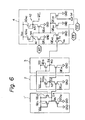
- FIG. 6 is a circuit diagram of another embodiment of the present invention.
- a voltage level setting circuit 1' includes a third depletion-type MIS transistor QD 13 .
- Other elements in Fig. 6 are identical to those in Fig. 3 and bear the same references.
- the transistor QD 13 is connected to the transistor QD 11 in parallel. That is, a drain and source of the transistor QD 13 are connected to those of the transistor QD 11 .
- a gate of the transistor QD 13 is connected to the node N3 in the inverter circuit 3. In other words, the output signal S z is applied to the gate of the transistor QD 13 as a feedback signal.
- the high level output signal S z is applied to the gate of the transistor QD13 , and thus the transistor QD 13 may be rendered operative.
- the voltage V NN (2) shown by a solid line in Fig. 5, at the node NN may be abruptly pulled up to the voltage V CC . Consequently, the buffer circuit or the signal generation circuit consisting of the inverter circuits 2 and 3 latches the detection signal S to output the stable output signal S Z .
- the output signal S z would be high or low, depending on the fluctuation of the voltage V CC in the vicinity of the threshold level VTH .
- the oscillation may be eliminated to ensure that the output of the output signal S Z is stable.
- the resistances of the transistors QD 11 and QD 13 are reduced in proportion to the increase of the voltage V CC of the power supply.
- the voltage V NN (2) may be increased to become approximately proportional to the increase of the voltage V CC , and then may remain at a constant level when the voltage V CC reaches the rated value at the time t 2 in Fig. 5.
- the above explanation of operation concerns detection of the rising voltage V CC at power supply start-up.
- the voltage level detection circuit naturally detects the falling voltage V CC when, for example, the power supply fails or stops, or a change of the voltage V CC occurs because of noise.
- the detection level of the voltage at the node NN can be determined with reference to the desired detection voltage level meeting the operation condition of the application circuit, and the threshold voltage V TH of the inverter circuit 2, and defines the size of the transistors QD11 to QD 13 . More specifically, when the desired detection voltage V CC is 3.0 V and the threshold voltage V TH of the inverter circuit is 1.5 V, the detection voltage at the node NN is designed to be 1.5 V.
- the dimensions of each of the transistors QD 11 and QD12 for example, the channel width and length of the transistor, are designed to meet the above requirement.
- the transistors QD 11 to QD 13 in the voltage level setting circuit 1 and 1' are depletion-type MIS transistors. Accordingly, even though the circuit parameters may be varied due to changes in the manufacturing process, the circuit parameters in each transistor may be uniformly varied to obtain relatively uniform circuit parameters between the transistors QD 11 , QD 12 , and QD13 , so that a high accuracy of voltage detection can be maintained.
- Any_desired number of steps of inverter circuits following the voltage level setting circuit 1 can be used to enable the output of a low-level and/or high- level detection signal.
- inverter circuits 2 and 3 shown in Figs. 3 and 6 can be replaced by complementary MIS (C-MIS) inverter circuits.
- C-MIS complementary MIS
Landscapes
- Physics & Mathematics (AREA)
- General Physics & Mathematics (AREA)
- Measurement Of Current Or Voltage (AREA)
- Manipulation Of Pulses (AREA)
- Electronic Switches (AREA)
- Dram (AREA)
Applications Claiming Priority (2)
| Application Number | Priority Date | Filing Date | Title |
|---|---|---|---|
| JP35112/84 | 1984-02-28 | ||
| JP59035112A JPS60180216A (ja) | 1984-02-28 | 1984-02-28 | 電圧検知回路 |
Publications (3)
| Publication Number | Publication Date |
|---|---|
| EP0155113A2 true EP0155113A2 (de) | 1985-09-18 |
| EP0155113A3 EP0155113A3 (en) | 1987-01-14 |
| EP0155113B1 EP0155113B1 (de) | 1990-11-14 |
Family
ID=12432848
Family Applications (1)
| Application Number | Title | Priority Date | Filing Date |
|---|---|---|---|
| EP85301312A Expired - Lifetime EP0155113B1 (de) | 1984-02-28 | 1985-02-27 | Spannungspegel-Detektorschaltung |
Country Status (5)
| Country | Link |
|---|---|
| US (1) | US4682051A (de) |
| EP (1) | EP0155113B1 (de) |
| JP (1) | JPS60180216A (de) |
| KR (1) | KR900004195B1 (de) |
| DE (1) | DE3580501D1 (de) |
Cited By (5)
| Publication number | Priority date | Publication date | Assignee | Title |
|---|---|---|---|---|
| EP0250242A3 (en) * | 1986-06-20 | 1989-10-11 | Fujitsu Limited | Semiconductor memory device having erroneous write operation preventing circuit |
| EP0277767B1 (de) * | 1987-02-04 | 1993-03-24 | AT&T Corp. | Stromspitzenbeschränkung in dynamischen CMOS-Schaltungen |
| EP0500958A4 (en) * | 1990-08-28 | 1993-04-07 | Fujitsu Vlsi Limited | Initializing circuit and semiconductor device using thereof |
| EP1962291A1 (de) * | 2007-02-23 | 2008-08-27 | Vestel Elektronik Sanayi ve Ticaret A.S. | Verhinderung unerwünschter I2C-Schreib-/Lese-Operationen |
| US7965709B2 (en) | 2005-10-19 | 2011-06-21 | Huawei Technologies Co., Ltd. | Bridge forwarding method and apparatus |
Families Citing this family (5)
| Publication number | Priority date | Publication date | Assignee | Title |
|---|---|---|---|---|
| JP3217498B2 (ja) * | 1992-10-29 | 2001-10-09 | 富士通株式会社 | 半導体集積回路装置 |
| JPH06334480A (ja) * | 1993-05-25 | 1994-12-02 | Nec Corp | 半導体集積回路 |
| FR2822956B1 (fr) * | 2001-04-02 | 2003-06-06 | St Microelectronics Sa | Dispositif de detection d'alimentation |
| FR2871309B1 (fr) * | 2004-06-02 | 2006-12-15 | St Microelectronics Sa | Circuit d'inhibition a faible consommation |
| US8154320B1 (en) * | 2009-03-24 | 2012-04-10 | Lockheed Martin Corporation | Voltage level shifter |
Family Cites Families (12)
| Publication number | Priority date | Publication date | Assignee | Title |
|---|---|---|---|---|
| US3950654A (en) * | 1974-11-14 | 1976-04-13 | American Microsystems, Inc. | Power-on initializing circuit for a calculator system |
| JPS5179540A (en) * | 1975-01-06 | 1976-07-10 | Hitachi Ltd | Dengentonyugono shokijotaisetsuteikairo |
| CH607455A5 (de) * | 1975-05-09 | 1978-12-29 | Siemens Ag | |
| JPS5373340A (en) * | 1976-12-11 | 1978-06-29 | Toshiba Corp | Abnormal voltage detection circuit |
| JPS6019011B2 (ja) * | 1977-12-23 | 1985-05-14 | 株式会社日立製作所 | オートクリア回路 |
| GB2081458B (en) * | 1978-03-08 | 1983-02-23 | Hitachi Ltd | Voltage comparitors |
| JPS55149871A (en) * | 1978-07-31 | 1980-11-21 | Fujitsu Ltd | Line voltage detector |
| US4301380A (en) * | 1979-05-01 | 1981-11-17 | Motorola, Inc. | Voltage detector |
| JPS56122225A (en) * | 1980-02-29 | 1981-09-25 | Fujitsu Ltd | Power on reset circuit |
| US4463270A (en) * | 1980-07-24 | 1984-07-31 | Fairchild Camera & Instrument Corp. | MOS Comparator circuit |
| JPS57168525A (en) * | 1981-04-09 | 1982-10-16 | Matsushita Electric Ind Co Ltd | Detecting circuit of power supply voltage |
| US4460985A (en) * | 1982-02-19 | 1984-07-17 | International Business Machines Corporation | Sense amplifier for MOS static memory array |
-
1984
- 1984-02-28 JP JP59035112A patent/JPS60180216A/ja active Pending
-
1985
- 1985-02-26 KR KR1019850001190A patent/KR900004195B1/ko not_active Expired
- 1985-02-27 US US06/706,284 patent/US4682051A/en not_active Expired - Fee Related
- 1985-02-27 DE DE8585301312T patent/DE3580501D1/de not_active Expired - Lifetime
- 1985-02-27 EP EP85301312A patent/EP0155113B1/de not_active Expired - Lifetime
Cited By (6)
| Publication number | Priority date | Publication date | Assignee | Title |
|---|---|---|---|---|
| EP0250242A3 (en) * | 1986-06-20 | 1989-10-11 | Fujitsu Limited | Semiconductor memory device having erroneous write operation preventing circuit |
| EP0277767B1 (de) * | 1987-02-04 | 1993-03-24 | AT&T Corp. | Stromspitzenbeschränkung in dynamischen CMOS-Schaltungen |
| EP0500958A4 (en) * | 1990-08-28 | 1993-04-07 | Fujitsu Vlsi Limited | Initializing circuit and semiconductor device using thereof |
| US5307319A (en) * | 1990-08-28 | 1994-04-26 | Fujitsu Limited | Initialization setting circuit and semiconductor memory device using the same |
| US7965709B2 (en) | 2005-10-19 | 2011-06-21 | Huawei Technologies Co., Ltd. | Bridge forwarding method and apparatus |
| EP1962291A1 (de) * | 2007-02-23 | 2008-08-27 | Vestel Elektronik Sanayi ve Ticaret A.S. | Verhinderung unerwünschter I2C-Schreib-/Lese-Operationen |
Also Published As
| Publication number | Publication date |
|---|---|
| EP0155113A3 (en) | 1987-01-14 |
| KR900004195B1 (ko) | 1990-06-18 |
| US4682051A (en) | 1987-07-21 |
| JPS60180216A (ja) | 1985-09-14 |
| EP0155113B1 (de) | 1990-11-14 |
| KR850006902A (ko) | 1985-10-21 |
| DE3580501D1 (de) | 1990-12-20 |
Similar Documents
| Publication | Publication Date | Title |
|---|---|---|
| US5589783A (en) | Variable input threshold adjustment | |
| JP2995204B2 (ja) | Mos技術の高圧レベル検出回路 | |
| KR930009148B1 (ko) | 전원전압 조정회로 | |
| EP0437039A2 (de) | TTL-Regel CMOS-Hysteresis-Einganspuffer mit niedriger Leistungsaufnahme | |
| US4868483A (en) | Power voltage regulator circuit | |
| US4527077A (en) | Output circuit of a semiconductor device | |
| US6127841A (en) | CMOS buffer having stable threshold voltage | |
| KR930008661B1 (ko) | 반도체메모리장치의 데이타입력버퍼 | |
| US6346834B1 (en) | Power on reset circuit | |
| US4682051A (en) | Voltage level detection circuit | |
| US10839921B2 (en) | Circuits for bleeding supply voltage from a device in a power down state | |
| KR100266901B1 (ko) | 내부 전원 전압 발생 회로 및 그것을 이용한 반도체 메모리 장치 | |
| US6240034B1 (en) | Programmable latches that include non-volatile programmable elements | |
| US20030214337A1 (en) | Latch circuit | |
| KR0140124B1 (ko) | 반도체 메모리 장치의 전원 전압 검출회로 | |
| KR0126254B1 (ko) | 반도체 메모리 장치의 데이터 입력 버퍼 | |
| US6522591B2 (en) | Semiconductor memory circuit | |
| US6885232B2 (en) | Semiconductor integrated circuit having a function determination circuit | |
| US9437258B2 (en) | Data readout circuit of a storage device for read-out operation for preventing erroneous writing into a data storage element and reading out of the data correctly | |
| EP0433696B1 (de) | Schaltung mit Hysterese für Spannungsquelle | |
| EP0350943B1 (de) | Integrierte Halbleiterschaltung mit Ausgangspuffer | |
| KR100554840B1 (ko) | 파워 업 신호 발생 회로 | |
| KR100224766B1 (ko) | 병렬 액티브 드라이버 | |
| KR950009852B1 (ko) | 반도체 메모리 장치의 데이타 입력 버퍼 | |
| JP2707825B2 (ja) | 半導体集積回路装置 |
Legal Events
| Date | Code | Title | Description |
|---|---|---|---|
| PUAI | Public reference made under article 153(3) epc to a published international application that has entered the european phase |
Free format text: ORIGINAL CODE: 0009012 |
|
| AK | Designated contracting states |
Designated state(s): DE FR GB |
|
| PUAL | Search report despatched |
Free format text: ORIGINAL CODE: 0009013 |
|
| AK | Designated contracting states |
Kind code of ref document: A3 Designated state(s): DE FR GB |
|
| 17P | Request for examination filed |
Effective date: 19870218 |
|
| 17Q | First examination report despatched |
Effective date: 19890321 |
|
| GRAA | (expected) grant |
Free format text: ORIGINAL CODE: 0009210 |
|
| AK | Designated contracting states |
Kind code of ref document: B1 Designated state(s): DE FR GB |
|
| ET | Fr: translation filed | ||
| REF | Corresponds to: |
Ref document number: 3580501 Country of ref document: DE Date of ref document: 19901220 |
|
| PLBE | No opposition filed within time limit |
Free format text: ORIGINAL CODE: 0009261 |
|
| STAA | Information on the status of an ep patent application or granted ep patent |
Free format text: STATUS: NO OPPOSITION FILED WITHIN TIME LIMIT |
|
| 26N | No opposition filed | ||
| PGFP | Annual fee paid to national office [announced via postgrant information from national office to epo] |
Ref country code: GB Payment date: 19921208 Year of fee payment: 9 |
|
| PGFP | Annual fee paid to national office [announced via postgrant information from national office to epo] |
Ref country code: FR Payment date: 19921229 Year of fee payment: 9 |
|
| PGFP | Annual fee paid to national office [announced via postgrant information from national office to epo] |
Ref country code: DE Payment date: 19930427 Year of fee payment: 9 |
|
| PG25 | Lapsed in a contracting state [announced via postgrant information from national office to epo] |
Ref country code: GB Effective date: 19940227 |
|
| GBPC | Gb: european patent ceased through non-payment of renewal fee |
Effective date: 19940227 |
|
| PG25 | Lapsed in a contracting state [announced via postgrant information from national office to epo] |
Ref country code: FR Effective date: 19941031 |
|
| PG25 | Lapsed in a contracting state [announced via postgrant information from national office to epo] |
Ref country code: DE Effective date: 19941101 |
|
| REG | Reference to a national code |
Ref country code: FR Ref legal event code: ST |